RBCCV 44205-1593 DOI 10.5935/1678-9741.20140078
Nebivolol in preventing atrial ibrillation following
coronary surgery in patients over 60 years of age
Nebivolol na prevenção da ibrilação atrial após a cirurgia coronária em pacientes acima de 60 anos
de idade
Nevzat Erdil
1, PhD; Murat Kaynak
1, MD; Köksal Dönmez
1, MD; Olcay Murat Disli
1, MD; Bektas
Battaloglu
1, MD
1Inonu University Turgut Ozal Medical Center, Malatya, Turkey.
Work carried out at Inonu University Turgut Ozal Medical Center, Malatya, Turkey.
No inancial support.
No conlict of interest.
Correspondence address: Nevzat Erdil
Inonu University Turgut Ozal Medical Center Division of Cardiac Surgery, Malatya, Turkey, 44280 E-mail: [email protected]
Article received on January 7th,2014 Article accepted on June 8th, 2014
Abstract
Objective: Postoperative atrial fibrillation is a common
complication after cardiac surgery, with an incidence as high as
20-50%. Increased age is associated with a signiicant increase in postoperative atrial ibrillation risk. This common complication is associated with higher morbidity and mortality rates. The aim of this study was to assess the eficacy of nebivolol in preventing atrial ibrillation following coronary artery bypass surgery in
patients over 60 years of age.
Methods: In this prospective randomized study, 200 patients
who were candidates for elective coronary artery bypass surgery
were divided into two groups. The irst group was administered
with nebivolol and the second group was administered with
metoprolol. Treatment was initiated four days prior to surgery, and patients were monitored for atrial ibrillation until discharge.
Forty-one patients recieved 50 mg metoprolol succinate daily, which was initiated minimum 4 days before surgery.
Results: Demographic data were similar in both groups.
The incidence of postoperative atrial ibrillation in both groups
was similar, with no significant difference being identified [n=20 (20%); n=18 (18%), P=0.718; respectively]. There were
not any mortality at both groups during study. Inotropic agent
requirement at ICU was similar for both groups [n=12 (12%), n=18 (18%), P=0.32].
Conclusion: We compared the effectiveness of nebivolol and
metoprolol in decreasing the incidence of postoperative atrial
ibrillation, and determined that nebivolol was as effective as metoprolol in preventing postoperative atrial ibrillation at
patients. Nebivolol may be the drug of choice due to its effects, especially after elective coronary artery bypass surgery.
Descriptors: Coronary Artery Bypass. Atrial Fibrillation.
Anti-Arrhythmia Agents. Drug Therapy.
Resumo
Objetivo: Pós-operatório ibrilação atrial é uma complicação
comum após a cirurgia cardíaca, com uma incidência tão elevada
quanto 20-50%. O aumento da idade está associado com elevação
signiicativa no risco de pós-operatório da ibrilação atrial. Esta complicação comum é associada com taxas de morbidade e mortalidade. O objetivo deste estudo foi avaliar a eicácia do nebivolol na prevenção da ibrilação atrial após cirurgia de revascularização
METHODS
Following the approval of the Medical Faculty’s Ethics Committee (Reference Number: 2009/145), and after written informed consents were obtained from the patients; 200 pa
-tients over 60 years of age with coronary artery disease, who had been admitted to our clinic for elective coronary artery bypass grafting surgery, were included into our study.
The study was performed according to a randomized,
prospective, parallel-group, active controlled, open-label,
single-blind study design. The patients were randomized into two groups, and the study procedures were carried out for a period of 4 days. All included patients were from an inpatient setting. Study subjects were randomly allocated into the NEB and MET treatment groups at the beginning of the study by
using a random number generated by SAS.
The patients were not stratiied according to race and sex during the randomization process, which led to an unequal distribution of males and females between the two groups. At the beginning of the study 100 subjects were recruited in each group. Due to the withdrawal of consent, lost to follow-up and missing values of some outcome variables, the inal sample size was 100 in the NEB group and 100 in the MET group.
Group 1 was the nebivolol group, consisting of 100 patients (27 women and 73 men, mean age 67.2±7.6), while Group 2 was the metoprolol group, also consisting of 100 patients (34 women and 67 men, mean age 68.4±5.8). Patients who had pre -vious beta-blocker or antiarrhythmic treatment, pre-vious atrial
ibrillation (AF), heart failure (ejection fraction ≤ 35%), sick
sinus syndrome, atrioventricular block, permanent pacemaker, valvular surgery, peripheral vascular disease, hyperthyroidism,
and emergency surgery were excluded from the study. In both groups, drugs use was started 4 days prior to surgery[9].
Abbreviations, acronyms & symbols
AF Atrial ibrillation
CPB Cardiopulmonary bypass
DVT Deep vein thrombosis
ECG Electrocardiogram
EuroSCORE (European) System For Cardiac Operative Risk Evaluation Score
ICU Intensive care unit
LMCA Left main coronary artery MI Myocardial infarction POAF Postoperative atrial ibrillation
INTRODUCTION
Postoperative atrial ibrillation (POAF) is a commonly observed complication following cardiac surgery, with an inci
-dence as high as 20-50% depending on the accepted deinition of POAF and the methods used for detection[1,2]. Increasing age in patients undergoing cardiac surgery is associated with a signiicant increase in POAF risk[2,3]. This common
complica-tion contributes to higher morbidity and mortality rates among
patients. Major outcomes associated with POAF include an increased incidence of stroke, longer hospitalization, increased
hospital costs, and higher early and late mortality rates[1,4,5].
Prophylactic treatment is recommended due to the high
incidence of POAF, especially if risk factors are present. Effective preventive and treatment strategies are important for reducing the undesirable effects of this complication.
It has been previously demonstrated in several studies that
beta-blockers are effective agents for preventing POAF. Be
-ta-blockers have also been recommended for POAF prophylax -is in several meta-analyses[6,7]. Nebivolol is a selective beta-1 adrenergic receptor antagonist that differs from conventional beta-blockers in its ability to induce nitric oxide synthesis in the
human endothelium. Tepliakov et al.[8] showed that nebivolol administration (1.25-5.0 mg/day) increased exercise tolerance, improved life quality, reduced IR index by 11.9%, and reduced triglyceride levels by 5.3% (which in turn lowered the risk of effects associated with diabetic atherogenic dyslipidemia).
In this prospective randomized study, we investigated the effectiveness of nebivolol and metoprolol in decreasing the incidence of POAF. Patients in this study were selected among individuals above 60 years of age, as age is a major risk factor for POAF. There are no other studies in the literature regarding the effects of nebivolol in preventing POAF.
Métodos: Neste estudo prospectivo e randomizado, duzentos
pacientes candidatos à cirurgia de revascularização do miocárdio
foram divididos em dois grupos. O primeiro grupo foi administrado com nebivolol e o segundo grupo, com metoprolol. O tratamento foi iniciado quatro dias antes da cirurgia, e os pacientes foram
monitorados para ibrilação atrial até a alta. Quarenta e um
pacientes receberam 50 mg de sucinato de metoprolol diário, que foi iniciado, no mínimo, 4 dias antes da cirurgia.
Resultados: Os dados demográicos foram semelhantes nos
dois grupos. A incidência de ibrilação atrial pós-operatória em ambos os grupos foi semelhante, com nenhuma diferença
significativa sendo identificado [n=20 (20%); n=18 (18%),
P=0,718; respectivamente]. Não houve mortalidade em ambos
os grupos durante o estudo. A necessidade de agente inotrópico
em UTI foi semelhante nos dois grupos [n=12 pessoas (12%),
n=18 (18%), P=0,32].
Conclusão: Nós comparamos a eicácia do nebivolol e metoprolol
na diminuição da incidência de ibrilação atrial no pós-operatório, e veriicamos que nebivolol foi tão eicaz como metoprolol na prevenção de ibrilação atrial no pós-operatório em pacientes.
Nebivolol pode ser a droga de escolha devido aos seus efeitos,
especialmente depois da cirurgia revascularização do miocárdio.
Descritores: Ponte de Artéria Coronária. Fibrilação Atrial.
Metoprolol was administered once daily at a dose of 50 mg, while nebivolol was administered once daily at a dose of 5 mg. Drug use was continued after extubation during the postoperative period. Dosages were adjusted according to the hemodynamic responses of the patients after coronary surgery. None of the patients withdrew from study due to the side effects of the drugs.
Data was collected at the time of hospitalization, during the irst postoperative day, and at the time of discharge. The primary end point of the study was new-onset AF until dis
-charge. None of the patients in both groups presented serious bradycardia or hypotension. Atrial ibrillation was diagnosed when 12-lead ECG showed rapid oscillations or ibrillatory P
waves that varied in size, shape, and timing, and which were associated with irregular QRS complexes.
In this study, POAF was deined as AF of any duration during the postoperative period, with the AF diagnosis being based on the physician’s assessments. All Holter and ECG data were evaluated by two blinded cardiologists, and AF diagnosis was conirmed with the observation of (i) absent P wave prior to QRS complex, and (ii) irregular ventricular rhythm that continued for more than 5 minutes. In the event that POAF was identiied, no further evaluations were performed, and the patient was started on an administration of amiodarone at a 150 mg bolus dose, followed by administration at 15 mg/kg/24 h infusion. After sinus rythm was achieved, the patient’s treat
-ment was continued with oral amiodarone administration for a period of 30 days, with a 800 mg/day dose being administered during week 1, a 600 mg/day dose during week 2, a 400 mg/ day dose during week 3, and a 200 mg/day dose during week 4. ECG and 12-lead ECG were needed to conirm the 12-lead ECG indings. Patients who developed AF were treated with a standard protocol of anticoagulation and amiodarone. None of pa
-tients who developed AF required electrical cardioversion. All of the patients were discharged from the hospital with a sinus rhythm.
Statistical analysis
Data were analyzed using the Statistical Package for Social Sciences 16.0 (SPSS 16.0) for Windows (SPSS Inc., Chica
-go, IL). Data for patient characteristics and outcomes were expressed either as percentage of total or as mean±SD. The independent samples t-test was used for normally distributed continuous variables (expressed as mean±SD), while the Pear
-son chi-square, Yates’ corrected chi-square and Fisher’s exact tests were used for categorical variables, where applicable. The Mann Whitney U test was used for continuous variables such as age, BMI and EuroSCORE, which were not normally dis
-tributed. The results were assessed within 95% conidence, and a value of P<0.05 was considered as statistically signiicant.
Surgical Procedure
Patients were placed under general anesthesia, and con
-ventional median sternotomy was performed. Each patient underwent on-pump coronary artery bypass grafting surgery,
and cardiopulmonary bypass was established by cannulating the ascending aorta and right atrium. Heparin (3 mg/kg) was administered for anticoagulation. Activated clotting time was maintained for longer than 450 seconds, and a roller pump and non-pulsatile low (2.4 L/m2/min) were used.
The body was cooled to a core temperature between 32oC
and 34oC when performing distal anastomosis, and the body was rewarmed to 36oC before weaning from cardiopulmonary bypass. Cold blood cardioplegia was delivered intermittently
via antegrade and retrograde routes throughout the
proce-dure. A inal dose of “hot-shot” cardioplegia was delivered
intermittently via antegrade and retrograde routes throughout
the procedure. A inal dose of “hot-shot” cardioplegia was administered immediately before the aorta was unclamped. An
epicardial temporary pacemaker lead (FLEXON 3-0 temporary
cardiac pacing lead, Syneture, Covidien, US) was placed on the right ventricle. Details of the surgical techniques used for complete revascularization solely by means of arterial grafts
have been previously described[10].
The same protocol was applied for each case in which radial artery was used. Radial-artery harvesting was carried out simultaneously with left internal thoracic artery harvesting. Saphenous veins were harvested using conventional meth
-ods. The choice of graft material was left to the surgeon, but certain protocols were followed. Left internal thoracic artery was generally used as a graft for the left anterior descending artery; radial artery and saphenous vein graft conduits were used mainly to bypass vessels other than the left anterior de
-scending artery; and only radial artery conduits were used to bypass vessels other than the left anterior descending artery in case they exhibited more than 70% stenosis.
Outcome parameters
A prospective study was performed for the relevant pre-op
-erative, intraoperative and postoperative data of the study group. The speciic pre- and intraoperative data obtained from each patient included the following: age and gender, history of hypertension, diabetes, smoking, obesity, hyperlipidemia, body surface area and body mass index (BMI), history of myo
-cardial infarction (MI), the presence of unstable angina, prior
percutaneous transluminal coronary angioplasty, the presence
of carotid artery disease, left ventricular ejection fraction, the presence of left main coronary artery (LMCA) disease, additive EuroSCORE and the extent of coronary disease.
death in the irst 30 days after coronary artery bypass grafting surgery). We further employed data regarding study design,
baseline patient data, administered treatment and POAF
incidence by entering them to an Excel spreadsheet that was standardized. POAF incidence was considered as the study’s
primary outcome.
RESULTS
Two hundred patients (100 patients per group) were includ -ed into this study. The pre-operative demographic
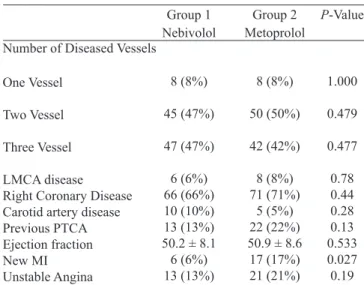
character-istics of the patients are summarized in Table 1 and Table 2. The mean age of the patients was 67.2±7.6 years in Group 1, and 68.4±5.8 years in Group 2.
There were no signiicant differences between the groups with respect to gender distribution; the prevalence of chronic obstructive pulmonary disease; the frequency of previous
percutaneous transluminal coronary angioplasty; the
preva-lence of hypertension, obesity (body mass index, ≥30 kg/m2),
hyperlipidemia, smoking, diabetes mellitus, unstable angina,
or LMCA disease; the ratio of patients with a history of MI; or the ratio of patients with carotid artery disease. There were also no statistical differences between the groups with respect to the mean number of diseased vessels, the mean left ventricular ejection fraction, or the EuroSCORE.
Intraoperative and postoperative data that were collected included the number of grafts per operation, the types of grafts used (for example, left internal thoracic artery, radial artery, and venous grafts), the cardiopulmonary bypass (CPB) time,
and the aortic cross-clamp time. Data collected regarding the postoperative outcomes included the mechanical ventilation
time; the requirement for inotropic or intra-aortic balloon pump support; the development of atrial ibrillation or infective com
-plications; the re-exploration for bleeding or cardiac tampon
-ade; and the occurrence of major pleural effusions, supericial or deep-wound infections, and deep vein thrombosis (DVT). With regards to inotrope usage, hypoxemia and low cardiac output, no statistically signiicant differences were observed between the two groups. Similarly, there was also no statisti
-cally signiicant difference between Group 1 and Group 2 in any of the types of data described above (Table 3).
Group I and Group II had similar durations of stay in the intensive care unit (2.6±0.7 vs. 2.5±0.9 days, respectively;
P=0.559), durations of overall hospital stay (7.1±1.4 vs. 7.4±2.2
days, respectively; P=0.388) and ventilation times (7.3±2.5 vs.
7.2±2.9 hours, respectively; P=0.794), with no signiicant dif
-ferences being identiied between the two groups. In addition, no perioperative deaths occurred in any of these two groups.
There was no signiicant difference in the incidence of POAF between Group I and Group II (20% vs. 18%, respec -tively; P=0.718). The incidence of inotropic agent requirement
at ICU were also similar in both groups (12% in Group I vs. 18% in Group II, P=0.32) (Table 4).
Table 1. Preoperative demographic data.
N Mean Age Gender (Female) Previous MI Diabetes Mellitus Hypertension Smoking COPD Hypercholesterolemia Obesity Renal Dysfunction BMI EuroSCORE BSA Group 1 Nebivolol 100
67.2 ± 7.6 27 (27%) 43 (43%) 31 (31%) 25 (25%) 52 (52%) 14 (14%) 58 (58%) 25 (25%) 0 (0%) 26.9±4.1 3.55±2.02 1.78±0.16 Group 2 Metoprolol 100
68.4 ± 5.8 34 (34%) 46 (46%) 28 (28%) 33 (33%) 45 (45%) 8 (8%) 66 (66%) 24 (24%) 2 (2%) 26.6±4.4 4.1±2.28 1.75±0.16 P-Value 0.21 0.36 0.67 0.64 0.21 0.39 0.25 0.24 0.9 0.49 0.574 0.072 0.274
COPD=Chronic Obstructive Pulmonary Disease; BMI=Body Mass Index; BSA=Body Surface Area
Table 2. Preoperative demographic data (cardiac).
Number of Diseased Vessels
One Vessel
Two Vessel
Three Vessel
LMCA disease Right Coronary Disease Carotid artery disease Previous PTCA Ejection fraction New MI Unstable Angina Group 1 Nebivolol 8 (8%) 45 (47%) 47 (47%) 6 (6%) 66 (66%) 10 (10%) 13 (13%) 50.2 ± 8.1 6 (6%) 13 (13%) Group 2 Metoprolol 8 (8%) 50 (50%) 42 (42%) 8 (8%) 71 (71%) 5 (5%) 22 (22%) 50.9 ± 8.6 17 (17%) 21 (21%) P-Value 1.000 0.479 0.477 0.78 0.44 0.28 0.13 0.533 0.027 0.19
LMCA=Left Main coronary Artery Disease; PTCA=Percutaneous Transluminal Coronary Angioplasty; MI=Myocardial Infarction
Table 3. Operative data.
N
Preoperative Mortality Complete arterial revascularization LIMA usage Radial Artery usage Mean distal bypass number
Cross-clamp time (min) Perfusion time (min)
Group 1 Nebivolol 100 0 3 (3%) 96 (96%) 7 (7%) 2.40 ± 0.67 64.6 ± 16.5 74.7 ± 17.6
Group 2 Metoprolol 100 0 1 (1%) 95 (95%) 4 (4%) 2.38 ± 0.69 62.6 ± 15.7 74.2 ± 16.9
P-value 1 0.62 0.733 0.352 0.835 0.423 0.838
DISCUSSION
The aim of this study was to investigate the effectiveness of nebivolol in the prophylaxis of postoperative atrial ibrillation (POAF) by comparing it with metoprolol, a medication whose effectiveness against atrial ibrillation is well-documented. Based on the study results, we identiied no signiicant dif
-ference between nebivolol and metoprolol with regards to the effectiveness of POAF prophylaxis. POAF is observed in nearly 30% of patients who undergo isolated coronary artery bypass (CABG) surgery. This ratio increases to nearly 40% if replacement or repair of valves is performed during surgery, and to 50% in case combined procedures are performed. Considering that the age average of populations undergoing
cardiac surgery is gradually increasing, and that the incidence
of POAF is positively correlated with age, it is likely that these percentages will increase in the future.
In most cases, POAF develops between the 2nd and 4th days that immediately follow surgery, with the highest incidence
being observed on the 2nd day. The onset of POAF occurs before the 4th postoperative day in 70% of cases, and before
the 6th postoperative day in 94% of cases[11].
POAF often manifests itself as a transient condition that is tolerated by most patients. However, POAF also has the potential to cause serious complications or even be fatal in certain patients – especially older patients and patients with certain ventricular dysfunctions[12] and mortality[13]. POAF was previously described as a potential cause of signiicant
morbidity[14] that can lead to further postoperative complica
-tions such as thromboembolism[15], hemodynamic problems[16],
ventricular dysrhythmias[17], and even to iatrogenetic effects due to inappropriate diagnosis and treatment of POAF.
Moreover, POAF is known to increase nearly three times the incidence of perioperative stroke[13-17]. In a study conducted
by Almassi et al. on 3855 cardiac surgery patients[14], it was
observed that POAF led to a nearly two-fold increase in the hospital mortality and the 6-month mortality of patients. Increasing age is the most signiicant contributing factor to the risk of POAF[11,13,14]. Matthew et al.[18] determined in a re-cently conducted study that the incidence of POAF increased by nearly 75% for every decade of age, and that all patients above the age of 70 were at a high risk of POAF.
Other factors that also increase the risk of POAF include previous episodes of AF, lower left ventricular ejection frac
-tion, left atrial enlargement, valvular heart surgery, chronic obstructive pulmonary disease, chronic renal failure, diabetes
mellitus, and rheumatic heart diseases[13,17,18]. Recent students have also suggested that obesity may be associated with a higher incidence of POAF in both patients with and without
previous cardiac surgeries[19,20].
A variety of factors appear to be involved in the etiology of POAF, although the mechanistic relationship between these factors and POAF development has not yet been clearly identiied. Several mechanisms that are potentially involved in POAF pathogenesis include pericardial inlammation, ex -cessive catecholamine production, postoperative autonomic
imbalance, and interstitial luid mobilization. These factors may adversely affect atrial refractoriness and slow atrial conduction. The multiple re-entry wavelets caused by the dispersion of atrial refractoriness appear to be the underlying mechanism for the development of POAF[21].
In a meta-analysis performed recently by Crystal et al.[22], it was observed that, within the scope of 28 trials conducted with
4074 subjects, beta-blocker drugs demonstrated the highest
magnitude of effect with an odds ratio (OR) of 0.3, and a 95% conidence interval (CI) of 02.26 to 0.49. In the meta-analysis of Burgess et al.[23], the authors reported that the use of be -ta-blocker drugs lead to a reduction in the incidence of POAF. According to the American College of Cardiology/Ameri
-can Heart Association and the European Society of Cardiology Guidelines for AF; pre-operative or early postoperative ad
-ministration of beta-blockers for preventing AF after coronary artery bypass grafting surgery in patients without contraindi
-cations is a class-1 indication, with an evidence level of A[24].
Nebivolol is a third generation selective beta-1 adrenergic
receptor antagonist that differs from conventional beta-block
-ers in its ability to induce nitric oxide synthesis in the endo -thelium[25]. The endothelium produces nitric oxide, which is a well-known vasodilator. Nebivolol has a high beta-1 adrenergic receptor selectivity, and can be used safely in patients with reduced cardiac functions.
There are numerous studies discussing other properties
of Nebivolol; however, based on our review of the literature, we believe that our study was the irst to investigate the pro
-phylactic use of nebivolol for POAF after coronary artery
bypass surgery.
Metoprolol is an important drug that was approved by the FDA in 1978. We chose metoprolol for comparison with
Table 4. Postoperative data.
Requirement for Inotropes
IABP
Ventilation time (hours) ICU stay (days) Surgical site infection Re-exploration for bleeding
or tamponade
Pleural effusion
DVT
Atrial Fibrillation
Inotrope requirement in
ICU
Hospital Stay (days)
Group 1 Nebivolol
11 (11%) 0 (0%) 7.3 ± 2.5 2.6 ± 0.7 1 (1%) 3 (3%)
3 (3%) 1 (1%) 20 (20%) 12 (12%)
7.1 ± 1.4
Group 2 Metoprolol
22 (22%) 1 (1%) 7.2 ± 2.9 2.5 ± 0.9 1 (1%) 1 (1%)
0 (0%) 1 (1%) 18 (18%) 18 (18%)
7.4 ± 2.2
P-value
0.057 1.000 0.794 0.559 1.000 0.62
0.24 1.000 0.718 0.32
0.388
Authors’ roles & responsibilities
NE Analysis and/or interpretation of data, statistical analysis, inal approval of manuscript
MK Final approval of manuscript, conception and study design, conduct of operations, and/or experiments
KD Study design, conduct of operations, and/or experiments OMD Analysis and/or interpretation of data, statistical analysis,
inal approval of the manuscript, conception and study design, conduct of operations, and/or experiments
BB Conception and design of the study
REFERENCES
1. Creswell LL, Schuessler RB, Rosenbloom M, Cox JL. Hazards of postoperative atrial arrhythmias. Ann Thorac Surg. 1993;56(3):539-49.
2. Andrews TC, Reimold SC, Berlin JA, Antman EM. Prevention of supraventricular arrhythmias after coronary artery bypass surgery. A meta-analysis of randomized control trials. Circulation. 1991;84(5 Suppl):III236-44.
3. Nisanoglu V, Erdil N, Aldemir M, Ozgur B, Berat Cihan H, Yologlu S, et al. Atrial ibrillation after coronary artery bypass grafting in elderly patients: incidence and risk factor analysis. Thorac Cardiovasc Surg. 2007;55(1):32-8.
4. Aranki SF, Shaw DP, Adams DH, Rizzo RJ, Couper GS, VanderVliet M, et al. Predictors of atrial ibrillation after coronary artery surgery. Current trends and impact on hospital resources. Circulation. 1996;94(3):390-7.
5. Mathew JP, Parks R, Savino JS, Friedman AS, Koch C, Mangano DT, et al. Atrial ibrillation following coronary artery bypass graft surgery: predictors, outcomes, and resource utilization. Multicenter Study of Perioperative Ischemia Research Group. JAMA. 1996;276(4):300-6.
6. Zhu J, Wang C, Gao D, Zhang C, Zhang Y, Lu Y, et al. Meta-analysis of amiodarone versus β-blocker as a prophylactic therapy
against atrial ibrillation following cardiac surgery. Intern Med
J. 2012;42(10):1078-87.
7. Zimmer J, Pezzullo J, Choucair W, Southard J, Kokkinos P, Karasik P, et al. Meta-analysis of antiarrhythmic therapy in the prevention of postoperative atrial ibrillation and the effect on hospital length of stay, costs, cerebrovascular accidents, and mortality in patients undergoing cardiac surgery. Am J Cardiol. 2003;91(9):1137-40.
nebivolol due to its safety and common use. Metoprolol has been used for the prevention and treatment of postoperative AF for decades. Thus, in this study we aimed to investigate the effectiveness of nebivolol in the prophylaxis of POAF by comparing it with metoprolol
Radial arterial graft vasospasm is one of the most problematic complications following cardiac surgery. As mentioned before, nebivolol possesses a potent vasodilator effect on radial artery graft, and can increase the lumen diameter and protect the graft[26].
Furthermore, nebivolol is also known to improve sleep parameters, which contributes positively to the patients’ life quality[27]. Disturbance of normal sleep, in particular, may
cause tiredness and lead to depression. This is most important
for postoperative patients, who are emotionally vulnerable after surgery. Owing to its electrophysiological properties,
and in a manner similar to other beta-blockers; nebivolol has
the effect of increasing the ventricular ibrillation threshold. This effect allows nebivolol to reduce ventricular ar -rhythmia or drug-induced cardiomyopathy in various animal
models. Nebivolol is also known to reduce the QT dispersions, which are associated with the risk of developing arrhythmias, and P-wave dispersions, which are associated with the risk of developing atrial ibrillation[28]. We believe that the results we obtained for nebivolol in our study – which were not signii
-cantly different than those for metoprolol – were ultimately the result of the effects and mechanisms described above.
Previous experiments on ischemia and reperfusion injury[29] have also demonstrated the preventive and protective effects of nebivolol. In addition, it was shown that the administration of nebivolol in humans increased tolerance during exercise (in comparison to atenolol), as well as the time required for the onset of angina[30]. Nebivolol was also demonstrated to have a consistent effect in increasing coronary low among individ
-uals with ischemic and nonischemic heart diseases, which is believed to engender a decrease in the ischemic threshold of
these individuals[31].
We believe that these effects that counter the damages associated with ischemia and ischemia-reperfusion will also allow nebivolol to be effective in the prevention and treatment of POAF. For ethical reasons, and also due to the relatively low number of patients in our study groups, we did not to include into the study design a control group without beta-blocker
treatment. Unlike metoprolol, nebivolol does not have an IV
form, which also represents a disadvantage.
CONCLUSION
Metoprolol is a well-known and commonly preferred drug for the prevention of POAF. In this study, Nebivolol was deter
-mined to be as effective as metoprolol. Thus, it is possible to use nebivolol effectively for prophylaxis of POAF. Moreover, nebivolol’s characteristic properties may also result in addi
-tional beneits for elderly patients. Due to the limitations of
8. Tepliakov AT, Kuznetsova AV, Lukinov AV, Levshin AV. Effects of a superselective beta1-adrenoblocker nebivolol on the course of coronary heart disease and insulin resistance in patients with diabetes mellitus type 2 after coronary artery bypass grafting. Ter Arkh. 2007;79(12):38-43.
9. Imren Y, Benson AA, Zor H, Tasoglu I, Ereren E, Sinci V, et al. Preoperative beta-blocker use reduces atrial ibrillation in off-pump coronary bypass surgery. ANZ J Surg. 2007;77(6):429-32.
10. Nisanoglu V, Battaloglu B, Erdil N, Ozgur B, Aldemir M, Cihan
HB. Complete myocardial revascularization using arterial grafts
only in patients with unstable angina: impact on early outcome. Thorac Cardiovasc Surg. 2007;55(1):7-12.
11. Hernández-Romero D, Vílchez JA, Lahoz A, Romero-Aniorte AI, Orenes-Piñero E, Caballero L, et al. High-sensitivity troponin T as a biomarker for the development of atrial ibrillation after cardiac surgery. Eur J Cardiothorac Surg. 2014;45(4):733-8.
12. Wyse DG, Waldo AL, DiMarco JP, Domanski MJ, Rosenberg Y, Schron EB, et al; Atrial Fibrillation Follow-up Investigation of Rhythm Management (AFFIRM) Investigators. A comparison of rate control and rhythm control in patients with atrial ibrillation. N Engl J Med. 2002;347(23):1825-33.
13. Mathew JP, Parks R, Savino JS, Friedman AS, Koch C, Mangano DT, et al; Atrial ibrillation following coronary artery bypass graft surgery: predictors, outcomes, and resource utilization. MultiCenter Study of Perioperative Ischemia Research Group.
JAMA. 1996;276(4):300-6.
14. Almassi GH, Schowalter T, Nicolosi AC, Aggarwal A, Moritz TE, Henderson WG, et al. Atrial ibrillation after cardiac surgery: a major morbid event? Ann Surg. 1997;226(4):501-11.
15. Fuller JA, Adams GG, Buxton B. Atrial ibrillation after coronary artery bypass grafting. Is it a disorder of the elderly? J Thorac Cardiovasc Surg. 1989;97(6):821-5.
16. Lauer MS, Eagle KA, Buckley MJ, DeSanctis RW. Atrial
fibrillation following coronary artery bypass surgery. Prog
Cardiovasc Dis. 1989;31(5):367-78.
17. Creswell LL, Schuessler RB, Rosenbloom M, Cox JL.
Hazards of postoperative atrial arrhythmias. Ann Thorac Surg.
1993;56(3):539-49.
18. Mathew JP, Fontes ML, Tudor IC, Ramsay J, Duke P, Mazer CD, et al; Investigators of the Ischemia Research and Education Foundation; Multicenter Study of Perioperative Ischemia Research Group. A multicenter risk index for atrial ibrillation
after cardiac surgery. JAMA. 2004;291(14):1720-9.
19. Zacharias A, Schwann TA, Riordan CJ, Durham SJ, Shah AS, Habib RH. Obesity and risk of new-onset atrial ibrillation after cardiac surgery. Circulation. 2005;112(21):3247-55.
20. Echahidi N, Mohty D, Pibarot P, Després JP, O’Hara G,
Champagne J, et al. Obesity and metabolic syndrome are independent risk factors for atrial ibrillation after coronary artery
bypass graft surgery. Circulation. 2007;116(11 Suppl):I213-9.
21. Cox JL. A perspective of postoperative atrial ibrillation in cardiac operations. Ann Thorac Surg. 1993;56(3):405-9.
22. Crystal E, Garinkle MS, Connolly SS, Ginger TT, Sleik K, Yusuf SS. Interventions for preventing post-operative atrial ibrillation in patients undergoing heart surgery. Cochrane Database Syst
Rev. 2004;(4):CD003611.
23. Burgess DC, Kilborn MJ, Keech AC. Interventions for prevention of post-operative atrial ibrillation and its complications after cardiac surgery: a meta-analysis. Eur Heart J. 2006;27(23):2846-57.
24. Fuster V, Rydén LE, Cannom DS, Crijns HJ, Curtis AB, Ellenbogen KA, et al; American College of Cardiology/American Heart Association Task Force on Practice Guidelines; European Society of Cardiology Committee for Practice Guidelines; European Heart Rhythm Association; Heart Rhythm Society. ACC/AHA/ESC 2006 Guidelines for the Management of Patients with Atrial Fibrillation: a report of the American College of Cardiology/American Heart Association Task Force on Practice Guidelines and the European Society of Cardiology Committee for Practice Guidelines (Writing Committee to Revise the 2001 Guidelines for the Management of Patients With Atrial Fibrillation): developed in collaboration with the European Heart Rhythm Association and the Heart Rhythm Society. Circulation. 2006;114(7):e257-354.
25. McNeely W, Goa KL. Nebivolol in the management of essential hypertension: a review. Drugs. 1999;57(4):633-51.
26. Erdil N, Nisanoğlu V, Eroğlu T, Tüten R, Cihan HB, Kutlu R, et
al. Choice of medication for radial artery vasodilation in patients
awaiting coronary artery bypass grafting. Turk Gogus Kalp Dama.
2011;19(1):7-11.
27. Toblli JE, DiGennaro F, Giani JF, Dominici FP. Nebivolol: impact
on cardiac and endothelial function and clinical utility. Vasc
Health Risk Manag. 2012:8:151-60.
28. Tuncer M, Fettser DV, Gunes Y, Batyraliev TA, Guntekin U, Gumrukchuoglu KhA, et al. Comparison of effects of nebivolol and atenolol on P-wave dispersion in patients with hypertension. Kardiologiia. 2008;48(4):42-5.
29. Vandeplassche G, Lu HR, Wouters L, Flameng W, Borgers M. Normothermic ischemic cardiac arrest in the isolated working
rabbit heart: effects of dl-nebivolol and atenolol. Basic Res
Cardiol. 1991;86(1):21-31.
30. Van Bortel LM, van Baak MA. Exercise tolerance with nebivolol and atenolol. Cardiovasc Drugs Ther. 1992;6(3):239-47.