Study conducted at Speech-Language Pathology Course, School of Medicine, Universidade de São Paulo – USP – São Paulo (SP), Brazil. (1) Speech-Language Pathology Course, School of Medicine, Universidade de São Paulo – USP – São Paulo (SP), Brazil.
Conflict of interests: No
Author’s contribution: HFW main researcher, development of the research, development schedule, approval of the final version, KP, TZS and LOPN responsible for survey of literature, collection and analysis of data, writing article; LOPN responsible for article submission and procedures, writing correction of the article. Correspondence address: Haydée Fiszbein Wertzner. R. Cipotânea, 51, Cidade Universitária, São Paulo (SP), Brazil, CEP: 05360-000.
E-mail: [email protected]
Received: 5/3/2013; Accepted: 8/12/2013
The use of severity measures and speech inconsistency in
children with speech sound disorders
Aplicação de medidas de gravidade e de inconsistência de fala em
crianças com transtorno fonológico
Haydée Fiszbein Wertzner1, Karina Pereira1, Thaís Zemlickas Silva1, Luciana de Oliveira Pagan-Neves1
ABSTRACT
Purpose: To describe the severity indexes PCC-R, IRS, IRO, IRD, PDI and SII in children with speech sound disorder with and without the phonological process of devoicing and verify its efficiency in identi-fying differences among children. Methods: This is retrospective and cross-sectional study involving 20 children with speech sound disorder between 5 and 8 years-old. Two subgroups were created according to the presence of the phonological process of stops and fricatives devoicing. Phonology test from the infantile language test (ABFW) was used to calculate productivity of phonological processes, the number of diffe-rent types of phonological processes and the indexes PDI, PCC-R, IRS, IRO and IRD. Speech inconsistency test was applied to calculate the speech inconsistency index. Data were statistically analyzed. Results: The study demonstrated that children with speech sound disorder and the presence of fricative and/or stops devoicing were more severe and presented higher values of the speech inconsistency index, PDI, IRS, IRO and IRD. The articulatory error most observed for both groups was the substitution while distortion occurred more in the group of children without the phonological process of devoicing. Conclusion: The severity indexes used were efficient to differentiate children with from children without the presence of the phonological processes of devoicing. There is evidence that children who have the phonological process of devoicing have difficulty with the phonological representation of the sound.
Keywords: Speech, Language and Hearing Sciences; Child; Evaluation; Articulation disorders; Severity of illness index; Language tests
RESUMO
Objetivo: Descrever os índices PCC-R, IRS, IRO e IRD, PDI e IIF em crianças com transtorno fonológico, com e sem os processos fonológicos de ensurdecimento, e verificar a eficiência desses índices na identificação de diferenças entre as crianças. Métodos: Trata-se de pesquisa retros-pectiva e transversal com 20 crianças com transtorno fonológico e idade entre 5 e 8 anos. Foram realizados dois agrupamentos, de acordo com a presença dos processos fonológicos de ensurdecimento de plosivas e de fricativas. Todos foram submetidos ao teste de fonologia ABFW, no qual foi verificada a produtividade dos processos fonológicos, o número de diferentes tipos de processos fonológicos e os índices PDI, PCC-R, IRS, IRO e IRD. A prova de inconsistência de fala foi aplicada para calcular o índice de inconsistência de fala. Os dados foram submetidos à análise estatística inferencial. Resultados: O estudo indicou que crianças com transtorno fonológico e presença de ensurdecimento de fricativas e/ou plosivas têm maior comprometimento de fala e apresentam valores mais altos do índice de inconsistência de fala, PDI, IRS, IRO e IRD. O erro ar-ticulatório mais ocorrente em ambos os grupos foi a substituição, sendo que a distorção ocorreu mais no grupo sem os processos fonológicos de ensurdecimento. Conclusão: Os índices aplicados foram eficientes para diferenciar crianças com e sem a presença dos processos fonológicos de ensurdecimento. Há evidências de que as crianças que apresentam os processos fonológicos de ensurdecimento têm dificuldade na repre-sentação fonológica.
INTRODUCTION
The fact that the Speech Sound Disorders (SSD) is one of the changes occurring over speech and language in children, it becomes the aim of several research studies. Despite the characteristics necessary for a child to be diagnosed as having PD are well known, the current studies seek to detail the cause, severity, error type (substitution, omission and distortion) and prevalent Phonological Processes (PP), as well as subtypes of the disorder, which attribute to high heterogeneity(1).
The SSD is identified starting from the difficulty to use the rules of the phonological system, which can be identified by the presence of phonological processes(2-4).
Among the most occurrent and determinants phonological processes to characterize the SSD in children are: Plosives Devoicing (PDe), Fricatives Devoicing (FD) of Palatal Fronting (PF), Simplification of consonant cluster (SCC) and Simplification of Liquids (SL)(5,6). Identify the phonological
process facilitates the understanding of phonological rules that the child with SSD uses appropriately and those that it streamlines.
One of the most widely indexes used by national(7-10) and
International(1) authors is what measures the Percentage of
Consonants Correct - Revised (PCC-R)(11), which considers
only substitutions and omissions as errors and evaluates distor-tions as correct. Process Density Index (PDI)(12,13) is an index
of severity of SSD which supports the occurrence of PP. The calculation counts the total number of PP and divides by the total number of words in the sample analyzed.
A rather described in children with SSD are the types of errors found in their speech. Using indexes to quantify the types of errors found in the assessment assists in comparisons among children and are also useful for monitoring therapy(9). In the
literature, are described some indexes, including relative inde-xes(14), which are calculated dividing the number of omission
(IRO), distortion (IRD), or substitution (IRS), by the number of total errors in the speech sample and allow verifying the type of error most occurring among all types produced.
Nowadays, we know the necessity of complement the diag-nosis of SSD with evidence that verify the subtype of errors according to the speech processing most impairment, that is: cognitive-linguistic, motor and auditory perception. One of the tests used to verify the presence of difficulties in phonological programming(15,16) considered as the process responsible for
selecting and organizing the production of the phoneme is the inconsistency speech test that shows the Speech Inconsistency Index (SII)(15). Authors(17,18) state that the variability in speech
production is part of typical development but may be present in children with SSD.
Therefore, from the importance of detailing the diagnosis of SSD and the high occurrence of phonological processes of plosives and fricatives devoicing in children with PD, the aim of this study was to describe the indexes PCC-R, RSI, ROI and
RDI, PDI and SII in children with phonological disorders, with and without the phonological process of devoicing and verify the effectiveness of these indexes in identifying differences among children.
METHODS
This study was approved by the Ethics Committee in Research of the Medical School from the, University of São Paulo (USP), CAPPesq (protocol number 192-11). All guar-dians signed the consent form. It is retrospective and transversal survey, which analyzed the evidence collected from subjects that are part of the database of the routine of a speech therapy service in the city of São Paulo.
From the evaluation protocols analyzed, were selected to participate in the study, 20 children with SSD, aged between 5 and 8 years old, of both genders. To be included in the survey the children were diagnosed with SSD performed by a speech therapy service in the city of São Paulo. The selected subjects were divided into two groups: the first group (G1) consisted of ten children without the presence of phonological processes of PDe, FD, and the second (G2) for ten children with the presence of these phonological processes.
Inclusion criteria in G1 were: aged between 5 and 8 years; presence of phonological errors in the assessment of phono-logical test(19) of Child Language Test - ABFW(20); present the
phonological processes of FD and PDe occurring less than 25% in both phonology tasks (picture naming and imitation tasks); have adequate performance for age in other fields of language and not complain of hearing difficulties.
Inclusion criteria for G2 were aged between 5 and 8 years; present phonological test phonology (19) of Child Language Test - ABFW (20); present the phonological processes of FD and PDe occurring more than 25 % of at least one of two tests test phonology tasks (picture naming and imitation tasks); have adequate performance for age in other fields of language and not complain of hearing difficulties.
The application tests was recorded and videotaped using a camera-JVC Everio® and ZOOM H2 digital recorder. For audio recording, the microphone used was Sennheiser® (model-e817) coupled to a recorder.
After the selection of subjects, the tests of picture naming and imitation test(19) were analyzed and, based on speech
two transcriptions should be higher than 90%.
The SII was calculated from the speech inconsistency test(15),
which included naming 25 figures, presented in three different sequences. The subjects were considered consistent when the three word emissions were made the same manner, regardless of the error or accuracy of the target word, or inconsistent when production of the target word was done differently in at least one of three presentations. The value of the SII was calculated(15-20) and the subjects were classified as consistent
(C) or inconsistent (I) according to the following cut-off values established in previous research: between 5 and 7 years and 6 months for girls, 21.5% and for boys 31.9%, and above 7 years and 7 months for girls, 14.5% and for boys 17.6%.
To check the data distribution for normality, it was applied the Kolgomorov-Smirnov test that showed other than the normal distribution and, therefore, were then applied to the inferential analyzes non-parametric tests.
In comparisons of age of subjects and indexes between groups in two tasks of phonological test, it was used the Mann-Whitney test. The Fisher exact test verified the presence of as-sociation between the classification of the speech inconsistency test in the groups. The significance level was 0.05.
RESULTS
No difference was observed regarding the age when com-paring the subjects of G1 and G2 (p=0.544).
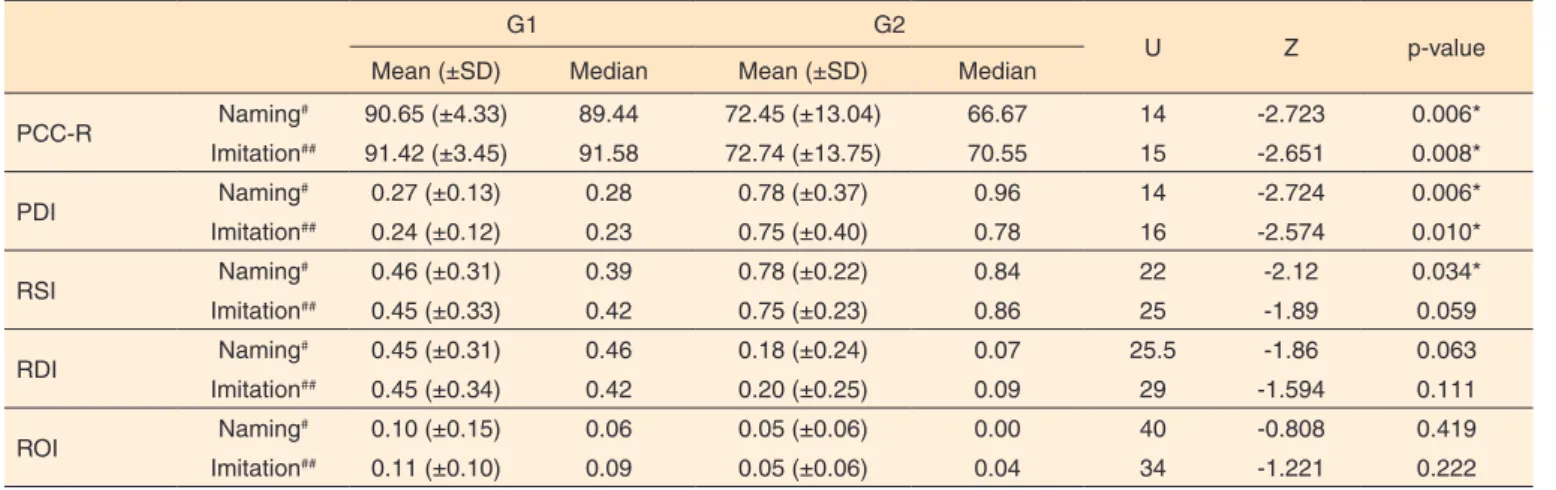
The comparison of indexes between groups indicated di-fferences in both tests of picture naming and imitation tasks for the PCC-R and PDI. There was evidence of a difference in picture naming task and a trend towards significance in the imitation words, on the analysis of RSI. We observed this trend also for the RDI, only in naming task. The descriptive data also showed that the means of RDI and ROI were higher in G1, in both tests, of phonological tasks (Table 1).
The intragroup comparison of three indexes indicated relative difference in the two tests of phonological tasks. The ranking showed RSI as the most frequent index and the ROI as less occurrent (Table 2).
No differences were observed in either group, when the indexes studied were compared between tests of picture naming and imitation words.
SII values were compared and indicate no difference (p=0.096) between the groups G1 and G2, G2 despite having presented SII mean higher (25.89) than the G1 (15.27).
The classification of subjects of G1 and G2 as consistent or inconsistent held from SII showed tendency to difference between groups (p=0.07), whereas in G1 most of the children were considered consistent (90% ), in G2 was observed a similar number of children classified as consistent (50%) and inconsistent (50%).
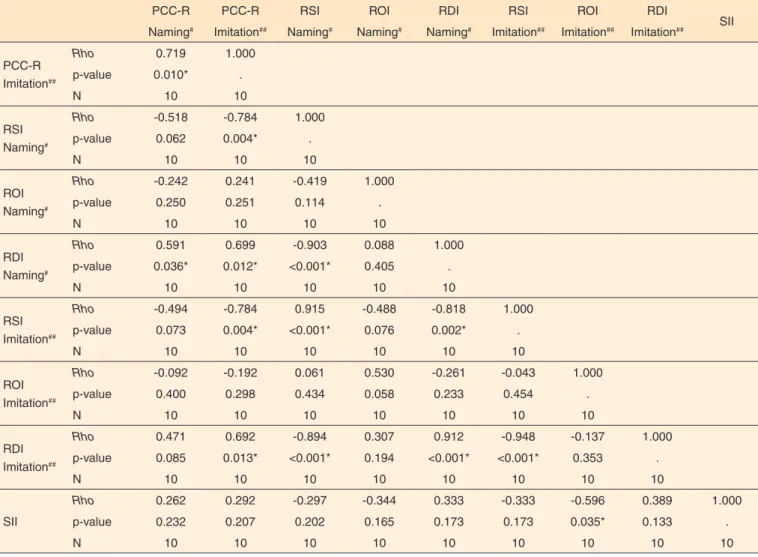
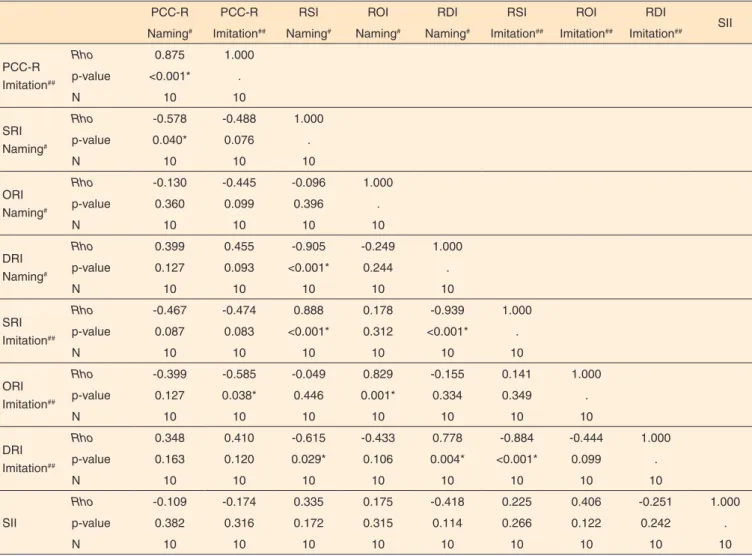
Analysis of the correlation between indexes of two tests of phonological tasks can be observed for G1 and G2 in Tables 3 and 4, respectively.
Table 1. Comparison between G1 and G2 in relation to the indexes of the phonological tasks
G1 G2
U Z p-value
Mean (±SD) Median Mean (±SD) Median
PCC-R Naming
# 90.65 (±4.33) 89.44 72.45 (±13.04) 66.67 14 -2.723 0.006*
Imitation## 91.42 (±3.45) 91.58 72.74 (±13.75) 70.55 15 -2.651 0.008*
PDI Naming
# 0.27 (±0.13) 0.28 0.78 (±0.37) 0.96 14 -2.724 0.006*
Imitation## 0.24 (±0.12) 0.23 0.75 (±0.40) 0.78 16 -2.574 0.010*
RSI Naming
# 0.46 (±0.31) 0.39 0.78 (±0.22) 0.84 22 -2.12 0.034*
Imitation## 0.45 (±0.33) 0.42 0.75 (±0.23) 0.86 25 -1.89 0.059
RDI Naming
# 0.45 (±0.31) 0.46 0.18 (±0.24) 0.07 25.5 -1.86 0.063
Imitation## 0.45 (±0.34) 0.42 0.20 (±0.25) 0.09 29 -1.594 0.111
ROI Naming
# 0.10 (±0.15) 0.06 0.05 (±0.06) 0.00 40 -0.808 0.419
Imitation## 0.11 (±0.10) 0.09 0.05 (±0.06) 0.04 34 -1.221 0.222
*Significant values (p<0.05) – Mann-Whitney Test
Note:#Naming = picture naming task; ##Imitation = imitation words; PCC-R = percentage of consonants correct revised; PDI = phonological density index; RSI = relative
substitution index; ROI = relative omission index; RDI = relative distortion index; SII = speech inconsistency index
Table 2. Ranking of relative indexes in imitation and picture naming tasks for G1 and G2
G1 G2
X2 DF p-value Ranking X2 DF p-value Ranking
Naming# 10.158 2 0.006* RSI >RDI>ROI Naming# 10.947 2 0.004* RSI >RDI>ROI
Imitation## 7.947 2 0.019* RSI >RDI>ROI Imitation## 9.800 2 0.007* RSI >RDI>ROI
*Significant values (p<0.05) – Friedman ANOVA
Note:#Naming = picture naming task; ##Imitation = imitation of words; DF = degrees of freedom; RSI = relative substitution index; ROI = relative omission index; RDI =
In G1 (Table 3) was observed positive correlations for inde-xes PCC-R, RSI, ROI and RDI on picture naming and imitating words tasks, RDI and PCC-R in the test of picture naming task, RDI and PCC-R in imitating words task and between the RDI, in the test of picture naming task, and PCC-R, in imitating words task. There were observed also negative correlations between the indexes: RSI in picture naming task and PCC-R in imitating words task, RSI and PCC-R in imitating words task, RSI and RDI in the picture naming task, RSI and RDI in imitating words task, RSI in imitating words task and RDI in picture naming task, RSI in picture naming task and RDI in imitating words task and between the SII, and the ROI in imi-tating words task. There was a trend for a positive correlation between indexes of the RDI imitating words task and PCC-R of the picture naming task and tendency of negative correlation to the indexes RSI and PCC-R in picture naming task, RSI in imitating words task and PCC-R in picture naming task, RSI in imitating words task and ROI in picture naming task and RDI in imitating words task and PCC-R picture naming task.
In G2 (Table 4), there was positive correlation between the
indexes PCC-R, RSI, and ROI and RDI in imitating words of words and picture naming tasks. The negative correlations were between the RSI and PCC-R, RSI and RDI in picture naming task, RSI and RDI in imitating words task, RSI in imitating words task and and RDI in picture naming task , RSI in picture naming task and RDI in imitation words task and between ROI and PCC-R, in imitation words task. There was a trend for a positive correlation in G2 only between RDI in picture naming and PCC-R in imitating words. The negative correlation oc-curred between the RSI in picture naming task and the PCC-R in imitating words task, ROI in picture naming task PCC-R in imitating words task, RSI and PCC-R in picture naming task, RSI and PCC-R in imitating words task between the RDI and ROI in imitating words task.
DISCUSSION
The speech severity indexes PCC-R and PDI applied to the phonological task, in combination with the analysis of SII were efficient to differentiate children with SSD, with and
Table 3. Correlation between the PCC-R, PDI and SII in G1
PCC-R PCC-R RSI ROI RDI RSI ROI RDI
SII Naming# Imitation## Naming# Naming# Naming# Imitation## Imitation## Imitation##
PCC-R Imitation##
Rho 0.719 1.000
p-value 0.010* .
N 10 10
RSI Naming#
Rho -0.518 -0.784 1.000
p-value 0.062 0.004* .
N 10 10 10
ROI Naming#
Rho -0.242 0.241 -0.419 1.000
p-value 0.250 0.251 0.114 .
N 10 10 10 10
RDI Naming#
Rho 0.591 0.699 -0.903 0.088 1.000
p-value 0.036* 0.012* <0.001* 0.405 .
N 10 10 10 10 10
RSI Imitation##
Rho -0.494 -0.784 0.915 -0.488 -0.818 1.000
p-value 0.073 0.004* <0.001* 0.076 0.002* .
N 10 10 10 10 10 10
ROI Imitation##
Rho -0.092 -0.192 0.061 0.530 -0.261 -0.043 1.000
p-value 0.400 0.298 0.434 0.058 0.233 0.454 .
N 10 10 10 10 10 10 10
RDI Imitation##
Rho 0.471 0.692 -0.894 0.307 0.912 -0.948 -0.137 1.000
p-value 0.085 0.013* <0.001* 0.194 <0.001* <0.001* 0.353 .
N 10 10 10 10 10 10 10 10
SII
Rho 0.262 0.292 -0.297 -0.344 0.333 -0.333 -0.596 0.389 1.000
p-value 0.232 0.207 0.202 0.165 0.173 0.173 0.035* 0.133 .
N 10 10 10 10 10 10 10 10 10
*Significant values (p<0.05) – Spearman correlation coefficient
Note:#Naming = picture naming task; ##Imitation = imitation of words; PCC-R = percentage of consonants correct revised; PDI = phonological density index; RSI =
without the presence of phonological processes on FD and PDe. The data showed that the G1, group of children without PDe and FD, presented greater number of correct consonants (measured by the PCC-R) and lower incidence of PP (measured by PDI), when compared to the G2 group with PDe and FD, evidence that cases of children with SSD, with the presence of PDe and FD above 25%, are more severe than those children who do not present these phonological processes. The presence of PDe and FD in Brazilian Portuguese-speaking children is reported in many research(21-23) and appears to be related to the
produc-tion and maintenance of voicing the vocal folds(22,24). These two
processes (PDe and FD) involving six voiced sounds (/ b, d, g, v, z, Z /), when produced with little or no voicing, result in severe speech analysis impairment.
The relative indexes showed that in both groups, the type of error most occurrent was substitution (RSI), it was confirmed by intragroup ranking held in the two phonological tasks. A recent study(8) has shown that the absolute and relative indexes
identified the most occurrent error type in children with SSD, with cognitive linguistic difficulties, is the substitution.
The RSI was higher for G2 than for G1 in both tests and for the RDI, there was a trend towards significance in the naming task, with greater occurrence of distortion in G1. It is known that the type of error and their occurrence influence the severity of the SSD(11). The greater the severity of the SSD, the
more compromised speech intelligibility in children with sub-stitutions and omissions, in comparison with those presenting distortions(8). As there was no difference between the ages of
the subjects of the two groups, the fact that there is a tendency to higher incidence of distortions in G1 (Table 1), it can not be attributed to maturational characteristics(25), but to those relating
to the residual errors(1,14,26). These data suggest that the presence
of the phonological process of devoicing may be associated with difficulty in understanding the phonological rule(27).
Another interesting result relates to the speech inconsis-tency. The literature(28) shows that patients with SSD that are
inconsistent usually have higher severity of speech disorder. Data from this study showed that in G2 there was a greater number of children classified as inconsistent, suggesting a prob-able involvement of phonological programming, resulting in
Table 4. Correlation between PCC-R, PDI and SII in G2
PCC-R PCC-R RSI ROI RDI RSI ROI RDI
SII Naming# Imitation## Naming# Naming# Naming# Imitation## Imitation## Imitation##
PCC-R Imitation##
Rho 0.875 1.000
p-value <0.001* .
N 10 10
SRI Naming#
Rho -0.578 -0.488 1.000
p-value 0.040* 0.076 .
N 10 10 10
ORI Naming#
Rho -0.130 -0.445 -0.096 1.000
p-value 0.360 0.099 0.396 .
N 10 10 10 10
DRI Naming#
Rho 0.399 0.455 -0.905 -0.249 1.000
p-value 0.127 0.093 <0.001* 0.244 .
N 10 10 10 10 10
SRI Imitation##
Rho -0.467 -0.474 0.888 0.178 -0.939 1.000
p-value 0.087 0.083 <0.001* 0.312 <0.001* .
N 10 10 10 10 10 10
ORI Imitation##
Rho -0.399 -0.585 -0.049 0.829 -0.155 0.141 1.000
p-value 0.127 0.038* 0.446 0.001* 0.334 0.349 .
N 10 10 10 10 10 10 10
DRI Imitation##
Rho 0.348 0.410 -0.615 -0.433 0.778 -0.884 -0.444 1.000
p-value 0.163 0.120 0.029* 0.106 0.004* <0.001* 0.099 .
N 10 10 10 10 10 10 10 10
SII
Rho -0.109 -0.174 0.335 0.175 -0.418 0.225 0.406 -0.251 1.000
p-value 0.382 0.316 0.172 0.315 0.114 0.266 0.122 0.242 .
N 10 10 10 10 10 10 10 10 10
*Significant values (p<0.05) – Spearman correlation coefficient
Note:#Naming = picture naming task; ##Imitation = imitation of words; PCC-R = percentage of consonants correct revised; PDI = phonological density index; RSI =
a difficulty cognitive-linguistic representation of phonological rules of the language(15).
Is worth mentioning that the comparison between the evi-dence of imitation and naming tasks indicated no differences for the indices studied, which demonstrates the effectiveness of the application of these indices in any speech sample(29). The
correlations between the scores on both tests also suggest that these indicators remained an association of values in both tests. The positive correlation observed in G1 between PCC-R and RDI in both tests indicates that the greater the number of correct productions and the distortion, the lower the number of omis-sions and substitutions(8). The negative correlation observed
in G2 between the PCC-R and the SRI, also confirms that the relation, the higher the PCC-R, the lower the RSI in both tasks.
CONCLUSION
The study indicated that children with SSD and the presen-ce of fricative and / or stops have greater speech impairment demonstrated by lower values of PCC-R, and higher values of SII, PDI and Relative Indexes.
The articulatory error most observed for both groups was the substitution, and the distortion occurred in the group without the phonological process of devoicing, which had higher PCC-R. There is evidence that children who have studied the pho-nological process of devoicing have difficulty in phopho-nological representation, which indicates the necessity of choosing the most appropriate treatment approach.
ACKNOWLEDGEMENTS
To the Foundation of Research Support of the State of São Paulo (FAPESP) for their support to this research, process number 2011/17920-0.
REFERENCES
1. Shriberg LD, Austin D, Lewis BA, McSweeny JL, Wilson DL. The speech disorders classification system (SDCS): extensions and lifespan reference data. J Speech Lang Hear Res. 1997;40(4):723-40. 2. Peña-Brooks A, Hedge MN. Assessment and treatment of articulation
and phonological disorders in children. Austin: Pro Ed; 2000. 3. Wertzner HF. O distúrbio fonológico em crianças falantes do
português: descrição e medidas de severidade. [tese] [Livre-Docência Junto ao Departamento de Fisioterapia, Fonoaudiologia e Terapia Ocupacional]. São Paulo (SP): Faculdade de Medicina da Universidade de São Paulo; 2002.
4. Ingram D. Phonological disability in children: studies in language disability and a remediation. 2nd ed. London: Edward Arnold; 1976.
5. Wertzner HF, Herrero SF, Ideriha PN, Pires SCF. Classificação do distúrbio fonológico por meio de duas medidas de análise: Porcentagem de Consoantes Corretas (PCC) e índice de ocorrências dos processos (PDI). Pro-Fono 2001;13(1):90-7.
6. Wertzner HF, Oliveira MMF. Semelhanças entre os sujeitos com distúrbio fonológico. Pro-Fono. 2002;14(2):143-52.
7. Wertzner HF, Francisco DT, Pagan-Neves LO. Fatores causais e aplicação de provas complementares relacionadas à gravidade no transtorno fonológico. Rev Soc Bras Fonoaudiol. 2012;17(3):299-303. 8. Wertzner HF, Santos PI, Pagan-Neves LO. Tipos de erros de fala em crianças com transtorno fonológico em função do histórico de otite média. Rev Soc Bras Fonoaudiol. 2012;17(4):422-9.
9. Wertzner HF, Pagan-Neves LO. A efetividade dos testes complementares no acompanhamento da intervenção terapêutica no transtorno fonológico. Rev Soc Bras Fonoaudiol. 2012;17(4):469-75.
10. Dias RF, Mota HB, Mezzomo CL. A consciência fonológica e a consciência do próprio desvio de fala nas diferentes gravidades do desvio fonológico. Rev CEFAC. 2009;11(4):561-70.
11. Shriberg LD, Austin D, Lewis BA, McSweeny JL, Wilson DL. The Percentage of Consonants Correct (PCC) metric: extensions and reliability data. J Speech Lang Hear Res. 1997;40(4):708–22. 12. Edwards ML. Clinical forum: phonological assessment and
treatment: in support of phonological processes. Lang Speech Hear Serv Sch. 1992;23(3):233-40.
13. Wertzner HF, Amaro L, Galea DES. Phonological performance measured by speech severity indices compared with correlated factors. São Paulo Med J. 2007;125(6):309-14.
14. Shriberg LD. Four new speech and prosody-voice measures for genetics research and other studies in developmental phonological disorders. J Speech Lang Hear Res. 1993;36(1):105-40.
15. Castro MM, Wertzner HF. Speech Inconsistency Index in Brazilian Portuguese-Speaking Children. Folia Phoniatr Logop. 2011;63(5):237-41.
16. Holm A, Crosbie S, Dodd B. Differentiating normal variability from inconsistency in children’s speech: normative data. Int J Lang Commun Disord. 2007;42(4):467-86.
17. Crosbie S, Holm A, Dodd B. Cognitive flexibility in children with and without speech disorder. Child Lang Teach Ther. 2009;25(2):250-70.
18. Castro MM, Wertzner HF. Articulatory error consistency in Brazilian Portuguese children with Phonological Disorder. In: 27th World Congress of the Internacional Association of Logopedics and Phoniatrics, Copenhagen. Dinamarca; 2007.
19. Wertzner HF. Fonologia. In: Andrade CRF, Befi-Lopes DM, Fernandes FDM, Wertzner HF. ABFW Teste de linguagem infantil nas áreas de fonologia, vocabulário, fluência e pragmática. Carapicuíba: Pró-Fono; 2004.
20. Andrade CRF, Befi-Lopes DM, Fernandes FDM, Wertzner HF. ABFW Teste de linguagem infantil nas áreas de fonologia, vocabulário, fluência e pragmática. Carapicuíba: Pró-Fono; 2004. 21. Papp ACCS, Wertzner HF. O aspecto familial e o transtorno
fonológico. Pro-Fono. 2006;18(2):151-60.
23. Yavas M, Hernandorena CL, Lamprecht R. Avaliação fonológica da criança. Porto Alegre: Artmed Editora; 2002.
24. Pagan-Neves LO, Wertzner HF. Elettroglotographic study from Brazilian Portugues fricative voiced sounds. In: The São Paulo School of Advanced Studies in Speech Dynamics (SPSASSD); 2010. Jun 07-11. São Paulo; 2010.
25. Smith A. Speech motor development: integrating muscles, movements, and linguistic units. J Commun Disord. 2006;39(5):331-49.
26. Shriberg LD, Fourakis M, Hall SD, Karlsson HB, Lohmeier HL, McSweeny JL, et al. Extensions to the Speech Disorders
Classification System (SDCS). Clin Ling Phon. 2010;24(10):795-824.
27. Wertzner HF, Santos PI, Pagan-Neves LO. Ocorrência de erros fonológicos de acordo com a gravidade em crianças com transtorno fonológico. No prelo. Rev CEFAC. 2013.
28. Broomfield J, Dodd B. The nature of referred subtypes of primary speech disability. Child Lang Teach Ther. 2004;20(2):135-51. 29. Wertzner HF, Papp ACCS, Galea DES. Provas de nomeação e