OPTIMAL DESIGN
OF
A SERIES
OF
CSTR's
PERFORMING REVERSIBLE REACTIONS
CATALYZED BY SOLUBLE ENZYMES:
A THEORETICAL STUDY
F. XAVIER MALCATAt
Escola Superior de Biotecnologia, Uniuersidade Catdlica Portuguesa, Rua Dr. Anto'nio Bernardino de Almeida, 4200 Porto, Portugal
and
DOUGLAS C. CAMERON
Department of Chemical Engineering, L'niuersity of Wisconsin,
1415 Johnson Drive, Madison, WI 53706, USA (Received 5 November 1990; in final form 6 March 19Yf)
The condition for the minimum overall reactor volume of a given number of CSTR's in series is theoretically determined for a reversible, single reactant-single product (Uni-Uni) enzyme catalyzed reaction. The reactor network is assumed to operate in steady-state, isothermal conditions with a single phase and a constant activity of biocatalyst. The method is based on a mathematical analysis of the discrete substrate concentration profile along the CSTR's assuming complete micromixing. The algebraic equations describing the critical loci are obtained for the general case, the mathematical proof that these equations define a minimum is presented, and an exact solution arising from an asymptotic situation is found. An approximate analytical method of optimization based on the aforementioned critical behavior is reported and its validity and usefulness discussed. The formulae introduced can be used in more general situations as tools for getting the approximate range where the optimal overall volume of the series of CSTR's lies. Hence, the reasoning developed is important
for the preliminary CSTR design and relevant in the initial steps of the more involved methods of numerical optimization. Finally, the enzymatic conversion of fumarate to L-malate is examined as a model system in order to assess the usefulness and applicability of the analysis developed.
KEY WORDS CSTR's in series, minimum overall reactor volume, single substrate reversible reaction, homogeneous enzymatic catalysis, steady state, fumarase.
INTRODUCTION
All reactions catalyzed by enzymes are inherently reversible. Although a major fraction of intracellular pathways are reversible, the approach to equilibrium seldom presents a real problem to the cell because normally the reaction product
immediately becomes the reactant of the next reaction in the pathway (i.e., the
equilibrium composition is shifted towards greater conversion extents according ~ ~~
f To whom correspondence should be addressed.
233
234 F. X . MALCATA AND D. C . CAMERON
to Le Ch2telier's principle). Due to technical constraints, segmentation of the
natural metabolic pathways is required before trying to perform enzyme-catalyzed
reactions in vitro; only a very limited number of steps will actually be carried out,
so reversible reactions become more likely to be of importance. On the industrial
level, however, approach to equilibrium plays an important role in very few
reactions. This situation can be mainly attributed to economic factors that limit
the commercial feasibility of enzyme-catalyzed reversible reactions not only to cases where extremely expensive enzymes and cofactors are not required, but also to cases where a desired product can be manufactured at much milder conditions, at much larger rates, and with a much higher degree of selectivity than using chemical process counterparts.
The most widespread enzymatic process involving a reversible reaction that approaches equilibrium at relatively low conversions of substrate is the industrial production of high fructose corn syrup from starch hydrolysates using glucose isomerase: this reaction has, nevertheless, been traditionally carried out using immobilized enzyme technology. Another industrial applications is the prepara- tion of L-malic acid, a general purpose food ingredient (Gardner, 1968). from
fumaric acid using free microbial fumarase (Irwin et al., 1967). Enzyme-catalyzed
hydration of fumarate offers advantages over the chemical means (Weizmann,
1937) in that (i) it produces only a single optically active isomer, the naturally
occurring form (i.e., L-malic acid), and (ii) maximum conversion efficiency is obtained at mild operating conditions, where acids are not particularly corrosive
to the reactor material or coating (Irwin et al., 1967).
Although for enzyme-catalyzed homogeneous reactions a plug-flow reactor
gives a volumetric reaction rate that is superior to a (single) CSTR of equal
volume, the continuous stirred tank reactor possesses a number of advantages for industrial operation. These include (i) lower construction costs when compared to classical tubular reactors. (ii) efficient stirring of the reactor content yielding uniform temperature and composition throughout, and (iii) easy access to the interior surface for maintenance (Hill, 1977).
Continuous stirred tank reactors have been successfully employed on the industrial level to perform biochemical reactions whenever (i) large volumetric flow rates of raw materials are handled and the products thereby obtained are
subject to strict specifications, (ii) the cost of enzyme makeup is not too high or
the level of purity of the enzyme with respect to other inert species is not critical
for efficient operation, and (iii) the residual enzymatic activity in the effluent
stream can be easily destroyed via thermal treatment or otherwise. If the cost of the enzyme plays the role of an important economic constraint, immobilization of the enzyme has proved to be a practical solution. However, coupling the CSTR with ultrafiltration membranes located downstream aimed at separating the
residual enzyme from low molecular products via enforced flow across the
membrane, followed by recycle of the enzyme to the CSTR has been reported to he a successful alternative (Wandrey, 1979).
Several literature references are available on the theoretical optimization
procedures used in the design of a series of CSTR's performing biochemical
reactions. From the work by Luyben and Tramper (1982) who introduced an analytical method to find the minimum overall volume of the reactor network for
the case of a soluble enzyme following irreversible Michaelis-Menten kinetics, a
number of extensions have emerged. These include (i) the case of irreversible
DESIGN OF CSTR’s FOR ENZYME REACTIONS 235
bireactant enzymatic reactions using two sequential objective functions in order to determine an optimal configuration which gives the minimum capital invest- ment for a given set of operating conditions (Malcata, 1988), (ii) the case of a reaction catalyzed by an allosteric enzyme possessing positive cooperativity (Malcata, 1989a), (iii) the case of immobilized biocatalyst beads obeying intrinsic Michaelis-Menten kinetics (Gooijer ef al., 1989), (iv) the use of equipment costs based on variable scale-up exponential factors on the volume for the optimal design of a cascade of CSTR’s (Malcata, 1989b), and (v) the change in the optimization techniques for the CSTR size profile in order to include the limiting case of complete segregation (Malcata, 1 9 8 9 ~ ) .
This paper deals with the development of a mathematical analysis aimed at
finding the optimal design of a series of CSTR’s assuming a reversible,
single-substrate, enzyme-catalyzed biochemical reaction taking place in a homog- eneous phase. The objective function is set to minimize the overall reactor volume. The particular case of having equal Michaelis-Menten constants for the reactant and product is given special attention since it leads to a simple functional form for the loci of the optimum intermediate concentrations of substrate. This asymptotic case is used as a basis for an approximate method of solution. The advantages and limitations thereof are discussed. In addition, the aforementioned method may yield approximate bounds for the overall reactor volume. This range may be employed during the process of guessing starting estimates for the more general situations of CSTR network design. Finally a numerical example is worked out in order to outline the applicability and usefulness of the reported theoretical analysis.
MATHEMATICAL ANALYSIS
Strictly speaking, all enzyme-catalyzed reactions are reversible. A realistic
sequence involves the formation of a hybrid enzyme/substrate complex, ES,
according to the following elementary mechanism (Segel, 1975; Bailey and Ollis,
1986)
E
+
S z 2 ES*E+-
P (1)where E , S, and P denote the enzyme, substrate, and product, respectively. The
net rate of the enzymatic conversion of S to P under the usual assumption of
Cs
>>
C,,, can be obtained using the following relationship derived by Haldane(1930) :
It should be emphasized here that, due to the reversible nature of the reaction
under study, v may be either positive or negative; however, for the sake of
simplicity of the mathematical analysis, it will hereafter be assumed that S
denotes the substance that is consumed and P denotes the substance that is
formed by the enzyme-catalyzed reaction. A t equilibrium, the net rate of the
236 F. X . MALCATA AND D. C . CAMERON
biochemical reaction becomes nil. Equation (2) can then be transformed into
Consider, as a working example, a system of CSTR’s in series performing a
homogeneous, enzyme-catalyzed reaction (such as the conversion of fumarate to L-malate) in steady state, with the reaction kinetics being described by Equation
(2). The enzyme concentration in all reactors is assumed to be equal and remain
constant at all times. (If the half life of the enzyme is very large compared with
the overall space time associated with the cascade of reactors, the condition of equal and constant enzyme concentration in all reactors is fulfilled provided that
fresh, or recycled, enzyme is added to the inlet stream of the first reactor in
amounts that make up for the enzyme lost in the outlet stream of the last reactor.) Isothermal conditions of operation are assumed. There are n o side
reactions taking place and the reaction starts with an aqueous solution of both
reactant and product. It is intended to design the volume of each unit in the series
of CSTR’s in such a way that, for a given overall conversion of substrate, the
overall reactor volume is minimized.
The stoichiometry of the reaction allows one to obtain the following expression relating the concentrations of reactant and product:
The material balance on the reactant in each CSTR of the series can be expressed as
Use of Equation (4) in Equation (5) and performance of some algebraic
manipulation o n the result thereby obtained leads to t h e following equation
Equation (4) can be rearranged to read
In the above equations, the ratio of product to reactant initial concentrations was
denoted as M . The Damkohler number can be ascribed the following meaning:
Da, is the ratio of the space time, or average residence time of reactor i(i.e.,
V , / Q ) to the characteristic time scale associated with the chemical reaction if it
were assumed to be irreversible and follow zero order kinetics at ail times (i.e.,
C’, O / ~ ~ , , , , r x , f ) . The definition of this number is convenient because it helps in
removing overparameterization from the problem and allows the analysis to be
pursued in dimensionless form. In a sense, Da, can be viewed as the dimension-
less volume of the i-th reactor.
DESIGN OF CSTRs FOR ENZYME REACTIONS 237
A necessary mathematical condition for a critical point reads (Luyben and
Tramper, 1982)
(8)
where C ; , - ; denotes all values of Cg,j ( j = 1, 2,
.
. . ,
i - 1, i+
1,. . .
, N). SinceC& appears only in the i-th and the (i
+
1)-th terms of the foregoing summation,Equation (8) is equivalent to
Combining Equations (6) and (9) one obtains
Since the condition expressed by Equation (8) holds for a minimum, as well as
for a maximum or an inflexion point, then the sign of the second order derivative
at the critical point must be investigated. Recalling Equation (lo), the second
derivative of Datot with respect to C& can be obtained as follows
238 F. X . MALCATA AND D. C. CAMERON - KcqK;(l
+
K c q ) ( ( K ; - K.;)(C:,,-I - C:,,) - ( ( K : - K,:)C,*,,+
K,*(l+
M+
KF))) (KF((1+
K , , ) C f , , - (1+
W))'
2K,,Kg2(i+
Keq)2(C:,,-I - Cf,,)((K,T - K.:)C.T,,+
K,*(l + M+
K r ) )+
( K ; ( ( l+
K&.L - ( 1+
i = 1, 2 , . . . , N - 1 (12)where advantage was taken from the fact that (dDa,+,ldC.:,,}K,,.KP,KG,M,[.;,_, is not
a function of C,:,,. Grouping similar terms and factoring out common terms in
Equation (12), one obtains
KF - K.; ( 1
+
K c q ) C f , , - ( -_ _ _
K ;[a;;;;t]
~ - 2 K c , (1+
K,,)((KT> - K:)(2C.;,, - C.:,l-l)+
K.:(1+
M+
K r ) ) (( 1 T Kcq)C.:,l - (1+
M))' K r q . K ; , K i . M , C i ,+
M , - (1+
Kcq)2(C,;,,-l - C.;,,)((K; - K$)C.;,,+
K.;(1+
M+
K ; ) ) ((1+
~ M J C . L - (1+
w 3
- i = 1, 2 , ..
. , N - 1 (13)Reducing the terms of the RHS of Equation (13) to the same denominator,
performing the multiplications thus obtained. grouping similar terms, and factoring out common terms, Equation (13) can be rearranged to read
- -
{S]
K , , , . K & K f . M.C'i ~, 2K,,((1+
K,,)CT,,_, - (1+
M ) ) ( 1+
M ) ( K F - K.;)+
K,:(1+
Keq)(l+
M+
K ; ) ) -K2(1
+
Kc,I)C.;,, - (1+
w 3
(14) Since the Damkohler numbers are continuous functions of the intermediate sub- strate concentrations, Equation (8) represents a necessary, but not a sufficient, conditions for a local minimum of Da,,,,. Besides setting the first derivatives equal to zero, one must confirm that the second order derivatives with respect to eachC.;,, are positive. This fact is apparent from a careful inspection of the sign of the right hand side of Equation (14): the differences appearing in the numerator and
in the denominator must be positive in order to ensure physical consistency (i.e.,
if the reaction system evolves towards a thermodynamic equilibrium, such differences must remain positive).
Returning to Equation ( l l ) , an analytical solution does not exist for it in the general form. Therefore, one must resort to numerical procedures to obtain
C.T,,,,,pt. In order for these procedures to be computationally efficient, good initial estimates are required. An approximate range for these estimates can be easily
obtained from consideration of the asymptotic situation of having Kg and K:
with the same value. Using this mathematical convenience, the terms containing
(KF - K,:) in Equation (1 1) can be dropped, and thus considerable simplification of this equation is obtained, viz.
DESIGN OF CSTR’s FOR ENZYME REACTIONS 239 Table 1 Values of (C.&opt.ap
-
C.&J/(l-
C&J at the outlet of each reactor assuming that(C,t,N- C&)/(l
-
C,&,J =0.100 and K.; = K P (first eleven columns), followed by the corresponding Damkohler number normalized by the Damkohler number for a plug flow reactor (last column).N i O 1 2 3 4 5 6 7 8 9 1 0 Da,,,,<,p ,,,, ,,/Dap, - .- - - ___-- _ _ _ ~ _ _ _ _ _ 1 1.OOO 0.100 3.909 2 1.000 0.316 0.100 1.878 3 1.000 0.464 0.215 0.100 1.504 4 1.000 0.562 0.316 0.178 0.100 1.352 5 1.0W 0.631 0.398 0.251 0.158 0.100 1.270 6 1.OOO 0.681 0.464 0.316 0.215 0.147 0.100 1.219 7 1.OOO 0.720 0.518 0.373 0.268 0.193 0.139 0.100 1.184 8 1.ooO 0.750 0.562 0.422 0.316 0.237 0.178 0.133 0.100 1.159 9 1.OOO 0.774 0.599 0.464 0.359 0.278 0.215 0.167 0.129 0.100 1.140 10 1.M) 0.794 0.631 0.501 0.398 0.316 0.251 0.200 0.158 0.126 0.100 1.124
Applying the recursive relation denoted as Equation (15) from i = 1 up to i = N ,
one gets after rearrangement
(16) (1
+
K e q ) C : . i , o p t , a p-
(1+
M )K e q - M
Combining Equations (6) and (16), one finally obtains
The optimal values of the intermediate concentrations for three different conversions of reactant are found in Tables 1, 2, and 3. Included are also the corresponding overall Damkohler numbers normalized by the Darnkohler num-
ber of an equivalent plug flow reactor. Special advantage was taken from the fact
that [(l
+
Ke,)C& - (1+
M ) ] / ( K c q - M ) is formally equivalent to ( C &-
C&,)/(l - Cs,,q) in order to enhance the physical significance of the former
expression as the degree of approach to equilibrium conditions.
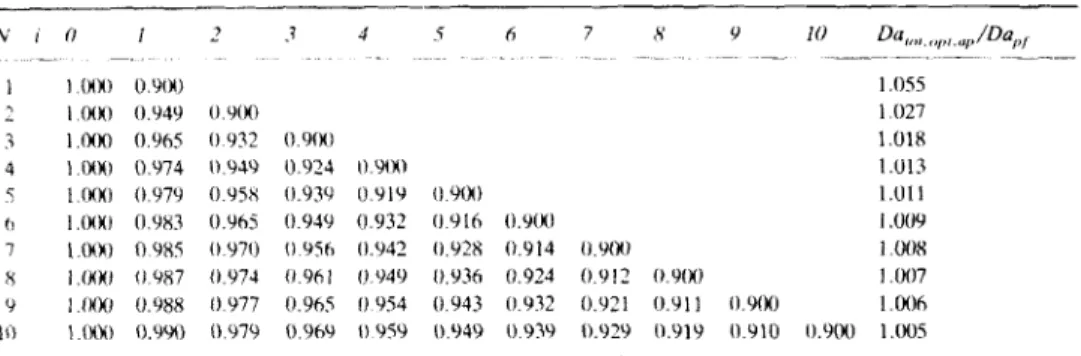
As the number of reactors in series increases, the total Dahkohler number
Table 2 Values of (C,&opt,ap- C,;,eq)/(l - C,;,,,) at the outlet of each reactor assuming that
(C,;,N - C,;+J/(l - C,;.eq) = 0.500 and Kf = K i (first eleven columns), followed by the corresponding Damkohler number normalized by the Damkohler number for a plug flow reactor (last column).
N I 0 I 2 3 4 5 6 7 8 9 10 Da,< ,,,, arJDa,,f 1 1.OOO 0.500 1.443 2 1.OOO 0.707 0.500 1.195 3 1.ooO 0.794 0.630 0.500 1.125 4 1.OOO 0.841 0.707 0.595 0.500 1.092 5 1.OOO 0.871 0.758 0.660 0.574 0.500 1.073 6 l.W 0.891 0.794 0.707 0.630 0.561 0.500 1.060 7 1.ooO 0.906 0.820 0.743 0.673 0.610 0.552 0.500 1.051 8 1.OOO 0.917 0.841 0.771 0.707 0.648 0.595 0.545 0.500 1.045 9 l.W 0.926 0.857 0.794 0.735 0.680 0.630 0.583 0.540 0.500 1.040 10 1.OOO 0.933 0.871 0.812 0.758 0.707 0.660 0.616 0.574 0.536 0.500 1.035
240 F. X . MALC'ATA AND D . C. CAMERON
Table 3 Value\ of (C; , , ~ p ' "p - C; c q ) / ( 1 - C'; % J at the outlet of each reactor assuming that
(CG - Cf ,,, J/( 1 - C c q ) = 0 900 and K ; = K ; (first eleven columns), followed by the corresponding
Damkohler numbtr normalized by the Ddmkohler number for d plug flow reactor (last column). h . 1 0 1 2 3 4 6 7 x 9 10 Du,,",p,,,,,/DQ,,, ~ ~ ~- __ - ~- ___ - 0.9IW) 0.Y4Y O.Y(Ki 0.965 0 932 0.90(J 0.974 11.949 0.924 0.979 0.9% 0.939 O.YX3 0.965 0.949 0 YXS 0 Y70 0 Y 5 h 0 Y87 0.974 0.961 0.988 I1 977 0.965 0.9%) 0 979 0.969 1.055 1 027 0 . Y i H ) 1.013 0.919 (I 90() 1.011 0.932 0 9 I6 O.Y(KI I .OfH 0.942 0.928 0.914 0.m) 1 .oox 0 949 I).Y3h 0.924 0.912 0.9IW) 1.007 I) 954 0.943 0.932 0.921 0 . Y 11 11.9i)O 1 .Do6 0959 0.949 0939 0.929 0 . Y l Y 0.910 0.900 1.005 1 . 0 1 ~
tends towards a limit according to Equation (18):
where the total Damkohler number is given by w
Da,,,, .,p =
2
Da, c>pt = N Da,.,,-
i = 1. 2,. . .
I N (19)1'1
The value of Da,, can also be obtained from the material balance to a plug flow reactor performing the same reaction (Spiegel, 1968)
where Equation (7) was again used to eliminate the functional dependence on
Cy,,. The fact that the plug flow reactor provides a boundary for the total volume
of the reactor is apparent from previous work (Luyben and Tramper, 1982;
Malcata, 1988).
Although exact only for K,: = KF, Equation (17) can also be employed as a
useful approximation for cases where this equality condition is only approached provided that the calculation of an estimate of the error implicit in such an approximation is feasible. From the definition of dimensionless substrate con- centration and the assumption that the reaction in the forward direction is faster
than in the reverse direction (1.e.. Cp,,I/C,s,(I< K , , ) , it is obvious that C . ; , i ~ 1 for
i = 1, 2 ,
.
. . , N ; this implies that ( K ; - Kf)C.;,;+
K,G(1 + M+
KF,) 5 ( K : -Kg)
+
K.;( 1+
M+
K ; ) . Careful inspection of the form of the numerator ofEquation (6) allows one to find that, given C.;,l-l and C.G,l, an upper bound for
Da, is then obtained when (KF - K:)C.:,,
+ K;(l
+
M
f K:)-
K;(l+
K.;)+
MK:. A reasoning similar to the one that led to the derivation of Equation (16)
from Equations (6) and (9)--(ll) can now be followed for this hypothetical
situation thus enabling one to obtain the optimal intermediate concentrations as expressed by the following equation:
(21)
( 1
+
Kcq)C.t.,.opt.e\r - (1+
M )-
(1+
K e q ) C g , N - (1 + M ) i" K,, - M- (
Kc,- Mi
DESIGN OF CSTR’s FOR ENZYME REACTIONS 24 1 Using Equation (21) in the corresponding simplified form of Equation (6), one finds that
For cases where the conversion of S remains low (say, below lo%), a good estimate of the relative deviation implicit in assuming that K,* equals KZ when this is only approximately true then reads
irrespective of the actual values of N , Keq, and C,*,,. The values for Er (which are
independent of the position of the reactor in the cascade of CSTR’s) are estimates of the actual deviation defined as
The confidence contours on the Kg:KZ plane for a number of estimated
percentual deviation levels are plotted in Figures l(i) & (ii) for two arbitrary
values of the ratio M. Two asymptotic values exist for lErl, which play an
important role at large K,* or KZ. These can be obtained from Equation ( 2 3 ) to be
1 lim ( E r l = -
K.+= M+KT,
and
These limiting situations correspond to negligible resistance to the kinetic rate for the reverse and the forward reaction, respectively, arising from the binding of reactant or product.
In the general case of having K,* # KZ and 0
<
C$,,<< 1 the exact value ofDatot,opt is contained in either the interval [Datot,opt.ap, Datot,opt,est] or the interval
[Datot,opt,est, Datot,opt,ap] depending on whether K,
>
K, or K,<
K,, respectively.This result is emphasized in the following application.
NUMERICAL EXAMPLE
Consider the isothermal conversion of fumarate to L-malate at 25°C in a sodium
phosphate aqueous solution of fumarase (EC 4.2.1.2) buffered at pH7.0. The
Michaelis constants have been found to be (Frieden et al., 1957): Ks = 7.2
x
lo-* mol m-3, and K P = 1.9 X lo-’ mol
.
mP3. The turnover numbers associatedwith the forward and reverse reactions are 1.9 x
lo3
s-l and 1.1 xI d
s-’,respectively (Frieden et al., 1957); coupling of this value with the expected
concentration of enzyme to be maintained in each reactor is (i.e., 5 . 0 ~
242 F. X . MALCATA AND D. C . CAMERON
lo-' mol
.
m-3) gives 9.5 x lo-' mol . m-'.
s-' and u ~= 5.5 ~x ~ , ~lo-' mol m-3
.
s-.
Two CSTR's in series will be used to perform the aforemen-tioned reaction with initial fumarate and L-malate concentrations of 35 mol
.
m-3and 0.5 mole m-3, respectively. The available pumping capacity allows a volu-
metric flow rate of 4.85 X lo-' m 3 . sCi to be delivered. Separation of the
unreacted substrate from the product in the effluent stream will be achieved by filtration upon cooling, advantage being taken from the much greater solubility of malic acid over fumaric acid in water (Dziezak, 1990). The residual enzymatic activity in the effluent stream will be destroyed by thermal treatment. Determine the volume of each reactor of the series yielding minimum global volume for the reactor network on the assumption that a 45% conversion of fumarate is desired. Using Equation (3) coupled with the definitions of the kinetic parameters and the normalized concentrations as given in the Nomenclature, one obtains
K : =2.06 x lo-', K ; = 5.43 x Keq.= 4.56, iM = 1.43 x lo-*, and C.& =
5.50 x lo-'. Using these values in Equation (1 1) and performing some algebra, one obtains the following simplified expression
C.~,',,~,,, - 0.5316C~,,,,,,, - 0.08596 = 0 (27) Of the two solutions of the polynomial that can be analytically obtained, only C.t,l,(,,t = 0.6615 is physically meaningful (the other solution is a negative value).
Replacing this value in Equation (6). one finds that Da,,,,, = 0.4620 and
Daz,,),, = 0.181 1. Using the definitions of the Damkohler number as listed in the
Nomenclaiure to ether with the remaining data available, one finally obtains that Vl,op, = 0.8255 m- and V2,0pt = 0.3236 m3. If the assumption that KS
-
K : weretrue then Equation (17) would yield equal values for Da,~,,,,,, and Da2,0pt.ap (i.e.,
have obtained a common value for Da,,,,,,,,,, and Da,,,,,,,,, (i.e., 0.4060), and
thus Vi.opt.e5t
-
V2,0pr.c,t = 0.7255 m'. The actual value for the minimum total valuerequired to effect the aforementioned conversion (i.e., 1.1491 m3 is between the
total volume predicted by using Equation (17) (i.e., 0.5564m.) and the total volume obtained by using Equation (22) (i.e., 1.2510 m').
B
0.1557), and VI.op,.dp -
-
V2,0p,.~,p = 0.2782 m3. Recalling Equation (22), one would-
1
DISCUSSION
Under the usual assay conditions the velocities of reaction are measured very
early in the reaction before the product concentration has increased to a
significant level. In this situation Equation (2) reduces to the classical form of the Michaelis-Menten kinetic equation (Segel, 1975), thus allowing the kinetic constants for both forward and reverse reactions to be estimated from classical linear fits to initial velocity data (e.g., Lineweaver-Burke plots). The four lumped kinetic parameters are not, however, all independent due to the general principle of microreversibility (Hill, 1977). In fact, the relationship denoted as Equation
( 3 ) , and commonly known as the Haldane equation (Creighton, 1984), can be understood as a thermodynamic constraint upon the biochemical reaction which
depends only on the temperature of operation. Although the correct definition of
the equilibrium constant (according to the general principles of mass action) requires the use of activities of the reactants and products instead of their molar concentrations, the aqueous solutions were assumed ideal (i.e., activity coefficient
DESIGN OF CSTR’s FOR ENZYME REACTIONS 243
equal to one) and dilute (i.e., molar fraction approximately equal to the solute-free molar fraction) for the sake of mathematical simplicity. The deviations from ideality and dilute behavior are not expected to introduce severe errors in common industrial practice.
It might be argued that the generic process scenario of having initial finite
concentrations of both S and P (i.e., M # 0) is not reasonable from an economic
point of view for an equilibrium limited conversion of S to P . The presence of
some product of the forward reaction was considered in order to include
situations where the natural feedstocks already contain both
S
and P rather thansituations where some effluent stream was to be recycled to the first reactor in the
cascade of CSTR’s.
Careful inspection
of
Tables 1 through 3 allows one to find that the volume of aplug flow reactor becomes a better approximation of the total volume of the
cascade of CSTR’s as (C,*,,
-
C&J/(l - C,*,,,) increases. Moreover, the aforem-entioned approximation improves as N increases for each level of (C,*,,
-
C& J / ( l- C&), as expected. In general, a preliminary estimate of the minimum size of the cascade of CSTR’s may proceed via Equation (18) for N above, say, 6.
It is interesting to note that in the asymptotic case leading to Equation (16) the
optimal intermediate substrate concentrations are a function of the equilibrium constant, the initial ratio of concentrations of reactant and product, the number of reactors, and the desired final concentration of substrate. Furthermore, the Damkohler number for each of the CSTR’s in the series under the assumption of
K,* = K:, as expressed in Equation (17), for each set of parameters K,,, K,*, K:,
M, and N is the same. The above finding is remarkable for the particular cases
where Ks is close to K p because it leads to equal-sized reactors, with
corresponding ease of construction and stocking of spare parts. In the general
case of applicability of Equation (1 l ) , it is found that individual reactors become
progressively (with increasing i) smaller, as was already observed by Luyben and
Tramper (1982) for the irreversible Michaelis-Menten counterpart.
The result previously reported by Luyben and Tramper (1982) for the case of an irreversible, single substrate enzymatic reaction following simple Michaelis- Menten kinetics can be obtained from Equation (11) as a limiting case. This particular solution requires that not only the chemical reaction proceeds virtually
to completion (e.g., large Keq), but also that the product generated in the forward
reaction does not appreciably bind to the enzyme (i.e., large K:). In this limiting
case the loci of the intermediate concentration optima depend only on the number of reactors and the final desired conversion. If these assumptions were taken as valid with the data used in the above numerical example, then one would
have gotten C,*,I,opt = 0.7416, Da,,,,, = 0.2591 and Da2,0pt = 0.1923; these values
yield an underestimated minimum reactor size required for the expected conversion. This drawback increases rapidly in importance as the desired conversion approaches the equilibrium conversion.
The approximation suggested as the underlying rationale of Equations (23)- (24) [i.e., Equation (22)] leads in general to predicted errors ( E r ) of the order of
magnitude of, but not necessarily greater than, the actual value of each
Dv,.
Thisfinding is due to the fact that although C,*., has an upper limit of unity, the
structure of the optimization procedure as depicted in Equation (9) is distorted
when one assumes that C:,, = 1 only in the third term of the numerator of
2% F. X. MALCATA AND D. C . CAMERON
Equation (6) [C:,, appears explicitely three times in Equation (6)]. The estimate
Er increases in accuracy as the overall reactant conversion in the reactor network
decreases because C,:,, then remains closer to unity for all i = 1, 2, . .
.
, N . Ingeneral, it can be stated that lErl is an upper bound for the average value of lDv,l
extending to all AT reactors in the series (i.e.,
EL,
ID2r,) 5 N . 1Erl).Data available for 1986 estimate the world overall consumption of malic acid as 20,000 ton/year (Blenford, 1986). Clear tendencies for increase of this figure in the near future are anticipated based o n consumer trends (Blenford, 1986) and as
a result of greater availability (Irwin et al., 1967). A survey over some common
suppliers of fine chemicals indicates that 1 kg of food grade fumaric acid and
I,-malic acid (both in free crystalline form) costs around 1 and 16 arbitrary currency units (c.u.), respectively. On the other hand, microbial raw fumarase costs about 0.00028c.u./f.u., where the fumarase unit (f.u.) is defined as the
amount of enzyme able to catalyze the production of 1 pnolt,.,,,,,,/min. The raw
net profit is therefore 4.9 c . i ~ . / k g ~ . , , , ~ ~ ~ , ~ ~ under the assumptions that (i) the
K
*
S
Figure 1 Confidence contours for a number of estimated percentual error levels, IErl, plotted as K ; vs k',; within the range of industrial interest. Two arbitrary values were considered for the initial ratio o f product to reactant concentrations: M = O (part i) and M = 1 (part ii). T h e main diagonal corre5ponds to Er = 0 % .
DESIGN OF CSTR’s FOR ENZYME REACTIONS 245
*
( i i )
Figure 1 (continued)
residence time of the fluid is 10h, (ii) 300 units of fumarase are used in the reactor system, (iii) all enzyme is lost upon one passage through the cascade of
CSTR’s, and (iv) the reaction rate is on average one half the maximum value. The reversible reaction catalyzed by fumarase in a homogeneous aqueous sytem is, therefore, of commercial interest and thus particularly suitable for design purposes.
The reaction considered in the problem statement involves two substrates in the forward reaction, one of which is water. The concentration of water remains, however, essentially constant because water also plays the role of solvent: the water concentration is typically two to three orders of magnitude greater than that of the substrate or product. In such situations the reaction can be virtually taken as unireactant in both directions and the reasoning followed remains valid. The exact calculation of the optimal intermediate concentrations leading to the minimum overall reactor volume, although conceptually straightforward, is quite cumbersome in practice whenever a fairly large number of reactors is considered
(for a cascade of N CSTR’s, a set of N - 1 N-th degree polynomials must be
solved simultaneously). This often requires involved mathematical manipulations
246 F. X . MALCATA AND D. C. CAMERON
which are more likely to lead to numerical instability as the number (and order) of the polynomials resulting from Equation (11) increases. The possible numerical solutions also increase in number, so special care is to be exercised in selecting the correct one. This can be achieved at the expense of appropriate physical
constraints, which can be stated as 1 2 C$
,,-,,
I,pt>
C.:,i,opt>
C.;,,, > 0 (i =1 , 2 , . . . , N ) for the case where conversion of the reactant to the product is
sought. The analytical approach as provided by Equations (16)-( 17) assumes
special significance as a short-cut method for pre-design purposes involving K s
not too different from K P and C:,N not too much below unity if a reasonable
upper bound for the relative error, Er (say, up to 20%) is acceptable (this type of
reasoning can not be extended to the numerical example of the fumarase-
catalyzed reaction because the degree of conversion considered, 45%, is well
above the upper boundary of 10%). This approximation becomes better as both
KS and K ; increase as apparent from Figure 1. Parameter M affects the spread of
the confidence contours about the exact solution lying on the diagonal of Figure 1 (i) & (ii); the larger M . the better the short-cut method for any given pair of
values for K,; and K;,. As expected, at
M
= 1 the plot is symmetrical about themain diagonal. Larger values of M skew the confidence contours downwards, thus
leading to more relaxed constraints on the side of positive deviations for Dai.opt. The existence of horizontal and vertical asymptotes as predicted by Equations
(25)-(26) is obvious in the aforementioned plots. A high practical value can then
be ascribed to this analytical approximation for large values of either of the
dimensionless kinetic constants because the short-cut method becomes particu- larly accurate in the most critical range for selection of capital investment (i,e, where the large volumes for a given conversion are required). If one seeks only a set of lower and upper bounds for the total reactor volume required for a desired conversion (e.g., during the preliminary design steps of a series of CSTR's), then Equations (17) and (22) can be employed to advantage. Further refinement of the estimates can then be obtained by numerically solving Equation (11) using the constraints introduced before.
NOMENCLATURE
total concentration of enzyme [mol. m-3]
equilibrium concentration of product [mol
.
m-'1concentration of product in the i-th reactor [mol .m-3]
(Cp,,/C.5,(,), normalized concentration of product
[-I
concentration of product at the inlet of the first reactor [mol
.
mP3]concentration of reactant [ m o l . m-'1
equilibrium concentration of reactant [mol
.
m-3]concentration of reactant in the i-th reactor [mol
.
m-'1(C.s,,/C.s,o), normalized concentration of reactant [--]
normalized concentration of reactant leading to a minimum of Datot normalized concentration of reactant leading to a minimum of 3atot
under the assumption that K s = K p [-]
concentration of reactant at the outlet of the last reactor in the series
of CSTR's [mol
.
m-'1[-I
DESIGN OF CSTR's FOR ENZYME REACTIONS 247 DaPf Datot Datot,opt Datot,opt,ap Datot,opt,est E Er ES 1 N P
Q
S
t 2, umax.f Vmax.r V( C s , N / C S , O ) , normalized concentration of reactant at the outlet of the
last reactor
[-]
concentration of reactant at the inlet of the first reactor [mol
.
m-3]( v , , , ~ ~ , ~ .
V , ) / ( Q
.
CS,"), Damkohler number for the i-th reactorDamkohler number for the i-th reactor leading to a minimum of
Datot under the assumption that Ks = K , [-]
Damkohler number for the i-th reactor leading to a minimum of
Datot under the assumption that ( K : - K,*)C&
+
K,*(l+
M+
K:) =Damkohler number using a plug flow reactor [-]
CE,
Da;, overall Damkohler number [-]EE,
Dai,opt, minimum overall Damkohler number [-]N Dai,opt,ap, minimum overall Damkohler number under the assump-
tion that Ks = K P [--]
N Dai,opt,est, minimum overall Damkohler number under the as-
sumption that ( K :
-
K,*)C&+
K,*(l+
M+
K:) = K:(1+
KB)+
MK,*(Da,,opt,ap/Dai,opt
-
l), actual value of the fractional error originatedfrom taking KB- K:
[-]
enzyme
(Dai,opt,ap/Dai,opt,est
-
l ) , estimated value of the fractional errororiginated from taking K:
-
Kp* [--]enzyme/substrate intermediate complex
dummy integer variable [--]
dummy integer variable
[-]
(Cp,eq/Cs,eq), equilibrium constant for the enzymatic reaction [-] Michaelis-Menten constant for the product of the enzymatic reaction [mole m-'1
( K , /CS,(J, Michaelis-Menten constant for the product
[-J
Michaelis-Menten constant for the reactant of the enzymatic reaction
[mol
.
m-'1( K s / C s , o ) , Michaelis-Menten constant for the reactant [-]
(Cp,o/Cs,O), ratio of initial concentrations of product and reactant
[-I
number of reactors in the series [-]
product of the biochemical reaction
volumetric flow rate through the reactor network [m3 * s-'1
reactant of biochemical reaction
time elapsed since start-up of the reaction [s]
overall kinetic rate of enzymatic reaction [mol
-
m-'.
s-'1maximum rate of enzymatic reaction in the forward direction
[mol- m-'
.
s-'1maximum rate of enzymatic reaction in the reverse direction [mol. m-'. s-'1
volume of reacting fluid [m']
liquid volume of the i-th reactor [m']
liquid volume of the i-th reactor leading to a minimum of Datot [m3]
liquid volume of the i-th reactor leading to a minimum of Datot under
the assumption that K s = K , [-]
K : ( 1 + K:)
+
MKB [-][-I
248 F. X. M A L C A T A A N D D . C. C A M E R O N
Vi,opt,est liquid volume of the i-th reactor leading to a minimum of Da,,, under
the assumption that ( K ; - K$)C;,,
+
KF(1+
M
+
K;) = K;(1+
K e )
+
MK,* [--] Greek lettersdummy variable of integration dummy variable of integration
Ackno wledgemenrs
Financial support for F. X. Malcata during the course of this research was
provided by INVOTAN (Portugal) and Institute of Food Technologists (United States of America).
Reference5
Bailey. J. E . and Ollis, D . F. (1986) Biochemical Engineering Fundamenfals. McGraw-Hill, New York Blenford. D. E. (1986) Ingredients insight: Food acids. Food Flau. Ingred. Proc. Pkg., 8(6), 1 1 , 17 Creighton. T. E. (1984) Proteins-Sfructures and Molecular Principles. Freeman, New York
Dziezak. J. D . (1990) Acidulants: ingredients that d o more than meet the acid test: Food Technol.,
Frieden, C.. Wolfe. R . G . and Alberty. R . A . (1957) Studies of enzyme fumarase. IV. T h e dependence of the kinetic constants at 25°C o n buffer concentration. composition and pH. J . A m .
Chem. Soc.. 79, 1523-1525
Gardner. W. H . (1968) Acidulants in Food Processing. In CRC Handbook of Food Additives, edited by T. E. Furia, pp. 247-281. Chemical Rubber Company, Cleveland
Gooijer, C. D . , Hens, H . J . H . and Tramper. J . (1089) Optimum design for a series of continuous stirred tank reactors containing immobilized biocatalyst beads obeying intrinsic Michaelis-Menten kinetics. Bioproc. Eng., 4, 153-158
44, 76-83
Haldane. J . B. S . (1930) Enzymes. Longman. London
Hill. C . G . (1977) A n Inrroduction to Chetnicul Engineering Kinetics and Reactor Design. Wiley, New
York
Irwin, W. E.. Lockwood, L. B. and Zienty. M. F. (1967) Malic Acid. In K i r k - O t h e r Encyclopedia ofChemica1 Technology, edited by H. F. Mark. J . J . McKetta. D. F. Othrner, and A. Standen, pp. 83-849. Wiley. New York
Luyben, K . C . and Tramper. J . ( 1982) Optimal design for continuous stirred tank reactors in series using Michaelis-Menten kinetics. Biotechnol. Bioeng., 24, 1217-1220
Malcdta. F. X . (1988) Optimal design on an economic basis for continuous stirred tank reactors in series using Michaelis-Menten kinetics for ping-pong reactions. Can. 1. Chem. Eng., 66, 168-172 Malcata. F. X. (1989a) CSTR’s in biochemical reactions-an optimization problem. Chem. Eng. E d . ,
a,
112-115. 128Malcata. F. X. (1989b) A heuristic approach for the economic optimization of a series of CSTR’s
performing Michaelis-Menten reactions. Biotechnol. Bioeng., 33, 251-255
Malcata, F. X. ( 1 9 8 9 ~ ) T h e effect of the level of micromixing on the optimal design of CSTR’s performing Michaelis-Menten reactions. Can. J . C‘hem. Eng., 68, 330-336
Segel. I. H. (1975) Enzyme Kinetics-Behavior and Analysis of Rapid Eyuilihrium and Steady-State Enzyme System. Wiley. Ncw York
Spicgel. M. R. (1968) Mathemafical Handbook, McGraw-Hill. New York
Wandrey. C . (1979) Continuous homogeneous catalysis in enzyme engineering. In Biochemical Engrneering, uol. 326. edited by W. R. Vieth, K . Venkatasubramanian, and A . Constantinides, pp.
87-95, The New York Academy of Sciences. New York
Weizmann. A . (1937) British Patent no. 476, 109