Social Modulation of Sex Steroid Concentrations
in the Urine of Male Cichlid Fish
Oreochromis mossambicus
Rui F. Oliveira,*
,1Vitor C. Almada,* and Adelino V. M. Canario†
*Unidade de Investigac¸a¨o em Eco-Etologia, Instituto Superior de Psicologia Aplicada, Rua
Jardim do Tabaco 44, 1100 Lisboa, Portugal; and †Unidade de Cieˆncias e Tecnologias dos Recursos Aqua´ticos, Universidade do Algarve, Campo de Gambelas, 8000 Faro, Portugal
The relationship between urinary concentrations (free/ of the teleost families in which there is a larger body
sulfates/ glucuronides) of the steroids testosterone (T), of evidence in the role of androgens on the control of
11-ketotestosterone (11KT), 17a, 20b-dihydroxy-4-preg- male social behavior, both in terms of organization nen-3-one (17,20b-P) and 17a,20a-dihydroxy-4-preg- (Billy and Liley, 1985; Groothuis and Ros, 1993) and nen-3-one (17,20a-P), and the social behavior of males activation (Kramer, Molenda, and Fiedler, 1969; Rein-of the cichlid fish Oreochromis mossambicus was
inves-both and Rixner, 1972; Wapler-Leong and Reininves-both,
tigated. After 8 days of isolation none of the steroids
1974; Fernald, 1976). In Oreochromis mossambicus and
were good predictors of social dominance developed
other tilapiine species androgen treatment at an early
after subsequent formation of all-male groups. One day
sensitive period in the ontogeny may even reverse the
after group formation dominance indexes were good
sex of the individual (Clemens and Inslee, 1968; Hunter
predictors of the urine concentrations of all sex steroids.
and Donaldson, 1983).
Dominance indexes and androgen concentrations
mea-sured after all-male group formation were positively cor- Castration and administration of androgens to
cas-related with territoriality, courtship rate, and nest size. trated and intact fish have been the primary tools to Similar relationships were found for progestins with the study the influence of steroids on social behavior. Cas-exception that they were not correlated with courtship tration has been shown to lower both agonistic and rate. All-male group formation was also accompanied by sexual behaviors, while androgen administration re-an increase in urinary sex steroid concentrations in fish
stored those behaviors in castrates and had an
enhanc-that became territorial and a decrease in non-territorial
ing effect on behavior in intact males (Aronson, Scharf,
fish with the exception of T, which increased in both
and Silverman, 1960; Reinboth and Rixner, 1972;
groups. Addition of ovulating females caused steroid
Wapler-Leong and Reinboth, 1974; Fernald, 1976;
Fran-concentrations to return to levels near isolation, except
cis, Jacobson, Wingfield, and Fernald, 1992).
for 17,20a-P in territorials, which underwent a large
in-crease. Thus, social interactions may have an important Androgen concentrations may also be affected by the
modulatory effect on sex steroid concentrations in O. interactions between conspecifics, suggesting a
two-mossambicus. q 1996 Academic Press, Inc. way type of interaction between androgens and
behav-ior (Villars, 1983). For example, in a natural population of stoplight parrotfish (Sparisoma viride) territorial males had higher concentrations of androgens than non-terri-The interrelationship between sex steroids and
be-torial males and during territory acquisition androgen havior in teleosts has been studied mainly from the
concentrations reached values above those found in al-point of view of the effect of androgens, testosterone
ready established territorial males. The peaks of andro-(T), or 11-ketotestosterone (11KT). Cichlid fishes are one
gens could also be induced by experimental intrusions of other males indicating that the agonistic interactions
1Address for correspondence: Rui Oliveira, Unidade de
Investiga-in themselves could affect the hormonal state of the
c¸a¨o em Eco-Etologia, Instituto Superior de Psicologia Aplicada, Rua
fishes (Cardwell and Liley, 1991a).
Jardim do Tabaco 44, 1100 Lisboa, Portugal. Fax: 351 1 8860954. Phone:
concentra-tions of the progestin 17a,20b-dihydroxy-4-pregnen-3- Subjects and Maintenance
one (17,20b-P) have been shown in spawning male
rain-Fish were obtained from a stock bred since the early bow trout (Liley, Breton, Fostier, and Tan, 1986). This
seventies at Aqua´rio Vasco da Gama (Lisboa, Portugal). hormone has been demonstrated to be involved in
The original stock was obtained from the Incomati sperm maturation (Miura, Yamauchi, Takahashi, and
River, Mozambique. In this work adult males, about Nagahama, 1992) and to function as a primer
phero-112 years old, ranging from 7.9 to 10.4 cm standard
mone released by females (Sorensen, Stacey, and
Cham-length, and females ranging from 6.0 to 7.0 cm standard berlain, 1989; Liley, Olsen, and Foote, 1991) but a direct
length were used. Fish were kept at 24 / 27C on a role on male behavior has not yet been found.
12D:12L light regime. They were fed daily with com-The primary objective of the present study was to
mercial fish food commonly used for tropical aquarium investigate the extent to which social interactions in O.
fish.
mossambicus could be predicted by prior concentrations
of androgens (T and 11KT) or whether the outcome of
agonistic interactions could modulate androgen con- Procedures
centrations. In order to do this, parameters of social
status and agonistic and sexual behaviors were deter- Prior to being tested fish were stocked in mixed sex
groups of 30 – 50 individuals in 500-l tanks for 2 months. mined in groups of sexually mature males, which were
first isolated to minimize prior social experience and At the start of the experiment 16 males were
individu-ally isolated in 46 1 36 1 40-cm3standard aquaria for
correlated to concentrations of androgens measured in
the urine, assuming that urinary steroid profiles pro- 8 days in order to minimize possible effects of prior
social experience. At the end of the isolation period, vide indications on the patterns found in the plasma.
In the absence of data on the dynamics of excretion in groups of four individuals were formed and placed in
similar aquaria (93 1 36 1 40 cm3) with a layer of sand
Tilapia it may be argued that urinary concentrations do
not reflect accurately what is going on in the plasma. in the bottom. Care was taken to minimize the
within-group variance of size. The standard length coefficients Despite this problem (see Discussion for a more
de-tailed consideration of this issue) it was decided to use of variation (CV Å standard deviation/arithmetic
mean) for each group were CV1 Å 0.07, CV2 Å 0.04, urinary concentrations because they involve much less
manipulation of the individuals, which can be a major CV3 Å 0.01, and CV4 Å 0.10. After 5 days of group
formation two ovulated females were added to each source of bias in behavioral studies in which the same
individual is sequentially sampled. In addition, a possi- group. Ovulation was induced by an ip injection of 200
ml saline containing 5mg des-Gly10, [D-Ala6]-luteiniz-ble involvement of 17,20b-P and 17,20a-P in social
be-havior was also assessed using the same methodology ing hormone releasing hormone ethylamide (Sigma) 48
h prior to their introduction in the experimental groups. as that used with the androgens.
Urine samples were collected for determination of steroid concentrations at the end of the social isolation (day 0), after 5 days of all-male group formation (day
METHODS
5) and 2 days after the addition of the females to the groups (day 7). The urine was collected into a 1.5-ml
Synopsis of the Oreochromis mossambicus
Eppendorf tube by applying a slight pressure on the
Mating System
lower part of the fish flanks behind the genital papilla. The procedure took less than a minute for each fish.
O. mossambicus is an African mouthbrooding cichlid
in which males form dense nest aggregations (arenas) Urine samples were stored at 0207C until they were
processed for radioimmunoassay (RIA). It must be em-in shallow water durem-ing the breedem-ing season. Males
establish territories within these aggregations where phasized that steroid measurements were obtained
without prior knowledge of the social status of each they dig pits (nests), to which they attract a succession
of females. Spawning takes place in the nest. The female individual at any time.
In our study we make the assumption that the pattern quickly takes eggs and sperm into her mouth where
fertilization takes place and leaves the arena (Bruton of variation of the total concentration of each steroid in
the urine reflects the pattern of variation of the same and Boltt, 1975). In the wild, the embryos and fry are
brooded in the female’s mouth during 20 – 22 days (Bru- steroid in the plasma. Although there are no data on
the dynamics of steroid excretion for Tilapia, Scott and ton and Boltt, 1975). Thus parental care is restricted to
mykiss) temporal variation in several steroids present were observed in the next 3 s or more. A fish was classi-fied as the loser of an agonistic interaction when it in the urine correspond to similar patterns of variation
in the plasma. In a similar vein Creel, Wildt, and Mon- adopted a submissive posture or moved away, either
by retreating or escaping, from the opponent, that was fort (1993) found that urinary concentrations of
andro-gens reflect adequately short-term variations of plasma then classified as the winner. A dominance index,
pre-viously used by other authors (e.g., Barlow and Ballin, concentrations in wild dwarf mongooses (Helogale
par-vula). Despite this problem it was decided to use the 1976; Winberg, Nilsson, and Olse´n, 1991; Go´mez-Laplaza and Morgan, 1993), was computed as the num-urinary concentrations since urine sampling involves
only a brief manipulation of the fish, while plasma sam- ber of victories over the total number of interactions in which the individual participated. In O. mossambicus pling may have more disruptive effects on the behavior
of the fish and on their subsequent steroid profiles due the rank attained by each fish using this index is highly correlated with the rank order obtained by the analysis to manipulative stress.
of the sociometric matrices, and so it is a good indicator of dominance status (Oliveira and Almada, submitted
Steroid Radioimmunoassays for publication).
(b) Courtship episodes — when one or more of the Urine samples (50ml) were extracted for steroid
sul-following acts were detected: tilting, jerking, leading, fates and glucuronides as described by Scott and
Cana-quivering, and pit circling. rio (1992) and the extracts were dissolved in phosphate
(c) Territoriality — a fish was classified as being terri-buffer for RIA.
torial if it dug and actively defended a pit in the substra-The RIA characteristics, including the cross-reactivity
tum and exhibited the characteristic black coloration of the antibodies used, have been reported before:
tes-(sensu Neil, 1964). tosterone and 17,20b-P by Scott, MacKenzie, and Stacey
(d) Nest volume — estimated from measurements of (1984); 11-ketotestosterone by Scott and Sumpter (1988);
the diameter and depth at the center of the pits, assum-and 17,20a-P by Canario and Scott (1989). The
intra-ing the approximate shape of a cone. In order to reduce and inter-assay variability for urine samples of O.
mos-inter-group variability in pit depths each aquarium was
sambicus is as follows: (1) testosterone; CVintra-assay Å
provided with approximately the same amount of sand 0.075, CVinter-assay Å 0.124, n Å 8; (2)
11-ketotestoster-(7-cm layer). This measure was taken since nest size is one: CVintra-assay Å 0.082, CVinter-assay Å 0.116, n
known to be an important correlate of male reproduc-Å9; 17,20a-P: CVintra-assay Å 0.089, CVinter-assay Å
tive success and male social status in other lek-breeding 0.121, n Å 7; 17,20b-P: CVintra-assay Å 0.085,
CVinter-cichlids (McKaye, Louda, and Stauffer Jr., 1990; assay Å 0.107, n Å 11.
Mckaye, 1991; Rossiter, 1992).
Behavioral Observations
Statistical Analysis
Observations were conducted for 20 min per group
Steroid concentrations in territorial and non-terri-every day between 11AMand 6PM. Every social
inter-torial fish along the three phases of the experiment action that occurred during this period was recorded
(isolation, all-male, and mixed sex groups) were com-and its behavior elements were noted together with the
pared through a univariate two-way repeated mea-identity of the actor and the receiver of the acts. A
sures analysis of variance (ANOVA) followed by con-detailed description of agonistic and courtship behavior
trasts analysis according to Winer, Brown and Mi-can be found in Baerends and Baerends von Roon (1950)
chels (1991). When needed, to match the assumptions and in Neil (1964). Fish were individually identified by
of ANOVA, the variables were log-transformed (i.e., a small clip in the dorsal fin membrane. The following
T, 11KT). Dominance indexes of territorial and non-elements of behavior were recorded:
territorial fish were compared with the Mann – Whit-ney U-test. The Spearman Rank correlation was used (a) Agonistic interactions — those that involved one
or more of the following behavioral patterns: approach, to access the relationships among behavioral
vari-ables and between them and hormonal concentra-charge, butting, biting, chasing, lateral and frontal
dis-play, circling, mouthfighting, pendelling, fleeing, and tions. Due to the large number of correlations
com-puted we used a significance level of 1% to avoid submission posture. An agonistic interaction was
con-sidered terminated when one of the opponents moved obtaining significant correlations by chance. The
Ken-dall W coefficient of concordance was used to access away from the other and no further agonistic exchanges
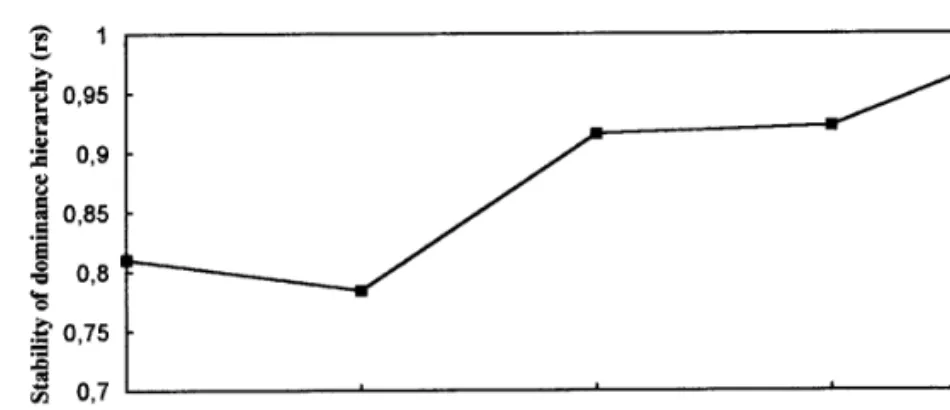
FIG. 1. Correlation coefficients between the dominance index computed daily, from day 1 to day 4, and the same index computed at day 5.
the consistency of behavioral data along the consecu- courtship behavior (already present in all-male groups)
is almost exclusively directed towards females. The tive days of the study. The significance levels of the
Kendall W coefficient were determined according to dominance index computed at day 1 was also a good
predictor of courtship rate, nest dimensions at day 5 the procedure described by Siegel and Castellan
(1988). The level of significance considered was 5%. (see Table 1) and effective defence of a territory at the
bottom (Mann – Whitney U test, N Å 16, U Å 0, territori-All statistical treatments were performed using the
software package STATISTICA for Windows v. 4.0 als mean rank Å 13.5, non-territorials mean rank Å 5.5,
p õ 0.01). Thus, in the first day after group formation
(copyright Statsoft, Inc., 1993).
the social status of each individual was basically estab-lished, and it strongly influenced the likelihood of be-coming territorial, the size of its nest and frequency of
RESULTS
courtship after the introduction of females.
Social Interactions after Group Formation
Isolated individuals had reduced locomotor activity Urinary Steroids and Social Status
and a neutral silvery coloration. They did not dig nests
or show any pattern of social behavior. At day 0 during Urinary concentrations of free steroids were very
low, and glucuronide and sulfate concentrations the first social interactions some individuals began to
acquire a dark coloration. At the same time a substantial showed a high variability in relation to behavioral
in-dexes. However, total steroid (free / glucuronide / number of symmetric interactions (i.e., circling fights,
frontal and lateral displays, mouth fighting) were ob- sulfate) concentrations showed high correlations with
behavior and those are the results presented hereafter. served, but these declined rapidly and from day 1
on-wards the interactions observed were mostly asymmet- The use of total steroid concentrations also avoids the
possible effects of differential excretion of the different rical (e.g., charging/fleeing). At day 1 the first signs of
pit digging by the fish that became territorial were visi- steroid metabolites.
Androgens — As one of the main aims of this paper ble. By this time a rank order was already established
within each group and persisted with little or no modi- was to evaluate to what extent individual androgen
concentrations prior to group formation were a good fication throughout the observation period. This
con-clusion was supported by the high correlation coeffi- predictor of social status attained by each fish, or if
social status itself could modulate individual androgen cient between the dominance index computed for each
fish at day 1 and the same index computed at day 5 concentrations, we analyzed the correlations between
androgen concentrations and behavioral variates in dif-(Fig. 1). This index was consistent along the entire
ob-servation period (Kendall’s coefficient of concordance ferent social contexts.
As can be seen in Table 1, at the end of social isolation for the dominance index computed for each day Å
0.881, average rank R Å 0.852, p õõ 0.001). (day 0) neither T nor 11KT urinary concentrations were
correlated with the dominance indexes obtained from After the introduction of the females a reduction in
andro-TABLE 1
Spearman Rank Correlation Coefficients (rs) among Behavioral Variables and between Them and Sex Steroid Concentrations in the Urine
Court. Nest
V/V / D1 V/V / D5 V/V / D7 N0Inter. rate volume
V/V / D1 — V/V / D5 0.81*** — V/V / D7 0.81*** 0.98*** — N0Inter. 0.40 0.55 0.56 — Court. rate 0.74** 0.92*** 0.88*** 0.58 — Nest volume 0.75*** 0.91*** 0.90*** 0.61 0.88*** — T0 0.23 0.003 00.04 00.17 00.01 00.13 T5 0.71** 0.80** 0.80** 0.47 0.79** 0.85*** T7 0.53 0.61 0.64 0.67** 0.60 0.75** 11KT0 0.18 0.27 0.19 00.15 0.34 0.17 11KT5 0.7** 0.80** 0.83*** 0.37 0.70** 0.91*** 11KT7 0.49 0.55 0.53 0.39 0.62 0.68** 17,20aP0 0.13 0.09 0.02 0.09 0.15 00.11 17,20aP5 0.81*** 0.73** 0.71** 0.37 0.64 0.78** 17,20aP7 0.45 0.66** 0.70** 0.57 0.60 0.68** 17,20bP0 00.23 00.44 00.42 00.21 00.41 00.53 17,20bP5 0.69** 0.54 0.59 0.61 0.51 0.71** 17,20bP7 0.37 0.36 0.49 0.12 0.26 0.47
Note. N Å 16 except for the pairs of variables that involve T5, 11KT5, 17,20aP5, or 17,20bP5on which case N Å 13, and those that involve T7,
11KT7, 17,20aP7, or 17,20bP7on which case N Å 14. Significance levels are: P õ 0.01 (**) and P õ 0.001 (***). V/V / D1, 5, 7are the dominance
indexes respectively in Days 0, 5, and 7 of the experiment. N0Inter is the total number of interactions on which each fish participated during
the all-male groups period. Court. rate is the total number of courtship episodes after the addition of the females to the groups. Nest volume was measured at Day 5. T0, 5, 7, 11KT0, 5, 7, 17,20aP0, 5, 7, and 17,20bP0 ,5, 7are the concentrations of the sex steroids in the urine, respectively, at
Day 0, 5, and 7 of the experimental procedure.
gens at day 5 were highly correlated to the dominance index at day 1. However, no significant correlation was detected between androgen concentrations and the total number of interactions, except for T in day 7. Concen-trations of both androgens measured at day 5 were also correlated with the courtship rate and the volume of the nest.
Since fish that established territories showed consis-tently higher dominance indexes than non-territorials, we compared the androgen variations of the two cate-gories in the different social contexts.
Social isolation fish, which after group formation be-came territorial, did not differ significantly both in T and 11KT from those that later failed to became
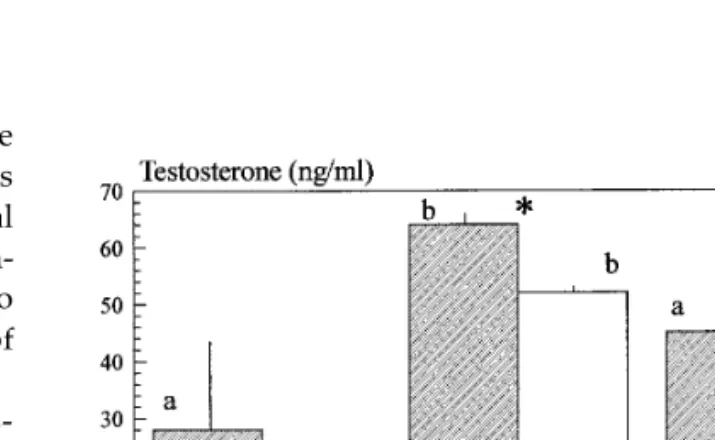
territo-FIG. 2. Differences in testosterone concentrations in the urine
rial (Figs. 2 and 3). In this section when we designate
(mean / SE) between territorial (T) and non-territorial fish (NT) (F
the individuals as territorials or non-territorials we are
Å 6.11, p õ 0.05), along the three phases of the experiment (F Å 8.62,
referring to these two classes. T concentrations in- p õ 0.01). The effect of the interaction between territoriality and the creased significantly in territorial and non-territorial 3 different social contexts was not significant (F Å 0.95, p ú 0.05). Sample sizes are as follows: (1) territorials: nisolationÅnall maleÅnmixed set
fish when male groups were formed followed by a
sig-Å 6; (2) non-territorials: nisolationÅ 10, nall maleÅ 7, nmixed sexÅ 8. Results
nificant decrease when ovulating females were
intro-of the contrast analysis are noted as follows: (i) significant differences
duced. However, statistically significant differences
between territorial and non-territorial fish at each phase of the
experi-(0.02 õ p õ 0.03) were only found between territorial ment are marked with an *; (ii) for the comparison of the same sample all-male groups and non-territorials in isolation or in (i.e., territorials or non-territorials) along the three phases of the
exper-iment, homogeneous groups are marked with the same letter.
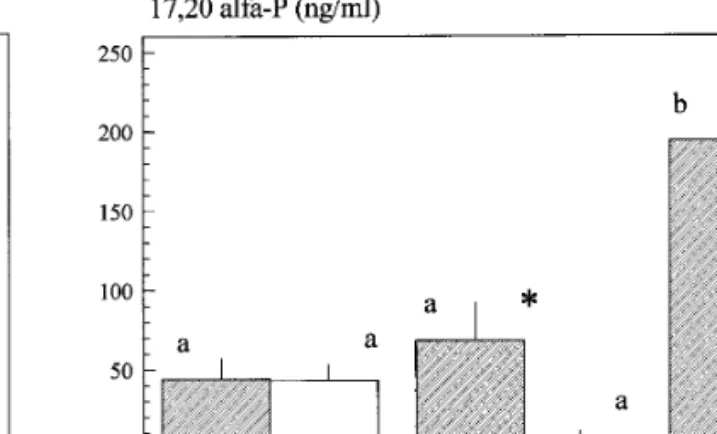
FIG. 4. Differences in 17,20a-P concentrations in the urine (mean FIG. 3. Differences in 11-ketotestosterone concentrations in the
/ SE) between territorial (T) and non-territorial fish (NT) (F Å 10.24, urine (mean / SE) between territorial (T) and non-territorial fish (NT)
p õ 0.01), along the three phases of the experiment (F Å 6.96, p
(F Å 13.98, p õ 0.01), along the three phases of the experiment (F Å
õ 0.01). There was a significant effect of the interaction between 3.08, p ú 0.05). There was a significant effect of the interaction between
territoriality and the three different social contexts (F Å 3.48, p õ territoriality and the three different social contexts (F Å 5.47, p õ
0.05). Sample sizes are as follows: (1) territorials: nisolationÅnall maleÅ
0.05). Sample sizes are as follows: (1) territorials: nisolationÅnall maleÅ
nmixed sexÅ 6; (2) non-territorials: nisolationÅ 9, nall maleÅ 7, nmixed sexÅ nmixed setÅ 6; (2) non-territorials: nisolationÅ 10, nall maleÅ 7, nmixed setÅ
8. Results of the contrast analysis are noted as follows: (i) significant 8. Results of the contrast analysis are noted as follows: (i) significant
differences between territorial and non-territorial fish at each phase differences between territorial and non-territorial fish at each phase
of the experiment are marked with an *; (ii) for the comparison of of the experiment are marked with an *; (ii) for the comparison of
the same sample (i.e., territorials or non-territorials) along the three the same sample (i.e., territorials or non-territorials) along the three
phases of the experiment, homogeneous groups are marked with the phases of the experiment, homogeneous groups are marked with the
same letter. same letter.
11KT concentrations increased dramatically in territo-rial fish (p õ 0.001) followed by a slight non-significant decrease when females were added. Non-territorial fish showed no significant variations in 11KT concentra-tions.
Progestins — In order to evaluate to what extent the concentrations of the different steroids could reflect common patterns of variation, the correlations among them were also investigated. At the end of the isolation period correlations among all steroids were not statisti-cally significant with the exception of the correlation between T and 17,20a-P (r’s Å 0.625, n Å 15, p õ 0.05). At this stage no significant differences in 17,20a-P or 17,20b-P concentrations were found between territorial
FIG. 5. Differences in 17,20b-P concentrations in the urine (mean
and non-territorial fish (Figs. 4 and 5). When all-male
/ SE) between territorial (T) and non-territorial fish (NT) (F Å 1.73,
groups were formed progestin concentrations increased
p ú 0.05), along the three phases of the experiment (F Å 1.23, p
in territorial fish and decreased in non-territorial fish.
ú 0.01). There was a significant effect of the interaction between
However, owing to the high degree of variability only territoriality and the three different social contexts (F Å 5.53, p õ the reduction in 17,20b-P was found to be statistically 0.05). Sample sizes are as follows: (1) territorials: nisolationÅnall maleÅ nmixed sexÅ 6; (2) non-territorials: nisolationÅ 10, nall maleÅ 7, nmixed sexÅ
significant (p õ 0.05). When females were added
uri-8. Results of the contrast analysis are noted as follows: (i) significant
nary concentrations of both progestins increased
differences between territorial and non-territorial fish at each phase
slightly in non-territorials, but in territorials there was
of the experiment are marked with an *; (ii) for the comparison of
a further significant rise in 17,20a-P concentrations (p the same sample (i.e., territorials or non-territorials) along the three Å 0.03) and little change in 17,20b-P. Like in the case phases of the experiment, homogeneous groups are marked with the
same letter.
measured at the end of the isolation period were not it is likely that the errors resulting from the temporal dynamics of the excretion that would be critical in the correlated with the dominance indexes after group
for-mation. The dominance index 1 day after all-male assessment of short-term fluctuations are minimized in
our experimental context. Finally, as stated in the Meth-group formation was highly correlated to the
concen-trations of both 17,20a-P and 17,20b-P 5 days after ods section, the available evidence for other teleost spe-cies points to the existence of good correlations between group formation (Table 1), when the concentrations of
the four steroids measured were also highly correlated the blood and urinary levels of several steroids (Scott
and Liley, 1994). Thus, in the absence of data on the (Table 2). When ovulated females were introduced
17,20a-P and 17,20b-P concentrations were correlated dynamics of excretion in Tilapia, in the following
dis-cussion we assume that the contrast in steroid profiles to nest size (Table 1).
found in the urine reflect similar contrasts in circulating steroids.
In the present study, the individuals with higher
an-DISCUSSION
drogen levels were also higher in the social hierarchy; they were more effective in defending territories and One basic assumption of the present paper that needs
had larger nests and a higher frequency of courtship to be considered with caution is that urinary steroid
behavior when the females were introduced. Males concentrations provide indications about their
concen-with a high social status also had larger gonadosomatic trations in the plasma, and the validity of the following
indexes and showed longer dorsal fin and a larger geni-discussion is contingent on the validity of this
assump-tal papilla, both being morphological displaying char-tion. Different steroids may show different temporal
acters in this species (Oliveira and Almada, in prepara-patterns of excretion and it may even be possible that
tion). Similar observations have been done in Astatoti-some metabolic pathways lead to the formation of
ste-lapia (Haplochromis) burtoni where, in comparison with
roids that have higher excretion rates and thus a high
subordinates and isolation-reared fish, dominant males concentration of a given steroid in the urine may reflect
had higher gonadosomatic indexes, with larger Leydig a physiological means for its removal from the blood.
cell nuclei, more spermatozoa in the testes (Fraley and In this case, the steroid profile as measured in the urine
Fernald, 1982), and larger cell bodies in a neuronal pop-would not be a good indicator of the profile that
actu-ulation in the preoptic area of the brain involved in ally occurs in the plasma. However, there are no
indica-gonadotropin-releasing hormone secretion (Davis and tions in the literature that the production of T, 11KT,
Fernald, 1990; Francis, Soma, and Fernald, 1993). In con-17,20a-P, or 17,20b-P are involved in processes of
inac-trast, both subordinate and isolation-reared males A. tivation of other steroids. On the contrary, they are
burtoni showed slower development of several
andro-known to play important physiological roles in teleost
gen dependent traits (Fraley and Fernald, 1982). In O. fish (Kime, 1987, 1993). Moreover, the conclusions of
mossambicus social isolation also affects negatively
sex-the present study do not require that sex-the concentration
ual development of males (Silverman, 1978). Dominant of each steroid in the urine reflect precisely its
concen-male Tilapia mariae also had larger genital papillae tration in the plasma. Indeed, our results are not
depen-(Schwanck, 1980), a feature that has been demonstrated dent on absolute values and moment-to-moment
varia-to be under androgen control (Levy and Aronson, tions of each steroid concentration but rather in
con-1955). trasting steroid profiles obtained in different social
Progestin, 17,20a-P and 17,20b-P, concentrations also contexts after some days in each social situation. Thus,
showed very high correlations with sexual and agonis-tic behavior. This is probably partly because of an accel-eration of gonadal development in dominant fish in
TABLE 2
connection with a putative role for these steroids in
Spearman Rank Correlation Coefficient for the Concentrations
in the Urine of the Four Measured Steroids male reproduction. 17,20b-P is a hormone largely
asso-at Day 5 after Group Formasso-ation ciated with acquisition of sperm mobility and
spermia-tion in male salmonids (Miura et al., 1992) and cyprinids
17,20a-P 17,20b-P T 11KT
(Asahina, Barry, Aida, Fusetani, and Hanyu, 1990;
17,20a-P — 0.831 0.803 0.867 Asahini, Aida, and Higashi, 1993), where it also has a
17,20b-P — 0.786 0.808 pheromonal role (Dulka, Stacey, Sorensen, and Van Der
T — 0.846
Kraak, 1987).
fish (dominant) than in non-territorial fish in all-male and Liley, 1991a). This has been interpreted as an adap-tation to adjust the readiness and intensity of aggressive groups. The addition of females brought concentrations
of 17,20b-P to similar levels in territorial and non-terri- behavior to changes in the social environment, and to the capabilities of the animals (‘‘challenge hypothesis,’’ torial fish. This is rather different from what happened
in male kokanee salmon (Oncorhynchus nerka) where, Wingfield, 1984). Such a mechanism would explain the
higher concentrations of T and 11KT in territorial males despite considerable agonistic interaction in an all-male
group, no clear correlations were found between andro- than in non-territorial males of stoplight parrotfish
(Sparisoma viride). The androgens would be responsible gens and 17,20b-P and agonistic activity. When females
were present dominants kokanee salmon had similar to maintain a higher level of aggressiveness required
by territorial status. Particular high increases above the levels of steroids to subordinate fish but had more
go-nadotrophin and milt (Liley, Olse´n, Foote, and Van Der androgen levels of established territorial males during
territorial disputes could also stimulate increased ag-Kraak, 1993). Finally, rainbow trout and kokanee
salmon males allowed to interact with nesting females gressiveness and territory vigilance, therefore
maximiz-ing the chances of territory defence (Cardwell and Liley, had higher steroid 17,20b-P levels than males in the
absence of females (Olse´n and Liley, 1993; Rouger and 1991a).
We propose that the present study provides further Liley, 1993).
Both progestins correlated positively with nest size, evidence to the ‘‘challenge hypothesis.’’ O. mossambicus
males were initially placed in isolation in order to pro-but only the androgens correlated positively with
court-ship rate. Also, the changes observed with 17,20a-P in vide a baseline condition in which the endocrine system
would be free of social stimuli. In this situation sex
O. mossambicus are more in line with the changes
associ-ated with 17,20b-P in male salmonids and cyprinids, steroid concentrations were presumably an indicator
of the state of gonadal development. They were not i.e., a large increase in response to the presence of
ovu-lating females, a change that would mediate social in- correlated with the dominance index or steroid
concen-trations that developed when groups of males were duced increases in milt volume (Liley et al., 1993). This
increase is particularly high in dominant fish and we formed. When male groups were formed there were
drastic changes in steroid concentrations, highly corre-propose that 17,20a-P may play a role in sperm function
and/or spawning behavior in male O. mossambicus and lated to the social hierarchy that was immediately
estab-lished. The dominance index after only one day of possibly in most male non-salmonid fish.
The question of whether or not the increase in 17,20a- group formation was a good predictor of the androgen
concentrations measured 4 days later. This increase in P is dependent on visual or chemical cues is still to be
clarified, although evidence points towards the exis- androgen levels during territorial acquisition and the
establishment of social hierarchies could be explained tence of a pheromonal component in O. mossambicus.
Males with an unlimited access to females show an by the need to maintain increased aggressiveness
dur-ing agonistic encounters. In A. burtoni, a cichlid fish increased courtship rate during the ovulatory period in
comparison to males, which have only visual contact with a breeding system similar to that of O.
mossambi-cus, males kept in isolation show both low levels of
with females (Silverman, 1978). Males also have
prefer-ence to water where ovulated females were kept as aggression (Heiligenberg and Kramer, 1972) and
plasma androgen concentrations and these increase opposed to water from unovulated females or pure
wa-ter (Falwa-ter and Dolisy, 1989). very rapidly after a ‘‘challenge’’ stimulation by visual
exposure to a territorial male (Hannes and Franck, It has been demonstrated that androgens, in
particu-lar testosterone, have a primary role in the control of 1983). Elevated androgen concentrations in territorial
male demoiselles (Chromis dispilus) seemed also to be agonistic and sexual behavior of male vertebrates,
in-cluding fish (see Becker, Breedlove, and Crews, 1992 primarily involved in maintaining a high level of
ag-gressive response demanded by status. This was partic-for references). However, in recent years an increasing
body of evidence has shown that short-term fluctua- ularly evident during the establishment of territorial
boundaries and was a function of population density tions of androgen concentrations in male vertebrates
can be modulated by social interactions (Harding and and frequency of territorial interactions (Pankhurst and
Barnett, 1993; Barnett and Pankhurst, 1994). Follett, 1979; Eberhart, Keverne, and Meller, 1980;
Har-ding, 1981; Hannes, Franck, and Liemann, 1984; Sachser In lekking cichlids, with a breeding system similar to
that of O. mossambicus, it was shown that dominant fish and Prove, 1984; Hannes, 1986; Sapolsky, 1987;
Wing-field and Moore, 1987; Booth, Shelley, Mazur, Tharp, occupy more central positions in the leks, dig larger
nests, and have a higher breeding success than subordi-and Kittok, 1989; Greenberg subordi-and Crews, 1990; Cardwell
nate males that occupy peripheral territories (Mckaye a role in initiating sex change, the production of sec-ondary sex characteristics, and some aspects of
et al., 1990; Mckaye, 1991; Rossiter, 1992). Although field
data on reproductive success for males of O. mossambi- spawning behavior. In a review of the hormonal bases
for male alternative reproductive tactics in teleosts,
cus are missing, similar results were found in aquarium
observations (Falter and Foucart, 1991). In such social Brantley, Wingfield, and Bass (1993) found that the
male morphotype that actively courts and shows the systems it may be of great adaptive value to respond
to the presence of other males by a rapid increase in full set of secondary sex characteristics has higher
concentrations of 11KT than the non-courting mor-readiness to fight that may be maintained by increased
androgen concentrations. Since larger fish tend to be photype (e.g., sneakers, satellites). In contrast for T
there is no consistent difference between these two dominant, smaller ones should adjust their agonistic
behavior to a level that maximizes their breeding suc- male morphotypes. A characteristic peak of 11KT was
associated with the onset of spawning in bluegill Lep-cess without exLep-cessive confrontation with larger
domi-nant fish. Social modulation of androgen concentrations omis macrochirus (Kindler, Philipp, Gross, and Bahr,
1989) and in three-spined stickleback Gasterosteus acu-as a mediating agent of agonistic regulation may be an
efficient way to accomplish this compromise. leatus (Mayer, Borg, and Schulz, 1990), and 11KT
im-plants were more effective than T imim-plants in increas-Territorial individuals had generally higher steroid
concentrations than non-territorial individuals. How- ing spawning behavior in these species (Borg, 1987;
Kindler, Bahr, and Philipp, 1991). Elevated plasma ever, the pattern of change of individual concentrations
of sex steroids according to social context (isolated to concentrations of T and 11KT have been found in
garibaldi, Hypsypops rubicundus, to be associated with all male to presence of females) was different for the
various steroids measured. courtship behavior and spawning activity (Sikkel,
1993). Among the androgens, T had a larger increase in
territorial fish when the groups of males were cre- In conclusion, we have shown that steroid
concentra-tions prior to group formation were not a good pre-ated, whilst 11KT increased in fish that became
terri-torial but have no change in non-territerri-torials. A possi- dictor of social status attained by each fish and that
social status itself could modulate sex steroid concen-ble explanation for this difference could be that one
of the physiological consequences of subordinance trations after group formation. We have further
sug-gested that there is a differential role for androgens
would be to block 11b-hydroxylase leading to a
re-duction in 11KT prore-duction and an accumulation of and progestins. T is more likely involved in agonistic
behavior while 17,20a-P changes are consistent with T T. This is supported by studies of steroid metabolism
in male Siamese fighting fish (Betta splendens), where being perhaps a sex specific (male) hormone. However,
despite the high correlations obtained these results keeping fish in high densities inhibits territorial,
ag-gressive, and reproductive behavior, and also blocks need to be consubstantiated by experiments designed
to establish the roles of the individual steroids. the conversion of testosterone to 11-oxy-androgens
(Leitz, 1987). We suggest that this is consistent with different roles for the two androgens. T may be
in-volved in keeping the fish in a state of behavioral
ACKNOWLEDGMENTS
readiness allowing a rapid shift to a more aggressive
behavior if favorable opportunities are presented, We thank Dr. Jacques Balthazart and two anonymous referees for
and 11KT may be more directly involved in gamete useful comments and improvements to the original manuscript.
R.F.O. also thanks the facilities provided by Laborato´rio Marı´timo da
development and maintenance of male secondary
Guia where part of this study was conducted. This work was partly
sexual characteristics, as it is more commonly
ac-supported by a grant given to R. F. O. (BD/1032/90-IG).
cepted for male fish (Fostier, Le Gac, and Loir, 1987). The increased concentrations of T in non-territorial fish can be explained by stimulation of the social
envi-REFERENCES
ronment to which they were exposed, includingterri-torial disputes, which they observed but restrained
Aronson, L. R., Scharf, A., and Silverman, H. (1960). Reproductive
from participating. A differentiation of the role of the
behavior after gonadectomy in males of the cichlid fish, Aequidens
two androgens has also been proposed by Cardwell
latifrons. Anat. Rec. 137, 335.
and Liley (1991b), which suggested that in the stop- Asahina, K., Aida, K., and Higashi, T. (1993). Biosynthesis of 17a,20a
-light parrotfish high levels of T are associated with dihydroxy-4-pregnen-3-one from 17a-hydroxyprogesterone by
goldfish (Carassius auratus) spermatozoa. Zool. Sci. 10, 381 – 383.
Asahina, K., Barry, T. P., Aida, K., Fusetani, N., and Hanyu, I. (1990). (Pisces: Cichlidae). Ann. Kon. Mus. Mid. Afr., Zool. Wetensch. 262, 65 – 71.
Biosynthesis of 17a,20a-dihydroxy-4-pregnen-3-one from 17a
-hy-droxyprogesterone by spermatozoa of the common carp, Cyprinus Fernald, R. D. (1976). The effect of testosterone on the behavior and
carpio. J. Exp. Zool. 255, 244 – 249. coloration of adult male cichlid fish (Haplochromis burtoni, Gunther).
Horm. Res. 7, 172 – 178.
Baerends, G. P., and Baerends von Roon, J. M. (1950). An introduction
to the ethology of cichlid fishes. Behaviour, suppl. 1, 1 – 242. Fostier, A., Le Gac, F., and Loir, M. (1987). Steroids in male reproduc-tion. In D. R. Idler, L. W. Crim, and J. M. Walsh (Eds.), Third Interna-Barlow, G. W., and Ballin, P. J. (1976). Predicting and assessing
domi-nance from size and coloration in the polychromatic Midas cichlid. tional Symposyum on Reproductive Physiology of Fish, Vol. 1, pp. 239 –
245. Memorial University of Newfoundland, Newfoundland.
Anim. Behav. 24, 793–813.
Barnett, C. W., and Pankhurst, N. W. (1994). Changes in plasma con- Fraley, N. B., and Fernald, R. D. (1982). Social control of develop-mental rate in the African cichlid, Haplochromis burtoni. Z. Tierpsy-centrations of gonadal steroids and gonad morphology during the
spawning cycle of male and female demoiselles Chromis dispilus chol. 60, 66 – 82.
(Pisces: Pomacentridae). Gen. Comp. Endocrinol. 93, 260 – 274. Francis, R. C., Jacobson, B., Wingfield, J. C., and Fernald, R. D. (1992). Castration lowers aggression but not social dominance in male Becker, J. B., Breedlove, S. M., and Crews, D. (editors) (1992).
Behav-ioral Endocrinology. MIT Press, Cambridge (Massachusetts). Haplochromis burtoni (Cichlidae). Ethology 90, 247–255.
Francis, R. C., Soma, K., and Fernald, R. D. (1993). Social regulation Billy, A. J., and Liley, N. R. (1985). The effects of early and late
andro-gen treatments on the behavior of Sarotherodon mossambicus (Pisces: of the brain-pituitary-gonadal axis. Proc. Natl. Acad. Sci. USA 90, 7794 – 7798.
Cichlidae). Horm. Behav. 19, 311 – 330.
Booth, A., Shelley, G., Mazur, A., Tharp, G., and Kittok, R. (1989). Go´mez-Laplaza, L. M., and Morgan, E. (1993). Social isolation, aggres-sion and dominance in attacks in juvenile angelfish, Pterophyllum Testosterone, and winning and losing Human competition. Horm.
Behav. 23, 556 – 571. scalare. Aggressive Behav. 19, 213 – 222.
Greenberg, N., and Crews, D. (1990). Endocrine and behavioral re-Borg, B. (1987). Stimulation of reproductive behaviour by
aromatiza-ble and non-aromatizaaromatiza-ble androgens in the male three-spined stick- sponses to aggression and social dominance in the green anole lizard, Anolis carolinensis. Gen. Comp. Endocrinol. 77, 246 – 255. leback, Gasterosteus aculeatus. Proc. V. Cong. Europ. Ichthyol.,
Stock-holm 1985, 269 – 271. Groothuis, T. G. G., and Ros, A. F. H. (1993). Ontogeny of sexual
display in a cichlid fish. Communication presented at the XXIII Interna-Brantley, R. K., Wingfield, J. C., and Bass, A. H. (1993). Sex steroid
levels in Porichthys notatus, a fish with alternative reproductive tac- tional Ethological Conference, Torremolinos.
tics, and a review of the hormonal bases for male dimorphism Hannes, R.-P. (1986). Blood and whole-body androgen concentrations among teleost fishes. Horm. Behav. 27, 332 – 347. of male swordtails correlated with aggression measures in a
stan-dard-opponent test. Aggressive Behav. 12, 249 – 254. Bruton, M. N., and Boltt, R. E. (1975). Aspects of the biology of Tilapia
mossambica Peters (Pisces; Cichlidae) in a natural freshwater lake Hannes, R.-P., and Franck, D. (1983). The effect of social isolation on (Lake Sibaya, South Africa). J. Fish Biol. 7, 423 – 445. androgen and corticosteroid concentrations in a cichlid fish (Haplochromis burtoni) and in swordtails (Xiphophorus helleri). Horm. Canario, A. V. M., and Scott, A. P. (1989). Synthesis of 20a
-hydroxyl-ated steroids by ovaries of the dab (Limanda limanda). Gen. Comp. Behav. 17, 292 – 301.
Endocrinol. 76, 147 – 158. Hannes, R.-P., Franck, D., and Liemann, F. (1984). Effects of rank-order fights on whole-body and blood concentrations of androgens Cardwell, J. R., and Liley, N. R. (1991a). Androgen control of social
status in males of a wild population of stoplight parrotfish, Spari- and corticosteroids in the male swordtail (Xiphophorus helleri). Z.
Tierpsychol. 65, 53 – 65. soma viride (Scaridae). Horm. Behav. 25, 1 – 18.
Cardwell, J. R., and Liley, N. R. (1991b). Hormonal control of sex and Harding, C. F. (1981). Social modulation of circulating hormone con-centrations in the male. Amer. Zool. 21, 223 – 231.
color change in the stoplight parrotfish, Sparisoma viride. Gen. Comp.
Endocrinol. 81, 7 – 20. Harding, C. F., and Follett, B. K. (1979). Hormone changes triggered by aggression in a natural population of blackbirds. Science 203, Clemens, H. P., and Inslee, T. (1968). The production of unisexual
broods of Tilapia mossambica sex-reversed with methyltestosterone. 918 – 920.
Trans. Am. Fish. Soc. 97, 18 – 21. Heiligenberg, W., and Kramer, U. (1972). Aggressiveness as a function of external stimulation. J. Comp. Physiol. 77, 332 – 340.
Creel, S., Wildt, D. E., and Monfort, S. L. (1993). Aggression,
reproduc-tion, and androgens in wild dwarf mongooses: a test of the chal- Hunter, G. A., and Donaldson, E. M. (1983). Hormonal sex control lenge hypothesis. Am. Nat. 141, 816 – 825. and its application to fish culture. In W. S. Hoar, D. J. Randall, and E. M. Donaldson (Eds.), Fish Physiology, Vol. IX (B) — Reproduction: Davis, M. R., and Fernald, R. D. (1990). Social control of neuronal
soma size. J. Neurobiol. 21, 1180 – 1188. Behavior and Fertility Control, pp. 223 – 303. Academic Press, New
York. Dulka, J. G., Stacey, N. E., Sorensen, P. W., and Van Der Kraak, G. J.
(1987). A sex steroid pheromone synchronizes male – female spawn- Kime, D. E. (1987). The steroids. In I. Chester-Jones, P. M. Ingleton, and J. G. Phillips (Eds.), Fundamentals of Comparative Vertebrate Endo-ing readiness in goldfish. Nature 325, 251 – 253.
crinology, pp. 3 – 56. Plenum Press, New York.
Eberhart, J. A., Keverne, E. B., and Meller, R. E. (1980). Social
influ-ences on plasma testosterone concentrations in male talapoin mon- Kime, D. E. (1993). ‘Classical’ and ‘non-classical’ reproductive steroids in fish. Rev. Fish Biol. Fisheries 3, 160 – 180.
keys. Horm. Behav. 14, 246 – 266.
Falter, U., and Dolisy, D. (1989). The effect of female sexual phero- Kindler, P. M., Philipp, D. P., Gross, M. R., and Bahr, J. M. (1989). Serum 11-Ketotestosterone and Testosterone concentrations associ-mones on the behaviour of Oreochromis niloticus, O. mossambicus
and hybrid males (Pisces: Cichlidae). Ann. Kon. Mus. Mid. Afr., Zool. ated with reproduction in male bluegill (Lepomis macrochirus: Cen-trachidae). Gen. Comp. Endocrinol. 75, 446 – 453.
Wetensch. 257, 35 – 38.
Falter, U., and Foucart, D. (1991). Territorial competition and sexual Kindler, P. M., Bahr, J. M., and Philipp, D. P. (1991). The effects of exogenous 11-ketotestosterone, testosterone, and cyproterone ace-selection in the colonial mouthbrooder Oreochromis mossambicus
tate on prespawning and parental care behaviors of male bluegill. Rouger, Y., and Liley, N. R. (1993). Effect of social environment on plasma hormones and availability of milt in spawning male
rain-Horm. Behav. 25, 410 – 423.
Kramer, B., Molenda, W., and Fiedler, K. (1969). Behavioural effect bow trout (Oncorhynchus mykiss Walbaum). Can. J. Zool. 71, 280 – 285.
of the antiandrogen cyproterone acetate (Schering) in Tilapia
mos-sambica and Lepomis gibbosus. Gen. Comp. Endocrinol. 13, 515. Sachser, N., and Prove, E. (1984). Short-term effects of residence in the testosterone responses to fighting in male guineapigs. Aggresive. Leitz, T. (1987). Social control of testicular steroidogenic capacities in
the Siamese fighting fish Betta splendens Regan. J. Exp. Zool. 244, Behav. 10, 285 – 292.
Sapolsky, R. M. (1987). Stress, social status and reproductive physiol-473 – 478.
Levy, M., and Aronson, L. R. (1955). Morphological effects of castra- ogy in free-living Baboons. In D. Crews (Ed.), Psychobiology of
Repro-ductive Behavior — An Evolutionary Perspective, pp. 291 – 322. Prentice
tion and hormone administration in the male cichlid fish Tilapia
macrocephala. Anat. Rec. 122, 450 – 451. Hall, Englewood Cliffs.
Schwanck, E. (1980). The effect of size and hormonal state on the Liley, N. R., Breton, B., Fostier, A., and Tan, E. S. P. (1986). Endocrine
establishment of dominance in young males of Tilapia mariae changes associated with spawning behavior and social stimuli in a
(Pisces: Cichlidae). Behav. Proc. 5, 45 – 53. wild population of rainbow trout (Salmo gairdneri). I. Males. Gen.
Scott, A. P., and Cana´rio, A. V. M. (1992). 17a,20b
-Dihydroxy-4-Comp. Endocrinol. 62, 145 – 156.
pregnen-3-one 20-sulphate; A major new metabolite of the teleost Liley, N. R., Olse´n, K. H., and Foote, C. J. (1991). Reproductive
phero-oocyte maturation-inducing steroid. Gen. Comp. Endocrinol. 85, 91 – mones in rainbow trout, Oncorhynchus mykiss, and kokanee salmon,
100.
O. nerka. In A. P. Scott, J. P. Sumpter, D. E. Kime, and M. S. Rolfe
Scott, A. P., and Liley, N. R. (1994). Dynamics of excretion of 17a,20,b -(Eds.), Reproductive Physiology of Fish, pp. 188 – 190. FishSymp 91,
dihydroxy-4-pregen-3-one 20-sulphate, and of the glucuronides of Sheffield.
testosterone and 17b-oestradiol, by urine of reproductively mature Liley, N. R., Olse´n, K. H., Foote, C. J., and Van Der Kraak, G. J. (1993).
male and female rainbow trout (Oncorhynchus mykiss). J. Fish Biol. Endocrine Changes associated with spawning behavior in male
44, 117 – 129. kokanee salmon (Oncorhynchus nerka) and the effects of anosmia.
Scott, A. P., and Sumpter, J. P. (1988). Seasonal variations in testicular
Horm. Behav. 27, 470 – 487.
germ cell stages and in plasma concentrations of sex steroids in Mayer, I., Borg, B., and Schulz, R. (1990). Seasonal changes in and
male rainbow trout (Salmo gairdneri) maturing at 2 years old. Gen. effect of castration/androgen replacement on thge plasma levels of
Comp. Endocrinol. 73, 46 – 58.
five androgens in the male three spined stickleback, Gasterosteus
Scott, A. P., Mackenzie, D. S., and Stacey, N. E. (1984). Endocrine
aculeatus L. Gen. Comp. Endocrinol. 79, 23 – 30.
changes during natural spawning in the white sucker, Catostomus Mckaye, K. R., Louda, S. M., and Stauffer Jr., J. R. (1990). Bower size
commersoni. II. Steroid hormones. Gen. Comp. Endocrinol. 56, 349 –
and male reproductive success in a cichlid fish lek. Am. Nat. 135,
359. 597 – 613.
Siegel, S., and Castellan, N. J., Jr. (1988). Nonparametric Statistics for Mckaye, K. R. (1991). Sexual selection and the evolution of the cichlid
the Behavioral Sciences, 2nd ed. McGraw-Hill, New York.
fishes of Lake Malawi, Africa. In M. H. A. Keenleyside (Ed.), Cichlid
Sikkel, P. C. (1993). Changes in plasma androgen levels associated
Fishes: Behaviour, Ecology and Evolution, pp. 241 – 257. Chapman &
with changes in male reproductive behavior in a brood cycling Hall, London.
marine fish. Gen. Comp. Endocrinol. 89, 229 – 237. Miura, T., Yamauchi, K., Takahashi, H., and Nagahama, Y. (1992).
Silverman, H. I. (1978). Effects of different levels of sensory contact The role of hormones in the acquisition of sperm motility in
salmo-upon reproductive activity of adult male and female Sarotherodon nid fish. J. Exp. Zool. 261, 359 – 363.
(Tilapia) mossambicus; Pisces: Cichlidae. Anim. Behav. 26, 1081 – 1090.
Neil, E. H. (1964). An analysis of color changes and social behavior
Sorensen, P. W., Stacey, N. E., and Chamberlain, K. J. (1989). Differing of Tilapia mossambica. University of California Publications in Zoology behavioral and endocrinological effects of two female sex
phero-75, 1 – 58. mones on male goldfish. Horm. Behav. 23, 317 – 332.
Oliveira, R. F., and Almada, V. C. (submitted for publication). Domi- Villars, T. A. (1983). Hormones and aggressive behavior in teleost nance hierarchies and social structure of captive groups of the Mo- fishes. In B. Svare (Ed.), Hormones and Aggressive Behavior, pp. 407 – zambique tilapia Oreochromis mossambicus (Teleostei, Cichlidae). 433. Plenum Press, New York.
Oliveira, R. F., and Almada, V. C. (in preparation). ‘Androgenization’ Wapler-Leong, D. C. Y., and Reinboth, R. (1974). The influence of of dominant males in a cichlid fish. androgenic hormone on the behavior of Haplochromis burtoni (Cich-Olse´n, K. H., and Liley, N. R. (1993). The significance of olfaction and lidae). Fortschr. Zool. 22, 334 – 339.
social cues in milt availability, sexual hormone status and spawning Winberg, S., Nilsson, G. E., and Olse´n, K. H. (1991). Social rank and behavior of male rainbow trout (Oncorhynchus mykiss). Gen. Comp. brain levels of monoamines and monoamine metabolites in Artic
Endocrinol. 89, 107 – 118. charr, Salvelinus alpinus (L.). J. Comp. Physiol. A168, 241 – 246.
Pankhurst, N. W., and Barnett, C. W. (1993). Relationship of popula- Winer, B., Brown, D. R., and Michels, K. M. (1991). Statistical Principles tion density, territorial interaction and plasma levels of gonadal in Experimental Design, 3rd ed. MacGraw-Hill, NY.
steroids in spawning male demoiselles Chromis dispilus (Pisces, Wingfield, J. C. (1984). Environmental and endocrine control of repro-Pomacentridae). Gen. Comp. Endocrinol. 90, 168 – 176. duction in the song sparrow, Melospiza melodia. II. Agonistic interac-Reinboth, R., and Rixner, W. (1972). Verhalten des Kleinen Maulbru¨ters tions as environmental information stimulating secretion of
testos-Hemihaplochromis multicolor nach Kastration und Behandlung mit Tes- terone. Gen. Comp. Endocrinol. 56, 417 – 424.
tosteron. [Film C 1019/1970]. Institut fu¨r den Wissenschaftlichen Wingfield, J. C., and Moore, M. C. (1987). Hormonal, social, and
envi-Film, Go¨ttingen. ronmental factors in the reproductive biology of free-living male
Rossiter, A. (1992). Social systems of two Tanganyikan cichlid fishes: Effects birds. In D. Crews (Ed.), Psychobiology of Reproductive Behavior —
of restricted resource access. Communication presented at the ASAB An Evolutionary Perspective, pp. 291 – 322. Prentice Hall, Englewood
Cliffs. Winter Meeting 1992 ‘‘Ecology of Social Systems’’, London.