Rethinking,
Reinterpreting
and
Restructuring
Composite Cities
Rethinking,
Reinterpreting
and
Restructuring
Composite Cities
Edited byGülsün Sağlamer,
Meltem Aksoy,
Fatma Erkök,
Nurbin Paker,
Pelin Dursun Çebi
Rethinking, Reinterpreting and Restructuring Composite Cities Edited by Gülsün Sağlamer, Meltem Aksoy, Fatma Erkök, Nurbin Paker, Pelin Dursun Çebi
This book first published 2017 Cambridge Scholars Publishing
Lady Stephenson Library, Newcastle upon Tyne, NE6 2PA, UK British Library Cataloguing in Publication Data
A catalogue record for this book is available from the British Library Copyright © 2017 by Gülsün Sağlamer, Meltem Aksoy, Fatma Erkök, Nurbin Paker, Pelin Dursun Çebi and contributors
All rights for this book reserved. No part of this book may be reproduced, stored in a retrieval system, or transmitted, in any form or by any means, electronic, mechanical, photocopying, recording or otherwise, without the prior permission of the copyright owner.
ISBN (10): 1-4438-9857-0 ISBN (13): 978-1-4438-9857-7
T
ABLE OF
C
ONTENTS
List of Figures... viii List of Tables ... xiii Preface ... xiv Gülsün Sağlamer
Acknowledgements ... xxii Introduction ... xxiii Fatma Erkök, Meltem Aksoy, Nurbin Paker, Pelin Dursun Çebi
Part I: Hybrid City
Chapter One ... 3 Hybrid City: Learning to Make Cities through the Daily Use
of the Internet
Angelique Trachana, Anna Maria Martin Castiellejos
Chapter Two ... 18 The Megacity of Delhi: Colonies, Hybridization and Old/New Paradigms Pilar Maria Guerrieri
Chapter Three ... 34 Rethinking Composite Cities: Strategies, Actions, and Tools in Europe Maria Luna Nobile
Chapter Four ... 50 Reuse and Urban Vegetable Gardens: Bagnoli – Former NATO Area of Naples
Daniela Buonanno, Carmine Piscopo
Chapter Five ... 65 Building the City on the City Itself
Table of Contents vi
Part II: Morphed City
Chapter Six ... 81 Nagele, a Green Building without a Roof
Enrique Abad Monllor
Chapter Seven ... 103 A Cross-Cultural, Comparative Morphology-Study of Two Composite Cities: Courtyard Design in Barcelona and Kermanshah
Magda Saura, Sahar Pakseresht, and Julia Beltran
Chapter Eight ... 121 The Postmodern City: A Critique – The Application of Neoliberal
Strategies in the Madrid Metropolitan Area
José Manuel Calvo del Olmo, Javier de Esteban Garbayo
Chapter Nine ... 138 Contemporary Oporto Fragments: Oppositions within the Morphological Relationship between Collective Housing and the City
Gisela Lameira
Part III: Fragmented City
Chapter Ten ... 159 Between Globalized Networks and Territories of Intimate
Elodie Nourrigat
Chapter Eleven ... 173 Adaptive Strategies and Urban Identity: Larnaca Oil Refinery Coastal Area Case Study
Angela Petrou, Maria Hadjisoteriou
Chapter Twelve ... 189 Recompose Fragments: Suspension and Recovery of Industrial Fabrics in Dismantlement – The Case of Aubervilliers, Paris
Giulia Setti
Chapter Thirteen ... 204 Fragmented Cities: The Connection of Urban Parks in Latin America Maria José de Azevedo Marcondes
Rethinking, Reinterpreting and Restructuring Composite Cities vii
Chapter Fourteen ... 220 From the Fragments of Postindustrial City to the Identification
of “Development Narratives” in Lota and Coronel in Chile M. Isabel López, Ignacio Bisbal and Carmen Aroztegui Part IV: Mutated City
Chapter Fifteen ... 241 Formation of New Cities in Switzerland from the Aggregation of Existing Villages as an Alternative Model of Sustainable Land Occupation Silvia Alonso de los Rios
Chapter Sixteen ... 254 The Urban Waterfront Hybridization
Nicoletta Nicolosi
Chapter Seventeen ... 269 A Case Study of the Third Bridge: An Exploration of the Impact
of the Transportation Infrastructure on the City’s Geography Nazlı Tümerdem
Chapter Eighteen ... 280 Transitional Spaces for Transitional Identities: The Plaça De Les Glòries Case Study in Barcelona
Benedetta Rodeghiero, Silvia Bassanese
Chapter Nineteen ... 299 Experimenting Planners’ Roles: The Case of Urban Space Transformation Grazia Concilio, Antonio Longo and Anna Moro
Editors’ Biographies ... 316 Appendix-EURAU2014 Istanbul Conference Committees ... 321
L
IST OF
F
IGURES
2.1: Delhi Improvement Trust Map, 1939-1940 2.2: Patel Nagar, Resettlement Colony, post 1947 2.3: Colonies in South Delhi, after 1947
3.1: Why Not? – Fare Ala, Cantieri Culturali alla Zisa, Palermo. Ph. M.L.Nobile 3.2: Italy/Norway, land use and different contexts, graphic M.L. Nobile
3.3: City LAB, USEAct Local Action Plan, Fourth USEAct thematic conference held in Sarpsborg – Moss, Ph. M.L. Nobile
3.4: Ex ATAN Building – USEAct Local Action Plan - Montesanto LAB, Ph. M.L. Nobile
4.1: Yesterday the army, today the citizens.
4.2: Satellite photo of Ciano College with the map of Saint Laise Hill and its buildings.
4.3: The satellite images have been modified to hide the area in recognition of being a “sensitive site”.
4.4: Behind the barbed wire there is a city within a city 4.5: Saint Laise Hill: land ownership map and project phases 4.6: Themes project: nature - agriculture – culture – teaching
4.7: Former Area Nato Masterplan adopted by Municipal Administration in March 2016.
5.1: Saint-Herblain, France: Public space and urban polarity in Preux district 5.2: Mantes-la-Jolie, France: View towards two condominiums in the Val Fourré
district, the Jupiter and Neptune towers
6.1: Landscape Desıgn Sketch of Noordoostpolder. Pouderoyen, 1943 (Nijhuis et al., Nieuw Land archives)
6.2: Noordoostpolder plan. Wieringermeer Directorate, 1947. (Nijhuis et al., Collection NAi)
6.3: Diagrams for Nagele. Van Eyck, 1948. (Strauven F., Van Eyck archives) 6.4: Sketch for Nagele, Rietveld, 1948. (Hemel et al., NAi archives)
6.5: Panels for urban grid, exposed in CIAM 7 in Bergamo (NAi archives) 6.6: Sketch for Nagele. Van Eyck, 1953 (Strauven, 1994, Van Eyck archives) 6.7: Scheme for Van Eyck´s sketch. Building phases
6.8: Nagele project, Van Eyck, 1953 (Strauven, 1994, Van Eyck Archives) 6.9: Diagrams of Nagele, showing the size of the central garden. From left to right:
Kamerling 1948, Stam and Merkelbach 1953, Van Eyck 1953, Van Eyck 1954 (E. Abad)
6.10: Van Eyck & Van Ginkel, 1954. (Strauven, 1994, Van Eyck archives) 6.11: Spatial diagram of 5 spaces for the neighborhood units (E. Abad)
6.12: Spatial transitions. Polder infinity–big central garden–smaller neighborhoods (E. Abad).
Rethinking, Reinterpreting and Restructuring Composite Cities ix 6.13: Transitional public spaces (E. Abad)
6.14: Pedestrian system (E. Abad).
6.15: Natural elements of the landscape (E. Abad) 6.16: Relation Nagele/Noordoostpolder (E. Abad). 6.17: Nagele/Square grid (E. Abad).
6.18: Nagele/Fibonacci grid (E. Abad)
7.1: The maps show connectivity and integration of children playing in semi-public, semi-open spaces in Kermanshah. A new street cuts through the historic urban fabric around the market.
7.2: Composite layers in the floor plan and street level of the St. Catherine market in Barcelona designed by Enric Miralles, designed in 1997 and built by 2005. 7.3: Several grid patterns of property alignments are found in Barcelona under the
mid-19th century addition. 1859 witnessed a debate on public and private use of new and old open space as planned by Ildefons Cerdà. This resulted in a rampant privatization of public property of walls, ditches, and ramparts. 7.4: The figures illustrate the negative environmental impact of the opening of the
urban fabric through the historic core of Kermanshah. It is particularly negative for children playing in the streets and to commercial, community life near market areas. Drawings gathered through ethnographic research done with children playing outdoors, both in Barcelona (left) and Kermanshah (right). 7.5: Data gathered through projective, children drawings in Kermanshah.
8.1: Plan of Madrid indicating the location of PAUs. 1. Arroyo Molinos, 2. Monte Carmelo, 3. Las Tablas, 4. Sanchinarro, 5. Ensanche de Vallecas, 6. Ensanche de Carabanchel
8.2: Model of the Valdebernardo project
8.3: PAU of Vallecas. General plan with representation of typology of blocks 8.4: Main boulevard of PAU of Carabanchel
8.5: From left to right: Bamboo housing, eco-boulevard, and the Belvedere building
9.1: Ceuta Street (on the left). Sá da Bandeira Street (on the right) 9.2: Campo do Luso (on the left). Boavista Residential Park (on the right) 9.3: Mota Galiza (on the left). Varandas da Foz (on the right)
9.4: Case Studies
9.5: Upper blocks of Sá da Bandeira Street. Floor plan. Scale: 1/2250 (author’s drawings)
9.6: Upper blocks of Ceuta Street. Scale: 1/2250 (author’s drawings) 9.7: Campo do Luso. Floor plan. Scale: 1/2250 (author’s drawings)
9.8: Boavista Residential Park. Floor plan. Scale: 1/2250 (author’s drawings) 9.9: Mota Galiza Complex (©Google earth view and author’s photo) 9.10: Varandas da Foz Residential Quarter. Scale: 1/2250 (author’s drawings) 10.1: Modernity has become the source of déliance by means of an ethical
break-up in the relation individual/society/species trinity 10.2: Déliance evolves in five directions
10.3: The passage from community to hyper-environments
10.4: A territorial system based on centralities and ‘outskirts’ tends to become a system based on hyper-environments densities
List of Figures x
10.5: Déliance tends to be an innovative and unexpected constitution 10.6: The sketches by Paul Baran in 1964, which represent the three different
network topologies described in his paper for RAND Corporation, 'On Distributed Communications: 1. Introduction to Distributed Communications Networks'. Centralised network / Polycentric network / Distributed network. 10.7: General view of the Montpellier Campus Sud de France Project, Montpellier,
realized by Hitoshi Abe, Elodie Nourrigat, Jacques Brion & Laurent Duport Architectes
10.8: The three ecologies: environmental ecology, mental ecology and social ecology
10.9: Creation of an urban reliance using three ecologies as urban links 10.10: Connection of the territory using circulation grids
11.1: Livadia oil refineries and the surrounding neighborhoods in Larnaca 11.1: The coastal line of Larnaca
11.2: The coastal line of Larnaca in more detail 11.3: Urban Games
11.4: "Big Overlaps" project 11.5: Mapping the boundaries
11.6: “Alternative networks” typologies identification 11.8: “Alternative networks” master plan
12.1: Aubervilliers, industrial disposal and conditions of crisis
12.2: Intervention strategies on industrial buildings: traces and stratifications 12.3: Aubervilliers: map of industrial fabric
12.4: Aubervilliers, identity of industries: time of abandonment and waiting time 12.5: Aubervilliers, intervention strategies: densification and rarefaction 12.6: Aubervilliers, scenarios of transformation: possible stories of recycle. 13.1: Global violence map
13.2: Xochimilco ecological park – gondolas for lakes and canals. Photo: Michael Calderwood
13.3: Xochimilco ecological park – zones of the park
13.4: Xochimilco ecological park:Aquaducts release recycled and cleansed water. Photo: Gabriel Figueroa
13.5: Virgilio Barco Park – master plan
13.6: Virgilio Barco Park – Ariel view. Photo: Fundación Rogelio Salmona. 13.7: Park of Youth – view of park entry. Photo: Leonardo Finotti
13.8: Park of Youth – master plan. Photo: Leonardo Finotti 13.9: Park of Youth – sports area. Photo: Leonardo Finotti
13.10: Park of Youth – new walkways attached to existing paths (ruins).Photo: Leonardo Finotti
14.1: Territorial expansion of mining companies’ properties at the Arauco Gulf; from the mid-nineteenth to the first decades of the twentieth century. Source: the authors
14.2: Historical urban layout of Lota Alto. Source: Endlicher, 1986 14.3: Historical urban layout of Lota Alto. Source: The authors; drawing:
Rethinking, Reinterpreting and Restructuring Composite Cities xi 14.4: Historical urban layout of Lota Alto. Source: The authors; drawing:
D.Villouta
14.5: An identified HVS related to HVPs at the southern side of the Park, in Lota (red dots in the map); at the upper right, one of the corresponding views during the early twentieth century; right beneath, the present scene captured from the same HVP. Drawing: J. Espinoza, LEU
15.1: Conurbations between major cities 15.2: The current 26 Swiss cantons
15.3: Decrease of the number of Swiss communes
15.4: Decrease of the number of communes in % between 2000 and 2012 by canton. Grey: mergers performed. Black: proposed mergers
15.5: Regional planning project of Val-de-Travers. Development of urbanization 15.6: Regional planning project Val-de-Travers. Urban affectation
15.7: Communications network in Val-de-Travers.
16.1: Catania waterfront, from the Port area to Europe Square 16.2: Catania XVII Century (incision)
16.3: Catania XVIII Century 16.4: Catania city map, 1850
16.5: Geovulcanic events that changed the Catania area from prehistoric times until 1669
16.6: Urban project of the coastal area in Catania arch. Oriol Bohigas
17.1: Diagram showing the route of Northern Marmara Highway (white) passing the northern and “non-urbanized” regions of Istanbul, Tekirdağ on the west and Kocaeli on the east
17.2: GE image of northern regions of Istanbul showing the completed road works for the third bridge
17.3: The diagram showing the cycle of introducing a new transportation project to the geography and built form of the city
17.4a: Historical Ottoman Map (1909). Map showing the littoral orientation of city in the beginning of the 20th century
17.4b: Istanbul, Turkey at Night (ISS032-E-17547). Image showing the highway orientation of the city after the construction of the two bridges over the Bosphorus
18.1: Plaça de les Glòries in transition, June 2014; Lemur 2014
18.2: Transitional spaces: self-built equipment at the Encants Primary School; Vandevyver 2013
18.3: The Cerdà’s plan, 1859; reprinted from URL 1 18.4: The Plaça de les Glòries, 1961; Pérez de Rozas 1961
18.5: A double line of events: the official history and the local microhistories; Lemur 2014
18.6: The map of conflicts; Lemur 2014
18.7: The starting point of the collective walk: the new Encant’s market; Lemur 2014
18.8: The map of the walk; Lemur 2014.
18.9: The upstairs neighbours: the New Encant's Market; Lemur 2014 18.10: The downstairs neighbours: the gipsy camp; Lemur 2014
List of Figures xii
18.11: The Plaça de les Glòries, September 2014; reprinted from Ecodiario.es 18.12: The illegal commerce back to the Plaça de les Glòries, April 2016; Lemur
2016
19.1: The boundary of Milan’s Municipality, divided into 9 administrative zones, and the localization of Piazza Leonardo da Vinci in Zone 3 (1: Administrative Zone n.3, 2: Città Studi Neighbourhood)
19.2: The square (in front of the entrance of the Politecnico) during one of the first experiments; in this case a theater performance, StormoRevolution. (photo Roberto Manuelli)
19.3: Sports activities (MiMuovo)
19.4: Spontaneous activities by the students of the primary school and associations devoted to children’s safety in town (Porta le Margherite a piazza Leonardo) 19.5: The new current use and atmosphere of the square (photo: Roberto Manuelli)
L
IST OF
T
ABLES
5.1: Disciplines concerned
7.1: Qualitative analysis model gathered through ethnographic data. Research conducted by GIRAS Research Group for UNICEF.
8.1: Housing program resulting from the amendment of PGOUM, approved provisionally on 26 February 1993 (Source: Sambricio, 2003a, p. 309) 8.2: Housing program resulting from the first agreement between municipality and
regional governments of Madrid, signed on 10 February 1995 (Source: Sambricio, 2003a, p. 310)
8.3: Housing program resulting from the second agreement between municipality and regional governments of Madrid, signed on 13 December 1995 (Source: Sambricio, 2003a, p. 312)
13.1: List of the most violent cities in the world 14.1: Methodology, source the authors
P
REFACE
G
ÜLSÜN
S
AĞLAMER
Initiated in 2004 and aimed at proposing and establishing an annual symposium for those involved in research in topics related to architecture and urbanism, the EURAU (European Union Research in Architecture and Urbanism) project was designed to establish a platform that could enable confrontation and discussion between researchers concerned with European architecture and the city. Since then, the various symposia have been organized and led by different European schools of architecture, and have involved the coordinated efforts and participation of a broad group of academics and researchers.
The seventh edition of EURAU, EURAU 2014, was hosted in Istanbul by the Faculty of Architecture of Istanbul Technical University. Structured in continuity with the previous editions, this symposium focused on discussions related to the theme of “Composite Cities.” This subject gives recognition to the fact that during the past several decades, dwellers of many inner-city geographies have been trying to comprehend and adjust to the particular new notion of “the city” that is an inevitable outcome of rapid globalization. The resultant transformation of cities in a multitude of local to global perspectives is giving rise to the invention, importation and/or reinterpretation of new models of urbanism, and to the creation of new kinds of actors in decision-making, intervention, mediation and initiation processes. These are combining to introduce new modes of spatiality (www.eurau.org).
The theme “Composite Cities” refers to this complexity of our cities, a complexity that is ever-increasing through new urban emergences being layered onto the existing urban environment, thus continuously redefining our urban experiences. To this end, the conference was aimed at enabling a medium in which participants could discuss the complex relationships between urban form and urban experience. Here, the composite character of our cities has been classified into four major headings summarizing the possible states of composite being: hybrid city, morphed city, fragmented city and mutated city (URL 1).
Rethinking, Reinterpreting and Restructuring Composite Cities xv
The topic “Composite Cities” proved to be both meaningful and timely thanks to the fact that the city of Istanbul is a living/live laboratory that proved especially amenable to the discussions raised by the symposium topics and subtopics. Because differing regions and neighborhoods of the metropolitan city of Istanbul reflect their own unique characteristics, this urban center meets the definitions of what we mean by a hybrid city, morphed city, fragmented city and mutated city. While these categories are also the selected conference sub-themes, it is recognized that there are many other city identifications, including those of the emerging city, crowded city, planned city, historic city, sanitized city, eco-city, visionary city, global city (Williams, Donald, 2011), imperial city, well-managed city, smart city, growing city (Glaeser, 2012) and so on, but the EURAU2014 organizers preferred to limit the discussion by structuring the topic around the physical formation of the cities.
Why Istanbul Technical University?
A group of academics from the Istanbul Technical University Faculty of Architecture has established close relationships with several architectural schools in the Mediterranean Basin, and in Europe in general. This group also joined academics from the Faculty of Architecture of Federico II in Naples in 2011-2012 to focus on the harbor area transformation of Naples within the organization of one of the Diploma Projects. During this collaboration, both sides exchanged their opinions on, experiences in and approaches to transformations of former city elements that have been stripped of their functions and importance by the changing conditions. This very fruitful process, which served to heighten the outcome of the diploma projects, was outlined in a book entitled Urban
Hub Naples published in 2013 by ITU (Saglamer et al., 2013). This
experience catalyzed the idea of organizing the next EURAU Conference in Istanbul, a city that has itself through the millennia hosted different cultures and witnessed constant change throughout its history.
Ranked as one of Turkey's oldest and leading universities, for more than two centuries ITU has served as an academic center that has been continually functioning in the same city and environs. Founded in 1773 during the time of Ottoman Sultan Mustafa III, Istanbul Technical University has become renowned for its engineering and architectural specializations by providing strong technical and academic education delivered within a modern educational environment by an expert academic staff. To this end, ITU has assumed pivotal roles in the reconstruction, modernization and administration of the country. ITU is also renowned for
Preface xvi
its outstanding female participation among its academic staff and students; 34 percent of the students and 42 percent of the academic staff of ITU are women. Women have also been represented at top management and decision-making positions in the university (Saglamer, 2016).
Not only has ITU consistently ranked as one of the leading universities in Europe, it has also demonstrated a capacity for change when needed. In 1969, at a time that preceded the Bologna Process, the university took the historic decision to transform its programs from a five-year “Diplomingeniuer” to a four-year B.Sc. degree and a two-year M.Sc. degree program. Changing the core structure of education was a challenge but the institution deemed it necessary and implemented it with great resolve. In 1988, ITU started to offer a voluntary English Supported Instruction Program. This paved the way for the historical inclusion of bilingual education, which started in 1997. ITU has firmly established a long-term objective to be an agile learning institution with the ability to redefine itself, thus allowing it to remain at the forefront of knowledge creation. ITU is an active member of many global associations and takes part in developing new visions, strategies and programs to adapt to an ever-changing world while preserving the cultural and traditional aspects of the university (Saglamer, Karakullukçu, 2004).
The acceptance of ITU's initiative to host and organize the EURAU 2014 conference at its Faculty of Architecture led to an almost 18-month-long period of concentrated effort and cooperation between the ITU Group and EURAU organizers with the conference scientific committee. And while the resulting conference was aligned with the general format of EURAU, it also highlighted some additional features that reflected both ITU and the city of Istanbul itself.
Why Istanbul?
Why was Istanbul an appropriate setting for hosting the conference on “Composite Cities”?
Istanbul served as the capital city of the Eastern Mediterranean basin for almost 1600 years, from the establishment of the Eastern Roman Empire until the end of Ottoman rule, and throughout its long existence it has enjoyed a unique geographical location and a diversity of cultures, which the city hosted for centuries with tolerance and great pride (Çelik, 1993). It has served as the capital city of three empires, representing different eras, different cultures and different religions, and at each of these times witnessed broad transformations to the shape of the city. These
Rethinking, Reinterpreting and Restructuring Composite Cities xvii
transformations were sometimes radical, sometimes inter-embedded, and sometimes continuations of the previous transformations. The visible signs of each era within one environment – sometimes incongruously but mostly coexisting harmoniously – have made Istanbul an even more attractive and vibrant city. Istanbul is a city where continents and seas form an outstanding geography. People, cultures, religions and languages have blended over the centuries to create a unique civilization with a great tolerance of diversity (Saglamer, 2012).
According to Zeynep Çelik (1993),
Istanbul has had to face two major transformations in its history because of its unique location. The first of these took place after the conquest of the city by Mehmet II in 1453, and the second took place in the nineteenth century. In this second, government-sponsored transformation, modernization efforts recast traditional urban policies based on Islamic law, and replaced the urban administration, institutions and organizations with new ones.
Since the 1960s, Istanbul has grown into one of the most vibrant cities in the world, an urban center in the midst of a rapid transformation process with a population that now tops sixteen million. While the city has witnessed two major transformation processes since the 15th century, this latest process of great change began to emerge in the 1950s, spurred on by rapid population growth and immigration from rural areas to big cities. National governments, local authorities and even universities found themselves unprepared to deal with such a rapid urbanization process. This uncontrolled process brought huge structural changes to Turkey's big cities, especially Istanbul. This transformation was followed by a third – and perhaps the most radical – transformation; one that started in the 1950s when Istanbul started to attract migrants from all over the country.
This third transformation can be analyzed according to several discrete phases: In the 1950s and 1960s, public housing, mass housing production and housing cooperatives were the main developments, but these mainly government-funded projects failed to keep pace with the demand, especially in big cities like Istanbul. As a result of massive migration, illegal housing developments began to emerge on green areas or empty lands near the center, and then spread to the outskirts of the city as the number of migrants kept growing. The need for accommodation was overwhelmingly satisfied by the mushrooming of squatter housing (Saglamer, 1993; Saglamer, Dursun, 1999). Parallel to these developments, the municipality began to transform existing city structures. Urban density rates were increased, and at the initiative of the private sector, existing
Preface xviii
low-rise housing units were allowed to grow into 5- or 6-story apartment buildings (First Phase).
The 1999 Kocaeli earthquake also had a serious impact on new developments. In this case, it was not only the central government but also the inhabitants themselves who started to question whether their environment, the communal facilities and the houses and flats in which they lived were earthquake-resistant. This new phenomenon, which was accompanied by a newly emerging economic dynamism, gave birth to another transformation process. This process, which has only appeared in recent years, may be classified as the second phase. Since the year 2000, Istanbul has been involved in a transformation process made up of urban transformation projects, transportation systems, international investments, land policies and mega projects. Housing demands and provisions in Turkey have been re-shaped, with both the public and private sectors now involved in urban transformation projects that have been spurred on by legal developments enacted by national and local government bodies (Second Phase).
Some of the projects currently in the government's pipeline are leading architects, urban planners and urban designers to voice their worries and concerns about the future of this beautiful city and the Marmara region as a whole. These worrisome projects include such major-scale projects as the construction of a new bridge and an accompanying transportation network that is both expanding over the Bosphorus Strait and swallowing up the city's northerly and most important forested area; the opening of a channel between the Black Sea and the Marmara Sea; and the construction of a third airport for Istanbul on an unsuitable land mass, a project in which geotechnical investment will almost double the cost of the construction.
A closer look may reveal the main mechanisms behind these transformation processes. The first and second transformations were top down processes, orchestrated and funded by the state. These transformations were successful in terms of physical transformations. They were also discrete processes as they related mainly to physical entities such as building new religious buildings, bazaars or providing trams, sea transportation, infrastructure, etc. The associated social and cultural transformations, however, did not accompany these physical changes at the same pace. Over the centuries, Istanbul has suffered from this mismatch between physical and social/cultural transformations and it has been seen that at times these provisions of infrastructure or new components have not been integrated into the system in an efficient and effective manner.
Rethinking, Reinterpreting and Restructuring Composite Cities xix
Although there were some limited government-funded mass housing initiatives in the beginning of the first phase, the first phase of the third transformation can be characterized as a people’s initiative, one that was created directly by and mostly funded by those people who immigrated to Istanbul from rural areas from the 1960s onwards. Therefore, this was a bottom up process, and one, ultimately, that the state or local authorities were at a loss to control or monitor for many years. The main drivers for the first phase were the desire for better job opportunities, better living conditions, freedom from the traditional cultural constraints and better educational and health services and security. These all combined to pave the way for a major invasion of land in and around the big cities by the newcomers. Istanbul was not prepared to absorb such a huge influx from rural areas. Therefore, the only real solutions offered were those created by the migrants themselves (Saglamer, 2012).
The second phase of the third transformation was funded by the private sector (both national and international) and, in part, by the state (TOKI). Since the close of the 20th century, the private sector has become an active player in building investments. The main driver for the second phase was economic growth: an increase in the GDP, global real estate mechanisms, suitable conditions offered by the private sector to people who would like to own a house within an environment where they had more facilities, better security and a pleasant landscape. Yet another important parameter should be mentioned here: the earthquake risk in Istanbul. Both past and potential earthquakes have given rise to the construction of many gated communities, residences, condominiums and shopping malls, offices, cultural centers, etc. While earthquake-resistant developments initially tended to be “vertical,” the Greater Municipality started to change the then-current land use patterns and allowed the construction of high-rise buildings in many parts of the city, a development that has resulted in dramatic changes in the city's skyline. Clearly visible in different parts of the Istanbul metropolitan area, these new developments are creating different types of transformations, most of which are fraught with a multitude of potential economic, social and cultural risk factors for the future.
Conclusions
At the global level, all big cities – especially those in the developing world – are very vulnerable in terms of future uncertainties. These uncertainties pervade all aspects of life, with some offering challenges and others possibilities. Modern man now faces such uncertainties as natural
Preface xx
disasters, economic crises, political crises, wars, the scarcity of natural resources, terrorism, security, technological developments, the information society, climate change and energy. It has now become our responsibility to determine what constitutes the best strategies to deal with these threats, if they are actually threats, since the world is so interconnected and “super-complex.” In which areas might such uncertainties create serious problems and in which excellent opportunities?
Rem Koolhaas explains his ideas about the uncertainty rising from future urban developments: “If there is to be a ‘new urbanism,’ it will be the staging of uncertainty; it will no longer be concerned with the arrangement of more or less permanent objects, but with the irrigation of territories with potential” (Williams, Sharro, 2011). How can we prepare our cities for these uncertainties? It is under these circumstances that decision-makers have to join forces with stakeholders to develop flexible policies and suitable resources to meet the emerging needs and demands. Alan Hudson (2011) has tried to explain this phenomenon by means of the triangle of state-citizen-market: “The mutual interaction between a globalized economy, cultural diversity, and human artifacts gives rise to urbanization, the sociology of the city, and the making of public policy as the relationship between the state, the market and the citizen. This is not a linear or one-dimensional relationship because it applies simultaneously at global, national and local levels.” This triple helix may create a strong commitment among stakeholders to handle the problems in a holistic and efficient way.
The term “Composite City” includes a host of conflicting features and components. In itself it has a complex structure full of uncertainties. Therefore, every big city has to craft and design its own flexible, but at the same time, conceivable and perceivable approaches that will allow it to sail safely in such a rapidly changing world by prioritizing the happiness of its citizens.
References
Çelik, Z. (1993). The Remarking of Istanbul, University of California Press. Donald, A. (2011). “The Emerging City.” In The Lure of the City: From Slums to
Suburbs, Ed. Williams, A., Donald, A., Pluto Press, 32-54.
Hudson, A. (2011). “Dynamic City.” In The Lure of the City: From Slums to Suburbs, Ed. Williams, A., Donald, A., Pluto Press. 12-31.
Saglamer, G., (1993). “Continuation of Vernacular in Squatter Settlements.” In Housing Research and Design Education, Ed. Bullos, M., Teymur, N., Avebury. 207-220.
Rethinking, Reinterpreting and Restructuring Composite Cities xxi —. (2012). Transformations of Istanbul: A Voyage from Past to Future, XXXVIII
IAHS World Congress on Housing, 16 – 19 April 2012 Istanbul Technical University, Istanbul, Turkey.
—. (2016). Women Participation in Public-Private-Academic Sectors. Global Women Leaders Forum, 18-20 May 2016, Sofia.
Saglamer, G. & Dursun, P. (1999). “Cultural Transformations and Reflections on the Physical Environment in Trabzon: A Morphological Analysis of Housing Patterns.” International Journal for Housing Science and Its Applications 23 (4): 217-232.
Saglamer, G., Dursun, P. & Avcı, O. (ed.) (2013), Urban Hub-Naples. ITU Press. Saglamer, G. & Karakullukçu, M. (2004). Istanbul Technical University
1996-2004: Crafting a Design for Permanence at the Forefront of Knowledge Creation, OECD-IMHE Conference 2004, Paris.
Williams, A., Sharro, K. (2011). “The Visionary City.” In The Lure of the City: From Slums to Suburbs, Ed. Williams, A.,Donald, A., Pluto Press. 161-197. URL 1: EURAU Web site, www.eurau.org, 2014.
C
HAPTER
N
INE
C
ONTEMPORARY
O
PORTO
F
RAGMENTS
:
O
PPOSITIONS WITHIN THE
M
ORPHOLOGICAL
R
ELATIONSHIP
B
ETWEEN
C
OLLECTIVE
H
OUSING AND THE
C
ITY
G
ISELA
L
AMEIRA
Introduction: From the City of Fragments
to the Fragmentary City
Although this paper focuses on Oporto, the second largest city in Portugal, it is believed that its transformation process presents similarities to that of many other European cities during the 20th century, with comparable results – some residential areas remained cut off from the urban fabric whereas others apparently became integrated. This may have been due to several factors but this paper is mostly concerned with the urban dynamics that result from the inner relations between the shape of the buildings and the shape of the city.
Indeed, the fragmentary nature of the city of Oporto, which is noticed in differing degrees in some parts of the city, is not something only related to contemporaneity or to the construction of peripheral areas. Nevertheless, while in the historical city this fragmentation results from the superpositions and stratifications that occurred over time, in the contemporary city it seems to be the result of its inherent logic.
The contemporary city (considered over the last three decades) acquired its fragmented condition not only because it was built over time but also by the strategic or speculative processes that have undervalued the design of public space. These practices make it difficult to achieve the formal coherence and compactness that can be found in the traditional city.
Contemporary Oporto Fragments 139
It is thus argued that the specific morphological long-term bond between the city’s public space and its buildings, preserved during the major transformations which occurred in Oporto from the early 1940s to the late 1960s, was somehow disregarded in later urban residential interventions.
This paper is divided into two sections. The first part consists of a general overview, aiming to portray the different policies applied during the first half of the 20th century, from amendment strategies to planned interventions within the Oporto urban fabric. The second part analyses some urban fragments, mainly residential areas of significant dimensions, through which it will try to demonstrate the diversity of urban experiences that emerged from the moment the city’s morphology started to change considerably in the early 1940s.
The analysis focuses on specific typological and morphological criteria that connect the shape of the dwellings with the shape of the city.
1. From Amendment to Planning in the City Center
of Oporto
1.1 The emergence of typo-morphological laboratories in the
core of the city during the first half of the 20
th
centuryDuring the first half of the 20th century, generally speaking, Oporto maintained its traditional forms of property division, characterized by long narrow lots where buildings faced the street and backyards occupied the remaining land. New possibilities to build only occurred occasionally, when old buildings were demolished, manufacturing units were deactivated or private properties were specifically divided to invest in construction. The main concern regarding the core of the city was the amendments of the existent streets and roads.
It was only in the early 1940s, with the interventions proposed by the then established Municipality Office of Urbanization, that major changes in procedures concerning design and parceling occurred, and only in specific areas in the core of the city where detailed plans were developed.
Oporto also has its own specific characteristic regarding collective dwellings, which is a phenomenon that occurred only in the first half of the 20th century, initially with the over-occupancy of single-family structures. Around the 1920s, new housing buildings began to be constructed, which brought significant changes to the city’s image and morphological structure. During the 1930s and the 1940s, it is noteworthy that the construction of multifamily housing occurred specifically in the core of the city, focusing on the transformation of the pre-existing urban fabric.
Chapter Nine 140
The city’s expansion through residential areas built by private promoters only seems to have begun in the 1960s.
1.2 Shifting urban dynamics and construction logics: peripheral expansions from the 1960s to the present day
Although the urban expansion of the first half of the 20th century still relied on the opening of a few streets and the development of limited parceled plans, the planning strategies of the 1950s brought about radical changes, mainly related to the studies that anticipated the first Master Plan for the city, published in 1962 under the responsibility of Robert Auzelle. This plan promoted the emergence of a second urban center on the west side of the city (Boavista area), which the construction of a new road bridge, the Arrábida Bridge (1963), would help consolidate.
In this period, the replacement of existing buildings with larger constructions became more frequent, and several consisted of residential property developments and complex plans. According to authors such as Vale and Almeida (2012), this shift in the building scale can be related not only to the (planned) expansion of the city but also mostly to the approval of specific legislation, such as that which formally established the legal system of horizontal property (Portuguese decree-law of 1955). With the promulgation of this decree, the rules of shared ownership became clearly defined, namely, the management and ownership of common spaces.
Just as in the 1960s, the allotment operations undertaken between the late 1980s and the early 2000s continued to focus on old and disused manufacturing facilities or extensive vacant parcels. The real-estate housing developments constructed in these areas followed intervention strategies where the private promoter took responsibility for the infrastructure construction and the connection to the surrounding street system. The municipal services do not seem to have had any major involvement in decisions concerning the structuring of public spaces as their primary interest would have been in promoting urbanization processes without public costs.
2. Morphological Relationships between the City
and its Buildings: Oporto Case Studies
The debate about typological transformations in housing in Oporto and their urban morphological consequences has formed a research framework for several authors. In his PhD thesis (1996), Barata Fernandes describes the transformation processes of single-family housing into multifamily
Contemporary Oporto Fragments 141
housing, emphasizing the prevalence of the adaptation (and over-occupancy) of existing buildings and the late 19th-century investments in new single-family structures built on traditional deep narrow lots. In his research, he also set out some objective criteria for typo-morphological analysis, namely:
i) the characteristics of the lot (date of construction, dominant relation with the slope, size), and
ii) the characteristics of the building (number of facades, internal organization, location of the stairway, number of floors, ventilation devices, ground-floor occupancy and access to upper floors). On the other hand, Calix Augusto’s research framework (2013) focuses specifically on the analysis of the new Oporto areas through their morphological specificity. Using concepts such as structure and texture – “shape attributes inherent to the primary morphological constitution of the areas” – she builds an interpretative matrix that aims to bring intelligibility and legibility to a complex reality, which traditional and conservative analytical instruments seem to fail to interpret.
By considering an intermediate urban scale, the interpretation matrix developed by Calix Augusto (2013) establishes a set of categories and characterization levels, divided into four groups:
i) Morphological areas of urban structuring
Attractor nodules Attractor lines
ii) Urban structuring and filling morphological areas
Attractor urban frameworks
iii) Urban filling morphological areas
Occupation by urban surface area Occupation by urban fabric Lineal occupation
iv) Dotted morphological areas
Spot occupation
For example, the occupation by surface area supposes an autonomous composition that is connected to the surrounding urban environment, while the occupation by urban fabric consists of the more classical type of occupation (composed of street, lot and building), generating a system with considerable dimension and density. Spot occupation is defined as isolated architectonic elements, and the lineal occupation refers to
Chapter Nine 142
compositions that are supported by a longitudinal axis, such as a street or a road.
As stated above, this paper intends to produce an analysis of some urban fragments, mainly residential areas with significant urban impact (number of stories, lot dimensions), through which it will try to demonstrate the diversity of urban experiences that emerged from the moment the city’s morphology started to change in the early 1940s. In these processes, there were significant changes in the collective housing design – through the implementation of joint plans, the design and characterization of outdoor public spaces or the definition of the ground-floor arrangement. It is argued here that these are key aspects to explain the degree of adjustment and integration of these fragments or parts of the city in the remaining urban structure. Therefore, the analysis focuses on these specific aspects:
• The intended city model and the type or morphological structure in each development (i.e., surface occupation, urban fabric occupation, for example)
• The design of the exterior public/collective space
• The characteristics of the urban facades and correlated floor-plan disposition (or internal organization of the dwellings)
• The ground-floor occupancy (and the particular access solutions adopted)
The upper city blocks of [1] Sá da Bandeira Street (mid-1930s–1940s) and the [2] Ceuta Street (mid-1940s–mid-1950s) represent two of the most significant residential interventions in the core of the city as they result from close articulation between private promoters and municipal urban services (Fig 9.1, Fig 9.5, Fig 9.6).
The [3] Campo do Luso Residential Complex (late 1950s–early 1960s) and the [4] Boavista Residential Park (mid-1960s–mid-1970s), both located in expansion areas, introduced a new city model, probably influenced by the ideologies of the Charter of Athens (Fig 9.2, Fig 9.7, Fig 9.8).
The [5] Mota Galiza Residential Complex (early 1990s) and the [6]
Varandas da Foz Residential Quarter (early 2000), both developed in
empty spaces between urban transition areas, tried to promote an articulation between private real-estate investment and urban design (Fig 9.3, Fig 9.9, Fig 9.10).
Contemporary Oporto Fragments 143
Fig 9.1: Sá da Bandeira Street (on the left), Ceuta Street (on the right)
Fig 9.2: Campo do Luso (on the left), Boavista Residential Park (on the right)
Chapter Nine 144
Fig 9.4: Case Studies: 1. Sá da Bandeira Street; 2. Ceuta Street; 3. Campo do Luso Complex; 4. Boavista Residential Park; 5. Mota Galiza; 6. Varandas da Foz
2.1 The mid-1930s–1940s: urban laboratories in the core of the city
The urban designs of both upper blocks of Sá da Bandeira Street (1875–1955) and Ceuta Street (1950–1952) were the result of the activities of the first municipal urbanization office. This office, established in 1939, developed parceled plans for these areas and experimented with new forms of connections between buildings and the inner yards of the blocks.
In the city center, large-scale building was only possible due to the dismantling of old factories or through extensive land expropriation. The restructuring of these areas triggered the rethinking of plot division, adapting it to new building types being designed by investors, architects and engineers.
These city blocks represent morphological units that can clearly be classified as being part of attractor urban frameworks. These units follow pre-existent urban logic and relations between their structuring elements in terms of public space (street, lot, building), while simultaneously experimenting with new ways of composing these primary elements in diverse formulations rather than traditional urban blocks (Fig 9.5).
The first planned interventions in Sá da Bandeira Street date from the 1930s, when urban strategies began to emphasize the need to control the growth of the city and its road circulation system. Several studies were proposed for the upper blocks to the west of the street, between Firmeza Street and Fernandes Tomás Street, on which can be seen the gradual attempt to change its traditional logic, i.e., the inner morphological relation between the traditional public space – the street – and the backyard.
Contemporary Oporto Fragments 145
Fig 9.5: Upper blocks of Sá da Bandeira Street. Floor plan. Scale: 1/2250 (author’s drawings)
The facades of these new modern buildings followed some compositional rules that cross decades of residential construction, and that are key to the Oporto building identity, such as fenestration metrics, the horizontal lines created by the balconies and, especially, the materiality of the buildings. Over time, these elements contributed to connecting and relating heterogeneous buildings.
As a general rule, the service areas of the apartments face the posterior courtyard. The reception areas and rooms are located in the main facade, contributing to the building’s urban representation (and urbanity).
Chapter Nine 146
The same processes occurred in the upper blocks of Ceuta Street, staring in the mid-1940s, following detailed studies of the available area allotment. The lot division shows 16-meter-wide parcels, in which the municipal services defined a six-story building limit (including the ground floor) (Fig 9.6).
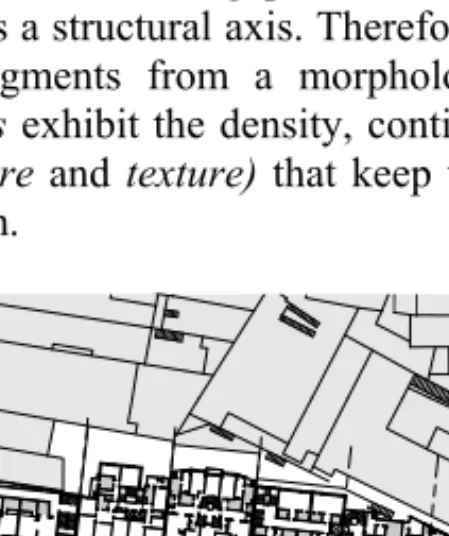
The constructed buildings, while radically different from the Oporto building tradition in terms of scale, style and typologies, maintained the alignment of the street, following pre-existent logic and, in this sense, reinforcing its role as a structural axis. Therefore, although the city blocks can be seen as fragments from a morphologic point of view, these
attractor frameworks exhibit the density, contiguity and regularity (i.e., a
high level of structure and texture) that keep them connected to the pre-existent urban system.
Fig 9.6: Upper blocks of Ceuta Street. Scale 1/2250 (author’s drawings)
2.2 The late 1950s – early 1970s: residential experiments in expansion areas
Located in expansion areas, Boavista residential park in the western part of the city and Campo do Luso residential complex to the north are both important cases of a paradigm shift regarding urban housing and associated exterior collective space design. In the early 1960s, these interventions clearly attempted to structure delimited parts of the city as
Contemporary Oporto Fragments 147
autonomous urban parts, moving away from the traditional closed block. In this sense, from a strictly morphological point of view, these open city blocks put forward an occupation by surface area with isolated residential buildings, where
the initial reference for their configuration are the parcel limits and the way these relate to access streets or roads, not producing either an urban fabric, or defining a continuous urban facade. (Calix Augusto, 2013)
The design of both developments stands out regarding their clear urban concept and defined structuring geometry, which guide the design of the plan, the positioning of each building and the relations that each established with the pre-existing surroundings. Both interventions suggest personal interpretations from the principles of the Charter of Athens, giving particular importance to the characterization of the collective outdoor space. They also introduced radical variations regarding residential types.
The Campo do Luso residential complex (late 1950s–early 1960s) has about 150 units (originally for renting) distributed in several isolated buildings spread over a continuous garden: two towers and two apartment blocks. Located in Alegria Street, in an area that was considered at the time as the first outskirts of Oporto, Campo do Luso represents an attempt to make the transition from the traditional condensed city to a modern urban fabric through the suggestion of new residential models.
Even though it aimed to design an alternative city model, Campo do
Luso did not question the traditional street as a structuring principle in the
urban system. Alegria Street is the main axis of a composition where each building and outdoors area had its role. For instance, one of the apartment blocks was intended to close the neighboring quarter perimeter while the other would define the background limit of the composition; the towers would reinforce the street alignment. Two service roads were created, closing the pre-existing city blocks. The service areas (kitchen, toilets) of the apartments face these service roads and backyards (Fig 9.7).
The collective exterior space, although open to the street, is slightly elevated, creating a subtle gradation of privacy. The towers and the apartment block near Alegria Street have raised basements. The ground floor of the towers has three stores and the concierge’s apartment while the ground floor of the apartment blocks is totally dedicated to dwellings or artist studios. The upper floors of the towers consist of two apartments on each floor, displaying typological options that emphasize solar exposure over the compartmental separation of the traditional front and rear facades.
Chapter Nine 148
Fig 9.7: Campo do Luso. Floor plan. Scale: 1/2250 (author’s drawings)
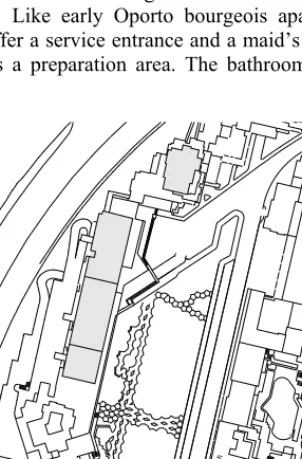
Boavista Residential Park (early 1960s–early 1970s) is located on Boavista Avenue, in the western part of the city, occupying a lot of
considerable size that also adjoins the Via de Cintura Interna (Oporto’s inner ring-road). This established a plan that combined collective dwellings (at the time to be sold) with several types of buildings: commercial galleries, office buildings and commercial, educational or religious buildings, such as a cinema, a hotel, a swimming pool and a church. This residential development relies on a strong urban concept where a defined geometry underlies the general plan, endowing it with rationality and intelligibility. This matrix organizes the location of each building, including the landmark buildings (Fig 9.8).
Taking the buildings perpendicular to Boavista Avenue as an example (eight-story apartment buildings), it is possible to highlight several distinctive features, considering the previous background of Oporto’s multifamily buildings. The buildings were placed parallel to each other, separated from Boavista Avenue by a slightly elevated small garden with footpaths and trees. There is an open car park between the buildings. The ground floor of these buildings is also slightly raised and separated from the street by small front yards, giving privacy to the ground floor
Contemporary Oporto Fragments 149
apartments and collective facilities such as meeting rooms. The entrance hall is clearly oversized, seeking permeability between the open front yards. Each floor has five apartments, the distribution of which clearly divides day and night activities. The living/dining room and the kitchen are on the western side of the building while the bedrooms are located on the opposite facade. Like early Oporto bourgeois apartments from the 1940s, these units offer a service entrance and a maid’s room; the kitchen is oversized and has a preparation area. The bathrooms are placed in a central location. GSPublisherEngine 588.0.86.100 GSEducationalVersion BOAVISTA Avenue A1 (Off ice build ing ) K (ch u rch ) M ( h otel) 15 15
Fig 9.8: Boavista Residential Park. Floor plan. Scale: 1/2250 (author’s drawings)
It is important to underline the density and multi-functionality of this real-estate development, the gradation of privacy through the design of the outdoor spaces (which connect the street system to the residential
Chapter Nine 150
buildings) and, finally, the detailed design of the ground floor and residential typologies. At different scales, all these solutions are closely related to the multiple dimensions of the city.
2.3 The early 1990s–early 2000: empty urban spaces to filled transition areas
The Mota Galiza Residential Complex and the Varandas da Foz Residential Quarter are two real-estate developments dating from the early 1990s and early 2000s. Similar to the developments from the 1960s/1970s, they result from the same intervention strategy – intensively occupying the available area with regard to its limits and making the necessary connections with the pre-existent urban fabric. Accordingly, these morphological territories are also occupations by surface area, although clearly with distinctive characteristics. The main differences are related to the size of the development, the way it connects with the surrounding streets and the way the commercial areas and offices are linked to the residential blocks.
The Mota Galiza Residential Complex (early 1990s) occupied the parcel of an old deactivated factory that faced Júlio Dinis Street, an important north-south axis in the city. This private real-estate investment involved a set of residential, commercial and office buildings; in particular, a large 170-meter curved building which, according to its authors, headed the general plan. At that time, this was one of the most iconic residential developments being built, and offered new ways of living in the city: distinctive buildings isolated with public gardens, with their own security systems, parking, services and shops (Fig 9.9).
The urban system that was created included a commercial area placed at the center of the curve, a service street that linked all the new buildings to the pre-existent streets and a public garden facing Júlio Dinis Street. The ground floor of the residential buildings is mostly commercial. Each floor has five apartment units of different sizes (with some exceptions), with each unit having two or three bedrooms, clearly separated from the daytime areas, as was usual in real-estate projects from the 1980s onwards. Since its opening, Júlio Dinis Street has been consolidated in line with traditional urban construction logics, with buildings facing the street. The
Mota Galiza project, which changed this pre-existent identity system
through the suggestion of an autonomous urban isle, seems to have failed to create a contemporary alternative while contributing to the loss of legibility of the main supporting street. Although this development displays a strong internal concept, which relates each building to the general plan, the segregated commercial areas, detached from the main
Contemporary Oporto Fragments 151
axis, are difficult to maintain, as well as the public garden, which lacks any connection to the footpaths actually used in the surroundings.
Fig 9.9: Mota Galiza Complex (©Google earth view and author’s photo)
The Varandas da Foz Residential Quarter (early 2000) resulted from an urban allotment process that occupied a large vacant lot near Campo
Alegre Street. It consists of five isolated multifamily housing units, eight
to fourteen stories high, with parking in the basement and individual shops, commercial galleries or apartments on the ground floor (Fig 9.3, Fig 9.10).
The structuring principle stated in the licensing project for the development was the connecting of two existent secondary streets –
Campo Alegre Alley and Progresso Street – through the opening of a new
street (Júlio Lourenço Pinto Street). The development was partially organized in the form of a closed condominium, mostly because of security concerns regarding its proximity to a problematic social housing neighborhood.
Each residential block forms a different relation to the new street, materialized by the conception and design of the exterior collective space, namely terraces, stairs and small gardens. Although these architectural solutions are efficient in terms of separating the ground floor apartments from the street, they also contribute to low affluence for the commercial areas.
The entrance halls of the buildings are quite small, serving the singular purpose of providing access to common lifts and staircases. An interior gallery provides access to the single-fronted apartments. This solution results in apartments that either have good solar exposure and views (facing south and the new street), or are turned to the interior of the pre-existent block, facing north.
Another remarkable fact is the narrowness of the two access roads to the Varandas da Foz development, which seems to dictate the segregation of this urban area along with the lack of suitable commercial areas or educational buildings.
Chapter Nine 152
Fig 9.10: Varandas da Foz Residential Quarter. Scale: 1/2250 (author’s drawings)
3. Conclusion
(…) the multi-family housing typologies are dominant in the urban context and reflect the partial accomplishment of a determined city model. To intervene in those contexts implies an awareness of the architectural and urban planning options that might be involved.(Fernandes, 1996)
The composite Oporto city is the result of the overlap of fragments from different decades, combined with several intervention strategies, architectural ideas and ways of building. This research framework expected to underline the fact that new housing building types, like new floor-plan distributions, should not ignore long-term formal relations between the city and its buildings. In Oporto, this relationship has traditionally relied on the primacy of public space, namely, on the reinforcement of the street as a structuring anchor, which can still be perceived until the interventions of the early 1960s and late 1970s.
It is not possible to establish a direct comparison between the interventions in the city center (such as the upper blocks of Sá da Bandeira and Ceuta Street) and later peripheral interventions due to substantial differences both in the proposed city model and the resulting morphological characteristics of the area. Nevertheless, the degree of their articulation with the pre-existent urban fabric appears to be more likely the result of determined typological and morphological intervention options than a consequence of the surrounding level of consolidation.
Contemporary Oporto Fragments 153
Unlike interventions such as the Sá da Bandeira and Ceuta upper blocks (attractor urban frameworks, with inbuilt articulation capabilities), both the Boavista Residential Park and Campo do Luso Complex (surface
occupation areas, with strong urban concepts) became integrated parts of
the urban fabric. Other surface occupation areas, such as the Mota Galiza Complex and the Varandas da Foz Quarter, apparently remained as cut- offs. On the morphological relationship between collective housing and the city, these interventions have developed opposite strategies, which seem to have dictated their characteristic nature as urban fragments.
From this viewpoint, their degree of integration can be explained at several levels that are independent of the location in the city and the architectural quality of the buildings themselves.
Adopting strong urban concepts to guide the proposed city models. Defining landmarks. As a real-estate development, the Boavista Residential Park suggests an urban model close to some of the principles of the Athens Charter, in which the dimension of the intervention, the rationality of the disposition of the buildings, the multi-functionality of the program and the existence of reference points have dictated its success as an independent yet cohesive fragment in the city. That is not the case with the Varandas da Foz Quarter: in fact, the design of the new street and the implantation of the blocks defines a continuous urban structure without reference points or symbolic landmarks.
Promoting the design of open collective spaces. The highlight of interventions such as the Boavista Residential Park and the Campo do
Luso Complex is the design of the outdoor spaces and the relation
established with the traditional street and the pre-existent blocks. In fact, neither the dissolution of the closed urban block, traditional in Oporto, nor the introduction of new residential types seems, in this particular case, to have changed pre-existent and conventional interactions between buildings and public space.
Privileging articulation with what is pre-existent rather than an objectual understanding. Over time, the “closed design” of the Mota
Galiza general plan demonstrated its inability to polarize the urban system
or create a structure for later constructions or urbanization actions. Focusing upon this area, it can be said that the objectual understanding related to the architectural development led to an unconnected fragment. Although the Varandas da Foz and Mota Galiza developments seem, generally speaking, to have similar surface area occupation types (as the interventions from the 1970s), their articulation with pre-existent forms is limited to street connections. In the Sá da Bandeira and Ceuta interventions, for example, other building dimensions reinforce their