Raquel Carvalho de Ferreira Costa e Almeida
Crosstalk between endothelial progenitor cells
and fibroblasts in vascularization
Dissertação de candidatura ao grau de Mestre em Engenharia Biomédica,
apresentada à Faculdade de Engenharia da Universidade do Porto
Faculdade de Engenharia
Universidade do Porto
This work was supervised by:
Professora Doutora Raquel Soares
Faculdade de Medicina da Universidade do Porto Departamento de Bioquímica (U38-FCT)
and
Doutor Pedro Lopes Granja
Faculdade de Engenharia da Universidade do Porto INEB – Instituto de Engenharia Biomédica
Host institutions:
Centro de Investigação Médica
Faculdade de Medicina da Universidade do Porto Departamento de Bioquímica (U38-FCT)
Rua Dr. Plácido da Costa, 91, 4200- Porto, PORTUGAL www.med.up.pt
IBMC – INEB Associate Laboratory
Rua do Campo Alegre, 823, 4150-180 Porto, PORTUGAL INEB – Instituto de Engenharia Biomédica www.ineb.up.pt
Acknowledgements
After finishing my first degree, I decided to enrol in a master program with the objective of growing, both as a person and as a researcher. Throughout my evolution and to make this work possible many people contributed with their effort, dedication and advisement and I would like to address a special thank to all of them.
First, to my supervisor, Professor Raquel Soares, for kindly accepting me at the Department of Biochemistry, for every friendly word of encouragement through all the difficulties and for sharing a small part of her knowledge (I learned a lot!).
To my co-supervisor, Dr Pedro Granja, for giving me the opportunity to work with him, for his patience and for making me so curious about tissue engineering and regeneration.
To Susana Guerreiro for guiding me through this work and for being so meticulous in every detail.
To María Lázaro for all her support and friendship, for every brainstorming and for sharing a lot of ideas.
To Susana Oliveira from Centro de Histocompatibilidade do Norte (Porto, Portugal) for providing the cell culture equipment and to Dr Carla Ramalho from
Serviço de Ginecologia e Obstetrícia at Hospital de S. João (Porto, Portugal) for
providing umbilical cord blood samples.
To all people from Dept. of Biochemistry that contributed for an enjoyable scientific environment and, particularly, to Raquel Costa, Ângela, Vera and Ilda for all the help and patience, as well as Andreia for her friendship.
To Bioinspired hydrogels team (thanks for all the help and useful questions) and all INEB, in particular, Perpétua (thanks for teaching me everything I know about stem cells and for being so helpful whenever I had a doubt!), Maria Oliveira, Patrícia Cardoso and Catarina Almeida.
To the Portuguese Government for supporting me throughout my academic path, by providing a social scholarship, without which I would not be able to be enrolled in any of my degrees.
To all my friends for all the support and encouragement specially Ana, Joca, Marta and André.
To my brothers (you know why!) and to my grandfather, Valdemar, for (still) inspiring me in everything I do (and for all the great memories).
Abstract
Vascularization is a major challenge in tissue engineering. Different strategies exist, and cell-based approaches have emerged as a promising therapy to achieve successful vascularization. Co-culture systems of endothelial cells (ECs) and other supporting cells may have an important role in what refers to cellular crosstalk, namely through the production of growth factors and extracellular matrix (ECM) synthesis. Since activation and migration of fibroblasts is required for several physiological events that rely on angiogenesis, the hypothesis underlying the research reported in the present work is that human outgrowth endothelial cells (OECs) and mature ECs respond differently when co-cultured with different types of human fibroblasts, in what concerns the formation of capillary-like structures. To investigate this, OECs were isolated from human umbilical cord blood samples and characterized by immunofluorescence, western blot and imaging flow cytometry. Also, two types of human dermal fibroblasts were used (neonatal human foreskin fibroblasts – HFF-1 – or juvenile human dermal fibroblasts – HDF), being characterized in terms of the expression of podoplanin (PDPN) and transglutaminase-2 (TG2), markers of dermal fibroblasts, as well as alpha smooth muscle actin (α-SMA), a marker of fibroblast activation. Co-culture systems were established using either human umbilical vein ECs (HUVECs) or OECs with HFF-1 or HDF. Two 3D systems were compared in the present work – one in 3D without the addition of an external ECM (co-culture) and another in 3D with the addition of an external ECM (matrigel) at the beginning of the assay. Several culture time points were evaluated: 7, 14 and 21 days for the co-culture system; 24h, 48h and 7 days for the matrigel assay.The formation of capillary-like structures was assessed by immunocytochemistry against CD31 and vWF proteins. Parameters such as the number of tubular structures and branching points, length and thickness were evaluated. The presence of ECM components, such as collagen types I and IV, laminin and fibronectin, was assessed in all cell types and in co-cultures of HUVEC/HDF by immunofluorescence and western blot.
OECs expressed several endothelial markers, including CD31, VE-cadherin and vWF, as well as VEGFR2 and CD34. HFF-1 exhibited a higher expression of TG2 than that observed for HDF, while HDF expressed higher amounts of PDPN and α-SMA. Fibroblasts influenced the formation of capillary-like structures by endothelial cells. Indeed, the formation of capillary-like structures was only observed in co-cultures with HDF and not with HFF-1 fibroblasts. In addition, in the co-culture system, HUVECs formed a highly branched capillary-like network to a great extent than that observed for OECs. In the matrigel assay, HUVECs and OECs behaved similarly when co-cultured
viii
with HDF. In terms of ECM, HUVECs were found to secrete collagen type IV, fibronectin and laminin to the extracellular media, whereas in OECs these proteins were only detected intracellularly. HDF were able to secrete all the investigated ECM components, primarily collagen I, which is lacking in HUVECs, OECs and HFF-1. In co-cultures of HUVEC/HDF, it was observed that all investigated ECM components were present, with collagen types I and IV being mainly expressed where capillary-like structures were present.
These findings suggest that HDF is a preferential cell source for enhancing vascularization, both in HUVECs and OECs. Given the already described advantages of OECs, these findings open a new field of research regarding the use of specific fibroblast populations co-cultured with OECs, as efficient partners for vascular development with tissue regeneration purposes.
Keywords: Endothelial cells, Co-culture models, Fibroblasts, Tissue Regeneration, Vascularization
Resumo
A vascularização é um dos maiores desafios em engenharia de tecidos. Existem diferentes estratégias e abordagens baseadas no uso de células emergiram como terapia promissora para se alcançar, com sucesso, vascularização. Os sistemas de co-culturas de células endoteliais (CEs) com outras células de suporte podem ter um papel importante no que se refere à comunicação celular, nomeadamente através da produção de fatores de crescimento e síntese de matriz extracelular (MEC). Dado que a ativação e migração de fibroblastos são requisitos de diversos eventos fisiológicos que dependem de processos angiogénicos, a hipótese subjacente ao presente trabalho é a possibilidade de células endoteliais progenitoras tardias (OECs) e ECs maduras responderem de forma distinta quando co-cultivadas com diferentes tipos de fibroblastos, em termos de formação de estruturas semelhantes a capilares. A fim de investigar esta hipótese, OECs foram isoladas a partir de amostras de sangue do cordão umbilical humano e caracterizadas por imunofluorescência, western blot e citometria de fluxo. Dois tipos de fibroblastos humanos da derme foram igualmente usados (fibroblastos neonatais humanos – HFF-1 – ou fibroblastos juvenis humanos – HDF), sendo caracterizados em termos da expressão de marcadores fibroblásticos da derme, incluindo podoplanina (PDPN) e transglutaminase-2 (TG2), assim como α-actina de músculo liso (α-SMA), um marcador de ativação de fibroblastos. Sistemas de co-culturas foram estabelecidos, usando tanto CEs de veia umbilical humana (HUVECs) ou OECs com HFF-1 ou HDF. Dois sistemas 3D foram comparados no presente trabalho – um sem adição de uma matriz externa (co-cultura) e outro em que se adicionou uma matriz (matrigel) no início do ensaio. Foram avaliados diversos tempos de cultura. 7, 14 e 21 dias, no sistema de co-cultura; 24, 48h e 7 dias, no caso do ensaio em matrigel. A formação de capilares foi determinada através de imunocitoquímica contra as proteínas CD31 e vWF, tendo sido avaliados parâmetros como o número de estruturas tubulares e pontos de ramificação, comprimento e diâmetro. A presença de componentes da MEC, incluindo colagénios tipos I e IV, laminina e fibronectina, foi estudada em todos os tipos de células e nas co-culturas de HUVEC/HDF por imunofluorescência e western blot.
As OECs expressaram vários marcadores endoteliais, incluindo CD31, VE-caderina e vWF, bem como VEGFR2 e CD34. Os HFF-1 exibiram uma maior expressão de TG2, enquanto os HDF expressaram PDPN e α-SMA em maiores quantidades. Os fibroblastos influenciaram a formação de estruturas-tipo capilares pelas células endoteliais. De facto, a formação de estruturas-tipo capilares foi apenas observada apenas nas culturas com HDF e não com HFF-1. Além disso, no sistema de
co-x
cultura, as HUVECs formaram uma rede-tipo capilar altamente ramificada, numa maior extensão do que aquela observada no caso das OECs. No ensaio de matrigel, HUVECs e OECs tiveram um comportamento semelhante quando co-cultivadas com HDF. No que se refere à MEC, observou-se que as HUVECs secretaram colagénio tipo IV, fibronectina e laminina para o meio extracelular, enquanto as mesmas proteínas nas OECs foram detetadas apenas intracelularmente. Os HDF também secretaram todos os componentes da MEC, principalmente colagénio tipo I, que não foi encontrado nas HUVECs, OECs e HFF-1. No sistema de co-cultura de HUVEC/HDF, observou-se que estavam presentes todos os componentes da MEC investigados, sendo os colagénios tipo I e IV maioritariamente expressos onde estruturas-tipo capilares estavam presentes. Estes resultados sugerem os HDF como um fonte preferencial de células para melhorar a vascularização, tanto com HUVECs como com OECs. Tendo em consideração as vantagens já descritas para as OECs, os presentes resultados criam uma nova área de investigação, no que respeita ao uso de populações específicas de fibroblastos em co-cultura com OECs, enquanto parceiros eficazes para o desenvolvimento vascular com fins de regeneração de tecidos.
Palavras-chave: Células endoteliais, Modelos de co-culturas, Fibroblastos, Regeneração de Tecidos, Vascularização
Communications under the scope of this thesis
Raquel Costa-Almeida, Susana G. Guerreiro, Maria Gomez-Lazaro, Pedro L. Granja, Raquel Soares. “Vascularization in tissue engineering: assessing the role of human dermal fibroblasts”. Advanced Summer School Inflammation/ Repair Interface. INEB, IPATIMUP, IBEC. Porto, June, 2013 (Poster and speed talk presentation).
Raquel Costa-Almeida, Susana G. Guerreiro, Pedro L. Granja, Raquel Soares. “Vascularization in tissue engineering – Crosstalk between outgrowth endothelial cells and fibroblasts”. ICTE – International Conference on Tissue Engineering. ISCTE, Leiria, June, 2013 (Oral communication).
Raquel Costa-Almeida, Susana G. Guerreiro, Pedro L. Granja, Raquel Soares. “Crosstalk between outgrowth endothelial cells and fibroblasts in vascularization”. IJUP 2013 – 6th Meeting of Young Researchers of University of Porto, February, 2013 (Poster
presentation).
Papers under the scope of this thesis
Raquel Costa-Almeida, Pedro L. Granja, Raquel Soares, Susana G. Guerreiro. “Cellular strategies to promote vascularization in tissue engineering”. (Review article, to be submitted).
Raquel Costa-Almeida, Maria Gomez-Lazaro, Pedro L. Granja, Raquel Soares, Susana G. Guerreiro. “Crosstalk between endothelial cells and fibroblasts in vascularization”. (Original article, in preparation).
Table of contents
ACKNOWLEDGEMENTS ... v
ABSTRACT ... vii
RESUMO ... ix
LIST OF FIGURES ... xv
LIST OF TABLES ... xvii
ABBREVIATIONS ... xix
CHAPTER I INTRODUCTION ... 1
1.1. The relevance of vascularization in Tissue Engineering ... 1
1.2. The vascular network ... 2
1.2.1. Endothelial Cells ... 4
1.2.2. Mural cells ... 8
1.2.3. Fibroblasts ... 9
1.3. The extracellular matrix ... 10
1.4. Cellular crosstalk and communication: the case of co-culture systems ... 11
1.4.1. Co-cultures of ECs with pericytes ... 11
1.4.2. Co-cultures of ECs with smooth muscle cells ... 12
1.4.3. Co-cultures of ECs with fibroblasts ... 13
1.5. Hypothesis and objectives ... 14
Chapter II MATERIALS AND METHODS ... 17
2.1. Cell culture... 17
2.1.1. Isolation and expansion of human outgrowth endothelial cells ... 17
2.1.2. Culture of HUVECs ... 18
2.1.3. Culture of Fibroblasts ... 18
2.2. Charactrization of OECs by imaging flow cytometry ... 19
2.3. Assembly of OECs into capillary-like structures by Matrigel assay ... 19
2.4. Direct contact co-culture of endothelial cells and fibroblasts ... 19
2.5. Characterization of cell phenotype and ECM by immunocytochemistry ... 20
2.6. Protein extraction ... 20
2.7. Western blot analysis for cell characterization and ECM components quantification .... 21
2.8. Preparation of fibroblast conditioned media ... 22
2.9. Determination of metabolic activity be MTS assay ... 22
2.10. Co-cultures of endothelial cells and fibroblasts in Matrigel... 22
2.11. Image and imaging quantification ... 23
xiv
Chapter III RESULTS ... 25
3.1. Endothelial phenotype of OECs from umbilical cord blood ... 25
3.2. Effect of different culture media in EC metabolic activity ... 29
3.3. Characterization of fibroblasts ... 30
3.4. Fibroblasts influenced EC assembly into capillary-like structures ... 31
3.5. Extracellular matrix production by different cell types ... 36
3.6 EC metabolic activity in response to conditioned media from fibroblasts ... 38
3.7. Assembly of ECs into a 3D microcapillary-like network in Matrigel ... 39
Chapter IV DISCUSSION ... 43
Chapter V CONCLUSIONS AND PERSPECTIVES ... 49
List of figures
CHAPTER I
Figure 1.1. Summary of strategies used to promote vascularization for tissue engineering
applications ... 2
Figure 1.2. Schematic representation of the biological processes involved in vascularization, including cell-cell/ cell-matrix interactions ... 4
Figure 1.3. Schematic representation of blood vessels constitution ... 8
CHAPTER II Figure 2.1. Isolation of OECs from umbilical cord blood ... 18
Figure 2.2. Experimental design for co-culturing endothelial cells and fibroblasts in Matrigel ... 23
CHAPTER III Figure 3.1. Morphology of outgrowth endothelial cells in culture ... 25
Figure 3.2. Immunophenotypic characterization of OECs ... 26
Figure 3.3. Characterization of the phenotypic heterogeneity of OECs by imaging flow cytometry ... 28
Figure 3.4. Assembly of OECs into capillary-like structures in Matrigel ... 29
Figure 3.5. EC metabolic activity in response to different culture media ... 30
Figure 3.6. Characterization of fibroblasts ... 31
Figure 3.7. Co-cultures of HUVECs with fibroblasts... 32
Figure 3.8. Luminal structures in co-cultures of HUVEC/HDF ... 33
Figure 3.9. Co-cultures of OECs with fibroblasts ... 34
Figure 3.10. Comparison between HUVEC/HDF and OEC/HDF co-cultures ... 35
Figure 3.11. Number of capillary-like structures, branching points, length and diameter in HUVEC/HDF co-cultures ... 36
Figure 3.12. ECM components produced by ECs ... 37
Figure 3.13. ECM components produced by fibroblasts ... 37
xvi
Figure 3.15. EC metabolic activity in response to conditioned media from fibroblasts after
24h ... 39
List of tables
CHAPTER I
Table 1.1. Overview on characteristics that distinguish between EPCs and OECs ... 7
CHAPTER III
Abbreviations
CD31 – Cluster of differentiation molecule 31 (=PECAM-1) CD34 – Cluster of differentiation molecule 34
CD144 – Cluster of differentiation molecule 144 (=VE-cadherin) CM – Conditioned medium
DMEM – Dulbecco’s Modified Eagle Medium EC – Endothelial cell
ECM – Extracellular matrix
EGM-2 – Endothelial Growth Medium-2
EGM-2MV – Microvascular Endothelial Growth Medium-2 EPC – Endothelial progenitor cell
GFR – Growth factor reduced
HDF – Juvenile human dermal fibroblast HFF-1 – Neonatal human foreskin fibroblast HUVEC – Human umbilical vein endothelial cell MMP – Matrix metalloproteinase
MNC – Mononuclear cell
OEC – Outgrowth endothelial cell PDPN - Podoplanin
SMC – Smooth muscle cell TG2 – Transglutaminase-2
TGF-β – Transforming growth factor beta VEGF – Vascular endothelial growth factor
VEGFR2 – Vascular endothelial growth factor receptor 2 (=Flk-1) vWF – von Willebrand factor
CHAPTER I
INTRODUCTION
1.1. The relevance of vascularization in Tissue Engineering
The regeneration of a lost or damaged tissue function in the adult generally involves a recapitulation of developmental processes, consequently implying the replication of biological concepts and instructions expressed during the embryonic development (1). This is the main reason why regeneration of large defects in a human adult tissue does not occur naturally. The majority of reconstruction and cosmetic surgeries use autologous donor sites as a source of soft tissue, which creates a secondary wound and increases surgery and recovery times, as well as a higher risk of infection and potential loss of function, resulting in a great demand for engineered/ artificial soft tissues for clinical applications (2).
Each tissue is constituted by several cell types, resulting in a complex structure, highly organized and integrated into the body, namely through the vascular and the nervous systems. Tissue engineering has been evolving as an interdisciplinary science which intends to restore, maintain or improve tissue function (3). In general terms, tissue engineering aims for the creation of adequate tissue or even organ equivalents, which is, therefore, a highly challenging task (4). Nowadays, only in vitro tissue engineered products for skin and cartilage are successfully used in clinics (5), since their demands in terms of blood supply are reduced, owing to the fact that these tissues are supplied through diffusion from distant blood vessels. However, the maximum diffusion distance of nutrients and oxygen out of blood vessels is 200 µm (6) and, due to mass transfer
2
limitations, organs with a more complex tridimensional structure actually need an integrated vascular network to support cell survival.
Overall, the inability to engineer blood vessels in vitro for subsequent transplantation has been referred as the main reason associated to the limited clinical success of tissue engineering strategies (5, 7, 8). When a tissue engineered construct, including transplanted cells, faces insufficient blood supply, associate problems arise due to the lack of nutrients and oxygen transportation, as well as elimination of metabolites, resulting in functional limitations of the bioengineered tissue or even to the failure of the implanted construct. Hence, several strategies have been investigated concerning vascularization for tissue engineering applications (Fig. 1.1), like growth factor delivery, cell transplantation and the use of materials for immobilization strategies (scaffold-based approaches), which have been extensively reviewed (5, 7, 9). In fact, there have been different efforts to develop new therapies so that a faster and successful vascularization is achieved.
Figure 1.1. Summary of strategies used to promote vascularization for tissue engineering applications. Growth factor delivery and cell transplantation are traditional strategies that present several
associated problems and have been improved through their combination and the use of scaffold materials.
1.2. The vascular network
The vascular network is responsible not only for the transport of gases, nutrients and metabolites, but also for the circulation of signalling molecules, hormones and antibodies between tissues and organs. Also, blood vessels work as a transport system for factors
that are produced by endothelial cells (ECs), particularly angiogenic factors, like vascular endothelial growth factor (VEGF).
The complex structure of the vascular network is achieved by the maturation of the immature blood vessels previously formed by angiogenesis or vasculogenesis (10). Vasculogenesis refers to the in situ formation of vessels orchestrated directly by endothelial precursor cells or angioblasts, whereas angiogenesis is defined as the process of new blood vessels formation through the sprouting of preexisting vasculature. Vasculogenesis is of major importance during embryonic development, but plays also a role in adulthood both in physiological, as well as in pathological conditions. On the other hand, angiogenesis plays a crucial role throughout postnatal life, being related to wound healing and the menstrual cycle (11, 12), inflammatory processes and also some pathological conditions, as rheumatoid arthritis, diabetic retinopathy, macular degeneration and tumor growth (13, 14), as well as accompanying growth repair, tissue remodeling and regeneration (6, 10, 15, 16).
The recruitment of new blood vessels through the activation of these two main processes of vascularization is still considered to be a great challenge in regenerative approaches. Different blood vessels exist, which express characteristic molecular markers. Endothelial precursors that form arteries express ephrin B2 (Efnb2), whereas its receptor, the B4 ephrin receptor (Ephb4), is preferentially expressed in veins (17). However, all blood vessels are formed by one thin inner layer of ECs, the endothelium, which is then covered by supporting cells, such as pericytes or smooth muscle cells and fibroblasts, which contribute for vessel stabilization and maturation. This vascular endothelium provides a selective barrier, separating the blood stream from the underlying tissues, with vascular wall cells being thus embedded in an extracellular matrix (ECM, Fig. 1.2).
4
Figure 1.2. Schematic representation of the biological processes involved in vascularization, including cell-cell/ cell-matrix interactions. The vascular endothelium is formed by one layer of
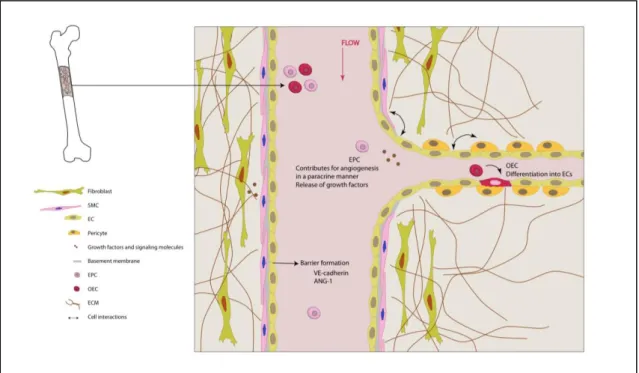
endothelial cells (EC). Their expression of adhesion molecules, like VE-cadherin and angiopoietin (Ang)-1, allows for intercellular interactions, which are important for vessel stabilization. Vascular maintenance is achieved through specific signaling (release of growth factors and signaling molecules) and direct physical contact between endothelial cells and mural cells, such as smooth muscle cells (SMC) and perycites, or fibroblasts. The extracellular matrix (ECM) will act as a bridge between blood vessels and the surrounding tissue. Moreover, different populations of endothelial progenitor cells exist in circulation – early endothelial progenitor cells (EPC) and outgrowth endothelial cells (OEC). These cells have distinct roles in vascularization: EPCs contribute for vascularization/angiogenesis in a paracrine manner through the release of growth factors, while OECs are able to contribute for the repair and formation of blood vessels by differentiating into mature ECs.
1.2.1. Endothelial cells
Endothelial cells (ECs) play a pivotal role in vascularization, forming the vascular endothelium. These cells characteristically express von Willebrand factor (vWF), platelet endothelial cell adhesion molecule-1 (PECAM-1 or CD31), and vascular endothelial (VE)-cadherin (18-20). However, molecular differences exist between endothelial cell populations due to the heterogeneity along this cell lineage, resulting in high variability when their functional behavior is assessed through angiogenesis assays (21). Some authors consider that mature endothelial cells (ECs) present a limited regenerative potential (22). The discovery of putative endothelial progenitor cells (EPCs) in 1997 (23) contributed to enlarge the knowledge of endothelial cell populations and to change the prevailing dogma until then, which stated that throughout postnatal life new blood vessels could only be generated by fully differentiated ECs. In fact, blood vessels are believed to be newly formed by endothelial precursors (15).
Although embryonic and adult stem cells exhibit a higher proliferative capacity (24), the use of EPCs has emerged as an alternative to them (25). EPCs exist in circulation
and have been described as being capable of incorporating into vessels after mobilization from bone marrow, in order to participate in neovascularization at sites of ischemia (23). These cells overcome some ethical considerations along with a deficient knowledge considering the control of embryonic stem cells differentiation (26). Two different types of EPCs are believed to exist, early EPCs and late EPCs, here called outgrowth endothelial cells (OECs) (20, 22, 27, 28), being commonly isolated from peripheral or umbilical cord blood. Other sources of endothelial progenitors include the adipose tissue (29, 30) and the amniotic fluid (31). Moreover, several works refer the bone marrow as a reservoir of EPCs (32-34), while others reported that these cells cannot be isolated from the bone marrow neither from cells mobilized from this organ (35). This finding defies the concept of bone marrow-derived circulating precursors of endothelial cells, originating further speculation about the eventual existence of a vascular source outside the bone marrow, or of a common precursor for endothelial progenitor cells and for hematopoietic stem cells. There is a great need to further explore these issues in future works, to improve knowledge on vascular biology, so that it can be applied to the development of tissue engineering strategies.
Despite their origin, these progenitor cells seem to be mobilized into circulation, contributing to the neovascularization process (24). However, there is still great controversy associated to the term “endothelial progenitor cell”. The main distinguishable features of both types of EPCs are briefly described in table 1.1. Early EPCs appear after 4 to 7 days in culture and have been described as bone marrow-derived cells, sharing surface markers expressed by hematopoietic stem cell populations, as CD14, CD45 and CD133 (20, 23, 36, 37), differentiating into phagocytic macrophages and possessing myeloid progenitor cell activity (38). On the other hand, OECs appear much later, after 14 to 21 days, exhibiting typical endothelial characteristics and being reported to incorporate into resident vasculature (22, 28, 39). Some authors reported that early EPCs failed to form interconnected vascular networks de novo, whereas OECs formed branching interconnected vascular networks after 72 hours in co-culture, being maximal after 14 days (22), which suggests a higher angiogenic potential associated to OECs (39). Moreover, early EPCs have been shown to preferentially express genes involved in immune responses and inflammation, while OECs expressed genes involved in development and angiogenesis, including the angiopoietin receptor Tie2, endothelial nitric oxide synthase (eNOS), ephrins and transforming growth factor (TGF)-β (20). A more recent study also showed that umbilical blood derived OECs secrete a broad spectrum of proinflammatory and angiogenic cytokines, including angiogenin, angiopoietin (Ang)-2 and platelet-derived growth factor (PDGF)-BB (40).
6
Table 1.1. Overview on characteristics that distinguish between EPCs and OECs. Adapted from Fuchs et al. 2010 (4) and Yoon et al. 2005 (41).
EPCs OECs Marker functions
Morphology
(4, 27, 41)
Spindle shaped morphology Cobblestone-like morphology
Appearance in culture After 7 days in culture (4, 42) After 2-3 weeks in culture (4, 27)
Human phenotypic markers CD31+ (22, 23) CD45+ (22, 43) CD34+ (23, 41) CD14+ (22, 41) CD146+ (22) CD133+ (44-46) Flt-1+ (42) eNOS (42) vWF+ (38, 42) VE-cadherin+ (42, 47) KDR+ (22, 42, 47) CD36+ (27) Tie2+ (23, 48) Caveolin-1- (20) CD115+ (38) CD31+ (18, 22) CD45- (22, 43) CD34+ (41, 43) CD14- (22, 41) CD146+ (18, 22) CD133- (43) Flt-1+ (42) eNOS (42) vWF+ (18, 38, 42) VE-cadherin+ (18, 27, 42) KDR+ (22, 41, 42) CD36+ (27) Tie2+ (48) Caveolin-1+ (18, 20, 48) CD115- (38)
Cell contact protein that mediates homotypic EC adhesion.
Surface transmembrane phosphatase expressed in hematopoietic lineage cells. Stem-cell-related marker.
Monocyte surface marker.
Adhesion molecule that mediates homotypic EC adhesion. Stem-cell-related surface marker.
VEGF receptor-1.
Modulates VEGF-induced angiogenesis and vascular permeability in vivo. Constitutive glycoprotein of the endothelium.
Cell contact protein that mediates homotypic EC adhesion. VEGF receptor-2.
Receptor of TSP-1 and mediator of its anti-angiogenic activity Cell surface receptor that bind and is activated by the angiopoietins. Marker of endothelial differentiation. Upregulated during vessel formation. Macrophage-specific antigen.
Proliferative potential Low (22, 41, 42) High (22, 41, 42)
Tube formation No (22, 42, 48) Yes (22, 42, 48)
1.2.2. Mural cells
Endothelial cells first associate to form tubules and afterwards mural cells are recruited allowing vessel maturation and stability (10). Signals involved in the recruitment and coverage of ECs by mural cells include PDGF-B, Ang1, TGF-β and NOTCH signaling (16).
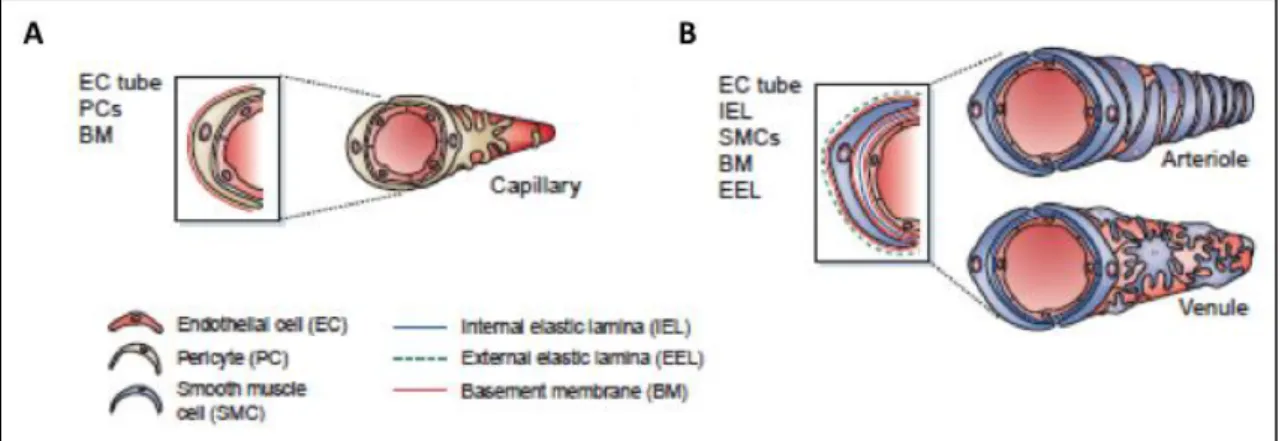
Different mural cells exist depending on their morphology, location and the expression of specific markers, being divided into pericytes and smooth muscle cells (SMCs) (49) and contacting the microvascular basement membrane in different microvascular beds (50). Vascular SMCs are present in larger blood vessels, as arteries and veins, forming multiple concentric layers, whereas microvessels are covered by pericytes often organized in a discontinuous cell layer around the endothelial cell tube (49) and embedded within the vascular basement membrane (50) (Fig. 1.3).
Figure 1.3. Schematic representation of blood vessels constitution. (A) Capillaries are the most
abundant vessels in the human body, consisting of endothelial cells surrounded by basement membrane and a sparse layer of pericytes embeeded within the basement membrane. (B) Arterioles and venules are the vessels that will originate arteries and veins, respectively, and are covered by smooth muscle cells, having an increased coverage of mural cells, when compared to capillaries. Adapted from Jain (10).
These periendothelial cells contribute to stabilize blood vessels through direct physical contact (51), ECM deposition (52) and growth factors release, as VEGF and Ang-1 (16, 51, 52).
Different tissues exhibit varying mural cell morphology and different degrees by which they cover the endothelium (49).
8
1.2.3. Fibroblasts
Fibroblasts are mesenchymal cells and can be quite different in terms of cell dynamics, depending on their tissue of origin (53). They are the main source of ECM components (53, 54), including collagen I, fibronectin and proteoglycans (55). Human fibroblasts are abundant in the dermis and can be easily obtained from minimally invasive skin biopsies, using standard laboratory protocols (56, 57). Therefore, human dermal fibroblasts have been quite used for skin tissue engineering applications and have gained an increasing interest as a cell source for other applications, like neovascularization. Considering their location within the dermis, human dermal fibroblasts are divided into papillary (superficial dermis) and reticular (deep dermis) fibroblasts, exhibiting different characteristics in terms of cell morphology, production of ECM and growth factors, among others (58, 59). Although there is no specific marker to distinguish both fibroblasts, Janson et al. investigated the differences in gene expression patterns between these two types of fibroblasts, reporting that reticular fibroblasts showed an increased expression of genes involved in cell motility and contraction, including calponin 1 and transglutaminase 2, whereas papillary fibroblasts characteristically expressed genes involved in the immune response, such as netrin-1 and podoplanin (59). In what concerns to vascularization, a study reported that papillary fibroblasts were able to support the formation of highly branched tubular-like structures
in vitro, while reticular fibroblasts were not (60). Therefore, human dermal fibroblasts
might be used in cell therapies aiming for the revascularization of a damaged tissue. For instance, the adventitial layer of large blood vessels is mainly composed by fibroblasts and associated ECM components (52). Besides, fibroblasts secrete potent angiogenic factors, like VEGF and fibroblast basic factor (FGF)-2, as well as matrix metalloproteinase (MMP)-2 and MMP-9 (61), which are proangiogenic metalloproteinases. Hence, it is possible that fibroblasts act as periendothelial progenitors in vivo (52), supporting EC survival and migration, as well as modulating the expansion of capillary-like networks, particularly in vitro (62). Moreover, since fibroblasts generate a scaffold for other cells through matrix deposition, they may alter the mechanical extracellular microenvironment, regulating vascularization processes (63).
1.3. The extracellular matrix
The ECM acts as a bridge between vascular wall cells and the respective surrounding tissues. Providing a three-dimensional (3D) support for EC proliferation and survival, ECM has a dual role – it acts as an adequate substrate for the organization of ECs into microvessels, simultaneously retaining and concentrating growth factors in the cellular microenvironment (61). ECM is therefore considered a reservoir of proteins that are involved in several physiological events, including wound healing and angiogenesis. The presence of proteases or protease inhibitors leads to changes in the bioavailability of matrix-sequestered factors (64).
Capillary morphogenesis is regulated through the immobilization of angiogenic cytokines, growth factors and other molecular cues involved in angiogenic activation (65), as well as by angiogenesis inhibitors (66). MMPs exist, which release pro-angiogenic (67) and anti-pro-angiogenic peptides (68), through ECM cleavage (69). In particular, the endothelium is separated from the connective tissue by the basement membrane, a specialized layer of ECM where collagen IV and laminin, together with heparin sulfate proteoglycans, organize into networks, being both essential for basement membrane stability (70, 71). Collagen IV has been described as having the capacity to modulate the angiogenic response in a rat aorta model, resulting in the elongation of the neovessels (72). On the other hand, cleavage of collagen IV may result in the release of tumstatin and other angiogenesis inhibitors (66), showing the relevance of the ECM in regulating vascularization, among other physiological processes. In the case of laminins, they have been shown to be involved in the regulation of blood vessel diameter, rather than vascular development, in a model of embryoid bodies (71).
In addition, it is worth to mention that fibronectin, a component from the ECM of developing microvessels, also acts as a scaffold for cell adhesion and migration (73, 74) and plays a role in the elongation of these developing microvessels (75).
Moreover, ECM stiffness has also been proved to be essential for lumen formation by ECs (76).
Given that ECM proteins also possess binding sites for cells to adhere through their surface receptors, ECM acts as a key controller of cell behavior, activating several intracellular signaling pathways and, in turn, cells degrade and remodel the ECM (65, 70, 77). Hence, understanding cell-matrix interactions is of major importance to mimic the natural ECM when developing functionalized biomaterials that provide biospecific cell adhesion and control cellular functions (78), since the ECM corresponds to a natural scaffold for tissue development and repair, supporting tissue reconstruction (79).
10
1.4. Cellular crosstalk and communication: the case of co-culture systems Co-culture systems may have an important role in what refers to cellular crosstalk, namely through the production of growth factors and ECM synthesis. The importance of a co-culture system relies on the intricate communication pathways that are established between different cell types, both through diffusible signaling molecules and by cell-cell contacts. In fact, angiogenesis is controlled by the interaction between ECs and other cell types (80) and different works have shown that cells expressing smooth muscle cell/ pericyte markers, such as α-smooth muscle actin (α-SMA), appeared in close proximity to capillary-like structures (26, 52, 81, 82). Hence, this section will focus on the use of ECs in co-culture systems to promote vascularization in tissue engineering.
1.4.1. Co-cultures of ECs with pericytes
Pericytes have been recently described as CD146+ CD34- cells; however, these
markers are not reliable in vitro and functional assays are needed (83). These cells were considered a multipotent subpopulation of mesenchymal stem cells, being able to retain endothelial tubules over time and to stabilize endothelial networks on Matrigel (83).
Pericytes have been investigated in co-culture systems with endothelial cells to mimic the blood brain barrier (84, 85), or the gliovascular complex from the neurovascular unit (86), as well as the retinal microvascular environment to study diabetic retinopathy (87). Although pericytes are described as being capable of protecting the blood brain barrier from disruption, for instance, following short periods of hypoxia (84), works in the field of vascularization are still scarce. Some authors developed in vitro models of the gliovascular complex and reported that capillary-like structures are maintained over time due to the presence of pericytes in co-cultures of endothelial cells and astrocytes (86), but pericytes are not the focus of these research models.
On the other hand, the 10T1/2 cell system, a mouse embryonic cell line, has been used as a precursor of pericytes or SMCs, since their differentiation can be induced by TGF-β (88). By co-culturing these cells with HUVECs, TGF-β produced by HUVECs induced the differentiation of 10T1/2 into pericytes and pericytes were shown to produce VEGF, stimulating ECs to organize into capillary-like structures, with markers of activated pericytes, like aminopeptidase N, being detected after the first 24h of culture (88).
The same pericyte precursors were also used by Au et al. to investigate whether the implantation of higher cell densities of cord blood(CB)-derived EPCs could obviate the need for co-implantation (89). Although some of the implanted CB-EPCs aligned into blood vessels, these vessels were only transiently perfused and regressed after 23 days,
with 10T1/2 cells functioning as perivascular cells in vivo (89). Therefore, co-implantation of endothelial and perivascular cells has been demonstrated to be critical for in vivo capillary formation, maintenance and stability. Despite the fact that vascularization starts with capillaries and progressively increases complexity in terms of cell organization, co-culture models have been focusing on cells that are mainly present in large vessels, instead of aiming to understand the role of pericytes in supporting vascularization. Therefore, further studies are needed, in order to standardize protocols concerning the use of a true pericyte and to use these cells for tissue engineering.
1.4.2. Co-cultures of ECs with smooth muscle cells
SMCs are known to be involved in the stabilization and maturation of blood vessels, being crucial for the development of functional blood vessels. A recent study has shown that implantation of decellularized small intestinal mucosa scaffold reseeded with HUVECs and SMCs resulted in a rapid vascularization (4 days) of the graft, together with the maintenance of favorable mechanical properties of the tissue engineered vascular grafts (90).
Co-administration of ECs and SMCs has been investigated in models of ischemia. For instance, Foubert et al. implanted endothelial and smooth muscle progenitor cells (OECs and SMPCs, respectively) in combination into an ischemic leg of nude mice and verified that this combined administration resulted in a higher microvascular density, compared to OECs implanted alone (91). In addition, molecular events that are involved in vascularization steps appear also seem to be different in co-culture systems, compared to ECs cultured alone. For instance, PDGF-B, a factor involved in mural cell recruitment, was found to be downregulated over time in co-culture spheroids of HUVECs/SMCs, contrasting to HUVECs alone, which suggests that co-cultures properly mimic the in vivo phenotype (92), since expression of PDGF-B is believed to be restricted to immature capillaries. Also, the Ang1/Tie-2 system regulates both vascular quiescence and angiogenesis. Foubert et al. have demonstrated the involvement of these signaling partners in the formation of capillary-like networks in co-cultures. In fact, SMPCs released Ang-1 and its receptor Tie-2 was subsequently activated in OECs, showing that paracrine release of Ang-1 modulate OEC incorporation into the vascular endothelium (91).
Given that OECs are thought to exhibit better characteristics in what concerns to vascularization in tissue engineering, Melero-Martin and colleagues first demonstrated the in vivo vasculogenic potential of OECs by performing a co-implantation protocol of
12
OECs from the cord blood or from the adult peripheral blood together with SMCs in Matrigel plugs by subcutaneous injection into immunodeficient mice (26). This approach resulted in the formation of human EC-lined vessels, which contained murine erythrocytes, with functional anastomoses being observed (26). They have shown that blood vessel formation occurred only for co-implantation experiments (26), reinforcing the importance of cellular crosstalk.
1.4.3. Co-cultures of ECs with fibroblasts
As previously mentioned, the role of fibroblasts in tissue regeneration has somehow been underestimated in tissues other than skin (93). However, in the past decade, different works have focused on the potential of fibroblasts to enhance vascularization and EC assembly into tubular structures. The implantation of neonatal human dermal fibroblasts using Matrigel plugs in mice showed that fibroblasts induced the ingrowth of blood vessels from the host vasculature (93), thus suggesting that these cells take part in the recruitment of ECs in vivo. A combination of fibroblast-derived proteins, comprising Ang-1, angiogenin, hepatocyte growth factor, TGF-α and tumor necrosis factor (TNF), has been described to support EC sprouting, while matrix proteins, such as collagen I, secreted protein acidic and rich in cysteine (SPARC) and insulin-like growth factor-binding protein 7 (IGFBP7), among others, were necessary for lumen formation in 3D fibrin gels, which proved to be related to an increased matrix stiffness (76). In particular, when ECM synthesis by fibroblasts is reduced, EC tube formation decrease, although ECM synthesis seems not sufficient for the organization of capillary-like structures, which requires a close association between ECs and living fibroblasts (61). It has also been described that pericytes spontaneously originate from fibroblasts, when co-culture systems with ECs are established (81). Berthod et al used a human tissue engineered skin model to perform co-cultures of ECs and fibroblasts, showing that cells expressing α-SMA only appeared around capillary-like structures, which reinforces the role of fibroblast-derived pericytes as supporting cells in vessel formation (81). In addition, a spheroid co-culture model has demonstrated that ECs were capable of attaching and migrating along fibroblasts-derived ECM into spheroids in order to form a capillary-like network (62). Other work reported a rapid sprouting of HUVECs seeded on microcarrier beads and co-cultured with dermal fibroblasts, in which capillary-like networks formed in a fibrin-based tissue construct after 2-3 days and continued to remodel up to 14 days (2). On the other hand, when neonatal human dermal fibroblasts were immobilized in alginate gels grafted with RGD peptidic sequence and co-cultured with HUVECs, it was
observed that fibroblasts had the ability to modulate and support the assembly of ECs into capillary-like structures (94).
In addition, the simultaneous use of bioactive silicate materials together with co-cultures of fibroblasts and HUVECs resulted in an enhanced formation of highly anastomosed capillary-like structures, with calcium silicate extracts inducing VEGF expression by fibroblasts (95).
Another relevant aspect is the contribution of OECs to accelerate wound healing for skin applications. In fact, OECs integrated into dermal fibroblast layers were capable of actively incorporating into new blood vessels, promoting re-oxygenation of the wound bed (96).
The implantation of fibroblasts in co-culture with OECs using 3D tissue constructs has also been described. Chen and colleagues created prevascularized tissue constructs by mixing endothelial cells and fibroblasts in a fibrinogen solution polymerized through the addition of thrombin (97). After OECs being organized into capillary-like networks in vitro, fibrin-based tissue constructs were implanted, with blood perfusion and the formation of anastomosis between vessels from the implanted structure and the host vasculature being observed within 27h after implantation, when OECs were co-cultured with a high density of fibroblasts (98).
Considering these data altogether, further studies should be performed using co-cultures of OECs and fibroblasts, in order to understand the molecular mechanisms underlying this cellular crosstalk during the angio- /vasculogenic processes.
1.6 Hypothesis and objectives
Since activation and migration of fibroblasts is required for several physiological events that rely on angiogenesis, the hypothesis underlying the research reported in the present work is that outgrowth endothelial cells and mature endothelial cells respond differently when co-cultured with different types of fibroblasts, in what concerns the formation of capillary-like structures.
In vitro work was performed in order to accomplish the following objectives:
To isolate and characterize populations of outgrowth endothelial cells and to evaluate their angiogenic potential;
To investigate the ability of two types of human dermal fibroblasts to induce/ support the formation of vascular-like networks by macrovascular endothelial cells and outgrowth endothelial cells;
14
To characterize the extracellular matrix that is being produced over time in these co-culture systems.
CHAPTER II
MATERIALS AND METHODS
2.1. Cell culture
2.1.1. Isolation and expansion of human outgrowth endothelial cells
Umbilical cord blood (UCB) samples were collected from healthy donors from Hospital de São João (Porto, Portugal). All samples were obtained under informed consent, according to the Declaration of Helsinki and to the ethical committee of Hospital de São João. UCB (volume of 80-100 mL/ isolation) was collected using blood bags (Mollitia, Fig. 2.1A) and processed as soon as possible after baby delivery (within an hour, at maximum).
Human OECs were isolated from cord blood samples, according to protocols already established (99). UCB was first diluted 1:1 (v/v) in Hank’s Balanced Salt Solution (HBSS, Sigma) and overlaid onto Histopaque-1077 solution (Sigma) for separation of mononuclear cells (MNCs). After centrifugation, the MNCs fraction was collected from the buffy coat layer (Fig. 2.1B) and washed with HBSS. After another centrifugation step at 300g for 10 min, the supernatant was discarded and cells were resuspended in Microvascular Endothelial Cell Growth Medium-2 (EGM-2MV, Lonza) supplemented with 10% (v/v) inactivated fetal bovine serum (FBS, Sigma) and centrifuged again for 7 min. Finally, MNCs were platted in type I collagen-coated 6-well tissue culture plates (BD, Biosciences) in a cell density of 10x106 cells/well. After 24h, wells were washed with
phosphate buffered saline (PBS) and nonadherent cells were discarded, while adherent cells were cultured again in EGM-2MV supplemented with 10% FBS. The medium was
16
changed every other day until colonies with a cobblestone-like morphology appeared, which took up to 2 – 3 weeks. These cells, the so-called OECs, were collected and expanded over several passages and characterized through imaging flow cytometry, immunocytochemistry and western blot. For each experiment, OECs were used at passages 2-4.
Figure 2.1. Isolation of OECs from umbilical cord blood. (A) Blood bag used to collect umbilical cord
blood after baby delivery. (B) Schematic representation of the separation of blood elements using Histopaque-1077. Erythrocytes and granulocytes form a red pellet at the bottom of the centrifuge tube; MNCs form a fine band at the interface between Histopaque-1077 and plasma, which appears at the top of the tube.
2.1.2. Culture of HUVECs
Human umbilical vein ECs (HUVECs) were kindly provided by Professor James Kirkpatrick from REPAIR-lab (University of Mainz, Germany) after being isolated as previously described (100). These cells were cultured in Endothelial Cell Growth Medium-2 (EGM-2, Lonza) supplemented with 5% (v/v) inactivated FBS (Sigma) and maintained in a humidified atmosphere with 5% CO2 – 95% air at 37ºC and medium was
changed twice a week until 90% confluence was reached, when cells were trypsinized and a split ratio of 1:3 was performed. For each experiment, HUVECs were used at passages 2-4.
2.1.3. Culture of fibroblasts
Neonatal human dermal foreskin fibroblasts-1 (HFF-1) were obtained from American Type Culture Collections (ATCC) and cultured according to supplier’s instructions. Juvenile human dermal fibroblasts (HDF) were kindly provided by Professor James Kirkpatrick from REPAIR-lab (University of Mainz, Germany).
Both types of fibroblasts were cultured in Dulbecco’s Modified Eagle Medium (DMEM, Sigma) supplemented with 15% (v/v) inactivated FBS (Sigma) and 1% (v/v) antibiotic/antimycotic solution (AB/AM, Sigma). Cells were maintained at 37ºC in a
humidified 5% CO2 atmosphere and medium was changed twice a week until 90%
confluence was reached, when cells were trypsinized and a split ratio of 1:3 - 1:5 was performed (94). For each experiment, fibroblasts were used at passages 8-10.
2.2. Characterization of OECs by imaging flow cytometry
To characterize OECs through imaging flow cytometry, cells were seeded in 0.2% (m/v) gelatin-coated 25 cm2 flasks and cultured in EGM-2MV until 90% confluence was
reached, when cells were trypsinized and counted. Cells were manipulated in suspension and, therefore, centrifugation steps (1200 rpm for 5 min) were performed between every incubation and washing steps. Cells were washed in PBS, fixed with 4% (v/v) of paraformaldehyde (Sigma) and permeabilized with 0.2% (v/v) Triton-X 100 (Merck) in PBS. After, cells were stained against CD31 (mouse anti-human CD31, Dako, 1:100), CD34 (mouse anti-human CD34, Dako, 1:50), CD144 (mouse anti-human CD144, BD Pharmingen, 1:100) and Flk-1 (mouse anti-human Flk-1, Santa Cruz Biotechnology, 1: 200). Alexafluor 488 goat anti-mouse (BD Pharmingen, 1:1000) was used as the secondary antibody. Samples were analyzed on imaging flow cytometer ImageStream® (Amnis), acquiring at least 10000 events. The data was analyzed using
the IDEAS® software (Amnis).
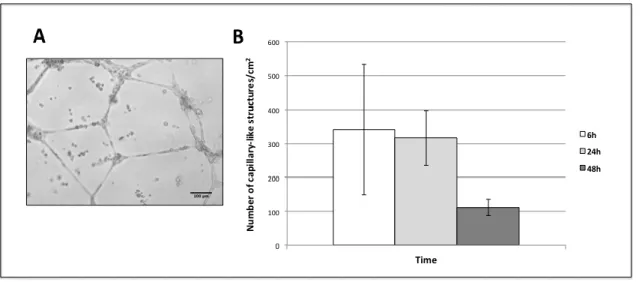
2.3. Assembly of OECs into capillary-like structures by Matrigel assay
In order to evaluate the capacity of OECs to organize into capillary-like structures, a Matrigel assay was performed. For this, 200 µL of Growth Factor Reduced Basement Membrane Matrix (GFR-Matrigel, BD Biosciences) were added to a 24-well culture plate and incubated at 37ºC for 30 min, to allow for Matrigel to solidify. Then, 2x10⁴ of OECs
in 500 µL of EGM-2MV were added per well. After, wells were maintained at 37ºC in a humidified 5% CO2 atmosphere. The cells were monitored using an inverted light
microscope, to observe the appearance of capillary-like structures, which were then counted.
2.4. Direct contact co-cultures of endothelial cells and fibroblasts
To evaluate the influence of fibroblasts in the ability of endothelial cells to form capillary-like structures, single-cell suspensions were seeded as mixtures. Co-cultures of ECs (HUVECs or OECs) with fibroblasts (HFF-1 or HDF) were established using a
18
cell ratio of 2:1. Cells were seeded onto 0.2% (m/v) gelatin-coated glass coverslips on 24-well (2x10⁴ ECs: 1x10⁴ Fibroblasts) and 6-well (2x10⁵ ECs: 1x10⁵ fibroblasts) plates
coated with 0.2% (m/v) gelatin (Merck) for immunofluorescent staining and protein extraction, respectively. ECs and fibroblasts were seeded at the same time to the culture plate and were grown in EGM-2 culture media. Different time points were considered – 7, 14 and 21 days. After each time point, cells were fixed and immunostained as described below. Co-cultures were then observed under a confocal microscope (CLSM, Leica SP2 AOBS; Leica Microsystems), photographed and parameters as the number of capillary-like structures, length, thickness and the number of branching points were determined.
2.5. Characterization of cell phenotype and ECM by immunocytochemistry For characterizing cells by immunofluorescence, the following primary antibodies were used: mouse anti-human CD31 (Dako, 1:100), rabbit anti-human vWF (Dako, 1:8000), mouse anti-human CD34 (Dako, 1:50), mouse anti-human CD144 (VE-cadherin, BD Pharmingen, 1:100), mouse anti-human Flk-1 (VEGFR2, Santa Cruz Biotechnology, 1: 200), mouse anti-human α-SMA (Dako, 1:100), mouse anti-human podoplanin (Santa Cruz Biotechnology, 1:100). For evaluating the distribution and organization of the extracellular matrix, mouse anti-human collagen IV (Dako, 1:100), mouse anti-human fibronectin (Antibody Shop, 1:200), rabbit anti-human laminin (Sigma, 1:1000) and mouse anti-human collagen I (abcam, 1:2000) were used. Alexafluor 488 goat anti-mouse (BD Pharmingen, 1:1000) and Alexafluor 555 donkey anti-rabbit (BD Pharmingen, 1:1000) were used as secondary antibodies. All antibodies were diluted in 1% (m/v) bovine serum albumin (BSA, nzytech) /PBS.
After being cultured for specific times, cells were fixed with 4% (v/v) of paraformaldehyde (Sigma) for 30 min at room temperature. 0.2% (v/v) Triton-X 100 (Merck) in PBS was used for cell permeabilization. Cells were washed in PBS and incubated for 1h at room temperature with primary antibodies. After washing three times with PBS, cells were incubated for 1h at room temperature with the secondary antibodies. Cell nuclei were then counterstained with 1µg/mL DAPI (Roche) in PBS for 15 min. Finally samples were washed with PBS and examined by fluorescence microcopy (Axio Zeiss Observer Z.1, USA).
2.6. Protein extraction
For protein extraction, cells were trypsinised, centrifuged and suitable amounts of RIPA buffer (RIPA buffer 10x, Millipore, diluted 1:10 in Millipore water; phosphatase inhibitor cocktail, Sigma and complete protease inhibitor cocktail, Roche) were added to the cell pellets on ice. After recovering the supernatant, a BCA (bicinchoninic acid) protein Assay Reagent Kit (Pierce, Thermo Scientific) was used to determine the protein concentration according to the manufacturer’s protocol. Proteins were quantified using a microplate reader (Thermo, Electron Corporation) at 550 nm.
2.7. Western blot analysis for cell characterization and ECM components quantification
For cell characterization, the following primary antibodies were used: rabbit human β-actin (abcam, 1:3000), rabbit human CD31 (abcam, 1:1000), mouse anti-human α-SMA (Dako, 1:1000), mouse anti-human podoplanin (Santa Cruz Biotechnology, 1:1000), rabbit anti-human transglutaminase-2 (Genetex, 1:1000), rabbit anti-human Flk-1 (VEGFR2, Cell Signaling, 1:1000) were used. For quantifying ECM components, mouse anti-human collagen IV (Dako, 1:500) and rabbit anti-human laminin (Sigma, 1:1000) were used. β-actin was used as an internal control. Goat anti-rabbit IgG HRP (Santa Cruz Biotechnology, 1:2000), goat anti-mouse IgG HRP (Santa Cruz Biotechnology, 1:2000), donkey anti-rabbit IgG-B (Santa Cruz Biotechnology, 1:2000) and goat anti-mouse IgG-B (abcam, 1:2000) were used as secondary antibodies.
Proteins were separated according to their molecular weight using SDS polyacrylamide gel electrophoresis (SDS-PAGE). For that, approximately 10 µg of cell proteins were mixed with loading buffer (250 mM Tris-HCl pH 6.8, 8% SDS, 40% Glycerol, 0.04% Bromophenol blue (1:4) and dithiothreitol (DTT 1M, 1:20)), being then denatured at 99ºC for 1 min. After, samples were loaded into the wells of the stacking gel and protein separation was performed at 200 V in SDS-running buffer (125 mM Tris HCl pH 8.3, 96 mM Glycine, 0.5% SDS). Precision Plus ProteinTM Dual Color Standards
(Bio-Rad) were used as protein standards. In order to make the proteins accessible for antibody detection, separated proteins were transferred from the gel onto a nitrocellulose membrane (Amersham Biosciences), using a mini transfer chamber filled with SDS transfer buffer (25 mM Trizma, 192 mM glycine, 20% methanol) for 1h at 40 V. Subsequently, the membrane was blocked in blocking solution for 1h at room temperature, washed 6 times with TBS 0.05% Tween (TBST) for 5 min and incubated with the primary antibody overnight at 4ºC. After another washing step of 6 times with
20
TBST for 5 min, each membrane was incubated with the secondary antibody for 1h at room temperature. All antibodies were diluted in the blocking solution.
For detecting proteins with lower expression, membranes were incubated with avidin-biotin complex solution (VECTASTAIN ABC kit PK-6100, Vector Laboratories) for 30 min.
Antibodies were detected using enhanced chemiluminescent (ECL) reagents (GE Healthcare) and the membranes were visualized using ChemiDocTM MP System
(Bio-Rad). Images were acquired and western blots were quantified using Image Lab Software 4.0.1 (Bio-Rad). Each sample was assayed three times in separate gels. Results are presented as relative protein expression normalized to signal intensity of β-actin protein.
2.8. Preparation of fibroblast conditioned media
Fibroblasts (either HFF-1 or HDF) were cultured in DMEM (Sigma) supplemented with 15% (v/v) FBS (Sigma) and 1% (v/v) AB/AM solution (Sigma) until 70% confluence was reached. Then, media was removed and cells were washed in PBS. Conditioned culture media was obtained by culturing fibroblasts during 24h in EBM-2 (Basal Medium) supplemented with 5% (v/v) FBS (Sigma) and 1% (v/v) AB/AM solution (Sigma). Medium was collected, centrifuged at 1200 rpm for 5 min. and the supernatant was harvested at -20ºC.
2.9. Determination of metabolic activity by MTS assay
Endothelial cells (HUVECs and OECs) were separately plated at a density of 6x10⁴
mL-1, left to adhere for 24h and, then, cultured in fibroblast conditioned media (CM) using
a final volume of 100 μL. Different percentages of CM were used – 25, 50, 75 and 100%. Fresh culture medium was used to complete the volume. After 24h, a colorimetric method was used to evaluate EC metabolic activity (CellTiter 96R AQ
ueous One Solution Cell
proliferation Assay, Promega), according to supplier’s instructions. The absorbance was measured at 490 nm in a plate reader (Thermo, Electron Corporation). The quantity of formazan product as measured by this absorbance is directly proportional to the number of living cells in culture.
2.10. Co-cultures of endothelial cells and fibroblasts in Matrigel
HDF were cultured for 24h at a cell density of 10000 cells/well in a 24-well plate. Matrigel assay was performed similarly to the assay previously described. Here, 200
µL/well of GFR-Matrigel (BD Biosciences) were added to the top of the fibroblast monolayer. Then, 60000 endothelial cells were added per well and cultured in 500 µL of EGM-2 culture medium. Controls were established by omitting fibroblasts from the experimental setup (Fig. 2.2). During the experiment, cells were monitored and photographed using an inverted light microscope, to observe the appearance of capillary-like structures. The number of capillary-capillary-like structures, length, thickness and the number of branching points were also evaluated.
Figure 2.2. Experimental design for co-culturing endothelial cells and fibroblasts in Matrigel.
2.11. Imaging and image quantification
Cell morphology and adhesion were monitored daily using an optical microscope. Cell characterization by immunofluorescence was analyzed using a Carl Zeiss Axiovert inverted microscope. Monocultures and co-cultures were visualized and scanned under a Leica confocal microscope (CLSM, Leica SP2 AOBS; Leica Microsystems) using laser wavelengths of 405 nm (DAPI), 488 nm (green) and 561 nm (red). Image analysis software ImageJ64 was used for quantifications, including the length and diameter of capillary-like structures.
2.12. Statistical analysis
All experiments were performed in triplicate. Quantifications are expressed as mean ± standard deviation (SD). The Student’s t-test was used for comparisons between two groups. A difference between experimental groups was considered significant with a confidence interval of 95%, whenever p<0.05.
CHAPTER III
RESULTS
3.1 Endothelial phenotype of OECs from umbilical cord blood
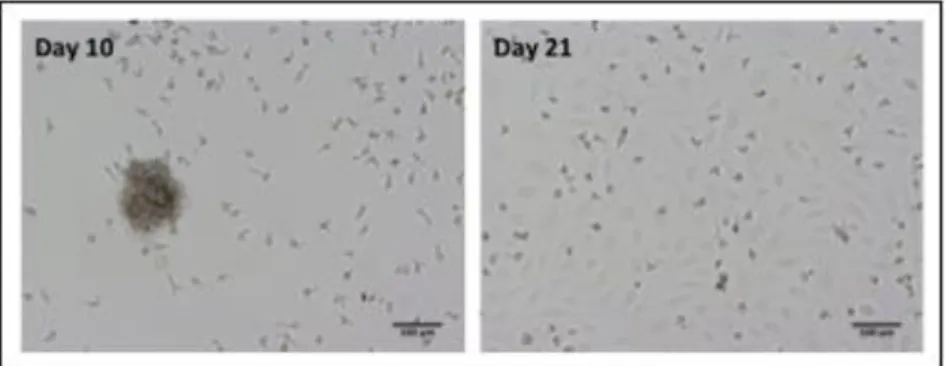
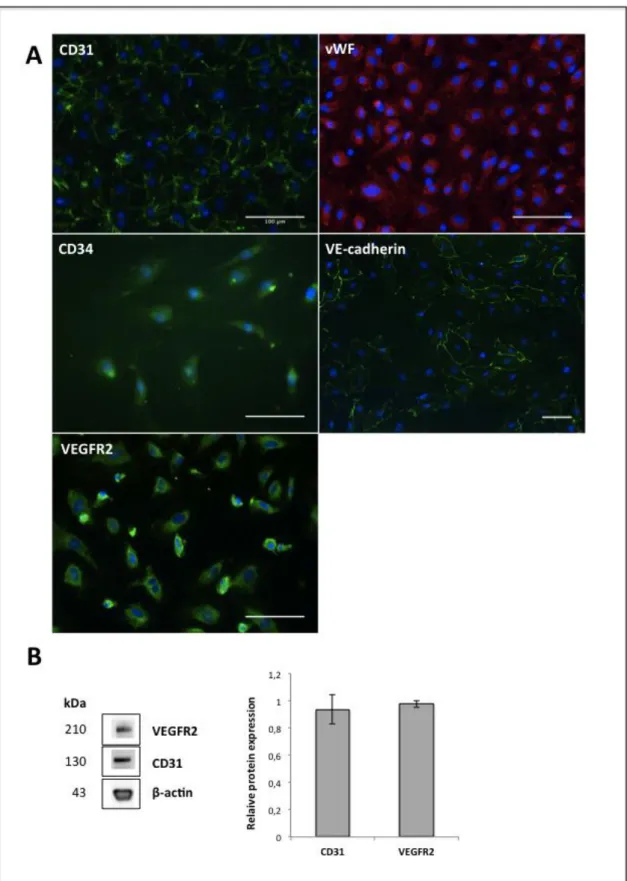
Outgrowth endothelial cells (OECs) were isolated from human umbilical cord blood and appeared after 2-3 weeks as small colonies in monocultures of MNCs, developing a characteristic cobblestone-like morphology over time (Fig. 3.1), similarly to endothelial cells, as well as showing a high proliferative potential. These cells were characterized in terms of the expression of endothelial markers, including CD31, VE-cadherin and vWF, as well as VEGFR2 and CD34 (Fig. 3.2A). CD31 and VEGFR2 expression was also verified at the protein level (Fig. 3.2B). These cells expressed significant levels of CD31 and VEGFR2, identical to β-actin, housekeeping gene. The presence of CD31 and VEGFR2 markers confirms that OECs are an endothelial cell population, while CD34 confirms that these cells have a mesodermal origin and that they are still in an endothelial progenitor cell state.
Figure 3.1. Morphology of outgrowth endothelial cells in culture. Here, at day 10, OECs are
differentiating as colonies and at day 21 cells are confluent in the well, exhibiting a cobblestone-like phenotype. Scale bar, 100 μm.
24
Figure 3.2. Immunophenotypic characterization of OECs. (A) Characterization of OECs by
immunocytochemistry. OECs stained positive for CD31 (green), vWF (red), CD34 (green), VEGFR2 (green) and VE-cadherin (green). Nuclei are counterstained with DAPI (blue). Scale bars, 100 μm. (B) Expression of CD31 and VEGFR2 in OECs determined by western blot analysis. Relative protein expression was obtained through normalization to signal intensity of β-actin protein (n=3).
Table 3.1 summarizes the percentage of cells expressing CD31, CD34, VE-cadherin and VEGFR2, with over 99% of the cells used in this study staining positive for CD31 and VEGFR2, while approximately 91% of this cell population was positive for CD144 (VE-cadherin). The overall expression of CD34 was markedly lower than the expression of the other cell markers, with only approximately 33% of this cell population staining positive for CD34.
Table 3.1. Phenotypic characterization of OECs by imaging flow cytometry. OECs were immunostained
against CD31, CD34, CD144 (VE-cadherin) and VEGFR2. The percentage of positive cells was calculated according to the gate defined for the unstained controls.
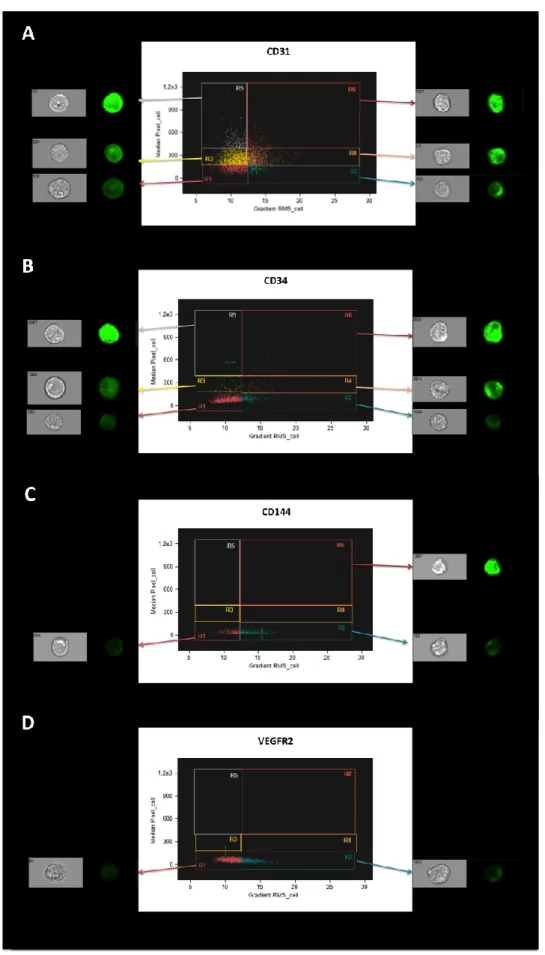
In addition, by establishing a relation between the median pixel (a measure of signal strength) and a texture feature, the gradient RMS, imaging flow cytometry allowed to characterize this cell population in terms of the cellular distribution of the different studied markers.
Indeed, OECs used in the present study appeared to constitute an heterogeneous population, making possible to define two to six distinct regions, according to the cellular distribution and intensity of each marker (R1-R6, Fig. 3.3). The population of CD31+ cells
(Fig. 3.3A), as well as CD34+ cells (Fig. 3.3B), could be divided into six regions (R1-R6),
with the expression of both surface markers varying from an homogeneous distribution with low intensity (R1) to an heterogeneous distribution with high intensity (R6). On the other hand, the expression of VE-cadherin (CD144, Fig. 3.3C) and VEGFR2 (Fig. 3.3D) could only be divided into a region of homogeneous distribution with low intensity (R1) and a region of heterogeneous distribution with low intensity (R2), although a single CD144+ cell appeared with a higher intensity (R6, Fig. 3.3C).
Considering these characterization data together, it is possible to define OECs used here as an heterogeneous cell population, expressing relevant EC markers, like CD31, vWF, VE-cadherin, VEGFR2 and, to a lower extent, CD34.
OECs
CD31 CD34 CD144 VEGFR2
26
Figure 3.3. Characterization of the phenotypic heterogeneity of OECs by imaging flow cytometry in
terms of the positive expression of CD31, CD34, CD144 and VEGFR2. Results presented here correspond to a relation between the median pixel (signal strength feature) and the gradient RMS (texture feature).