alternative reproductive tactic or a functional
constraint?
J.M. Jordão1)& R.F. Oliveira2)
(ISPA, Unidade de Investigação em Eco-Etologia, R. Jardim do Tabaco, 34, 1149-041 Lisboa, Portugal)
(Accepted: 15 June 2005)
Summary
The ‘aggressive wandering’ behaviour of male fiddler crabs is well documented in several species and is usually described as an apparently random movement through a population, punctuated by threats and combat directed at displaying males, and superficial burrow ex-plorations. It has been suggested that wandering males are mainly low condition individuals with a regenerating major claw, unsuccessful at attracting mates, wandering through the pop-ulation seeking surface coppop-ulations as an alternative to burrow coppop-ulations, which may be considered an alternative reproductive tactic. In order to test this hypothesis we have made several predictions. We observed several focal wandering males, compared sizes of wander-ing and resource holder individuals, and monitored their abundance across the lunar cycle. We did not observe any surface copulation attempts in any of our focal subjects. The number of burrows explored by wandering males was highly variable and not dependent on the subject’s size although larger males do spend more time superficially exploring burrows. Wandering males are significantly larger than burrow-holder males and there was a peak in wandering in the first moon quarter. We conclude that it is important to dissociate wandering from surface copulations and that wandering is not an alternative reproductive tactic for lower condition males. The number of wandering males across the lunar cycle still suggests that wandering may be related to mating and we discuss several ways in which it could be possible.
Keywords: fiddler crabs, wandering, alternative reproductive tactic.
1)E-mail address: [email protected] 2)E-mail address: [email protected]
© Koninklijke Brill NV, Leiden, 2005 Behaviour 142, 929-939
-Introduction
Fiddler crabs, genus Uca, are semi-terrestrial species, surface active during low tide and using a burrow as refuge during high tide. The species of this genus can be generally classified into ‘narrow front’ or ‘broad front’ species based on the width of the space between their eye stalks (Crane, 1957). These two groups show several ecological and behavioural differences. The mating system of ‘narrow front’ species is resource-free, copulation occurs on the surface and females breed in their own burrows. ‘Broad front’ species, on the other hand, present a resource-based mating system in which males provide females with breeding burrows. Sexually receptive females wander through the population, approach courting males and visit their burrows where they are followed by the burrow owner. Next, either the female comes out and continues sampling, or the male seals the burrow opening and mating takes place. Typically, females sample several burrows before they finally choose one for mating. After mating, the female stays inside the male burrow for ap-proximately two weeks when it leaves and releases the larvae (Crane, 1975). Males are sequentially polygynous and may mate with more than one fe-male in the same burrow sealing each incubating fefe-male in a separate bur-row chamber; they can also leave to find another burbur-row for the next mating (Christy & Salmon, 1991). In most ‘broad front species’ the frequency of male courting behaviour peaks twice a month. Individual females, however, only breed once a month with different females breeding each semi-lunar period (Christy & Salmon, 1991).
In addition to the resource holders, in several of these species, males have been observed which are not associated to a breeding burrow and actively wander through the population. This behaviour was first described as ‘ag-gressive wandering’ in U. maracoani by Crane (1975) as an apparently ran-dom movement through the population, punctuated by threats and combat directed at displaying males, and superficial burrow explorations. Hyatt & Salmon (1978) described a similar behaviour in U. pugnax and U. pugilator and considered that wandering males seek new breeding territories and stop this wandering and aggressive phase as soon as a new one is established. Alternatively, it has been suggested that wandering is predominant in males of low condition with a regenerating major claw (e.g., Von Hagen, 1962; Faria, 1995; Machado, 1996). In an Andalusien population of U. tangeri, Von Hagen (1962) found up to 85.5% of males with a regenerating or fully regenerated claw among wanderers.
Interestingly, in spite of the typical resource-based mating system of these species, Crane (1975) described several surface mating attempts by wander-ing males and Von Hagen (1962) also stated that, in the absence of a breed-ing burrow into which to attract mates, these wanderbreed-ing males would attempt forced surface copulations. This opens up the possibility that wandering may be considered an alternative reproductive tactic. In the absence of a breed-ing burrow a male has two possibilities: (i) searchbreed-ing and establishbreed-ing a new breeding territory or, (ii) pursuing other mating opportunities such as surface copulations. Surface copulations can take up to 1 hour to be effective (Von Hagen, 1962, and references there in); also, in fiddler crabs there is last male sperm precedence (Koga et al., 1999) and since there is no mate guarding in surface copulations the same female can afterwards mate with another male. Both these reasons suggest a low fitness benefit associated to surface copu-lations so we would only expect the occurrence of this alternative tactic if (i) finding a breeding burrow is a time consuming task and/or if, (ii) surface copulations is a condition-dependent tactic that occurs in males of low condi-tion with low success at attracting mates even when they possess a breeding burrow.
We have studied the occurrence of alternative mating tactics in a U. tan-geri population, in the Ria Formosa, Portugal. In this population, finding a new breeding burrow is not hard. Very often, wandering males establish themselves in an empty burrow (J. Jordão, pers. obs.) not necessarily evict-ing another male. In the peak of the matevict-ing season there are 16% to 32% of empty burrows (Denise Pope, unpubl. data) which seems a reasonable offer of available burrows to assure that any evicted male can easily establish a new breeding territory in a short period of time. Even with the more con-servative estimate of 16% of empty burrows and given an average density of 12 burrows per square meter (J. Jordão, unpubl. data), there are 2 empty burrows per square meter. Since resources are not scarce, we only expect to observe alternative mating tactics in males of low condition. This population has the particularity of being regularly harvested for males’ claws, present-ing a relatively large number of regeneratpresent-ing males (see Oliveira et al., 2000, for details on claw harvesting). Such a population is therefore ideal to verify if low condition males opt for wandering and surface copulations as an alter-native to resource-holding and burrow copulations. If this is so, we predict that: (i) surface copulation attempts are commonly performed by wander-ing males; (ii) wanderwander-ing males have small claws relative to their body size
(i.e., regenerating claws) in relation to burrow-holder males and (iii) since wandering is a reproductive behaviour it should be synchronized with the peak on courting behaviour by burrow-holder males (which is, in turn, syn-chronized with female receptivity).
In order to verify these predictions, in this study, we have: (1) described and quantified the behaviours engaged in by wandering U. tangeri males; (2) investigated whether the wandering males population is dominated by males with relatively small major claws and (3) monitored the abundance of U. tangeri wandering males across the lunar cycle.
Materials and methods
Study site
The Ria Formosa is the largest marine lagoon system of the southern coast of Portugal, permanently connected to the Atlantic ocean by several natural inlets-channels, covering an area of about 16300 ha. During low tide, it consists of several mudflats and salt marshes with a length of 55 km from Barra do Ancão on the West to Manta Rota on the East, and a maximum width of 6 km in Faro (Monteiro, 1989). Populations of U. tangeri are found on most of the mudflats at Ria Formosa. All experiments and observations were done at the Cacela Velha site, situated 40 km East of Faro.
Focal observations of wandering males
These observations were carried for 25 days, between May and June 2001, always in the second half of low tide, evenly spread across the lunar cycle.
The observer stood still in the middle of the mudflat until the crabs fully recovered their normal activity and then selected the first male in sight dis-playing typical wandering behaviour (as described by Crane, 1975) for focal observations. The focal male was followed for 30 minutes and its behaviour was dictated to a tape recorder at fixed intervals of 30 seconds; the social in-teractions were observed continuously and recorded on tape whenever they happened; it was also noted continuously when the subject sampled a new burrow. The focal males were easy to keep under visual contact and the ob-server could easily approach the subject without disturbing it whenever it was inside a burrow.
The scored behaviours during these focal observations were: (i) Wander-ing — the subject was considered to be wanderWander-ing when it actively walked through the population; (ii) Burrow exploration — this was divided into (a) Superficial burrow exploration, when the subject did not enter the bur-row and only probed it with its legs, and (b) Inside burbur-row, when the subject fully entered the burrow until no legs were visible on the surface; (iii) Mud-balling — when exploring a burrow for a long period of time the subject would, sometimes, go in and out several times carrying mudballs outside in the process; (iv) Waving (high and low intensity) — when exploring a bur-row for a longer period of time the subject would, sometimes, adopt typical territorial behaviours even if the burrow was soon discarded and the subject kept on wandering; (v) Fighting — the subject was considered to be involved in a fight when there was physical contact between the major claw of the two participants; (vi) Threatening — the subject was considered to be threaten-ing when it adopted the typical threatenthreaten-ing posture (Faria, 1995) directed at another individual.
After the observation period, the subjects were captured, measured, checked for a regenerating claw, marked with coloured tape, and then re-leased. Regenerating and regenerated major claws are easily identified by the absence of a large ‘tooth’ in the polex and dactyl (see Von Hagen, 1962 for a detailed description).
Twenty-five males with different sized claws were observed, but three males were discarded from our sample because the observation was impos-sible to complete, and another four males were discarded from part of the analyses because they were not captured and measured.
Relative claw size of wandering males
Observations were carried between May and June 2002, for one lunar cy-cle, starting at the peak of low tide. For 2 days in each moon phase (i.e., 8 sampling days in total), two 20 m transects were laid down with a measur-ing tape, 15 m apart (although in each day both transects were separated by 15 m, the four transects were each 7.5 m apart). In each transect we captured 1 wandering male and 1 burrow-holder male every 4 meters (i.e., 5 wan-dering and 5 burrow-holder males per transect, thus completing a total of 20 wandering males and 20 burrow-holder males per moon phase). After the captures in each transect, the crabs were measured, checked for a regenerat-ing claw, marked with coloured tape of different colours for the wanderregenerat-ing
and burrow-holder male classes, and released. The morphometric measures of wandering males were afterwards compared to those of burrow-holder males.
Abundance of wandering males through the lunar cycle
These observations were carried out between June and July 2002, for one lunar cycle, starting at the peak of low tide. An area of 468 m2of the mudflat was divided into plots of approximately 20 m2 each. In each moon phase 5
plots were randomly selected for observation. After an acclimation period of 5 minutes, each plot was monitored for a period of 20 minutes and all wandering males that entered the plot were counted. We used the number of wandering males per plot as a measure for wandering males’ abundance in each moon phase. Air temperature was measured every five minutes, as it may be a confounding variable since crab activity is strongly related to temperature (Von Hagen, 1962; Doherty, 1982).
Statistical analysis
All statistical analysis was done using the Statistica data analysis software system (StatSoft, Inc. 2001.STATISTICAversion 6. www.statsoft.com). The normality and homogeneity of variance assumptions of parametric statistics were tested before subsequent analysis.
The size of wandering males relative to burrow-holder males was com-pared by the non-parametric Mann-Whitney U test because the data did not meet the assumptions for parametric statistics. Two morphometric measures (Carapace width and Major claw length) and one morphometric ratio (Ma-jor claw length/Carapace width) were chosen as representative variables for crab size.
The numbers of wandering males across the moon cycle were compared by a 1-way ANCOVA, using each plot as a replicate, and temperature as a covariate.
Results
Focal observations of wandering males
During the 30 minutes of observation none of the subjects attempted any sur-face copulation. They explored (Superficially and Inside burrow) on average
(± SE) 26.5 ± 4.1 burrows (range 2-68) and were, on average (± SE), Inside 6.4± 0.7 burrows (range 2-14).
Most of the observation time was spent exploring burrows, either In-side or in Superficial explorations. Another major behaviour was Wandering through the population (Figure 1).
Territorial behaviours, associated to a burrow, such as Mudballing, Low intensity waving and High intensity waving did hardly occur (Figure 1).
Subjects only engaged on average (± SE) in 1.8 ± 0.5 Fights/30 min. Most of the agonistic interactions were resolved with Threats, never esca-lating to the fighting stage. On average (± SE), subjects were involved in 2.8± 0.6 Threats/30 min interactions that did not result in fights: 1.9 ± 0.4 Threats/30 min were initiated by the subject and directed at a burrow-holder male, while 1.5± 0.4 Threats/30 min were received from a burrow-holder male that the subject approached or passed by.
From the total number of Threat interactions, about 60% were directed towards smaller males, 30% towards males of the same size class, and 10% towards larger males. Considering wandering and burrow-holder males sep-arately, the main difference is in the percentage of threats that smaller males directed towards larger males: 15% if it is a wandering male initiating the threat and 3% if it is a territorial male.
Figure 1. Average (+ SE) percentage of time spent on each activity by the subjects (from the 30 minutes of focal observation).
There was no correlation between the subject’s size (claw, body and rela-tive claw size) and number of burrows explored and entered, but males with a relatively larger claw in relation to carapace width do spend more time superficially exploring burrows (Pearson correlation, N = 17, r = 0.6, p = 0.016). There is also no correlation between male size (claw, body and relative claw size) and number and time of fights, or threats, they engage in.
Relative claw size of wandering males
Wandering males have a significantly larger carapace (Wandering males average± SE Carapace width = 26.56 ± 0.46 mm, Burrow-holder males
average ± SE Carapace width = 24.71 ± 0.42 mm; Mann-Whitney U
test, N1 = 80, N2 = 80, p < 0.01), larger major claw (Wandering
males average ± SE Major claw length = 44.10 ± 1.28 mm, Burrow-holder males average± SE Major claw length = 38.74 ± 1.18 mm; Mann-Whitney U test, N1 = 80, N2 = 80, p < 0.01), and a higher Major claw
length/Carapace width ratio (Wandering males average ± SE Major claw length/Carapace width ratio = 1.64 ± 0.03, Burrow-holder males average Major claw length/Carapace width ratio = 1.54 ± 0.02; Mann-Whitney U test, N1= 80, N2= 80, p < 0.01) than burrow-holder males.
From the sample of 160 wandering and territorial males captured, only 1 wandering male had a regenerating major claw.
Abundance of wandering males through the lunar cycle
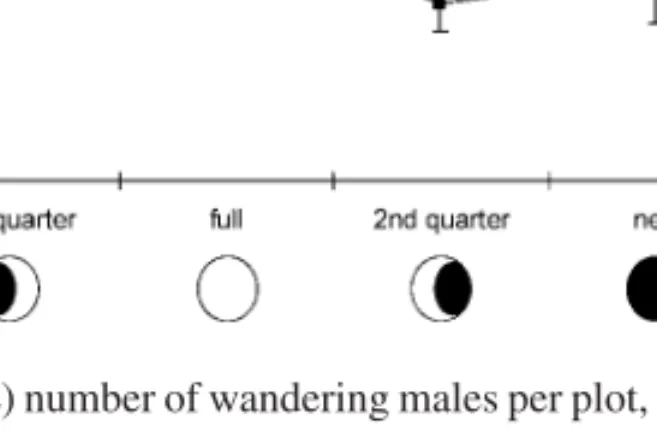
After controlling for the significant effect of temperature as a covariate we have found significant differences in the abundance of wandering males across the lunar cycle (1-wayANCOVA, F3,15= 4.74, p = 0.016). Post hoc
comparisons (Tukey HSD test, p = 0.016) showed that the abundance of wandering males during the second moon quarter is significantly lower than in the first moon quarter (see Figure 2). The temperature by lunar cycle phase interaction was not significant (Homogeneity of slopes model, F3,12 = 1.84,
p= 0.193).
Discussion
From the results of our focal observations our first prediction of surface cop-ulation attempts being commonly observed among wandering males is not
Figure 2. Average (± SE) number of wandering males per plot, and temperature (◦C), along the lunar cycle.
met: they were not observed in any of the subjects. It may be argued that an observational window of 30 minutes may be too little to observe any attempt of a surface copulation and that our results are therefore unable to reflect its real frequency. However, if we take the frequency of female visits to resource holder males for comparison, in the same 30 minutes of observational time, there is a 20% probability of a resource holder male receiving a female visit (J. Jordão, unpubl. data). If we consider the low fitness benefit of surface copulations compared to burrow copulations we would expect wandering males to attempt surface copulations more frequently than resource holder males receive female visits but even considering an equal probability of 20% in 30 minutes per individual, there is a 99.6% of probability of seeing at least one surface copulation attempt in the total of our 25 focal observations. Since we didn’t observe any we conclude that the probability of a wandering male attempting a surface copulation in a 30 minutes period is much smaller than 20% and that therefore surface copulation attempts do not qualify as a frequent behaviour in wandering males. Our results also suggest that finding a new burrow is the main purpose of wandering: about one third of the time is spent sampling burrows (Figure 1).
Wandering males were found to be significantly larger than territorial males. This indicates that they are not mainly regenerating individuals which contradicts our second prediction (wandering males have small claws relative to their body size in relation to burrow-holder males). In contrast to Von Hagen (1962) who found 85.5% of regenerating or regenerated males among wanderers, which primarily prompted the idea of wandering males being
mainly individuals with a relatively small claw, in this study only 1 out of 80 wandering males had a regenerating major claw. It should be noted, however, that Von Hagen did not compare the percentage of regenerating males among wanderers with the percentage of regenerating males among burrow-holder males. It can well be the case that the population studied by Von Hagen had a generalized high percentage of regenerating males due to the strong claw harvesting pressure by fishermen. This way, our results are not against Von Hagen’s results since he didn’t compare wanderers to burrow-holder males.
The failure to meet our first two predictions readily dismisses the idea of wandering being an alternative reproductive tactic to resource holding for low condition males. However, the peak in wandering that we found in the first quarter moon, our third prediction, suggests that it is still probably related to reproduction. According to Paula (1989) and Pope (D.S. Pope, unpubl. data) there is also a mating peak for this species in that stage of the lunar cycle. There are several possible ways in which wandering could be related to reproduction. First, it might reflect the importance of having a ‘good’ burrow in this period prompting males to wander in search of a good territory to optimize their mating success. Second, it might be a reflection of the mating success of better condition males as they would leave their burrows after their quicker matings. This second hypothesis is corroborated by our findings that wandering males are on average significantly bigger than resource holder males. Nevertheless, we cannot overlook the possibility of that finding being the result of a sampling bias. Large males may need to sample more burrows (i.e., wander for a longer period of time) in order to find an appropriate one. Large males are constrained by their size and do not fit in the burrows that previously belonged to smaller individuals. Indeed, larger males do spend more time superficially exploring burrows than smaller males do, according to the results of our focal observations. This way, our results could just reflect a higher chance of randomly collecting a large male than of collecting a small one.
In summary, our main conclusions are: (1) it is important to dissociate wandering from surface copulations; (2) wandering is not an alternative to holding a burrow for lower condition males; and (3) the frequency of wan-dering across the lunar cycle still suggests that wanwan-dering is related to mat-ing, although not for lower condition males but, most probably, for better condition ones.
Acknowledgements
This study was funded by Fundação para a Ciência e Tecnologia (grant PRAXIS XXI/BD/19835/99). We thank Ria Formosa Natural Park, Portugal, for permission to work in their protected area and Denise S. Pope and Albert Ros for very helpful discussion.
References
Crane (1957). Basic patterns of display in fiddler crabs (Ocypodidae, genus Uca). — Zoolog-ica 42: 69-82.
Crane, J. (1975). Fiddler crabs of the world. — Princeton University Press, New Jersey. Christy, J.H. & Salmon, M. (1991). Comparative studies of reproductive behavior in mantis
shrimps and fiddler crabs. — Am. Zool. 31: 329-337.
Doherty, J.A. (1982). Stereotypy and the effects of temperature on some spatio-temporal subcomponents of the ‘courtship wave’ in the fiddler crabs Uca minax (Le Conte) and Uca pugnax (Smith) (Brachyura, Ocypodidae). — Anim. Behav. 30: 352-363. Faria, M.M. (1995). Estudo técnico no1: Aspecto do comportamento das bocas-de-cavalete
Uca tangeri Eidoux (Ocypodidae, Brachyura) no Parque Natural da Ria Formosa. — Ed. Parque Natural da Ria Formosa, Olhão.
Hyatt, G.W. & Salmon, M. (1978). Combat in the fiddler crabs Uca pugilator and U. pugnax: a quantitative analysis. — Behaviour 65: 182-211.
Koga, T., Murai, M. & Yong, H.-S. (1999). Male-male competition and intersexual interac-tions in underground mating of the fiddler crab Uca paradussumieri. — Behaviour 136: 651-667.
Machado, J.L.G.H.C. (1996). Distribuição espacial e variação temporal dos comportamentos sociais em Uca tangeri. — Master thesis. Mestrado em Etologia, ISPA, Lisboa. Monteiro, C.C. (1989). La faune ichthyologique de la lagune Ria Formosa (sud Portugal). —
PhD thesis. Université des Sciences et Techniques du Langueloc.
Oliveira, R.F., Machado, J.L., Jordão, J.M., Burford, F.L., Latruffe, C. & McGregor, P.K. (2000). Human exploitation of male fiddler crab claws: behavioural consequences and implications for conservation. — Anim. Conserv. 3: 1-5.
Paula, J. (1989). Rhythms of larval release of decapod crustaceans in the Mira Estuary, Portugal. — Mar. Biol. 100: 309-312.
Von Hagen, H. (1962). Freilandstudien zur Sexual und Fortpftanzungsbiologie von Uca tan-geri in Andalusien. — Z. Morphol. Ökol. Tiere 51: 611-725.