
Security on over the top TV services
114
0
0
Texto
(2)
(3) UNIVERSIDADE DE LISBOA FACULDADE DE CIÊNCIAS DEPARTAMENTO DE INFORMÁTICA. SECURITY ON OVER THE TOP TV SERVICES. Carlos Filipe Zambujo Lopes Pereira. Orientador Nicolas Christin Co-Orientador Nuno Neves. MESTRADO EM SEGURANÇA INFORMÁTICA.
(4)
(5) Resumo A oferta abundante de serviços de acesso à Internet em banda larga, em redes fixas e redes móveis, e a popularização do uso de dispositivos móveis capazes de mostrar vídeo de alta qualidade descarregado da Internet, criaram um mercado para serviços que disponibilizam conteúdos de vídeo e televisão através na Internet para computadores pessoais, dispositivos móveis e aparelhos de televisão. Este mercado, com o paradigma de “3 ecrãs em qualquer sítio”, levou ao aparecimento de serviços de vídeo e televisão over-the-top. Os fornecedores OTT entregam conteúdos de vídeo e televisão através da Internet, usando redes de outros operadores. Os clientes acedem aos conteúdos OTT “por cima” dos serviços contratados ao fornecedor de Internet. A disponibilização de serviços de vídeo num ambiente aberto, como a Internet, requer que os seus operadores implementem mecanismos de segurança que protejam os seus valiosos conteúdos de acessos ilícitos, duplicação e distribuição não autorizada. Nesta tese, propomo-nos determinar as propriedades de segurança necessárias para fornecer serviços de vídeo OTT de forma segura. Com o objectivo de avaliar os mecanismos de segurança usados para assegurar autenticação, autorização, gestão de direitos digitais e restrições geográficas, estudamos três fornecedores OTT proeminentes. Pelo seu tamanho e pela tecnologia usada, escolhemos analisar o Netflix, Hulu e Comcast, três serviços de grande dimensão e popularidade nos Estados Unidos. Recorrendo a analisadores de protocolos de rede para inspecção do tráfego de mensagens, estudamos as interacções entre as aplicações cliente e os servidores. Para cada um dos mecanismos de segurança identificados e estudados, fizemos experiências com o objectivo de encontrar falhas e testar a sua eficácia. Descrevemos as experiências realizadas com clientes baseados em navegadores de Internet e clientes para dispositivos móveis com sistema operativo Android. Os resultados obtidos são apresentados e para cada fornecedor de serviço OTT é feita uma análise de segurança, onde são identificados os problemas de segurança encontrados. De entre estes, os mais significativos são problemas relacionados com o tratamento e a transmissão de cookies HTTP em claro pelos clientes baseados em navegadores de Internet. Estas vulnerabilidades são comuns aos três operadores OTT analisados e podem ser exploradas por adversários para roubar cookies de autenticação e personificar o cliente legítimo, permitindo acesso ilícito a conteúdos de vídeo e a informação privada do cliente. O ataque de roubo de cookies de autenticação é descrito e exemplificado com uma experiência feita numa rede Wi-Fi aberta. A simplicidade do ataque e a existência deste tipo de redes em espaços públicos, como escolas, universidades, centros comerciais, hotéis e aeroportos, tornam importante a implementação de medidas correctivas. São apresentadas estratégias de mitigação para fornecedores de serviços OTT, utilizadores e administradores de redes sem fios. Estas consistem, respectivamente, na utilização de SSL para proteger a informação de autenticação, a utilização somente de ligações HTTPS ou de acessos cifrados a redes privadas virtuais, e a utilização de protocolos do standard WPA2 para protecção de redes sem fios. Ao contrário do que é observado com os clientes baseados em navegadores de Internet, o cliente móvel da Netflix para dispositivos Android não é vulnerável ao ataque descrito. Este cliente usa SSL para proteger todas as ligações em que são transmitidos cookies de autenticação. Palavras-chave: Internet, segurança, vídeo, OTT, IPTV i.
(6)
(7) Abstract The widespread availability of high bandwidth Internet access on fixed and mobile networks, in conjunction with the availability of mobile devices powerful enough to play streamed high quality video, has created the demand for services that deliver television and video content over the Internet to television sets, personal computers and mobile devices. This demand has lead to the appearance of over-the-top TV and video service providers that deliver video over the Internet, using networks not operated by them. Video delivery in an open environment, like the Internet, requires operators to implement security mechanisms to protect their valuable content from illicit access and distribution. In this thesis, we investigate security properties needed to securely deliver OTT video services. In order to assess the security mechanisms employed to enforce authentication, authorization, digital rights management and geographical restrictions, we survey three prominent OTT service providers. Due to their size and choice of technologies, we selected Netflix, Hulu and Comcast. We studied the interactions between the client applications and the providers’ servers by inspecting the traffic of messages exchanged. For each of the security mechanisms analyzed, experiments were designed to find flaws and test their effectiveness. The most important of the identified security issues are related to the handling and transmission of HTTP cookies when using web browser-based clients. These vulnerabilities are common to all surveyed providers and can be exploited by adversaries to steal authentication cookies and impersonate the customer, allowing illicit access to video assets and private information of the customer. A cookie stealing and session hijacking attack is described and mitigation strategies are presented for OTT service providers, users and wireless network access point administrators. These consist in the use of SSL to protect authentication tokens, the use HTTPS only or VPN services, and the use of WPA2 to protect wireless networks, respectively. An interesting result, observed with the analyzed mobile client for Android devices, is that it uses SSL to protect the transmission of HTTP cookies used for authentication. Thus, it is not vulnerable to the described attack. Keywords: Internet, video, security, IPTV, OTT. iii.
(8)
(9) Acknowledgments I owe my gratitude to Doctor Nicolas Christin and Doctor Nuno Neves for their invaluable guidance as advisors of this thesis. I am grateful to my colleagues André, Rui and Paula for interesting and fruitful discussions about the research work and help with writing in LaTeX. It is my pleasure to thank Professors Paulo Veríssimo, Adrian Perrig, Miguel Correia, Alysson Bessani and António Casimiro for the teachings in security and dependability that provided me with the background necessary for this thesis. I am thankful to my wife Sílvia, my brother Frederico and my parents Francisco and Yolanda, for the encouragement and unconditional support in difficult moments. At Portugal Telecom, I would like to thank Ana Maltez and Cristina Veríssimo for encouraging and helping me to pursue the opportunity provided by the Carnegie Mellon|Portugal partnership; João Ferreira and Luís Gueifão for proposing and giving their support for this thesis. Finally, I would like to thank Portugal Telecom, my employer, for making my participation in this masters program in Information Security possible. Lisbon, November 2011. v.
(10)
(11) Dedicated to my wife Sílvia.. vii.
(12)
(13) Contents 1 Introduction. 1. 1.1 Over-the-top TV services . . . . . . . . . . . . . . . . . . . . . . . . . . . . . . . . .. 1. 1.2 Motivation . . . . . . . . . . . . . . . . . . . . . . . . . . . . . . . . . . . . . . . . . .. 1. 1.3 Our work . . . . . . . . . . . . . . . . . . . . . . . . . . . . . . . . . . . . . . . . . .. 2. 1.4 Contribution . . . . . . . . . . . . . . . . . . . . . . . . . . . . . . . . . . . . . . . . .. 3. 1.5 Organization of the thesis . . . . . . . . . . . . . . . . . . . . . . . . . . . . . . . . .. 4. 2 Objectives, methodology and limitations. 5. 2.1 Objectives . . . . . . . . . . . . . . . . . . . . . . . . . . . . . . . . . . . . . . . . . .. 5. 2.2 Methodology . . . . . . . . . . . . . . . . . . . . . . . . . . . . . . . . . . . . . . . .. 6. 2.3 Limitations. 8. . . . . . . . . . . . . . . . . . . . . . . . . . . . . . . . . . . . . . . . . .. 3 Netflix. 9. 3.1 Technology . . . . . . . . . . . . . . . . . . . . . . . . . . . . . . . . . . . . . . . . .. 9. 3.2 Account creation . . . . . . . . . . . . . . . . . . . . . . . . . . . . . . . . . . . . . .. 10. 3.3 Authentication and session management . . . . . . . . . . . . . . . . . . . . . . . .. 12. 3.3.1 Sign in process . . . . . . . . . . . . . . . . . . . . . . . . . . . . . . . . . . .. 12. 3.3.2 Session management . . . . . . . . . . . . . . . . . . . . . . . . . . . . . . .. 15. 3.3.3 Sign out process . . . . . . . . . . . . . . . . . . . . . . . . . . . . . . . . . .. 15. 3.3.4 User account details . . . . . . . . . . . . . . . . . . . . . . . . . . . . . . . .. 16. 3.4 Authorization . . . . . . . . . . . . . . . . . . . . . . . . . . . . . . . . . . . . . . . .. 16. 3.4.1 Client start . . . . . . . . . . . . . . . . . . . . . . . . . . . . . . . . . . . . .. 16. 3.4.2 Client registration . . . . . . . . . . . . . . . . . . . . . . . . . . . . . . . . . .. 17. 3.4.3 Client authorization. . . . . . . . . . . . . . . . . . . . . . . . . . . . . . . . .. 20. 3.5 Stream encryption . . . . . . . . . . . . . . . . . . . . . . . . . . . . . . . . . . . . .. 23. ix.
(14) 3.6 Simultaneous streaming . . . . . . . . . . . . . . . . . . . . . . . . . . . . . . . . . .. 25. 3.7 Geolocation . . . . . . . . . . . . . . . . . . . . . . . . . . . . . . . . . . . . . . . . .. 26. 3.8 Output protections . . . . . . . . . . . . . . . . . . . . . . . . . . . . . . . . . . . . .. 27. 3.9 Mobile client application . . . . . . . . . . . . . . . . . . . . . . . . . . . . . . . . . .. 28. 3.10 Security evaluation . . . . . . . . . . . . . . . . . . . . . . . . . . . . . . . . . . . . .. 29. 3.10.1 Attacker model . . . . . . . . . . . . . . . . . . . . . . . . . . . . . . . . . . .. 29. 3.10.2 Vulnerabilities and weaknesses . . . . . . . . . . . . . . . . . . . . . . . . . .. 30. 3.10.3 Cookie sniffing simulation . . . . . . . . . . . . . . . . . . . . . . . . . . . . .. 32. 4 Hulu Plus. 33. 4.1 Account creation . . . . . . . . . . . . . . . . . . . . . . . . . . . . . . . . . . . . . .. 33. 4.2 Authentication and session management . . . . . . . . . . . . . . . . . . . . . . . .. 35. 4.2.1 Sign in process . . . . . . . . . . . . . . . . . . . . . . . . . . . . . . . . . . .. 35. 4.2.2 Session management . . . . . . . . . . . . . . . . . . . . . . . . . . . . . . .. 37. 4.2.3 Sign out process . . . . . . . . . . . . . . . . . . . . . . . . . . . . . . . . . .. 37. 4.3 Authorization . . . . . . . . . . . . . . . . . . . . . . . . . . . . . . . . . . . . . . . .. 39. 4.4 Simultaneous streaming . . . . . . . . . . . . . . . . . . . . . . . . . . . . . . . . . .. 39. 4.5 Geolocation . . . . . . . . . . . . . . . . . . . . . . . . . . . . . . . . . . . . . . . . .. 40. 4.6 Output protections . . . . . . . . . . . . . . . . . . . . . . . . . . . . . . . . . . . . .. 42. 4.7 Security evaluation . . . . . . . . . . . . . . . . . . . . . . . . . . . . . . . . . . . . .. 42. 5 Comcast Xfinity TV. 45. 5.1 Account creation . . . . . . . . . . . . . . . . . . . . . . . . . . . . . . . . . . . . . .. 45. 5.2 Authentication and Session Management . . . . . . . . . . . . . . . . . . . . . . . .. 47. 5.2.1 Sign in process . . . . . . . . . . . . . . . . . . . . . . . . . . . . . . . . . . .. 47. 5.2.2 Session management . . . . . . . . . . . . . . . . . . . . . . . . . . . . . . .. 48. 5.2.3 Sign out process . . . . . . . . . . . . . . . . . . . . . . . . . . . . . . . . . .. 48. 5.2.4 Unprotected user account details . . . . . . . . . . . . . . . . . . . . . . . . .. 49. 5.3 Simultaneous streaming and geolocation . . . . . . . . . . . . . . . . . . . . . . . .. 49. 5.4 Output protections . . . . . . . . . . . . . . . . . . . . . . . . . . . . . . . . . . . . .. 49. 5.5 Security evaluation . . . . . . . . . . . . . . . . . . . . . . . . . . . . . . . . . . . . .. 50. x.
(15) 6 Recommendations. 53. 6.1 For OTT video service providers . . . . . . . . . . . . . . . . . . . . . . . . . . . . .. 53. 6.2 For Network Administrators . . . . . . . . . . . . . . . . . . . . . . . . . . . . . . . .. 54. 6.3 For Network Users . . . . . . . . . . . . . . . . . . . . . . . . . . . . . . . . . . . . .. 55. 7 Conclusions. 57. Bibliography. 61. Appendices. 67. A Netflix listings. 67. A.1 clientaccesspolicy.xml . . . . . . . . . . . . . . . . . . . . . . . . . . . . . . . . . . .. 67. A.2 Authorization response. 69. . . . . . . . . . . . . . . . . . . . . . . . . . . . . . . . . . .. B Hulu video license responses. 83. B.1 License granted response . . . . . . . . . . . . . . . . . . . . . . . . . . . . . . . . .. 83. B.2 License not granted response . . . . . . . . . . . . . . . . . . . . . . . . . . . . . . .. 91. C Comcast Xfinity cookies. 93. C.1 Cookies set by Xfinity online sign in process . . . . . . . . . . . . . . . . . . . . . . .. xi. 93.
(16)
(17) List of Figures 3.1 Message displayed by Netflix.com when it is not able to determine the user’s IP address geographical location. . . . . . . . . . . . . . . . . . . . . . . . . . . . . . .. 11. 3.2 Message displayed by Netflix Global page when a user connects from a foreign IP address. . . . . . . . . . . . . . . . . . . . . . . . . . . . . . . . . . . . . . . . . . . .. 11. 3.3 Secure submission of credentials in the Sign in process. . . . . . . . . . . . . . . . .. 12. 3.4 Remember Me option in the sign in page of Netflix.com. . . . . . . . . . . . . . . . .. 14. 3.5 Error caused by setting UseNetflixId=false. . . . . . . . . . . . . . . . . . . . .. 17. 3.6 Error caused by changing or suppressing the authentication and integrity methods specified in clientaccesspolicy.xml. . . . . . . . . . . . . . . . . . . . . . . . .. 17. 3.7 Warning displayed when the 50th device is registered with a single user account. . .. 20. 3.8 Error displayed by the Netflix player when attempting to play a movie on a third computer with the same user account. . . . . . . . . . . . . . . . . . . . . . . . . . .. 25. 3.9 Error displayed by the Netflix player when an authenticated user tries to access the Watch Instantly page from outside the United States. . . . . . . . . . . . . . . . . . .. 27. 4.1 Message displayed by Hulu.com when accessed from an IP address outside the United States. . . . . . . . . . . . . . . . . . . . . . . . . . . . . . . . . . . . . . . . .. 34. 4.2 Error displayed when the billing address is not associated with the credit card provided. 35 4.3 Hulu’s Log in process using JavaScript to securely send credentials. . . . . . . . . .. 36. 4.4 Most Popular content screen as seen on a Hulu Plus account. . . . . . . . . . . . .. 38. 4.5 Most Popular content screen as seen on a basic Hulu account. . . . . . . . . . . . .. 38. 4.6 Attempt to play Hulu Plus content with expired session cookie. . . . . . . . . . . . .. 38. 4.7 Attempt to play Hulu Plus content on a basic Hulu account by setting the cookies shown in Table 4.2 . . . . . . . . . . . . . . . . . . . . . . . . . . . . . . . . . . . . .. 39. 4.8 Attempt to play Hulu Plus content simultaneously on more than two computers . . .. 40. 4.9 Attempt to play Hulu content with an IP address from outside the United States. . . .. 42. xiii.
(18) 5.1 Xfinity website’s Comcast Account Number Registration. . . . . . . . . . . . . . . . .. 46. 5.2 Comcast re-authentication process when the customer returns with persistent authentication cookies. . . . . . . . . . . . . . . . . . . . . . . . . . . . . . . . . . . . .. 48. 5.3 Xfinity TV online error when a user located outside the U.S. tries to watch a video or the number of simultaneous streams has been exceeded. . . . . . . . . . . . . . . .. xiv. 49.
(19) List of Tables 3.1 Parameters passed in the HTTP POST request to register a new user account. . . .. 10. 3.2 Parameters passed in the HTTP POST request to authenticate the user and sign in.. 13. 3.3 Parameters in the NetflixID authentication cookie.. . . . . . . . . . . . . . . . . .. 14. 3.4 Parameters passed to the Silverlight based Netflix player. . . . . . . . . . . . . . . .. 16. 3.5 Custom HTTP header with authentication and integrity parameters in the registration request. . . . . . . . . . . . . . . . . . . . . . . . . . . . . . . . . . . . . . . . . . . .. 18. 3.6 Custom HTTP headers authenticating the authorization request. . . . . . . . . . . .. 21. 4.1 User ID and session cookies used by Hulu to keep the user authenticated. . . . . . .. 37. 4.2 Cookies are set to different values according to the type of customer, such as if he/she is a Hulu Plus or free Hulu customer. . . . . . . . . . . . . . . . . . . . . . . .. 37. 5.1 Authentication and session cookies set by the Xfinity TV sign in process when user selects the "Remember me..." option. . . . . . . . . . . . . . . . . . . . . . . . . .. xv. 47.
(20)
(21) Chapter 1. Introduction 1.1. Over-the-top TV services. With the widespread adoption of high bandwidth Internet access in developed nations, new business opportunities have opened to TV content creators, owners and distributors. It is now possible to deliver high quality video over the Internet, providing customers with the flexibility to watch the content of their choice on a variety of Internet connected device categories. Many companies have been trying to succeed in the marketplace, experimenting with various business models. Most prominently, Hulu and Netflix became large players in the video distribution over the Internet space. This type of video services, which are distributed over a network but are not offered by the network operator, came to be referred to as OTT video services: they are served on top of the network service provided by an Internet service provider. Telecommunications operators that have five years ago started to offer IPTV services, integrated with voice and Internet services, are now expanding their TV offerings to include the ability to watch television programming on personal computers, mobile smart phones, tablets, Internet connected TV sets, gaming consoles, Blu-ray players and other types of Internet connected devices. The demand for 3-screens anywhere services – TV, personal computer, and mobile screens – is a growing trend. Although these services are offered by the network operator, generally the customer can also access them through other networks, over the top, as long as there is an Internet connection and access is not explicitly blocked due to policy enforcement.. 1.2. Motivation. Television programming and premium video content distribution over fixed networks have traditionally been done in closed environments, where the operators have a large degree of control over the network and the customer premises equipment. Where fraud is possible, network operators have been working to thwart it, implementing encryption mechanisms and set-top box authentication 1.
(22) schemes that prevent unauthorized devices from receiving and decoding the signal. Nevertheless, the problem of unauthorized access has been largely limited to the physical network of the provider. With over-the-top TV services, distributed via the Internet, users do not need to be physically connected to the operator’s network. Access can potentially be done from anywhere in the world. The ability to access content on mobile devices, personal computers and other Internet connected devices from anywhere within the allowed geographical regions is a critical feature of OTT services. Distributing premium content over open IP networks presents new challenges to fixed network TV operators: • content distribution licenses impose geographical restrictions on where the content can be. accessed from, even for existing legitimate customers;. • content distribution servers must not allow unauthorized access to premium content by non-. paying users;. • the operator does not control end devices but unauthorized recording and copying of content. bits should be prevented;. • Denial of Service attacks on the network, coming from thousands of machines located all over. the world, may leave legitimate customers without service.. To be able to serve premium content, OTT service providers must properly monitor and address these security risks. Authentication, authorization, session management, digital rights management, auditing geolocation, quality assurance and video output protections are security requirements that operators must guarantee to be satisfied.. 1.3. Our work. This thesis sets out to survey and explore the security properties needed to secure OTT service delivery. In order to assess the main security strategies and mechanisms employed by major OTT video service providers, we selected Netflix, Hulu and Comcast. By virtue of their size and the choice of technologies they use, we conjectured that these three large and prominent services would provide a representative sample of user experience. We found that the three providers use SSL during the sign in process to authenticate the server to the user and encrypt connections. SSL protects the user’s log in credentials, with which he/she authenticates to the server. After successfully signing in, SSL is no longer used for video catalog browsing and users are then redirected to HTTP connections. Session state and authentication is maintained via HTTP cookies sent in the clear, leaving the customer vulnerable to cookie stealing and session hijacking by network eavesdroppers. To assess the difficulty of this attack, we ran a proof of concept experiment in a controlled environment, which revealed that the attack is simple to do. We analyzed how geographical location is done and in which phases of the customer interaction with the service are the geographical restrictions enforced. We found that the use of VPN software 2.
(23) allows some of these restrictions to be bypassed. In the case of Netflix, this method can be applied in the initial authentication and authorization phases to obtain a license that allows the user to subsequently watch the video without the VPN connection. In the case of Hulu and Comcast, the VPN must be used during the entire time the user is watching. Hulu is even more restrictive in the case of premium content: by verifying the billing address of the credit card in the account creation process, Hulu enforces that its premium customers must have a billing address within the United States. Our analysis proceeded with simultaneous streaming restrictions, video stream encryption and output protections. All three OTT providers we studied enforce simultaneous streaming restrictions, thus limiting the sharing of account credentials. They all encrypt the video stream the server sends to the client, requiring the client to obtain a valid license containing the decryption key. We learned that none of the providers are using output protections, making it possible to send the images to unprotected analog and digital outputs. The experimental work was concluded with the analysis of the Netflix client application for mobile phones running Android. We observed that the Android client encrypts all communications that are related to authentication, session management and authorization. Thus, unlike the web browserbased client for personal computers, the Netflix mobile client for Android is not vulnerable to cookie stealing attacks by network eavesdroppers. Reflecting our views on the subject of insecure web authentication and session cookies, we wrote a set of recommendations for OTT service providers, network administrators and end users. The recommended practices are not new, but would increase the security for everyone using these premium content services.. 1.4. Contribution. During the preparation work for the thesis, we found an abundance of literature on the topic of IPTV security. These works focus predominantly on closed IPTV networks like those implemented by traditional telecommunications and cable operators. These networks use custom built set-top boxes, with the specific purpose of delivering the operator’s TV service to the customer. We found very few works on analysis of OTT services. The most relevant analysis, and the only one we found on the topic of security, is a report done by Pomelo, LLC1 [27] that briefly describes the authentication and authorization interactions between the Netflix client and the service’s servers. This report provided us with good starting point, but did not detail the interactions with the depth we were aiming for and did not mention aspects like how Netflix does geographical location, simultaneous streaming restrictions or output protections. Adams also briefly describes the interactions between the Netflix client, the Netflix Controller server and the CDNs [2]. The analysis is not focused on security aspects, but rather on aspects related to simulating the traffic load generated by Netflix. A company called ViaForensics has done a security analysis2 of the Netflix mobile application for Android, but the study is not freely available. 1 http://www.pomelollc.com/. 2 http://viaforensics.com/appwatchdog/netflix-android.html. 3.
(24) In our work, we surveyed three OTT video service providers, with emphasis on the security mechanisms of authentication, authorization, simultaneous streaming, geographical restrictions, output protections and, in the case of Netflix, mobile client security. As far as we know, this is the first work that surveys multiple over-the-top video service providers. We strived to describe the mechanisms implemented by the OTT providers in more detail than the mentioned previous works, as well as test them for effectiveness and correctness. In most cases, our search for bugs and vulnerabilities did not reveal any flaws and did not enable us to bypass the services’ security controls. We did find, however, a pattern of vulnerability common to authentication schemes used by Netflix, Hulu and Comcast on their websites: they all use cookies without any encryption to authenticate the user after the sign in process, leaving their users vulnerable to cookie stealing and session hijacking attacks. Another aspect not included in the previous works, is the effectiveness of enforcement of geographical restrictions early on in the account creation process, which revealed different strategies being followed by Hulu and Netflix: Netflix only relies on geographical location based on source IP address, while Hulu verifies the billing address associated with the credit card.. 1.5. Organization of the thesis. The rest of this document is organized as follows: Chapter 2 – Objectives, methodology and limitations, presents the goals set out for this thesis and the methods employed in the experiments. The last Section describes limitations encountered while doing the research. Chapter 3 – Netflix, describes the experimental work developed to analyze Netflix’s service and results obtained. The Chapter concludes with a security evaluation of the service. Chapter 4 – Hulu Plus, presents the experimental work developed to analyze Hulu’s service. The findings of our study are then presented and the Chapter concludes with a security evaluation of Hulu’s service. Chapter 5 – Comcast Xfinity TV, presents the study of Xfinity’s online video service and its security evaluation. Chapter 6 – Recommendations, contains a set of recommendations to mitigate the security vulnerabilities found in cookie handling and transmission. Chapter 7 – Conclusions, summarizes the main results and conclusions of the thesis.. 4.
(25) Chapter 2. Objectives, methodology and limitations 2.1. Objectives. We aimed to survey and evaluate the security mechanisms available to and implemented by some of the major OTT service providers. We could not attempt to analyze an exhaustive list of existing providers, as there are today many of them. The limited time available to us would make the task impossible. A complete security review of the services offered by any one provider would also be too lengthy to fit our schedule. Another difficulty arises when doing this kind of security evaluation work: service providers are not willing to grant inside access to their systems to be evaluated by outsiders. For these reasons we chose to do a security evaluation of a few selected companies, using a black box approach, concentrating on very specific aspects. We selected three OTT providers to analyze: • Netflix – offers a streaming service that offers its customers access to movies, TV shows. and documentaries for a flat monthly fee. Users have unlimited access to the catalog from within the allowed geographical regions. Netflix has enjoyed large market share in the movie streaming business and has secured content deal with many content providers. According to a report [26] by networking equipment company Sandvine, in May of 2011, Netflix was the largest source of Internet Traffic in North America during peak hours. For content protection, Netflix uses a combination of in-house solutions and Microsoft PlayReady DRM technology. Customers can access content using personal computers, mobile smart phones, tablets, gaming consoles and other Internet connected devices. We chose to analyze Netflix for its size and technology.. • Hulu – offers streaming of TV shows, movies, movie trailers and web specific content. It. has an ad-supported free service that allows users to watch content on personal computers and it also has a paid service called Hulu Plus. Hulu Plus also has ads, but customers have 5.
(26) access to additional premium content, can access HD content and have the ability to watch on Internet connected TVs and mobile devices. Content is streamed and DRM protected using Adobe Flash technology and is only available in the United States and Japan. Hulu is a joint venture of major traditional television content providers. We chose to evaluate Hulu because it is one the prominent players in the Internet video distribution arena, because of its technology and because it is owned by traditional television business players. • Comcast – is the largest cable operator and Internet service provider in the United States. [24]. It is also one of the largest telephone providers. Comcast offers Internet access to. movies, TV series and programming from premium networks like HBO, Starz and others. Premium networks’ content is only available to subscribers with access through Comcast’s television service. Other content is available for free for anyone accessing over the Internet from within the United States. We chose to evaluate Comcast because of its size and because it is a traditional cable TV operator. For each one of these providers, we concentrated our efforts on the mechanisms realizing the security properties that are particularly relevant to secure OTT service delivery: 1. Authentication – How do securely OTT service providers authenticate their users? 2. Authorization – After making sure of the identity of the user, how do OTT providers determine whether to grant access to content and how do they securely give permissions to the user? 3. DRM – How is content protected from unauthorized access and unauthorized use? 4. Simultaneous streaming – Do OTT allow content to be accessed with the same account from multiple devices? 5. Geolocation – How do OTT providers enforce geographical restrictions imposed by their content licensing deals? 6. Output protections – Are OTT providers enforcing output protections to prevent unauthorized copying? 7. Mobile client security – Are the previous points implemented differently on mobile clients than they are in web browser clients? Our last goals were to identify vulnerabilities in the surveyed mechanisms and propose remedies and mitigating measures.. 2.2. Methodology. The services from each of the selected providers expose interfaces to client applications. Our analysis was focused on the interactions that occur through these interfaces using a black box approach, on the client behavior and on the service responses to non-standard client requests. No 6.
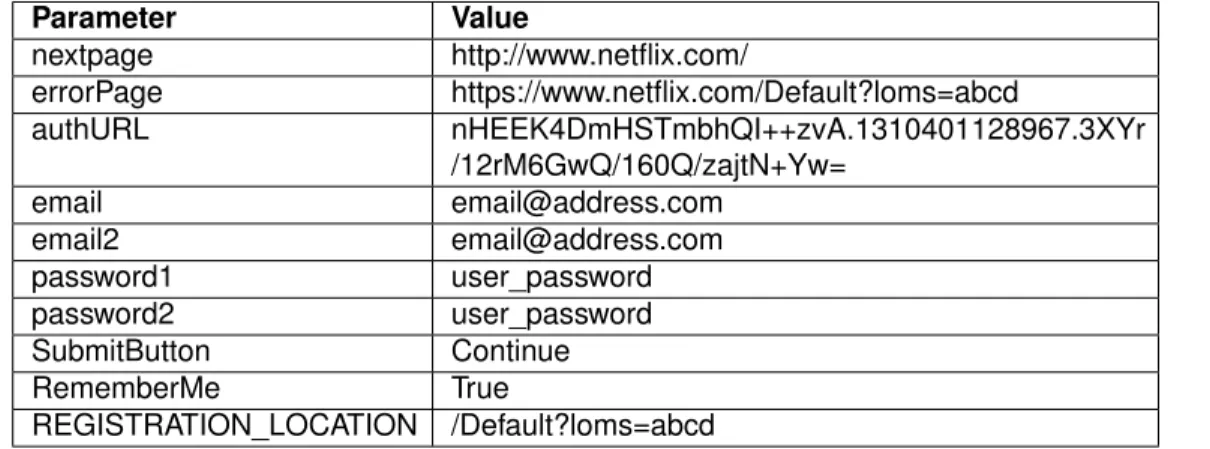
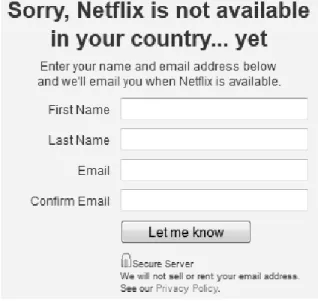
(27) information was asked to the OTT providers about their systems’ internal architecture, implementation details and specific security mechanisms employed. To carry out our work we used a number of freely available software tools on Windows machines and on Macintosh computers. The tools we used include: • HTTP debugging proxy servers – are HTTP proxies that allow interception, modification,. generation and analysis of HTTP requests and responses. With the installation of the appro-. priate TLS certificates [11], some HTTP debugging proxies allow the analysis, modification and generation of HTTPS traffic. In our work, we did use such techniques to analyze traffic protected by TLS connections. • Network protocol analyzers – are more generic traffic analysis tools than HTTP proxies.. They allow monitoring of traffic at various levels of protocol stacks and support the dissection of many known and standard protocols. On hardware with network interfaces that support. promiscuous mode, these analyzers can be used to analyze traffic not addressed to, originated by, or being routed through the machine on which they are installed, as long as they have access to the network medium that is carrying the traffic. We used network protocol analyzers, instead of the simpler HTTP debugging proxies, in two specific situations: 1. To monitor traffic to and from a mobile smart phone, connecting to the Internet via through a machine serving as a wireless access point. The protocol analyzer was installed on this machine. 2. To demonstrate an attack on a wireless network in a controlled environment. This experiment was run in a network specifically set up for this demonstration, in an environment that did not pose any risks to non-participating entities or machines, and with user accounts created specifically for this purpose. • OpenSSL – is an open implementation of the SSL/TLS protocols. It supports the generation. of RSA public/private key pairs, generation and signing of X.509 certificates [17].. • Android rooters – are tools that can be used to root Android devices. Rooting is the process. of modifying the operating system in order to allow users to run applications with root priv-. ileges. There are many applications available to root Android devices, with varying levels of support for device models and operating system versions. • VPN connections – were used to run experiments in the United States with connections. originating in Portugal and to run experiments in Portugal with connections originating in the United States.. • Media metadata readers – were used to run tests and determine whether a decrypted file. had MP4 metadata or not.. • Image capturing tools – we used to capture video images displayed by the client software. used by the OTT video service providers.. To test the mobile Netflix application, we used an Android based smart phone, running Android 2.2.2, which had to be rooted in order to install an SSL CA certificate in it. 7.
(28) 2.3. Limitations. We had not completely accomplished our initial objectives when we decided to stop our experimental work and concentrate on writing the thesis. The main difficulties we faced are inherent to the security mechanisms and strategies the OTT service providers we chose to analyze: • To allow access to premium content, Comcast’s Xfinity online service requires the user to be. a subscriber of the Xfinity TV cable service and a paying customer of premium channels. We did not have an Xfinity TV cable account dedicated to our tests. To study the services offered in Xfinity’s website, we had to borrow access from a web account belonging to one of the advisors of this thesis. Although this web account was associated with a cable account, the physical installation did not have a cable box connected to network. Thus, we could not test the cable box management and remote control functions on the website.. • Most of the work for the thesis was done during a three months period, in the summer. semester, in Pittsburgh. The time was limited and more in-depth analysis of protocols such as RTMP, used by Adobe Flash players, was not possible.. • Time was also a limiting factor on the mobile client application analysis. The necessary. access point configuration on a machine connected to the Internet is not allowed by the Cisco AnyConnect VPN software, used to connect to CMU’s network and run experiments from Portugal. As a result, analyzing the mobile client in Portugal took more time than expected.. • The lack of a device supported by the Hulu Plus Android application prevented us from doing. the experiments with Hulu’s mobile client.. Despite these limitations, we believe our work met most of the goals we set out in the beginning. The survey and evaluation of the selected security aspects implemented by Netflix, Hulu and Comcast are presented in the following chapters.. 8.
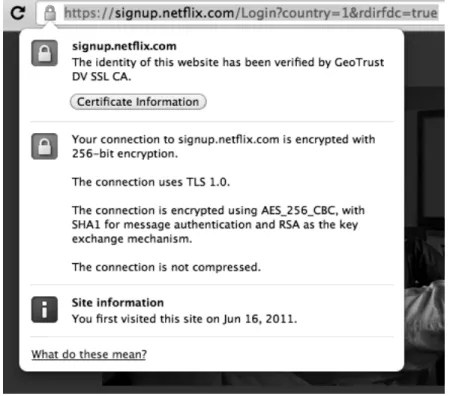
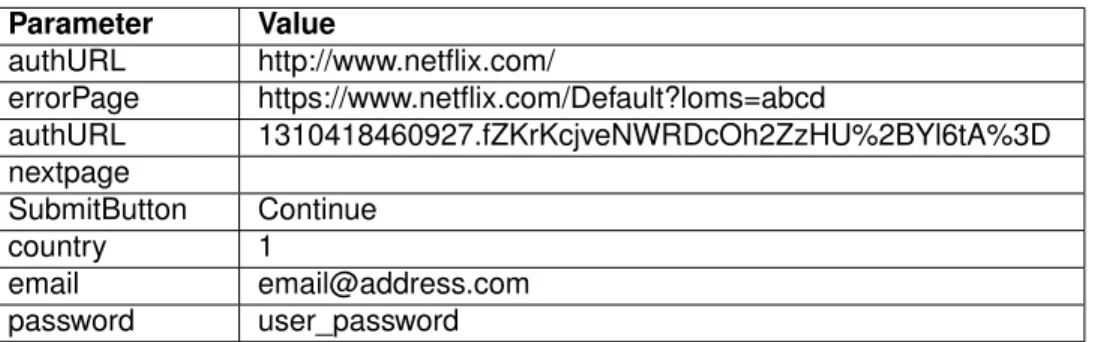
(29) Chapter 3. Netflix Netflix, Inc. is company that specializes in video rentals. Customers can subscribe to DVD by mail rentals and/or a video on demand streaming service over the Internet called Watch Instantly, which is only available in the United State and in Canada1 . For a flat monthly fee, Watch Instantly subscribers have unlimited access to its entire movie catalog. A report done by Pomelo, LLC2 in April of 2009, helped us understand the basic architecture implemented by Netflix [27] to enforce authentication, authorization and Digital Rights Management. However, that report had been done more than two years prior to our work and Netflix had been evolving the service. We also wanted our study to be both broader and more detailed. In order to analyze the mechanisms employed by Netflix to enforce authentication, authorization, DRM and enforcement of geographical restrictions, we analyzed the interactions between the client and Netflix’s servers. In the following Sections, we describe the interactions we observed using Netflix’s web browser client, from the account creation process to browsing the catalog, selecting a movie, watching the movie and closing the player. As we learned the processes by which Netflix enforces its security policy, we tried to find flaws and work around imposed limits. After studying the web browser client, we analyzed the mobile client on an Android smart phone. The Chapter ends with a security evaluation of the described processes.. 3.1. Technology. Watch Instantly content can be accessed through a wide range of consumer devices from a variety of manufacturers: gaming consoles, Blu-ray players, HDTVs, Home Theater systems, dedicated web TV set-top boxes, phones, tablets and personal computers3 . On a personal computer running Microsoft Windows or Mac OS X, the service can be accessed via a web browser with the Microsoft 1 http://www.netflix.com/Help?action=2&jsEnabled=false&faqtrkid=5&p_faqid=4042&lnkctr= yas_faq 2 http://www.pomelollc.com/ 3 https://account.netflix.com/NetflixReadyDevices. 9.
(30) Silverlight plug-in installed. To implement DRM protections on Watch Instantly content, Netflix is using Microsoft PlayReady DRM4 , which is not available for Linux users.. 3.2. Account creation. To create and manage an account with Netflix, users must navigate to https://www.netflix. com/ and provide their email address and a password, which will be their credentials to access the service. An HTTP POST request [12] sends this information to the server, together with an opaque token designed to defend against Login CSRF (Cross Site Request Forgery) attacks, as described in [8]. As an example, one HTTP POST request includes the parameters in Table 3.1. Parameter nextpage errorPage authURL email email2 password1 password2 SubmitButton RememberMe REGISTRATION_LOCATION. Value http://www.netflix.com/ https://www.netflix.com/Default?loms=abcd nHEEK4DmHSTmbhQI++zvA.1310401128967.3XYr /12rM6GwQ/160Q/zajtN+Yw= [email protected] [email protected] user_password user_password Continue True /Default?loms=abcd. Table 3.1: Parameters passed in the HTTP POST request to register a new user account. The account is created in Inactive state and the user is then redirected to a page that requests the additional information required to activate the account: first and last name; credit card details; and year of birth. If it were not for the authURL token, a Login CSRF attack could allow an adversary to cause a victim to login as the attacker, by doing the account creation POST request with the attacker’s credentials, and then trick the victim into providing credit card details in the account activation page. No valid street address is required in the registration process when the user is connecting with an IP address from within the United States. When connecting from an IP address from Portugal, the user’s browser is redirected to a page with the message: Sorry, Netflix is not available in your country... yet5 . When Netflix is unable to determine the geographical location of the IP address, or if a connection from a U.S. IP address is sending HTTP cookies [7] assigned to a browser previously connecting from outside the U.S., Netflix presents the message in Figure 3.1 to the user. 4 http://www.microsoft.com/PlayReady/Default.mspx 5 https://signup.netflix.com/global. 10.
(31) Figure 3.1: Message displayed by Netflix.com when it is not able to determine the user’s IP address geographical location. We have not been successful in triggering the subsequent U.S. mailing address confirmation. Clicking the I have a valid U.S. mailing address button causes Netflix to proceed to the Sign up page or to the Global page, as shown in Figure 3.2, depending on whether we are connecting from the U.S. or not.. Figure 3.2: Message displayed by Netflix Global page when a user connects from a foreign IP address. We have tried replaying the new user registration HTTP POST request with the parameters shown in Table 3.1 from a foreign IP address from Portugal, without going to the main Netflix.com front page first. The registration request was accepted and it was possible to register a new user this way. However, the authURL shown in Table 3.1 imposes some restrictions to those willing to bypass the geolocation restrictions: • authURL must be valid and the method to generate it is not publicly available – otherwise it. would not be a secure defense against CSRF[8]. 11.
(32) • It contains a timestamp in Unix format. In the example in Table 3.1, 1310401128967 rep-. resents Mon, 11 Jul 2011 16:18:48.967 GMT. Replaying it a few minutes after it has been generated causes the browser to be redirected to a page that performs the geolocation validation again and the user is presented with the message in Figure 3.2.. The entire sign up process is done over HTTPS to protect the user credentials and credit card information from eavesdropping and man-in-the-middle attacks. These measures are sufficient as long as adversaries are not able to forge SSL certificates with a valid Certificate Authority signature [29], [30] and the user adopts secure behavior when the browser presents SSL errors and warnings.. 3.3 3.3.1. Authentication and session management Sign in process. To login to Netflix, subscribers must navigate to https://signup.netflix.com/ where they can provide their email and password credentials. The Member Sign In is a secure page served over TLS, as shown in Figure 3.3.. Figure 3.3: Secure submission of credentials in the Sign in process. The Member Sign In does a number of cookie operations in the browser cookie store, one of which is to clear the NetflixId cookie, to deal with cases in which it was previously defined: Set-Cookie: NetflixId=""; Domain=.netflix.com; Expires=Thu, 01-Jan-1970 00:00:10 GMT; Path=/ 12.
(33) The sign in page contains in a hidden element the secret token authURL, shown in Table 3.2, and sets the cookie VisitorID: VisitorId=002~a3181d57-84b3-49ac-b1d3-5dd095a020c3~1309555650935 ~false~1309555650935~ When the user enters the sign in credentials and clicks Continue, the browser does a POST request that sends to the server the parameters shown in Table 3.2, including the user credentials and the secret token, and the cookie VisitorID. Parameter authURL errorPage authURL nextpage SubmitButton country email password. Value http://www.netflix.com/ https://www.netflix.com/Default?loms=abcd 1310418460927.fZKrKcjveNWRDcOh2ZzHU%2BYl6tA%3D Continue 1 [email protected] user_password. Table 3.2: Parameters passed in the HTTP POST request to authenticate the user and sign in. Tampering with, or removing, either the cookie VisitorID or the token authURL in the POST request causes the sign in process to fail. This scheme is designed to defend against Login CSRF attacks, as described in [8]. The cookie VisitorId establishes a pre-session, which the server uses to check the validity of the secret session-dependent nonce authURL. If the credentials are correct, the server sets the authentication cookie NetflixId in the user’s browser: NetflixId=v%3D2%26ct%3DBQAOAAEBELo7W-YTy2bJNXcEl1TIeDCA4AnuGT1ifC5sP4hv EI8UgFEdZC2k99H8Z-gf17PMV5BSlyKf7sK5QtbduIJe6uRLIGsLv8sXR2jEATDCXucUZJD fCFnfkw8fPQac8-YRn_RiHozXyzEslK3Aht5V2xU1jfgm-RpK85pYH02xZzbD01Grbl48Y3 QJi_2glV83rfDRbroJAZ1y-YLyNvtTBIz3F0fB-EgXZjm4xkyhDKoCuZgTrEvek9mR0RZii 6GcfdtakzSuuR4GoXcXEHjCqPoUeljrMtlrvCXKyXdYpdZLWk2Eu9U51To15MdxJzWMOuvr %26bt%3Dusr%26ch%3DAQEAEAABABRl67oGydn0Domopyk8KQjEqPFNWDOSXqo.%26mac %3DAQEAEAABABTLNxa0RDLs6kSHXPY8Tz6v67Mn93RM1RE.; Domain=.netflix.com; Expires=Tue, 10-Jul-2012 21:16:31 GMT; Path=/ This cookie is responsible for keeping the user authenticated in the Netflix.com website. Every time the user’s browser makes a request to .netflix.com the cookie is sent in the request and is used by the servers to identify the user. The cookie is URL encoded and by decoding it we can identify the parameters shown in Table 3.3. The cookie is a persistent cookie because there is an expiration date. It will not be lost when the user quits the browser, as a session cookie would. The Netflix site sets the cookie as persistent, even if the user does not select the Remember me on this computer checkbox in the Sign In page as shown in Figure 3.4. From a security perspective, this can constitute a vulnerability. User A signing in to Netflix on a shared computer account, might think that not checking the checkbox will 13.
(34) Parameter v mac ch ct. bt Domain Expires Path. Value 2 AQEAEAABABTfeNqfpDBCIAQ2-eefKNHcsVm3FAlQRHI AQEAEAABABQetHlHVol4E02dVwbm315voHpO9i8sNhk BQAOAAEBEFCPZu557vjYzErOe0_XX3aBAElikp0KOI3489aUQcz1QciQXw 0F-UQX_F93-dzbNU5YPKsf1axyiXBHQidLnbMcTnXThNMPJLl1njTcgAWUpI cWt-pZ3JJ6JnepH7gc0d800gnayu_yyVELE8la9vQA3OtzT70unSVRXLkonxD xy_L2WCnqRtZMWVRFBVeDBMFmRGu5WjsSL6GRuFcLaGDOMS9PzQ_E ThtKJQAIrrV7926j5FxHMomlFRPT7EjzUaHYeQJt7KJMN9Zt4f3osHhjiqBUY_ 5bu7n5BlQgphpKbtY7sW1Ge1rVTeyuai7bju8-tjUbENW3hChoSmPysEqr6Jx2 bCz_Ls2HYzo36f4r3sA usr .netflix.com Tue, 10-Jul-2012 21:16:31 GMT / Table 3.3: Parameters in the NetflixID authentication cookie.. cause the browser to forget the session when it is closed without explicitly signing out from the website. This is not the case, and user B using the same browser will be automatically signed in to A’s account when visiting http://www.netflix.com.. Figure 3.4: Remember Me option in the sign in page of Netflix.com. The sign in process is done using HTTPS, all data being sent and received over SSL. On modern web browsers and operating systems, like Mozilla Firefox6 running on Microsoft Windows 7 or Mac OS X, these SSL connections are encrypted with 256-bit AES and authenticated with SHA1. Provided that users do not ignore security warnings displayed by the browser when server certificates are not properly signed by a Certificate Authority (CA), that the system does not contain a rogue CA certificate installed [11] and that adversaries have not been able to compromise a CA and produce forged certificates, this scheme provides a robust mechanism to protect the user credentials and authentication cookie from third parties. 6 http://www.mozilla.com/firefox/. 14.
(35) 3.3.2. Session management. The HTTPS response that sets the NetflixId cookie, also redirects the user to http://movies. netflix.com/ and then to http://movies.netflix.com/WiHome. This is the Watch Instantly home page that presents personalized movie suggestions. Although the sign in process was done over SSL, the user has now been redirected to plain HTTP, with no encryption. In order to keep track of the user’s state, the website needs the browser to send the authentication cookie with every request it makes to domains with suffix .netflix.com, including http: //movies.netflix.com. While the user is browsing the movie catalog and accessing movie information, every request sends the NetflixId cookie in the clear. The fact that these communications are unencrypted allows adversaries with eavesdropping capabilities to see the cookie in clear text. This is a vulnerability that allows such attackers to steal the cookie and impersonate the victim to the Netflix website [10], in what are known as cookie stealing and session hijacking attacks.. 3.3.3. Sign out process. When the user clicks on the Sign Out link, the server invalidates the authentication cookie on the browser by doing: Set-Cookie: NetflixId=; Domain=.netflix.com; Expires=Thu, 01-Jan-1970 00:00:10 GMT; Path=/ The browser is then redirected to the Signed Out page. To regain access to the account, a customer must re-authenticate by entering the user credentials in the Sign In page. Despite the fact that the browser no longer has the authentication cookie, Netflix servers do nothing to invalidate it. To demonstrate this point, we have done the following sequence of actions: 1. While signed in, export the cookie NetflixId to a text file. 2. Sign out from the website by explicitly clicking Sign Out; 3. Import the cookie into the browser cookie store. 4. Go to http://www.netflix.com to confirm that we sign in without re-entering the user credentials. Exporting the cookie and importing it to a browser in a different machine produces the same result: we are signed in to the user account without having to re-enter the authentication credentials. This means that signing out of the website only impacts the client side. From a security point of view, the consequence is that even if a user suspects that the cookie has been compromised, there is no quick way of explicitly invalidating it on the server to prevent continued abuse. The customer would have to contact Netflix through their Customer Service line, in what could potentially be a time consuming process. We have not tried calling Netflix’s Customer Service and we don’t know whether they would be able to solve this problem in an effective and satisfactory way. 15.
(36) 3.3.4. User account details. In order to protect more sensitive user account information, such as the credit card update page, type of plan and billing history, Netflix also sets two secure cookies during the sign in process: • SecureNetflixId – used during the sign in process; • NetflixShopperSecret – used when the user accesses the account details page.. This provides considerable more security for these pages because the cookies are marked as Secure and are never transmitted in the clear. To capture these cookies and adversary would need to break SSL. These cookies are cleared during the sign out process using the same techniques employed for the NetflixId cookies. Exporting these cookies to a file and using them on another machine allows access to the user account details without having to provide the user credentials. This means that these cookies are not invalidated on the server as well. Password and email address changes require the user to re-enter the current user credentials, even when the user is already logged in, increasing security even more to protect those critical data.. 3.4 3.4.1. Authorization Client start. When a user selects a movie to watch instantly, an HTTP GET request identifies the movie in the URL: http://movies.netflix.com/WiPlayer?trkid=1537777&movieid=70018715 JavaScript contained in the server response downloads the Silverlight based Netflix player and launches it with the appropriate initialization settings. Notable parameters are listed in the Table 3.4. Parameter xsrf SupportedCountry NccpControllerCloudEnabled NccpControllerCloudShopperIdEnabled UseNetflixId xapUrl. Value 1309111643200.0dxkXOLYvz2nfnnzJ5KSBnGh/iA= US true true true http://movies.netflix.com/layout/silverlight/ SLPlayer3.xap?v=2.876.642.1. Table 3.4: Parameters passed to the Silverlight based Netflix player. With the exception of the UseNetflixId, changing the value of these parameters does not produce any apparent differences in the player behavior. Changing UseNetflixId=true to UseNetflixId=false causes the player to display the error shown in Figure 3.5. 16.
(37) Figure 3.5: Error caused by setting UseNetflixId=false. The xapUrl parameter in Table 3.4 contains the URL to the SLPlayer3.xap player, which is a Silverlight application that runs inside the browser. From this point onwards, the player begins requesting the necessary information to access and play the selected video asset. The player requests the file https://agmoviecontrol.netflix.com/clientaccesspolicy. xml and it receives a list of valid domain URI’s with which it can interact through NCCP, as is shown in Appendix A.1. NCCP is a protocol that the Netflix player uses to exchange data with Netflix’s authentication, authorization and license servers. As far as we know, this is not a standard protocol and is a Netflix proprietary solution. The file clientaccesspolicy.xml also specifies in line 5 a number of integrity and authentication mechanisms the client should accept: <allow-from http-request-headers="Content-Type,X-HMAC,X-CTicket,X-ESN, X-ShopperID,X-AuthenticationType,X-FORCEIP,X-AllowCompression, X-Netflix-ForceCountry"> Intercepting and then suppressing or modifying any of the specified integrity and authentication mechanisms from the server response causes the player to reissue the request, only this time it is done without any encryption over HTTP. Whether we allow the response to this second request to go unmodified or tamper with it to match the tampered response over HTTPS, result is always the same: an error message is displayed by the player as shown in Figure 3.6.. Figure 3.6: Error caused by changing or suppressing the authentication and integrity methods specified in clientaccesspolicy.xml.. 3.4.2. Client registration. If this is the first time the Netflix player is running on this computer, the next step it does is to register itself with Netflix by doing an HTTP POST to https://agmoviecontrol.netflix.com/ 17.
(38) nccp/controller/2.10/register. This HTTP post contains the NetflixId authentication cookie, as do all requests to the netflix.com domain, and some of the integrity and authentication mechanisms specified in the clientaccesspolicy.xml in the form of custom HTTP headers presented in Table 3.5. The body of the POST request contains the NCCP message exchange of the player as shown in Listing 3.1 in abbreviated form. The complete Listing is presented in Listing A.1. <?xml version= " 1 . 0 " encoding= " u t f −8" ?> < n c c p : r e q u e s t xmlns:nccp= " h t t p : / / www. n e t f l i x . com / eds / nccp / 2 . 1 0 " > <nccp:header > <nccp:softwareversion>2.876.642.1< / nccp:softwareversion> < n c c p : c e r t i f i c a t i o n v e r s i o n >1< / n c c p : c e r t i f i c a t i o n v e r s i o n > <nccp:preferredlanguages> < n ccp:ap pselec tedlan guages > <nccp:language > < n c c p : i n d e x >1< / n c c p : i n d e x > <nccp:bcp47>en< / nccp:bcp47> < / nccp:language > < / nccp: ap psel ec t edl an guage s > < / nccp:preferredlanguages> < n cc p: p ay l oa d e n c r y p t e d = " t r u e " > AhC5NPMRretsOhxjyz9sYXShgJCyDn6qNX20+a4L2uRv0SiWlv8TNGq . . . < / n cc p: p ay l oa d > < / nccp:header > <nccp:register> <nccp:idcookiereg> < n cc p: p ay l oa d e n c r y p t e d = " t r u e " > AhAB1lkyZLqjLbx3BAgRHyMSg3A++r7EsW5o1cZcuaK+r8W / K y I l t E L V . . . < / n cc p: p ay l oa d > < / nccp:idcookiereg> </ nccp:register> < / nccp:request>. Listing 3.1: NCCP message in the player registration request. Parameter X-AuthenticationType X-ESN X-HMAC X-ShopperID. Value ShopperID SLW32-TXD06LNCZZE1QW7GFL3NENUWNM EM6I/6ziHEIBA3BSjTzN4GGaJAaN0P+gFCBATFnZUts= (Identical to NetflixId cookie). Table 3.5: Custom HTTP header with authentication and integrity parameters in the registration request. The payloads in the <nccp:header> and in the <nccp:idcookiereg> are base64 encoded and encrypted and, presumably, contain unique information to identify and register this particular client. Replaying the request with any modification to the data in the message body or to the X-HMAC header causes the server to reply with: HTTP/1.1 500 Internal Server Error Replaying the request unmodified but with a delay of a few minutes causes the server to send the reply shown in Listing 3.2. 18.
(39) < n c c p : r e s u l t method= " r e g i s t e r " > <nccp:status> <nccp:success > f a l s e < / nccp:success > <nccp:error> <nccp:code>4005< / nccp:code> < n c c p : d e s c r i p t i o n >Clock skew< / n c c p : d e s c r i p t i o n > < n c c p : a c t i o n i d >2< / n c c p : a c t i o n i d > </ nccp:error> </ nccp:status> </ nccp:result>. Listing 3.2: Clock skew NCCP error message due to delayed request.. The response of a successful registration request contains an NCCP message with encrypted payloads and protected by the HMAC, in a way similar to the request. In Listing 3.3 we have omitted the encrypted payloads, and in line 17 we can see the result of the operation indicated in line 8. <HMAC>q8jqRVFzJTaK1BxuCp4KYnaSbWl10Co2XWEe7h28NUk=< /HMAC> <?xml version= " 1 . 0 " encoding= " u t f −8" ?><nccp:response xmlns:nccp= " h t t p : / / www. n e t f l i x . com / eds / nccp / 2 . 1 0 " > <nccp:responseheader > < n cc p: p ay l oa d > base64 encoded encrypted payload < / n cc p: p ay l oa d > < / nccp:responseheader> < n c c p : r e s u l t method= " r e g i s t e r " > <nccp:registrationdata> < n cc p: p ay l oa d > base64 encoded encrypted payload < / n cc p: p ay l oa d > < n c c p : u s e r i d > C a r l o s P< / n c c p : u s e r i d > <nccp:userdescription /> </ nccp:registrationdata> <nccp:status> <nccp:success > t r u e < / nccp:success > </ nccp:status> </ nccp:result> ... < / nccp:response >. Listing 3.3: Portion of the NCCP response to a successful registration request.. The registration request is important for Netflix to be able to restrict the number of players associated with each particular account. The limit of 6 active devices – an installation of the Silverlight Netflix player in a user account of a computer counts as one device – has recently been increased to 50 by Netflix. Every attempt we made of intercepting and blocking either the request or the response, replaying requests to the server, replaying responses to the client, in an attempt to bypass the registration of new client were detected by the client and resulted in an error message being displayed. On the same machine and OS user account, signing out of the Netflix account and signing in with a different one causes the player to issue a new registration request, registering itself in the latter. 19.
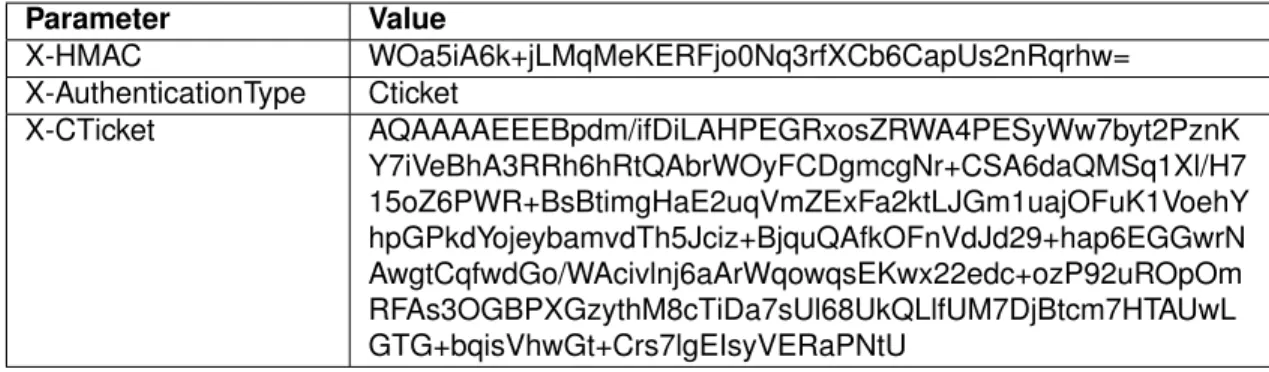
(40) During the course of this analysis Netflix has changed their device management page7 so that it no longer lists information about every individual device. We have successfully registered 50 devices, at which point Netflix’s device management page shows the warning in Figure 3.7. Nevertheless, we were allowed to continue registering new devices and old devices continued to be allowed to play content. It is not clear whether Netflix has decided not to enforce this as a hard limit during an experimental period of the new limit or this is an implementation flaw.. Figure 3.7: Warning displayed when the 50th device is registered with a single user account. From what we have observed in the previous message exchanges, we can formulate a series of hypothesis that we believe to be true: 1. The X-HMAC custom header protects the integrity of the body of the POST request – modifying the X-HMAC value or the contents of the message produces the same error. 2. The message data contains clock information – replaying delayed messages results in a Clock skew error. 3. The player registration data contains identifiers that are unique to this particular Silverlight player installation – every registration request payload is different and uniquely identifies this client in the Netflix Authorized Devices list.. 3.4.3. Client authorization. After registration, the client issues an authorization request to https://agmoviecontrol.netflix. com/nccp/controller/2.11/authorization, once again using NCCP. Unlike registration, which only occurs on the first run of the client, authorization is done every time the client runs to play a movie. The NCCP message in the request is protected in a similar way as the registration request. HTTP request now contains two new custom headers and these are protected by an HMAC, presented in Table 3.6. Any modifications to either of these headers results in a server error. This is the first time we see the CTicket being used and it appears in a client originated request. Either: 1. it is generated by the client; or 2. it was given by the server in one of the previous encrypted interactions. From numerous experiences we have done, we concluded that: 7 https://account.netflix.com/Player?manage_device=0. 20.
(41) Parameter X-HMAC X-AuthenticationType X-CTicket. Value WOa5iA6k+jLMqMeKERFjo0Nq3rfXCb6CapUs2nRqrhw= Cticket AQAAAAEEEBpdm/ifDiLAHPEGRxosZRWA4PESyWw7byt2PznK Y7iVeBhA3RRh6hRtQAbrWOyFCDgmcgNr+CSA6daQMSq1Xl/H7 15oZ6PWR+BsBtimgHaE2uqVmZExFa2ktLJGm1uajOFuK1VoehY hpGPkdYojeybamvdTh5Jciz+BjquQAfkOFnVdJd29+hap6EGGwrN AwgtCqfwdGo/WAcivlnj6aArWqowqsEKwx22edc+ozP92uROpOm RFAs3OGBPXGzythM8cTiDa7sUl68UkQLlfUM7DjBtcm7HTAUwL GTG+bqisVhwGt+Crs7lgEIsyVERaPNtU. Table 3.6: Custom HTTP headers authenticating the authorization request. • Signing in to a different Netflix account triggers authentication renewal, device registration. and a new CTicket is used.. • Deleting the Isolated Storage folder, where the Silverlight based player locally stores data,. causes the player to re-register (no authentication renewal) and use a new CTicket.. • After 12 hours the CTicket expires. The server responds with the message in Listing 3.4 and. triggers an authentication renewal request, and then the CTicket is renewed.. CTicket is probably given to the player when it registers, it is stored in Isolated Storage and is renewed when it expires or is invalid – authentication renewal request to https://agmoviecontrol. netflix.com/nccp/controller/2.10/authenticationrenewal. <nccp:error> <nccp:code>4003< / nccp:code> < n c c p : d e s c r i p t i o n >CTicket expired< / n c c p : d e s c r i p t i o n > < n c c p : a c t i o n i d >5< / n c c p : a c t i o n i d > </ nccp:error>. Listing 3.4: Portion of the NCCP response to an authorization request with expired CTicket. All attempts we made to block requests or responses, replay messages, with the objective of bypassing the authorization were detected by the client or the server and resulted in errors. A successful authorization response contains instructions on how the client should access the movie, as can be seen in Appendix A.2. The content can be fetched from a number of Content Delivery Networks (CDN) and the instructions contain the URLs that can be used for each of the CDN. For Level3 for example, the URL is http://nflx.i.80ed7672.x.lcdn.nflximg.com/685/941879685.ismv? etime=20110625044831&movieHash=715&encoded=05a03c23763faca66e1c4 The client then makes requests to the CDNs by issuing HTTP requests with the form http://nflx.i.80ed7672.x.lcdn.nflximg.com/685/941879685.ismv/range/ 0-48269?etime=20110625044831&movieHash=715&encoded=05a03c23763faca66e1c4 &random=1650549099 21.
(42) From our experiments, we have determined the following for each of the parameters in the URL: • 462565273.ismv – is a video file chunk in Microsoft IIS Smooth Streaming Media Video. format, which is based on the ISO MP4 standard file format with some modifications to the organization schema [35].. • range/0-48269 – is the byte range of the vide file in the chunk being fetched. Changes as the. client requests for different parts of the movie.. • etime=20110625044831 – is the expiration date of the URL and it is always the same as the. client requests movie chunks. This URL, for example, will be valid until 25 Jun 2011 04:48:31 GMT (8 hours after the authorization request).. • movieHash=715 – three last digits of the Movie ID and it is always the same as the client. requests movie chunks. Movie ID was in the URL when the user selected the movie in the movie catalog.. • encoded=05a03c23763faca66e1c4 – is a MAC that protects the other parameters in the. URL except: range and random. It is always the same as the client requests movie chunks.. • random=1650549099 – is different for every request made by the client. Its function is either. to disambiguate movie chunk requests made by different clients that requested authorization. at the same time; or, more probably, to avoid cached responses by caches in Internet Service Providers. The client also fetches audio chunks with .isma extension, instead of .ismv. Modifying any of the parameters in the URL – except range and random – or making the request after the expiration time causes the CDN server to reply with an error: HTTP/1.1 401 Unauthorized To determine whether the encoded parameter is generated on the client side or the server side, we signed in to two different user accounts and we got the players in two separate machines to issue the authorization requests at the same time. They both got the instructions with the same encoded parameter. Apart from the random, both clients started using the same URLs to fetch the movie chunks: Client A: http://nflx.i.80ed91bb.x.lcdn.nflximg.com/592/925963592.ismv/range/ 0-57857?etime=20110920244132&movieHash=640&encoded=0c7324abb5bac31c91d02 &random=1896822204 Client B: http://nflx.i.80ed91bb.x.lcdn.nflximg.com/592/925963592.ismv/range/ 0-57857?etime=20110920244132&movieHash=640&encoded=0c7324abb5bac31c91d02 &random=779206362 22.
(43) This result leads us to believe that the MAC parameter encoded is generated by the authorization server and is not dependent on any client side information. No other type of authorization validation is done by the CDNs. Anyone with the valid URL can request movie chunks without any restrictions until the URL expires. This means that after the client is authorized and is given the correct URL to fetch the file, what prevents unauthorized clients from displaying the movie is the DRM encryption.. 3.5. Stream encryption. When the client is playing a movie and stops, it sends HTTP POST requests with NCCP messages to http://movies.netflix.com/nccp/controller/2.10/playdata and http:// movies.netflix.com/nccp/controller/2.10/logblob. These signal the server that the client has stopped streaming, the position in the movie at which it stopped and other statistics. The next time the user selects this movie it will resume from the point at which it previously stopped. Nevertheless, the first chunks of video and audio the player requests are always in the beginning of the movie range. It does this because the first bytes of the movie contain headers that are needed to determine if the movie is encrypted and, if it is, to obtain the key required for decryption. <WRMHEADER xmlns= " h t t p : / / schemas . m i c r o s o f t . com /DRM/ 2 0 0 7 / 0 3 / PlayReadyHeader " version= " 4 . 0 . 0 . 0 " > <DATA> <PROTECTINFO> <KEYLEN>16< / KEYLEN> <ALGID>AESCTR< / ALGID> < / PROTECTINFO> <KID>AAAAADk67SMAAAAAAAAAAA==< / KID> <CHECKSUM>6AmJA9oC3Xw=< /CHECKSUM> < / DATA> < /WRMHEADER>. Listing 3.5: Header in the first bytes of the video file. In Listing 3.5 we can see an example of the header in a video file. The header informs the player that: 1. The video file is protected with Microsoft PlayReady DRM [21]. 2. The movie is encrypted. 3. The key is 16 bytes long (128 bits). 4. The cipher used to encrypt the movie was AES in counter mode (CTR). 5. The Key ID of the key the player needs to fetch. If this is the first time the client is playing PlayReady DRM protected content, it will contact Microsoft servers and perform what Microsoft calls the Individualization process. It will do an HTTP 23.
(44) POST request to http://services.silverlight.microsoft.com/PlayReady/FW-I81/ default.freeway?Individualize with client data: PostType=DrmIndivAcquire&SecurityVersion=5.0.0.0&Platform=0& Architecture=0&ClientSdkType=1&ClientId= t4LqFbAyzAEkAAAAAAAAAAEAAAAAAAEAAAABAAEAAQCcnwAAYgXxnileYFY%3D Player individualization, according to [22] and [20] is the process of acquiring a software component, the Individualized Black Box (IBX), that is embedded into the Silverlight plug-in to handle requesting licenses and protecting sensitive data used in the decryption process. Replaying the same individualization request multiple times always results in a different Individualized Black Box being downloaded. The IBX contains randomized portions that uniquely identify each particular instance, but as far as we know, Microsoft does not provide details of the component inner workings. After the individualization process, the client sends an NCCP message requesting a license to https://agmoviecontrol.netflix.com/nccp/controller/2.10/license. The message is authenticated with the NetflixId cookie, the CTicket protected by the HMAC, and contains the NCCP encrypted payload. The NCCP response contains an encrypted payload of DRM data of more than 20kB, with the usual protection mechanisms. After the license has been successfully acquired, the player fetches the desired byte ranges from the CDN and starts displaying the movie. The code for the Silverlight based client made by Netflix and the Individualized Black Box is obfuscated. Analyzing decompiled and disassembled code would take much more time than we had available. So we decided to pursue other options. Movie chunks fetched from the CDN are always the same – for the same byte ranges – independently of what client fetches them, when it does it and from where it does it. We have verified that their SHA-1 hashes are the same when requesting from different countries, different machines and with a time difference of as much as two months. This means that the AES encryption key to decrypt a particular movie is always the same. If the key is known, it is simple to build a client in Silverlight, provide the key locally and fetch the movie chunks as long as the URL is valid. We tried using aeskeyfind8 , which is a program that can be used to analyze memory dumps and retrieve candidate AES keys, based on the AES key scheduling data structures [13]: 1. We accessed Netflix.com and started watching a movie on a virtual machine. 2. We paused the virtual machine, causing its memory to be saved to a file. 3. We ran aeskeyfind on the memory file. This process generated a number of candidate keys, as shown in Listing 3.6. With each of these candidate keys, we tried to decrypt the first movie chunk and see if we got an mp4 file chunk, but we were not successful. We also tried to decrypt – after base64 decoding – the NCCP payloads but without success. In the case of NCCP payloads we do not even know what encryption algorithm is being used, but we gave it a try. In conclusion: we did not succeed in breaking the encryption. 8 http://citp.princeton.edu/research/memory/. 24.
(45) eb724c7e8b4c15d2d6c39785af527143 ace6e5ed4737ae4b9a0dd232658bdfce e175c9b65bab6a9d7a514c09d792cca6 eb724c7e8b4c15d2d6c39785af527143 5808 eb8b1f54dfeb4f6a3b1bd025b7f8 5808 eb8b1f54dfeb4f6a3b1bd025b7f8 ace6e5ed4737ae4b9a0dd232658bdfce e175c9b65bab6a9d7a514c09d792cca6. Listing 3.6: Output of the aeskeyfind program ran on the virtual machine memory file to find AES encryption keys.. 3.6. Simultaneous streaming. To prevent widespread sharing of credentials by users, Netflix enforces restrictions on simultaneous streaming. Using the same account it is possible to watch movies on two computers simultaneously. Trying to watch on a third computer with that account causes the player to display the error message in Figure 3.8.. Figure 3.8: Error displayed by the Netflix player when attempting to play a movie on a third computer with the same user account. The error occurs when the client issues the license request to https://agmoviecontrol. netflix.com/nccp/controller/2.10/license. Instead of replying with success as in Listing 3.7 and granting the license, the server replies with the error in Listing 3.8. <nccp:status> <nccp:success > t r u e < / nccp:success > </ nccp:status>. Listing 3.7: Success code when license is granted by the license server. We ran several experiments with simultaneous streaming and concluded that the license server grants at most two outstanding licenses for each account. To be able to obtain a new license for that account one of two things has to happen: 1. The server has to receive the HTTP POST request to http://movies.netflix.com/ nccp/controller/2.10/logblob, mentioned in Section 3.5, with data signaling that the player has stopped displaying the movie. 2. That user must wait until the server side timeout expires, which we have measured to be 36 minutes. 25.
Imagem
+7





Documentos relacionados
The sandboxes we describe in this paper were selected from the proceedings of five conferences: IEEE Symposium on Security and Privacy (Oakland), Usenix Security, ACM Conference
De uma certa maneira, este pensamento vem ao encontro do conceito cabeça bem feita, de Edgar Morin (2001). Para o pensador francês, a cabeça bem feita, que se opõe à cabeça cheia,
Mathematical model for blood flow has been developed in the present model with a view to correlate the finding with its impact on higher altitude [for the benefit of
FEC Retransmission ER EC.. have to resend lost packets. ARQ is example of retransmission. Error-resilient schemes are performed at both the source and the
As the fi rst step for the de fi nition of the security services, this work presents the implementation of the Communication Channel Protection (CCP) service in the COMPaaS
I stated in the last Lecture, that the quantity and quality of the commodities obtained by each labouring family during the year, must
They are e-commerce security (confidentiality, data integrity, authentication, non-repudiation, privacy and trust), and national environmental factors (relative advantage,
Pretende-se desta forma melhorar a imagem da cidade, mas mais importante de tudo, melhorar a qualidade de vida das populações, salvaguardando assim a sua segurança e
