A Work Project, presented as part of the requirements for the Award of a Masters Degree in Management from NOVA- School of Business and Economics.
SME Competitiveness
MARKETING PLAN FOR GUESTCENTRIC SYSTEMS
ANA PATRÍCIA RIBEIRO CARAJOTE 804
A project carried out on the Management course, under the supervision of: Professor Sonia Dahab
Professor Filipe Castro Soeiro 4th June 2012
Marketing Plan for GuestCentric NOVA School of Business and Economics
2 | P a g e
Table of Contents
Executive Summary ... 3
1. Methodology ... 3
2. Description of the firm ... 4
3. Perspective on Business Mission, Vision and Strategic Objectives ... 5
4. Market size and trends and the Industry mapping ... 5
5. Internal Scanning ... 8
6. External Scanning ... 12
7. Strategic Triangle ... 16
8. Service Marketing Mix... 17
9. Conclusions and Recommendations ... 25
Bibliography ... 25
Marketing Plan for GuestCentric NOVA School of Business and Economics
3 | P a g e
Executive Summary
After four years in the market, GuestCentric (GC) Systems, a hospitality software Portuguese company, has not yet been able to reach break even. So the question that arises is why? To answer that question ones needs to analyze the market the company operates, the main competitors and the company itself. That is what I have done in this work project, and after that I developed a marketing plan to help the company to improve its results, thus helping the business to growth.
I started by analyzing the external environment of the company, then I studied GC’s internal situation, especially their competitive advantages. After identifying some of the main problems GC is facing, I decided to conduct a marketing plan to solve some of the problems and to give suggestions of improvement. An analysis of the strategic triangle and marketing mix was developed and some conclusions were reached. Finally I conclude the paper by providing some recommendations.
KEYWORDS: SaaS, hospitality industry, strategic triangle and service marketing mix
1. Methodology
In order to develop this work project several tools were used. The first and most important method was the visits to, both website of the company, and to their Lisbon offices’, when we had an interview with Engineer Pedro Colaço. Also I had the help of Professor Sonia Dahab, Professor Filipe Castro Soeiro and Professor Victor Centeno. It was also essential to conduct some questionnaires to GC’s clients. Finally, it was necessary to read some books and papers related with the studied subject, but it was also necessary to search some important information in the internet that was based on statistical data and other articles.
Marketing Plan for GuestCentric NOVA School of Business and Economics
4 | P a g e
2. Description of the firm
Created in October 2006, GuestCentric Systems (GC) is a Small Portuguese company that operates in the software hospitality industry, with offices in Spain, US and Portugal. It was founded by Pedro Colaço, the current president and CEO, and Filipe Tappenbeck, the vice-president of product management, the company is composed of 23 employees (Appendix1- organizational structure).
GC’s product is a CRM1
SaaS2 that offers a fast and easy multi-device booking engine; website creation; a centralized tool to manage all channels; access to mobile and social networks; and synchronization of all contents in all means automatically, targeting independent hotels. Also included in all GC’s product is live online training with a GC employee, a support team 24x7, no additional software or hardware needed, no limit in terms of users and automatic and free upgrades to new versions of the software.
Currently, GC has 450 clients3 in 46 different countries; most of GC’s clients are located in Portugal, Spain, Brazil and Argentina. (Appendix2- Accounts per country). However, their net sales aren’t enough to cover their costs, which mean that GC has been losing money, for four years now.
So one can ask why the company hasn’t been able to break-even after being in the market for four years. I will try to find the answer to that question and then show how GC can improve their situation using a new marketing mix.
1
CRM: customer relationship management 2
Software as a service (SaaS) is a software distribution model in which applications are hosted by a vendor or service provider and made available to customers over a network, typically the Internet.
3
Marketing Plan for GuestCentric NOVA School of Business and Economics
5 | P a g e
3. Perspective on Business Mission, Vision and Strategic Objectives
GuestCentric is a determined and focus company, thus their mission and vision have remained unchanged along the years. Their Mission is: “To give support to independent
hotels on their online presence in an easy and fast way. GC wants to build “a solution that focuses on revenue-generation and simplicity using best-in-class cloud technology”
(GC, 2012). Their Vision is: “To be the global leader of software hospitality
applications service providers till the year 2020.” The most recent Strategic objectives
of GC for 2012, given the difficult financial situation of the firm, are to reach break-even or leave the market. This implies a need to cut costs and increase rbreak-evenues by getting new clients. For that reason GC wants to open an office in the United Kingdom and continue the internationalization process to the Latin America.
4. Market size and trends and the Industry mapping
Regarding the market size of the independent hotels, there are a total of 97.502 hotels worldwide, representing a total of 69% of all hotels worldwide, with generated revenues of $256.1 billion dollars (the entire data is in appendix3), this aligned with the most recent trends of the market (see appendix4) that say that in 2011, 45% of all hotel booking were via internet, make it further attractive to enter the hospitality software industry. Also it’s important to say that global Travel & Tourism is expected to grow by an average 4% per year between 2011 and 2021 (World Travel & Tourism Council, 2012). Additionally it’s expected that Travel and Tourism will reach approximately 10% of global GDP and 10% of global employment by 2021 (Blanke & Chiesa, 2011).
To have a better look of the competitive environment of their industry, an industry mapping was developed (Figure I).
Marketing Plan for GuestCentric NOVA School of Business and Economics
6 | P a g e
In the hospitality market, customers have two possibilities to book a hotel; they can go directly to the hotel’s website or they use the internet to search for one, using the computer or the phone. In the internet many intermediaries can be found: Online Travel Agencies (OTA), Global Distribution Systems (GDS), the website of the hotel or their pages in the social media; these are the places were clients can search for hotels. (A further explanation of the intermediaries is in Appendix5). Aside from the intermediaries there are other players in this market, like tourism organizations and Destination and Marketing Organizations (DMO), which provide information to the travelers about destinations and hotels. GC appears as the link between Hotels and the Internet, because as a hospitality software application company, their service includes providing hotels with a new website, social media and the website optimized for mobile devices, and a powerful multi-device booking engine. GC’s objective is to decrease the dependency between hotels and the intermediaries, making possible for hotels to contact their clients more directly. The main advantage for hotels is that they gain access to proper digital marketing tools; they can do a better CRM; and no longer need to be so much dependent on such intermediaries, by allowing them to cut down on intermediaries’ fees and consequently increase their margins and revenues. According to GC (but not confirmed by all clients), their software allows hotels to increase direct booking between three to ten times and to lower the distributions cost by 30%. For
Marketing Plan for GuestCentric NOVA School of Business and Economics
7 | P a g e
hotel’s guests the main advantage is that by contacting directly the hotel they would save time and have access to better rates and special promotions and discounts.
However some problems can be identified. Let us start with the side of the hotels’ guest: generally guests prefer to search for hotels in the intermediaries, like booking.com or Tripadvisor, instead of going directly to the hotel’s website. The main
reasons for that are: those companies are well known and respected in the marketplace and so they inspire trust and confidence; also the intermediaries have another advantage that is related with the reviews and commentaries of past guests of the hotel, that can be seen there, allowing potential guest to have an idea of the hotel itself, their good aspects and defects. Besides, when it comes down to find the best prices, it’s very common to find that most people rarely check the hotel website for online reservations because the idea is that the intermediaries offer lower prices. All of this shows that hotels are still very dependent of the intermediaries.
Now looking in the side of the hotels: it’s very common to find that most hotel are not taking full advantage of GC’s software, because only 20% have lower prices in their website that the ones from Booking (a comparison of prices can be seen in appendix6). This means that there is no advantage for hotel’s clients to book directly in the hotel’s website, since prices there are usually higher or equal than at booking. This implies that:
For hoteliers- direct booking will not increase as much as they would
have expected when bought software such as the one GC offers, so most of the hotel’s booking continue to come from the intermediaries, thus hotels will continue to pay commissions to the intermediaries and if they acquire GC’s product, they will need to pay to GC as well.
Marketing Plan for GuestCentric NOVA School of Business and Economics
8 | P a g e
For GC- if direct bookings don’t increase they will not receive that much
money since most clients chooses the payment method pay-as-you-go, which is a percentage of direct booking.
Now thinking about other issue, most of hotels already have websites and booking engines of their own, so the question is why should they choose GC, especially, as explained before, if the results are not immediate? This product would only make sense for: 1) brand new hotel that don’t have those tools already, 2) hotels that want to change their brand image or 3) those that need a better software than they currently have; and if 4) results (direct bookings) from GC would be so impressive that booking from intermediaries would decrease and so the fees paid to them, thus saving the hotel some money, like the cases presented in GC’s website of Crescent Hotels or Casa Madrid (explained in appendix7).
5. Internal Scanning
First it’s important to examine GC’s Business Model (See appendix8). To start we need to identify which are GC’s targets. Being a B2B company, their main targets are independent hotels. However in the hotels industry there are several types of segments: destination resorts; lower tiers resorts; high-end boutiques; classic mid-tier; budget/economy and low budget. These segments4 were defined according to two main criteria: number of bedrooms and Average Daily Rate (ADR). In appendix9 we find, the size and value of each segment.
Today, GC targets: high-end boutiques, classic mid- tier and some hotels of the budget-economy (with 75$<ADR<100$), because since the beginning the company wanted to help independent5 hotels, so that they could compete with the big ones. In the
4 The segments were defined by Global Smith Travel
Marketing Plan for GuestCentric NOVA School of Business and Economics
9 | P a g e
beginning they also target the lower segments; however, recently they dropped it for several reasons. One reason is that in the lower segment, there are a lot of independent web designers, offering a low quality product and focusing on low prices which competing makes it harder for GC to compete; also in this segment switching cost are lower, so it’s harder to create loyalty with the hotel owners. Finally, as Pedro Colaço told us GC’s goal today is to have as many of the best hotels, as a way to position the firm differently in the market and build brand awareness.
In terms of the revenue model, GC sells their product to interested clients, using “Cold calls”, which occur when a sales rep from GC calls an independent hotel that has never contacted or was never contacted by GC’ sales rep. In 2011, GC’s revenues were
divided in the following matter: 30% are from Portugal and the remaining 70% are international. The pricing is calculated through a fixed fee of 643€ for the all-in-one option or a pay-as-you-go system of 6% of all the hotel bookings that came from GC’s software (with 1 year contract), being this system preferred by 90% of the all clients (appendix10- pricing systems). As a way to expand the market, GC has developed some partnerships in Portugal, with Portugal Telecom (PT) and NewHotel (NH), in order to do a product bundling, thus creating a complete solution for hoteliers with internet, TV and phone (PT); online marketing (GC) and PMS 6(NH).
Regarding the cost model, GC has a server that has the capacity for 4.000 clients, as GC was not able to capture that number of clients; they have an extra capacity, so they can use economies of scale to enhance that situation. In the value chain (See appendix11), the activities that have more weight in GC’s cost structure are the Firm’s Infrastructure (FI), Marketing & Sales (M&S) and Human Resources (HR). The weight
6
Marketing Plan for GuestCentric NOVA School of Business and Economics
10 | P a g e
of these activities is excessive, especially because some of them are not crucial for the firm and can’t be seen as an investment, given that they are not contributing to positive results. Additional, GC hasn’t yet been able to break-even in four years and they have fixed costs three times higher than revenues, so in this phase it’s crucial for the firm to cut down costs in a very extreme way, if they want to survive.
For example, in HR costs, salaries are the ones with the biggest weight, which is not suitable for a company that is struggling to survive. So, it’s necessary to cut salaries to the average paid in the market for the same position or if necessary, to fire some workers. Then we see that the FI has also excessive costs, so to save money in the rental of the office, for example, GC could move to a different area or choose a smaller space with lower rent. Then, M&S costs are not being reflected on sales, so salaries should be based on commission, selling more would result in higher salaries. Also the impact of the money invested in M&S should be done to access further investments.
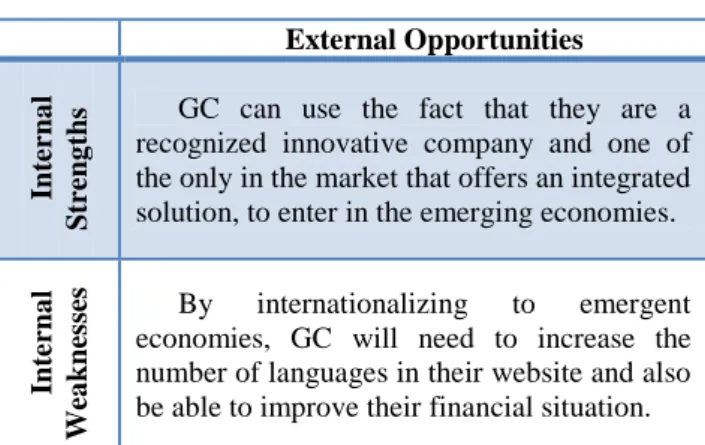
After the study of the Business Model, one need to elaborate a SWOT (appendix12) and TOWS analysis of the company to determine the most important, internal and external factors that affect GC.
External Opportunities External Threats
Inte
rna
l
Str
eng
ths recognized innovative company and one of GC can use the fact that they are a the only in the market that offers an integrated solution, to enter in the emerging economies.
Develop a communication plan to highlight the fact that GC’s is different from the other, the best price/quality solution and a very important investment in time of crisis, since it increases direct bookings and decreases distribution costs.
Inte rna l Wea k nes
ses By internationalizing to emergent economies, GC will need to increase the number of languages in their website and also be able to improve their financial situation.
Invest in better communication efforts to create brand awareness and show client’s how differentiated the product is, this way GC will be able to enhance their financial situation and pass by the international crisis.
Table I: TOWS analysis
After these analyses it becomes clear that GC has a set of distinctive competences (resources and capabilities), next it’s necessary to determine if they can be considered a
Marketing Plan for GuestCentric NOVA School of Business and Economics
11 | P a g e
sustainable competitive advantage of the company or not. They first competence,
Innovation is automatically associated with GC, since only in the last year they have
won 9 innovation prizes for the website they create, and also there is a continuous effort on bringing constant innovation to the product, one of the latest is the possibility to have advertising of other companies like car rentals, restaurants, in the hotels’ website, thus creating extra sources of revenues for the hotel. It’s also important to mention that CG has a very good reputation among their client base, given that 89% of their customers would recommend them to their industry peers (GC, 2012). Other important resource is related with GC’s product, which is considered not only by the company, but also by the interviewed customers, an excellent solution at a reasonable price. This characteristic can be considered the most important source of competitive advantage GC has, because only one other company7 offers such an integrated solution as GC does, including in one product several tools that hotels need to develop their marketing strategy. This integration enables hoteliers to manage all marketing action in an integrated system, being all contents synchronized automatically when changes are made, thus reducing time and costs. Finally, customer service is considered very helpful and efficient by 50% of all interviewed hotels, which is an important way to better engage with clients, and create a stronger relationship, thus leading to loyalty.
After this analysis we can conclude that none of these competences can be considered VRIO8. Although they are rare in the market, valuable for the company and difficult to imitate in the short-run they are not organized internally. This is because of several factors: the distinctive features of the software are not fully transmitted to customers (current and potential); the company has unused capacity; the revenue model
7
The other company is Buuteeq, located in Seattle, US with 400 clients 8
Marketing Plan for GuestCentric NOVA School of Business and Economics
12 | P a g e
is not adequate to the cost model; and the marketing strategy may not be adequate given the importance of the intermediaries in the market.
6. External Scanning
To perform the external analysis, it’s necessary to study GC’s competitors and external environment, to do that I will use a Porter’s 5 forces analysis and a competitor’s benchmark approach.
First it’s important to say that there are some external factors hurting GC such as their country of origin (Portugal) that is currently facing a very hard financial crisis, so internal market is shrinking, thus growth is very limited, besides it’s being hard for the company to have access to funds (except the ones received from QREN).
The conclusions we get from Porter’s 5 forces (appendix13) analysis are the low bargaining power of supplier and buyers, cannot over balance the fact that the threat of new entrants, the rivalry among competitors and the threat of substitute products is very high. This means that this is a very competitive industry, so it’s important to have a clear and sustained competitive advantage to be successful, which is not the case of GC.
About competition, GC has a product that can be considered global, so their main competitors are international, they can be divided in:
Direct Competitors- are firms that have the exact same product as GC, like
Travelclick.com, sabrehospitality.com, fastbooking.net, and buuteeq.com;
Indirect Competitors
o Substitute companies- like booking websites such as: booking.com, expedia.com, hoteis.com, HRS.com and fastbooking.com;
o Companies that offer in separate what GC offers as one solution. (Example: companies that only provide website creation, or just booking engines.
Marketing Plan for GuestCentric NOVA School of Business and Economics
13 | P a g e
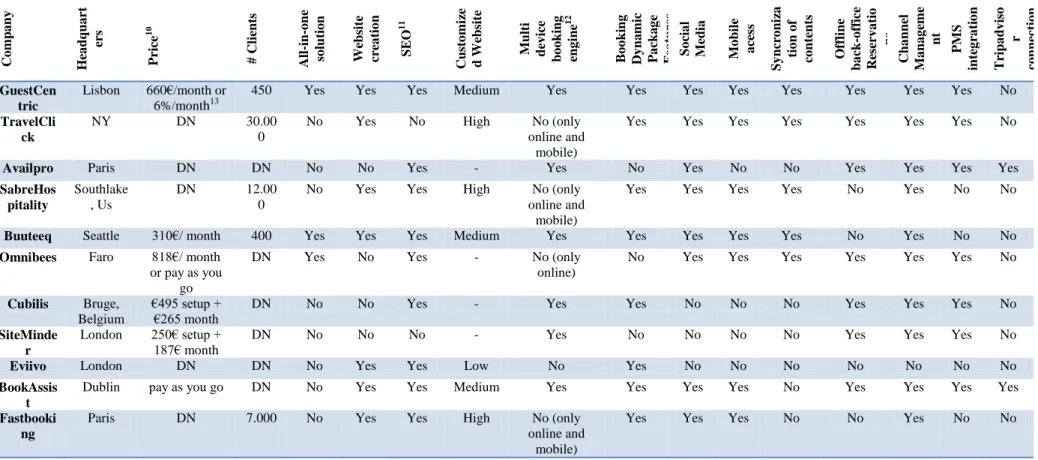
A competitive benchmark of the products’ main features can be seen in the table III (page14). The most important thing we can identify is that GC is one of the only that offers an integrated product, and that’s what differentiates GC from most of the competitors. Nonetheless it’s hard for GC to distinguish from their main competitors, since all of the most important characteristics are shared by other companies. Besides, there are some recent features that other companies have and GC doesn’t, like the appearance of the hotel’s website in Tripadvisor.
However it’s important to say that one of the companies in this table, Buuteeq, was created as an imitation of GC, so if a company that is located in one of the most technological places of the US (Seattle) is copying GC, this means GC is a very good company. Yet, Buuteeq was only founded 2 year ago (GC was created 4 years ago) and already has the same number of clients’ as GC. This situation can be explained by the country of origin of both companies. The reasons why software companies from the US have better advantages over the ones from Europe are: 1) The US domestic market is much larger than the European that’s very fragmented, 2) Funding in Europe is harder than in the US, 3) “The US has a larger pool of trained software engineers; this means US firms have attained dominant positions in many of the established software markets and are most often first to market with new product ideas.”(Brouthers, Keith D.; M. van’t Kruis, Yvette, 1997)9
10Comparison based in a 150 rooms’ hotel, with an ADR of $150
11
SEO: search engine optimization 12
Includes online bookings, on Facebook, mobile and tablet 13
With 1 year contract+ setup fees
Co m p a n y H ea d q u a rt ers Pric e 10 # Clients All -in -o n e so lu tio n We b site cr ea tio n S EO 11 Custo m ize d We b site Mu lti d ev ice b o o k in g en g in e 12 Bo o k in g Dy n a m ic Pa ck a g e Fea tu re s S o cia l Medi a Mo b il e a ce ss S y n cr o n iz a tio n o f co n te n ts O ffli n e b a ck -o ff ice Re se rv a tio ns Cha n n el Ma n a g em e nt PM S in te g ra ti o n Tr ip a d v iso r co n n ec tio n GuestCen tric Lisbon 660€/month or 6%/month13
450 Yes Yes Yes Medium Yes Yes Yes Yes Yes Yes Yes Yes No
TravelCli ck
NY DN 30.00
0
No Yes No High No (only
online and mobile)
Yes Yes Yes Yes Yes Yes Yes No
Availpro Paris DN DN No No Yes - Yes No Yes No No Yes Yes Yes Yes
SabreHos pitality Southlake , Us DN 12.00 0
No Yes Yes High No (only
online and mobile)
Yes Yes Yes Yes No Yes No No
Buuteeq Seattle 310€/ month 400 Yes Yes Yes Medium Yes Yes Yes Yes Yes No Yes No No
Omnibees Faro 818€/ month or pay as you
go
DN Yes No Yes - No (only
online)
No Yes Yes Yes Yes Yes Yes No
Cubilis Bruge, Belgium
€495 setup + €265 month
DN No No Yes - Yes Yes No No No Yes Yes Yes No
SiteMinde r
London 250€ setup +
187€ month
DN No No No - Yes No No No No Yes Yes Yes No
Eviivo London DN DN No Yes Yes Low No Yes No No No No No No No
BookAssis t
Dublin pay as you go DN No Yes Yes Medium Yes Yes Yes Yes No Yes Yes Yes Yes
Fastbooki ng
Paris DN 7.000 No Yes Yes High No (only
online and mobile)
Yes Yes Yes No No Yes No No
Now it’s important to see how clients see GC, to do so I conducted a survey (appendix14) to 127 hotels that was answered by only 28 hotels, the main conclusions from this study are:
The first time 43.5% of GC’s clients heard about GC were through their
colleagues. What this means is that word of mouth is working in favor of GC, because their clients are recommending it to other hoteliers.
When clients were contacted the first time by GC the first impression was
usually positive. GC is described as dynamic, professional, and helpful, with no formalities, available, efficient and fast. Some say that GC’s product was just what they needed at the moment, since it satisfies their needs; the clients support was very good and the sales rep revealed an excellent domain of the product features. Although some clients had some doubts after the first contact most of them were clarified.
73% said that what made them decide to work with GC was the product and
58% said it was the price. The product was described as simple, easy to use and functional, the price was considered fair and it was also expressed that there was a good price/quality. These aspects are important, because they are what constitute the major source of GC’s competitive advantage and show that GC’s clients are price sensitive.
50% agree that GC client service is very useful and efficient, while more than 50% don’t have a clear opinion if GC has overcome their expectations or GC’s product is very innovative. The first aspect can be leveraged so that it becomes a competitive advantage of GC, excellent customer service. The other aspects are a part of what GC needs to improve, which can be used to develop a better communication to the clients, putting emphasis on the innovation.
93% say they prefer to be contacted via email by companies as GC, which can
Marketing Plan for GuestCentric NOVA School of Business and Economics
Page | 16 Some of the suggestion hotels gave to GC were related with: better follow up of post-sales, improvements in terms of the product characteristics and efficacy after the installation of the software (bookings from intermediaries are still higher than the ones generated by GC’s software). Some companies said that they preferred a better customization according to their needs, and finally some suggested more contents in their mother tongue and a wider offer of online channels.
In conclusion, GC’s main problems were identified with the previous analysis, showing that some actions are necessary. Those will be explored and analyzed in the next sections using the service marketing mix.
7. Strategic Triangle
The strategic triangle is composed by the segmentation, targeting and positioning of a company. GC’s segmentation and targeting was already explained when talking about the business model of the company. In terms of positioning, GC positions itself as a high quality with reasonable price product, surpassing competitors that either have good quality and price, or medium quality and price. With that said GC’s positioning statement could be: “For independent hotel owners that want to solve their digital marketing problems/needs, GC offers the ultimate all-in-one solution.” This positioning is aligned with GC’s mission in a way that their product allows independent hotels to
compete at the same level as big hotels, by creating an online marketing strategy that enables them to reach the consumer in a more direct and easy way.
My opinion about these elements is that, since GC is currently facing so many difficulties, they should focus on their most valuable segments, the ones that give them more money. As appendix15 shows the clients that give GC the major percentage of revenues are high-end boutiques and resorts. So in this initial period they should target them, making an effort to acquire more clients from this segment. Regarding the rest of
Marketing Plan for GuestCentric NOVA School of Business and Economics
Page | 17 GC’s clients, what most of them pay to GC is not enough to cover the expenses GC incurs with them, so they need to pay less attention to them. To support this statement, we know that GC spends 200€/year per hotel, so hotels should pay GC this amount to allow break-even. However there are 81 hotels that pay GC less than that amount per year, so instead of making money with these clients, GC is actually losing money.
In this first phase, and since the company is trying to survive, my advice would be to not focus too much on the clients that are not profitable for GC, and center the attention on the ones that are more valuable, so that they can retain them. In a second phase, when the company is in better health, the segments that should be targeted are, inside independent hotels, the resorts and boutiques, since they are the ones that generate more revenues for a company like GC. To capture these clients from higher segments, product customization could be done, by including in the booking engine features such as other services provided by the hotel like spa treatments, eating in the restaurant or attending the gym with a professional trainer. So including the booking of these services offered by the hotel, would be an advantage for the hotel that could also market these services, and for GC that could include these services as an extra feature of the software, charging an extra fee for it.
8. Service Marketing Mix
The services’ marketing mix is characterized by the use of seven P’s, instead of the commonly used four P’s.
Product : Regarding the characterization of GC’s product as SaaS(More product
details in appendix16)., it’s important to refer an article that points out that some of the problems these type of product face are “data security, reliability, data logging” (Wu,
Wei-Wen, 2010). In order to overcome the problems of SaaS adoption, the same author advises companies to “increase user’s understanding the potential merits and reasonable
Marketing Plan for GuestCentric NOVA School of Business and Economics
Page | 18 security for SaaS adoption. The SaaS provider’s must respond to the user’s worries and concerns regarding cost-effectiveness, application compatibility, and security of data backups.” (Wu, Wei-Wen, 2010). To do so GC could incorporate in their website or sales pitch, expert’s opinions about GC’s product; other suggestion is to emphasize the advantages of the product, such as being a good help to make things faster, and an extremely secure solution with data backups.
Nowadays, many costumer look for hotels using tools such as Tripadvisor.com, were one can see the description of the hotel and the prices GDS and OTA’s offer, like booking.com and Expedia.com. So it’s essential that the hotel’s website appears next to those websites, since the main advantage of GC is that hotels’ customers can get lower prices going directly from the hotel’s website. However since the hotel website never appears in Tripadvisor next to intermediaries’ prices, customers will not go to the website to check if the price is lower. To confirm this statement I searched on Tripadvisor for one of GC’s clients in Spain, Casa de Madrid, and the only option to see prices were: Expedia.com, Booking.com and agoda.com.pt, the hotel website doesn’t appear (Aappendix17). This means that guests will book with booking.com and the hotel will still need these intermediaries. So, one can conclude that a connection with such websites, like Tripadvisor, needs to be incorporated in GC’s product.
Additionally, something very alarming came up when talking with some of GC’s clients, which is the fact that the result of using GC’s product are not immediate, and although direct bookings increase substantially, and thus their sales and revenues, the impact on total sales and revenues is not as significant as the ones from the intermediaries, which means hotels still need to pay intermediaries to book their rooms. This is very bad for GC because if hoteliers don’t see the advantage of the product, they will leave GC sooner or later will. Other situation is that the rate of retention of guests
Marketing Plan for GuestCentric NOVA School of Business and Economics
Page | 19 that use GC’s online booking is very low. This means that clients that use the online booking of the hotel to book their stay usually don’t use it for a second time. This could have several meanings, related with the hotel itself, or it could be related with the booking engine of GC. Maybe the first experience using it was not satisfactory, or guests didn’t like the system or got confused with some aspects of it; or maybe guests see no advantage in it.
A lot of GC’s clients than answered the questionnaire, complained about the fact that the software should be more customized according to their needs; that it’s hard to make changes in the hotel’s prices; the hotel’s clients get confused when they want an extra bed; and the software should be pre-established for a double room for 2 people, instead of 1 person as it’s now.
This means GC should listen more attentively to their clients’ suggestion and comments, since they are the ones that use the software daily and know what can be improved to better satisfy their needs. Other suggestion would be to “educate” hotels to be more efficient in the use of GC software by provide workshops to teach them how to better use the software, providing suggestions and tips to maximize their benefits and show how to create strategies to retain clients, like allowing guests to have access to especial discounts, promotions, etc. By doing these workshops, GC would have an extra source of revenues.
Besides a smartphones application could be developed by GC to allow hoteliers to have access to GC’s software using their smartphones, anywhere they want. So it would be possible to check: current bookings, relevant statistics about the hotel and client’s behavior, and it would be possible to control social media engagement. This
Marketing Plan for GuestCentric NOVA School of Business and Economics
Page | 20 be going with the current trend of people using their smartphones to do almost all their activities.
To conclude it must be said that a company so focused on innovation, as GC is, it’s imperative for them to charge an extra payment from the client for new versions of the software or new features add to it, which is not being done currently by the company. At least a symbolic amount should be charged as a compensation of the work done for developing that innovation. As for the hotel they have the possibility to acquire the new feature if they want given the charged price, by doing so GC would find a new and valuable source of income.
Place: GC’s product is distributed by the company itself, so it’s a direct distribution,
accessible to hoteliers in GC’s website or via phone call of a GC’s sales rep. This is the best option, especially because of the characteristics of the product itself; since it’s a SaaS, distribution is done online with no extra costs for GC. Also by selling the software directly, GC has more control, is able to create a better and long-lasting relationship with the customers and thus enhance customer satisfaction, loyalty and brand awareness. Also it’s easier and more comfortable for clients to have the necessary help when needed. However, in the international market, some indirect distribution channels are needed, so it’s necessary to find trustworthy partners. However, there are countries were physical presence is necessary and as such the direct distribution is also required. Some important partners could be well-know PMS companies in such market, since hotels always need PMS software, so if those companies also offered the online marketing software from GC, it would be good for both companies but also for the clients that would encounter the global solution for their problems.
Price: Currently GC has two types of prices as it was already explained. The fixed
pay-Marketing Plan for GuestCentric NOVA School of Business and Economics
Page | 21 as-you-go is chosen by the remaining 90%, which shows that many clients prefer not to “tied up” with one company. These percentages demonstrate that hotels don’t want to compromise to GC’s product immediately. Associated with that, is the fact that, results using GC’s product are not immediate, so in my opinion this pricing option is prejudicial to the company. However, most clients prefer this payment system, so GC needs to maintain it, but with a few changes, such as the way it’s calculated. My recommendation is to do a progressive fee, based on the results of using GC’s product. As such, if GC’s product gives the company 50 clients the fee should be 5% per month, if they achieve 100 clients the fee would be 10% and so on to the maximum percentage of the intermediaries, approximately 15% (Appendix18- how this fees were calculated).
Besides that, GC should do price discrimination, offering what seem to be different products, for different segments, at different prices. For instance for boutique segment that are more sophisticated and usually charge higher prices for their rooms, GC should charge a higher price that the ones that does currently, offering the pack all-in-one with the option to customize the software according to the client’s needs. This is very important because with this type of product, price is seen as an indication of its quality, so if the price is high, hoteliers will associate it with quality leading to more confidence and security in the solution. So the ideal price for the fixed amount per month, for this segment would be 800€, which is still very competitive when comparing with the competition that has similar prices for a software that is not as complete as the one from GC (ex. Omnibees). For the mid tier, the prices should remain the same, since for most of the clients the biggest competitive advantage GC has is the quality product at an accessible price, if the chosen product is not the all-in-one, but the middle option, the price should remain 400€ a month or the pay-as-you-go option explained before,
Marketing Plan for GuestCentric NOVA School of Business and Economics
Page | 22 since it’s already a very competitive price when comparing with the competition’s prices and product offer.
Other option is to offer a more customized product for clients that prefer it, and then charger a higher price for those extra features client’s want. However for that it’s necessary that the R&D department focus more on reducing customization costs, so that GC could have a higher margin to sell their prices at a higher price. Some promotions could also be used to lower the price of the most loyal customers, for instance, if GC’s clients help the company giving them contact of fellow hoteliers; they should be rewarded with a promotion on the price they pay, if their colleagues become GC’s clients. A discount of 5% could be done per hotel acquired by GC after the help of their current clients.
Promotion: GC’s promotion mix can be divided in: online, personnel selling and
public relations. Their online marketing is based on the divulgation of the website through organic results14, and with the appearance of some articles from their website in tourism newsletters. In personnel selling, GC does cold calls, however according to data from GC this method only generates between 4 and 5% opportunity to acquire a client, this tell us that this is not a very efficient method or the sales elevator speech is not being successful. Finally, in public relations, GC is present in printed press, with a column in Publituris magazine, and is supported by opinion leaders, specialized in the hospitality industry, who GC can talk to, explaining how they are as a company, what they do, so that those leaders can then divulgate GC in to their pears.
The fact that GC’s product is still in a growth phase, and aligned with the problems of SaaS adoption, communication to potential clients must emphasize the advantages that the product will bring them: like decrease in distribution costs, increase in direct
14
Organic results allow a company to appear in the top of Google search without paying advertisement; by creating the company’s website with specific characteristic that make it more visible to Google algorithm.
Marketing Plan for GuestCentric NOVA School of Business and Economics
Page | 23 bookings, thus increasing profits, in a simple, user friendly and time saver tool. Also it would be important to use their advisory board opinions about GC in the website to give potential clients a sense of trust in the product. The cold calls, should be an elevator pitch of no more than 5 minutes where the sales rep creates curiosity in the consumer, by naming the advantages and gains of having such an innovative product, then redirecting them for the website, where GC can post an explaining video of how to use the software (in the home page and filmed in their Lisbon office) making it in a way as it was someone using the software and explaining it at the same time. This would be very important since trying and seeing how the software is simple and easy to use, is usually a good way to persuade clients to acquire it. If the client was already impressed and wants to acquire product, a meeting should be scheduled preferably via video chat. It’s important to have a meeting with prospect client, when possible, in order to create trust and a closer relationship with them, allowing also a demonstration of how the product works. Also is fundamental to have the website in more languages namely Portuguese and Spanish, since many independent hotel owners don’t know how to speak English at all, or not very well, again it’s a sign of concern for the client. Also it’s very important to create ad words campaigns, since when clients search for this kind of product, using words as: “digital marketing”, GC appears in the 4th
place; “hotel’s online marketing” GC doesn’t appear in the 1st
page; “booking engines for hotels” GC is in the 3rd
place and many other examples. This exercise shows that when hoteliers search for hotels GC rarely appear as a 1st option, and since that is such an important tool for the promotion mix of GC, one sees that ad words are essential for the success of the company. Ad words should include both search ads (in the Google ranking) but also in display ads (in websites used by hoteliers).
Marketing Plan for GuestCentric NOVA School of Business and Economics
Page | 24 Related with the product one suggestion to engage with the customers and create a better relationship with them is to create a blog or a special email where clients can send their suggestion in order to improve the product, thus making them feel appreciated and their opinion valuable. Other option would be to create a company’s newsletter dedicated to clients, sent via email, where the most important features wrote in the blog appeared, especially those articles related with how to maximize the use of GC’s software.
Physical Environment: GC has offices in Lisbon, New Jersey, Barcelona, and an
office being planned for UK. Partnerships are the chosen option for other countries like Brazil and Argentina, where GC already has some clients. It’s important to note that in some countries GC tries to enter is crucial to have physical presence since it creates a sense of security and a closer relationship with the buyer, so some cultural studies will be necessary to determine the necessity or not of a physical environment. Also these offices can act as headquarter for the region, so only one office should be opened in the Latin America, since it’s very expensive.
People & Partnerships: GC’s team is dispersed in the following areas of the
company: sales, R&D, finances, customer support and administrative services. Also a number of partners around the world can be considered part of GC’s people. The most recent Portuguese partners are very well-know and recognized brands in the country and in the tourism industry, PT and NH. So it’s very important to mention hotels this partnership, using their logos in GC’s website, to transfer their brands’ trust and awareness to GC’s, solving one of the problems of SaaS adoption, that is the uncertainty about the reliability of the product (trust issue) and making hoteliers feel safer with the adoption of GC’s product.
Marketing Plan for GuestCentric NOVA School of Business and Economics
Page | 25
Process: GC as a company is composed of several processes and flows between their
employees and clients, such as the sales flow, product development and support flow (appendix 19 to 21). It’s important to mention, after analyzing the flow charts, that GC has an important focus on quality assurance, and to listen to their clients in the product development and support area. This trait of GC is needs to be maintained in order to differentiate the firm from competitors by providing quality product and service.
9. Conclusions and Recommendations
After analyzing GC internally and externally, it can be seen that the market is very attractive, thus competition is very intense, so a sustainable competitive advantage is essential. However, GC has not been able to organize internally their main competences, thus being unable to have a sustainable competitive advantage. For these reasons it’s hard for GC to differentiate, given that all competitors are similar and so clients decide based on price. Nonetheless, GC seems to be imitated by one company in terms of the main features of the software, showing that they are a good company, worth of being imitated. However, the financial situation of the company is problematic situation, and to overcome it some actions are necessary: severely cut down cost and increase revenues. Besides, measures in the marketing field can be done, in terms of targeting and the marketing mix. If the presented suggestions are taken into consideration I believe that GC can survive and became a successful company.
Bibliography
Teece, David J.2010. “Business models, business strategy and innovation”. Long
Range Planning, 43: 172-194
Kotler, Philip; Armstrong, Gary; Wong, Veronica; and Saunders, John. 2008.
Principles of Marketing. Fifth European Edition. Harlow. Pearson Education
Porter, Michael.2008. “The Five Competitive Forces that Shape Strategy”. Harvard
Business Review, Jan, 2008, vol.86(1), p.78(16)
Brouthers, Keith D.; M. van’t Kruis, Yvette. 1997. “Competing in Software: Strategies for Europe’s Niche Business”. Long Range Planning, 30 (4): 518-528
Marketing Plan for GuestCentric NOVA School of Business and Economics
Page | 26 Wu, Wei-Wen. 2011. “Developing an explorative model for SaaS adoption”. Expert
Systems with Applications, 38: 15057- 15064
Wu, Wei-Wen. 2011. “Mining significant factors affecting the adoption of SaaS using the rough set approach”. The Journal of Systems and Software, 84: 435- 441
Lehmann, Sonja, and Peter Buxmann. 2009. “Pricing strategies of Software Vendors”. Business & Information Systems Engineering, 6: 452- 461
Alajoutsijarvi, Kimmo, and Kari Mannermaa, and Henrikki Tikkanen. 1999. “Customer relationships and the small software firm. A framework for understanding challenges faced in marketing”. Information and Management, 37: 153- 159
Barney, Jay. 1991. “Firm Resources and sustained competitive advantage”. Journal of Management, vol. 17 (1):99-120
Mind Tools. 2012. Mind Tools.
http://www.mindtools.com/pages/article/newSTR_94.htm
GuestCentric. 2012. GuestCentric Systems .www.guestcentric.com Slides of Professor Filipe Castro Soeiro and Professor Sonia Dahab Strategy4you.2012. Strategic Advantage, Inc.
http://www.strategy4u.com/assessment_tools/info.php?s=2&PHPSESSID=2c613c0165 8529b4077ee70820f1814f
http://www.wttc.org/research/economic-impact-research/ TravelClick. 2012. TravelClick. http://www.travelclick.com/
Sabre Hospitality. 2012. Sabre Hospitality. http://www.sabrehospitality.com/ Buuteeq. 2012. Buuteeq. http://www.buuteeq.com/
Booking.com. 2012. Booking.com. http://www.booking.com/ FastBooking. 2012. FastBooking. http://www.fastbooking.com/ Tripadvisor. 2012. Tripadvisor. http://www.tripadvisor.com/ World Tourism Organization. 2012. World Tourism Organization. http://www.unwto.org/
Online fantastic’s blog. 2012. Online fantastic’s blog.
http://onlinefantastic.wordpress.com/2011/08/25/hotel-digital-marketing-trends-interesting-stats/
Ettsa. 2012. European Technology and Travels Services Association. http://www.ettsa.eu/index.php?page=faqs#anc7
Marketing Plan for GuestCentric NOVA School of Business and Economics
Page | 27
Appendices
Appendix1- Organizational StructureAppendix2 Source: GuestCentric CEO Support Department Marketing Department R&D Department Engineering and Development Quality Assurance Information Technology Sales Department Portugal Spain United Kingdom U.S.A. Rest of the World Financial Department 127 91 42 30 27 19 15 13 43
Accounts by country in 2011
Marketing Plan for GuestCentric NOVA School of Business and Economics
Page | 28
Appendix3- Market Size
Independent Hotels (number of hotels) Destination Resort Lower Tier Resort High-End Boutique Classic Mid-Tier Budget-Economy Low Budget Total US/Canada 228 661 760 4.656 14.503 9.674 30.482 LAC 179 351 477 1.903 3.126 571 6.607 Europe 296 1.378 2.476 12.487 23.313 1.792 41.742 AsPac/MEA 399 1.092 890 4.032 8.562 3.696 18.671 Total 1.102 3.482 4.603 23.078 49.504 15.733 97.502 Independent Hotels Estimated Revenues in $Billions Destination Resort Lower Tier Resort High-End Boutique Classic Mid-Tier Budget-Economy Low Budget Total US/Canada 10,7 9,3 4,4 13,0 12,7 3,3 53,4 LAC 6,1 3,7 2,4 5,0 3,2 0,2 20,6 Europe 11,7 18,4 16,2 36,7 25,4 1,1 109,5 AsPac/MEA 16,0 14,8 5,7 17,3 15,5 3,3 72,6 Total 44,5 46,2 28,7 72,0 56,8 7,9 256,1
Data Source: Global Smith Travel, 2011
Appendix4- Major trends in the hospitality industry
Forget offline, online marketing is a way to go! (49.1% shifted money from offline marketing budgets to online marketing; also over 45% of all hotel bookings in 2011 will be via the Internet)
Go Social! Social Media is now a major player. (Social 43% of hoteliers saying they believe social media is one of the Internet marketing formats that produce the best results and the highest ROIs.)
Go mobile! Many hotels are planning for a mobile site and mobile booking engine this year (14.6% increase comparing to 2010)
Marketing Plan for GuestCentric NOVA School of Business and Economics
Page | 29 Invest in website optimization and social media! Majority of hoteliers attribute the highest ROI to these two components.
Source: http://onlinefantastic.wordpress.com/2011/08/25/hotel-digital-marketing-trends-interesting-stats/
Appendix5-Explanation of the intermediaries
GDS- Global Distribution Systems provide customers with instantaneous
information about the availability of travel services and the fares associated with these services. They permit travel agents (whether on-line or brick and mortar) to make immediate confirmed reservations on behalf of the consumer. The terms Computerized Reservation System (CRS) and Global Distribution System are used interchangeably but refer to the same technology.
OTA- Online Travel Agencies base their strategy in distributing and
selling GDS’s databases through online marketing. Source:http://www.ettsa.eu/index.php?page=faqs#anc7
Appendix6- Comparison of prices between Website and Booking
Sample size: 45 hotels, 10%total clients Price
Hotel Website Booking Google Position
of the website
Aldeia da Pedralva 156 156 3
Amazigh Hostel 90 90 2
Apartamentos Mur-mar 317,52 268,94 4
Beja Parque Hotel 50 74,2 2
BiniBag Guest House 40 40 1
Buena Vista Cuenca 128,4 130 2
CasaBlanca Inn 110 110 4
Casa do Adro da Igreja 150 140 2
Casa Madrid 502 360 1
Casas do Moinho 250 250 2
Casazul 110 100 2
Clube Vilarosa Apartamentos Turísticos 72 88 2
Coia 130 129,6 2
Marketing Plan for GuestCentric NOVA School of Business and Economics
Page | 30
Cueva del Fraile 147,99 140 2
Details Hotels 115 166,5 1
Encosta do Lago 280 224 2
Gran Hotel Toledo 110 110 2
Herdade da Matinha 218 218 1
Hotel Arcada (Hotel Aveiro Palace) 138 138 2
Hotel Dom Afonso Henriques 98 98 2
Hotel Leonor de Aquitania 147,96 160 2
Hotel Mira Sagres 140 140 3
Hotel Molino del Arco 191,2 215,6 3
Hotel Pico da Urze 74 74 3
Hotel Posada San Fernando 90 100 3
Hotel Quinta Jardim da Serra 110 104 3
Hotel Rambla-Benidorm 132 124 4
Itaca Sevilla 225 225 2
Lisbon Colours 220 220 2
Mallorca Palace 222 222 4
Masd Mediterraneo 200 200 2
Palacio Las Manillas 160 160 2
Pateo Lisbon Lounge Suites 440 440 2
Pensão Londres 130 130 4
Pousada Vale do Gaio 230 230 4
Real Caparica Hotel 65 65 5
S. Pedro Lisbon Hotel (Residencial S. Pedro) 80 80 2
Sagres Time 150 150 1
Solar dos Mouros 260 312 2
Vilacampina Guesthouse 230 230 2
Cegonha Country Club 96 112 4
Casa Do Vale Hotel 108 100 4
Casa Balthasar 360 360 2
Apartamentos Club Condal 140 118 3
Conclusion:
Price equal in the website
and in Booking 56%
Price higher in Booking 20% Price lower in Booking 24%
Marketing Plan for GuestCentric NOVA School of Business and Economics
Page | 31
Appendix7- Case Studies of Crescent Hotels and Casa Madrid
Crescent San Francisco is a new interpretation of an original Victorian era building by layering modern design on this San Francisco architectural classic of 80 rooms. Crescent San Francisco is part of the 2-hotel group that has a sister property in Beverly Hills. The challenges for Crescent were:
A modern hotel reservations system Integration with their existing website Deploy quickly, low maintenance solution
GC powered Crescent San Francisco with a modern and easy solution:
Best-in-class booking engine- The new Crescent Hotels booking engine
offers visitors a fluid shopping experience with a calendar overview that shows up to 550 days of real-time room availability and pricing information, visitors are guaranteed to find the best available rates when booking online. GC’s one-screen hotel booking engine decreases the reservation abandon rate by offering a simple and faster booking process.
Promotions engine, promo codes for Travelzoo- With the powerful
promotions feature, Crescent San Francisco could start to rethink and reinvent their offer. The promotions feature allows the hotel to create special offers with yielding restrictions like maximum/minimum stay, advance booking, sell limit and specific dates. Travelzoo campaigns integrate via promo codes, enabling flash sales of hundreds of room nights.
2011: Mobile and maybe social- With the latest features from GC, all
Crescent visitors that access the Crescent websites from smartphones and intend to book get redirected to GC’s mobile booking engine. In addition, Crescent is now considering deploying the GC mobile site and social media solution to maximize their outreach on new, emerging channels.
The Results
Bookings instantly increased 4 times in just 30 days Conversion ratio over 5%
Marketing Plan for GuestCentric NOVA School of Business and Economics
Page | 32 Casa de Madrid is a 7-room luxury guesthouse located in the center of Madrid, Spain. The hotel caters to an upscale clientele, both business and leisure, with a premium ADR. For 2010, three main challenges were identified for Casa de Madrid:
Launch a new website that mapped the “stay experience” and managed guest expectations
Make the site transactional, and not just an online brochure
Increase occupancy while not discounting premium Average Daily Rate GC powered Casa de Madrid with an all-in-one premium solution at a reasonable price.
Hotel website design transmits the Casa de Madrid experience-
Working closely with the Ashley and Marta at Casa de Madrid, the GC team was able to design a website that conveyed the upscale experience at Casa de Madrid, while introducing modern technology to promote and highlight the exquisite rooms and common areas.
One page booking engine- Prior to using GC’s all-in-one solution,
dealing with online reservations was a laborious and manual process. Once the GC solution was deployed, the new Casa de Madrid website started offering visitors a fluid shopping experience with real-time room availability and pricing information.
Leading edge e-commerce to compete on mobile and social into 2011-
Finally with GC’s mobile website and Facebook pages, Casa de Madrid is prepared to compete with larger, chain-affiliated luxury properties, and can deliver once more the personalized experience that makes Casa de Madrid a unique property in Madrid.
The Results
Online bookings grew 4x in 30 days
Website visits increase 5x and yields WebAward 2010 Facebook fan page has over 300 brand ambassadors Source: Case studies developed by GC
Marketing Plan for GuestCentric NOVA School of Business and Economics
Page | 33
Appendix8- Business Model
Source: Slides of Prof. Filipe Castro Soeiro
Appendix9- Hotels Segmentation, based on number of rooms and estimated revenues
Destination Resort Lower Tier Resort High-End Boutique Classic Mid-Tier Budget-Economy Low Budget Wor ld wi d e Total # rooms 2.523 7.218 6.298 38.366 67.723 18.448 Total estimated revenues ($B) $ 98,4 $ 93,7 $ 42,0 $ 126,4 $ 83,7 $ 10,1 Source: Global Smith Travel, 2011
Compet
iti
ve A
dv
an
tag
e
En
vir
onmen
tal Con
te
xt
Value Proposition
Business Model
Operating Model
Target
Segm
ent
Reven
ue
Mode
l
P&S
Offeri
ng
Value
Chain
Organizat
ion and
Partnersh
ip
Cost
Mode
l
Marketing Plan for GuestCentric NOVA School of Business and Economics
Page | 34
Appendix10- GC’s pricing system: pay-as-you-go or fixed fee
PAY-AS-YOU-GO
Design and setup fees - one-time USD EUR GBP
Booking engine setup $ 500,00 € 400,00 £ 360,00 Value Website design & setup $ 750,00 € 600,00 £ 540,00 Premium website design & setup $ 1.750,00 € 1.400,00 £ 1.260,00 Mobile design & setup $ 750,00 € 600,00 £ 540,00 Facebook design & setup $ 750,00 € 600,00 £ 540,00 Full digital marketing -incl. premium web $ 3.000,00 € 2.400,00 £ 2.160,00
Integration fees - one-time USD EUR GBP
Channel management - 5 or more channels $ 375,00 € 300,00 £ 270,00 PMS integration $ 1.250,00 € 1.000,00 £ 900,00 Payment gateway $ 1.250,00 € 1.000,00 £ 900,00
Usage fees – annual USD EUR GBP
Content management – web $ 250,00 € 200,00 £ 180,00 Content management – mobile $ 250,00 € 200,00 £ 180,00 Content management - Facebook and social marketing $ 250,00 € 200,00 £ 180,00
Full digital marketing $ 500,00 € 400,00 £ 360,00
Channel management - booking.com $ 250,00 € 200,00 £ 180,00 Channel management - 5 channels $ 1.500,00 € 1.200,00 £ 1.080,00 Channel management - 10 channels $ 2.000,00 € 1.600,00 £ 1.440,00 Channel management - 15 channels $ 2.500,00 € 2.000,00 £ 1.800,00 Channel management - 20 channels $ 3.000,00 € 2.400,00 £ 2.160,00 Channel management - all channels $ 4.500,00 € 3.600,00 £ 3.240,00 Offline reservations $ 250,00 € 400,00 £ 360,00 Domain and email hosting $ 250,00 € 200,00 £ 180,00
Booking fees –monthly USD EUR GBP
1 year contract 6% 6% 6%
2 year contract 5% 5% 5%
3 year contract 4% 4% 4%
Marketing Plan for GuestCentric NOVA School of Business and Economics
Page | 35 FIXED FEE
Package subscriptions – monthly USD EUR GBP
Booking Pro $ 350,00 € 280,00 £ 252,00 2 year contract $ 295,00 € 235,00 £ 210,00 3 year contract $ 250,00 € 200,00 £ 180,00 Online Expert $ 500,00 € 400,00 £ 360,00 2 year contract $ 420,00 € 335,00 £ 300,00 3 year contract $ 355,00 € 280,00 £ 250,00 All-in-one $ 825,00 € 660,00 £ 594,00 2 year contract $ 695,00 € 555,00 £ 500,00 3 year contract $ 585,00 € 465,00 £ 420,00 DIGITAL AGENCY
Agency services - one time + T&E EUR
Photography
Property photos -- 20-photo pack € 500,00
Property photos -- 50-photo pack € 1.250,00
360-degree photos -- 5-pack € 750,00
360-degree photos -- 10-pack € 1.250,00
Video
Video-website -- 5 minute clip € 7.500,00
Facebook 3-minute interviews - 6 pack € 6.000,00
Facebook 3-minute interviews - 12 pack € 10.000,00
Corporate image and branding
Brand research and name identification € 2.500,00
Logo and corporate image for boutique € 3.500,00
Logo and corporate image for economy € 1.500,00
SEO
SEO Audit - 10 pages € 750,00
SEO Audit - 20 pages € 1.500,00
SEO Audit - 40 pages € 3.000,00
Marketing Plan for GuestCentric NOVA School of Business and Economics
Page | 36
Appendix11- GC’s Value Chain
Margin calculation: (total revenues- total costs)/ total revenues=-122%
Source: GuestCentric and www.mindtools.com
Appendix12- SWOT analysis
Strengths
o Several innovation prizes for the websites created o Good price/quality15
o Integrated solution (all-in-on software) o Multi-device booking engine
o Fast delivery
o Easy to use and simple product o Free trial to test the product
o Free updates of new versions of the software
Weaknesses
o Internal financial situation (not able to break-even and access capital)
o No patents
o Low brand awareness o Website only in English o Headquarters in Portugal o Not well prepared sales force Opportunities
o Tourism & Travel is a growing industry
o Online booking are increasing on the intermediaries
o Mobile use to book hotels is increasing o Emergent economies
Threats
o Global financial crisis
o Product is not seen as differentiated by customers
o Customers are very price sensitive o Low buyers’ switching costs
Appendix13-Porter’s 5 Forces
1. Bargaining power of suppliers- Low
Marketing Plan for GuestCentric NOVA School of Business and Economics
Page | 37 The only relevant suppliers in this industry are the server providers, which can be considered a very competitive market since there are only a few firms. This implies that the rivalry among them is so high that is become insignificant when talking about GC. Also there is little threat of backward or forward integration; supplier’s product is not differentiated so it’s easy to switch suppliers.
2. Bargaining power of buyers- Low
The factors that contributes to make this a low influence are the following: there are a lot of buyers relative to the sellers, the switching costs are low since the services are paid monthly and are similar among each other, the product sold can be seen as very important to the clients’ operational process; there is no threat of backward or forward integration and each clients doesn’t not have a high volume of sales.
3. Threat of new entrants- High
The industry growth rate is considered to be high, with a 4.4% increase regarding 2010 and it’s forecasted to increase in 2012 3 to 4%16, also the entry and exit barriers are considered to be low.
4. Rivalry among existing Competitors- High
The number of competitors in the specific market segment is low and the differences between them are not very big, since they offer the same service with slight changes; the industry growth rate is high; some companies have a bigger size then other which increases the difficulty for smaller ones, on the other hand, there are not many exit barriers and the switching costs for the clients are low. For this we conclude that the rivalry is high.
5. Threat of substitutes-High