M
2014CLUSTERS AND
INTERNATIONALIZATION:
HOW DOES BELONGING TO A CLUSTER INFLUENCE THE PROCESS OF INTERNATIONALIZATION AND THE STRATEGIES OF ITS MEMBERS?SARA DO SOUTO FONTES ANTUNES LOPES MASTER’S DISSERTATION PRESENTED
TO THE SCHOOL OF ECONOMICS AND MANAGEMENT FROM THE UNIVERSITY OF PORTO FOR THE MASTER IN INTERNATIONAL ECONOMICS AND MANAGEMENT
CLUSTERS AND
INTERNATIONALIZATION:
HOW DOES BELONGING TO A CLUSTER INFLUENCE THE PROCESS OF INTERNATIONALIZATION AND THE STRATEGIES OF ITS MEMBERS?Biography
Sara do Souto Fontes Antunes Lopes graduated in Economics at the School of Economics and Management of the University of Porto (FEP) in 2013 and is currently finishing the Master in International Economics and Management at the same school. During the journey at FEP, Sara participated in various projects at the student union of FEP (AEFEP) and at NEV (Association of Volunteer Students), currently named as
EXUP (Experience Upgrade Program).
Sara previously participated in a summer internship at EDP Valor and worked at the finance and human resources department at Adclick. Recently Sara started to work as an assurance assistant at PwC.
Acknowledgments
This dissertation would not have been possible without the precious support received from several people. Their help and encouragement allowed me to gain knowledge that would make the difference in my professional and personal life. Before this dissertation, I was not familiar with the Portuguese agrofood sector, but now this sector fascinates me.
Firstly, I would like to thank to my supervisor, Professor Ana Teresa Cunha de Pinho Tavares Lehmann for the most patient and dedicated guidance of this research. Also, for her meticulous attention to detail, her encouragement and comprehension throughout the completion of this dissertation. To Professor Ana Teresa Lehmann, I would like to express my deepest gratitude.
I am very grateful to the PortugalFoods leadership, who from the beginning supported the project and was very helpful. Their collaboration was precious in this research. I would like to express my gratitude to all the participants in the interviews, for sharing your knowledge and experience.
I would like to thank to all Professors of the Master in International Economics and Management for the knowledge I was taught and to my colleagues of the Master.
My most sincere appreciation to all my family, for being an encouragement pillar during this challenge and for always believing in the success of this project. I would also like to express my gratitude to my boyfriend, Ricardo, for all the patience and comprehension.
Abstract
Clusters and internationalization are two phenomena of paramount importance that have been receiving attention in the literature and about which there is a considerable amount of literature. However, literature that addresses the interaction between clusters and internationalization is scarce, which makes this study relevant. The research question underlying this dissertation is: how does belonging to a Cluster influence the process of internationalization and the strategies of its members? This dissertation aims to clarify the mechanisms (based on relevant theories and frameworks) by which this influence occurs. An empirical application based on the experience of PortugalFoods, the Portuguese agrofood cluster, is developed. Primary data was collected through in-depth interviews to a selected number of companies with diverse patterns of internationalization.
It was found that the reasons that led firms aspiring an international activity to integrate the cluster were mainly the access to international information and the access to a network, followed by the opportunity to develop joint R&D.
A key conclusion arises: despite the differences between the internationalization process of the firms and their capabilities or difficulties, PortugalFoods has a supportive role and acts as a facilitator and a booster in the internationalization of its members. The cluster provides the needed information and helps its members to build or enrich their network. Furthermore, the cluster provides a set of resources to its members and, in more specific issues, gives a more tailored support: contacts of partners, specific information on target markets or support to define positioning in foreign markets.
PortugalFoods does not have a decisive role, even in firms taking their first steps, but provides the needed resources to evolve quickly, as well as specific information to help making the right decisions and achieving goals.
Table of Contents
Biography ... i
Acknowledgments ...ii
Abstract ... iii
Table of Contents ... iv
Index of Tables ...vii
Index of Figures ... viii
Introduction ... 1
Chapter 1. Literature review ... 3
1.1 Clusters ... 3
1.1.1. From Marshall’s Industrial Districts to Porter's Cluster approach ... 3
1.1.2. Cluster business environment ... 9
1.1.3. Clusters life cycle ... 14
1.1.4. Impact on the performance of clustered firms ... 17
1.2. Internationalization: concept and theoretical frameworks ... 19
1.2.1. Uppsala Internationalization Model ... 19
1.2.2. Network Theory ... 21
1.2.3. Born Global ... 23
1.2.4. International New Ventures (INV) ... 24
1.3.2. Role of leading firms in initiating cluster internationalization ... 26
1.3.3. Cluster’s resources ... 27
1.3.4. Role of temporary clusters in establishing global pipelines ... 30
1.3.5. Cluster’s reputation ... 31
1.3.6. The impact of firm internationalization on regional clusters ... 32
1.4. A synthesis of the literature review ... 33
1.4.1. Framework ... 35
Chapter 2. An Empirical Study on the Influence of Clusters on Firms’ Internationalization: The Case of Portugal Foods... 40
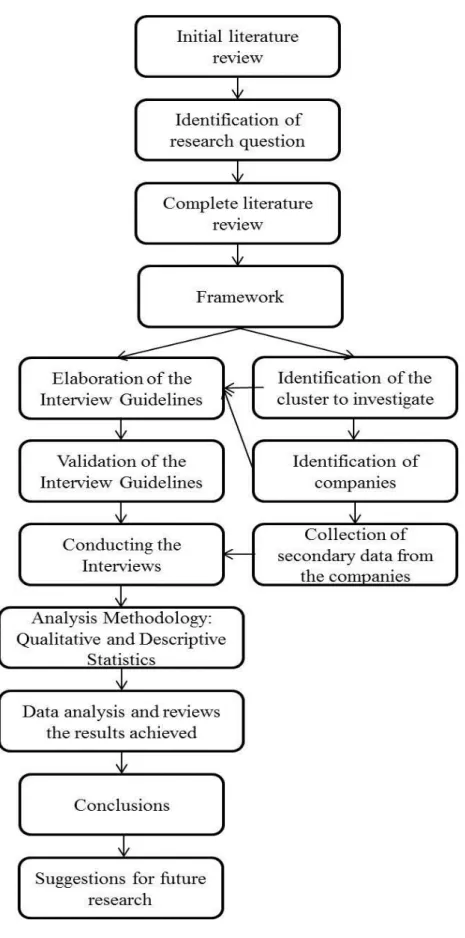
2.1. Methodology ... 40
2.1.1. Interview Guidelines ... 43
2.1.2. Why PortugalFoods as an empirical base? ... 45
2.1.3. Criteria for selection of companies ... 47
2.1.4. Data gathering procedures ... 48
2.1.5. Sample ... 49
2.2. Empirical results and analysis ... 50
2.2.1. Individual analysis – Description of the selected cases studies ... 50
2.2.2. Group analysis – Characterization of each group profile ... 70
2.2.3. Group analysis – Comparisons between groups ... 77
2.2.4. General analysis ... 81
References ... 90
Appendices ... 97
Appendix A: Interview Guidelines ... 98
Appendix B: Tables ... 104
Index of Tables
Table 1: Factors that influence the location decision …………..……...….. 5
Table 2: Cluster life cycle ……….……….. 12
Table 3: Initial sample divided by groups ………...………..………. 49
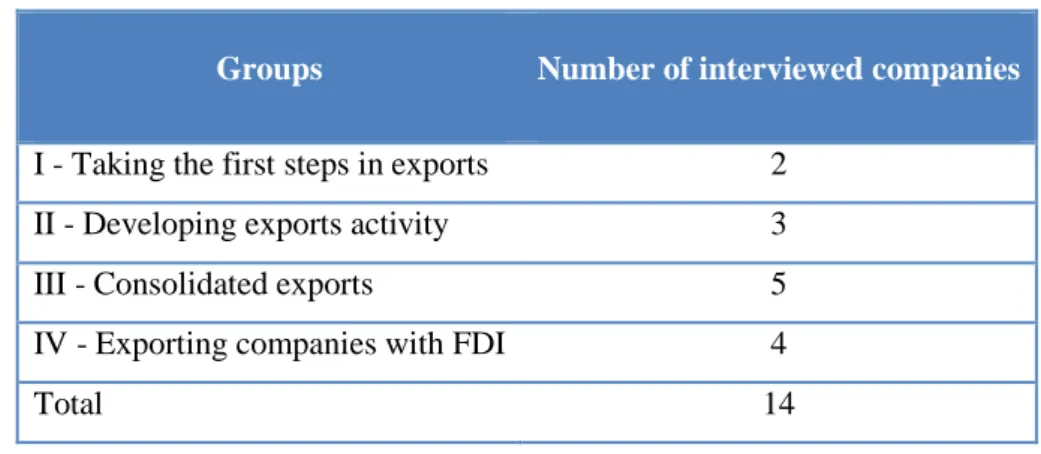
Table 4: Companies interviewed divided by groups ………...…...…… 50
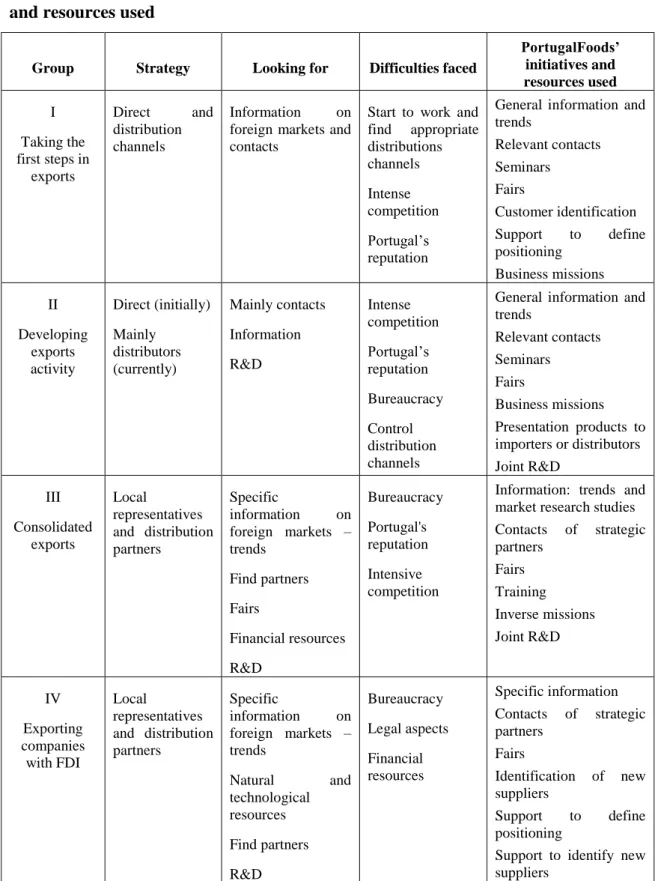
Table 5: Synthesis of each group needs, difficulties and PortugalFoods’ initiatives and resources used ……….. 78
Table A.1: Selected companies divided by groups …………...………….……… 104
Table A.2: Export destination markets identified by all companies – oldest entry criteria (Interview Guideline B.4.2.1) ……….……… 105
Table A.3: Export destination markets identified by all companies – sales volume criteria (Interview Guideline B.4.3.) ……….. 106
Table A.4: Analysis of barriers faced to internationalize and influence of PortugalFoods to overcome them (Interview Guideline B.10.) ……….……. 107
Table A.5: Goals expected and benefits achieved with the integration in PortugalFoods (Interview Guideline C.2.) ……….……. 108
Table A.6: Identification of partners within the PortugalFoods (Interview Guideline C.4. and C.8.) ………..……… 108
Table A.7: Reasons to cooperate identified by the companies (Interview Guideline C.6.) ……….………... 109
Table A.8: Identification of the entity that mainly promoted the cooperation (Interview Guideline C.7.) ………..………. 109
Index of Figures
Figure 1: Synthesis of the literature review ………..………. 33
Figure 2: Influence of the cluster in a gradual process of internationalization ... 36 Figure 3: Influence of the cluster in an accelerated process of
internationalization ……….. 39
Figure 4: Synthesis of the Methodology ………...………. 44 Figure A.1: Motivations to Internationalize (Interview Guideline B.2.) ...……. 111
Figure A.2: The most important factors in the selection of foreign markets
(Interview Guideline B.4.1.) ……… 112
Figure A.3: The most important factors in the selection of foreign markets –
Group IV (Interview Guideline B.4.1.) ………... 113
Figure A.4: Sources to finance internationalization (Interview Guideline B.9.) 114
Figure A.5: Barriers to internationalize and PortugalFoods (PTFoods) influence
- General Analysis (Interview Guideline B.10.) ………..…… 115
Figure A.6: Barriers to internationalize and PortugalFoods (PTFoods) influence
– Group I (Interview Guideline B.10.) ……….………... 116
Figure A.7: Barriers to internationalize and PortugalFoods (PTFoods) influence
– Group II (Interview Guideline B.10.) ……….……….. 116
Figure A.8: Barriers to internationalize and PortugalFoods (PTFoods) influence
- Group III (Interview Guideline B.10.) ………..……… 117
Figure A.9: Barriers to internationalize and PortugalFoods (PTFoods) influence
- Group IV (Interview Guideline B.10.) ………..……… 117
Figure A.10: Goals expected and benefits achieved with the integration in
PortugalFoods – General Analysis (Interview Guideline C.2.) ……….…………. 118
Figure A.11: Goals expected and benefits achieved with the integration in
PortugalFoods – Group I (Interview Guideline C.2.) ………. 119
Figure A.12: Goals expected and benefits achieved with the integration in
PortugalFoods – Group II (Interview Guideline C.2.) …...…….……… 119
Figure A.13: Goals expected and benefits achieved with the integration in
Figure A.14: Goals expected and benefits achieved with the integration in
PortugalFoods – Group IV (Interview Guideline C.2.) ………….……….. 120
Figure A.15: Initiatives developed by PortugalFoods in which the company
participated (Interview Guideline C.3.) ………... 121
Figure A.16: Influence of PortugalFoods in the internationalization process
Introduction
Over time, markets became more open and globalized, leading to an overall increase in competition. In the globalization process, clusters became a relevant reality as they represent a new form of organization that opens new opportunities for their member firms and their host regions, since "the enduring competitive advantages in a global economy lie increasingly in local things - knowledge, relationships, motivation - that distant rivals cannot match” (Porter, 1998, p. 77). At the same time, internationalization is an even more relevant phenomenon in the modern world economy, with many organizations embracing the opportunity to go international (Kowalski, 2014) through various entry modes (Foreign Direct Investment/FDI, exports or contractual forms). Despite the undeniable relevance of both phenomena - clusterization and internationalization - the literature and frameworks dealing with their interaction is scarce.
On the other hand, the Portuguese enterprise structure is dominated by SMEs that represented in 2011 approximately 99.9% of the total structure of non-financial enterprises (INE, 2013). According to zu Köcker, Müller & Zombori (2011), the lack of resources (human, capital, financial), experience, information about foreign markets and the inexistence of internationalization strategy are other barriers that such firms face a
priori in the internationalization process. Firms may “profit from a network or cluster
which takes responsibility for the internationalization efforts of its members and assists them in their international orientation of organizations” (zu Köcker et al., 2011, p. 4). However, there is limited literature about clusters in Portugal, and even less about the internationalization of enterprises in clusters. Such blatant scarcity in the literature calls for research in this area. All these reasons motivate and give pertinence to the present study.
This dissertation seeks to address the following main research question: “How does belonging to a Cluster influence the process of internationalization and the strategies of its members?”. In order to answer the main research question other research questions arise:
1. Which reasons lead companies aspiring to have an international activity to integrate a cluster? What are they expecting from the cluster?
2. Does belonging to a cluster change the internationalization process for companies that already have some form of internationalization, and in what sense? In terms of entry modes? In terms of speed? In terms of choice of markets?
3. The support provided by the cluster is the same whatever the process of internationalization of each company? Does the cluster have the ability to adapt its mechanisms according to the company stage and path of internationalization? Having these questions in mind, the objectives of this dissertation are:
To contribute to the systematization of the extant literature on clusters and internationalization, exploring their interaction;
To propose specific mechanism(s)/framework(s) on how clusters may help their members to internationalize;
To develop an empirical application based on a Portuguese cluster (PortugalFoods, the agrofood sector cluster) which will involve:
o A micro analysis of the internationalization process of the selected cluster members on an individual basis;
o An assessment on how cluster membership influences the process of internationalization of member companies.
In order to achieve these objectives, a review of extant literature was developed, which will be presented in chapter 1. The first subchapter of the second chapter describes the empirical methodology that supported this research. The following subchapter of the same chapter describes the case studies highlighting the process of internationalization and the influence of the cluster in each case. After a process of detailed treatment of the information gathered and based on the main contributions from the literature review, conclusions will be drawn in order to answer the research question.
Chapter 1. Literature review
1.1 Clusters
The aim of this section is to provide a comprehensive overview of the relevant concepts and literature related to clusters. Firstly, the concepts of industrial districts and clusters will be presented, followed by the characterization of the cluster business environment in terms of entrepreneurship and innovation and the type of firms that are present in the cluster, emphasizing the role of leading firms. This chapter also includes an approach to clusters life cycle and an analysis of their impact on the performance of clustered firms.
1.1.1. From Marshall’s Industrial Districts to Porter's Cluster approach
The environment that surrounds firms is determinant to their success and the choice of location is a firm’s strategic decision that influences it’s ability to get competitive advantages. Over time a phenomenon of agglomeration of firms in certain locations has been observed, which has captured the attention of relevant literature and has been analyzed with the aim of understanding the factors that lead to this concentration. Marshall (1920) identified the factors that lead to agglomeration of similar industries in certain places called “industrial districts”: “the concentration of large numbers of small businesses of a similar kind in the same locality” (p. 1302). Initially Marshall (1920) considered climate conditions and resource endowments as factors leading to the emergence of industrial districts. Yet, the author gave more relevance to a second aspect: the concentration of qualified employees in a district. In this issue, migrations movements’ play an important role as, on the one hand, there are non-local workers looking for companies who need their knowledge and, on the other hand, there are companies that look for employees who have the specific skills demanded. This double seek leads to a concentration of employees and firms in certain places. The third explanation given is based on movements of companies to follow other firms, i.e., companies from the same industry tend to choose the same places to be and follow each other: “so great are the advantages which people following the same skilled trade get from near neighborhood to one another” (Marshall, 1920, p. 156). Finally, to explain industrial districts, Marshall (1920) adopted a consumer perspective according to which
Furthermore, with reduced tariffs and costs associated with the transport of goods, consumers will travel a greater distance, which also explains why industries agglomerate.
A different perspective to the Marshallian concept of industrial districts is proposed by Pyke, Becattini & Sengenberger (1990), who emphasized the importance neither of the firm nor of the industry, but the linkages between them and the role of networks that allow local firms to be close and interconnected, leading to the emergence of clusters. An industrial district was defined by these authors as a “socio-territorial entity which is characterized by the active presence of both a community of people and a population of firms in one naturally and historically bounded area. In the district, unlike in other environments, such as manufacturing towns, community and firms tend to merge” (Pyke et al., 1990, p. 38).
Preceded by Marshall (1920) and Pyke et al. (1990), Porter (1990) proposed a new approach in the industrial districts theme. In “The Competitive Advantage of Nations” Porter (1990) highlighted the crucial role of the local dimension considering that “competitive advantage is created and sustained through a highly localized process” (p. 73) and achieved through acts of innovation. Aiming to explain why companies choose to locate in certain nations and how they are capable of continous processes of innovation, Porter (1990) presented four factors originating “the diamond of national advantage”: factor conditions (nation’s position in production factors); demand conditions (nature of home-market demand); related and supporting industries (presence of supplier or related industries that are internationally competitive) and firms strategy, structure and rivalry (p. 78). As mentioned by Porter (1990) “these determinants create the national environment in which companies are born and learn how to compete” (p. 78). Later Porter (1998) stressed that the choice of location was important to get competitive advantage, but the determinants that influence this decision have changed over time. If earlier the locations that were richer in resources, like supply of cheap labor which leads to a reduction in input costs, used to be a location’s comparative advantage, now the focus is not only on the firm itself, but also on the external and business environment, leading to the emergence of clusters. This view is consistent with Marshall (1920) and with the network contributions of Pyke et al. (1990). The focus of
location decision is not on the firm itself but on the potential of the external environment that surrounds it.
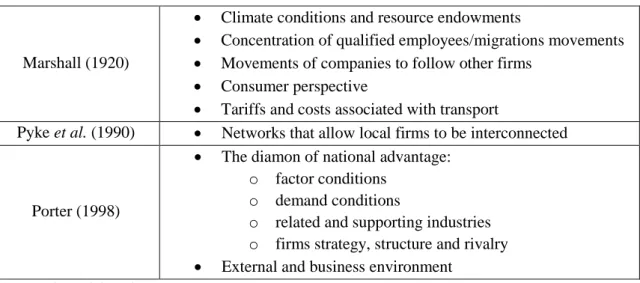
Table 1: Factors that influence the location decision
Source: Own elaboration.
Over time, the factors that lead to the emergence of industrial districts, or that influence the choice of location, have shifted from production factors to factors that characterize the environment in which the company operates. The relevance of business environment is reflected in Porter’s (1998) definition of clusters “geographic concentrations of interconnected companies and institutions in a particular field” (p. 78). In this concept the author considers several actors and institutions as part of the cluster: customers, suppliers, firms in related industries and also “governmental and other institutions - such as universities, standards-setting agencies, think tanks, vocational training providers, and trade associations - that provide specialized training, education, information, research, and technical support” (p. 78).
Langen (2002) defined cluster in a different way: “a population of geographically concentrated and mutually related business units, associations and public (private) organizations centered around a distinctive economic specialization” (p. 210). With this definition, the author emphasizes four aspects (p. 210):
1. a cluster is not an entity, but a population leading to an internal heterogeneity of clusters;
Marshall (1920)
Climate conditions and resource endowments
Concentration of qualified employees/migrations movements
Movements of companies to follow other firms
Consumer perspective
Tariffs and costs associated with transport
Pyke et al. (1990) Networks that allow local firms to be interconnected
Porter (1998)
The diamon of national advantage: o factor conditions
o demand conditions
o related and supporting industries o firms strategy, structure and rivalry
2. clusters are geographically concentrated and they can be local, regional or interregional;
3. the population consists of business units, associations, public-private organizations such as education or research institutes if they are engaged in the cluster activities;
4. the existence of a cluster core that is a “spatial concentration of similar activities”.
Several indicators can be used to measure the strength of relations: “economic transaction with the cluster core; use of common cluster resources; membership of cluster associations and inclusion in a regional learning system” (Langen, 2002, p. 210). Both definitions of clusters indicate a geographical concentration of related industries.
1.1.1.1. Agglomeration economies
Industrial clusters can be characterized in terms of nature of firms in the cluster, nature of their relations and transactions undertaken, leading to three types of agglomeration models (Iammarino & McCann, 2006, p. 1022):
1. Pure agglomeration model – characterized by transient inter-firm relations, in which firms do not have market power and continuously change their relations with other firms and customers, leading to an intense local competition and absence of loyalty and long-term relations;
2. Industrial complex – characterized by long-term stable and predictable relationships that involve frequent transactions;
3. Social Network – presence of mutual trust relations between key agents; it is an aspatial model, but proximity tends to foster trust relations, leading to a local business environment of confidence, risk-taking and cooperation.
Clusters result from agglomeration economies. Those economies “arise within clusters of complementary industries related by technology, skills, shared infrastructure, demand and other linkages” (Delgado, Porter & Stern, 2010, p. 2).
Several mechanisms explaining why firms agglomerate were identified. Following Marshall (1920), studies have recognized three drivers of agglomeration economies (Delgado et al., 2010; Iammarino & McCann, 2006; Langen, 2002, p. 211):
1. Labor market pooling – “reduces search costs and allows specific training and education programs, which upgrade the quality of the labor pool” (Langen, 2002, p. 211);
2. Input-output linkages - presence of suppliers and customers in a cluster which proximity allows low transport costs and “enables closer monitoring and frequent face-to-face contacts” (Langen, 2002, p. 211);
3. Presence of knowledge spillovers in clusters.
Following the driver of labor market pooling, Delgado et al. (2010) defined clusters as “collections of industries with high levels of co-location in terms of employment” (Delgado et al., 2010, p. 3).
Krugman (1990) had a different approach and considered that scale economies and transportation costs were the main reasons that could explain why manufacturing is concentrated in a certain area, remaining other regions with the role of agricultural suppliers to the manufacturing core: “in order to realize scale economies while minimizing transport costs, manufacturing firms tend to locate in the region with larger demand, but the location of demand itself depends on the distribution of manufacturing” (pp. 483-485). According to the Krugman (1990) model of geographical concentration of manufacturing, agricultural production has constant returns to scale, thus its location depends on the distribution of suitable land. The model assumes that manufacturers have increasing returns to scale. Hence, because of economies of scale, manufactures will be placed in a limited number of locations and those locations are closed to demand “since producing near one’s main market minimizes transportation costs” (p. 485). There is a circular effect due to which “manufactures production will tend to concentrate where there is a large market, but the market will be large where manufactures production is concentrated” (p. 486). Later, Krugman (1998) presented a different approach according to which there are centripetal forces promoting geographical concentration of activities, and centrifugal forces working against it. The
(1920): market-size effects; thick labor markets and pure external economies via information spillovers. The centrifugal forces identified were: immobile factors like dispersed production factors (demand side) or obligatory placement of production where consumers are (supply side); land rents as concentration leads to an increase of land price; pure external economies that can cause congestion (p. 8).
Other agglomeration drivers that stimulate firms to locate in clusters where identified by Delgado et al. (2010, p. 5): local demand characteristics; specialized institutions and the structure of regional business; social networks. The presence of strong clusters environment – strong clusters were defined as large presence of other related industries – “reduces barriers to entry and enhances regional comparative advantage, should be a central driver of entrepreneurial vitality” (Scott, 2010, p.5).
As shown, the existing literature about the drivers of agglomeration economies presents different explanations to the emergence of this phenomenon. Instead of using external economies to analyze regional economies, Saxenian (1996) suggested the network approach. Saxenian (1996) made significant contributions to this theme with an analysis to two American leading technology regions: Silicon Valley and Route 128. According to the author, agglomeration and external economies cannot explain why these regions responded so differently to the same external shock and intensified international competition: Silicon Valley recovered quickly from the crises of 1980, showing a rapid growth of stat-up businesses; Route 128 has shown few signs of reversing a decline that began in the early 1980s. “A network approach can be used to argue that, despite similar origins and technologies, Silicon Valley and Route 128 evolved distinct industrial systems in the postwar period” (Saxenian, 1996, p. 45). Silicon Valley has a dense regional network characterized by: the presence of informal communication and cooperation to learning among specialist producers of related industries, while simultaneously competing intensely; open labor market that encourages entrepreneurship and experimentation. Route 128 has a different reality: “dominated by autarkic corporations that internalize a wide range of productive activities. Practices of secrecy and corporate loyalty govern relations between these firms and their customers, suppliers, and competitors, reinforcing a regional culture that encourages stability and self-reliance” (Saxenian, 1996, p. 45).
Taking for instance the case of the Silicon Valley, Saxenian (1996) suggests the network form of organization as a driver to regional agglomeration. Reinforces the importance of the network and the difference it made in these two cases by adding: “proximity facilitates the repeated, face-to-face interaction that fosters the mix of competition and collaboration required in today’s fast-paced technology industries. Yet the case of Route 128 demonstrates that geographic clustering alone does not ensure the emergence of regional networks” (Saxenian, 1996, p. 57).
Silicon Valley portrays an example of a dynamic network environment identified in several studies about clusters. The following section is focused on this dynamic cluster business environment that impacts the relations established within the cluster.
1.1.2. Cluster business environment
Following Porter’s (1998) cluster definition, within a cluster there can be a huge variety of companies and institutions. According to Furlan & Grandinetti (2008) in a cluster there are usually two types of firms: firms producing final goods and firms operating in business (B2B) markets. In the first case, their business is driven to exports and largest firms are progressively more involved in cross-border operations. Firms that operate in business markets usually work with intermediate goods, business services and machinery and technologies, and their customers are co-located. These firms represent different stages of the value chain, but both get their inputs from local suppliers (Furlan & Grandinetti, 2008) which reflects Porter’s idea that “a cluster, then, is an alternative way of organizing the value chain“ (Porter, 1998, p. 80).
The agrofood industry in Moderna, Italy, illustrates Porter (1998) idea of a cluster that represents an alternative way to organize the meat processing industry. Moderna cluster is characterized by a dense network of SMEs, which promotes a high degree of division of labor, leading to a strong specialization of each stage of production: “the enterprises (agricultural and industrial) are linked by a network of inter-industrial relationships involving the mutual supply of specific products, essential for the production process of each player. The network of relationships also involves the trade in finished products, ready for distribution, which firms purchase from each other depending on order trends” (Bertolini & Giovannetti, 2006, p. 284). To Bertolini & Giovannetti (2006) this form of
organization of the industry is a reaction of the industry to face globalization, as co-operative movements allow a reduction of transactions costs.
Competition and cooperation are two realities that can be promoted simultaneously in the clusters’ business environment (Porter, 1998). On the one hand, firms will act as rivals and compete to hold their customers but, on the other hand, there is a culture of cooperation where interests are aligned and that enables cooperation between firms operating in related or complementary industries or institutions (vertical cooperation). Furthermore, clusters business environment is characterized by a climate of understanding and trust that benefits the companies operating there. According to Maskell (2001, p. 926), co-localized firms benefit from that environment: it reduces malfeasance; induces volunteering of reliable information; causes agreements to be honored; places negotiations on the same wavelength; eases the sharing of tacit knowledge.
According to Maskell (2001), the main reason for clusters’ existence is the enhanced knowledge creation that takes place in the vertical and horizontal dimensions (p. 924). The vertical dimension includes business partners and collaborators and is formed by “firms with dissimilar but complementary capabilities that carry out complementary activities” (p. 927). The horizontal dimension of the cluster corresponds to Marshall (1920) description of firms “with similar capabilities that carry out similar activities” (p. 927) and in this dimension rivals and competitors can be found. Maskell (2001) considered that “it is by watching, discussing and comparing dissimilar solutions – often emerging from everyday practices – that firms along the horizontal dimension of the cluster become increasingly engaged in the process of learning and continuous improvement, on which their survival depends” (Maskell, 2001, p. 929).
Depending on the type of flow, knowledge spillovers can be perceived by firms as being positive or negative. If it is an inflow of knowledge, Iammarino & McCann (2006) safely assume that all firms perceive it positively. However, an unintentional outflow of knowledge can have a negative effect in two situations (Iammarino & McCann, 2006): “the private effect of an unintentional knowledge outflow on the owner firm is a leakage of its valuable intellectual capital” (p. 1023); “where any knowledge outflows from a
firm are more valuable to its competitors than are any potential knowledge inflows to the firm from its competitors” (p. 1024). According to Iammarino & McCann (2006) this can be a counter argument to Porter’s (1998) logic in favor to industrial clustering given that these effects may lead to a decision of rejecting that location. On the other hand, an unintentional outflow of knowledge can be viewed as public good knowledge that has a positive effect: “important in situations where local knowledge outflows contribute to a virtuous cycle by strengthening the knowledge base of the location, thereby making it more attractive for other innovation-bearing firms, leading to larger knowledge inflows in the future” (p.1023).
Clusters provide a rich business environment for companies’ operations. There is within the cluster a variety of firms that work together contributing to an environment of trust and cooperation, inducing knowledge spillovers. Moreover, clusters business environment is characterized by entrepreneurial activity that induces proactively innovation.
1.1.2.1. Entrepreneurship and innovation
Over time, different perspectives were developed to explain the origin of the clusters and their establishment. According to Elola, Valdaliso, López & Aranguren (2012, p. 259) “companies in clusters experience stronger growth and faster innovation than those outside clusters, and that clusters attract more start-ups than regions without a cluster”. Engel & del-Palacio (2009) consider that agglomeration of businesses by industries cannot explain the emergence of high entrepreneurial startups, almost independent of industry alignment, in certain regions. The authors defined Clusters of Innovation (COI) as “environments that favor the creation and development of high potential entrepreneurial ventures” (Engel & del-Palacio, 2009, p. 1).
Bell (2005, p. 288) defends that firms in the cluster are more innovative due to two reasons: “clustered firms benefit from agglomeration economies such nearby suppliers (…) direct observation of competitors and ability to exploit the collective knowledge; second cluster benefit from network-based effects, especially enhanced social interaction”. Plus, Bell (2005) considers that the ability to develop informal cooperative R&D results from information exchange among firms. Firms that are located in a cluster
have better access to information and, thus, are more able to be more innovative. It was during the analysis of Canadian mutual fund companies that Bell (2005, p. 287) concluded that “locating in the industry cluster as well as centrality in the managerial tie network enhances firm innovation”.
Engel & del-Palacio (2009, p. 2) suggested that “in clusters of innovation other agglomeration benefits dominate, defined not by industry specialization, but by the stage of development and innovation” and pointed out the following four benefits: mobility of resources; foundation of companies as a mechanism of innovation and business model experimentation; global strategic perspective and alignment of incentives and goals (p. 3).
Finally, according to Libaers & Meyer (2011), innovative firms located in a cluster that invests more in R&D are more effective at leveraging cluster-based resources to internationalize their operations than the ones who are in the cluster but are less innovative.
Delgado et al. (2010) pointed out that the presence of a cluster of related industries in a location promotes entrepreneurship given that: the costs of starting a new business are lower; opportunities for innovation are high; firms have better access to a diverse range of inputs (p. 3). Furthermore, “the co-location of companies, customers, suppliers, and other institutions also increases the perception of innovation opportunities while amplifying the pressure to innovate” (p. 3).
Formal and informal relationships of a network are channels where know-how is rapidly exchanged. At the same time, the mobility of resources is reflected in the high inter-firm mobility of entrepreneurs, which enables transfer of knowledge and generation of innovation. Frequently, in dynamic and entrepreneurial environment there is an inter-firm support of sharing of experiences and this may explain why unrelated industries emerge within the cluster (Engel & del-Palacio, 2009). Clusters usually have their own infrastructures and contacts, for instance with lawyers and bankers, which plays an important role in supporting new businesses (Engel & del-Palacio, 2009).
1.1.2.2. Influence of leading firms in the clusters
Clusters are formed by several different firms and institutions linked by business relationships, playing each one a specific role. Leading firms have captured the literature attention once those firms are considered as “acting as drivers for innovation development and clusters growth” (Ferretti & Parmentola, 2012, p. 66). A leading firm is characterized by “having an international reputation within a particular market or research area, being involved in extensive global linkages and networks and, most significantly, having built a specialist area of activity within the region so that the cluster becomes recognized internationally” (Giblin, 2010, p. 38).
The presence of “leading firms” in a cluster has a stimulating effect on the cluster, generates external economies and promotes clustering, since the location becomes more attractive. Giblin (2010) developed an empirical application in two clusters (a medical technology cluster and a software cluster) that shown that large firms might have a leading position by influencing the technology trajectory of the region and generate agglomerative effects, enhancing the relevance and sustainability of clusters. The presence of leading firms in the cluster increases the availability of skilled labor, specialized suppliers and knowledge spillovers among firms in the cluster (leading firms can act as gatekeepers). Moreover, Giblin (2010) found that leading firms presence affects positively the degree to which firms connect with global networks and that “the presence of dominant firms in a cluster increases the likelihood that other firms in the cluster will internationalize through outward foreign direct investment” (Giblin, 2010, p. 27).
However, in the research developed by Ferretti & Parmentola (2012) in the Campania Aircraft Cluster, they reached an opposite conclusion to that of Giblin (2010). Ferretti & Parmentola (2012) found that those firms do not always have a positive impact on clusters development: “the presence of a focal firm in a technology cluster is not a positive factor if this firm does not act as knowledge hub with explicit intention to transfer knowledge to other cluster members. On the contrary, in some cases the presence of focal firm may even hinder cluster development by limiting the activity of other cluster companies” (p. 75).
The companies that formed the cluster and its business environment might influence positively or negatively clustered companies. Some authors have developed some research about clusters life cycle and how it influences clustered firms performance.
1.1.3. Clusters life cycle
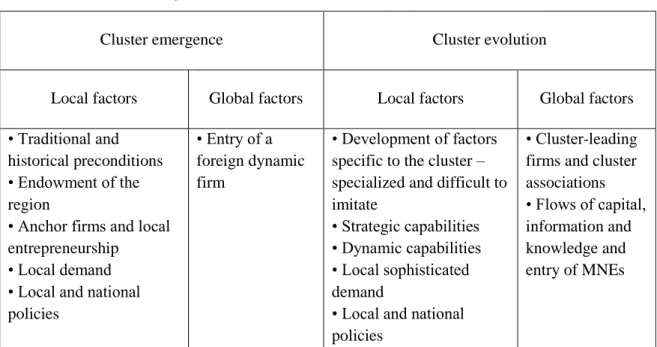
Clusters growth patterns are influenced by internal and external factors that determined clusters evolution and the different stages crossed, which characterize their life cycle. According to Elola et al. (2012) this natural evolution is determined by initial conditions and capabilities created by the clustered firms. The authors identified local and global factors that drive cluster emergence and evolution, as shown in the following table.
Table 2: Cluster life cycle
Cluster emergence Cluster evolution
Local factors Global factors Local factors Global factors • Traditional and
historical preconditions • Endowment of the region
• Anchor firms and local entrepreneurship
• Local demand • Local and national policies
• Entry of a foreign dynamic firm
• Development of factors specific to the cluster – specialized and difficult to imitate
• Strategic capabilities • Dynamic capabilities • Local sophisticated demand
• Local and national policies
• Cluster-leading firms and cluster associations • Flows of capital, information and knowledge and entry of MNEs
Source: adapted from Elola et al. (2012)
The local factors that drive cluster emergence identified by Elola et al. (2012) are similar to those mentioned by Marshall (1920), Porter (1990). However, Elola et al. (2012) stressed the role of anchor firms and local entrepreneurship as factors fostering the emergence of a cluster. On the other hand, the entry of a foreign dynamic firm (multinational or subsidiary) with foreign investment and entrepreneurship will promote an inflow of external knowledge contributing to the cluster’s emergence.
At a local level, the evolution of a cluster is determined not by preconditions of location, but by strategic decisions taken by firms: cost leadership, innovation and ability to face up sudden changes in the environment. The process of cluster evolution is also explained by global factors that are considered particularly challenging to clusters: globalization process. This process has an impact on the cluster evolution as it is reflected in terms of flows of capital, information and knowledge and entry of MNEs. “Cluster-leading firms and cluster associations may act as technological gatekeepers of extra-knowledge, which they channel into the cluster” (Elola et al., 2012, p. 262). As a dynamic reality, it is difficult to find a pattern of a structured life cycle fitting all different clusters. There are two interpretations to explain cycle evolution: an autonomous process of the clusters and the industry life cycle (Martin & Sunley, 2011). The first one is a simple interpretation of cluster evolution according to which “clusters life cycles are determined by the balance of agglomerative advantages and disadvantages” (Martin & Sunley, 2011, p. 1302). The second interpretation is a 5 main stages model which explains the clusters development as follows: emergence or birth, growth, maturity, decline and death. These phases are delimitated in terms of age of the cluster, number of employed, number of firms, innovativeness, market share or other similar indicators (Martin & Sunley, 2011, p. 1301).
From the empirical study done by Elola et al. (2012) in 2008 for four different clusters (paper-making, maritime industries, electronics and ICT, and aeronautics) in the Basque country, some patterns corresponding to different stages of cluster life cycle emerged:
1. During the origin/emergence of clusters, local demand and factor conditions, together with entrepreneurship and inflow of external knowledge and technology played an important role;
2. On the development stage, the factors specific to the cluster developed and an increasing demand, either local and/or international, is the most determinant; 3. From development to maturity or decline, to ensure the competitive advantage,
the local resources are not enough, which leads to a quickly reaction (dynamic capabilities) of clusters and firms to reformulate the existing strategies, thus testing out the strategic capabilities.
According to Elola et al. (2012) the heterogeneity of growth patterns can be due to different initial conditions. From this study, another conclusion arises: “Clusters react differently to the same external shocks and evolve differently according to their learning capabilities (…) cluster evolution (…) also depends on the local firm-specific mechanisms of learning and introduction of technological innovation, referring to the importance of organizational, product and process innovation” (Elola et al., 2012, p. 276). Silicon Valley and Route 128 (Saxenian, 1996) reacted differently to the same external shock and both illustrate the conclusions to which Elola et al. (2012) reached. Audretsch & Feldman (1996) posit a close relationship between the propensity for innovative activity and the phase of a cluster life cycle. There is a “greater propensity for innovative activity to cluster during the early stages of the industry life cycle, innovative activity tends to be more highly dispersed during the mature and declining stages of the life cycle” (p. 253). Consistent with Elola et al. (2012), Audretsch & Feldman (1996) consider that there are “certain types of knowledge sources, such as university research tend to lead to a clustering of innovative activity in the introduction stage of the life cycle but not during the growth stage, other knowledge resources, such as skilled labor promote innovative clustering throughout the life cycle” (p. 254). Another finding from Audretsch & Feldman (1996) is that in mature and declining stages the geographic concentration of production increases leading to a greater dispersion of innovative activity (p. 254). “As the technology-industry life cycle matures, clusters advantages gradually become disadvantages and industries tend to disperse spatially as process innovations become more important” (Martin & Sunley, 2011, p. 1301). The main conclusion emerging from Audretsch & Feldman (1996) work is that “positive agglomeration effects during the early stages of the industry life cycle apparently are less important during the latter life cycle stages (p. 254).
Hence, some research exists in clusters’ life cycle but this topic remains very undeveloped (Martin & Sunley, 2011). The influence of the cluster on the performance of clustered firms is a topic that has been discussed by some authors, as the next section describes.
1.1.4. Impact on the performance of clustered firms
The interaction between companies and institutions embedded in the cluster favors the foundation, establishment and fosters the development of firms and businesses. Yet, some studies reveal inconsistent results about the effect of clusters in performance: “while a number of studies have found that clusters enhance the probability of entry, survival, and growth of new firms; other studies indicate that location in a cluster decreases the survival chances of new firms” (Wennberg & Lindqvist, 2010, p. 222). With the purpose of evaluating the effects of clusters on the survival and performance of new entrepreneurial firms, Wennberg & Lindqvist (2010) developed a study among 4.397 Swedish firms from different sectors (telecom, financial services and pharmaceutical) and “found evidence that a high concentration of own cluster employment (in same industry and related industries) was related to better chances of survival, higher employment, higher tax payments, and higher salary payments” (Wennberg & Lindqvist, 2010, p. 238). Furthermore, they concluded that “clusters do provide economic benefits not only for firms in general, but also for newly started entrepreneurial firms in particular (…) not only have higher survival rates, but also have higher economic performance” (Wennberg & Lindqvist, 2010, p. 238).
According to Porter (1998), members of a cluster benefit from a dynamic environment that allows them to achieve a better performance. Companies within the clusters will have better access to sourcing inputs such as specialized employees, with lower cost of recruitment and easier and less costly access to suppliers already present in the location. Personal relationships and community ties play an important role as they are a channel for transfer of specialized information.
Cluster members are complementary and dependent: on the one hand, the products they offer can be complementary, on the other hand, in a marketing perspective, the impact of marketing strategies will affect the whole cluster and their reputation, thus making the location more or less attractive to customers. All members will take advantage of investments, e.g. infrastructure, made by government or public institutions. Finally, local rivalry works as a motivation to perform better and, as all firms have access to the
same resources and conditions, it becomes easier to measure their performance (Porter, 1998, pp. 81-83).
However, a research by Klumbies & Bausch (2011) analyzing 42 different research studies concluded that the influence of clusters in the performance of clustered companies is not so linear as pointed by Porter (1998). The authors identified a negative influence of the agglomeration effect that was explained by the apprehension of entrepreneurs about leakage of internal information or knowledge due to the proximity between companies, and the risk of employee turnover. On the other hand, they concluded that the presence of foreign firms has a positive effect since the performance of local firms increases. The studies analyzed indicate that access to cluster infrastructure does not seem important, indicating no relevant influence in clustered companies’ performance. This research found positive effects, negative effects and in other situations could not confirm any influence, leading to mixed results about cluster’s influence.
For Langen (2002) cluster performance is measured in value added: “a good performance is shown by a rise in the value added generated in the cluster” (Langen, 2002, p. 211). Plus, cluster performance depends on economic and institutional characteristics. Langen (2002) developed a framework to analyze cluster performance based on structure and cluster governance. The author identified four structural factors that influence cluster performance: presence of agglomeration economies; internal competition that fosters specialization; entry barriers that have a negative effect and exit barriers that tie firms to a cluster; heterogeneity of cluster population (economic activity, size, international presence, innovative strategy) that adds performance. Cluster governance can be defined as “the mix of and relations between different modes of governance, i.e. mechanisms to co-ordinate interaction in a cluster” (Langen, 2002, p. 212). The variables identified related to cluster governance were: the presence of trust and intermediaries that reduce transaction costs; the leader firm’s behavior, since such firms treat the interests of the cluster as a whole; solutions for collective problems (e.g. education and training), which is a role of associations that act in the interest of their members and provide collective goods to cluster members. Therefore, the influence of the cluster on the company’s performance is not a consensual topic in the literature.
The interest and analysis of clusters is not new, albeit it has been changing. This is a reality that year after year has captured more attention and different approaches and studies with dissimilar conclusions arise.
1.2. Internationalization: concept and theoretical frameworks
For different reasons, internationalization is a theme that has gained attention from distinct perspectives and from diverse actors: companies are concerned about making their operations more effective and efficient in a more competitive global environment; governments seek to ensure that the overall process has a positive effect on the national interest; trade unions are concerned with the impact on working conditions, wages and their own power (Welch & Luostarinen, 1988, p. 36).
For Welch & Luostarinen (1988), internationalization describes an “outward movement in an individual firm’s or larger grouping’s international operations” (p.37). They defined internationalization as “the process of increasing involvement in international operations” (p. 37). Calof & Beamish (1995) adopted a different perspective, defining internationalization as “the process of adapting firm’s operations (strategy, structure, resource, etc) to international environment” (p.116).
The internationalization strategy of the company can be materialized in different modes of entry to reach a target market: exports; contractual forms (licensing, franchising, management contracts, turnkey contracts, subcontracting, production sharing and strategic alliances), and foreign direct investment (FDI) (Dunning, 1988).
The most influential and traditional theory on internationalization is the Uppsala Internationalization Model, but other approaches like Born Globals, International New Ventures and Networks Theory are also relevant in this regard.
1.2.1. Uppsala Internationalization Model
Through an empirical research in four Swedish firms, Johanson & Wiedersheim-Paul (1975) and Johanson & Vahlne (1977) developed a model of the internationalization process of a firm: the Uppsala Model. This model describes a gradual process of
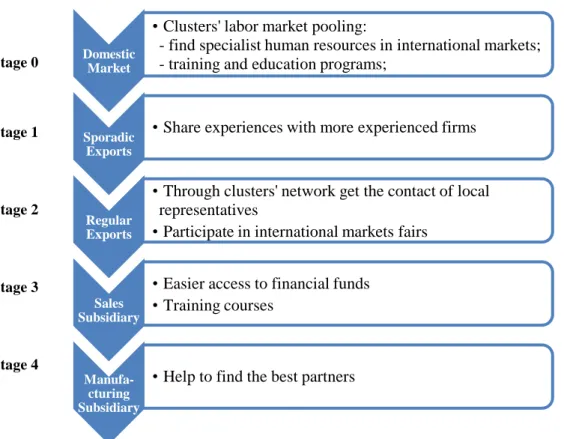
internationalization and is focused on the gradual acquisition and integration of knowledge and also on successively increasing commitment with foreign markets. Johanson & Wiedersheim-Paul (1975) identified four different stages that give rise to “the establishment chain”. In the first stage, the focus is on the domestic market and there is no regular exports activity, meaning a low resource commitment as a result of the lack of a channel of regular information about the market. In the second stage, there is a channel through which the firm receives regular market information, allowing a higher degree of commitment, and the firm starts to export, eventually using independent representatives (agents). In the third stage, the company sets up a sales subsidiary and controls the information channel. The last step is the establishment of a production/ manufacturing facility in the host market, which requires a large commitment of resources. As the firm goes through these steps, it can access more information, gain more experience and knowledge about the market, which is reflected in the degree of commitment and involvement that increases gradually.
Due to changes in business practices and theoretical advances, Johanson & Vahlne (2009) revisited the model and added some new considerations to the initial one. Contrasting with the neoclassical market, characterized by independent suppliers and customers, Johanson & Vahlne (2009) describe the business environment as a web of relationships and networks where all players are linked. Comparing the old and the revisited model, Johanson & Vahlne (2009) state that they “were not aware of the importance of mutual commitment for internationalization. Now our view is that successful internationalization requires a reciprocal commitment between the firm and its counterparts” (p. 1414). In this new approach, relationships became central, performing essential roles in internationalization: as channels for learning, creating new knowledge through the network and access certain types of knowledge that are confined to network insiders; relationships are important to build trust and commitment relations, which are preconditions to internationalize and have impact on the selection of the foreign market and on the entry mode, adding that “foreign market entry should not be studied as a decision about modes of entry, but should instead be studied as a position-building process in a foreign market network” (p. 1415). Johanson & Vahlne (2009) add: “internationalization depends on a firm’s relationships and network (…) expect the focal firm to go abroad based on its relationships with important partners who are
committed to developing the business through internationalization (…) focal firm is also likely to follow a partner abroad if that partner firm has a valuable network position in one or more foreign countries” (p. 1425).
One of the main contributions that lead this revision of the Uppsala Model, was the Network Model of Internationalization developed, based on business network research, by Johanson & Mattsson (1988).
1.2.2. Network Theory
According to Holm, Eriksson & Johanson (1996) “while most research on foreign market entry has focused on entry mode selection, our findings indicate that the development of cooperative relationships with customers, suppliers or other business partners may be critical” (p.1049).
The network model of internationalization is defined by Johanson & Mattsson (1988) as a “model that describes industrial markets as networks of relationships between firms” (p. 287), thus allowing the influence of external actors in the internationalization process. The authors assume “that firms in industrial markets are linked to each other through long-lasting relationships. They establish and develop complex, inter-firm information channels, and they also develop social and technical bonds with each other” (p. 290). Trust between partners is a condition to do business. To ensure that commitments are fulfilled, it is necessary to invest in strong relationships between suppliers and customers and establish contacts at several levels in the organizational hierarchies.
In the internationalization process, networks are a strategic resource that encourages and supports firms to go aboard. The industrial network model assumes that “firms depend on resources controlled by other actors, and that access to such resources can be gained through network positions” (Karlsen & Nordhus, 2011, p. 203). A common obstacle to internationalization is the lack of information and networks can have an important role to overcome this, as firms can transfer knowledge and share experiences gained from foreign markets and cooperate. This experimental knowledge “reduces the firm’s perception of market uncertainty or risk, which, in turn, impacts on commitment to
international markets” (Hadley & Wilson, 2003, p. 699). The network model views markets as networks of firms where firms establish relationships to obtain resources, sell products and get information about foreign markets (Karlsen & Nordhus, 2011). At an international level and according to the network model “the internationalization of the firm means that the firm establishes and develops positions in relation to counterparts in foreign markets. This can be achieved: (1) through establishment of positions in relation to counterparts in national networks that are new to the firm – international extension; (2) by developing the positions and increasing resources commitments in those nets abroad in which the firm already has positions – penetration; (3) by increasing co-ordinations between positions in different national nets – international integration” (Johanson & Mattsson, 1988, p. 296). A more extensive network with internationally experienced actors and the firm’s international experience will enable the firm to get a better position within the network and perhaps skip some steps in the internationalization process.
Johanson & Mattsson (1988) used a framework where four situations of internationalization were identified: the early starter, the late starter, the lonely international and the international among other. The “Early Starter” firm has little or no experience in operating in foreign markets and its network is characterized by a low degree of internationalization, leading to a low commitment with foreign markets and weak information channels with foreign networks. In this type of firms, knowledge has to be acquired through interaction with the market (learning by doing) and could also be acquired through its network. However, since their network has a low degree of internationalization, the available knowledge resources are limited (Hadley & Wilson, 2003). The firm’s network has great relevance in the “Late Starter”, given that in this situation the firm has a low degree of internationalization but has a good home position within a highly internationalized network, leading the firm to internationalize through its network, perhaps without taking all the internationalization steps (Karlsen & Nordhus, 2011). Although network members do not have international experience, the “Lonely International” firm has a high degree of internationalization and a great degree of commitment to foreign markets. It has higher levels of experiential knowledge than both the Early Starter and the Late Starter (Hadley & Wilson, 2003). If a firm is
“International Among Others”, it has a high degree of internationalization and experience in integrating and coordinating its network positions through joint ventures, mergers and acquisitions leading to international independence (Karlsen & Nordhus, 2011).
According to network model, as firms go international and the degree of internationalization increases, the number of strong and high commitment relationships established all over the world increase, and their network becomes richer.
1.2.3. Born Global
Rennie (1993)’s study in Australia’s high-value added manufacturers identified two types of exporting firms: a more traditional with domestic-based firms and the born global firms. The first was the traditional exporting firm that, after having the core business well established in the domestic market, starts to export to foreign markets. The second type is born global firms, mainly small and medium-sized enterprises (SMEs), that start to export very early, on average two years after their foundation (Rennie, 1993).
The process of internationalization of a born global is accelerated as these companies possess a global vision and globalize very quickly without being a long period in the domestic market. According to Gabrielsson & Kirpalani (2004), born global firms “often rapidly globalize their business by methods that circumvent many of the existing international business research paradigms” (p.556). As their resources are limited and they cannot take a huge risk to reach new international business, they are usually organized with an alternative governance style, in which their distribution channels depend on hybrid structures, like close relationships or network partners. The authors identified the following channels used to minimize the risks taken: multinationals acting as systems distributing born global products/services; networks as partnerships for born global and the internet as a method to generate networks and do marketing, which is also a framework to overcome their lack of resources (Gabrielsson & Kirpalani, 2004).
1.2.4. International New Ventures (INV)
Contrasting with the traditionally expected characteristics of multinational enterprises, an international new venture is a “business organization that, from inception, seeks to derive significant competitive advantage from the use of resources and the sale of outputs in multiple countries (…) The distinguishing feature of these start-ups is that their origins are international as demonstrated by observable and significant commitments of resources (e.g., material, people, financing, time) in more than one nation” (Oviatt & McDougall, 2005, p. 31).Although “creating a global start-up does not guarantee it will be a success” (Oviatt & McDougall, 1995, p. 34) seven characteristics associated with the survival, growth and success of these ventures were identified:
1. A global vision of the founders and their ability to communicate that vision; 2. The accumulated international experience of founders or managers;
3. Strong international business networks, built during previous international experiences, which enables them to access important resources;
4. The possession of a distinctive advantage, for instance a distinctively valuable product or service, to enter in a foreign market with success;
5. Hold unique and intangible assets in order to sustain their advantage and to avoid being imitated by competitors;
6. Continuous innovation and ability to make extensions of the initial products or services;
7. Be coordinated on a global scale to access the resources need.
Although INVs have limited resources, recent technological innovations, low-cost communication technology and transportation allowed global start-ups to access business opportunities and compete successfully in multiple countries as well as mature corporations.
The network model and Resource Based View (RBV) are linked with INVs. As pointed by Nicole E Coviello & Cox (2006), due to the liabilities of newness and smallness INVs may not have access to the resources needed and “the networks of relationships can be valuable for providing access to partners resources” (p. 114). The resources
needed may not only be natural or physical resources, but can also be human capital: “network seems more important for the transfer of organizational and human capital than it was for psychical or financial resource flows” (Nicole E Coviello & Cox, 2006, p. 125).
1.3. Clusters and Internationalization
Being a cluster member and initiating an internationalization process may be separate strategies, but when used together they can add greater value and create more opportunities to grow and to expand abroad. “After local clustering, taking place between actors located in one region, it is time to create cooperative relations on a supra-regional and transnational networks, and establish cross-border clusters” (Kowalski, 2014, p. 183). As mentioned in section 1.1, networks and cooperation are important elements of a cluster and a channel to get more resources and access to knowledge. However, the internationalization of companies is another step that has to be taken in order to expand businesses abroad, have contact with other companies, develop new partnerships and access to valuable resources that are not available in neighboring clusters.
In this section these strategies will be explored and illustrated in more detail.
1.3.1. Clustered firm’s network
The network model applied to the international context explains how firms can have access and become integrated in external networks. This can also be applied to a cluster context, where clusters’ dynamics promote connection between firms and external networks through existing local/clusters networks.
In order to learn more about cluster dynamics, Karlsen & Nordhus (2011) developed an empirical study based on interviews with top managers and direct observation of SMEs located in the NCE Subsea regional cluster in Western Norway. They selected four companies that were part of the cluster since its foundation: two smaller firms with limited international experience (X and Y), representative of small cluster firms in terms of internationalization; and two medium-sized firms that were internationalized (Z and