Reduction in the efficiency of light use
due to disease
by
ANA CARLA MADEIRA
Dep. Ciências do Ambiente, Instituto Superior de Agronomia and
J.A. CLARK
Dept. Physiology and Environmental Sciences, School of Agriculture, University of Nottingham
RESUMO
Foram estudados os efeitos de uma micose causada por Ascochyta fabae na intercepção de luz solar pelo copado e no crescimento de Vicia faba, durante o seu cultivo no campo (Universidade de Nottingham, Inglaterra). Infecções precoces reduziram a “duração da área foliar” e a “eficiência de utilização de luz”, originando um decréscimo na produção de matéria seca da cultura.
RÉSUMÉ
Les effets d’une maladie due à Ascochyta fabae ont été etudiés vis-à-vis à 1’interception du rayonnement solaire par les feuilles et à la croissance des plantes de Vicia faba. Les essais ont été faits en culture à l’air libre (Université de Nottingham, Angleterre). Des infections précoces enduisent à la réduction soit de “la durée de 1’aire foliaire” soit de “l’efficacité d’utilisation du rayon nement”. Par consequence, le décroissement de la matiére séche de la culture a été constaté.
SYNOPSIS
The effects of disease and the timing of infection on light interception and growth were studied on field bean (Vicia faba). Early infection by Ascochyta fabae reduced both leaf area duration and light use efficiency and, consequently,
1. INTRODUCTION
Observations of the depression of crop yields by disease are commonplace, and the control of disease outbreaks is of major con- cern in agriculture and forestry. However, the mechanisms of yield depression are relatively poorly quantified, despite the scientific and practical importance of the subject (Boote et al., 1983; Madden,
1983; Waggoner &: Berger, 1987; Brassett k Gilligan, 1989). The effects of disease and other stresses on the ability of vegetation to produce photosynthate (measured as dry matter production) can be considered in terms of those which reduce the quantity of solar energy intercepted by the crop and those which reduce the effi- ciency with which the intercepted energy is fixed in photosynthesis, or both (Monteith, 1977).
Much evidence suggests that the main influence of stresses on dry matter production is through consequent reductions in the size and duration of the leaf canopy, and therefore light interception
(Biscoe k Gallagher, 1977; Gallagher k Biscoe, 1978; Waggoner k Berger, 1987; Madeira, Clark k Rossall, 1988; Russell, Jarvis k Monteith, 1988). However, Green, Hebblethwaite k Ison (1985)
have shown that the efficiency of light use in field bean (Vicia faba)
may be reduced by water stress, while Hughes(1988) suggested that
similar effects may be expected due to disease.
The analysis proposed by Monteith (1977) identifies three fac-
tors which express the dependence of the dry matter production of vegetation on environmental and biological variables:
(a) crop duration, the period over which green vegetation is present, t (days);
(b) the quantity of solar radiation intercepted by the crop canopy, equal to the product fl (MJ m-2 d-1), where / is the incident flux density (MJ m-2 d-1) and / is the fraction of radiation intercepted;
(c) the efficiency of light use or dry matter yield of energy,
e (g MJ-1), which measures the efficiency with which the vegetation converts intercepted solar energy to dry matter.
The dry matter produced by the vegetation, W (g m 2) is the time integral of the product of the above terms
W =
J
efldt. (1)The weather of a particular season determines the available solar radiation and also influences the crop duration through the temperature and water balance. Other environmental and biolo- gical factors influence dry matter production through their indirect eífects on / and e. The fraction of radiation intercepted is deter- mined by canopy leaf area and leaf geometry, and may be related to them by an equation of the form of Beer’s law, where path lenght is replaced by leaf area index, L (Monteith, 1975).
Waggoner & Berger (1987) recently used a model similar to
that of Monteith (1977) to analyse the published yields of a number of crops in terms of the eífects on the canopy of biotic stress due to pathogen attack. If (1 — d)L is the leaf area index of a dieased crop (excluding defoliation d, due to a particular disease) and x is the fraction of leaf area affected by the pathogen, Waggoner & Berger
give
Wx=
í
d{l - exp[-K(l-d)L]}I(l-x)dt (2) thusfi = (1 ~ *) {1 - exp [- K (1 - d)L}} (3) where K is the extinction coefficient for the particular crop. A simplified approach was used in the present work, considering light interception by healthy leaf tissue only. In this case
W2 =
J
e2 {1 — exp [— K (1 — x)L]} I dt (4) andf2 = 1 - exp [- K(1 - x)L\ (5) where (1 - x)L is the healthy leaf area index of the diseased crop. Usually, d is negligeable for the first stages of infection by disease. The difference between these two equations is associated with dif- ferent methods of estimation of / for diseased crops, as the fraction of radiation intercepted is not affected by x in the equation (2). Hence, diíferent values will be obtained for e\ and e2.
As noted earlier, the main differences in the dry matter produc- tion of vegetation are usually associated with differences in canopy leaf area and duration and therefore in intercepted radiation, ahd
e is a relatively conservative quantity (Biscoe & Gallagher, 1977;
Monteith, 1977; Gallagher & Biscoe, 1978; Waggoner & Berger,
1987; Hughes, 1988; Russell et al., 1988).
This paper reports the first measurement of a reduction in the efficiency of light use by a crop (Vicia faba L.) due to a leaf and pod spot disease and compares the two models. The pathogen As-
cochyta fabae Speg., responsible for this disease, induces necrotic lesions, which constitute a loss of photosynthesizing tissue. The necrotic leaf tissue may remain and affect light interception, but of- ten falis out depending on the severity of infection and the weather conditions. Leaf senescence is also induced by A. fabae infection.
2. MATERIALS AND METHODS
The measurements of dry matter yield of energy reported here were obtained in an field experiment where crops of the determinate field bean cultivar “Ticol” were deliberately infected with Ascochyta fabae. This experiment was done in order to study the effects of the crop stage at which infection commenced and severity of infec tion on subsequent crop growth (Madeira, 1988; Madeira et al., 1988). The growth, dry matter production and yield of the infected crops, grown at Nottingham in 1987, were compared with those obtained from a control crop, which was untreated, and with a crop recei- ving a prophylactic fungicide treatment using chlorothalonil (Jellis, Lockwood & Aubury, 1984).
Samples for growth analysis were harvested at intervals of ap- proximately two weeks, from six weeks after sowing to crop matu- rity (21 weeks). Measurements were made of canopy leaf area (Leaf Area Meter, Delta-T Devices Ltd.), above ground dry matter and the extent of infection by A. fabae and other diseases. Concurrent measurements were made of the solar radiation intercepted by the crops, using tube solarimeters placed above and below the canopies. Seed yields were also assessed at final harvest. The results of this work are reported in detail elsewhere (Madeira, 1988; Madeira et
3. RESULTS AND DISCUSSION
The measurements of total dry matter production per unit area obtained at successive harvests up to 126 days after sowing are plotted against estimates of intercepted solar radiation accumulated over the corresponding periods in Fig. 1. The slopes of the lines are the values of the dry matter yield of energy e, for the particular crop treatment, expressed in g MJ-1. The values of e obtained by equation (4) for the three diseased treatments were all about 1.20 g MJ-1, significantly lower (at P < 0.01) than those of 1.45 and 1.34 g MJ-1 obtained for the control and fungicide treated crops, respectively, in which infection was either less severe or absent. These values are similar to those reported by Monteith (1978) for
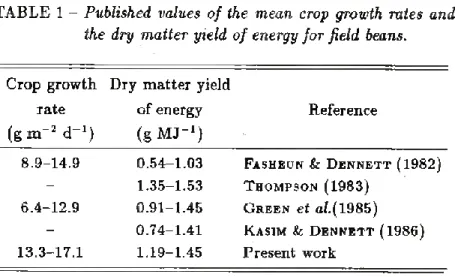
C3 crops (1.3 g MJ-1) and to other reported values for field bean crops (TABLE 1). The mean values of dry matter yield of energy correspond to efficiencies of fixation of total solar radiation of about 2.1% for the diseased treatments, 2.35% for the fungicide and 2.55% for the control, assuming a calorific value of dry matter of 17.5kJ g_1
(Leith, 1975).
TABLE 1 - Published values of the mean crop growth rates and the dry matter yield of energy for field beans.
Crop growth rate (gm-2 d'1)
Dry matter yield of energy (g MJ’1)
Reference
8.9-14.9 0.54-1.03 Fasheun & Dennett (1982) - 1.35-1.53 Thompson (1983)
6.4-12.9 0.91-1.45 Green et al.( 1985) - 0.74-1.41 Kasim & Dennett (1986) 13.3-17.1 1.19-1.45 Present work
FIGURE 1 - Total dry matter per unit area vs corresponding esti- mates of accumulated solar radiation intercepted for field bean crops, using equation (4). Data from 44 1°
126 days after sowing.
Key: Control, untreated, Q (y = 1.45® + 14, r2 = 0.98); Fungicide treatment, A (y — 1.34® +24, r2 = 0.99); Diseased treatments inoculated at different crop growth stages (Madeira, 1988):
1, # (y = 1.19® +44, r2 = 0.99); 2, ▲ (y = 1.19® +49, r2 = 0.99); 3, ■ (y = 1.21® + 38, r2 = 0.99).
There are evident differences between the predictions of eqila- tions (3) and (5): the former will underestimate the total light in- terception by the canopy, but overestimate the light interception by healthy leaves because shading by damaged leaf tissue is ignored. The latter assumes a uniform proportion of disease damage, and therefore underestimates the light interception by healthy leaves in the (common) case when disease and senescence are more severe on old leaves low in the canopy than on young leaves high in the canopy, which applied to cv. Ticol. In the present work, compa- rison of the estimates of light interception (/i and /2) shows that values of fi (from eq. 3) are higher by between 2 to 13% than those of /2 obtained using equation (5). The values of dry matter yield of energy estimated using equation (4) were therefore re-calculated using equation (2). Assuming K is constant, the values of e es timated for the diseased treatments by the analysis proposed by
Waggoner & Berger are higher, about 1.22 g MJ-1 compared with
1.19g MJ-1 obtained by equation (4), a difference of 2.5% but well within the limits of experimental error. The true values of e for the diseased crops are likely to lie between those estimated by the two methods. For the disease/crop combination studied here, the measured proportion of disease leaf area x was about 15% and le- sions quickly became necrotic and were “lost” in partial defoliation. In this case, equation (4) gives simpler analysis and similar results when x is small ,or when infection results in lesions which are “lost” from the leaf area. However, large errors may be introduced if this equation is applied to crops with severe disease symptoms (large
x).
4. CONCLUSION
In the current work, significant differences in canopy area de- veloped only at the end of the period of vegetative growth, and the differences in e were therefore responsible for the majority of the depression in dry matter production in the diseased treatments
(Madeira, 1988). This finding contrasts both with those of Wag
goner & Berger (1987) and that of previous work on Ticol by the
canopy duration were significantly associated with depression of dry matter production due to disease. The present measurements therefore provide the íirst evidence in support of Hughes expec-
tations (Hughes, 1988), that examples would be found of disease
depressing the efficiency of light use in a field crop.
REFERENCES
BlSCOE, P.V. & Gallagher, J.N. (1977) — Weather, dry matter production and yield. In “Environmental Effects on Crop Phy- siology”, pp. 75-100. Eds J.J. Landsberg and C.V. Cutting, London: Academic Press Inc. Ltd.
Boote, K.J., Jones, J.W., Mishoe, J.W. & Berger, R.D. (1983) — Coupling pests to crop growth simulators to predict yield reductions, Phytopathology, 73: 1581-1587.
Brassett, P.R. & Gilligan, C.A. (1989) — Fitting of simple models
for disease progress data for the take-all fungus, Plant Patho- logy, 38: 397-407.
Fasheun, A. & DENNETT, M.D. (1982) — Interception of radiation and growth efficiency in field beans ( Vicia faba L.), Agricultural Meteorology, 26: 221-229.
Gallagher, J.N. & Biscoe, P.V. (1978) — Radiation absorption,
growth and yields of cereais, Journal of Agricultural Science, Cambridge, 91: 47-60.
Green, C.F., Hebblethwaite, P.D. & Ison, D.A. (1985) — A quantitative analysis of varietal and moisture status effects on the growth of Vicia faba in relation to radiation absorption,
Annals of Applied Biology, 106: 143-155.
Hughes, G. (1988) — Models of crop growth, Nature, 332: 16.
JELLIS, G.J., Lockwood, G. & Aubury, R.G. (1984) — Further
evaluation of chlorothalonil for control of Ascochyta fabae in faba beans, Tests of Agrochemicals and Cultivars No. 5 (Annals of Applied Biology N.S. 104), pp. 58-59.
Kasim, K. & Dennett, M.D. (1986) — Effects of shading and plant
density on leaf growth of Vicia faba, Annals of Applied Biology, 109: 627-638.
Leith, H. (1975) — Measurement of calorific values. In “Primary Pro- ductivity of the Biosphere”, pp. 119-129. Eds H. Leith and R. Whittaker, Berlin: Springer-Verlag.
MADDEN, L.V. (1983) — Measuring and modelling crop losses at the
field levei, Phytopathology, 73: 1591-1596.
Madeira, A.C.A. (1988) — Growth, Light Interception and Disease in Field Bean, Ph.D. Thesis, University of Nottingham.
Madeira, A.C., Clark, J.A. & Rossall, S. (1988) — Growth, light
interception and disease in field bean (Vicia faba): the effect of late infection by Ascochyta fabae, Annals of Applied Biology, 112: 585-595.
Monteith, J.L. (1975) — Principies of Environmental Physics, London: Edward Arnold, 241 pp.
Monteith, J.L. (1977) — Climate and the efficiency of crop production
in Britain, Philosophical Transactions of the Royal Society of London, B281: 277-294.
Monteith, J.L. (1978) — Reassessment of maximum growth rates for C3 and C4 crops, Experimental Agnculture, 14: 1-5.
Russell, G., Jarvis, P.G. & Monteith, J.L. (1988) — Absorption of radiation by canopies and stand growth. In “Plant Canopies: Their Growth, Form and Function”, pp. 21-40. Eds G. Rus sell, P.G. Jarvis and M. Marshall, Cambridge University Press, Cambridge.
Thompson, R. (1983) — Changes in the partitioning of assimilates
of Vicia faba in response to environment. In “Temperate Legumes: Physiology, Genetics and Nodulation”, pp. 175-190. Eds D.G. Jones and D.R. Davies, Pitman Books Ltd.
Waggoner, P.E. &: Berger, R.D. (1987) — Defoliation, disease and