HOW INFLUENCERS` CREDIBILITY ON INSTAGRAM
IS PERCEIVED BY CONSUMERS AND ITS IMPACT ON
PURCHASE INTENTION
MARTA REBELO
DISSERTATION WRITTEN UNDER THE SUPERVISION OF PROFESSOR CAROLINA AFONSO
DISSERTATION SUBMITTED IN PARTIAL FULFILMENT OF REQUIREMENTS FOR THE MSC IN BUSINESS ADMNISTRATION, AT THE UNIVERSIDADE
ABSTRACT
Title: How influencers’ credibility on Instagram is perceived by consumers and its impact on purchase intention
Author: Marta Figueiredo Rebelo
The purpose of this thesis is to understand the perception Instagram users, in other words consumers, have of influencers they follow on Instagram. Consumer perceived credibility of influencers, and its impact on the purchase intention, is therefore studied. This dissertation aims to highlight which credibility dimensions better explain the purchase intention. Gender is also explored to verify behavior differences between female and male consumers.
To better analyze the perceived credibility of influencers and purchase intention, scales previously developed were applied and adapted as proposed by Ohanian (1990) and Dodds, Monroe & Grewal (1991), respectively.
The present study is exploratory and quantitative. It was implemented through an online survey, where only active Instagram users that follow one or more influencers on the platform were selected. Overall, 285 valid responses were collected.
The results of the present study indicate that perceived “attractiveness” and “trustworthiness” of influencers are the dimensions of credibility that better explain consumers’ purchase intention. In what concerns gender differences, it is verified that more female than male consumers are influenced by perceived trustworthiness.
The developed model aims to support brands and marketers in better understanding the effects perceived credibility of influencers has on consumption, and of its impact in purchase intention.
RESUMO
Título: Como a credibilidade nosinfluenciadores do Instagram é percebida pelos consumidores e oimpacto que causa naintenção de compra
Autora: Marta Figueiredo Rebelo
O propósito desta tese é compreender as percepções que os utilizadores do Instagram, que neste caso são os consumidores, têm para interagir com influenciadores no Instagram. Desta forma, é estudado o impacto que a credibilidade percebida pelos consumidores nestes Influenciadores tem na intenção de compra. Esta dissertação visa destacar quais ostipos de credibilidade que melhor explicam a intenção de compra. Os dois géneros dos consumidores são também explorados, de modo a verificar se há diferenças no comportamento entre os homens e mulheres.
Para compreender melhor o impacto que os influenciadores têm nas percepções de credibilidade dos consumidores e na intenção de compra, foram utilizadas e adaptadas escalas previamente propostas por Ohanian (1990) e Dodds, Monroe & Grewal (1991), respectivamente.
O presente estudo é exploratório e quantitativo. Nafase derecolha de dadosfoi feito um questionário online, onde foram selecionados apenas os utilizadores do Instagram que se consideram activos e que seguem um ou maisinfluenciadores na plataforma. Nototal foram obtidas 285 respostas válidas.
Os resultados obtidos neste estudo indicam que a “atractividade” e a “confiabilidade” percebida pelos consumidores nosinfluenciadores são as dimensões de credibilidade que melhor explicam a intenção de compra. Relativamente às diferenças entre homens e mulheres, constata-se que a percepção da confiabilidade de um influenciadortem mais influência nas mulheres do que nos homens.
O modelo desenvolvidotem como objectivo auxiliar marcas e marketeers a compreender melhor oimpacto que a credibilidade percebida pelos consumidores nosinfluenciadores tem naintenção de compra.
ACKNOWLEDGEMENTS
I would like to express my gratitude to Professor Carolina Afonso, who supported me in every stage of this research, without whom it would have been impossible to accomplish this goal – especially for encouraging me to write about this new topic. She instantly understood my passion for Instagram, and has constantly guided me in the right direction.
I would also like to thank my friends and colleagues that consistently supported me throughout this challenging task, particularly Marta Lopes for all the advice she provided me with while constructing this thesis.
Last, but not least, I must express my profound gratitude towards my parents, sister and boyfriend for always believing me and comforting me in despairing times. Especially my father, with his inspiring wisdom and positive energy. This accomplishment would not have been possible without them.
TABLE OF CONTENTS Chapter 1. Introduction ... 9 1.1Background ...9 1.2Problem statement ... 11 1.3 Aim ... 12 1.4 Scope ... 12 1.5 Research method ... 12
1.6 Academic and managerial relevance ... 13
1.7 Dissertation outline ... 16
Chapter 2. Literature Review and Conceptual Framework ... 17
2.1 Web 2.0 and the Emergence of Social Media (SM) ... 17
2.1.1 Definition of SM...17
2.1.2 Main SM platforms ...17
2.1.3 Importance of SM for businesses and consumers ...18
2.1.4 Benefits of using SM platforms ...20
2.1.5 SM platforms in Portugal ...21
2.2 Influencers presence on Instagram ... 22
2.2.1 The emergence of Instagram ...22
2.2.2 Influencers ...23
2.2.3 Instagram in a business context ...25
2.2.4 Main brands’ presence on Instagram ...26
2.3 The role of credibility to explain the interaction with influencers and the impact on purchase intention ... 27 2.3.1 Definition of credibility ...27 2.3.2 Attractiveness...28 2.3.3 Trustworthiness ...28 2.3.4 Expertise ...29 2.4 Purchase intention ... 29 2.5 Gender ... 31
2.6 Conclusion and conceptual framework ... 32
Chapter 3. Methodology ... 34
3.1 Research approach ... 34
3.2 Research instruments ... 35
3.2.1 Population and sample ...35
3.2.2 The survey ...35
3.2.3 The measures...36
Chapter 4. Results analysis ... 37
4.1 Preliminary analysis ... 37
4.1.1 Data collection and analysis ...37
4.1.2 Sample characterization...37
4.1.3 Data screening – univariate and multivariate outliers ...40
4.1.4 Data reliability ...40
4.1.5 Principal component analysis (PCA) ...41
4.1.6 Correlation analysis ...42
4.1.7 Descriptive statistics ...43
4.2.1 Research questions ...44
Chapter 5. Conclusions ... 51
5.1 Academic contributions... 51
5.2 Managerial contributions... 52
5.3 Limitations and future research recommendations ... 54
APPENDICES ... 56
LIST OF FIGURES
Figure 1. Top 13 social media platforms visual comparison………...…..18
Figure 2. Number of monthly active Instagram users from January 2013 to April 2017 (in millions)………...…23
Figure 3. Top 15 leading brands ranked by number of Instagram followers (in millions)………26
Figure 4. Conceptual framework……….………...…...32
Figure 5. Gender distribution……….37
Figure 6. Age distribution………..……….…...……38
Figure 7. Occupation distribution……….…...…..38
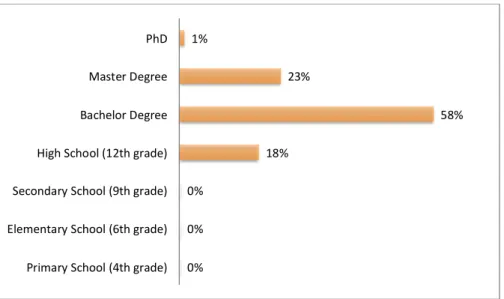
Figure 8. Education level distribution………39
LIST OF TABLES
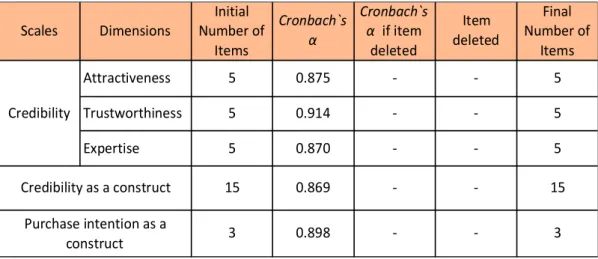
Table 1. Scales’ reliability test analysis……….40
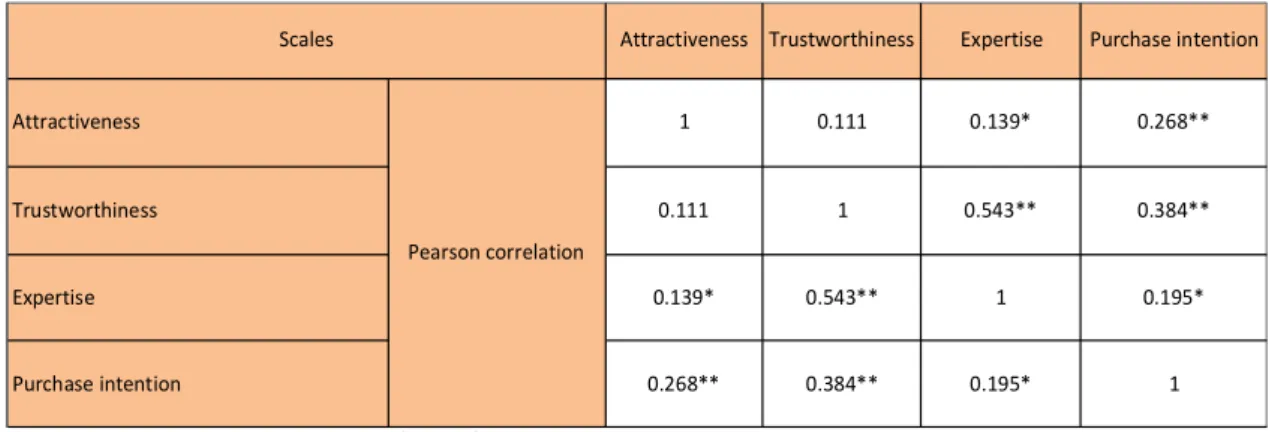
Table 2. Pearson correlation’s analysis………..43
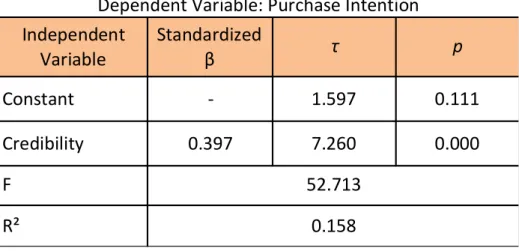
Table 3. Linear regression – credibility and purchase intention………....44
Table 4. Multiple linear regression – attractiveness, trustworthiness, expertise and purchase intention………...45
Table 5. Chi-square test – gender and attractiveness……….46
Table 6. Chi-square test – gender and trustworthiness………..46
Table 7. Chi-square test – gender and expertise………47
Table 8. Chi-square test – gender and purchase intention……….47
Table 9. Female – multiple linear regression – attractiveness, trustworthiness, expertise and purchase intention………48
Table 10. Male – multiple linear regression – attractiveness, trustworthiness, expertise and purchase intention………....49
Chapter 1. Introduction
1.1Background
The omnipresent smartphone and other mobile devices have generated lots of Social Media (SM) applications (Yadava, Joshia & Rahmanb, 2015). SM has become essential for social networking and content sharing (Asur & Huberman, 2010), but also performs an important role in the economic interests of small businesses (Habibi et al, 2014).
Therefore, according to Evans, Bratton, & McKee (2010), the possibility of SM marketing in marketers’ business activities may be an advantage.
Regarding SM platforms, Instagram stands out because it is the fastest growing SM network nowadays (Garifova, 2016). The quick evolution of Instagram (90 million monthly active users since 2013 to 700 million monthly active users in 2017) provides an increasing number of organizations pondering to promote in the platform, and for some of them it is an essential prerequisite (Statista.com 2017). Moreover, Instagram gained 1 million users two months after its launching and hasn’t stopped growing consistently every year. If comparing Instagram’s with other SM growth, Twitter took 2 years to reach the exact same amount of users and Foursquare, 1 year (Instagram.com, 2017).
This rise of Instagram has also been accompanied by that of brands investing on a presence on this SM network. Forrester research (2017) demonstrates that more than half of the top 50 brands (58%) post on Instagram an average of 5.6 times per week. Also, its engagement with brands is 10 times higher than Facebook’s, 54 times higher than Pinterest’s and 84 times higher than Twitter’s. Additionally, engagement per post has risen 416% in 2 years. These Instagram data show how imperative this trend is for advertisers wanting to achieve their audience (Brandwatch.com, 2016).
SM evolution has led to the emergence of influencers such as “Instagrammers”, “YouTubers” and “Bloggers”. Influencers are common Internet users who gather a huge following on SM through the engagement with followers in digital and physical spaces by coordinating advertorials into their SM posts (Senft, 2008). Several advertorials in the influencer business are exceptionally customized, since they give their opinion about products and services they experienced themselves and endorse for a fee (Abidin, 2016). In addition, van der Waldt et al. (2009: 102) wrote that the “right choice of influencer
can be effective in establishing a position for newly launched product and it can also change perceptions on a product that has been positioned in a wrong way”.
Therefore, for marketing managers, understanding the consumer perception of influencers might enable more efficiency (van der Waldt et al., 2009).
Since consumers usually tend to perceive friends and the influencers they follow as more credible than distant and motivated sources (Neilsen, 2013), plenty research was conducted to explore consumers’ perceived credibility of influencers. To fulfill that, a large literature on “source effects” was executed (Janis and Hovland 1959; Ohanian 1990). Moreover, consumers are increasingly skeptical about marketing advertisers (Campbell and Kirmani 2008; Friestad and Wright 1994) and, consequently, there is a craving for product and message authenticity (Brown, Kozinets, and Sherry 2003).
Since consumers perceive the content generated by influencers as more credible than the content provided by the sellers (Jonas, 2010), their willingness to set a purchase intention might increase (Waldt, Loggerenberg & Wehmeyer, 2009; Fan & Miao, 2012).
Additionally, Lecinski (2011) reported that 70% of purchase decisions occur during online search, specifically when products are recommended. Fleishman-Hillard and Harris (2012) reveal that 89% of consumers buy products through the Internet.
So, exploring Instagram users’ perceived credibility of influencers is relevant for marketers and brand managers, as consumers buy a greater amount of a company product when influencers develop credibility in their relationship with the product, and demonstrate they would appreciate to use that specific product (Erdogan, 1999; Ohanian, 1991; van der Waldt et al., 2009).
Considering consumers get and share information on products and services via digital platforms (Clemons, 2009), in order to increase purchase intention, organizations need to meet the goals and requests of consumers (Fortsythe et al., 2003). To attain it is critical to deeply investigate the impact of the perceived credibility of an influencer as a determinant of purchase intention, and which dimensions of credibility have a higher influence on purchase intention. Therefore, this study aims to examine whether the influencer influences purchase intention.
communities, being a female or male consumer is a significant and relevant aspect on communication and purchase transactions. It is thus fundamental to understand gender differences in their purchase intentions (Chiu, Lin & Tang, 2005), to support their presence, and to promote the development of online shopping. One other goal of this study is therefore to understand the differences of each gender regarding the relation between the perceived credibility of an influencer and purchase intention.
1.2Problem statement
Past research shows that with the emergence of SM, the way consumers interact with brands completely changed. Consumers are getting used to look for information from individuals with a high rate of visualizations, usually referred as influencers (Liu et al., 2015). Meanwhile, companies keep making efforts to investigate the impact of influencers on sales and advertising. Hence, Liu et al. (2015) stated that the ability of identifying influencers has ended up being important for companies, since with the utilization of SM platforms advertising messages can be spread faster, and be better promoted via influencers’ recommendations to their extensive followers. It is thus of great importance for marketers to understand that if they use SM platforms and its influencers efficiently, their marketing campaigns may get more consumers and boost their return rate.
Past research shows that influencers’ image has a positive impact on the image of several brands (Walker et al., 1992) as well, their endorsement in strengthening companies financially (Agrawal and Kamakura, 1995; Mathur et al., 1997). Using them as a marketing tool may consequently help brand managers announcing a new product or repositioning an existing one (Kaikati, 1987).
According to Sertoglu et al. (2014), if consumers believe the content posted by the influencer, it is more likely that they will frame a purchase intention. Considering that
SM intrinsically drives consumers to suspect company commercials in SM (Akar & Topçu, 2011), and since the genuine experience of an experienced consumer is handily feasible, this problem can be minimized if managers and marketers understand which perceptions of credibility do Instagram users have of influencers, and the impact these have on purchase intention. They may then adapt their strategies and convince managers and marketers that Instagram and influencers are an important “bridge” for purchasing and promoting the purchase growth.
Instagram thus being the platform getting more engagement from consumers (WeAreSocial.com, 2017), and influencers’ posts a convenient marketing device and an essential reference source when consumers make a purchase decision (Chen & Xie, 2008), the research problem of this thesis lies in exploring how influencers’ credibility is perceived by Instagram users, and the effect these influencers might have on purchase intention.
1.3 Aim
This study proposes to understand to what extent do Instagram users perceive the credibility of influencers and whether these influence their intention of purchasing the promoted products. Afterwards, the aim is also to assess if there are differences concerning each gender, and finally, if it they are verified, which are the main differences among female and male Instagram users.
In order to acknowledge this aim, two distinct research questions are put forward, namely:
RSQ1_A – Does perceived credibility of an influencer on Instagram influence purchase intention of the products promoted by the influencer?
RSQ2_A – Are there any differences on perceived credibility of an influencer and on
purchase intention of the products promoted by the influencer concerning gender -related characteristics?
1.4 Scope
Through the use of the Instagram platform, the goal of this thesis is mainly to explore the perceptions of credibility that Instagram users have regarding an influencer, and subsequently of studying its impact on the purchase intention of the products promoted by the influencer. Afterwards, it aims to understand if the impact on purchase intention is different concerning female and male Instagram users’ perceived credibility of influencers.
1.5 Research method
In this thesis, an exploratory, quantitative and descriptive research approach is taken. Exploratory, for this topic has not yet been studied in-depth, and it was necessary to collect some data through qualitative research.
The study is also quantitative, since primary data is the main source to conduct this research, by analyzing the major perceived credibility dimensions of an influencer and their impact on purchase intention and also by exploring if there are any differences on the impact of these constructs through an analysis of the different genders.
Descriptive, since some studies have already analyzed credibility aspects of consumers to follow an endorser and further the purchase intention aspects. Therefore, it is also supported by secondary data collected through quantitative research.
Moreover, the study is based only on the behavior of active Portuguese Instagram users, aged 18 years old or up, that follow one or more Influencers on Instagram. A quantitative and exploratory study is thus held with primary data collected through an online and self-administered survey made in Qualtrics and later analyzed in SPSS.
1.6 Academic and managerial relevance
According to Messik (2012) Social Media can be considered as an intra-organizational communications tool and since more customers are adopting their mobile devices as a tool to search and make purchases online, more attention should be paid from entrepreneurs to improve their sites, so they can be convenient in usability, in order to better target their audiences. Therefore, it is fundamental to know how to use all the features that SM marketing include in today circumstances (Garifova, 2016).
Additionally, Garifova (2016) pointed out that Facebook mostly represents the raise of SM networks, followed up by Twitter and more recently by Instagram. Garifova (2016) also invoked that the evidence that Instagram is quickly developing contributes to the fact that more companies fancy to promote in this network.
Academically speaking, very little research concerns the potential of Instagram influencers nowadays. Despite the field being relatively new, previous studies provided empirical support of influencers’ importance and of the general qualities of an influencer (Zhang, Moe & Schweidel, 2017; Kapitan and Silvera, 2016; Freberg et al., 2010; Mangold & Faulds, 2009). However, these studies are focused on other popular social media networks, such as Blogs, Facebook, Twitter and YouTube (Uzunoglu & Kip, 2014), with no considerable amount of research made in direct regard to Instagram. Additionally, instead of the Instagram’s influencers context that is studied in the present research, current studies regarding Instagram focus mostly on other fields (Bakhshi et
al., 2014; Hochman and Schwartz, 2012; Hu et al., 2014; Silva et al., 2013).
Moreover, few studies have considered consumers’ credibility factors to interact with influencers through Blogs (Ohanian, 1990). However, to the best of our knowledge, no other studies were conducted and applied to the Portuguese market about the specific Instagram platform. Moving forward, as consumers are increasingly applying social media as a source of information related to the brands they aim to know better (Baird and Parasnis, 2011; Naylor et al., 2012) and because the information provided by influencers influences positive perceptions of credibility on consumers (Chu and Choi, 2011; Chu and Kim, 2011), the present thesis aims to understand the perceived credibility of these influencers on Instagram users, based on several studies (Ohanian, 2010; Sertoglu et al., 2014; Newell and Goldsmith, 2001; Cosenza et al., 2015; Cheng and Ho, 2014).
Again, since consumers purchase more products from a company when influencers can build credibility about their relationship with the product by showing their followers they would appreciate to use the particular product (Erdogan, 1999; Ohanian, 1991; van der Waldt et al., 2009), the main goal of this study is to explore Instagram users’ perceived credibility of an influencer as to understand the impact on purchase intention (Dodds et al., 1991; Akar and Aslihan, 2015; Jiménez and Mendoza, 2013; Taylor and Baker, 1994), based in a few studies (Sertoglu, Catli & Korkmaz, 2014; Ohanian, 1990). The findings from this study aspire to make a contribution to the broad literature and its research efforts to formulate new and fresh variables on the digital consumer behavior subject, throughout the investigation of the link between Instagram users’ perceived credibility of influencers on Instagram platform, and consequently its impact on the purchase intention of the products promoted by the influencers. Afterwards, it also aims to explore gender – related differences among the same constructs, since several studies prove that are considerable differences regarding gender characteristics (Flanagan and Metzger, 2003; Ferebee, 2008; Deaux & Kite, 1987; Meyers-Levy & Sternthal, 1991; Hinz, McCarthy & Schlarbaum, 1977; Allen, 2001; Kwak et al., 2002; Slyke et al. 2002; Rodger & Harrys, 2004).
For management, being the influencer the main source of information, perceived credibility is a meaningful aspect for the advertiser (Friedman et al., 1978). Moreover,
brands are recognizing the power of influencers to directly influence their connected network by making suggestions, which result in the search for purchasable products (Flynn, Goldsmith & Eastman, 1996). Therefore, companies are looking for ways of using this influence in order to create interest, drive action, create goodwill, establish expertise and dialogue with their online stakelholders (Gardner, 2005), instead of focusing only on conventional media. Consequently, by understanding the opportunities influencers provide, marketers seek to benefit from characteristics such as their perceived credibility (Schmallegger & Carson, 2008).
According to Katz & Lazarsfel (1995) it is difficult for brand managers to communicate directly with consumers, but they have the opportunity to influence it by using influencers as intermediates. Furthermore, it is important to explore the role that influencers have on SM as it is found to have impact on consumers’ purchase decisions (Kaplan & Haenlein, 2009).
Therefore, this dissertation aims to provide relevant managerial implications for determining the credibility of influencers as perceived by Instagram users and the impact it has on purchase intention, which intends to help marketers and advertisers when trying to figure out what perceptions of influencers are better perceived by the Instagram users to engage with influencers and their purchase intentions. Subsequently, marketers can better segment and shape strategies by understanding Instagram users’ perceived credibility of influencers more accurately, and therefore better acknowledge the underlying mechanism of consumer/Instagram user and influencer on Instagram.
An understanding of gender differences regarding perceived credibility and its relation with purchasing through SM platforms and purchase intention is also useful for researchers interested in disclosing insights of purchase intention (Chiu et al., 2005). Another pertinent question that this research aims therefore to answer, is whether the credibility of an influencer is perceived differently by female and male Instagram users, and if their purchase intentions also differ from each other.
To conclude, and since this dissertation is based on active Portuguese Instagram users, this study hopes to support brand managers as well as marketers to engage in the market by presenting insights on how influencers’ credibility is perceived by Instagram users, and the impact it has on the purchase intention of the products promoted by the
influencers.
1.7 Dissertation outline
The first chapter presents an introduction to the dissertation’s subject, concerning its problem statement, aim, scope of analysis, research method and academic and managerial relevance. The second chapter provides the results of an extensive literature on social media marketing, particularly on the use of one specific platform, Instagram, as a business tool. Perceived credibility and purchase intention constructs are explored along this chapter, as well as the differences between genders. Based on this literature, research questions arose, concerning the intent to understand the relationship among these constructs. The third chapter establishes the methodology used throughout this research in order to collect the data required to analyze the research questions formulated. In the fourth chapter the primary data is evaluated, the main results are exposed and a preliminary analysis is attempted, conducive to the confirmation of data reliability and suitability, followed by an in-depht analysis. Finally, the last chapter provides the major conclusions of this research, accompanied by the limitations and recommendations for future research that can be shaped from this subject.
Chapter 2. Literature Review and Conceptual Framework
2.1 Web 2.0 and the Emergence of Social Media (SM) 2.1.1 Definition of SM
Firstly, Web 2.0 describes a second generation of the World Wide Web that focuses on the capacity to cooperate and share information online. In other words, Web 2.0 is the development from fixed html Web pages to a more charismatic and organized Web that provides Web applications to users. The main functionality of Web 2.0 is the ability of sharing more open information (Constantinides & Stefan, 2008).
And Social Media can be considered as Internet–based applications that sustain consumer–generated content, which includes archives with content established by experienced consumers that are shared online for others to easily access (Blackshaw, 2006). SM can also be defined as any type of website that allows users to share their community building, interactions, opinions and views (Kaur, 2016). SM combines several applications that enable consumers to “post”, “tag” or “blog” on the Internet. Moreover, consumers post a variety of content on SM with the intent of cultivating each other about brands, products, services and issues (Blackshaw & Nazzaro, 2006). Compared with content added by marketers and suppliers, SM is created by consumers with the only goal of sharing information among themselves.
To conclude, through the emergence of Web 2.0 many consumer–behavior and marketing analysts considered that brands now have an excellent tool set to cooperate with their most loyal consumers, and bring associated value for the brand (Cova & Cova, 2002). Thanks to Web 2.0, consumers are becoming significantly empowered in building relationships with the companies that manage their most loved brands (Uncles, 2008). 2.1.2 Main SM platforms
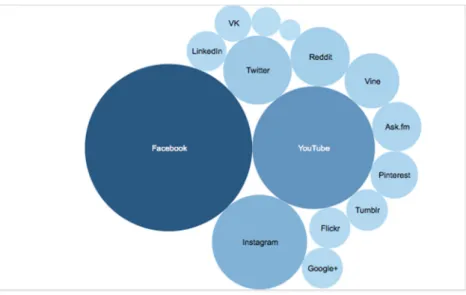
Through the study conducted by Kallas (2017), the 13 most popular social networks worldwide are enumerated as follows: Facebook, with 1.94 billion monthly active users; YouTube: 1 billion; Instagram: 700 million; Twitter: 313 million; Reddit: 250 million; Vine: 200 million; Pinterest: 150 million; Ask.fm: 160 million; Tumblr: 115 million; Flickr: 112 million; Google+: 111 million; LinkedIn: 106 million and VK with 90 million monthly active users.
Figure 1. Top 13 social media platforms visual comparison Source: (dreamgrow.com, 2017)
Moreover, according to Kallas (2017) the 10 top social networking apps currently are: firstly Facebook and WhatsApp, both with 1.2 billion monthly active users; QQ Chat: 899 million; WeChat: 806 million; Instagram: 700 million; QZone: 652 million; Viber: 249 million; LINE: 218 million; Snapchat: 200 million and YY with 122 million monthly active users.
Focusing on Instagram, its videos have 2 times the engagement of any other social media platform (Aslam, 2017). Moreover, Instagram hosts 700 million individual accounts, among which 400 million log on every day. Instagram was bought by $1 billion by Facebook and nowadays the platform’s current worth is estimated to be of approximately $50 billion (Hutchinson, 2017). It is also known that 59% of Instagram users are between 18 and 29 years old, followed by 33% between 30 and 49; 18% are between 50 and 64; and the remaining 8% are over 65 years old (SproutSocial.com, 2017).
2.1.3 Importance of SM for businesses and consumers
Web 2.0 takes a new step forward in the expansion of the Internet in a marketing environment. Previous studies advocate that young consumers have already adopted online SM as an inherent part of their life (Bizreport.com, 2007). Furthermore, online consumers have perceived Web 2.0 applications as a source of empowerment, not only in the shape of content sourcing and communities of dialogue. but also as one of confrontation of producers and vendors concerning their commercial, ethical and social
responsibilities.
According to Damanpour and Gopalakrishnan (2001), conventional communication in marketing has been seriously depreciated since the development of the engagement aspect arrived to marketing (Mangold & Faulds, 2009; Muñiz & Schau, 2007).
Moreover, Lea et al. (2006) and Dwyer (2007) consider SM as virtual communities, groups of consumers connected with each other that interact over the Internet. Dholakia et al. (2004) state that their intention is to achieve common and personal goals. Consequently, considering that B2C companies are already familiar with the development of virtual communities, perceiving SM as virtual communities implies an opportunity for B2C companies to take advantage of this SM and of Web 2.0 technologies for targeting the user they want to reach.
Past research represents SM as a component of the promotional mix (Mangold & Faulds, 2009; Muñiz & Schau, 2007) since integrated marketing communication (B2C) tools are incorporated, marketing professionals are not able to control the distribution, range and type of information. As consumers increasingly distance themselves from the conventional promotional approaches, these SM are essential for companies that make use of, and acknowledge, them. Although the conventional media ends in a compromise between the approach and commitment of consumers, SM facilitates both the approach and the commitment of said consumers (Hanna, Rohm, & Crittenden, 2011; Edelman, 2010).
Moreover, some studies recognize the significance of SM as a platform for building and conveying an image for the brands, and therefore for making sales. Besides, SM went from engaging and communicating with consumers to a mode of generating revenues (Wang and Zhang, 2012; Barnes, 2014). Research shows that almost 40% of SM users had bought a product after sharing it on SM sites. The growing attendance of colossal brands on SM sites demonstrates that these sites are increasingly in SM industry (Pelet and Papadopolou, 2013; Liang et al., 2011).
Additionally, Shadkam and O’Hara (2013) claim that Instagram accounts and Facebook pages are examples that social industry provides businesses by selling to consumers from SM platforms. Therefore, social industry represents an electronic business in which the consumer is more participative than ever (Liang et al. 2011). Hence, SM and digital
platforms may be considered as a set of collaborative tools that connect consumers and with which marketing can be developed (Quinton, 2013).
To conclude, this evolution brought a new consumer profile denominated the “online consumer” (Racolta-Paina & Luca, 2010). This online consumer performs an essential role in the e–commerce and has distinct buying habits compared with conventional consumers. Therefore, companies should consider online consumers’ needs, behaviors, lifestyles and purchase intentions in order to satisfy them in a highly dynamic and competitive market.
2.1.4 Benefits of using SM platforms
From a consumer’s perspective, the utilization of information provided on SM offers several benefits, such as convenience, efficiency, participative and wealthier information, a more extensive selection of products, cost reduction, high variety of products and competitive pricing (Bayo-Moriones & Lera-Lopez, 2007). Besides, one of the biggest benefits of using SM in research is the speed of response and immediacy of information (Quinton, 2013).
Online social networking usually tends to upgrade these benefits, considering it provides a more proactive communication between consumers. For instance, through SM, consumers can search for others’ opinions about particular products (Henderson, 2011). Hence, consumers have been demonstrating to esteem peer judgments more than company promotions, which represent a shift in the locus of persuasive power (Berthon, Pitt, Plangger, & Shapiro, 2012; Pitt, Berthon, Watson, & Zinkhan, 2002).
The marketer benefits of using SM based on consumers strategy are as follows: the consumer purchases the product, uses it, shapes an opinion about it and afterwards communicates with other consumers. Based on this, the marketer considers the last step, communication between consumers, an opportunity to increase recognition of how consumers perceive their products and services. Afterwards, marketers can choose what to take in consideration for improving their products and services (Evans, Bratton, & McKee, 2010). Besides that, SM offers researchers opportunities to research areas that were once impossible to access (Hookway, 2008).
2.1.5 SM platforms in Portugal
In 2005, Portugal was considered the 15th worldwide in mobile communication
penetration rated by 82% (Union, 2009). By the end of 2012, the mobile penetration rose to 156%, verifying that Portuguese citizens have more than one mobile phone per person (Anacom, 2012). The use of Internet multiplied because of the increasing access to high– speed wireless networks and adoption of mobile phones. According to Seybert (2012), Portugal has an Internet penetration rate in excess of 61%.
SM popularity and growth between consumers is prominent. There is an evolution since the number of active SM users is already 2.307 billion (Kemp, 2016). Specifically in Portugal, SM utilization has triplicated along the last seven years (Lusa, 2016).
In addition to this, Portugal has a total population of 10.28 million, within which 6.10 million are active SM users that spend on average almost 2h18min per day on SM platforms (Hootsuite, 2017). SM users’ market penetration in Portugal is higher on Facebook platform, followed by Instagram, Twitter, LinkedIn and then by Snapchat (Marktest, 2016). And finally, in Portugal, 67% of SM users follow public figures and 62% follow brands in SM platforms.
The most active SM platforms in Portugal are, first, Facebook with a percentage of 64% active users; Youtube: 63%; FB Messenger: 41%; Instagram: 32%; Google+ and WhatsApp: 27%; Skype and Twitter: 25%; LinkedIn: 24%; Pinterest: 21%; Snapchat: 16% and Tumblr with 13% of active users (wearesocial.com, 2017). Also, and to better understand the importance of e–commerce activities, Wearesocial.com (2017) reported that 60% of Portuguese citizens search online for a product or service to purchase per month, 56% visit an online retail store and 39% buy a product or service online, also on a monthly basis.
Focusing on Instagram users, in Portugal there are 1.9 million active users, which are distributed as follows: users between 13 and 17 years old represent 11%; 18-24 years: 36%; 25-34 years: 26%; 35-44 years: 16%; 45-54 years: 7%; and finally, users 55 years or over represent 4%. Also interesting for this study is that in Portugal 54% of Instagram users are female, and 46% are male (napoleancat.com, 2016).
2.2 Influencers presence on Instagram 2.2.1 The emergence of Instagram
Instagram was founded by Kevin Systrom and Mike Krieger in October 2010, being the
first photo-based social platform. Instagram was launched via app store and right after one week of existence it achieved 100 000 followers. When comparing Instagram’s to other SM platforms growth, such as Twitter and Foursquare, these took respectively two and one years to achieve the same amount of users. Actually, Instagram reached 1 million users only two months after its launch and nowadays is constantly increasing (Wersm.com, 2017). And since the app was available for android phones and recently joined direct messaging, Instagram is growing even more (Wersm.com, 2017).
In addition to that, when Instagram added video sharing services, more than 5 million videos were shared in 24h, and its use also doubled over the last two years (Smith, 2016). Additionally, McNely (2012) states that visual-based SM is amidst the fastest-growing social networking sites, and Instagram is among the increasing growth of these sites. Also, the most appealing particularity of Instagram is that when its users take photos and share them with friends, it provides users with the opportunity of applying distinct filters on their pictures or videos before posting them on the platform (Lee et al., 2015). For instance, McNely (2012) also states that using Instagram among expert organizations is noteworthy because it provides a predominantly mobile visual image, which differentiates qualitatively from professional photography in support of branded communication.
Instagram enables brands to provide a “behind–the–scenes” look to stakeholders, ending up by strengthening their relationship with the organization (Conlin et al., 2014; Magrath & McCormick, 2013) and, consequently, identifying relationship-marketing goals for fortifying the brand.
Regarding some statistical aspects, the use of Instagram grew significantly in 2014 along all key demographic groups (Duggan, Ellison, Lampe, Lenhart, & Madden, 2015). About 50% of Internet users are aged between 18-29 years old (Duggan et al., 2015). Instagram is the 3rd most popular SM platform amidst college students and its
engagement ratio is greater than those on Facebook and Twitter (Salomon, 2013). Also, according to Forrester Research (2017), the average engagement rate reported via
Instagram is 4.2%, compared with 0.07% on Facebook, which is piquing researchers` interest.
Moreover, according to the latest statistics conducted by MediaKix.com (2017), this $1 billion app, bought by Facebook in 2012, is increasing its popularity, having achieved 700 million monthly active users since its launch in 2010, overtaking Twitter, where only 400 million users are active. In addition to this, the number of photos shared per day on Instagram is 95 million, up from 70 million last year of 2016. Currently more than 40 billion photos were uploaded on the platform, and the daily number of “likes” is, on average, 3.5 billion every day (OmnicoreAgency.com, 2017).
To conclude, and from a study conducted by Lee et al. (2015), Instagram users are 2.5 times more willing to click on advertorials than on other SM platforms. The originality and simplicity of Instagram enabled users to share and recognize each other`s lives through photos, and also provided celebrities and commercial brands the opportunity to engage with their consumers.
Figure 2. Number of monthly active Instagram users from January 2013 to April 2017 (in millions) Source: (statista.com, 2017)
2.2.2 Influencers
Influencers can be characterized as “microcelebrities”. They are a new approach of online performance that involves people expanding their recognition by using technologies like social platforms, blogs and videos (Senft, 2008). Also, Gorry &
Westbrook (2009) state that influencers represent a sort of autonomous outsider endorser that shape people attitudes by using SM due their influential energy. Therefore, advances have been created to distinguish and track the influencers pertinent to a given brand or association. This strive to identify influencers relies on aspects like number of “followers”, “likes” or the number of times a post is shared.
In addition, earned endorsements enable customers to benefit since it helps them internalizing messages, and provides the endorsed product or service with strength. An example of earned endorsements may be the recommendations of an influencer which enabled buyers to advocate for their most loved brands (Neilsen, 2013). Additionally, Hall (2010) adds that influencers carry countless direct friends and followers, but their real significance lies on the number and relevance of their expanded indirect followers. On the other hand, Petty and Andrews (2008) discuss that consumers perceive influencers who receive cash payments to be less credible than those taking free samples or coupons as compensation. Brands that pay direct-monetary benefits to the influencers in exchange for a recommendation post are usually perceived as “buying” an article, and the influencer perceived to “sell” the trust of readers to the company (Fu, 2010; Hsu, 2010). On the other hand, if the influencer provides product samples or discount coupons as allowance, consumers may consider this as a product trial opportunity and be more likely to acknowledge this type of activity adequately (Fu, 2010; Hsu, 2010).
Additionally, the appeal of influencers is introduced in such a way that they connect and engage with their followers giving the idea of a personal and exclusive relation. Commonly on Instagram, there are influencers who are classified as “lifestyle” who post content related to their own lives as focal subject, but other influencers post content associated with different classifications, such as “fashion”, “food” or “parenting”, which solely focus on a streamlined topic that does not need to personally identify with their own private lives (Senft, 2008).
Subsequently, influencers are more fascinating than celebrities since Instagram users perceive them as common people (Danesi, 2008). However, influencers are stimulated by hidden business interests, and that’s why they put a lot of effort on keeping up impressions of affection on followers (Abidin & Thompson, 2012). Contrasting with traditional media, posts published by the influencers are considered more casual, fresh
and crude and allow for prompt intuitiveness and reaction from followers. Therefore, followers can see the interaction with influencers as much more individual, quick and intimate (Boyd, 2006).
Lastly, through SM platforms, influencers straightforwardly control their self-portrayal and connections with followers by developing disclosures into the backstage of their camera and using their individual voice to transmit fellowship (Boyd, 2006; Lövheim, 2010). The amount and wide spread of influencers’ posts amidst followers gives the idea they are always sharing parts of their private lives, and in order to engage with their followers, they regularly welcome them to interact with each other, thus creating “influencer content” through requested feedback (Senft, 2008).
2.2.3 Instagram in a business context
Recently, SM platforms have provided brand managers with distinct characteristics that allow more innovative and original content strategies. In addition, brand managers can use SM for further branding goals and customize communication with fans that allows for engagement opportunities (Meng, Stavros, & Westberg, 2015). Therefore, SM forces brands and companies to look for recent interactive methods of reaching and engaging their consumers (Gallaugher & Ransbotham, 2010; Kozinets, de Valck, Wojnicki, & Wilner, 2010). SM increasing utilization offers brand managers an opportunity for reaching their target audiences (Meredith, 2012). For instance, organizations can create a much more interactive relationship with consumers (Papasolomou & Melanthiou, 2012).
Regarding a research conducted by Brandwatch Agency (2016), 49% of brands are on Instagram and by the end of this year they are predicted to rise to 71%. Also, looking at the top 100 brands in the world, 90% have an Instagram account. Besides this, almost a third of Instagram users have already used their mobile to purchase a product online, making them 70% more willing to purchase a product than non-users (Brandwatch.com, 2016). In addition, the same study shows that the average engagement per post grew by 416%, comparatively to two years ago. Hence, it is important to notice that these Instagram statistics show how important the use of this trendy platform is for marketers intending to reach their audience.
To conclude, not only does the success of small organizations rely on building “committed” relationships, and SM platforms facilitate that task (Schaffer, 2013), but Instagram also gives a step forward on that commitment (Garifova, 2016).
2.2.4 Main brands’ presence on Instagram
Statista.com (2017) reported that the 3 leading global brands rated by number of Instagram followers which are present on Instagram are firstly, Nike with 69.4 million followers; following is National Geographic: 69.2 million, and then Victoria’s Secret with 51.3 million followers.
Figure 3. 15th leading brands ranked by number of Instagram followers (in millions)
Source: (statista.com, 2017)
Again, Instagram reported 700 million monthly active users, becoming one of the most popular social networks worldwide. For instance, the following of brands and celebrities is considered one of the most attractive Instagram activities, turning this platform a highly important marketing channel.
According to Hutchinson (2017), 70% of the campaigns performed on Instagram generated a significant boost for online conversion. In addition, 50% of Instagram users
follow at least one business, and almost 500 000 advertisers are increasing their businesses on Instagram.
Finally, Instagram prospects to generate in mobile advertising sales this year about $1.5 billion and in 2018 about $5 billion (Aslam, 2017).
2.3 The role of credibility to explain the interaction with influencers and the impact on purchase intention
2.3.1 Definition of credibility
The perceived credibility of an influencer refers to whether an individual perceives the influencers’ recommendations as unbiased, believable, true, or factual (Hass, 1981). Perceived credibility of an influencer explains that the effectiveness of a message depends on perceived level of expertise and trustworthiness of an influencer (Hovland et al., 1953; Hovland and Weiss, 1951; Ohanian, 1990). Information from a credible source can influence believes, opinions, attitudes and/or behaviors through a process called “internalization”, which occurs when receivers embrace the source influence in terms of their personal attitude and value structures (Erdoğan, 1999: 297). Ohanian (1990) referred that "source credibility" is often used to pick attention to the influencer’s positive characteristics that influences the consumer’s acceptance of a message. Because the influencer is the principal source of information, his perceived credibility is an important apect for the advertiser (Friedman et al., 1978).
The interpretation of credibility diverges in the related literature. For example, according to Hovland et al. (1953, p. 21) credibility consists of two components called perceived expertness and trustworthiness. Trust is a relevant element in several studies (Bowers and Phillips, 1967; Whitehead, 1968; Applbaum and Anatol, 1972; 1973). Further, Applbaum & Anatol (1972) and DeSarbo & Harshman (1985) consider that besides trust, expertise is also a crucial factor of perceived credibility of an influencer. In more recent studies the attractiveness of an influencer is also considered as a dimension of credibility (Ohanian, 1990; 1991; Goldsmith et al., 2000).
To conclude, Ohanian (1990) developed three constructs to measure the effectiveness of influencers through looking at the perceived expertise, trustworthiness and attractiveness
of the influencer, specifically in the advertisement course. Subsequently, fifteen items of perceived credibility of an influencer have been extensively accepted, and used by several researchers (Pornpitakpan, 2003; Till and Busler, 1998; 2000). Therefore, in this study, the perceived credibility of an influencer is measured in three dimensions, which are composed of influencers’ perceived attractiveness, trustworthiness and expertise, as proposed by Ohanian (1990).
2.3.2 Attractiveness
According to Erdogan (1999: 299), attractiveness is the “stereotype of positive associations to a person and not only entails physical attractiveness but also other characteristics such as personality and athletic ability”. Joseph (1982) provided some evidence regarding physically attractive influencers’ impact on different dependent measures, and declared that attractive influencers are mostly believed, liked and preferred to have a positive impact on products than unattractive influencers. Influencers “who are perceived to be attractive are more likely to lead the purchase intent” (van der Waldt et al., 2009: 104). Attractiveness is also considered a crucial factor for developing effective messages (Schlecht, 2003). Attractive influencers usually have more influence over consumers than less attractive ones (Kahle and Homer, 1985; Joseph, 1982). However, Baker and Churchill (1977) reported that although attractiveness positively affects evaluations, it is meaningless in affecting purchasing intentions. While advertisers have regularly chosen influencers based on their physical attractiveness in order to affect consumer attitudes (Chaiken, 1979), many researchers (Joseph, 1982; Kahle and Homer, 1985) admit that influencers’ attractiveness may only be siginficant if the product enhances the attractiveness of the user. Briefly, the attractiveness of an influencer is considered, when Instagram users perceive them as elegant, classy, attractive, beautiful or sexy (Ohanian, 1990).
2.3.3 Trustworthiness
The trust paradigm in communication is the listener’s level of confidence in, and level of acceptance of the influencer and the message (Abdulmajid-Sallam and Wahid, 2012). Ohanian (1990) stated that the trustworthy influencer was more persuasive, whether an expert or not. Trustworthiness can be defined as “the honesty, integrity and believability the endorser possesses” (van der Waldt et al., 2009: 104). Tustworthiness is also defined as the degree of confidence that consumers place on influencers’ intent to convey the assertions they consider most valid (Ohanian, 1990). Much literature executed supports
the positive impact of trustworthiness on effectiveness (Chao et al., 2005). To conclude, the trustworthiness of an influencer is considered when Instagram users perceive them as dependable, honest, reliable, sincere or trustworthy (Ohanian, 1990).
2.3.4 Expertise
Expertise is presented as "authoritativeness" (McCroskey, 1966), "competence" (Whitehead, 1968), "expertness" (Applbaum and Anatol, 1972), or "qualification" (Berlo et al., 1969). Expertise is also defined as “the degree to which the endorser is perceived to have the adequate knowledge, experience or skills to promote the product” (van der Waldt et al., 2009: 104). The expertise of the endorser is not important unless consumers perceive it to be so (Erdogan, 1999: 298). Expertise is accepted as the most important component for endorsement to be successful, as Daneshvary and Schwer (2000: 104) indicated. Influencers might be perceived as having more expertise than created spokespersons (van der Waldt et al., 2009: 104). Influencers’ expertise is “the extent to which a communicator is perceived to be a source of valid assertions” (Erdogan, 1999: 298). To sum up, the expertise of an influencer is considered when Instagram users perceive them as expert, experienced, knowledgeable, qualified or skilled (Ohanian, 1990).
2.4 Purchase intention
SM has changed the communication landscape and has essentially effected marketing communication. The increasing relevance of apps like Instagram, Facebook, Youtube and others in consumers’ lives show a growing influence on their communication habits.
Since consumers spend much time on SM, an expanding share of communication arises among these new social networks (Hautz et al., 2013). In what concerns marketing communication, many brand related interactions and publicity to campaigns increasingly occur amidst SM networking sites. The development of communication has transformed consumers from being passive participants in marketing allowing them to be active creators and influencers (Kozinets et al., 2008, Merz et al., 2009), but also, it has provided more power over brands straightforwardly to the consumer (Constantinides and Fountain, 2008).
According to Hinz et al. (2011) this recent marketing communication reality offers new challenges and opportunities to companies, as purchase decisions are significantly influenced by SM interactions.
Nowadays, consumers usually log on to SM in order to look for product information and prior influencers’ feedback previously deciding to purchase, as they rely more on the content generated by other users, especially on Instagram (Brown et al., 2003, Horst et al., 2007; Harris, 2012; Racherla & Friske, 2012). Authors like Bahtar & Muda (2016) have also stated that this happens regularly, because several product-related photos and videos can be found on Instagram.
Purchase intention, is therefore, a relevant indicator of an actual purchase and is used to measure consumers’ actions (Kim et al., 2008; Lee et al., 2015; Pavlou, 2003). In addition, purchase intention can also be considered a consumer’s goal intention toward a product (Fishbein & Ajzen, 1975). Spears & Singh (2004) define it as a consumer’s conscious plan or intention to make an effort in order to purchase a product.
Moreover, purchase intention is considered to be “the mental stage” in the development of a decision where the consumer has built up a genuine willingness to perform toward a product (Wells et al., 2011; Dodds et al., 1991).
To conclude, since the advertisers’ main objective is getting consumers to form an intention to purchase the product advertised by the influencers to attract and retain its customers (Ko, Kim, and Zhang, 2008), it is relevant to study if the perceptions of credibility of an influencer influence consumers’ purchase intentions (Erdogan, 1999; Ohanian, 1991; van der Waldt et al., 2009).
Therefore, regarding the study conducted by Dodds et al. (1991), Instagram users’ purchase intentions occur as follows: when Instagram users pretend to buy the product; or when they are likely that they will buy the product; or when they are willing to buy the product that influencers are promoting on Instagram.
Following this rationale, the subsequent research questions are put forward:
RSQ1_A – Does perceived credibility of an influencer on Instagram influence purchase intention of the products promoted by the influencer?
RSQ1_B – If yes, which dimensions of credibility - attractiveness, trustworthiness and
expertise - better help to explain purchase intention of the products promoted by the influencer?
2.5 Gender
Several prior researchers have attempted to depict the main similarities and differences among genders (Deaux & Kite, 1987). In advertising, these differences are very relevant since gender has commonly been used as a basis for market segmentation. Nowadays, gender remains frequently applied to implement segmentation strategies (Meyers-Levy & Sternthal, 1991).
Advertisers have the need to acknowledge how online consumers perceive credibility. Ferebee (2008) advocates that since advertisers target ads to specific demographics, any difference in how male and female perceive the credibility of an influencer is important to take into account. Flanagan and Metzger (2003) suggest that male rate perceived credibility of an influencer significantly higher than female, which means that female and male consumers have different perceptions of perceived credibility of an influencer. Consequently, it appears to be likely that gender may assume an important role in determining the differences that are perceived by female and male Instagram users of an influencer’s credibility.
In addition, Garbarino and Strahilevitz (2004) found that females usually perceive a higher risk level in purchase products online than males. This phenomenon suggests for instance that intrinsic gender differences may contribute to the moderating role for purchase intentions (Holbrook, 1986; Palmer and Bejou, 1995). Accordingly, female consumers are more sensitive to relevant information posted online than male when making judgments, causing subsequent purchase intentions done by male and female consumers to differ (Meyers-Levy and Sternthal, 1991). Additionally, Omnicore.com (2017) states that 68% of Instagram users all over the world are female and 32% are male.
Following this rationale, the aim of this study is to explore if there are differences among gender, concerning Instagram users’ perceived credibility of an influencer and the purchase intentions of the products promoted by the influencer, in order to help
advertisers better comprehend the differences between female and male Instagram users, as to produce effective promotions for each segment, and target their audiences.
Therefore, the subsequent research questions were put forward:
RSQ2_A – Are there any differences on perceived credibility of an influencer and on purchase intention of the products promoted by the influencer concerning gender -related characteristics?
RSQ2_B – If yes, which are the main dimensions of credibility that better help to explain
the purchase intention of the products promoted by the influencer of each gender?
2.6 Conclusion and conceptual framework
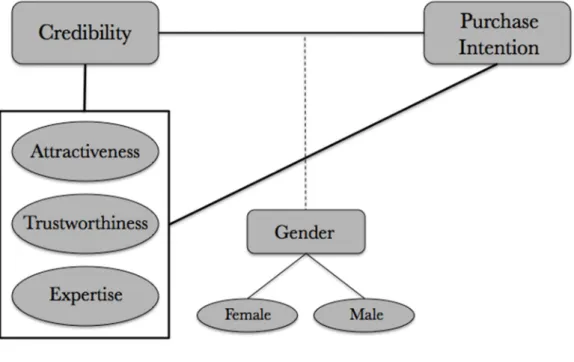
The goal of the present study is to explore the impact that the perceived credibility of an influencer, on Instagram, has on purchase intention, and understand what are the differences in this impact considering gender-related characteristics of Instagram users. Figure 4 schematizes the conceptual framework developed.
Figure 4. Conceptual Framework
RSQ1_A – Does perceived credibility of an influencer on Instagram influence purchase
intention of the products promoted by the influencer?
RSQ1_B – If yes, which dimensions of credibility – attractiveness, trustworthiness and expertise – better help to explain purchase intention of the products promoted by the influencer?
RSQ2_A – Are there any differences on perceived credibility of an influencer and on purchase intention of the products promoted by the influencer concerning gender -related characteristics?
RSQ2_B – If yes, which are the main dimensions of credibility that better help to explain the purchase intention of the products promoted by the influencer of each gender?
Chapter 3. Methodology
3.1 Research approach
According to Saunders et al. (2009) there are three types of research approach when conducting researches; namely, the exploratory, the descriptive and the explanatory research.
Exploratory research is used to investigate a problem, which has not yet been studied in-depth. For this approach the researchers identify and generally describe a new problem statement by analyzing primary data, frequently collected through qualitative
research, such as interviews and focus groups (Saunders et. al, 2009). Descriptive research focuses on providing a detailed point of view of an issue or theory
that has been analyzed already in the past, allowing for theory building by doing empirical generalizations of the relation between variables. In contrast, to the exploratory research, this research is supported on secondary data collected through quantitative research. Explanatory research aims to establish a causal relationship between variables. Researchers use it to test the causal relationships underlying a given problem. This approach is used when theoretical insights exist, so that hypotheses are formulated and tested through quantitative research and primary data collection. This dissertation aims to explore how purchase intention relates with Instagram users’ perceived credibility of an influencer. In other words, understanding if and how the credibility of an influencer perceived by the Instagram users varies across different levels of purchase intention. To do so, all constructs involved are firstly researched and described, based on secondary data coming from existing research. This is followed by the collection of primary data, achieved with resource to a questionnaire in which respondents are assessed on their levels of credibility to follow an influencer on Instagram and its impact on purchase intention.
In this dissertation, an exploratory research (since the impact of digital influencers on Instagram users has not yet been studied in-depth) and descriptive research (since it is based on quantitative research) approach was undertaken, by analyzing the major credibility and purchase intention dimensions of the studied sample. The present study is therefore quantitative.
3.2 Research instruments 3.2.1 Population and sample
Population, as defined by Malhotra (2006), is the collection of elements or objects that possess the information sought by the researcher, and about which inferences are to be made. This way, four dimensions are used to define population: its elements (object about which or from which the information is desired), sampling units (unit containing the element, that is available for selection at some stage of the sampling process), extent (refers to the geographical boundaries) and time (is the time period under consideration). For this dissertation, population is composed by Portuguese individuals aged 18 years old or over, that have an account on Instagram, considering only those that are active Instagram users and follow one or more Influencers on this social media platform. The present study uses a non-probabilistic convenience sample. According to Malhotra (2006), a convenience sample is of non-probabilistic nature, as the questionnaire was distributed among friends, family and colleagues. The convenience sampling technique is a non-probabilistic technique that seeks to obtain a sample of convenient elements, where the selection of sampling units is left to the researcher. The author highlights the least expensive, the least time-consuming and the most convenient as the main strengths of this sampling technique.
3.2.2 The survey
This research used a structured and self-administered survey, which was built and distributed online, considering the information needs and the data collection method chosen.
Moreover, it is possible through online surveys to build a proper questionnaire with several format and design questions. While addressing the questionnaire, recommendations by the authors Malhotra’s (1999) and DeVellis’ (1991) were followed to guarantee that the questions were as simple and clear as possible, to keep wording appropriate and also not too extensive in order to prevent that different meanings could create some confusion among respondents, resulting in incorrect answers.
The first part of the questionnaire is meant to measure the filters needed to consider that survey response valid, followed by Instagram users’ perceived credibility to follow influencers. Afterwards, it is meant to measure the impact that perceived credibility of
an influencer has on purchase intention, proceeded by extra questions. The final part of the questionnaire consisted of socio-demographic characterization data. Lastly, the questionnaire was subjected to a pre-test before the launch. This pre-test was answered by 21 participants and the main findings were that the measurement model had good internal consistency and proved to be adequate for the study.
3.2.3 The measures
To operationalize the impact of Instagram users’ perceived credibility to follow influencers on purchase intention, the measures were adapted from previous studies. The credibility scale was measured by 15 items adapted from the Ohanian (1990) study, and purchase intention scale was measured by 3 items adapted from Dodds, Monroe & Grewal (1991) research.
In this questionnaire, Likert Scale was mostly used, with the intention of classifying respondents’ positions on each of the questions. According to Malhotra (2006) this scale is widely used and requires respondents to indicate a degree of agreement and disagreement with each of statements. All items were measured on a 7-point Likert Scale, where 1 represents “strongly disagree” and 7 represents “strongly agree”.
Moreover, the English questionnaire was translated into Portuguese and developed into
Chapter 4. Results analysis
4.1 Preliminary analysis
4.1.1 Data collection and analysis
Responses from the online survey were collected between March 11 and April 5 . The survey was promoted through email and social media platfoms. The data collected was analyzed through the statistical program IBM SPSS Statistics. Finally, the questionnaire was answered by 491 respondents. After removing participants with missing answers, the sample counts 285 valid-responses.
4.1.2 Sample characterization
Demographic characteristics:
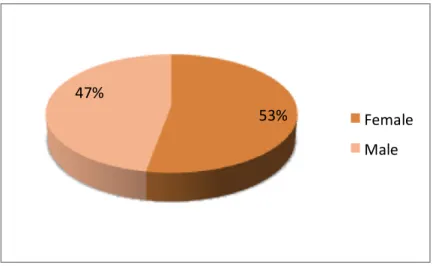
As far as gender is concerned, 53% of the total sample consisted of female participants and 47% of male. Results are presented on Figure 5.
Figure 5. Gender distribution.
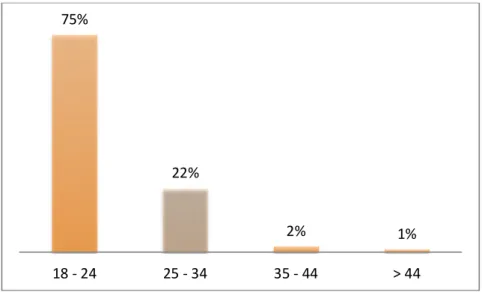
Regarding the age distribution of the sample, there was a clear majority of young adults between the ages of 18 and 24 years old that represent 75% of the sample; followed by respondents between 25 and 34 years old, 22%. Results presented on Figure 6.
53% 47%
Female Male
Figure 6. Age distribution.
In terms of occupation, it is possible to conclude that majority of the respondents are students, representing 47% of the sample, followed by participants that are employed by third parties with 25%. Moreover, 16% of the respondents are working students, 7% are self-employed, 3% of them are unemployed and 2% have other occupations. Results on
Figure 7.
Figure 7. Occupation distribution.
Regarding the education level, the analysis of the total sample`s results show that 58% of the participants have a bachelor degree, whereas 23% of them have a master degree. Moreover, 18% of the respondents are high school graduated and only 1% have a PhD.
75% 22% 2% 1% 18 - 24 25 - 34 35 - 44 > 44 47% 25% 7% 3% 16% 0% 2% Student Employed by third par es
Self-employed Unemployed Student-worker Re red Other
Results on Figure 8.
Figure 8. Education level distribution.
As far as the monthly net income is concerned, the most common value is equivalent to 0 – 500€, 50% of the sample. Next, 25% of the respondents claim a value between 500€ – 1000€; following, 17% state that they receive more, namely from 1000€ – 2500€; afterwards, 4% report a value between 2500€ – 3500€ and lastly, and the remaining 4% mentioned to receive more than 3500€. Results on Figure 9.
Figure 9. Monthly net income distribution. 0% 0% 0% 18% 58% 23% 1%
Primary School (4th grade) Elementary School (6th grade) Secondary School (9th grade) High School (12th grade) Bachelor Degree Master Degree PhD 50% 25% 17% 4% 4% 0 - 500€ 500€ - 1000€ 1000€ - 2500€ 2500€ - 3500€ > 3500€