2 A Work Project, presented as part of the requirements for the Award of a Masters Degree in
Management from the Faculdade de Economia da Universidade Nova de Lisboa.
IWP STRATEGY – SME COMPETITIVENESS
Internationalization Process: GuestCentric Systems Embracing People‟s Republic of China
Duarte Arriaga e Cunha Matos Chaves Nr. 510
A Project carried out on the Management course, with the supervision of: Professor Sonia Dahab and Professor Filipe Castro Soeiro
3 The way the independent hotel industry makes business has recently changed. Startup venture capitalist GuestCentric Systemsi henceforth called GC, is a small sized IT company that is tackling an unmet opportunity, they are revolutionizing the online
presence of the independent hotel industry by offering a fully integrated e-commerce
management solution that allows hotels to create an outstanding online presence, resulting in an increase of their online bookings, through equipping hoteliers with innovative e-commerce optimization features, in a fast and affordable way. Up until now this was only within reach of big hotel chains, thus GC is leveling the playing field, as well as empowering hoteliers to bypass intermediaries, reducing costs while increasing sales growth.
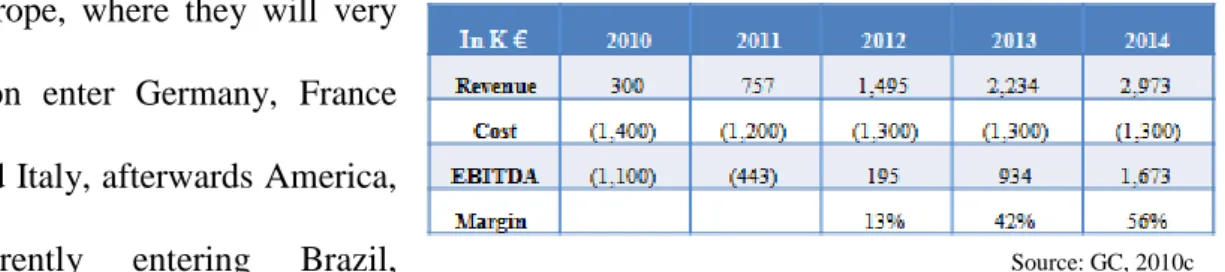
Notwithstanding, CG has massive costs that are impacting seriously the company and causing a huge negative EBIT of €1.100.000, meaning that their revenues of €300.000 are not able to cover minimally their costs of €1.400.000 estimated for 2010. Thereby, GC has an innovative business model that is sustainable, if and only if, the company is able to capture a great market share. GC was demanded to internationalize and will have to proceed on doing it to obtain the required customer base and overcome the delicate financial situation. Being a web based company, GC has perceived that it not enough to have a website to attract clients, it is required highly countries‟ adaptations to boost sales. That is the reason why this project has as its cornerstone the internationalization process of GC to China, therefore, the purpose of this work and its major added value is not only to build up and streamlining a step-by-step internationalization business plan with accurate solutions to enter and succeed in this market, but also, recommend GC the right momentum to enter in it, having in mind the tradeoff between the consolidation of their financial position and the vitality of the Chinese market.
4 The project‟s research was done mostly through internet. The research began with visiting the website of the company where I got to know the main components of the business and therefore understanding what the company does. Afterwards, a meeting was held with GC‟s CEO Pedro Colaço, to collect dataii
. In the meanwhile, I went to work project workshops presented by my advisors. The university‟s full text databases were also used in order to lead me to important papers and internet desktop research was used mainly for market analysis, both global and Chinese. A questionnaire was conducted to some of GC‟s clientsiii to perceive GC main competitive advantages and the quality of the service. Three properties responded, answers are in appendix 1. I have constantly exchanged emails with GC‟s CEO Pedro Colaço as well as with companies themselves as to know the price of their products, such as Dragon Trail, CIC, Callnovo, DerbySoft. One more meeting was conducted with Pedro Colaço to align ideas regarding subjects as modes of entry and implementation plan. Finally, my advisors reviewed my work project.
With a raising of $1.25M in financing, the Portuguese based company GC Systems emerged in 2006. Co-founders Pedro Colaço, president and CEO, and Filipe Tappenbeck, vice-president, have education in electrotechnical and computer science engineering, with extensive experience in networking and software industries and online marketing. Founders own 60% of the firm, supported by Venture Capitalists 25% and small investors 10%, and the 27 employees, 25 in Portugal and 2 in Spain own 5%. GC exports to clients spread all around the world (a countries‟ list in appendix 2). Recently a social media revolution has been triggered. Social media is the number one activity on internet. There is this new hyper-interactive consumer that is constantly
3. Description of the firm
2. Methodology
5 delivering content on the web. What does this represent for hotels? The new consumer is embodied in travelers, which are hotels‟ target. GC can provide independent hotels with the perfect tools to capitalize on this “world” of mouth revolution.
Coupled with powerful marketing and distribution tools, GC is a web based, e-commerce online platform, providing B2B Software as a Service (SaaS) - they license a hospitality application service – that installs new distribution and marketing channels as well as other software applications in hotels, using web 2.0, and connecting buyers (travelers) and suppliers (hotels) via online.
GC‟s clients fit three segments of the market: boutique/ design properties, independent properties and rural properties, B&B, Inns. Appendix 3 fits GC with each segment. Overall, GC‟s main goal is to canalize and convert online visitors into real guests for a particular hotel website through online marketing and distribution techniques, and thus, surpassing traditional intermediaries with its respective commissions, by capitalizing on the trend that 82% of customers seek a more personalized experience and prefer booking directly via suppliers‟ (hotels) website (GC, 2010a). Since inception GC has made a substantial investment to create a top notch product:
1) A customizable and versatile high-end website designed specifically for hotels, able to hold five languages (appendix 4);
2) A breakthrough interactive one-step booking engine (appendix 5), portable to other distribution channels such as social media;
3) An attractive and easy-as-email backend, were hoteliers gain an overall perspective to control their online presence (appendix 6). Hoteliers can check overall performance, revenues, online progress, website visits and business trends, manage their own website and a system that automatically creates guest profile through guest‟s stay history;
6 4) A reservation platform, which is a time saving tool that simplifies the management of the online and offline reservations;
5) They are revolutionizing the way independent hoteliers are competing for customers to capitalize on the social media revolution (appendix 7) with a unique new social
customer engagement platform. This platform includes: tools to leverage a particular
hotel on social media websites; incorporated booking engine on hotels‟ social media pages; a followers specials that rewards hotels‟ social media followers with promotions; a reputation management to send, track and monitor what people are saying about a particular propriety on social media; and a guest finder on twitter that enables hoteliers to track guests travelling to a specific region through key words, and interact with them. GC‟s promise of outstanding results is the cornerstone, Look, Book, Interact virtuous cycle (appendix 8).
The way GC executes its service is after receiving an order, they produce the software in a customized and fast way, set up the software, educate the client on how to use it via telephone in about 30 minutes, and after, they provide continuous customer service.
The mantra conceived by GC is modernizing hoteliers. My own mantra is much more than that - fashioning hoteliers. In fact, GC has created a very attractive and modern software technology. GC‟s business mission is to “Create the leading cloud platform that delivers a social commerce community for independent hotels”. CC‟s vision is to be the global leader of online marketing and interactive platform of hospitality applications service providers till the year of 2020. Corporate values are the following: commitment to excellence through creativity and innovation, respect, team spirit and open communication, and customer focus (GC, 2010b).
7 GC‟s main strategic objective is to reach operational breakeven through achieving one million in net sales until 2012, verifiable on Table 1. This will be fueled by international proliferation to strategic markets. Thus, geostrategic objectives are first to explore Europe, where they will very
soon enter Germany, France and Italy, afterwards America, currently entering Brazil,
thereby missing Asia and the Pacific (China, India, Japan, Australia) which will start to be explored until 2015. In addition, to complete the revenue growth model, besides increasing the number of customers, GC wants to increase the revenue per customer, the ARPU, which is €1500 per year (GC, 2010). Some tactics will be later recommended.
Basing on the Value Chain Model (Porter, 1985), it is going to be analysed GC‟s Value Chain portrayed in figure 1, in order to allocate costs in appendix 9.
The figure separates the business system into a series of value-generating activities that will result in the profit margin (Porter, 1985). The primary activities are separated in: 1. Production, associated with the needed support and service to create the product.
Rackspace and eChiron are server hosts for GC‟s software, while Arte Numérica is an outsourcing company that operationalizes the server.
2. Marketing & sales costs are associated with resellers and marketing programs. 3. Customer service is linked with the management of the product.
The Secondary activities are divided in:
4. Technology development, (R&D) in efforts to improve the product and process;
Table 1 – GC’s Base Plan 2011-2014
5. GC’s Value Chain
Source: GC, 2010c
8 5. Firm infrastructure, including general management, finance, accounting,
administration. These activities support the entire value chain.
6. Human resource management contains only the training executed to employees. The resulting margin is a negative number thus it does not make sense to calculate it. The product is always created in the Portuguese headquarters, being adapted to hotels‟ requests for their own websites and subject to approval by the client. In the case of foreign countries, the client will directly conduct adaptations if needed, or will be indirectly assisted by GC‟s regional partners – resellers. Meanwhile, an explanation of the usability of the product and how to personalize it is conveyed through telephone and complemented with a PowerPoint presentation. Thereafter, customer service will provide assistance to their clients, update the software quarterly or semiannually and also foster sales of new products developed.
6.1. Industry Mapping
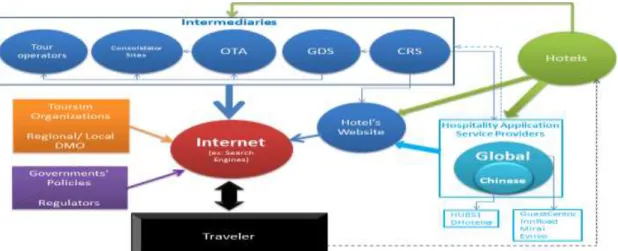
As demonstrated in figure 2, the e-commerce and hospitality industries, if a traveler desires to book a hotel through the online channel, he has mainly two options, book directly via hotels‟ website, or book through intermediaries (see main global intermediaries in appendix 10). Thus the relationships from hotels with intermediaries and with their own website are the most important ones for GC. GC has identified a market niche constituted by independent hotels that did not have the necessary resources
6. Environmental Context Analysis
9 to enhance the direct online business via their own website. Thereby, GC enables hotels to surpass intermediaries which charge a commission that can be as high as 40% of the traveler spendingiv. In fact, intermediaries have a large portion of the market, in Europe suppliers‟ website share is 42% while intermediaries‟ share is 58%, in contrast, in the US 59% share for hotels and 41% for intermediaries (ITIC, 2010). Computer reservation systems (CRS) are vital in this industry, as they provide systems that
support the activities of intermediaries, hotels website and the hospitality application
service providers (HASP) such as GC. Tourism organizations and regional/ local Destination Marketing Organizations (DMO) will impact on the consumer, while regulators and local governments will impact on companies‟ way of doing business. A brief analysis of the global market will be now conducted. Overlooking the Global
Travel & Tourism Economy, with which GC has a positive correlation, its GDP is
forecast to grow between 2010 and 2020 by 4.4% annum in real terms (WTTC, 2010). The introduction of e-commerce in the labor and information technology-intensive tourism industry, brought great opportunities for development. Internet users worldwide are now 28,7% of the population, 1,97 Billion of a total of 6,80 Billion (Internet World Stats, 2010). The hospitality industry is in recovery mode from the harsh past two years, nevertheless, the industry projects to end 2010 with an important increase in the most important gauge of health - revenue per available room (RevPAR) will increase by 4.3%. In 2011, RevPAR will increase by 5.3% (Starkov and Safer, 2010a).
Making the bridge between e-commerce and hospitality industries, in the US 45% of all hotel reservations will be booked online in 2010 (Starkov and Safer, 2010a). Moreover, 80% of travelers select their hotel in the online channel (GC, 2010b).
10 Henceforth, it will be deepened the relevant market for GC - the HASP for the
independent hotel industry. The market size is 400,000 independent propertiesv with an estimated value of $400M - $4Bvi. GC embraced on a “blue ocean strategy” by creating new demand in a niche market. Additionally, the product is in a growth phase of its life cycle, characterized by great market growth and low market concentration. Almost all market trendsvii and social trends present in table 2, post huge opportunities for GC:
Market Trends Social Trends
70% of hoteliers said the current economic environment would affect negatively their
budget planning for 2010.
Worldwide, 58% of travellers are influenced by user reviews.In the US,
four in five travelers read reviews on Social Media and 95% of those
indicated such reviews were influential during the decision making process
(Starkov and Safer, 2010b).
From the total marketing budget, hoteliers will dedicate between 23,1% and 24,6% to
the online channel, increasing the spending towards web 2.0 interactive technology
applications/ Social Media advertising. 50% of hoteliers will create profiles on social
networks and 40% will advertise on social media sites, while only 6,9% are not
planning on Social Media initiatives in 2010. (Starkov and Safer, 2010a)
There is new breed of Hyper - Interactive travel consumer that often in real-time, is communicating with friends via Facebook, with more than 400 million users, and Twitter, with an average of 50 million tweets per day, and commenting on hotel and dining experiences. Thus, consumers expect interactive and engaging hotel websites (Starkov and Safer, 2010b)
More and more consumers are connecting to internet via mobile format, incorporating
hotel online booking.
Travellers prefer a much more personalized experience, 82% of travellers
prefer to book directly on suppliers‟ website (GC, 2010b) which,
regardless of being positive or negative, will spread around community.
In sum, these new trends - the struggle for reaping the increase in online booking, the will to drag out intermediaries‟ commissions, the proliferation of social commerce with the recognition of its importance, the desire to control brand image, and above all, the massive appearance of the new travel consumer - have created a market need.
6.3. Competitive Assessment
The Porter’s Five Forces Model will be applied to understand how market forces work and the main factors explaining profitability of hospitality application service providers
11 for small independent hoteliers. Porter argued that the strength of the five competitive forces and the organization‟s profitability are inversely correlated (Porter, 1980).
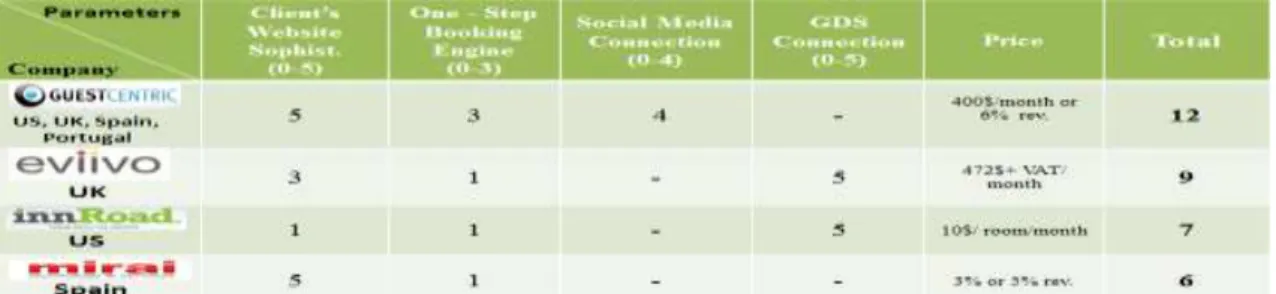
GC‟s suppliers are mainly software developers required for GC‟s activity, these are very competitive markets, quite a few companies offer similar products, therefore fierce competition weakens the supplier‟s bargaining power, which is considered to be low. GC‟s customers are the independent hotels, a highly fragmented industry with a very low concentration, as a consequence their bargaining power is considered to be very low. Nevertheless, small hoteliers cannot be overcharged with unbearable prices. The threat of potential entrants is high. Structural and strategic barriers to entry are relatively low, as there are almost no switching costs, only Eviivo (table 3) was able to attain economies of scale and none was able to create solid brand equity, despite having first mover‟s advantage. Nonetheless, for an entrant to catch up with GC, it is necessary 18 to 24 months due to GC‟s high degree of differentiation (GC, 2010a). Regarding exit barriers, besides lost investment and compensations to workers, they are low.
The major threat to industry‟s profitability are substitute products, companies offering at least some component within the range of GC‟s offer, as well as all the intermediaries present on figure 1, as the latter are a mean of substitution for suppliers‟ direct channel. Hotels may prefer to pay only a small fee to access intermediaries‟ solution, rather than a more expensive one like GC if they do not perceive its added value.
All these forces will directly influence intensity of rivalry which is regard as low, as one vital aspect to dictate the attractiveness of this market is the fact that there is an opportunity to explore - “blue ocean strategy” - in a huge market enjoying a huge growth, and therefore, the terms of competition will be based on differentiation through
12 brand awareness with promotional costs (GC spends €100.000/ year) rather than price competition. All companies are enjoying an exponential revenue growth.
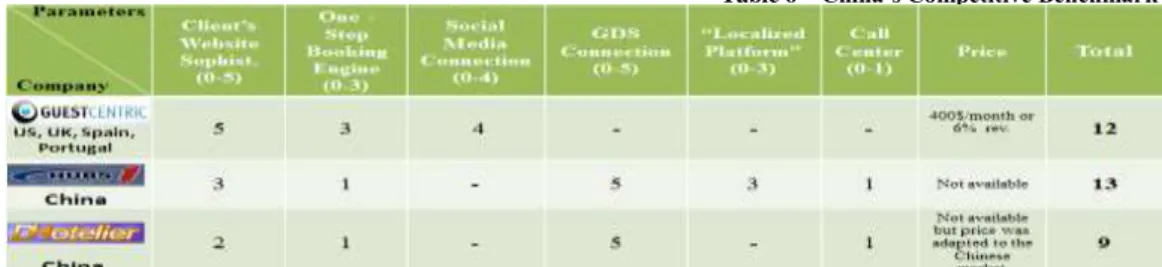
A competitive benchmark evaluationviii is displayed in table 3. GC has a total rank of 12, being above any other competitor. Overall, this is a very attractive market,
supporting space for every company to grow, the real competitive challenge will come when the market starts to mature, which will be boosted by one of the problems of the industry - companies can only charge small prices earning a small margin per customer.
The website GC offers to its customers was tested for 800 hours of usability on website control, being a source of competitive advantage, as it was granted with the win of the Web Marketing Association‟s 2010 Standard of Excellence Web Award for Hotel Website Designix. GC‟s booking engine is the fastest in the industry (one-step booking engine), based on Ajax technology and the only one that is portable to social media. GC‟s major source of competitive advantage is the connection to social media.
GC‟s major flaw is not having an alliance with intermediaries. GC aspire to bypass intermediaries, however, small hotels still value the connection to GDS (it increases hotels‟ distribution channels) as travelers still substantially utilize these vehicles and being in some cases markedly loyal to them. GDS are often cheaper when compared with the direct channel. This alliance would leverage client‟s perceived value regarding GC‟s product, propelling the client to buy it. This cost would be input to the client.
7.1. Organizational Resources and Capabilities
7. GuestCentric’s Competitive Advantages
13 GC has six patents in development. To save in R&D costs, GC has launched the Developers Cloud. GC has integrated case-studies on their website (appendix 11), exemplifying clients that are now loyal due to brand attributes, increasing the value-for-money mindset. Nowadays, GC can implement its products 25 times in only 1 day. Also, GC has the ability to integrate its products in clients‟ systems (booking engine). GC had a very good product introduction in 2006, as its customer base doubled every year and they had 100% conversion rate from free trials, since December 2008.
GC‟s headquarters in Portugal provides a salary‟ cost advantage. Their human resources are well trained and informed, having an extensive knowledge and experience in the networking and software industries, they have also gained a considerable experience while internationalizing the company which also adds credibility to the product. To guide the company in attaining its vision, GC is supported by an advisory board with seven international opinion leaders in the hospitality, internet and software industries. They are also members of the hotel electronic distribution network association and the OpenTravel alliance to keep improving GC‟s product towards the lodging industry. GC also displays a McAfee Secure certification mark to increase shopper confidence. Finally, as already stated, it is required 18 to 24 months to copy GC.
One aspect that may act as a competitive disadvantage is that due to their fragile financial position they may not be able to risk as much as other companies.
7.2. Positioning
Mass customization allied to a focus strategy on a niche target market is GC‟s
competitive strategy. GC takes the benefits of mass production, low cost product, rapid
turnaround, high output, with customization, highly tailored product to meet the individual needs of its customers (Smith and William, 2003) - a niche market. Mass customization can be considered to be an integrated strategy, as it combines both cost
14 leadership and differentiation elements (Porter, 1980), which is a promising alternative online strategy where price competition is constrained (Kim et al., 2004). GC will be able to achieve the vital economies of scale, due to the scalability of internet, they have made a great initial investment but their marginal cost is close to zero.
7.3. Business Model Analysis
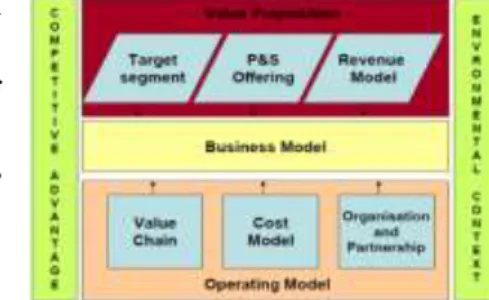
GC has as revenue model two different pricing models, a more rentable fixed fee of $400 or 6% of revenue sharing, (appendix 12). The analysis of GC‟s break-through business model will be based on figure 3. The value proposition
of GC is constituted of a product & service tailored to an attractive niche target segment collecting a small margin per client, while the way GC operates (operating model) is supported in high costs.
GC is being able to leverage their competitive advantages
in an enhancing environmental context, as they are doubling their paying clients each year. GC‟s rented server has a capacity for 4000 clients without sacrificing quality, nonetheless they have 610 customers presently, meaning that for the same costs they can gain more revenues achieving in that way economies of scale. To attain the desired market share they will have to foster market development by introducing existing products in new markets, broadening their clients‟ base, this is the reason why GC has been diversifying into new markets from inception – a born global firm.
The key variables that support GC business model are forecasted to grow colossally in the next few years in China. Therefore, China is not only a vastly promising country, but also, a starting point to dip into the Asia-Pacific market. GC should establish an early presence in China to sustainably follow this growth, thereby having a proactive
Figure 3 - Business Model Analysis 1
8. Criteria of Country Selection
Source – Slides of Professor Filipe Castro Soeiro
15 motivation and taking advantage of first mover advantage, this way GC would choose the best partners, best locations and having the potential to foster strong relationships with the Chinese government. Nevertheless, Chinese market is still pretty infant, this can be demonstrated with the Chinese hotel industry, despite the fact that China has almost 10.000.000 square km, while Germany has only 350.000 square km, Germany has 55.000 hotels while China has only 15.000 hotels. Hence, my standpoint is that the best tradeoff between an early entrance and a more mature less risky Chinese industry is 2013, which is going to be sustained later.
Risk is inherent in China. However, China embodies also a great opportunity.
Risk (- - -) Opportunity (+++)
( - - ) Country risk: “travel suppliers and all components of the China‟s travel infrastructure operate under very strict regulatory environment, to varying degrees.
In some cases government authorities also own suppliers, travel agencies and GDS”
(Badrinathan et al., 2009).
( + + ) “Chinese government gradually eliminated limitations on the entry of
foreign travel companies. These are now allowed to establish wholly-owned
operations tourism or hotel booking services without regional limitations”
(Badrinathan et al., 2009).
( - ) Financial risk: currency risk, volatility of China Yuan Renminbi against Euro.
( + + ) By 2020, China will become the single largest source of international
tourism and the number one travel destination (appendix 13), while having the
largest domestic tourism market in the world (China Contact, 2010).
( - - - ) High cross-cultural risk: language and high context culture drastically different, intrinsic network of influence - Guanxi – Chinese build on trust, harmony,
reciprocity and face-to-face business deals.
( + + + ) Between the end of 2009 to July 2010 the number of Internet users in
China increase 36 million to 420 million, representing only 30% penetration,
but the world largest number of online users (Internet world stats, 2010b).
( - - - ) Commercial Risk: timing of entry, competitive intensity, poor execution of
strategy.
( + + + ) Chinese hotel industry will step into a new round of golden
development period. In May 2010 China had 96,691 hotel rooms under
construction, more than the US (70,962), Europe (58,617). The boom will
continue for the next years. This can be attributed to the strength of China‟s
economy and the development of infrastructure (Saturday Briefing, 2010).
( - - - ) Underdeveloped Chinese hotel industry with 15000 star-grade hotels (China Online, 2010). Hotel Chains only control around 16% of hotels in China (China
Online, 2010), meaning that 12600x are independent hotels.
( + + ) GC can also provide their product to big chains as China hotel chains
lack effective distribution channels and reservation system support, where less
than 30 chains have CRS (China Online. 2010).
( - - ) Resistance of Chinese consumers in adopting the online channel, as there is (+ + ) Number of users of online payment, online shopping and online have
9. Chinese market attractiveness
16
lack of trust on online payments due to disjointed banking system and fear of fraud.
India‟s leading OTA MakeMyTripxi has its online bookings close to 90%, Ctrip has
only 35%.
increased in 2009 by about 30% (China Hospitality News, 2010). China will
likely surpass US as the world's top credit card market by number of cards in
a decade, which will quadruple to 800 million by 2020 from 200 million
currently (International Business Times, 2010).
( - ) Ctripxii is now the world‟s third largest OTA, with a market cap of US$5 billion
(Tnooz, 2010). eLongxiii is the second OTA. (market shares in appendix14).
( + ) Chinese government did not allow entrance of large global GDS
companies through foreign direct investment.
( - ) China lags behind some markets in software infrastructure.
( + ) “The growth of credit card adoption and of broadband infrastructure in China are expected to boost IT penetration”. (Badrinathan et a.l, 2009).
( - - ) Chinese social media is complex, vastly different and particular. Access to Twitter, Facebook, and YouTube shut down by the government controlled great
firewall of China (appendix 15 and 16 shows differences from China to western).
( + + + ) China is the most engaged country online with 92% of online users
having contributed to social media., which is the most influential
communications medium in modern (China Brand Republic, 2009).
As afore mentioned, Chinese independent hotel industry is constituted of 12600 independent hotels, therefore, Chinese market value estimation is $12,6M-$126Mxiv. Chinese internet users are increasingly planning and purchasing their travel online, online travel booking is growing at a very fast pace, as it can be seen in table 2.
Online Travel Booking in China 2008 2009 2010 (estimated) 2013 (estimated)
Value $438 Million $548 Million
$710 Million (New Media Trend Watch, 2010)
$1350 Million (New Media Trend Watch, 2010)
% increase - 25% 30% 90%
The U.S. online travel booking market amounted to US$9100 Million in 2007, from
which we can see the shortage of China's online tourism industry (Chinavestor, 2010).
9.1. Competitive Assessment
Narrowing the Porter‟s five forces model for the Chinese market:
Threat of potential entrants is a bit lower, a new entrant company will not primarily enter the risky Chinese market, as it still lags behind other markets in key aspects.
Power of substitutes remains very high although the players change, the monopolist TravelSkyxv is China‟s number one GDS while Ctrip and eLong the leading OTAs.
Table 5 – Online Travel Booking
17
The intensity of rivalry is a bit higher as the number of hotels in China is much lower comparing with a global basis. As demonstrated in table 6, GC will have to be
savvy to circumvent the threat of the two main competitors, HUBS1xvi the strongest player, highly adapted to the Chinese market as it is the only competitor offering offline distribution channels through a localized platform and a call center, scoring higher than GC for the Chinese market; and DHotelierxvii, a product of DerbySoft, which is more focused in online marketing and distribution, despite also offering less sophisticated components of GC‟s offer. GC‟s major flaws regarding Chinese competitors are the lack of offline distribution channels, (its importance in appendix 17) and the absence of GDS connection.
Sales expansion is GC‟s main reason for internationalization. Added value comes also from achieving economies of scale, increase brand recognition and customer loyalty, spread company‟s risk and increase capabilities & resources. The puzzle is that due to their current fragile financial position, they have to weigh carefully the trade-off between risk and opportunity when choosing countries since they do not have the resources to go after all the potential international opportunities (Daniels et al., 2009). After analyzing the Chinese market one can perceive that everything that sustains GC‟s business model is still developing in China, however, at a very rapid pace. GC will have to embrace on a transnational strategy as they have high pressures for global efficiencies and also high pressure for local responsiveness and flexibility, therefore, they have to
10. Main Factors to Obtain Success on the Mode of Entry
18 become very educated about the Chinese market. As a consequence, to reduce cross-border business risk, GC must enhance sales through channel partnerships with local resellers, creating commercial relationships to marketing GC products on behalf of GC. Being aware of Chinese market intricacies, it is not linear to decide on the right time of entrance. However, it is my viewpoint that GC has not the financial strength that allows them to take risks by entering now in a market where they cannot leverage some competitive advantages, without the services of a consultant. Thus, first they have to enter in less risky countries and only after having secured a healthy financial position, they can risk entering the Chinese market. After the entrance, they will not have to wait much to see the Chinese industry mature due to its exponential growth. Being my belief supported by Pedro Colaço, GC should start exploring China in 2012, officially entering the country in 2013. This way, GC will be able to evolve sustainably in this market, creating first mover advantage and holding the necessary time period to enhance its business model in a more mature Chinese market. Thereby, GC will be able to balance financial and strategic objectives. For the Chinese market GC has fixed a goal of reaching €1.000.000 in sales volume within three years (GC, 2010). Hence, having what has been said in mind next will be proposed an entry mode and an implementation plan.
In an analysis to GC‟s value chain in figure 4, as GC is a small and young company, in order to make a successful entrance in China, GC will have to select and secure
incremented value-generating activities in the Chinese market due to its
particularities through a vertical alliance. Thus, GC‟s entry mode will be decided depending only on how to improve the performance of value chain activities that will have to be conducted in China, namely, marketing & sales and customer service, as
11. Mode of Entry
19 production can be easily and cost effectively performed in the Portuguese headquarters after the order is transmitted from China. Simultaneously, GC has to scan how transferable and how to leverage its competitive advantages, resources & competencies and which ones will have to be created to enhance a successful locally adapted strategy.
11.1. Local Adaptations
After a conducted thorough scanning of the Chinese market some local adaptations stood out. In regard to product adaptations:
“Localized Platform”: a product created by HUBS1 to simplify the linking between hotels and travel agencies, it is a platform that centralizes the real-time booking and confirmations to enable offline TA to browse the latest rates and promotions from GC‟s clients. GC should benchmark HUBS1 as most Chinese still book through traditional TA. GC has already a resembling product, being adaptable to the Chinese market with little costs (GC, 2010).
GC‟s offer does not include a property management system, which is very important to help hoteliers with the management of their hotels and therefore, especially important for the underdeveloped Chinese hotel industry.
Create GC‟s Chinese website in the Portuguese headquarters.
As for the price, GC has as commercial policy to maintain a constant price in all countries as online transparency demands coherencexviii.
11.2. Incremented Value-Generating Activities
Rather than handle it internally, by outsourcing the necessary activities GC will not have to incur in fixed costs and will be able to undertake activities that otherwise would be beyond their means (Daniels et al., 2009). These activities are:
Marketing: GC does not have local knowledge expertise, in fact, they require
20 market modus operandi. Consulting services would serve two proposes, on one hand, gain access to that specialized know-how to incorporate it in GC‟s product & service offering, on the other hand, to disseminate GC‟s brand in China, that would be spread around to all different regions of People‟s Republic of China. Consulting service should advise on matters such as vital local social media sites, online distribution channels, where to boost SEO. The most solid hypothesis are the companies Dragon Trailxix providing a complete China solution, and China‟s leading social business intelligence providers (CICxx). For purpose of analysis, Dragon Trail will be the selected company as it appears to be best price/ quality proposal (see appendix 18 for description of consultancy services, contrasting the two companies).
Sales: GC does not have a sales force, thus they have to embrace in direct selling through distributors to foster different regions. For instance, Qast Software Groupxxi and Dragon Trail also act as sales representative, charging a commission. GC pays 25% of sales (GC, 2010a) in a revenue sharing collaborative arrangement.
Customer Service: will be conducted by an outsourced call centerxxii. This will be linked to the “localized platform” afore mentioned. After a highly specialized local training to call center agents provided in partnership with Dragon Trail, these will have several functions: 1) providing clients with GC‟s service by explaining how to implement the product; 2) promote GC to capture clients and to sell new developed products; 3) Increase customers‟ loyalty to GC by helping them with the management of their hotels, as China‟s hotels are considerably underdeveloped. To enter the complex Chinese market it is require GC a financial effort towards sending a permanent expatriate to China (GC, 2010). The role of the expatriate would be to grant control over the consulting partner by representing a status team; train and control
21 call center employees; recruit clients and resellers; and would also be responsible for promotional activities to accelerate the spread of reputation, such as, participation in relevant international tourism trades and events, public and analyst relationships, door-to-door personal selling, send newsletters and cold emails, enhance SEO and boost social media for GC, and acquire two or three clients in order to put successful Chinese case-studies in GC‟s Chinese website that would bridge the market and enhance sales. Another entering option would be one encompassing the establishment of an office, but this will not be considered as GC does not have the necessary financing resources. Apart from the headquarters in Portugal, GC has not established an office in any other country. It is my opinion that they should only consider opening an office only when the gains from this market would pay the office. This office should be established in an Asian hub city such as Hong Kong or Singapore, to further enhance the Asia-Pacific geographical zone, which would encompass China as well. (GC, 2010a)
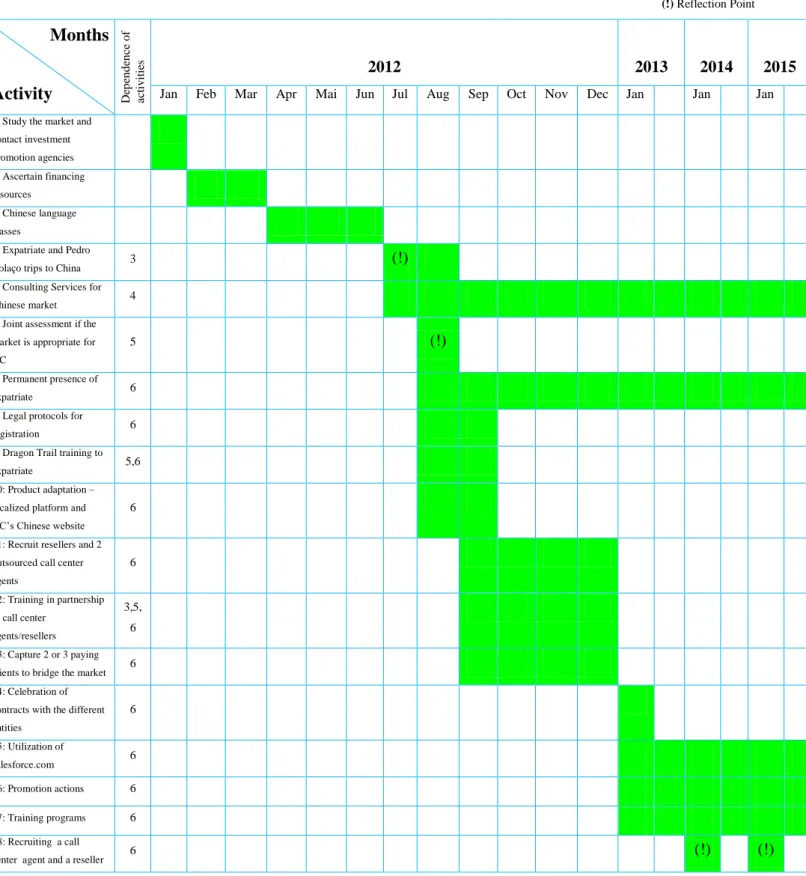
For devising and estimate an implementation plan for GC to China under the chosen mode of entry, the four 4 Ms analysis – Men, Money, Minute and Memo – will be used. For necessary documents, taxes and promoting agencies to enter China see appendix 19. As explained before, GC will require some men to perform the job, specifically one expatriate and four phased call center agents. Table 7 gives a detailed business plan of the order of activities (minute) of the proposed implementation plan. Following this plan, GC will have to bear relatively small initial investments to study the market in the months of Jul-Aug/2012 (costs in appendix 20.1), namely, foreign language classes (€940), seven plane ticket (€4200) and two months of salary to the expatriate (€4000). If it is concluded that China is not viable or they cannot form required partnerships, GC
22 will drop the market and lose €9140. If they perceive the market as attractive, they can have one month of consulting services with Dragon Trail (€2850), to reach in conjunction a final decision of whether to enter the market or not. If negative, GC will lose €11990 (€9140+€2850) for not entering the market.
Activity
2012 2013 2014 2015
Jan Feb Mar Apr Mai Jun Jul Aug Sep Oct Nov Dec Jan Jan Jan
1: Study the market and contact investment promotion agencies 2: Ascertain financing resources 3: Chinese language classes
4: Expatriate and Pedro
Colaço trips to China 3 (!)
5: Consulting Services for
Chinese market 4
6: Joint assessment if the market is appropriate for GC
5 (!)
7: Permanent presence of
expatriate 6
8: Legal protocols for
registration 6
9: Dragon Trail training to
expatriate 5,6
10: Product adaptation – localized platform and GC‟s Chinese website
6
11: Recruit resellers and 2 outsourced call center agents 6 12: Training in partnership to call center agents/resellers 3,5, 6 13: Capture 2 or 3 paying
clients to bridge the market 6 14: Celebration of
contracts with the different entities 6 15: Utilization of salesforce.com 6 16: Promotion actions 6 17: Training programs 6 18: Recruiting a call
center agent and a reseller 6 (!) (!)
Months D ep en d en ce o f ac ti v it ie s Table 7 - Minute (!) Reflection Point
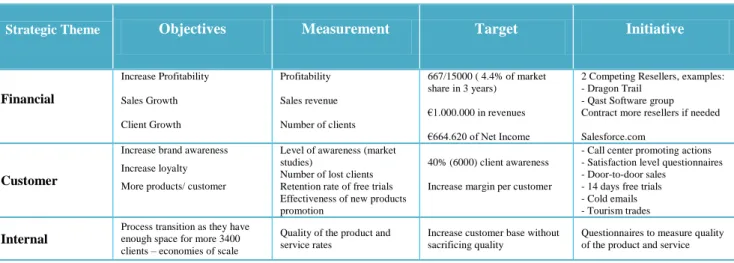
23 From Sep/2012 until the year ending, required actions are synthetized in table 7. In Jan/2013, GC will enter the market by celebrating contracts with the different entities. To control the process and to secure the accomplishment of the key performance indicators described in the target of table 8, additional initiatives will be performed: 1) As GC is embedded in an internationalization process it should upgrade salesforce.comxxiii, from the current GC‟s professional sales cloud product, which enhances sales, to the enterprise one, which allows the management of multiple partner programs (from various countries) in one system, for a fee of €135/ user/ month.
2) To foster competition, two competing resellers would be recruited (Dragon Trail and for instance, Qast software group) remaining only the most profitable one in 2014; 3) In Jan/2014 and Jan/2015, to guarantee that sales would be achieved, it would be recruited two more resellers to foster specific geographic region. To support the gradual increase of the customer base, two more call center agents would be recruited. These would be reflection points as it would depend on the degree of growth of sales;
4) Questionnaires to clients to measure the quality of the product and service, so that, resellers and call center agents will not neglect these aspects;
5) Promoting actions would be leveraged to attract potential clients;
6) Finally, training programs would be conducted to resellers and call center agents.
Strategic Theme Objectives Measurement Target Initiative
Financial Increase Profitability Sales Growth Client Growth Profitability Sales revenue Number of clients 667/15000 ( 4.4% of market share in 3 years) €1.000.000 in revenues €664.620 of Net Income
2 Competing Resellers, examples: - Dragon Trail
- Qast Software group Contract more resellers if needed Salesforce.com
Customer
Increase brand awareness Increase loyalty More products/ customer
Level of awareness (market studies)
Number of lost clients Retention rate of free trials Effectiveness of new products promotion
40% (6000) client awareness Increase margin per customer
- Call center promoting actions - Satisfaction level questionnaires - Door-to-door sales
- 14 days free trials - Cold emails - Tourism trades Internal
Process transition as they have enough space for more 3400 clients – economies of scale
Quality of the product and service rates
Increase customer base without sacrificing quality
Questionnaires to measure quality of the product and service
24
Learning
Training of call center agents Improve the product
Learn about the Asia-Pacific zone
Level of training of call center agents
Product adaptation Asian market knowledge
Offer a substantial positive customer service Great knowledge of Chinese market to leverage GC‟s offer and to bridge the Asia-Pacific zone
Continuous training
Consulting Services from Dragon Trail
Market and field Studies “Localized Platform”
The costs of the project (money) will amount the sum of €358.068, revenues will be €1.042.500, thus, the estimated profit is €684.432. This is explained in appendix 20.2. As a contingency planning, the implementation plan has as its cornerstone the consulting services from Dragon Trail, if this fails they have alternatives, such as CIC and other resellers such as Kunlan Solutionsxxiv or Columbia Computer Productsxxv. If there is a cost slippage, additional call center agents will not be contracted, and depending on the evolution of sales, the resellers would be relinquished. If in the worst case scenario the product will not be accepted by Chinese hotels, GC can easily withdraw from the market by ending the contracts (low exit barriers).
The objective of this project was to provide GuestCentric with the basis for engaging in an internationalization process onto China, as relying solely on a webpage is not enough for e-commerce companies. Yet, the company has been very responsive to international available business opportunities, having such a proactive approach that it is still too soon to enter China. Weighing risk/ opportunity and the consolidation of GC‟s financial position, it was reached the conclusion that GC should only enter the market in 2013. After thoroughly analyzing GC‟s business and choosing China as the country under analysis, it was proposed a mode of entry and an implementation plan in conformity. To succeed in the complex Chinese market it is vital to have consulting services and to partner with resellers, this being the cornerstone of the implementation plan and its catalyst. In time, all competitive advantages, competencies & resources are adaptable,
25 but this will require a deep knowledge of the Chinese market. The main obstacle to GC‟s success in China is the cultural clash and the operational risk, whilst intermediaries will be a constant threat, either globally as to the Chinese market.
When the right time comes, it is considered that the expected gains will compensate the risky variables embodied in China. Moreover, the company has a risky past and they will not want to miss the auspicious China, that despite still being an immature industry, it is projected to grow immensely. This way, GC will capture the critical market share to overcome their flimsy financial position.
Finally, this project and its implementation in the very heart of Asia can be utilized to serve as foundation to expand to the Asia-Pacific geographical zone, crucial markets for GC‟s long lasting success.
Before entering the market and regardless of the solutions presented, GC should consult the advisory board and make comprehensive field market research to reduce commercial risk. If GC perceives China as too risky, they can comprise business risk insurance to decrease risk, not needing to avoid China. Also, despite it was advised to enter China in 2013, it is not an absolute truth, depending on the evolution of the market.
Furthermore, more general aspects could be implemented. GC could also offer consulting services on online marketing and distribution to websites eager to capitalize on the social media revolution that is going on. In addition, through conducted interviews to GC‟s clients, it must be underlined that despite a fast implementation, there is some slowness on software updates and a degree of incompatibility of software. In spite of being a small sample it would be wise for GC to improve those areas in order to leverage their P&S. Moreover, to increase the ARPU, GC could: drive new platform upgrades with new services, sell new products, benefit monthly fixed fee paying clients
26 with more services over revenue sharing clients, or providing fixed fee clients with consultancy services on revenue management.
Finally, as internet is passing to mobile phones, GC should try to incorporate it in its offer the online booking of hotels though mobile format.
1. Badrinathan, Ram and Tommy Tian Shu Bo. 2009. “Corporate Travel Management and Travel Practices in China”.
http://www.amadeus.com/corporations/documents/corporations/PhoCusWright%20Amadeus%20White%20Paper%20Final%2 0012609.pdf
2. Berthon, Pierre, Leyland F. Pitt and Richard T Watson. 1996. “The world wide web as an Advertising Medium” Journal of Advertising Research, Vol. 36: 43-55.
3. Brand Republic. 2009.Eldeman. http://www.brandrepublic.com/news/968695/China-public-affairs-execs-turn-social-media-Edelman/?DCMP=ILC-SEARCH (accessed in November 7, 2010).
4. Chinavestor. 2010. Jiayu Tian. http://www.chinavestor.com/internet/71629-overview-chinese-online-travel-industry.html
(accessed in November 8, 2010).
5. China Contact. 2010. http://www.ccontact.com/ (Accessed in October 23, 2010)
6. China Hospitality News. 2010. http://www.chinahospitalitynews.com/en/2010/08/11/17201-online-marketing-in-china-the-travel-agencies-view/ (accessed November 12, 2010)
7. China Online. 2010. https://www.chinaonline.net.cn/home_NEW_eng/Article/ShowArticle.asp?ArticleID=79 (Accessed in October 22, 2010)
8. Collins, M.K. and Winrow, B. 2010, “Porter‟s generic strategies as applied toward e-tailers post-Leegin”, Journal of Product & Brand Management, Vol. 19 (4): 306–311
9. Corvi, Elisabetta and Michelle Bonera. 2005. “Web Orientation and value chain evolution in the tourism industry”. Dipartamento di Economia Aziendale. Università degli Studi di Brescia Working Paper No 51.
10. Daniels, John D,. and Lee H. Radebaugh, and Daniel P. Sullivan. 2009. “Country evaluation and selection.” In International Business: Environments and Operations, ed. Pearson International Edition, 580-584.
11. GuestCentric Systems. 2010a. Interview conducted to Engineer Pedro Colaço, CEO of GuestCentric (in 16th November 2010)
12. GuestCentric Systems. 2010b. www.guestcentric.com
13. GuestCentric Systems. 2010c. Power Point presentations sent by Pedro Colaço.
14. Hi138. 2010. Free papers download center. http://eng.hi138.com/?i143001 (accessed October 12, 2010) 15. International Business Times. 2010. Samuel Shen and Jacqueline Wong.
http://www.ibtimes.com/articles/61300/20100910/china-credit-mastercard.htm (accessed in December 5, 2010) 16. Internet world stats, 2010a. http://www.internetworldstats.com/stats.htm (accessed October 2, 2010) 17. Internet world stats, 2010b. http://www.internetworldstats.com/asia/cn.htm (accessed October 18, 2010) 18. ITIC. 2010.
http://www.itic.ie/fileadmin/docs/PRINT-V1-Tourism_and_Travel_Distribution_in_a_Changed_World_Sept_2010.pdf (accessed November 5, 2010)
19. Kim, Eonsoo, Dae-ll Nam and J.L. Stimpert. 2004. “The applicability of Porter‟s generic strategies in the digital age: assumptions, conjectures, and suggestions”, Journal of Management, Vol. 30 (5): 569-89.
20. New Media Trend Watch. 2010. European Travel Commission. http://www.newmediatrendwatch.com/news/604-chinas-online-travel-services-on-the-rise (accessed in November 17, 2010)
21. Porter, Michael E. 1980. “The Value Chain and Competitive Advantage.” In Competitive Advantage: Creating and Sustaining Superior Performance, Free Press, New York, NY.
22. Saturday Briefing. 2010. Richard Kelley. http://saturdaybriefing.outrigger.com/chairman_briefing/china%E2%80%99s-hotel-industry-booming/ (accessed November12, 2010)
23. Smith, A.D. and William T. Rupp. 2003. “Information Management Leveraging in the Case of E-Folios: Mass Customization approaches in an E-Commerce Environment”, Services Marketing Quarterly, Vol. 25 (1)
24. Starkov, Max, and Mariana M. Safer. 2010a. “Smart Hotelier‟s Guide to 2011 Internet Marketing Budget Planning”.
http://www.hospitalityebusiness.com/documents/HeBS2010BudgetPlanning.pdf
25. Starkov, Max, and Mariana M. Safer. 2010b. “Engaging the Hyper-Interactive Traveler Using Web 2.0 and Social Media: The Hotelier‟s Best Practices Guide”.
http://www.hospitalityebusiness.com/articles/pdf/HeBS_2010_Engaging_the_Hyper_Interactive_Traveler_with_Web_20_and _Social_Media.pdf
26. Thraenhart, Jens. 2010. Dragon Trail‟s CEO executive partner and chief strategist.
27. Tnooz. 2010. PhocusWright. http://www.tnooz.com/tag/phocuswright/ (accessed in November 18, 2010) 28. World Travel & Tourism Council. 2010. (accessed in October 2, 2010)
http://www.wttc.org/eng/Tourism_News/Press_Releases/Press_Releases_2010/WTTC_Forecasts_Subdued_Growth_For_2010/
27
28
Appendix 1 – Questionnaire with responses from GC‟s clients to access GC‟s main
sources of competitive advantages
Questionnaire about GuestCentric Systems
The questionnaire that follows was developed as part of a thesis for the completion of a Master in Management in Nova school of business and economics. The result of the preparation of this paper is to formalize an internationalization business plan for the company GuestCentric Systems to the Chinese market.
The purpose of this questionnaire is to access the competitive advantages of
GuestCentric Systems, pointing what really sets them apart as a company providing software services to independent hotels.
I thank you in advance your willingness and cooperation. The answers should be short and objective.
Answers from Memmo Baleeira are represented as MB, from The House as TH and from Hotel Aiken as HA.
1. Since when are you a GuestCentric’s customer?
MB: Since 2007.
TH: Since March 2010. HA: July 2008.
2. Having in mind your business volume, do you consider your hotel as a small or
medium property?
MB: Medium property.
TH: Small, I consider my hotel a boutique bed & breakfast. HA: Small.
29
company from other companies in the market?
MB: The fact that they charge a fixed fee and not a commission on sales.
TH: Research on R & D as they are always developing new products. Good marketing and distribution tools.
HA: Ease of use, tools available to the Hotel to track different aspects of reservations and email.
4. How was the implementation process from request to completion of the service?
MB: The process was very simple and fast. The tool in terms of management is simple to use.
TH: The service was conducted by telephone and they have also sent me a PowerPoint presentation. The first attempt of website production was very good and aligned with what I intended. Nevertheless, too many technical problems occurred related with content on the website.
HA: Very Good.
5. What is the biggest flaw you identify in the product?
MB: The tool needs continuous developments, sometimes this development is a bit slower than desirable, despite the freshness of the application.
TH: Poor monitoring as well as several technical problems. Problems with software‟s incompatibility.
HA: N/A
6. What was the increase in online booking percentage after using the services of
GuestCentric?
30 quantify any increase. Our site is the online channel more representative when
compared to other channels.
TH: I do not know because the product was installed before the opening of the hotel. But from my reservations, 50% are from the website, 45% of customers call me for having seen the website and 5% through Facebook and acquaintances.
HA: 40%.
7. Do you feel that the return on investment regarding GuestCentric has been and
continues to be positive?
MB: Clearly positive and will predictably grow.
TH: Having a CRS is very profitable but specifically for the product GuestCentric I do not know.
HA: Yes.
Thank you for your cooperation!
31
Appendix 3 – Segments of the market
Source: GC, 2010c
Appendix 4 – Example of a GC‟s Customer Website
Source: GC, 2010b
Appendix 5 – Portable Booking Engine
32
Appendix 6 – GC‟s Backend
Source: GC, 2010b
Appendix 7 - GC‟s Social Media offer and Social Media Revolution
33
Appendix 8 – GC‟s Virtuous Cycle
Source: GC, 2010c
GC‟s Virtuous Cycle “generates a steady growth for hotels as travelers are able to find and have a real look & feel of the hotel, book on an innovative hotel booking engine, and also, interact with the community and share the experience” (GC, 2010b).
Appendix 9 – Calculations and explanation of costs allocation
Activity Type of Costs Calculations (€) %
1. Production Costs of goods sold + IT
113.588 9,2
2. Marketing & Sales Sales & Mktg
302.816 24,5
3. Customer Service Service
92.503 7,5
4. Technology
Development R&D 325.481 26,2
5. Firm Infrastructure General &
Administration 397.197 32
6. Human Resource
Management Training 7788 0,6
Total
34 The costs were calculated based on GC‟s quarterly results only till the end of the third quarter, illustrated below:
Sales & marketing costs were evidently allocated to Sales & Marketing.
The costs from Service & Support costs were allocated to Production (eChiron, Arte Numérica and Rackspace all support the product by providing base where the software runs, programming and effectiveness and efficiency).
R & D costs were assigned to Technology Development.
IT costs to production.
General & Administration costs were allocate to Firm Infrastructure.
Product Management has to do with Customer Service.
35
Appendix 10 – Global market share of monthly OTA internet traffic
Source: ComScore Media Matrix, March 2010
Appendix 11 – Example of a case-study incorporated in GC website
StayinEstes.com grows direct online revenue by 700% after implementing powerful e-commerce solutions.
Aware of the new online searching patterns of travelers, StayinEstes.com a 9-loft
independent property located in Estes Park, CO was committed to create and control
a successful e-Commerce strategy. At the same time they were concerned about how to provide a professional looking website that increased their direct bookings.
Integrated e-commerce platform design for independent properties
After a long search among different providers StayinEstes.com found in GuestCentric Systems the only easy to use integrated platform that could meet the needs of properties like theirs. The property was equipped with powerful marketing and distribution tools that focus on the development and management of direct online bookings:
36
A new professional website design
Powerful booking engine
Reservation and revenue management platform
Automated Guest CRM
Integrated user reviews and user generated content
Social networks integration
With a professional web design, the new hotel website transmits the look and feel of the property and provides relevant information to visitors that increases conversions. Thanks to GuestCentric‟s Instant Hotel Technology, StayinEstes.com now has full control of their website. They can update and change the content anytime without having to worry about additional charges.
Customers love the simplicity, speed and safety of the booking engine
StayinEstes.com is very pleased with the ease-of-use of their new online reservations system and the one screen-booking engine that provides a calendar overview of up to 550 days with real time availability and pricing. The booking engine provides simple and complete information about rooms and booking restrictions. This means that customers have all the necessary information to make a purchasing decision without having to exit the booking engine.
The reservations platform is a time saving tool that simplifies the management of the online and offline reservations. Now the property can focus in creating strategies to increase business. With the complete hotel analytics provided by the back-end, finally the property has a clear view on the website‟s performance, number of visits, visits per country as well as detailed information on revenue.
37 Aware of the rapid changes in the searching preferences of online travelers, StayinEstes.com integrated GuestCentric‟s portable booking engine to their Twitter account and Facebook page. This technology allows them to sell their rooms, simplify booking transactions by providing direct access to the property‟s booking engine through Facebook and Twitter in fewer clicks.
Outstanding results, one secret: Look, Book, Interact
Look – Two months after the new website went live, StayinEstes.com experienced an
increase of 230% in unique number of website visitors. By having control of their
website StayinEstes.com can immediately react to the demand and preferences of their visitors and guarantee the best offer available online. “The website and booking engine not only provide visitors with the best available rates but we also try to provide them with a wider offer where they can choose based on their needs and wants” Said StayinEstes.com manager Mark Despain
Book – The increase of the website traffic increased the booking engine visibility and
thanks to GuestCentric‟s easy to use powerful e-Commerce tools, the direct online
revenue of the property had an outstanding growth of 700% in four months. “We
couldn’t be happier with the results of our e-commerce. Our previous online system was not user-friendly and lacked the necessary tools to optimize direct online revenue. As a small independent property we are happy to have GuestCentric as our online partner, because it is guarantee that we will always have the latest technology available to manage our e-commerce” continued Despain
Interact – Satisfied online customers provide and share good reviews and comments
about the property. To potentiate the interaction with new customers through social networks, StayinEstes.com integrated GuestCentric‟s Portable Booking Engine to
38 Twitter and Facebook. This allows the property to expand their visibility in new distribution channels. Now StayinEstes.com has all the necessary information to create strategic viral marketing campaigns to increase market share. Online reservations
through these channels account for 5% of their overall online revenue.
It is not easy for a small independent hotel to succeed in such a crowded and demanding environment. GuestCentric‟s Look-Book-Interact Cycle pushes new customers into the hotel network as a result StayinEstes.com numbers keep on increasing month after month.
Source: GC, 2010b
Appendix 12 – Revenue Model
39
Appendix 13
Source: Travel & Tourism Economic impact in China 2010 Research (WTTC)
Appendix 14 - China online travel service market share
40
Appendix 15 – Correspondence from online global players to Chinese leading players
Source: http://www.slideshare.net/chinacontact/tdseurope2009-workshop-chinacontact
Appendix 16 – Ranking of Chinese Social Media
41
Appendix 17 – China travel marketplace: share by channel
Source: http://slideshare.net/mfredactie/presentation-cees-bosselaar-phocus-wright
Appendix 18 – Dragon Trail Partnership vs. CIC
Basing the analysis on Dragon Trail‟s website, http://dragontrail.com/ Dragon Trail, a Beijing based company, provides end-to-end solutions for hotel companies, tourism organization, and travel corporations, as well as small to mid-size businesses seeking success in the Social Web, connecting it with consumers in China via electronic distribution channels. It is the premier brand engagement firm to help travel and tourism organizations to connect to Chinese consumers by leveraging the Chinese online and social media landscape to develop and seed relevant content, executing results-driven digital marketing campaigns, and enabling innovative technology solutions. In collaboration with COTRI (China Outbound Tourism Research Institute), the partnership offers an integrated “China Solution”, including technology, marketing,
42 trade sales, and research, as well as service training, combined with specific industry expertise and local knowledge because bridging Chinese regional barriers is a particularly difficult task, especially given language, cultural and technical nuances. Dragon Trail offers aspects of the utmost importance in order for GC to succeed in the Chinese environment, such as, consulting to promote travel products and services; creates strategy to connect with Chinese consumers; develops and maintains an online presence in China, including translation, web copy writing, web development, social network sites, and blog management; plan, develop, execute, and measure Digital marketing and social media campaign; leverage innovative brand insight tool in order to gather consumer voices in social networks towards a brand, product, or service within a certain market; and leverage consumer engagement tools.
By being provided with consulting services from an experienced group with the complex Chinese system, GC will be able to reduce political, commercial and cross-cultural.
Furthermore, in exchanged emails with Dragon Trail‟s CEO executive partner and chief strategist Jens Thraenhart, he said that they also act as resellers, forming partnership charging commission on sales. Notwithstanding, he said that GC should make a fairly significant commitment towards the Chinese market, as only having Dragon Trail as sales representative would not work in the Chinese market, rather, GC should also have Dragon Trail‟s consulting services, that would allow GC to perceive if there is a consistent market for them.
“For a price of $2500-$5000/month or $250/hour based on scope”xxvii
, Dragon Trail, leverages the Chinese online and social media landscape to develop and seed relevant content, advice and craft a market entry strategy.
43
CIC charges “depending on your request and the scope of work our reports tend to
range from €2300 to €13000. However for a new client we‟d recommend you conduct a „CIC Data–Audit‟ report for €11000, as it gives our clients a very comprehensive understanding as to a brand, their competitors and products position on the Chinese Internet and the whole industry they work in.xxviii”
Appendix 19 – Required documents to be submitted to the commercial authorities in
setting up a wholly foreign-funded enterprisexxix, investment promotion agencies and taxes:
a. Application form for setting up a foreign-funded project;
b. Articles of association of the wholly foreign-funded enterprises; c. Notification of approval for name registration;
d. Name list of the legal agent;
e. Certifications on the foreign investor's legal status and financial &credit standing; f. The written reply from the county level or above government where the foreign-funded enterprise will be located;
g. Project application report;
h. Evaluation license procedures related to city plan, land usage, environment protection and water resources and flood protection;
i. Other documents promulgated by laws and regulations.
GC should contact investment promotion agencies that provide a “one-stop service” in order to facilitate business.