Finance from the NOVA – School of Business and Economics.
Re-Designing Social Impact Bond
“TO STRIVE, TO SEEK, TO FIND AND NOT TO YIELD”
NINA KUSNIROVA 34437
A Project carried out on the International Master in Finance Program, under the supervision of: Francisco Queiró
2 ABSTRACT
The impact was the first time added into the investment equation in 2007 (Rockefeller Foundation, 2019), one of the most successful results is social impact bond, a public-private partnership which links returns to a social impact. Change is necessary for the development; therefore, this paper aims to develop an alternative social impact bond structure through an understanding of positive and negative elements of traditional social impact bond. The proposal combines characteristics of social impact bond with debt swap, trust and endowment fund to limit critical aspects of social impact bond and create a truly sustainable financial tool for social impact. The concept was tested through interviews with professionals in the field and adjusted based on their perspectives.
4
1 INTRODUCTION
The current economic and political system is creating its problems by focusing on return and forgetting about negative externalities. Governments do not have means to cope with the social and environmental challenges; society is facing. Philanthropists create an impact but do not offer a scalable solution. Therefore, it is necessary to access financial markets to scale innovative ideas for the social change, to no longer live in the world where the business creates inevitable negative externalities that governments are unsuccessfully trying to remedy at huge costs (Cohen, 2018).
In the 19th century, investment decisions were mainly based on returns; the risk was incorporated later in the 20th century. Now in the 21st century, it is the time to add impact into the paradigm and create return-risk-impact investment perspective, where returns are not limited by the impact. Impact, “the measure of an action´s benefit to society and the planet”, needs to become the centre of our consciousness (Cohen, 2018). The new generation is twice as much likely to invest in companies with a positive impact in society; it is the generation which wants to make a difference (ibid.).
The mission is to align the interests of government and philanthropists with those of consumers, investors and non-profit organizations (NGO) for the purpose of improving lives. One of the financial tools which managed to provide this is Social Impact Bond (SIB). These bonds raise capital from investors to fund activities of NGOs which are solving the social issue at its cause (not the outcome) creating governmental savings whose part is used to repay the investment and its return. Giving opportunities to people with social problems, they would not have otherwise; creating the savings for the government without taking any risk; yielding competitive return tied to the positive impact for investors makes this truly win-win-win situation.
1.1 RESEARCH QUESTION
When there is no improvement, there is stagnation; thus, the research question of this paper is:
“Based on the current findings of academia and industry, how could the concept of Social Impact Bond be improved to limit main critical factors while developing its win-win-win situation?”
5
2 LITERATURE REVIEW
One can only improve relative to the past if she understands it; therefore, the starting point of this study is to look back on the first appearance of the SIB, its development and critiques.
2.1 DEFINITION: When the words have a different meaning than the phenomenon itself
The United Kingdom (UK) was the birthplace of the first SIB in 2010, the Peterborough SIB (Social Finance, 2019); however, there has been the terminological confusion since then (Nicholls, Paton, & Emerson, 2015). The primary obstacle is that SIBs are not, by definition, bonds, in reality, their structure would fall into the bucket of working capital loans with a variable interest rate (Williams, 2019). The combination of both debt and equity features resemble more “quasi-equity” product. “People had all sorts of different ways they described it and ways they talked about it. And it´s still … true to some extent” (Williams, 2019). Nevertheless, legible and common language could stimulate the discussion around this topic and its further development to triger the broader use of this social-finance tool.
2.2 STRUCTURE: How can making positive impact make money
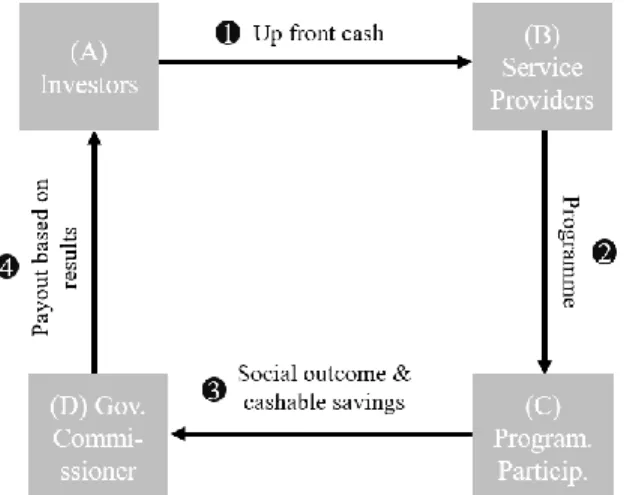
SIB´s win-win-win situation is built on three pillars: government potentially gaining significant savings without taking any risk, subjects with a social problem getting a new chance and support and investors potentially obtaining market-competitive return while creating positive impact (see Figure 1).
6
Example-based explanations were proven to be the most effective in terms of understanding (Atkinson, 2007); therefore, the principle of SIB will be explained on the example of the first SIB. 60% of short-term prisoners in Peterborough prison were reoffended within a year, mainly due to issues with housing, lack of working skills and rejections of their families (Social Finance, 2019). Social Finance as an intermediary connected all contracting parties: investors, social service providers and governmental commissioner to lower the reoffending rates. Investors supplied funds to provide service for prisoners (accommodation, labour training and psychological help) operated by One Service (ibid.). In this case, the service had a positive impact on prisoners and lowered the reoffending rate by 8,6% (targeted 7,5%) (OECD, 2016). The lower reoffending rate decreased governmental expenses on prisoners and court proceedings. Moreover, it was enough to pay only 1/3 of those savings to repay principal and market-competitive return to investors, even though the program was terminated due to success and implemented as national policy (ibid.). The SIB market has moved away from the original structure of the Peterborough SIB, which is now only distant resemblance; however, the principle of solving a social problem by earning money is present in all of them.
2.3 CURRENT SITUATION IN THE MARKET: Status Quo
Since the inception, there have been 134 SIBs issued all-around 27 developed (124) and 9 developing (10) countries (Brookings Institution Global Impact Bond Database, 2019). The SIB market is estimated to represent $ 370 M (ibid.); however, the potential is enormous as in the UK, human services are 15.3x higher than the value of all SIBs issued in the UK (Williams, 2019). Even though the SIB market is continuously growing, the pace of the growth is slower than expected (ibid.). The average SIB duration is 52 months, with an average SIB upfront capital of $ 3,74 M and on average serving 15 thousand beneficiaries (Brookings Institution Global Impact Bond Database, 2019). The main focus of SIBs is employment and social welfare, together covering 69% of all SIBs (ibid.). The SIB funding relays primarily on philanthropic investors (trusts, foundations and charities) and social investment wholesaler, lacking commercial and institutional investors who are required to scale the SIB market (Williams, 2019). Current conventional
7
investors are represented by only a handful of local pension funds, high net worths and financial institutions such as Goldman Sachs, JP Morgan and Deutsche Bank (ibid.).
2.4 JOURNEY OF EVEOLUTION: Long story short
The SIB market evolved over the nine years and changed in many aspects. Firstly, there has been observed migration of intermediary and advisory firms away from the private investment elements of SIBs (Williams, 2019). The reason behind this change is difficulty of establishing a sustainable business model, small scale and the impact of their effort (ibid.). Secondly, misalignment of SIB agendas between social investors and the public sector creates tension in the market and takes SIBs away from mainstream capital markets (ibid.). Third, two biggest markets US and UK have been dividing between “finance-first” (use private capital to finance outcome-based contracts) and “data-first” (SIBs as a policy tool) model of SIBs, respectively (ibid.). Due to all of these changes, the SIB market is at a very confusing stage, but at the same time, this is the moment which decides its future: If it becomes a mainstream financial instrument with competitive returns or if it becomes a philanthropic tool to make an impact through a private-public partnership.
2.5 WHAT IS NOT WORKING: The crux of the matter
One of the current SIB technical issues is the impact of commissioners (investors and debtors) on the service design and delivery; this significantly limits scope and flexibility of the service providers leading to increased oversight and administrative burden (Roy, 2018).
Majority of academia considers high transactional costs to be the biggest problem with SIBs. Transactional costs are considerable, due to the complex nature of stakeholders which makes it difficult to commission and require external input (ibid.). The reason behind this is the capacity of many third-sector organizations, as only a few of them possess the financial skills required to manage and monitor such investment (ibid.). Another criticism relates to an evaluation that is the essence of the SIB because of the “pay-for-success” model. There are numerous issues connected to the evaluation such as a selection of outcome measurement,
8
the attribution of what leads to and who caused changes in selected indicators, and perverse incentives such as “parking” harder-to-serve clients and “creaming” those easier to support (ibid.).
Sustainability, the big word in current society, plays against SIBs, as well. The improvement in the social issue is dependent on the termination of the SIBs; thus, the short-term contractual targets are the obstacle for sustaining and progressing the improvement (ibid.).
3 METHODOLOGY
Academic literature draws a subjective picture of the social phenomenon due to the limited information availability. Majority of academic studies are done based on the observations and interviews focusing on details of the reality with the subjective motivation behind. Therefore, the philosophy of the research is aligned in all three branches of metaphysics (ontology, epistemology and axiology) as the interpretivism (Saunders, 2018).
The research has inductive interference; known premises are used to generate untested conclusions. Alternative structure building is based on the generalising, from the specific to the general (induction). Data collection helps to explore the phenomenon and identify critical aspects which should change to improve the concept (ibid.).
Mixed methods are applied as multiple methods are used. Combining qualitative data collection (literature review and interview with professionals in the field) and analytical procedure, done in both qualitative and quantitative approach, the research is in the form of integrated mixed methods research (ibid.).
The focus of the study is change and development, to gain this capacity longitudinal research is used. Thanks to what it is provided with the measure of control over some of the variables studied; the key success factors and most critical points of the phenomenon are concluded and used for the proposal of alternative structure.
3.1 DATA COLLECTION AND DATA ANALYSIS
Secondary data, findings from academic articles and different indexes publishing reports on the topic of SIBs, are complemented by primary data in the form of interviews with two leading figures in the SIB
9
industry. Interviewees were Antonio Miguel who issued two SIBs in Portugal and collaborated on the first SIB in the UK, and Ruben Koekoek who issued seven SIBs in the Netherlands. The interviews were performed after primary research of academia and building the first draft of the alternative structure through one of the new creative thinking theories. The purpose of the interviews was to test findings from academia and challenge the proposed alternative structure.
4 RE-DESIGNING THE SOCIAL IMPACT BOND
The change is necessary for the improvement and stagnation can be avoided only through experimentation. To design an experiment for continuous improvement, one must understand what needs to be sustained and what needs to be changed. Therefore, the next chapter will analyse these aspects and then propose the alternative structure.
4.1 STRENGTHS: What should be sustained
The win-win-win situation is the essence of the SIB popularity and needs to be present in any future form. The SIB creates a collaboration based on “profit-for-success” which links the social impact and the return; unique functionality is that agency problem is not present as the intentions are aligned. The SIB solves the cause of the social problem, not the outcome; thus, has a preventive effect, as well. While at the same time, the solution of the social problem creates savings for the government and frees up the capital for the potential development of the country. This sounds like a fairy tale; however, in the finance world, everything has also its dark side.
4.2 WEAKNESSES: What should be improved
Based on the literature review the following aspects for improvement were analysed as the potential game-changers. Currently, 92,5% of SIBs are present in developed markets with only 10 SIBs in developing countries (Brookings Institution Global Impact Bond Database, 2019); thus, the tool for improvement of social problems is not present where there are most of them. Secondly, SIBs are very unsustainable as the impact lasts only until the termination of the bond (Roy, 2018), this might lead to even bigger inequality
10
and negative impact for individuals who require more long-term treatment. Third, in a case of no positive impact, no savings are created; thus, there is no repayment for investors, making it an investment with huge risk. Forth, the impact of creditors on the design of the program and service itself has unwanted negative effect and stress for service providers leading to low social outcomes and investment returns. The last issue with the functionality of SIBs is unstructured evaluation of social impact, which is essential for the return and savings; this ineffective measurement of social impact is the most potent deal-breaker for all concerned parties.
4.3 CONCEPTUAL PROPOSAL: Same same, but different
To turn dark sides into the light and to make the fairy tale continue, the SIB mechanism was combined with a debt swap, a trust and an endowment fund (see Figure 2). The debt swap idea is based on the debt for nature swap, “agreement that reduces a developing country’s debt stock or service in exchange for a commitment to protect nature” (United Nations Development Fund, 2016).
4.3.1 ENTITIES IN THE MECHANISM: It is the actors who make the theatre
Prominent roles in this new proposed SIB fairy tale are played by former contractual parties (A) Investors, (C) Government, (F) Service Providers and new ones (B) Trust, (D) Governmental Creditors and (E) Endowment. The (B) Trust will be set up as the public-private partnership, supervised by the board of directors, which should consist of governmental and investment representatives. However, the trust should be grant-making, not the implementing entity; thus, manage cash flows from the debt swap, perform annual call for proposals of social services and fund (F) Service Providers.
4.3.2 ACTION PLAN: Step by step
The illustration of proposed stucture in the figure 2 follows: (1) Investors purchase the SIB from the trust at price X (principal =X, interest=impact/savings). (2) The trust lends the X amount to the government. (3) & (4) Next operation is the debt swap between government and governmental creditor, the government swaps its current loan of X+Y for immediate payment of X receiving a discount of Y on loan from creditors. (5)
11
Government writes two notes to the trust in values X and Y. (6) Trust uses the note of X value to repay the principal to investors. (7) In the next step, the trust splits the Y (discount) into two transactions, the typical SIB transaction to fund the social service of Z value and the second one to the endowment fund of Y-Z value. (8) If the service is successful in creating impact, governmental savings should be recognized. (9) The full amount or a part of these savings depending on the impact should be transferred to the trust. (10) These savings should be used to pay the interest on the SIB for investors. (11) In the last step, the endowment fund should activate and support social service without any termination ensuring the sustainability of the impact.
4.3.3. TIME PERSPECTIVE OF TRANSACTIONS: Time is money
From the investor perspective, the transaction gained a “call option” like position. The principal is secured, and the interest is impact-dependent, both are received at maturity of the bond. As the trust plays the role of intermediary, it will be left out from this explanation because capital only flows through it without any changes.
Government receives capital from investors (X) at the beginning of the period but has to repay it only after the termination of the bond. Thus, there is a space for financial engineering to make more profits. The discount from governmental creditors (Y=C+Z) is transferred through the trust and split between the social service provider (C) and the endowment fund (Z). The cost of social service (C) is distributed over time which creates additional financial space for the government. In regards, of the portion for the endowment
12
(Z), there are two possible scenarios: (1) distribute the funds over the period of the bond, this would make the required capital for endowment higher, as well as, the total required capital; but would create a supplementary financial space for the government; or (2) transfer full amount for the endowment immediately which would have opposed effects on the two mentioned aspects. Thanks to this additional transaction scheme government gains a better position than it has in case of the traditional SIBs. At the maturity of the bond (T), the impact measurement is contemplated by the independent party. If savings (S) are realized, they are transferred through the trust to the investors as a return. After the bond termination (T), the endowment fund would start to pay out the cost of service (C) to the service provider to continue performing its activity. Perpetuity of this funding support will improve the stage of social issue and create even more savings (S) for the government in the long-run, as sustainability never pays out in the short-term.
Figure 3: Timeline of the transactions (legend in text and Annex 1)
4.3.4. NUMBERS BEHIND THE MODEL: Capital + Social Problem = Return
To calculate the required capital (X) for this transaction, one needs to start from the end. Considering the first option when the endowment receives annual instalments until the maturity of the bond (T); the required capital for one instalment (𝑍1) to fund the annual costs of service (C) forever is dependent on the potential
13
return of the endowment (𝑟𝐸). Considering that the first payment is not obtained immediately the equation
is the following: 𝑍1= 𝐶 𝑟𝐸∗ [(1+𝑟𝐸)𝑇−1 𝑟𝐸 ] (1)
Otherwise, if one immediate bullet transfer to the endowment (Z) is done at the beginning of the period: 𝑍 = 𝑟 𝐶
𝐸∗(1+𝑟𝐸)𝑇 (2)
Another step in the search for the total required investment (X) is to find the value of discount (Y). This is dependent on the governmental cost of capital (𝑟𝐺), maturity of the SIB (T) and of course the endowment
funding type, in the case of the first option (1) (distributed until the maturity): 𝑌 = (𝑍1+ 𝐶) ∗ [
1−(1+𝑟𝐺)−𝑇
𝑟𝐺 ] (3)
If the endowment fund receives one immediate payment (2), the value of the discount is equal to: 𝑌 = 𝑍 + 𝐶 ∗ [1−(1+𝑟𝐺)−𝑇
𝑟𝐺 ] (4)
Thus, the total required investment (X) for this new SIB is the result of the relationship between the value of the discount (Y) and the discount rate (d) given by governmental creditors:
𝑋 =𝑌𝑑 (5) By inserting the first equation (1) and the third one (3) into the fifth equation (5), the total required investment (X) for the first type of the endowment funding (1) (distributed over the bond period) is defined as: 𝑋 = { 𝐶 𝑟𝐸∗ [(1+𝑟𝐸)𝑇−1𝑟𝐸 ] +𝐶}∗[1−(1+𝑟𝐺)𝑇 𝑟𝐺 ] 𝑑 (6)
The total required investment (X) with the second option of the endowment funding (2) is the combination of the second (2) and the fourth equation (4) in the relationship set by the fifth equation (5).
𝑋 = 𝐶 𝑟𝐸∗ (1+𝑟𝐸)𝑇+𝐶∗[ 1−(1+𝑟𝐺)𝑇 𝑟𝐺 ] 𝑑 (7)
14
It can be concluded that the total required investment (X) can be calculated based on the annual cost of service (C), expected endowment rate of return (𝑟𝐸), expected governmental cost of capital (𝑟𝐺), the rate of
discount offered by governmental creditors (d) and the maternity of the bond (T). 4.3.5 EVALUATION AND INTEREST: Impact measurement
The second part of the transaction is implied only when the provided service made a social impact and governmental savings. Therefore, the essence is to make the social impact connected to the governmental savings through the evaluation measurement.
To prove that the impact and savings are based on the service provided, the measurement should be done through comparison with the control group. This way, the effect of the independent variable (service provided) should be directly shown as the difference between the experimental and the control group. The impact of the independent variable should be translated to savings if it is not already in that form and transferred from government to the trust which distributes the rest to the investors as the return on their investment. This method should prevent the manipulation of the data by any of the concerned parties.
4.4 UNDERLING ASSUMPTIONS OF MODEL´S APPLICABILITY: Applicability
New features of the alternative SIB structure restrict the scope of its application; therefore, the following question guide was developed. The questions should be answered in the proposed order. If any of the questions lead to a negative answer, the process should be stopped and revisited with a new target region (Question 1) or a new social issue (Questions 2, 3, 4 and 5). The negative answer recognizes the social issues for which this model is not an appropriate solution.
1. Does a country have a potential position to negotiate the debt swap?
Munro´s (2001) research showed that the main motivations of governmental creditors to enter the debt for nature swap are limiting uncertain future repayment or in certain case tax benefits, positive publicity or exiting the country. Thus, developing countries are gaining more favourable position. Optionally, the
15
investment could be complemented by grants as it is in many cases of conversation debt swaps (Weary, 2015).
2. Does the social issue create direct expenses for the government?
This question is essential for any SIB model because, without a direct link between the social issue and governmental expenses, investors will never get paid any return on their investment.
3. Does the general public care about the social issue?
The interest of investors is the key for success of any SIB, because the lack of funding and support from investors might lead to challenging situation to sustain the SIB until its maturity as in the example of the first US SIB whose funding was cut in the process (Porter, 2015). Moreover, another potential issue is the agency problem of misaligned interests between investors and the trust or service providers, making an initiative inefficient in the short-run with limited application for the long-run.
4. Is there or could be designed service initiative to solve the cause of the social issue?
The important part of this question check is that the cause of the social issue needs to be solved, not an outcome. Moreover, not every social issue could be solved through service for the concerned population. This is the aspect on which SIB stands and falls because inadequate service initiative ruins the whole SIB. This was the case with London Homelessness SIB where one of the initiatives was to send homeless people to their former hometown or country which is not solving the cause of the social problem (Mason, 2017).
5. If no indirect profit or savings for government are implied. Are the costs of service initiative lower than he savings the initiative creates for government?
This assumption is included to avoid wasteful use of resources. Some initiatives might be effective, but more costly than the savings they create, thus are misaligned with economical use or resources.
16 4.5 VALUE CREATION: Where is the treasure hidden
The investor´s reluctance to invest in SIBs is mainly based on a complete loss of investment if the service failed to solve a social problem. This negative aspect is almost entirely cancelled out since the principal is not distributed to the service provider (traditional SIB), but loaned to the government for the debt swap (proposed structure). Thus, the risk of losing principal is limited to the risk of the government not repaying its liabilities. By limiting the loss but not profit, the structure is offering an investor position similar to buying a call option.
The favourability of developing countries brings value in applicability for the regions where it was not widely used before. Moreover, the structure creates a lot of financial space for the government to fulfil its obligations and make additional profit through reinvesting the loan from investors.
The proposed structure is an example of sustainable finance, thanks to the endowment fund. Perpetua mobile is based on the return of the endowment, which sustains the investment into the service provided that can run forever. At the same time, creating the space for experimentation as the funds become unlimited by time. The existence of the trust makes the distance between investors and service providers, limiting investor impact on the service design which has been proven to have a negative impact on the final outcome of SIBs (Roy, 2018).
Impact measurement is the essence of any SIB, to find the exact variable which is dependent on the impact created and can be translated into savings, still stays for the trust to tackle as it is particular for each of the social issues. However, the potential manipulation of the data is prevented through the independent assessment based on the control group comparison.
5 ILLUSTRATION
One of the most efficient ways to understand the idea is through examples (Atkinson, 2007); therefore, the following part will be dedicated to an illustration of the proposed model. The illustration is devoted to a social issue with very little attention from the public, the adolescence of orphans.
17 5.1 PROBLEM SPECIFICATION: Life after orphanage
Currently, there are more orphans in the world (140 million) than citizens of Russia (118 million) (UNICEF, 2016). Only less than 5% of these children get to be adopted; however, this does not imply successful adoption; in other words that they are not returned to an orphanage, but stay with a family (ibid.). Thus, more than 95% of these kids must leave the orphanage, generally at the age of 18 (some countries 15) years, without any support or base out in the real world (ibid.). The consequences are humongous, within two years of leaving orphanage: 30% will become addicted to drugs, 60% of girls will become prostitutes, 70% of boys will turn to crime and 15% will commit suicide (Heard of Orphans, 2017). It is not a surprise as they have no one in the world. Also, society is influenced by this invisible problem, not only by raising criminality and homicidal rates, but also making expenses for the government.
Slovakia was selected as a case country; debt for nature swap was performed in neighbouring Poland (Sheikh, 2010); therefore, there is potential for application. Every problem has a solution; one just needs to find it. One of the preventive solutions to the downturn of the orphan adolescence is so-called “home halfway” (Klimek & Klimek, 2019). These homes offer accommodation, psychological support and professional training for struggling male orphans to enter the adult life. The program lasts up to two years and participant has to pay a small fee of € 1,80 a day and have to obey the rules as actively searching for the job or improving skillset through education and others (ibid.). This implies that only working only for 3,5 months would create enough savings to pay three months deposit (see Annex 2). Based on all this information, all questions in assumption questionnaire were answered positively (see Annex 3). The most considerable portion of Slovak debt was issued by German creditors (Odkladal, 2016); therefore, the model assumes that German creditors will take part in the transaction.
5.2 FINANCING STRUCTURE: Balance the books
Due to the limited scope of this paper, only version 2, when the endowment is funded in one transaction will be explained below; however, Appendix 4 includes calculations for both versions. (1) Based on the calculations in Appendix 4, the required capital for the proposed SIB is € 4,5 M which will be raised through
18
the sale of the bond to investors (see Figure 4). (3 & 4) This capital will be used for the debt swap between Slovak governmental commissioner and German creditors; the discount factor is assumed to be the average of past discount offered in debt for nature swaps by Germany (Sheikh, 2010) this yields € 1,8 M (see Annex 4). (7) The discount is split between the endowment fund and the “home halfway” into € 1 M and € 0,8 M respectively. (11) The amount invested in the endowment fund, € 1 M, is enough to supply € 0,09 M to “home halfway” annually in perpetuity after the termination of the bond, ten years, based on the average endowment rate of return, 5,0% (Almanac, 2018).
Figure 4: SIB Structure Illustration
5.3 REPAYMENT STRUCTURE: Bring home the bacon
The principal of € 4,5 M is repaid by the government at the maturity of the bond together with return. Implied return-impact measure for this SIB is the improvement in the offending rate. Statistics imply that 70% of boys will commit a crime within two years after leaving an orphanage house (Heard of Orphans, 2017), the treatment has been reporting the improvement of 37% on average yearly (see Annex 4) which yields a market-competitive return of 4,62% (see Table 1).
Improvement in offending rate 1% 19% 37% 54% 70%
Return 0,13% 2,39% 4,62% 6,74% 8,82%
19
6 TESTING THE PROPOSED SIB STRUCTURE
Although the very similar concept of the debt for nature swap supports the willingness of governmental creditors to enter the proposed SIB structure. It cannot be argued that if concepts function separately, they will function together as well, as there is no causality. Thus, an alternative way of testing the feasibility of the proposed bond was performed through interviews with professionals in the field and their perspective on the proposal.
6.1 INTERVIEW STRUCTURE: Fighting confirmation bias
The interviews were performed based on one of the creative thinking techniques to overcome the confirmation bias (Michalko, 2006). Therefore, the structure of the interviews was the following (see annex 5 for full interview guide):
- Firstly, the understanding of the traditional SIBs was tested,
- Secondly, interviewees were asked what key success and failure (or critical) aspects of SIBs are, - Thirdly, they were presented with the conclusions of academia to the same question to confirm or
disprove those findings and,
- Lastly, the proposed SIB structure was explained, and interviewees were asked for critical opinion. 6.2 SOCIAL FINANCE, NETHERLANDS: Ruben Koekoek
The first interviewee was Ruben Koekoek, who developed the first SIB in the Netherlands together with ABN AMRO Bank and later founded Social Finance NL, where he is currently managing director and issued other 7 SIBs for different social issues like health care, unemployment and social entrepreneurship (Social Finance NL, 2019).
6.2.1 SUCCESS FACTORS: Bear fruit
In regards of success factors, Ruben brought up two new aspects: public-private partnership and transparency of the impact measure. On the other hand, he disproved that the model Profit-for-success aligns
20
interests of shareholders in all cases. He also mentioned that there are cases of SIBs where the government did not realize any savings, but the bond was successful and repaid its investors.
6.2.2 CRITICAL FACTORS: Dead in the water
Variables in measuring impact (selection of participants and other personal influences) play a significant role in the measurement of the impact even if the treatment is correct or performing well. Performance management is another of the critical SIB factors. Mainly, management of data and evaluation, and the improvement over time as the model should be revisited and adjusted in progress. Ruben also raised interesting point towards the transaction costs: “… some costs would be there anyway, …” (Koekoek, personal communication, 2019); therefore, it needs to be understood which are inevitable costs and which are coming from the SIB model.
6.2.3 PROPOSED SIB STRUCTURE: House of cards
The concern was raised towards two aspects of the framework. “If the government is able to get the discount to its debt based on the country-specific risk, isn´t it contradicting to that the government is trustworthy to repay its new debt to impact investors.” (Koekoek, personal communication, 2019). Another one is connected to the assumption for applicability: “…it might be difficult to find direct costs of government in developing countries as they do not have taxes or public services.” (ibid.).
6.3 SOCIAL FINANCE UK & MAZE: Antonio Miguel
Antonio Miguel was the second interviewee in the test of the proposed model feasibility. Antonio structured the very first SIB in Peterborough Prison at Social Finance UK. Maze, an impact investing company in Portugal, was founded and is managed by Antonio. Thanks to Maze and Antonio, there have been four SIBs issued tackling social issues in Portugal.
21 6.3.1 SUCCESS FACTORS: Hit a home run
From Antonio´s perspective, there are three main success factors: efficient allocation of risk, incentive structure and performance management. Wiser allocation of risk is based on the fact that the government does not guarantee anything and investors can lose everything if there is no impact. The incentive structure is built on the impact measurement, which could be binary or frequency matrix, what is one of the critical decisions. Performance management should test the process and learn over time to improve.
6.3.2. CRITICAL FACTORS: Blind alley
Antonio pointed out these drawbacks of SIBs: The first one is the high complexity connected to high transactional costs. Another limitation is that SIBs can be applied only in a niche segment because they are not fit for most interventions. Moreover, Antonio agreed with all the findings of academia.
6.3.3 PROPOSED SIB STRUCTURE: Moment of truth
A significant difference between traditional SIBs and the proposed model has been observed in terms of financial impact for the government. Antonio explained that governmental savings are fallacy and majority of the SIBs are based on more efficient allocation of resources and risk. Due to this, it might be challenging to find a social problem which underlines this assumption, but it is the case for employment and childcare issues.
Another critique which was raised, was the applicability in developing countries as these countries are not welfare countries. It might happen that “… by solving a problem, the government spends even more money…” (Miguel, personal communication, 2019). Thus, the government should only invest in only what makes savings for them. This will limit the already niche sector even more.
Moreover, he criticized the fact that the transaction costs were increased, due to the redundancy of the capital flowing from investors through trust and government to finally governmental creditors. On the other hand, Antonio appreciates the idea as it created a new source of capital, which is the biggest bottleneck for these initiatives.
22
7 DISCUSSION
The following chapter will discuss new points raised by the interviewees and propose remedies to these points.
7.1 FINDINGS FROM THE INTERVIEW WITH RUBEN KOEKOEK
None of the new success factors is contradicting with assumptions behind the proposed model. Moreover, new critical aspects raised by Ruben are concerning the implementation of the model, which is not dealt with in this paper due to its limited scope.
It is logical to worry about the credibility of the government, used in the argument for the discount on the debt, which contradicts with the trustworthiness to repay its loan from impact investors. On the other hand, this structure has been applied already 47 times since 1970 in some of the most dispute countries as Bolivia, Guatemala and Nicaragua and succeeded until the end of bond termination.
7.2 FINDINGS FROM THE INTERVIEW WITH ANTONIO MIGUEL
Points raised by Antonio are mainly connected to limiting already niche scope of SIB application, which are a valid concern, however, due to the limited scope of this paper model will not be revisited to consider for this aspect, but is proposed for the future research of the alternative structure.
23
Moral hazard concern of government as a debtor which is connected to problem pinpointed by Ruben, as well, could be solved by the alternative structure of debt swap. (2 & 3) In this structure, the trust gains new role and buys the debt from creditors at a discount, (4) this loan will continue to be paid by the government, but now to the trust (see Figure 4). The position of government does not change contractually from before the swap, which implies that moral hazard is limited.
7.3 LAST WORD ON FEASIBILITY
Even though the critical perspective of the subjects from the industry helped to shed some light on the limitations of the model and brought improvements in place, it cannot be fully proved unless it is applied. Therefore, the argument for why the model would work comes from Ronald Cohen (2011) “There are certain things that involve an act of faith. I can see that this is going to work, it should work, and I have faith if I back the right people it will work, and that is the stage where we are with social impact bonds today, it´s a very powerful innovation…”.
7.4 QUESTION OF MORALITY: Good or evil
As everything in the world, SIBs have its enemies as well; they see SIBs as capitalistic casino on human´s lives (Cox, 2015). There is nothing bad in betting on the improvement of the social problem as it aims for good. However, the implementation brings a couple of challenges; many great ideas were implemented into terrible realities. One of the discussed issues is the decision to focus on outcome or intention: “Is the priority achieving the most good, or is it acting according to a good purpose?” (Muers, 2017). The ideal it would be to find a balance between both where the intention drives outcomes.
8 LIMITATIONS AND FURTHER RESEARCH
The complexity of the idea brings numerous limitations on the paper and model level, which create questions for future research.
24 8.1 LIMITATIONS OF THE STUDY
This study is not a guide for developing SIBs or anything like SIBs; it is the structural proposal of alternative social-finance tool which combines the basis of SIBs, the debt swap and the endowment fund to create a sustainable model to solve social problems. Therefore, a very limited part of this paper copes with the implementation of the proposal and repayment structure.
Limited time and scope dedicated to creating this paper did not allow for deep analysis or all aspects of the proposed model, due to its complexity. However, all essential factors were mentioned and explained in considerations with these restrictions.
Limitations of the model are transformed into the assumption guide which selects appropriate cases for the application of this proposal. However, the biggest limitation is omitting transactional cost, due to their complexity and limited public information, it is difficult to make any reasonable assumptions.
8.2 FURTHER RESEARCH
There are a couple of interesting findings which were discovered during writing this paper. The most interesting one is to gain more knowledge in the compatibility of different financial tools to align social impact and financial return. Moreover, it is believed that the concept of morality in terms of SIB could help to develop technical guides for better implementation.
9 CONCLUSION
“How money is invested today is crucial for what the world will look like tomorrow.” (Cerruti, 2011), that is the motivation of this paper to revisit the structure of financial tool which aims to deliver return and impact, SIB.
Strengths and weaknesses of typical SIB were analysed based on the academic literature as the cornerstone for this paper. Return linked to the impact, solving cause not the outcome and creating savings for the government while earning a return for investors were discovered as fundamental aspects responsible for win-win-win situation of SIB. SIBs are supposed to create win-win-win situation as they satisfy three
25
concerned parties, government (potential savings without risk), investors (market-competitive return and impact) and people affected by social problem (an opportunity which they would not have otherwise). On the other hand, the following critical features were found: limited presence in developing countries, the unlimited risk for the investor, negative direct impact of creditors of social service providers, unsustainability after maturity of the bond, and evaluation of social impact.
The proposed structure combined four elements to empower strengths and limit weaknesses: SIB, debt swap, trust and endowment fund. SIB features are present to protect the strengths of the model. Debt swap in the form of debt for nature swap will create a more favourable position for application in developing countries and limit the risk of investors to a situation similar to purchasing a call option. Trust will play intermediary position and split creditors from social service providers optimizing the impact social providers can create by limiting the impact of creditors. Sustainability of the intervention will be created due to the existence of the endowment fund, which after the maturity of the bond will reinvest the returns to the social service. For this model, impact measurement should be directly linked to the governmental savings, which translate into the return for investors.
Return-oriented markets will not switch for impact unless we create financial tools which can deliver impact and return at the same time. The aim of this paper was to show that by combining existing financial tools, it is possible to improve the impact-oriented products to make them more competitive with traditional return-oriented products.
i
10 BIBLIOGRAPHY
Almanac. (2018). Average Annual Endowment Returns, FY 2017. The Chronicle of Higher Education. (online) https://www.chronicle.com/article/Average-Annual-Endowment/244182.
Atkinson, R. K. (2007). Interactive Example-Based Learning Environments. Educational Psychology
Review, p. 375–386.
Brookings Institute Global Impact Bond Database. (2019). Brookings Impact Bonds Snapshot - January 1, 2019. Global Economy and Development at Brookings. (online)
https://www.brookings.edu/series/impact-bonds/.
Cerruti, Z. M. (Princess Maxima of the Netherlands). (2011). Speech by Princess Máxima, UNSG’s Special Advocate for Inclusive Finance for Development, SOCAP Europe Congress. (online)
https://www.royal- house.nl/documents/speeches/2011/05/30/speech-by-princess-maxima-unsg-s-special-advocate-for-inclusive-finance-for-development-socap-europe-con.
Cohen, R. (2011). Closing Remarks. Social Impact Conference London. (online)
https://www.youtube.com/watch?v=cqoKV0-WD-k .
Cohen, R. (2018). On Impact. London: Park Communications.
Cox, G. (2015). Social Impact Bonds: The Next Stage of Casino Capitalism. Citizen´s Press. (online)
https://cpress.org/old/social-impact-bond-casino/.
Heard of Orphans. (2017). The Problem. (online)
www.heartfororphans.com/what-we-do/our-transition-homes/the-problem/.
Klimek, B., Klimek, L. (2019). Domov na pol ceste pre mládež z detských domovov. Prešov: Občianske združenie Partneri pre socialny rozvoj a pomoc.
Klimek, L. (2019). Personal communication. Koekoek, R. (2019). Personal communication.
Mason, P. (2017). Qualitative Evaluation of the London Homelessness Social Impact Bond (SIB).
Department for Communities and Local Government. (online)
https://assets.publishing.service.gov.uk/government/uploads/system/uploads/attachment_data/file/658921/ Qualitative_Evaluation_of_the_London_Homelessness_SIB.pdf.
Michalko, M. (2006). A Handbook of Creative Thinking Techniques. Berkley: Speed Press. Miguel, A. (2019). Personal communication.
Muers, S. (2017). Talking About Ethics in Impact Investing. Stanford Social Innovation Review. (online)
https://ssir.org/articles/entry/talking_about_ethics_in_impact_investing.
Munro, A. (2001). Debt-for-Nature Swaps. Working Paper. (online)
https://www.cbd.int/doc/nbsap/finance/Guide_Debt_Nov2001.pdf.
Nicholls, A., Paton, R., & Emerson, J. (2015). Social Finance. Oxford: Oxford Scholarship Online. (online)
https://www.oxfordscholarship.com/view/10.1093/acprof:oso/9780198703761.001.0001/acprof-9780198703761.
Odkladal, M. (2016). Štátny dlh Slovenska neustále rastie. Dlhujeme aj európskym penzistom. (online)
https://www.aktuality.sk/clanok/312537/statny-dlh-slovenska-neustale-rastie-dlhujeme-aj-europskym-penzistom/.
OECD. (2016). Social Impact Bonds: State of play and lessons learned. (online)
https://www.oecd.org/cfe/leed/SIBs-State-Play-Lessons-Final.pdf.
Porter, E. (2015). Program Fails But Social Impact Bond Experiment Succeeds. (online)
ii
Poštová Banka. (2014). Štruktúra výdavkov priemernej slovenskej domácnosti. (online)
www.cfo.sk/articles/struktura-vydavkov-priemernej-slovenskej-domacnosti#.XeKFWzP7Q2w.
United Nations Development Fund. (2016). Debt for Nature Swaps. (online)
http://www.undp.org/content/sdfinance/en/home/solutions/debtfornatureswaps.
Rockefeller Foundation. (2019). Innovative Finance and Impact Investing. (online)
https://www.rockefellerfoundation.org/our-work/initiatives/innovative-finance/.
Roy, M. J. (2018). A Critical Reflection of Social Impact Bonds. Stanford Social Innovation Review. (online)
https://ssir.org/articles/entry/a_critical_reflection_on_social_impact_bonds#.
Sheikh, P. A. (2010). Debt-for-Nature Initiatives and the Tropical Forest Conservation Act: Status and Implementation. Congressiotonal Research Service. (online) https://fas.org/sgp/crs/misc/RL31286.pdf. Saunders, M. (2018). Research methods for business students. London: Pearson. Sixth edition.
SITA. (2014). Takmer 40 eur na deň stojí pobyt väzňa za mrežami na Slovensku. Vypočítajte si, koľko teda stojí ročne väzniť viac ako 10-tisíc ľudí. (online)
https://www1.pluska.sk/spravy/peniaze/vazni-vobec-nie-su-lacny-spas-tipnite-kolko-nas-stali-minuly-rok.
Social Finance. (2019). Peterbourough Social Impact Bond. (online) https://www.socialfinance.org.uk/. Social Finance NL. (2019). Social Impact Bonds. (online) https://socfin.nl/wat-doen-wij/?lang=en#SIB. UK government. (2015). Social Impact Bond Payment by Results Pilot at HMP Peterborough. London. (online)
https://assets.publishing.service.gov.uk/government/uploads/system/uploads/attachment_data/file/486512/ social-impact-bond-pilot-peterborough-report.pdf.
UNICEF. (2016). Orphans. (online) https://www.unicef.org/media/media_45279.html.
Weary, R. (2015). Rising Tides: Debt-for-Nature Swaps Let Impact Investors Finance Climate Resilience.
Global Insights . (online) https://www.nature.org/en-us/what-we-do/our-insights/perspectives/rising-tides-debt-for-nature-swaps-finance-climate-resilience/.
Williams, J. (2019). From visions of promise to signs of struggle. FInal Research Report. (online) https://golab.bsg.ox.ac.uk/documents/234/Williams-2019-Final-Report.pdf.
ii
11 APPENDICIES NOT NECCESSARY FOR UNDERSTANDING OF THE PAPER
APPENDIX 1: Legend to the Figure 2X = required capital for the bond/ price of the bond Y=discount received from governmental creditors
S = savings recognized by government as a result of social service provided C = cost of social service
Z = capital required for the endowment fund to run in perpetuity T = termination of the bond
APPENDIX 2 : Calculaton of saving for deposit while participating in the „home halfway“ Average monthly salary in Slovakia € 507
Average monthly expenses excluding accomodation € 314 Monthly expense for the individual in the „home halfway“ € 54 Average monthly rent in Slovakia € 210
Normally deposit is paid 3 months
MONTHLY SAVINGS = (Average monthly salary – Average monthly expenses – Monthly expenses for the individual in the „home halfway) = € 139
TIME TO SAVE UP FOR THE DEPOSIT = (Average monthly rent * Deposit in months) / Monthly savings = 4,5 months
Source: Slovak Post Bank Statistics, 2014
APPENDIX 3 : Assumption questionaire quite for the application of the proposal in the illustration
1. Does country position to negotiate the discount in the debt swap?
Slovakia might not seem as a country with high country specific risk, however, the debt swap was performed in the neighbouring Poland (Sheikh, 2010). The countries have very similar economic situation what leads to the conclusion that the framework will be applicable in Slovakia, as well.
iii
2. Does the social issue create direct expenses for the government?
Certainly does, as only after two years leaving orphanage 70% of boys turn to the crime. Due to that government needs to provide for the court and the punishment or the treatment for example the prison. There are the direct expenses connected to the social issue, however, there are many indirect ones, as well.
3. Does the general public cares about the social issue?
The fact that there is not that much attention does not imply that public does not care. Using the example of UNICEF whose activities are mainly focused on unprivileged kids in orphanages proves that public cares about the issue, because UNICEF is growing and spreading its services all around the world.
4. Is there or could be designed service initiative to solve the cause of the social issue?
The example initiative are “homes halfway” describe in the Illustration section. Results of the treatment in the “home halfway”:
Source: Klimek & Klimek, 2019, Domov na polceste pre mládež z detských domovov
5. If no indirect profit or savings for government are implied. Are the costs of service initiative lower than he savings the initiative creates for government?
Failed (Left to prison)
30%
Unknown (Left due to the end of
contractual period)
5% Success (Left to
their new home) 65%
iv
Due to the limited time no other service providers were approached, but there are significant indirect costs for the government in terms of unpaid taxes. These unpaid taxes come for example from prostitution which is only hardly taxed (60% of girls end up being prostitutes after 2 years leaving the orphanage house). APPENDIX 4: Calculations for the illustration
Monthly cost of service
The monthly cost of running the “home halfway” with the capacity of 25 people is € 7 455, this is total cost including monthly payment of patents in the “home halfway” (Klimek, personal communication, 2019). Monthly payment by patients in € 54 and was included in the calculations of the total annual cost as self-paid by patients.
Endowment rate of return
Based on the Almanac´s (2018) article summarizing average annual return of endowment funds the most appropriate rate was selected. The endowment in the illustration falls into the category of “under $ 25 million” and the “10-year average annual return” was selected as the time scope is aligned with the maturity of the bond (ibid.).
Governmental rate of return
One of the simplifying assumptions is used here and governmental rate of return is assumed to be equal to economic growth, 4,1%
Discount rate
The biggest creditor of Slovak republic is Germany (Odkladal, 2016), therefore, the illustration assumes that the transaction would have been done with German creditors. German creditors have been part of numerous debt swaps and the average discount they gave is 40,3% (Sheikh, 2010). This rate was applied in calculations.
Table: German discount rate offered in the past
Country of debtor Debt Discount
Discount (%)
v Peru 16079 6100 37,9% Jordan 13400 6700 50,0% Jordan 22700 11300 49,8% Philippines 5800 1800 31,0% Vietnam 18200 5400 29,7% Bolivia 3700 1150 31,1% Honduras 1068 534 50,0% Peru 5140 2060 40,1% Vietnam 16400 5000 30,5% Jordan 43600 21800 50,0% Bolivia 15800 3200 20,3% Jordan 11300 5700 50,4%
Vietnam 7000 n/a n/a
Syria 31700 15900 50,2%
Ecuador 9500 3081 32,4%
Ecuador 10200 3235 31,7%
Madagascar 25092 14843 59,2%
Indonesia n/a n/a n/a
Indonesia n/a n/a n/a
Average 15099 6738 40,3%
Source: Sheikh, 2010 Rotation per 10 years
The contractual period is 2 year, with possible extension based on the case (Klimek & Klimek, 2019), thus, total rotation of one capacity unit per 10 years is 5 patients.
vi
Global statistics imply that within 2 years 70% of boys commit crime which leads to court and potentially to prison (Heard of Orphans, 2017). The results of the treatment disclosed by the director of the “home halfway” are 33,3% of boys leave due to criminal behaviour (Klimek, personal communication, 2019). Average cost of single court ruling
One of the regional judges disclosed during interview (2019) that average cost of the single court ruling for small clime, such as pickpocketing, fighting or robbing, in Slovakia is € 400. This is a relatively conservative assumption as normally additional costs would be accounted, due to limited ability to pay for lawyer and notary confirmations, as well as, that the case would be finalized during first ruling.
Average cost of a day in prison
Expense on day in prison equal to € 38,9 in Slovakia (SITA, 2014). Average days in prison for small crime
Small crime is defined as the regional judge (2019) said pickpocketing, fighting, robbing. Employee of the local prison (2019) assumed in the conversation that young man under 23 spend on average 3 to 4 months in prison due to small crimes. For calculation the average was take, 105 days.
vii REPAYMENT STRUCTURE:
APPENDIX 5: Interview guide I SECTION: QUESTIONS Interest repayment period
- When is the interest paid? (If at the end only interest or interest in perspective of value of money?)
Source of principal repayment
- What is the principal repaid from? (If savings, do you model it in already, how do you choose the service any correlations?)
Choice of the service
- From you experience do you find it difficult to design the programme/ choose the service provider?
viii - How do you measure impact?
Social impact bond win-win-win
- Which aspect of the social bond, do you believe, is essential for its success? - What do you believe has to be sustained in any form of SIB?
Social impact bond drawbacks
- What do you find the biggest disadvantage of SIB?
- What do you believe is the hardest part to exercise about SIB?
II SECTION: ACADEMIA PERSPECTIVE
Would you agree with the findings of the academia? Social Impact Bond Win-Win-Win
- Earns return by solving social issue and creating savings for government o Profit-for-success – Aligns interest of shareholders
o Solves the cause not the result of the social problem o Savings for government – refinance for other development
Social Impact Bond Drawbacks
- Present (only) mostly in developed countries
- Unsustainable – exist only until the maturity of the bond - High transaction costs
- Impact of creditors on design of programme and service providers – lowering their impact - Impact measure
ix IV SECTION: TIME PERSPECTIVE
V SECTION: EQUATIONS BEHIND THE PROPOSAL
𝑍1=
𝐶 𝑟𝐸∗ [(1 + 𝑟𝐸)
𝑇− 1
x 𝑍 = 𝐶 𝑟𝐸∗ (1 + 𝑟𝐸)𝑇 𝑌 = (𝑍1+ 𝐶) ∗ [ 1 − (1 + 𝑟𝐺)𝑇 𝑟𝐺 ] 𝑌 = 𝑍 + 𝐶 ∗ [1 − (1 + 𝑟𝐺) 𝑇 𝑟𝐺 ] 𝑋 =𝑌 𝑑 𝑋 = { 𝐶 𝑟𝐸∗ [(1 + 𝑟𝐸) 𝑇− 1 𝑟𝐸 ] + 𝐶} ∗ [1 − (1 + 𝑟𝑟 𝐺)𝑇 𝐺 ] 𝑑 𝑋 = 𝐶 𝑟𝐸∗ (1 + 𝑟𝐸)𝑇+ 𝐶 ∗ [ 1 − (1 + 𝑟𝐺)𝑇 𝑟𝐺 ] 𝑑
It can be concluded that the total required investment (X) can be calculated based on only annual cost of service (C), expected Endowment rate or return (𝑟𝐸), expected governmental cost of capital (𝑟𝐺) and the
rate of discount offered by governmental creditors (d). VI SECTION: ASSUMPTIONS BEHIND THE PROPOSAL
6. Does country have reasonably high country risk to negotiate the discount in the debt swap? 7. Does the social issue create direct expenses for the government?
xi 8. Does the general public cares about the social issue?
9. Is there or could be designed service initiative to solve the cause of the social issue?
10. If no indirect profit or savings for government are implied. Are the costs of service initiative lower than he savings the initiative creates for government?
VII SECTION: ADDED VALUE OF THE MODEL
- Tool for developing countries
- Sustainability of financing is achieved through the Endowment fund - Transaction costs are covered by governmental savings
- Impact evaluation through governmental savings - More financial space for government – less stress
- Sustainable financing allows for mistakes in service provider choice - Investor´s risk is limited (secured principal)