Editor: Ronald P. Weber © 2015 Nova Science Publishers, Inc.
Chapter 4
EXPANSION OF THE JUNIPERUS GENUS
DUE TO
ANTHROPIC
ACTIVITY
Ana Cano-Ortiz
*,1, José C. Piñar Fuentes
†,2,
Carlos J. Pinto Gomes
‡,3, Carmelo M. Musarella
4and Eusebio Cano
21
Department of Sustainability Interra, Engineering and Resources SL. Plaza España, Salamanca, Spain
2
Department of Animal and Plant Biology and Ecology. Botanical Section. University of Jaén, Jaén, Spain
3
Department of Landscape, Environment and Planning/Institute of Agricultural and Environmental Sciences
Mediterranean (ICAAM), University of Évora (Portugal), Rua Romão Ramalho, Portugal
4
Department of Agrarian, University Mediterranean of Reggio Calabria, Feo di Vito, Italy
A
BSTRACTThis work contains a study of Juniperus forests in the southern Iberian Peninsula and aims to determine their floristic composition and
*
E-mail: [email protected].
†
Corresponding author: [email protected].
‡
their biogeographical, ecological and bioclimatological distribution. The analysis of Juniperus formations revealed a series of different plant communities. The presence of endemic companions in these plant communities justifies the study of these islands: Echinospartum ibericum
Rivas Mart., Sánchez Mata & Sancho, Adenocarpus argyrophyllus (Rivas Goday) Caball., Digitalis purpurea L. subsp. mariana (Boiss.) Rivas Goday, Sideritis lacaitae Font Quer, Coincya longirostra (Boiss) Greuter &Burdet, Cytisus scoparius (L.) Link subsp. bourgaei (Boiss.) Riv.-Mart., Cytisus striatus (Hill) Rothm. subsp. eriocarpus (autor), Genista polyanthos R. Roem. Ex Willk., Dianthus crassipes R. de Roemer, Dianthus lusitanus Brot. Digitalis thapsi L., Digitalis purpurea L. subsp. Heywoodii P. Silva & M. Silva, subsp. mariana (Boiss) Rivas Goday, Securinega tinctoria (L.) Rothm., Lavandula stoechas L. subsp. luisieri (Rozeira) Rozeira, lavandula stoechas subsp. sampaiana Rozeira, Genista hirsuta Vahl, Thymus mastichina (L.) L., Thymus grantensis Boiss. subps. micranthus (Willk.) O. Boòs & Vigo, Thymus zygis Loefl ex L. subsp. gracillis (Boiss.) Boiss., Antirrhinum graniticum Roth. subsp. onubensis (Fernández Casas) Valdés. The territories in the study are of
community interest (SCI) due to the presence of habitats such as Habitat 8220, which includes the plant associations Digitali thapsi-Dianthetum
lusitani Rivas-Martínez ex Fuente 1986, Jasiono marianae-Dianthetum lusitani Rivas Goday (1955) 1964, Coincyo longirostraae-Dianthetum lusitani Melendo in Cano, Melendo & F. Valle 1997, and is the motive
for the need to conserve these areas. However the dominant species in these environments is Juniperus oxycedrus L. subsp. lagunae (Pau ex C. Vicioso) Rivas Mart., and all the other –mainly endemic– species are located within its vicinity. These zones can thus be classified as hotspots with particular interest for conservation.
Areas dominated by Juniperus are currently becoming more widespread due to the greater prevalence of rock beds, which increase every year in response to deforestation and forest fires. This phenomenon leads to the extension of edaphoxerophilous zones and a decrease in climatophilous zones, and creates more potential areas that can potentially act as a refuge for endemic species.
Keywords: Juniper groves, phytosociology, SCI zone, conservation
I
NTRODUCTIONThe species Juniperus oxycedrus L. has its characteristic distribution in the Mediterranean region, eastern Portugal, Morocco, even extending as far as northern Iran (Amaral Franco, 1986). According to this author, the species has
three clearly differentiated subspecies; the subspecies macrocarpa (Sm.) Ball. is commonly found on dunes and sand flats along the coastline, and occasionally occupies rocky areas. The formations of this taxon on the Iberian Peninsula are described and included in the alliance Juniperion turbinatae Rivas-Martínez 1975 corr. 1987, with other formations presided by Juniperus navicularis Grand. and Juniperus phoenicea L. subsp. turbinata (Guss.) Nyman, also typical of psammophilous environments and dunes in coastal regions.
The subspecies oxycedrus and badia (H. Gay) Debeaux grow on both acidic and basic hard substrates on the Iberian Peninsula. The primary differences between these two taxa according to Amaral Franco (op. cit.) mainly concern their physiognomy and the size of their mature fruits; whereas the subspecies oxycedrus tends to be shrublike, the subspecies badia takes the form of a pyramidal tree of considerable height. The mature galbuli of the subspecies oxycedrus do not tend to exceed 1 cm, whereas in the subspecies badia they are larger than 1 cm. One peculiarity is that these subspecies frequently coexist in similar biotopes, which has given rise to continual misunderstandings by a number of authors.
The presence of the subspecies badia on the African continent has also been called into question; some authors such as Valdés et al. (2002) do not include this taxon in northern Africa. Bolòs and Vigo (1984) include the var. laguna Pau ex Bolòs et Vigo –which has the same characters as the subspecies badia– within the subspecies oxycedrus. Recently, based on the work by Vicioso (1946), Rivas-Martínez et al. (2002) formulated the new combination Juniperus oxycedrus subsp. lagunae (Pau ex C. Vicioso) Rivas Mart. This all serves to highlight the complexity of this taxon, whose area of distribution is still insufficiently known. However it is manifestly present in the central and southern Iberian Peninsula, where it generates formations over large extensions generally on rock fields and biotopes with shallow soils in which holm oaks (Quercus rotundifolia Lam.) have ceased to be dominant or are simply unable to exist due to their failure to meet the ecological and/or soil requirements that allow these taxa to develop (Cano et al., 2007).
These phytocoenoses are also of significant ecological interest due to the presence of the endemic companions of these plant communities –the justification for their study– and because they form small islands of vegetation which –as they are of no use for agriculture or livestock farming– are not destroyed by human action and can act as reservoirs for species. They commonly contain endemic species with varying degrees of distribution on the peninsula such as: Digitalis purpurea L. subsp. mariana (Boiss.) Rivas Goday,
Sideritis lacaitae Font Quer, Coincya longirostra (Boiss) Greuter & Burdet, Cytisus scoparius (L.) Link subsp. bourgaei (Boiss.) Riv.-Mart., Cytisus striatus (Hill) Rothm. subsp. eriocarpus Boiss & Reuter, Dianthus crassipes R. de Roemer, Dianthus lusitanus Brot. Digitalis thapsi L. Securinega tinctoria (L.) Rothm., Lavandula stoechas L. subsp. luisieri (Rozeira) Rozeira, Lavandula stoechas subsp. sampaiana Rozeira, Genista hirsuta Vahl, Thymus mastichina (L.) L.
It is also worth noting that most of these areas are of significant community interest and have been declared as SCI (sites of community interest) due to the presence of habitats such as Digitali thapsi-Dianthetum lusitani Rivas-Martínez ex Fuente 1986, Jasiono marianae-Dianthetum lusitani Rivas Goday (1955) 1964, Coincyo longirostraae-Dianthetum lusitani Melendo in Cano, Melendo & F. Valle 1997, Coincyo transtaganae-Brassicetum barrelieri Cano, N. Sánchez & F. Valle 1996. All these habitats are featured in the Habitats Directive of 2000 (8220) which thus justifies the ecological interest of these areas, and underlines the need for further research in order to ensure their subsequent conservation.
The aim of this work is to study the formations present in the central and southern Iberian Peninsula presided by Juniperus oxycedrus subsp. oxycedrus and J. oxycedrus subsp. lagunae included in the Habitats Directive as ―Arborescent matorral with Juniperus Juniperus‖ (5 .
M
ATERIAL ANDM
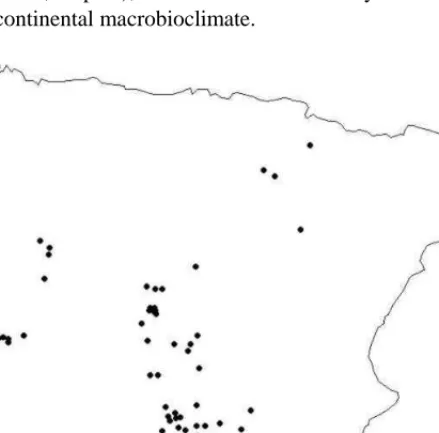
ETHODSJuniper formations are well represented in various biogeographical units on the Iberian Peninsula, where they can be found in both the central and most continentalised eastern zones and in the most oceanic Portuguese territories in both siliceous and limestone areas (Figure 1).
All these areas share the common feature of being small mountain chains formed by quartzite, granite, pre-Cambrian slate, limestone and dolostone-limestone with altitudes ranging between 280-1,500 m.
We studied 100 meteorological stations in the centre-south of the Iberian Peninsula, of which 29 have an ombrothermic index (Io) of between 3.6 and 6.3, indicating that the territory has a subhumid-humid ombrotype. The 71 remaining weather stations have an Io of between 2.02 and 3.6, conforming a dry ombrotype which predominates throughout the whole territory.
The continentality values range between 10.8 for Santiago Do Cacen (Portugal) and 21.7 for Vianos (Albacete, Spain), suggesting the presence of a
Mediterranean pluviseasonal-oceanic macrobioclimate in the westernmost areas of the territory in the study, and a Mediterranean pluviseasonal-continental macrobioclimate in the easternmost areas.
The thermotype ranges between the thermomediterranean in the warmest territories near the Guadalquivir river valley, and the supramediterranean on the ridges on the Iberian plateau. However, the average values of Io (3.89), Ic (18.54) and Itc (284) clearly indicate the territorial dominance of the dry-subhumid ombrotype, the mesomediterranean thermotype and the Mediterranean pluviseasonal-oceanic macrobioclimate, showing evidence of the continental influence of the plateau in the easternmost areas (Jaén, Ciudad Real and Toledo, Spain), also characterised by the Mediterranean pluviseasonal-continental macrobioclimate.
Figure 1. Area of distribution of Juniperus oxycedrus subsp. lagunae on the Iberian Peninsula (Cano et al., 2007).
The samplings used in this study were collected by the authors over an extensive territory (Spain and Portugal). A variety of territories were covered, and inventories were taken from all the communities dominated by the subspecies Juniperus oxycedrus subsp. oxycedrus and subsp. lagunae. These inventories were compiled following Braun-Blanquet's phytosociological methodology, as described in works such as Braun-Blanquet (1979) and Gèhu and Rivas-Martínez (1981). We also used samplings taken by authors of published works on plant communities that have either a similar physiognomy to our plots or else feature high abundance indices of the species Juniperus oxycedrus in the community.
The various plant taxa were identified in the laboratory with reference to the following works: Flora Ibérica: Castroviejo et al., (eds.) (1986, 1990, 1993a, 1993b, 1997a, 1997b); Muños-Garmendia and Navarro (eds.) (1998); Talavera et al. (eds.) (1999, 2000) and Paiva et al. (eds.) (2001); Flora of Eastern Andalusia: Valdés et al. (eds.) (1987); and Flora Europaea: Tutin et al. (eds.) (1964-80).
R
ESULTS ANDD
ISCUSSIONAll the communities of Juniperus oxycedrus subsp. lagunae have in common the fact that they are permanent formations whose edaphoxerophilous character is imposed by the substrate, which is the result of soil loss caused by human activity. This implies that although the territorial ombrotype allows the survival of species from the Quercus genus, Quercus coccifera can only do so in certain territories. The different groups of inventories in the study belong to different plant communities, and these groups show clear differences –both floristic, bioclimatic, catenal and biogeographical–, as we will outline below.
One of the inventory groups corresponds to a set of samplings taken in the province of Toledo and in the north of the province of Ciudad Real and Jaén. This is a neutral-basophilous phytocoenosis with distribution in Portugal and Extremadura, and found in the mesomediterranean with a dry ombrotype. The inventories highlight the coexistence of species such as Stipa tenacissima, Staehelina dubia, Ruta chalepensis and Thymus zygis, alongside another set of acidophilus species such as Stipa gigantea, Lavandula sampaiana, Cistus ladanifer and Genista hirsuta. This neutral-basophilous phytocoenosis acts as a transition towards the communities of Juniperus oxycedrus subsp. lagunae and Juniperus phoenicea with a clearly basophilous character which grow on
calcareous and dolomitic ridges in Baetic territories and thermo-, meso- and supramediterranean environments with a dry-subhumid ombrotype.
The second group encompasses a series of inventories that were all collected in territories with a strong continental influence within the Toledano-Tagano biogeographic sector. The general characteristics of this group are that they grow in territories with a continental climate, a dry-subhumid ombrotype, and the presence of the taxa Juniperus oxycedrus subsp. oxycedrus, Juniperus oxycedrus subsp. lagunae and Pistacia terebinthus. It is found in the dry-subhumid mesomediterranean bioclimatic belt. In the Toledano-Taganos territories the taxon Juniperus lagunae penetrates into the forests of Pyro-Quercetum rotundifoliae Rivas-Martínez 1987, representing a dynamic aspect deriving from the transformation of the holm-oak into a juniper formation in response to the soil loss caused by human action (forest fires) (Figure 2). This group contains a small cluster of inventories lying far from the main cluster that were collected on steep slopes and deep gorges in the Sierra Morena, under the influence of the thermomediterranean and dry lower mesomediterranean bioclimatic belts in the Mariánico-Monchiquense sector. There is a total absence of western mesophytic elements, and the presence of thermophilous elements that act as differentiating elements: Phlomis purpurea, Asparagus albus, Asparagus aphyllus, Aristolochia baetica. The formations contact catenally on the upper edges of gorges with the siliceous and mesomediterranean holm-oak formation of Pyro bourgaeanae-Quercetum rotundifoliae Rivas-Martínez 1987 myrtetosum communis Rivas-Martínez 1987, and with the siliceous and thermomediterranean Myrto communis-Quercetum rotundifoliae Rivas Goday in Rivas Goday, Borja, Esteve, Galiano, Rigual & Rivas-Martínez 1960; whereas on the interior edges they contact with the edaphohygrophilous formations of Pyro bourgaeanae-Securinegetum tinctoriae (Rivas Goday 1964) Rivas-Martínez & Rivas Goday 1975 (Figure 3).
Both the Toledano-Taganos and Mariánico-Monchiquenses supramediterranean territories contain formations of Juniperus lagunae that tend to be accompanied by Echinospartum ibericum and Adenocarpus argyrophyllus; these are permanent formations that contact catenally with the Pyrenean-oak formations of Sorbo-Quercetum pyrenaicae Rivas Goday ex Rivas-Martínez 1987. This group of inventories is located in territories in Portugal and Extremadura under the supramediterranean thermotype and the dry or subhumid ombrotype.
Figure 2. Vegetation catena with a quartzite rock field and a predominance of
Juniperus oxycedrus subsp. lagunae, contacting towards the lower areas with forests of
Fagaceae.
Figure 3. Vegetation catena in gorges on Palaeozoic slate in the Sierra Morena with a predominance of Juniperus oxycedrus subsp. lagunae, contacting towards the upper areas with forests of Fagaceae.
The formations of Juniperus oxycedrus subsp. lagunae in the easternmost territories of the Iberian Peninsula (Portugal) appear in small mountain ranges with a quartzite character and frequent mesophytic flora, as although the thermotype continues to be mesomediterranean, the ombrotype is subhumid-humid. There is thus a strong floristic component with an oceanic character such as Erica arborea, Viburnum tinus and Cytisus eriocarpus.
C
ONCLUSIONThe different groups of Juniperus communities occupy areas whose dominant ecological feature is the xericity of the substrate. These are permanent edaphoxerophilous formations occupying limited areas that are currently spreading due to the expansion of areas eroded through soil loss due to frequent forest fires, deforestation and brush clearing. These biotopes are not usually occupied by Fagaceae, and Quercus rotundifolia forests are relegated to less hospitable territories. If the same factors that condition this dynamic are maintained, there will continue to be an opportunity for an exponential increase in the area occupied by species from the Juniperus genus. We can therefore predict a change in the landscape in the future, with a strong predominance of gymnosperms over angiosperms owing to the former's better adaptation to extreme conditions. We conclude that these areas in expansion do not pose a serious threat unless there is excessive grazing pressure from livestock, which would produce an alteration in these habitats that are rich in endemic species. All these factors lead us to recommend the application of conservation measures and the implementation of some protective mechanism as a means of monitoring the management of the territory.
A
CKNOWLEDGMENTSWe would like to thank Pru Brooke-Turner for the English translation, and the architect Francisco Javier Quiros Higueras for the vegetation profiles.
R
EFERENCESAmaral Franco, J.; 1986. Juniperus in Flora Ibérica I:181-188 ed. Real Jardín Botánico de Madrid.
Bolos, O. & Vigo J.; 1984. Flora dels Països Catalans. Ed. Barcino, pág. 736. Braun-Blanquet, J.; 1979. Fitosociología. Bases para el estudio de las
comunidades vegetales. Ed. Blume 820 pp. Madrid.
Cano, E.; Rodríguez Torres, A.; Pinto Gomes, C.; García Fuentes, A.; Torrers, J.A.; Salazar, C.; Ruiz, L.; Cano-Ortiz, A. & Montilla, R.J. (2007). Analysis of the Juniperus oxycedrus L. communities in the centre and south of the Iberian península (Spain and Portugal). Acta Bot. Gallica 154(1):79-99.
Castroviejo, S.; Laínz, M.; López González, G.; Momserrat, P.; Muñoz Garmendia, F.; Paiva, J. & Villar, L.; 1986. (eds.).Flora Ibérica. Plantas Vasculares de la Península Ibérica e Islas Baleares. Vol. I: Lycopodiaceae-Papaveraceae. Real Jardín Botánico, CSIC. Madrid. 575 pp.
Castroviejo, S.; Laínz, M.; López González, G.; Momserrat, P.; Muñoz Garmendia, F.; Paiva, J. & Villar, L.; 1990. (eds.) Flora Ibérica. Plantas Vasculares de la Península Ibérica e Islas Baleares. Vol. II: Platanaceae-Plumbaginaceae (partim). Real Jardín Botánico, CSIC. Madrid. 897 pp. Castroviejo, S.; Aedo, C.; Cirujano, S.; Laínz, M.; Monserrat, P.; Morales, R.;
Muñoz Garmendia, F.; Navarro, C.; Paiva, J. & Soriano,C.;1993a. (eds.). Flora Ibérica. Plantas Vasculares de la Península Ibérica e Islas Baleares. Vol. III: Plumbaginaceae (partim)-Capparaceae. Real Jardín Botánico, CSIC. Madrid. 730 pp.
Castroviejo, S.; Aedo, C.; Gómez Campo, C.; Laínz, M.; Monserrat, P.; Morales, R.; Muñoz Garmendia, F.; Nieto Feliner, G.; Rico, E.; Talavera, S. & Villar, L.; 1993b. (eds.). Flora Ibérica. Plantas Vasculares de la Península Ibérica e Islas Baleares. Vol. IV: Cruciferae-Monotropaceae. Real Jardín Botánico, CSIC. Madrid. 730 pp.
Castroviejo, S.; Aedo, C.; Laínz, M.; Morales, R.; Muñoz Garmendia, F.; Nieto Feliner, G. & Paiva,J.; 1997a. (eds.). Flora Ibérica. Plantas Vasculares de la Península Ibérica e Islas Baleares. Vol. V: Ebenaceae-Saxifragaceae. Real Jardín Botánico, CSIC. Madrid. 320 pp.
Castroviejo, S.; Aedo, C.; Benedí, C.; Laínz, M.; Muñoz Garmendia, F.; Nieto Feliner, G. & Paiva,J.;1997b. (eds.). Flora Ibérica. Plantas Vasculares de la Península Ibérica e Islas Baleares. Vol. VIII: Haloragaceae-Euphorbiaceae. Real Jardín Botánico, CSIC. Madrid. 375 pp.
Géhu, J.M. & Rivas Martínez, S.; 1981. Notions fondamentales de Phytosociologie. En: Berichte der Symposien der Int. Verein. für Vegetat. (Syntaxonomie), 5-33. Cramer. Vaduz.
Muñoz Garmendia, F. & Navarro, C.; 1998. (eds). Flora Ibérica. Plantas Vasculares de la Península Ibérica e Islas Baleares. Vol.VI: Rosaceae. Real Jardín Botánico, CSIC. Madrid. 592 pp.
Paiva, J.; Sales, F.; Hedge, I.C.; Aedo, C.; Aldasoro, J.J.; Castroviejo, S.; Herrero, A. & Velayos,M.; 2001. (eds). Flora Ibérica. Plantas Vasculares de la Península Ibérica e Islas Baleares. Vol. XIV: Myoporaceae-Campanulaceae. Real Jardín Botánico, CSIC. Madrid. 251 pp.
Talavera, S.; Aedo, C.; Castroviejo, S.; Romero Zarco, C.; Sáez, C.; Salgueiro, F.J. & Velayos, M.; 1999. (eds). Flora Ibérica. Plantas Vasculares de la
Península Ibérica e Islas Baleares. Vol.VII (I): Leguminosae (partim). Real Jardín Botánico, CSIC. Madrid. 578 pp.
Talavera, S.; Aedo, C.; Castroviejo, C.; Herrero, A.; Romero Zarco, C.; Salgueiro, F.J. & Velayos,M.;2000. (eds.). Flora Ibérica. Plantas Vasculares de la Península Ibérica e Islas Baleares. Vol. VII (II): Leguminosae (partim). Real Jardín Botánico, CSIC. Madrid. 1119 pp.
Tutin, T.; Heywood, V.H.; Burges, D.A.; Valentine, D.H.; Walters, S.M. & Webb, D.A.; 1964-80. (eds.) Flora Europaea. Vol I al V. Cambrige at the University Pres.
Valdés, B.; Talavera, S. & Fernández Galiano,E.; 1987. Flora Vascular de Andalucía Occidental. Vol. 1, 2 y 3. Ketres Editora, S. A. Barcelona. Valdés, B.; Rejdali, M.; Achhal El Kadmiri, A.; Jury, J. L. & Monserrat, J.M.;
2002. (eds.). Checklist of vascular plants of N. Morocco with identification keys. CSIC. Vol I y II. Madrid.
Vicioso, C.; 1946. Notas sobre la flora española. Anales Jar. Bot. Madrid, VI(2)5-89.