THE DYNAMICS OF LEARNING ORGANIZATIONS IN HIGHER EDUCATION INSTITUTIONS Marina Antunes ADJUNCT PROFESSOR AT ISCAL (LISBON ACCOUNTING AND BUSINESS SCHOOL) OF THE LISBON POLYTECHNIC INSTITUTE (IPL), Portugal Pedro Mucharreira ISCE-INSTITUTO SUPERIOR DE CIÊNCIAS EDUCATIVAS | UIDEF, INSTITUTO DE EDUCAÇÃO, UNIVERSIDADE DE LISBOA, Portugal Maria do Rosário Justino ISCAL – LISBON ACCOUNTING AND BUSINESS SCHOOL OF THE LISBON POLYTECHNIC INSTITUTE, Portugal Joaquín Quirós UNIVERSITY OF EXTREMADURA, Spain Access to this paper is restricted to registered delegates of the EURAM 2019 (European Academy of Management) Conference.
1
THE DYNAMICS OF LEARNING ORGANIZATIONS IN HIGHER
EDUCATION INSTITUTIONS
ABSTRACT
This research aims to study the role that learning organizations may have on Portuguese higher education institutions (HEIs), through a literature review that supports the presentation of a conceptual model proposed by the authors, which aims to study the possible relationships between learning organizations and Total Quality Management (TQM) practices, innovation strategies, internationalization, and organizational performance. The survival of HEIs depends on how these institutions accept change, improve their practices and react to competitiveness. Nowadays, the most relevant aspects of education in higher education are translated by learning, dynamic structures, flexibility, and quality. Consequently, the higher education system will have to adapt to the continuous changes and new requirements, to achieve the success and the proposed objectives. Thus, to differentiate themselves from their competitors, organizations must develop their resources, promoting the creation of knowledge and the dissemination of information.
Regarding the methodology of this research, the data will be obtained through a questionnaire to evaluate the different dimensions of the proposed conceptual model. The sample will consist of about 200 emails from members of the management boards of Portuguese HEIs. In the treatment of quantitative data, a model of structural equations (SEM) will be used, to investigate the possible relations between the different dimensions incorporated in the model. In terms of the discussion of results, it is intended to characterize the relationship between the concept of learning organizations and TQM, innovation, internationalization, and performance in Portuguese HEI.
Keywords: Higher Education Institutions, Learning Organizations, Organizational Performance, Total Quality Management, Internationalization, Innovation.
2
1. INTRODUCTION
Nowadays, HEIs face increasing challenges posed by competitive and dynamic markets. This leads to disruptive changes that force organizations to change their strategy to survive. Expansion of the global economy, as well as, a global competition, new developments and innovations, rapid changes and new technologies, customer expectations, quality management, demographic changes, and demand for specific skills, pose a huge challenge to the flexibility of an organization that operates in this scenario. Organizations need to change and adopt new ways to remain competitive. To survive in a competitive and rapidly changing environment, continuous learning becomes essential.
Learning organizations can be defined as organizations that facilitate the learning of all their elements, assuming themselves as learning entities that have certain characteristics to meet the changing needs of the environment. Currently, HEIs suffer great pressure to create significant learning environments, this is, learning spaces that can fully train their students, based on educational projects that take on and respond to the growing cultural, linguistic, ethnic, and socioeconomic diversity of students, their families and their teachers. An educational organization that intends to establish itself as a learning organization will have to consider multiple dimensions, such as the individual behaviour of different educational agents, teamwork and organizational culture, structured and fostered by factors such as trust, time, technology and joint reflection. Learning organizations will be able to follow developments and improvements in the business environment to perform their actions successfully. Thus, one of the key goals of HEIs is to achieve academic excellence among students, and as such, need to transform into learning organizations and subsequently improve the overall performance of the organization.
The capacity to deal with change and the search for continuous improvement to overcome the challenges that arise in organizations' day to day has been related to the capacity of these
3
organizations to learn (Senge, 1990; Armstrong and Foley, 2003). This means that organizations that demonstrate learning ability will be able to more easily follow developments and changes in the environment in which they operate to be successful in their area of business. In this way, like other organizations, HEIs will also have to become learning organizations in order to achieve their strategic objectives, as learning organizations seek transformation and excellence through an organizational renewal (Griego et al., 2000). To be successful, HEIs must apply business concepts that are inherent in profit-oriented businesses, including evaluating their performance, and as such they will have to engage with organizations oriented towards continuous learning. As learning organizations, HEIs will be able to expand knowledge, skills, produce high-quality professionals and researchers, increase innovation and creativity, and effectively contribute to the production of knowledge and the development of intellectual property (Kok, 2005; Abdullah and Selamat, 2005).
Quality also plays a very important role, and nowadays one of the primary goals of any institution is to achieve excellence in its area of expertise. Many factors can affect the quality of HEIs, such as the organizational culture and the rapid change that occurs in the contexts in which they are inserted and that inevitably affect all organizations, including HEIs. One way to achieve the quality in an organization is to implement the Total Quality Management (TQM) approach, which covers all processes and stakeholders of an institution.
Since higher education is considered a public good, thus being a public responsibility, the pressure is continuously on the demand for maximum effectiveness and efficiency in the management of resources and in the search for quality assurance, and the organization itself is the first instance where evaluation processes should be established. The internal structures and mechanisms for quality assurance should be a fundamental first line of intervention in evaluation processes, with the ultimate objective of promoting the internalization of a quality culture that permeates all the activities carried out within the institution (Cabrito, 2009).
4
On the other hand, there is also the concept of innovation. Innovation in HEIs is understood as a procedure or method of educational activity that differs significantly from established practice and is used to increase the level of efficiency in a competitive environment. Innovation provides organizations with the means to progress in parallel with the changes that are taking place in the environment, being considered a strategic key to respond to new challenges full of uncertainties (Lloréns-Montes et al., 2005). Educational innovations include pedagogical innovation, scientific and methodological innovation, educational and technological innovation. Higher education institutions that have chosen innovation-based development become competitive leaders in the education market. The creation of new forms of education and the use of perfect control mechanisms in each educational institution will give the opportunity to create a unique educational space capable of meeting the needs of society in quality education with specific opportunities of clients in the educational market. Thus, higher education systems should seek to innovate (Barber et al., 2013), that is, HEIs should rethink their working model, provide their graduates with the skills and knowledge appropriate to the job market and create knowledge that can be marketed in new products and services.
2. THEORETICAL FRAMEWORK
2.1. Relevance of the research
Organizational learning is a crucial factor to be managed proactively by organizations in order to survive and be successful in the activity in which they operate. Learning encourages people to develop their ability to solve problems by promoting the improvement of the quality of their actions. Develop qualified collaborators is one of the valences of continuous learning which can create long-term competitive advantage for organizations and that promotes success in organizational performance. Organizational learning prioritizes the creation and acquisition of new knowledge and emphasizes the role of people in the creation and use of that knowledge
5
(Denton, 1998). In this way, the concept of organizational learning provides the fundamental foundations for achieving competitive advantage, translating into an excellent performance and success of organizations (Dunphy and Griffths, 1998).
To be successful, HEIs must apply business concepts that are inherent in profit-oriented businesses, including evaluating their performance, and as such they will have to engage with organizations oriented towards continuous learning. HEIs play an important role in the knowledge-based economy. The increase of knowledge assets is the central issue of higher education and clearly contributes to the future of the economic and social development of any society. HEIs are characterized by several distinctive features that differentiate them from any other type of institution, and these aspects reflect the strategy of the whole educational system as well as the development strategy of each educational institution. Many factors can affect HEIs quality, such as the organizational culture and the rapid change that occurs in the contexts where they are inserted and that inevitably affect all organizations, including HEIs. One of the ways to achieve a quality organization is the implementation of the Total Quality Management (TQM) approach that encompasses all the processes and stakeholders of an institution. Education and science are deeply embedded in economics and social life, and their level significantly affects the life quality and the possibility of constant development in both a country and the international community at large. Therefore, science and qualified personnel are recognized in Europe as the decisive factor in achieving the objectives of internationalization of the educational process, that is, to make European education more competitive, dynamic and capable of ensuring sustainable growth, employment of the population and social cohesion. The issue of internationalization has, over the last few years, taken on a leading role not only in Europe but throughout the world. Concerning the internationalization of HEIs, several authors have analyzed the question of quality in these
6
institutions with a view to obtaining a sustainable competitive advantage (Aldridge and Rowley, 1998).
Due to an increasingly competitive environment among HEIs globally, these institutions have been concerned with the need to adopt management techniques to improve the quality of study programs and services (Telford and Masson, 2005; Yeo, 2005). In addition to this, HEIs have taken a more active approach than they did in the past, with institutions now focusing not only on services, but also on influential environmental factors and their impacts on potential students. The quality of higher education is affected by a variety of factors, not only the content of the courses of study, but also the performance of faculty, student support services and other aspects should be recognized when assessing higher education, especially the quality of HEIs. Organizational performance, on the other hand, has proved to be a difficult concept to define and even measure. Among the existing studies about the performance, is possible to state that there isn’t a single criterion for defining the performance, which makes difficult to measure or compare the results. To overcome this ambiguity concerning the performance criterion, in this research will be considered three perspectives of performance, namely, financial, operational, and market performance.
2.2. The dynamics of learning organizations
An institution that wishes to establish itself as a learning organization will have to consider multiple dimensions, such as the individual behavior of different educational agents, teamwork and organizational culture, structured and empowered by factors such as trust, time, technology and joint reflection (OECD, 2016). In this same line of thinking, Senge (1990) clarified that learning organizations usually develop five capacities - or as the author designates them, nuclear disciplines - such as learning systems, personal domain, mental models, shared vision and team learning. By learning systems, we can understand a whole body of knowledge and tools that
7
help in the identification and perception of how they can be transformed, always bearing in mind the existence - and the will to circumvent it - of certain dynamics that are real obstacles to change. If a system does not record changes, it will continue to generate the same results, even assuming the individuality of each employee. The causes and effects of problems are not always centered in space and time, and it is important that learning organizations seek multiple levels of understanding in the domain of these complex realities where education is embedded (Senge et al., 2000).
Bowen et al. (2007) believe that when HEIs are assumed to be learning organizations, this may lead to the unlocking of creative processes and dynamics that allow significant changes, responding to the new and growing challenges that are posed to higher education, in search of an educational achievement, but also a personal one. These authors clarify that learning organizations are able to value, acquire, and use information that emerges from the organization and its employees, to redefine and evaluate strategies to achieve certain objectives. According to the authors, an institution that manifests several properties or characteristics can be regarded as a learner, grouped according to certain actions and feelings.
According to Webber et al. (2013), referring to the learning organizations paradigm, although having its origin in the economic and business world, it is becoming increasingly urgent to assume its application in educational organizations. Other authors (Fullan and Hargreaves, 2000) corroborate that the educational institutions that assume this paradigm can be more effective in the processes of change, being possible to verify a benefit in the professional development of teachers which is reflected in better learning by the students. Some criticisms are pointed to this process in the educational context, as reported by Bolivar (2000), particularly in the difficulties of implementation of this concept in public institutions, pointing to examples of high bureaucracy, excessive centralization and little openness to change.
8
The concept of learning organizations is an important and valuable way to facilitate learning and knowledge management and has been considered an important plan to improve organizational performance so that the organization remains competitive (Davis and Daley, 2008). Learning organizations promote innovation and the creativity of employees, which in turn will improve organizational performance (Ramus and Steger, 2000; Calantone et al., 2002). Likewise, it also promotes the transfer and sharing of knowledge within the organization, which is extremely important in the process of organizational performance (Jiang and Li, 2008). According to DeSimone et al. (2002), a learning organization can be characterized by five different organizational dimensions, namely, structure, information systems, human resources and human resource development practices, organizational culture, and leadership. In terms of structure, learning organizations are known by eliminating hierarchical barriers and promote collaborative structures, such as multifunctional teams. Besides that, learning organizations define structures and practices that stimulate information sharing and, at the same time, implement reward systems which reinforce long-term performance and the development of new skills and knowledge. The culture of learning organizations is characterized by an emphasis, promotion and reinforcement of risk-taking.
2.3. TQM in higher education institutions (HEIs)
Total Quality Management (TQM) is a management philosophy that aims at continuous improvement of organizational performance and customer satisfaction, being transversal to the whole organization and incorporating in its model all the actors of the organizational structure. TQM involves integrating and dynamic processes. TQM is a strategic orientation within the organization, focusing on management commitment and support for the allocation of valuable resources in process improvements, product and service quality, in the participation and involvement of employees, as well as in the sharing of information and knowledge among the
9
various elements within the organization. On the other hand, TQM also focuses on the demand and expectations of customers, the quality of suppliers and business partners, and strategic adaptation to changes in the surrounding environment and the markets where organizations are inserted. Many of the researches that have focused on the effects of TQM over the competitive advantage have shown that its presence leads to improved performance and increased competitiveness (Zhang, 2000; Antunes et al., 2017). TQM principles have been applied in the industrial sector for several decades, however, its application in service companies and, more specifically, in HEIs has recently emerged as a new concept, framed in new realities that began to recognize higher education institutions as profitable organizations (Antunes et al., 2018). Researches on the implementation of TQM practices in HEIs have had projection due to the growing competitiveness of educational institutions, not only in the private but also public sector, and in the increase of expectations generated around the labor market. Nowadays, due to globalization and internationalization, there are constant changes that occur very quickly, which means that, in business environments, organizations must react quickly and efficiently to these changes, if they want to be successful in the business world. Thus, to differentiate themselves from their competitors, organizations must develop their resources, promoting the creation of knowledge and the dissemination of information. It is in this perspective that the new paradigm of how to manage and develop knowledge and the strategic forces of organizations, thus becoming the central focus of recent investigations. Education is a resource of enormous value for the development of any society and the recognized quality of education provided in institutions is a fundamental element of the administrative management of higher education institutions (Rahman and Bullock, 2005). Quality assumes a role of relevance in customer satisfaction and recognition of the institution in the market, and nowadays one of the primary objectives of any institution is to achieve excellence in its area of business. However, this task is more complex when it comes to assessing something intangible, such as education
10
systems and the processes of higher education institutions, and it is therefore essential to define adequate tools for the evaluation of these intangible assets. Although the TQM principles were initially used in the industrial sector, the implementation of TQM practices is also applicable to higher education institutions, having the potential to improve quality in educational institutions and achieve continuous improvement (Owlia and Aspinwall, 1997). Nowadays, the most relevant aspects of education in higher education are translated by learning, dynamic structures, flexibility and quality. Consequently, the higher education system will have to adapt to the continuous changes and new requirements, to achieve the success and the proposed objectives. This means that the entire education system will, necessarily, to coat itself on high levels of quality. On the other hand, the emphasis placed on costumers and quality leads to consider as priorities, organizational learning and innovation so that institutions provide the best services to students and teachers as well as to society itself, promoting, ultimately, growth and economic development (Mucharreira and Antunes, 2015).
2.4. The relationship between learning organizations and TQM
According to Martinez-Costa and Jimenez-Jimenez (2009), organizational learning should be recognized as a key issue for organizations that aspire to implement TQM practices. These authors point out that TQM constitutes the propitious environment for the creation of organizational learning, proving to be the first step in the construction of learning organizations. Other conclusions also mention that organizational learning is the result of a successful TQM process (Martinez-Costa and Jimenez-Jimenez, 2009). Both TQM and organizational learning capacity are interrelated concepts due to their focus on continuous improvement and gaining competitive advantage. One of the essential intervention points of the TQM culture is the emphasis on organizational learning by each person involved in the process to obtain process improvement. In this way, the following hypothesis of investigation is considered:
11
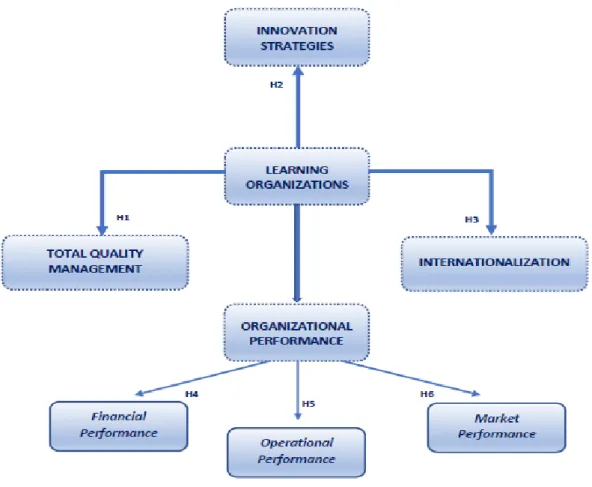
H1: The dynamics of learning organizations have a positive influence on the TQM implementation on HEIs.
2.5. Innovation in higher education institutions (HEIs)
In the last decades, the theme of innovation has attracted the attention of many researchers and professionals, and innovation has been considered as a strategic driver to take advantage of new opportunities and to protect knowledge assets (Gatignon et al., 2002; Hurmelinna-Laukkanen et al., 2008). Innovation plays a major role in providing unique products and services, creating more value than previously recognized and setting barriers to entry for new competitors (Lloréns-Montes et al., 2005). Therefore, innovation has sparked the interest of many researchers identify their push factors (Becheikh et al., 2006).
In the literature, several definitions of the concept of innovation are found. Damanpour (1991) defines innovation as anything new to the business, which may consist of a system, a policy, a process, a product or a service, and is considered a tool for the success of the organization. Lafley and Charan (2008) refer to innovation as a new idea that materializes in benefits, revenues and profits. Crossan and Apaydin (2010) gave a more exhaustive definition of the concept, characterizing innovation as the production or adoption, assimilation and exploitation of innovative added value in economic and social spheres; renewal and creation of products, services and markets; development of new production methods; and definition of new management systems, being both a process and an outcome.
Competitiveness as one of the elements of any market environment improves the quality of specialist training, because it leads HEIS to provide qualified professional standards to all stakeholders, such as teachers, non-teaching staff and students. The higher education market, through competitive mechanisms, promotes participation in innovation processes. Competition based on innovation, its quality and opportunity are an important feature of the survival of HEIs, it serves as a crucial factor for the development and implementation of new offers. Higher
12
education institutions that opt for innovation-based development become competitive leaders in the education market, and only those institutions will be able to adapt quickly to change.
2.6. The relationship between learning organizations and innovation
Chaveerug (2008) points out that innovation is closely related to organizational learning, since organizational learning is associated with the development of new knowledge, which is crucial to the institution's capacity for innovation and its performance.Moreover, according to Liao et al. (2008), innovation emerges as a prerequisite for the creation of knowledge and is assumed as the essential key to knowledge management, because organizations learn mainly from innovations made or adopted.Most of the studies developed on this relation consider that the learning injects new ideas, and strengthens the creativity and the capacity to discover new opportunities, which, consequently, leads to the definition of innovation strategies (Lloréns -Montes et al., 2005).Organizational learning helps the organizationto acquire new knowledge, which leads to innovation (Cohen and Levinthal, 1990). Garvin (2000) pointed out that an organization must develop the factors that help in the introduction of new ideas, products and services, contributing to innovation strategies. According to Cefis and Marsili (2005), organizational learning helps organizations to introduce new products and services through innovations so that they can survive in a highly competitive environment.
Successful innovations are the result of gradual changes in concepts and methodologies continuously implemented over time (Liao et al., 2008). This gradual process depends on the creation, search, acquisition and sharing of knowledge, which in turn will lead to organizational learning,thus forming the basis for successful innovation. In this way, it is pertinent to approach this relation to the HEIs context, which presupposes the definition of the following investigation hypothesis:
13
H2: The dynamics of learning organizations have a positive influence on innovation strategies on HEIs.
2.7. Learning organizations and internationalization strategies
Many researchers point out that internationalization provides different experiences to organizations, and internationalization strategies allow them to learn or to develop new knowledge (Hitts et al., 1997, Gomes and Ramaswamy 1999, Forsgren 2002). In fact, some of these studies also considered that internationalization creates new knowledge, which encourages them to adopt new ideas and procedures (Wagner, 1995; Pittiglio et al., 2009). Pittiglio et al. (2009) stated that organizations in international markets generate more knowledge than their competitors who do not adopt any internationalization strategybecause organizations that adopt internationalization strategies learn more from the experiences gained across borders. Wagner (2001) demonstrates that international companies innovate more and perform better because they have access to new realities, knowledge and experiences. In this way, we consider the following hypothesis:
H3: The dynamics of learning organizations have a positive influence on internationalization strategies on HEIs.
2.8. Learning organizations and organizational performance
According to Harbor (2008), organizational performance can be measured through the implementation of a series of measures that represent the result of the organization’s activity. Other authors, namely Peterson et al. (2003), defined organizational performance as the ability of organizations to use their resources efficiently in order to produce results consistent with their strategic objectives. Other studies have considered organizational performance as something that allows to evaluate the success of organizations and to achieve their success (Antony and Bhattacharyya, 2010).
14
Several studies have suggested that learning organizations have a significant impact on the performance of their activities (Hernaus et al., 2008; Ramírez et al., 2011; Pokharel and Choi, 2015). Ramírez et al. (2011) showed that organizational learning is positively related to organizational performance in Spanish public universities, concluding that a greater emphasis on the size of learning organizations is equivalent to better performance in the organization. The learning orientation of an organization influences its performance indirectly, as it improves the quality of market-oriented behaviors, and directly, since it facilitates generating learning which leads to innovations. Another evidence found in the literature is the study of Calantone et al. (2002), which states that organizational learning affects organizational performance through the company's innovative performance. Also, Martinez-Costa and Jimenez-Jimenez (2009) evidenced the positive influence of organizational learning on organizational performance, referring that organizations that learn best are more likely to identify events and trends in the market that, in turn, will lead to increased sales and increased market share. Apart from this aspect, organizational learning provides a more flexible structure for organizations so that they can respond more quickly and assertively to new challenges than their competitors. On the other hand, continuous learning will also provide the organization with a better efficiency and celerity in the processing of information from the markets.
Based on the various researches carried out on these subjects, the three hypotheses of investigation that intend to respond to the possible relationship between the learning organizations and organizational performance of HEIs are now presented, being considered in this study three different perspectives on the concept of organizational performance, namely, the financial, operational and market approach.
H4: The dynamics of learning organizations have a positive influence on the financial performance of HEIs.
H5: The dynamics of learning organizations have a positive influence on the operational performance of HEIs.
15
H6: The dynamics of learning organizations have a positive influence on the market performance of HEIs.
Completed the description of the fundamentals that led to the construction of the initial issues based on literature review, it is now presented the proposed research model as illustrated in the figure 1:
Figure 1 - Conceptual Model and Research Hypotheses
3. Methodology
Regarding to methodology, the research is qualitative in nature, using quantitative techniques. The data were obtained through the application of a questionnaire elaborated by the authors in order to evaluate the different dimensions of the proposed conceptual model. In this study, the
16
independent variable is the concept of learning organizations while the dependent variable are TQM practices, innovation strategies, internationalization, and organizational performance, being this last variable measured through three different perspectives, namely, financial, operational, and market.
The sample will consist of about 200 email addresses of members of the direction of Portuguese universities and polytechnics. For the statistical treatment of the data, a structural equations model (SEM) will be used to investigate the possible relationships between the different dimensions incorporated in the model. The questionnaire will be elaborated with closed questions, using a five-point Likert scale to evaluate the respondents' conceptions about the dimensions considered, where 1 represents "strongly disagree" and 5 represents "strongly agree". For the characterization of respondents and organizations, nominal and ordinal scales will be used.
4. Final considerations
Nowadays, organizational learning, TQM, innovation and internationalization have become increasingly important for organizations. Organizations are forced to eliminate their mental and physical barriers in order to learn to innovate and to become competitive in highly competitive markets. Continuous learning, new mental models, new products, new processes, new markets and the question of globalization are issues that HEIs cannot ignore at all, being part of the dynamics of organizations.
This research, which is still under development, intends to analyze these dimensions in HEIs, since this type of institutions has been little studied in the various investigations carried out, not only in Portugal, but also in other countries. Thus, with the first conclusions that are expected soon,the authors of this research hope to contribute to a better understanding of HEIs, in order to assist the decision-making of these institutions to achieve the strategic objectives.
17
Increasingly, HEIs have to recognize themselves with profit-oriented organizations, since ensuring financial sustainability is a huge challenge for education institutions.
References
Abdullah, R. and M. Selamat, 2005, “A Framework for Knowledge Management Systems Implementation in Collaborative Environment for Higher Learning Institution”. Journal of Knowledge
Management Practice, Retrieved from http://www.tlainc.com/articl83.htm.
Aldridge, S. and J. Rowley, 1998, “Measuring customer satisfaction in higher education”, Quality
Assurance in Education, 6, 4: 197–204.
Antony, J. P. and S. Bhattacharyya, 2010, “Measuring organizational performance and organizational excellence of SMEs – Part 2: An empirical study on SMEs in India”. Measuring Business Excellence, 14, 3: 42-52.
Antunes, M. G., J. Texeira-Quirós and M. R. Justino, 2017, “The relationship between innovation and total quality management and the innovation effects on organizational performance”. International
Journal of Quality & Reliability Management, 34, 9: 1474-1492.
Antunes, M. G., P. R. Mucharreira, M. R. Justino and J. Texeira-Quirós, 2018, “The Role of TQM, Innovation and Internationalization Strategies on the Financial Sustainability of Higher Education Institutions (HEIS)”. ICERI 2018 Proceedings – Meeting the Challenges of 21st Century Learning, Seville, Spain: IATED Academy, pp. 9778-9787.
Armstrong, A. and P. Foley, 2003, “Foundations of a learning organization: Organization learning mechanism”, Learning Organization, 10: 74-82.
Barber, M., K. Donnely and S. Rizvi, 2013, An Avalanche Is Coming Higher Education and the
Revolution Ahead. London: Institute for Public Policy Research.
Becheikh, N., R. Landry and N. Amara, 2006, “Lessons from innovation empirical studies in the manufacturing sector: a systematic review of the literature from 1993-2003”. Technovation, 26, 5/6: 644-664.
Bolivar, A., 2000, Los centros educativos como organizaciones que aprenden. Madrid: Editorial La Muralla.
Bowen, G., W. Ware, R. Rose and J. Powers, 2007, “Assessing the Functioning of Schools as Learning Organizations”. Children & Schools, 29, 4: 199-208.
Cabrito, B. G., 2009, “Avaliar a qualidade em educação: avaliar o quê? Avaliar como? Avaliar para quê?”. Caderno Cedes, 29, 78: 178-200.
Calantone, R., S. Cavusgil and Y. Zhao, 2002, “Learning orientation, firm innovation capability, and firm performance”. Industrial Marketing Management, 31, 6: 515-524.
Cefis, E. and O. Marsili, 2005, “A matter of life and death: Innovation and firm survival”. Industrial
18
Chaveerug, A. and P. Ussahawanitchakit, 2008, “Learning Orientation, Innovation Capability, and Organizational Performance in Thai Audit Firms: Moderating Effects of Organization Climate and Uncertainty Environment”. Review of Business Research, 8, 2: 92-102.
Cohen, W. M. and D. A. Levinthal, 1990, “Absorptive capacity: A new perspective on learning and innovation”. Administrative Science Quarterly, 35, 1: 128-152.
Crossan, M. and M. Apaydin, 2010, “A multi-dimensional framework of organizational innovation: a systematic review of the literature”. Journal of Management Studies, 47, 6: 1154- 1191.
Damanpour, F., 1991, “Organizational innovation: a meta-analysis of effects of determinants and moderators”. Academy of Management Journal, 34, 3: 550-590.
Davis, D. and B. J. Daley, 2008, “The learning organization and its dimensions as key factors in firms’ performance”. Human Resource Development International, 11, 1: 51-66.
Denton, J., 1998, Organisational learning and effectiveness. London: Psychology Press.
DeSimone, R. L., J. M. Werner and D. M. Harris, 2002, Human Resource Development. Orlando: Harcourt College Publishers.
Dunphy, D. and A. Griffths, 1998, The Sustainable Corporations. St Leonards: Allen and Unwin. Forsgren, M., 2002, “The Concept of Learning in the Uppsala Internationalization Process Model: A Critical Review”. International Business Review, 11, 3: 257–277.
Fullan, M. and A. Hargreaves, 2000, A Escola como organização aprendente. Porto Alegre: Artmed Editora.
Garvin, D. A., 2000, Learning in action: A guide to putting the learning organization to work. Boston: HBSP.
Gatignon, H., M. Tushman; W. Smith and P. Anderson, 2002, “A structural approach to assessing innovation: construct development of innovation locus, type, and characteristics”. Management Science, 48, 9: 1103-1122.
Gomes, L. and K. Ramaswamy, 1999, “An Empirical Examination of the Form of the Relationship between Multinationality and Performance”. Journal of International Business Studies, 30: 173–188. Griego, O. V., G. D. Geroy and P. C. Wright, 2000, “Predictors of learning organizations: A human resource development practitioner’s perspective”. The Learning Organization, 7, 1: 5-12.
Harbour, J. L., 2008, The performance paradox: Understanding the real drivers that critically affect
outcomes. Boca Raton: CRC Press.
Hernaus, T., M. Skerlavaj and V. Dimovski, 2008, “Relationship between organisational learning and organisational performance: the case of Croatia”. Transformations in Business & Economics, 7, 2: 32-48.
Hitt, M. A., R. E. Hoskisson, and H. Kim, 1997, “International Diversification: Effects on Innovation and Firm Performance in Product-diversified Firms”. Academy of Management Journal, 40: 767-798. Hurmelinna-Laukkanen, P., L. Sainio and T. Jauhiainen, 2008, “Appropriability regime for radical and incremental innovations”. R&D Management, 38, 3: 278-289.
19
Jiang, X. and Y. Li, 2008, “The relationship between organizational learning and firms’ financial performance in strategic alliances: A contingency approach”. Journal of World Business, 43, 3: 365-379.
Kok, A., 2005, “Intellectual Capital Management as Part of knowledge Management Initiatives as Institutions of Higher Learning”. The Electronic Journal of Knowledge Management, 5, 2: 181-192. Lafley, A. and R. Charan, 2008, The game-changer: how you can drive revenue and profit growth with
innovation. New York: Crown Business.
Liao, S., W. Fei and C. Liu, 2008, “Relationship Between Knowledge Inertia, Organizational Learn-ing and Organization Innovation”. Technovation, 28: 183-195.
Lloréns-Montes, F. J., A. R. Moreno and V. G. Morales, 2005, “Influence of support leadership and teamwork cohesion on organizational learning, innovations and performance: an empírica examination”.
Technovation, 25, 10: 1159-1172.
Martinez-Costa, M. and D. Jimenez-Jimenez, 2009, “The Effectiveness of TQM: The Key Role of Organizational Learning in Small Businesses”. International Small Business Journal, 27: 98-125. Mucharreira, P. R. and M. G. Antunes, 2015, “Os efeitos das variáveis macroeconómicas no desempenho das organizações: Evidência das pequenas e médias empresas em Portugal”. Portuguese
Journal of Accounting and Management – Revista Científica da Ordem dos Contabilistas Certificados,
17: 113-143.
OECD, 2016, What makes a school a learning organisation? - A guide for policy makers, school leaders
and teachers. Paris: OECD Publishing.
Owlia, M. S. and E. M. Aspinwall, 1997, “TQM in higher education - A review”. International Journal
of Quality & Reliability Management, 14: 527– 543.
Peterson, W., G. Gijsbers and M. Wilks, 2003, An organizational performance assessment system for
agricultural research organizations: Concepts, methods, and procedures. The Hague: International
Service for National Agricultural Research.
Pittiglio, R., E. Sica and S. Villa, 2009, “Innovation and internationalization: the case of Italy”. The
Journal of Technology Transfer, 34, 6: 588–602.
Pokharel, M. P. and S. O. Choi, 2015, “Exploring the relationships between the learning organization and organizational performance”. Management Research Review, 38, 2: 126-148.
Rahman, S. and P. Bullock, 2005, “Soft TQM, hard TQM, and organizational performance relationships: An empirical investigation”. Omega, 33: 73–83.
Ramírez, A., V. Morales and R. Rojas, 2011, “Knowledge creation, organizational learning and their effects on organizational performance”. Engineering Economics, 22, 3: 309-318.
Ramus, C. and U. Steger, 2000, “The roles of supervisory support behaviors and environmental policy in employee" ecoinitiatives" at leading-edge European companies”. The Academy of Management
Journal, 43, 4: 605-626.
Senge, P. M., 1990. The fifth discipline: The art and practice of learning organization. New York: Doubleday.
20
Senge, P. M., N. Cambron-McCabe, T. Lucas, B. Smith and J. Dutton, 2000, Schools that learn: A fifth
discipline fieldbook for education, parents, and everyone who cares about education. New York:
Doubleday.
Telford, R. and R. Masson, 2005, “The congruence of quality values in higher education”. Quality
Assurance in Education, 13, 2: 107–119.
Wagner, J., 1995, “Exports, firm size, and firm dynamics”. Small Journal Economics, 71: 29–39. Wagner, J., 2001, “A note on the firm size – export relationship”. Small Journal Economics, 174: 229– 237.
Webber, K., G. Bowen, N. Melão and M. Dinis, 2013, “As escolas portuguesas são organizações aprendentes? Um estudo empírico”. Revista Portuguesa de Investigação Educacional, 13: 7-26. Yeo, R. K., 2008, “Brewing service quality in higher education”. Quality Assurance in Education, 16, 3: 266–286.
Zhang, Z., 2000, “Developing a model of quality management methods and evaluating their effects on business performance”. Total Quality Management, 11: 129–137.