A Work Project presented as part of the requirements for the Award of a Master’s degree in Management from the Nova School of Business and Economics.
WILL AUTONOMOUS VEHICLES MAKE PUBLIC TRANSPORT
OBSOLETE?
Will – Colin Wellhausen
Work project carried out under the supervision of: Professor João Castro
Abstract
Autonomous vehicles are often discussed as a desirable development in the future of transport with great potential improvements on emissions, congestion and safety. This raises the question whether autonomous vehicles could potentially make a centralized public transport obsolete. The thesis begins by discussing different opinions in the current literature regarding the positive and negative impacts of autonomous vehicles on urban mobility. It continues by developing four scenarios for the future of mobility. These are discussed in several expert interviews. In conclusion, public transport will potentially remain an important urban mobility mode and autonomous vehicles will support rather than replace it.
Keywords: Autonomous Vehicles, Public Transport, Mobility, Sharing, Technology
This work used infrastructure and resources funded by Fundação para a Ciência e a Tecnologia (UID/ECO/00124/2013, UID/ECO/00124/2019 and Social Sciences DataLab, Project 22209), POR Lisboa (LISBOA-01-0145-FEDER-007722 and Social Sciences DataLab, Project 22209) and POR Norte (Social Sciences DataLab, Project 22209).
1 Introduction
The development of autonomous vehicles is one of the major trends in modern technology. Some see it as a potential solution to today’s greatest challenges in urban mobility, e.g., congestion and environmental pollution (Eugensson et al., 2013). In the past, the best response to these challenges has been public transport, since it saves resources like infrastructure space and fuel per passenger compared to regular cars. However, some consider autonomous vehicles as having the potential to combine the advantages of individual mobility and public transport and, therefore, to make public transport lose its unique selling point (VDV, 2015). Very recently, the ongoing COVID-19 pandemic sets public transport modes under additional pressure (Bliss, 2020). This thesis aims to develop a better understanding of the impact of autonomous driving technology on urban mobility. It analyses which role autonomous road vehicles will play in solving today's’ challenges in mobility and whether they will have the potential to replace public transport as our best response to these challenges. The thesis is structured as follows: Chapter 2 highlights four major challenges in the context of mobility that should be considered when trying to answer the question which mobility modes will dominate in the future. In chapter 3, future trends that have the potential to influence urban mobility substantially are explored. Chapter 4 develops four scenarios for future urban mobility, and chapter 5 further discusses these scenarios with the help of expert interviews. Chapter 6 concludes. Additional figures and tables can be found in the appendix.
2 Four concerns in mobility
The United Nations projects that by 2050 the world population will exceed 9 billion people (United Nations, 2019a). In the same time, it is estimated that the number of cars will increase from 700 million today to over 3 billion by 2050 (European Commission, 2009). Looking towards Europe in 2050, it is projected that 83,7% of Europe’s citizens will live in cities (United
Nations, 2019b), and, therefore, increase demand for mobility which stresses existing infrastructure. The need for different mobility concepts is, therefore, strong (European Commission, 2009).
When thinking about the future of mobility, one might conclude that the most successful mobility modes will determine urban travel. In the course of that, the question about the context of successfulness arises. On the one hand, companies working in the mobility sector typically evaluate business models for monetary profitability while focusing on customer demand and convenience. On the other hand, negative externalities arise through mobility, from which the heaviest weighting are environmental pollution, congestion, and traffic fatalities. These cannot be left out when evaluating different modes of mobility for their successfulness (European Commission, 2001). “(…) There is a permanent contradiction between society, which demands
ever more mobility, and public opinion, which is becoming increasingly intolerant of chronic delays and the poor quality of some transport services.” (European Commission, 2001, p. 6).
Balancing out the social costs of mobility is the objective of EU mobility regulations (European Commission, 2001), (European Commission, 2007b). The successfulness of mobility solutions should, therefore, not be evaluated by pure monetary aspects but also from global, society driven benchmarks that will eventually give a hint for the requirements that will make mobility modes successful in the future. For the scope of this thesis, I identified four concerns from the present literature that are impacted by mobility: Environment, Congestion, Safety, and Convenience.
2.1 Environment
Road transport alone is responsible for 20% of all European Union’s greenhouse gas emissions (EEA, 2018), 40% of CO2 emissions, and 70% of other pollutants (European Commission, 2007a). By targeting a greenhouse gas emission neutrality by 2050, the EU estimates a required 90% reduction of emissions coming from transport (European Commission, 2019). Comparing
emissions per passenger between public transport and individual car travel shows that public transport modes are more efficient. Figures published by the German federal environment agency (Umwelt Bundesamt, 2020) compare the emission categories, with respect to average occupancy.
Table 1: Vehicle Emissions, Values in g/pkm (Umwelt Bundesamt, 2020, Appendix 1)
Vehicle
(Passengers/Occupancy) Car (1,5) Bus (19%) Light Rail (19%)
Greenhouse Gases 147 80 58
Carbon Monoxide 1 0.06 0.04
Volatile Hydrocarbons 0.14 0.03 0.00
Nitrogen Oxides 0.43 0.32 0.05
Particulates 0.007 0.005 0.002
Next to environmental harm, traffic-related air pollution has been associated with a wide range of health effects on humans. Exhaust pollutants as well as secondary pollutions from tires and breaks are known to negatively impact human health in a great variety, for example respiratory diseases, cancer and cardiovascular effects (Matz et al. 2019).
2.2 Congestion and economic competitiveness
In many European metropoles, traffic has become a recognizable challenge that increases travel times and causes congestion. For instance, in 2017, the average driver in Lisbon and Berlin has spent 22 and 44 hours respectively, stuck in traffic jams (Statista, 2018). Long travel times do not only cause inconvenience for drivers but also come hand in hand with increasing economic costs. The yearly external costs of traffic congestion in the EU are estimated to sum up to 110€ billion caused by delay costs in different vehicle categories (European Commission, 2012). As Hartgen and Fields (2009) state, the reduction of traffic could regionally increase workers’ productivity by up to 30%. Ultimately, traffic congestion imposes the risk for Europe to lose
its economic competitiveness (European Commission, 2001). Improving traffic flow is, therefore, in the interest of individuals as well as society.
Calculations show that a car driving 30 km/h requires 65m2 street space per passenger (1.4
passengers on board), while a bus uses 8 m2 and a tram 5m2 per passenger, each with 20%
occupancy (Randelhoff, 2014, Appendix 3). These occupancy rates are also backed by VDV (2019). The gained space on roads enables traffic to flow smoother and faster. Hence, public transport creates a congestion-relief relatively compared to cars under the current predominant occupancy rates (Adler and Ommeren, 2015). Furthermore, traffic congestion plays an essential role towards environmental impact. Following the findings of Zhang and Batterman (2013), faster traffic flow improves air quality since vehicle wind turbulences increase dispersion of pollutants. Due to increased average vehicle speed, passengers' exposure to low quality air is reduced. This decreases negative health effects for commuters and people living close to major urban roads. Overall, reducing congestion reduces economic costs, environmental harm, and health effects.
2.3 Safety
In the past years, fatalities caused by traffic accidents constantly declined. However, road accidents accounted for 25,600 deaths and 1,4 million injured people in 2016 (European Commission, 2018a). General traffic safety is highest in public transport compared to other land transport modes. The European Annual Accident report shows that in 2016, 113 fatalities accounted for busses and coaches and 12000 for car and taxi drivers and passengers (European Commission, 2018a).
Table 2: Passenger fatalities in the EU per billion pkm. 2011-2015 (European Union Agency for Railways, 2018)
User Fatalities per billion passenger-km
Railway passenger 0.1
Bus / Coach occupant 0.225
Car occupant 0.267
Car driver 1.820
Car passenger 0.850
Taking into account the passenger kilometer traveled for each transportation mode individually, it can be seen that the safest travel modes are among public transport. Trains being 2.25 times safer than busses and 18 times safer than actively driving a car (European Union Agency for Railways, 2018). Busses are still 8 times safer than actively driving a car. However, considering this data should not be done without caution about the limitations which emerge from the relatively short evaluation period over 5 years (European Union Agency for Railways, 2018). Still, from the total 25,600 road fatalities in the EU, 25% are alcohol-related, 30% account for speeding (European Commission, 2016), and a growing cause is distraction by mobile devices (European Commission, 2018b). Overall, 90% of road accidents are caused by human error (European Commission, 2016). In order for the EU’s to reach its zero-fatality target by 2050 (“Vision Zero”) (European Commission, 2018b), a significant change in traffic safety is required.
2.4 Convenience and travel time
Mobility modes’ convenience and attractiveness are important since they are linked to passenger wellbeing and commuting choice. If convenience and satisfaction with the commute are high, the perceived travel time reduces (Wardman, 2014). In the transport euro barometer, 27% said they would use PT more if it is more frequent, and 25% said they would use PT more if it is cheaper (European Commission, 2014), which indicates that people care about time and money of their journey.
Comparisons of travel times in European cities between public transit and car rides often show similar results (Salonen, Toivonen, 2013). A study performed in the city of Helsinki in Finland shows that public transport rides take at least 1.62 times longer than car rides (Salonen, Toivonen, 2013), although the city offers a highly reliable and innovative public transport system (Deloitte, 2018). Reducing travel time (Chatterjee et al., 2020) and increasing predictability (Evans, Wener, Phillips, 2002) has generally been found to reduce commuting stress. Although, longer travel times have been found to cause lower satisfaction among commuters (Olsson et al. 2012), St-Louis et al. (2014) found that travel time alone is not sufficient to measure satisfaction. Other subjective factors (individual preferences, social environment) and objective factors (trip characteristics) also play a role. Therefore, the travel mode also influences commute satisfaction (St-Louis et al. 2014). The lowest level of satisfaction was found among public transport users, while car users reported relatively high satisfaction, argued because of independence, joy, and prestige. A way to quantify commuters' perception towards mobility modes and the commute in general is the value of travel time saving (VTTS). It is defined as the amount of money the individual is willing to pay to save an extra unit of travel time (Jara-Diaz, Button, Hensher, 2000). It does not only take into account the travel costs but also, e.g., comfort and satisfaction during the trip. A high VTTS indicates passengers' low satisfaction with the transport mode or the overall commute. Generally, it was found that VTTS increases with the distance of the commute (Shires, Jong, 2008). However, no homogeneous results were found between transportation modes (e.g., between car and public transport) (Kolarova et al. 2017), and even within the same transportation mode, different VTTS can be found. E.g., Mackie (2003) found lower VTTS for car passengers than for drivers. Understandably, passengers seem to prefer short, convenient, and predictable trips that play well for their satisfaction and wellbeing. Despite the negative impacts of today's traffic
situation, considering passengers' attitudes towards different mobility modes is important when developing the future of transport.
3 The future of urban road mobility
This Chapter highlight some of today’s technological trends, that are likely to impact transport in the next decades.
3.1 Autonomous road vehicles
Autonomous road vehicle technology is currently still in development and testing phases (Hawkins, 2017). Autonomous trains on closed networks, however, are already feasible today. From the new planned metro projects, 48% are expected to be autonomous in 2022 (Briginshaw, 2019). A common terminology for the six levels of autonomous driving is provided by SAE International by the level of driver intervention (SAE, 2018).
Level 0 – No Driving automation: Driver undertakes all operations; can be assisted by safety systems
Level 1 – Driver Assistance: System can steer or accelerate and brake but not both at the same time. The driver performs the rest of the driving.
Level 2 – Partial driving automation: The vehicle can steer, accelerate and brake. Driver needs to supervise all systems and decide when engagement or disengagement of automation systems is appropriate.
Level 3 – Conditional Driving Automation: System performs entire driving task while engaged. Human driver needs take over control when the system requests him to. Level 4 – High Driving Automation: The systems perform all driving tasks within its capabilities and only disengages after it evaluated for minimal risk conditions. A human driver does not need to be in the vehicle.
Level 5 – Full Driving Automation: The vehicle performs the driving under all conditions that a human driver would be able to manage. A human driver does not need to be in the vehicle.
Autonomous Vehicles have the potential to significantly impact the four concerns in mobility. However, literature sees controversial effects in autonomation technology.
Implications on environment
The environmental impact of autonomous vehicles is controversial. Berry (2010) shows that eco-driving techniques performed by a human driver (upshifting, avoiding high engine speeds, anticipating traffic, etc.) can lead to up to 25% of fuel-saving in the short term. Autonomous vehicles, permanently following these rules of eco-driving techniques, may be able to maintain the fuel-saving effect in the long term (Wadud, MacKenzie, Leiby, 2016). While paying attention to eco-driving is highly effective in urban areas with high stop-and-go traffic, platooning (vehicles driving in short distance to each other), pays out mainly on highways. Automating vehicles enables them to minimize safety distances, which reduces aerodynamic drag and could reduce energy consumption between 3% and 25% (Wadud, MacKenzie, Leiby, 2016).
Further, a study by Stern et al. (2018) used automation driving technology to smoothen stop-and-go traffic and showed an overall reduction in fuel consumption by 42,5%. So, the extent of the environmental impact depends on the use case of autonomous driving technology. SAE (2017) estimates that the combination of autonomous vehicles as first/last mile service combined with public transport could reduce energy consumption by up to 37% compared to personal vehicle travel. Furthermore, could the current burdens of alternative fuels (e.g., long charging times of battery electric vehicles) disappear, since autonomous vehicles could drive to a charging station without the driver's time and effort (Wadud, MacKenzie, Leiby, 2016). However, controversial effects are possible. Autonomous cars make individual mobility accessible to users that were previously excluded, e.g., young and older people without a driver's license. (Wadud, MacKenzie, Leiby, 2016) estimates that these additional user groups
will account for an increase of 2-10% in personal vehicle travel. Furthermore, they see an overall 4-60% increase in light duty travel due to reduced costs of travel time (see Convenience and Travel Time), depending on the level of automation and the changes in cost of travel time, which could set off the gains in emission savings. Therefore, the overall environmental effects of autonomous cars are not straight forward, depending on the individual scenario and, in the general sense, on the level of automation (Wadud, MacKenzie, Leiby, 2016).
Implications on congestion
Autonomous driving technology potentially has a remarkable impact on congestion. A study by (Stern et al., 2018) shows that already simple automation technology improves traffic flow and congested road situations. Enabling the velocity control system of one of 22 vehicles already shows improvements in the traffic flow around it. The study states that adaptive cruise control systems that are already available in some modern vehicles have a significant impact on traffic flow and road capacity and increased road throughput by 14.1%. The safety improvements connected to autonomous vehicles are projected to reduce congestion by 4,5% due to lower crash frequency (Taiebat et al., 2018). However, the potential increase of overall travel of up to 60% (Wadud, MacKenzie, Leiby, 2016), could also be harmful to the congestion improvements due to automation.
Implications on Safety
Autonomous vehicles take out the human error component while driving and, therefore, have the potential to reduce road accidents by up to 90%, which gives them a key role towards the EU’s vision zero (Eugensson et al., 2013) and (Fagnant, Kockelman, 2015). However, the extent of the exact safety impacts of autonomous vehicles is unknown yet, since they are still in development- and testing phases. Obtaining the safety improvements by performance
observation is unlikely since vehicles would have to travel hundreds of millions of miles over the next tens or hundreds of years to make it comparable to human driver performance. Therefore, other measures have to be found to demonstrate safety improvements (Kalra, Paddock, 2016).
Implications on convenience and travel time
Since passengers in high-level autonomous vehicles (Level 4 and 5) do not need to focus on driving and can engage in other activities, their time perception for autonomous rides could differ from non-autonomous rides and public transport (Kolarova et al. 2017). Autonomous technology has the potential to remove the disadvantages of non-autonomous cars at the expense of public transport (Wadud, Huda, 2019). A study by Kolarova et al. (2017) indicates a less negative perception towards travel time in an automated vehicle than in a regular car, especially when it was private and not shared. Wadud and Huda (2019) conclude that VTTS tends to be lower in autonomous vehicles than in driver-controlled cars. The extent of change in VTTS is believed to depend on the activity people engage in during the ride.
Sharing replaces owning
Another potentially high impact of autonomous vehicles regards the sharing habits of people. Most of the cars today are unused throughout 96% of their life (Duarte, Ratti, 2018). An opportunity to increase utilization and decrease the total number of cars is provided by autonomous vehicles that allow a more efficient way of sharing (Burns, Jordan, Scarborough, 2012). Although shared vehicles are defined in (Burns, Jordan, Scarborough, 2012) as “used by several people throughout the day rather than being used exclusively by single individuals(..)”, the term sharing applies, in an automated vehicle context, to car-sharing (different users share the same car throughout the day but not necessarily at the same time), ride-sharing (multiple
passengers share the same vehicle during a trip or parts of the trip, e.g., UberPool) and ride-booking (passengers book a vehicle that picks them up and brings them to a destination, e.g., UberX). By intensifying vehicle sharing (in the sense of ride-sharing), a significant drop in the total number of vehicles is projected (Fulton, Mason, Meroux, 2017). Fagnant, Kockelman (2014) estimated through modeling that a single autonomous vehicle could replace up to thirteen individually owned vehicles, which reduces traffic. However, Currie (2018) further points out that occupancy levels for autonomous vehicles without a driver could drop below 1 due to deadhead, access, and egress trips, which indicates an increase in traffic.
Overall, the impact of Autonomous Vehicles is not clearly predictable but indicates different trends. On the one hand, technology promises a more efficient traffic flow, less negative environmental impact, and safer, more convenient travel time that is perceived as less negative than for regular cars. On the other hand, these advancements might increase the demand for mobility. Lower (perceived) travel costs might lower the burden on traveling and commuting. It is conceivable that people are willing to make longer commutes to work, due to increased convenience and lower value of travel time savings. Autonomous vehicles that drive without a human passenger might do deadhead trips, which further increase total traffic. The increased demand might have the potential to offset the positive implications, at least partly (Wadud, MacKenzie, Leiby, 2016).
3.2 Connectivity
Connectivity in vehicles refers mainly to the vehicle’s ability to communicate with its surrounding. Typically, communication between vehicles (V2V) and between vehicles and infrastructure (V2I), in general (V2X). V2X communication is distinct from vehicle automation, but it is a key enabler of autonomous technology (Taiebat et al., 2018). V2V
communication is mainly used to send and receive position information about vehicle speed, direction, and location to other vehicles near it (Zmud et al., 2015). By that, other vehicles are able to anticipate vehicles in blind spots and around corners before visually perceiving them (Khairnar, Pradhan, 2014). V2I communication is, e.g., used to send information between traffic lights and vehicles, which enables traffic lights to evaluate the actual traffic situation at an intersection and optimize the traffic flow, which reduces emissions and lowers congestion (Zmud et al. , 2015) and (Olaverri Monreal, Errea-Moreno, Diaz-Alvarez, 2018). Ultimately, connectivity potentially increases traffic safety since it reduces human error during driving.
3.3 Electric vehicles
Motivated by the poor air quality in cities, some governments have agreed to ban internal combustion engine (ICE) vehicles from cities or entire countries in the future. They promote the use of alternative energy sources for vehicles, e.g., battery electric vehicles (BEV) and hydrogen fuel cell electric vehicles (HFCV) (Delucchi et al., 2013). In Europe, e.g., Denmark, Amsterdam, and the UK plan to ban sales of new ICE vehicles between 2030 and 2040 (Reuters, 2018, 2019, 2020). Until the bans are valid, countries incentivize purchases of electric vehicles with tax benefits, financial benefits, and infrastructure incentives (Directorate-General for Mobility and Transport, 2019). Fleet electrification in public transport is already happening. (Sustainable-Bus, 2018). BEV and HFCV have zero exhaust emissions but still emit non-exhaust particulate matter (e.g., from breaking and tire wear), same as common ICE vehicles do but still cause various emissions during production (Senecal, Leach, 2019). One, therefore, has to conduct a life cycle assessment to compare the environmental costs and benefits of these alternative vehicle types (Nealer, Hendrickson, 2015). Large sources of emissions in BEVs and HFCV come from battery- and vehicle manufacturing. Key factors for estimating emissions is, therefore, the electricity mix used for charging the vehicle’s battery and vehicle lifetime (Nealer, Hendrickson, 2015). The current European energy mix would allow for a 10-15%
reduction in global warming potential if vehicles were powered electrically (Senecal, Leach, 2019). As Delucchi et al. (2013) state, if electricity is generated entirely by renewable energy sources like wind, solar and hydroelectricity, BEV and HFCV will be almost 100% greenhouse gas emission-free. Therefore, the overall success of the electrification of vehicles depends heavily on the ability to generate green and renewable energy. A technical challenge today is the insufficient range of batteries (Neubauer, Wood, 2014). Technological advancements like autonomous driving could partly make up for this obstacle. Vehicles could optimize driving behavior, recover energy through braking and communicate with the electricity grid (V2G / V2I) to charge autonomously whenever the vehicle is unused and available charging stations are nearby (Taiebat et al., 2018).
3.4 Further implications of technological trends
The described technological trends are far-reaching and do not only impact traffic and driving itself but also different aspects around the passenger transport- and car industry. This passage briefly highlights some of the implications that are out of the scope of this thesis but should be considered in a more in-depth analysis on the topic of future mobility.
3.5 Design of city infrastructure
City design in the future might change with the spread of autonomous vehicles. Traffic lights are likely to disappear since V2X communication replaces them as necessary safety infrastructure (Duarte, Ratti, 2018). If sharing becomes a more attractive way of traveling the total number of vehicles could drop, and many parking areas would remain empty which raises the opportunity for cities to transform the space to more human-centered areas like parks or create space for housing (Riggs, Appleyard, Johnson, 2020), (Fulton, Mason, Meroux, 2017) and (Duarte, Ratti, 2018). Autonomous vehicles have the potential to transition the way we live in cities and offer the opportunity to rethink urban life and mobility (Duarte, Ratti, 2018).
3.6 Liability and ethics
Developing and using autonomous technology raises ethical and liability questions in exceptional situations, like crashes. Although autonomous vehicles' safety is perceived as higher than for human-controlled vehicles, crashes might still occur when the vehicle cannot avoid them, i.e., when an animal suddenly jumps on the road. As Lin (2013) states, even if technology avoids the majority of accidents and fatalities, those that still occur are caused by algorithms' deliberate decisions on how to react to any given situation. Human beings are typically not held to account when making decisions when avoiding a crash. An algorithm, however, acts in a way that it was taught. If in the example of an animal on the road, the algorithm decides to steer the vehicle away from the animal onto the sidewalk and kills a child, it is unclear who should be held accountable. The legal and ethical question that needs to be answered is: who will be responsible for a crash - the driver or the manufacturer? (Hevelke, Nida-Rümelin, 2015)
3.7 Privacy and software security
Autonomous Vehicles require technical equipment, like sensors and chips, that are connected to a network and enable the vehicle to send and receive information about its environment. The increased connectivity raises concerns about cyber-attacks and security (Thing, Wu, 2016). It is imaginable that loopholes in software security can lead to hacker attacks that cause vehicles to perform in a harmful way towards their passengers or the surroundings, e.g., cause a crash on purpose. Experts say security issues are not fully comprehensible yet (Anderson et al. 2016). Following, also, the security of peoples’ privacy information is doubtable. Since autonomous vehicles process data about origin and real-time location during the drive, this information could potentially not only be interesting for vehicle developers but also, e.g. marketing agencies
that could advertise products individually for each vehicle user, depending on their location or preferences (Glancy, 2012).
3.8 Policy implications
“So far, policy and innovation efforts remain overwhelmingly focused on incrementally optimizing existing private motorization modes (…) and automobile technologies rather than on leveraging integrated transport and mobility strategies. (...) Future efforts need to focus on the combined and synergetic effects of integrating urban energy, infrastructure and mobility systems including via modal-shift measures, expansion of public transport options, and sustainable land use governance. “(European Commission, 2017, Chapter 1).
The future developments of urban mobility and their success towards a more sustainable and efficient transport is highly depending on regulation and policy. Keeping up with the fast pace of technological advancements is one of the great challenges that regulation faces today (Malan, 2018). Overall, regulators and policy makers are in a key role to make technology work in the best way possible for the future.
4 Scenarios for future urban mobility
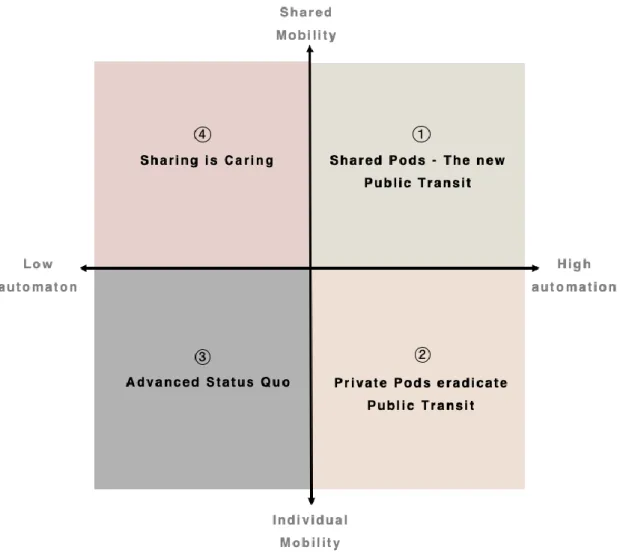
To get a sense of the future developments that will determine European cities’ transport modes, four scenarios for the year 2050 are developed in the following chapter. They summarize possible developments along two uncertainties that arise through vehicle automation: The level of automation and the degree of shared mobility.
Figure 1: Four scenario matrix
4.1 Scenario 1: Pods - The New Public Transit
In this scenario, technology is highly advanced, and level 5 emission-free autonomous connected vehicles, dominate traffic in cities. Autonomous public transport operates on high-frequency routes that are fed by autonomous last-mile vehicles, called pods. Pods are versatile and exist in different versions. From cheaper and publicly shared ones, that feed the high-frequency mass transit lines or collect multiple passengers along a similar route, to more expensive, not shared versions that go straight to the predetermined destination and offer more comfortability. This offers mobility to socially marginalized groups that were excluded from transport before, like children and the elderly. The convenience of ordering instead of owning a vehicle is immense because travel costs are low since no drivers are required, and vehicle utilization for fleet providers is high. The combination of shared and autonomous technology
reduces the total number of vehicles, improves traffic flow, ultimately eliminates congestion from cities and improves air quality through locally emission-free engines. Since passengers do not need to be involved in any activity during the ride, vehicle design focuses on accommodating passengers’ in-vehicle time by enabling them to work, use the onboard internet connection for entertainment, or spend the time in social interaction with their co-passengers. Since almost all vehicles are operated in fleets, technology standards of highly connected vehicles are widely spread and provide safety advantages that lower traffic fatalities close to zero. Most vehicles do not need to park in the city center since they either leave autonomously to pick up the next passenger or are able to leave the area and wait for their next order. This enables cities to transfer unused street infrastructure and -space to more generously and greener spaces for people. Traffic efficiency and the near emission-free vehicles will make congestion and air pollution almost forgotten. This new city will be quiet and green with more space for living and socializing, which ultimately increases livability in the city.
4.2 Scenario 2 - Private Pods Eradicate Public Transport
In Scenario 2, autonomous driving technology is highly developed (level 5) and deployed in every privately-owned pod. Passengers get dropped off at their destination, and, depending on their choice, the locally emission-free pods leave for a, not necessarily close by, parking spot or circle around the area to stay nearby for a quick pick up. The achieved convenience makes public transport’s unique selling points (freeing up travel time and not worrying about parking) disappear. Due to the large scale of autonomous connected vehicles, technology prices have dropped, and basic versions of pods are available for most people living in the city. For those without an own vehicle, cheap autonomous ride-sharing alternatives are available. Due to its convenience, groups of people that have not been able to take part in individual travel before are now able to, e.g., children and older people. Although the highly developed technology
ensures an almost accident and congestion-free city, traffic in urban areas is high since the increased numbers of vehicles and vehicle kilometers (through reduced perceived cost of travel time and deadheading trips to parking spaces or circling in the drop-off area) increase total traffic. This scenario, on the one hand, improves traffic flow but, on the other hand, slows down traffic speed which does not allow for a reduction in travel times. However, the connected and autonomous pods make traveling- and commuting time useful and enjoyable for activities like working, entertainment, and socializing. Since vehicles require no driving or control capabilities for people, their design can be adjusted entirely to the owner’s needs. Whether it is equipped with work essentials like a desk and screens or family-focused with many seats and entertainment functionalities, pods are an extension of the home and perfectly adapted to the owner’s needs. Connectivity between vehicles and infrastructure makes them the safest travel mode and reduce traffic fatalities to an all-time low. Parking spaces along the roads and in prime locations in the city center are not required anymore, but the increased traffic density requires still the same space as in the year 2020. Therefore, small parts of the street infrastructure can be converted to people-centered areas for outdoor activities and living space.
4.3 Scenario 3 – Advanced Status Quo
In 2050, personal vehicles dominate the streets. Since technological development is improved compared to 2020 but not on a fully autonomous level, the majority of affordable cars for the mass market operates on level 3 autonomy with low or locally emission-free engines. Autonomous systems can perform driving tasks during highway travel, and security systems like breaking and camera assistants help drivers in confusing situations, e.g., in city traffic and during poor visibility. Despite these advancements, congestion in cities worsened due to high amounts of private vehicle commute and low sharing willingness. Public transit still exists but is mainly efficient in underground and separated rail-bound systems. Busses and trams that
share the space with individual road traffic struggle with congestion and are relatively inefficient, which makes them unattractive for most people. Travel times are, therefore, high and considered as wasted time that is spent actively driving. Air quality in cities improved due to widespread low- and (locally) zero-emission vehicles, and traffic fatalities are reduced through the vehicle security assistants. However, the EU’s Vision Zero (Zero traffic fatalities by 2050) could not be fulfilled yet. Cities are still built car-centric with wide streets, parking spots, and -garages, which leaves only little spaces for people and green wellbeing areas. Young families tend to move outside the city to greener suburbs that are less occupied by traffic.
4.4 Scenario 4 – Sharing is Caring
Cities and societies in 2050 have understood that high amounts of traffic bring great harm to the environment and livability in cities. Since technology is further developed than in 2020, but level 5 autonomy is still not widely present yet, congestion, safety, and environmental concerns are still bothering cities. Metropolitan transport is, therefore, organized around a strong low emission public transport system that builds the backbone in cities' traffic infrastructure. This supply of a clean and attractive transit system attracts high numbers of passengers that enjoy cheap, fast, and green transport. The individual trips that require the use of a car or van for transportation are mostly made through highly convenient and free-floating car sharing. The combination of a well-developed, modern public transit system and car-sharing covers the needs of most citizens and reduces the number of vehicles and traffic congestion within the city. The high utilization of public transport and relatively low demand for individual travel optimizes the traffics’ energy consumption and keeps emissions low. Commuters enjoy spending their travel time on different activities made possible by flawless internet connection in the public transit vehicles that are designed to value passengers' time in the best way possible. Commuters and visitors from outside the city leave their vehicles at the outer boundaries of the public transit network that brings them to the city center. This shift in mobility from privately
owned to (publicly-) shared transport, frees up space that enables cities to evolve more people-centric by transforming parking areas and multi-lane streets to green spaces and attract more families and people that tended to live in well-situated suburbs before.
5 Expert Interviews
To evaluate the scenarios, five expert interviews were conducted. The goal of the interviews was to find out expert’s perceptions about the mentioned future trends of urban transport, the described scenarios, and a possible answer to the overall research question. The detailed answers are displayed in Appendix 4. The experts have different backgrounds that are all linked to public transport, mobility, or technology. Except for expert 4, all wished to stay anonymous. Expert 1 is the CEO of a German public transport company. Expert 2 is the CEO of a German local transportation authority. Expert 3 works in the urban mobility sector. Expert 4 is Graham Currie, director of the Public Transport Research Group at Monash University. Expert 5 is a sales representative for the West German market of an international car and bus manufacturer based in Germany.
5.1 Challenges for Public Transport and future trends
Expert 4 mentions that urbanization causes one of the biggest challenges in the future since it will increase the demand for mobility in cities. If the modal split between the different transport modes (private vehicles and public transport) does not get balanced, the risk of traffic collapse in cities rises (Expert 3). Experts 1- 4 recognized the current COVID-19 pandemic as a massive challenge for public transport (and shared mobility) since passengers switched to private travel modes for health safety reasons. It might take passenger numbers up to four years to fully recover, which puts further pressure on the current public transport financing gap, and further subsidies are needed (Expert 1, 2, 4, 5). The goal for the future should be to bundle passengers on shared vehicles to not overwhelm city infrastructure (Experts 2, 3, 4) and make public
transport the backbone of city mobility (Expert 3). This need was also recognized as the biggest chance for public transport in the future since efforts will be made to increase public transport's attractivity through improved service and more clean and attractive vehicles (Experts 1, 3) and a greater share of on-demand modes (Expert 1). Besides the COVID-19 effect, expert 4 sees a global trend in public transport, attracting more people. He stated that it is important not to lose these people in the long term to the individual vehicle. Expert 5 sees the trend of young people from urban environments, who never had a private car before, trending away from shared vehicles to private ones, due to COVID-19. However, from a global perspective, younger generations in cities are becoming more open to shared mobility.
5.2 What will the future look like?
Autonomous Vehicles
All experts (1-5) do not see autonomous vehicles in the short- and medium-term future in widespread use on the streets and instead towards 2050, (Expert 1 between 2030 – 2050). However, expert 4 emphasizes that autonomous vehicles are already present in public transport today, mainly on rail systems. From all the autonomous transport that is already operating today, 99% are happening in public transport vehicles (Expert 4). Furthermore, he questions whether the broad application of autonomous vehicles is even possible within the next decades. Expert 4 states that autonomous vehicles will only work if all traffic is autonomous, which would require the entire city infrastructure to be adapted to this technology, which would be impossible in the next decades. Expert 5, however, is sure that fully autonomous driving will be feasible in last-mile shuttles first and eventually become mandatory for all individual vehicles in the city center. Experts 1, 2, 3, and 5 think autonomous vehicles are safety improving compared to today’s vehicles. However, none believe in a zero-fatality rate. Having autonomous- and non-autonomous cars on the road at the same time will cause high accident risks (Experts 1 and 4). Expert 4 is skeptical about the current development of safety systems
in autonomous cars. By mentioning the case of the victim, Elaine Herzberg, who was killed by an autonomous Uber car, he thinks that the funding of researchers flaws the discussion about the safety of autonomous cars. The Uber cars’ safety systems had been turned off since their performance with human driver intervention was not as expected, and test-driving results could be improved without the safety systems. “Deliberately turning off safety systems and putting it [the vehicle] in a position to kill somebody, reveals a culture that is the opposite of safety” (Expert 4). Experts 1 and 5 point out the uncertainty of technical reliability. Expert 5 further states the risk of software crashes, failures, and hacker attacks. He proposes a surveillance system that watches autonomous vehicles and intervenes as soon as fatal errors occur.
Shared mobility
Experts 1, 4, and 5 are sure that sharing will become more accepted, especially with today’s younger generations. “Individual travel is, besides COVID-19 effects, already seen to decrease in some German cities today” (Expert 1). Expert 2 sees a mix of shared and individual travel for the future since some people will still demand private vehicles. Expert 4 states that in the past, the car has been in the context of cultural freedom and that this changes since the car is becoming something that can just be used to travel. Furthermore, sharing in large vehicles becomes more and more popular. He emphasizes that “urbanization cannot allow single-occupancy vehicles anymore” and requires high volume movement, which demands “shared occupancy” within vehicles instead of just “vehicle sharing”. By stating that “we need intervention to ensure good outcomes”, he points towards regulation to incentivize shared mobility.
5.3 Will autonomous vehicles support or eradicate public transport?
Expert 1 and 5 clearly see autonomous vehicles as a support for public transport since they will serve last mile passengers and feed the main travel axis that are served by public transport
vehicles. Expert 2 and 3 see a support as desirable but Expert 2 points out the successfulness of this support as depending on whether regulation can combine different transport modes and technologies within the city. He and expert 5 expect a broad application of autonomous technology in public transport first, since it will be easier for technology to cope with fixed routes. Expert 4 has the same view and points out that 99% of autonomous travel that is done today is happening in public transport.
5.4 Regulation
Expert 1, 2, 3, and 4 mention regulation as necessary to frame mobility in the future. “Mobility in cities needs to be regulated to prevent too much traffic from overwhelming cities” (Expert 2). He furthermore says that regulations should keep in mind the far-reaching impacts of autonomous driving technology outside the mobility market. Expert 3 says that regulation should help to cope with the risks in adopting autonomous technology and that it should put emphasis on security (also cybersecurity). Expert 1 demands clear rules regarding accountability in crash scenarios, and expert 4 sees regulations influenced by the prevailing political view and as generally necessary.
5.5 Scenario decision
Expert 1 sees a realistic future in scenario 1, since technology is likely to improve fast.
Expert 2 sees scenario 1 as realistic if regulation intervenes efficiently. Otherwise, scenario 2 would be likely. Expert 3 sees a scenario on the axis between scenarios 1 and 4 likely since technology might not be advanced enough for scenario 1, but sharing will be high.
Expert 4 sees a future in scenario 4, that does not include the high automation of scenario 1 but has a high sharing character. Expert 5 believes that autonomous last-mile vehicles will complement public transport systems on the last mile, and some individual traffic will still exist, which points to scenario 1. (For a graphical representation, see Appendix 5)
6 Conclusion
In aiming to answer the question, whether autonomous vehicles can make public transport obsolete, this thesis has highlighted some of today’s great challenges in mobility. Further, future trends that could potentially reduce the extend of these where discussed. An analysis of the current literature emphasized that the implications of autonomous vehicles are not straight forward and a lot of uncertainties still exist around vehicle automation: The broad adoption of autonomous vehicles could help with or further exacerbate current challenges. The expert interviews revealed a skepticism about short- and medium-term automation of road vehicles in urban mobility. They stressed a very careful and thorough development of technology and its regulation to ensure it is beneficial for cities and society. The importance of shared mobility modes for the future was emphasized. All experts see a key role for public transport in the future and think of autonomous driving technology as a support for public transport rather than a replacement. In the end, it will be up to regulators to set a framework for cooperation between the most successful mobility modes to serve the purpose of a sustainable and efficient urban transit.
Limitations and Further Research
The interviews should be viewed in the light of three experts having a background in the area of public transport. This might bias the outcomes towards a more favorable view of public transport. An interesting area for further research would be to pole passengers and users of urban mobility to better understand their preferences. It is crucial to design urban mobility in a way that is convenient for travelers and incentivizes them to use mobility modes that cause the smallest negative externalities on the wider society.
7 References
Adler, Martin W., Jos N. van Ommeren. 2015. "Does Public Transit reduce Car Travel Externalities?"
Anders Eugensson, Mattias Brännström, Doug Frasher, Marcus Rothoff, Stefan Solyom, Alexander Robertsson. 2013. "Environmental, Safety, Legal and Societal
Implications of Autonomous Driving Systems". 23rd International Technical Conference on the Enhanced Safety of Vehicles (ESV). Seoul.
Anderson, James M., Nidhi Kalra, Karlyn D. Stanley, Paul Sorensen, Constantine Samaras, Tobi A. Oluwatola. 2016. "Autonomous Vehicle Technology: A Guide for Policymakers". Santa Monica, CA: RAND Corporation
Berry, Irene Michelle. 2010. "The Effects of Driving Style and Vehicle Performance on the Real-World Fuel Consumption of U.S. Light-Duty Vehicles". Massachusetts Institute of Technology
Bliss, Laura. 2020. "When the World Stops Moving".
https://www.citylab.com/transportation/2020/03/coronavirus-impact-public-transit-street-traffic-data-trains/607915/. Accessed on 20.05.2020
Burns, Lawrence D., William C. Jordan, Bonnie A. Scarborough. 2012. "Transforming Personal Mobility". The Earth Institute Colimbia University.
Briginshaw, David. 2019. “Rail is on the way to autonomous trains”. International Railway Journal. https://www.railjournal.com/opinion/rail-autonomous-trains. Accessed on
Chatterjee, Kiron, Samuel Chng, Ben Clark, Adrian Davis, Jonas De Vos, Dick Ettema, Susan Handy, Adam Martin & Louise Reardon. 2020.: "Commuting and wellbeing: a critical overview of the literature with implications for policy and future research", Transport Reviews, Vol. 40: 5-35
Currie, Graham. 2018. “Lies, Damned Lies, AVs, Shared Mobility, and Urban Transit Futures“. Journal of Public Transportation. Vol. 21: 19-30
Deloitte. 2018. "Deloitte City Mobility Index Helsinki".
https://www2.deloitte.com/content/dam/insights/us/articles/4331_Deloitte-City-Mobility-Index/city-mobility-index_HELSINKI_FINAL.pdf. Accessed on 12.04.2020
Delucchi,M.A., C. Yang, A. F. Burke, J. M. Ogden, K. Kurani, J. Kessler and D.
Sperling. 2014. "An assessment of electric vehicles: technology, infrastructure requirements, greenhouse-gas emissions, petroleum use, material use, lifetime cost, consumer acceptance and policy initiatives". Philosophical Transactions of The Royal Society A Mathematical Physical and Engineering Sciences. Vol 372
Directorate-General for Mobility and Transport of the Eurpean Commission. 2019. "Transport in the European Union Current Trends and Issues". Brussels
Duarte, Fábio, Carlo Ratti. 2018. "The Impact of Autonomous Vehicles on Cities: A Review". Journal of Urban Technology, Vol 25:4: 3-18
EEA. 2018. "Progress of EU transport sector towards its environment and climate
objectives". https://www.eea.europa.eu/themes/transport/term/term-briefing-2018. Accessed 20.05.2020
Etherington, David. 2017. "Waymo now testing its self-driving cars on public roads with no one at the wheel". https://techcrunch.com/2017/11/07/waymo-now-testing-its-self-driving-cars-on-public-roads-with-no-one-at-the-wheel/. Accessed on 22.04.2020
European Commission, 2001. "Whitepaper European transport policy for 2010: time to decide". Brussels
European Commission. 2007a. "Grünnbuch Hin zu einer neuen Kultur der Mobilität in der Stadt". Brussels
European Commission. 2007b. "REGULATION (EC) No 1370/2007 OF THE EUROPEAN PARLIAMENT AND OF THE COUNCIL of 23 October 2007". Official Journal of the European Union
European Commission. 2009. " A sustainable future for transport". Luxembourg: Publications Office of the European Union,
European Commission. 2012. “Measuring road congestion”. Luxembourg: Publications Office of the European Union
European Commission. 2014. "Transport Eurobarometer: congestion and maintenance are the major challenges for EU roads". https://ec.europa.eu/transport/media/news/2014-12-08-eurobarometer_en. Accessed on 04.04.2020
European Commission. 2016. "Working together for SAFER ROADS in the EU"
European Commission. 2017. "Smart mobility and services". Luxembourg: Publications Office of the European Union"
European Commission. 2018a. "Annual Accident Report 2018". European Comission, Directorate General for Transport
European Commission. 2018b. "Europe on the move - Sustainable Mobility for Europe: safe, connected, and clean", Brussels
European Commission. 2019. “The European Green Deal”. 2019. The European Commission. Brussels
European Union Agency for Railways. 2018. "Report on Railway Safety and Interoperability in the EU". Luxemourg: Publications Office of the European Union
Evans, Gary W., Richard E. Wener, Donald Phillips. 2002. "The Morning Rush Hour - Predictability and Commuter Stress". Environment and Behavior, Vol. 34 (4), 521-530
Fagnant, Daniel, Kara M. Kockelman. 2014. "The Travel and Environmental Implications of Shared Autonomous Vehicles, using Agent-Based Model Scenarios”. Transportation Research Part C, Vol 40: 1-13
Fagnant, Daniel J., Kara Kockelman. 2015. "Preparing a Nation for Autonomous Vehicles: Opportunities, Barriers and Policy Recommendations for Capitalizing on Self-Driven
Vehicles". Transportation Research Part A, Vol 77: 167-181
Fulton, Lew, Jacob Mason, Dominique Meroux. "Three Revolutions in Urban Transportation" https://www.itdp.org/publication/3rs-in-urban-transport/. Accessed on 20.05.2020
Glancy, D. J. 2012. "Privacy in autonomous vehicles". Santa Clara Law Review, Vol. 52(4): 1171-1240.
Hartgen, David T., Fields, M. Gregory. 2009. "Gridlock and Growth: The Effect of Traffic Congestion on Regional Economic Performance". Reason Foundation Policy no. 371
Hawkins, Andrew J. 2017. “Waymo is first to put fully self-driving cars on US roads
without a safety driver”. https://www.theverge.com/2017/11/7/16615290/waymo-self-driving-safety-driver-chandler-autonomous. Accessed on 21.05.2020
Hevelke, Alexander, Julian Nida-Rümelin. 2015. "Responsibility for Crashes of Autonomous Vehicles: An Ethical Analysis". Sci Eng Ethics, Vol. 21: 619–630
Jara-Díaz,Sergio R., David A. Hensher, Kenneth John Button. 2000. "Allocation and valuation of travel time savings", In Handbooks in Transport, Vol. 1: Transport Modelling, Emerald Group Publishing Limited, pp. 363-379
Kalra, Nidhi, Susan M. Paddock. 2016. "Driving to safety: How many miles of driving would it take to demonstrate autonomous vehicle reliability?". Transportation Research Part A 94: 182-193
Khairnar, Vaishali D., S.N. Pradhan. 2014. "V2V COMMUNICATION SURVEY - (WIRELESS TECHNOLOGY)". Int.J.Computer Technology & Applications, Vol 3: 370-373
Kluger, Avraham N. 1998. "Commute variability and strain". Journal of organizational behavior, Vol. 19: 147-165
Kolarovaa, Viktoriya, Felix Stecka, Rita Cyganskia, Stefan Trommera. 2017. "Estimation of the value of time for automated driving
using revealed and stated preference methods using revealed and stated preference methods". Transportation Research Procedia. Vol 31: 35-46
Lars E. Olsson, Tommy Ga ̈rling, Dick Ettema, Margareta Friman, Satoshi Fujii. 2012. "Happiness and Satisfaction with Work Commute". Soc Indic Res. Vol 111: 255–263
Lawrene, Karp, Richard Kim, Chen Liu, Betty Liu. 2017. "Insuring Autonomous Vehicles An $81 Billion Opportunity Between now and 2025". Accenture, Hoboken, N.J.
Lin, Patrick. 2013. "The Ethics of Saving Lives with Autonomous Cars Is Far Murkier Than You Think". https://www.wired.com/2013/07/the-surprising-ethics-of-robot-cars/. Accessed on 20.05.2020
Mackie, P.J., Wadman, M., Fowkes, A.S., Whelan, G., Nellthorp, J., and Bates, J. 2003. "Value of Travel Time Savings UK". Institute of Transport Studies, University of Leeds, Working Paper 567
Malan, Daniel. 2018. "The law can't keep up with new tech. Here's how to close the gap". https://www.weforum.org/agenda/2018/06/law-too-slow-for-new-tech-how-keep-up/. Accessed on 20.05.2020
Matz, Carlyn, Marika Egyed, Robyn Hocking, Shayesta Seenundun, Nick Charman and Nigel Edmonds. 2019. "Human health effects of traffic-related air pollution (TRAP): a scoping review protocol", Syst Rev 8:223
Nealer, R., T.P. Hendrickson. 2015. "Review of Recent Lifecycle Assessments of Energy and Greenhouse Gas Emissions for Electric Vehicles". Current Sustainable/Renewable Energy Reports. Vol 2: 66-73
Neubauer, Jeremy, Eric Wood. 2014. "The impact of range anxiety and home, workplace, and public charging infrastructure on simulated battery electric vehicle lifetime utility". Journal of Power Sources. Vol 257: 12-20
Olaverri-Monreal, Cristina, Javier Errea-Moreno, and Alberto Díaz-Álvarez. 2018. "Implementation and Evaluation of a Traffic Light Assistance System Based on V2I
Communication in a Simulation Framework". Journal of Advanced Transportation. Vol 2018
Randelhoff, Martin. 2014. "Vergleich unterschiedlicher Flächeninanspruchnahmen nach Verkehrsarten (Pro Person)". http://www.zukunft-mobilitaet.net /78246/analyse/
flaechenbedarf-pkw-fahrrad-bus-strassenbahn-stadtbahn-fussgaenger-metro-bremsverzoegerung-vergleich/. Accessed on 05.03.2020
Reuters. 2018. "Denmark embraces electric car revolution with petrol and diesel ban plan". https://www.reuters.com/article/us-denmark-autos/denmark-embraces-electric-car-revolution-with-petrol-and-diesel-ban-plan-idUSKCN1MC121. Accessed on 14.04.2020
Reuters. 2019. "City of Amsterdam to ban polluting cars from 2030".
https://www.reuters.com/article/us-netherlands-pollution-amsterdam/city-of-amsterdam-to-ban-polluting-cars-from-2030-idUSKCN1S81XV. Accessed on 15.04.2020
Reuters. 2020. "Electric dream: Britain to ban new petrol and hybrid cars from 2035". https://www.reuters.com/article/us-climate-change-accord/electric-future-britain-to-ban-new-petrol-and-hybrid-cars-from-2035-idUSKBN1ZX2RY. Accessed on 15.04.2020
Riggs, William, Bruce Appleyard & Michael Johnson. 2020. "A design framework for livable streets in the era of autonomous vehicles". Planning and Transport Research, Vol 8: 125-137
SAE International. 2017. "Shared Autonomous Vehicles as a Sustainable Solution to the Last Mile Problem: A Case Study of Ann Arbor-Detroit Area"
https://saemobilus.sae.org/content/2017-01-1276. Accessed on 20.05.2020
SAE International. 2018. "Surface Vehicle Recommended Practice"
Salonen, Maria, Tuulo Toivonen. 2013. "Modelling travel time in urban networks:
comparable measures for private car and public transport". Journal of Transport Geography. Vol 31:143-153
Senecal, P.K., Felix Leach. 2019. "Diversity in transportation: Why a mix of propulsion technologies is the way forward for the future fleet". Results in Engineering. Vol 4, Article 100060
Shires, J.D., G.C. de Jong. 2008. "An international meta-analysis of values of travel time savings". Evaluation and Program Planning, Vol. 32 (4): 315-325
St‐Louis, E., Kevin Manaugh, Dea van Lierop, Ahmed El‐Geneidy. 2014. The happy commuter: A comparison of commuter satisfaction across modes. Transportation Research Part F: Traffic Psychology and Behaviour, 26, 160–170.
Statista. 2018. "The European Capitals with The Worst Traffic Jams".
https://www.statista.com/chart/16347/european-capital-cities-by-peak-hours-spent-in-traffic-congestion/ Retrieved on April 2, 2020
Stern, Raphael e., Shumo Cuib, Maria Laura Delle Monachec, Rahul Bhadanid, Matt Buntingd, Miles Churchilla, Nathaniel Hamilton. 2018. "Dissipation of stop-and-go waves via control of autonomous vehicles: Field experiments". Transportation Research Part C: Emerging Technologies, 89: pp. 205-221
Sustainable-Bus. 2018. “Germany 2030: 3,000 electric buses in 5 biggest cities”. https://www.sustainable-bus.com/news/germany-electric-bus-biggest-cities-3000-berlin-hamburg-cologne-frankfurt-munich/. Accessed on 21.05.2020
Taiebat, Morteza, Austin L. Brown, Hannah R. Safford, Shen Qu, and Ming Xu. 2018. "A Review on Energy, Environmental, and Sustainability Implications of Connected and Automated Vehicles". Environ. Sci. Technol. 52: 11449−11465
Thing, Vrizlynn L. L., Jiaxi Wu. 2016. "Autonomous Vehicle Security: A Taxonomy of Attacks and Defences". IEEE International Conference on Internet of Things (iThings) and IEEE Green Computing and Communications (GreenCom) and IEEE Cyber, Physical and Social Computing (CPSCom) and IEEE Smart Data (SmartData), Chengdu. pp. 164-170
Umwelt Bundesamt. 2020. "Emissionsdaten".
https://www.umweltbundesamt.de/themen/verkehr-laerm/emissionsdaten#emissionen-im-personenverkehr-grafik. Accessed on 04.04.2020.
United Nations. 2019a. "World Population Prospects 2019". Department of Economic and Social Affairs, Population Division
United Nations. 2019b. "World Urbanization Prospects. The 2018 Revision". New York.
University of East Anglia. 2014. "Walking or cycling to work improves wellbeing".
https://www.uea.ac.uk/about/-/walking-or-cycling-to-work-improves-wellbeing-university-of-east-anglia-researchers-fi-1. Accessed on 04.04.2020
VDV. 2015. "Scenarios for Autonomous Vehicles – Opportunities and Risks for Transport Companies". Verband Deutscher Verkehrsunternehmen.
VDV. 2019. “2018 Statistik“. Verband Deutscher Verkehrsunternehmen. Köln.
Wadud, Zia, Don MacKenzie, Paul Leiby. 2016. "Help or hindrance? The travel, energy and carbon impacts of highly automated vehicles". Transportation Research Part A: Policy and Practice, Vol 86: 1-18
Wadud, Zia, Fuad Yasin Huda. 2019. "Fully automated vehicles: the use of travel time and its association with intention to use." Proceedings of the Institution of Civil Engineers - Transport: 1-15
Wardman, Mark. 2014. "Valuing convenience in public transport" Discussion Paper No. 2014-02, International Transport Forum.
Zhang K, Batterman S. 2013. "Air pollution and health risks due to vehicle traffic". Sci
Total Environ, 450-451:307‐316.
Zmud, Johanna, Melissa Tooley, Trey Baker, Jason Wagner. 2015. "Paths of Automated and Connected Vehicle Deployment: Strategic Roadmap for State and Local Transportation Agencies". Texas A&M Transportation Institute
8 Appendix
Appendix 1: (Umwelt Bundesamt, 2020)