1
This is an Author's Accepted Manuscript of an article published in the International Marketing Review. Accepted: December 2017. Copyright Emerald.
TESTING THE SELF-SELECTION THEORY IN HIGH
CORRUPTION ENVIRONMENTS: EVIDENCE FROM
EXPORTING AFRICAN SMES
Emanuel Gomesa,*, Ferran Vendrell-Herrerob, Kamel Mellahic, Duncan Angwind and Carlos M.P. Sousae a Nova School of Business and Economics, Universidade Nova de Lisboa, Portugal; b Birmingham Business School, University of Birmingham, UK c Warwick Business School, University of Warwick, UK; d Lancaster University Management School, Lancaster University, UK; e University of Durham, Durham University Business School, UK. ABSTRACT:
Purpose: Whilst substantial evidence from low corruption, developed market environments supports the view that more productive firms are more likely to export, there has been little research into analysing the link between productivity and exports in high corruption, developing market environments. The purpose of this paper is twofold. First, to test the premise of self-selection theory whether the association between productivity and export is maintained in high corruption environments, and second to identify other variables explaining export activity in high corruption contexts, including cluster networks and firms’ competences. Design/methodology/approach: The authors draw on the World Bank Enterprise survey to undertake a cross-section analysis including 1,233 SMEs located in nine African countries. The advantage of this database is that it contains information about the level of perceived corruption at firm-level. Logistic regressions are performed for the full sample and for subsamples of firms in high and low corruption environments.
Findings: The findings demonstrate that the self-selection theory only applies to low corruption environments, whereas in high corruption environments, alternative factors such as cluster networks and outward looking competences, exert a stronger influence on the exporting activity of African SMEs.
Research implications/limitations: This research contributes to theory as it provides evidence that contradicts the validity of self-selection theory in high corruption environments. Our findings would benefit from further longitudinal investigation.
2
Practical implications: African SMEs need to consider cluster networks and outward looking competences as important strategic factors that might enhance their international competitiveness. Originality/value: Our criticism of the self-selection theory is distinctive in the literature and has important implications for future research. We show that the contextualisation of existing theories matters and this opens a research avenue for further more sensitive contextualisation of existing theories in developing economies. Keywords: Exports, Productivity, Self-selection, Corruption, Networking, Outward Looking Competences, Cluster, African SMEs, World Bank Enterprise Survey. * Corresponding Author: Emanuel Gomes (Nova School of Business and Economics, Universidade Nova, Portugal), email: [email protected]) Acknowledgements: This work was funded by Fundação para a Ciência e Tecnologia (UID/ECO/00124/2013 and Social Sciences Data Lab, Project 22209), by (LISBOA-01-0145-FEDER007722 and Social Sciences Data Lab, Project 22209).
3
TESTING THE SELF-SELECTION THEORY IN HIGH
CORRUPTION ENVIRONMENTS: EVIDENCE FROM
AFRICAN SMES
INTRODUCTION
A variety of studies have validated the so-called self-selection theory; that more productive firms are more capable of exporting and competing in international markets (Aw, Chung & Roberts, 2000; Melitz, 2003; Melitz & Otoviano, 2008; Temouri, Vogel & Wagner, 2013). However, there are geographical contexts in which established managerial theories like selection have not been tested. In this study we evaluate the application of self-selection theory in the context(s) of Africa. In so doing we respond to recent calls for contextualizing international business research by testing the relevance of established theories in contexts such as Africa (Teagarden, Von Glinow and Mellahi, 2017). Several studies investigating the effect of productivity on the exporting behaviour of firms [Temouri, et al. (2013) for UK, Germany and France, Cassiman & Golovko (2011) for Spain, Aw, Chung & Roberts (2000) for emerging economies like Taiwan, and Clerides, Lack, & Tybout (1998) for developing countries like Colombia and Morocco], provide evidence that firms with higher productivity levels are more likely to self-select themselves into export markets. However, other studies seem to demonstrate that exporting firms are more productive not because they self-select themselves but rather because they actually learn-by-exporting as they start interacting with more competitive foreign firms and more demanding customers and suppliers (Fernandes & Isgut, 2005; Van Biesebroeck, 2005; Martins & Yang, 2009; Love & Ganotakis, 2013; Salomon & Shaver, 2005).
Research on the exporting behaviour of African SMEs has been scarce and the limited existing evidence is far from being conclusive. To shed light on this debate, this study aims to
4
examine the impact of productivity on the exporting behavior of African small and medium-sized enterprises (SMEs). This is important because in recent years, African firms have become increasingly engaged in international trade via exports (Ibeh, Wilson & Chizema, 2012). As a result, African countries’ share of global trade has risen significantly in the first decade of the 21st century (Ndikumana, 2015). The extent to which their productivity influences their capacity to compete in international markets merits academic and scholarly attention. We focus on SMEs’ because their international activities are generally limited to export and therefore are ideal for examining the relationship between productivity and exports. In addition, SMEs contribute over 50% towards GDP in African countries and represent over 90% of private business in Africa (Omer, Van Burg, Peters, & Visser, 2015).
However, as it is widely documented, the business environment in most African countries is not conducive to SMEs’ success and has a negative impact on their output and productivity (Bah & Fang, 2015). Therefore, we argue that the impact of productivity on export engagement is moderated by the quality of the business environments supporting or hindering exporting firms, such as the presence of institutional voids. For instance the presence of corruption can distort institutional and business environments and be economically damaging (Rose-Ackerman, 1999). Therefore, our main research question is whether in high corruption contexts, invisible barriers may have a detrimental effect on the capacity of African SMEs to compete in international markets. We argue that in such contexts, more productive firms may not necessarily be the ones more capable of overcoming the barriers to export and so may not exhibit higher levels of exports.
The international marketing and international business literatures indicate other factors enabling export capacity. Some research studies have indicated that being located in network cluster zones can help shield firms from an ineffective business environment and help them learn to be efficient by facilitating networking with other firms inside the cluster (Fafchamps
5
et al., 2008; Naudé & Matthee, 2010). Thus, in this study we examine how networking capabilities developed within cluster zones enhance the exporting capacity of African SMEs. As evidenced by previous studies, networks provide firms with access to resources, know-how, technologies and markets through enduring exchange relationships with other network members (Inkpen & Tsang, 2005). Networking capacity may be particularly important for SMEs as they lack the scale and resources of large MNEs to internationalise easily on their own (Naudé & Havanga, 2005). Previous studies have also indicated that the possession of outward-looking competences (OLC), understood as the capacity to communicate quality signals to external stakeholders through technology based mechanisms, enhances the export capacity of developing market firms located in geographically isolated regions (Vendrell-Herrero, Gomes, Mellahi, & Child, 2017). International expansion, especially from more isolated regions like Africa, may be more difficult as local firms have to move across geographical, cultural and institutional barriers to reach foreign markets. Hence, this paper also investigates the role of OLC that enhance firm’s image and reputation in international markets and ultimately the export capacity of African SMEs.
The paper makes several important contributions. First, it contributes to the much larger literature on the internationalization of firms from developing markets by focusing on the exporting behaviour of African SMEs. More specifically, it provides much needed empirical evidence on the effect of productivity on the exporting capacity of African SMEs. This is important because it helps identify and test other limitations of the self-selection theory when applied to contexts characterised by high levels of corruption. This is a major theoretical contribution as several scholars have consistently demanded for the development of more context suitable theories for the case of emergent markets like Latin America (Carneiro et al., 2015) and especially of Africa (Teagarden et al,. 2017). As asserted by Amankwah-Amoah, Boso & Debrah (2017, pp. 11), in the case of Africa “there remains a need for the
6
development of indigenous concepts and issues to explain the effects of institution-based factors.” Additionally, understanding the limitations of the self-selection theory in the African context, characterised by high levels of corruption provides an important contribution because as argued by Cuervo-Cazurra (2016), results about the impact of corruption at the firm level are inconclusive and lack further empirical support. Second, the paper will enhance our understanding of how networking capabilities and the possession of outward-looking competences are conducive to higher levels of exports in complex institutional contexts. An important empirical contribution of this study is that we use a firm level measure of corruption. This is unique because most previous studies have used country level measures of corruption such as the Bribe Payer’s Index (Baughn et al., 2010), the Corruption Perceptions Index (Wilhelm, 2002) and other country level measures (Husted, 1999; Montinola & Jackman, 2002) which amalgamate information from various surveys and create a single country level indicator (Cuervo-Cazurra, 2016). In this study we use a firm level measure of corruption derived from a large data set of African SMEs obtained from the World Bank’s Enterprise Surveys, in which the managers from the firms included in the analysis share the perceived level of corruption in the business environment in which their companies operate.
The paper is structured as follows. First we provide a review of the background literature and develop our hypotheses. In doing so, we first resort to the self-selection literature to explain the linkage between productivity and exports. We then review some of the main acknowledged limitations of self-selection theory and justify our argument about the limitations of self-selection theory in contexts characterised by high levels of corruption. In the following section of the paper we explain the research methods adopted and this is followed by the section containing the main findings of the study. Finally, we discuss the implications of the findings for both theory and practice and provide suggestions for future research.
7
THEORY AND HYPOTHESES
Self-selection theory and exports: applicability and acknowledged limitations
The race for global reach has increased the pressure for firms to internationalise. For SMEs this tends to mean exporting, rather than use of other expansion modes, as this requires less resources, foreign market knowledge and commitment (Johanson & Vahlne, 1977). The limited resource base of African SMEs (Sapienza et al., 2006) makes exporting attractive as an effective mechanism in helping overcome resource paucity as well as geographical and institutional distances. However, evidence from previous studies seems to demonstrate the existence of self-selection mechanisms, as only more productive firms are capable of entering the export market and competing with international competitors (Altomonte et al., 2013; Becker & Egger, 2013; Wagner, 2007). Melitz (2003) even argues that unlike other strategic choices, such as industry or product portfolio diversification, which are mostly motivated by endogenous factors, the decision to enter international markets is primarily based on an understanding of how a firm’s competitiveness and productivity compares to that of local and foreign competitors. In sum, the self-selection theory argues that firms able to reach a certain threshold in terms of productivity are more capable to compete in international markets. Based on this well established framework, we propose the following baseline hypothesis:
H1: Higher levels of productivity are conducive to higher likelihood of exporting.
However, some questions can be raised about the applicability of the self-selection theory in developed economies. For example, it can be questioned whether higher productivity levels influence firms to export (self-selection theory) or whether exports lead to higher levels of productivity (learning-by-exporting theory) (Ganotakis & Love, 2012; Salomon & Shaver, 2005). There is also a more consensual understanding that increased levels of innovation may also be associated with productivity improvement and the capacity
8
to export (Love & Roper, 2015). In this sense, Paul, Parthasarathy & Gupta (2017) assert that Vernon’s (1979) international product life-cycle theory helps to reconcile both positions because it suggests that innovation enhances the competitiveness of domestic firms, which in turn become more productive and competitive in foreign markets as well. Moreover, these authors suggest that less innovative firms are not able to enter foreign markets until their productivity capacity has been improved. Evidence from an extensive longitudinal research by Cassiman & Golovko (2011) shows that the self-selection causal effect of productivity on exports is only evident in the case of non-innovative firms. This may be explained by the fact that innovative firms are capable of competing in foreign markets, not necessarily because they are more productive (before exporting) but because they are capable of differentiating their products from those of foreign competitors. This rationale is also applicable to the case of born-global firms because of their innovative capacity and differentiated narrow product offer (Glaister et al., 2014).
Despite these acknowledged limitations, the self-selection theory is widely accepted. Hence the above mentioned criticisms seek to better understand the contextual nuances of the theory. In essence, the critiques do not reject that ultimately the most productive firms end up being able to demonstrate their superiority in international markets. In this research we aim to understand additional limitations of this theory in the context of high corruption environments.
Limitations of the self-selection theory in high corruption environments
As discussed above, the self-selection theory explains how more productive firms are more capable of entering the export market. However, the applicability of this theory in environments characterised by high corruption can be questioned. Various scholars have been
9
increasingly highlighting the importance of testing the validity of existing marketing (Amankwah-Amoah, Boso, & Debrah, 2017; Arnould, Price & Moisio, 2006) and international business theories (Michailova, 2011; Teagarden et al., 2017) in different contexts. As Boyacigiller & Adler (1991) argued, scholars need to move away from ‘‘contextual parochialism’’ deeply entrenched in the Western Anglo-North American paradigm in order to be able to capture the nuances across different contexts and avoid theoretical and methodological biases. Numerous scholars have argued this to be the case in Africa, where theoretical models and managerial practices are imported without taking sufficient account of the local context (Amankwah-Amoah, Boso, & Debrah, 2017; Anakwe, 2002; Angwin, Mellahi, Gomes, & Peter, 2016; Gomes, Mellahi, Angwin, & Peter, 2012; Kamoche, Debrah, Horwitz, & Muuka, 2004; Kamoche et al., 2012).
As such, we test the applicability of the self-selection theory in the context of Africa in which, despite all the recent acknowledged political, economic, financial, institutional and technological developments (Amankwah-Amoah, 2015, 2016; Debrah, 2007; Elmawazini & Nwankwo 2012) most countries still face major challenges like low diversification and high dependence on extractive natural resources (The Economist, 2016), inadequate transportation, communications and energy infrastructures (Aker & Mbiti, 2010) and human resource management issues (Kamoche et al., 2004), which hinder the competitiveness of African firms, especially of those willing to compete in international markets (Ibeh, Wilson & Chizema, 2012).
However, despite recent improvements and reforms, it is still commonly acknowledged that one of the main factors hampering the long-term growth and global competitiveness of African firms is existence of high levels of market imperfections and institutional voids like the “absence of market supporting institutions, specialized intermediaries, contract enforcing mechanisms” (Acquaah, 2012, pp. 1216), resulting in the development of high levels of
10
corruption prevalent in African public organizations (Ibeh, 1999; Kimuyu, 2007). Corruption, defined by Cuervo-Cazurra (2016, pp. 36) as ‘the abuse of entrusted power for private gain’ increases the costs of doing business (Kimuyu, 2007), thus reducing firm productivity, and inhibiting firms from competitively reaching international markets (Cuervo-Cazurra, 2016). This author asserts that public corruption is manifested when politicians or civil servants obtain a bribe in exchange of favours to individuals or companies.
Several country level characteristics such as, low institutional development, culture of arms-length relationships, ethnic and ethnolinguistic diversity, and cultural dimensions, are more conducive to higher corruption levels (Mauro, 1995; Shleifer & Vishny, 1993; Tanzi, 1995; Zheng, Ghoul, Guedhami, & Kwok, 2013). However, Cuervo-Cazurra (2016) argues that corruption at the firm level does not necessarily have a negative impact on firm performance. Corruption may have a positive effect on firm performance and therefore be seen “as ‘grease in the wheels of commerce’ that enables the company to operate better… when it is the manager who offers to pay a bribe to get something that helps the company” (Cuervo-Cazurra, 2016, pp. 40). Through corrupt relationships, managers expect to be able to minimise transaction costs in uncertain markets, by circumventing burdensome and unclear bureaucratic procedures and regulations (Lui, 1985).
In environments characterised by high levels of corruption, political connections and longstanding relationships with government officials can benefit companies from expediency in the issuance of legal permits and authorisations as government officials prioritise those firms willing to pay a bribe (Chen, Ding, & Kim, 2010; Cuervo-Cazurra, 2016; Fisman, 2001; Lui, 1985). Conversely, corruption can have a negative effect and be seen as ‘sand in the wheels of commerce’ when “it limits the ability of the company to operate efficiently” when government officials demand the payment of bribes which act like ‘informal’ additional taxes on firms (Cuervo-Cazurra, 2016, pp. 40). The costs associated with corruption are not
11
only due to the payment of bribes but also with the time that managers have to devote in managing complex relationships with crooked officials (Kaufmann, 1997) and the uncertainty generated by such modus operandi, as managers can never be sure whether government officials will deliver the expected favour or will ask for additional bribes (Uhlenbruck et al., 2006; Wei, 2000). Therefore, it is essential to understand the effects of corruption on the competitiveness and subsequent exporting behaviour of African SMEs. Based on the above arguments we hypothesise that:
H2.a: The self-selection argument (productivity leads to higher likelihood of exporting) is applicable to low corruption contexts; but
H2.b: in contexts with high levels of corruption, productivity does not lead to higher likelihood of exporting.
Alternative explanations to the self-selection theory in high corruption environments:
The effect of cluster networks
We have argued that in contexts with high corruption environments, relationships between managers and government officials can help minimise transaction costs and overcome burdensome and unclear bureaucratic procedures and regulations and help companies benefit from expediency in the issuance of legal permits. In this instance Acquaah (2012, pp. 1217) argues that in developing African markets characterised by high levels of uncertainty and market imperfections, it is essential for managers to develop networking relationships with “government political leaders, bureaucratic officials, and community leaders to secure access and facilitate the exchange of resources, information, and knowledge for the organization of their activities.”
12
Underpinned by the social capital theory, various studies have recognised that longstanding networking relationships provide companies with access to markets, resources, and knowledge, (Baum, Calabrese, & Silverman, 2000; Dyer & Nobeoka, 2000; Gupta & Govindarajan, 2000; Inkepen & Tsang, 2005). Through personal, social and professional relationships between the various networking players, financial, human and other resources and competences, and business opportunities are transferred across networking members (Gargiulo & Benassi, 2000). The importance of relationships and networking seems to be particularly relevant in the African socio-cultural context (Anakwe, 2002; Boso, Story & Cadogan, 2013). This is the case because of the Ubuntu, a “philosophical and cultural form of communal humanism” (Cunha et al., 2017, pp. 3) prevalent in most Sub-Saharan countries (Mangaliso, 2001). It presupposes a collectivistic, interactive and interdependent relational network of reciprocal commitments and benefits (Cunha et al., 2017; Gomes et al., 2015; Kamoche, Chizema, Mellahi, & Newenham-Kahindi, 2012), underpinned by “the belief in a universal bond of sharing that can be developed and leveraged to boost the value” for individuals and organisations (Amankwah-Amoah, Boso, & Debrah, 2017, pp. 3). As argued by Cleeve, Debrah & Yiheyis (2015), it contributes to social capital development and can provide a competitive advantage to exporting African companies. In this study we focus on enduring and repeated networking relationships taking place between government officials, competitors, suppliers, buyers, intermediaries and other institutions and organisations located in cluster network zones.
As noted by Aranguren et al. (2014) cooperation and linkages between the various players are essential components of such network associations. The advantage that cluster networks confer on involved companies is connectedness. This created advantage may take several forms and results from the geographical concentration of government agencies and institutions, competitors, suppliers and customers which may reduce transaction costs, allow
13
economies of scale, provide firms with shorter feedback loops for innovation, allow the exchange and creation of knowledge through face-to-face interactions and the creation of common languages and institutions – particularly important if uncertainty is high, and trial and error is required in the process of new product development (Solvell & Zander 1998). So, spatial proximity brings competitive advantage if the firm has to manage a complex set of networking interdependencies with clients, suppliers and governmental institutions (Porter 1998), as is the case in high corruption environments. These social networks, therefore, are expected to confer significant advantages to affiliates in domestic and foreign markets.
Understanding the impact of networking relationships on the export performance of African SMEs is essential because most African countries suffer from lack of supporting market institutions and mechanisms (Acquaah, 2012). It is in such contexts that networking relationships and ties, especially with government officials and politicians, can facilitate the acquisition of the necessary knowledge and resources and competences, to operate markets characterised by high levels of uncertainty, complexity and volatility. It is important to understand that in African countries, politicians have enormous power and capacity to influence the “the award of major projects and contracts, and access to financial resources for business activities, while bureaucratic officials control the regulatory and licensing procedures such as providing certification and approval to newly manufactured products as meeting government standards” (Acquaah, 2012, pp. 1217).
While previous studies have not investigated the effect of networking relationships on the exporting capacity of African SMEs, in our study we predict that networking capability plays a positive role on the exporting level of firms located in high corruption environments. This positive effect can be partly explained by what Nadvi (1999) called collective efficiency- the benefits that accrue from joint action. Collective efficiency is an important component for international growth and competitiveness. One must not forget that one of the
14
important measures of cluster network competitiveness is its capacity to export products to other regions (Austrian, 2000). Sonobe et al.’s (2011) findings show that higher levels of exports in African firms tend to be correlated with more entrepreneurial, innovative and marketing capabilities, which may potentially be maximized when firms located in exports hubs benefit from networking capabilities (Fafchamps et al., 2008; Naudé & Matthee, 2010). Based on this we posit:
H3: In high corruption environments firms benefiting from network/cluster have a higher likelihood of exporting.
The effect of outward looking competences
New international markets provide exporting firms the opportunity to reach significantly higher revenues and scale. However, in order to reach foreign markets exporting firms, especially from more isolated geographical markets such as Africa, have to overcome geographical, institutional, economic and cultural distances. As indicated long ago by Keesing (1967), developing country governments need help their export manufacturing sector firms develop “Outward Looking Competences” (OLC) in order to increase their international competitiveness. In the words of Keesing (1967; p. 304) developing countries have to make an extra effort “to remain in touch, absorb the latest technology, catch up and become competitive with the most advanced industrial countries”. Research findings in the context of Asia corroborate this view showing that outward looking policies developed in the 1970s and 1980s were critical for the development of international competitiveness of their export manufacturing firms. Recent research findings in the context of Latin America, show that exporting firms possessing OLC benefitted from higher levels of exports (Vendrell-Herrero et al., 2017). Amankwah-Amoah, Boso, & Debrah (2017) have argued that in contexts like Africa, characterised by lower levels of resource capability, exporting SMEs
15
need “to develop a capacity to be frugal: an ability to reduce the complexity and cost of producing new products and services for” new markets “with an underlying mind-set of doing more with less” (Amankwah-Amoah, Boso, & Debrah, 2017, pp. 7).
OLC provides firms with two important advantages. First, it enables firms to improve their stock of knowledge and enhance their external image by resorting to external collaborative activities, such as outsourcing research and development (R&D), and acquiring licenses and patents from different network partners (Bustinza et al., 2017; Carmeli et al., 2017; Vendrell-Herrero et al., 2017), this enables them to develop more differentiated products and services thereby providing the firm with essential conditions to compete in international markets. Second, OLC helps reduce information asymmetries and cultural, geographical and institutional distances between firms and foreign customers, important barriers for SMEs located in more isolated regions like Africa. Hence, SMEs capable of acquiring external knowledge and of sending strong quality signals through collaborative outsourcing, licensing, and quality certifications, and of developing and using appropriate communication channels with domestic and foreign partners and clients like intranets (in the case of B2B) and internet site (in the case of B2C) are more likely to succeed in foreign markets (Luo & Bu, 2016; Vendrell-Herrero et al., 2017). Various studies have demonstrated that market signals are particularly important for firms (Das & Bandyopadhyay, 2003), especially from developing markets (Newburry & Soleimani, 2011) because require dynamic and cooperative relations between exporting firms, local and foreign agents, suppliers and distributors, government officials and other network players that are conducive to increased learning, productivity and sales. OLC competences may become particularly important in environments characterised by higher levels of corruption as positive quality signals may help SMEs overcome negative corruption perceptions that foreign distributors and buyers may have about firms from such contexts. Hence, we hypothesise that:
16
H4: In high corruption environments firms with higher OLC have a higher likelihood of exporting.
Mutually reinforcing interactive effect between networking and OLC
Current debates in the management literature are looking at the synergies and complementarities between managerial factors. Ennen & Ritcher (2010, p. 207) found that “complementarities are most likely to materialize among multiple, heterogeneous factors in complex systems”. The international marketing literature has already identified synergies between market orientation and network ties to enhance firm performance (Boso, Story & Cadogan, 2013). We argue that these synergies are relevant as well in the development of international competitiveness. Firms lacking internal resources need to leverage their networks, not only to achieve greater access to international markets, but also as a way to extract more value from their OLC. Similarly, OLC facilitate the management of networking ties between firms and with domestic and foreign partners and buyers. The capacities to resort to established networks and to develop OLC mutually reinforce each other, and enable African SMEs to overcome some of the barriers prevalent in high corruption environments and hence increase their ability to export. As such, we hypothesize that:
H5: In high corruption environments, there is a positive and mutually reinforcing effect between network and OLC that further increases the likelihood to export.
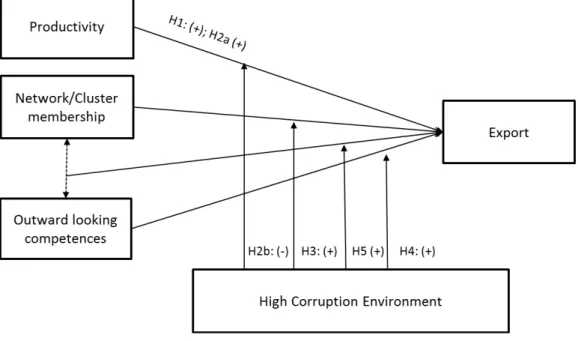
To sum up, our theoretical framework contains five empirical hypotheses and uses the exposure to high corruption environment as a moderator between the independent variables (productivity, cluster and OLC) and the exporting status of firms. Figure 1 provides a conceptual diagram that shows all the relationships tested in the empirical section.
17
RESEARCH METHODS The context and its relevance
In recent times, Africa has been recognised as an important context presenting numerous opportunities for both managers and scholars (Angwin, Mellahi, Gomes & Peter, 2014; Chikweche & Fletcher, 2014; Kamoche, 2011; Kamoche et al., 2012; Krüger & Strauss, 2015; Mellahi & Mol, 2015; Uzo & Mair, 2014). During the last decade the region has been in an important economic expansion, registering an average growth rate in the 2008–2012 –crisis period of about 2% higher than that of the world economy (UNCTAD, 2014) and continues to register one of the fastest economic and demographic growth rates in the world (World Bank, 2016). In terms of exports, the African continent has experienced an average growth rate of 4.9% from 2000-2011, representing a nearly 35% share of the continent’s total GDP (UNCTAD, 2014). This outflow activity has been coupled by an accentuated inflow of MNEs into Africa (Adjasi, Abor, Osei & Nyavor-Foli, 2012; Cleeve, 2012; Nwankwo, 2012; Wood et al., 2014; Kamoche & Siebers, 2015) and a consequent increase in inward FDI from $2.4 billion in 1985 to $66.5 billion in 2015 (Africa Investment Report, 2016; UNCTAD 2013).
However, despite these recent improvements, primarily enhanced by state-marketed primary commodities, Africa lags well behind other regions in terms of global trade involvement and investment flows (Ibeh, Wilson & Chizema, 2012). Various factors such as, lack of international experience and managerial know-how and resources exhibited by SMEs, the high level of informal exporting, limited logistics and distribution infrastructure, underdeveloped business networks, challenging relationships with African neighbouring countries and high levels of transaction costs, have been indicated as major reasons
18
explaining why the export potential is not fully realized (Okpara, 2012; Ibeh et al., 2012; Dibben & Wood, 2016).
Similarly to what happens in other developing economies (Cuervo-Cazurra, 2016), African firms are exposed high levels of corruption; which represents an important barrier to internationalization (Ibeh, 1999; Kimuyu, 2007). To visualize the level of corruption in Africa and compare it to other regions we can resort to the corruption perception index1. This index has been published yearly since 1995 and captures the informed views of local analysts through a series of surveys in a wide spectrum of countries. The index has a broad acceptance in academia (i.e. Djankov et al, 2002) and takes values from 0 to 10, where 0 means maximum perceived corruption in public organizations and 10 the absence of corruption. Table 1 shows the average of the corruption perception index for different geographical regions for the periods 2010 and 2014. When comparing the corruption of African public organizations with the rest of the regions it can be seen that African public sectors are amongst the most corrupt. Despite there is some heterogeneity in the region, Africa is one the most corrupted continents, including economies like Zimbabwe (CPI2014 = 2.1) and the Democratic Republic of the Congo (DRC) (CPI2014 = 2.2). The increasing participation of African SMEs in the international business arena has been facilitated by the implementation of a range of supportive government policies, such as the reduction of trade barriers and the strengthening of regulatory and legal systems. Above all, it has been enabled through the development of international activation mechanisms, and lower transaction/operational costs of physical environments (Ibeh et al., 2012). Within such a context, the creation of cluster zones has been particularly important as this type of soft policy requires from governments lower levels of financial investment.
[Please insert Table 1 here]
1http://www.transparency.org/
19
Sample profile
A large cross-sectional data set of African SMEs was obtained from the World Bank’s Enterprise Surveys (http://www.enterprisesurveys.org/). It provides a representative sample of firm-level data comprising a diversity of factors such as financial data, business ownership, level of competition, marketing data, technology, and infrastructure. The data was collected by specialised organisations, under the supervision of the World Bank. The data was collected in a systematic manner by experienced interviewers, who were instructed not to provide inappropriate explanations to interviewees (managers and owners), in order to avoid interpretation bias. Respondents were guaranteed full confidentiality, as a way to encourage them to provide true information. Additionally, the accuracy level of response of each interviewee was also recorded. The fact that various important studies (cf. Jensen, Li & Rahman 2010; Glaister et al., 2014; Gomes et al., 2014; Luo & Bu, 2016; Vendrell-Herrero et al., 2017) have used the World Bank enterprise survey data attests to the quality and reliability of the this dataset.
Since the data was collected by specialised organisations but under the supervision, and with the support, of the World Bank, a very ample sample frame was created. A stratified random sampling technique was used in order to ensure a high level of representativeness of the data. The stratification was performed by taking into account geographical region, business sector, and firm size. The sample setting was generated from a list of firms obtained from each country’s national statistical office and from various other government agencies. One of the main advantages of this sample for our research design is that it contains information of perceived corruption at firm level, so it is possible to test self-selection mechanism in both high and low corruption environments.
20
We used the data collected in 2010 from nine African countries: Angola, Botswana, Burkina Faso, Cameroon, DRC, Ivory Coast, Madagascar, Mauritius and South Africa. These countries reflect the diverse administrative backgrounds of Africa with countries in our sample having Belgium, British, French, German, and Portuguese heritages. As can be seen in Table 1 the countries selected are on average highly corrupted (CPI2014 = 3.63), quite similar to the rest of Africa (CPI2014 = 3.29), and significantly more corrupted than European economies (CPI2014 = 6.61).
To ensure a higher level of SME homogeneity, we only included firms with more than 5 and less than 500 employees, and firms less than 40 years old. This selection procedure resulted in a dataset of 1,233 valid responses from a senior managers of manufacturing SMEs in the Food, Textile, Chemical, Plastic metal and non-metal, machinery, and other manufacturing sectors. Table 2 shows the country and industry distribution in our sample.
[Please insert Table 2 here]
Measures
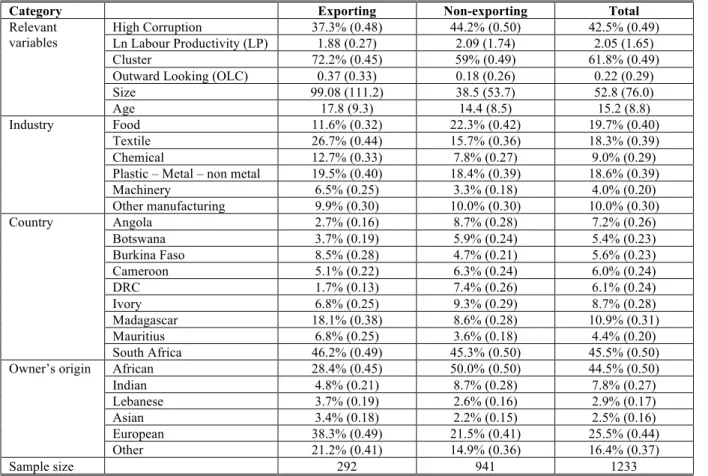
Exporting behaviour: The dependent variable is defined as a dummy variable (extensive margin), coded 1 if the firm has export sales and was coded 0 if the firm did not engage in exports (Cassiman & Golovko; Luo & Bu, 2016). As it is depicted at the bottom of Table 2, in our sample practically one fourth of the firms are exporters (23.7%). As a way to visualize the specificities of exporting firms Table 2 provide descriptive statistics (mean and standard deviation) for all variables used in this study for exporting and non-exporting subsamples.
Corruption environments: Following the empirical approach of Cassiman & Golovko (2011) we test the relationship between productivity and exports in two different business environments, in our case low and high corruption. This variable has therefore a moderating
21
role in our empirical model. Corruption is difficult to measure as its illegal nature means individuals involved in bribery or other forms of corruption are not likely to admit it (Cuervo-Cazzurra, 2008). Therefore we used perceived levels of corruption, that in the sample appear as a Likert scale ranging from “1 No obstacle” (the perception that corruption is non-existent), to “5 Severe obstacle” (the perception of very high level of corruption). We categorize firms responding “1” or “2” to this scale as being in low corruption environments, and firms responding “3”, “4” or “5” to this scale as being in high corruption environments. According to Table 2 42.5% of the firms in our sample perceive to be located in high corrupted environments. In the analysis this measure is analysed at firm level, however as a way to test the robustness of our corruption measure, we can correlate the aggregated measure at country level and the Corruption Perception Index (CPI). As it is depicted in Figure 2 there is a high positive Pearson correlation (0.81) between the aggregated low corruption percentage (for homogeneity multiplied by 10) and the CPI measured in 2010 (similar results obtained with CPI in 2014). This high correlation at country level sheds credibility to our firm level measure.
[Please insert Figure 2 here]
Labour Productivity: This (independent) variable is calculated as the ratio of total sales over labour expenses. Although some studies have measured labour productivity as the ratio of total Sales (P*Q) over number of employees (L), (Luo & Bu, 2016; Pessoa & Van Reenen, 2014), in line with Vendrell-Herrero et al. (2017), we have adapted the measure by using the ratio of total sales over labour expenses. We believe that this measure is more appropriate because it eliminates any possible bias effects resulting from differences in currency values and inflation across the countries included in our sample. This is particularly the case because our respondents provided figures in different currencies. Attempting to overcome this limitation by converting all figures to the same currency (e.g. US$) would not have solved
22
the problem because inflation rate differences would have made it difficult to warrant homogeneity in terms of the purchasing power of 1 US$ across the region. In order to overcome these issues, we used labour costs (W*L) instead of number of employees (L), and divided sales over labour costs (PQ/WL). As such, our measure of labour productivity is free of potential biases because the monetary values are cancelled by using a numerator and denominator measured in the same local currency. Our measure of productivity links revenue with each monetary unit spent in labour, an input already used in previous literature and named as labour expenses (Ortín-Ángel & Vendrell-Herrero, 2014), and therefore the average firm in our sample exhibits a value of approximately 8 monetary units for each unit invested. This variable is log transformed and as such its skewness decreases, fitting better to a normal distribution.
Cluster: This (independent) variable seeks to measure the access to local networks through the membership in a cluster association. In line with previous studies we created a dummy variable to measure the firms’ association to clusters (Aranguren et al., 2014). The variable is coded as 1 when the firm is associated with a cluster zone, and 0 otherwise. According to Table 2, 72% of exporting firms and 59% of non-exporting firms are affiliated to a cluster zone. This descriptive evidence seems to suggest that there are some exporting additionalities of being part of a cluster.
Outward Looking Competences: This (independent) variable is an index directly borrowed from Vendrell-Herrero et al. (2017) and based on three binary dimensions available in the survey. The index is composed of three binary elements that determine knowledge acquisition (licensing) and signalling practices (website and quality certifications) and therefore have an impact on OLC competences. Vendrell-Herrero et al. (2017) argue that quality certifications have lower impact on OLC competences and therefore the OLC index is equal to (3*license + 3*website + 2*quality)/8. It is important to note that this index is a
23
continuous variable that takes values between 0 and 1. According to Table 2 the index has an average value of 0.37 for exporting firms and 0.18 for non-exporting firms. This descriptive evidence seems to suggest that OLC competences are an important element for exporting.
Firm size: We control for firm size as the existing literature seems to suggest that it may affect firms’ export activities (Dass, 2000), as larger firms tend to have a larger resource base than smaller firms, which facilitates their export capacity (Wolff & Pett, 2000). The average firm size of our sample is 52.8 employees.
Firm age: In line with previous studies, we include firm age as a control variable as it seems to exert an influence on firm national and international expansion (Das 1995; Mata & Portugal 1994). The average firm age in our sample is of 15.2 years.
Owner’s origin: Previous studies have considered foreign ownership to be associated with internationalisation choices (Bhaumik et al., 2010; Hsu & Leat, 2000), as foreign owners are more likely of being able to provide firms with international experience and know-how (Jormanainen & Koveshnikov, 2012). The dataset provides information about the nationality of the largest owner. As such we created a set of dummy variables to control for the nationality of the largest owner. As can be observed in Table 2, 44.5% of firms have an owner with an African nationality. The rest of owners are European (25.5%), Indian (7.8%), Lebanese (2.9%) and Asian (2.5%). The rest of owners (16.4%) have other backgrounds.
Empirical model
The aim of this research is to uncover how the traditional variable explaining exporting behavior of firms (productivity) are relevant only in low corruption environments, whereas in high corruption environments alternative explanations (capacity to networking or to engage with foreign markets) apply. Since our dependent variable, exporting behavior, is a binary variable, a logistic regression seems to be appropriate. In order to verify our hypotheses we
24
test the Logit model in Equation 1, where the subscript i identifies each company, the vectors of coefficients γi, µi, and τi are the country, industry and owners’ origin fixed effects
respectively, and εi are the robust standard error terms.
𝐸𝑥𝑝𝑜𝑟𝑡' = 𝛽*+ 𝛽,𝐿𝑃'+ 𝛽/𝐶𝑙𝑢𝑠𝑡𝑒𝑟' + 𝛽5𝑂𝐿𝐶'+ 𝛽7𝐶𝑙𝑢𝑠𝑡𝑒𝑟 ∗ 𝑂𝐿𝐶 + 𝛽9∗ 𝑠𝑖𝑧𝑒' + 𝛽<∗ 𝑎𝑔𝑒 + 𝛾'+ 𝜇'+ 𝜏' + 𝜀' (1)
As common practice, in Table 3 we provide standard β coefficients and marginal effects for each parameter. The β coefficients provide an indication of the sign and significance of the relationship and therefore are used to accept or reject hypotheses, whereas marginal effects are used to quantify the economic impact of a particular explicative variable on the dependent variable (Greene, 2012). The model seeks to estimate the effect of an interactive variable (β4). Ai & Norton (2003) show that common inconsistencies occur with
software used to estimate the marginal effects of interactive terms. For instance, the interaction effect is conditional on the independent variables and may have different signs for different values of covariates. To interpret logistic models appropriately social science scholars strongly encourage the graphical interpretation of marginal effects (Hoetker, 2007; Vendrell-Herrero et al., 2018; Zelner, 2009). In this research we provide graphical support to the interpretation of the coefficient β4.
In line with Cassiman & Golovko (2011), the research strategy proposed in this article is to test the model specified in Equation 1 for relevant subsamples (in our case firms located in low and high corruption environments) and to observe how the self-selection effect washes away under particular conditions (in our case in high corruption environments). The results of these estimations are shown in Table 3. Columns 1and 2 provide the βs and marginal effects for the full sample respectively (Model 1), columns 3 and 4 provide the results for the low corruption subsample (Model 2), and finally columns 5 and 6 depict the results for the high corruption subsample (Model 3).
25
[Please insert Table 3 here]
To assess the accuracy of our empirical model an ex-post predictive analysis has been performed with the assumption that the probability of exporting in the population is equal to the one observed in our sample (23.7% for the full sample). Overall the model has a good fit. For example, in the full sample the model correctly predicts 75.26% of firms’ exporting decision. The models estimated for the subsamples also show high predictive capacity.
Results
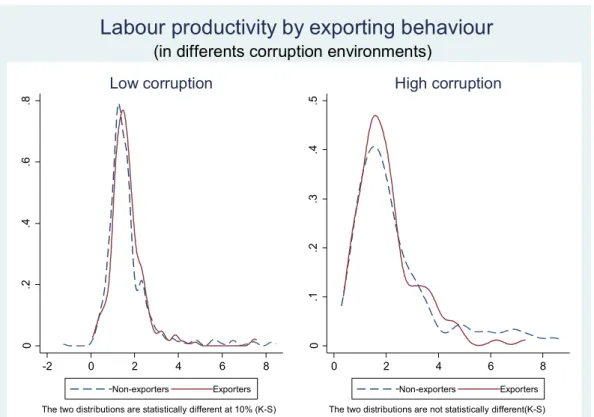
As a warm up exercise we have compared labour productivity distributions for exporting and non-exporting firms. By doing this we could test graphically whether the most productive firms are more likely to export. Interestingly, as it is shown in Figure 3 self-selection mechanisms (more productive firms are more likely to export) are observed only for the subsample of firms in low corruption environments. In particular, according to the Kolmogorov-Smirnov test (Wilcox, 2005) productivity distribution is significantly different at 10% for exporting and non-exporting firms in low corruption environments, whereas this result washes away in high corruption environments. From a visual interpretation of the figure we can see that in high corruption environments a high proportion of the most productive firms are non-exporters (see Figure 3).
[Please insert Figure 3 here]
A more in-depth analysis of the parameters β1 demonstrates that the results presented in
Figure 3 are corroborated in Table 3. The relationship between labour productivity and export is positive in all models, but significant only in Model 2 (low corruption). In particular, for the low corruption subsample an increase of 1% in labour productivity leads to an increase of 0.036 percentage points in the likelihood of a firm to export (β1>0; P-value < 0.05). This
26
the parameter β1 rejects our baseline hypothesis (H1) since the relationship between
productivity and exports is non-significant for the full sample, but accepts Hypotheses H2b stating that the self-selection mechanism does not apply in high corruption environments. The remaining hypotheses seek to explore alternative explanations of exporting behaviour in high corruption environments; that is the reason why we will pay special attention to the results of Model 3 presented in Table 3.
Hypothesis 3 states that in high corruption environments, firms benefiting from network/cluster membership are more likely to export. According to Table 3 (Model 3) and considering the rest of variables remaining constant (et ceteris paribus), getting associated to a network/cluster leads to an increase of 11.2 percentage points in the likelihood of a firm to export (β2>0; P-value < 0.05). The results for the full sample are qualitatively similar.
Consequently the results presented on Table 3 (Models 1 and 3) validate Hypothesis 3. Hypothesis 4 states that in high corruption environments, firms deploying OLC are more likely to export. According to Table 3 (Model 3) and considering the rest of variables remaining constant (et ceteris paribus), a rise in 1% in the OLC index leads to an increase of 0.173 percentage points in the likelihood of a firm to export (β3>0; P-value < 0.05). The
results for the full sample are qualitatively similar. Consequently the results in Table 3 (Models 1 and 3) validate Hypothesis 4. It is worth mentioning that according to our estimates, network/cluster and OLC are irrelevant in low corruption environments, where self-selection mechanism dominates.
Hypotheses 5 states that there is a mutually reinforcing interactive effect between networking and OLC in enhancing firms’ export likelihood. The parameter β4 is statistically
not distinguishable from zero in all models. Though, as we explained before, results regarding interaction terms in logistic regression are only averages and are, therefore, better interpreted through graphical representation (Ai & Norton, 2003; Hoetker, 2007;
Vendrell-27
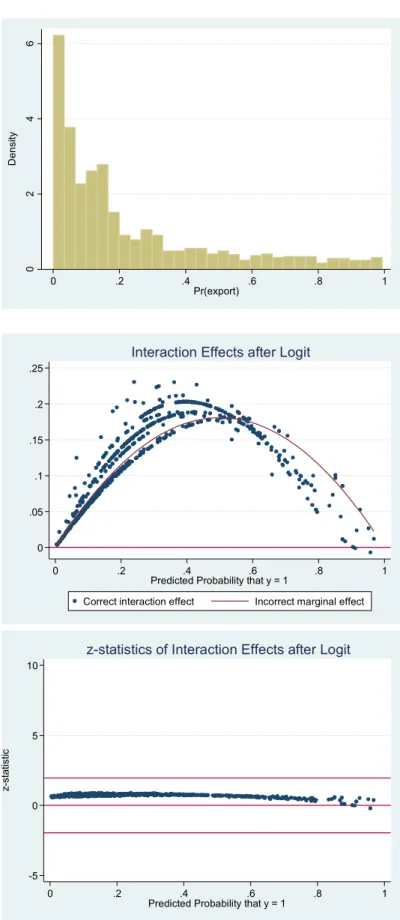
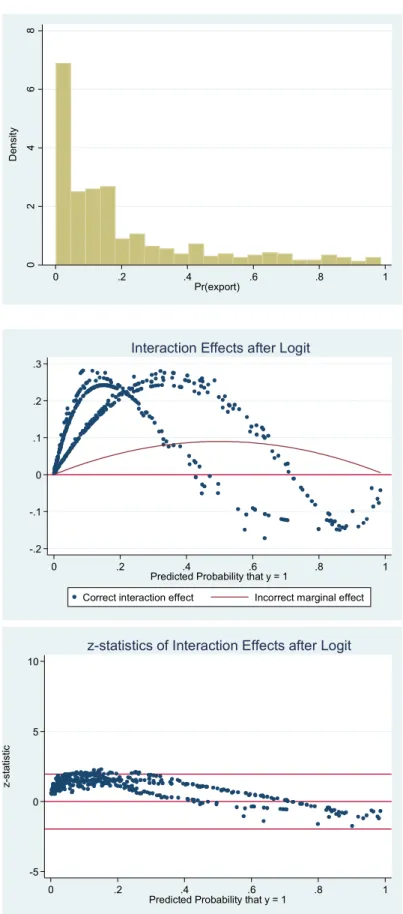
Herrero et al., 2018; Zelner, 2009). This can be seen in Figure 4 for the case of the full sample, Figure 5 for low corruption environments and Figure 6 for high corruption environments. The bottom part of Figure 4 shows that when the predicted propensity to export (X-axis) for a given firm (after model estimation) is below 0.3 the parameter of the interactive term is positive and significant (Y-axis) above 5% (β4>0; p-value < 0.05). When
the predicted propensity to export is above 0.3 we cannot rule out the null hypothesis that the parameter of the interactive term (β4) is different from zero. The results are qualitatively
similar for the high corruption sub-sample (Figure 6), but are non-statistically significant for the low corruption subsample (Figure 5).
[Please insert Figures 4, 5 and 6 here]
In sum, the evidence presented in Figures 4 and 6 suggests that in high corruption environments there are positive synergies between cluster and OLC for exporting only for those firms with relatively low probability of exporting. This means that are precisely those firms with low probability/capability to export the ones that can benefit from jointly deploying OLC and getting associated to a cluster network. The top of Figures 4, 5 and 6 provide a histogram with the distribution of predicted probabilities to export for each sample. For the case of the full sample there is a high concentration of firms with a probability of exporting below 0.3. In particular 890 firms (72.2%) have a probability to export below 0.3 (77.1% for the case of the high corruption sub-sample). This implies that according to the graphical analysis we can accept our Hypothesis 5 for a large proportion of the sample.
Regarding our control variables (size and age) the results in Table 3 indicate that firm size significantly increases the likelihood of exporting in all models. In terms of economic impact, et ceteris paribus, an employment increase of 10% leads to an increase of 0.009 percentage points in the likelihood of a firm to export (β5 >0; p-value <0.01). However,
28
results suggest that firm age does not have an impact on exporting behaviour since we cannot rule out that the underlying parameter is distinct from zero (β6 = 0).
DISCUSSION AND CONCLUSIONS
Implications to theory
Our results provide important evidence in response to various scholars who demanded for the testing and validation of existing marketing (Arnould, Price & Moisio, 2006) and international business theories (Cuervo-Cazurra, 2016; Michailova, 2011; Teagarden, Von Glinow & Mellahi, 2017) in different contexts, especially in the context of Africa (Amankwah-Amoah, Boso, & Debrah, 2017; Anakwe, 2002; Kamoche, Debrah, Horwitz, & Muuka, 2004; Kamoche et al., 2012). This is the first study testing the application of the self-selection theory in the context of Africa. Our results show that in high corruption contexts, invisible barriers seem to have a detrimental effect on the capacity of African SMEs to compete in international markets, as more productive firms do not seem to be more capable of overcoming the barriers to export and therefore exhibit higher levels of exports. In that regard, our findings contribute to the vast body of knowledge on self-selection, by partly challenging the widely accepted assertion that more productive firms are more capable to export (Aw, Chung & Roberts, 2000; Melitz, 2003; Melitz & Ottoviano, 2008; Temouri, Vogel & Wagner, 2013). In fact, our results show that in high corruption environments more productive firms do not exhibit higher likelihood of selling to foreign markets. Thus, our evidence suggests that the well-established self-selection argument is not applicable to all contexts.
We have identified two additional alternative factors explaining the capacity to export in high corruption environments; namely the access to cluster networks and the possession of
29
OLC. By resorting to network clusters, firms are capable of overcoming ‘invisible barriers’ prevalent in high corruption environments like for instance speeding up bureaucratic processes, obtaining permits, etc. (Cuervo-Cazurra, 2016). The importance of networks in explaining the firms’ internationalization process is such that it “is seen as an entrepreneurial process embedded in an institutional and social web which supports the firm in terms of access to information, human capital, finance, and so on” (Bell et al 2003; p. 341). It allows the firm to secure relevant information and contacts from its network which facilitates opportunity discovery. Social ties as a consequence of network membership can be particularly relevant in high corrupt environments as it allows the firm access to more fine-grained and tacit information thereby strengthen its position.
The results also emphasize the importance of OLC. Firms’ intention to acquire external knowledge strengthens its competitive position and makes it more likely to engage in export activities. The possession of OLC enables firms to build bridges to distant markets by sending positive signals through their internet and intranet, the possession of licensing agreements with foreign firms, and obtaining quality certifications (Vendrell-Herrero et al., 2017). Firms which are based in countries with low levels of corruption tend to be more trusted not only by customers in their home country but also by customers located in foreign markets (Lin et al., 2016). As such, customers are more likely to buy products and services from firms based in countries where corruption is absent. The possession of OLC for African firms is therefore crucial to counteract the negative perception of being based in countries perceived to be highly corrupt.
However, we need to note that our results do not make a fundamental criticism of the self-selection argument, but rather refine it in order to help understand what lies behind best performing firms in different contexts. Our results show that in low corruption environments it is more important to understand ‘the rules of market’ and focus on input minimisation –
30
output maximisation, as a key condition to enter and succeed in export markets (Melitz, 2003). In contrast, in high corruption contexts it becomes more important to understand the ‘rules of the game’ and be able to tap into alternative mechanisms such as OLC and networking ties in order to be able to ‘open the doors’ of the export market. This opens a line of investigation about the importance of understanding the dichotomy prevalent in developing markets (such as those in Africa), where firms are confronted with the need to choose between following the ‘rules of the game’ or the ‘rules of the market’.
Practical implications
African governments should first work towards the reduction of corruption levels as this is the only way to develop better and fairer market conditions that encourage firms to achieve competitiveness levels required to successfully operate in more competitive international markets. However, we are aware that the reduction of corruption is complex and requires time. Our results suggest that whilst in markets where corruption levels remain high, policy makers need to continue encouraging SMEs to export. To this end, clusters networks provide a valuable mechanism. Furthermore, policy makers should also recognise that, for this to be fully effective, cluster networks depend upon institutional support and social exchange that can be impaired by the presence of corruption. In parallel, policy makers and managers also should be aware about the importance of the use of inter and intranets and of the adoption of foreign technology in the form of licensing in order to strengthen their OLC. These insights may have resonance with other developing economies more generally. They may also be of interest to external funding bodies, such as development banks, seeking to help developing economies develop through targeted investments.
31
Limitations and directions for further research
This paper has limitations, common to other prior survey-based studies, in using a cross-sectional approach to assess the exporting behaviour of firms. The insights may be extended by future studies using longitudinal methodology to capture better the dynamics of high corruption environments.
This study uses data from nine African countries. Future studies testing these relationships in other African and developing markets will be welcome. While data collection in Africa still presents an important challenge to researchers (Klingebiel & Stadler 2015) the emergence of new and more reliable data from other African countries may allow additional analyses to be carried out to provide a more comprehensive picture of African exporting firms and the role of network clusters across the continent.
Given that other variables such as levels of entrepreneurship, innovation, marketing capabilities, and export promotion programs may affect these relationships, future studies are encouraged to explore these relationships particularly in developing countries where corruption tends to be more prevalent. This study focuses on corruption but there are a number of institutional variables that could also affect these relationships. Thus, future studies are encouraged to examine the effects of other institutional and country factors that enable the identification of important nuances and further develop existing international marketing/business theories.
Finally, while there have been a number of studies examining the antecedents of corruption, there have been few studies investigating the impact of corruption on the firm’s strategy (Lin et al, 2016; Lee & Weng, 2013). Thus, by pointing out the impact of corruption to explain the firm’s export activity, this study emphasizes the importance of low and high corruption environments as an antecedent in the international business and marketing areas. It
32
is hoped that this study will contribute to a better understanding of this topic and will stimulate further research in this area.
REFERENCES
Acquaah, M. (2012). “Social networking relationships, firm-specific managerial experience and firm performance in a transition economy: A comparative analysis of family owned and nonfamily firms”. Strategic Management Journal, 33(10), 1215-1228.
Adjasi C.K.D, Abor J, Osei K.A, & Nyavor-Foli E.E. (2012). “FDI and economic activity in Africa: The role of local financial markets”. Thunderbird International Business Review,54, 429-439.
The Africa Investment Report (2016) https://www.camara.es/sites/default/files/publicaciones/the-africa-investment-report-2016.pdf Last accessed: 6 September 2017.
Ai, C., & Norton, E. C. (2003). “Interaction terms in logit and probit models”. Economics Letters, 80(1), 123–129.
Aker, J. C., & Mbiti, I. M. (2010). “Mobile phones and economic development in Africa”. The Journal of Economic Perspectives, 24(3), 207-232.
Altomonte, C., Aquilante, T., Békés, G., & Ottaviano, G. I. 2013.”Internationalization and innovation of firms: evidence and policy”. Economic Policy, 28(76), 663-700.
Amankwah-Amoah, J. (2015), “Solar energy in sub-Saharan Africa: The challenges and opportunities of technological leapfrogging”, Thunderbird International Business Review, Vol. 57 No. 1, pp. 15–31. Amankwah-Amoah, J., Boso, N., & Debrah, Y. A. (2017). “Africa Rising in an Emerging World: An
International Marketing Perspective”. International Marketing Review. In Press.
Anakwe, U.P. (2002), “Human resource management practices in Nigeria: challenges and insights” The International Journal of Human Resource Management, 13, 1042-1059.
Angwin, D. N., Mellahi, K., Gomes, E., & Peter, E. (2016). “How communication approaches impact mergers and acquisitions outcomes”. The International Journal of Human Resource
Management, 27(20), 2370-2397.
Aranguren M.J, Maza-Aramburu X, Parrilli D, Vendrell-Herrero F, & Wilson J. (2014). “Nested
Methodological Approaches for Cluster Policy Evaluation: An Application to the Basque Country”. Regional Studies. 48 (9), 1547-1562
Arnould E.J., Price, L.L. & Moisio R. (2006). Making contexts matter: selecting research contexts for theoretical insights. In R. W. Belk (Ed.), Handbook of Qualitative Research, Methods in Marketing Aw, B. Y., Chung, S., & Roberts, M. J. (2000). “Productivity and turnover in the export market: micro-level
evidence from the Republic of Korea and Taiwan (China)”, The World Bank Economic Review, 14(1) 65-90.
Bah E. H, & Fang L. 2015. “Impact of the business environment on output and productivity in Africa”. Journal of Development Economics 114, 159-171.
Baughn, C., Bodie, N. L., Buchanan, M. A., & Bixby, M. B. (2010). “Bribery in international business transactions”, Journal of Business Ethics, 92(1), 15-32.
Becker, S. & P. Egger (2013). “Endogenous product versus process innovation and a firm’s propensity to export”, Empirical Economics, 44(1), 329–54.
Bell, J., McNaughton, R., Young, S., & Crick, D. (2003). “Towards an integrative model of small firm internationalization”, Journal of International Entrepreneurship, 1 (4), 339-362.
Baum, J. A. C, Calabrese, T., & Silverman, B. S. (2000). “Don't go it alone: Alliance network composition and startups' performance in Canadian biotechnology”. Strategic Management Journal. 21: 267-294. Bhaumik S.K, Driffield N, & Pal S. 2010. “Does Ownership Structure of Emerging-Market Firms Affect
their Outward FDI? The Case of the Indian Automotive and Pharmaceutical Sectors”. Journal of International Business Studies 41(3), 437-450.
Boso, N., Story, V. M., & Cadogan, J. W. (2013). “Entrepreneurial orientation, market orientation, network ties, and performance: Study of entrepreneurial firms in a developing economy”. Journal of Business Venturing, 28(6), 708-727.
Boyacigiller, N. A., & Adler, N. J. (1991). “The parochial dinosaur: Organizational science in a global context”. Academy of Management Review, 16(2), 262—291.