i
Student: Luís Afonso da Cunha Monteiro Claro de Castro
Dissertation presented as a partial requirement for obtaining
the Master’s degree in Statistics and Information
Management.
The Role of Information Systems in achieving
the Sustainable Development Goals:
An overview of Established and Emerging
Technologies for Development.
i
Title: The Role of Information Systems to achieve the 2030 Sustainable Development Goals
Subtitle: An Overview of the Established and Emerging Technologies for Sustainable Development
Student: Luís Afonso da Cunha Monteiro Claro de Castro
full name
MEGI
ii
NOVA Information Management School
Instituto Superior de Estatística e Gestão de Informação
Universidade Nova de Lisboa
The Role of Information Systems in Achieving the Sustainable Development Goals:
An Overview of Established and Emerging Technologies for Development. by
Student: Luís Afonso da Cunha Monteiro Claro de Castro
Dissertation presented as a partial requirement for obtaining the Master’s degree in Information Management, with a specialization in Marketing Intelligence.
iii August/2018
ACKNOWLEDGEMENTS
I would like to thank and dedicate this Master Thesis to my family, especially my mother who have always taught me how to be a critical thinker and see beyond. Without this skill, such research would have not been possible.
I want to thank the guidance provided by my thesis advisor, professor Vítor Santos, which inclusively shared the same passion and interest on the topics of technology for development. Finally, I would like to thank my girlfriend for all the support, dedication and patience and for pushing me to break the boundaries of the unknown.
“Wonder is the beginning of wisdom”
iv
ABSTRACT
The Sustainable Development Goals initiative is one of the most significant Global Development programs created by the United Nations for the future. It is both the result and the continuation of a successful anti-poverty movement called Millennium Development Goals, implemented in the year 2000. At a time of transition marked by the post-2015 agenda for Development, new questions and problems have arisen and new challenges have been set in order to keep track of Sustainable Development. Information Systems and technology are among the key elements behind these Global Agenda Programmes, since they are rightly seen as enablers of Sustainable Development. The aim of this study was to understand what the role of technology might be in achieving the Sustainable Development Goals according to literature and field experts, providing a framework that can be used for discussion in a 2015 post-agenda context.
KEYWORDS
Human Sustainable Development, Information Systems, Sustainable Development Goals, ICT4D, Global Leaders, Established and Emerging Technologies, WSIS.
v
Table of Contents
1.Introduction ... 1 1.1- Background ... 2 1.2- Objectives ... 3 2. Literature Review ... 42.1- Human and Sustainable Development ... 4
2.1.1- Current Main Challenges of the 21st Century ... 10
2.1.2- The Achievements of the MDGs ... 15
2.1.2- What is missing?... 18
2.1.3- From MDGs to SDGs ... 21
2.1.4- What is being done to achieve the SDGs by 2030? ... 24
2.2- Information Systems ... 28
2.2.1- Concepts ... 29
2.2.2- Technology for Development... 33
2.2.3- Established and Emerging Technologies at the service of the SDGs ... 36
3. Methodology ... 47
3.1- Design Science Research ... 47
3.2- Research Process ... 49 3.3- Interviews ... 50 4. Study ... 54 4.1- Assumptions ... 54 4.2 – Reference Model... 55 4.3- Validation... 66 4.4- Results ... 95 4.5- Discussion ... 107
4.5.1- Leveraging technology for Sustainable Development: The role of Development Agents and Global Leaders ... 107
4.5.2- The role of established and emerging Technologies in achieving the SDGs: a model validation ... 114
5. Conclusions ... 121
5.1- Summary of the Developed Work ... 124
5.2- Limitations and Recommendations ... 125
5.3- Future Work ... 126
vi
LIST OF FIGURES
Figure 1- Triangulation of Sustainable Development - Adapted from: Beyond Economic
Growth (Soubbotina, 2004) ... 7
Figure 2- Model for Sustainable Development, retrieved from The Imperatives of Sustainable Development (Holden et al., 2017)... 8
Figure 3– Millennium Development Goals (Retrieved from: UN.org/millenniumgoals, last accessed, October 2017) ... 15
Figure 4- MDGs Progress by Number of Countries (Source: UNDP Report, transitioning from the MDGs to the SDGs, 2015, retrieved in November 2017) ... 18
Figure 5 - Sustainable Development Goals adopted by the United Nations in 2015 (Source: http://www.un.org/sustainabledevelopment/sustainable-development-goals/, Retrieved in November, 2017) ... 22
Figure 6 - Computer-based Information System components (Adapted based on the work of: Wallace, 2015, Nelson & Cox, 2018 and Bourgeois, 2014) ... 31
Figure 7- Contributions of Microbial Technology to the SDGs (Adapted from: The contribution of microbial biotechnology to Sustainable Development goals: microbiome therapies, O’Toole & Paoli, 2017) ... 42
Figure 8- Kondratieff Cycles (Retrieved from: Analysis & Trends The sixth Kondratieff - long waves of prosperity, Allianz, 2010) ... 43
Figure 9 - Adapted DSR process steps from Vaishnavi and Kuechler (2007) and Peffers et al. (2006). ... 47
Figure 10- Methodological Approach - DSR Component, adapted from Venable (2006) ... 48
Figure 11- Adopted Research Strategy based on Vaishnavi and Kuechler (2007) & Peffers et al. (2006). ... 49
Figure 12 – Interviewees’ Countries of Nationality & Origin ... 67
Figure 13 – Interviewees Representing: International Organizations, Academia, Private Sector, Government and Civil Society. ... 67
Figure 14 - Results: Human Sustainable Development dependency on Technology. ... 95
Figure 15 - The existence or not of differences between established and emerging technologies. ... 99
Figure 16 - The role of established and emerging technologies in achieving the SDGs. ... 100
Figure 17 - Emerging Technologies impact on the Digital Divide. ... 102
Figure 18 - The most eligible group of technologies for Development until 2030 ... 104
vii
LIST OF TABLES
Table 1- Some of the main achievements of the MDG (source: UN, Millennium Development Goals Report, 2015) ... 16 Table 2 - Reference Model: Established & Emerging Technologies for Sustainable Development ... 57 Table 3 -Study participants backgrounds ... 70 Table 4 – Relevant addressed technologies features by the experts ... 106
viii
Outcomes of the present master’s dissertation
2 Paper Submissions:- Paper Submission for the International Journal of Sustainable Development (IJSD) from Inderscience publisher.
- Paper Submission for the Information Technologies and International Development (ITID) journal.
Partnership Opportunity:
NOVA Lisbon has now the opportunity to integrate the Smart Campus Cloud Network (SCCN) initiative from the TERRE Policy Center and UNESCO. SCCN has the goal to provide universities with the tools to foster sustainable development best practices by having close contact with smart grid technologies, their implementation, usage and monitoring of different fields: water and energy consumption, waste and transportation.
ix
LIST OF ABBREVIATIONS AND ACRONYMS
A.I Artificial Intelligence BC Blockchain
BD Big Data BT Biotechnology
CBIS Computer-Based Information System DSR Design Science Research
GDP Gross Domestic Product GIS Global Information Society GNI Gross National Income HD Human Development HDI Human Development Index
IAEG International Association for Engineering Geology ICTs Information and Communication Technologies IDMC International Displacement Monitoring Centre IFAD International Fund for Agricultural Development ITU International Telecommunication Union
IMF International Monetary Fund IT Information Technology LIC Low-Income Countries M&E Monitoring and Evaluation MCH Maternal and Child Health MDGs Millennium Development Goals MIC Middle-Income Countries
OECD Organization for Economic Cooperation and Development RGS Royal Geographic Society
SDGs Sustainable Development Goals
SDSN Sustainable Development Solutions Network SHD Sustainable Human Development
STI Science, Technology and Innovation UGC User-generated content
x
US United States
UNDP United Nations Development Programme UNH United Nations Habitat
WHO World Health Organization
1
1.INTRODUCTION
At the beginning of this millennium 189 governments of the United Nations officially agreed to fight poverty and promote global partnership by signing the United Nations Millennium Declaration (2000), which was adopted during the Millennium Summit – a three-day meeting between many world leaders in September 2000 – and led to the creation of 8 Millennium Development Goals (MDGs). This framework was in place during the following fifteen years;18 targets were set and, in order to measure the success in achieving them, 60 indicators were developed for more efficient data-gathering, monitoring, evaluation and reporting of results until 2015.
Before the release of the United Nations Millennium Development Goals Report (2015b), a new project was already being undertaken to determine the following steps to taken by the international community . The Road to Dignity 2030 Synthesis Report of the U.N Secretary-General on the Post-2015 Agenda (2014) provided an overview of the results and drew conclusions. It was essentially a summary of what we had learnt from the MDGs initiative and a reflection on what the future held: “We are at a historic crossroads, and the directions we take will determine whether we will succeed or fail on our promises” (United Nations, 2014, pp.3). Based on the analysis of the results of the MDGs and new human and environmental challenges, 9 new Goals were introduced and a total of 232 indicators were introduced, resulting in the creation of the Sustainable Development Goals (SDGs).
Behind the successful implementation and results of the MDGs, there were many different factors to be considered, with Information Systems (IS) playing a crucial role in guaranteeing the alignment and cohesion of Infrastructure, data, information management, financial/human resources and technology (United Nations, 2012). Without them it would not have been possible to give fast responses to human needs and challenges posed by different countries at the same time.
Information Systems can, according to Alter (1992, cited by Varajão & Amaral, 2000), be defined as a combination of procedures, information, people and information technologies for the achievement of organizational purposes. Santos (2015) believes in the importance and contribution of IS in achieving the SDGs more specifically Technology, which nowadays is a crucial part of any information system, and has been playing and shall continue to play an unquestionable role to foster human progress and should be used to achieve a society where no one is be left behind (Seydiogullari, 2013).
2 The purpose of the Sustainable Development Goals initiative is to set a worldwide mindset of joining forces and tackling the world’s largest challenges such as fighting poverty, eliminating inequalities and achieving sustainable, human and economic development. Pilemalm (2002) suggests that technology not only enables Sustainable Development but also works as a facilitator for change and improvement of human life. Moreover, it operates as a connector and contributor to the global well-being by bringing together people from different nations, religions and backgrounds to work and cooperate towards a prosperous and equal society (United Nations, 2012a).
1.1-
B
ACKGROUNDTo achieve Sustainable Development, societies will have to transform, in order to keep the pace of human progress, while simultaneously assuring global sustainability. Sachs and Modi (2015) believe that technology will play a particularly impactful role in today’s low-income countries, allowing them to close existing gaps and coming closer to the desired outcomes of the SDGs by 2030. For instance, and as a practical example of how this is already taking place, mobile subscriptions in Africa have gone up from almost no subscribers to nearly 900 million in 2015, thus reducing the digital divide and giving people access to information and communication tools according to these authors (Sachs and Modi, 2015).
Technology has the capacity to transform and directly or indirectly improve human life and the environment; Dzidonu (2010) believes that only now are we truly unlocking the power of technology to help us solve social, environmental, political and economic problems. This study was therefore an opportunity to give an overview of the main technologies which are and will be contributors to achieve human Sustainable Development in a post-2015 context. To keep pace with a fast-changing planet and humankind, new technological alternatives are being developed and tested to bring in solutions for the challenges we are facing today and will be facing in the future (Beder, 1994). It is now an opportune time to address the present and emergent options to achieve the SDGs, given the heightened interest and significance of technology for Development purposes (United Nations, 2012).
Technology brings new possibilities, not only for a more inclusive world with less gaps between the developed and developing countries, but also for deep transformation of the economy and societies in general (Sachs & Modi, 2015):
3 the Internet of Things can help reduce the digital divide, artificial intelligence can lead to the creation of efficient robots, 3-D printing can help improve production, Geolocation services can help water and agriculture management, Cloud Computing can help gather and make relevant data access possible anytime and anywhere. These are some of the technologies addressed in this research that have been proven to be essential not only for human and economic development but also to help achieve the sustainable path of the Road to Dignity 2030. However, there are different variables that need to be aligned, in a global context, in order to successfully deploy technology for Sustainable Development, which will be extensively addressed throughout this research, in particular in the Study section.
1.2-
O
BJECTIVESThe main objective of this research was to understand what the role of established and emerging technologies might be in achieving the SDGs.
The secondary objectives were:
➢ To Establish a relationship between Technology and Development;
➢ To review the existing literature on technologies for development and how they are being used for Sustainable Development purposes;
➢ To find established and emergent technologies that can help achieve the SDGs;
➢ To understand what the role of Development Agents and Global Leaders is in leveraging technology for Sustainable Development;
➢ To link relevant technologies to the SDGs based on their present and possible future contributions in achieving the goals.
The research questions which led to and will serve as guidelines for this master’s thesis research are:
➢ Is Human Sustainable Development dependent or independent of technology?
➢ What current and emergent technologies contribute towards the achievement of the SDGs?
➢ How are the researched technologies proving helpful to improve human life and achieve Sustainable Development?
➢ How can these technologies help solve current Development challenges?
➢ What is the role of Global Leaders and Development Agents in leveraging technology for Sustainable Development?
4
2. LITERATURE REVIEW
In order to successfully understand what the role of Information Systems and Technology is and will be in achieving the SDGs, it is necessary to understand the conceptual Human and Sustainable Development foundations driving the UN mission. It will then be possible to address the program’s origins, objectives, to properly understand what exactly the results of the Millennium Development Goals (which originated the SDGs) were and their implications, what the present context is and what is missing to achieve better outcomes for the future, from a Sustainable Development point of view.
This research aimed to give a contribution to the academic field of Information Systems, Technology and Development Studies, and a call for multidisciplinary academic research approaches. By understanding the drivers of such a global and ambitious program, it is possible to take a deep dive into the topic and understand what the role of Information Systems and Technology might be in achieving the SDGs and which present and emerging technologies will be key to help humanity step forward and become more inclusive, equal and ‘sustainable’.
2.1-
H
UMAN ANDS
USTAINABLED
EVELOPMENTIn order to have a better understanding of the present of the SDGs initiative and how exactly Information Systems and technology are shaping the field of Development as proposed by the United Nations (2014), it is first necessary to define and understand the context in which Human and Sustainable Development is used. The following concepts will be of great importance to have a historic understanding of both the evolution of these concepts and of what exactly humanitarian organizations such as the UN are striving to achieve and how. Development is a rather hard to define and broad concept, which is used and cited in scientific, academic, professional, personal, religious and many other different fields. The actual history of the concept of Development is, according to Rist (1996), the author of The
History of Development, intimately connected to the progress of human history, and the
influence of the Western World and its philosophies, concepts and scientific discoveries since early ages.
5 The concept of Development has been used by humankind, mainly the western world, to define and justify different acts, decisions and judgements throughout history, from the Greek philosophers to the modern scientists and theorists (Rist, 1996).
One of the greatest contributors to modern Development theories is the economist Mahbub ul Haq (1995, pp.ix), who claims that “the ultimate purpose of the exercise of development should not be lost in sight: to treat men, women and children – present and future generations – as ends, to improve human condition and to enlarge people’s choices”. Mahbub ul Haq (1995) was one of the major contributors to the modern concepts of Human Development, which was defined by him as the widening of the range of people’s choices, and how it can be measured. This same definition would be adopted and incorporated in the United Nations (2015) vision.
Amartya Sen, who is another well recognized economist in the Development field, describes Human Development as the expansion of peoples’ ability to live better, with more freedom and opportunity (Heyes & Kapur, 2017).
Sen, along with Mahbub ul Haq and other development researchers and economists, contributed to the creation of the United Nations Human Development Index used by the United Nations Development Programme (UNDP, 1994), through his capabilities-based approach; indicators such as the standard of living were emphasized over income per capita for example, moving from utility to capabilities and distinguishing between means and ends – for instance money vs well-being or freedom. (Elizabeth A. Stanton, 2010). In his most influential book, The Standard of Living (1987), Amartya Sen brought up the importance of human well-being and what defines it; this author helped shape the Human Development policies of the United Nations; in particular, the Millennium Development Goals were heavily based on his ideas.
Heyes and Kapur (2017) identify Human Development as an alternative approach to the measurement of the income/wealth approach, which used as indicators the GNI (Gross National Income) or the GDP (Gross Domestic Product). The Human Development approach focuses itself on three primary dimensions according to the UNDP (2015): life expectancy, education and per capita and Gross National Income (GNI), which makes it easier to provide accurate measurement of the standards of living across the globe.
6 Human Development was, according to ul Haq (1995), an emerging alternative to the classical economic growth school of the late 20th century, where the main focus of
development was on the economy, namely on the wealth a nation would be able to generate. The Human Development approach, on the other hand, emphasizes the importance of enlarging people’s choices in all fields, - mainly society, culture and politics - , not focusing exclusively on the economy.
The concept of Human Development is flexible in its different dimensions and capabilities according to Sen (as cited in: Alkire, 2010). Its relevancy will differ according to cultural and national contexts. Alkire (2010, pp.10), however, “criticizes the broad modern definition of Human Development, mentioning the importance of “procedural principles” on human development to avoid inequality or the infringement of the human rights of a group to expand the freedoms of another.
Despite the great contributions of the aforementioned authors, the concept and measurement of human development is however only one of the three major Development Theories, the others being Sustainable Development and Human Sustainable Development. According to (Neumayer, 2012), Human Development should be intimately connected to Sustainable Development. The foundations of the Human Development concept given by the United Nations on Human Development Report (1994) and by Sen on the Income Component of the HDI (2000) both entail the principle of universalism and, although the concern for both present and future generations has often been associated with the enlargement of people’s freedoms and choices, that principle does not directly cite the compromise with it in regards to the future (Neumayer, 2012). The most commonly used definition of Sustainable Development was given by the World Commission on Environmental Protection and Sustainable Development Report: Our Common Future (1987, pp.6); it was defined as the capacity for development to meet the needs of the present without compromising the ability of future generations to meet their own needs. Despite the fact that humans have long shown interest in sustainability and its practices - see the irrigation technology of the ancient Egyptians or the ecological engineering used by the Mayans to conserve water and food - , the modern concern with environmental and human issues increased mostly in the second half of the 20th Century (Higgins, 2015).
7 The Club of Rome’s well-known report The Limits of Growth (1972) featured the first use of the term in modern times; the book authors, Meadows, Randers and Behrens (1972), as well as other researchers and scientists, from both the academic and the business world, developed their own model, which helped them reach conclusions such as:
1. If the current growth rate of world population, industrialization, pollution, food production and resource depletion continue, the limits of our planet’s growth will be reached somewhere within the next one hundred years.
2. It is possible to revert these growth trends and to establish a state of ecological and economic stability that is sustainable far into the future. A global equilibrium could be designed to satisfy the basic needs of each person by assuring equal opportunities and realizing individual human potential.
3. The sooner humanity begins working towards attaining the outcome mentioned above, the greater the chance of success.
This approach to the question of Sustainable Development would underline a period of increased Global awareness on the subject, where these authors encouraged the scientific community to give continuity to the study and to help them prepare for a period where global equilibrium and sustainability will matter more than economic growth.
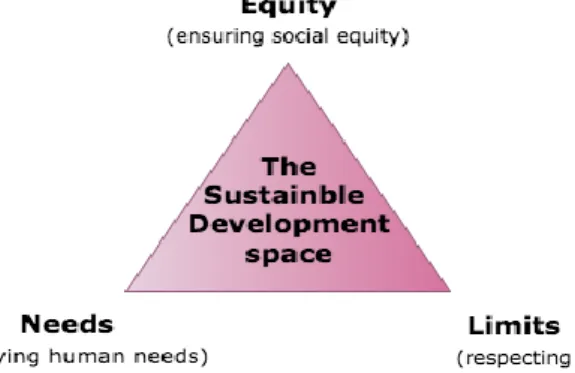
The variables that are implicit in Sustainable Development are usually presented in the form of a triangulation that, according to Soubbotina (2004) and Higgins (2015), should respect the 3 main pillars of Sustainable Development:
Figure 1- Triangulation of Sustainable Development - Adapted from: Beyond Economic Growth (Soubbotina, 2004)
More recently within the Sustainable Development field, a new definition of the term has emerged, with Holden, Linnerud and Banister (2017) defining Sustainable Development as a normative value system.
8 This system entails an interconnectedness of Human Rights, Democracy and Freedom. According to the authors, these are the elements of the Sustainable Development concept which are described as “moral imperatives” - Holden et al. (2017, pp:213). Sustainable Development relies on three moral imperatives: satisfying human needs, ensuring social equity and respecting environmental limits.
The model proposed by the authors on the Imperatives of Sustainable Development (2017), differs from the classical model of representing Sustainable Development (see Figure 1), where the variables should be balanced between them, but each has its own space.
Sustainable Development can be defined as three constraints on human behaviour; these constraints will create and define the Sustainable Development space to be shared by all implicit variables as shown in figure 2 and according Holden et al. (2017):
Figure 2- Model for Sustainable Development, retrieved from The Imperatives of Sustainable Development (Holden et al., 2017)
Despite the different contexts and concepts of Human and Sustainable Development, they should both be taken into account, according to Neumayer (2012), when measuring successful human progress. For instance, when considering and approaching both concepts and metrics applied to Development Rankings from the United Nations, such as in the SDG Index (2016), it can be inferred that despite the high Human Development (HD) ranking of some countries they are not being able to meet the Sustainable Development standards, resulting in differences of more than 20 places when doing a comparison of the rankings. It is also true that economic growth and development are focused on reducing poverty and contributing towards solving other social issues. History shows us that growth was actually attained at the cost of greater inequality and natural resources overconsumption between the so called developed and developing countries (Soubbotina, 2004).
9 Human Development is an enabler of economic growth, by providing resourceful, knowledgeable and well-prepared workers through education for the challenges of technology usage and innovation. This leads to a better job market, with more inclusion, opportunities and, above all, more freedom of choice (Soubbotina, 2004). Neumayer (2012); Biggeri and Ferrannini (2014) along with Peeters, Dirix and Sterckx (2013) defend that Human and Sustainable Development should be seen as Human Sustainable Development, thus considered as only one all-encompassing concept.
Neumayer (2012) argues that many countries achieve high levels of HD at the expense of sustainability; in his article on Human Development and Sustainability he proposes a model for linking the measurement of both Human and Sustainable Development.
According to Peeters et al. (2013), the care for the ecological system of the planet is a necessity to avoid its deterioration and to keep the biophysical conditions for human development. However, human activities should not go beyond the limits of the environment. Environmental Sustainability, should, according to the UNDP (2011), be at the core of Sustainable Human Development.
The Human Development goal of enhancing people’s capabilities and well-being should always take into consideration the biophysical limits and constrains of the ecosphere (Sen, 1987). Nevertheless, and as agreed by Biggeri and Ferrannini (2014), SHD should always start at the Local level. Local Development is thus, according these authors, at the core of the true Human, Environmental and Economic Development.
Information Systems and Technology have always played a key role in putting the above presented concepts into practice, by improving everyday life, measuring and analysing our impact on planet Earth and supporting decision-making and theory building through research based on scientific evidence and computational statistics (Saariluoma, Cañas & Leikas 2016). For example, the book Limits of Growth (1972) presented the readers with conclusions about the future thanks to advanced prediction models already being used by the authors in their research.
As time went by and technology kept evolving, it proved to deserve the necessary attention by the International Community as a tool that can greatly contribute towards Human and Sustainable Development and the different initiatives focusing on it, such as the MDGs pre-2015, and now the SDGs until 2030.
10
2.1.1- Current Main Challenges of the 21
stCentury
The concern for Human and Sustainable Development has long been part of both rational and survival human instinct since early times and across civilizations; according to Cribb (2017) fighting for survival and looking towards the future to assure subsistence is an inherent human characteristic.
Fire, technology, buildings, vaccines, armies, healthcare, agriculture, clean water, climate science are some representations of our wisdom applied to the challenges of subsistence through history.
The United Nations World Economic and Social Survey (2013) reported that there still were more than 1 billion people living in extreme poverty as a result of extreme income inequality and also that high rates of both production and consumption are resulting in the environmental degradation of the planet. In this research one of the key questions taken into consideration is: Can technology effectively help tackle the challenges we face in the 21st
Century?
Currently, and according to the triangle of Sustainable Development (See figure 1), which entails Economic, Social and Environmental sustainability, many challenges will have to be faced to reach a balance between these three different yet connected development fields. There is a need for Development Strategies to be inclusive, ambitious, action-oriented and collaborative, according to the United Nations Millennium Development Goals Report (2013). It is important to change consumption and production rates, reduce inequalities, strengthen economic governance and minimize negative externalities such as pollution, while at the same time enhancing worldwide technology adoption to help reduce food and water waste, and increase energy efficiency.
Technological advancements have changed human life throughout history as technical inventions not only gave humans the possibility of seeing far into the future but also of understanding and measuring how our impact on the planet is changing it (Saariluoma et al., 2005). However, this is not enough to provide solutions to the issues we are facing today. Ackerman and Stanton (2014) believe that some existing technologies could certainly be used as a way of reducing or even completely eliminating the greenhouse effect and solving other environmental and social issues; however, they also believe that the biggest obstacles to this path of action are primarily economic and political, rather than technological.
11 Despite the existent literature on Sustainable Development related topics such as climate change, environmental damage and protection or water pollution, there is yet a relatively small number of publications focusing on the most prominent and critical challenges faced by humankind in the 21st century as far as Sustainable Development is concerned.
There are conferences and gatherings among global leaders and UN organizations that attempt to cover all the issues that directly or indirectly affect us and require our effort to tackle them. Most of the United Nations initiatives for Development, such as the MDGs programme, resulted from Global Conferences, which determine the steps and directions to follow on areas such as the Environment, Society and the Economy. One of the earliest initiatives with the focus on addressing the 21st century challenges we are facing was an initiative of the
Royal Geographic Society in 2015.
The programme, named 21st Century Challenges, was held between 2015 and 2017, and
entailed a series of discussions run by the institution. The initiative focused on the biggest social, environmental and economic challenges in the coming decades. Although the discussion sessions took place in the UK, the addressed challenges were all of a global nature (Royal Geographic Society, retrieved from: https://21stcenturychallenges.org/ in November 2017). Below is a list and discussion of those challenges:
1. Adapting to Climate Change and finding low-carbon alternatives
The first challenge addressed is the need to control Carbon Dioxide emissions and to start using more alternative sources of energy. Carbon Dioxide (CO2) is a greenhouse gas that traps heat in the atmosphere, resulting in global rises of the temperature. Therefore, high levels of emission greatly increase the probability of extreme weather events such as storms, droughts, heat waves and floods, which will negatively impact human health, agriculture and infrastructure.
2. Ecosystem Protection
The ecosystem is in danger due to overfishing, deforestation and plastic pollution in the oceans. The United Nations (2015b) estimated that 87% of world fish stocks are fully exploited or overfished, which requires changes in their management. When it comes to deforestation, the main challenges are conserving the planet’s rainforests and minimizing the destruction caused by the palm oil industry, timber trade and biofuels. Finally, plastic pollution is threatening marine life and it will therefore be a challenge to find practical solutions to clean and reuse all the plastic being thrown away to the ocean.
12
3. Economy
In 2007, there was a Global Financial Crisis, could this have shaped capitalism as we know it today?
Many different factors contributed to the economic transformations of the past decades. These changes have consequences for manufacturing, production, jobs, skills, innovation, the economy and sustainability. How can Economic Growth be assured in a sustainable way? Current and emerging technologies are bringing in new alternatives to follow the sustainability path; this will be further addressed in the second stage of this literature review.
4. Education
Education has always been one of the main concerns and challenges for the United Nations; according to the 2015 report Education for All, many objectives from the Millennium Development Goals (MDGs) were achieved. However, there are still challenges, mostly lying in the improvement of the targets for the MDGs 2015 post-agenda.
Several of the proposed post-agenda education targets lack specificity and clarity in the concepts employed and outcomes expected (UNESCO, 2015). According to the 21st Century
Challenges programme, the main challenges on education will be to prepare young people to fulfil their potential and to assure gender equality in education across the globe.
5. Globalization and Geopolitics
Information, people and resources can move around the world thanks to globalization. What are the opportunities and challenges for the future?
According to the programme, one of the main challenges will be to understand the role of Africa, each of their countries and how they can be supported, as 7 of the 10 fastest growing economies in the world are from this continent according to the International Monetary Fund (2015).
6. Human Health
In this area, the main challenges and concerns are:
- Air Pollution, which, according to the World Health Organization (2015), is the number one environmental health-related risk. How can deaths from air pollution be prevented across the world?
13 - Reducing the impact of viral outbreaks and pandemics such as HIV, Malaria, Dengue, Ebola or Cholera, while at the same time trying to find ways to eradicate these diseases.
7. Natural Hazards and Risks
According to the International Displacement Monitoring Centre (2014), during 2013 natural disasters displaced more people than war. The challenge is to find ways to improve response and protection of communities.
Over the past years, both organizations such as NASA (Reibeek, 2005 see:
https://earthobservatory.nasa.gov/Features/RisingCost/rising_cost5.php, retrieved in November 2017) and academic researchers on the Environment such as Hallegatte (2014) have been focusing on the influence of climate change on natural hazards.
The question posed is: Can a reduction in CO2 emissions and effective political and environmental measures to combat Climate Change help reduce natural hazards?
8. Natural Resources: Food, Water and Energy
With the rise of the world’s population and consequent increase in resource consumption - such as water, food, land and energy supply -, how can a sustainable path of development be assured to find the balance between human needs and environmental resource consumption? Water, energy and food are linked, this is called the water-energy-food nexus. Water is needed to extract energy and generate power: energy is needed to treat and transport water and both take part in the process of food production. According to the Organization for Economic Cooperation and Development (2017, retrieved from:
http://www.oecd.org/agriculture/water-use-in-agriculture.htm, November, 2017), farming uses 70% of the world’s water, and according SciDev (Zareen Pervez Bharucha, 2013 , retrieved from https://www.scidev.net/global/food-security/feature/sustainable-food-production-facts-and-figures.html, November, 2017) food production will increase by 70% by 2050.
These estimations and the current reality are putting pressure on Governments and NGOs and will require them to answer an important question: How can we better manage our valuable resources?
9. Communication and Technology
14 There had never been a time where humans generated and consumed such enormous amounts of data as they do now, thus it is necessary to truly unlock the potential of data and make it useful for society (IDC, 2014).
Maintaining the pace of technological development is a serious challenge but also an opportunity. However, the real challenge will be not to forget all the people who are not digitally literate, in other words to combat the digital divide.
According to the World Bank's (2016) research on the Digital Dividends, only 3.2 billion people, which is not even half the world, have access to the Internet.
10. Population, Demographics and Migration
According to the Brookings Institute (2014), by 2030 two billion people will have joined the middle class from emerging economies. What impact will that have on those people’s lives and on the planet?
There are other challenges addressed by the RGS: one is the ageing of the population , which according to the United Nations (2015) will require governments to design innovative and specific policies targeted to the needs of older people. The other challenge lies in including and planning migration at the national and local level, at a time where human mobility has never been higher (International Organization for Migration, 2015).
11. Urbanisation, housing and infrastructure
Within less than 40 years, it is expected that 70% of the world’s population will be living in cities, according to the United Nations Human Settlements Programme (UN-Habitat, 2013). This leads to the last challenge presented by the RGS in the 21st Century Challenges: how can
cities be designed and planned to accommodate people while making sure infrastructure both ensures people’s well-being and protects the environment?
The RGS’s programme was an attempt to address and bring into discussion the main concerns and challenges we are facing nowadays. The United Nations has been working on the development of initiatives that focus on researching, creating and implementing solutions for the above presented Global issues. The Millennium Development Goals were themselves an initiative which made world leaders agree to work together to tackle some of the aforementioned challenges.
15
2.1.2- The Achievements of the MDGs
The Millennium Development Goals (MDGs) resulted from an agreement during the Millennium Summit and were based on the Millennium Declaration of the United Nations (2000), where 189 governments of the United Nations officially decided to fight and tackle extreme poverty. The result of this gathering was the creation of eight MDGs:
Figure 3– Millennium Development Goals (Retrieved from: UN.org/millenniumgoals, last accessed, October 2017)
To measure the results of the initiative, 18 targets were set by the international community, and to measure their outcomes 60 indicators were developed for more efficient data-gathering, monitoring, evaluation and reporting of results until the year 2015 (Andrews & Khalema, 2015). Two years after the first official Report on the Millennium Development Goals, the attention has turned to the post-2015 agenda and the SDGs (Nelson, 2015).
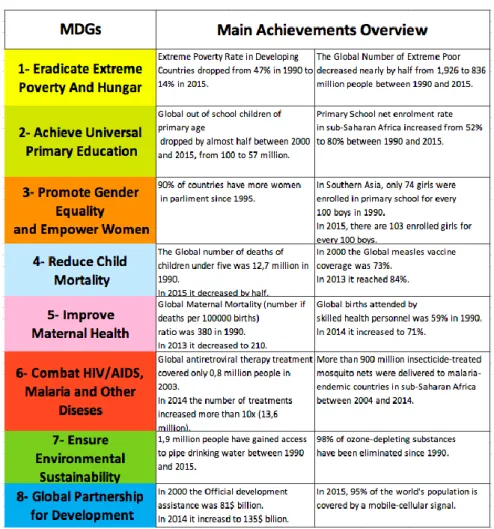
The effectiveness of the MDGs has been extensively debated since the release of the programme back in 2000, however supporters argue that the initiative has awaken an unprecedented international movement against extreme poverty, reducing it by more than 50% globally (Woolbridge, 2015). According to the United Nations (2015) Official Millennium Development Goals Report there have been visible improvements and progress before and after the implementation of the programme as presented below:
16
Table 1- Some of the main achievements of the MDG (source: UN, Millennium Development Goals Report, 2015)
The above figure shows some of the MDGs’ target achievements. Many different consultancy agencies, NGOs and other independent entities have participated not only in the collection of data and its analysis but also through the implementation of the MDGs in countries at the social and economic levels; according to Lomazzi, Borisch and Laaser (2014), most MDG initiatives worldwide targeted MDGs 4, 5 and 6, which focus on maternal and child health (MCH), while on the other hand fewer initiatives focused on MDGs 1,2,3 and 7. Lomazzi et al. (2014) also mention that some studies underline regional differences; for instance, MDGs 4 and 5 have been considered more important in the African region, while MDGs 7 and 8 had higher importance in the Western Pacific Region.
When looking at general country level progress McArthur and Rasmussen (2017) noticed that faster progress occurred in low-income countries (LICs) and in sub-Saharan Africa, while middle-income countries (MICs) and the rest of the world typically registered larger gains in a more gradual way. During the years after the MDGs’ implementation, according to McArthur and Rasmussen (2017) the following occurred:
17 • Primary school completion rates markedly rose in most of the developing world; • On undernourishment, countries saw an average acceleration in progress, except for
highly populated countries;
• Water and sanitation followed the general trends;
• There were considerable strides in many countries as far as gender equality in education is concerned;
• Environmental indicators, however, saw limited gains and in much of the planet retrogression.
The answer to the question “Did the Millennium Development Goals make any difference?” is perhaps one of the most important questions regarding the UN initiative. For instance, Mcarthur and Rasmussen (2017) believe that the MDGs’ achievements are connected to the improvements of global policy cooperation in recent years, however it remains difficult to give a conclusive answer to this question; most of the discussion surrounding it is more theoretical than based on empirical facts, whose availability is limited. As it will be further addressed, it is difficult to assess data in a way that the local, national and international levels are aligned (Fehling, Nelson & Venkatapuram, 2013). Moreover, and according to (Higgins, 2013) each country has its own priorities and concerns; for instance, an Arab country can set different targets to a specific goal than a Latin American country, based on its different social, economic, political, religious, environmental and security contexts and limitations.
Kenny and Sumner (2011) from the Center for Global Development also agree that it is difficult to assess with certainty the impact of the MDGs; these authors also mention the importance of the initiative in increasing the “aid flows” during this Century. The MDGs were seen as an opportunity to provide a framework for action according to Kenny and Sumner (2011), where despite the outcomes above presented a sense of compromise among country leaders to achieve the proposed Goals by the UN became official.
Despite the considerable achievements resulting from the MDGs, there are less discussed angles on the initiative, which bring into question its success and highlight some of its failures and missing elements (Easterly, 2009).
18
2.1.2- What is missing?
Despite the previously addressed achievements and arguments in favour of the MDGs initiative and its results, there are, however, according to both experts and sceptics from different fields several, limitations, criticisms and missing factors that should be taken into account during the SDGs program (Sen & Mukherjee, 2014).
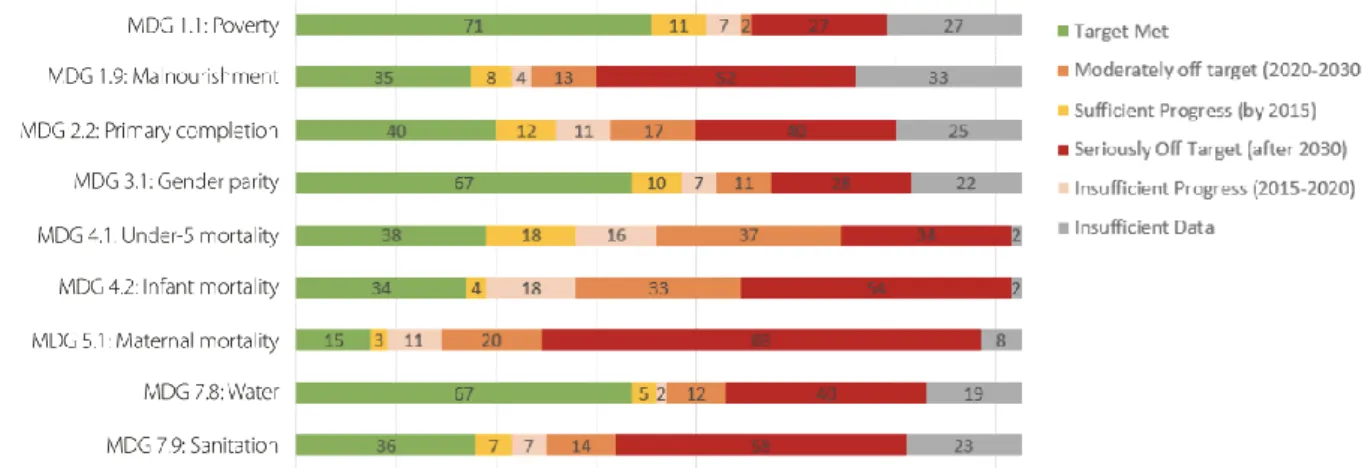
According to The World Bank Global Monitoring Report (2015) and despite the positive results discussed above, many countries have missed one or more of the MDGs targets for 2015 as presented below (UN, 2015):
Figure 4- MDGs Progress by Number of Countries (Source: UNDP Report, transitioning from the MDGs to the SDGs, 2015, retrieved in November 2017)
The viability of the MDGs is questioned by Andrews and Khalema (2015),who claim they are either incongruous with the realities of life or a faulty yardstick to determine whether country or region-specific performances are on track, especially in the developing countries.
The MDGs, as previously addressed, are underpinned by three main pillars of development (see figure 1): economic, social and environmental development. According to Mansouri (Anderson, 2011, see: www.smh.com.au/national/education/what-is-missing-in-the-un-millennium-development-goals-20110613-1g02z.html, last accessed on November, 2017), there is, however, a key component missing: culture. The professor from Deakin University argued in an interview to The Sydney Morning Herald that in order to solve advanced economic, environmental and social issues, humanity will first have to address cultural issues, which the professor believes are the root of many development problems. The UN (2012), in its Review of the contributions of the MDG Agenda towards development, identified a series of limitations and criticisms made to the programme, among which the absence of targets such as decent work conditions, human rights, governance, security and peace.
19 Despite the fact that these issues were addressed in the Millennium Declaration of the United Nations (2000), they were not set as goals or targets within the MDGs framework. According to Sen and Mukherjee (2014), the Millennium Development Goals are somehow reductionist, simplistic and do not do justice to the declaration that originated them; for instance, the authors mention that some goals such as poverty alleviation or women’s empowerment were given priority over inequality or sustainability.
These authors defend that the goal of gender equality can remain: the aim is to promote gender equality and empower women, while at the same time looking to support groups of women who have been marginalized.
Regarding Governance, and according to a study on maternal health made by Transparency International (2013), 30% of all Development assistance did not reach its intended targets due to corruption; this suggests a lack of specific governance and security measures which, according to Denney (2012), can help identify risks and measure citizen security.
Among sceptics, one of the most common criticisms made is that the MDGs are nothing more than a bureaucratic accounting exercise with very little tangible impact. Fehling et al., (2013) and Andrews and Khalema (2015) defend that the achievements of the MDGs were relatively limited progress due to the global recession and the fact that the Goals were not sufficiently addressed in terms of policy priorities at the national level (McArthur & Rasmussen, 2017). The MDGs have demonstrated a limited conceptual basis to address development change according to Kenny and Sumner (2011), while being both reductionist and incomplete in identifying the structural causes behind each goal and in the creation and implementation of effective strategies and policy actions .
For example, the MDGs only cover some of the multiple dimensions poverty entails according to the International Aid’s definition of the term, which is based on the work of Amartya Sen (1987), according to whom poverty entails the deprivation of economic, human, socio-cultural, political and protective capabilities (Loewe, 2012).
Despite the MDGs’ achievements and overall progress, many developing countries, in particular from Africa, remained behind the proposed MDG targets, as addressed by Andrews and Khalema (2015); the definition of progress or its absence, in quantitative or qualitative terms, is highly controversial, which is one of the main obstacles regarding the comparison criteria and its conceptualization, design and adoption.
20 The same authors developed an alternative measurement method, which could possibly show Africa in a positive light in terms of their MDG-related progress, as opposed to the very negative picture painted if one simply takes the numbers at face value (Andrews & Khalema 2015).
According to Vandemoortele (as cited in Higgins, 2013), there is a tendency to misinterpret the MDGs as “one-size-fits-all” goals and targets at the country level; this interpretation makes the achievement of the MDGs less likely in countries with low starting points, namely Sub-Saharan Africa.
As a consequence, when looking at the country level progress of the MDGs there is a need to measure progress not only in relative terms (where a certain goal is to be met within a specific number of years in order to meet the MDG target), but also in absolute terms, where the total amount of change will be taken into account (Higgins, 2013). Easterly (2009) uses the example of primary enrolment rates in Africa vs Other Developing Countries to address the question of relative vs absolute progress; despite the slightly higher Gross Primary Enrolment Rate in the non-African developing countries in 2005, the overall growth of developing African countries between 1960 and 2005 was two times higher in this aspect.
This issue will lead to one of the most commonly mentioned limitations and criticisms regarding the MDGs’ data framework, which is the lack of real-time data, as described by the United Nations (2015). The MDGs were perceived as a top-down exercise, where the selection of indicators resulted solely from the limited consultation of international agencies. The United Nations Report on the Lessons Learned from MDG Monitoring of the IAEG-MDG (2013a) also accounts for the inconsistencies between some goals, its targets and indicators.
The aforementioned question of absolute vs relative progress also resulted in discrepancies between the global and national monitoring process. This all raises the question: How should national and global targets be aligned?
According to the Sustainable Development Solutions Network (2015) and the United Nations (2013), in order to solve some of the issues discussed above:
• Targets should be consistent and aligned with Goals;
• Establishing clear levels of disaggregation for relevant SDGs indicators to make data monitoring and evaluation more flexible is crucial;
21 • The exercise of defining targets needs to find a balance between a bottom-up and a
top-down approach;
• National statistical capabilities, data quality and availability should be part of the development framework to facilitate monitoring.
Finally, as reported by the United Nations System Task Team on the post-2015 agenda ( 2012), greater flexibility should be given to tailor targets to specific regional and national realities, at a time where it was learnt from the outcomes of the MDGs that regional development is critical for an effective and coordinated response to the increasing number of development challenges in the Road to Dignity 2030.
Different criticisms, limitations and missing goals, targets and indicators of the MDGs were previously addressed with the purpose of assessing how technology is being used to help solve these issues and what emerging alternatives will be there to further help in the future. In the next section, the focus will be on the transition from the MDGs to the SDGs, what it entailed, what improvements have been made and what the premises of this new direction announced by the UN Synthesis Report (2014) toward the Road to Dignity 2030 were.
2.1.3- From MDGs to SDGs
In December 2014, the United Nations former Secretary-General Ban Ki-moon released his
Synthesis Report of the Secretary-General on the Post-2015 Agenda. This document marked
on the one hand the end of the MDGs programme and on the other hand the rise of a new United Nations Development programme called the Sustainable Development Goals (SDGs). “We are at a historic crossroads, and the directions we take will determine whether we will succeed or fail on our promises, with our globalized economic and sophisticated technology, we can decide to end the age-old ills of extreme poverty and hunger…… and achieve Sustainable Development for all” (United Nations, 2014 pp:3). This report was intended to guide future negotiations for the new Sustainable Development Agenda.
Over the past 20 years, there have been two main trends dominating the International Development Debate: the focus on reducing extreme poverty in its various dimensions around the globe, which was represented in the MDGs programme, and the concept of Sustainability, which gained popularity at the Rio +20 Summit in 2012 and would give birth to the SDGs (Loewe, 2012).
22 During the MDGs initiative, a lot of global progress was recorded; according to the World Health Organization (WHO, 2015) the programme has contributed to the way people think and talk about the world, shaping not only the international discourse but also the debate on Development.
The 2030 Sustainable Development Agenda goes well beyond the MDGs, comprising not only poverty eradication, health, education and food security, which remain priorities, but also including economic, social and environmental objectives as well as a focus on making societies more inclusive, peaceful, cooperative and secure (Denney, 2012).
During the 70th session of the United Nations General Assembly on September 25th of 2015 a
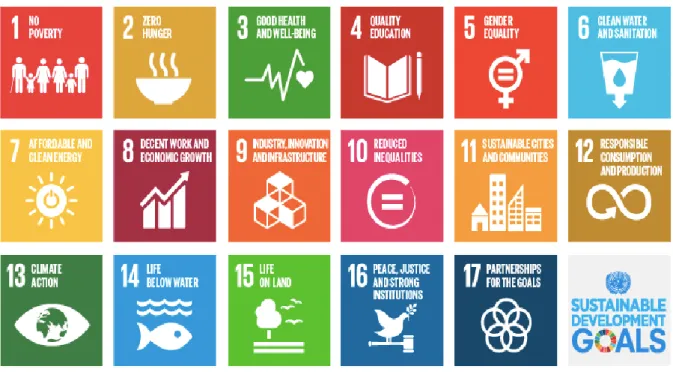
new declaration was adopted, its name being “Transforming Our World – The 2030 Agenda for Sustainable Development” (Woolbridge, 2015). The result of the Assembly was the creation of the SDGs:
Figure 5 - Sustainable Development Goals adopted by the United Nations in 2015 (Source: http://www.un.org/sustainabledevelopment/sustainable-development-goals/, Retrieved in November, 2017)
Although the priorities have remained similar, the SDGs Agenda is much broader than that of the MDGs, as argued by Fukuda-Parr (2016). With 17 goals, 169 targets and 304 proposed indicators the SDGs are, according Uitto (2015), a universal and inclusive approach to Sustainable Development with a global vision of progress which entails the three pillars of Sustainable Development: Economy, Society and the Environment (Soubbotina, 2004 & Higgins, 2015).
23 The SDGs are intended to be Universal but at the same time specific to the constraints and opportunities of each national situation (Uitto, 2015). Countries can now incorporate global goals into their national targets to facilitate and promote the accountability of the SDGs, whose framework is designed to be more transparent and participatory than their predecessors, according to the United Nations Division for Sustainable Development (2016). The SDGs resulted from a United Nations Open Working Group established in 2013, made up of 70 countries, especially created to develop the SDGs as we know them today, by giving developing countries the possibility to provide their contribution to the initiative along with other stakeholders, such as governments, civil society and the private sector (Woolbridge, 2015). For these reasons, Fukuda-Parr and Yamin (2013) believe that the SDGs do not simply differ from the MDGs in the number of goals and targets, but also in their purpose, conception and creation process:
• The MDGs were a North-South aid agenda, with the emphasis on reducing extreme poverty in the developing world.
• The SDGs, however, are a universal agreement on what the Development direction of humankind should be, and everyone should take part in it, not only the developing countries.
• Finally, the SDGs and their targets are focused on complex and even abstract concepts such as sustainability and inclusion rather than tangible and measurable outcomes, which were the focus of the MDGs.
On the topic of data monitoring, evaluation and accountability, the World Bank (2016) is focusing on the increase of the availability and quality of data, by making it more timely, reliable and disaggregated by relevant metrics, such as income, gender, location or ethnicity. In general, and according to Bapna (n.d.) in a panel called “The UN Sustainable Development
Goals: 17 or One?” hosted by the Wilson Center (See:
https://www.wilsoncenter.org/event/the-un-sustainable-development-goals-17-goals-or-one, accessed in November, 2017) it is expected that the SDGs will have a broader reach; this programme aims to eliminate poverty by attacking its root causes - such as environmental quality and lack of economic and social Sustainable Development - , promoting partnerships and cooperation between nations to that end. The SDGs also seek open communication and to make their 17 goals more integrated, instead of individual goals being addressed in isolation.
24 Despite the fact that most of the previously addressed key goals missing from the MDGs have now been taken into consideration by the SDGs agenda for 2030, there will be, according to Woolbridge (2015) and Fukuda-Parr (2016), other key challenges to be taken into consideration for the future:
1. Missing out on integration potential: The possibility of national governments
deciding to focus solely on the goals that are aligned with their own development agenda and therefore neglecting the most transformative goals can pose a major challenge for the programme;
2. Data and Monitoring: The concern that, as in the MDGs, many countries might be unable to access the means to collect, analyse and disseminate the necessary data for measuring and reporting their progress;
3. Financing & the North-South divide: To implement and monitor the SDGs, it is estimated by current projections that 17 trillion dollars may be needed. This poses a challenge for both the Developing and Developed countries: on the one hand, developing countries need to mobilize their domestic resources, and on the other hand developed countries should provide the necessary funding.
In this section, different aspects of the transition from the MDGs to the SDGs were addressed, primarily the improvements and changes made regarding data collection and monitoring, the definition of goals and the International vs National agenda alignment. The SDGs are now seen as universal and inclusive above all, with every country playing a relevant role to the programme(United Nations, 2014b).
2.1.4- What is being done to achieve the SDGs by 2030?
Before shifting gears from Development to an Information Systems perspective of the research and matching concepts, goals and challenges with technologies and their contributions to the SDGs, it is first necessary to address what is currently being done to achieve them by 2030.
25 Before working on the implementation of the SDGs, stakeholders must figure out the best way to approach each one of the Goals at the national level according to the Sustainable Development Solutions Network (SDSN, 2015); as previously addressed by Uitto (2015), the SDGs programme now gives countries the opportunity to address their main issues regarding the Sustainable Development Agenda and adapt them to their national and local reality. Countries are now developing their strategies and plans to achieve the SDGs based on their previously achieved goals and targets, and their priorities for the present and future of the country.
This planning stage is of great importance due to the complexity of the goals, and the challenge of developing an integrated plan that connects each goal and the national circumstances and priorities (SDSN, 2015). As previously addressed, and according to Andrews and Khalema, (2015), there was a need to adapt each MDG to the national and local level, which has now been taken into consideration in the SDGs; previously, the MDGs were considered a top-down exercise from the Developed to the Developing countries. To help in this long-term planning task countries are using backcasting, which is considered by SDSN (2015) as a best practice for long-term planning; backcasting generates a desirable future and then works backwards in order to figure out how that future could be achieved. The core of this strategy is developing a long-term plan that takes into consideration the SDGs targets and milestones and what steps will be taking stakeholders to the desired endpoint at a specific date (SDSN, 2015). This strategy will help develop the policies, technical reforms, investments and partnerships needed to achieve the SDGs by 2030.
In order to allow an integrated approach of the SDGs and connect the International, National and Local levels, and due to the identified difficulty in collecting MDGs-related data, Ban Ki-moon created in 2014 an Independent Expert Advisory Group (IEAG) to give answer to the necessity to implement, monitor, evaluate and report 17 Goals, 169 defined targets and 232 indicators, which are now entirely interrelated (CSIS, 2017).
The MDGs experience also demonstrated the importance of developing partnerships both at the national and international levels: bilateral partnerships between states, public, private and multilateral actors are crucial to deliver effective results on a Global scale (SDSN, 2015). Currently, there is an increasing number of initiatives being held on the online platform for SDG partnerships.
26 ( see: https://sustainabledevelopment.un.org/partnerships/, last accessed in November, 2017); The goal of this platform is to provide global engagement for multi stakeholder partnerships, and voluntary commitments from everyone devoted to support the implementation of each SDG. This platform seeks to inform all stakeholders on the initiatives carried out to allow them to follow and keep track of the progress of those initiatives, according to the United Nations Division for Sustainable Development (2016).
To ensure the awareness, engagement and participation on the SDGs, according to Devex, ( 2015, source: https://www.devex.com/news/7-steps-toward-sustainable-development-by-2030-86861, last accessed in November 2017) , last accessed in November 2017), it is necessary to make people feel closer to the cause of Sustainable Development through understanding and commitment.
Education is therefore one of key elements that will play a decisive role in the success of the 2030 Agenda since it can lead to the inclusion of not only the International and National communities but also minorities, making it a more inclusive and universal initiative. The International Commission on Education highlights the importance of education in supporting Human Development (Yoshida & Zusman, 2015); education is both the tool which will lead to awareness and global conscience for Sustainable Development and the primary means to tackle most of the SDGs until 2030.
Over the past twenty years, the agendas for Human Development and Sustainable Development have run parallel to each other (Yoshida & Zusman, 2015); the SDGs seek to reconcile the global community and integrate both agendas through education initiatives and actions. Education represents one of the most important investments towards Sustainable Development, therefore the Global Education First Initiative is an attempt to accelerate the progress towards the Education for All goals, through political and financial support for education (Unesco, 2014). The United Nations intends to make Sustainable Development a lifelong learning process (Filho, Mifsud, & Pace, 2018) , by conducting ongoing research and field projects with the intention of accelerating the educating process towards the achievement of the 2030 SDGs.
There are currently many different ongoing partnerships and initiatives regarding each SDG (see: https://sustainabledevelopment.un.org/partnerships/, last accessed in November, 2017), however, and according to the Sustainable Development Knowledge Platform, ( see:
https://sustainabledevelopment.un.org/topics/technology , last accessed in November, 2017), to eradicate poverty and reorient trajectories from unsustainable Development to The Road