1 THE IMPACT OF HOME CARE NURSING IN PUERPERA DIFICULTIES
Mendes, A.1 ; Paiva, A.2 ; Leal, I.3
BACKGROUND: The birth of the first child forwards the new mother to an individual, family and social reset in order to deal with self-caring and parenting skills. Many women in post-partum period report having to deal often with new doubts and/or problems.
OBJECTIVE: Identify the main difficulties reported by mothers during puerperium time. Compare those mentioned difficulties, between control group and study group.
METHODS: Quasi-experimental design - Control group and study group with 200 primiparous women (100 women in each group). Participants in the study group were submited to at least two home visits during the postpartum period.
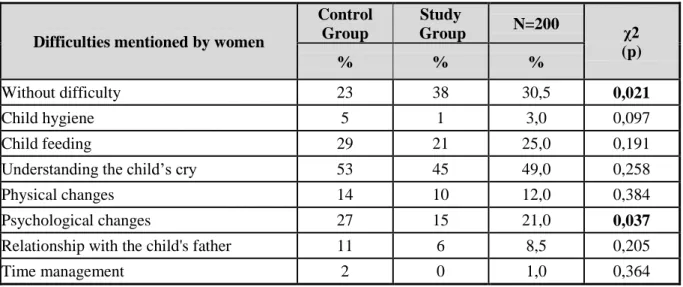
RESULTS: Chi-square test revealed statistically significant differences between groups, for participants who did not report difficulties (p=0.021). A larger number of mothers in the experimental group did not mention difficulties (38%), compared to those belonging to the control group (23%). The three main difficulties were found:
Understanding child's cry - 53% in the control group and 45% in study group; Child feeding - 29% in the control group and 21% in study group; “Psychological changes” are referred by both groups in thirdly. Chi-square test shows differences between groups in this variable (p=0.037) - Control group 27% and study group 15%.
CONCLUSIONS:This investigation demonstrated the relationship between home visit and expressed difficulties: a higher number of participants followed during puerperium did not mention difficulties.
For those who mentioned difficulties also the groups show different regarding the difficulty in dealing with the psychological changes. More mothers from control group mentioned this problem.
Keywords - Difficulties, home visit, puerperium
1 Instituto Politécnico de Castelo Branco - Portugal 2 Escola Superior de Enfermagem do Porto- Portugal 3 Instituto Superior de Psicologia Aplicada- Portugal
2 INTRODUCTION
After delivery, the length of stay in motherhood should be enough for consolidate and acquire skills to care for herself and for the newborn child in postpartum.
Knowing that this is hardly achieved (usually after eutocic delivery, hospital discharge happens about 48 hours after birth) it’s expected that the acquired skills match the needed ones to promote mother, newborn and family wellness untill nursing intervention, ideally at home during the first week postpartum. Usually women monitoring during postpartum after maternity discharge does not occur in an organized and regular basis (except for women referenced as risk situations). Usually during first month of newborn’s life, the interaction between mother and healthteam, including nursing care, are focused on child’s weight assessment and metabolic diseases screening.
While is not difficult to access information related to postpartum and newborn’s health, not always this is done in a correct way. It would be desirable that all the women could attend preparation classes for parenting, aiming prenatal period. The “school” for parenting previously held within the family, when girls were asked to help caring siblings or younger family members, is now expected from healthcare professionals. Besides that, nowadays mothers spend most of their time alone. In the past, 30 or 40 years ago it was new mothers used to be “full-time” accompanied by their mothers or someonelse in the family sharing domestic tasks. Due to economic and social situation, this accompaniment when it happens is often performed in “part-time”. After hospital discharge, difficulties break up related to self-care, childcare and adaptation to motherhood.
After birth, nurses are the health professionals who due to their close relationship with families are more skilled to help women and family to choose the adaptive and defensive mechanisms to overcome instability and achieve a new equilibrium.
Home visiting during postpartum emerges as a fundamental nursing activity to make more effective this equilibrium.
OBJECTIVES
Identify the main difficulties reported by mothers between 6 and 9 postpartum weeks. Compare the mentioned difficulties, between the control group and study proup. METHODS
Quasi-experimental study eas held with a control group and a study group – with the participation of 200 primiparous women (100 women in each group). Participants in the study group were subject to at least two home visits during the postpartum period. The target
3 population was composed by women during pregnancy followed-up in health services and after giving birth at the hospital in the center region of Portugal (about 108 395 inhabitants) since March, 2010 to November, 2012.
Selection of study participants consisted in a non probabilistic convenience or accidental sampling. Any woman who fulfilled the inclusion criteria and agreed to participate could be selected to take part in this study. The control group included the first 100 participants who completed the three questionnaires in the first phase of the investigation, which began in March, 2010 and ended in November, 2011. The study group was formed by the first 100 participants who completed the three questionnaires in the second phase of the study, which began in December, 2011 and ended in November, 2012.
Inclusion Criteria - First questionnaire – Pregnant women with gestational age not less than 35 weeks; Nulliparous aged over 18 and under 35 years; No history of mental illness; Portuguese readind and writing linguistic expression. Questionnaires were filled during community health center visit for medical surveillance.
Second questionnaire – Mothers between 5th and 10th day after delivery and who completed the first questionnaire; Simple vaginal birth (only one child including eutocic or dystocic birth by forceps or vacuum), resulting in a healthy child; Hospital discharge not later than seventy-two hours after delivery. Questionnaires were filled by mothers during community health center visit to assess newborn’s weight and/or for early diagnosis screening.
Third questionnaire – Mothers between 6 and 9 postpartum weeks that completed first and second questionnaire.The questionnaires were filled during women’s visit to community health center for puerperal surveillance.
The questionnaires consisted in two parts. First part, issues related to opinions, facts or attitudes related to pregnancy / childbirth / post-partum. Second part consist of three scales –Anxiety, Depression and Stress Scale (Pais Ribeiro et al., 2004) in the first questionnaire; Assessment Psycho-emotional Changes in Puerperium Scale (Sousa and Leal, 2007) in the second questionnaire; and the Edinburgh Postpartum Depression Scale (Augusto et al., 1996) in the third questionnaire. All scales are validated for application in Portugal. The questionnaires were evaluated by eight expert nurses.
The pre-test was performed in a community health center, after regarding the compliance of inclusion criteria.
Procedures - In March, 2010, questionnaires began to be presented to pregnant and postpartum women in the control group. After collecting data from control group, was iniciated the data
4 collection procedures in the experimental group. Women were invited to join in this group, while they still were at the hospital, after childbirth. The process of contacting health professionals, for presenting and collecting of questionnaires, was the same in both groups. All women belonging to the study group had at least two home visits:the first visit, six days after childbirth; the second visit in the second week postpartum. In some cases needing more home visits the schedule was set depended on the health state. Data were stored in a computer databasis – Microsoft Office Access 2007. For statistical data analysis, Statistical Package for the Social Sciences (SPSS) v.20 was used. Descriptive statistics was used to describe and synthesizedata, while Chi-square test (χ2) was used for hypothesis testing. Significance level was chosen for p <0.05 with a 95% confidence interval.
RESULTS
The participants were asked in the third questionnaire about the difficulties experienced during the postpartum period.Chi-square revealed differences statistically significant between groups, for participants who did not report difficulties (p=0.021). More mothers in study group did not mention difficulties (38%) when compared to the control group (23%). The three main difficulties reported were: “Understanding child’s cry” the one most often mentioned by both groups (53% in control group and 45% in study group); “Child feeding” was the second most
referred (29% in control group and 21% in study group);
“Psychological changes” are referred by both groups in thirdly (p=0.037) the chi-square test shows that there are significant differences between groups in this variable. The control group participants in report more difficulties in dealing with the “Psychological changes” (27%) than the participants in the study group (15%).
Table 1 - Analysis of differences between groups as the difficulties mentioned by women
Difficulties mentioned by women
Control Group Study Group N=200 χ2 (p) % % % Without difficulty 23 38 30,5 0,021 Child hygiene 5 1 3,0 0,097 Child feeding 29 21 25,0 0,191
Understanding the child’s cry 53 45 49,0 0,258
Physical changes 14 10 12,0 0,384
Psychological changes 27 15 21,0 0,037
Relationship with the child's father 11 6 8,5 0,205
5 Chi-square test application reveals that there are statistically significant differences between the two groups in relation to infant feeding in the final postpartum period (p=0.001).
The children of participants in the study group are exclusively breastfeeded in a larger number (71%), than those on the control group (38%). Child feeding with artificial milk occurs in 23% of mothers from control group and 10% in study group.
All the participants of study group, 90% of children are breastfeeded (Table 2).
Table 2 - Analysis of differences between groups regarding child feeding by the end of puerperium End of puerperium Control Group Study Group N=200 χ2 (p) % % %
Breast and artificial feeding 39 19 29,0
0,001
Artificial feeding 23 10 16,5
Exclusive breastfeeding 38 71 54,5
Total 100 100 100,0
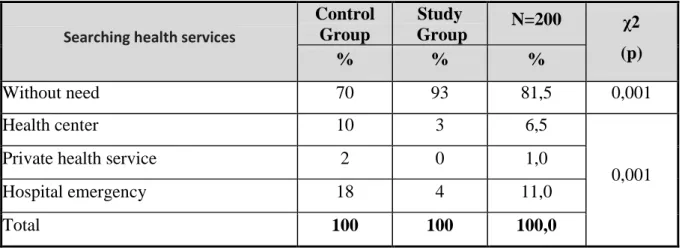
Chi-square test (p=0.001) shows that there is no statistically significant differences between the two groups, on the demand of health services related with child´s problems. During the puerperium, 30% of participants from the control group had need for health services for child´s problems. In study group this number is only 7% (Table 3).
Table 3 - Analysis of differences between groups related to the need of searching health services for child's problems
Searching health services
Control Group Study Group N=200 χ2 (p) % % % Without need 70 93 81,5 0,001 Health center 10 3 6,5 0,001
Private health service 2 0 1,0
Hospital emergency 18 4 11,0
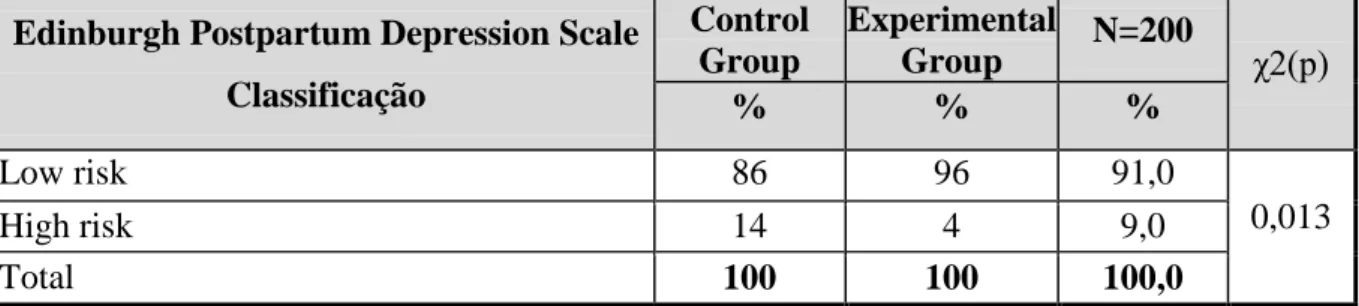
6 Psycho-emotional status of mothers was evaluated applying Edinburgh Postpartum Depression Scale. This 10 issue scale, scored from 0 to 3, indicates the probability of postpartum depress-sion if the result is equal to or greater than 12 (Direção-Geral de Saúde, 2006). Chi-square test shows that there are statistically significant differences between groups, comparing the outcomes of Edinburgh Postpartum Depression Scale. There are more participants from control group tagged with "high risk" of postpartum depression (scoring 12 or more) compared participants from the study group (Table 4).
Table 4 - Analysis of differences between groups in relation to the Edinburgh Postpartum Depression Scale
Edinburgh Postpartum Depression Scale Classificação Control Group Experimental Group N=200 χ2(p) % % % Low risk 86 96 91,0 0,013 High risk 14 4 9,0 Total 100 100 100,0 DISCUSSION
This investigation lead us to the finding that there are differences statistically significant between control and the experimental groups regarding the difficulties felt by mothers. More mothers from the study group referred to have no relevant difficulties during postpartum period (38%) compared to those from control group (23%). The fact that mothers have been subjected to nursing home visit, knowing that even in case of need they could use the phone to clarify any questions or just to talk, this can undertake the difference between groups (the two groups were followed according to the same monitoring procedures by nurse and family doctor). Understanding “child crying” was the most reported difficulty by both groups. In the first weeks of the child’s life, parents felt great difficulties in achieving the skill to distinguish different types of crying, leading them to feel powerless and frustrated, because that might mean that they were not able to satisfy their child’s needs (Strapasson and Nedel, 2010). Also for Macedo
et al. (2009), this difficulty is the one most referred in their investigation. Bergamaschi and
Praça (2008), Medeiros and Santos (2009), Silva and Roldan (2009) and Strapasson and Nedel (2010) also identified in their research, the difficulty of mothers in dealing with their child’s crying. They felt frightened and distressed, because they did not know the reason for crying, and were unable to calm the child (Terra and Okasaki, 2006). “Child feeding” emerges as the second most referenced difficulty by both groups. This variable included aspects related to both
7 breastfeeding and artificial feeding. The correct and clear explanation of breastfeeding technique is one of the components to be addressed in prenatal caring, but the reality is that this information is not always adequately addressed. Upon arriving the first moment breastfeeding in maternity, women may become anxious and feeling not prepared for the act of breastfeeding. Silva et al. (2012) report that the main difficulty associated with the act of breastfeeding is related to the lack of information about breastfeeding technique and breastcare during the prenatal period. Women experiencing breastfeeding difficulties may lead to breast related complications, which is the main reason for seeking health services during this period. Also Martins et al. (2008) performed a study, pointing to the difficulties related to lactation process as one of the main health problems reported by women.Similarly to our results, an experimental study conducted in Zambia by Ransjo-Arvidson et al. (1998) attended by 408 mothers, the 208 women who were visited by nurses at 3, 7, 28 and 42 days after delivery had at 42 days a higher breastfeeding prevalence. Also Olds (2002), evaluating two home-visit programs implemented in two risk communities in the United States, found that there was a higher breastfeeding prevalence among the visited families. Zadoroznyj (2006) evaluating the Mothercarer program in Australia (home visits after hospital discharge) revealed that without nursing support in home visits, there were more questions, more anxiety thus reducing breastfeeding. Another difficulty supported by significant differences in two groups is the difficulty in dealing with the “psychological changes” (third most cited). Women from control group refer this difficulty (27%) in a major number than mothers from the study group (15%). Since the changes in mood associated to postpartum blues, to symptoms that might indicate postpartum depression, a woman may experience a personal situation about which she does not feel prepared to deal with.A systematic review through meta-analysis procedures performed by Dennis (2005) in Canada in order to evaluate the effectiveness of psychological interventions and social care in comparing pre-, intra- and post- partum with the risk of developing postpartum depression has revealed that the only intervention that has a significant effect in preventing postpartum depression is intensive support during the postpartum period given by a healthcare professional. The “difficulty associated with the physical changes” that occur in herself, may influence the self-image and is associated usually to pain and discomfort located in the abdominal, perineal, muscle, joint, breast, upper limbs, dorsal regions and to intestinal elimination (Springhouse Corporation, 2005).Studies developed by Whiteford and Polden (1992), and Matheus et al. (2006) show that the most evident difficulties are related to anatomical and physiological adaptations of abdomen, perineum, buttocks and lower back. Physical complaints, particularly
8 fatigue and loss of appetite are referenced by Figueiredo (2001). “Difficulties in the relationship with child’s father” are felt by mothers on returning home after delivery. Women must need a readjustment of family dynamics, so that the transition of both women and family to the new reality so that hosting a new totally dependent element, may take place in a healthy way. To Afonso (1998) the birth of child and specially the first-baby starts up an irreversible process characterized by significant changes in personal and family life of each member of the couple, changing the previous balance. The “difficulties with child hygiene”, which received 5% of references in the control group and 1% in the study group were also referenced a study by Afonso (1998). This researcher, in addition to questions regarding mobilization, positioning, hygiene and children’s clothing highligts the feelings of insecurity and fear in handling or holding the child. Grace (2003), in a study conducted with first baby occurrence also identified this kind of difficulty, where mothers had fear of catching their child due to being “fragile”, “slippery” and “restless”. More recently, research carried out by Bergamaschi and Praça (2008), Medeiros and Santos (2009), Silva and Roldan (2009) and Strapasson and Nedel, (2010) have also highlighted this difficulty. The “difficulty in time management” was referenced by 2% of the control group participants. Despite this low percentage, we emphasize its importance since it did not belong to the list of possible answers associated to the question about the main difficulties experienced by mothers during the postpartum period. It was the only answer mentioned in open space. There are many changes happening on a day woman’s daily life with the arrival of a child. This one becomes often the family “time clock” re-scheduling housework, meals, visits from friends and family, shopping, and so on. Child’s pace turns out to control the pace of postpartum women, getting this without a determined routine (Stefanello, 2005). This time management may take some time until it becomes effective, leading sometimes the woman to give up her sleep to take care of household chores (Lowdermilk and Perry, 2002; Stefanello, 2005). Regarding women’s main difficulties in the postpartum period, they can be summed up as Afonso (1998) proposes, in three levels: difficulties associated with postpartum physiology, difficulties in child caring and psychosocial difficulties. Although no differences statistically significant regarding to the difficulties in taking care of children, there are more mothers from the control group who sought health services by child-related problems, having thus differences statistically significant between both groups. A study conducted by Ransjo-Arvidson et al. (1998) found that women who received nurse's visit had a lower prevalence of newborn health problems and are better skilled to solve their own and children’s problems. Cornell (2002) showed that home visit programs during prenatal and postpartum period contribute, among
9 other factors, to reduce costs associated to the decline in demand for emergency services and hospitalizations. More recently, a study by Christie and Bunting (2010) revealed that the target mothers in home visit programs sought less secondary care, thus reinforcing the idea of benefits of this activity in the adoption of healthy behaviors by families.
CONCLUSIONS
Control group and study group behaved differently in relation to the “difficulties in the postpartum period”. There were more mothers from the study group who did not mentioned difficulties. For those who mentioned difficulties the groups presented differences regarding the difficulty in dealing with psychological changes. There are more mothers from control group referring this difficulty. Understanding the “child crying” was the most reported difficulty by the participants. Increasingly emerging studies are trying to teach parents how to “decipher” baby crying. Unknown until now, research that has achieved satisfactory results relevant in understanding newborn’s cry. It is essential for women to accept that only with knowledge of child’s characters, which requires time and patience, will be able identify the different meanings of crying. The way parents relate to their child, their sensitivity to the specific needs of child and the appropriateness of their answers influence baby’s temperamental characteristics (Direção-Geral de Saúde, 2005). Relation between the intervening variables of the study and the risk of women developing postpartum depression were analyzed: All mothers who did not report “significant difficulties during the postpartum period” were classified as “low risk” of developing postpartum depression, so there is a significant relationship between the variables. Also on the first variable, there were statistically significant differences between the control group and the study group. The higher percentage of mothers who did not report significant difficulties belonged to the study group. The “difficulties with child feeding", “difficulties in dealing with psychological changes” and “difficulties in the relationship with the baby’s father” also appear to be related with higher risk of postpartum depression. The study demonstrated the existence of relationship between nursing home visit and the difficulties felt by postpartum women. The number of participants followed throughout the postpartum period and not referring difficulties is higher. Increasingly, there are health facilities in Portugal developing postpartum home visits. We hope for more research showing the benefits that can be achieved from this activity. Benefits for the health of the family, but also related to costs for society in general, taking into account the lower cost of a home visit when compared to demands for health services and even for hospitalizations.
10 All the procedures regarding to this research respected ethical and deontological principles set in the Nurses Code of Ethics (Ordem dos Enfermeiros, 2003) themselves embodying the ethical principles of Ethical Guidelines for Research in Nursing, indicated by International Council of Nurses (1996):Beneficence and evaluation of maleficence: Principle which results in doing good, not causing harm to study participants; Confidentiality: All the personal information was safeguarded, reserving solely for research purposes; Fidelity: Principle implies confidence that should exist between those involved in research; Justice. Which is reflected in equity to exist in groups; Truthfulness. This principle focuses the informed consent that was made in the first contact with each of the participants. Fieldwork to be developed for the study was preceded by formal request to the Ethics Committee of the health unit involved, which received assent. CONFLICT OF INTEREST DECLARATION
The authors declare no conflicts of interest that may be an embarrassment to the publication of this article.
REFERENCES
Afonso, E.H. (1998), Dificuldades da mulher no puerpério: subsídios para a enfermagem. Dissertação de Mestrado em Ciências de Enfermagem, Faculdade de Ciências Humanas - Universidade Católica Portuguesa, Portugal.
Augusto, A., Kumar, R., Calheiros, J.M., Matos, E. and Figueiredo, E. (1996), Post-natal depression in an urban area of Portugal: Comparision of childbearing women and matched controls, Psychological Medicine, Vol. 26 No. 1, pp.135-142.
Bergamaschi, S. F. F. and Praça, N. S. (2008), Vivência da puérpera-adolescente no cuidado dorecém-nascido, no domicílio, Rev Esc Enferm USP, Vol.42 No.3, pp.454-60.
Christie, J. and Bunting, B. (2011), The effect of health visitors’ postpartum home visit frequency on first-time mothers: Cluster randomised trial, International Journal of Nursing Studies, Vol.48 No. 6, pp. 689-702.
Dennis, C.L. (2005), Psychosocial and psychological interventions for prevention of postnatal depression: systematic review, BMJ. Vol. 2 No.331, pp.7507-7515.
Direcção-Geral da Saúde - Divisão de Saúde Materna, Infantil e dos Adolescentes (2005), Saúde Infantil e Juvenil: Programa Tipo de Actuação, Direcção-Geral da Saúde, Lisboa.
Figueiredo, B. (2001), Depressão pós-parto: Considerações a propósito da intervenção psicológica,
Psiquiatria Clínica ,Vol 22 No 3, pp 329-339, available at:
http://repositorium.sdum.uminho.pt/bitstream/1822/4218/1/Depress%C3%A3o%20p%C3%B3s-parto%20(2001).pdf (accessed 10 March 2012).
International Council of Nurses (1996), Ethical Guidelines for Nursing Research, International Council of Nurses, Geneva.
Lowdermilk, D. and Perry, S. (2008), Enfermagem na Maternidade (7ªed.), Lusodidacta, Loures. Macedo, C., Mendes, I.M., Silva, G. and Serranho, H. (2009), Autocuidado e cuidado do recém-nascido no puerpério das dificuldades à utilização de uma linha telefónica de apoio, Revista Nursing, No. 249, pp. 24-33.
Martins, C.A., Siqueira, K.M., Tyrrell, M.A.R., Barbosa, M.A., Carvalho, S.M.S. and dos Santos, L.V. (2008), Dinâmica familiar em situação de nascimento e puerpério, Revista Eletrónica de Enfermagem, Vol. 10 No. 4, available at: www.fen.ufg.br/revista/v10/n4/v10n4a13.htm (accessed 21 March 2012).
11 perineais e dos cones vaginais, associados à correção postural, no tratamento da incontinência urinária feminina, Revista Brasileira de Fisioterapia,Vol. 10 No. 4, pp. 32-38.
Medeiros, C.R.G. and Santos, B.R.L. (2009), As vivências da família no retorno ao lar com o primeiro filho, Revista Ciência & Saúde, Vol. 2 No. 1, pp. 16-24.
Olds, D.L. (2002), Prenatal and infancy home visiting by nurses: From randomized trials to community replication, Prevention Science, Vol.3 No.3, pp.153-172.
Ordem dos Enfermeiros (2003), Código Deontológico do Enfermeiro: anotações e comentários, Lisboa. Pais Ribeiro, J.L.,Honrado, A. And Leal, I. (2004), Contribuição para o estudo da adaptação portuguesa das Escalas de Ansiedade, Depressão e Stress (EADS) de 21 itens de Lovibond e Lovibond, Psicologia Saúde & Doenças, Vol.5 No. 2, pp. 229-239.
Ransjö-Arvidson, A. B., Chintu, K., Ng'andu, N., Eriksson, B., Susu, B., Christensson, K. and Diwan, V. K. (1998), Maternal and infant health problems after normal childbirth: a randomised controlled study in Zambia, Journal of Epidemiology and Community Health, Vol. 52 No. 6, pp.385-391.
Silva, S.L.C. and Roldán, M.C B. (2009), Adolescentes en puerperio y sus prácticas de cuidado, Av. Enferm., Vol.27 No.2, pp.82-91.
Silva, L.L.X., Schwab, P M., Ravelli, A.P.X., Silva, C.L. and Lemos, J.R.D. (2012), Os problemas mamários advindos na consulta puerperal de enfermagem, 10.° CONEX.- Apresentação Oral-Resumo Expandido, available at:
http://www.uepg.br/proex/anais/trabalhos/251.pdf (accessed 11April 2012).
Sousa, J.V. and Leal, I. (2007), Estudo psicométrico de uma escala de avaliação das alterações psicoemocionais do puerpério (EAAPP), Nursing, No.220, pp.7-13.
Springhouse Corporation (2005), Enfermagem no cuidado materno e neonatal: série incrivelmente fácil, Guanabara Koogan, Rio de Janeiro.
Stefanello, J. (2005), A vivência do cuidado no puerpério: as mulheres construindo-se como mães, Programa de Pós-Graduação de Saúde Pública - Universidade de São Paulo Ribeirão Preto, Brasil. Strapasson, M.R. and Nedel, M.N.B. (2010), Puerpério imediato: desvendando o significado da maternidade, Revista Gaúcha de Enfermagem, Porto Alegre, Vol. 31 No. 3, pp.521-528.
Terra, D.L.H. and Okasaki, E.L.F.J. (2006), Compreensão de puérperas primíparas sobre os cuidados domiciliarios com o recém-nascido, Rev Enferm UNISA,Vol.7, pp.15-20.
Whiteford, B. and Polden, M. (1992), Exercícios pós-natais: um programa de seis meses para a boa forma da mãe e do bebê, Maltese, São Paulo.
Zadoroznyj, M. (2006), Postnatal care in the community: report of an evaluation of birthing women’s assessments of a postnatal home-care programme. Health and Social Care in Community Blackwell Publishing Ltd., Vol.15 No.1, pp.35-44.
Alda Maria Pires Silva Mendes - Instituto Politécnico de Castelo Branco - Portugal Abel Avelino de Paiva e Silva - Escola Superior de Enfermagem do Porto - Portugal Isabel Maria Pereira Leal - Instituto Superior de Psicologia Aplicada - Portugal
CONTACT - Alda Maria Pires Silva Mendes – Rua Arrabalde dos Oleiros, nº 75, 1º dto. 6000-155 Castelo Branco- Portugal. E-mail:[email protected]