Where is the Meat?
Exploring the consumption drivers, barriers and consumer profile for
plant-based burger in burger-focused chain restaurants.
Alejandra Maria Urquijo Pedroza
Dissertation written under the supervision of Miguel Fontes Rita
Dissertation submitted in partial fulfilment of requirements for the International
MSc in Management with Specialization in Strategy and Consulting, at the
Abstract
Title: “Where is the Meat?: Exploring the consumption drivers, barriers, and consumer profile for
plant-based burgers in burger-focused chain restaurants.”
Author: Alejandra Maria Urquijo Pedroza
This research aims to explore the acceptance of plant-based burger in burger-focused chain restaurants in the Spanish market, through the assessment of main drivers, barriers to consumption, and potential consumer profiles. Following this idea, a study of the impact of perceived product benefits, risks, and individual characteristics on purchase intention and value individuals are willing to pay was conducted.
To collect the data for this analysis was developed a qualitative questionnaire and an online survey. The main conclusions showed that environmental benefits positively influenced individuals to purchase plant-based burgers in burger-focused chain restaurants. Additionally, the lower the perceived risk in the quality of taste, the higher might be the purchase intention. Finally, individuals with high levels of environmental concern were more prone to purchase this product.
The present study adds to the literature regarding plant-based food consumption behaviors in the food services industry, in specific. Furthermore, it analyzes an innovative solution to the recent environmental issue caused by the massive meat production, and at the same time, provides essential insights for the chain restaurant businesses and helps them to find a source of competitive advantage.
Key Words: Plant-based burgers, sustainability, burger-focused chain restaurants, drivers,
Sumário
Título: "Onde está a Carne? Explorando os factores de consumo, as barreiras e o perfil dos
consumidores de hambúrgueres à base de plantas em cadeias de restaurantes centrados em hambúrgueres".
Autor: Alejandra Maria Urquijo Pedroza
Este estudo tem como objetivo explorar a aceitação do hambúrguer à base de plantas em cadeias de restaurantes centrados em hambúrgueres no mercado Espanhol, através da avaliação dos principais impulsionadores, e barreiras ao consumo bem e de potenciais perfis de consumidores. Seguindo essa ideia, foi realizado um estudo do impacto dos benefícios e dos riscos, e características individuais percebidos na intenção de compra, bem como no valor que o comprador se encontra disposto a pagar.
Para coletar os dados para esta análise, foi desenvolvido um questionário qualitativo e uma pesquisa online. As principais conclusões mostraram que os benefícios ambientais influenciaram positivamente os indivíduos a comprar hambúrgueres à base de plantas em cadeias de restaurantes focadas em hambúrgueres. Além disso, quanto menor o risco percebido na qualidade do sabor, maior pode ser a intenção de compra. Por último, os indivíduos com altos níveis de preocupação ambiental estavam mais propensos a comprar este produto.
O presente estudo complementa a literatura sobre comportamentos de consumo de alimentos à base de plantas na indústria de serviços alimentícios, em específico. Além disso, analisa uma solução inovadora para a recente questão ambiental causada pela produção massiva de carne e, ao mesmo tempo, disponibiliza conhecimentos relevantes para os negócios da cadeia de restaurantes e os ajuda a encontrar uma fonte de vantagem competitiva.
Palavras-chave: Hambúrguer à base de plantas, sustentabilidade, cadeias de restaurantes
Acknowledgements
First of all, I would like to thank my family for their constant support during my journey. Words can not express how grateful I am to you, my father, and my mother, who have always believed in me and made all the sacrifices to provide me with the best education. To my sisters, Sheryl and Daniela, who are the best teachers and friends, thank you for always being there for me. Thank you to them for giving me wings to fly and roots to always come back.
Secondly, I would like to express my gratitude to my supervisor, Professor Miguel Fontes Rita, who always supports me with his great advice, motivation, feedback, and continuous optimism throughout my thesis.
To my boyfriend Ricardo, who always supported me during this process and kept incentivizing me to do and be better. Thank you for your patience and love when things got a little discouraging.
Finally, I would like to show my appreciation to my friends, especially Nathalie, Stephanie, Clara, Emily, and Ana, who were always helping me with their experiences and wise opinions. They always keep me motivated to continues my academic journal.
Table of Contents Abstract ... 2 Sumário ... 3 Acknowledgements ... 4 CHAPTER 1: Introduction ... 7 1.1 Research Proposal ... 8
CHAPTER 2: Literature Review ... 10
2.1 Meat Consumption- Globally and in Spain ... 10
2.1.1. Meat Consumption and environmental impact ... 10
2.1.2 Meat Consumption in Spain ... 11
2.2 Sustainable food and Plant-based protein from a Business Perspective ... 12
2.3 Plant-based Meat Substitute in fast food and burger chain restaurant in Particular ... 13
2.3.1 Plant-based Meat Substitute in a burger-focused chain restaurant in Spain ... 15
2.4 Consumer respond to plant-based protein ... 16
2.4.1 Perceived Benefits ... 17
2.4.2 Perceived Risk ... 18
2.4.3 Individual Characteristics ... 19
CHAPTER 3: Methodology and Data Collection ... 21
3.1 Research Method ... 21
3.2 Secondary Data ... 21
3.3 Primary Data qualitative research ... 21
3.3.1 Data Collection qualitative research ... 21
3.4 Conclusions and Research Hypotheses ... 22
3.4.1 Research Hypotheses: ... 24
3.5 Primary data quantitative research ... 25
3.5.1 Questionnaire Design ... 26
3.5.2 Measurements: Items and Scales ... 26
3.5.3 Data Analysis ... 27
CHAPTER 4: Result and Analysis ... 28
4.2 Result Analysis ... 29
4.2.1 Descriptive Statistics ... 29
4.2.2 Hypothesis Testing ... 30
CHAPTER 5: Main Conclusions, Future Research, and Limitations ... 35
5.1. Main Findings and Conclusions ... 35
5.2. Managerial Implications ... 36
5.3. Limitations and Further Research ... 37
References ... 39
Appendices ... 48
Appendix 1- Qualitative Survey ... 48
Appendix 2 – Questionnaire ... 60
Appendix 3 – Hypotheses Testing ... 70
3.1 Ordinal Logistic regression evaluating perceived benefits on PI ... 70
3.2 Ordinal Logistic regression evaluating perceived risk on PI ... 71
CHAPTER 1: Introduction
Globally animal protein is contemplated as one of the essential parts of a balanced diet, contributes with valuable nutrients -including iron, zinc, and vitamin B12- (Godfray, Aveyard, & Garnett, 2018), which are crucial for the growth and development of the human body. Because of this consideration, the consumption of animal protein has significantly increased in the last 50 years (FAO,2018), and it raises various health and environmental issues, as well as moral concerns regarding farm animal welfare (Bonnet, Bouamra-Mechemache, Réquillart & Treich, 2020).
The awareness about food security and the challenge of an ever-growing world population (Gomes, Franco, & Mattar, 2020) has encouraged many companies in the food industry to search for new sustainable and environmentally friendly food sources. It goes towards the current purpose of the consumers to incorporate more plant-based proteins in their regular diets (Niva, Vainio, Jallinoja, 2017). Diverse plants have been widely studied and used as protein sources such as grains, seeds, leaves, and pulses (Fasolin, Pereira, Pinheiro, 2019).
Nevertheless, it is not only essential to develop a sustainable alternative protein to address the recent market’s need but also to understand their behavior. Consumers base their choices on the quality of the food (Torquati, Tempesta, & Vecchiato, 2018) and build this quality on intrinsic cues which are related to product’s physical characteristics (Brunso, Fjord, Grunert, 2002) and extrinsic cues as prices and brands (Luning, Marcelis & Jongen, 2002).
Additionally, according to Rimal’s study, 2005, consumers base their meat consumption on the perception of its labels -nutrition and ingredient information-. Although many studies demonstrate that most of the plant proteins provide required nutrients for the human needs (López, 2018), plants are often perceived by buyers as deficient or nutritional inferior to animal proteins (Hughes, Ryan, Mukherjea, 2011).
To companies in the food industry develop an innovative sustainable plant protein that addresses the mentioned issues is necessary to create substitutes that fulfill the nutrition requirements but also need to resemble animal protein increasingly. While food sustainability has academically researched, there is a lack of understanding and research of vegetarian options in the context of the foodservice sector (Rivera & Shani, 2013), specifically in the segment of plant protein that looks like animal protein.
1.1 Research Proposal
This thesis supplements the present literature on sustainable food and strives to understand mainly the consumer behavior regarding plant-based protein. Overall, it intends to analyze the approval of meat substitutes in burger-focused chain restaurants in the Spanish market by evaluating variables related to their decision and identifying potential consumer groups.
Aside from chain restaurants, many other companies in the food industry as the retail store had added many plant-based products such as veggie burgers and tofu steaks (Kiernan, 2011). Nevertheless, chain restaurants would be the market place of this study because of their keen brand awareness and their high relation with purchase intention (Kuang, Ren, & Ting, 2009); it is assumed that majority individuals had bought and visited a chain restaurant in their lifetime. Moreover, considering the unprecedented demand for meatless options by vegetarians and non-vegetarian the high response of the consumer is assumed on this particular product (Rivera & Shani, 2013).
The current study will try to understand the main drivers of a regular buyer in a burger-focused chain restaurant, preferring a plant-based protein rather than regular animal meat, as well as its perceived risk, consumer characteristics and the relationship between the product purchase intention and the willingness to pay.
RQ1: Who are the consumers of plant-based burgers in burger-focused chain restaurants located
in Spain?
RQ2: What are the main driver of the purchase intention for plant-based burgers in burger-focused
chain restaurants?
RQ3: What are the main perceived risks to purchasing intention for plant-based burgers in the
CHAPTER 2: Literature Review
2.1 Meat Consumption- Globally and in Spain 2.1.1. Meat Consumption and environmental impact
According to the FAO (Food and Agriculture Organization of the United Nations), meat consumption is projected to double by 2050 (2019). The continuous increase in meat demand has been emerging as one of the causes of global environmental issues like climate change and deforestation (Recanati, Allievi, & Scaccabarozzi, 2015). The problem not only lies in the carbon emission caused by different animals like cattle but also its transport and the production of its fodder (Steinfeld, Gerber, & Wassenaar, 2006). Also, animal agriculture can contribute in a less directly way to air pollution, land, soil, water degradation, and the reduction of biodiversity (Gfeller, 2019).
Meat is recognized as one of the most relevant livestock products (FAO, 2019). In a nutritional point of view is a high-quality protein that contains all the essential amino acids, minerals, and vitamins (FAO, 2019). For these reasons, animal protein is converting a vital part of a balanced diet among all the consumer categories. Overall, the meat market structure can differ from one nation to another, mostly because this industry is determined by region resources, consumer preferences, and domestic policies (Dyck & Nelson, 2003). As FAO stated in 2019, in developed nations, the consumption of meat has been relatively static, while in the developing countries has doubled since 1980, and with it, the opportunity for livestock farmers and processors.
Nevertheless, massive meat consumption had increased environmental concern. The animal protein production is associated with 18% of global greenhouse gas emissions originating from the enormous quantities of unnatural fertilizers required to feed extremely concentrated cattle, to deforestation and methane released from livestock excrement. (Stoll-Kleemann & ORiordan, 2015). Also, according to Mekonnen and Hoeksta's study in 2012, 29% of the whole water
footprint generated by the agricultural sector is related to the animal product industry, and one-third of the water footprint of animal production is related to beef cattle.
Under these circumstances, it is necessary to discuss new food alternatives that integrate the concept of food safety and sustainability ( Fasolin, Pereira, Pinheiro, 2019). Including the research of alternative protein sources (Gomes, Franco, & Mattar, 2020). Plant-based protein has become a versatile and natural alternative substituting animal products. Compared with traditional proteins, it has lower greenhouse gas emissions and tends to be less environmentally destructive and resource-intensive. ( Fasolin, Pereira, Pinheiro, 2019).
2.1.2 Meat Consumption in Spain
Animal-based food consumption has changed over time and differs across regions (Mathjis, 2015). Meat production tends to increase with economic development; at the same time, it is increasingly questioned in affluent countries considering all the environmental and human health issues association (Tilman & Clarck, 2014). According to the OECD and FAO's Agricultural Outlook (2018), in 2027, global meat production is projected to be 15% higher, and developing countries are projected to account for the vast majority of this amount.
Furthermore, the consumption of animal protein in the European Union (EU) had remained moderately stable. However, consumer preference for animal-based food is changed over time. Overall, bovine meat consumption decreased by nearly 14% from 2000 to 2013; a large part of the EU citizens are switched from cattle to poultry, pork, fish, and seafood to cover their protein needs (European Environment Agency, 2017). Different factors could contribute to this dietary change as urbanization, change of the consumer perspective and healthy diet awareness.
Spain's dietary pattern has changed during the last decades; the new family life organization and the accelerated increase of immigrants, which now represent 10% of the entire population, are factors that may affect the preference of food consumption in the Spanish market ( Varela-
Moreiras, Ávila, Cuadrado, 2010). As the Spanish Ministry of Agriculture, Fisheries and Food stated in the Food Consumption Report (2018), the trend that started in 2012 of constant reduction of meat demand continues, compared with 2017, the meat consumption decreased by 2.6 percent.
Moreover, conforming to Consulting Firm Latern's 2017 study, 6,3 percent of the resident population in Spain over 18 years old tend to integrate more vegetables and plant-based products in their diets and reduce the consumption of animal-based protein. Overall, this trend is generally based on the association of meat consumption and higher prices, climate change, biodiversity loss (Gomes, Franco, Mattar, 2020) and cardiovascular diseases (Nagao, Yamagishi & Tamakoshi, 2012).
2.2 Sustainable food and Plant-based protein from a Business Perspective
The food and beverage industry is continuously permeating the daily lives of the majority of individuals around the world; as a consequence, it is one of the sectors which is continuously facing social and environmental issues (Belz & Schmidt‐Riediger, 2010). Based on that, the expectation of improving sustainability practices are continuously increasing (Matopoulos & Bourlakis, 2010). Moreover, in the majority of the different sectors, sustainability issues have become an excellent differentiation opportunity and a competitive factor (Belz & Schmidt-Riediger, 2009).
Companies in the food industry have reacted to this trend of sustainable consumption by creating new brands and products to satisfy consumer needs (Forster, 2013). Plant-based protein is one of these emerging products, and it is recently experiencing unprecedented growth in the European market (Tziva, Negro, & Kalfagianni, 2019). Although meat substitutes have a booming demand, other studies indicated the importance of a similar appearance of this protein substitute to meat products (Elzerman, Hoek, Van Boekel & Luning, 2011).
Therefore, from a management perspective, corporations need to develop high standard sustainable products with meat similarities and valuable nutrients. Furthermore, it is necessary to implement
Sustainable Marketing Strategies (SMS) (Belz, 2008) to create a more accurate concept and expectation of plant-based meats substitutes. Related to the idea of contemporary marketing, SMS
studies consumer needs to generate sustainable solutions that provide superior customer value and distributes them effectively to chosen target groups (Belz & Schmidt-Riediger, 2009)
2.3 Plant-based Meat Substitute in fast food and burger chain restaurant in Particular
The raised awareness about a sustainable diet might be one of the critical factors for the development of new options in the fast-food industry. The sustainable diet is the one that has a low environmental impact and, at the same time, contributes to the food and nutrition security and the present and future generation's healthy life (FAO, 2018). Additionally, there are several reasons why consumers' demand for healthier items in chain restaurants is increasing. Buyers tend to perceive unhealthy meals as more calorically than healthy meals (Chandon & Wansink, 2007); also, they are doubtful about some of its ingredients as trans-fatty acids (Bech-Larsen & Aschemann-Witzel, 2012) and genetically modified organisms (GMO) (Hartmann, Hieke, Taper, & Siegrist, 2018).
Moreover, regarding the incremented awareness of the consumer organization and health authorities, the fast-food industry has implemented voluntaries initiatives to promote healthfulness in their meals (Dahl, Lehmann, & Andersen, 2016), restaurants including burger-focused chain have introduced lower in sodium and calorie items in their menus (Wolfson, Leung & Gearhardt, 2020). Additionally, the growing trend of moving from meat-centric to plant-forward diets to improve environmental and animal welfare (Aschemann & Odile, 2019) has given rise to putting plant-based proteins into popular meat-based dishes like burgers, tacos, and meatballs.
However, most of the good intentions of the consumer to maintain a sustainable diet are frustrated by some non-conscious purchasing patterns as the taste experience, price, familiarity, and the presentation of the meal (Lesser et al., 2007). Elzerman, Hoek, & Boekel concluded in their study in 2011 that the meat substitutes acceptance of non-vegetarian depends on its shapes, appearance, and how it fits appropriately in the meal. Based on these conclusions, the attempt to create a
plant-based burger indistinguishable from beef has become a culinary race (Slade, 2018). Companies as Impossible Food and Beyond Meat (Slade,2018) are developing plant-based meat substitutes that physical resemble a general beef burger and allow the consumer to eat their traditional dishes while feeling great about health sustainability and animal welfare (Ethan Brown, CEO Beyond Meat)
During 2019 in the United States (US), various burger-focused chain restaurants as Carl’s Jr and Burger King started launch burgers with patties from companies as Beyond Meat and Impossible Food, respectively (Popper, 2019). Burger King, owned by Restaurant Brands International (RBI), is one of the brands committed to strengthening sustainable business practices (RBI,2016). In April 2019, launched for the first time the Impossible Whopper in St Louis area in around 59 restaurants (Popper, 2019), after a great success, in August of the same year, the company rolled out the new meatless whopper all over the US (Engel, 2019).
Cil RBI’s CEO sees the importance of serving great food to costumers and, at the same time, focus on their ingredients, reduce environmental footprint and be a source of sustainability (RBI, 2020). Furthermore, the commitment to provide their guest a variety of choices and improve the nutrient profile on their menu is continuously increasing (RBI, 2020) and expanding the meat-free menu all over the US was just the first step. Based on the considerable success, between November of 2019 and January 2020, Burger King and the Dutch Company The Vegetarian Butcher launched the Rebel Whooper as a meatless option menu in 17 different European countries (RBI,2020).
McDonalds goes in the same direction, as one of the world’s largest chain restaurant, the company developed sustainable strategies to improve the customer’s lives and the environment (Corporate McDonalds, 2017). In January 2020, the burger-focused restaurant created a partnership with Beyond Meat and launched the PLT (Plant, Lettuce, Tomato), the first meat-less burger on 52 locations in Canada (Beyond Meat, 2020). According to Wahlgren, Mcdonalds’s VP of Global Menu Strategy, this test would help understand the real customer demand and the impact on restaurant operation (Beyond Meat, 2020).
Even though there a substantial amount of past research about the preference of customers for meat substitutes that are more similar to Meat in terms of taste, texture, appearance, and smell (Hoek,
Luning, & Wijzen, 2011). It is essential to consider that sensory perception is not the only factor to
contemplate in a purchasing decision also is important to include other patterns as the consumer’s identity and cultural background (Slade, 2018).
Therefore, it is crucial to understand consumer perception and behaviors. From a research point of view, as the Rebel Burger is available in the Spanish market, consumer demand must be analyzed to develop a national market projection.
2.3.1 Plant-based Meat Substitute in a burger-focused chain restaurant in Spain
In the last three decades, the percentage of the restaurant sector in the Spanish economy had been increasing. In general, this may be a consequence of the social-economic changes in the Spanish culture and may also be related to the growth of the tourist sector (Urbano, Toledano & Ribeiro, 2010). In general, Spanish culture is known for its Mediterranean diet, rich in vegetables, legumes, carbohydrates, olive oil, and wine (Holgado, de Irala-Estevez, & Martinez-Gonzalez, 2000). Nevertheless, recently, the demand for fast-food restaurants had been increasing and with it the threat to public health (Schröder, Elosua, & Vila, 2007), some studies had related the increasing rate of the obesity with the growing consumption of fast-food (Ribas-Barba, Serra-Majem, & Salvador, 2007).
According to the report of expenditure on Fast-Food in Spain (EAE Business School, 2015), it will rise to reach €2.9 billion in 2019, an increase of almost 50 percent from revenues generated in 2014. Additionally, in 2019, the fast-food chain with a higher number of restaurants was the burger-focused with more than 1.000 establishments. The leader was the brand Burger King with approximately 750 restaurants (Statista, 2019).
As one of the priorities of RBI is to serve great food and, at the same time, be a source of sustainability (RBI, 2020), in 2019, the burger-focused chain restaurant added in their menu a meatless meal. It all started in the United States, it has the name of Impossible Whooper. This sandwich comes with a plant-based patty -from the American company Impossible Food-, tomatoes, lettuce, mayonnaise, ketchup, pickles, and onion (Burger King USA, 2019). Comparing
with a regular Whooper, the Impossible Whopper has a higher price. The price per sandwich is US$6,39 and per medium meal US$9,69 (including a medium drink and medium side). On the other hand, the price of a regular Whopper Sandwich is US$4,79, and the price of the medium meal is US$9,19 (Burger King USA, 2020).
In Spain, the meatless option was added in January of 2020, and it has the name of Rebel Whooper (Burger King Spain, 2020). The sandwich comes with a plant-based patty -from the Dutch company The Vegetarian Butcher-, tomatoes, lettuce, mayonnaise, ketchup, pickles, and onion (Burger King Spain, 2020), which means, it has the same ingredients comparing with the meatless option in the United States. Moreover, the price could be slightly different; the choice with the higher price is still the meatless option with a €5,95 per sandwich, and the price in a medium meal is €7,95. Contrarily, the price of a regular Whooper is €4,95, and for a medium meal, the price is €7,45. (Burger King Spain, 2020)
Considering that the Rebel Whooper has a slightly higher price compared with a Regular Whooper, in this study, it would be necessary to understand consumer perception and behavior based on the difference of the prices and if it could affect the product acceptance and the willingness to pay by the buyer.
2.4 Consumer respond to plant-based protein
The increasing interest in sustainability is changing the consumer's conscious behavior. Buyers tend to purchase products that are beneficial for the environment (Mainieri, Barnett, & Valdero, 1997). Companies are fulfilling the growing consumer's expectation of food safety and sustainable production (Beske, Land, & Seuring, 2014).
Even though many past studies have concluded that consumers' strong support for environmental protection remains uncertain the public's willingness to pay to improve the environment (Mainieri, Barnett, & Valdero, 1997), additionally, despite many researchers have talked about the benefits of plant-protein; less is known about the sociodemographic and attitudinal drivers for its consumption (Aggarwal & Drewnowski, 2019).
Moreover, the data of consumers who choose plant-based protein remains limited (Alles, Baundry, & Mejean, 2017). Many studies have found different conclusions as health-conscious consumers tend to accept plant-based protein (Halkjaer, Olsen, & Bjerregaard, 2009), and others mention the strong relation about meat substitute demand and age (Allès, Baudry, & Méjean, 2017).
The following segments will study in detail the consumer response to plant-based protein products. More precisely, the perceived benefits, the possible risk, and the impact of individual characteristics on product purchase intention and the value they are willing to pay.
2.4.1 Perceived Benefits
Perceived benefits are factors that may have a positive influence on consumers' value they are willing to pay and purchase intention for plant-based protein or other protein substitutes. According to the Academy of Nutrition and Dietetics, plant-based diets are considered more environmentally sustainable comparing with diets based on animal products. Furthermore, it had been demonstrated that high plant food consumption promotes many health benefits (Melina, Craig, & Levin, 2016). In the past study of Lea, Crawford, and Worsley in 2006, it was founded that the primary consumer's perceived benefits associated with the consumption of plant-based food were the ones related to health, mainly the ones connected with a decrease of saturated fat intake and increase of fiber intake.
Moreover, previous research has found that a dietary change and healthy eating in the European Union were related to various perceived benefits as stay healthy, prevent diseases, control weight, be fit, and quality of life (Zunft, Friebe, & Seppelt, 1997). Additionally, other studies had shown that non-health-related benefits as environmental concern and animal welfare (Lea, Crawford, and Worsley, 2006 ) had been associated with a reduction of meat-eating (Rothgerber, 2020) and as perceived benefits of consumption of plant-based protein but in a lower proportion comparing with health-related benefits (Lea, Crawford, and Worsley, 2006)
This way, the consumer's response to plant-based protein or protein substitutes is likely to be influenced by the perceived environmental benefits and health-related benefits.
2.4.2 Perceived Risk
Consumer's adoption of plant-based food can also be considered as perceived risk (Lea, Crawford, & Worsley, 2006; Crimarco, Dias & Tuerner-McGrievy, 2020). Consumer's researchers defined the term perceived risk as to the consumer's perception of uncertainty and adverse outcomes of purchasing a product or service (Dowling & Staelin, 1994).
Previous studies have shown that one of the most strongest barriers in the consumption of plant-based food is the related to the habits, routines and cultural identity (Cheah, Sadat, & Liang, 2020; Crimarco, Dias & Tuerner-McGrievy, 2020; Lea, Crawford, & Worsley, 2006). In fact, meat consumption in Western culture offers a sense of tradition and familiarity ( Hoek, Luning, & Wijzen, 2011) and generally holds a central position in their meals (Barrena & Sanchez, 2009). Moreover, for buyers tend to see like a challenge to change their consumption habits, this is reflected, in the Lea, Crawford, & Worsley's study in 2006, one of the most common barriers was the consumer's unwillingness to alter dietary patterns.
According to Piazza, Ruby & Loughnan (2015) research, one of the pro-meat consumers' arguments is the emphasis gustation. In general, the sensory and taste quality of meat may be seen as a weakness (Rothgerber, 2020) for trying protein substitutes. Therefore, in several past studies, participant perceived the lack of taste of meat substitute as one of the most significant barriers for its consumption (Crimarco, Horton & Tuerner-McGrievy, 2020; Lea, Crawford, & Worsley, 2006; Rothgerber, 2020; Cheah, Shimul, & Liang, 2020).
Furthermore, the plant-based protein and other plant-based food might be seen as limited in the restaurant context or outside the home (Cheah, Shimul, & Liang, 2020; Lea & Worsley, 2003). In general, consumers tend to perceive the vegetarian food option more widely available (Pohjolainen, Vinnari, & Jokinen, 2015) but it still consider a barrier the lack of information of plant-based food and unavailability options when consumer try to adopt a plant-based diet (Reipurth, Hørby & Gregersen, 2019; Lea, Crawford & Worsley, 2003). Consequently, it is essential to address those characteristics, since the consumers tend to react to these barriers with a lower willingness to pay and purchase intention to plant-based proteins.
2.4.3 Individual Characteristics
Individual determinants cover characteristics such as socio-economic (age, sex, and education), needs, motivation, personal values, norms, and habits (Terlau & Hirsch, 2015). Classical behavioral studies focused on these determinants and individual experiences as the drivers of consumer behavior.
According to Lorenz and Langen's research in 2017, there are two areas of research in individual factors that may be related to food consumer behavior. First, individuals' food-related knowledge, consumers may align their behavior according to the interpretation of information acquired by educational programs or labels and, as a consequence, choose more healthy food items (Choi & Zhao, 2014). Secondly, personal perceptions and preference are not only relevant information but also required in the context of food-related behaviors (Drewnowski, 1997)
Additionally, other previous studies had mentioned the positive correlation between the individual's environmental concern and the purchasing of sustainable food (Grunert & Juhl, 1995). Nowadays, consumers increasing awareness about sustainability affect their food consumption behavior by buying products with an ethical background (Pelsmacker, Driesen & Rayp, 2003).
Furthermore, according to the study developed by Tarrega, Rizo & Murciano (2020), regular meat consumers who are willing to introduce mixed and 100% vegetable protein in their diet comprised 57,8 percent of the participants they were classified in Pro and intermediate meat reduction attitude. In most of them, the willingness to reduce meat was related to environmental concern and ethics-related to killing animals (Tarrega, Rizo & Murciano, 2020).
Besides those external motivations, other studies founded that non-vegetarian consumers were interested in trying to meat substitutes because of personal motives as a health concern, curiosity, interest in a vegetarian lifestyle, and variation in their diet (Elzerman, van Boekel & Luning 2013).
Even though consumers interested in meat substitutes may be increasing, the plant-based protein market is still considered a niche that attracts buyers with specific profiles as an environmental and health concern, consumer with food-related knowledge and interest in change their diet
CHAPTER 3: Methodology and Data Collection
3.1 Research Method
Nowadays, topics related to environmental issues are seen as a priority; this study investigates what influence the acceptance of non-vegetarian consumer to innovative plant-based food. In order to achieve this purpose, it was developed qualitative and quantitative research. Researchers have recently used mixed methods to expand and find different insights into the same study (Sandelowski, 2000).
Primary, qualitative research was used as an exploratory approach to get first- hand information and complement the literature. It was developed through an opened question survey to 10 non-vegetarian Spanish consumers. After this, quantitative research was conducted through an online survey, designed to reach reliable conclusions.
3.2 Secondary Data
The secondary data included the literature review and academic articles, national reports, company reports, established companies' statements, and reviewed journals. These sources gave substantial support to the study and were used as a foundation for the development of the hypothesis.
3.3 Primary Data qualitative research
3.3.1 Data Collection qualitative research
Open questions survey
A qualitative survey took place to explore general consumer attitudes. This type of survey help to determine some specific topic of interest in a specific population (Boyatzis, 1998). This approach was chosen because it promotes and studies the diversity of behaviors and reasons for choices by using semi-structured interviews with specific groups in a short amount of time (Jansen, 2010; McDonagh-Philp & Bruseberg, 2000). Also, this type of data collection helps to find complementary information for the analysis and the research hypothesis.
The chosen population was 10 non-vegetarian Spanish consumers, who were classified into two groups. The first was the consumers who never tried a burger with plant-based patties in burger-focused chain restaurants (CNTPBCR), and the second one was the consumer who tried plant-based burger in burger-focused chain restaurants (CTPBCR). They all had a minimum level of knowledge about plant-based food/proteins and shared a similar background. Every interview lasted no more than 20 minutes.
Main Findings
All the participants demonstrated a general level of knowledge and awareness about actual environmental problems. In general, the CTBCR had a positive correlation between environmental concerns and the purchasing of plant-based food. Besides, the same group showed a higher interest in the background and production of the product they usually buy, by looking for information or reading their label before any purchasing.
On the other hand, the CNPBCR showed less knowledge about plant-based food and less concern about the background or production of their food options. Furthermore, they tend to consider this type of protein as tasteless and dry compared with a regular burger in a burger focused chain restaurant.
Overall, both groups seem to use a plant-based burger as a fast food option, which is easier to digest. As Fasolin, Pereira & Pihneiro (2019) concluded in their study, some proteins and proteins fractions are more able to resist human digestion and are more difficult to be directly absorbed. Participants tend to purchase the plant-based option to reduce heavy stomach issues after its consumption. This way, it essential to address this characteristic as a possible perceived benefit that influences a consumer to increase the purchase intention of plant-based burgers in burger-focused chain restaurants
3.4 Conclusions and Research Hypotheses
Massive meat consumption had increased environmental concern. Thus, companies in the food industry have no choice to develop new brands and products that integrate the concept of food safety and sustainability (Fasolin, Pereira, Pinheiro, 2019). In the framework of sustainable food, it is found the plant-based meat substitutes.
Overall, the increasing awareness of healthier diet and the booming demand of plant-based products is reflected in the recent restaurant's movement of voluntarily adding new plant food items in their menu, particularly in the fast-food industry (Lassen, Lehmann, & Andersen, 2016 ). However, several past studies have concluded that meat substitutes acceptance by non-vegetarian depends on various factors as shapes and appearance (Elzerman, Hoek, & Boekel, 2011). Therefore, companies have created a plant-based meat substitute that resembles a general beef burger in the sensory and taste quality (Brown, 2019).
In 2019, various burger-focused chain restaurants as Burger King and McDonalds (Popper, 2019; Corporate McDonalds, 2017) had added these plant-based burger patties. Though these brands have an increasing demand, there are several challenges that companies must overcome, such as the perceived risks, benefits and individual characteristics that might impact the consumer's purchase intention and value they are willing to pay for a plant-based burger in burger-focused chain restaurants.
There are several studies on sustainable food, but there is a lack of understanding of vegetarian options in the foodservice sector (Rivera & Shani, 2013). The present study aims to combine the followed aspects and evaluate the impact of these on the Spanish market for plant-based burgers in a burger-focused chain restaurant.
H1a H2a H3a
H1b H2b H3b H1c H2c
H1d
Conceptual Framework
3.4.1 Research Hypotheses:
Firstly, to estimate who are the consumers of plant-based protein substitutes in a burger-focused restaurant in Spain, the following hypotheses were developed based on the previous literature review.
H1a: Individuals with high levels of environmental concern are more likely to purchase
plant-based burger in burger-focused chain restaurants.
H1b: Individuals with a high level of knowledge about sustainable/plant-based food are more
likely to purchase plant-based burger in burger-focused chain restaurants.
H1c: Individuals who place high importance in the products' ethical background are more likely
to purchase plant-based burger in burger-focused chain restaurants.
Perceived Benefits - Environmental benefits.
- Health-related benefits - Easy to digest benefit*
Perceived Risk - Lack of taste.
- Lack of information
Consumption
- Consumer acceptance
- Value willing to pay
Individual Characteristics - Environmental concern.
- Sustainable / plant based food knowledge.
- Importance of the ethical background of the products. - Interest to variate their diet
H1d: Individuals who have the interest to variate their diet are more likely to purchase plant-based
burger in burger-focused chain restaurants
Moreover, the following hypotheses are to evaluate the main drivers of product acceptance and willingness to pay:
H2a: The perceived environmental benefits of plant-based burger in burger-focused chain
restaurants will positively influence the purchase intention and the willingness to pay.
H2b: The perceived health-related benefits of plant-based burger in burger-focused chain
restaurants will positively influence the purchase intention and the willingness to pay.
H2c*: The perceived easy to digest benefits of plant-based burger in burger-focused chain
restaurant will positively influence the purchase intention and the willingness to pay (Hypothesis added after data collection in the Open Question Survey).
Next, based on the screened literature, the following hypotheses were developed to measure the principal risks of purchase intention and willingness to pay:
H3a: Perceived lack of taste in plant-based burger in burger-focused chain restaurants will
negatively influence purchase intention and willingness to pay.
H3b: Perceived lack of information of plant-based burger in burger-focused chain restaurants will
negatively influence purchase intention and willingness to pay
3.5 Primary data quantitative research
In the second step, an online survey was created to acquire quantitative data for this thesis's aim. A questionnaire was developed with 14 questions to gather quantitative data. At first, the survey was tested with 10 participants to clarify each question's understanding and avoid possible problems that could harm the result. In general, the structure did not reveal significant issues, just some grammatical adjustments. After that, the survey was launched on Qualtrics software to increase the possibility of collecting a more significant amount of data for future analysis. It was available for the participants for ten days. Additionally, social networks such as Facebook, LinkedIn, and Instagram were used to spread platforms to reach a higher number of participants.
3.5.1 Questionnaire Design
The questionnaire was divided into 7 sections. The first one was composted by 4 questions of demographic control, i.e., gender, age, nationality, and current occupation. It was helpful to select solely Spanish respondents, the chosen market to be evaluated in the study, and discard the individuals who were not qualified.
Afterward, the second section was structured with questions about the general involvement of the individuals and plant-based proteins and burger-focused chain restaurants. Moreover, the following sections were developed based on the insights of previous studies mentioned in the literature review and the different hypotheses found in Section 2. In each of these parts, questions regarding product benefits, risks, individual characteristics related to the selection of the product, purchase intention, and willingness to pay, were exposed.
3.5.2 Measurements: Items and Scales
In the study, most of the items were measured with a Likert Scale, which is the most common scale used to collect participants' responses regarding the level of agreement (Kandasamy, Obbineni & Smarandache, 2019) and it was adjusted to the specific case of this study. The Likert Scale can be defined as a bipolar scaling method used in a questionnaire to understand the individual perception, could be positive, negative, and a degree of agreement with a set of statements (Malhotra, 2006). In general, it is possible to use different types of Likert Scale that allow different level of agreement or disagreement, during this research, was used a 6-point Likert Scale where 1= strongly disagree and 6 = strongly agree.
Additionally, to evaluate the possible product barriers, a 5 points semantic differential scale was used (Low taste quality/High taste quality and Dry and Juicy). These two types of scale could be considered as a single-point capturing scale, which is commonly used in marketing research (Bendixen & Yurova, 2012). Single-point capture scale based on it measures a varied number of points linked to an actual statement, and the respondent can only choose one point where they feel identify on a specific topic (Themistocleous, Pagiaslis & Smith, 2019). However, it can have some limitations by capturing the respondent's uncertainty in their answers.
3.5.3 Data Analysis
The data was imported to IBM SPSS Statistics software, and the incomplete answers and non-suitable nationalities were deleted. Then, variables were edited and grouped for further analysis. Moreover, statistical tests were taken to conduct the hypotheses testing and the relationship between them.
To analyze the data, ordinal logistic regression was developed. According to Stevens & Galanter (1957), the scales measurement can be classified by nominal, ordinal, interval, and ration. Generally, variables on ordinal scales are qualitative variables categorized by categorical order of responses, as a Likert scale (Hill, Brierley & MacDougall 2003). Some of the models are commonly used to analyze this type of data as linear and ordinal logistic regression (Eboli & Mazzulla, 2009).
However, the use of linear regression with ordinal variables can violate some assumptions of the model, leading to incorrect conclusions (McKelvey & Zavoina, 1975; Winship and Mare, 1984). Based on the following, to avoid any mistake in analyzing the data, it is better to use a model as an ordinal logistic model, which does not assume an equal distance between the categories of a question (Long & Freese, 2014).
CHAPTER 4: Result and Analysis
This chapter aims to describe the result obtained through the conducted analysis and establish a relationship with the literature review insights.
4.1 Sample Characterization
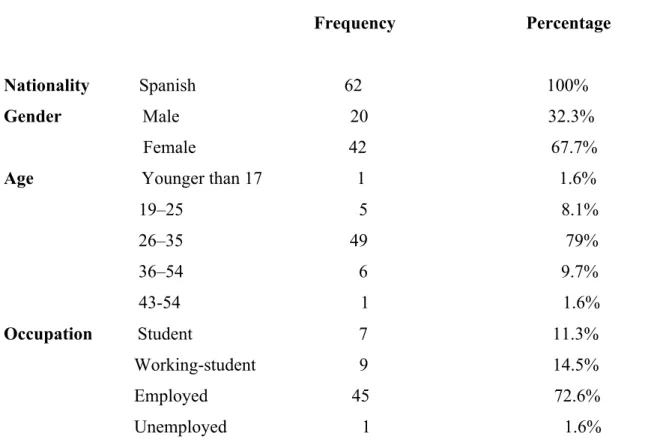
The survey was opened 95 times, and 95 answers were obtained. Nevertheless, 33 responses were excluded from the analysis, 24 were non-Spanish participants, and the other 9 did not complete the survey until the end. After eliminating the non-suitable answers, the total sample of 62 responses was taken into account for further research. This sample was composed of Spanish (100%), the majority between the ages of 26 and 35 (79%). The higher percentage of the participants were women (67.7%) compared to men (32.3%), and the majority were employed (72.6%).
Table 1 summarizes the demographic of the sample.
Table 1: Sample demographic characterization
Frequency Percentage
Nationality Spanish 62 100% Gender Male 20 32.3%
Female 42 67.7%
Age Younger than 17 1 1.6%
19–25 5 8.1% 26–35 49 79% 36–54 6 9.7% 43-54 1 1.6% Occupation Student 7 11.3% Working-student 9 14.5% Employed 45 72.6% Unemployed 1 1.6%
Total respondents 62 100%
4.2 Result Analysis
At first, it is essential to analyze the participants' general involvement with the burger-focused chain restaurants to consider this research as a valid study. On average, the respondents were acceptably involved; in general, they were familiar with this type of restaurant (M = 5.87) and perceived themselves as regular consumers (M = 5.02).
As a consequence, the study can be continued.
Table 2: Descriptive statistics for product involvement
Statement Mean Std. Deviation
“ I am familiar with burger-focused 5.87 1.520 chain restaurant”
“Overall, I am regular consumer in 5.02 1.824 Burger-focused chain restaurants”
4.2.1 Descriptive Statistics
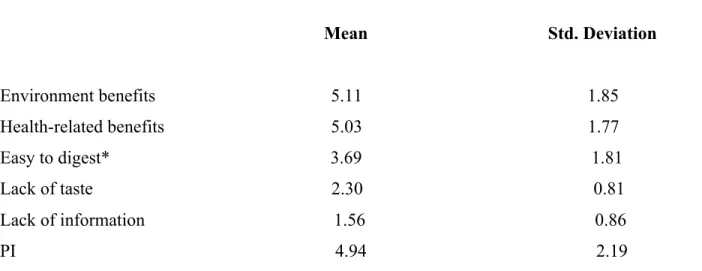
To continue, the multi-item scales were aggregated into a single variable, then the mean of each one of these variables was computed. Overall, the result demonstrated a great perception of the participants toward plant-based burgers in burger-focused chain restaurants; also, individuals confirm it as a benefit to the easy digestion of the plant-based burgers compared with animal-based proteins. On the other hand, the response toward the perceived risk was as expected; participants anticipate barriers in terms of lack of taste and lack of information offered by a burger-focused chain restaurant to consumers
Table 3: Descriptive statistics for general perceptions Mean Std. Deviation Environment benefits 5.11 1.85 Health-related benefits 5.03 1.77 Easy to digest* 3.69 1.81 Lack of taste 2.30 0.81 Lack of information 1.56 0.86 PI 4.94 2.19
Notes: *Easy to digest was formulated negatively so that lower levels of agreement mean higher benefit.
Concerning the individual characteristics and self-perceptions, respondents consider being well informed about food based on plants. In general, they were concerned about the safety of their food production and seemed to enjoy trying different types of food and dishes.
Table 4: Descriptive statistics for individual characteristics
Mean Std. Deviation
Environment concern 4.93 2.20 Plant-based food knowledge 5.00 2.03 Background knowledge 5.04 2.00
Diet variation 5.87 0.96
4.2.2 Hypothesis Testing
For hypothesis testing, an ordinal logistic regression was conducted to understand the correlation between the dependent variables Purchase Intention (PI) and the independent variables based on the formulated hypothesis in chapter 2. As Long and Freese concluded (2014), to analyze this type
of data, it is better to use models that avoid equal distance assumptions between each one of the categories in the variable as a linear regression model
Table 5: Ordinal Logistic regression evaluating perceived benefits on PI
Logit p-value Environment benefits 1.42 0.007 Health-related benefit 0.47 0.92 Easy to digest 0.03 0.84
Perceived benefits such an environmental concern showed a significant positive impact on the PI (EB = 1.42), as predicted in the H2a. It means, on average, for every unit increase in the perceived environmental benefit, the PI will increase 1.42 units, respectively, ceteris paribus. The other two perceived benefits, health-related and easy to digest, were statistically not significant in the regression, with p-value = 0.92 >0.05 and p-value = 0.84 >0.05, respectively.
Table 6: Ordinal Logistic regression evaluating perceived risk on PI
Logit p-value
Lack of taste* 2.93 0.00 Lack of information -0.52 0.14
Notes: *Lack of taste was formulated in scale (0 = low taste quality and 10= high taste quality.
Additionally, in the perceived risk was statistically proven that the risk related to the lack of taste in plant-based burgers has a positive correlation with PI, meaning, on average, for every unit increase perceived taste quality, PI increase 2.93 units, ceteris paribus. Taking into account, the question was formulated in Scale of 0 as low expected taste quality and 10 as high expected taste quality.
Although lack of information should not be considered since the effect was not statistically significant (p-value = 0.14>0.05), it is interesting to observe that this variable might affect PI
negatively (-0.52), the less knowledgeable individuals have about plant-based burger in a burger-focused chain restaurant, the lower was their intention to purchase it.
Overall, environmental benefit and lack of taste were the only statistically significant predictor of PI for a plant-based burger in burger-focused chain restaurants, meaning the more individuals have a higher perceived environmental benefit and higher quality taste perception, the more they were willing to buy a plant-based option.
Table 7: Ordinal Logistic regression evaluating individual characteristics on PI
Logit p-value
Environmental concern 1.65 0.02 Knowledge plant-based food 0.82 0.28
Background knowledge -0.07 0.92 Variation diet 0.39 0.34
To test the individual characteristics hypothesis, an ordinal logistic regression was conducted using the PI as the dependent variable. The only independent variable considered statistically significant was the environmental concern. This means the higher level the environmental concern has the individual, the higher will be the PI, ceteris paribus. (p-value: 0.02 <0.05). Consequently, H1a were verified while H1b, H1c, and H1d were non-statistically significant.
Finally, to analyze the general price, the individuals are willing to pay, a table with the frequency of the different options in the survey was made.
Table 8: Sample price willing to pay
Frequency Percentage Price 5.00 € 6 9.7% 6.00 € 13 21.0% 7.00 € 13 21.0% 8.00 € 21 33.9% 9.00 € 9 14.5%
Overall, the result showed that a higher percentage of the respondents would be relatively willing to pay the price between 6 € and 8 € for plant-based meals. Considering the data obtained in the Market Research in Chapter 2, it can be assumed that the result from the analysis is coherent with the current price of the plant-based burger in the burger-focused chain restaurant market.
Table 9: Summary of hypotheses validation
Perceived benefits and Significance p-value risks
Environmental benefit (H1a) Significant 0.007 Health-related benefit (H1b) Non-significant 0.92 Easy to Digest (H1c) Non-significant 0.84 Lack of taste (H2a)* Significant. 0.00 Lack of Information (H2b) Non-significant 0.14
Individual Characteristics
Environmental concern (H3a) Significant 0.02 Knowledge plant-based food (H3b) Non-significant 0.28 Background knowledge (H3c) Non-significant 0.92 Variation diet (H3d) Non-significant 0.34
Notes: *Lack of taste was formulated in scale 0 = low taste quality and 10= high taste quality.
After the data was analyzed through the ordinal logistic model with purchase intention as an independent variable, it might be concluded that from the 8 different hypotheses based on the perceived benefits, perceived risk, and individual characteristics. Only 3 might have a significant relation with PI (H1a, H2a, and H3a).
• Individuals that perceived the consumption of plant-based burger in burger-focused chain restaurant have an environmental-related benefit (p-value 0.007 < 0.05) might have a higher purchase intension.
• Individuals who perceived a plant-based burger as a great taste quality product might have a higher purchase intension (p-value 0.0 < 0.05)
• Individuals with environmental concerns (p-value 0.02 < 0.05) might be a potential buyer of plant-based burger in a burger-focused chain restaurant.
CHAPTER 5: Main Conclusions, Future Research, and Limitations
5.1. Main Findings and Conclusions
This paper aimed to disclose who are the consumers of plant-based burgers in burger-focused chain restaurants in Spain and what could be the main drivers and barriers to purchase intention and the value they are willing to pay for this product. The relevance of this study comes from the lack of understating and knowledge about plant-based options in the foodservice sector (Rivera & Shani, 2013). Additionally, considering how the environment had been affected by the massive meat production, it is essential to study the acceptance of protein substitutes in burger-focused chain restaurants that could be considered a solution to these issues. Based on previous research and studies to find a framework, this study focused on the impact of individual characteristics, perceived benefits, and risks.
Qualitative and quantitative analysis was developed in order to best address the research. The data was collected through a focus group of 10 individuals (divided in CNTPBCR and CTPBCR) and an online survey. Afterward, to find which Spanish consumers would be more likely to consume this type of burger, environmental concern, knowledge on plant-based food, background knowledge of the food (production), and variation of the diet were the individual's characteristics studied to find further information in their behaviors.
Furthermore, it was found in the research that environmental concerns were the perceived characteristic that might have a significant impact on the purchase intention, which means, the more individuals were concerned with environmental issues, the more they intended to try plant-based burgers in burger-focused chain restaurants. Although four groups of potential consumers were found, the product is more likely to be bought by individuals with a high level of this characteristic.
Although past research has suggested, there were a low significant impact from non-health related benefit as environmental and animal welfare on purchase intention (Lea, Crawford & Worsley,
2006). After analyzing the data, it was found that from the 3 possible perceived benefit exposed in the research as an environmental benefit, health-related benefit and easy to digest, the
environmental benefit was the only one that has a significant impact on the purchase intention of a plant-based burger in a burger-focused chain restaurant. The following information means that an individual who perceived the consumption of plant-burger brings benefits in a long and short term the environment would have a higher percentage of trying this product than those who do not perceive it.
To identify potential barriers to purchase intention, lack of taste, and lack of information was the set of variables analyzed. The study showed that the risk of lack of taste significantly impacted the variable positively. The more individuals believed that plant-based burger in burger-focused chain restaurants might have a high-quality taste, the higher was their intention to purchase.
Conclusions are aligned with previous studies, which mentioned that plant-based burgers could be perceived as lower taste quality options (Crimarco, Dias & Tuerner-McGrievy, 2020; Lea, Crawford, & Worsley, 2006) and those cases might have a lower purchase intention.
Lastly, the average price that individuals are willing to pay for a plant-based meal in burger-focused chain restaurant was between a 6 € and 8 €. Since the average price for this product is 7.45 €, the price would not be considered as a potential barrier. This confirms that individuals are willing to pay 1 € to 2 € extra to try a burger with a substitute meat option.
5.2. Managerial Implications
The present research contributes to the existing literature regarding sustainable food consumption behaviors, and specifically, plant-based meat substitutes in the foodservice sector. From a managerial perspective, this study provides critical elements that can incentivize the consumption of meat substitutes and those combined with marketing strategies that could represent a source of competitive advantage. Moreover, this study a possible solution to a global environmental issue.
Nowadays, firms in the food industry need to decrease the impact of their production on the environment and find new brands and alternatives for sustainable solutions for consumers (Forster, 2013). Introducing plant-based food can be a way to establish reputation advantage, market strength and product differentiation. At the same time, not adapting the brand to these options might bring a long-term crisis.
Even though most consumers might show concerns about this type of issue, it is generally not reflected in their consumption decision. Consequently, it might be a problem to understand the primary motivators and barriers to individuals' behaviors.
This research indicates that perceived future environmental benefits by consuming this product would be an essential factor in the purchase decision, and this might suggest that marketing message in burger-focused chain restaurants should center on the individuals and how they feel good by choosing this type of burger, and this can successfully motivate them to buy this product. Following this idea, also it is advised that firms target groups of people with high levels of environmental concerns, and it would be considered crucial to signal their decisions.
Additionally, it is essential to identify which potential risk is considered in the process, since plan-based food, in general, can cause a perception of lower quality of taste (Lea, Crawford, & Worsley, 2006), leading to a lower purchase intention. Therefore, these firms must focus on promoting the excellent taste of the plant-based burgers. Usually, consumers tend to try products with perceived good taste. Considering this information, it is crucial to provide clear information regarding product description, beneficial warranty, or to implement a more consummatory image of the product (Poor, Duhachek & Krishnan, 2013) to decrease the risk to non-try plant-based option in the menu.
5.3. Limitations and Further Research
Although the study provided relevant results to further researches and firms involved in the food industry, some limitations need to be considered.
One of the main limitations was the small number of responses in the quantitative data, even though during the online survey was collected 95 answers, the 35% of the responses were excluded because there were non-suitable for the study. In the past, some research had concluded that small studies might have an imprecise estimate of the effect, leading to non-firm conclusions (Hackshaw,
2008). In the future, other similar studies should try to collect a larger sample to provide more robust and meaningful conclusions.
Additionally, three of the hypotheses were partially confirmed. In the majority, some effects were as predicted by the literature review but could not be proven significantly. To approach these limitations, further studies should try to collect a more significant sample in order to have more substantial results and be more prone to generalized.
Lastly, it might generate a problem using the brand name of burger-focused chain restaurants in the online survey. Although it was used to explain the respondent a general perception of the type of burger that was addressed, it should be a consideration for further research. It might be the case that participants might be influenced by the perception they already possessed toward the mentioned brand
References
• Aggarwal, A., & Drewnowski, A. (2019). Plant-and animal-protein diets in relation to sociodemographic drivers, quality, and cost: findings from the Seattle Obesity Study. The American journal of clinical nutrition, 451-460.
• Allès, B., Baudry, J., Méjean, C., Touvier, M., Péneau, S., Hercberg, S., & Kesse-Guyot, E. (2017). Comparison of sociodemographic and nutritional characteristics between self-reported vegetarians, vegans, and meat-eaters from the Nutrinet-Sante study. Nutrients, 1023.
• Aschemann-Witzel, J., Varela, P., & Peschel, A. O. (2019). Consumers’ categorization of food ingredients: Do consumers perceive them as ‘clean label’producers expect? An exploration with projective mapping. Food quality and preference, 117-128.
• Barrena, R., & Sánchez, M. (2009). Consumption frequency and degree of abstraction: A study using the laddering technique on beef consumers. Food quality and preference, 144-155.
• Belz FM. 2008. Marketing in the age of sustainable development. In System Innovation for Sustainability 1. Perspectives on Radical Changes to Sustainable Consumption and Production, Tukker A et al . (eds). Greenleaf: Sheffield; 114–135.
• Belz, F. M., & Schmidt‐Riediger, B. (2010). Marketing strategies in the age of sustainable development: evidence from the food industry. Business strategy and the environment, 401-416.
• Belz, F. M., & Schmidt‐Riediger, B. (2010). Marketing strategies in the age of sustainable development: evidence from the food industry. Business strategy and the environment, 401-416.
• Bendixen, M., & Yurova, Y. (2012). How respondents use verbal and numeric rating scales: A case for rescaling. International Journal of Market Research, 261-282.
• Beske, P., Land, A., & Seuring, S. (2014). Sustainable supply chain management practices and dynamic capabilities in the food industry: A critical analysis of the literature. International journal of production economics, 131-143.
• Beyond Meat (2020). Beyond Meat Mission. Retrieved from: https://www.beyondmeat.com/
• Beyond Meat (2020). MCDONALD’S CONTINUES TEST OF NEW P.L.T. MADE WITH A BEYOND MEAT® PATTY. Retrieved from: https://www.beyondmeat.com/whats-new/mcdonalds-tests-new-p-l-t-made-with-a-beyond-meat-patty/
• Bonnet, C., Bouamra-Mechemache, Z., Réquillart, V., & Treich, N. (2020). Regulating meat consumption to improve health, the environment and animal welfare. Food Policy. • Boyatzis, R. E. (1998). Transforming qualitative information: Thematic analysis and code
development. sage.
• Brunsø, K., Fjord, T. A., & Grunert, K. G. (2002). Consumers’ food choice and quality perception. The Aarhus School of Business Publ.
• Burger King España(2020). Burger King Carta. Retrieved from: https://www.burgerking.es/carta/public-menu
• Burger King USA (2020). Burger King Menu. Retrieved from: https://www.bk.com/menu/picker-QmR7M8G5c2SjI194gF3LPV
• Capacci, S., Mazzocchi, M., Shankar, B., Brambila Macias, J., Verbeke, W., Pérez-Cueto, F. J., ... & Saba, A. (2012). Policies to promote healthy eating in Europe: a structured review of policies and their effectiveness. Nutrition reviews, 188-200.
• Chandon, P., & Wansink, B. (2007). The biasing health halos of fast-food restaurant health claims: lower calorie estimates and higher side-dish consumption intentions. Journal of Consumer Research, 301-314.
• Cheah, I., Shimul, A. S., Liang, J., & Phau, I. (2020). Drivers and barriers toward reducing meat consumption. Appetite, 149
• Chi, H. K., Yeh , H. R., & Yang, Y. T. (2009). The Impact of Brand Awareness on Consumer Purchase Intenttation: The Meadiating Effect of Perceived Quality and Brand Loyalty . The Journal of International Management Studies
• Choi, J., & Zhao, J. (2014). Consumers' behaviors when eating out. British Food Journal. 494-509.
• Consulting Firm Latern (2017). The Green Revolution. Consulting Firm Latern España Papers.