DETERMINANTS OF BANK
CAPITAL STRUCTURE:
VOLUNTARY OR INVOLUNTARY
DECISIONS, WHAT REALLY MATTERS?
Master in Finance Dissertation
Filipe Alves Domingues
Advisors:
Professor Manuel de Oliveira Marques
Professor Miguel Augusto Sousa
III
Acknowledgments
Concluding this dissertation project successfully would not be possible without the support of many people. I apologize if I have forgotten someone, it is unintentionally.
First, I would like to thank my two advisors: Manuel de Oliveira Marques, who oriented me in choosing the subject of this dissertation and provided helpful insights in the preliminary discussions and Miguel Augusto Sousa for the guidance and the valuable comments and, especially, for his generous availability.
A special word to Sheila da Silva for her friendship, patience and complete availability to read the drafts and suggest improvements. A word of gratitude to José de Moura Rodrigues and to António Miguel Martins who gave me an important contribute when I was starting the empirical data analysis.
The empirical study would not be possible without the data collected from the Bankscope database of the Bureau Van Dijk and from Thompson Financial’s Datastream database. I would like to thank the library of ISEG, in the person of Duarte Meireles who kindly allowed me to use their Bankscope terminal. I would also like to thank António Silva and João Lemos, from Bureau Van Dijk, who responded promptly to my questions. A special word to the staff of the FEP library, always helpful and friendly.
Finally, I want to express my admiration and gratitude to my family, who always give me unconditional encouragement and support. This dissertation is dedicated to my wife, my parents and my sister, the most important people in my life.
V
About the Author
Filipe Alves Domingues was born on December 10th, 1978, in Miranda do Douro. He holds a 5 years degree in Management from Faculdade de Economia da Universidade do Porto, attributed in 2001. In 2010 he started postgraduate studies by joining the Master in Finance at the same University.
Filipe has a professional experience of more than 12 years. From May 2007 onwards, he has been working for the planning and controlling department of EDP Renováveis as senior financial analyst. Previously, he worked in the banking sector, firstly in investment banking, then in the accounting and financial department and finally as head of planning and controlling.
VII
Abstract
The purpose of this dissertation is to shed some light on which are the main capital structure determinants of the EU27 listed banking firms. Do the standard capital structure factors apply to this sample of banks? Or instead, are the regulatory capital and capital buffers the main factors considered by banks in their capital structure choice? Our results seem to indicate that, in some extent, standard cross-sectional determinants of non-financial firms’ capital structure also apply to our sample of EU27 listed banks, from 1998 to 2011. However, this evidence is stronger for market leverage than for book leverage. Controlling for asset risk does not exclude the remaining variables. In contrast, the regulatory view seems to have weaker explanatory power of banks’ capital structure changes.
Keywords: banks, capital structure, leverage, capital regulation. JEL codes: G32, G21
IX
Table of Contents
Chapter 1 - Introduction ... 1
Chapter 2 - Firm’s Capital Structure Theory: Overview of the Literature ... 5
2.1. Modigliani and Miller’s (1958) Theorem ... 5
2.2. Tax Based Trading-Off Models of Capital Structure ... 6
2.3. Agency Theory and Capital Structure Decisions ... 7
2.4. Asymmetric Information Models of Capital Structure ... 9
2.4.1. Pecking Order ... 9
2.4.2. Signaling ... 11
2.4.3. Market Timing ... 12
Chapter 3 – Capital Structure of the Banks: Overview of the Literature ... 15
3.1. Market (In)Eficiency and Banks’ Role ... 15
3.2. Tax Advantages of Debt and Bankruptcy Costs ... 17
3.3. Agency Problems and Bank’s Capital Structure Decisions ... 19
3.4. Regulation on Banking ... 22
3.4.1. Basel Accords ... 23
Chapter 4 – European Banks: Empirical Study ... 27
4.1. Objectives ... 27
4.2. Data sources and Sample Description ... 27
4.3. Descriptive Statistics ... 29
4.4. Financial Structure of Banks ... 34
4.5. Methodology and Predictions ... 35
4.6. Results ... 40
4.6.1. Market Leverage as Dependent Variable ... 40
4.6.2. Book Leverage as Dependent Variable ... 43
4.6.3. Controlling for Asset Risk ... 45
4.6.4. Introducing Leverage as Lagged Dependent Variable ... 48
4.6.5. Regulatory Capital as Dependent Variable ... 51
Chapter 5 - Conclusions ... 55
References ... 59
XI
Index of Tables
Table 1 - Number of unique banks and bank-year observations across countries ... 29
Table 2 - Variables Definition ... 30
Table 3 - Descriptive Statistics ... 33
Table 5 – Theory predictions ... 36
Table 6 – Explanatory power of standard determinants of bank market leverage... 42
Table 7 – Explanatory power of standard determinants of bank book leverage ... 44
Table 8 – Explanatory power of standard determinants of bank market and book leverage after controlling for asset risk ... 47
Table 9 – Including lagged dependent variable as explanatory variable ... 50
Table 10 – Explanatory power of standard determinants of bank leverage using regulatory capital as the dependent variable ... 53
Index of Graphs
Graph 1 - Banks book financial structure over time ... 341
Chapter 1 - Introduction
The firm’s capital structure refers to the combination of equity and long-term debt the company uses to finance its investments/assets. The source of capital can be internal, meaning cash flow from operations, or external, when the financial needs surpass the amount of cash-flow generated leading to the issuance of new equity or debt securities. These securities vary in terms of rights over the returns and the assets control. Moreover, accessing the markets to raise funds is costly. Since the choice of the capital structure, as all the other corporate finance decisions, is relevant to the firm’s value, it is particularly appropriate to consider the marginal costs of using each type of available funding.
Since the theorem of Modigliani and Miller (1958) which states that, in perfect capital markets, capital structure choice is irrelevant to firm value, many theoretical models have been proposed, based on the existing market imperfections, to respond to all these questions and to better understand why the capital structure decisions really matter.
The static trade-off theory, in simple terms, assumes that the firm decides its sources of funding in order to find a debt ratio that maximizes the tax benefits offered by the interest payments on debt and minimize the probability of bankruptcy and the loss if a failure occurs. The Agency theory of Jensen and Meckling (1976) introduce the concept of agency costs, due to the conflicts of interest mainly between equityholders and managers and between debtholders and equityholders, and how it relates to the existence of an optimal mix of funding.
Subsequently, asymmetric information based theories of capital structure arose. The pecking order theory suggests that firms have good reasons to avoid issuing common stock or other risky securities to finance new investments. Rather, they should accumulate operational cash-flow to prevent the dilemma of either passing by positive NPV projects or issuing stock at a low price. The signaling theory suggests that the market values the firm according to its perceived stream of returns. Thus, changes in the capital structure of such a firm may alter that market perception, since it leads to changes in the market perceived firm’s risk class although the actual risk class in fact remains unchanged. In their turn, underlying the market timing approach is the
2 empirical evidence that the observed capital structure is the cumulative outcome of past attempts to time the market, although it has limited explanatory power in the long-run.
Some empirical studies on non-financial firms, have found that capital structure is cross-sectionally correlated with certain factors. Harris and Raviv (1991) suggest that leverage increases with fixed assets, non-debt tax shields, growth opportunities, and firm size and decreases with volatility, advertising expenditures, research and development expenditures, bankruptcy probability, profitability and uniqueness of the product. Frank and Goyal (2004) found that the most reliable factors in the leverage decisions are median industry leverage (positive effect), market-to-book ratio (negative), collateral (positive), profits (negative), dividend paying (negative), log of assets (positive), and expected inflation (positive). Rajan and Zingales (1995) found that leverage correlates positively with size and tangibility and negatively with market-to-book ratio and profitability.
Despite these important theoretical and empirical findings, some authors (e.g. Rajan and Zingales, 1995; Frank and Goyal, 2004) suggested that it is necessary to strengthen the relationship between these theoretical models of capital structure and the empirical facts.
Furthermore, this empirical research is usually restricted to non-financial firms. Due to their special characteristics, financial firms (notably banks) have been excluded from corporate finance studies on capital structure determinants. Since banks are subject to a regulatory framework that establishes mandatory capital levels, they are involved in both voluntary and involuntary capital structure decisions (Besanko and Kanatas, 1996; Marques and Santos, 2003). Moreover, banks raise most of their funds in the form of deposit contracts. Marques and Santos (2003) assert that “the investigation of capital
structure of financial firms such as banks has been largely overlooked.” Gropp and
Heider (2009) also conclude that, “there is a long tradition in corporate finance to
investigate the capital structure decisions of non-financial firms. But what determines banks’ capital structures?”
Aiming to answer this question, Gropp and Heider (2009), using a sample of 200 large U.S. and European banks, examined whether the standard determinants of capital structure usually applied to non-financial firms (size, profitability, market-to-book ratio, asset tangibility, and dividend paying) are also relevant to banks. They also introduced
3 asset risk and macroeconomic factors. They further tested whether asset risk captures the effect of risk adjustments or if it rather excludes the corporate standard variables. Overall, their results show that standard corporate finance determinants of capital structure also apply to banks. Furthermore, their empirical facts suggest that capital regulation and capital buffers may only be of second order importance in determining the capital structure of most banks.
The approach followed in this empirical study is similar to Gropp and Heider (2009). Using a sample of 145 listed commercial banks and bank-holding companies from 25 countries, between 1998 and 2011, we explore whether the standard determinants of capital structure are significant factors in determining the level of bank leverage in the European Union (EU27). We also control for asset risk and examine whether the regulatory framework, that imposes minimum capital ratios on banks, influences the choice of capital structure by banks.
The remainder of this dissertation is organized as follows. Chapter 2 presents an overview of the firm’s capital structure most prominent theories. Chapter 3 introduces the capital structure of banking firms. Chapter 4 comprises an empirical study to test whether standard determinants of capital structure have any explanatory power when applied to banks. We summarize and conclude in Chapter 5.
5
Chapter 2 - Firm’s Capital Structure Theory: Overview of the
Literature
“The study of capital structure attempts to explain the mix of securities and financing
sources used by corporations to finance real investment. […] There is no universal theory of the debt-equity choice, and no reason to expect one. There are several useful conditional theories, however.”
(Myers, 2001)
2.1. Modigliani and Miller’s (1958) Theorem
Modigliani and Miller (1958) is recognized as the seminal academic work on firm’s capital structure. In their study, the authors argue that, in perfect and frictionless markets, capital structure is irrelevant1. They suggest that capital structure should not influence the market value of the firm, based on a set of theoretical assumptions that have their basis in the market efficiency postulate. Therefore, we should look at the Modigliani and Miller irrelevance theorem as an outcome based on a theoretical corporate environment, without any kind of frictions and market imperfections2.
In 1963, Modigliani and Miller made a correction to their previous study which consist in introducing the effect of tax deductibility of interest payments in their model (the absence of taxes, previously considered one of the main assumptions, is now relaxed). Thus, the firm benefits from using debt financing because the higher the debt level the greater the firm’s value3. However, Modigliani and Miller (1963) recognized that, despite the tax advantage of debt, firms should not use 100 percent debt because of “the need to preserving flexibility” regarding its treasury management and the choice of
1 Modigliani and Miller (1958): “the capital structure of a firm is a matter of indifference; and that,
consequently, one of the core problems of corporate finance - the problem of the optimal capital structure for a firm - is no problem at all”.
2 Modigliani and Miller (1958) assume perfect markets in the absence of taxes, bankruptcy costs and transaction costs; investors are rational and have homogeneous expectations about the investment opportunities of firms; absence of agency costs.
3 The firm's value becomes equal to its value when financed only with equity plus the present value of the tax benefits resulting from debt. In the extreme situation, the firm’s maximum value would occur when its assets are fully financed by debt, which corresponds to a tax saving maximization.
6 their sources of funding and because creditors can impose restrictions to the amount of financing.
Although controversial, the theory of Modigliani and Miller gave a very important contribution to explain the firm value formation and the flexibility of its assumptions becoming crucial to the formulation of many theories of capital structure. Since then many capital structure studies have been produced and many models and theories have been proposed, looking for a better understanding of the capital structure foundations and overcome the theoretical assumptions subjacent to Modigliani and Miller (1958).
2.2. Tax Based Trading-Off Models of Capital Structure
According to the trade-off theories, the firm decides its sources of funding in order to find a debt ratio that maximizes the tax benefits offered by debt and minimize the costs of bankruptcy in which the company may incur.
Hasan (1997) illustrates it, saying that “[…]the trade-off between gains from
leverage-induced tax shields and expected bankruptcy costs may well account for the traditional cost of capital curve, declining at low levels of debt but rising with substantial leverage and hence an optimal capital structure.” As debt increases, the
marginal benefits decrease and marginal costs increase and vice-versa. Therefore, the optimal capital structure entails balancing the tax benefits of debt against the costs related with financial distress.
Miller (1977) suggests that when determining the optimal capital structure, it is important to not simply consider corporate taxes but also add the effect of personal taxes. This Author argues that, considering this effect, the gain from leverage is less than previously believed because in a world of differential personal taxes, the marginal personal tax disadvantage of debt combined with supply side adjustments by firms will override the corporate tax advantage of debt and drive market prices to equilibrium.
DeAngelo and Masulis (1980) added to Miller's (1977) work the effect of deductible non-cash charges substitutes of interest payments on debt, such as accounting depreciation and investment tax credits. In their study they state that “for
relatively low levels of leverage, the marginal value of debt is positive because there is a relatively high probability that additional debt can be fully utilized to reduce the
7
firm’s tax liabilities and this corporate tax reduction outweighs the higher personal taxes paid on additional debt. For relatively high levels of debt, the marginal value of debt is negative because the tax shield substitutes imply a relatively high probability that the potential corporate shield from additional debt will be partially or totally lost because of insufficient earnings, while an additional personal tax liability for holding debt is incurred.” Therefore, assuming that the only benefit of using debt is the tax
saving associated to it, the use of debt is good only as long as the interest on debt can be deductible4. Thereby, the incremental value of interest tax shields decreases as the firm financial leverage increases. Consequently, as stated by Hasan (1997), a high degree of leverage increases the probability of bankruptcy and, therefore, increases the overall riskiness of the earnings stream. Moreover, the rate of interest on debt may start to rise and may cause the cost of capital to increase.
Myers (2001) states that this theory supports the existence of moderate debt ratios and is consistent with the fact that companies with relatively safer investments and tangible assets tend to borrow more than firms with higher risk investments while DeAngelo and Masulis (1980) suggest in their study that each firm has a unique interior optimum leverage decision, due solely to the interaction of personal and corporate tax treatment of debt and equity, even with the existence of positive default costs and with or without tax shield substitutes for debt.
2.3. Agency Theory and Capital Structure Decisions
One of the main fragilities of the neoclassical theory lies in overlooking the possibility of separation between ownership and management. However, in the real economy, the specialization of the management has been increasing. Therefore, it is not surprising that in more recent literature, researchers became interested not only in understanding how the capital structure affects the firm value but also how it affects the ownership and governance of the firm.
Assuming the separation between ownership and management, owners (securities holders) no longer have control over the cash-flows. Although the objective
4 DeAngelo and Masulis (1980): “The tax codes set a ceiling to ensure that the expected marginal
8 of managers (agents) should be maximizing the shareholders’ return, they do not always run the firm with this objective, thereby originating an agency problem. As mentioned by Jensen and Meckling (1976) “If both parties to the relationship are utility
maximizers, there is good reason to believe that the agent will not always act in the best interests of the principal.”
The managers’ information advantage may conduct to an opportunistic exploitation, using the available firm free cash-flow to accomplish their personal goals. Thus, the agency risk becomes a critical determinant of firm’s performance.
Based on the existence of these agency relationships, in their influential work, Jensen and Meckling (1976) suggest that taxes are not the only condition for the existence of an optimal capital structure. They introduce the concept of agency costs and how it relates to the existence of an optimal mix of internal (retained earnings) and external financing (debt or equity). They identify two different types of conflicts that are present in every publicly-traded firm: conflict between equityholders and managers and conflict between debtholders and equityholders.
The securities holders do not have control over the cash-flows, therefore in order to protect their rights they have to monitor the managers’ actions to ensure that their decisions follow the objective of increasing the firm’s value instead of wasting resources. The following question arises: How does one formulate the contractual relation between the principal and agent in order to create the right incentives for the manager behavior to maximize the principal’s welfare? The principal may implement several monitoring mechanisms, create compensation schemes or limit the resources available for the agent by changing the capital structure5.
By increasing leverage while keeping the level of manager’s equity ownership constant, the firm mitigates the agency problem between managers and equityholders since managers are holding a larger stake in the firm. Increasing the level of debt also forces a firm to pay out cash (in the form of interest payments) and consequently reduces the amount of “free” cash available for managers to engage in their self-centered activities. On the other hand, increasing the debt level may also lead to higher costs of debt arising from the conflict between debtholders and equityholders.
5 However, as pointed by Jensen and Meckling (1976) “is generally impossible for the principal or the
agent at zero cost (pecuniary or non-pecuniary) to ensure that the agent will make optimal decisions from the principal’s viewpoint.”
9 According to the literature, the conflict between shareholders and debtholders can take two distinct forms: asset substitution and underinvestment problems. Regarding the asset substitution, Jensen and Meckling (1976) argue that once a debt is in place, the equityholders will have incentives to increase the risk of the firm to enhance the equity value at the expense of debtholders. It means that equityholders prefer a riskier project to a safer one because it gives them a potentially higher return while they are subject to the risk of losing the same amount of investment. However, this incentive to increase risk can be mitigated since future debt issuances will be priced taking into account this higher risk. The underinvestment problem arises when equityholders refuse positive NPV projects because they bear the full costs of the investment while having to share the proceeds with the debtholders. In particular, when a firm is on the edge of bankruptcy, the equity holders might reject to undertake positive NPV projects because in the event of bankruptcy the liquidation proceeds go first to the debtholders.
2.4. Asymmetric Information Models of Capital Structure 2.4.1. Pecking Order
Myers and Majluf (1984) developed a new model, combining financing and investment decisions, to explain corporate finance behavior, under the assumptions that managers know the firm better than potential investors and the latter interpret the firm’s actions rationally. The model suggests explanations for the tendency to rely on internal sources of funds, and the preference of debt to equity if external financing is required, which generally means that it is better to issue safe securities than risky ones.
Due to information asymmetry between the managers and the market, there is a hierarchy of funding sources. Preferably the company is financed with retained cash flows, then with the issuing of new debt and, only after exhausting the previous alternatives, with the issuing of equity. There are several reasons to explain the preference for internal financing. Signaling, since issuing equity may be a sign that the shares are overvalued and issuing debt can be a sign that the company is experiencing difficulties. Flexibility, given that external financing reduces the flexibility to face upcoming funding needs. Control, because debt contracts have covenants and new
10 shares issuing brings new shareholders to the company. Costs of new issuances, contrary to internal funding that have no issuance costs.
Myers (1984) argues that “the firm may also plan to cover part of normal
investment outlays with new borrowing, but it tries to restrain itself enough to keep the debt safe - that is, reasonably close to default-risk free. It restrains itself for two reasons: first, to avoid any material costs of financial distress; and second, to maintain financial slack in the form of reserve borrowing power6.” Myers and Majluf (1984) suggest that firms whose investment opportunities outstrip operating cash flows, and which have used all their ability to issue low-risk debt, may forego good investments rather than issue risky securities to finance them. In this way, firms should carry sufficient financial slack to undertake good investment opportunities as they arise.
Myers (1984) also argues that there are two conditions under which issuing equity might not be optimal for the firm. The first being that both managers and investors recognize that managers know better the exact condition of the firm and the future investment opportunities than the investors - asymmetric information problem. The second being that managers act in the best interest of the existing equityholders.
Myers and Majluf (1984) also argue that if managers have superior information and stock is issued to finance investment, the stock price will fall, ceteris paribus. If the firm issues safe (default-risk-free) debt to finance investment, the stock price will not fall.
Firms may prevent these troubles by building up financial slack by restricting dividends, when investment requirements are modest or by issuing stock in periods when managers’ information advantage is small. However, as noted by Myers (1984), since target dividend payout ratios are sticky, and investment opportunities fluctuate relative to internal cash flow, the firm will, from time to time, exhaust its ability to issue safe debt. When this happens, the firm first turns to less risky securities - for example, risky debt or convertibles before common stock.
The pecking order theory indicates that when firms make capital structure decisions they do not have a target leverage ratio. Leverage will adjust in accordance with the need to obtain external financing and not because of trying to reach an optimal
11 capital structure. It contrasts with a static trade-off framework in which the firm is viewed as setting a target debt-to-value ratio and gradually moving towards it.
2.4.2. Signaling
If we assume that market prices do not reflect all the information, especially that is not publicly available, then capital structure decisions could be used as a signaling mechanism. Modigliani and Miller irrelevance proposition implicitly assumes that investors know the random return stream of the firm and they value the firm accordingly. This is the basis for signaling approaches of optimal capital structure. The market values the firm according to its perceived stream of returns, thus changes in the capital structure of such a firm may alter that market perception. Changing the capital structure can influence the value of the firm since it leads to changes in the market perceived firm’s risk class although the actual risk class in fact remains unchanged.
Building on this, Ross (1977) proposes the signaling approach to explain the changes in capital structure. He argues that managers who are better informed than the investors about the firm’s expected cash flows may change the capital structure to send out clear signals to the market about the future performance of the firm, if they have the appropriate incentive to do so. However, without incentive schedules to truthful signaling, incentive signaling equilibrium does not exist.
One empirical implication of the Ross’s (1977) incentive-signaling theory is that in a cross-section the values of firms will rise with leverage since increasing leverage increases the market’s perception of value and, in equilibrium, firms are correctly distinguished by their financial choices.7
Leland and Pyle (1977) developed a model of capital structure based in the informational asymmetries, in which it is assumed that owners (the insiders) are better informed about firm’s projects than the investors (the outsiders). The greater the owner’s willingness to invest in his own projects or company, the more positive signal
7 Ross (1977): “Despite these somewhat paradoxical results, a great deal of care must be taken in actual
empirical testing. […] In a continuous time model it is certainly the case that for a given firm, with true bankruptcy costs, value will fall with increases in the debt-equity ratio; in fact D/E must approach infinity as bankruptcy is approached (in a diffusion model). Even without such costs, D/E and V will move in opposite directions. These effects will tend to counter the initial incentive-signaling effects and may make empirical testing more difficult.”
12 the firm is sending out to investors. It can serve as a signal of project quality and the value of the firm is expected to increase.8
About this signaling model, Hasan (1997) underlines two implications. “[A first is that] if the original owners of a company going public decide to keep a large fraction
of the stock, then these firms should experience greater price earnings multiples (Copeland and Weston, 1988). Thus, in contrast with MM (1958), even in the absence of taxes, the financial structure of the firm will be related to project or firm value. A second implication is that if the firm’s value is positively related to the fraction of the owners’ wealth held as equity in the firm, then the firm will have greater debt capacity and will use a greater amount of debt. Hence, although debt is not a signal in this model, its use will be positively correlated to the firm’s value.”
This financing equilibrium proposed by signaling models diverges from models which ignore asymmetric information. In contrast with Modigliani and Miller (1958), the financial structure is related to the firm value even in absence of taxation and firms with riskier returns will have lower leverage ratios even without bankruptcy costs. Furthermore, Leland and Pyle (1977) suggest that financial intermediation, which is difficult to explain in classical models of financial equilibrium, can be seen as a natural response to the asymmetric information.
2.4.3. Market Timing
In addition to the theoretical models we presented so far, which have been subject to major theoretical and empirical research, other approaches have emerged in an attempt to explain the capital structure decisions. Among them, Baker and Wurgler (2002) introduce a new approach, supported in the empirical evidence that market timing is an important determinant of real financing decisions. They suggest that firms issue equity when their market values are high, relative to book and past market values, and repurchase equity when their market values are low. They also find that low-leverage
8 Leland and Pyle (1977): “[…] information on project quality may be transferred if the actions of
entrepreneurs ("which speak louder than words") can be observed. One such action, observable because of disclosure rules, is the willingness of the person(s) with inside information to invest in the project or firm. This willingness to invest may serve as a signal to the lending market of the true quality of the project; lenders will place a value on the project that reflects the information transferred by the signal.”
13 firms tend to raise funds issuing more equity when their valuations are high and, conversely, high-leveraged firms tend to raise funds issuing more debt when their valuations are low. Hence, they consider that the observed capital structure is the cumulative outcome of past attempts to time the market. Like in the pecking order, also in the market timing theory there is no optimal leverage ratio.
Frank and Goyal (2004) suggest that the basic idea behind this theory is the following: “managers look at current conditions in both debt markets and equity
markets. If they need financing, then they will use whichever market looks more favorable currently. If neither market looks favorable, then fund raising may be deferred. Alternatively, if current conditions look unusually favorable, then funds may be raised even if they are not currently required.”
Alti (2006) said that despite the fact that market timing is important to explain changes in capital structure in the short-run, it has limited explanatory power in the long-run. He suggests that the long-run capital structure policies of a firm appear to be largely consistent with the existence of leverage targets, in accordance with trade-off model.
15
Chapter 3 – Capital Structure of the Banks: Overview of the
Literature
3.1. Market (In)Eficiency and Banks’ Role
As a firm, banks dovetail with the same capital theory of non-financial firms. However, as financial intermediaries, banks are a specific industry with a particular function and special features that should be incorporated in their capital structure analyses. Moreover, banks develop their activity under a regulatory and supervisory framework that establishes mandatory capital levels.
Banks, as important payers in the financial system, have the primary function of facilitate the allocation and deployment of economic resources, both spatially and temporally, in an uncertain environment (Merton, 1995).9 Under the traditional view of financial intermediation, banks are in competition with markets to offer an increasing range of financial products and, thus, in many aspects they are substitutes. The increasing market globalization and continuous improvement of technologies led to an increasing sophistication of financial products and a reduction of transaction costs. This tendency adds to competition between financial intermediaries and financial markets and, hence, contributes to the market efficiency.
According to this traditional view, in perfect capital markets characterized by the inexistence of frictions, transaction and informational costs, no benefits would emerge from the existence of financial intermediaries. In contrast, market imperfections underlie the existence and rationality of the financial intermediaries. Banks would contribute to solve or mitigate some of these imperfections.
Merton (1995) introduces a new conceptual framework to analyze the dynamics of financial intermediation. According to his dynamic perspective, intermediaries are better suited to handle highly customized and low volume products whereas financial markets tend to be a more efficient alternative to financial institutions when products are standardized, traded in large volumes, serving a large number of investors who are
9
“Under the traditional theory of financial intermediation, a banking firm is portrayed as an asset
transformer (see, e.g., Gurley and Shaw 1960), which pools resources in an attempt to match / intermediate economic agents’ profiles of consumption and investment. Under this approach, the banking firm’s most prominent function is to intermediate between savers and borrowers” (Santos, 2003)
16 comfortable to evaluate their prices. According to this view, further to their resources’ allocation function, banks also play an important role in the financial innovation process, creating and testing new products constantly and, hence, contributing to increase the market efficiency. 10
As per this Merton’s (1995) new dynamic perspective of complementarities and interactions, it no longer makes sense to say that financial institutions and markets compete amongst themselves but say that the two are just as surely complementary institutions, each reinforcing and improving the other in the performance of their functions.
There is some literature arguing that the main driver behind this financial innovation is the attempt to reduce the constraints of regulation, including taxes accounting rules and transaction costs, thus contributing to market efficiency11. However, during the present global financial crisis, a large number of economists have come to argue that financial innovation played an important role in causing the financial crisis due to an excessive risk-taking by financial institutions. This moral hazard behavior is largely motivated by the government safety net and the prospect of bailouts for banks12
Among academics is widely accepted that innovation in finance contributes to market efficiency, but only the innovation which makes the securities more flexible and
10
See Merton (1995) for more detail on the role and institutional dynamics of the financial intermediation, under a functional perspective.
11 e.g. Finnerty (2008): “Securities innovation improves capital market efficiency by offering more
cost-effective means of transferring risks, increasing liquidity, and reducing transaction costs and agency costs. It is a profit-driven response to changes in the economic, tax, and regulatory environment.”
12 There is no consensus about the implications of financial innovation, for instance while Sánchez (2010) argues “My central point is that although financial innovation has lately fallen out of favor because some
of its products acted as vehicles in the credit boom that led to the crisis, criticism should be taken with caution. Innovation has been with us for a long time, and its overall contribution to finance and welfare has been positive. Provided that we strengthen prudential regulation to discourage excessive risk taking in the future, innovation can continue to benefit our societies.”; Park (2009) argues “The current crisis is primarily the direct result of the abuse of some of the latest and most innovative financial techniques. Most of which are too esoteric and technical to be comprehended correctly by both government regulators and academic economists. Many crises are usually a byproduct of the cycle of financial innovations.”; and Pearson and Henderson (2011) point out “Our findings are, however, consistent with the recent hypothesis that issuing firms might shroud some aspects of innovative securities or introduce complexity to exploit uninformed investors.”
17 less costly, hence, accessible for a larger number of people, allows improving the risk management and contributes to the transparency and better functioning of the markets.13
Comparing to other industries, another major peculiarity of banks is the fact that customers are simultaneously debtholders because banks raise most of their funds in the form of deposits. This also makes banks have a distinctive capital structure, since deposits are a component of debt. An additional feature that distinguishes banks from non-financial firms is their comparative higher default risk sensibility, since their performance is highly determined by the client’s liabilities probability of default.14
3.2. Tax Advantages of Debt and Bankruptcy Costs
Santos (2003) point out that, similarly to non-financial firms, “in the banking industry
and under many tax regimes, the deductibility of borrowing costs for income taxes purposes also represents an element of the tax advantage of debt financing over equity (e.g., Osterberg and Thompson 1996; and Marcus 1983).” However, as we have seen in
the previous chapter, Miller (1977) considers that, by adding the effect of personal taxes, this tax shield effect is partly offset. Besides the tax advantages of debt, in the same fashion as non-financial firms, banks have other tax deductible substitutes of debt as tax shields, e.g. depreciation of fixed assets, goodwill and provisions for loan losses.
Osterberg (1990) presents a model where, in the absence of capital regulation, income tax and bankruptcy costs are relevant for a particular bank to decide its leverage ratio. When Osterberg (1990) accounts for capital regulation, it becomes clear that the impact of such regulation depends on market forces (market factors considered in his model are tax rates, nondebt tax shields and municipal securities). This means that market forces and regulatory influences on banks' capital structure are interconnected.
13 “Financial innovation does have a dark side; it can have detrimental effects. There is evidence that
financial innovations are sometimes undertaken to create complexity and exploit the purchaser. As far as the financial crisis that started in 2007 is concerned, securitisation and subprime mortgages may have exacerbated the problem. [...] There are also many financial innovations that have had a significant positive effect. These include venture capital and leveraged buyout funds to finance businesses. In addition, financial innovation has allowed many improvements in the environment and in global health. On balance it seems likely its effects have been positive rather than negative.” (Franklin Allen. European
Financial Management, Vol. 18, No. 4, 2012, 493–514)
14
“Thus, risk management is almost always an activity of first order importance to the efficient operation
18 Scholes et al. (1990) developed a model15 that predicts a relationship between banks' marginal tax rates and their investment and financing strategy. This evidence supports the existence of tax clienteles in the sample of U.S. Banks used in their empirical tests.16 Nevertheless, they also document that banks seemingly consider nontax costs in their tax planning, for instance, the regulatory capital penalties.
Scholes et al. (1990) state that “the evidence suggests that banks are more
inclined to take actions that reduce taxes when the costs of doing so, in terms of the effects on income reported to shareholders and regulators are relatively small and the magnitude of the potential tax benefits is large.” Their findings also suggest that when
regulatory capital falls to close the minimum required or bellow it, banks are more willing to forgo tax benefits by selling appreciated securities or defer the sale of losers to improve their regulatory capital positions, by increasing earnings. In these circumstances, may be keen to use both the accounting standards and fiscal law available means in order to improve the earnings, even paying more taxes, to increase the capital book value and consequently, the regulatory capital. In contrast, as regulatory capital increases, banks can better afford to accelerate the sale of losers or defer the sale of appreciated securities to save on taxes.
Admitting absence of supervision and regulation, increasing the financial leverage led to an increment of financial distress and bankruptcy risk. Are these risks different from non-financial firms? Santos (2003) suggest three major reasons to explain why banking firms are likely to face lower expected bankruptcy costs than non-financial firms, for the same level of financial leverage. “The first factor is related to the
effectiveness of bankruptcy administrative proceedings, the second factor is related to the governmental safety net regime, and the third effect is related to the so-called to-big-to-fall doctrine.” Relating to the first, some authors argue that the losses for
creditors resulting from a bank’s bankruptcy process are smaller than those from non-financial firms, because the insolvency process of banks is handled more efficiently. Regarding the second, the safety net includes a combination of measures and rules
15 They test a model where banks trade-off the tax advantages of realizing securities losses against the costs of reporting reduced regulatory capital and financial income.
16 “We find that banks with net operating losses take fewer long positions in tax favored assets (municipal
bonds and direct lease assets) and more short positions in tax-favored assets (preferred stock and common stock) than do tax-paying banks.” (Scholes, Wilson and Wolfson, 1990)
19 emerged from public authorities, regulators and other market players, aiming to ensure the stability and soundness of the banking system and protect the bank customers. The third argument, to-big-to-fall, is based on the widely negative impact of a bank failure in the economy as a whole. Thus, according to this, the probability of a big bank going into bankruptcy is lower than the probability of failure of a non-financial firm in the same circumstances. Therefore, large banks might take more risks than they would, increasing the probability of bankruptcy.
The results of the survey conducted by Marques and Santos (2003)17 shows moderate support for the trade-off theory. With regard to this theory, they argue that “it
is manifestly clear that it cannot resolve the central problem of identifying and measuring these costs and benefits, thus leaving undetermined the economic framework that could explain the capital structure conundrum.”
In contrast, we can find a number of authors that present arguments in support of the hypothesis that the problem of the banking firm’s capital structure choice can be approached and explained, similar to non-financial firms, trading-off the benefits of debt in terms of tax shield against the increase of the costs of bankruptcy.
3.3. Agency Problems and Bank’s Capital Structure Decisions
In both non-financial and financial firms we can find conflicts of interest among the different stakeholders18. As noted earlier in chapter 2, in non-financial firms the most prominent conflicts, and also the most present in the literature, arise among shareholders, managers and debtholders. In the banking sector, other stakeholders assume the same relevance as the previous, due to the idiosyncrasies of this industry. They are the regulators, the depositors and the tax payers. The existence of these agency problems may influence the decisions about the bank’s capital structure.
Regarding the conflicts between shareholders and managers in banking, Santos (2003) argues that “are of the same nature as the ones emerging in a non-banking firm.”
17 Marques and Santos (2003) conducted a survey to a sample of 89.5 percent of the Chief Executive Officers (CEOs) of Portuguese banks in office during the period of 1989-1998.
18
Those individuals and/or organizations that have interest or concern in a certain firm and, thus can affect or be affected by the firm's actions, objectives and policies. In addition to the most studied in the corporate finance literature (debtholders, shareholders and managers) we can enumerate others such as employees, public entities (e.g. government and its agencies), clients, suppliers, community, etc.
20 Besanko and Kanatas (1996) argue that regulatory capital may not have the desirable effect in promoting bank safety if the agency problem between insiders and outside investors has economic significance because issuing equity may dilute the ownership of bank insiders sufficiently to reduce their incentives to expend effort on behalf of the bank’s stockholders. The results of the Marques and Santos (2003) survey indicate that the “managers appear to be primarily concerned with the influence of the incentives
associated with the governance arrangements and the control rights allocation determined by capital structure decision-making”, which is consistent with the
relevance of the agency relationships in the capital structure decision making in banking firms.
One of the idiosyncrasies of banks is their liabilities structure since they are, to a large extent, held by small depositors and other financial institutions. Concerning the small depositors, due to both insignificant portion each one holds on the firm’s total debt and their lack of skills, they are unable or unwilling to assess the banks riskiness, creating a free-riding problem. As we know, in the absence of such monitoring, managers’ decisions might result in moral hazard. For this reason small depositors need any public or private authority acting on their behalf (agent) to mitigate the costs arising from the conflict of interests between bank owners and them. On the other hand, once the public authorities’ safety net mechanisms19 protect the depositors’ wealth against the consequences of risk taking by the banking firm, the incentive of depositors to monitor and control the banks performance are sorely reduced. Moreover, the existence of this government guarantee creates a moral hazard problem in the form of an incentive for excessive risk-taking by banks, while depositors have little or no incentive to monitor them.
When the depositors’ protection against opportunistic risk-taking by banks is achieved by a fixed-premium deposit insurance regime, insensitively to asset risk, banks’ owners have an additional incentive to leveraging-up and invest in riskier assets. Thus, shareholders instead of using their own financing or resorting to risk sensitive debt-financing to fund incremental asset growth, are very likely to resort to deposit
19
The safety net mechanism can take different forms and provides a cushion that protects lenders against bank’s economic losses. Among the different mechanisms included in the safety net, deposit insurance is one of the most used. However, such protection limits the incentive to control risk taking, creating a moral hazard problem.
21 financing because it is advantageous due to the subsidy granted by public deposit insurers at taxpayers’ expense. Such decision reduces the capital ratio and further increases the probability of potentially disruptive and costly insolvency. (Santos, 2003)
Gropp and Heider (2009) find some evidence that higher deposit insurance coverage is associated with higher market leverage, which is consistent with an effect of regulation on capital structure. However, this effect disappears once they control for bank characteristics. Thus, their study fails to find evidence that deposit insurance coverage has impact on banks’ capital structure.
Depositors who do not benefit from the deposit insurance protection can mitigate the agency cost assessing the risk level of such a bank and withdraw their deposits if they perceive that the bank insiders’ decisions are increasing the probability of failure and, therefore, their money is at risk. Thus, in the absence of deposit insurance the agency problem between shareholders and depositors becomes the typical agency problem between shareholders and creditors. Due to their limitations, the most common reaction of small depositors to a bank’s risk increasing, and perhaps the only one, is withdrawing their deposits, which usually happens as a result of a market or public authority notice that the bank is experiencing difficulties and not as a result of their own assessment.
Santos (2003) argues that governmental intervention in deposit markets “[…]
grants banks’ owners a ‘free’ put option on the assets of the bank, enabling them to honor deposit obligations under all circumstances and ‘transforming’ deposits into risk free assets.” Concerning the agency conflict between bank shareholders and regulators,
it arises once regulators should act in behalf and best interests of depositors. To overcome the agency conflict between bank owners and regulators, the latter set a regulatory framework such as minimum capital requirements and implement supervisory activities, which intended to control bank owners’ incentives to undertake moral hazard decisions.
Also the agency relationship between taxpayers and regulators, such as government and central bank, is a source of agency risk, once taxpayers expect the public entities and regulators to act in their interest. But, at the same time, they are dispersed and do not have the incentives and the tools to monitor the public entities intervention.
22 3.4. Regulation on Banking
Capital structure of banking firms is somewhat non-discretionary, since they have regulatory capital requirements. According to the literature, the main foundations for banking regulation are the market inefficiencies (asymmetric information, adverse selection and moral hazard), the inability of depositors to monitor banks (mostly explained by the associated costs and the free riding problem) and the risk of a systemic failure (banks receive deposits and have a monetary function, which exposes them to runs that can be transmitted to the entire financial system).
The supporters of banking regulation use the classical argument that financial markets (in particular banks) must be strongly regulated to mitigate the risk of a systemic financial crisis20, due to the important role they play in the economy (Santos, 2001). However, due to the lack of consensus on the nature of the market failure, there is still no consensus on whether banks need to be regulated and, if so, how they should be regulated (Santos, 2001). More recently, if the current EU sovereign debt crisis, with global impact, strengthens the idea that bank regulation and supervision are needed, also evidences the failure of the objective of stability in the financial system.
In the literature, the two most prominent aspects of banking regulation are the regulatory capital and the deposit insurance. Consistent with the objective of the dissertation, this section only focus in the first aspect and try to understand how it can influence the banking capital structure decisions. According to the regulatory view, it is believed that if the banks’ capital is at an appropriate level and large enough to absorb losses in case of severe events, it can avoid major failures in the financial system. Though, based on their empirical results, Gropp and Heider (2009) suggest that capital regulation and capital buffers may not be of first-order importance in determining the capital structure of most banks.
The Basel accords are the most visible outcome of a continuous effort to improve the banking regulatory framework and incorporate, albeit slowly, some of the suggestions produced by the literature in this field. The successive accords are the most relevant contributions for the general use of capital ratios as an instrument of banking regulation and for its convergence worldwide. Therefore, in what respects capital
23 structure involuntary decisions in banking is essential, nevertheless some conceptual shortcomings and ineffectiveness, take a trip through the Basel Accords.
3.4.1. Basel Accords Basel I
The international convergence of bank capital regulation started with the 1988 Basel I Capital Accord that intended to state a minimum level of capital for banks with relevant international business, to ensure the capital adequacy in relation to the counterparty credit risk21. Basel I set out the target standard ratio of capital to weighted risk assets at 8% (of which the tier 1 capital element will be at least 4%), which banks would be expected to accomplish by the end of 1992. The bank’s capital is then related to different categories of assets or off-balance-sheet exposure, which are risk-adjusted according to broad categories of relative risk22 in order to assess the banks’ capital adequacy. About this accord, Santos (2001) refers that “its conceptual limitations
together with financial innovation have created incentives and opportunities for regulatory capital arbitrage, and have consequently led to a reduction in its effectiveness”, which emphasized the need to redesign this regulatory framework and
gave space to the emergence of new research and contributions on this field.
The first amendment took place in 1996 and aims to amend the 1988 Capital Accord, which considered solely the risk of counterparty failure, to accounts and set capital requirements for market risks23 and also defined a Tier 3 capital to cover these risks.
21
The counterparty credit risk is defined as the risk that the counterparty to a transaction could default before the final settlement of the transaction’s cash flows. An economic loss would occur if the transactions or the portfolio of transactions with the counterparty have a positive economic value at the time of default.
22
The set of risk weights available to classify the assets is 0%, 10%, 20%, 50 and 100%. 23
Market risk is defined by the Basel Committee as “the risk of losses in on and off-balance sheet
positions arising from movements in market prices. The risks subject to this requirement are: the risks pertaining to interest rate related instruments and equities in the trading book; foreign exchange risk and commodities risk throughout the bank.”
24 Basel II
Later, in June 2004, the Basel Committee on Banking Supervision presented the Basel II accord, which sets more risk-sensitive capital requirements because is more aware of particular features of the supervisory and accounting systems, as well as the different risk profiles of the banks. This new approach builds on two main ideas: banks are better informed about its risks than the regulators and the capital charges must be more correlated with the credit risk of bank’s assets (risk sensitive). Basel II lays on the following three pillars approach: minimum capital requirements, supervisory review and market discipline. The First Pillar adjusts the total minimum capital requirements calculation to cover credit, market and operational risks. Despite the great changes in the calculation basis, the target capital ratios remain unchanged (target standard ratio of capital to weighted risk assets at 8%; tier 1 capital ratio at 4%). The total risk-weighted assets is obtained multiplying the capital requirements for market risk and operational risk by 12.5 (i.e. the reciprocal of the minimum capital ratio of 8%) and adding the sum of risk-weighted assets for credit risk.
This new accord consents banks to choose between two broad methodologies for calculating their capital requirements for credit risk: the standardized approach which is largely supported on ratings published by external credit assessment institutions recognized for this purpose and came to replace the existing risk-weighting bucket scheme and the internal ratings-based approach, which allows banks to use their internal rating systems for credit risk.
Undoubtedly, Basel II is intended to create a set of incentives to award the best practices of banks in terms of risk assessment and management. The Basel Committee believed that such objective could be achieved by combining the risk sensitive capital requirements of the pillar 1 with the efforts by banks to assess their capital adequacy and by supervisors to review such assessments, supported by pillar 2, and the market discipline required under the pillar 3.
In 2005, the Basel Committee started working in the enhancement of the Basel II market risk framework. This work, influenced by the financial crisis that began in the middle of 2007, culminates with the publication of the Basel 2.5 Accord, in 2009, and results in a greater capital charge against the market risks that banks run in their trading operations.
25 During the financial crisis, the losses verified in most of the banks’ trading books were much higher than the capital charges to cover market risks fixed by Pillar 1 and it became an important source of losses and leverage increase. The main objective of Basel 2.5 is to encourage banks to derisk and deleverage the trading book activities by introducing both a stressed value-at-risk (SVaR) which adds to the Basel II VaR capital requirement and an incremental risk charge (IRC). Banks were expected to comply with Basel 2.5 by no later than 31 December 2011.
Basel III
More recently, in 2011 the Basel Committee introduced the Basel III, aiming to strengthen global capital (capital ratios calibration, in order to increase both the quality and quantity of the regulatory capital base) and liquidity rules with the goal of promoting a more resilient banking sector. The Basel Committee (2011) argued that “One of the main reasons of the economic and financial crisis, which began in 2007,
became so severe was that the banking sectors of many countries had built up excessive on and off-balance sheet leverage. This was accompanied by a gradual erosion of the level and quality of the capital base.” Hence, innovative hybrid capital instruments
currently allowed in Tier 1 capital base, although limited to 15%, will be ruled out, Tier 2 capital instruments will be harmonized and Tier 3 capital instruments will be removed. In complement to capital ratios, a leverage ratio requirement will be introduced to drive down the leverage and enhance the risk-based measures with a straightforward and independent measure of risk.
27
Chapter 4 – European Banks: Empirical Study
4.1. Objectives
The purpose of this empirical study is to identify the main capital structure determinants of the European Union listed banks. Do the standard capital structure factors apply to banks? Or instead, are the regulatory capital and capital buffers the main factors considered by banks in their capital structure choice? The answer to these questions shed some light on the relative prominence of the capital structure voluntary and/or involuntary decisions of banks.
The methodology followed is similar to Gropp and Heider (2009), who suggest that standard cross-sectional determinants of non-financial firms’ leverage carry over to large U.S. and European banks, from 1991 to 2004, except for banks whose capital ratio is close to the regulatory minimum. Their results also show that mispriced deposit insurance and capital regulation were of second order importance in determining the capital structure of these banking firms.
This chapter is organized as follows. Firstly, we describe the sample and present the descriptive statistics in the sections 4.2 and 4.3, respectively. We examine the components of bank capital structure in Section 4.4. Then, methodology is delineated and predictions about the relationship between variables are given, in section 4.5. Section 4.6 presents and discusses the results.
4.2. Data sources and Sample Description
The data used in this empirical study comes from the following sources:
a) A sample of listed banks from the EU27 was initially collected from the Bankscope of the Bureau Van Dijk. The sample only includes banks which are classified as commercial banks and bank-holding companies according to the Bankscope. All the financial statements data are from this database;
b) All market data which comprise banks’ stock prices, number of shares outstanding and dividends were obtained from Thompson Financial’s Datastream.
28 The analysis period starts in 1998 and ends in 2011, according to the data available in the Bankscope. The sample comprises 145 banks24, from 25 countries25, and has 1,452 bank-year observations.
Here, we face at least two potential sources of bias. Firstly, we use an unbalanced panel of banks due to the missing data. While some studies (e.g. Frank and Goyal, 2004) use the multiple imputation method26 to predict the data that has not been recorded, we assume that the lack of data for some bank-year is purely random and therefore does not result in a biased sample. Secondly, the survivorship bias27, since the Bankscope includes only data on banks that continue to exist at the last release of the database. The Table 1 shows the details of the sample for each EU27 country.
In their empirical study, Gropp and Heider (2009) decided on 2004 as the end point in order to avoid the confounding effects of i) banks anticipating the implementation of the Basle II regulatory framework and ii) banks extensive use of off-balance sheet activities in the run-up of the subprime bubble leading to the 2007-09 financial crisis. We also share this concern and will analyze two distinct periods, 1998-2004 and 2005-2011, to isolate the effects of the Basel II and the recent financial crisis. Nevertheless, we will also report the results for the entire sample (1998-2011).
24
The initial sample collected from Bankscope consisted of 163 Banks, but not all could be included due
to lack of data.
25 Estonia and Latvia have no banks in the sample.
26 “The idea of multiple imputation is to use the facts that you can observe about a firm in a given year to
predict the data that has not been recorded.” (Frank and Goyal, 2004)
27
“This leads to the well known problem of survivorship bias. Early studies such as Titman and Wessels
(1988) examined balanced panels of data. Only firms that existed over the full time period were included. In recent years this practice has been replaced by the now common use of unbalanced panels of firms. We use unbalanced panel methods.” (Frank and Goyal, 2004)
29 Table 1 - Number of unique banks and bank-year observations across countries
The sample consists of all the listed commercial banks and bank-holding companies, in the 27 countries of the European Union, from 1998 to 2011, with available data in the Bankscope database.
4.3. Descriptive Statistics
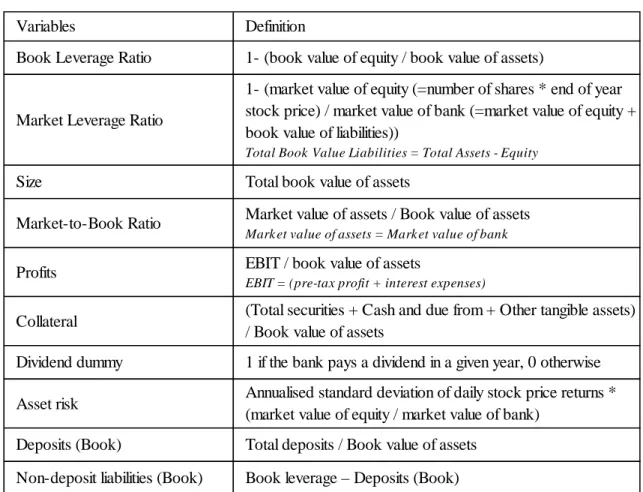
Frank and Goyal (2004) pointed out that the older academic literature tends to focus on book debt ratios, while more recent academic literature tends to focus on market debt ratios. In this investigation we use both market and book leverage ratios and, in both cases, we consider not only the long term debt but instead the total debt. When equity is measured at book value, it’s called book leverage and when measured at market value
Country Number of unique banks Number of bank-year observations AUSTRIA 5 62 BELGIUM 4 26 BULGARIA 3 13 CYPRUS 2 14 CZECH REPUBLIC 1 13 DENMARK 28 311 FINLAND 3 13 FRANCE 9 101 GERMANY 10 89 GREECE 7 59 HUNGARY 1 14 IRELAND 2 27 ITALY 16 175 LITHUANIA 2 15 LUXEMBOURG 3 27 MALTA 2 11 NETHERLANDS 5 36 POLAND 12 126 PORTUGAL 3 42 ROMANIA 3 21 SLOVAKIA 4 32 SLOVENIA 2 7 SPAIN 6 74 SWEDEN 3 38 UNITED KINGDOM 9 106 TOTAL 145 1,452