CERN-EP/2016-118 2016/11/30
CMS-TOP-13-008
Measurement of the W boson helicity fractions in the
decays of top quark pairs to lepton+jets final states
produced in pp collisions at
√
s
=
8 TeV
The CMS Collaboration
∗Abstract
The W boson helicity fractions from top quark decays in tt events are measured us-ing data from proton-proton collisions at a centre-of-mass energy of 8 TeV. The data were collected in 2012 with the CMS detector at the LHC, corresponding to an
in-tegrated luminosity of 19.8 fb−1. Events are reconstructed with either one muon
or one electron, along with four jets in the final state, with two of the jets be-ing identified as originatbe-ing from b quarks. The measured helicity fractions from
both channels are combined, yielding F0 = 0.681±0.012 (stat)±0.023 (syst), FL =
0.323±0.008 (stat)±0.014 (syst), and FR = −0.004±0.005 (stat)±0.014 (syst) for the
longitudinal, left-, and right-handed components of the helicity, respectively. These measurements of the W boson helicity fractions are the most accurate to date and they agree with the predictions from the standard model.
Published in Physics Letters B as doi:10.1016/j.physletb.2016.10.007.
c
2016 CERN for the benefit of the CMS Collaboration. CC-BY-3.0 license
∗See Appendix A for the list of collaboration members
1
Introduction
The data from proton-proton (pp) collisions produced at the CERN LHC provide an excellent environment to investigate properties of the top quark, in the context of its production and decay, with unprecedented precision. Such measurements enable rigorous tests of the standard model (SM), and deviations from the SM predictions would indicate signs of possible new physics [1–4].
In particular, the W boson helicity fractions in top quark decays are very sensitive to the Wtb vertex structure. The W boson helicity fractions are defined as the partial decay rate for a given
helicity state divided by the total decay rate: FL,R,0 ≡ΓL,R,0/Γ, where FL, FR, and F0are the
left-handed, right-left-handed, and longitudinal helicity fractions, respectively. The helicity fractions
are expected to be F0 = 0.687±0.005, FL =0.311±0.005, and FR = 0.0017±0.0001 at
next-to-next-to-leading order (NNLO) in the SM, including electroweak effects, for a top quark mass
mt = 172.8±1.3 GeV [5]. Anomalous Wtb couplings, i.e. those that do not arise in the SM,
would alter these values.
Experimentally, the W boson helicity can be measured through the study of angular
distribu-tions of the top quark decay products. The helicity angle θ∗is defined as the angle between the
direction of either the down-type quark or the charged lepton arising from the W boson decay and the reversed direction of the top quark, both in the rest frame of the W boson. The dis-tribution for the cosine of the helicity angle depends on the helicity fractions in the following way, 1 Γ dΓ d cos θ∗ = 3 8(1−cos θ ∗)2 FL+ 3 4(sin θ ∗)2F 0+ 3 8(1+cos θ ∗)2 FR. (1)
This dependence is shown in Fig. 1 for each contribution separately, normalised to unity, and for the SM expectation. Charged leptons (or down-type quarks) from left-handed W bosons are preferentially emitted in the opposite direction of the W boson, and thus tend to have lower momentum and be closer to the b jet from the top quark decay, as compared to charged leptons (or down-type quarks) from longitudinal or right-handed W bosons.
*) θ cos( -1 -0.5 0 0.5 1 0 0.2 0.4 0.6 0.8 1 1.2 1.4 F0=1 =1 L F =1 R F SM
Figure 1: Predicted cosθ∗distributions for the different helicity fractions. The distributions for
the fractions F0, FL, and FR are shown as dashed, dotted, and dash-dotted lines, respectively,
and the sum of the three contributions according to the SM predictions is displayed as a solid line.
The measurement of the W boson helicity is sensitive to the presence of non-SM couplings between the W boson, the top quark, and the bottom quark. A general parametrisation of the
2 3 Data and simulated samples
Wtb vertex can be expressed as [1, 6]
LWtb = −√g 2¯bγ µ(V LPL+VRPR)tWµ−− g √ 2¯b iσµνq ν MW (gLPL+gRPR)t Wµ−+h.c., (2)
where VL, VR, gL, gR are vector and tensor couplings (complex constants), q = pt−pb, and
pt (pb) is the four-momentum of the top quark (b quark), PL (PR)is the left (right) projection
operator, and h.c. denotes the Hermitian conjugate. Hermiticity conditions on the possible
dimension-six Lagrangian terms also impose Im(VL) = 0 [7]. In the SM and at tree level,
VL =Vtb, where Vtb ≈ 1 is the Cabibbo–Kobayashi–Maskawa matrix element connecting the
top and the bottom quarks and VR = gL = gR = 0. The relationships between the W boson
helicity fractions and the anomalous couplings including dependences on the b quark mass are given in Ref. [8].
The helicity fractions of W bosons in top quark decays were first measured at the Tevatron Collider [9–11]. They have been also measured at the LHC, using samples containing tt events obtained in pp collisions at 7 TeV, and having either one [12, 13] or two [12] charged leptons in the final state. The CMS Collaboration also reported measurements using event topologies that contain one single reconstructed top quark [14], in pp collisions at 8 TeV. Limits on anomalous couplings have also been reported, derived from W boson helicity measurements [12–14], and from single top quark differential cross section production measurements [15].
This Letter describes a measurement of the W boson helicity fractions in tt events involving
one lepton and multiple jets, tt→ (W+b) (W−¯b) → (`+
ν`b) (qq0b), and its charge conjugate,
where`is an electron or a muon, including those from leptonic decays of a tau lepton. Final
states corresponding to such processes are referred to as lepton+jets. The measurement relies on the analysis strategy described in Ref. [13]. The measurement is performed using pp
colli-sions at centre-of-mass energy of 8 TeV, corresponding to an integrated luminosity of 19.8 fb−1,
collected during 2012 by the CMS detector.
2
The CMS detector
The CMS detector is a multipurpose apparatus of cylindrical design with respect to the pro-ton beams. The main features of the detector relevant for this analysis are briefly described here. Charged particle trajectories are measured by a silicon pixel and strip tracker,
cover-ing the pseudorapidity range |η| < 2.5. The inner tracker is immersed in a 3.8 T magnetic
field provided by a superconducting solenoid of 6 m in diameter that also encompasses several calorimeters. A lead tungstate crystal electromagnetic calorimeter (ECAL), and a brass and
scintillator hadronic calorimeter surround the tracking volume and cover the region|η| < 3.
Quartz fibre and steel hadron forward calorimeters extend the coverage to|η| ≤5. Muons are
identified in gas ionisation detectors embedded in the steel return yoke of the magnet. The data for this analysis are recorded using a two-level trigger system. A more detailed description of the CMS detector, together with a definition of the coordinate system used and the relevant kinematic variables, can be found in Ref. [16].
3
Data and simulated samples
Signal events corresponding to top quark pairs that decay to lepton+jets final states are ex-pected to contain one isolated lepton (electron or muon) together with at least four jets, two of which originate from b quark fragmentation. Such events are referred to separately as e+jets
or µ+jets, respectively, or when combined as `+jets. Background events containing a single isolated lepton and four reconstructed jets arise mainly from processes that produce events containing a single top quark, processes that produce multijet events in association with a W boson that decays leptonically (W+jets), or Drell–Yan processes accompanied by multiple jets (DY+jets) when one of the leptons is misidentified as a jet or goes undetected. Multijet pro-cesses can also mimic lepton+jets final states, if a jet is reconstructed as an electromagnetic shower or, more unlikely, if a nonprompt muon from a hadron decay in flight fulfils all identi-fication criteria of a prompt muon.
Simulated Monte Carlo (MC) samples, interfaced with GEANT4 [17], are used to account for
detector resolution and acceptance effects, as well as to estimate the contribution from back-ground processes that have characteristics similar to lepton+jets final states in tt decays. A signal tt sample, which also provides a reference for the SM (see Eq. (5)), is simulated using
MADGRAPH v5.1.3.30 [18] with matrix elements having up to three extra partons in the final
state. The parton distribution function (PDF) set CTEQ6L1 [19] is used when simulating this
reference tt sample. The MADGRAPHgenerator is interfaced withPYTHIAv6.426 [20], tune Z2*
[21], to simulate hadronisation and parton fragmentation, and also withTAUOLAv27.121.5 [22]
to simulate τ lepton decays. This SM reference tt sample is simulated assuming mt =172.5 GeV,
which results in the following leading-order (LO) W boson helicity fractions for that sample:
F0SM=0.6902, FLSM=0.3089, FRSM=0.0009. (3)
Single top quark events in the s, t, and tW channels are generated using POWHEG v1.0 [23]
and PYTHIA interfaced with TAUOLA, with the PDF set CTEQ6M [19]. Background W+jets
and DY+jets processes are simulated using MADGRAPHwith the PDF set CTEQ6L1, followed
by PYTHIA for fragmentation and hadronisation. Finally, background multijet processes are
simulated using thePYTHIAevent generator.
Corrections are applied to the simulated samples so that resolutions, energy scales, and
efficien-cies as functions of pT and η of jets [24] and leptons [25] measured in data are well described.
The effect of multiple pp collisions occurring in the same bunch crossing (pileup) is also taken into account in the simulation.
The data samples selected for this measurement were recorded using inclusive single-lepton
triggers, which require at least one isolated electron (muon) with pT > 27 (24)GeV, used to
define the e+jets (µ+jets) data sample.
The decay products of candidate top quarks are reconstructed using the CMS particle-flow (PF) algorithm, described in detail elsewhere [26, 27]. Individual charged particles identified as coming from pileup interactions are removed from the event. Effects of neutral particles from pileup interactions are mitigated by applying corrections based on event properties. Leptons are required to originate from the primary vertex of the event [28]. A lepton is determined to be isolated using a variable computed as the total transverse momentum of all particles (except the lepton itself) contained within a cone of radius 0.4, centred on the lepton direction, relative to the transverse momentum of the lepton. Electrons are identified by using a multivariate analysis (MVA) [29] based on information from the inner tracker and the ECAL. Events are selected for the e+jets data sample if the identified electron has an MVA discriminant value
greater than 0.9, is determined to be isolated, has pT > 30 GeV, and |η| < 2.5. Muons are
identified by matching information from the inner tracker and the muon spectrometer [30].
Events are selected for the µ+jets data sample if they contain an isolated muon, pT > 26 GeV,
and|η| <2.1. Events with at least one additional isolated electron or muon are vetoed to reject backgrounds from dileptonic decay modes of tt and DY+jets processes. Jets are reconstructed
4 4 Reconstruction of the tt system and reweighting method
[24] using the anti-kTclustering algorithm [31], with a distance parameter of 0.5. The selected or
vetoed leptons described above are not allowed to be clustered into jets, to avoid ambiguities.
The event selection requires at least four reconstructed jets having |η| < 2.4, of which the
four most energetic jets are required to have pT higher than 55, 45, 35, and 20 GeV. Events
with additional jets are not vetoed. The transverse momentum imbalance of the event~pmissT is
determined by summing the negative transverse momentum over all reconstructed particles, excluding those charged particles not associated with the primary vertex.
The transverse mass of the W boson is defined as MT =
√
2p`
TpmissT (1−cos(∆φ)), where p`T
is the transverse momentum of the lepton, pmissT is the magnitude of~pmiss
T , and ∆φ is the
an-gle in the (x, y) plane between the direction of the lepton and~pmissT . To reduce the
multi-jet background and suppress dilepton events from tt processes, events are required to have
30< MT <200 GeV. All backgrounds are further suppressed by requiring that at least two jets
be identified as originating from b quarks. All jets with pT >20 GeV are considered as b quark
candidates, including those that are not among the four most energetic.
The combined secondary vertex algorithm [32, 33] tags b quark jets with an efficiency of about 70% and mistags jets originating from gluons, u, d, or s quarks with a probability of about
1%, for the typical pTranges (30–100 GeV) probed in tt events. Charm jets have a probability of
≈20% of being tagged as b quark jets. The residual multijet backgrounds, already strongly
sup-pressed by the b tagging requirement described above, are estimated by normalising simulated event samples to yields in control data samples. The control samples are defined by selection criteria which are similar to those for the signal, but which have no b tagging requirement,
and have MT < 30 GeV for the µ+jets channel or have an electron MVA discriminant value
smaller than 0.5 for the e+jets channel. The estimated amount of multijet events is≈2% of the
e+jets sample, and less than 1% of the µ+jets sample. The contributions of all other residual backgrounds are determined using simulation.
4
Reconstruction of the tt system and reweighting method
The reconstruction of the tt system, described in detail in Ref. [13], relies on testing the selected
lepton, the measured~pmiss
T , and all selected jets for their compatibility with the top quark decay
products from the leptonic (t → bW → b`ν) and hadronic (t → bW → bqq0) branches.
The unmeasured component of the neutrino momentum pν
z is determined by requiring the
tt system to be consistent with the invariant masses of two top quarks and two W bosons. With these constraints, b jets are correctly assigned to the leptonic (hadronic) branch in about 74% (71%) of signal events. After the assignment, a kinematic fit is performed, where the momenta of the measured jets and lepton are allowed to vary within their resolutions to better
comply with the mass constraints, leading to an improved determination of pν
z and a more
accurate reconstruction of the tt system. In about 5–7% of the selected events, the fit fails to find a solution that is compatible with the constraints and such events are discarded. The number of data events passing all selection criteria, including the fit convergence, is 71 458 in the e+jets sample and 70 986 in the µ+jets sample. A study using simulations normalised to the most precise theoretical cross sections available to date [34–37] indicates that the final sample
composition is largely dominated by tt events, with about 82% of events from the`+jets decay
mode, ≈10% from other decay modes (including τ leptons), and ≈3.5% of the events from
single top quark processes. The remaining events come from backgrounds not containing top quarks in the final state.
of maximising a binned Poisson likelihood function constructed using the number of observed
events in data Ndata(i)and expected events from MC simulation NMC(i;~F), in each bin i of the
reconstructed cos θrec∗ distribution,
L(~F) =
∏
i NMC(i;~F)Ndata(i) h Ndata(i)i! exp[−NMC(i;~F)]. (4)While the charged lepton is easily identified in the leptonic branch of tt decays, the down-type quark jet arising from the W boson decay in the hadronic branch of tt decays can not be experimentally distinguished from the up-type quark jet. Due to this ambiguity, only the
absolute value|cos θ∗rec|can be reconstructed for the hadronic branch. Hence, only the leptonic
branch measurement of cos θrec∗ is used in this analysis. The expected numbers of events from
background processes, NW+jets(i), NDY+jets(i), and Nmultijet(i) represent W boson production
in association with multiple jets, Drell–Yan production in association with multiple jets, and production of multiple jets, which do not depend on the W boson helicity fractions. For the processes containing top quarks, the number of expected events in a given bin i is modified by reweighting each event in that bin by a factor w, defined for each decaying branch as
wlep/had/single-t(cos θgen∗ ;~F) ≡ 3 8FL(1−cos θ ∗ gen)2+ 3 4F0sin 2 θgen∗ + 3 8FR(1+cos θ ∗ gen)2 3 8F SM L (1−cos θgen∗ )2+ 3 4F SM 0 sin2θgen∗ + 3 8F SM R (1+cos θgen∗ )2 , (5)
where θ∗genis the helicity angle (specified at matrix element level) of a particular decay branch,
and FLSM, F0SM, FRSMare given in Eq. (3). Therefore, the number of expected events, as a function
of the helicity fractions to be measured, is
NMC(i;~F) =Ntt(i;~F) +Nsingle-t(i;~F) +NW+jets(i) +NDY+jets(i) +Nmultijet(i), (6) where
Ntt(i;~F) = Ftt
"
∑
tt events in bin iwlep(cos θgen∗ ;~F) ×whad(cos θgen∗ ;~F) #
, (7)
Nsingle-t(i;~F) =
∑
single-t events in bin i
wsingle-t(cos θ∗gen;~F) (8)
represent the expected number of events fulfilling event selection criteria for processes
involv-ing top quark pair, and sinvolv-ingle top quark production, respectively. The normalisation factorFtt
for the tt sample is a single free parameter in the fit across all bins. The expected cross section
for the simulated reference tt sample is 252.9+−13.314.5pb, calculated at NNLO and
next-to-next-to-leading-log (NNLL) accuracy [34, 35], and describes the data well. The fitted values ofFttin
both e+jets and µ+jets channels are compatible with 1.00 within 3%. The overall normalisation factor for simulated single top quark events is not modified in the fit and the uncertainty in the assumed cross section is considered as a source of systematic uncertainty. Finally, the unitarity
constraint (FL+F0+FR = 1) is imposed, so that one of the helicity fractions, namely FR, is
bound by the measurement of the other two.
The method was validated using pseudo-experiments, where the fitting procedure was per-formed on pseudo-data, mimicking altered helicity fractions. Linearity tests show that the
fit-ting procedure correctly retrieves the helicity fractions of altered input values for F0 ∈ [0.50, 0.85]
and FL ∈ [0.20, 0.50]. Likewise the corresponding statistical uncertainties were verified using
6 5 Systematic uncertainties
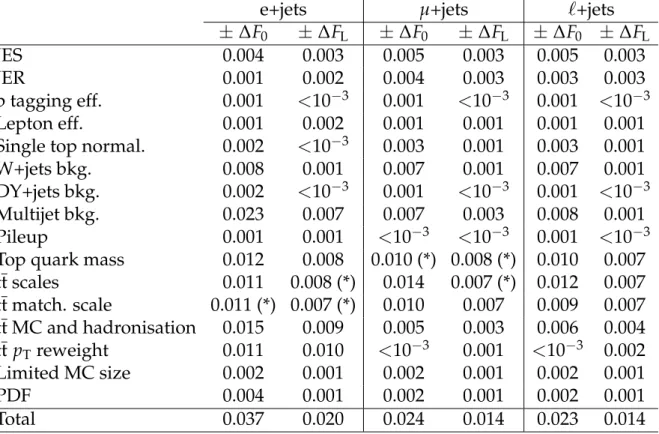
Table 1: Systematic uncertainties on the measurements of the W boson helicity fractions from lepton+jets events. The cases in which the statistical precision of the limited sample size was assigned as systematic uncertainties are denoted by the symbol (*).
e+jets
µ
+jets
`
+jets
±
∆F
0±
∆F
L±
∆F
0±
∆F
L±
∆F
0±
∆F
LJES
0.004
0.003
0.005
0.003
0.005
0.003
JER
0.001
0.002
0.004
0.003
0.003
0.003
b tagging eff.
0.001
<
10
−30.001
<
10
−30.001
<
10
−3Lepton eff.
0.001
0.002
0.001
0.001
0.001
0.001
Single top normal.
0.002
<
10
−30.003
0.001
0.003
0.001
W+jets bkg.
0.008
0.001
0.007
0.001
0.007
0.001
DY+jets bkg.
0.002
<
10
−30.001
<
10
−30.001
<
10
−3Multijet bkg.
0.023
0.007
0.007
0.003
0.008
0.001
Pileup
0.001
0.001
<
10
−3<
10
−30.001
<
10
−3Top quark mass
0.012
0.008
0.010 (*) 0.008 (*)
0.010
0.007
tt scales
0.011
0.008 (*)
0.014
0.007 (*)
0.012
0.007
tt match. scale
0.011 (*) 0.007 (*)
0.010
0.007
0.009
0.007
tt MC and hadronisation
0.015
0.009
0.005
0.003
0.006
0.004
tt p
Treweight
0.011
0.010
<
10
−30.001
<
10
−30.002
Limited MC size
0.002
0.001
0.002
0.001
0.002
0.001
0.004
0.001
0.002
0.001
0.002
0.001
Total
0.037
0.020
0.024
0.014
0.023
0.014
5
Systematic uncertainties
Systematic effects which could potentially bias the measurement of the W boson helicity frac-tions have been investigated and their corresponding uncertainties determined, as presented in Table 1.
Residual corrections are applied in simulation to the jet energy scale (JES), to account for differ-ences between data and simulation. The momenta of the jets in simulation are also smeared so that the jet energy resolution (JER) in simulation agrees with that in data. These corrections and
smearings are propagated into~pmiss
T to correct its momentum scale. The uncertainties [24]
as-sociated with the JES and JER corrections are also propagated to~pTmiss, and the full analysis,
in-cluding the tt reconstruction and the resulting measurements of the W boson helicity fractions, is repeated. Scale factors are used to correct the b tagging efficiency in simulation, where those corrections are shifted by their estimated uncertainties, and the full analysis repeated. Scale factors are also used to correct leptons for their identification, isolation and trigger efficiencies, which are varied within their uncertainties so as to maximise potential shape variations of the
predicted cos θ∗ distributions.
To account for any possible bias of the W boson helicity measurements due to uncertainties in the normalisation of simulated backgrounds, the assumed cross section for each sample is varied individually [13]. An uncertainty of 30% is used for the normalisation of DY+jets, single top quark, and W boson production in association with light-quark or gluon jet production. Since the modelling of the simulated heavy-flavour content of the W+jets sample is known to
-1 -0.8 -0.6 -0.4 -0.2 0 0.2 0.4 0.6 0.8 1 Entries/bin 500 1000 1500 2000 2500 3000 3500 4000 4500 Data e+jets t t bkg t t W+jets Single top DY+jets Multijet CMS (8TeV) -1 19.8 fb e+jets *) θ Leptonic cos( -1 -0.8 -0.6 -0.4 -0.2 0 0.2 0.4 0.6 0.8 1 MC/data 0.8 1 1.2 -1 -0.8 -0.6 -0.4 -0.2 0 0.2 0.4 0.6 0.8 1 Entries/bin 1000 2000 3000 4000 5000 Data +jets µ t t bkg t t W+jets Single top DY+jets Multijet CMS (8TeV) -1 19.8 fb +jets µ *) θ Leptonic cos( -1 -0.8 -0.6 -0.4 -0.2 0 0.2 0.4 0.6 0.8 1 MC/data 0.8 1 1.2 0 0.1 0.2 0.3 0.4 0.5 0.6 0.7 0.8 0.9 1 Entries/bin 500 1000 1500 2000 2500 3000 3500 4000 Data e+jets t t bkg t t W+jets Single top DY+jets Multijet CMS (8TeV) -1 19.8 fb e+jets *)| θ Hadronic |cos( 0 0.1 0.2 0.3 0.4 0.5 0.6 0.7 0.8 0.9 1 MC/data 0.81 1.2 0 0.1 0.2 0.3 0.4 0.5 0.6 0.7 0.8 0.9 1 Entries/bin 500 1000 1500 2000 2500 3000 3500 4000 4500 Data +jets µ t t bkg t t W+jets Single top DY+jets Multijet CMS (8TeV) -1 19.8 fb +jets µ *)| θ Hadronic |cos( 0 0.1 0.2 0.3 0.4 0.5 0.6 0.7 0.8 0.9 1 MC/data 0.81 1.2
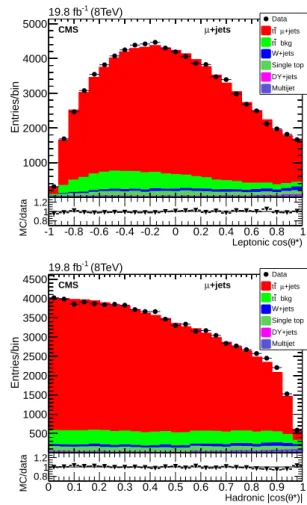
Figure 2: Distributions for the cosine of the helicity angle in the leptonic (upper row) and hadronic (lower row) branches, for the e+jets (left) and µ+jets (right) decay channels. The
combined`+jets post-fit measurements of the helicity fractions were used in the simulation of
tt and single top quark events. The data are displayed as solid points, simulated samples of tt (signal) processes and the contribution from background processes as histograms. At the bottom of each plot, the ratio between MC simulation and data is displayed. The error bars correspond to the statistical uncertainties.
be inaccurate, an uncertainty of +−100%50% is assumed for simulated events involving a W boson
produced in association with b quark jets. The impact of the DY+jets normalisation uncertainty in the analysis is small, since it corresponds to only a few percent of the sample composition. The normalisation of the multijet background is estimated from control samples and results in
an uncertainty of+−50%50% in the e+jets channel and+−40%50%in the µ+jets channel. Shape
uncertain-ties on the multijet background templates were investigated by comparing the distributions in several different control regions, both in MC and in data, and were found to be negligible, compared to the much larger normalisation uncertainties.
Several uncertainties from possible systematic effects related to theoretical modelling of the sig-nal are estimated by replacing the default tt samples with alternative tt samples and repeating
the entire analysis. Specifically, for the MADGRAPHinterfaced with PYTHIA event generation,
the default mtvalue of 172.5 GeV is shifted up and down by 1 GeV; the renormalisation and
fac-torisation scales are varied down (up) by a factor of 0.5 (2); the kinematic scale used to match jets to partons (matching threshold) is varied down (up) by factor of 0.5 (2); finally, the parton shower and hadronisation modelling is studied in a tt sample simulated with MC@NLO v3.41
8 5 Systematic uncertainties 0 F 0.60 0.62 0.64 0.66 0.68 0.70 0.72 0.74 0.76 L F 0.28 0.30 0.32 0.34 0.36 0.38 e+jets +jets µ l+jets combined SM 95% CL 68% CL CMS (8TeV) -1 19.8 fb ) L Re(g -0.3 -0.2 -0.1 0.0 0.1 0.2 0.3 ) R Re(g -0.10 -0.08 -0.06 -0.04 -0.02 0.00 0.02 0.04 0.06 0.08 0.10 =0 R =1, V L V CMS
+jets and e+jets
µ Combined (8TeV) -1 19.8 fb 68% CL 95% CL SM
Figure 3: Left: the measured W boson helicity fractions in the(F0, FL)plane. The dashed and
solid ellipses enclose the allowed two-dimensional 68% and 95% CL regions, for the combined
`+jets measurement, taking into account the correlations on the total (including systematic)
uncertainties. The error bars give the one-dimensional 68% CL interval for the separate F0and
FL measurements, with the inner-tick (outer-tick) mark representing the statistical (total)
un-certainty. Right: the corresponding allowed regions for the real components of the anomalous
couplings gL and gR at 68% and 95% CL, for VL = 1 and VR = 0. A region near Re(gL) = 0
and Re(gR) 0, allowed by the fit but excluded by the CMS single top quark production
measurement, is omitted. The SM predictions are shown as stars.
[38] using the PDF set CTEQ6M and interfaced withHERWIGv6.520 [39].
Uncertainties in the helicity fractions arising from the limited size of the simulated tt samples are taken into account, both in the main analysis and in the determination of the modelling uncertainties. In the former case, these effects are added as a separate source of uncertainty. In the latter case, the systematic uncertainties in the W boson helicity are assigned to be the larger of either (i) the statistical precision of the limited sample size or (ii) the systematic shift of the central value with respect to the reference tt sample.
The shape of the pT spectrum for top quarks, as measured by the differential cross section for
top quark pairs [25, 40], has been found to be softer than the predictions from MADGRAPH
simulation. The effect of this mismodelling is estimated by reweighting the events in the
simu-lated tt sample, so that the top quark pTat parton level in the MC describes the unfolded data
distribution. Further, the systematic effects due to the PDFs used to simulate the signal and background samples are estimated according to the prescriptions described in [41, 42], using NNPDF21 [43] and MSTW2008lo68cl [44] PDF sets as alternatives to those used at generation. Finally, uncertainties related to the modelling of the pileup in simulated events are also taken into account.
The total systematic uncertainty is given by the sum in quadrature of all uncertainties described above.
6
Results
The measurements of the W boson helicity fractions, using cos θ∗ from the leptonic branch of
tt events that decay into e+jets or µ+jets, including the full combination of these two
measure-ments, are shown in Table 2. Within an individual channel, the helicity parameters F0 and
FL are fit simultaneously, but they are strongly anti-correlated due to the unitarity constraint
FL+F0+FR =1, as indicated by the statistical correlation coefficient ρ0,Lgiven in the table. The
separate helicity measurements from the e+jets and µ+jets channels are combined into a
sin-gle`+jets measurement using the BLUE method [45, 46], taking into account all uncertainties
and their possible correlations. Uncertainties related to lepton efficiency, multijet background estimations, and statistical uncertainties are considered uncorrelated between the e+jets and
µ+jets analyses, while all other uncertainties are assumed to be fully correlated. The
com-bined `+jets measurement of the helicity fractions is dominated by the µ+jets channel, with
weights more than double those of the e+jets channel. The χ2 of the combination is 2.13 for
2 degrees of freedom, corresponding to a probability of 34.5%. The measurement uncertain-ties are dominated by systematic effects that are correlated between both the e+jets and µ+jets
channels. The combined F0and FLvalues are anti-correlated with a statistical correlation
coeffi-cient ρ0,L = −0.959. The total correlation coefficient, considering both statistical and systematic
uncertainties, is found to be −0.870. The measured helicity fractions presented in Table 2 are
consistent with the SM predictions given at NNLO accuracy [5]. Figure 2 shows, separately for the e+jets and µ+jets channels, the distributions for the cosine of the helicity angles from the leptonic branch, which are used in the helicity measurements, and the distributions of the cor-responding absolute values from the hadronic branch, for comparison purposes. The simulated samples involving top quarks used in the figure were produced using the measured values for
the W boson helicity fractions, as determined from the combined `+jets fit. Left-handed W
bosons tend to populate the region at cos θ∗ ≈ −1, where the charged lepton overlaps with
the b quark. However, the angular separation requirement between leptons and jets removes
most of the events near cos θ∗ = −1. Very few events are expected in the region preferred by
right-handed bosons, near cos θ∗ = +1. However, due to resolution effects, the reconstructed
distribution does not fall as rapidly as expected in that region, where the charged lepton and b
quark have opposite directions. For these reasons, the shape of the reconstructed cos θ∗
distri-bution differs from that expected in the SM (Fig. 1). These features are well reproduced by the simulation, and taken into account in the measurement.
Table 2: Measurements of the W boson helicity fractions from lepton+jets final states in tt
de-cays. The helicity fractions F0 and FL are measured simultaneously and are strongly
anti-correlated, as indicated by a correlation coefficient ρ0,L, because FRis derived from the unitarity
condition.
Channel F0
±
(stat)±
(syst) FL±
(stat)±
(syst) FR±
(stat)±
(syst) ρ0,Le+jets 0.705
±
0.013±
0.037 0.304±
0.009±
0.020−
0.009±
0.005±
0.021−
0.950 µ+jets 0.685±
0.013±
0.024 0.328±
0.009±
0.014−
0.013±
0.005±
0.017−
0.957`
+jets 0.681±
0.012±
0.023 0.323±
0.008±
0.014−
0.004±
0.005±
0.014−
0.959Using these results, limits on anomalous couplings are obtained by fixing the two vector
cou-plings in Eq. (2) to their SM values, VL = 1 and VR = 0, and choosing the tensor couplings,
Re(gL)and Re(gR), as free parameters. The combined`+jets measurement of the W boson
he-licity fractions F0and FL is reinterpreted in terms of the tensor couplings, Re(gL)and Re(gR),
10 7 Summary
The W boson helicity measurements are displayed in the(F0, FL)plane in Fig. 3 (left), together
with their one-dimensional statistical (inner-tick mark) and total (outer-tick mark) error bars. The full two-dimensional confidence level (CL) contours corresponding to 68% (dashed line) and 95% (solid line) probabilities are also displayed for the combined measurement. The SM prediction is shown as a star and lies within the 68% CL contour. The corresponding regions
in the(Re(gL), Re(gR))plane, allowed at 68% (dark contour) and 95% CL (light contour), are
shown in Fig. 3 (right), together with the SM value. They are derived from Fig. 3 (left), using the relationships between the W boson helicity fractions and the anomalous couplings given
in Ref. [8]. A region near Re(gL) =0 and Re(gR) 0, allowed by the fit but excluded by the
CMS single top quark production measurement [47], is not shown.
If the right-handed component FRis bound to zero, consistently with the SM within the
preci-sion of the current measurement, the combined`+jets measurement amounts to F0 = 0.661±
0.006 (stat)±0.021 (syst). In this case, FL is obtained via the unitarity constraint and yields
FL =0.339±0.006 (stat)±0.021 (syst).
7
Summary
A measurement of the W boson helicity fractions in top quark pair events decaying in the e+jets
and µ+jets channels has been presented, using proton-proton collision data at√s =8 TeV, and
corresponding to an integrated luminosity of 19.8 fb−1. The helicity fractions F0 and FL are
measured with a precision of better than 5%, yielding the most accurate experimental determi-nation of the W boson helicity fractions in tt processes to date. The measured W boson helicity
fractions are F0 =0.681±0.012 (stat)±0.023 (syst), FL =0.323±0.008 (stat)±0.014 (syst), and
FR = −0.004±0.005 (stat)±0.014 (syst), with a correlation coefficient of−0.87 between F0and
FL, and they are consistent with the expectations from the standard model.
Acknowledgments
We congratulate our colleagues in the CERN accelerator departments for the excellent perfor-mance of the LHC and thank the technical and administrative staffs at CERN and at other CMS institutes for their contributions to the success of the CMS effort. In addition, we gratefully acknowledge the computing centres and personnel of the Worldwide LHC Computing Grid for delivering so effectively the computing infrastructure essential to our analyses. Finally, we acknowledge the enduring support for the construction and operation of the LHC and the CMS detector provided by the following funding agencies: BMWFW and FWF (Austria); FNRS and FWO (Belgium); CNPq, CAPES, FAPERJ, and FAPESP (Brazil); MES (Bulgaria); CERN; CAS, MOST, and NSFC (China); COLCIENCIAS (Colombia); MSES and CSF (Croatia); RPF (Cyprus); MoER, ERC IUT and ERDF (Estonia); Academy of Finland, MEC, and HIP (Finland); CEA and CNRS/IN2P3 (France); BMBF, DFG, and HGF (Germany); GSRT (Greece); OTKA and NIH (Hungary); DAE and DST (India); IPM (Iran); SFI (Ireland); INFN (Italy); MSIP and NRF (Re-public of Korea); LAS (Lithuania); MOE and UM (Malaysia); BUAP, CINVESTAV, CONACYT, LNS, SEP, and UASLP-FAI (Mexico); MBIE (New Zealand); PAEC (Pakistan); MSHE and NSC (Poland); FCT (Portugal); JINR (Dubna); MON, RosAtom, RAS and RFBR (Russia); MESTD (Serbia); SEIDI and CPAN (Spain); Swiss Funding Agencies (Switzerland); MST (Taipei);
ThEP-Center, IPST, STAR and NSTDA (Thailand); T ¨UBITAK and TAEK (Turkey); NASU and SFFR
(Ukraine); STFC (United Kingdom); DOE and NSF (USA).
Individuals have received support from the Marie-Curie programme and the European Re-search Council and EPLANET (European Union); the Leventis Foundation; the Alfred P. Sloan
Foundation; the Alexander von Humboldt Foundation; the Belgian Federal Science Policy Of-fice; the Fonds pour la Formation `a la Recherche dans l’Industrie et dans l’Agriculture (FRIA-Belgium); the Agentschap voor Innovatie door Wetenschap en Technologie (IWT-(FRIA-Belgium); the Ministry of Education, Youth and Sports (MEYS) of the Czech Republic; the Council of Science and Industrial Research, India; the HOMING PLUS programme of the Foundation for Polish Science, cofinanced from European Union, Regional Development Fund; the Mobility Plus pro-gramme of the Ministry of Science and Higher Education (Poland); the OPUS propro-gramme of the National Science Center (Poland); the Thalis and Aristeia programmes cofinanced by EU-ESF and the Greek NSRF; the National Priorities Research Program by Qatar National Research Fund; the Programa Clar´ın-COFUND del Principado de Asturias; the Rachadapisek Sompot Fund for Postdoctoral Fellowship, Chulalongkorn University (Thailand); the Chulalongkorn Academic into Its 2nd Century Project Advancement Project (Thailand); and the Welch Foun-dation, contract C-1845.
12 References
References
[1] J. A. Aguilar-Saavedra et al., “Probing anomalous Wtb couplings in top pair decays”, Eur. Phys. J. C 50 (2007) 519, doi:10.1140/epjc/s10052-007-0289-4,
arXiv:hep-ph/0605190.
[2] C. Bernardo et al., “Studying the Wtb vertex structure using recent LHC results”, Phys. Rev. D 90 (2014) 113007, doi:10.1103/PhysRevD.90.113007, arXiv:1408.7063. [3] G. A. Gonz´alez-Sprinberg and J. Vidal, “The top quark right coupling in the tbW vertex”,
Eur. Phys. J. C 75 (2015) 615, doi:10.1140/epjc/s10052-015-3844-4, arXiv:1510.02153.
[4] M. Fabbrichesi, M. Pinamonti, and A. Tonero, “Limits on anomalous top quark gauge couplings from Tevatron and LHC data”, Eur. Phys. J. C 74 (2014) 3193,
doi:10.1140/epjc/s10052-014-3193-8, arXiv:1406.5393.
[5] A. Czarnecki, J.G. K ¨orner, J.H. Piclum, “Helicity fractions of W bosons from top quark decays at NNLO in QCD”, Phys. Rev. D 81 (2010) 111503(R),
doi:10.1103/PhysRevD.81.111503, arXiv:1005.2625.
[6] J. A. Aguilar-Saavedra, “A minimal set of top anomalous couplings”, Nucl. Phys. B 812 (2009) 181, doi:10.1016/j.nuclphysb.2008.12.012, arXiv:0811.3842. [7] J. A. Aguilar-Saavedra, “A minimal set of top-Higgs anomalous couplings”, Nucl. Phys.
B 821 (2009) 215, doi:10.1016/j.nuclphysb.2009.06.022, arXiv:0904.2387. [8] J. A. Aguilar-Saavedra and J. Bernabeu, “W polarisation beyond helicity fractions in top
quark decays”, Nucl. Phys. B 840 (2010) 349,
doi:10.1016/j.nuclphysb.2010.07.012, arXiv:1005.5382.
[9] V.M. Abazov, et al., D0 Collaboration, “Measurement of the W boson helicity in top quark
decays using 5.4 fb−1of p ¯p collision data”, Phys. Rev. D 83 (2011) 032009,
doi:10.1103/PhysRevD.83.032009, arXiv:1011.6549.
[10] T. Aaltonen, et al., CDF Collaboration, “Measurement of W-boson polarization in top-quark decay using the full CDF Run II data set”, Phys. Rev. D 87 (2012) 031104(R),
doi:10.1103/PhysRevD.87.031104, arXiv:1211.4523.
[11] T. Aaltonen, et al., CDF and D0 Collaborations, “Combination of CDF and D0 measurements of the W boson helicity in top quark decays”, Phys. Rev. D 85 (2012) 071106(R), doi:10.1103/PhysRevD.85.071106, arXiv:1202.5272.
[12] ATLAS Collaboration, “Measurement of the W boson polarization in top quark decays with the ATLAS detector”, JHEP 06 (2012) 088, doi:10.1007/JHEP06(2012)088, arXiv:1205.2484.
[13] CMS Collaboration, “Measurement of the W-boson helicity in top-quark decays from tt
production in lepton+jets events in pp collisions at√s=7 TeV”, JHEP 10 (2013) 167,
doi:10.1007/JHEP10(2013)167, arXiv:1308.3879.
[14] CMS Collaboration, “Measurement of the W boson helicity in events with a single
reconstructed top quark in pp collisions at√s =8 TeV”, JHEP 01 (2015) 053,
[15] ATLAS Collaboration, “Search for anomalous couplings in the W tb vertex from the measurement of double differential angular decay rates of single top quarks produced in the t-channel with the ATLAS detector”, JHEP 04 (2016) 023,
doi:10.1007/JHEP04(2016)023, arXiv:1510.03764.
[16] CMS Collaboration, “The CMS experiment at the CERN LHC”, JINST 3 (2008) S08004, doi:10.1088/1748-0221/3/08/S08004.
[17] S. Agostinelli, et al., “GEANT4 – a simulation toolkit”, Nucl. Instrum. Meth. A 506 (2003) 250, doi:10.1016/S0168-9002(03)01368-8.
[18] J. Alwall et al., “The automated computation of tree-level and next-to-leading order differential cross sections, and their matching to parton shower simulations”, JHEP 07 (2014) 079, doi:10.1007/JHEP07(2014)079, arXiv:1405.0301.
[19] J. Pumplin et al., “New generation of parton distributions with uncertainties from global QCD analysis”, JHEP 07 (2002) 012, doi:10.1088/1126-6708/2002/07/012, arXiv:hep-ph/0201195.
[20] T. Sj ¨ostrand, S. Mrenna, and P. Z. Skands, “PYTHIA 6.4 physics and manual”, JHEP 05 (2006) 026, doi:10.1088/1126-6708/2006/05/026, arXiv:hep-ph/0603175. [21] CMS Collaboration, “Jet and underlying event properties as a function of
charged-particle multiplicity in proton-proton collisions at√s=7 TeV”, Eur. Phys. J. C
73(2013) 2674, doi:10.1140/epjc/s10052-013-2674-5, arXiv:1310.4554.
[22] N. Davidson et al., “Universal interface ofTAUOLA: technical and physics
documentation”, Comput. Phys. Commun. 183 (2012) 821,
doi:10.1016/j.cpc.2011.12.009, arXiv:1002.0543.
[23] S. Alioli, P. Nason, C. Oleari, and E. Re, “NLO vector-boson production matched with shower in POWHEG”, JHEP 07 (2008) 060,
doi:10.1088/1126-6708/2008/07/060, arXiv:0805.4802.
[24] CMS Collaboration, “Determination of jet energy calibration and transverse momentum resolution in CMS”, JINST 6 (2011) P11002,
doi:10.1088/1748-0221/6/11/P11002, arXiv:1107.4277.
[25] CMS Collaboration, “Measurement of the differential cross section for top quark pair
production in pp collisions at√s =8 TeV”, Eur. Phys. J. C 75 (2015) 542,
doi:10.1140/epjc/s10052-015-3709-x, arXiv:1505.04480.
[26] CMS Collaboration, “Particle–flow event reconstruction in CMS and performance for jets,
taus, and EmissT ”, CMS Physics Analysis Summary CMS-PAS-PFT-09-001, 2009.
[27] CMS Collaboration, “Commissioning of the particle–flow event reconstruction with the first LHC collisions recorded in the CMS detector”, CMS Physics Analysis Summary CMS-PAS-PFT-10-001, 2010.
[28] CMS Collaboration, “Description and performance of track and primary-vertex reconstruction with the CMS tracker”, JINST 9 (2014) P10009,
14 References
[29] CMS Collaboration, “Performance of electron reconstruction and selection with the CMS
detector in proton-proton collisions at√s=8 TeV”, JINST 10 (2015) P06005,
doi:10.1088/1748-0221/10/06/P06005, arXiv:1502.02701.
[30] CMS Collaboration, “The performance of the CMS muon detector in proton-proton
collisions at√s=7 TeV at the LHC”, JINST 8 (2013) P11002,
doi:10.1088/1748-0221/8/11/P11002, arXiv:1306.6905.
[31] M. Cacciari, G. P. Salam, and G. Soyez, “The anti-ktjet clustering algorithm”, JHEP 04
(2008) 063, doi:10.1088/1126-6708/2008/04/063, arXiv:0802.1189.
[32] CMS Collaboration, “Identification of b-quark jets with the CMS experiment”, JINST 8 (2013) P04013, doi:10.1088/1748-0221/8/04/P04013, arXiv:1211.4462.
[33] CMS Collaboration, “Performance of b tagging at√s=8 TeV in multijet, tt and boosted
topology events”, CMS Physics Analysis Summary CMS-PAS-BTV-13-001, 2013.
[34] A. Ferroglia, B. D. Pecjak, and L. L. Yang, “Top-quark pair production at high invariant mass: an NNLO soft plus virtual approximation”, JHEP 09 (2013) 032,
doi:10.1007/JHEP09(2013)032, arXiv:1306.1537.
[35] H. T. Li et al., “Top-quark pair production at small transverse momentum in hadronic collisions”, Phys. Rev. D 88 (2013) 074004, doi:10.1103/PhysRevD.88.074004,
arXiv:1307.2464.
[36] N. Kidonakis, “Differential and total cross sections for top pair and single top
production”, (2012). arXiv:1205.3453. presented at XX International Workshop on Deep-Inelastic Scattering and Related Subjects (DIS2012), Bonn, Germany.
[37] R. Gavin, Y. Li, F. Petriello, and S. Quackenbush, “FEWZ 2.0: a code for hadronic Z production at next-to-next-to-leading order”, Comput. Phys. Commun. 182 (2011) 2388, doi:10.1016/j.cpc.2011.06.008, arXiv:1011.3540.
[38] S. Frixione and B. R. Webber, “Matching NLO QCD computations and parton shower simulations ”, JHEP 06 (2002) 029, doi:10.1088/1126-6708/2002/06/029, arXiv:hep-ph/0204244.
[39] G. Corcella et al., “HERWIG 6: an event generator for hadron emission reactions with interfering gluons (including supersymmetric processes)”, JHEP 01 (2001) 010,
doi:10.1088/1126-6708/2001/01/010, arXiv:hep-ph/0011363.
[40] CMS Collaboration, “Measurement of differential top-quark pair production cross
sections in pp collisions at√s =7 TeV”, Eur. Phys. J. C 73 (2013) 2339,
doi:10.1140/epjc/s10052-013-2339-4, arXiv:1211.2220.
[41] S. Alekhin et al., “The PDF4LHC Working Group interim report”, (2011).
arXiv:1101.0536.
[42] M. Botje et al., “The PDF4LHC Working Group interim recommendations”, (2011). arXiv:1101.0538.
[43] NNPDF Collaboration, “Impact of heavy quark masses on parton distributions and LHC phenomenology”, Nucl. Phys. B 849 (2011) 296,
[44] A. D. Martin, W. J. Stirling, R. S. Thorne, and G. Watt, “Parton distributions for the LHC”, Eur. Phys. J. C 63 (2009) 189, doi:10.1140/epjc/s10052-009-1072-5,
arXiv:0901.0002.
[45] L. Lyons, D. Gibaut, and P. Clifford, “How to combine correlated estimates of a single physical quantity”, Nucl. Instrum. Meth. A 270 (1988) 110,
doi:10.1016/0168-9002(88)90018-6.
[46] A. Valassi, “Combining correlated measurements of several different physical quantities”, Nucl. Instrum. Meth. A 500 (2003) 391, doi:10.1016/S0168-9002(03)00329-2. [47] CMS Collaboration, “Measurement of the t-channel single-top-quark production cross
section and of the|Vtb|CKM matrix element in pp collisions at√s=8 TeV”, JHEP 06
A
The CMS Collaboration
Yerevan Physics Institute, Yerevan, Armenia
V. Khachatryan, A.M. Sirunyan, A. Tumasyan
Institut f ¨ur Hochenergiephysik, Wien, Austria
W. Adam, E. Asilar, T. Bergauer, J. Brandstetter, E. Brondolin, M. Dragicevic, J. Er ¨o, M. Flechl,
M. Friedl, R. Fr ¨uhwirth1, V.M. Ghete, C. Hartl, N. H ¨ormann, J. Hrubec, M. Jeitler1, A. K ¨onig,
I. Kr¨atschmer, D. Liko, T. Matsushita, I. Mikulec, D. Rabady, N. Rad, B. Rahbaran, H. Rohringer,
J. Schieck1, J. Strauss, W. Treberer-Treberspurg, W. Waltenberger, C.-E. Wulz1
National Centre for Particle and High Energy Physics, Minsk, Belarus
V. Mossolov, N. Shumeiko, J. Suarez Gonzalez
Universiteit Antwerpen, Antwerpen, Belgium
S. Alderweireldt, E.A. De Wolf, X. Janssen, J. Lauwers, M. Van De Klundert, H. Van Haevermaet, P. Van Mechelen, N. Van Remortel, A. Van Spilbeeck
Vrije Universiteit Brussel, Brussel, Belgium
S. Abu Zeid, F. Blekman, J. D’Hondt, N. Daci, I. De Bruyn, K. Deroover, N. Heracleous, S. Lowette, S. Moortgat, L. Moreels, A. Olbrechts, Q. Python, S. Tavernier, W. Van Doninck, P. Van Mulders, I. Van Parijs
Universit´e Libre de Bruxelles, Bruxelles, Belgium
H. Brun, C. Caillol, B. Clerbaux, G. De Lentdecker, H. Delannoy, G. Fasanella, L. Favart, R. Goldouzian, A. Grebenyuk, G. Karapostoli, T. Lenzi, A. L´eonard, J. Luetic, T. Maerschalk, A. Marinov, A. Randle-conde, T. Seva, C. Vander Velde, P. Vanlaer, R. Yonamine, F. Zenoni,
F. Zhang2
Ghent University, Ghent, Belgium
A. Cimmino, T. Cornelis, D. Dobur, A. Fagot, G. Garcia, M. Gul, D. Poyraz, S. Salva, R. Sch ¨ofbeck, M. Tytgat, W. Van Driessche, E. Yazgan, N. Zaganidis
Universit´e Catholique de Louvain, Louvain-la-Neuve, Belgium
C. Beluffi3, O. Bondu, S. Brochet, G. Bruno, A. Caudron, L. Ceard, S. De Visscher, C. Delaere,
M. Delcourt, L. Forthomme, B. Francois, A. Giammanco, A. Jafari, P. Jez, M. Komm, V. Lemaitre, A. Magitteri, A. Mertens, M. Musich, C. Nuttens, K. Piotrzkowski, L. Quertenmont, M. Selvaggi, M. Vidal Marono, S. Wertz
Universit´e de Mons, Mons, Belgium
N. Beliy
Centro Brasileiro de Pesquisas Fisicas, Rio de Janeiro, Brazil
W.L. Ald´a J ´unior, F.L. Alves, G.A. Alves, L. Brito, C. Hensel, A. Moraes, M.E. Pol, P. Rebello Teles
Universidade do Estado do Rio de Janeiro, Rio de Janeiro, Brazil
E. Belchior Batista Das Chagas, W. Carvalho, J. Chinellato4, A. Cust ´odio, E.M. Da Costa,
G.G. Da Silveira, D. De Jesus Damiao, C. De Oliveira Martins, S. Fonseca De Souza, L.M. Huertas Guativa, H. Malbouisson, D. Matos Figueiredo, C. Mora Herrera, L. Mundim,
H. Nogima, W.L. Prado Da Silva, A. Santoro, A. Sznajder, E.J. Tonelli Manganote4, A. Vilela
Pereira
Universidade Estadual Paulistaa, Universidade Federal do ABCb, S˜ao Paulo, Brazil
18 A The CMS Collaboration
P.G. Mercadanteb, C.S. Moona,5, S.F. Novaesa, Sandra S. Padulaa, D. Romero Abadb, J.C. Ruiz
Vargas
Institute for Nuclear Research and Nuclear Energy, Sofia, Bulgaria
A. Aleksandrov, R. Hadjiiska, P. Iaydjiev, M. Rodozov, S. Stoykova, G. Sultanov, M. Vutova
University of Sofia, Sofia, Bulgaria
A. Dimitrov, I. Glushkov, L. Litov, B. Pavlov, P. Petkov
Beihang University, Beijing, China
W. Fang6
Institute of High Energy Physics, Beijing, China
M. Ahmad, J.G. Bian, G.M. Chen, H.S. Chen, M. Chen, Y. Chen7, T. Cheng, C.H. Jiang,
D. Leggat, Z. Liu, F. Romeo, S.M. Shaheen, A. Spiezia, J. Tao, C. Wang, Z. Wang, H. Zhang, J. Zhao
State Key Laboratory of Nuclear Physics and Technology, Peking University, Beijing, China
Y. Ban, Q. Li, S. Liu, Y. Mao, S.J. Qian, D. Wang, Z. Xu
Universidad de Los Andes, Bogota, Colombia
C. Avila, A. Cabrera, L.F. Chaparro Sierra, C. Florez, J.P. Gomez, C.F. Gonz´alez Hern´andez, J.D. Ruiz Alvarez, J.C. Sanabria
University of Split, Faculty of Electrical Engineering, Mechanical Engineering and Naval Architecture, Split, Croatia
N. Godinovic, D. Lelas, I. Puljak, P.M. Ribeiro Cipriano
University of Split, Faculty of Science, Split, Croatia
Z. Antunovic, M. Kovac
Institute Rudjer Boskovic, Zagreb, Croatia
V. Brigljevic, D. Ferencek, K. Kadija, S. Micanovic, L. Sudic
University of Cyprus, Nicosia, Cyprus
A. Attikis, G. Mavromanolakis, J. Mousa, C. Nicolaou, F. Ptochos, P.A. Razis, H. Rykaczewski
Charles University, Prague, Czech Republic
M. Finger8, M. Finger Jr.8
Universidad San Francisco de Quito, Quito, Ecuador
E. Carrera Jarrin
Academy of Scientific Research and Technology of the Arab Republic of Egypt, Egyptian Network of High Energy Physics, Cairo, Egypt
Y. Assran9,10, T. Elkafrawy11, A. Ellithi Kamel12, A. Mahrous13
National Institute of Chemical Physics and Biophysics, Tallinn, Estonia
B. Calpas, M. Kadastik, M. Murumaa, L. Perrini, M. Raidal, A. Tiko, C. Veelken
Department of Physics, University of Helsinki, Helsinki, Finland
P. Eerola, J. Pekkanen, M. Voutilainen
Helsinki Institute of Physics, Helsinki, Finland
J. H¨ark ¨onen, V. Karim¨aki, R. Kinnunen, T. Lamp´en, K. Lassila-Perini, S. Lehti, T. Lind´en, P. Luukka, T. Peltola, J. Tuominiemi, E. Tuovinen, L. Wendland
Lappeenranta University of Technology, Lappeenranta, Finland
J. Talvitie, T. Tuuva
IRFU, CEA, Universit´e Paris-Saclay, Gif-sur-Yvette, France
M. Besancon, F. Couderc, M. Dejardin, D. Denegri, B. Fabbro, J.L. Faure, C. Favaro, F. Ferri, S. Ganjour, S. Ghosh, A. Givernaud, P. Gras, G. Hamel de Monchenault, P. Jarry, I. Kucher, E. Locci, M. Machet, J. Malcles, J. Rander, A. Rosowsky, M. Titov, A. Zghiche
Laboratoire Leprince-Ringuet, Ecole Polytechnique, IN2P3-CNRS, Palaiseau, France
A. Abdulsalam, I. Antropov, S. Baffioni, F. Beaudette, P. Busson, L. Cadamuro, E. Chapon, C. Charlot, O. Davignon, R. Granier de Cassagnac, M. Jo, S. Lisniak, P. Min´e, I.N. Naranjo, M. Nguyen, C. Ochando, G. Ortona, P. Paganini, P. Pigard, S. Regnard, R. Salerno, Y. Sirois, T. Strebler, Y. Yilmaz, A. Zabi
Institut Pluridisciplinaire Hubert Curien, Universit´e de Strasbourg, Universit´e de Haute Alsace Mulhouse, CNRS/IN2P3, Strasbourg, France
J.-L. Agram14, J. Andrea, A. Aubin, D. Bloch, J.-M. Brom, M. Buttignol, E.C. Chabert,
N. Chanon, C. Collard, E. Conte14, X. Coubez, J.-C. Fontaine14, D. Gel´e, U. Goerlach, A.-C. Le
Bihan, J.A. Merlin15, K. Skovpen, P. Van Hove
Centre de Calcul de l’Institut National de Physique Nucleaire et de Physique des Particules, CNRS/IN2P3, Villeurbanne, France
S. Gadrat
Universit´e de Lyon, Universit´e Claude Bernard Lyon 1, CNRS-IN2P3, Institut de Physique Nucl´eaire de Lyon, Villeurbanne, France
S. Beauceron, C. Bernet, G. Boudoul, E. Bouvier, C.A. Carrillo Montoya, R. Chierici, D. Contardo, B. Courbon, P. Depasse, H. El Mamouni, J. Fan, J. Fay, S. Gascon, M. Gouzevitch, G. Grenier, B. Ille, F. Lagarde, I.B. Laktineh, M. Lethuillier, L. Mirabito, A.L. Pequegnot,
S. Perries, A. Popov16, D. Sabes, V. Sordini, M. Vander Donckt, P. Verdier, S. Viret
Georgian Technical University, Tbilisi, Georgia
T. Toriashvili17
Tbilisi State University, Tbilisi, Georgia
D. Lomidze
RWTH Aachen University, I. Physikalisches Institut, Aachen, Germany
C. Autermann, S. Beranek, L. Feld, A. Heister, M.K. Kiesel, K. Klein, M. Lipinski, A. Ostapchuk, M. Preuten, F. Raupach, S. Schael, C. Schomakers, J.F. Schulte, J. Schulz, T. Verlage, H. Weber,
V. Zhukov16
RWTH Aachen University, III. Physikalisches Institut A, Aachen, Germany
M. Brodski, E. Dietz-Laursonn, D. Duchardt, M. Endres, M. Erdmann, S. Erdweg, T. Esch, R. Fischer, A. G ¨uth, T. Hebbeker, C. Heidemann, K. Hoepfner, S. Knutzen, M. Merschmeyer, A. Meyer, P. Millet, S. Mukherjee, M. Olschewski, K. Padeken, P. Papacz, T. Pook, M. Radziej, H. Reithler, M. Rieger, F. Scheuch, L. Sonnenschein, D. Teyssier, S. Th ¨uer
RWTH Aachen University, III. Physikalisches Institut B, Aachen, Germany
V. Cherepanov, Y. Erdogan, G. Fl ¨ugge, F. Hoehle, B. Kargoll, T. Kress, A. K ¨unsken,
J. Lingemann, A. Nehrkorn, A. Nowack, I.M. Nugent, C. Pistone, O. Pooth, A. Stahl15
Deutsches Elektronen-Synchrotron, Hamburg, Germany
M. Aldaya Martin, C. Asawatangtrakuldee, I. Asin, K. Beernaert, O. Behnke, U. Behrens,
20 A The CMS Collaboration
C. Diez Pardos, G. Dolinska, G. Eckerlin, D. Eckstein, E. Gallo19, J. Garay Garcia, A. Geiser,
A. Gizhko, J.M. Grados Luyando, P. Gunnellini, A. Harb, J. Hauk, M. Hempel20, H. Jung,
A. Kalogeropoulos, O. Karacheban20, M. Kasemann, J. Keaveney, J. Kieseler, C. Kleinwort,
I. Korol, W. Lange, A. Lelek, J. Leonard, K. Lipka, A. Lobanov, W. Lohmann20, R. Mankel,
I.-A. Melzer-Pellmann, A.B. Meyer, G. Mittag, J. Mnich, A. Mussgiller, E. Ntomari, D. Pitzl,
R. Placakyte, A. Raspereza, B. Roland, M. ¨O. Sahin, P. Saxena, T. Schoerner-Sadenius, C. Seitz,
S. Spannagel, N. Stefaniuk, K.D. Trippkewitz, G.P. Van Onsem, R. Walsh, C. Wissing
University of Hamburg, Hamburg, Germany
V. Blobel, M. Centis Vignali, A.R. Draeger, T. Dreyer, E. Garutti, K. Goebel, D. Gonzalez, J. Haller, M. Hoffmann, A. Junkes, R. Klanner, R. Kogler, N. Kovalchuk, T. Lapsien, T. Lenz,
I. Marchesini, D. Marconi, M. Meyer, M. Niedziela, D. Nowatschin, J. Ott, F. Pantaleo15,
T. Peiffer, A. Perieanu, J. Poehlsen, C. Sander, C. Scharf, P. Schleper, A. Schmidt, S. Schumann, J. Schwandt, H. Stadie, G. Steinbr ¨uck, F.M. Stober, M. St ¨over, H. Tholen, D. Troendle, E. Usai, L. Vanelderen, A. Vanhoefer, B. Vormwald
Institut f ¨ur Experimentelle Kernphysik, Karlsruhe, Germany
C. Barth, C. Baus, J. Berger, E. Butz, T. Chwalek, F. Colombo, W. De Boer, A. Dierlamm,
S. Fink, R. Friese, M. Giffels, A. Gilbert, D. Haitz, F. Hartmann15, S.M. Heindl, U. Husemann,
I. Katkov16, P. Lobelle Pardo, B. Maier, H. Mildner, M.U. Mozer, T. M ¨uller, Th. M ¨uller,
M. Plagge, G. Quast, K. Rabbertz, S. R ¨ocker, F. Roscher, M. Schr ¨oder, G. Sieber, H.J. Simonis, R. Ulrich, J. Wagner-Kuhr, S. Wayand, M. Weber, T. Weiler, S. Williamson, C. W ¨ohrmann, R. Wolf
Institute of Nuclear and Particle Physics (INPP), NCSR Demokritos, Aghia Paraskevi, Greece
G. Anagnostou, G. Daskalakis, T. Geralis, V.A. Giakoumopoulou, A. Kyriakis, D. Loukas, I. Topsis-Giotis
National and Kapodistrian University of Athens, Athens, Greece
A. Agapitos, S. Kesisoglou, A. Panagiotou, N. Saoulidou, E. Tziaferi
University of Io´annina, Io´annina, Greece
I. Evangelou, G. Flouris, C. Foudas, P. Kokkas, N. Loukas, N. Manthos, I. Papadopoulos, E. Paradas
MTA-ELTE Lend ¨ulet CMS Particle and Nuclear Physics Group, E ¨otv ¨os Lor´and University, Budapest, Hungary
N. Filipovic
Wigner Research Centre for Physics, Budapest, Hungary
G. Bencze, C. Hajdu, P. Hidas, D. Horvath21, F. Sikler, V. Veszpremi, G. Vesztergombi22,
A.J. Zsigmond
Institute of Nuclear Research ATOMKI, Debrecen, Hungary
N. Beni, S. Czellar, J. Karancsi23, A. Makovec, J. Molnar, Z. Szillasi
University of Debrecen, Debrecen, Hungary
M. Bart ´ok22, P. Raics, Z.L. Trocsanyi, B. Ujvari
National Institute of Science Education and Research, Bhubaneswar, India
Panjab University, Chandigarh, India
S. Bansal, S.B. Beri, V. Bhatnagar, R. Chawla, R. Gupta, U.Bhawandeep, A.K. Kalsi, A. Kaur, M. Kaur, R. Kumar, A. Mehta, M. Mittal, J.B. Singh, G. Walia
University of Delhi, Delhi, India
Ashok Kumar, A. Bhardwaj, B.C. Choudhary, R.B. Garg, S. Keshri, A. Kumar, S. Malhotra, M. Naimuddin, N. Nishu, K. Ranjan, R. Sharma, V. Sharma
Saha Institute of Nuclear Physics, Kolkata, India
R. Bhattacharya, S. Bhattacharya, K. Chatterjee, S. Dey, S. Dutt, S. Dutta, S. Ghosh, N. Majumdar, A. Modak, K. Mondal, S. Mukhopadhyay, S. Nandan, A. Purohit, A. Roy, D. Roy, S. Roy Chowdhury, S. Sarkar, M. Sharan, S. Thakur
Indian Institute of Technology Madras, Madras, India
P.K. Behera
Bhabha Atomic Research Centre, Mumbai, India
R. Chudasama, D. Dutta, V. Jha, V. Kumar, A.K. Mohanty15, P.K. Netrakanti, L.M. Pant,
P. Shukla, A. Topkar
Tata Institute of Fundamental Research-A, Mumbai, India
T. Aziz, S. Dugad, G. Kole, B. Mahakud, S. Mitra, G.B. Mohanty, N. Sur, B. Sutar
Tata Institute of Fundamental Research-B, Mumbai, India
S. Banerjee, S. Bhowmik26, R.K. Dewanjee, S. Ganguly, M. Guchait, Sa. Jain, S. Kumar,
M. Maity26, G. Majumder, K. Mazumdar, B. Parida, T. Sarkar26, N. Wickramage27
Indian Institute of Science Education and Research (IISER), Pune, India
S. Chauhan, S. Dube, A. Kapoor, K. Kothekar, A. Rane, S. Sharma
Institute for Research in Fundamental Sciences (IPM), Tehran, Iran
H. Bakhshiansohi, H. Behnamian, S. Chenarani28, E. Eskandari Tadavani, S.M. Etesami28,
A. Fahim29, M. Khakzad, M. Mohammadi Najafabadi, M. Naseri, S. Paktinat Mehdiabadi,
F. Rezaei Hosseinabadi, B. Safarzadeh30, M. Zeinali
University College Dublin, Dublin, Ireland
M. Felcini, M. Grunewald
INFN Sezione di Baria, Universit`a di Barib, Politecnico di Baric, Bari, Italy
M. Abbresciaa,b, C. Calabriaa,b, C. Caputoa,b, A. Colaleoa, D. Creanzaa,c, L. Cristellaa,b, N. De
Filippisa,c, M. De Palmaa,b, L. Fiorea, G. Iasellia,c, G. Maggia,c, M. Maggia, G. Minielloa,b,
S. Mya,b, S. Nuzzoa,b, A. Pompilia,b, G. Pugliesea,c, R. Radognaa,b, A. Ranieria, G. Selvaggia,b,
L. Silvestrisa,15, R. Vendittia,b, P. Verwilligena
INFN Sezione di Bolognaa, Universit`a di Bolognab, Bologna, Italy
G. Abbiendia, C. Battilana, D. Bonacorsia,b, S. Braibant-Giacomellia,b, L. Brigliadoria,b,
R. Campaninia,b, P. Capiluppia,b, A. Castroa,b, F.R. Cavalloa, S.S. Chhibraa,b, G. Codispotia,b,
M. Cuffiania,b, G.M. Dallavallea, F. Fabbria, A. Fanfania,b, D. Fasanellaa,b, P. Giacomellia,
C. Grandia, L. Guiduccia,b, S. Marcellinia, G. Masettia, A. Montanaria, F.L. Navarriaa,b,
A. Perrottaa, A.M. Rossia,b, T. Rovellia,b, G.P. Sirolia,b, N. Tosia,b,15
INFN Sezione di Cataniaa, Universit`a di Cataniab, Catania, Italy
S. Albergoa,b, M. Chiorbolia,b, S. Costaa,b, A. Di Mattiaa, F. Giordanoa,b, R. Potenzaa,b,
22 A The CMS Collaboration
INFN Sezione di Firenzea, Universit`a di Firenzeb, Firenze, Italy
G. Barbaglia, V. Ciullia,b, C. Civininia, R. D’Alessandroa,b, E. Focardia,b, V. Goria,b, P. Lenzia,b,
M. Meschinia, S. Paolettia, G. Sguazzonia, L. Viliania,b,15
INFN Laboratori Nazionali di Frascati, Frascati, Italy
L. Benussi, S. Bianco, F. Fabbri, D. Piccolo, F. Primavera15
INFN Sezione di Genovaa, Universit`a di Genovab, Genova, Italy
V. Calvellia,b, F. Ferroa, M. Lo Veterea,b, M.R. Mongea,b, E. Robuttia, S. Tosia,b
INFN Sezione di Milano-Bicoccaa, Universit`a di Milano-Bicoccab, Milano, Italy
L. Brianza, M.E. Dinardoa,b, S. Fiorendia,b, S. Gennaia, A. Ghezzia,b, P. Govonia,b, S. Malvezzia,
R.A. Manzonia,b,15, B. Marzocchia,b, D. Menascea, L. Moronia, M. Paganonia,b, D. Pedrinia,
S. Pigazzini, S. Ragazzia,b, T. Tabarelli de Fatisa,b
INFN Sezione di Napolia, Universit`a di Napoli ’Federico II’b, Napoli, Italy, Universit`a della Basilicatac, Potenza, Italy, Universit`a G. Marconid, Roma, Italy
S. Buontempoa, N. Cavalloa,c, G. De Nardo, S. Di Guidaa,d,15, M. Espositoa,b, F. Fabozzia,c,
A.O.M. Iorioa,b, G. Lanzaa, L. Listaa, S. Meolaa,d,15, M. Merolaa, P. Paoluccia,15, C. Sciaccaa,b,
F. Thyssen
INFN Sezione di Padova a, Universit`a di Padova b, Padova, Italy, Universit`a di Trento c, Trento, Italy
P. Azzia,15, N. Bacchettaa, L. Benatoa,b, D. Biselloa,b, A. Bolettia,b, R. Carlina,b, A. Carvalho
Antunes De Oliveiraa,b, P. Checchiaa, M. Dall’Ossoa,b, P. De Castro Manzanoa, T. Dorigoa,
U. Dossellia, F. Gasparinia,b, U. Gasparinia,b, A. Gozzelinoa, S. Lacapraraa, M. Margonia,b,
A.T. Meneguzzoa,b, J. Pazzinia,b,15, N. Pozzobona,b, P. Ronchesea,b, F. Simonettoa,b, E. Torassaa,
M. Zanetti, P. Zottoa,b, A. Zucchettaa,b, G. Zumerlea,b
INFN Sezione di Paviaa, Universit`a di Paviab, Pavia, Italy
A. Braghieria, A. Magnania,b, P. Montagnaa,b, S.P. Rattia,b, V. Rea, C. Riccardia,b, P. Salvinia,
I. Vaia,b, P. Vituloa,b
INFN Sezione di Perugiaa, Universit`a di Perugiab, Perugia, Italy
L. Alunni Solestizia,b, G.M. Bileia, D. Ciangottinia,b, L. Fan `oa,b, P. Laricciaa,b, R. Leonardia,b,
G. Mantovania,b, M. Menichellia, A. Sahaa, A. Santocchiaa,b
INFN Sezione di Pisaa, Universit`a di Pisab, Scuola Normale Superiore di Pisac, Pisa, Italy
K. Androsova,31, P. Azzurria,15, G. Bagliesia, J. Bernardinia, T. Boccalia, R. Castaldia,
M.A. Cioccia,31, R. Dell’Orsoa, S. Donatoa,c, G. Fedi, A. Giassia, M.T. Grippoa,31, F. Ligabuea,c,
T. Lomtadzea, L. Martinia,b, A. Messineoa,b, F. Pallaa, A. Rizzia,b, A. Savoy-Navarroa,32,
P. Spagnoloa, R. Tenchinia, G. Tonellia,b, A. Venturia, P.G. Verdinia
INFN Sezione di Romaa, Universit`a di Romab, Roma, Italy
L. Baronea,b, F. Cavallaria, M. Cipriania,b, G. D’imperioa,b,15, D. Del Rea,b,15, M. Diemoza,
S. Gellia,b, C. Jordaa, E. Longoa,b, F. Margarolia,b, P. Meridiania, G. Organtinia,b, R. Paramattia,
F. Preiatoa,b, S. Rahatloua,b, C. Rovellia, F. Santanastasioa,b
INFN Sezione di Torino a, Universit`a di Torino b, Torino, Italy, Universit`a del Piemonte Orientalec, Novara, Italy
N. Amapanea,b, R. Arcidiaconoa,c,15, S. Argiroa,b, M. Arneodoa,c, N. Bartosika, R. Bellana,b,
C. Biinoa, N. Cartigliaa, F. Cennaa,b, M. Costaa,b, R. Covarellia,b, A. Deganoa,b, N. Demariaa,
L. Fincoa,b, B. Kiania,b, C. Mariottia, S. Masellia, E. Migliorea,b, V. Monacoa,b, E. Monteila,b,
A. Romeroa,b, M. Ruspaa,c, R. Sacchia,b, K. Shchelinaa,b, V. Solaa, A. Solanoa,b, A. Staianoa,
P. Traczyka,b
INFN Sezione di Triestea, Universit`a di Triesteb, Trieste, Italy
S. Belfortea, M. Casarsaa, F. Cossuttia, G. Della Riccaa,b, C. La Licataa,b, A. Schizzia,b, A. Zanettia
Kyungpook National University, Daegu, Korea
D.H. Kim, G.N. Kim, M.S. Kim, S. Lee, S.W. Lee, Y.D. Oh, S. Sekmen, D.C. Son, Y.C. Yang
Chonbuk National University, Jeonju, Korea
H. Kim, A. Lee
Hanyang University, Seoul, Korea
J.A. Brochero Cifuentes, T.J. Kim
Korea University, Seoul, Korea
S. Cho, S. Choi, Y. Go, D. Gyun, S. Ha, B. Hong, Y. Jo, Y. Kim, B. Lee, K. Lee, K.S. Lee, S. Lee, J. Lim, S.K. Park, Y. Roh
Seoul National University, Seoul, Korea
J. Almond, J. Kim, S.B. Oh, S.h. Seo, U.K. Yang, H.D. Yoo, G.B. Yu
University of Seoul, Seoul, Korea
M. Choi, H. Kim, H. Kim, J.H. Kim, J.S.H. Lee, I.C. Park, G. Ryu, M.S. Ryu
Sungkyunkwan University, Suwon, Korea
Y. Choi, J. Goh, C. Hwang, D. Kim, J. Lee, I. Yu
Vilnius University, Vilnius, Lithuania
V. Dudenas, A. Juodagalvis, J. Vaitkus
National Centre for Particle Physics, Universiti Malaya, Kuala Lumpur, Malaysia
I. Ahmed, Z.A. Ibrahim, J.R. Komaragiri, M.A.B. Md Ali33, F. Mohamad Idris34, W.A.T. Wan
Abdullah, M.N. Yusli, Z. Zolkapli
Centro de Investigacion y de Estudios Avanzados del IPN, Mexico City, Mexico
H. Castilla-Valdez, E. De La Cruz-Burelo, I. Heredia-De La Cruz35, A. Hernandez-Almada,
R. Lopez-Fernandez, J. Mejia Guisao, A. Sanchez-Hernandez
Universidad Iberoamericana, Mexico City, Mexico
S. Carrillo Moreno, C. Oropeza Barrera, F. Vazquez Valencia
Benemerita Universidad Autonoma de Puebla, Puebla, Mexico
S. Carpinteyro, I. Pedraza, H.A. Salazar Ibarguen, C. Uribe Estrada
Universidad Aut ´onoma de San Luis Potos´ı, San Luis Potos´ı, Mexico
A. Morelos Pineda
University of Auckland, Auckland, New Zealand
D. Krofcheck
University of Canterbury, Christchurch, New Zealand
P.H. Butler
National Centre for Physics, Quaid-I-Azam University, Islamabad, Pakistan