• Nenhum resultado encontrado

The idea of exclusivity in luxury : is it real or created? : a study on how to grow and remain exclusive

N/A
N/A
Protected

Academic year: 2021

Share "The idea of exclusivity in luxury : is it real or created? : a study on how to grow and remain exclusive"

Copied!
79
0
0

Texto

(1)

The idea of exclusivity in

luxury: is it real or created?

A study on how to grow and

remain exclusive

Francisca Martins

Dissertation written under the supervision of Laure Leglise

Dissertation submitted in partial fulfilment of requirements for the International

MSc of Science in Management with Specialization in Marketing, at the

(2)

Resumo

Título: “

A ideia da exclusividade no luxo: é real ou criada? – Um estudo sobre como crescer

e permanecer exclusivo”

Autor:

Francisca Maria Lourenço Martins

Nos últimos vinte anos, o poder de compra da classe média aumentou, a internet revolucionou

totalmente as operações das empresas, e os líderes de mercado ocuparam os seis cantos do

mundo, questionando assim um dos códigos fundamentais do luxo – a exclusividade. As

marcas de luxo querem crescer e atingir níveis mais altos de rentabilidade, mas como mantêm

o seu encanto baseado na exclusividade e raridade? O objetivo desta dissertação é entender

como as marcas de luxo gerem a tensão entre o crescimento e a exclusividade, fonte de desejo

e sonho.

Através de um caso de estudo comparativo, analisei quatro empresas: LVMH, o grupo de luxo

líder, duas das mais icónicas marcas francesas, Christian Dior S.A. e Cartier, e uma marca

espanhola com alto potencial de crescimento, Loewe. Entrevistas, ficheiros de empresas,

artigos e outras fontes disponíveis, foram as principais fontes de dados.

Os meus resultados sugerem quatro mecanismos para gerir a tensão: I- Implementação de

estratégias digitais e de retalho, II- Distinção dos consumidores em aspiracionais ou elitistas,

para adaptar as estratégias de gestão da tensão a cada cliente. III- Manutenção de linhas de

design coerentes e dos produtos icónicos para um crescimento constante. IV- Manutenção das

estratégias de gestão da tensão ao nível das marcas e dos seus conglomerados. Adicionalmente

a minha pesquisa acrescenta valor à literatura, através da ilustração dos mecanismos com

estratégias específicas e exemplos correspondentes das marcas.

(3)

Abstract

Title:

“The idea of exclusivity in luxury: is it real or created? – A study on how to grow and

remain exclusive”

Author:

Francisca Maria Lourenço Martins

In the past twenty years, middle class purchase power increased, internet totally revolutionized

companies’ operations, and market leaders soon took over all six corners of the world,

questioning one of luxury’s core code - exclusivity. Luxury brands want to grow, and reach

higher levels of profitability, but how do they keep their essence based on exclusivity and

rarity? The purpose of this research is to understand how luxury brands can manage the tension

between growth and exclusivity, source of desirability and dream.

Drawing on a comparative case-study, I analyzed four brands: LVMH, the luxury group leader,

two of the most iconic and renown French brands Christian Dior S.A. and Cartier, and a Spanish

brand with high growth potential, Loewe. Interviews, company files, website articles and other

available sources, were the main sources of data.

My findings suggest four mechanisms to manage the tension: I- Implementing digital and retail

strategies, II- Distinguish the different types of consumers to adapt and target tension

management strategies, III- Keeping an iconic and design coherence for steady growth, IV-

Keeping the management of the tension at the brand and conglomerate level. Additionally, my

research adds value to the literature on the tension by illustrating the mechanisms with specific

strategies and correspondent brands’ examples.

(4)

Acknowledgements

Firstly, I would like to thank my thesis supervisor, Laure Leglise. Her supervision was

outstanding. During the entire process of my thesis she was exceptionally responsive, flexible,

and always committed to help me with any question or doubt that I had. Overall, she was a

great support and inspiration and I could not have wished for a better supervisor. Moreover, I

would like to thank Católica Lisbon School of Business and Economics, my home for the last

five years, all of my Professors and the entire supporting staff for helping me outgrow myself

on academic but also on a personal level throughout the past 5 years.

I would like to thank my family, my parents, Sofia Lourenço da Silva and Alejandro Martins,

my aunt Patrícia Silva and uncle Paulo Ventura, my grandparents Hélder Lourenço da Silva

and Maria Adelaide Lourenço da Silva and my sisters, Margarida Martins and Maria Teresa

Martins for their inspiration, love and endless support throughout my entire academic career.

Thank you for encouraging and enabling me to pursue my dreams and extent my academic

knowledge in such a great manner. Above all, I would like to thank them for making me believe

in myself and motivating me for always be curious and hungry for all the beautiful things in

this world. I would also like to thank Marine Vedel for her amazing support and contribution.

Lastly, I want to thank my friends, for their always joyfulness and loving support throughout

all my academic process. Moreover, thank all the memories and amazing friendships I will take

for life.

(5)

Table of Contents

RESUMO ... 1

ABSTRACT ... 2

ACKNOWLEDGEMENTS ... 3

LIST OF FIGURES: ... 5

LIST OF TABLES: ... 5

LIST OF APPENDICES: ... 5

LIST OF ABBREVIATIONS: ... 5

INTRODUCTION ... 6

LITERATURE REVIEW ... 8

1.

THE LUXURY INDUSTRY

... 8

1.1. The luxury market ... 8

1.2. What luxury stands for, and its variability ... 8

1.3. The specificities of luxury conglomerates ... 9

1.4. Key success factors to succeed in luxury ... 10

1.4.1 Rarity: the essence of luxury ... 10

1.4.2 Desire: the first step of the purchasing process ... 10

1.4.3. The ‘one-to-one’ relationship ... 11

1.4.4. Different types of consumers, different motivations ... 12

1.4.5. The luxury digital print ... 13

2.

G

ENERATING HIGHER PROFITABILITY

... 14

2.1. The challenges of growth for luxury brands ... 14

2.2 Strategies to manage the tension between growth and exclusivity ... 15

METHODOLOGY ... 16

R

ESEARCH

D

ESIGN

... 16

DATA COLLECTION ... 16

INTERVIEW AND SAMPLING TECHNIQUE ... 17

D

ATA ANALYSIS

... 18

EMPIRICAL SETTING ... 22

1.

LVMH LUXURY GROUP ... 22

1.1 Christian Dior S.A. ... 22

1.2 LOEWE ... 23

2.

RICHEMONT LUXURY GROUP ... 24

2.1 CARTIER ... 24

FINDINGS ... 26

I. IMPLEMENTING DIGITAL AND RETAIL STRATEGIES ... 26

II.

D

ISTINGUISH THE DIFFERENT TYPES OF CONSUMERS TO ADAPT AND TARGET TENSION MANAGEMENT

STRATEGIES

... 29

... 29

III. KEEPING AN ICONIC AND DESIGN COHERENCE FOR STEADY GROWTH

... 33

IV.

K

EEPING THE MANAGEMENT OF THE TENSION AT THE BRAND AND CONGLOMERATE LEVEL

... 35

DISCUSSION... 38

MECHANISM I: ... 38

M

ECHANISM

II: ... 40

M

ECHANISM

III: ... 41

MECHANISM IV: ... 42

CONCLUSION ... 44

(6)

REFERENCES: ... 45

APPENDICES: ... 50

SECONDARY DATA ENDNOTES ... 77

List of figures:

FIGURE 2. CODING PROCESS

18

FIGURE 3. SCHEME OF CODES AND HIGHER-ORDER CATEGORIES’

RELATIONSHIPS

20

FIGURE 4. THE SIX SEQUENTIAL PHASES FOR THE FOUR MECHANISMS

CREATION.

21

List of Tables:

TABLE 1. INTERVIEWEE CHARACTERISTICS

17

TABLE 2. ORIGIN OF CODES BY COLOR

19

TABLE 3. SUMMARY OF COMPANIES’ CHARACTERISTICS

25

TABLE 4. SUMMARY OF MECHANISM I STRATEGIES

29

TABLE 5. CHARACTERISTICS OF ASPIRATIONAL AND ELITIST CONSUMERS

29

TABLE 6. SUMMARY OF MECHANISM II STRATEGIES

33

TABLE 7. SUMMARY OF MECHANISM III STRATEGIES

35

TABLE 8. SUMMARY OF MECHANISM IV STRATEGIES

37

List of appendices:

APPENDIX. 1 CATEGORIES AND SUB CODES

50

APPENDIX. 2 LOOK FROM DIOR FASHION SHOW SPRING SUMMER 2020 THAT

SHOWCASES COHERENT CREATIVE LINE BETWEEN READY-TO-WEAR AND

ACCESSORIES CATEGORIES.

52

APPENDIX. 3 STRUCTURE OF CHRISTIAN DIOR WITHIN LVMH GROUP.

52

APPENDIX. 4 INTERVIEWS SCRIPT

53

APPENDIX. 5 CODING TABLE

54

APPENDIX. 6 MECHANISMS STRUCTURES AND DESCRIPTIONS

71

APPENDIX. 7 SECONDARY DATA

75

List of abbreviations:

CRM – Customer relationship management

CDM – Customer data-base management

RTW – Ready-to-Wear

HC – Haute-Couture

(7)

Introduction

Luxury, once the ordinary of extraordinary people, has become the extraordinary of ordinary

people too (Kapferer & Valette-Florence, 2018). While all definitions of luxury relate to some

form of rarity and exclusivity (Kapferer & Valette-Florence, 2018) it is harder for brands to

defend their exclusivity, as luxury becomes more accessible to the masses (Yeoman, 2010).

Since growth is needed by any business, the increase in sales volume and brand penetration can

also challenge the exclusivity and rarity of luxury brands. How is it possible to increase internet

sales, expand to different markets, and maximizing profits while maintaining the allure of

exclusivity (Radón, 2012)? The challenge of luxury growth is to sustain the brand dream, and

the sense of rarity and exclusivity while increasing brand penetration, diffusing and growing

popularity (Kapferer & Valette Florence, 2018). As result, there is a possible risk of desirability

being diluted. Another growth challenge, is that supply should always be below demand

(Kapferer, 2014). Luxury brands need to maintain a fragile balance between their high

awareness and a controlled level of sales (Radón, 2012).

Higher theorical consideration has been given to changes in the luxury industry, both from

brand and consumer perspectives (Yeoman, 2010; Kapferer & Bastien, 2011; Kapferer &

Valette-Florence, 2018). These changes influenced who buys luxury items, hence influencing

the need for adaptation of luxury brands’ strategies (Yeoman 2006; Atwal 2008). However, less

attention has been given to the definition of concrete growth strategies that respect luxury’s

core code- exclusivity. Over the years empirical studies have developed frameworks explaining

the factors that influence desire for luxury products (De Barnier el. Al, 2012; Dubois &

Paternault, 1995; Kapferer & Valette-Florence, 2016), the importance of exclusivity and rarity

in luxury brands (Kapferer & Bastien, 2011; Gierl & Huettl, 2010), and the effect of brand

diffusion (Dubois & Paternault, 1995). Nonetheless, management strategies that uphold both

growth and exclusivity in luxury brands, have not been provided yet with empirical insights.

Thus, a noticeable gap exists on the literature of this issue. Therefore, I intend to answer the

following research question:

“How do luxury brands manage the tension between growth and exclusivity?”.

I intend to contribute to a better understanding of the strategies and mechanisms luxury brands

should follow in order to be able to grow, while maintaining the desirability based on the sense

of exclusivity and rarity.

(8)

In order to answer this question, I adopted a qualitative approach, and among the different

qualitative methods, I chose to conduct a multiple case study. I selected Christian Dior S.A.,

Loewe, Cartier and LVMH. The four mechanisms suggested by the results include:

“Implementing digital and retail strategies”, “Distinguish the different types of consumers to

adapt tension strategies”, “Keeping an iconic and design coherence for steady growth”, and

“Keeping the management of the tension at the brand and conglomerate level”.

This dissertation will be divided into six main chapters. The Literature Review will consist on

a critical analysis of the main theoretical findings about the shifts in the luxury industry, the

key factors to succeed in luxury, and the challenges of luxury growth. The second chapter

details the process of data collection and analysis. The next chapter presents the companies

under case study, followed by the Findings chapter. The final sections will be Discussion and

Conclusion.

(9)

Literature Review

1. The luxury industry

1.1. The luxury market

According to Bain & Company’s Worldwide Market Study (2019), the luxury market grew by

4% in 2019, representing a value of €1.3 trillion globally. The personal luxury goods category

reached €281 billion, representing a yearly growth of 4%. The retail channel grew 11% in 2019,

and the online sales raised 22%. The online sales in 2019 accounted for 12% of the market,

being consumers increasingly influenced by digital channels, including in their physical

purchases. On a global basis, 75% of luxury transactions were influenced by the online channel,

and 20% to 25% of purchases were made digitally. Millennial consumers have been consuming

luxury steadily. The 80’s - mid 90’s generation accounted for 35% of the luxury consumption

in 2019, and by 2025 will represent 45% of the market. Generation Z consumers, born from

1995 to 2010, symbolize tomorrow’s luxury market, representing by 2035 40% of the

purchases. However, this generation does not behave like the others. They see themselves as

critical actors in creativity and conversations with luxury brands, returning to products, stores

and physical interactions in order to truly connect and engage emotionally. Seeking an ongoing

conversation, Generation Z will force brands to be innovative in both their value propositions

and business models. One of the themes that will define luxury’s future is its diverse customer

base. By 2025 the customer base will grow from two sources: (1) ultra-high-net-worth

individuals, primarily based in the Americas and Asia, that look for “what money cannot buy”,

exhibiting snob effects (Snyder & Fromkin, 1980), (2) and a new base of emerging consumers,

stemming from the growing Asian middle-class who look for “entry-to-luxury” products,

innovative “mini” versions of core luxury products flourishing with stylistic content in their

own right.

1.2. What luxury stands for, and its variability

The luxury concept changes dramatically across time and culture (Yeoman, 2010) , but despite

the ongoing discussions on its precise definition, the general concept of luxury is familiar and

fairly clear, even if one person’s luxury is not identical to another person’s (Berry, 1994).

Following the review of the existing luxury management literature, Nueno and Quelch (1998)

propose a list of characteristics that luxury brands carry:

(10)

I.

An heritage of craftmanship often steaming from the original designer, characterized by

a consistent delivery of premium quality;

II.

A product portfolio that combines excellence and emotional appeal, with limited

production run that ensures exclusivity, with possibility of generating customer waiting

lists. Moreover, follows a recognizable style or design with the personality and values

of the creator mirrored, that enables the savvy consumer to recognize the brand without

seeing its brand label;

III.

A strong global reputation coming from an association to its country of origin;

IV.

A marketing program that is supported through limited and selected distribution;

V.

Premium pricing.

On an economic perspective, the authors present luxury brands as “those whose ratio of

functionality to price is low, while the ratio of intangible and situational utility to price is high”.

1.3. The specificities of luxury conglomerates

Preiholt and Hagg (2006) state “(…) conglomerates are not very sensitive about which brand

the customer sticks to as long as it is one of their own brands”. LVMH’s growth strategies aim

group growth, without loss for the brands (Cavender & Kincade, 2014). Their brand portfolio

strategy bases on the creation or maintenance of timeless, modern, fast growing, and highly

profitable products (Wetlaufer, 2001). It is rare for a brand to be the four at the same time,

nevertheless can happen, and in that case, the brand has successfully became a star (Wetlaufer,

2001) with products that “speak to the ages” but “feel intensely modern”.

Creative directors’ work, allows consumers to maintain their relationship with brands overtime,

resulting on a willingness to pay premium prices (Wetlaufer, 2011). Hence, LVMH hires top

celebrity designers to generate creativity for mass media coverage and customer stimulation

(Donzé & Wubs, 2017).

LVMH preserves the know-how of craft techniques and raw-materials from previous

generations and trains the new generations of craftsmen to achieve the same levels of quality

and expertise (Donzé & Wubs, 2017). Marketing and advertisement campaigns in LVMH’s

brand portfolio, highlight the quality of materials used, the traditional know-how that passes

from generation to generation, and the quality of the craft process.

(11)

1.4. Key success factors to succeed in luxury

1.4.1 Rarity: the essence of luxury

Rarity and exclusivity are considered significant traits of luxury brands (Radón, 2012), as all

definitions of luxury relate to some form of rarity and exclusivity (Kapferer & Valette-Florence,

2018). Okonkwo (2007), Nueno and Quelch (1998) models, identify limited production as a

fundamental trait to maintain brand exclusivity. As rarity improves the allure for luxury brands

(Hanna, 2004), the different types of rarity will be presented next.

Kapferer and Bastien (2011) present two forms of rarity: physical or virtual. The physical rarity

can be found in (1) raw-materials, limiting the volume of production, (2) technical procedures

(e.g. Cartier artisans’ 10 years of training), (3) the product itself, enhancing the logic of

self-limitation, and (4) distribution. Nowadays, luxury brands in the pressure of presenting results

to its conglomerate, use virtual rarity to indulge the consumers with the sense of exclusivity

and uniqueness. Virtual rarity relies in information rarity, e.g. using the word “rare” in labelling,

or the selection of famous people who wears the products.

Lack of supply or excess of demand, defended by Gierl and Huettl (2010, p.230), are the two

sources that can generate scarcity. However, “If a product is used for conspicuous consumption,

signals of scarcity due to limited supply are advantageous compared to signals of scarcity due

to high demand” (Gierl & Huettl, 2010, p.230). Kapferer and Bastien (2011) state that rarity

can be managed just as much, customer relationship can be managed, meaning that poor sales

values forecasted by scarcity, created rarity, or true physical rarity, are strategies to resist

demand in order to master it.

1.4.2 Desire: the first step of the purchasing process

In the analysis of luxury perception scales, De Barnier et. Al (2012) noted one convergent

dimension: elitism. Hence, luxury value is based on the perceived rarity and the feeling that not

everyone can or should possess a luxury product or brand.

The pioneer study to address how brand penetration impacts luxury’s brands desirability was

realized by Dubois & Paternault (1995). From this study resulted the “Dream Equation” that

focus on two levers of luxury desirability: brand awareness and brand penetration, i.e. the

aggregate of individually declared purchases over the past two years. The equation confirmed

that brand awareness creates value. However, this value creation needs to be managed and

(12)

increased over time, as constant brand awareness affects negatively the brand’s dream value

through increased brand penetration. Thus, in order to build the dream, the difference between

the levels of brand awareness and brand penetration is of crucial importance.

Kapferer and Valette-Florence (2016) present a fourth-order modelization, identifying the

levers and paths of luxury dream building. In contemporary luxury, having an emotionally

intense product surely remains the cornerstone of brand building. However, as time goes by, it

is also crucial to endow the brand with a high seductive symbolic capital that can be passed

onto the customers themselves. The study showed that some luxury brands lack dream: they

create selectivity based on tangibles and exclusivities – virtual or real. Considered the world’s

most valuable brand by Interbrand (2015), Louis Vuitton showed how a luxury brand could

grow, abandoning the physical rarity, while being considered by the influential as leading in

the luxury sector.

Some theorical approaches are relevant when analyzing how differently consumers look to

scarcity and exclusivity. For Brock (1968), the pertinence of the commodity theory is in how it

addresses the psychological effects of scarcity: how rarity enhances the desirability of anything

that can be possessed. Belk defends that the possession of scarce products creates value through

feelings of personal distinctiveness and uniqueness, because possessions are an extension of

the self (1988). Nevertheless, some consumers might want to stand out by not buying the same

as everybody else, as suggested by the uniqueness theory (Fromkin, 1970; Snyder & Fromkin,

1980). Products purchased mainly for their symbolism demonstrate how the stronger the need

for uniqueness, the more scarcity enhances value (Lynn, 1991). Oppositely, the bandwagon

effect can occur in societies where the demand for a commodity is increased as result of others

being also consuming the same commodity (Leibenstein, 1950, p.189).

To sum up, the higher the difficulty to access an item, either created by virtual or actual rarity,

the more the product is desired by consumers (Kapferer & Bastien, 2011). Luxury brands need

to know how to set the necessary obstacles, and keep updating them, to sustain and intensify

desire (Kapferer and Bastien, 2011).

1.4.3. The ‘one-to-one’ relationship

As competitivity is high, brands have an higher necessity to differentiate by adding emotional

value to the brand through storytelling (Wetlaufer, 2001). By evoking the brand’s history and

heritage, makes it possible to create a myth (Kapferer & Bastien, 2011). The latter needs to be

(13)

consistent and coherent throughout the years, and across its product range, enabling its

authenticity, spark and attraction (Kapferer & Bastien, 2011).

Luxury products are comprehended as sensory in its essence, meaning that human senses are

regarded as compulsory in selling luxury goods (

Dennis, et. al 2004)

. Hence, the ‘one-to-one’

relationship between sales assistant and customer is a vital part of the luxury service DNA, as

explained by its strong human, purely relational dimension (Kapferer & Bastien, 2011). Retail

should be the place where art is experienced, leaving luxury stores to be artistic architectural

statements and locations for a four-dimensional experience, both inside and outside the store

(Kapferer, 2014). A shift of growing need for meaningful experiences, pressured luxury

companies to develop experiential marketing strategies (Atwal & Williams, 2009). These

experiences need to pleasurably fulfil the functional and symbolic needs of luxury consumers

(Schmitt, 1999; Tsai, 2005). By focusing on maintaining its exclusivity, luxury brands create

intense customer experiences at stores through brand interaction, in order to improve the whole

store experience with personalization of services, architecture culturally adapted, and

implementation of interactive initiatives (LVMH, 2012).

1.4.4. Different types of consumers, different motivations

Luxury consumers can either make their purchases for satisfying a personal need or for

fulfilling their social self (Sirgy, 1982). Hence, luxury brands serve signaling functions (Sundie

et al., 2011), attaching the product’s exclusivity and rarity to its customers. In line with the

latter definition, in fast growing economies with a rising class of new rich who want to make

strong social statements to signal their success (Han, et al., 2010), this function is particularly

important. For example, Asians consider that wearing luxury goods is a necessity to maintain

their face, their universal social visa (Kapferer, 2014).

As mentioned previously, economic and social factors in recent history (1990s-2012) have led

to a beneficial environment for luxury consumption (Truong et al., 2009), observing a

noteworthy increase in demand from aspirational consumers. Continued growth of aspirational

customers is predicted by specialists, as emerging markets gain more relevance, wealthy and

middle class consumers increase, and aspirational feelings among middle class consumers

increase (Truong et al., 2009). These middle class consumers will buy products that meet their

aspiration needs, being this phenomenon called the “luxurification of society”, and marketers

in the luxury sector really need to redefine their strategies to reflect these changes (Yeoman,

2006; Atwal, 2008). However, a luxury brand that can only profit and grow from accessible

(14)

products sales, can no longer be considered luxury (Kapferer & Bastien, 2011). On the parallel,

in order to maintain the elite loyal to the brand, luxury brands need to offer to these consumers

the ability to distinguish themselves from the other types of clients, and exhibit their aptitude

to appreciate aesthetically cultural work, to exalt the money they have (Kapferer, 2014).

Bernard Arnault (Wetlaufer, 2001) stated that only 15% of the business revenue comes from

new products, the rest derives from classic proven products- the legacy pieces. When brands

want to create design risky pieces, carry out high levels of communication and advertisements

to increase awareness of the product, but will only produce several thousand units of it. The

rest of the line will reflect some ideas of the core product, for e.g. the same shape, but use less

risky patterns and fabrics, charging lower prices. In this way, the brand can be creative but

minimize the risk.

1.4.5. The luxury digital print

Since luxury is for the others and for the individuals (Kapferer & Bastien, 2011), it is essential

that the number of people who know the brand, is greater than the number of people who can

afford to buy the brand. It is fundamental that brand awareness is spread beyond the target

group of the luxury brand. Due to the high awareness levels beyond the target group, and

symbolic nature luxury brands enjoy, extraordinary marketing options arise (Cavender &

Kincade, 2014). Consistent communication of the brand concept, and social and cultural

responsibility initiatives involvement, are essential for successful brand strategies (Heding et

al., 2009). Okonkwo (2007) defines brand image as “the interpretation of a brand in the mind

of the consumer based on the way the brand projects itself”, and brand identity as “the very

basis of the brand (e.g. name, country of origin, history, total offerings)”.

Okonkwo (2009), presents six challenges of the internet:

I.

Change the corporate orientation from rigid to receptive of the digital technology and

its effects on the brand;

II.

Separation from advertising and communication - advertisements are a one-way

communication, and costumers look for a 360º engagement with brands;

III.

Set the brand’s essence in its website;

IV.

Omnichannel and create a coherent path throughout all the brand touchpoints;

V.

The power and influence of consumers on brand image and reputation, along with the

(15)

Kapferer and Bastien (2011) state: “If the use of the internet as a means of communication or

advertising, is unproblematic, the same cannot be said for distribution”, adding “(…) always

communicate via internet, never sell on the internet”. Nevertheless, these statements are

followed by an assertion of the internet opportunity to maintain conversations, after-sales

relationships with clients, and present and reserve goods, with the purpose to make clients come

to stores regularly to maintain a physical link with the brand. Indeed, one cannot deny the

existence of a wealthy customer willing to buy online (Bialobos, 1991; Villacampa,1995;

Sharpe, A. et al. 2002) . The reality is that luxury brands have successfully implemented online

strategies and e-retail services, as they have acknowledged this channel as one of the rapidest

growing distribution channels (Okonkwo, U., 2007).

2. Generating higher profitability

2.1. The challenges of growth for luxury brands

As society becomes wealthier the luxury definition changes (Yeoman, 2010). Luxury is not

anymore just for the extraordinary, it became also available for the ordinary (Kapferer, 2011).

Since luxury becomes more accessible to the masses, it is harder for brands to defend its

exclusivity (Yeoman, 2010). In the first decade of the century, the concept of luxury has

transformed itself from materialism and elitism, to time and aspiration, becoming more

democratized and reachable (Yeoman, 2010).

Bernard Arnault affirms (Wetlaufer, 2001) growth is a function of premium prices, move to

new markets, and mainly a function of high desire. However, how can luxury brands maximize

profits by increasing internet sales, and expand to new markets, while maintaining its allure and

desirability (Radón, 2012)? The challenge of luxury growth is to maintain the sense of rarity

and exclusivity, sustaining the dream and desire for the brand, while increasing sales volume,

brand awareness and growing geographically (Kapferer & Valette-Florence, 2018). As result,

the risk of desirability being diluted is high. Conversely exists a paradox: the higher the dream

notion of a brand, the higher sales, hence, the lower the dream (Kapferer & Valette-Florence,

2018). So, in order to not be confused by the masses, brands have to have already created an

inaccessibility that is source of desire (Kapferer and Bastien, 2011).

Another luxury growth challenge is that supply should always be below demand (Kapferer,

2014), yet brands want to grow and increase sales. However, meeting demand would mean the

banalization of the brand, loss of its dream and exclusivity – the preconditions for price

(16)

premium charge (Thomas, 2008). Hence, a delicate balance between high awareness and the

level of sales needs to be maintained (Radón, 2012).

2.2 Strategies to manage the tension between growth and exclusivity

There have been few empirical studies that sought to identify and deepen the knowledge on

strategies and processes to manage the tension between exclusivity and growth. Many have

identified the tension (Radón, 2012; Kapferer & Valette-Florence, 2018; Kapferer, 2014 ). In

the past ten years, internet has gain an unpredictable power and relevance in the market

(Yeoman, 2010;

Okonkwo, 2009)

, luxury became accessible to lower societal groups

(Okonkwo, 2009;), and internationalizations and brand expansions increased (Kapferer, 2012;

Nueno & Quelch 1998). Hence, a binding adaptation of luxury brands strategies had to be made

(Yeoman,

2006;

Atwal,

2008).

Fionda and Moore (2008) state that advertisement, endorsement, controlled distribution, price,

and limited edition lines, are the factors necessary to sustain exclusivity. On the same note,

Preiholt and Hagg’s (2006) solution to solve the tension is to have high number of different

products, so that the total volume of sales is high, and the sales volume of each product is minor.

To increase the total volume of sales, the launch of new products needs to be timely strategic.

Radón (2012) suggests the way to keep creating desire is to partly create exclusivity by incite

desire within many, and at the same time raise barriers of entry so that only some can buy.

Higher attention has been given to factors that influenced the creation of the tension. Namely,

the luxury industry changes on the consumer and brands perspectives (Yeoman, 2010; Kapferer

& Bastien, 2011; Kapferer & Valette-Florence, 2018), the factors that influence the motivations

and desire for luxury products (De Barnier et. al, 2012; Dubois & Paternault, 1995; Kapferer

& Valette-Florence, 2016), the importance of exclusivity and rarity in luxury products and

services (Kapferer & Bastien, 2011; Gierl & Huettl, 2010; Okonkwo, 2007; Nueno & Quelch,

1998), and the effect of internationalization and brand penetration (Dubois & Paternault, 1995).

However, as stated previously little studies have actually addressed strategies to manage the

tension (Fiona & Moore, 2018; Preiholt & Hagg, 2006; Radón, 2012).

All in all, a visible gap on the literature of this issue, plus an outdated and poor literature on the

strategies for tension management, let me conclude there is a gap on this issue. This gap

prompted the creation of this dissertation, with an objective to answer “How do luxury brands

manage the tension between growth and exclusivity?”, by outlining the strategies and

(17)

Methodology

Research Design

I adopted a qualitative approach as my objective was to study human complex matters (Rego,

et al., 2018). As the present dissertation intends to provide detailed examples of strategies that

manage the growth-exclusivity tension, a qualitative approach seemed the right method for a

comprehensive description and understanding of strategies that involve actual human

interactions, meanings and processes that comprise real-life organizational settings (Denzin &

Lincoln, 1994).

I chose to conduct a multiple case study and identified several companies: Christian Dior S.A.,

Loewe, Cartier and LVMH. Christian Dior and Loewe are both owned by LVMH. The luxury

conglomerate was added due to its weight and relevance on the brands’ strategies of tension

management. On the other parallel, Cartier is owned by the Richemont Group, and in 2019 had

a noteworthy performance, with sales growth in all regions except Japan

i

. Each company

represents successful examples of tension management, due to their high recognition, growing

revenues, and strength within the luxury market. LVMH is the world leader in luxury products.

According to Forbes (2020)

ii

, LVMH occupies the 73

rd

place with a $194.3 billion market value,

and a portfolio of assets worth $108.3 billion. Under LMVH’s helm, “Loewe has been

delivering strong growth under the impetus of its new designer”, and “Christian Dior had a

remarkable year (…) with its continued grow much faster than the market”

iii

(2019).

Data Collection

I collected both primary and secondary data sources, including: 1) semi-structured interviews

with experienced managers, 2) archival data, 3) media articles, press releases and company

websites. The data collected enabled me to do a triangulation of data, by drawing data from

different sources and people, capturing different dimensions of the same phenomenon.

The primary data collection process comprised individual in-depth interviews with managers.

I conducted these interviews from 21

st

of April until 6

th

of May. For an overview of the

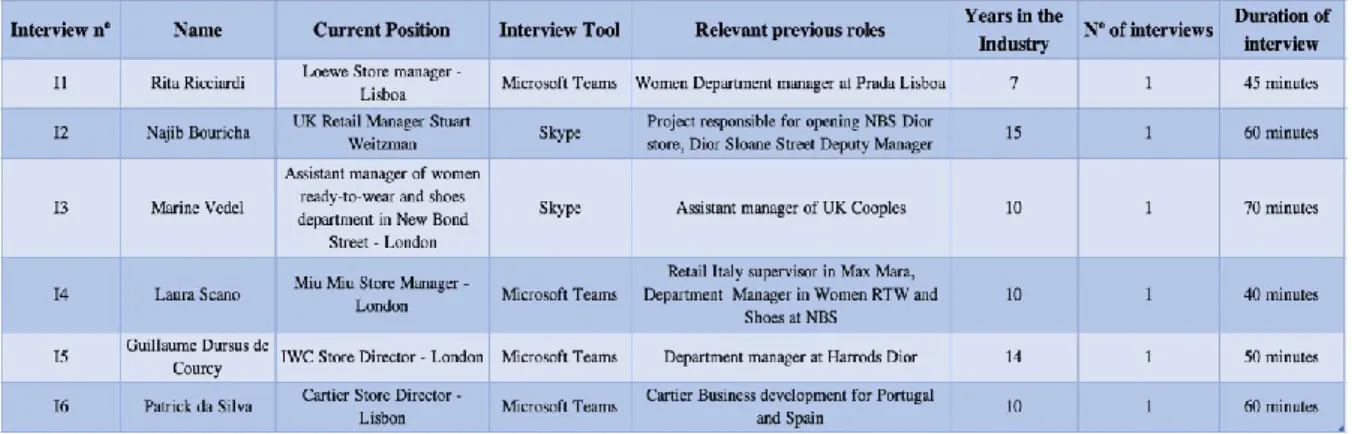
interviewees characteristics, see Table 1. I selected the interviewees based on their knowledge

of the companies selected, due to their present and past work experiences. The interviewees

sample includes a set of individuals specialized on the luxury retail sector, with an average of

(18)

eleven years of sector experience, and high knowledge on the companies under case study due

to their work experience.

Table 1. Interviewee characteristics

The secondary data collection process took place from 19

th

April to 15

th

May. The archival data

was obtained from my internship at Christian Dior. In what respects the other types of

secondary data collected, a selection based on source’s legitimacy, added value to the research,

and publication date, was applied. See appendix 7 for secondary data sources.

Interview and Sampling Technique

The interview scripts (Appendix. 4) intended to eliminate any questions that were biased,

double barreled or too value laden (Berg, 1994). Throughout the interviews, little adaptations

were made to control better the direction of the interviews. In what regards sampling, snowball

(Lincoln & Guba, 1985) and purposeful sampling (Patton, 1990) were applied. The interviews

were recorded, transcribed and organized on an individual data basis.

The interviewee sampling can be divided in three paths: 1) Linked-In hunt, 2) personal network,

and 3) family network. The first social network used to contact expertise managers was

Linked-In. In this website, I contacted fifteen managers working in Lisbon on luxury retail. The only

successful answer received was the first interview I realized to Loewe’s Lisbon store director.

The second network used was my professional network. From November 2019 to January 2020,

I did an internship at a Dior boutique in London. I contacted my previous manager, the assistant

manager of the RTW and women shoes department. She agreed to be interviewed and

recommended other managers working in London in luxury retail, who all agreed to participate.

(19)

Lastly, I recurred to my personal network and was able to contact Cartier’s store director in

Lisbon. He was my sixth and last interviewee.

The samples’ informational power, i.e. their expertise on the subject under study (Malterud el

al., 2016), was high. The interviewees’ work experience, which enabled the creation of an

homogeneous sample, and the similar interview questions and script, enabled the collection of

concise, interesting and concentrated information, reducing the necessity for increasing the

sample size (Rego, et al., 2018; Johansen et. al., 2017).

Data analysis

I used a middle-order approach for the data analysis. I used coding to reduce and condensate a

big amount of data by selecting, categorizing, and labeling statements. “A code in qualitative

inquiry is most often a word or short phrase that symbolically assigns a summative, salient,

essence-capturing, and/or evocative attribute for a portion of language-based data” (Saldana,

2015, p.3).

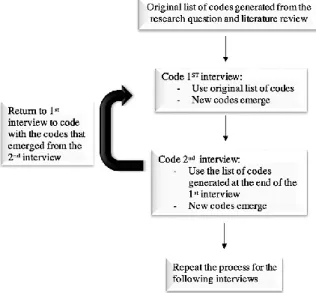
I started by defining a first list of codes generated from the research question and the literature

review (Layder, 1998). When coding the 1

st

interview, I applied the original list of codes, while

new codes emerged from the data, adding codes to the original list. Following to code the 2

nd

interview, I applied the list of codes generated at the end of the 1

st

interview, and again new

codes emerged from the 2

nd

interview. The next step was to return to the 1

st

interview, and

update the codes generated from the 2

nd

interview with quotes from the 1

st

interview.

Successively, the process was repeated until the sixth interview was coded, and the five

previous interviews were coded with the new codes generated from the sixth interview.

(20)

Where it was possible to maintain interviewees’ level meanings, I used labels with terms

actually used by the interviewees, for example the code “Uber Luxury” was mentioned by

Dior’s boutique assistant manager in her interview. In other cases, I appointed labels that

respected the level meaning of the statements but weren’t the exact words used by the

informants, enabling me to capture as close as possible the interviewees meanings and language

(Spradley, 1979). To exemplify how codes emerged I will give as example the sentence “When

a collection is launched, the limited production allows the brand to create waiting-lists for the

products.” (I2), that was coded as “Customer waiting lists”, or “The oblique print is very

successful, because you cannot miss it is Dior.”(I3) was coded as “Recognizable Style/Design”.

On the coding table found in appendix 5, different colors are assigned to codes depending on

their origin:

Table 2. Origin of codes by color

At the end of the interview coding process, secondary data was coded through the same exact

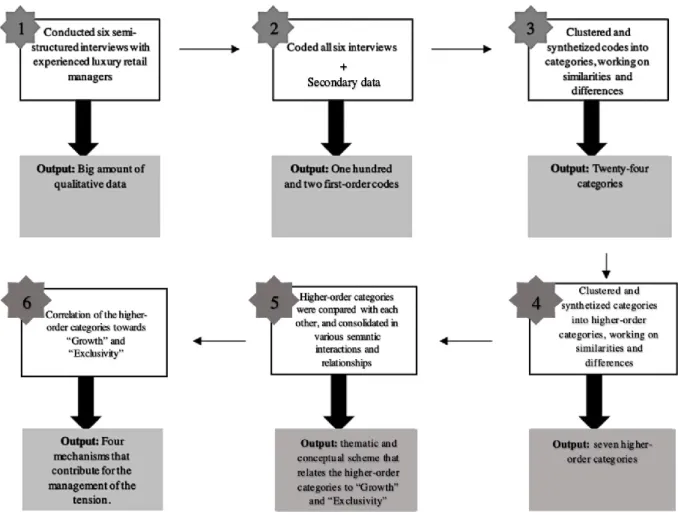
process, and one hundred and two first-order codes emerged. In order to compare and contrast

data across sources, comparative methods were used (Glaser, 1978). The analysis included an

axial coding (Strauss & Corbin, 2008), that worked on similarities and differences between the

first-order codes, enabling me to create categories that represented groups of codes related to

the same topic. For example:

The same process was applied to all codes until twenty four categories were formed (Appendix

1). The final phase was theoretical coding (Glaser, 1978, pag.72). This phase, involved

organizing categories into higher-order categories: “more general, higher-level, and more

(21)

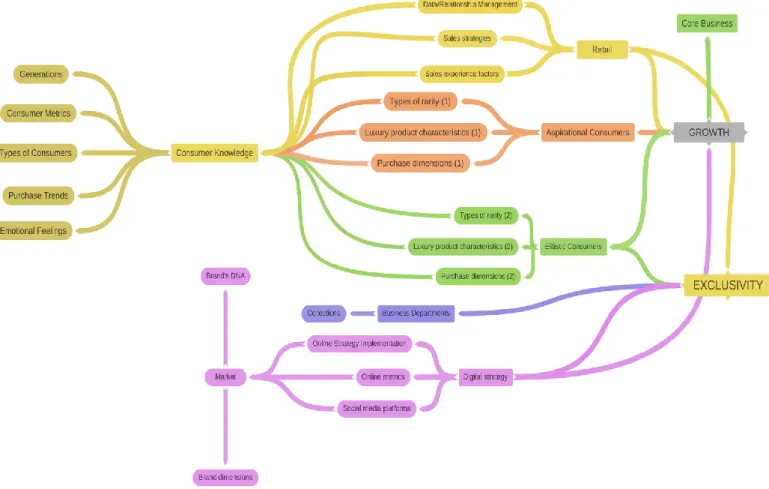
Subsequently, categories and higher-order categories were compared with each other, and

consolidated in various semantic interactions and relationships, progressing towards a thematic

and conceptual scheme. Resulting from this, is the scheme below that traces sequential and

interactive relationships.

Figure 2. Scheme of codes and higher-order categories’ relationships

The circular forms represent categories, whereas the square forms represent higher-order

categories. Every higher-order category or category was sequentially related to “Growth”,

“Exclusivity”, or both. From that resulted the scheme presented above, that details the four

mechanisms that influence “Growth” and “Exclusivity”. In appendix 6, the structure of each

mechanism is detailed.

(22)

All in all, provided below is the scheme that resumes how data analysis functioned.

(23)

Empirical Setting

The empirical chapter intends to present the companies selected for case study. Table 3 details

the characteristics of the latter.

1. LVMH Luxury Group

Louis Vuitton Moët Hennessy is the actual leading luxury group. Its Fashion and Leather Goods

brands portfolio includes brands like Louis Vuitton, Christian Dior, Celine, Loewe, and

RIMOWA.

Bernard Arnault, LVMH’s CEO said

iv

(2019): “LVMH had another record year, both in terms

of revenue and results. The desirability of our brands, the creativity and quality of our products,

the unique experience offered to our customers, and the talent and commitment of our teams

are the Group’s strengths and have, once again, made the difference”. The key highlights for

2019 include continued group growth in all geographical areas.

1.1 Christian Dior S.A.

Christian Dior was born in Normandy, France in 1905. From a young age, showcased his

sketches in an art gallery in Paris alongside artists like Pablo Picasso

v

. After serving in the 2nd

world war, in 1942 went to work as couturier and designer for Lucien Long, along with Pierre

Balmain.

With his strong will, passion for couture and rich experience, Christian Dior founded the

renown and iconic brand Christian Dior in October 8th 1946 at 30 Avenue Montaigne, Paris

vi

.

The first official collection was showcased on February 12th in 1947. Christian Dior had just

one purpose: to lift up women, bringing them beautiful, joyful and elegant pieces. His name

eventually became synonymous with French luxury all around the world.

In 1947, the brand debuts its first fragrance Miss Dior, as a tribute to the creator’s sister

Catherine Dior, creating the House of Christian Dior Parfums

vii

. This visionary creator invented

the concept of global beauty with its Rouge Dior lipstick and subsequent cosmetic lines. In the

present days, Dior Beauty includes Make-Up, Skincare and Perfume lines. In 1949, Dior was

the first couturier to arrange licensed production of his designs. Having realized the importance

of the complete look, Dior together with business partner Jacques Rouët, licensed his name to

(24)

Chamber of Couture - denouncing the move as cheapening the haute couture industry -

licensing became a profitable move for Dior and was followed by nearly all of the period's

fashion houses.

Christian Dior suffered a fatal heart attack on October 24th, 1957

ix

. As result, Yves Saint

Laurent was assigned artistic director, staying on the role until 1960. In 1967 the house created

its first ready-to-wear collection, under the helm of Marc Bohan as artistic director. On the same

year, a Baby Dior collection is launched, that remains until the present days. In 1970 the brand

launches its first Dior Homme collection. In 1989 LVMH bought Christian Dior and

repositioned it as Christian Dior S.A. Nowadays, Maria Grazia Chiuri, the Creative Director of

the brand since 2015, is the first female to be head of the label.

In April 2017 LVMH announced that was integrating the entire Christian Dior brand within the

group, by buying Christian Dior Couture, in a deal valued at $13 billion

x

(Appendix 3).The

intent was to create further synergies between Christian Dior Couture and Parfums Christian

Dior, which is already fully owned by LVMH. Christian Dior Couture was an exclusive owned

subsidiary since 1995.

1.2 LOEWE

Loewe was founded in 1846 in Madrid Spain, by an artist specialized in the creation of small

leather goods

xi

. At the end of the 19th century, Enrique Loewe arrived in Spain and joined the

group. The German craftsman was specialized and had high technical skills in leather treatment

and construction, joining the owners and helming the operations, giving his name to the brand.

In 1945 the brand started its ready-to-wear business with José de Rozas as Creative Director.

Until 1978, Rozas created and strengthen Loewe’s spirit: a brand enriched by Spanish heritage

with a democratic sense of design. Loewe’s emblematic anagram was created by Vicent Vela

in 1970, that since then represents the brand’s technical and material excellence. In 1996 Loewe

was bought by LVMH, joining the portfolio of brands specialized in leather goods. The

Amazona, an iconic handbag debuted in 1975, is a continuous example of a combination of

exquisite materials and craftmanship with functionality and timelessness. Until the present

days, the brand is known and recognized by its exquisite leather work and aspires to become

one of the top 3 world leading luxury leather Houses.

Since 2013 Jonathan Anderson has been the Creative Director, leading the brand to a new, bold,

playful and spontaneous brand identity. Paula’s Ibiza collection, an yearly partnership with a

(25)

southern Boho Spanish brand, and Eye/Loewe/Nature, a collection based on outdoor activities,

are examples of this.

With an ongoing internationalization strategy, Loewe continues to open new stores in trendy

powerful streets around the world: Milan and Tokyo in 2014, Miami in 2015, and two stores in

New York in 2019. The 2019 LVMH press release mentioned “Loewe delivered strong growth

under the impetus of its designer JW Anderson”

xii

.

2. RICHEMONT Luxury Group

2.1 CARTIER

It all started in the beginning of the 19th century. Louis Cartier was born in 1819 in Paris

xiii

. In

1847, Cartier bought the store from his employer, in order to collect jewelry pieces to expand

his collection, adding to his timeless pieces, focusing only on the finest jewelry he could find.

Throughout the years, Cartier’s collection got richer and richer, becoming the "King of

Jewelers, Jeweler of Kings".

In 1899, monsieur Cartier handed the business over to his three sons

xiv

. In 1904 with the brand’s

founder death, the will to extend the brand and make it known in the most influential capitals

became an objective to Alfred, the founder’s soon. The brand survived successfully both world

wars due to the strategic focus on less affected countries. After the death of Louis and Jacques

in 1942, the company remained family-owned with the sons of the grandsons’ creator. Upon

Pierre’s death in 1964, the decision to sell each branch separately, Paris, London and New York,

seemed the correct one. In 1972, 1974 and 1979 Robert Hocq along with Joseph Kanoui and

Anton Rupert, bought all three branches back, and the company remains to this day, a single

entity.

During a time where the watch industry was experiencing a recession, Hocq and Perrin created

Les Must Cartier in 1973, which consisted in an affordable line of products, from leather goods

to sunglasses, pens and watches, with Cartier’s logo and design

xv

. These products were sold by

the millions and democratized Cartier’s brand making it accessible to a large audience and no

longer just jewels of the royals. By 1980 these products were exceeding a billion dollars a year.

Currently, from this collection the only products still manufactured are small leather goods and

perfumes.

In 1993, Cartier was merged with other brands controlled by the Rupert Family, creating the

(26)

Group, in December bought the 30% remaining, consolidating the Vendôme Group under

Richemont’s operations.

Cartier’s jewelry sales were supported by the iconic collections Love and Juste un Clou

xvii

.

Watches sales profited from Santos de Cartier collection, and the strong performance of Cartier

Panthère, which keeps a strong appeal. In December 2019 introduced its first feminine handbag

based on the Maison’s emblematic red box, Guirlande de Cartier. The company made high

value investments in boutique renovations, as the brand intends to showcase their creations in

the ultimate retail environment. The renovations aim to reach 38 boutiques. Moreover, with the

objective of personalization and cultural appeal, 20 different versions of the brand’s website

were created. Cartier is one of the most recognized names in the jewellery and watches

industries as a reference of timeless, elegant, simple and true luxury. The brand entices with its

exquisite design, lines of innovation and expertise. It successfully stays unique and a leader in

its pioneer field.

(27)

Findings

This chapter answers the following research question “How do luxury brands manage the

tension between growth and exclusivity?”. From the data analysis resulted four mechanisms

used to manage the tension (Appendix. 6). The findings will be structured around the four

mechanisms used by the brands, and correspondent examples.

I. Implementing digital and retail strategies

The first mechanism to manage the tension between growth and exclusivity, illustrates the

different strategies on how to excel on the digital and retail channels. These two channels have

rather different functions on the brands’ strategies to manage the tension.

In all brands under case study, the retail channel has emerged as the prime channel for emotional

and personal connection building. This connection can be with the sales assistant, brand or with

the experience as a whole. Sales teams are trained and inspired to provide the most unique,

dreamy and emotional experiences to each customer at store. In each contact between customer

and sales teams, the brand’s lifestyle and heritage is transmitted in order to increase desirability

for the brand’s products, and connection with the brand: “The way the product is presented

needs to make the client dream of having it.” (I1). These connections cannot be underrated, as

they represent one of the most powerful tools of growth for luxury brands nowadays.

In the last few years Christian Dior, Loewe and Cartier, made high investments for the creation

and nourishment of the consumer data base (CDM) and relationship management (CDM). The

former, came as result of the brands understanding the power and influence of the retail

interactions and experiences on brand growth. These investments target generally local clients,

once these are the ones with higher shopping frequency probability. The end goal for the brands

is to discover and deepen the knowledge on consumers’ aspirations and lifestyle, which will

further allow to understand the consumers’ purchase power and potential, and stimulate future

sales on special occasions (e.g. the client’s birthday, relationship anniversaries, or vacations).

Having this knowledge, the sale assistant will be able to discern what type of client it is, and

choose the client strategy accordingly. The different strategies differ in the access to brand

events, exclusive products, brand content and treatment at store.

Since it is very important for luxury brands to differ the type of clients, and adapt the treatment

to each segment, Christian Dior makes the following distinction in higher segments

xviii

: Very

(28)

ascending basis. Reasonably, the exclusiveness of access to Dior brand events and products

increases along the segments. For example, Very Very Good clients + are invited for

Trunkshows and one-to-one appointments in VIP rooms, whereas Elite clients have access to

the preview of the collection after the fashion shows in Paris, access to Uber luxury and outside

venue events. Other experiences that sales assistants provide to these segments include

invitations for evening dresses roadshows to sell exclusive pieces, and for clients to come in

store to pick up orders from fashion shows to maximize sell-through and encourage additional

sales

xix

.

In what respects lower segments, Dior and Loewe’s sales assistants focus on driving repeat

xx

.

Here the strategy is to increase the volume of clients contacted in order to generate higher traffic

in store and identify the best future clients with the clienteling tools available. To these

segments, sales assistants invite for selected minor brand events: cocktail events for collection

presentations, or launch of products, using digital cards to tease the clients and enlarge the target

audience with purchase potential.

Sending flowers on the client’s birthday, inviting for lunch at the customer’s favorite restaurant,

or for the Wimbledon Horse Race in London, are some of Dior’s actions outside the boutiques,

that increase the emotional and personal connection between consumer and sales assistant. It

was concluded by the managers that a consumer emotionally attached to a brand, is more loyal,

and in times of choice, will choose the brand to which is more personally and emotionally

connected, whether this connection comes from store experiences, social media actions or

outside venue events. Since brands know this they strive to deliver meaningful and exclusive

experiences, using retail as a mean to do so.

Furthermore, 360º degree coherent communications between all brand’s touchpoints with the

consumer, as showed to be pivotal to strengthen brand image and symbolic associations.

Mentioned by most interviewees, is it crucial that both online and offline channels are aligned,

whether by the same aesthetics, or core message. To give as example, Dior’s OUI Launch pack

(2020) showcases six dimensions of action for a strong 360º strategy. The six dimensions

include: 1) Network, 2) Media – digital campaigns, 3) CRM- promotion material to send

directly to strategic clients, 4) Press – magazines , 5) Visual Merchandising- display of the new

product for a powerful impact, and 6) Sales Teams

xxi

.

In brief, the mechanism on retail illustrates the importance of CDM and CRM programs that

enable deepened consumer knowledge. This knowledge is used to discern the type of client and

choosing the according strategy. Consequently, sales assistants deliver inside and outside

(29)

of purchases and higher sales values. Moreover, these meaningful, personalized, and unique

experiences contribute to increased exclusivity and desirability.

On a world each time more digital, where the most digitalized generations are becoming even

more relevant for luxury brands, brands’ presence online is compulsory. It is crucial to be

present, to be noticed and to be relevant. The brands under case study have two main branches

of action on the online: e-commerce and social media and website marketing actions.

The companies studied, use digital channels to raise brand awareness, and transmit the brand’s

heritage, craftmanship, values, identity and image. Moreover, these brands use social media to

engage in conversations with consumers, stimulate the beginning of customer-brand

relationships, and above all build and nurture the brand dream, aspiration and desirability. The

Dior Saddle bag relaunch in 2018 used this strategy strongly: contacted one hundred of the

biggest influencers worldwide to post a picture with the bag on the launch day, resulting on an

extraordinary product and brand awareness, and consequent affluent product hunt. Hence, these

actions intend for the brand to be known by all types of consumers, increasing the brand

audience beyond the target group and having an aligned strategy with boutiques.

However, the interviewees have stated that luxury e-commerce does not represent a pivotal

channel for growth. Indeed, the sales values are relevant and essential for their brands. Yet, a

necessary factor for growth cannot be reached through this selling channel- the emotional and

personal connection. Since the emotional connection is a both sides advantage, consumers will

also prefer to buy at boutiques, rather than online. As result, brands cannot excel online on

exclusivity, CRM and CDM, thus not achieving the same results of sales as in retail stores. To

sustain this, there is the fact that five out of six managers demonstrated doubts regarding the

future of e-commerce for luxury brands. Moreover, 43% of luxury online sales in 2019 were in

the accessories category, a less emotional category (Bain & Company’s, 2019), and as stated

by Rambourg (2020)

xxii

“Consumers still want to enjoy mingling with their favorite sales

associate, touch and feel products, or drink their favorite champagne in a VIP salon to which

few have access”. In sum, the digital mechanism illustrates how the digital channels are

important for brand building and awareness, but do not represent crucial channels of sale for

luxury brands, as the emotional connection cannot be achieved.

(30)

Table 4. Summary of mechanism I strategies

II. Distinguish the different types of consumers to adapt and target tension

management strategies

Table 5. Characteristics of Aspirational and Elitist consumers

Mechanism II illustrates how the differentiation of consumers into aspirational and elitist,

allows brands to adapt their exclusive and selling strategies in order to grow, while nourishing

the sense of exclusivity and rarity. Beyond differentiating the consumers in higher segments

(31)

(mechanism I), Christian Dior, Loewe and Cartier, also distinguish and divide the luxury

costumers into two general groups: aspirational and elitist.

Table 5 summarizes and details the characteristics of each type of consumer that were the cross

between the description made by the managers, and the codes and categories that emerged from

data analysis. The brands studied characterize aspirational costumers has having medium to

medium-high purchase power. This type of client is attracted by trendy, branded items that have

a recognizable style or design. Aspirational customers are not affected if they see other

individuals with the same product as theirs, as their aim is to have items recognized by the

general audience to fulfill the need of social status and class statement, aspiration and extension

of self-reassurance, the final objective of their conspicuous buy.

The elitist consumer incurs feelings of prestige and elitism. These customers do not need their

products to be recognized by the general audience, but rather by their specific elite group. Their

purchases strive for personal distinctiveness and uniqueness. Given that they have high

purchase power, they are able to include the brands on their day-to-day life, from clothing, to

accessorize, to home décor. Elitist consumers seek high quality, exquisite design and higher

exclusive products, hence they buy ready-to-wear in higher frequency or even haute-couture

pieces.

Considering consumers’ differentiation, the second strategy illustrates the departments different

targets and objectives. For Christian Dior and Loewe, the accessories department has the

highest echelons of profitability and trendiest products, due to the high volume of sales.

Adjoining to this department, RTW carries high levels of brand heritage and identity, charges

higher prices for higher exclusive products, therefore selling in lower volume. Naturally, due

to the characteristics mentioned above, accessories appeal more to aspirational consumers,

whereas RTW and HC departments are more consumed by elitist consumers. On the whole,

RTW and HC collections keep the dreaminess, desirability and exclusiveness of the brand with

modern, appealing and exquisite items every season. In short, accessories sell in high volume,

reaching high profitability values, whereas RTW sells higher priced items, in lower volume, to

keep the dreaminess and aspiration, caused by harder accessibility. In this way the brand grows

by selling in high volume, while maintaining its exclusivity and desirability levels.

Scarcity strategies realized by Christian Dior and Loewe, are strategies that stimulate both types

of consumers. These strategies manage desirability, CDM, exclusivity and growth at the same

time. Scarcity is the brand’s created artificial rarity. This strategy intends to manage the amount

of product produced to be considerably lower than the demand expected, in selected strategic

Imagem

Table 1. Interviewee characteristics
Figure 1. Coding process
Table 2. Origin of codes by color
Figure 2. Scheme of codes and higher-order categories’ relationships
+7

Referências

Documentos relacionados