CERN-PH-EP/2013-037 2014/10/29
CMS-TOP-12-026
Measurement of the tt production cross section in pp
collisions at
√
s
=
8 TeV in dilepton final states containing
one τ lepton
The CMS Collaboration
∗Abstract
The top-quark pair production cross section is measured in final states with one electron or muon and one hadronically decaying τ lepton from the process tt → (`ν`)(τντ)bb, where ` = e, µ. The data sample corresponds to an integrated lu-minosity of 19.6 fb−1 collected with the CMS detector in proton-proton collisions at √
s = 8 TeV. The measured cross section σtt =257±3 (stat)±24 (syst)±7 (lumi) pb, assuming a top-quark mass of 172.5 GeV, is consistent with the standard model pre-diction.
Published in Physics Letters B as doi:10.1016/j.physletb.2014.10.032.
c
2014 CERN for the benefit of the CMS Collaboration. CC-BY-3.0 license
∗See Appendix A for the list of collaboration members
1
Introduction
Top quarks at the CERN LHC are mostly produced in pairs with the subsequent decays tt → W+bW−b. The decay modes of the two W bosons determine the event signature. The dilepton decay channel corresponds to the case in which both W bosons decay into leptons, where the term lepton usually refers to electrons or muons, as studied in Refs. [1, 2]. In this letter we measure the production cross section of top-quark pairs by considering dilepton decays where one W boson promptly decays into`ν`, with` = e or µ, and the other decays into τντ, tt → (`ν`)(τντ)bb. The expected fraction of these events is 4/81 of all tt decays. The τ lepton is identified by means of its hadronic decay products, with a branching fractionB(τ→hadrons+ ντ) '65%, to produce a narrow jet with a small number of charged hadrons, denoted as τh. The
cross section is measured by counting the number of`τh+X events consistent with originating
from tt production, after subtracting the contributions from other processes, and correcting for the efficiency of the event selection. A similar method was used in pp collisions at a centre-of-mass energy of√s=7 TeV [3]. This “τ dilepton” channel is of particular interest because it is a natural background process to the search for a charged Higgs boson [4, 5] with a mass smaller than that of the top quark. In this case, the production chain tt→H+bW−b, with H+ →τ+ντ (or the corresponding charge-conjugate particles) could give rise to differences with respect to the standard model (SM) prediction of the number of tt events with a τ lepton [6]. The present measurement is based on data collected by the CMS experiment in pp collisions at √
s = 8 TeV corresponding to an integrated luminosity of 19.6 fb−1. The relative accuracy of this measurement improves over previous results [7–11], thanks to the inclusion of additional data and improved analysis techniques.
The CMS detector is briefly introduced in Section 2, followed by details of the simulated sam-ples in Section 3, and a brief description of the event reconstruction and event selection in Section 4. The descriptions of the background determination and the systematic uncertainties are given in Sections 5 and 6, respectively. The measurement of the cross section is discussed in Section 7, and the results are summarised in Section 8.
2
The CMS detector
The central feature of the CMS apparatus is a superconducting solenoid of 6 m internal di-ameter and 13 m in length, providing a magnetic field of 3.8 T. Within the superconducting solenoid volume are a silicon pixel and strip tracker, a lead tungstate crystal electromagnetic calorimeter, and a brass/scintillator hadron calorimeter, each composed of a barrel and two endcap sections. The calorimetry provides high-resolution energy and direction measurements of electrons and hadronic jets. Muons are identified using gas-ionization detectors embedded in the steel flux-return yoke outside the solenoid. Extensive forward calorimetry complements the coverage provided by the barrel and endcap detectors. The CMS experiment uses a right-handed coordinate system, with the origin at the nominal interaction point, the x axis pointing to the centre of the LHC ring, the y axis pointing up (perpendicular to the LHC plane), and the z axis along the anticlockwise-beam direction. The polar angle θ is measured from the positive z axis and the azimuthal angle ϕ is measured in the x-y plane. Charged particle trajectories are measured covering 0 < ϕ ≤ 2π in azimuth and |η| < 2.5, where the pseudorapidity η is
defined as η = −ln[tan(θ/2)]. The detector is nearly hermetic, allowing for energy balance
measurements in the plane transverse to the beam directions. A two-level trigger system se-lects the most interesting proton-proton collision events for use in physics analyses. A more detailed description of the CMS detector can be found elsewhere [12].
2 4 Event selection
3
Data and simulation samples
Events are selected online by a trigger requiring a single isolated electron (muon) with trans-verse momentum pT >27(24)GeV and|η| <2.5(2.1).
This measurement makes use of simulated samples of tt events as well as other processes that mimic the `τh decay signature. These samples are used to optimise the event selection, to
calculate the acceptance for tt events, and to estimate some of the backgrounds in the analysis. The signal acceptance and tt dilepton background are evaluated using a version of MADGRAPH
which includes the effects of spin correlations [13, 14]. The number of expected tt events is es-timated with the next-to-next-to-leading-order (NNLO) SM cross section of 251.7+−6.38.6(scale)± 6.5(PDF)pb [15–19] for a top-quark mass of 172.5 GeV, where the first uncertainty is due to renormalisation and factorisation scales, and the second is due to the choice of parton distribu-tion funcdistribu-tions (PDFs). The generated events are subsequently processed withPYTHIA6.426 [20] which performs the hadronisation of partons. Soft radiation is matched to the contributions from direct emissions accounted for in the matrix-element calculations using the kT-MLM
ap-proach [21]. The τ lepton decays are simulated usingTAUOLA27.121.5 [22], which accounts for the τ-lepton polarization.
The samples containing W+jet and Z+jet events are simulated using the MADGRAPH5.1.3.30 event generator [23]. The electroweak production of single top quarks is considered as a back-ground process and is simulated with POWHEG 1.0, r1380 [24–28]. The diboson production processes WW, WZ, and ZZ are generated withPYTHIA6.424. In each case, thePYTHIA
param-eters for the underlying event are set according to the Z2* tune [29], which uses the CTEQ6L PDFs [30].
Simulated events are processed using the full CMS detector simulation based on GEANT4 [31, 32], followed by a detailed trigger emulation and event reconstruction. For both signal and background events, additional pp interactions (pileup) in the same or nearby bunch crossings are simulated withPYTHIAand superimposed on the hard collision, using a pileup multiplicity distribution that reflects the luminosity profile of the analysed data.
4
Event selection
Events are reconstructed with the particle-flow (PF) algorithm [33, 34], which combines infor-mation from all sub-detectors to identify and reconstruct individual electrons, muons, photons, charged and neutral hadrons. The primary collision vertex is chosen as the reconstructed ver-tex with the largest∑ p2T of the associated tracks. Electrons are identified with a multivariate discriminant combining several quantities describing the track quality, the shape of the energy deposits in the electromagnetic calorimeter, and the compatibility of the measurements from the tracker and the electromagnetic calorimeter [35], and are reconstructed with an average efficiency of approximately 95%. Muons are identified with additional requirements on the quality of the track reconstruction and on the number of measurements in the tracker and the muon systems [36], and are reconstructed with an average efficiency of approximately 96%. Charged and neutral particles provide the input to the anti-kT jet clustering algorithm with a
distance parameter of 0.5 [37]. The jet momentum is determined from the vector sum of parti-cle momenta in the jet. After jet energies are corrected for additional pileup contributions and for detector effects, they are found in simulations to be within 5–10% of the actual jet momen-tum [38]. The missing transverse energy ETmissis calculated as the magnitude of the vector sum of momenta from all reconstructed particles in the plane transverse to the beam.
In addition, higher-level observables such as b-tagging discriminators and lepton isolation vari-ables are used. The lepton relative isolation is defined as the transverse energy contributions deposited by charged hadrons (ET, ch), neutral hadrons (ET, nh), and photons (ET, ph) in a cone of radius R =
√
(∆ϕ)2+ (∆η)2 = 0.4 centered on the lepton candidate track, relative to the lepton’s transverse momentum (pT), Irel = (ET, ch+ET, nh+ET, ph)/pT. An electron (muon)
candidate is considered to be non-isolated and is rejected if Irel>0.1 (>0.12).
The hadronic products of the τ-lepton decay are reconstructed using a jet as the initial seed, and are then classified as having one or three charged hadrons with the “hadron-plus-strips” algorithm [39, 40]. In the “hadron-plus-strips” algorithm, calorimeter energy deposits clus-tered along strips in the ϕ direction are used for neutral pion identification. Then, the decay modes, four-momenta, and isolation quantities of the τhare determined, and the following
cat-egories are considered: single hadron, hadron plus a strip, hadron plus two strips, and three hadrons. These categories together encompass approximately 95% of hadronic τ-lepton de-cays. The sum of the charged hadron charges provides the τhcharge. The τh-jet momentum is
required to match the direction of the original jet within a maximum distance R = 0.1. Isola-tion criteria require that there be no addiIsola-tional charged hadrons with pT > 1.0 GeV or photons
with transverse energy ET >1.5 GeV within a cone of size R = 0.5 around the direction of the
τhjet. Electrons and muons misidentified as τhare suppressed using algorithms that combine
information from the tracker, calorimeters, and muon detectors [12]. The τhidentification
ef-ficiency is defined as the ratio of the number of selected τh candidates divided by the number of hadronic τ-lepton decays in tt events; the ratio depends on pT and η of the τh, and is on
average 50% for pτh
T > 20 GeV, with a probability of approximately 1% for generic jets to be
misidentified as a τhjet.
The combined secondary vertex (CSV) algorithm [41] is used to identify jets originating from the hadronisation of b quarks. The algorithm combines the information about track impact parameters and secondary vertices within jets into a likelihood discriminant to provide sep-aration between b jets and jets originating from light quarks, gluons, or charm quarks. The output of this CSV discriminant has values between zero and one; a jet with a CSV value above a certain threshold is referred to as being “b tagged”. We choose a working point where the b-tagging efficiency is approximately 60%, as measured in a data sample of events enriched with jets from semileptonic b-hadron decays. The misidentification rate of light-flavour jets is estimated from inclusive jet studies and is measured to be about 0.1% for jets with pT >30 GeV.
Events are preselected by requiring exactly one isolated electron (muon) with transverse mo-mentum pT > 35(30)GeV and |η| < 2.5(2.1), at least two jets with pT > 30 GeV, and one
additional jet with pT > 20 GeV. The selected jets must be within |η| < 2.4. The electron
or muon is required to be separated from any jet in the (η, ϕ) plane by a distance R > 0.4. Events with any additional loosely isolated, Irel <0.2, electron (muon) of pT >15(10)GeV are
rejected. Further event selection requirements include EmissT > 40 GeV and only one τh with
pT > 20 GeV and|η| < 2.4. The τhand the lepton are required to have electric charges of
op-posite sign (OS). At least one of the jets is required to be identified as originating from b-quark hadronisation (b-tagged).
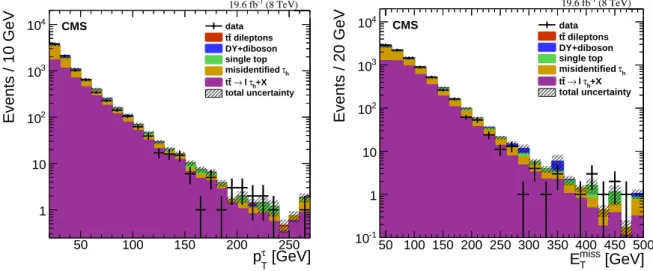
Figure 1 shows, for the sum of the eτh and µτh final states, a comparison between data and simulation of the number of b-tagged jets in each event Nb-tag after all the selection criteria
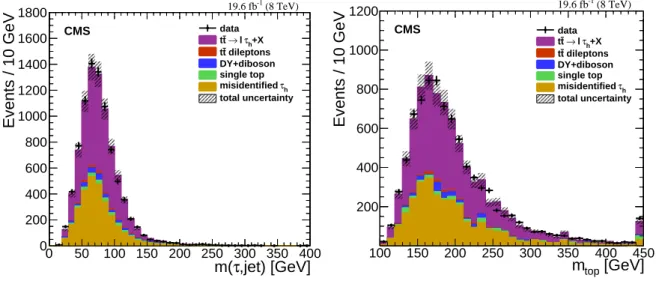
have been applied. The distributions of the τh pT and EmissT after the final event selection are
shown in the left and right panels of Fig. 2, respectively. The distributions show agreement between the observed numbers of events and the expected numbers of signal and background events obtained from the simulated distributions normalised to the integrated luminosity of
4 4 Event selection b-tag N 1 2 3 ≥ 4 Events 1 10 2 10 3 10 4 10 (8 TeV) -1 19.6 fb CMS data dileptons t t DY+diboson single top h τ misidentified +X h τ l → t t total uncertainty
Figure 1: The b-tagged jet multiplicity after the full event selection. The simulated contributions are normalised to the SM predicted values. The hatched area shows the total uncertainty. the selected data sample.
[GeV] τ T p 50 100 150 200 250 Events / 10 GeV 1 10 2 10 3 10 4 10 (8 TeV) -1 19.6 fb CMS data dileptons t t DY+diboson single top h τ misidentified +X h τ l → t t total uncertainty [GeV] miss T E 50 100 150 200 250 300 350 400 450 500 Events / 20 GeV -1 10 1 10 2 10 3 10 4 10 (8 TeV) -1 19.6 fb CMS data dileptons t t DY+diboson single top h τ misidentified +X h τ l → t t total uncertainty
Figure 2: Distribution of the τhpT(left) and EmissT (right) after the full event selection, for the eτh
and µτhchannels combined. The simulated contributions are normalised to the SM predicted
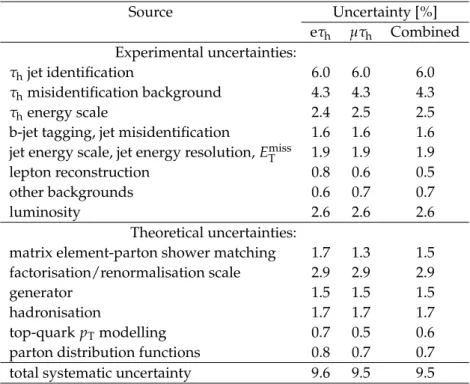
values. The hatched area shows the total uncertainty. The last bins include the overflow events. Following the final selection, additional kinematic features of the tt events are studied to evalu-ate the agreement between the observed data and the predicted sum of signal and background. For each event, two invariant mass combinations are reconstructed by pairing the τh with the two candidate b-jets: (1) in events with two or more b-tagged jets, the two combinations are based on the two b-tagged jets with the highest value of the discriminator; (2) in events with one b-tagged jet, this is used for the first combination, while the non-b-tagged jet with the high-est pT is used to form the second combination. For the two combinations, the invariant mass
with the lowest value is shown in Fig. 3 (left), for the eτhand µτhchannels combined.
For each event, the top-quark mass mtopis reconstructed using the KINb algorithm [42, 43]. Due
to the multiple neutrinos in the event, the reconstruction of mtopleads to an underconstrained
system. The KINb algorithm applies constraints on the W boson mass, the mass difference between the top and anti-top quark, and the longitudinal momentum of the tt system. For each event, solutions to the kinematic equations are evaluated, varying the jet momenta and
the direction of EmissT within their resolutions. For each set of variations and each lepton-jet combination, the kinematic equations allow up to four solutions; the one with the lowest tt invariant mass is accepted if the mass difference between the two top quarks is less than 3 GeV. For each event, the accepted solutions corresponding to the two possible lepton-jet combina-tions are counted and the combination with the largest number of solucombina-tions is chosen and mtop
is obtained by fitting the peak of this distribution. The events in which solutions are found are shown in Fig. 3 (right). Data are in agreement with the expected sum of signal and background events. ,jet) [GeV] τ m( 0 50 100 150 200 250 300 350 400 Events / 10 GeV 0 200 400 600 800 1000 1200 1400 1600 1800 (8 TeV) -1 19.6 fb CMS data +X h τ l → t t dileptons t t DY+diboson single top h τ misidentified total uncertainty [GeV] top m 100 150 200 250 300 350 400 450 Events / 10 GeV 200 400 600 800 1000 1200 (8 TeV) -1 19.6 fb CMS data +X h τ l → t t dileptons t t DY+diboson single top h τ misidentified total uncertainty
Figure 3: (left) Minimum invariant mass reconstructed by pairing the τhwith either a b-tagged jet or with the highest pT non b-tagged jet, as described in the text. (right) Distribution of the
reconstructed top-quark mass mtopfor the `τh candidate events after the full event selection.
Data (points) are compared with the sum of signal and background yields, for the eτhand µτh
channels combined. The simulated contributions are normalised to the SM predicted values. The hatched area shows the total uncertainty. The last bins include the overflow events.
5
Background estimate
The main background (misidentified τh) comes from events with one lepton (electron or muon),
significant Emiss
T , and three or more jets, where one jet is misidentified as a τh jet [6]. The
dominant source is tt lepton+jet events. The misidentified τh background accounts also for events with W bosons produced in association with jets, either genuine W+jet or single-top-quark production, and for QCD multijet events. In order to estimate this background from data, the misidentification probability w(jet→ τh)is parameterised as a function of the jet pT,
η, and width (Rjet). The quantity Rjetis defined as
√
ση2+σϕ2, where ση (σϕ) expresses the extent in η (ϕ) of the jet cluster [38].
The probability w(jet→τh)is evaluated from two control samples:
• wW+jets: from a W+jet event sample, selected by requiring one isolated muon with
pT >20 GeV and|η| <2.1, and at least one jet with pT >20 GeV and|η| <2.4;
• wQCD: from a QCD multijet sample, triggered by one jet with pT > 40 GeV, selected
by requiring events to have at least two jets with pT > 20 GeV and|η| <2.4, where
the triggering jet is removed from the misidentification rate calculation to avoid a trigger bias.
6 6 Systematic uncertainties
Both probabilities are evaluated in simulated events as well as in data, with good agreement found between the results from simulation and data [39].
The number of events containing misidentified τhcandidates is then determined as
Nmisid= M
∑
i m∑
j wji(jet→τ) −Nother, (1)where j is the jet index of event i, and m is the number of jets in each event and M is the total number of events. The quantity Nother is the expected'20% contamination from signal and other processes to the misidentified background as estimated from simulated samples. The value of Notheris evaluated by applying the procedure described above to simulated events of Z/γ∗ → ττ, single-top-quark production, diboson production, and the tt processes included
in the misidentified τhbackground estimation.
Jets in QCD multijet events originate mainly from gluons, while in W+jet events they are pre-dominantly from quarks. The quark and gluon composition in the misidentified τhevents lies between these two control samples. As wQCD < wW+jets, the actual Nmisid value is
under-(over-) estimated by applying the wQCD (wW+jets) probability. We determine from data the rate
for the misidentification of a jet to be identified as a τh, and from simulation the quark/gluon
composition in the W+jet and multijet samples. From these quantities we derive the following combination:
hNmisidi =SFW+jet×NWmisid+jet+SFQCD×NQCDmisid, (2)
where the misidentification rates, extracted from the data control samples discussed above, are combined with the scale factors SFs determined from the set of equations describing the quark/gluon composition of the samples: SFQCD = 0.83 and SFW+jet = 0.17. The
corre-sponding systematic uncertainty is obtained from Eq. (2) by weighting the relative deviations of NWmisid+jet and NQCDmisidfromhNmisidiwith the related scale factors. This results in an uncertainty of 7% for both eτhand µτhchannels.
The efficiency of the OS requirement εOS is determined from simulated lepton+jet tt events
and is applied in order to obtain the misidentified τhbackground after the final event selection Nmisid
OS , where NOSmisid = εOS·Nmisid. We find values of εOS = 0.729±0.002 (stat)±0.004 (syst)
for the eτh selection and εOS = 0.731±0.002 (stat)±0.003 (syst) for the µτh selection, where
all sources of systematic uncertainty are accounted for in the modelling of the simulated tt lepton+jet events.
6
Systematic uncertainties
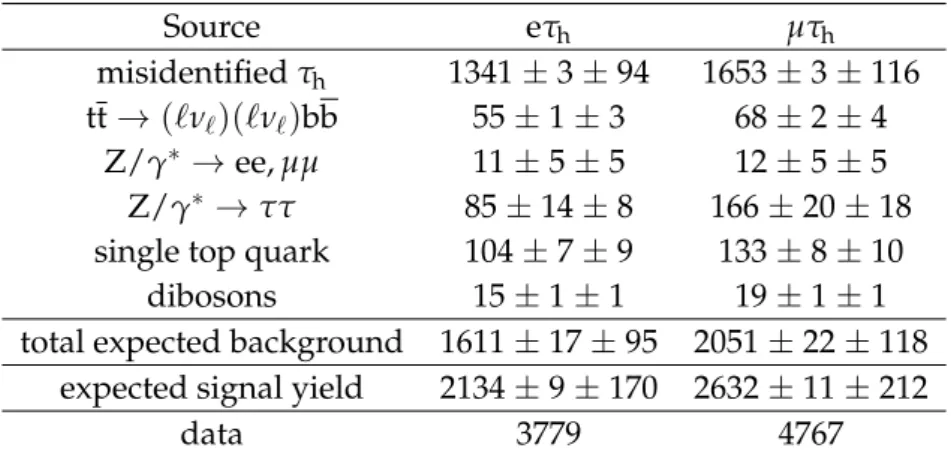
Several sources of systematic uncertainty are considered and listed in Table 1. They are related both to the signal reconstruction efficiency, background determination, and luminosity mea-surement (Experimental uncertainties) and to the theoretical assumptions on the tt production (Theoretical uncertainties). In Table 1 and in what follows, relative values refer to the cross section uncertainty unless explicitly stated otherwise.
Table 1: List of systematic uncertainties in the cross section measurement, and their combi-nation. Lepton reconstruction uncertainties are uncorrelated, while all other uncertainties are assumed 100% correlated. Source Uncertainty [%] eτh µτh Combined Experimental uncertainties: τhjet identification 6.0 6.0 6.0 τhmisidentification background 4.3 4.3 4.3 τhenergy scale 2.4 2.5 2.5
b-jet tagging, jet misidentification 1.6 1.6 1.6 jet energy scale, jet energy resolution, EmissT 1.9 1.9 1.9
lepton reconstruction 0.8 0.6 0.5
other backgrounds 0.6 0.7 0.7
luminosity 2.6 2.6 2.6
Theoretical uncertainties:
matrix element-parton shower matching 1.7 1.3 1.5 factorisation/renormalisation scale 2.9 2.9 2.9
generator 1.5 1.5 1.5
hadronisation 1.7 1.7 1.7
top-quark pTmodelling 0.7 0.5 0.6
parton distribution functions 0.8 0.7 0.7 total systematic uncertainty 9.6 9.5 9.5 Experimental uncertainties
Regarding the τhreconstruction, the uncertainty associated to the identification efficiency amounts to 6%, while the contribution relative to the τhjet energy scale is 2.4% (2.5%) for the eτh(µτh) channel, as estimated by varying the pTof the τhjet by 3% [39, 40]. The uncertainty in the τh
identification efficiency includes the uncertainty in charge determination which is estimated to be smaller than 1%. The uncertainty related to the misidentified τh background process,
discussed in Section 5, is obtained by propagating the 7% uncertainty onhNmisidito the cross section determination and results in 4.3% for both channels. It also includes the uncertainty in the OS efficiency determination.
The reconstruction of a light flavour jet as a b quark is defined as mistagging. The uncertainty due to b (mis)tagging is estimated to reflect the data-to-simulation scale factors and correspond-ing uncertainties for b-taggcorrespond-ing and mistaggcorrespond-ing efficiencies [41]. When propagated to the cross section measurement, they amount to 1.6% for both eτhand µτhchannels.
The jet energy scale (JES) uncertainty is estimated [38] by varying the jet energy within the pT
-and η-dependent JES uncertainties per jet, -and taking into account the uncertainty due to pileup and parton flavour. The jet energy resolution (JER) is estimated by smearing the jet energy in simulation within the η-dependent JER uncertainties per jet. The JES and JER uncertainties are propagated in order to estimate the uncertainty of the EmissT scale. In addition, modelling of the ETmiss component, which is not clustered in jets, is also considered. The resulting uncertainty from propagating these effects to the cross section measurement is 1.9% for both the eτh and
µτhchannels.
Uncertainties due to trigger, lepton identification, isolation, and lepton energy scale are calcu-lated from independent samples with a “tag-and-probe” method [35, 36], and yield 0.8% (0.6%)
8 7 Cross section measurement
for the eτh(µτh) channel.
An overall 0.6% (0.7%) uncertainty for the eτh(µτh) channel is due to other minor backgrounds, accounting for the uncertainties related to the theoretical cross sections, JES, and b-tagging in these simulated samples, and the` →τh (` = e, µ) misidentification in the Z/γ∗ → `+`−and
tt dilepton processes.
Finally, the integrated luminosity is known with 2.6% accuracy [44].
Theoretical uncertainties
The theoretical uncertainty due to the matrix element (ME) and parton shower (PS) matching is estimated by varying up and down by a factor of two the threshold between jet production at the ME level and via PS, and it results in 1.7% (1.3%) for the eτh(µτh) channel.
The modelling uncertainty in the signal acceptance due to the factorisation and renormalisation scale choices is estimated by varying them simultaneously up and down by a factor of two from the nominal value equal to the Q2 in the event, with an uncertainty of 2.9% found for both channels.
The uncertainty due to the choice of the generator is estimated as the relative difference be-tween the acceptances evaluated with MADGRAPHandPOWHEG[24–26, 45] after the full event selection and results in 1.5%. In a similar way, the uncertainty in the hadronisation scheme is evaluated from the relative differences between the acceptances from POWHEG+PYTHIA and
POWHEG+HERWIGsamples, estimated prior to the b-tagging or τhjet requirement, resulting in
a 1.7% uncertainty.
We consider the uncertainty related to the top-quark pT scale modelling by varying the
top-quark pT spectrum and evaluating the change in the signal acceptance, resulting in 0.6%, and
the uncertainty related to the PDF variations following the PDF4LHC prescriptions [17], result-ing in 0.7%.
7
Cross section measurement
The number of expected signal and background events as well as the number of observed events after all selections are summarised in Table 2. The statistical and systematic uncertainties are also shown. The tt production cross section measured from τ dilepton events is σtt = (N−B)/(L·Atot), where N is the number of observed candidate events, B is the estimate of
the background and L is the integrated luminosity. The total acceptance Atotis the product of
the branching fractions, geometrical and kinematic acceptance, trigger, lepton identification, and the overall reconstruction efficiency. It is evaluated with respect to the inclusive tt sample. After the OS requirement and assuming a top-quark mass mtop=172.5 GeV, we obtain:
Atot(eτh) =0.04333±0.00017 (stat)±0.00300 (syst) %;
Atot(µτh) =0.05370±0.00021 (stat)±0.00376 (syst) %.
The statistical uncertainties are due to the limited number of simulated events and the system-atic uncertainties are estimated by accounting for all sources listed in Table 1. The statistical and systematic uncertainties listed in Table 2 are propagated to the final cross section measure-ments:
σtt(eτh) =255±4 (stat)±24 (syst)±7 (lumi) pb; σtt(µτh) =258±4 (stat)±24 (syst)±7 (lumi) pb.
Table 2: Number of expected events for signal (assuming mtop=172.5 GeV) and backgrounds.
The background from misidentified τhis estimated from data, while the other backgrounds are
estimated from simulation. Statistical and systematic uncertainties are shown.
Source eτh µτh
misidentified τh 1341±3±94 1653±3±116 tt→ (`ν`)(`ν`)bb 55±1±3 68±2±4
Z/γ∗ →ee, µµ 11±5±5 12±5±5 Z/γ∗ →ττ 85±14±8 166±20±18
single top quark 104±7±9 133±8±10 dibosons 15±1±1 19±1±1 total expected background 1611±17±95 2051±22±118
expected signal yield 2134±9±170 2632±11±212
data 3779 4767
The BLUE method [46] is used to combine the cross section measurements in the eτh and µτh
channels, yielding weights of 0.47 and 0.53, respectively. Lepton reconstruction uncertain-ties are uncorrelated, while all other uncertainuncertain-ties are assumed 100% correlated. With this method we obtain a combined result of σtt = 257±3 (stat)±24 (syst)±7 (lumi) pb, in agree-ment with the NNLO expectation of 251.7+−6.38.6(scales) ±6.5(PDF)pb. Following the most re-cent conventions for the treatment of PDF and scale uncertainties the same calculation yields 252.9+−6.48.6(scale) ±11.7(PDF+αS)pb [15–19]. The dependence on the top-quark mass has been
studied for the range 160–185 GeV and is well described by a linear variation. If we adjust our result to the current world average value of 173.3 GeV [47], we obtain a cross section that is lower by 3.1 pb.
8
Summary
A measurement of the tt production cross section in the channel tt→ (`ν`)(τντ)bb is presented, where`is an electron or a muon, and the τ lepton is reconstructed through its hadronic decays. The data sample corresponds to an integrated luminosity of 19.6 fb−1collected in proton-proton collisions at√s =8 TeV. Events are selected by requiring the presence of one isolated electron or muon, two or more jets (at least one of which is b-tagged), significant missing transverse energy, and one τ. The largest background contribution is estimated from data and consists of tt events with one W boson decaying into jets, where one jet is misidentified as a τ. The measured cross section is σtt = 257±3 (stat)±24 (syst)±7 (lumi) pb for a top-quark mass of 172.5 GeV. This measurement improves over previous results in this decay channel, and it is in good agreement with the standard model expectation and other measurements of the tt cross section at same centre-of-mass energy.
Acknowledgements
We congratulate our colleagues in the CERN accelerator departments for the excellent perfor-mance of the LHC and thank the technical and administrative staffs at CERN and at other CMS institutes for their contributions to the success of the CMS effort. In addition, we gratefully acknowledge the computing centres and personnel of the Worldwide LHC Computing Grid for delivering so effectively the computing infrastructure essential to our analyses. Finally, we acknowledge the enduring support for the construction and operation of the LHC and the CMS
10 References
detector provided by the following funding agencies: BMWFW and FWF (Austria); FNRS and FWO (Belgium); CNPq, CAPES, FAPERJ, and FAPESP (Brazil); MES (Bulgaria); CERN; CAS, MoST, and NSFC (China); COLCIENCIAS (Colombia); MSES and CSF (Croatia); RPF (Cyprus); MoER, ERC IUT and ERDF (Estonia); Academy of Finland, MEC, and HIP (Finland); CEA and CNRS/IN2P3 (France); BMBF, DFG, and HGF (Germany); GSRT (Greece); OTKA and NIH (Hungary); DAE and DST (India); IPM (Iran); SFI (Ireland); INFN (Italy); NRF and WCU (Re-public of Korea); LAS (Lithuania); MOE and UM (Malaysia); CINVESTAV, CONACYT, SEP, and UASLP-FAI (Mexico); MBIE (New Zealand); PAEC (Pakistan); MSHE and NSC (Poland); FCT (Portugal); JINR (Dubna); MON, RosAtom, RAS and RFBR (Russia); MESTD (Serbia); SEIDI and CPAN (Spain); Swiss Funding Agencies (Switzerland); MST (Taipei); ThEPCenter, IPST, STAR and NSTDA (Thailand); TUBITAK and TAEK (Turkey); NASU and SFFR (Ukraine); STFC (United Kingdom); DOE and NSF (USA).
Individuals have received support from the Marie-Curie programme and the European Re-search Council and EPLANET (European Union); the Leventis Foundation; the A. P. Sloan Foundation; the Alexander von Humboldt Foundation; the Belgian Federal Science Policy Of-fice; the Fonds pour la Formation `a la Recherche dans l’Industrie et dans l’Agriculture (FRIA-Belgium); the Agentschap voor Innovatie door Wetenschap en Technologie (IWT-(FRIA-Belgium); the Ministry of Education, Youth and Sports (MEYS) of the Czech Republic; the Council of Sci-ence and Industrial Research, India; the HOMING PLUS programme of Foundation for Polish Science, cofinanced from European Union, Regional Development Fund; the Compagnia di San Paolo (Torino); the Consorzio per la Fisica (Trieste); MIUR project 20108T4XTM (Italy); the Thalis and Aristeia programmes cofinanced by EU-ESF and the Greek NSRF; and the National Priorities Research Program by Qatar National Research Fund.
References
[1] ATLAS Collaboration, “Measurement of the t¯t production cross-section using eµ events with b-tagged jets in pp collisions at√s =7 and 8 TeV with the ATLAS detector”, (2014). arXiv:1406.5375.
[2] CMS Collaboration, “Measurement of the tt production cross section in the dilepton channel in pp collisions at√s =8 TeV”, JHEP 02 (2014) 024,
doi:10.1007/JHEP02(2014)024, arXiv:1312.7582.
[3] CMS Collaboration, “Measurement of the top quark pair production cross section in pp collisions at√s=7 TeV in dilepton final states containing a τ”, Phys. Rev. D 85 (2012) 112007, doi:10.1103/PhysRevD.85.112007, arXiv:1203.6810.
[4] J. F. Gunion, H. E. Haber, G. L. Kane, and S. Dawson, “The Higgs Hunter’s Guide”. Frontiers in Physics. Addison-Wesley, 1990.
[5] A. Djouadi, “The anatomy of electro-weak symmetry breaking Tome II: The Higgs bosons in the minimal supersymmetric model”, Phys. Rept. 459 (2008) 1,
doi:10.1016/j.physrep.2007.10.005, arXiv:hep-ph/0503173.
[6] CMS Collaboration, “Search for a light charged Higgs boson in top quark decays in pp collisions at√s=7 TeV”, JHEP 07 (2012) 143, doi:10.1007/JHEP07(2012)143, arXiv:1205.5736.
[7] CDF Collaboration, “The µτ and eτ decays of top quark pairs produced in p ¯p collisions at√s=1.8 TeV”, Phys. Rev. Lett. 79 (1997) 3585,
doi:10.1103/PhysRevLett.79.3585, arXiv:hep-ex/9704007.
[8] CDF Collaboration, “A search for t→τνqin tt production”, Phys. Lett. B 639 (2006) 172,
doi:10.1016/j.physletb.2006.06.030, arXiv:hep-ex/0510063.
[9] D0 Collaboration, “Measurement of the tt production cross section and top quark mass extraction using dilepton events in p ¯p collisions”, Phys. Lett. B 679 (2009) 177,
doi:10.1016/j.physletb.2009.07.032, arXiv:0901.2137.
[10] CDF Collaboration, “Study of top quark production and decays involving a tau lepton at CDF and limits on a charged Higgs boson contribution”, Phys. Rev. D 89 (2014) 091101, doi:10.1103/PhysRevD.89.091101, arXiv:1402.6728.
[11] ATLAS Collaboration, “Measurement of the top quark pair cross section with ATLAS in pp collisions at√s =7 TeV using final states with an electron or a muon and a
hadronically decaying τ lepton”, Phys. Lett. B 717 (2012) 89,
doi:10.1016/j.physletb.2012.09.032, arXiv:1205.2067.
[12] CMS Collaboration, “The CMS experiment at the CERN LHC”, JINST 3 (2008) S08004, doi:10.1088/1748-0221/3/08/S08004.
[13] J. Alwall et al., “MadGraph 5: going beyond”, JHEP 06 (2011) 128, doi:10.1007/JHEP06(2011)128, arXiv:1106.0522.
[14] J. Alwall et al., “The automated computation of tree-level and next-to-leading order differential cross sections, and their matching to parton shower simulations”, JHEP 07 (2014) 079, doi:10.1007/JHEP07(2014)079, arXiv:1405.0301.
[15] M. Czakon, P. Fiedler, and A. Mitov, “The total top quark pair production cross section at hadron colliders through O(α4
S)”, Phys. Rev. Lett. 110 (2013) 252004,
doi:10.1103/PhysRevLett.110.252004, arXiv:1303.6254.
[16] M. Czakon and A. Mitov, “Top++: A program for the calculation of the top pair cross-section at hadron colliders”, Comput. Phys. Commun. 185 (2014) 2930, doi:10.1016/j.cpc.2014.06.021, arXiv:1112.5675.
[17] M. Botje et al., “The PDF4LHC Working Group Interim Recommendations”, (2011). arXiv:1101.0538.
[18] J. Gao et al., “CT10 next-to-next-to-leading order global analysis of QCD”, Phys. Rev. D
89(2014) 033009, doi:10.1103/PhysRevD.89.033009, arXiv:1302.6246. [19] NNPDF Collaboration, “Parton distributions with LHC data”, Nucl. Phys. B 867 (2013)
244, doi:10.1016/j.nuclphysb.2012.10.003, arXiv:1207.1303.
[20] T. Sj ¨ostrand, S. Mrenna, and P. Z. Skands, “PYTHIA 6.4 physics and manual”, JHEP 05 (2006) 026, doi:10.1088/1126-6708/2006/05/026, arXiv:hep-ph/0603175. [21] J. Alwall et al., “Comparative study of various algorithms for the merging of parton
showers and matrix elements in hadronic collisions”, Eur. Phys. J. C 53 (2008) 473, doi:10.1140/epjc/s10052-007-0490-5, arXiv:0706.2569.
12 References
[22] P. Golonka et al., “The tauola-photos-F environment for the TAUOLA and PHOTOS packages, release II”, Comput. Phys. Commun. 174 (2006) 818,
doi:10.1016/j.cpc.2005.12.018, arXiv:hep-ph/0312240.
[23] P. Artoisenet, R. Frederix, O. Mattelaer, and R. Rietkerk, “Automatic spin-entangled decays of heavy resonances in Monte Carlo simulations”, JHEP 03 (2013) 015, doi:10.1007/JHEP03(2013)015, arXiv:1212.3460.
[24] P. Nason, “A New method for combining NLO QCD with shower Monte Carlo algorithms”, JHEP 11 (2004) 040, doi:10.1088/1126-6708/2004/11/040, arXiv:hep-ph/0409146.
[25] S. Frixione, P. Nason, and C. Oleari, “Matching NLO QCD computations with parton shower simulations: the POWHEG method”, JHEP 11 (2007) 070,
doi:10.1088/1126-6708/2007/11/070, arXiv:0709.2092.
[26] S. Alioli, P. Nason, C. Oleari, and E. Re, “A general framework for implementing NLO calculations in shower Monte Carlo programs: the POWHEG BOX”, JHEP 06 (2010) 043, doi:10.1007/JHEP06(2010)043, arXiv:1002.2581.
[27] S. Alioli, P. Nason, C. Oleari, and E. Re, “NLO single-top production matched with shower in POWHEG: s- and t-channel contributions”, JHEP 09 (2009) 111,
doi:10.1088/1126-6708/2009/09/111, arXiv:0907.4076. [Erratum: doi:10.1007/JHEP02(2010)011].
[28] E. Re, “Single-top Wt-channel production matched with parton showers using the POWHEG method”, Eur. Phys. J. C 71 (2011) 1547,
doi:10.1140/epjc/s10052-011-1547-z, arXiv:1009.2450.
[29] CMS Collaboration, “Measurement of the underlying event activity at the LHC with√ s =7 TeV and comparison with√s =0.9 TeV”, JHEP 11 (2011) 109,
doi:10.1007/JHEP09(2011)109, arXiv:1107.0330.
[30] P. M. Nadolsky et al., “Implications of CTEQ global analysis for collider observables”, Phys. Rev. D 78 (2008) 013004, doi:10.1103/PhysRevD.78.013004,
arXiv:0802.0007.
[31] GEANT4 Collaboration, “GEANT4—a simulation toolkit”, Nucl. Instrum. Meth. A 506 (2003) 250, doi:10.1016/S0168-9002(03)01368-8.
[32] J. Allison et al., “GEANT4 developments and applications”, IEEE Trans. Nucl. Sci. 53 (2006) 270, doi:10.1109/TNS.2006.869826.
[33] CMS Collaboration, “Particle flow event reconstruction in CMS and performance for jets, taus, and EmissT ”, CMS Physics Analysis Summary CMS-PAS-PFT-09-001, 2009.
[34] CMS Collaboration, “Commissioning of the particle flow event reconstruction with the first LHC collisions recorded in the CMS detector”, CMS Physics Analysis Summary CMS-PAS-PFT-10-001, 2010.
[35] CMS Collaboration, “Electron reconstruction and Identification at√s =7 TeV”, CMS Physics Analysis Summary CMS-PAS-EGM-10-004, 2010.
[36] CMS Collaboration, “Performance of CMS muon reconstruction in pp collision events at√ s =7 TeV”, JINST 7 (2012) P10002, doi:10.1088/1748-0221/7/10/P10002, arXiv:1206.4071.
[37] M. Cacciari, G. P. Salam, and G. Soyez, “The anti-ktjet clustering algorithm”, JHEP 04
(2008) 063, doi:10.1088/1126-6708/2008/04/063, arXiv:0802.1189.
[38] CMS Collaboration, “Determination of jet energy calibration and transverse momentum resolution in CMS”, JINST 6 (2011) P11002,
doi:10.1088/1748-0221/6/11/P11002, arXiv:1107.4277.
[39] CMS Collaboration, “Performance of tau lepton reconstruction and identification in CMS”, JINST 7 (2012) P01001, doi:10.1088/1748-0221/7/01/P01001, arXiv:1109.6034.
[40] CMS Collaboration, “Evidence for the 125 GeV Higgs boson decaying to a pair of τ leptons”, JHEP 05 (2014) 104, doi:10.1007/JHEP05(2014)104,
arXiv:1401.5041.
[41] CMS Collaboration, “Identification of b-quark jets with the CMS experiment”, JINST 8 (2013) P04013, doi:10.1088/1748-0221/8/04/P04013, arXiv:1211.4462. [42] CMS Collaboration, “Measurement of the top-quark mass in tt events with dilepton final
states in pp collisions at√s =7 TeV”, Eur. Phys. J. C 72 (2012) 2202, doi:10.1140/epjc/s10052-012-2202-z, arXiv:1209.2393.
[43] CMS Collaboration, “Measurement of the tt production cross section and the top quark mass in the dilepton channel in pp collisions at√s =7 TeV”, JHEP 07 (2011) 049, doi:10.1007/JHEP07(2011)049, arXiv:1105.5661.
[44] CMS Collaboration, “CMS luminosity based on pixel cluster counting - Summer 2013 Update”, CMS Physics Analysis Summary CMS-PAS-LUM-13-001, 2013.
[45] S. Alioli, S.-O. Moch, and P. Uwer, “Hadronic top-quark pair-production with one jet and parton showering”, JHEP 01 (2012) 137, doi:10.1007/JHEP01(2012)137,
arXiv:1110.5251.
[46] L. Lyons, D. Gibaut, and P. Clifford, “How to combine correlated estimates of a single physical quantity”, Nucl. Instrum. Meth. A 270 (1988) 110,
doi:10.1016/0168-9002(88)90018-6.
[47] ATLAS, CDF, CMS, and D0 collaborations, “First combination of Tevatron and LHC measurements of the top quark mass”, (2014). arXiv:1403.4427.
A
The CMS Collaboration
Yerevan Physics Institute, Yerevan, Armenia
V. Khachatryan, A.M. Sirunyan, A. Tumasyan
Institut f ¨ur Hochenergiephysik der OeAW, Wien, Austria
W. Adam, T. Bergauer, M. Dragicevic, J. Er ¨o, C. Fabjan1, M. Friedl, R. Fr ¨uhwirth1, V.M. Ghete, C. Hartl, N. H ¨ormann, J. Hrubec, M. Jeitler1, W. Kiesenhofer, V. Kn ¨unz, M. Krammer1, I. Kr¨atschmer, D. Liko, I. Mikulec, D. Rabady2, B. Rahbaran, H. Rohringer, R. Sch ¨ofbeck,
J. Strauss, A. Taurok, W. Treberer-Treberspurg, W. Waltenberger, C.-E. Wulz1
National Centre for Particle and High Energy Physics, Minsk, Belarus
V. Mossolov, N. Shumeiko, J. Suarez Gonzalez
Universiteit Antwerpen, Antwerpen, Belgium
S. Alderweireldt, M. Bansal, S. Bansal, T. Cornelis, E.A. De Wolf, X. Janssen, A. Knutsson, S. Luyckx, S. Ochesanu, B. Roland, R. Rougny, M. Van De Klundert, H. Van Haevermaet, P. Van Mechelen, N. Van Remortel, A. Van Spilbeeck
Vrije Universiteit Brussel, Brussel, Belgium
F. Blekman, S. Blyweert, J. D’Hondt, N. Daci, N. Heracleous, J. Keaveney, S. Lowette, M. Maes, A. Olbrechts, Q. Python, D. Strom, S. Tavernier, W. Van Doninck, P. Van Mulders, G.P. Van Onsem, I. Villella
Universit´e Libre de Bruxelles, Bruxelles, Belgium
C. Caillol, B. Clerbaux, G. De Lentdecker, D. Dobur, L. Favart, A.P.R. Gay, A. Grebenyuk, A. L´eonard, A. Mohammadi, L. Perni`e2, T. Reis, T. Seva, L. Thomas, C. Vander Velde, P. Vanlaer, J. Wang
Ghent University, Ghent, Belgium
V. Adler, K. Beernaert, L. Benucci, A. Cimmino, S. Costantini, S. Crucy, S. Dildick, A. Fagot, G. Garcia, J. Mccartin, A.A. Ocampo Rios, D. Ryckbosch, S. Salva Diblen, M. Sigamani, N. Strobbe, F. Thyssen, M. Tytgat, E. Yazgan, N. Zaganidis
Universit´e Catholique de Louvain, Louvain-la-Neuve, Belgium
S. Basegmez, C. Beluffi3, G. Bruno, R. Castello, A. Caudron, L. Ceard, G.G. Da Silveira, C. Delaere, T. du Pree, D. Favart, L. Forthomme, A. Giammanco4, J. Hollar, P. Jez, M. Komm, V. Lemaitre, C. Nuttens, D. Pagano, L. Perrini, A. Pin, K. Piotrzkowski, A. Popov5, L. Quertenmont, M. Selvaggi, M. Vidal Marono, J.M. Vizan Garcia
Universit´e de Mons, Mons, Belgium
N. Beliy, T. Caebergs, E. Daubie, G.H. Hammad
Centro Brasileiro de Pesquisas Fisicas, Rio de Janeiro, Brazil
W.L. Ald´a J ´unior, G.A. Alves, L. Brito, M. Correa Martins Junior, T. Dos Reis Martins, C. Mora Herrera, M.E. Pol
Universidade do Estado do Rio de Janeiro, Rio de Janeiro, Brazil
W. Carvalho, J. Chinellato6, A. Cust ´odio, E.M. Da Costa, D. De Jesus Damiao, C. De Oliveira Martins, S. Fonseca De Souza, H. Malbouisson, D. Matos Figueiredo, L. Mundim, H. Nogima, W.L. Prado Da Silva, J. Santaolalla, A. Santoro, A. Sznajder, E.J. Tonelli Manganote6, A. Vilela Pereira
16 A The CMS Collaboration
Universidade Estadual Paulistaa, Universidade Federal do ABCb, S˜ao Paulo, Brazil
C.A. Bernardesb, S. Dograa, T.R. Fernandez Perez Tomeia, E.M. Gregoresb, P.G. Mercadanteb, S.F. Novaesa, Sandra S. Padulaa
Institute for Nuclear Research and Nuclear Energy, Sofia, Bulgaria
A. Aleksandrov, V. Genchev2, P. Iaydjiev, A. Marinov, S. Piperov, M. Rodozov, S. Stoykova, G. Sultanov, V. Tcholakov, M. Vutova
University of Sofia, Sofia, Bulgaria
A. Dimitrov, I. Glushkov, R. Hadjiiska, V. Kozhuharov, L. Litov, B. Pavlov, P. Petkov
Institute of High Energy Physics, Beijing, China
J.G. Bian, G.M. Chen, H.S. Chen, M. Chen, R. Du, C.H. Jiang, S. Liang, R. Plestina7, J. Tao, X. Wang, Z. Wang
State Key Laboratory of Nuclear Physics and Technology, Peking University, Beijing, China
C. Asawatangtrakuldee, Y. Ban, Y. Guo, Q. Li, W. Li, S. Liu, Y. Mao, S.J. Qian, D. Wang, L. Zhang, W. Zou
Universidad de Los Andes, Bogota, Colombia
C. Avila, L.F. Chaparro Sierra, C. Florez, J.P. Gomez, B. Gomez Moreno, J.C. Sanabria
University of Split, Faculty of Electrical Engineering, Mechanical Engineering and Naval Architecture, Split, Croatia
N. Godinovic, D. Lelas, D. Polic, I. Puljak
University of Split, Faculty of Science, Split, Croatia
Z. Antunovic, M. Kovac
Institute Rudjer Boskovic, Zagreb, Croatia
V. Brigljevic, K. Kadija, J. Luetic, D. Mekterovic, L. Sudic
University of Cyprus, Nicosia, Cyprus
A. Attikis, G. Mavromanolakis, J. Mousa, C. Nicolaou, F. Ptochos, P.A. Razis
Charles University, Prague, Czech Republic
M. Bodlak, M. Finger, M. Finger Jr.8
Academy of Scientific Research and Technology of the Arab Republic of Egypt, Egyptian Network of High Energy Physics, Cairo, Egypt
Y. Assran9, A. Ellithi Kamel10, M.A. Mahmoud11, A. Radi12,13
National Institute of Chemical Physics and Biophysics, Tallinn, Estonia
M. Kadastik, M. Murumaa, M. Raidal, A. Tiko
Department of Physics, University of Helsinki, Helsinki, Finland
P. Eerola, G. Fedi, M. Voutilainen
Helsinki Institute of Physics, Helsinki, Finland
J. H¨ark ¨onen, V. Karim¨aki, R. Kinnunen, M.J. Kortelainen, T. Lamp´en, K. Lassila-Perini, S. Lehti, T. Lind´en, P. Luukka, T. M¨aenp¨a¨a, T. Peltola, E. Tuominen, J. Tuominiemi, E. Tuovinen, L. Wendland
Lappeenranta University of Technology, Lappeenranta, Finland
DSM/IRFU, CEA/Saclay, Gif-sur-Yvette, France
M. Besancon, F. Couderc, M. Dejardin, D. Denegri, B. Fabbro, J.L. Faure, C. Favaro, F. Ferri, S. Ganjour, A. Givernaud, P. Gras, G. Hamel de Monchenault, P. Jarry, E. Locci, J. Malcles, J. Rander, A. Rosowsky, M. Titov
Laboratoire Leprince-Ringuet, Ecole Polytechnique, IN2P3-CNRS, Palaiseau, France
S. Baffioni, F. Beaudette, P. Busson, C. Charlot, T. Dahms, M. Dalchenko, L. Dobrzynski, N. Filipovic, A. Florent, R. Granier de Cassagnac, L. Mastrolorenzo, P. Min´e, C. Mironov, I.N. Naranjo, M. Nguyen, C. Ochando, P. Paganini, S. Regnard, R. Salerno, J.B. Sauvan, Y. Sirois, C. Veelken, Y. Yilmaz, A. Zabi
Institut Pluridisciplinaire Hubert Curien, Universit´e de Strasbourg, Universit´e de Haute Alsace Mulhouse, CNRS/IN2P3, Strasbourg, France
J.-L. Agram14, J. Andrea, A. Aubin, D. Bloch, J.-M. Brom, E.C. Chabert, C. Collard, E. Conte14, J.-C. Fontaine14, D. Gel´e, U. Goerlach, C. Goetzmann, A.-C. Le Bihan, P. Van Hove
Centre de Calcul de l’Institut National de Physique Nucleaire et de Physique des Particules, CNRS/IN2P3, Villeurbanne, France
S. Gadrat
Universit´e de Lyon, Universit´e Claude Bernard Lyon 1, CNRS-IN2P3, Institut de Physique Nucl´eaire de Lyon, Villeurbanne, France
S. Beauceron, N. Beaupere, G. Boudoul2, E. Bouvier, S. Brochet, C.A. Carrillo Montoya, J. Chasserat, R. Chierici, D. Contardo2, P. Depasse, H. El Mamouni, J. Fan, J. Fay, S. Gascon, M. Gouzevitch, B. Ille, T. Kurca, M. Lethuillier, L. Mirabito, S. Perries, J.D. Ruiz Alvarez, D. Sabes, L. Sgandurra, V. Sordini, M. Vander Donckt, P. Verdier, S. Viret, H. Xiao
Institute of High Energy Physics and Informatization, Tbilisi State University, Tbilisi, Georgia
Z. Tsamalaidze8
RWTH Aachen University, I. Physikalisches Institut, Aachen, Germany
C. Autermann, S. Beranek, M. Bontenackels, M. Edelhoff, L. Feld, O. Hindrichs, K. Klein, A. Ostapchuk, A. Perieanu, F. Raupach, J. Sammet, S. Schael, H. Weber, B. Wittmer, V. Zhukov5
RWTH Aachen University, III. Physikalisches Institut A, Aachen, Germany
M. Ata, E. Dietz-Laursonn, D. Duchardt, M. Erdmann, R. Fischer, A. G ¨uth, T. Hebbeker, C. Heidemann, K. Hoepfner, D. Klingebiel, S. Knutzen, P. Kreuzer, M. Merschmeyer, A. Meyer, P. Millet, M. Olschewski, K. Padeken, P. Papacz, H. Reithler, S.A. Schmitz, L. Sonnenschein, D. Teyssier, S. Th ¨uer, M. Weber
RWTH Aachen University, III. Physikalisches Institut B, Aachen, Germany
V. Cherepanov, Y. Erdogan, G. Fl ¨ugge, H. Geenen, M. Geisler, W. Haj Ahmad, A. Heister, F. Hoehle, B. Kargoll, T. Kress, Y. Kuessel, J. Lingemann2, A. Nowack, I.M. Nugent, L. Perchalla, O. Pooth, A. Stahl
Deutsches Elektronen-Synchrotron, Hamburg, Germany
I. Asin, N. Bartosik, J. Behr, W. Behrenhoff, U. Behrens, A.J. Bell, M. Bergholz15, A. Bethani, K. Borras, A. Burgmeier, A. Cakir, L. Calligaris, A. Campbell, S. Choudhury, F. Costanza, C. Diez Pardos, S. Dooling, T. Dorland, G. Eckerlin, D. Eckstein, T. Eichhorn, G. Flucke, J. Garay Garcia, A. Geiser, P. Gunnellini, J. Hauk, G. Hellwig, M. Hempel, D. Horton, H. Jung, A. Kalogeropoulos, M. Kasemann, P. Katsas, J. Kieseler, C. Kleinwort, D. Kr ¨ucker, W. Lange, J. Leonard, K. Lipka, A. Lobanov, W. Lohmann15, B. Lutz, R. Mankel, I. Marfin, I.-A. Melzer-Pellmann, A.B. Meyer, J. Mnich, A. Mussgiller, S. Naumann-Emme, A. Nayak,
18 A The CMS Collaboration
O. Novgorodova, F. Nowak, E. Ntomari, H. Perrey, D. Pitzl, R. Placakyte, A. Raspereza, P.M. Ribeiro Cipriano, E. Ron, M. ¨O. Sahin, J. Salfeld-Nebgen, P. Saxena, R. Schmidt15, T. Schoerner-Sadenius, M. Schr ¨oder, C. Seitz, S. Spannagel, A.D.R. Vargas Trevino, R. Walsh, C. Wissing
University of Hamburg, Hamburg, Germany
M. Aldaya Martin, V. Blobel, M. Centis Vignali, A.r. Draeger, J. Erfle, E. Garutti, K. Goebel, M. G ¨orner, J. Haller, M. Hoffmann, R.S. H ¨oing, H. Kirschenmann, R. Klanner, R. Kogler, J. Lange, T. Lapsien, T. Lenz, I. Marchesini, J. Ott, T. Peiffer, N. Pietsch, J. Poehlsen, T. Poehlsen, D. Rathjens, C. Sander, H. Schettler, P. Schleper, E. Schlieckau, A. Schmidt, M. Seidel, V. Sola, H. Stadie, G. Steinbr ¨uck, D. Troendle, E. Usai, L. Vanelderen
Institut f ¨ur Experimentelle Kernphysik, Karlsruhe, Germany
C. Barth, C. Baus, J. Berger, C. B ¨oser, E. Butz, T. Chwalek, W. De Boer, A. Descroix, A. Dierlamm, M. Feindt, F. Frensch, M. Giffels, F. Hartmann2, T. Hauth2, U. Husemann, I. Katkov5, A. Kornmayer2, E. Kuznetsova, P. Lobelle Pardo, M.U. Mozer, Th. M ¨uller, A. N ¨urnberg, G. Quast, K. Rabbertz, F. Ratnikov, S. R ¨ocker, H.J. Simonis, F.M. Stober, R. Ulrich, J. Wagner-Kuhr, S. Wayand, T. Weiler, R. Wolf
Institute of Nuclear and Particle Physics (INPP), NCSR Demokritos, Aghia Paraskevi, Greece
G. Anagnostou, G. Daskalakis, T. Geralis, V.A. Giakoumopoulou, A. Kyriakis, D. Loukas, A. Markou, C. Markou, A. Psallidas, I. Topsis-Giotis
University of Athens, Athens, Greece
A. Panagiotou, N. Saoulidou, E. Stiliaris
University of Io´annina, Io´annina, Greece
X. Aslanoglou, I. Evangelou, G. Flouris, C. Foudas, P. Kokkas, N. Manthos, I. Papadopoulos, E. Paradas
Wigner Research Centre for Physics, Budapest, Hungary
G. Bencze, C. Hajdu, P. Hidas, D. Horvath16, F. Sikler, V. Veszpremi, G. Vesztergombi17, A.J. Zsigmond
Institute of Nuclear Research ATOMKI, Debrecen, Hungary
N. Beni, S. Czellar, J. Karancsi18, J. Molnar, J. Palinkas, Z. Szillasi
University of Debrecen, Debrecen, Hungary
P. Raics, Z.L. Trocsanyi, B. Ujvari
National Institute of Science Education and Research, Bhubaneswar, India
S.K. Swain
Panjab University, Chandigarh, India
S.B. Beri, V. Bhatnagar, N. Dhingra, R. Gupta, U.Bhawandeep, A.K. Kalsi, M. Kaur, M. Mittal, N. Nishu, J.B. Singh
University of Delhi, Delhi, India
Ashok Kumar, Arun Kumar, S. Ahuja, A. Bhardwaj, B.C. Choudhary, A. Kumar, S. Malhotra, M. Naimuddin, K. Ranjan, V. Sharma
Saha Institute of Nuclear Physics, Kolkata, India
S. Banerjee, S. Bhattacharya, K. Chatterjee, S. Dutta, B. Gomber, Sa. Jain, Sh. Jain, R. Khurana, A. Modak, S. Mukherjee, D. Roy, S. Sarkar, M. Sharan
Bhabha Atomic Research Centre, Mumbai, India
A. Abdulsalam, D. Dutta, S. Kailas, V. Kumar, A.K. Mohanty2, L.M. Pant, P. Shukla, A. Topkar
Tata Institute of Fundamental Research, Mumbai, India
T. Aziz, S. Banerjee, S. Bhowmik19, R.M. Chatterjee, R.K. Dewanjee, S. Dugad, S. Ganguly, S. Ghosh, M. Guchait, A. Gurtu20, G. Kole, S. Kumar, M. Maity19, G. Majumder, K. Mazumdar, G.B. Mohanty, B. Parida, K. Sudhakar, N. Wickramage21
Institute for Research in Fundamental Sciences (IPM), Tehran, Iran
H. Bakhshiansohi, H. Behnamian, S.M. Etesami22, A. Fahim23, R. Goldouzian, A. Jafari, M. Khakzad, M. Mohammadi Najafabadi, M. Naseri, S. Paktinat Mehdiabadi, B. Safarzadeh24,
M. Zeinali
University College Dublin, Dublin, Ireland
M. Felcini, M. Grunewald
INFN Sezione di Baria, Universit`a di Barib, Politecnico di Baric, Bari, Italy
M. Abbresciaa,b, L. Barbonea,b, C. Calabriaa,b, S.S. Chhibraa,b, A. Colaleoa, D. Creanzaa,c, N. De Filippisa,c, M. De Palmaa,b, L. Fiorea, G. Iasellia,c, G. Maggia,c, M. Maggia, S. Mya,c, S. Nuzzoa,b, A. Pompilia,b, G. Pugliesea,c, R. Radognaa,b,2, G. Selvaggia,b, L. Silvestrisa,2, G. Singha,b,
R. Vendittia,b, P. Verwilligena, G. Zitoa
INFN Sezione di Bolognaa, Universit`a di Bolognab, Bologna, Italy
G. Abbiendia, A.C. Benvenutia, D. Bonacorsia,b, S. Braibant-Giacomellia,b, L. Brigliadoria,b, R. Campaninia,b, P. Capiluppia,b, A. Castroa,b, F.R. Cavalloa, G. Codispotia,b, M. Cuffiania,b, G.M. Dallavallea, F. Fabbria, A. Fanfania,b, D. Fasanellaa,b, P. Giacomellia, C. Grandia, L. Guiduccia,b, S. Marcellinia, G. Masettia,2, A. Montanaria, F.L. Navarriaa,b, A. Perrottaa,
F. Primaveraa,b, A.M. Rossia,b, T. Rovellia,b, G.P. Sirolia,b, N. Tosia,b, R. Travaglinia,b
INFN Sezione di Cataniaa, Universit`a di Cataniab, CSFNSMc, Catania, Italy
S. Albergoa,b, G. Cappelloa, M. Chiorbolia,b, S. Costaa,b, F. Giordanoa,2, R. Potenzaa,b, A. Tricomia,b, C. Tuvea,b
INFN Sezione di Firenzea, Universit`a di Firenzeb, Firenze, Italy
G. Barbaglia, V. Ciullia,b, C. Civininia, R. D’Alessandroa,b, E. Focardia,b, E. Galloa, S. Gonzia,b,
V. Goria,b,2, P. Lenzia,b, M. Meschinia, S. Paolettia, G. Sguazzonia, A. Tropianoa,b
INFN Laboratori Nazionali di Frascati, Frascati, Italy
L. Benussi, S. Bianco, F. Fabbri, D. Piccolo
INFN Sezione di Genovaa, Universit`a di Genovab, Genova, Italy
F. Ferroa, M. Lo Veterea,b, E. Robuttia, S. Tosia,b
INFN Sezione di Milano-Bicoccaa, Universit`a di Milano-Bicoccab, Milano, Italy
M.E. Dinardoa,b, P. Dinia, S. Fiorendia,b,2, S. Gennaia,2, R. Gerosa2, A. Ghezzia,b, P. Govonia,b, M.T. Lucchinia,b,2, S. Malvezzia, R.A. Manzonia,b, A. Martellia,b, B. Marzocchi, D. Menascea, L. Moronia, M. Paganonia,b, S. Ragazzia,b, N. Redaellia, T. Tabarelli de Fatisa,b
INFN Sezione di Napoli a, Universit`a di Napoli ’Federico II’ b, Universit`a della Basilicata (Potenza)c, Universit`a G. Marconi (Roma)d, Napoli, Italy
S. Buontempoa, N. Cavalloa,c, S. Di Guidaa,d,2, F. Fabozzia,c, A.O.M. Iorioa,b, L. Listaa, S. Meolaa,d,2, M. Merolaa, P. Paoluccia,2
20 A The CMS Collaboration
INFN Sezione di Padovaa, Universit`a di Padovab, Universit`a di Trento (Trento)c, Padova, Italy
P. Azzia, N. Bacchettaa, D. Biselloa,b, A. Brancaa,b, R. Carlina,b, P. Checchiaa, M. Dall’Ossoa,b, T. Dorigoa, M. Galantia,b, F. Gasparinia,b, U. Gasparinia,b, P. Giubilatoa,b, A. Gozzelinoa,
K. Kanishcheva,c, S. Lacapraraa, M. Margonia,b, A.T. Meneguzzoa,b, M. Passaseoa, J. Pazzinia,b, N. Pozzobona,b, P. Ronchesea,b, F. Simonettoa,b, E. Torassaa, M. Tosia,b, P. Zottoa,b, A. Zucchettaa,b, G. Zumerlea,b
INFN Sezione di Paviaa, Universit`a di Paviab, Pavia, Italy
M. Gabusia,b, S.P. Rattia,b, C. Riccardia,b, P. Salvinia, P. Vituloa,b
INFN Sezione di Perugiaa, Universit`a di Perugiab, Perugia, Italy
M. Biasinia,b, G.M. Bileia, D. Ciangottinia,b, L. Fan `oa,b, P. Laricciaa,b, G. Mantovania,b, M. Menichellia, F. Romeoa,b, A. Sahaa, A. Santocchiaa,b, A. Spieziaa,b,2
INFN Sezione di Pisaa, Universit`a di Pisab, Scuola Normale Superiore di Pisac, Pisa, Italy
K. Androsova,25, P. Azzurria, G. Bagliesia, J. Bernardinia, T. Boccalia, G. Broccoloa,c, R. Castaldia, M.A. Cioccia,25, R. Dell’Orsoa, S. Donatoa,c, F. Fioria,c, L. Fo`aa,c, A. Giassia, M.T. Grippoa,25, F. Ligabuea,c, T. Lomtadzea, L. Martinia,b, A. Messineoa,b, C.S. Moona,26, F. Pallaa,2, A. Rizzia,b, A. Savoy-Navarroa,27, A.T. Serbana, P. Spagnoloa, P. Squillaciotia,25, R. Tenchinia, G. Tonellia,b,
A. Venturia, P.G. Verdinia, C. Vernieria,c,2
INFN Sezione di Romaa, Universit`a di Romab, Roma, Italy
L. Baronea,b, F. Cavallaria, G. D’imperioa,b, D. Del Rea,b, M. Diemoza, M. Grassia,b, C. Jordaa, E. Longoa,b, F. Margarolia,b, P. Meridiania, F. Michelia,b,2, S. Nourbakhsha,b, G. Organtinia,b, R. Paramattia, S. Rahatloua,b, C. Rovellia, F. Santanastasioa,b, L. Soffia,b,2, P. Traczyka,b
INFN Sezione di Torino a, Universit`a di Torino b, Universit`a del Piemonte Orientale (No-vara)c, Torino, Italy
N. Amapanea,b, R. Arcidiaconoa,c, S. Argiroa,b,2, M. Arneodoa,c, R. Bellana,b, C. Biinoa, N. Cartigliaa, S. Casassoa,b,2, M. Costaa,b, A. Deganoa,b, N. Demariaa, L. Fincoa,b, C. Mariottia, S. Masellia, E. Migliorea,b, V. Monacoa,b, M. Musicha, M.M. Obertinoa,c,2, G. Ortonaa,b, L. Pachera,b, N. Pastronea, M. Pelliccionia, G.L. Pinna Angionia,b, A. Potenzaa,b, A. Romeroa,b, M. Ruspaa,c, R. Sacchia,b, A. Solanoa,b, A. Staianoa, U. Tamponia
INFN Sezione di Triestea, Universit`a di Triesteb, Trieste, Italy
S. Belfortea, V. Candelisea,b, M. Casarsaa, F. Cossuttia, G. Della Riccaa,b, B. Gobboa, C. La Licataa,b, M. Maronea,b, D. Montaninoa,b, A. Schizzia,b,2, T. Umera,b, A. Zanettia
Chonbuk National University, Chonju, Korea
T.J. Kim
Kangwon National University, Chunchon, Korea
S. Chang, A. Kropivnitskaya, S.K. Nam
Kyungpook National University, Daegu, Korea
D.H. Kim, G.N. Kim, M.S. Kim, D.J. Kong, S. Lee, Y.D. Oh, H. Park, A. Sakharov, D.C. Son
Chonnam National University, Institute for Universe and Elementary Particles, Kwangju, Korea
J.Y. Kim, S. Song
Korea University, Seoul, Korea
University of Seoul, Seoul, Korea
M. Choi, J.H. Kim, I.C. Park, S. Park, G. Ryu, M.S. Ryu
Sungkyunkwan University, Suwon, Korea
Y. Choi, Y.K. Choi, J. Goh, D. Kim, E. Kwon, J. Lee, H. Seo, I. Yu
Vilnius University, Vilnius, Lithuania
A. Juodagalvis
National Centre for Particle Physics, Universiti Malaya, Kuala Lumpur, Malaysia
J.R. Komaragiri, M.A.B. Md Ali
Centro de Investigacion y de Estudios Avanzados del IPN, Mexico City, Mexico
H. Castilla-Valdez, E. De La Cruz-Burelo, I. Heredia-de La Cruz28, R. Lopez-Fernandez, A. Sanchez-Hernandez
Universidad Iberoamericana, Mexico City, Mexico
S. Carrillo Moreno, F. Vazquez Valencia
Benemerita Universidad Autonoma de Puebla, Puebla, Mexico
I. Pedraza, H.A. Salazar Ibarguen
Universidad Aut ´onoma de San Luis Potos´ı, San Luis Potos´ı, Mexico
E. Casimiro Linares, A. Morelos Pineda
University of Auckland, Auckland, New Zealand
D. Krofcheck
University of Canterbury, Christchurch, New Zealand
P.H. Butler, S. Reucroft
National Centre for Physics, Quaid-I-Azam University, Islamabad, Pakistan
A. Ahmad, M. Ahmad, Q. Hassan, H.R. Hoorani, S. Khalid, W.A. Khan, T. Khurshid, M.A. Shah, M. Shoaib
National Centre for Nuclear Research, Swierk, Poland
H. Bialkowska, M. Bluj, B. Boimska, T. Frueboes, M. G ´orski, M. Kazana, K. Nawrocki, K. Romanowska-Rybinska, M. Szleper, P. Zalewski
Institute of Experimental Physics, Faculty of Physics, University of Warsaw, Warsaw, Poland
G. Brona, K. Bunkowski, M. Cwiok, W. Dominik, K. Doroba, A. Kalinowski, M. Konecki, J. Krolikowski, M. Misiura, M. Olszewski, W. Wolszczak
Laborat ´orio de Instrumenta¸c˜ao e F´ısica Experimental de Part´ıculas, Lisboa, Portugal
P. Bargassa, C. Beir˜ao Da Cruz E Silva, P. Faccioli, P.G. Ferreira Parracho, M. Gallinaro, F. Nguyen, J. Rodrigues Antunes, J. Seixas, J. Varela, P. Vischia
Joint Institute for Nuclear Research, Dubna, Russia
I. Golutvin, V. Karjavin, V. Konoplyanikov, V. Korenkov, G. Kozlov, A. Lanev, A. Malakhov, V. Matveev29, V.V. Mitsyn, P. Moisenz, V. Palichik, V. Perelygin, S. Shmatov, S. Shulha, N. Skatchkov, V. Smirnov, E. Tikhonenko, A. Zarubin
Petersburg Nuclear Physics Institute, Gatchina (St. Petersburg), Russia
V. Golovtsov, Y. Ivanov, V. Kim30, P. Levchenko, V. Murzin, V. Oreshkin, I. Smirnov, V. Sulimov, L. Uvarov, S. Vavilov, A. Vorobyev, An. Vorobyev
22 A The CMS Collaboration
Institute for Nuclear Research, Moscow, Russia
Yu. Andreev, A. Dermenev, S. Gninenko, N. Golubev, M. Kirsanov, N. Krasnikov, A. Pashenkov, D. Tlisov, A. Toropin
Institute for Theoretical and Experimental Physics, Moscow, Russia
V. Epshteyn, V. Gavrilov, N. Lychkovskaya, V. Popov, G. Safronov, S. Semenov, A. Spiridonov, V. Stolin, E. Vlasov, A. Zhokin
P.N. Lebedev Physical Institute, Moscow, Russia
V. Andreev, M. Azarkin, I. Dremin, M. Kirakosyan, A. Leonidov, G. Mesyats, S.V. Rusakov, A. Vinogradov
Skobeltsyn Institute of Nuclear Physics, Lomonosov Moscow State University, Moscow, Russia
A. Belyaev, E. Boos, M. Dubinin31, L. Dudko, A. Ershov, A. Gribushin, V. Klyukhin, O. Kodolova, I. Lokhtin, S. Obraztsov, M. Perfilov, S. Petrushanko, V. Savrin
State Research Center of Russian Federation, Institute for High Energy Physics, Protvino, Russia
I. Azhgirey, I. Bayshev, S. Bitioukov, V. Kachanov, A. Kalinin, D. Konstantinov, V. Krychkine, V. Petrov, R. Ryutin, A. Sobol, L. Tourtchanovitch, S. Troshin, N. Tyurin, A. Uzunian, A. Volkov
University of Belgrade, Faculty of Physics and Vinca Institute of Nuclear Sciences, Belgrade, Serbia
P. Adzic32, M. Ekmedzic, J. Milosevic, V. Rekovic
Centro de Investigaciones Energ´eticas Medioambientales y Tecnol ´ogicas (CIEMAT), Madrid, Spain
J. Alcaraz Maestre, C. Battilana, E. Calvo, M. Cerrada, M. Chamizo Llatas, N. Colino, B. De La Cruz, A. Delgado Peris, D. Dom´ınguez V´azquez, A. Escalante Del Valle, C. Fernandez Bedoya, J.P. Fern´andez Ramos, J. Flix, M.C. Fouz, P. Garcia-Abia, O. Gonzalez Lopez, S. Goy Lopez, J.M. Hernandez, M.I. Josa, G. Merino, E. Navarro De Martino, A. P´erez-Calero Yzquierdo, J. Puerta Pelayo, A. Quintario Olmeda, I. Redondo, L. Romero, M.S. Soares
Universidad Aut ´onoma de Madrid, Madrid, Spain
C. Albajar, J.F. de Troc ´oniz, M. Missiroli, D. Moran
Universidad de Oviedo, Oviedo, Spain
H. Brun, J. Cuevas, J. Fernandez Menendez, S. Folgueras, I. Gonzalez Caballero, L. Lloret Iglesias
Instituto de F´ısica de Cantabria (IFCA), CSIC-Universidad de Cantabria, Santander, Spain
J.A. Brochero Cifuentes, I.J. Cabrillo, A. Calderon, J. Duarte Campderros, M. Fernandez, G. Gomez, A. Graziano, A. Lopez Virto, J. Marco, R. Marco, C. Martinez Rivero, F. Matorras, F.J. Munoz Sanchez, J. Piedra Gomez, T. Rodrigo, A.Y. Rodr´ıguez-Marrero, A. Ruiz-Jimeno, L. Scodellaro, I. Vila, R. Vilar Cortabitarte
CERN, European Organization for Nuclear Research, Geneva, Switzerland
D. Abbaneo, E. Auffray, G. Auzinger, M. Bachtis, P. Baillon, A.H. Ball, D. Barney, A. Benaglia, J. Bendavid, L. Benhabib, J.F. Benitez, C. Bernet7, G. Bianchi, P. Bloch, A. Bocci, A. Bonato,
O. Bondu, C. Botta, H. Breuker, T. Camporesi, G. Cerminara, S. Colafranceschi33, M. D’Alfonso,
D. d’Enterria, A. Dabrowski, A. David, F. De Guio, A. De Roeck, S. De Visscher, M. Dobson, M. Dordevic, N. Dupont-Sagorin, A. Elliott-Peisert, J. Eugster, G. Franzoni, W. Funk, D. Gigi, K. Gill, D. Giordano, M. Girone, F. Glege, R. Guida, S. Gundacker, M. Guthoff, J. Hammer,
M. Hansen, P. Harris, J. Hegeman, V. Innocente, P. Janot, K. Kousouris, K. Krajczar, P. Lecoq, C. Lourenc¸o, N. Magini, L. Malgeri, M. Mannelli, J. Marrouche, L. Masetti, F. Meijers, S. Mersi, E. Meschi, F. Moortgat, S. Morovic, M. Mulders, P. Musella, L. Orsini, L. Pape, E. Perez, L. Perrozzi, A. Petrilli, G. Petrucciani, A. Pfeiffer, M. Pierini, M. Pimi¨a, D. Piparo, M. Plagge, A. Racz, G. Rolandi34, M. Rovere, H. Sakulin, C. Sch¨afer, C. Schwick, A. Sharma, P. Siegrist, P. Silva, M. Simon, P. Sphicas35, D. Spiga, J. Steggemann, B. Stieger, M. Stoye, D. Treille, A. Tsirou, G.I. Veres17, J.R. Vlimant, N. Wardle, H.K. W ¨ohri, H. Wollny, W.D. Zeuner
Paul Scherrer Institut, Villigen, Switzerland
W. Bertl, K. Deiters, W. Erdmann, R. Horisberger, Q. Ingram, H.C. Kaestli, D. Kotlinski, U. Langenegger, D. Renker, T. Rohe
Institute for Particle Physics, ETH Zurich, Zurich, Switzerland
F. Bachmair, L. B¨ani, L. Bianchini, P. Bortignon, M.A. Buchmann, B. Casal, N. Chanon, A. Deisher, G. Dissertori, M. Dittmar, M. Doneg`a, M. D ¨unser, P. Eller, C. Grab, D. Hits, W. Lustermann, B. Mangano, A.C. Marini, P. Martinez Ruiz del Arbol, D. Meister, N. Mohr, C. N¨ageli36, F. Nessi-Tedaldi, F. Pandolfi, F. Pauss, M. Peruzzi, M. Quittnat, L. Rebane, M. Rossini, A. Starodumov37, M. Takahashi, K. Theofilatos, R. Wallny, H.A. Weber
Universit¨at Z ¨urich, Zurich, Switzerland
C. Amsler38, M.F. Canelli, V. Chiochia, A. De Cosa, A. Hinzmann, T. Hreus, B. Kilminster, C. Lange, B. Millan Mejias, J. Ngadiuba, P. Robmann, F.J. Ronga, S. Taroni, M. Verzetti, Y. Yang
National Central University, Chung-Li, Taiwan
M. Cardaci, K.H. Chen, C. Ferro, C.M. Kuo, W. Lin, Y.J. Lu, R. Volpe, S.S. Yu
National Taiwan University (NTU), Taipei, Taiwan
P. Chang, Y.H. Chang, Y.W. Chang, Y. Chao, K.F. Chen, P.H. Chen, C. Dietz, U. Grundler, W.-S. Hou, K.Y. Kao, Y.J. Lei, Y.F. Liu, R.-W.-S. Lu, D. Majumder, E. Petrakou, Y.M. Tzeng, R. Wilken
Chulalongkorn University, Faculty of Science, Department of Physics, Bangkok, Thailand
B. Asavapibhop, N. Srimanobhas, N. Suwonjandee
Cukurova University, Adana, Turkey
A. Adiguzel, M.N. Bakirci39, S. Cerci40, C. Dozen, I. Dumanoglu, E. Eskut, S. Girgis,
G. Gokbulut, E. Gurpinar, I. Hos, E.E. Kangal, A. Kayis Topaksu, G. Onengut41, K. Ozdemir, S. Ozturk39, A. Polatoz, K. Sogut42, D. Sunar Cerci40, B. Tali40, H. Topakli39, M. Vergili
Middle East Technical University, Physics Department, Ankara, Turkey
I.V. Akin, B. Bilin, S. Bilmis, H. Gamsizkan, G. Karapinar43, K. Ocalan, S. Sekmen, U.E. Surat, M. Yalvac, M. Zeyrek
Bogazici University, Istanbul, Turkey
E. G ¨ulmez, B. Isildak44, M. Kaya45, O. Kaya46
Istanbul Technical University, Istanbul, Turkey
H. Bahtiyar47, E. Barlas, K. Cankocak, F.I. Vardarlı, M. Y ¨ucel
National Scientific Center, Kharkov Institute of Physics and Technology, Kharkov, Ukraine
L. Levchuk, P. Sorokin
University of Bristol, Bristol, United Kingdom
J.J. Brooke, E. Clement, D. Cussans, H. Flacher, R. Frazier, J. Goldstein, M. Grimes, G.P. Heath, H.F. Heath, J. Jacob, L. Kreczko, C. Lucas, Z. Meng, D.M. Newbold48, S. Paramesvaran, A. Poll, S. Senkin, V.J. Smith, T. Williams