A new Traffic Separation Mechanism (TSm) in Wireless 802.11e
Networks: A simulation study
Ricardo Moraes1, Francisco Vasques1, Paulo Portugal1, José Alberto Fonseca2 1 Faculdade de Engenharia – Universidade do Porto
Rua Dr. Roberto Frias s/n – 4200-465 – Porto – Portugal {rmoraes, vasques, pportugal}@fe.up.pt
2Departamento de Electrónica e Telecomunicações – Universidade de Aveiro Campo Universitário de Santiago – 3810-193 Aveiro – Portugal
Abstract: Wireless Local Area Networks (WLAN) has attracted significant interest to support real-time
communication. The most promising solution was recently published as IEEE 802.11e, which provide traffic differentiation. However, that solution still has an inadequate behavior to support real-time applications. In this paper, we propose a new traffic separation mechanism for IEEE 802.11e networks. Such Traffic Separation Mechanism (TSm) allows the coexistence of CSMA standard stations with modified (real-time) stations in the same network domain. We investigate the performance of TSm mechanism through computer simulations. We show the efectiveness of such scheme when the real-time traffic is kept at reduced loads or when we have only one producer real-time traffic station.
Key-Words: WLAN, IEEE 802.11e, real-time communication.
1 Introduction
In the last few years, there have been a tremendous growth, acceptance and interest in wireless LAN (WLAN) based approaches to support real-time communication. One of the most popular wireless networks was standardized as IEEE 802.11 standard in 1999 [1]. The IEEE standard 802.11 has two sub-layers: Point Coordination Function (PCF) and Distributed Coordination Function (DCF). The PCF is an access method intended to provide real-time guarantees to the supported communication; however, it does not demonstrate an adequate real-time performance [2] and most of the WLAN (wireless local area networks) cards actually available on the market do not implement the PCF scheme for complexity reasons.
On the other hand, the DCF access method offers a best effort service, i.e., it does not provide real-time guarantees to the supported applications; it just tries to deliver the information sent by the sender to the receiver. The basic scheme for the DCF access method is based on a Carrier Sense Multiple Access with Collision Avoidance (CSMA/CA) scheme. In CSMA/CA scheme, when a station wants to transmit, it shall sense the transmission medium. If the medium has been sensed idle during an Inter Frame Space (IFS), it transmits immediately; otherwise, the station shall defer its transmission until the end of the current transmission. After deferral, or prior attempting to transmit another frame, the station will select a random backoff interval and shall decrement the backoff interval counter while the medium is idle. When the backoff interval counter reaches 0, the station can retry the transmission after the medium has been sensed idle during another IFS interval.
Multiple approaches [3-6] have been proposed to overcome the real-time limitations of the IEEE 802.11
DCF medium access scheme, in order to provide QoS guarantees to the supported applications. The most promising solution was developed by the Task Group E of the IEEE 802.11 working group, published as the IEEE 802.11e standard [7]. The IEEE 802.11e incorporates a new distributed access mechanism called EDCA (Enhanced Distributed Channel Access). The EDCA is designed to provide differentiated flow support for frames with 8 different priorities. This mechanism enables QoS support by the enhancement of the DCF access scheme. In EDCA, each frame arriving at the MAC level with a priority is mapped into an access category (AC). These access categories are based on the IEEE 802.1D standard [8].
In contrast to the DCF scheme, where all the stations compete for the channel with the same priority, EDCA provides a differentiated mechanism where the highest priority is given to voice applications. Nevertheless, if there are multiple voice channels in the same network domain, successive collisions may occur between transmitted packets. Moreover, during the backoff procedure, a lower priority station may send a packet before higher priority stations. Clearly, this is an inadequate behavior to support real-time applications.
Supporting real-time communication in open
communication environments, where both the number of
communicating devices and its timing requirements are unknown at setup time, is a hard task. Usually, real-time medium access control schemes impose a strict control of the timing behavior of each communicating devices. Consequently, it is impossible the coexistence of real-time controlled stations together with unconstrained stations in the same network domain. A possible solution would be to constrain the traffic behavior of all the unconstrained stations, by means of a traffic smoother.
Unfortunately, such kind of approach is not applicable in
open communication environments, as there is no
possibility to constrain the traffic of any “new in the
group” station that starts to transfer its messages.
To overcome these limitations, we propose the use of a new Traffic Separation mechanism (TSm) at the MAC level of CSMA networks. This mechanism allows the coexistence of CSMA standard stations with modified (real-time) stations in the same network domain, imposing higher priority to privileged traffic/stations. This means that it becomes possible to support real-time communication among just a subset of network stations, without upgrading all the communicating devices. This is a mandatory requirement to support real-time communication in any open communication system, which is fulfilled by the TSm approach.
The TSm approach is based on previous research work [9-11], where we have proposed the use of a modified collision resolution algorithm: the h-BEB algorithm, to support real-time communication in shared Ethernet networks (IEEE 802.3). Such algorithm allows the coexistence of at most one modified (real-time) station with several standard stations in the same network segment, imposing higher priority to the privileged traffic. This mechanism was extended in a subsequent paper [12], where it was proposed the use of a virtual token passing procedure among h-BEB enabled stations, allowing privileged (real-time) stations to coexist in the same network segment with multiple standard Ethernet stations.
This paper is organized as follow: section 2 describes the EDCA medium access mechanisms. Afterwards it is present the proposed TSm scheme, focusing on the modifications to the upcoming IEEE 802.11e standard. Then, the simulation analysis is discussed followed by some conclusions.
2 IEEE 802.11e EDCA
As mentioned before, the IEEE 802.11e standard is an extension of the 802.11 Wireless Local Area Network (WLAN) standard for provisioning Quality of Service (QoS) to the supported applications. It has two-transmission intervals: the Contention Period (CP) and the Contention Free Period (CFP). Additionally, it introduces an additional coordination function called hybrid coordination function (HCF) that is only used in QoS network configurations. The HCF uses both a contention-based channel acces method, called the
enhanced distributed channel access (EDCA) mechanism
for contention-based transfer and a controller channel acccess, refered to as the HCF controlled channel access (HCCA) mechanism [7]. Similarly as PCF the HCCA mechanism is used during a contention period.
The EDCA is designed to provide differentiated transmission services, with 8 different priorities. It enhances the DCF scheme, as each frame arriving at the MAC with a defined priority, will be mapped into an access category (AC). These access categories are based on the 8 priority levels of IEEE 802.1D standard, as
follows: priorities 1 and 2 for background traffic (AC_BK); priority 0 and 3 for best effort (AC_BE); priorities 4 and 5 for video traffic (AC_VI); and, finally, priorities 6 and 7 for voice traffic (AC_VO).
The EDCA scheme considers that when a frame arrives to the head of the transmission queue, the MAC waits until the medium becomes idle and begins the transmission after an AC-related IFS. That is, instead of waiting during a DIFS interval each frame will wait during an AIFS[AC] interval (specific value for each AC). If the channel remains idle during AIFS[AC], the station starts transmitting the frame. Otherwise, the station selects a random number, in the range [0, CW], where the
CW size is initialized at CWmin[AC]. When a transmission
fails, the CW value is increased by [(oldCW[AC]+1)*PF]
- 1, where PF is the persistence factor (its default value is PF=2). On the other hand, the backoff timer decreases
the backoff interval whenever the medium is detected to be idle. As soon as the backoff timer becomes zero, the station will try to transmit. Figure 1 shows the relationships between the multiple IFSs in the EDCA scheme.
The HCF access method extends the EDCA access rules. The HC (Hybrid Coordinator) may initiate a transmission after detecting that the channel has been idle during PIFS, which is shorter than the DIFS interval. To prioritize the HC scheme over EDCA, the AIFS parameter must be longer than PIFS. During the CP, each station will have a transmission opportunity (TXOP), during which the medium is determined to be available under the EDCA rules; i.e., after AIFS plus the backoff interval, or when the station receives a special poll frame from the HC, which can be sent after a PIFS idle period without any backoff.
Figure 1. IFS relationships.
For the EDCA mode, the default parameters are presented in Table 1. The default values are usually set to CWmin = 31 and CWmax = 1023. When the default value for the arbitration inter frame space (AIFS) is set to 1, the high priority queues have an AIFS value equal to PIFS. When AIFS is set to 2, the AIFS value is equal to DIFS.
Table 1. Default EDCA parameter set
Parameters CWmin CWmax AIFS[AC]
AC_BK ACWmin ACWmax 7 AC_BE ACWmin ACWmax 3 AC_VI (aCWmin+1)/2-1 ACWmin 2 AC_V0 (aCWmin+1)/4-1 (aCWmin+1)/2-1 2
3 The Traffic Separation Mechanism
(TSm)
In this paper, we propose the use of a new Traffic Separation mechanism (TSm) at the MAC level of CSMA/CA networks. Figures 2 (a), (b) and (c) summarize the dynamic behavior of the CSMA/CA protocol working, respectively, with DCF, EDCA and TSm modes. End Backoff? Update counter Free? W ait for DIFS Calculate Backoff yes yes no no End Backoff? Update counter Free? W ait for AIFS[AC] Calculate Backoff yes yes no no Free? W ait for AIFS[AC] Calculate Backoff yes no (a) (b) (c)
Figure 2. Backoff procedures.
As mentioned before the DCF mode, represented in Figure 2 (a) does not provide any traffic differentiation. Whenever the network is working in DCF mode and a collision occurs, all the involved stations will select a locally computed random backoff interval; subsequently, the stations may only retry to transmit whenever the backoff counter reaches 0. The default values used for these parameters in DCF mode are presented in Table 1. In the EDCA mode (Figure 2 (b)), the backoff procedure is similar to the DCF one, except that each station has multiple access categories and, for each access category, it has different values for the IFS and the CW parameters.
A station implementing the TSm scheme has the same operating behavior as an EDCA station, except in what concerns the evaluation of the backoff delay and the setting of its IFS values. For the case of the highest traffic
priority transmitted by a TSm station, whenever a frame
arrives to the head of the transmission queue, the MAC waits until the medium becomes idle and begins the transmission just after a minimum inter frame space, i.e.,
AIFS [AC_VO] = DIFS. In the proposed TSm scheme
(Figure 2 (c)), the CW parameters are set to 0 in the highest traffic priority transmitted by a TSm stations.
This behavior guarantees the highest transmitting probability to TSm station in a wireless environment with multiple EDCA standard stations (open communication
environment). Any TSm station will always try to
transmit its frame in the first empty slot, while all the other standard stations will wait during a time interval evaluated by the backoff function.
Nevertheless, whenever two or more TSm stations contend simultaneously for the medium access, they will collide and eventually discard the frame transmission after the maximum number of attempts. This means that the TSm mechanism, in case of multiple TSm-enabled stations, is just able to impose the traffic separation (between real-time and EDCA traffics), if the real-time traffic is kept at a reduced load (whatever the EDCA traffic load). An obvious solution to this limitation is to implement a virtual token passing procedure among the TSm stations, similar to the one proposed in [12]. Such procedure, built upon the underlying TSm mechanism, enables the traffic separation without such limitation. However, such extension is outside of scope of this paper.
The main target of this paper is to demonstrate that the TSm mechanism is an enabling mechanism to support real-time communications in open communication
environments. That is, the TSm mechanism can be
considered as an adequate mechanism to separate traffic in CSMA networks, upon which real-time communication can be supported. The simulation analysis will illustrate that: a) it is able to support real-time communication generated from one TSm-enabled station; b) in the case of multiple TSm-enabled stations, it behaves well for reduced real-time traffic load; for higher real-time traffic loads, it must be complement with a higher layer procedure to separate the real-time traffic from multiple TSm enabled stations.
4 The Simulation Model
A simulation model was implemented using the Network
Simulator (NS-2) tool. Such simulation model consists in
an ad-hoc network topology, where n standard IEEE 802.11e stations coexist in the same wireless domain with
m TSm-enabled stations; such m stations are called
real-time (RT) stations. The target of the simulations is to assess the timing behavior of the m TSm-enabled stations, operating in an open communication environment. The results were validated against previous simulation results presented by Ni, Romdhani and Turletti [13].
The performance measures include: throughput, average packet delay and standard deviation (transfer jitter). The throughput is the ratio between the total duration of the successfully transferred packets and the total simulated period of time, i.e., the fraction of nominal bandwidth that is used for successfully transferring data. The average packet delay is the average delay required to successfully transfer a packet, measured from the first transmission attempt to the end of the packet transfer. Discarded packets are not considered for the average packet delay evaluation, as this measure deals with just the successfully transferred packets. The standard deviation of the average packet delay is related to a fundamental timing parameter: the message transfer jitter; it is given by:
∑
=−
×
=
N i ix
x
N
1 2)
(
1
σ
where N is the total number of simulated packets, is the delay of each transferred packet and
i
x
x
is the evaluated average packet delay.4.1 Simulation Rationale
Two simulation scenarios are analyzed. In the first scenario (Scenario 1), where 8 mobile stations are connected in an ad hoc topology: 4 source stations and 4 destinations stations, we analyze the validity of the TSm mechanism. In the set of source stations, there is one real-time station (m=1) and 3 IEEE 802.11e standard stations (n=3). The objective of such simulation scenario is to analyze the behavior of a TSm-enabled real-time producer station (producing, for instance, multiple timing synchronization beacons) in an open communication
environment. The target is to analyze the behavior of the
TSm-enabled station in an environment with an increasing RT traffic load. Relevant performance measures for the real-time station are: message delay jitter
and the related standard deviation, which have key impact on the quality of timing synchronization beacon.
In the second scenario (Scenario 2), the validity of the TSm mechanism is now analyzed in a scenario with multiple (n) IEEE 802.11e standard stations. The target is to analyze the impact over the RT stations of an increasing traffic load from standard stations. Relevant performance measures for this scenario are: message delay jitter, which has key impact on the quality of timing synchronization beacon; and, throughput, which is related to the percentage of lost packets that must be kept as small as possible.
4.2 Simulation Results
In Scenario 1 each station has a CBR/UDP traffic source with a fixed packet length of 512 bytes. Each station operates in IEEE 802.11a PHY mode with a data rate of 36 Mbps. The 3 source standard stations equally divide a network load of 70%. The load imposed by RT station varies from 1% to 10%, by decreasing the time interval between consecutive packets. Therefore, the total network load varies from 71% to 80%. The packet size includes the whole frame, i.e., data plus header.
The simulation parameters for both simulations
Scenarios are shown in Table 2.
Table 2. Simulation Scenarios parameters
Parameters RT stations Standard stations
RT traffic Voice traffic Video traffic Background
CWmin 0 7 15 31
CWmax 0 15 31 1023
AIFSN 2 2 3 7 Table 3. Parameters Scenario 2
Packet Size (bytes) 84 180 1300 1520
Packet Interval (ms) 5 20 16 12.5
Network Load 0,37% 0,2% 1,80% 2,70%
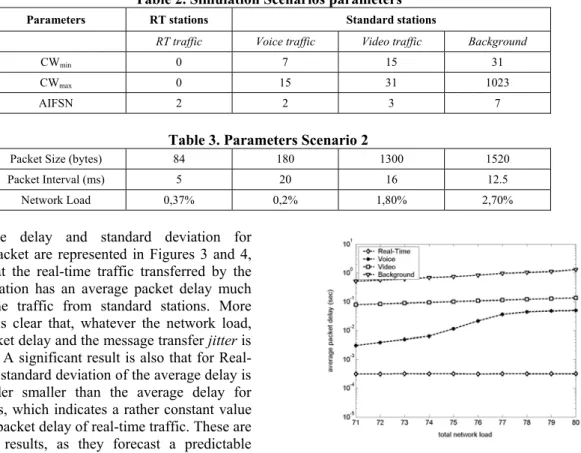
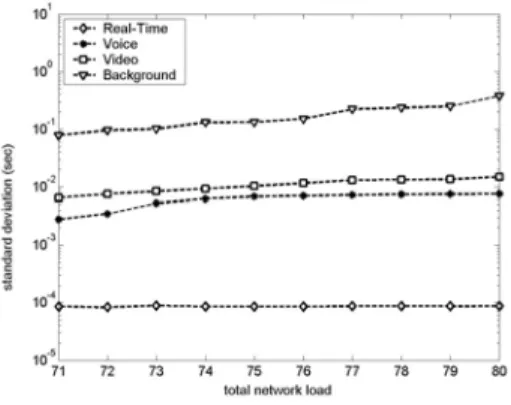
The average delay and standard deviation for transferring a packet are represented in Figures 3 and 4, which show that the real-time traffic transferred by the TSm-enabled station has an average packet delay much smaller than the traffic from standard stations. More importantly, it is clear that, whatever the network load, the average packet delay and the message transfer jitter is nearly constant. A significant result is also that for Real-Time traffic the standard deviation of the average delay is almost one order smaller than the average delay for standard stations, which indicates a rather constant value for the average packet delay of real-time traffic. These are very important results, as they forecast a predictable communication delay when supporting real-time communications. Additionally, it has been observed that the TS-m station did not discard any packet until the simulated network load of 77%.
Figure 4. Standard Deviation Scenario 1.
In Scenario 2, 1 RT station (m=1) coexists with a variable number of standard stations (n=4, 6, 8, 10…20). The RT station transmits at the highest priority according to the TSm mechanism. The standard EDCA stations transmit three types of traffic (voice, video and background traffic). All traffics are CBR/UDP sources (the packet lengths and other parameters are shown in Table 2), each station operates at IEEE 802.11a PHY mode and the PHY data rate is set to 36 Mbps. The total network load range varies from about 19% to 94.5%, by increasing the number of active standard stations. The packet size includes the whole frame, i.e., data plus header. The results for Scenarios 2 will be plotted considering the number of standard EDCA stations (n).
The average delay for transferring a packet is represented in Figure 2. The results are intended to compare the average delay for transferring a packet by RT stations vs. standard EDCA stations. The results show that the RT traffic has an average packet delay smaller than other traffics.
Figure 5. Average Delay Scenario 2.
However, it can also be seen that the average packet delay is no longer constant, which indicates that, for higher network load variations (from about 20% to 95%), the TSm mechanism is no longer able to keep almost constant average packet delays. Nevertheless, the achieved results still highlight a much smaller average packet delay for the RT traffic, when compared to the voice traffic (for the same set of default parameters as in standard IEEE 802.11e applications).
Figure 6 compares the standard deviation of the average packet delay, which is directly related to the message transfer jitter. From Figure becomes clear the difference between the message transfer jitter for each kind of supported traffic.
Figure 6. Standard deviation Scenario 2.
The average throughput for each type of traffic is plotted in Figure 7. It can be seem that throughputs are very similar in both voice and video traffics, as the line are almost superposed. However, it is unquestionable the improvement carried on by the TSm mechanism, as for the RT traffic the throughput is nearly constant and equal to 1 (the worst case achieved for the throughput values were 99.85% in the Scenario 2). This is a remarkable result, as it indicates that in highly loaded network scenarios, the TSm mechanism is able to guarantee the deliver of almost every RT message (these results must be confirmed by an analytical assessment, as no timing guarantees can be deduced from simulation analysis).
Figure 7. Throughput Scenario 2.
5 Conclusion
This paper proposes a new Traffic Separation Mechanism (TSm) to allow the coexistence of CSMA standard stations with modified (real-time) stations in the same wireless network domain. The TSm mechanism was designed to be used in open communication
environments, where both the number of communicating
devices and its timing requirements are not known by the real-time system designer at setup time.
The simulation analysis has been done. The performance measures included: throughput, average packet delay and standard deviation of the average packet delay. The results obtained in simulation Scenario 1 demonstrates that the proposed underlying TSm mechanism guarantees the highest transmitting probability to TSm station in a wireless environment with multiple EDCA standard stations. More importantly, it is clear that, whatever the network load, both the average packet delay and related standard deviation are nearly constant for the real-time traffic. This is a very important result, as it forecasts a predictable communication delay when supporting real-time communications.
Furthermore, the results obtained in Simulation
Scenarios 2 demonstrates that the TSm mechanism has a
good performance in an open communication
environment, where real-time TSm-enabled stations
coexist with multiple IEEE 802.11e standard stations. Mainly, the TSm mechanism improved the throughput of real-time traffic, which has key impact on the quality of real-time communications.
References:
[1] "Information technology- Telecommunications and information exchange between systems- Local and metropolitan area networks- Specific requirements- Part 11: Wireless LAN Medium Access Control (MAC) and Physical Layer (PHY) Specifications," in ANSI/IEEE Std 802.11, 1999 Edition (R2003), 2003, pp. i-513.
[2] D. Miorandi and S. Vitturi, "Analysis of master-slave protocols for real-time-industrial communications over IEEE802.11 WLANs," presented at Industrial Informatics, 2004. INDIN '04. 2004 2nd IEEE International Conference on, 2004.
[3] J. Deng and R.-S. Chang, "Priority scheme for IEEE 802.11 DCF access method," IEICE Transactions on Communications, vol. E82-B, pp. 96-102, 1999. [4] J. L. Sobrinho and A. S. Krishnakumar,
"Quality-of-service in ad hoc carrier sense multiple access wireless networks," Selected Areas in Communications, IEEE Journal on, vol. 17, pp. 1353-1368, 1999.
[5] G. Bianchi, "Performance analysis of the IEEE 802.11 distributed coordination function," Selected Areas in Communications, IEEE Journal on, vol. 18, pp. 535-547, 2000.
[6] J.-D. Kim and C.-K. Kim, "Performance analysis and evaluation of IEEE 802.11e EDCF," Wireless Communications and Mobile Computing, vol. 4, pp. 55-74, 2004.
[7] "IEEE Standard for Information technology - Telecommunications and information exchange between systems - Local and metropolitan area networks - Specific requirements Part 11: Wireless LAN Medium Access Control (MAC) and Physical Layer (PHY) specifications Amendment 8: Medium Access Control (MAC) Quality of Service Enhancements," in IEEE Std 802.11e-2005 (Amendment to IEEE Std 802.11, 1999 Edition (Reaff
2003), 2005, pp. 0_1-189.
[8] "Information technology - Media access control (MAC) bridges," in ANSI/IEEE Std 802.1D, 1993, pp. 1.
[9] R. Moraes and F. Vasques, "A Probabilistic Analysis of Traffic Separation in Shared Ethernet Systems Using the h-BEB Collision Resolution Algorithm," presented at 13th International Conference on Real-Time Systems - RTS'2005, Paris - France, 2005. [10] R. Moraes and F. Vasques, "Real-Time Traffic
Separation in Shared Ethernet Networks: Simulation Analysis of the h-BEB Collision Resolution Algorithm," presented at 11th IEEE International Conference on Embedded and Real-Time Computing Systems and Applications, Hong Kong - China, 2005. [11] R. Moraes and F. Vasques, "Probabilistic Timing
Analysis of the h-BEB Collision Resolution Algorithm," presented at 6th IFAC International Conference on Fieldbus System and thei Application, Puebla, México, 2005.
[12] F. Carreiro, R. Moraes, J. A. Fonseca, and F. Vasques, "Real-Time Communication in Unconstrained Shared Ethernet Networks: The Virtual Token-Passing Approach," presented at Emerging Technologies and Factory Automation - ETFA, Catania, Italy, 2005. [13] Q. Ni, L. Romdhani, and T. Turletti, "A survey of QoS
enhancements for IEEE 802.11 wireless LAN," Wireless Communications and Mobile Computing, vol. 4, pp. 547-566, 2004.