Paralympic VR: an immersive experience
Caroline Delmazo
April, 2018
Project work presented in partial fulfilment of the requirements necessary to obtain the Master's degree in New Media and Web Practices attained under the scientific supervision
To Léa, Luiz Carlos, and Hilda,
ACKNOWLEDGEMENTS
Many thanks to my advisor for the expertise and support throughout this process and, mostly, for the inspiration as a disruptive researcher. I am really grateful to Rui Avelans Coelho for the competence and outstanding partnership in working and learning. I would like to give a special thanks to Samsung on behalf of Hugo Bento and Joana Santos for the crucial support.
I also wish to thank iNOVA Media Lab team, not only for the practical support but also for believing in the project, particularly Janna Joceli, for the friendship, motivation, and every smile; Paulo Oliveira, for the help and stimuli in the essential moments; Ana Figueiras, for the impeccable moderation and for sharing the enthusiasm; Dora Santos Silva, for the emotional strength; and Paulo Castanheiro, for the audio inspiration.
I would like to express my gratitude to Catarina Gomes, for helping and encouraging me in the “360 trip” and for always thinking ahead. I also thank Davide Mancine for completing the recording crew. Many thanks to the Portuguese wheelchair basketball players and staff for opening the doors to the project and being helpful since the first contact, particularly Augusto Pinto, Márcio Dias, Marco Galego, and Pedro Gonçalves. I thank each of the participants of the focus groups for the valuable contribution.
My heartfelt thanks are due to Ana, Nuno, and fantastic Alda, for being the best Portuguese friends one person can have. I am also grateful to Ana Filipa and Joana, for the dinners and patience, and to Fernanda, for the friendship and partnership. I extend my gratitude to my friends in Brazil, especially Luísa and Thais, for the incredible support that went beyond the Atlantic ocean. Special thanks to Maria Martha, for the priceless dedication in the revision process.
PARALYMPIC VR: AN IMMERSIVE EXPERIENCE
CAROLINE DELMAZO
ABSTRACT
KEYWORDS: Paralympic sports, wheelchair basketball, Virtual Reality, 360 video.
Paralympic VR: an immersive experience is based on exploratory research and consists in the
production of a 360 video-prototype that aims to give special access to the wheelchair basketball training universe, bringing the users close to Paralympic athletes without the need to hide the impairment or hyper focus on the stories behind the disability.
Media coverage of Paralympic sports and the representation of disabled athletes have been changing, but still present a medicalised framing, a narrative where the athletes are commonly portrayed as heroes due to the overcoming of difficulties related to the impairment and not to the sports results. This present project work considers immersive journalism and the use of virtual reality technologies as the means by which an alternative approach and a better representation of Paralympians are possible.
PARALYMPIC VR: AN IMMERSIVE EXPERIENCE
CAROLINE DELMAZO
RESUMO
PALAVRAS-CHAVE: Desporto paralímpico, basquete em cadeira de rodas, Realidade Virtual, vídeo 360.
Paralympic VR: an immersive experience baseia-se em investigação exploratória e consiste na produção de um vídeo 360 graus que visa dar acesso especial ao universo de treino do basquete em cadeira de rodas, aproximando os utilizadores dos atletas paralímpicos sem a necessidade de ocultar a deficiência ou dar grande enfoque às histórias por detrás da deficiência.
A cobertura do desporto paralímpico nos media e a representação dos atletas com deficiência está a transformar-se, mas ainda apresenta uma abordagem medicalizada, uma narrativa em que os atletas são comumente retratados como heróis devido à superação de dificuldades relacionadas à deficiência e não em virtude aos resultados desportivos. O jornalismo imersivo e o uso de tecnologias de realidade virtual são considerados no presente trabalho de projeto os meios pelos quais é possível uma abordagem alternativa e uma melhor representação dos atletas paralímpicos.
O projeto apresenta a descrição de todo o processo de produção do vídeo-protótipo, detalhando decisões de conceito, aspectos técnicos e, principalmente, os desafios e lições aprendidas. Um estudo com utilizadores combinando grupos de foco e questionário on-line também foi conduzido para a recolha de perceções sobre a experiência de assistir ao vídeo com o headset Samsung Gear VR. Os comentários fornecidos pelos participantes indicaram
CONTENT
1. Introduction ... 1
2. Literature review ... 4
2. 1. Sport, disability, and media ... 4
2. 2. Immersive Journalism ... 9
2. 3. Sports and VR ... ….15
2. 4. Lessons for VR storytelling ... 20
3. Developing the experience ... ……22
3. 1. The production process ... 23
3. 2. Shooting 360: unlearn to learn ... 26
3. 3. Post-production ... 31
4. User study ... 36
4. 1. Groups set up ... 37
4. 2. After-experience online survey ... 38
4. 3. Focus groups discussion ... 40
5. Overall discussion ... 46
6. References ... 50
List of figures... 57
Appendix 1 - Initial shot list ... i
Appendix 2 - Questions for the interviews ... ii
Appendix 3 - Final shot list ... iii
Appendix 4 - Film script ... vi
1.
INTRODUCTION
“I think people still have not understood that parasport is serious sport. They often see us as if it were
something of charity, to make happy who has a disability”, Deepa Malik, as cited in Delmazo, 2016
The Rio 2016 Paralympic Games were a milestone to Deepa Malik: she was the first Indian woman to win a Paralympic medal in history. As other Paralympic athletes, she has an inspiring life story and has overcome important obstacles since a tumour in her spine resulted in paraplegia. Her silver medal in the shot put competition also meant overcoming, but overcoming hard training, measures in the shot put field, results. She is an athlete, and wanted to be seen as an athlete, as the non-disabled ones.
Every four years, after the Olympic Games, another big sport event takes place: the Paralympic Games. The word “Paralympic” derives from Greek preposition “para” (beside or alongside) and the word “Olympic”. According to the International Paralympic Committee (n.d.-a), “Paralympics are the parallel Games to the Olympics and illustrates how the two movements exist side-by-side”. The growing attention drawn by the Paralympic Games also shed light on media representation of impaired people. Beacom, French and Kendall (2016) emphasize that wider discourses relating to disability sport and representations of disability in general are influenced by media representations (p.58). According to the World Health Organization1, over a billion people have some form of disability. It means about 15% of the
world's population.
We assume here R. F. R. Marques, Gutierrez, de Almeida, Nunomura and Menezes (2014) definition of Paralympic athletes as individuals who practice and compete systematically and officially in one of the sports included in the Paralympic Games organized by IPC (p.991). Media coverage of Paralympic athletes has been changing, but it still presents a medicalised framing, a “triumph-over-adversity” narrative where athletes are seen as heroes that overcome difficulties related to the impairment. (Beacom et al., 2016; Maika & Danylchuk, 2016; Brittain, 2017). In addition to what researchers have found, the author’s personal experience as a journalist was essential to this perception, having covered Paralympic sports and done hundreds of interviews with Paralympic athletes.
We advocate the view that there is a need to better represent Paralympic athletes in media coverage. Immersive journalism is considered here the means by which this better representation could be possible. As Cordeiro and Costa (2016) remark, an immersive journalism benefit is that, when participating to the news, the user does not depend only on journalistic reporting (written, audio-visual, etc.) to form the understanding about a given event (p.113).
The main objective of this project is to create an immersive experience using virtual reality (VR) technologies that allows a more natural perception of disability and sport, portraying impaired athletes as athletes, without the need to hide or ignore the disability while telling stories about Paralympians. We hold the position that it is not necessary to choose between the sport’s framing or the disability’s framing, in accordance with McNamee (2017), who defends that “a dual lens is needed” (p.203). The secondary objective is to contribute to a better understanding of Paralympic sports in terms of rules and specifications.
Paralympic VR: an immersive experience is a project work based on exploratory research. It consists in the production of a 360o video-prototype that allows special access to
the wheelchair basketball training universe, letting users feel really close to Paralympic athletes. As Vicente (2018) emphasizes, it is crucial for Digital researchers not to study media,
but in media, as “the contact with the system structures that actually make digital media realities is a fundamental requirement to a simultaneously in and out meaning making”.
The structure of this document is the following. Literature review is divided into four topics. In the Sport, disability, and media section, it presents a brief history of adapted sport and the growth of the Paralympic Games, as well as the studies regarding how media has been covering Paralympic sports and representing impaired athletes. The next section focuses on
Immersive journalism, the key-concepts related to it and how virtual reality technologies have been used in media coverage in recent years. The third one, Sports and VR, revises different uses of virtual reality in this field, such as a training tool or an entertainment experience for users, both in third or first-person point of view. The last section in the literature review describes studies that bring Lessons for VR storytelling.
The following section describes the User study conducted in the aftermath to have insights of how was the user experience when watching the video-prototype with a Head-Mounted Display (HMD) and what should be done differently in future work on the same purpose. Four focus groups were organized with this aim. Users discussed in-depth the experience after seeing the video, providing important feedback, which is further detailed. The Overall discussion presents limitations of the project and indications for future work concerning
2.
LITERATURE REVIEW
2.1. Sport, disability, and media
Sport and disability belonged to different worlds for much of history. DePauw (1997) states that impaired people were excluded from sport as they didn’t meet “the socially constructed ideals of physicality, masculinity and sexuality” (p.421). The foundation of the first Sports Club for the Deaf took place in 1888 in Berlin. Nonetheless, the decisive push for the widely introduction to sports for people with disabilities happened after the World War II in Stoke Mandeville, England, where dr. Ludwig Guttmann used sports as a way for rehabilitation of patients with spinal cord injury. In 1948, he organized the first Stoke Mandeville Games, an archery competition with a total of 16 wheelchair athletes (International Paralympic Committee, n.d.-a).
The transition from rehabilitation sport to competitive sport occurred in the following decades, with the growth of the Stoke Mandeville Games (Blauwet & Willick, 2012). The ninth edition was held in 1960 in Rome, Italy – same place of the Olympic Games in that year – with 400 athletes from 23 countries, and it is considered the first edition of the Summer Paralympic Games (Goggin & Hutchins, 2017).
Since 1960 the Paralympic Games took place every four years, with an increasing number of sports including not only wheelchair athletes, but also individuals with other impairments such as amputees, people with visual and motor disabilities and cerebral palsy (J. C. Marques, 2017). The first Winter Paralympic Games were held in Ornskoldsvik, Sweden, in 1976. Ever since they have taken place every four years.
representation of Paralympic Athletes has been slower, as Maika and Danylchuk (2016) point out: “It was not until the twenty first century that a partnership with the Olympic Games truly began to bring the Paralympic Movement to the attention of a broader audience of sport consumers”(p.404).
Media coverage in Paralympic Games
In 2000, 2,300 media representatives were on site to cover the Games in Sydney, Australia, while 3,103 worked in the coverage of Athens 2004, in Greece. This increasing coverage reached its peak in the Rio 2016 edition, in Brazil, the most broadcast in the history of the Paralympics. It was covered by television, radio and online outlets in a record of 154 countries (International Paralympic Committee, n.d.-b).
The portrayal of disabled people through the coverage of the Paralympic Games, even summer or winter editions, has been studied by several scholars. Thomas and Smith's (2003) analysis of articles from four British newspapers regarding the Sydney 2000 Paralympic Summer Games exposes the use of medicalised descriptions of disability. Almost one quarter of the articles in the sample shows a victimization of the athletes, depicted as “courageous people who ‘suffer’ from ‘personal tragedies” (p.172). The study also indicates that most of the photos used on the coverage seemed to hide the impairment and no amputee athletes were shown.
Studies of journalistic articles focused on more recent editions, such as London 2012 Summer Paralympic Games and Sochi 2014 Winter Paralympic Games, indicate the permanence of a medicalised framing. Beacom et al. (2016) note that, even though the general perception of media coverage of both events was positive, the small-scale qualitative analysis of the articles in two British newspapers (The Daily Mail and The Guardian)
demonstrates that the media still tends to objectify disabled people and to promote the “triumph-over-adversity” narrative in order to sensationalize stories.
A first analysis of the Canadian coverage of London 2012 edition, as Maika and Danylchuk (2016) remark, shows that 61% of the articles surrounding the Games, in the
stereotype "Supercrip". Thus, the overall effect shifts “from a sport-focused narrative towards a feature or human interest story that paints the athlete as inspirational or heroic, not for his/her sporting achievements, but for the ability to persist in the face of his/her impairment” (p.410).
The concept of "Supercrip" is fundamental in the literature that examines the media discourse concerning parasport. Berger (2004) define the “Supercrips” as “individuals whose inspirational stories of courage, dedication, and hard work prove that it can be done, that one can defy the odds and accomplish the impossible”(p.798). The constant presence of the “Supercrip” approach, Berger argues, raises the concern regarding false expectations about what disabled people should be able to reach: they supposedly only need to try hard enough. The “Supercrip” stereotype and the medical approach were not prominent in the articles analysed by Marques (2017) from two Brazilian newspapers (Folha de S. Paulo and Lance!) about the last edition of the Summer Paralympic Games, held in Rio, in 2016. The
articles highlighted the achievements and results of the athletes, avoiding their representation as heroes who succeed to overcome the disability or as individuals whom we should look at with compassion or even strangeness, due to their impairment (p.13). The analysis of the photos that illustrated the articles, nevertheless, identified images highly focused on the disability itself or emphasising the idea of Paralympians’ vulnerability.
The broadcast companies, as Brittain (2017) summarizes, used to keep few people working on the coverage of the Paralympics, for the production of only some hours of recorded programs about the Games. In the last editions, the interest in the event has increased significantly, with live coverage and more people involved. The British Channel 4 is an example. It won the bid as the official broadcaster for 2012 London Paralympics with the promise of 130 hours of coverage. They did not stop there, continuing to broadcast a range of parasport events after the Games, and trying to improve the quality of their programming in order to “educate the general public about parasport and improve the visibility of people with disabilities across all of its programming” (p.256). Brittain ponders that, despite the growing coverage, the content still has a medical approach and uses the “Supercrip” stereotype, supporting the above mentioned studies regarding print press coverage.
in Rio had a cumulative audience of more than 4,1 billion people. The total number of hours broadcast increased to nearly 5,110, more than the total hours broadcast for Beijing 2008 and London 2012 combined. Only the content available via the IPC’s digital media channels leaded to 79 million video views across different platforms (International Paralympic Committee, 2016).
Athletes’ view and empowerment
Some studies were centred on the athletes’ point of view. Based on semi-structured interviews with 23 Brazilian Paralympic athletes, R. F. R. Marques et al. (2014) observe that, in regards to media coverage, most respondents prefer the focus on their athletic achievements and felt uncomfortable with the “Supercrip” discourse, although some accept this framing once it allows more media exposure. In a similar study, with nine Portuguese Paralympic athletes, R. F. R. Marques et al. (2015) found analogous results: they prefer the approach focused on sports performance to the detriment of the “triumph-over-adversity” discourse. However, some of them recognize that the “Supercrip” speech attracts broader audience.
It is also important to mention the growing use of Social Media platforms as a tool to provide voice to the athletes, who have found an easier way to communicate to the general public. Beacom et al. (2016) highlight that it has been changing “the construction of contemporary disability identities, enabling athletes to articulate their personal perspectives as competitors with disabilities” (p.58).
Another very discussed subject among scholars is whether the Paralympic Games is a viable platform for empowerment of individuals with disability in general. Purdue and Howe's (2012a) study - based on interviews with current and former Paralympians, active and retired disability sport administrators, social researchers and disability rights advocates - suggests that the Games may, to some extent, be considered as a potential tool to empower disabled people, once it creates sporting and lifestyle role models. However, the authors remark that “from the views of some Paralympic stakeholders, Paralympians may appear best suited to becoming empowered” (p.915).
quality of life, helping to reinforce an identity “which provided a sense of acceptance, purpose, and pride” (p.2068). Similarly, after interviewing six retired British Paralympians who had participated in a total of 22 Summer Paralympic Games, Braye (2016) holds the position that Paralympic athletes can contribute to equality for disabled people in general. Even though most part of the retired athletes don’t see themselves as activists, they consider they can be active “in trying to break down barriers, change attitudes and create opportunities” (p.1294). Peers (2012) criticizes what she identifies as the two common types of elite disability sport research: media analyses and sport-as-empowerment research. She uses Foucault’s concepts of discourse in an analysis that “challenge the dominant scholarly trend of characterizing elite disability sport as a form of resistance, in and of itself” (p.311). The disabled activists affiliated to disability rights entities, who participated to another study carried out by Braye, Dixonand Gibbons (2013), show a particular view that also differs from the “sport-as-empowerment research”. They believe that the Paralympic Games promote an unrealistic view of the disabled people’s life and can be seen as counterproductive to disability rights. The Media portrayal of disability built through the coverage of the games is also seen as negative, once “heroic stories of super cripples seem more important than real everyday issues”, as one of the participants in the study stated (p.992).
Media challenges
Escaping from the approach of Paralympic athletes as "Supercrips" is considered here one of the main challenges for media narratives. It is also a hard task to deal with what Purdue and Howe (2012b) named as the “Paralympic Paradox”: when emphasizing the sports achievements and not the disability, it could help to empower people with impairment. On the other hand, when de-emphasizing the athlete’s disability, it can lead to a confusion among able-bodied audience, who needs to identify Paralympians as possessing some kind of impairment. At the same time, it can contribute to distance the viewers with disabilities from the athletes (pp.194-195).
to offer an approach to the Paralympic world in a very special perspective, seeking to contribute to a more natural view of sport and disability, as proposed by DePauw (1997):
The transformation of sport culture will mean we are able to “see” sport and athlete with a disability without seeing any contradiction, without assuming a physical liability, stigma or deformity, and without assuming an impaired athletic performance. That is, we will see an athlete, an athletic performance, and a “sporting body” (p.424).
2.2. Immersive journalism
The aim of an immersive experience in journalism is providing a “special perspective”. When introducing the concept of immersive journalism, de la Peña et al. (2010) explain that the person, typically represented in the form a digital avatar, participate of a virtually re-created scenario representing the news story as a visitor with first-hand access or through the perspective of a character which is part of the story. In both ways, “the participant is afforded unprecedented access to the sights and sounds, and possibly, the feelings and emotions that accompany the news” (p.292).
De la Peña et al. (2010) and other researchers highlighted three key-concepts regarding immersive environments. The first key concept is Place Illusion (PI), a strong sense of being in a place even though you know that you are not in fact there, as defined by Slater (2009). He further asserts that PI is “the human response to a given level of immersion, and is bound by the set of SCs (sensorimotor contingencies) possible at that level of immersion” (p.3552). Slater also explains that Plausibility (Psi), in turn, is the illusion that what is happening is actually happening, in a reliable relation to what would happen in reality and the actions you perform are responded by the environment. Moreover, there are correlations between external events not directly caused by you and your sensations. In this context, the consequence is what Slater calls RAIR, ‘response-as- if-real’.
between the posture of the virtual body representation and the actual person’s posture can lead to a lesser perception of body ownership compared to situations where real and virtual postures are similar. The analysis also suggests that a virtual posture more uncomfortable than the real one can result in psychological discomfort.
One of the de La Peña’s pioneering works observed a similar result: an immersive experience where the participant “enters” in the digital body of a prisoner in a cell in Guantánamo and he/she listens to the interrogation being held in an adjacent cell. The audio was produced based on the reading of real interrogations. The avatar was in a crouched position in an apparently wooden box. Even though the participants were sitting in a straight position, some reported the feeling of physical discomfort (de la Peña et al., 2010).
Domínguez-Martín(2015) remarks that immersive journalism is still a simulation, even if it is a reconstruction of real facts in which no alternatives are given. It is a narrative experience of a representation, where people and actions of a fragment of reality are simulated and users participate somehow (p.420). This kind of simulation for news purposes is one of the growing uses of virtual reality (VR), defined by Aronson-Rath, Owen, Milward and Pitt (2015) as “an immersive media experience that replicates either a real or imagined environment and allows users to interact with this world in ways that feel as if they are there”. The virtual environment can be created based on video recording of real scenes or be totally built in Computer Generated Imagery (CGI). The access to this virtual world is possible by the use of head-mounted displays (HMD) which are evolving rapidly, along with technological advances in 360-degree, 3D-video capture and computational capacity (Aronson-Rath et al., 2015).
Other pioneering immersive experiences led by de La Peña are worth mentioning, firstly in the Immersive Journalism Group and more recently in the Emblematic Group. Domínguez (2017) highlights the following pieces of the “godmother of VR”: Hunger in Los Angeles, Project Syria – described in http://www.immersivejournalism.com - and After Solitary, Out of Exile, Kiya and Use of Force – which can be found in
www.emblematicgroup.com. She also points out that immersive formats are increasingly
Here we remark some examples. Vice News’ The Millions March2, published in January, 2015 is one of the significant first 360-degree videos in the news landscape. Led by reporter Alice Speri, it provides an inside view of a march that took place in December, 2014, when 60,000 New Yorkers protested racial profiling by police. The 360o video, as explained by Tse
et al.(2017), is created with a camera that simultaneously records all 360 degrees of a scene and footage is stitched so that users can pan and rotate the video’s perspective to watch it from different angles.
Since November 2016, The New York Times has been providing daily 360-degree
videos. In the article that introduces the feature, the pieces are described as “immersive videos put you at the centre of the scene, allowing you to look left, right, up, down and behind you” (The New York Times, 2016). Even before the publication of the daily 360o videos, the
company had also been investing on actions to boost the consume of VR productions. In November 2015 the NYT attached to its Sunday paper edition a million of Google Cardboards,
the simplest virtual reality headsets available, encouraging people to see The Displaced - stories of three children who were driven from their homes by war- in the new NYT VR app. Six months later, they did a “second round”, sending out 300,000 Cardboard headsets to its "most loyal" digital online-only subscribers, promoting the VR production Seeking Pluto's Frigid Heart, a visualization of the dwarf planet based on data from the New Horizons spacecraft (Robertson, 2016).
Time Inc. is also investing on its virtual reality platform, TIME VR, which offers immersive experiences from some of their publications such as TIME, People, and Sports Illustrated. The purpose is to provide“360° video and interactive virtual reality experiences to engage every passion, including news, entertainment, sports, fashion, history, food, and travel”. One of the most famous productions is The People’s house, an “intimate journey” to Former President Barack Obama and Former First Lady Michelle Obama’s White House in Washington D.C., United States (Time Magazine, 2016).
The Guardian’s first virtual reality experience 6x9: a virtual experience of solitary
confinement, launched in April, 2016, places the user inside a solitary confinement prison cell in the United States, focusing on the psychological damage caused by long-term isolation. The
cell was designed with the Unity 3D game engine, using CGI. The user hears the real voices of seven people who have spent time in solitary confinement. A different voice can be listened depending on the viewer’s gaze – from the toilet, the book, the letter. (Davies, 2016).
The Guardian is still investing on VR stories, as the more recent The Party – a virtual experience of autism, available since October, 2017. The user is put in Laila’s shoes, a 15-year old autistic girl, at her mother’s surprise birthday party, trying to manage the anxiety while dealing with stressful situations. The piece was written by an autistic writer, Sumita Majumdar, filmed with the Google’s stereoscopic 360° camera (Jump) and had the participation of 25 actors. According to Francesca Panetta, executive editor, virtual reality in Guardian News & Media (as cited in GNM, 2017), “The Guardian’s VR studio is interested in how we can work with researchers and academics to turn journalism into first person dramas”.
Broadcasters such as NBC News3 and ABC News4 have special sections in their websites
dedicated to VR/360o video production. Virtual reality projects have been under test in the
BBC Taster5. In order to test technology and editorial potential of VR/360ovideo, the tool
provides works that people can try, rate and share. One example is We Wait: real stories of refugees are the basis for an animated virtual experience, which permits interactive eye-contact between audience and the characters (Conroy, 2017).
The BBC’s We Wait was built specifically for the Oculus Rift VR headset. However, most part of the productions, as the majority of the above mentioned ones, are able to be experienced in different and simplistic ways: with only a smartphone, panning during playback by simply moving the device in any direction as a “magic window”; in a desktop, using the mouse to move the scene; or with headphones and different headsets.
The 360-degree video, or cinematic VR, is considered the most accessible type of VR. It provides a certain degree of immersion, but the user is in a central position that cannot be altered within the environment, as the Emblematic Group (2016) observes. On the other hand, the volumetric VR (or kinematic VR) allows the participant to move around inside the environment choosing among different viewpoints. It requires external sensors to track the
3https://www.nbcnews.com/storyline/nbc-news-vr
4http://abcnews.go.com/VR
position of the headset and adjust what the user sees in real time based on their position. “The range of experiences available to consumers is vast: from videos that simply offer a spherical field of view to interactive environments that deploy the artistry and techniques of video games in the service of journalism” (Emblematic Group, 2016).
In a recent article, with the purpose of reviewing a range of VR applications, Slater and Sanchez-Vives (2016) hold the position that VR is not going to replace traditional media. It is a new type of media for news reporting providing a different perspective, leading to another understanding of the events . “[T]he goal is not so much the presentation of ‘what happened’ but to give people experiential, non-analytic insight into the events, to give them the illusion of being present in them”(p.32).
Immersion: a technical or a cognitive aspect?
According to Slater and Sanchez-Vives (2016), immersion describes the technical capabilities of a system, the physics of the system, while the subjective correlate of immersion is presence, the place illusion of “being there” previously mentioned. The degree of correlation between immersion and presence was examined by Cummings and Bailenson (2016) in a meta-analysis of 155 effect sizes of 83 studies. Overall, it was found that immersion has a medium-sized effect on presence, while individual immersive features were found to vary in their effect sizes. According to the study, tracking level, stereoscopy and field of view have a stronger impact on user spatial presence compared to other features, particularly image quality and resolution and sound. It is important to remark that the study relied on self-reported information.
Shin and Biocca (2017) investigated how users react to an immersive journalistic experience. The study combined questionnaires and an experiment designed in a 2x2 format, considering two levels of immersion (VR-content-based and flat-screen-TV-based) and two personality traits (high immersion tendency and low immersion tendency). The results indicate that technological properties alone do not lead to enhanced immersion. It strongly depends on the users’ traits and contexts. “Rather than immersion being an external factor being given to users, immersion is a fluid state that is processed and determined by users” (p.13).
VR has been called the “empathy machine”, which refers to “any attempt to make sensible to oneself the emotional experience of another via technology, often with the goal of inhabiting another body” (Bollmer, 2017, p.63). The possibility to empathise with another person is facilitated by a virtual reality experience, according to Schutte and Stilinović (2017)’s pilot study. The eight-minute long United Nations documentary ‘Clouds over Sidra’ was presented in two conditions: the VR one, in which participants saw the 360-degree video in a Samsung headset, and in the control condition, when the documentary was seen in a two-dimensional format. The study showed that participants in the virtual reality condition experienced significantly greater empathy for Sidra, the refugee girl featured in the film. In this case, the authors remark, the life in a refugee camp is a presentation of a group of others, once the Australian participants had no direct contact with that reality. Similar studies, they argue, should be replicated with larger samples and even test the impact of VR in situations where the participants have contact with the context/characters presented in the video.
Shin (2018) observes that becoming absorbed in VR can stimulate empathy and participants may feel other’s emotions by being in the same space, and close to that character. However, he remarks that is still unclear if immersion has an impact on empathy or embodied cognition. A 2x2 between-subject survey, with a very similar format comparing to the previous one (Shin & Biocca, 2017) - indicates that high immersive devices may contribute to certain levels of embodiment and empathy, although the user’s traits ultimately define those levels. “People who understood the issues in the story, and could relate to them, found it much easier to empathize and embody the content than those who did not” (p.71).
comes to digital media, once, according to him, technology presumes to acknowledge the experience of another, but inherently it is not possible. Instead of the statement that empathy can be provoked by digital media, reliant on VR, he proposes that media can contribute to foster radical compassion. Following the French philosopher Emannuel Levinas and other philosophers to discuss Levina’s ethical relationship of faciality, and also bringing a historical discussion of empathy as an aesthetic category, Bollmer states that the “understanding” that came with empathy destroys the metaphysical relation Self-Other, converting the Other into an object to be consumed, absorbed. That’s why he suggests the term radical compassion, which regards “the potentials of not understanding another, of not feeling what they feel, in a way that does not negate or ignore the experience of another but is open to it, even if it can never fully grasp it” (p.73).
2.3. Sports and VR
Liao (2015) identifies four main uses of VR in the field of sports: in the high-performance level, as a tool for training purposes so that athletes and coaches can interact with simulated environments to enhance their skill levels (systems developed in China for diving, trampoline and basketball are some examples given); in sports rehabilitation, with satisfying effects been achieved in areas such as spatial perception disorders, memory disorders, poor coordination and balance, among others; in what he calls “popular sports”, mentioning Chinese examples of virtual environments for bowling and athletics; and in physical education, especially for sports technique analysis.
Slater and Sanchez-Vives (2016) mention several studies describing VR experiences in sports such as table tennis, football, rowing, baseball, handball, skiing, rugby, and shooting. They point out the need to carry out rigorous analyses to check if “small differences between the VR version and the real version might lead to poor skills transfer, or incorrect learning”(p.16). However, they highlight the advantage of VR to plan overall strategy and tactics in team sports.
Miles, Pop, Watt, Lawrence and John (2012), in a review of Virtual Environments (VEs) for ball sports, identified challenges that need to be overcome in delivering training environments. Besides costs, they draw attention to the importance of identifying types of skills best suited to training in VEs and technologies that achieve the best results in specific performance measures. Moreover, they consider important to evaluate the situations in which the use of stereoscopic displays and high fidelity systems are really needed. It is also critical to know how and when feedback should be delivered to the learner. The reliability of skills transfer from VE training conditions to real-world practices is another key-point highlighted.
Covaci, Olivier and Multon (2015) remark two topics not discussed by Miles et al. (2012): spatial perception in large VEs and the use of visual guidance. Both aspects are examined in their study for the development of an immersive training system for basketball free throws, an aiming and precision task. The natural motor behaviour and success rates of beginners when performing free-throws on a real court were recorded. Then, using a large-screen immersive display (LSID), researchers tested beginners’ performance in three visual conditions: first-person perspective, third-person perspective, where the virtual ball is displayed in front of the user, and third-person with guidance feedback, where the circles displayed in front of the user show the ideal trajectory. Stereoscopic glasses were used and synchronized with the immersive room. Each result was also compared with the performance of experts in the real situation. Findings indicate that users more accurately estimate distance to target in the third-person perspective, and the visual guidance information also led to more natural motor behaviour.
as explained by Rauter et al. (2013), who tested a training simulator in a CAVE (Cave Automated Virtual Environment) system. In the study, eight rowers trained either exclusively on the simulator or on water. Biomechanical performance measures, video analysis, and questionnaires were used to assess the skill transfer/development. The results showed that the simulator fostered skill gains to a similar extent as training in the real environment and, thus, it can be used as a complementary training tool.
Kalivarapu et al. (2015) developed a VR experience for American college football in order to improve recruiting process of talented students. Using the Unity 3D game engine, a simulation of the Iowa State Cyclone game-day experience was delivered for a very high-resolution environment, a six-sided CAVE named C6, and for the DK2 Oculus Rift. A user study was held with sixty participants, equally divided between three modes: C6, HMD, and regular video. Presence and immersion were measured by questionnaires. Results indicate that the C6 and HMD improved upon the standard practice of showing 2D videos in terms of interaction and examination of the atmosphere. A greater degree of realism was experienced in the Cave, although both the C6 and HMD were scored similar in the rest of presence categories. Miller et al. (2017) did a very similar study with the same virtual game application, adding a more portable solution and even lower cost HDM, the Merge VR smart phone-driven, once C6 and Oculus Rift are considered costly and do not have the ideal portability. The tests with 82 students showed that Merge VR produces similar results to Oculus and C6 in most presence categories and could be a viable alternative.
Different sports have been investing on VR to watching. The National Basketball Association (NBA) - the men's professional basketball league in North America - partnered with Intel to provide virtual reality via the TNT VR app on Samsung Gear VR or Google Daydream. For the 2017-18 season, the fans are allowed to view the game from different locations throughout the arena, from high in the stands or taking the viewpoint of the photographers sitting on the baseline, for example. By integrating 360-degree volumetric video into the VR experience, Intel also let fans freeze a moment of the game and take the player’s point of view in the court6. Post-game experiences in VR featuring highlights of
selected matches have already been provided for fans of the United States’ National Football
League (NFL)7, while cricket fans in India are expected to try the VR experience in the Indian
Premier League 2018 starting in April8.
After delivering 85-extra hours of VR content in partnership with Samsung for the 2016 Summer Olympic Games in Rio, most available on the day after each event, NBC announced a
step forward regarding the 2018 Winter Olympic Games in PyeongChang, South Korea: more than 50 hours of live VR coverage – including key-moments such as the Opening and Closing Ceremonies. Powered by Intel True VR technology, the tool is available to authenticated users with Windows Mixed Reality headsets, Samsung Gear VR, Google Cardboard and Google Daydream via the NBC Sports VR app (NBC, 2018). The Olympic Channel9 also launched
“Trending Gold”, a VR seven-episode series produced by Jaunt (a virtual reality content and technology company) that let the users experience athletes’ preparation for the 2018 Winter Olympic Games in six countries.
Sports watching turns into sports playing in Wear the Rose10 experience, designed to
Oculus Rift headset and launched in an immersive experimental event in 2014. In full 360-degree visual spectrum, the user is placed within a training session of the England Rugby Team, with a first-person point of view, as if he/she was one of the players receiving passes and participating of the training. The real images were captured by nine GoPro Hero 3 cameras. It took more than 160 hours of filming and 320 hours of development to create the experience (Williams, 2014b). After experiencing Wear the Rose, Williams (2014a) stated: “It’s an utterly bizarre blend of the surreal and the truly believable; you flinch when you’re tackled and twitch when it’s your turn to drive. You can’t help it, it just feels that real”.
Iekura et al. (2015) advocate that, even though the use of HMDs using player viewpoint is considered the closest experience to the athletes, it moves the user away from other spectators. Therefore, researchers describe SMASH, an haptic system that allows the audience to feel the players’ heartbeats and tactile sensations in the palm while enjoying sports watching with others. The athletes’ heartbeat and tactile sensation became signals driven to a diversity channel receiver, then amplified and sent to the spectator’s two-hand device
7https://www.nextvr.com/nfl-vr-experience-announce/
8https://gadgets.ndtv.com/apps/news/hotstar-vivo-ipl-2018-live-stream-vr-1801343
9
https://www.olympicchannel.com/en/playback/trending-gold/behind-the-scenes/trending-gold-go-behind-the-scenes-of-the-new-virtual-reality-series/
through a bluetooth transmitter. This research focused on the audience device and on how to share accurate player experience, leaving the implementation of the athlete’s side system for future work.
Regarding Paralympic sports, Morais, Rezende and Goncalves (2015) propose the development of a virtual environment for the training of shooting, in a computer game format, following the rules established by the competent bodies concerning the weapons included in the game, the amount of ammunition, the size of the targets, and distances between the athlete and the targets. In the model described, the interface shall adapt to the size of the display window in which the game is used. The image acquisition is performed by a webcam that interacts with the software, processing analyses of the images in matrix form. Results are displayed dynamically, providing the user with instant feedback. The goal is to allow the practice in any environment, including at home, without the need to go to training stands.
2.4. Lessons for VR storytelling
The first experiences headed by de La Peña in Second Life11 platform have already
shown the importance of integrating primary source material documenting the physical space within the virtual environment to strengthen the narrative and the sense of immersion. Moreover, after conducting a case study of the production of a VR documentary – following its planning, field production, post-production, and distribution – Aronson-Rath et al. (2015) list some recommendations for journalists seeking to work in virtual reality, such as the importance to understand, before production starts, the form and what raw material the finished work will need. Another suggestion:
If directors want to avoid relying on 2D video, or other overlays, it appears they will need to capture the action, or the interviews, as they will be experienced by the viewer; that is to say, without cuts other than the starts and ends of the scene (p.65). They further advise journalists to choose a place on the spectrum of VR technology: delivering for higher-quality devices linked to computer or for mobile devices, with less computer power and restrictions for interactivity. The Emblematic Group (2016) also recommends the decision of the platform very early in the production process, once the type of headset will determine overall parameters of the piece, and it is important to be aware of the platform capabilities. Domínguez-Martín (2015) lists 10 resources or strategies to an immersive rhetoric, such as realistic and detailed graphic style, fluidity of movement through space (which conveys the feeling of "being there") and constant ambient sound, which helps in the feeling of expectation and atmosphere in the environment.
Newton and Soukup (2016) draw attention to the amount of visual and sound information. In their studies to explore the audience’s experience in VR, when the scene had more than one focal point, some participants reported FOMO (fear of missing out). The researchers highlight that FOMO has strong potential to distract, taking the audience out of the experience, “but may also be a storytelling tool to create suspense or illicit curiosity”. FOMO was also reported by participants in Jones' (2016) focus group study, when watching a
sample of twelve journalistic 360-degree videos on various HMDs, and in Tse et al.'s (2017) findings: 35% of the 40 participants mentioned experiencing FOMO in a study carried out to explore if 360 viewing platform (magic window / Google cardboard) and headphone use (with / without) have an effect on immersion for 360-degree videos. Jones (2016) also mentions users’ feeling of discomfort for having their personal space invaded by characters very visually close in the scene. Some declared will to take off the headsets, especially in situations like protests.
A study led by Passmore et al. (2016) comparing the user experience of 360-degree video across three platforms (headset, phone and flat screen) draws attention to the fact that users in the headset condition reported less concentration on the narrative because of the possibility of looking around: they had more doubts about what they should attend to, compared to screen viewers. The voice over is another feature that should be used carefully according to the authors. In 360o video, the user needs to check, by looking around, if there is
someone talking on camera or it is a voice over.
3.
DEVELOPING THE EXPERIENCE
The purpose of this project work is the production of a 360-degree video that brings users close to the Paralympic sport’s environment by telling a story without the heroic or the “Supercrip” framing regularly used by traditional journalistic reporting. A 360-degree video, as previously mentioned, is considered by the Emblematic Group (2016) the most accessible type of virtual reality, and the same view is assumed in this project. It provides a cinematic experience, which means that the agency is to look around from a fixed central position. The workflow process of the video-prototype will now be depicted in detail. The goal is to report the challenges and lessons learned, in order to improve upcoming work related to the present subject.
As it is a prototype, we consider that, besides this first step of immersion in VR, it is an opportunity to contribute to a deeper level of immersion and interaction in a second part of the experience, a game that provides a first-person point of view. This will be developed in future work in a transdisciplinary partnership with Raquel Macedo, a Master’s student in Computer Science and Informatics Engineering in the Faculty of Sciences and Technology (NOVA/FCT). Some of the recordings done for the present project were also sent to the partner for the development of the game.
Step one: which sport and which platform?
Two important decisions were taken in the very beginning of the project. The first one regards the sport that will be the subject of the narrative. The second one is the platform to which the experience will be delivered for the users’ tests. A meeting with the Portuguese Paralympic Committee was scheduled early in April, 2017, before the official start of the project, in order to know what are the Paralympic sports practiced in the country at the high-performance level. The options took into consideration after the meeting were: athletics, boccia, cycling, judo, shooting, swimming, and wheelchair basketball.
In October, 2017, the sport chosen for the experience was the wheelchair basketball12,
due to the facts that: a) as a prototype, it was considered important to choose a sport not so challenging to be understood by people not used to it. In terms of rules, the wheelchair
basketball and regular basketball are similar, and the latter is most known by the general public; b) technically, it is believed that it is possible to reproduce the sport’s environment in a virtual world without so many difficulties in the game development led by Raquel Macedo.
The other decision, concerning the platform, was also made in the early stage of the project. Tricart (2017) remarks that what turns a 360o video into a VR experience is the
possibility of seeing the content in a VR headset, not in a flat screen. The 360o video, thus,
would be delivered to a VR headset used with a mobile phone, such as the Samsung Gear VR. It is an option for a broaden group of users, once there is no need to be attached to a computer.
3.1. The production process
The next step was to get in touch with the Portuguese wheelchair basketball team to check the feasibility of the recordings. A meeting with Augusto Pinto, president of the Wheelchair Basketball National Committee of the Portuguese Basketball Federation was scheduled in November, 2017. In this meeting we were told that the national team would have a three-day training in the High Performance Centre of Vila Nova de Gaia (North of Portugal) in December, 2017. We agreed that the recordings would be allowed in the first day and in the morning of the second day. A test recording was scheduled before the shooting in Gaia. Augusto Pinto suggested a training court in Sintra, 30 km away from Lisbon, once the features of the court are similar to the ones we would see in Gaia in December.
November 23rd: preliminary testing
The test took place at the “Pavilhão Municipal Serra das Minas”, in Sintra, during a 1h30 regular training session of the local team (“Associação Portuguesa de Deficientes”– APD-Sintra). The main goal was to try camera position while different activities were taking place. The equipment list used in the test is the following: Kodak Pixpro SP360 4K camera (with two MicroSD Cards); tripod; Roland R-44 audio recorder (with one SD Card); 4 microphones Behringer C-2; extra battery for the audio recorder.
positioned in different parts of the court such as centre, sides, the three-point arc and under the basket.
The raw material was revised the day after. The first challenge was the size of the files: the Pix Pro has two cameras in order to form the full 360o spherical video, which means that
every shot has two files. The shots in the test had an average of 4 minutes and the two files together reached 5GB for some of the scenes. Therefore, we comprehended that was counterproductive to shoot so long scenes if the Pix Pro were the camera chosen for the official recordings in Gaia. The camera ran out of battery with one hour and a half of use, which was also an important lesson: as we were planning an all-day shooting, only one camera wouldn’t be enough. Another challenge faced was to match audio and video files, since the shots were not identified during the test. Therefore, it took a long time to find the audio file correspondent to each video file. It was a constraint that couldn’t be repeated in Gaia.
The softwares used for the stitching process were VideoStitch Studio and PTGUI Pro.
The tripod and the audio recorder (placed under the tripod) were obviously seen in the images and it would be definitely a challenge for the post-production process, when masking out the rig. A decision was taken: try to replace the tripod for a monopod and look for a smaller audio recorder equipment before the shooting in Gaia.
Some shots were sent to the partner in NOVA/FCT for the second step of the experience. Real scenes of a wheelchair basketball training, even if they are monoscopic footage (flat, without depth), will be useful in the conception of the game. Photos of wheelchairs used in the sport – which differ considerably from the regular ones – were also provided to the partner.
Planning Gaia
From the test (November, 23rd ) to the official recording (December, 8th– 9th ) in Vila
Nova de Gaia, three process were led simultaneously. The first was the conduction of interviews with the coach of the national team, Marco Galego, and the captain of the team, player Márcio Dias. Those interviews were done by phone with the purpose to know their journey in the field of Paralympic sports, namely in wheelchair basketball. Having a previous idea of their careers and thoughts was essential once they are the main characters of the 360o
The second process was providing the equipment. As mentioned previously, efforts were made in order to get a monopod and a smaller audio recorder. Both were not possible due to financial constraints, so the tripod and the Roland R44 were kept. Besides the four microphones, a fifth one – a wireless lavalier mic - was added to the list, so as to replace one of the other four in the moment of the interviews. The main change comparing to the test was the choice of the camera. Samsung was contacted and agreed to lend two cameras Gear 360 (2016) and two smartphones Samsung Galaxy S7 through which it would be possible to follow the shooting via the Gear app. The Gear 360 (2016) is a small and lightweight camera that comes with dual fisheye lenses. It can capture high-resolution (3840×1920) 360-degree video that also supports 30 megapixel still images. It only provides monoscopic footage and does not produce stereoscopic footage (with depth and 3D effect). The final list of equipment was the following: 2 Samsung Gear 360 (2016) cameras (with chargers); 3 MicroSD cards; 2 smartphones Galaxy S7 Edge (with chargers); tripod; Roland R-44 audio recorder (with one SD Card); 5 microphones (four Behringer C-2 and one wireless lavalier mic); extra battery for the audio recorder; SD Card reader; a Mac book (to check the files before the second day of shooting).
The third challenge was to set the team up. Besides the author of this project, three people have voluntarily agreed to participate to the recording of the project. Davide Mancine13 is an Italian multimedia journalist and content creator with experience in video,
photo, and written content for different online media and organisations. Rui Avelans Coelho14
is a Portuguese film director, Digital Media researcher, and an audio expert. Catarina Gomes15
is a Portuguese journalist and impact manager at an immersive storytelling studio specialized in content production and VR experiences for media and Non-Governmental Development Organization (NGDO).
13Davide Mancine also funded and run a company providing new technologies for online video gathering adopted
by publishers and brands in different countries.
14Rui Avelans Coelho also taught “Sound Editing” and “Audio Post-production” in several Portuguese schools, as
well as “Experimental Video” and “Interactive Video". He coordinated cultural projects for Portuguese museums producing multimedia guides and interactive sound environments.
15Catarina Gomes also holds a Master’s degree in Journalism from the University of Aarhus (Denmark) and
Script
Based on the shooting test on November 23rd and considering both the previous
experience of the author of this project covering wheelchair basketball and the discussions with the team, a list of 22 shots was defined as the essential raw material needed in the official recording. Most of them were training scenes and eight shots were designed as 360o video
interviews (see Appendix 1).
Considering it is a prototype, the team agreed that it would be important to try a shot as close as possible to the athlete’s perspective, placing the camera in the training wheelchair, even though shots in movement are considered very risky in 360 shooting. In Jaunt’s Cinematic VR Field Guide, the concern is remarked: “Of all issues related to cinematic VR none is more important than that of moving the camera as it has the potential of literally making your audience sick” (Jaunt, 2017).
Besides the eight shots with interviews in 360o predicted in the list, we decided that a
linear audio interview must be recorded with Marco Galego and Márcio Dias. This audio would be used as a voice over on the edited video, trying to keep the audience engaged in the narrative and not only having a sequence of shots.
A short script for the linear audio interviews was also prepared as a guide (see Appendix 2). Phone interviews done before the official recording proved to be essential to think about the main questions. The ones related to rules and specifications of the wheelchair basketball, as well as the differences/similarities and motivation for training impaired athletes, would be driven to coach Marco Galego. The motivation of being an athlete and the more interesting skills in that sport would be asked to the player Márcio Dias. Both would be questioned about how they see sport and impairment.
3.2. Shooting 360: unlearn to learn
Gaia with the script of shots and interview questions as initial guides, with the awareness that different shots and different questions would raise depending on how the training would be led.
The Jaunt’ field guide remarks that trying to force the linear video sensibilities and film language into the new medium is a common mistake. They also mention a very famous phrase of one of the Star War’s characters:
As Yoda once said, ‘You must unlearn what you have learned.’ While it is of course natural to build on the skills that you already know as a filmmaker it is also important to embrace this for the new canvas that it is and experiment with new techniques and new ways of telling stories unencumbered from the past (Jaunt, 2017).
In this sense, it was a challenge not to think of close-ups, panning, zooming, and also to not count on future cuttings in the shots. In 360o video/VR, other elements can play similar
roles. When discussing a narrative grammar in 360o video, Lescop (2017) remarks that the
challenge to draw the viewer’s attention can be overcome by elements like cinematic direction, lights/shadows, and sounds. Lescop highlights that sound can change the attention from one point to another. A sudden sound, for example, can be a tool to produce the effect of a jump cut or a close-up, focusing attention.
All the time we tried to bear in mind the reason why the 360o video was chosen to
deliver this message: to provide a special perspective to the user, immerging him/her in the training routine in order to make him/she fell closer to the athletes; to facilitate the understanding of rules and specificities of the wheelchair basketball; and, at the same time, contribute to a view of sport and disability without contradiction.
Start shooting
This is one of the main differences between a linear video and the 360o recording: as
the camera simultaneously records all 360 degrees of the scene, you have to leave the place. We used two “hiding places”: behind the wall that separates the locker rooms from the courts and also the bench in the side of the court, where we sat and followed the training among the staff members.
The audio recorder has four recording channels and allows independent listening of each channel, or grouped in stereo. No internal processing was used during recording (equalization or limitation / compression). The four microphones were fixed on a stand in an XY format perpendicular and 90 degrees apart from each other. For the interviews, one of the microphones Behringer C-2 was replaced by the lavalier mic. The files were recorded in a monophonic way. In order to facilitate the synchronization of video and audio, once we were rolling, we identified each scene saying it’s number and also clapped about 50cm above the microphones, aligned with the axis of the tripod.
The author of this project was in charge of the production of the scenes and shared direction with Catarina Gomes. Rui Avelans Coelho was responsible for the audio and Davide Mancine organized the shooting: identifying and writing down the shots, checking if audio and video were in fact recorded.
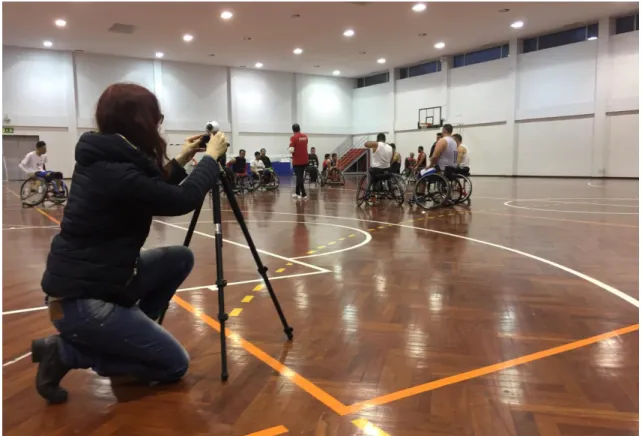
Figure 1: The author placing the Samsung Gear camera and the tripod on the court of the High-Performance Centre in Gaia. The uniform illumination was helpful in the recording.
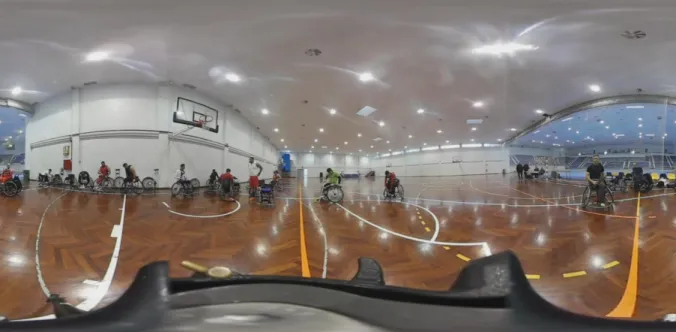
Another aspect we paid special attention to was the “seam area” of the camera, placing it headed to the wall or to places with less movement and objects, to simplify the stitching process. According to Jaunt (2017), it is also important to shoot clean plates of the ground that the rig (the tripod and the audio recorder, in our case) will be covering. We decided to take pictures of every place we put the rig, in order to facilitate the process of painting out the ground below the camera in the editing process.
Right choices, mistakes: lessons learned
We had a start guide of 22 shots and we ended up shooting almost 60 scenes (see Appendix 3), considering the repetition of some shots, which was proved to be a right choice, mainly in the interviews. We tried hard to identify every shot and every audio in order to not lose time in the post-production.
video, but we realised they would not be possible without disturbing the training programme. Thus, Marco agreed to shot 2 questions and Márcio answered 3 questions in 360o. The
remaining questions were recorded only as linear audio.
It was a challenge to interview in 360o due to fact that we had to hide ourselves. We
posed the question, left the scene and asked the interviewees to wait for our signal to start answering, looking at the camera. We had to repeat some shots because we planned with characters the beginning, but didn’t plan the end of the scene, therefore they didn’t know what to do after the answer. With the instructions of how to finish the answers – and consequently the shots – we repeated the scenes and then it was considered satisfactory. We tried to keep the camera at the same height as the player’s eyes while sat in the wheelchair. It was done in most part of the shots.
Although we had decided to shoot shorter scenes comparing to the ones in the test (with the average of 4 minutes), we changed our minds due to the fact that, in the first longer shots, we had non predictable and interesting events, such as the ball hitting the tripod and producing a very curious effect, or a player fall of the wheelchair with the consequent recover in a very interesting way. Most part of the shots therefore had more than 4 minutes. Sometimes it was not possible to take a picture of the ground after the shot due to the speed of the training: we had to quickly take the camera out of the place to avoid disturbing the continuity of the practice.
Concerning the camera itself, the Gear 360 (2016) doesn’t have a support under it, so the camera gets very close to rig. Consequently, the tripod was clearly seen in the images, more than in the test, when we used the Kodak Pix Pro camera. In the first shot, we realised it would be a considerable challenge to remove the tripod from the images in post-production. We also had a permanent care about the security of the camera. Hence we gave up shooting scenes such as the training match with the camera in the centre of the court. We replaced it for another camera position on the side of the court.
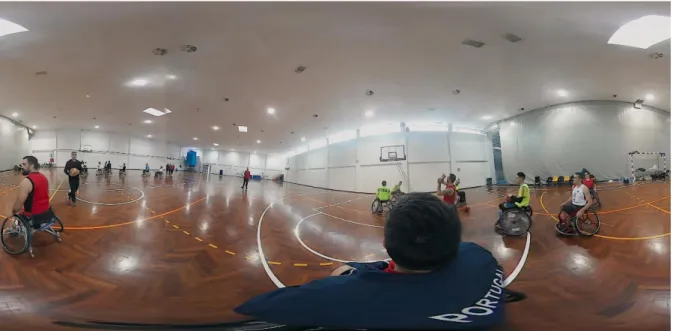
(3840 x 1920). On the second day, we repeated some shots firstly recorded in 1920 x 1080 now with the higher resolution available, even though it was impossible to repeat every shot.
3.3. Post-production
All the raw material was transferred to a computer at iNOVA Media Lab, the digital creation laboratory where this project is incubated. Vanderborght (2016) indicates the importance of organizing the files clearly, also marking the incomplete takes. It was the first post-production step: all files were identified, audio and video files were matched and organized in folders. The audio recorder automatically generated a folder for each shot, which made organization easier.
Every shot was watched carefully and a total of 21 were chosen for the stitching process as options for editing. The best part of each shot was selected and the interviews were transcribed. Thus, the script for the prototype was designed. The video was recorded in Portuguese once the characters are Portuguese and they manage to express themselves better in their mother language. (see in Appendix 4 the script with the full video’s content translated to English). The video was conceived with nine main scenes, each one lasting at least 25 to 30 seconds. One of the main recommendations indicated in Jaunt’s VR field guide concerns the time needed by users to immerse themselves in each scene. “Cut too quickly and your viewer will be frantically looking about trying to figure out what is going on and what to look at all while you are tiring them out” (Jaunt, 2017).
Editing
The 21 shots16chosen were automatically stitched with the software Gear 360 Action
Director. The next part of the editing process was done in Premiere Pro cc 2018 and led by the author and Rui Avelans Coelho. The script was implemented in order to have a “rough cut” to be analysed with a HMD. The main purpose, in this stage, was to check if all scenes would be kept, with a special concern with three of them. In the final moment of the scene where Márcio shows typical plays, he tries the three-point throw five times before succeeding. We
16Some shots already stitched were also sent to the partner in order to help the creation of the virtual