Engineering
ISSN: 1809-4430 (on-line)
Hymenaea courbaril SEEDLINGS IN PROTECTED ENVIRONMENTS AND
SUBSTRATES
Doi:http://dx.doi.org/10.1590/1809-4430-Eng.Agric.v37n1p24-34/2017
CÁSSIO F. SANCHES1*, EDILSON COSTA2, GEANY G. S. DA COSTA2,
FLÁVIO F. DA S. BINOTTI2, ELIANA D. CARDOSO2
1*Corresponding author. Universidade Estadual de Mato Grosso do Sul/UEMS/ Cassilândia - MS, Brasil.
E-mail: [email protected]
ABSTRACT: The Brazilian copal is a tree fruit species that can be used for various purposes. The study evaluated protected environments and substrates in forming Brazilian copal seedlings (Hymenaea courbaril), at the State University of Mato Grosso do Sul, Cassilândia-MS, from
January to March, 2014. Two greenhouses were used: (A1) agricultural greenhouse covered with aluminized thermal reflector screen of 50% shading and (A2) agricultural greenhouse covered with black screen of 50% shading. Inside the greenhouses, substrates derived from mixtures of cattle manure, soil, medium vermiculite, super fine vermiculite and washed fine sand were tested. For each cultivation environment, a completely randomized experimental design was used. The environments were compared by combined analysis. Emergence parameters, growth, phytomass and biometric relations were evaluated. The best seedlings were formed on the substrates containing 10 or 20% of cattle manure in the mix. Substrates containing 50% of cattle manure in the mixture did not favor the development of seedlings in the greenhouse with black screen. The best seedlings have been formed in the protected environment of aluminized screen coverage, with higher air and total phytomass, and Dickson quality index. Larger seedlings in height, with more leaves were formed in the protected environment with black screen coverage.
KEY WORDS: Hymenaea courbaril, solar radiation, reflective covered, cattle manure,
vermiculite, humus, sand.
INTRODUCTION
The State of Mato Grosso do Sul is composed of two major biomes, the Cerrado and the Pantanal, which have great biodiversity of fauna and flora. In the Cerrado, intensive agricultural activities with major crops, as well as extensive animal husbandry, occupy the productive spaces and reduce fruit native species that has an important role in economy, social and environment, because they are food for humans, birds and wild animals.
The Brazilian copal (Hymenaea L.) is a tree species that can be found in several regions of
Brazil from the north to the southeast. From the Leguminosae - Caesalpinioideae family it appears
from Mexico, through Central America and reaching South America, occurring in drylands as the Cerrado. The Brazilian copal is underutilized by local communities, perhaps because of scientific ignorance or the lack of incentives for its commercialization (AGOSTINI-COSTA et al., 2006). It is a fruit tree species that can be used for various purposes, such as cooking, trunk resin for varnishes and wood in buildings, furniture and waterworks.
According to GANDINI et al. (2011), the plant is excellent to be worked in consortium with perennial plants because it supports the presence of green manure and forage. It is a shade tolerant species (LIMA et al., 2010), with great capacity to naturally regenerate in shaded environments, but at low luminosities their growth is limited (OLIVEIRA et al., 2011).
of seeds, grown under shading of 0, 30 and 50%, inhibition in germination and growth were observed, under the biostimulants and higher chlorophyll content in plants at 30% and lower photosynthesis at 0% shading (PIEREZAN et al., 2012).
The different types of protected environments directly influence the emergence and initial growth of native fruit or from cerrado seedlings (COSTA et al., 2011; SANTOS et al., 2011; COSTA et al., 2012; SASSAQUI et al., 2013; BENETT et al., 2013) and, in a group with substrates with its various formulations (COSTA et al., 2011; SANTOS et al., 2011; COSTA et al., 2012; SASSAQUI et al., 2013; OLIVEIRA et al., 2014a; OLIVEIRA et al., 2014b), interact to provide suitable conditions to plants to express their potential and vigor, with uniform seedling growth.
Even though little used by local communities, the Brazilian copal can be used in cooking in various ways (ice cream, flour, etc.) due to the great potential that this species has, therefore, the research developed with the formation of Brazilian copal seedlings will contribute to strengthen the productive agribusiness chain in the state of Mato Grosso do Sul, providing diverse options of production in the Bolsão Sul-Mato-Grossense region.
Thus, this study evaluated protected environments and substrates in the formation of Brazilian copal seedlings (Hymenaea courbaril) of high quality.
MATERIAL AND METHODS
The experiments were conducted at the State University of Mato Grosso do Sul (UEMS), Cassilândia University Unit (UUC) in the period of January to March, 2014.The local has latitude
of 19º07’21” S, longitude of 51º43’15” W and altitude of 516 m (CASSILANDIA-A742 Automatic
Station), which according to the Köppen climate classification, presents Rainy Tropical Climate (Aw).
Two types of protected environment were used: (A1) agricultural greenhouse, of galvanized steel structure, with 8.00 m of wide by 18.00 m of length, with a height of 4.00 m, covered with aluminized thermal reflector screen of 50% shading, and side closures in 90º degree angle with black screen of 50% shading; (A2) agricultural greenhouse in galvanized steel structure, with 8.00 m of wide by 18.00 m of length, with a height of 3.50 m, side closures in 45º degree angle, with black screen, mesh with 50% shading. The slopes of 90 ° (A1) and 45º (A2) of the side screens are only constructive details of the protected environment by specialist companies, and they did not constitute the study aim. For each cultivation environment, a completely randomized design was adopted to evaluate substrates, with eight repetitions of five seedlings, which are compared by
experiment groups’ analysis.
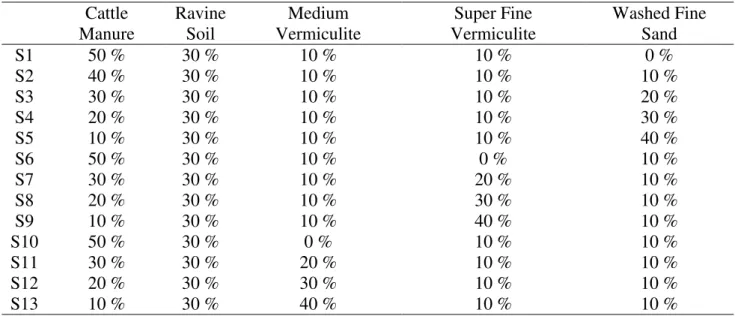
TABLE 1. Treatments with proportions of cattle manure, ravine soil, medium vermiculite, super fine vermiculite and washed fine sand. Cassilândia-MS, 2014.
Cattle Manure
Ravine Soil
Medium Vermiculite
Super Fine Vermiculite
Washed Fine Sand
S1 50 % 30 % 10 % 10 % 0 %
S2 40 % 30 % 10 % 10 % 10 %
S3 30 % 30 % 10 % 10 % 20 %
S4 20 % 30 % 10 % 10 % 30 %
S5 10 % 30 % 10 % 10 % 40 %
S6 50 % 30 % 10 % 0 % 10 %
S7 30 % 30 % 10 % 20 % 10 %
S8 20 % 30 % 10 % 30 % 10 %
S9 10 % 30 % 10 % 40 % 10 %
S10 50 % 30 % 0 % 10 % 10 %
S11 30 % 30 % 20 % 10 % 10 %
S12 20 % 30 % 30 % 10 % 10 %
S13 10 % 30 % 40 % 10 % 10 %
The cattle manure (Table 2) and soil (Table 3) were chemically characterized. The manure was purchased in July, 2013 from local refrigerator, being part of its composition manure and rumen material and composted daily for 45 days, in the period from 07.17.2013 to 08.31.2013, in a covered place, being moistened and overturned with the aid of hoes and shovels, in order to obtain in the shortest possible time a stable material, rich in humus and mineral nutrients, turning the waste into an organic compound in a balanced manner for the seedlings.
TABLE 2. Cattle manure characteristics after composting. Cassilândia-MS, 2014.
N P2O5 K2O Ca Mg S Hu Total-OM Total-C
--- natural percentage ---
0.7 0.5 0.1 1.3 0.1 0.1 32.0 12.0 7.0
Na B Cu Fe Mn Zn C/N (total) pH
---on natural g.kg-1 --- --- on natural---
462.0 39.0 15.0 6,018.0 132.0 87.0 10/1 6.6
Hu – humidity; OM = organic matter; C/N = carbon and nitrogen ratio.
The soil was collected near the Cassilândia University Unit (UUC) at 20 cm 40 cm. The vermiculite and the fine sand were purchased from commercial companies. After the composting, the cattle manure was sieved using a 5 mm sieve, as well as the washed fine sand and the soil.
The sowing was carried out on 01.13.2014 after being realized the dormancy overcoming; the method used was mechanical scarification using an electric grinder in which the seeds were lightly sanded to not cause damage to them. Then, they were soaked in water for the purpose of decreasing the rigidity of the tegument and to catalyze the germination.
TABLE 3. Soil characteristics. Cassilândia-MS, 2014.
pH Cmol.dm-3 mg. dm-3(ppm) Cmol. Texture (gdm-3)
CaCl2 Ca Mg Al K P(mol) CEC Clay Silt Sand
4.1 0.30 0.20 1.19 31 3.1 4.7 150 25 825
mm.dm-3(ppm) Micronutrients mg.dm-3(ppm), Mehlich 1 g dm-3 %
S B Cu Fe Mn Zn Na O.M. C.O. Bases Sat.
Two seeds were planted per container, occurring the emergence beginning on January 24, 2014 (11 days after sowing), irrigation was done manually, always trying to not soak the substrate, keeping in good condition for the seedlings development, which was later carried out the thinning on 02.13.2014, keeping only one plant per container.
After the emergence of the first Brazilian copal seedling, the emergence speed index (ESI) adapted from Maguire (1962) was measured, with cumulative counting, and the emergence
percentage (EP). To obtain the emergence speed index, the seedlings’ counts were performed daily
until stabilization (repeat count for 3 consecutive days) in the period of January 24 to February 9, 2014.
At 40 and 60 days after sowing (DAS) plant height (PH1, PH2) and the leaves number (LN1, LN2) per plant were measured. The determination of the seedling height was carried out with a ruler graduated in centimeters, measuring the distance from the plant stem to the apex. At 60 DAS the stem diameter (SD) was measured with a digital caliper.
After the measurements of plant height (PH), stem diameter (SD) and chlorophyll levels in the three-day period in forced-air oven at 65 ° C, drying of the seedlings shoot and root system were done until they reach constant phytomass. At the end of the drying period, the phytomass of the shoot dry matter (SDM) and root system (RSDM) were measured in an analytical balance. From the (SDM) and the (RSDM), the phytomass of total dry matter (TDM) was obtained. The height and stem diameter ratio (HSDR), and Dickson quality index (DQI) were determined.
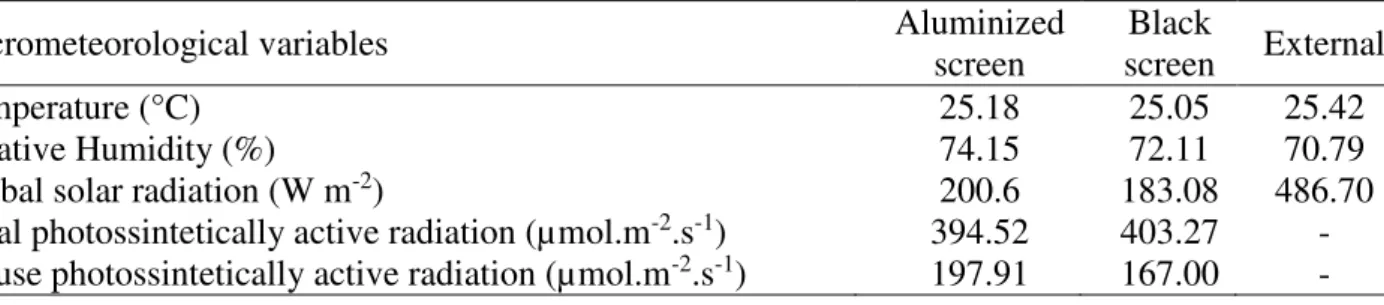
Inside the protected environments, air temperature (°C), the air relative humidity (%), the global solar radiation (W m-2), the total and diffuse active photosynthetically radiation (µmol.m-2.s -1) were monitored. The measurements of micrometeorological parameters inside the protected
environments (meshes) were carried out from specific sensors, coupled to a Delta-T Devices "datalloger", GP2 model at the environment geometric center. The system was programmed to perform readings at intervals of 10 seconds, with averages at every minute. For the radiations, the daily average was calculated from 8 am to 6 pm (Table 4).
For the external environment, the air temperature, air relative humidity and solar radiation values were acquired from the automatic data collection platform of Cassilândia, A742, INMET-SONABRA (Table 4). For the external environment, the active photosynthetically radiation was not available, because the platform does not provide such data.
The data were collected from February 03 to March 8, 2014 due to the equipment availability.
TABLE 4. Temperature average (°C), relative humidity (%), global solar radiation (W m-2), total photossintetically active radiation (µmol.m-2.s-1) difuse photossintetically active radiation (µmol. m-2.s-1). Cassilândia-MS, 2014.
Micrometeorological variables Aluminized
screen
Black
screen External
Temperature (°C) 25.18 25.05 25.42
Relative Humidity (%) 74.15 72.11 70.79
Global solar radiation (W m-2) 200.6 183.08 486.70
Total photossintetically active radiation (µmol.m-2.s-1) 394.52 403.27 -
Difuse photossintetically active radiation (µmol.m-2.s-1) 197.91 167.00 -
Because there is no repetition of cultivation environments, each one was considered an
experiment. The environments were evaluated by experiments groups’ analysis (BANZATTO &
RESULTS AND DISCUSSION
The relation between the largest and smallest average square of waste from the substrates analysis in both growing environments for emergence speed index (ESI), emergency percentage (EP), plant height (PH1, PH2), leaves number (LN1, LN2), stem diameter (SD), phytomass of shoot dry matter (SDM), phytomass of the root system dry matter (RSDM), phytomass of total dry matter (TDM), hight.stem diameter-1 ratio (HSDR) and Dickson quality index (DQI) were, respectively, 2.26; 1.12; 1.11; 1.40; 1.52; 8.45; 1.12; 2.87; 3.16; 4.16; 0.89; 1.53 and 4.79. For LN2 variable, the relation between the average squares of waste (RASW) was higher than 7 (8.45), not allowing the implementation of joint analysis of the experiments for this variable. For the other parameters, the relation was less than 7, which allowed performing the analysis of experiments groups (BANZATTO; KRONKA, 2013) and comparison of environments.
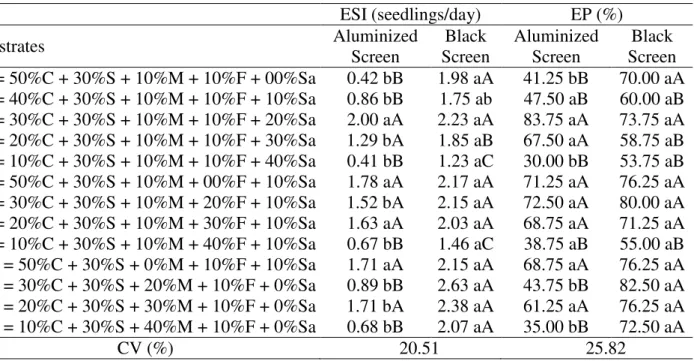
In the environment covered with aluminized screen (Table 5), there were greater ESI and EP in S3, S4, S6, S7, S8, S10 and S12 substrates. In the environment with black screen on the coverage, there were greater ESI and EP in S1, S3, S6, S7, S8, S10, S11, S12 and S13 substrates. The environment covered with black screen provided higher ESI compared to the aluminized screen, where the ESI in aluminized screen was 2.0 plants per day (S3) and the black screen was 2.63 (S11) (Table 5), superior results to those reported by PIEREZAN et al. (2012) who found ESI of 0.935 plants per day. The shading promoted by the black screen showed lower global radiation and diffuse photosynthetically active (Table 4), providing higher emergence speeds (Table 5).
In both environments with S5 and S9 substrate and aluminized screen environment with S13 substrate (Table 5) higher emergence speed was expected, since these substrates (Table 1) were 60% of porous material (sand + medium and super fine vermiculite), beyond the soil with 82.5% of sand (Table 3), which are materials that act as physical conditioning, facilitate aeration, humidification and water imbibition (H2O), but this result was not obtained. In these substrates (S5, S9 and S13), the least amount of manure (10%), the least amount of organic matter (Table 2), that possibly absorbed less amount of water than the other substrates, which is an important factor in seed soaking.
TABLE 5. Emergence speed index (ESI), emergence percentage (EP) of Brazilian copal in different protected environments and substrates. Cassilândia-MS, 2014.
ESI (seedlings/day) EP (%)
Substrates Aluminized
Screen
Black Screen
Aluminized Screen
Black Screen
S1 = 50%C + 30%S + 10%M + 10%F + 00%Sa 0.42 bB 1.98 aA 41.25 bB 70.00 aA
S2 = 40%C + 30%S + 10%M + 10%F + 10%Sa 0.86 bB 1.75 ab 47.50 aB 60.00 aB
S3 = 30%C + 30%S + 10%M + 10%F + 20%Sa 2.00 aA 2.23 aA 83.75 aA 73.75 aA
S4 = 20%C + 30%S + 10%M + 10%F + 30%Sa 1.29 bA 1.85 aB 67.50 aA 58.75 aB
S5 = 10%C + 30%S + 10%M + 10%F + 40%Sa 0.41 bB 1.23 aC 30.00 bB 53.75 aB
S6 = 50%C + 30%S + 10%M + 00%F + 10%Sa 1.78 aA 2.17 aA 71.25 aA 76.25 aA
S7 = 30%C + 30%S + 10%M + 20%F + 10%Sa 1.52 bA 2.15 aA 72.50 aA 80.00 aA
S8 = 20%C + 30%S + 10%M + 30%F + 10%Sa 1.63 aA 2.03 aA 68.75 aA 71.25 aA
S9 = 10%C + 30%S + 10%M + 40%F + 10%Sa 0.67 bB 1.46 aC 38.75 aB 55.00 aB
S10 = 50%C + 30%S + 0%M + 10%F + 10%Sa 1.71 aA 2.15 aA 68.75 aA 76.25 aA
S11 = 30%C + 30%S + 20%M + 10%F + 0%Sa 0.89 bB 2.63 aA 43.75 bB 82.50 aA
S12 = 20%C + 30%S + 30%M + 10%F + 0%Sa 1.71 bA 2.38 aA 61.25 aA 76.25 aA
S13 = 10%C + 30%S + 40%M + 10%F + 0%Sa 0.68 bB 2.07 aA 35.00 bB 72.50 aA
CV (%) 20.51 25.82
The emergence started at 11 days after sowing, with maximum percentage of 83.75% for S3 substrate in an environment covered with aluminized screen and 82.5 in S11 substrate in an environment covered with black screen (Table 5), these results of percentage are higher than those found by PIEREZAN et al. (2012) who found emergence at 14 days and maximum percentage of 79%, while CARVALHO FILHO et al. (2003) found emergence at 20 days and 41% of emergence in a protected environment with Sombrite® screen 50%.
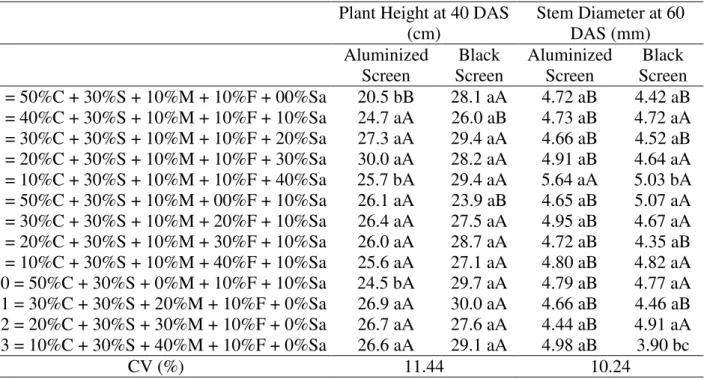
At 40 days after the sowing (Table 6), the smaller plants in the aluminized screen environment were observed in the S1 substrate and in the black screen in S2 and S6 substrates, it was verified that the S1 and S6 the composition of substrates showed 50% of cattle manure and 30% of soil (Table 6). According to DIAS et al. (2009a) the use of manure on substrates, over 30% was not beneficial to coffee seedlings (Coffee arábica), however SILVA et al. (2013) reported that
substrates containing 50% of manure associated with vermiculite or commercial substrate may be suitable for the formation of coffee seedlings, as well as COSTA et al. (2014) reported that substrates containing 33.33, 50.00 and 100.00% of manure may be indicated to the formation of
“bocaiúva” seedlings (Acrocomia aculeata).
TABLE 6. Plant height at 40 DAS and stem diameter at 60 DAS of Brazilian copal in different protected environments and substrates. Cassilândia-MS, 2014.
Plant Height at 40 DAS (cm)
Stem Diameter at 60 DAS (mm) Aluminized
Screen
Black Screen
Aluminized Screen
Black Screen
S1 = 50%C + 30%S + 10%M + 10%F + 00%Sa 20.5 bB 28.1 aA 4.72 aB 4.42 aB
S2 = 40%C + 30%S + 10%M + 10%F + 10%Sa 24.7 aA 26.0 aB 4.73 aB 4.72 aA
S3 = 30%C + 30%S + 10%M + 10%F + 20%Sa 27.3 aA 29.4 aA 4.66 aB 4.52 aB
S4 = 20%C + 30%S + 10%M + 10%F + 30%Sa 30.0 aA 28.2 aA 4.91 aB 4.64 aA
S5 = 10%C + 30%S + 10%M + 10%F + 40%Sa 25.7 bA 29.4 aA 5.64 aA 5.03 bA
S6 = 50%C + 30%S + 10%M + 00%F + 10%Sa 26.1 aA 23.9 aB 4.65 aB 5.07 aA
S7 = 30%C + 30%S + 10%M + 20%F + 10%Sa 26.4 aA 27.5 aA 4.95 aB 4.67 aA
S8 = 20%C + 30%S + 10%M + 30%F + 10%Sa 26.0 aA 28.7 aA 4.72 aB 4.35 aB
S9 = 10%C + 30%S + 10%M + 40%F + 10%Sa 25.6 aA 27.1 aA 4.80 aB 4.82 aA
S10 = 50%C + 30%S + 0%M + 10%F + 10%Sa 24.5 bA 29.7 aA 4.79 aB 4.77 aA
S11 = 30%C + 30%S + 20%M + 10%F + 0%Sa 26.9 aA 30.0 aA 4.66 aB 4.46 aB
S12 = 20%C + 30%S + 30%M + 10%F + 0%Sa 26.7 aA 27.6 aA 4.44 aB 4.91 aA
S13 = 10%C + 30%S + 40%M + 10%F + 0%Sa 26.6 aA 29.1 aA 4.98 aB 3.90 bc
CV (%) 11.44 10.24
*Uppercase letters in the same rows and lowercase in columns, for each parameter, do not differ from each other by the Scott-Knott test for the substrates and by the F test for cultivation environments, at 5% probability C = Cattle manure; S = ravine soil; M= medium vermiculite; F = super fine vermiculite; Sa = sand
The plants with larger diameters (5.64 mm), in the aluminized screen, were verified in S5 substrate and in the black screen in the substrates S2, S4, S5, S6, S7, S9, S10 and S12 (Table 6). For the S5 and S13 substrates, the plants of the aluminized screen showed greater diameter than the black screen, and for the other substrates the cultivation environments did not differ. At 60 DAS, the seedlings had 5.64 mm of diameter, superior result (5.27 mm in bags of 11 × 18 cm and 4.50 mm in bags of 15 × 20 cm) than observed by CARVALHO FILHO et al. (2003) at 180 DAS and above (2.70 mm) to what was observed by PIEREZAN et al. (2012) at 226 DAS.
environments did not differ. In these substrates, the maximum amount of manure was 20%, and these results are consistent with SANTOS et al. (2011) who found that the Brazilian copal is demanding in nutrition, because it is a Cerrado plant and is adapted to few fertile soils, as well as DUBOC et al. (2006) who highlighted for Hymenaea courbaril that the species has little nutritional
requirement for N, P, Ca, Mg, S and K, and the excess of B and Zn can be phytotoxic.
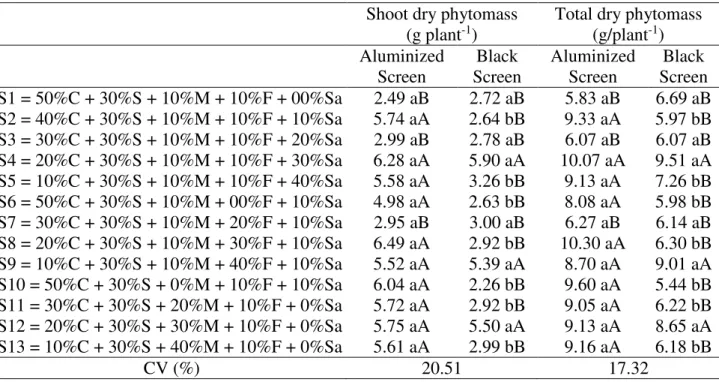
For substrates that provided greater Brazilian copal plant phytomass, the aluminized screen environment showed higher amount of global radiation, diffuse photosynthetically active radiation and relative humidity (Table 4), conditions which promoted greater accumulation of phytomass (Table 7).
TABLE 7. Shoot dry phytomass and total dry phytomass of Brazilian copal in different protected environments and substrates at 60 DAS. Cassilândia-MS, 2014.
Shoot dry phytomass
(g plant-1) Total dry phytomass (g/plant-1) Aluminized
Screen
Black Screen
Aluminized Screen
Black Screen
S1 = 50%C + 30%S + 10%M + 10%F + 00%Sa 2.49 aB 2.72 aB 5.83 aB 6.69 aB
S2 = 40%C + 30%S + 10%M + 10%F + 10%Sa 5.74 aA 2.64 bB 9.33 aA 5.97 bB
S3 = 30%C + 30%S + 10%M + 10%F + 20%Sa 2.99 aB 2.78 aB 6.07 aB 6.07 aB
S4 = 20%C + 30%S + 10%M + 10%F + 30%Sa 6.28 aA 5.90 aA 10.07 aA 9.51 aA
S5 = 10%C + 30%S + 10%M + 10%F + 40%Sa 5.58 aA 3.26 bB 9.13 aA 7.26 bB
S6 = 50%C + 30%S + 10%M + 00%F + 10%Sa 4.98 aA 2.63 bB 8.08 aA 5.98 bB
S7 = 30%C + 30%S + 10%M + 20%F + 10%Sa 2.95 aB 3.00 aB 6.27 aB 6.14 aB
S8 = 20%C + 30%S + 10%M + 30%F + 10%Sa 6.49 aA 2.92 bB 10.30 aA 6.30 bB
S9 = 10%C + 30%S + 10%M + 40%F + 10%Sa 5.52 aA 5.39 aA 8.70 aA 9.01 aA
S10 = 50%C + 30%S + 0%M + 10%F + 10%Sa 6.04 aA 2.26 bB 9.60 aA 5.44 bB
S11 = 30%C + 30%S + 20%M + 10%F + 0%Sa 5.72 aA 2.92 bB 9.05 aA 6.22 bB
S12 = 20%C + 30%S + 30%M + 10%F + 0%Sa 5.75 aA 5.50 aA 9.13 aA 8.65 aA
S13 = 10%C + 30%S + 40%M + 10%F + 0%Sa 5.61 aA 2.99 bB 9.16 aA 6.18 bB
CV (%) 20.51 17.32
*Uppercase letters in the same rows and lowercase in columns, for each parameter, do not differ from each other by the Scott-Knott test for the substrates and by the F test for cultivation environments, at 5% probability C = Cattle manure; S = ravine soil; M= medium vermiculite; F = super fine vermiculite; Sa = sand
The lowest height and diameter ratio (HSDR) were observed in S1, S2, S5, S7 and S10 substrate in aluminized screen and in S2, S6, S9, S10 and S12 substrates in the black screen. The highest Dickson quality Index (DQI) was verified in S2, S4, S5, S8, S9, S10, S11, S12 and S13 substrates in aluminized screen and S4, S5, S9 and S12 substrates in black screen (Table 8).
The S4, S9 and S12 substrates show in their constitutions 10 and 20% of cattle manure and the two environments showed the best results for DQI, followed by S5 that showed better results for HSDR and DQI in aluminized screen. These variables indicate stronger seedlings on substrates with smaller quantities of manure, as SANTOS et al. (2011) observed the same characteristics for
“jatobá-do-cerrado” (Himenaea stigonocarpa). COSTA et al. (2011) do not recommend the
substrate with 100% of compound for the formation of “jatobá-do-cerrado” seedlings. According to
SANTOS et al. (2011), the “jatobazeiro-do-cerrado” (Himenaea stignocarpa) is adapted in a few
fertile soils (Cerrado) and does not require high nutrition for its early development, as well as DUBOC et al. (2006) highlight for Hymenaea courbaril that this species has little nutritional
TABLE 8. Plant height and stem diameter ratio (HSDR) and Dickson quality index (DQI) of Brazilian copal in different protected environments and substrates at 60 DAS. Cassilândia-MS, 2014.
Height and stem diameter ratio
(HSDR)
Dickson quality index (DQI)
Aluminized Screen
Black Screen
Aluminized Screen
Black Screen
S1 = 50%C + 30%S + 10%M + 10%F + 00%Sa 7.60 bB 9.46 aB 0.700 aB 0.660 aB
S2 = 40%C + 30%S + 10%M + 10%F + 10% Sa 7.7101 aB 8.33 aC 1.010 aA 0.661 bB
S3 = 30%C + 30%S + 10%M + 10%F + 20% Sa 8.37 aA 9.44 aB 0.651 aB 0.596 aB
S4 = 20%C + 30%S + 10%M + 10%F + 30% Sa 8.50 aA 9.03 aB 1.014 aA 0.893 aA
S5 = 10%C + 30%S + 10%M + 10%F + 40% Sa 6.95 bB 8.89 aB 1.086 aA 0.760 bA
S6 = 50%C + 30%S + 10%M + 00%F + 10% Sa 8.20 aA 7.82 aC 0.831 aB 0.698 aB
S7 = 30%C + 30%S + 10%M + 20%F + 10% Sa 7.68 bB 9.03 aB 0.737 aB 0.617 aB
S8 = 20%C + 30%S + 10%M + 30%F + 10% Sa 8.26 bA 9.77 aB 1.038 aA 0.597 bB
S9 = 10%C + 30%S + 10%M + 40%F + 10% Sa 8.25 aA 8.59 aC 0.876 aA 0.894 aA
S10 = 50%C + 30%S + 0%M + 10%F + 10% Sa 7.51 bB 8.75 aC 1.047 aA 0.579 bB
S11 = 30%C + 30%S + 20%M + 10%F + 0% Sa 8.37 bA 9.62 aB 0.901 aA 0.594 bB
S12 = 20%C + 30%S + 30%M + 10%F + 0% Sa 9.22 aA 8.34 aC 0.874 aA 0.862 aA
S13 = 10%C + 30%S + 40%M + 10%F + 0% Sa 8.07 bA 11.6 aA 0.961 aA 0.520 bB
CV (%) 12.98 21.68
*Uppercase letters in the same rows and lowercase in columns, for each parameter, do not differ from each other by the Scott-Knott test for the substrates and by the F test for cultivation environments, at 5% probability C = Cattle manure; S = soil; M= medium vermiculite; F = super fine vermiculite; Sa = sand
As observed for the phytomass, for the substrates that provided higher DQI to Brazilian copal plants, the aluminized screen environment showed higher amount of global radiation, diffuse photosynthetically active radiation and relative humidity (Table 4), conditions that promoted greater accumulation of phytomass (Table 8).
The larger plants at 60 DAS were observed in S3, S4, S5, S7, S8, S9, S11, S12 and S13 substrates. The higher leaves number at 40 DAS was verified in S4, S7, S8, S10, S11, S12 and S13 substrates, and at 60 DAS there was no difference between the leaves number. The major root system dry phytomass were observed in plants cultured in the S1, S4, S5 and S8 substrates (Table 9). For these variables, the S4, S5 and S8 substrates provided suitable conditions for the seedlings growth. These substrates had in its constitution no more than 20% of cattle manure, which is consistent with the results observed by SILVA et al. (2009) where the use of 10 and 20% of cattle
manure in substrate provided the best characteristics for healthy and good quality of “mangabeira”
seedlings (Hancornia speciosa) for planting in the field. However, DIAS et al. (2009b) found that
the use of cattle manure above of 10% on substrate reduced root growth and leaf expansion of
TABLE 9. Plant height at 60 DAS, leaves number at 40 and 60 DAS, and root dry phytomass of Brazilian copal in different substrates. Cassilândia-MS, 2014.
Plant height at 60 DAS
(cm)
Leaves number at
40 DAS
Leaves number at
60 DAS
Root dry phytomass
(g.plant-1)
S1 = 50%C + 30%S + 10%M + 10%F + 00%Sa 38.78 B 5.99 B 8.62 A 3.656 A
S2 = 40%C + 30%S + 10%M + 10%F + 10% Sa 37.65 B 6.03 B 8.56 A 3.457 B
S3 = 30%C + 30%S + 10%M + 10%F + 20% Sa 40.59 A 6.13 B 8.89 A 3.184 B
S4 = 20%C + 30%S + 10%M + 10%F + 30% Sa 41.56 A 6.40 A 9.52 A 3.700 A
S5 = 10%C + 30%S + 10%M + 10%F + 40% Sa 41.67 A 6.08 B 9.38 A 3.776 A
S6 = 50%C + 30%S + 10%M + 00%F + 10% Sa 38.59 B 5.92 B 8.98 A 3.225 B
S7 = 30%C + 30%S + 10%M + 20%F + 10% Sa 39.93 A 6.24 A 8.87 A 3.232 B
S8 = 20%C + 30%S + 10%M + 30%F + 10% Sa 40.61 A 6.20 A 9.24 A 3.594 A
S9 = 10%C + 30%S + 10%M + 40%F + 10% Sa 40.13 B 5.66 B 9.42 A 3.398 B
S10 = 50%C + 30%S + 0%M + 10%F + 10% Sa 38.70 B 6.25 A 8.90 A 3.375 B
S11 = 30%C + 30%S + 20%M + 10%F + 0% Sa 40.94 A 6.55 A 9.26 A 3.313 B
S12 = 20%C + 30%S + 30%M + 10%F + 0% Sa 39.80 A 6.35 A 8.85 A 3.264 B
S13 = 10%C + 30%S + 40%M + 10%F + 0% Sa 41.22 A 6.34 A 10.73 A 3.369 B
CV (%) 7.00 10.61 21.46 16.52
* Uppercase letters in the same column, for each parameter, do not differ from each other by the Scott-Knott test at 5% probability. C = Cattle manure; S = soil; M= medium vermiculite; F = super fine vermiculite; Sa = sand
In this evaluation stage, 40 DAS, the plants reached the height from 20.5 to 30.0 cm (Table 5) and 41,69 cm (Table 10) in the aluminized screen and the S1, S2, S6 and S10 substrates showed the smaller seedlings (Table 9).The seedlings showed heights (41.69 cm) greater than those observed by SANO and FONSECA (2003) who observed a height of 33 cm at 270 DAS in Hymenaea spp
and CAMPOS & UCHIDA (2002) that verified 31.45 cm at 82 DAS and 36.35 cm at 150 DAS. CARVALHO FILHO et al. (2003), in São Cristóvão-SE, obtained height of 34.31 cm in greenhouse of 50% at 180 DAS, Lima et al. (2010) in Ji-Parana-RO, obtained 54.20 cm at 120 DAS in greenhouse of 50% and PIEREZAN et al. (2012), in Dourados-MS, verified height of 11.43 cm at 40 DAS and 25.75 cm at 226 DAS in greenhouse of 50%. The growth of Brazilian copal in the region of Cassilândia presented excellent performance and adaptability to the region, when compared to the literature data.
TABLE 10. Plant height at 60 DAS, leaves number at 40 and 60 DAS, roots dry phytomass of Brazilian copal in different protected environments. Cassilândia-MS, 2014.
Plant height at 60 DAS (cm)
Leaves number at 40 DAS
Leaves number at 60 DAS
Dry phytomass of root system (g) Aluminized
Screen 38.34 B 5.90 B 9.02 A 3.430 A
Black Screen 41.69 A 6.43 A 9.32 A 3.423 A
CV (%) 7.00 10.61 21.5 16.52
* Uppercase letters in the same column, for each parameter, do not differ from each other by the F test at 5% probability.
CONCLUSIONS
The best seedlings were grown on substrates containing 10 or 20% of cattle manure in the mixture.
Substrates containing 50% of manure in the mixture (S1 and S6) did not favor the seedlings growth in the black screen greenhouse.
The best seedlings were formed in the environment of aluminized screen coverage, with higher shoot and total phytomass and Dickson Quality Index.
Bigger seedlings in height, with the highest leaves number, were formed on the black screen.
ACKNOWLEDGEMENTS
The authors want to thank for scholarship on Research Produtivity granted by CNPq (proc. nº 300829/2012-4); and by FUNDECT (proc. nº 23/200.647/2012 - Call Notice FUNDECT/ CNPq No. 05/2011 - Program of First Projects - PPP).
REFERENCES
AGOSTINI-COSTA, T. S.; SILVA, D. B.; VIEIRA, F. R.; SANO, S. M.; FERREIRA, F. R. Espécies de maior relevância para a região Centro-Oeste. In: VIEIRA, R. P.; AGOSTINI-COSTA, T. S.; SILVA, D. B.; FERREIRA, F. R.; SANO, S. M. (Ed.) Frutas nativas da região Centro-Oeste do Brasil. Brasília-DF: Embrapa Recursos Genéticos e Biotecnologia, 2006. cap.1. p.12-24. BANZATTO, D. A.; KRONKA, S. N. Experimentação agrícola. 3. ed. Jaboticabal: Funep, 2013. 237 p.
BENETT, C. G. S.; PELLOSO, M. F.; LIMA, M. F.; BENETT, K. S. S.; COSTA, E.; SECRETI, M. L.; RODRIGUES, F. Diferentes períodos de fermentação de sementes para produção de mudas de pitombeira em ambientes protegidos. Revista Processos Químicos, Anápolis, v.7, n.13, p.37-42, 2013.
CAMPOS, M. A.; UCHIDA, T. Influência do sombreamento no crescimento de mudas de três espécies amazônicas. Pesquisa Agropecuária Brasileira, Brasília, DF, v.37, n.3, p.281-288, 2002. CARVALHO FILHO, J. L. S. de; ARRIGONI-BLANK, M. de F.; BLANK, A. F.; RANGEL, M. S. A. Produção de mudas de jatobá (Hymenaea courbaril L.) em diferentes ambientes, recipientes e
composições de substratos. Cerne, Lavras, v.9, n.1, p.111-121, 2003.
COSTA, E.; LEAL, P. A. M.; REGO, N. H.; BENATTI, J. Desenvolvimento inicial de mudas de jatobazeiro do cerrado em Aquidauana-MS. Revista Brasileira de Fruticultura, Jaboticabal, v.33, n.1, p.215-226, 2011.
COSTA, E.; OLIVEIRA, L. C.; SANTO, T. L. E.; LEAL, P. A. M. Production of baruzeiro seedling in different protected environments and substrates. Engenharia Agrícola, Jaboticabal, v.32, n.4, p.633-641, 2012.
COSTA, E.; MARTINS, R. F.; FARIA, T.A.C.; JORGE, M. H. A.; LEAL, P. A. M. Seedlings of Acrocomia aculeata in diferent substrates and protected environments. Engenharia Agrícola, Jaboticabal, v.34, n.3, p.395-404, 2014.
DIAS, R.; MELO, B.; RUFINO, M. A.; SILVEIRA, D. L.; MORAIS, T. P. Fontes e proporção de material orgânico para a produção de mudas de cafeeiro em tubetes. Ciência e Agrotecnologia, Lavras, v.33, n.3, p.758-764, 2009a.
DUBOC, E.; VENTURIM, N.; VALE, F. R. do, DAVIDE, A. C. Nutrição do jatobá (Hymenaea courbaril L. var. stilbocarpa (Hayne) Lee et Lang.). Cerne, Lavras, v.2, n.1, p.12, 2006.
GANDINI, A. M. M.; SANTOS, J. B.; ANDREZZA, M. M. G.; SANTANA, R. C.; CUNHA, V. C.; VALADÃO SILVA, D.; FIORE, R. A.Capacidade competitiva do jatobá com adubos verdes, forrageiras e plantas daninhas. Planta daninha, Viçosa, MG, v.29, n. esp., p. 991-999, 2011.
LIMA, A. L. S.; ZANELLA, F.; CASTRO, L. D. M. Crescimento de Hymenaea courbaril L. var.
stilbocarpa (Hayne) Lee et Lang. e Enterolobium contortisiliquum (Vell.) Morong (Leguminosae)
sob diferentes níveis de sombreamento. Acta Amazônica, Manaus, v.40, n. 1, p.43-48, 2010. MAGUIRE, J. D. Speed of germination aid in selection and evaluation of seedling emergence and vigor. Crop Science, Madison, v.2, n.2, p.176-177, 1962.
OLIVEIRA, L. C.; COSTA, E.; OLIVEIRA, A. D.; JORGE, M. H. A. Emergência do baruzeiro sob ambientes protegidos e substratos. Revista de Agricultura Neotropical, Cassilândia, v.1, n.1, p.10-16, jul./set. 2014a.
OLIVEIRA, L. C.; COSTA, E.; OLIVEIRA SOBRINHO, M. F.; BINOTTI, F. F. S.; MARUYAMA, W. I.; ALVES, A. C. Esterco bovino e fibra de coco na formação de mudas de baruzeiro. Revista de Agricultura Neotropical, Cassilândia, v.1, n.2, p.42-51, out./dez. 2014b. OLIVEIRA, W. L.; MEDEIROS, M. B.; MOSER, P.; PINHEIRO, R. OLSEN, L. B. Regeneração e estrutura populacional de jatobá-da-mata (Hymenaea courbaril L.), em dois fragmentos com
diferentes graus de perturbação antrópica. Acta Botanica Brasilica, Feira de Santana, v.25, n.4, p.876-884, 2011.
PIEREZAN, L.; SCALON, S. P. Q.; PEREIRA, Z. V. Emergência de plântulas e crescimento de mudas de jatobá com uso de bioestimulante e sombreamento. Cerne, Lavras, v.18, n.1, p.127,-133, 2012.
SANO, S. M.; FONSECA, C. E. L. Estabelecimento de progênies de jatobá(Hymenaea spp)em
plantios puros no Cerrado. Planaltina: Embrapa Cerrados, 2003. 14p. (Boletim de Pesquisa e Desenvolvimento número, 110).
SANTOS, L. C. R.; COSTA, E.; LEAL, P. A. M.; NARDELLI, E. M. V.; SOUZA, G. S. A. Ambientes protegidos e substratos com doses de composto orgânico comercial e solo na formação de mudas de jatobazeiro em Aquidauana-MS. Engenharia Agrícola, Jaboticabal, v.31, n.2, p.249-259, 2011.
SASSAQUI, A. R.; TERENA, T. F. S.; COSTA, E. Protected environments and substrates for production of genipap seedlings. Acta Amazonica, Manaus, v.43, n.2, p.143-152, 2013.
SILVA, A. P.; COSTA, E.; SANTO, T. L. E.; SILVA, L. E. Coffee seedlings in different substrates and protected environments. Engenharia Agrícola, Jaboticabal, v.34, n.4, p.589-600, jul./ago. 2013.
SILVA, E. A.; MARUYAMA, W. I.; OLIVEIRA, A. C.; BARDIVIESSO, D. M. Efeito de diferentes substratos na produção de mudas de mangabeira (Hancornia speciosa). Revista