Repositório ISCTE-IUL
Deposited in Repositório ISCTE-IUL: 2019-03-08
Deposited version: Post-print
Peer-review status of attached file: Peer-reviewed
Citation for published item:
Marques, S., Mariano, J., Lima, M. L. & Abrams, D. (2018). Are you talking to the future me? The moderator role of future selfrelevance on the effects of aging salience in retirement savings. Journal of Applied Social Psychology. 48 (7), 360-368
Further information on publisher's website: 10.1111/jasp.12516
Publisher's copyright statement:
This is the peer reviewed version of the following article: Marques, S., Mariano, J., Lima, M. L. & Abrams, D. (2018). Are you talking to the future me? The moderator role of future selfrelevance on the effects of aging salience in retirement savings. Journal of Applied Social Psychology. 48 (7), 360-368, which has been published in final form at https://dx.doi.org/10.1111/jasp.12516. This article may be used for non-commercial purposes in accordance with the Publisher's Terms and Conditions for self-archiving.
Use policy
Creative Commons CC BY 4.0
The full-text may be used and/or reproduced, and given to third parties in any format or medium, without prior permission or charge, for personal research or study, educational, or not-for-profit purposes provided that:
• a full bibliographic reference is made to the original source • a link is made to the metadata record in the Repository • the full-text is not changed in any way
The full-text must not be sold in any format or medium without the formal permission of the copyright holders.
Serviços de Informação e Documentação, Instituto Universitário de Lisboa (ISCTE-IUL) Av. das Forças Armadas, Edifício II, 1649-026 Lisboa Portugal
Phone: +(351) 217 903 024 | e-mail: [email protected] https://repositorio.iscte-iul.pt
Are You Talking To the Future Me? The Moderator Role of Future Self-Relevance on the Effects of Aging Salience in Retirement Savings
Sibila Marques, João Mariano and Maria Luísa Lima
Instituto Universitário de Lisboa (ISCTE-IUL), CIS-IUL, Lisboa, Portugal Dominic Abrams
University of Kent at Canterbury, UK
Corresponding Author
Correspondence should be addressed to the first author to Centro de Investigação e Intervenção Social (CIS/ISCTE-IUL), Ed. ISCTE, Av. das Forças Armadas, 1649-026 LISBOA, Portugal, Fax number: +351 217903962, Phone number: +351 96 8621220, Email address: [email protected].
Acknowledgements
This work was supported by the Portuguese Foundation for Science and Technology (grant number SFRH/BPD/64226/2009).
Abstract
Increasing the salience of aging has been shown to be a promising strategy to promote young adults’ interest in saving for retirement. However, the processes responsible for this effect are still largely unknown. We hypothesize that increased savings choices will only occur when participants are also engaged in self-relevant thoughts about their own future. Participants were exposed to a fictitious website advertising financial products. Study 1 (n = 78; Mage = 20.87) primed age salience and future
self-relevance orthogonally and showed that priming aging only caused increases in retirement investment decisions when self-relevance was also high. Study 2 (n = 91; Mage = 23.40) tested whether the effects of age priming were due specifically to age or
to a broader focus on the future. The study confirmed that investment decision effects are specific to exposure to the aging prime and not merely priming the future. The effects were also specific to investment in retirement funds and not just depositing money in a checking account. These findings have both theoretical and practical implications for the psychology of aging and retirement planning.
Introduction
Many industrialized countries are now experiencing population aging. This means that there is an increasing pressure on young adults to prepare economically for their distant future. Despite the pressing economic issues and societal implications of future generations of old and very old people who find themselves in poverty, psychology has, so far, devoted relatively little attention to this problem. The main goal of the present proposal was to investigate psychological variables that may encourage young adults to invest in their longer-term well-being, specifically their willingness to save for retirement.
Saving for retirement is an intertemporal choice between spending money in the present or saving it for the future. In general, research shows that people tend to prefer smaller immediate rewards over larger delayed ones (Frederick, Loewenstein, & O'Donoghue, 2003). For example, most individuals would choose to receive $100 today rather than $110 in a month’s time. This tendency to discount the value of future outcomes, either monetary or nonmonetary, as the temporal distance to their occurrence increases is known as temporal discounting (Frederick et al., 2003; Green & Myerson, 2004). The failure to save for retirement is an example of this phenomenon (Diamond & Köszegi, 2003; Laibson, Repetto, & Tobacman, 1998; Zhang, 2013).
What can be done to overcome temporal discounting? A promising route suggested by the research literature is that exposing younger people to aging primes can encourage them to save. However, there is still some debate regarding both types of stimuli that may be effective and which processes are responsible. A recent study of college students (Israel, Rosenboim, & Shavit, 2014) showed that, compared with a no prime control condition, exposure to image-based aging primes increased
participant’s interest in deferred monetary rewards. Conversely, students presented with vacation pictures showed a tendency to focus more on present rewards. Interestingly, these effects did not occur when text-based primes were presented. If the mere presence of pictures of aging may be enough to encourage young adults’ saving behaviours it suggests that this could serve as an easy-to-use strategy for targeting young people across a range of contexts to promote better prospects for successful aging across many populations (OECD, 2015).
One question arising from the literature is whether text-based primes can be sufficient to promote saving decisions. If the priming effect is to do with age alone it seems curious that it occurs with visual imagery but not text, particularly because other studies do show effects of textual manipulations on individuals’ saving preferences. For instance, Bartels and Urminsky (2011) increased a preference for future monetary outcomes relative to present gains merely by asking individuals to write a few sentences after reading a textual manipulation.
Second, a deeper look into the literature reveals that the presence of visual age primes per se may not be sufficient to stimulate saving planning for future retirement. A growing body of recent research seems to suggest that a certain degree of self-relevance may be needed for these effects to occur. Specifically, some authors have emphasized the need to strengthen the sense of one’s continuity with the future self (sometimes known as psychological connectedness between present and future selves) as a means of promoting saving for the future (Hershfield, 2011). People feel more connected to proximal future selves (e.g., in 3 years) than to distant future selves (e.g., 30 years) (Bartels & Rips, 2010; Frederick, 2003). In fact, the disconnection can be so great that the future self may seem like another person (Ersner-Hershfield, Wimmer, & Knutson, 2009).
A consequence of disconnection is that the future self is liable to be viewed and treated differently from the present self, though similarly to others (Pronin, Olivola, & Kennedy, 2008; Pronin & Ross, 2006). Therefore, people might care less about the future self than the present self and hence prefer to spend money in the present rather than saving it for the future. For instance, Pronin and colleagues (2008) showed that participants were more willing to select more immediate rewards when making decisions for their present self than for others or their future self. In the same vein, participants who are primed to focus on present events show a stronger preference for lower present rather than larger future gains (Bartels & Rips, 2010).
Hershfield and colleagues (2011) found that participants primed with realistic computer-generated representations of their retirement-aged future selves, using both immersive virtual reality and interactive decision aids, reported both a greater sense of continuity with their future self, and lower discounting of future monetary rewards and higher contributions to retirement saving accounts.
The relevance of the future-self should also be distinguished from the relevance of the future per se. Hershfield, Cohen, and Thompson (2012) found that participants who wrote about how they would remain similar over 10 years reported a greater similarity with the future self than did participants who wrote about how the world would be like in 10 years. Thus, merely thinking about the future in general, that is, without personal relevance, seems insufficient to promote greater feelings of connection to the future self and consequently decrease temporal discounting.
These effects may occur due to difficulties in episodic future thinking capacities. Episodic future thinking, also known as mental time travel or prospective thinking, refers to the ability to project oneself into the future to pre-experience an event (Atance & O'Neill, 2001; Schacter, Addis, & Buckner, 2007). Imagining
possible future events shares common cognitive and neural processes with remembering personal past experiences, suggesting that episodic memory integrates information from past experiences to construct mental simulations of future events (Schacter et al., 2007).
Several studies show that imagining future events reduces the tendency to prefer immediate rewards over delayed ones (Benoit, Gilbert, & Burgess, 2011; Daniel, Stanton, & Epstein, 2013a, 2013b; Lin & Epstein, 2014; Peters & Büchel, 2010). The effect of episodic future thinking on temporal discounting has been compared to no manipulation (Peters & Büchel, 2010), nonepisodic thinking (Benoit et al., 2011) and present future thinking (Daniel et al., 2013a, 2013b; Lin & Epstein, 2014). In addition, this effect has been shown to depend on working memory capacity (Lin & Epstein, 2014), mental imagery vividness (Daniel et al., 2013a, 2013b; Peters & Büchel, 2010) and emotional intensity experienced (Benoit et al., 2011) during episodic future thinking.
For example, Peters and Büchel (2010) found that cueing participants with personally relevant future events while performing a temporal discounting task resulted in an increased tendency to choose delayed rewards over immediate ones. Importantly, the more vividly participants imagined those episodes, the greater the effect of cueing future events on discounting delayed rewards.
One possible explanation for this effect is that episodic future thinking improves the subjective valuation of delayed rewards by promoting the consideration of its undiscounted value, consequently attenuating temporal discounting (Benoit et al., 2011; Boyer, 2008; Kurth-Nelson, Bickel, & Redish, 2012). Therefore, easy to imagine future outcomes should be less discounted than difficult to imagine ones (Kurth‐Nelson et al., 2012). This is consistent with research showing that the effect of
episodic future thinking on temporal discounting is stronger when the vividness of imagined future events is greater (Daniel et al., 2013a, 2013b; Peters & Büchel, 2010).
In addition, since imagining future events is based on stored information from past experiences (Schacter et al., 2007), future events lacking personal relevance should be more difficult to imagine, resulting in more temporal discounting (Daniel et al., 2013a, 2013b). This is also in line with findings showing that thinking about self-relevant future events generate more vivid imagery and less temporal discounting than thinking about events lacking personal relevance (Daniel et al., 2013a, 2013b; Peters & Büchel, 2010).
Thus, just as episodic future thinking increases the tendency to choose delayed monetary rewards over immediate ones, presumably because it allows the vivid simulation of future outcomes, personally relevant thoughts about future aging should also increase the willingness to save money for retirement rather than spending it in the present. However, as far as we know no study has ever used this type of manipulation to influence savings for future retirement. In fact, studies on this issue have often used more resource intensive types of manipulation (e.g., virtual reality) in order to increase participants’ psychological linkage to their future. Yet the simpler, “imagine your own future”, manipulation from episodic future thinking studies (Benoit et al., 2011; Peters & Büchel, 2010) may offer a more practical and easier way to promote saving decisions in real world settings (i.e., banks or retirement funds advertisements). The present studies aim to test the viability of using these manipulations in order to influence young adults’ preferences for retirement savings.
To investigate the ambiguities arising from prior research, the present study explores the potential moderating role that thinking about one’s own future may have on the effects of exposure to aging primes. As far as we are aware, this is the first test of the effect of the combination of self-relevance and aging primes on young adults’ saving behaviours.
To this end, we conducted two experiments. Study 1, tested whether future self-relevance moderates the effects of aging priming on retirement savings preferences. In Study 2, we re-test this question but also aim to eliminate a potentially confounding factor – focus on the future per se. Our goal was to determine whether both future self-relevance and age primes are necessary to impact on savings preferences. In both studies, we test the hypothesis that saving for retirement should be stronger when individuals are primed with future aging and consider the self-relevance of that future.
Study 1
Study 1 tests how priming aging influences saving behaviours when future self-relevance is either high or low. After exposure to either an aging prime or a neutral prime, participants either did or did not answer questions about their own future (high self-relevance and low self-relevance, respectively). Finally, they were asked to allocate money to a hypothetical retirement fund. In line with research suggesting that personally relevant future thinking is associated with increased saving behaviours and reduced temporal discounting (Daniel et al., 2013a, 2013b; Hershfield et al., 2011; Peters & Büchel, 2010), we predicted that the aging prime would lead participants to save more for retirement than the neutral prime, but only when they thought about their own future. Thus, we hypothesized: H1) when future self-relevance is high participants in the aging prime condition will choose to save more money for retirement than those in the control condition; H2) when future self-relevance is low
participants in the aging prime condition and control condition will choose to save equivalent amounts of money for retirement and less than those in the high/future self-relevance + aging prime condition.
Method
Design. Participants were randomly assigned to condition in a 2 (priming condition: aging vs. control) × 2 (own future thinking: low vs. high) between-participants factorial design.
Participants. 78 young university students collaborated in this study. We considered young adults to be between the ages of 18 and 35 in accordance with the age limits indicated for young age in a representative sample of Portuguese population in the European Social Survey module “Experiences and expressions of ageism” (Abrams, Russell, Vauclair & Swift, 2011; Marques, 2011). Five participants who were over 35 years old were excluded from the analyses. The final sample was therefore composed of 73 participants (Mage = 20.30; SD = 2.82; MIN = 17; MAX =
35). 67.1% were female. Sixty two percent already had some form of organized plan for saving for the future2.
Instruments and materials.
Aging prime task. Participants were asked to give their opinion regarding a financial product presented in a (fictitious) website page printed on paper. This website was modelled closely on real websites used by banks and insurance companies. No participants guessed that the website was in fact bogus.
In the aging prime condition, the webpage advertised a savings plan with the label “Future aging”. In the control condition, the virtually identical webpage advertised a debit card card with the label “Debit card”. Both pages included a brief text with specific information about the product and the same length, format and
similarity to realistic advertisements for these products. In the Future Aging condition there was a reference to interest accrued to these types of financial products thus emphasizing the increased future valorisation of the savings. In the case of the “Debit card” there was a reference to relevant financial information for these products. Both texts shared exactly the same amount of text (17 lines). After viewing the website, participants were asked to rate: “To what extent do you think this financial product is interesting?”, using 7-point Likert scale, ranging from 1 (not at all interesting) to 7 (very interesting).
Future self-relevance task. Based on previous procedures (Benoit et al., 2011; Daniel et al., 2013a, 2013b; Lin & Epstein, 2014; Peters & Büchel, 2010), participants were asked to think about their own future by showing their agreement with a set of sentences. Only those in the high future self-relevance condition completed this task. Sample sentences included “Many opportunities await me in the future,” “Most of my life still lies ahead of me,” “I have the sense that time is running out,” and “My future seems infinite to me.” They answered on a 7-point scale, ranging from 1 (very much) to 7 (not at all).
Money allocation task. Based on the measure used by Hershfield and
collaborators (2011), participants were asked to indicate the amount of money they would like to save for retirement. First they were told to imagine they had just unexpectedly received 1000 euros. Then they were asked how much of that sum they would be willing to invest in a retirement fund.
Procedure. The study was conducted in a university classroom. Each
participant received an envelope containing the tasks and completed the questionnaire pack without discussion. In the low future self-relevance condition, participants answered the aging prime task first and then responded to a questionnaire containing
the money allocation task, as well as some demographic questions (age, gender, and whether they already had some sort of savings plan). In the high self-relevance condition, the future thinking task was inserted between the aging priming and the money allocation tasks. After completing all the tasks, they were debriefed and thanked for participating in the study.
Results
Initially we examined the effects of participant’s gender, age and already having a savings plan for the future on our DVs. As none were significantly related to the dependent measures these variables were not considered in further analyses. We also tested whether the level of agreement with the sentences used in the future self-relevance manipulation task were related to the dependent variables and none were (r’s < . 10, ps > .6).
Interest in the product. A 2 (priming condition: aging prime vs. control) x 2 (future self-relevance: high vs. low) factorial analysis of variance (ANOVA) with prime and own future thinking as IVs revealed no significant effects on interest regarding the financial products. Overall, interest was moderate across conditions (M = 3.89, SD = 1.19).
Money allocation task. A 2 (priming condition: aging vs. control) x 2 (future self-relevance: high vs. low) factorial analysis of variance (ANOVA) revealed a significant main effect of future self-relevance, F (1, 64) = 4.69, p = .034, p2 = .07.
Participants saved more money overall when future self-relevance was high (M = 158,
SD = 155.84) than when it was low (M = 86, SD = 135.12). However, consistent with
our hypotheses, there was a highly significant interaction between the aging priming condition and future self-relevance, F (1, 64) = 9.38, p = .003, p2 = .13. Planned
the retirement plan was significantly higher in the aging prime than in the control condition, F (1, 64) = 7.32, p = .009, p2 = .10, However, when own future
self-relevance was low there were no differences between the amount of money allocated to the retirement plan in the aging prime and in the control condition, F (1, 64) = 2.86,
p = .096, p2 = .04 (Figure 1). Moreover, a planned contrast showed that the aging
prime + future self-relevance condition produced higher savings than the other three conditions: neutral prime + high future self-relevance, F (1, 64) = 7.32, p = .009; aging prime + low future self-relevance condition, F (1, 64) = 13.66, p < .001; neutral prime + low future self-relevance, F (1, 64) = 3.64, p = .061 (albeit at marginal levels).
Discussion
The results of Study 1 confirmed our initial hypotheses, demonstrating that future self-relevance, in this case thinking about one’s own future, is a strong moderator of the effect of priming aging on saving preferences. As predicted, only when participants were led to think about their own future did aging primes increase their inclination to save for retirement. This evidence reinforces previous work showing an increase in saving behaviours in situations of increased future
self-relevance (Hershfield et al., 2011), but showing that it is the combination with a focus on aging that most powerfully generates this effect. These results are important both from applied and theoretical points of view. In terms of application, the data indicate that, at least in some situations, aging primes per se are insufficient to increase young adults’ preference to save for retirement.
In terms of theory, the study shows for the first time that thinking about one’s own future may have an important role to play in these decisions when aging has been primed. However, an unresolved question is whether it is a future self-focus or a
future self-focus + aging that is responsible for this effect. Disambiguating that issue is a further important step because it is unclear from previous studies whether the decision to save for retirement is specifically linked with future aging prime or a mere focus on the future, regardless of aging. Previous studies (Peters & Büchel, 2010; Kurth-Nelson et al., 2012) suggest that focusing on own future aging should increase vividness of a specific future situation, making that future easier to imagine, which would then lead to an increase in saving for retirement plans for this specific moment in time compared with just thinking of the future in general terms.
Study 2
In Study 2 our goal was to replicate and extend the results of Study 1 to test these ideas. First, we included a new condition to distinguish the effects of aging priming versus future priming. Second, we extended the measure of money allocation (Hershfield et al., 2011), by allowing participants to distribute the money between five financial options. This change allowed us to understand whether individuals would choose more immediate options (e.g., “Plan a fun and extravagant occasion” or “Put it into a checking account”) rather than more deferred (future) options (e.g., “Invest it in a retirement fund” or “Invest it in a health plan”). This modification therefore allowed to test the effects of priming and self-relevance on decisions affecting different types of financial options for the future (i.e., “invest in a retirement fund” or “invest in a health plan”).
Third, and in order to ensure the independence of the future aging priming and the future self-relevance manipulation, we changed the order of the procedure. This change is more in tune with the hypothesis that an increase in future self-relevance promotes more vivid and easier to imagine future aging, which would then reinforce the effect of the aging prime on saving for retirement (Daniel et al., 2013a, 2013b;
Peters & Büchel, 2010). Following the guidelines in these studies (Baron & Kenny, 1986), we first introduced the manipulation of the moderator variable (i.e., future self-relevance) and then the independent variable (i.e., aging priming). This ensures that the independent variable manipulation is not having an unintended effect on the moderator.
We hypothesized that: H1) when future self-relevance is raised prior to the priming task, participants in the aging prime condition should opt to save more for retirement than those in the future prime and neutral conditions; H2) when future self-relevance is low participants in the aging prime, future prime and neutral conditions should opt to save similar amounts of money for retirement.
Method
Design. Participants were randomly assigned to a condition in a 3 (priming condition: aging vs. future vs. control) × 2 (future self-relevance: low vs. high) between-participants factorial design.
Participants. 90 university students participated in this study (Mage = 20.24, SD
= 5.50; MIN = 18; MAX = 28). All were within the ‘young’ age range, between 18-35 years old (Abrams et al., 2011; Marques, 2011). Fifty four percent were female and 60% already had some form of organized plan for saving for the future, mostly organized by parents or family members (57.4%).
Instruments and materials.
Future relevance task. As in Study 1, participants in the high future self-relevance condition were asked to what extent they agreed with a set of statements regarding their future immediately before the priming task.
Priming task. We used a similar procedure as in Study 1. In the aging prime condition, the webpage advertised a savings plan with a label explicitly stating that it
was a plan for “Future aging” whereas in the future prime condition the label explicitly stated that it was a plan for the “Future”. The two conditions were exactly the same except for the word “aging” in the label, that was absent in the “Future” condition. In the neutral condition, participants were asked to give their opinion regarding a debit card. Participants were then asked their opinion regarding the financial product from 1 (not at all interesting) to 7 (very interesting).
Money allocation task. This task was based on the procedure proposed by Hershfield and colleagues (2011). Participants were told to imagine that they had just unexpectedly received 1000 euros and were asked to allocate it among five options: “Use it to buy something nice for someone special”, “Invest it in a retirement savings fund”, “Plan a fun and extravagant occasion”, “Put it into a checking account” and “Invest it in a health plan”. By using this measure, our primary interest was in the amount of money allocated in the option “Invest it in a retirement savings fund”. This measure also allowed understanding whether the pattern of spending was more directed to present or delayed return.
Procedure. The study was conducted in a university classroom and each participant answered individually in the same manner as in Study 1. After completing all the tasks, participants were thanked and debriefed.
Results
As in Study 1, initially we tested the relationships between participants’ gender, age and already having a savings plan for the future with the dependent variables. We found no significant relationships, hence these variables were not considered in further analyses. Nor were there any significant relationships between level of agreement with the sentences used in the “own future thinking” manipulation task and the dependent variables.
Interest in the product. We found no significant effects of our manipulations on this variable.
Money allocation task. We analysed money allocations using a 3 (prime) x 2 (self-relevance) between participants x 5 (money option) within participants ANOVA. This analysis revealed a significant main effect of the money option, F (4, 296) = 62.28, p < .001, p2 = .46. Pairwise comparisons revealed that allocation of money to
the checking account was higher than all the other alternatives (p <.001). The amount of money allocated to the retirement savings plan was second, differing from the money allocated to a health plan (p = .035) and buying something for someone special (p = .087; albeit at marginal levels). No significant differences were found between the money allocated to the retirement savings plan and an extravagant occasion (p = .808). Finally, the money allocated to the extravagant occasion, the health plan and buying something to someone special did not differ among themselves (ps >.15). More relevant to our hypotheses, there was a significant three-way interaction between money option, prime and future self-relevance, F (8, 296) = 2.23, p = .025, p2 = .06. Tests of the simple prime, future relevance and prime x future
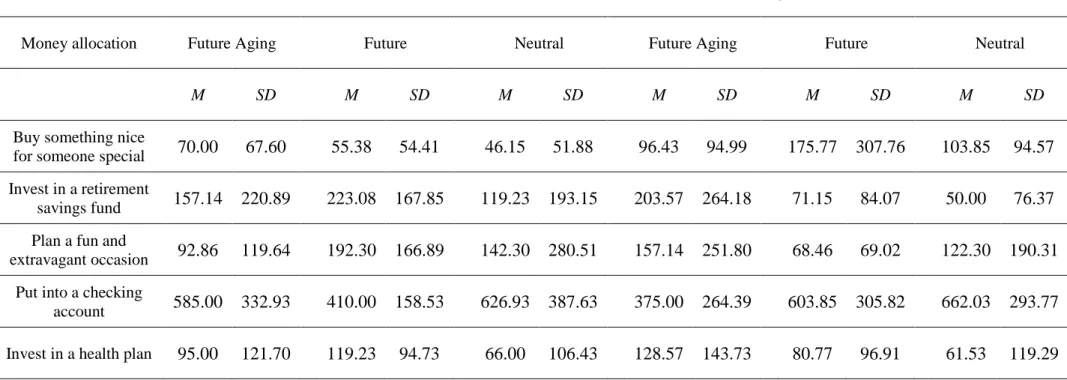
self-relevance effects for each money option revealed no main effects or interactions involving “use it to buy something nice to someone special”, “plan a fun and extravagant occasion” and “invest in a health plan”, F < 1.5. However, there were significant interaction effects for two categories of products: the checking account, F (1, 74) = 6.15, p = .02, p2 = .08, and the investment in a saving for retirement fund, F
(1, 74) = 3.95, p = .05, p2 = .05 (Table 1).
To better understand the pattern of significant interactions we conducted a 3 (prime) x 2 (future self-relevance) between participants x 2 (money option: saving for retirement fund and checking account) within participants ANOVA. We found the
expected three-way interaction between money option, prime and future self-relevance, F (2, 74) = 3.48, p = .036, p2 = .09.
The relevant pattern occurred in the distribution of money between these two options. When future self-relevance was low, there were no changes in the
distribution of money among these two options according with the priming
conditions, F < 1, However, when future self-relevance was high, there was higher allocation of money to the retirement savings fund in the aging prime than in future prime condition, F (1, 74) = 3.52, p = .064 (albeit at marginal levels), p2 = .05, and
the neutral prime condition, F (1, 74) = 4.74, p = .032, p2 = .06. Moreover, there
were no significant differences in the allocation of money for the retirement savings fund between the future and neutral conditions, F < 1.
The opposite pattern occurred for the money spent in the checking account in the high future self-relevance condition, with participants allocating less money for this alternative in the aging prime than in the future, F (1, 74) = 3.95, p = .050, p2 =
.05, and neutral, F (1, 74) = 6.23, p = .015, p2 = .08, conditions. Once again, there
were no significant differences in the allocation of money for the checking account between the future and neutral conditions, F < 1 (Figure 2).
Discussion
Study 2 confirmed that both a focus on aging and future self-relevance are needed to promote intentions to save for retirement. As predicted, when participants thought about their own future, the aging priming task led to more retirement savings than did the future and neutral primes. Additionally, higher contributions for the retirement fund were accompanied by lower monetary allocations in the checking account, indicating a reduced preference for immediate access to the funds.
Importantly, priming the future per se resulted in allocation patterns that were not distinguishable from the neutral (control) condition for all hypothetical options, including the retirement fund, regardless of whether future self-relevance was high or low. This suggests that activating the concept of future is not enough to promote saving for retirement, even when thinking about one’s own future. The observed effects on retirement savings are specific to personally relevant aging primes.
General Discussion
We initially hypothesized that future self-relevance influences the effect of priming aging on retirement savings in important ways. Merely being exposed to aging primes was not enough to increase retirement savings. Both studies showed that it is also necessary to induce future self-relevance by asking individuals to think about their own future. The replication of this effect confirms its robustness. Equally
important is that Study 2 confirmed that the aging-self-relevance effect is distinct from a future-self-relevance effect. For investment in retirement funds to increase, it is necessary to prime individuals with their future aging, thus showing the specificity of these types of primes.
Our findings are in line with self-continuity research suggesting that thinking about the future self enhances the connection between present and future selves, which in turn leads to more saving behaviours and less temporal discounting (Hershfield et al., 2011). Our results are also consistent with research on episodic future thinking showing that thoughts about possible future events increase the tendency to prefer delayed rewards over immediate ones (Peters & Büchel, 2010). Imagining future experiences with personal relevance is associated with more vivid imagery and less temporal discounting than thinking about future events lacking self-relevance (Daniel et al., 2013a, 2013b). Moreover, episodic future thinking has been
proposed to improve the evaluation of future outcomes by enabling the consideration of its undiscounted value (Benoit et al., 2011). Accordingly, one possible explanation for our findings is that the activation of future self-relevant thoughts about their own aging may have enabled participants to vividly imagine and thus better consider the long-term benefits of saving for their old age. In fact, this impact of self-relevance instructions is very similar to what has been found in other type of domains such as, for instance, pro-environmental behaviours (Meleady et al., 2017).
As a matter of fact, research on both future self-continuity and episodic future thinking seem to share converging views regarding vivid imagery as an important factor underlying the influence of self-relevance on intertemporal decision making. Vividness of the future self is one of the main determinants of future-self continuity, along with similarity and positivity (Hershfield, 2011). Hershfield and colleagues (2011) argued that exposing participants to realistic representations of their aged selves helped them to vividly imagine the future self that would benefit or suffer from the outcomes of their decisions. To the extent that the aged self is more vividly imagined, one should feel more connected to it and consequently be more motivated to save for retirement. This is consistent with evidence on episodic future thinking, suggesting that the effect of self-relevant thoughts about future events on temporal discounting are mediated by the vivid spontaneous imagery evoked when imagining these future experiences (Daniel et al., 2013a, 2013b; Peters & Büchel, 2010). Thus, future studies exploring the role of self-relevance on the effect of priming aging on retirement savings should include measures of imagery vividness and continuity with the future self in order to disentangle the contributions of these factors. Also
important is the fact that, in the case of the specific behaviour of saving for
fact, focusing on self-relevance in a general manner probably creates a focus on the present self, not necessarily on the future self. Hence, it seems to be determinant that individuals focus on their future self. However, further studies are needed in order to disambiguate these types of processes.
In an apparent contradiction to the effect of episodic future thinking on temporal discounting, in Study 2 we found that merely priming individuals with the general future, that is, without priming aging, was insufficient to increase retirement saving decisions, and this was the case even when self-relevance was high. It might be that in the future prime/self-relevant condition participants simply did not consider the future as involving an older self (i.e., they considered themselves in a different context rather than a changed but connected self). Thus, it seems that the critical element is to ensure that people imagine themselves as having been through an aging process and a shorter remaining lifespan in order to elicit the motivation to invest in long-term savings.
Limitations and future research
These novel and interesting findings are subject to some caveats. One of these is the priming method used in our studies. Contrary to previous evidence (Israel et al., 2014), we found that merely priming aging without making individuals think about their own future was not enough. A possible explanation is that Israel et al. (2014) used visual primes whereas the present studies used mainly textual primes. Hence, it is possible that text-based primes need to be reinforced with future self-relevance (perhaps to increase vividness), whereas visual non-self-relevant primes are similarly effective. Future research is needed to determine the relative effectiveness of these different methods and whether vividness is indeed the crucial mediating process.
It will also be important to explore possible mediating factors that may help to explain how aging primes affect saving for retirement. One possibility would be to
explore the role of mortality salience because priming aging may activate thoughts about death. Terror Management Theory predicts that older people are threatening reminders of our mortality, because they remind us that death is inevitable, the body is fallible and the bases of our self-esteem are transitory (Martens, Goldenberg, & Greenberg, 2005). Therefore, exposing participants to aging primes might have increased mortality salience, activating fears of death and illness, which might have led to an increase in the need to save for retirement. The same should also hold true for negative stereotypes of aging. Negative stereotypes that associate aging with illness and disability (Marques, Lima, Abrams, & Swift, 2014) may have triggered the need to save for retirement. However, an alternative persuasive possibility is that the negative affect evoked through such mortality salience or negative stereotypes might be cognitively depleting and might result in a stronger desire for immediate
gratification. Additional studies should therefore test these possible mediating mechanisms.
Saving for retirement might require time-specific and age-related primes in order to elicit precise thoughts about old age. Although priming future had no effect on retirement savings, it would be useful to explore its possible effects on other types of investment decisions such as more short-term general savings or even gambling, which might be less time-contingent.
Finally, the present studies included young adults who were asked to make intertemporal choices regarding hypothetical scenarios shortly after being exposed to primes. Further research on the effects of priming aging on retirement savings should also address whether there are particular age ranges within which such primes are more or less effective, and different savings time frames within which the effects can be produced.
Conclusions
Our findings have important practical implications for the development of interventions to encourage individuals to save for retirement. We found that, contrary to their intended purpose, exposing people to aging-related messages that lack
personal relevance might actually have no effect or even reduce the motivation to save for retirement. Conversely, personally relevant aging-related messages appear to quite strongly encourage financial investment in retirement savings plans. Thus, our studies show that prompting individuals to think about their own future as older adults
constitutes a simple and effective way to enhance the self-relevance of generic aging-related messages directed to multiple targets, overcoming the difficulty of designing personally relevant messages appealing to each and every individual. Given the importance of this topic for contemporary ageing societies this evidence offers considerable promise for promoting positive personal financial strategies for old age.
Notes
1 This work was supported by The Portuguese Foundation for Science and
Technology (grant number: SFRH/BPD/64226/2009)
2 Preliminary analyses in Study 1 revealed that the exclusion of these five participants
References
Abrams, D., Russell, P. S:, Vauclair, C. M. & Swift, H. J. (2011). Ageism in Europe: Findings from the European Social Survey. London: AGE UK.
Atance, C., & O'Neill, D. K. (2001). Episodic future thinking. Trends in Cognitive
Sciences, 5(12), 533-539. doi:10.1016/S1364-6613(00)01804-0
Bartels, D. M., & Rips, L. J. (2010). Psychological connectedness and intertemporal choice. Journal of Experimental Psychology: General, 139(1), 49-69. doi:10.1037/a0018062
Bartels, D. M., & Urminsky, O. (2011). On intertemporal selfishness: How the perceived instability of identity underlies impatient consumption. Journal of
Consumer Research, 38(1), 182-198. doi:10.1086/658339
Benoit, R. G., Gilbert, S. J., & Burgess, P. W. (2011). A neural mechanism mediating the impact of episodic prospection on farsighted decisions. The Journal of
Neuroscience, 31(18), 6771-6779. doi:10.1523/JNEUROSCI.6559-10.2011
Boyer, P. (2008). Evolutionary economics of mental time travel? Trends in Cognitive
Sciences, 12(6), 219-224. doi:10.1016/j.tics.2008.03.003
Childers, T. L., & Houston, M. J. (1984). Conditions for a picture-superiority effect on consumer memory. Journal of Consumer Research, 11(2), 643-654.
Daniel, T. O., Stanton, C. M., & Epstein, L. H. (2013a). The future is now: Comparing the effect of episodic future thinking on impulsivity in lean and obese individuals. Appetite, 71, 120-125. doi:10.1016/j.appet.2013.07.010 Daniel, T. O., Stanton, C. M., & Epstein, L. H. (2013b). The future is now: Reducing
impulsivity and energy intake using episodic future thinking. Psychological
Diamond, P., & Köszegi, B. (2003). Quasi-hyperbolic discounting and retirement.
Journal of Public Economics, 87(9-10), 1839-1872.
doi:10.1016/S0047-2727(02)00041-5
Ersner-Hershfield, H., Wimmer, G. E., & Knutson, B. (2009). Saving for the future self: Neural measures of future self-continuity predict temporal discounting.
Social Cognitive and Affective Neuroscience, 4(1), 85-92. doi:10.1093/scan/nsn042
Frederick, S. (2003). Time preference and personal identity. In G. Loewenstein, D. Read, R. Baumeister, G. Loewenstein, D. Read, & R. Baumeister (Eds.), Time
and decision: Economic and psychological perspectives on intertemporal choice. (pp. 89-113). New York, NY, US: Russell Sage Foundation.
Frederick, S., Loewenstein, G., & O'Donoghue, T. (2003). Time discounting and time preference: A critical review. In G. Loewenstein, D. Read, R. Baumeister, G. Loewenstein, D. Read, & R. Baumeister (Eds.), Time and decision: Economic
and psychological perspectives on intertemporal choice. (pp. 13-86). New
York, NY: Russell Sage Foundation.
Green, L., & Myerson, J. (2004). A discounting framework for choice with delayed and probabilistic rewards. Psychological Bulletin, 130(5), 769-792. doi:10.1037/0033-2909.130.5.769
Hershfield, H. E. (2011). Future self-continuity: how conceptions of the future self transform intertemporal choice. Annals of the New York Academy of Sciences,
1235(1), 30-43. doi:10.1111/j.1749-6632.2011.06201.x
Hershfield, H. E., Cohen, T. R., & Thompson, L. (2012). Short horizons and tempting situations: Lack of continuity to our future selves leads to unethical decision
making and behavior. Organizational Behavior and Human Decision
Processes, 117(2), 298-310. doi:10.1016/j.obhdp.2011.11.002
Hershfield, H. E., Goldstein, D. G., Sharpe, W. F., Fox, J., Yeykelis, L., Carstensen, L. L., & Bailenson, J. N. (2011). Increasing saving behavior through age-progressed renderings of the future self. Journal of Marketing Research, 48, S23-S37. doi:10.1509/jmkr.48.SPL.S23
Israel, A., Rosenboim, M., & Shavit, T. (2014). Using priming manipulations to affect time preferences and risk aversion: An experimental study. Journal of
Behavioral and Experimental Economics, 53(0), 36-43. doi:10.1016/j.socec.2014.08.006
Kurth‐Nelson, Z., Bickel, W., & Redish, A. D. (2012). A theoretical account of cognitive effects in delay discounting. European Journal of Neuroscience,
35(7), 1052-1064. doi:10.1111/j.1460-9568.2012.08058.x
Laibson, D. I., Repetto, A., & Tobacman, J. (1998). Self-control and saving for retirement. Brookings Papers on Economic Activity, 1998(1), 91-196.
Lin, H., & Epstein, L. H. (2014). Living in the moment: Effects of time perspective and emotional valence of episodic thinking on delay discounting. Behavioral
Neuroscience, 128(1), 12-19. doi:10.1037/a0035705
Marques, S. (2011). Discriminação da Terceira Idade. Lisboa: Relógio d'Água Editores.
Marques, S., Lima, M.L., Abrams, D. & Swift, H.J. (2014). Will-to-live in older people's medical decisions: immediate and delayed effects of aging stereotypes. Journal of Applied Social Psychology, 44(6), 399-408. doi: 10.1111/jasp.12231
Martens, A., Goldenberg, J. L., & Greenberg, J. (2005). A terror management perspective on ageism. Journal of Social Issues, 61(2), 223-239. doi:10.1111/j.1540-4560.2005.00403.x
Martens, A., Greenberg, J., Schimel, J., & Landau, M. J. (2004). Ageism and Death: Effects of Mortality Salience and Perceived Similarity to Elders on Reactions to Elderly People. Personality and Social Psychology Bulletin, 30(12), 1524-1536. doi:10.1177/0146167204271185
Meleady, R., Abrams, D., Van de Vyver, J., Hopthrow, T., Mahmood, L., Player, A., ... & Leite, A. C. (2017). Surveillance or Self-Surveillance? Behavioral Cues Can Increase the Rate of Drivers’ Pro-Environmental Behavior at a Long Wait Stop. Environment and Behavior (online ahead of print). DOI: 0013916517691324.
Peters, J., & Büchel, C. (2010). Episodic future thinking reduces reward delay discounting through an enhancement of prefrontal-mediotemporal interactions.
Neuron, 66(1), 138-148. doi:10.1016/j.neuron.2010.03.026
Pronin, E., Olivola, C. Y., & Kennedy, K. A. (2008). Doing unto future selves as you would do unto others: Psychological distance and decision making.
Personality and Social Psychology Bulletin, 34(2), 224-236. doi:10.1177/0146167207310023
Pronin, E., & Ross, L. (2006). Temporal differences in trait self-ascription: When the self is seen as an other. Journal of Personality and Social Psychology, 90(2), 197-209. doi:10.1037/0022-3514.90.2.197
Organisation for Economic Co-operation and Development [OECD], 2015). http://irsc.libguides.com/apa/bookwithorganizationasauthorreferenceexample
Read, D., & Read, N. L. (2004). Time discounting over the lifespan. Organizational
Behavior and Human Decision Processes, 94(1), 22-32. doi:10.1016/j.obhdp.2004.01.002
Schacter, D. L., Addis, D. R., & Buckner, R. L. (2007). Remembering the past to imagine the future: The prospective brain. Nature Reviews Neuroscience, 8(9), 657-661. doi:10.1038/nrn2213
Trostel, P. A., & Taylor, G. A. (2001). A theory of time preference. Economic
Inquiry, 39(3), 379.
Zhang, L. (2013). Saving and retirement behavior under quasi-hyperbolic discounting.
Table 1. Descriptive (Means and Standard deviations) for type of priming and level of future self-relevance for each money spending options
Low future self-relevance High future self-relevance
Money allocation Future Aging Future Neutral Future Aging Future Neutral
M SD M SD M SD M SD M SD M SD
Buy something nice
for someone special 70.00 67.60 55.38 54.41 46.15 51.88 96.43 94.99 175.77 307.76 103.85 94.57 Invest in a retirement
savings fund 157.14 220.89 223.08 167.85 119.23 193.15 203.57 264.18 71.15 84.07 50.00 76.37 Plan a fun and
extravagant occasion 92.86 119.64 192.30 166.89 142.30 280.51 157.14 251.80 68.46 69.02 122.30 190.31 Put into a checking
account 585.00 332.93 410.00 158.53 626.93 387.63 375.00 264.39 603.85 305.82 662.03 293.77 Invest in a health plan 95.00 121.70 119.23 94.73 66.00 106.43 128.57 143.73 80.77 96.91 61.53 119.29
Figure 1. Study 1: Effect of aging prime condition on the amount of money allocated to the retirement savings plan under high and low future self-relevance.
0 50 100 150 200 250 300 350
Low self-relevance High self-relevance Aging Control
Figure 2. Study 2: Effect of priming condition on the amount of the money allocated to each type of financial product under low and high future self-relevance.
Low Future Self-Relevance
High Future Self-Relevance 0 100 200 300 400 500 600 700 800 900 1000
Checking account Retirement saving
Future Aging Future Control 0 100 200 300 400 500 600 700 800 900 1000
Checking account Retirement saving
Future Aging Future Control