IOP Conference Series: Materials Science and Engineering
PAPER • OPEN ACCESS
Bicycle Solutions in Mountain Cities: CycloCable® in Trondheim-Norway
To cite this article: Isabel Matias and Ana Virtudes 2019 IOP Conf. Ser.: Mater. Sci. Eng. 603 022024
View the article online for updates and enhancements.
WMCAUS 2019
IOP Conf. Series: Materials Science and Engineering 603 (2019) 022024
IOP Publishing doi:10.1088/1757-899X/603/2/022024
Bicycle Solutions in Mountain Cities: CycloCable
®in
Trondheim-Norway
Isabel Matias1, Ana Virtudes2
1Civil Engineer, University of Beira Interior, Covilhã, Portugal
2C-MADE, Center of Materials and Building Technologies, University of Beira Interior, Covilhã, Portugal
Abstract. With the rising of soft mobility strategies among to the decision-makers regarding the
city policies, the urban designers are developing new ways of improving the bicycles using solutions considering the urban spaces. In the particular case of the mountain cities, the bicycle is still seen as a problematic way of transportation, requiring deep transformations of the urban fabric features. This paper presents the case study of the Norwegian city of Trondheim, well-known by its hills, which is an enormous success in terms of bicycle solutions not only among the locals but also among the visitors. The system is called CycloCable® and it is the first cycle lift for collective transportation which aims to help cyclists, who wish to move more easily, to overcome the sleepiest slopes in urban areas. The methodological approach is based on the literature review, in order to identify the characteristics of this system, which could be used in other mountain cities with similar features of the urban fabric.
1. Introduction
Among the various urban functions, mobility is of fundamental importance for the dynamics in the cities, as it permeates and connects the essential services to its functioning. Non-motorized modes of mobility, coupled with measures of integration of different modes of transport, can be a viable alternative for reducing the problems brought about by the lack of spatial planning, especially in medium and large cities [1].
Promoting smooth mobility in urban areas is an effective strategy to improve urban sustainability, especially in small and medium-sized cities. In fact, in these cities, a large percentage of journeys has distances compatible with pedestrian or bicycle mobility.
On short-term trips, the bicycle presents itself as an alternative with several advantages for both the user and the community in general. Figure 1 shows a graph which shows the comparison between different modes of transport and in which it can be seen that, for distances up to 5 km (which may increase depending on the congestion), the bicycle goes beyond the car.
The construction of pedestrian networks and bicycle lanes, sometimes combined with bicycle-sharing systems (bike bicycle-sharing), are the most common interventions in transport policy to encourage mobility. However, for cities built on the slopes of mountains, where there are sharp slopes, other solutions must be considered.
WMCAUS 2019
IOP Conf. Series: Materials Science and Engineering 603 (2019) 022024
IOP Publishing doi:10.1088/1757-899X/603/2/022024
2
Figure 1. Graph with a comparison of times, from door to door, traveling within a distance of 5 km
[2].
This condition, when pronounced such as reliefs of more than 5 % [2], limits and restricts the use of the bicycle in the face of the additional effort that the user has to spend to overcome these territories. Slopes higher than 5% are not desirable because the climbs are too hard to beat and dangerous descents provide great speeds. However, a higher slope is allowed as long as the length to be covered is reduced (Table 1 and Figure 2).
Of course, these figures change when one refers to electric bicycles, also known as e-bikes or pedelec, which are in every respect similar to conventional bikes in terms of general appearance and components, but are additionally equipped with an electric motor and a battery that can watch the user pedaling.
With the exception of users of such bicycles, potential users of soft mobility (inhabitants or visitors) often are discouraged from this practice, given the demands of the steep slopes. This issue is particularly important for mountain towns that generally have their historical centers located upon mountain areas. In these cases, connection systems, vertical or oblique, equipped with mechanical means (escalators, funiculars, etc.) should be adopted.
Table 1. Criteria for cycling fitness. [3]
0 to 3% Land considered flat With total fitness for cycling
3 to 5% Low slope land Considered suitable for
cycling up to medium distances
5 to 8% Sloping Inappropriate for long and
medium distances. Acceptable for very short distance connections (Figure 3)
8 to 10% Very steep
The choice of appropriate technology should be guided by an analysis of the technical, economic and financial feasibility. For example, escalators may be a suitable solution for short distances, since the vertical connection between two points with a not very large difference in dimensions can be ensured
WMCAUS 2019
IOP Conf. Series: Materials Science and Engineering 603 (2019) 022024
IOP Publishing doi:10.1088/1757-899X/603/2/022024
by an elevator adapted for the transport of bicycles. For longer distances, cable cars are the most suitable solutions, although the cost increases significantly.
Figure 2. Decline and maximum recommended length for the use of the bicycle. [4]
In Norway, since 1993, an innovative solution to encourage the use of a bicycle - a bicycle lift or cycloelevator - has been invented by a user of the city whose objective was to reduce the effort in the ascent of one of the hills of the city which he found on the way to his work.
2. Brief Historical Background
Introduced for the first time in 1993 by the Trampe project, Design Management, the cycling elevator was invented by a cycling enthusiast from the city of Trondheim in Norway (Figure 3), JarleWanvik, who was simply tired of climbing every morning up a hill to go to work.
As he did not intend to change his means of transport to get to work, he decided to develop a mechanical system that would help the users of this means of transport to climb up the slope with less effort, without having to dismount from the bicycle, taking inspiration from the technology used in skielevators.
Jarle Wanvik’s hometown is Trondheim, which is the third largest and one of the oldest cities in Norway, situated where the Nidelva River meets Trondheimsfjorden. It is a university city, where the great majority of students use the bicycle as a means of transportation and for this reason, there have been many public investments in the construction of bicycle paths. The highest point in the city is
WMCAUS 2019
IOP Conf. Series: Materials Science and Engineering 603 (2019) 022024
IOP Publishing doi:10.1088/1757-899X/603/2/022024
4
Stordheia Hill, at 565 meters above sea level, whereby the terrain was a problem, making the cyclists' move to the center of the city less favorable.
Jarle Wanvik, inspired by the technology behind ski lifts, had the idea of creating a bicycle lift that would allow the cyclist to be transported without having to get off his bike and not reach his destination too worn. Therefore, he presented the project to the public highway administration that at that time had funds available for such investment.
On August 18, 1993, Trampe was inaugurated in a ceremony attended by about 2000 people. In the following years, more than 220,000 cyclists were transported and although there was no accident, in 2010 POMA GROUP contacted the Design Management AS and after testing the Trampe lift, applied for a worldwide license that was signed on July 22 of 2011. Although no accidents were reported during the 15 years of operation, international authorities demanded safer construction for a more sustainable new generation.
The first version of the cycloelevator was withdrawn in 2012 and replaced by an updated version in 2013, named CycloCable® which has since become a tourist attraction. Cyclocable® is a bicycle lift developed by SKIRAIL (a member of POMA GROUP) and Design Management AS, based on the Trampe lift, with a simple yet innovative design.
3. CycloCable®System Specifications
The CycloCable® developed by POMA [6] has as a predicate, to constitute a system that aims to contribute to sustainable development and ecological mobility in contemporary cities (Table 2). This first cycle lift is a collective transport that aims to help cyclists, who wish to move more easily to overcome the steepest slopes in urban areas, even in mountainous cities, and constitute a true revolution in mobility urban. This cycle lift was also designed to take up little space on the public road since it was designed for urban areas, especially the preexisting ones where the space available for the fitting of new systems friendly to the bike, does not always abound.
Table 2. System description [7]
Propulsion System Vehicle concept Concept of transport Mode of transport/ Search type Electric network (power supply + electric motor) The cycloelevator + bicycle + underground electric cable
For public use Cycle lift for steep slope
cyclists
Individual transportation between the suburbs and
the city center
The lift is operated by a keycard, which can be purchased by the user or rented, in the case of sporadic users. In the first 4 years, the cards were distributed free of charge. However, as of June 1997, they have an associated fee of NOK 100 per year, equivalent to around EUR 10 per year. During the first 5 years of operation, the lift carried about 145,000 cyclists, the equivalent of the total population of Trondheim. Since its inauguration, no accidents were recorded and there were no injuries in the cycloelevator [7].
The prototype installed in Trondheim has an extension of 130 meters and a maximum slope of 20%. Its structures are located immediately below the surface of the street allowing pedestrians and vehicles to cross the road safely (Figure 4).
WMCAUS 2019
IOP Conf. Series: Materials Science and Engineering 603 (2019) 022024
IOP Publishing doi:10.1088/1757-899X/603/2/022024
Figure 4. Cycle lift in Trondheim - Norway.
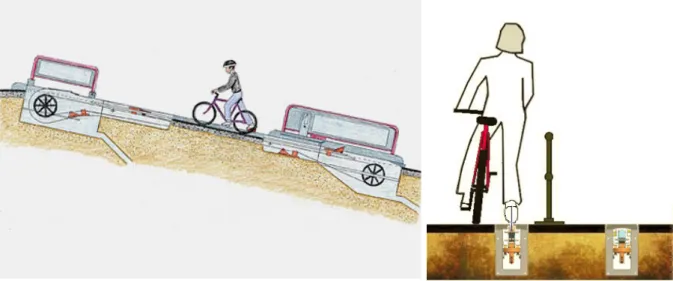
The cycle lift consists of a rope with 11 footrests, attached to a handle cable. An electric motor with a minimum power of 5.5 kW is located at the top of the hill, inside the designated exit station. At each end of the elevator, there are wheels 600 mm in diameter that allow the handlebar, where the supports are housed, to circulate continuously. At the starting point, there is an accelerator, a sort of piston, to make it easier to start the climb. The support for the foot that supports the cyclist appears coupled to the accelerator and after the initial impulse, it detaches of this one and follows with the cyclist by the rail. The system installed underground is 300 millimeters from the surface of the street, on a layer of sand.
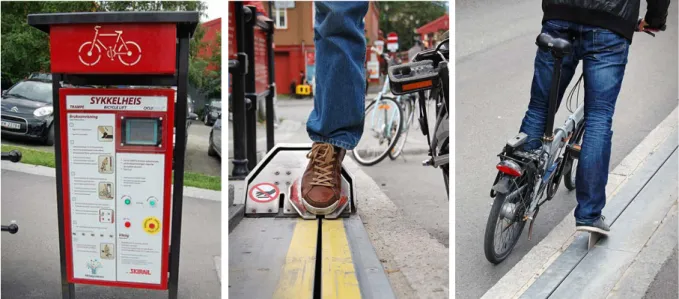
A cyclist who intends to use the system approaches that station from the start station and places himself in the position indicated by the auxiliary images in the station, placing his foot on the support. Then pass the card in the machine next to the support, press the “start” button and a buzzer sounds that tells the user that it will start being boosted. The user upon entering the system must transfer his or her entire weight to the support in order to climb comfortably always on top of his / her bicycle and should never use the brakes of the speedometer while in the lift [8].
Each support carries a cyclist and only those who are requested are on the road. The remainder remains lodged below the surface (Figure 5).
To prevent accidents, the cable pedals automatically retract when the rider pulls the foot off the support. This technique, patented by SKIRAIL, allows the installation of this system in ways for both
automobile traffic and pedestrian circulation
WMCAUS 2019
IOP Conf. Series: Materials Science and Engineering 603 (2019) 022024
IOP Publishing doi:10.1088/1757-899X/603/2/022024
6
3.1. Main components of CycloCable®
The main components of the system are the following elements:
• The entrance station, at the base of the hill, with reader and cards; • The exit station at the top of the hill where the electric motor is located; • The rail where the handlebar passes;
• Handlebar cable with footrests;
• The electronic system controlled by the user's card.
The system is equipped with a soft start device, that is, starting at the station is done gradually from the zero speed until it reaches the normal speed of operation of 1.5 m / s. In each of the stations (in and out) there is also an emergency pushbutton which, when pressed, stops the operation of the cycle-lift for 5 minutes (Figure 6). After this time, it restarts normal operation [9].
Figure 6. The cyclists using the cycle lift in Trondheim – Norway
3.2. Capacity of transport
Regarding the CycloCable® system, the distance between the footrests is 20,00 meters, which means that the cycle lift can transport a cyclist every 20,00 meters. A cyclist can enter the elevator every 12 seconds. The speed of the elevator is 2,00 meters per second which equates to a maximum capacity of 6 cyclists per minute. The rail where the supports circulate is integrated into the pavement surface. 3.3. Installation and maintenance costs
The cost of installation ranges from 960 to 1,200 Euros (equivalent to approximately 8,000 to 10,000 Norwegian kroner) per meter. This cost is similar to that of building a bicycle path in Norway.
The annual cost of maintenance is around 11,840 Euros (NOK 100,000) due to weekly system checks (once a week), monthly maintenance (about five hours a month) and cleaning once a year, after the closure period in the more rigorous winter months, from November to February [8].
The energy consumed by the cycle-elevator in the transport of 30,000 cyclists in a year is 5,000 kWh and by the heating cables under the elevator and on the pavement next to the elevator is 30,000 kWh per year [7].
WMCAUS 2019
IOP Conf. Series: Materials Science and Engineering 603 (2019) 022024
IOP Publishing doi:10.1088/1757-899X/603/2/022024
In Norway, about 100% of electricity is generated from renewable sources. The price of electricity is 0.5 NOK (0.05 Euros) per kWh. That is to say, that the cost of the electric energy consumed by the cycle-elevator in the transport of each cyclist is 0.08 NOK (0.01 euro) and in the heating cables is 0,48 NOK (0.05 Euros) [7]. It is, therefore, a solution which is quite attractive from the financial point of view when compared to other more expensive alternatives, such as funiculars or cable cars.
4. Requirements for the installation of a cycle lift
The cycle lift is a system that, due to the small space it occupies, can be installed in roads with or without car traffic, although on busy streets it is advisable to demarcate, through fences, a safety perimeter at least 1,00 meter width, for better perception of drivers and pedestrians, although this measure was not adopted in the prototype.
Tracks with a slope between 1:10 and 1:50 [8] are the ones with the best conditions for the installation of the cycle-heater, which also tolerates horizontal and vertical curves with radii of curvature of not less than 25,00 meters. The maximum length at which the system can operate with only one lane is estimated at 400,00 meters, so if the distance to go is greater, more rails [8] must be installed. It is recommended the minimum length to be at least 100 meters [9].
In the case of roads with frequent intersections, the safety fences must be interrupted. Priority should always be given to the cycle-elevator, so it is recommended that light signals be adopted on the roads with which it intersects, although it is admitted that in roads with very small traffic or in the entrance and exit of private properties, another kind of signaling, namely vertical danger and / or information.
In addition to the minimum requirements, referenced above, for the installation of this SME, its location must consider that it is powered by electric power so it must be placed next to a power supply. Finally, it must be considered that the system needs to be supervised to avoid acts of vandalism, so that the place chosen must be very frequent, in the main routes carried out by cyclists and preferably equipped with a surveillance system.
5.
Conclusions
As this article aimed to show, the current scientific knowledge about the bicycle in urban space indicates that its use is strongly linked to the urban features of the territory. Therefore, urban intervention plays a fundamental role in promoting its use, equal to or even greater than the role of transport planning [10]. Slopes are a not considerable obstacle for poorly trained cyclists, who use old and unsuitable bicycles, especially in cities where steep slopes above 5% are common [2]. However, even in such
circumstances, there is a potential for cycling in mountainous cities, as demonstrated in the example of the city of Trondheim in Norway, which has a significant rate of bicycle use of 8%, as the European Commission points out [2].
This city was also a pioneer in the installation of a bicycle lift, called CycloCable®, whose main objective was to reduce the effort of cyclists on steep slopes.
Although this system has been in operation since 1993 and several studies have already been carried out for its installation in other cities, there are no examples of replication in other cities, although the result is frankly positive, namely as a tourist attraction. The use of other mechanical means and / or the technological development of e-bikes may be one of the justifications for the fact that this system has not been adopted in other cities, particularly mountainous ones.
WMCAUS 2019
IOP Conf. Series: Materials Science and Engineering 603 (2019) 022024
IOP Publishing doi:10.1088/1757-899X/603/2/022024
8
Considering the social, economic and environmental benefits of cycling, there is a need to demystify the idea that it is a vehicle intended for children or associated with sports activities. When minimum conditions are met at the level of urban public spaces, their use is always associated with feelings of happiness and pleasure. Consequently, it is feasible and may even become quite competitive as a mode of urban transport.
As can be concluded, it is in this context that bicycle incentive solutions are particularly important in mountain towns, where orography is one of the factors that influences this practice the most.
Acknowledgment(s)
This work is supported by Portuguese national funds by FCT - Foundation for Science and Technology within the UID/ECI/04082/2019 project.
References
[1] M. R. Silva, R. Salvalaio, J. F. G. De Brito and C. E. De Alvarez, “The bicycle as an alternative to urban mobility in medium size cities: the case study of the city of Vitória (ES), Brazil", in II
Encontro Nacional sobre Reabilitação Urbana e Construção Sustentável: do edifício para a Escala Urbana, Lisboa, 2017 (in Portuguese).
[2] J. DeKoster and U. Schollaert, Cities for bicycles, cities for future, Belgium: European Commission, 2000 (in Portuguese).
[3] IMTT - Institute for Mobility and Transports, I.P., Cycling Network - Planning and Design Principles, 2011 (in Portuguese).
[4] D. S. Vale, “The city and the bicycle: an analytic reading" (in Portuguese), in Finisterra - Revista
Portuguesa de Geografia, Vols. LI - Número 101, 2016.
[5] [6]
Google maps [Online] 2019 Available at: https://www.google.pt/maps/preview. “The Poma Group,” [Online]. Available: http://www.poma.net.
[7] Hiconsumption, CycloCable®System description [Online] 2019 Available at: www.hiconsumption.com.
[8] L. A. d. N. Magalhães, “To improve the pedestrian mobility in cities with unfavorable orography", 2010 (in Portuguese).
[9] A. Sestáková, “Návrh A Ekonomické Vyhodnocení Projektu", Cyklistický Výtah, 2017.
[10] N. Haworth and A. Schramm, “How do level of experience, purpose for riding, and preference for facilities affect location of riding?,” Transportation Research Record 2247, pp. 17-23, 2011.
![Figure 1. Graph with a comparison of times, from door to door, traveling within a distance of 5 km [2]](https://thumb-eu.123doks.com/thumbv2/123dok_br/18066607.864155/3.892.109.710.195.474/figure-graph-comparison-times-door-door-traveling-distance.webp)
![Figure 2. Decline and maximum recommended length for the use of the bicycle. [4]](https://thumb-eu.123doks.com/thumbv2/123dok_br/18066607.864155/4.892.113.730.228.433/figure-decline-maximum-recommended-length-use-bicycle.webp)
![Table 2. System description [7]](https://thumb-eu.123doks.com/thumbv2/123dok_br/18066607.864155/5.892.114.788.740.839/table-system-description.webp)