From Monterrey to Addis Ababa
and beyond: a new global
framework for public finance for
sustainable development?
De Monterrey a Addis Abeba e além:
um novo quadro para o financiamento
para o desenvolvimento sustentável?
DOI: 10.21530/ci.v15n3.2020.1046Philippe Orliange1 Ana Flávia Granja e Barros2
Abstract
How did the global framework for financing sustainable development evolve in the past ten years? We argue that its evolution is deeply connected to multilateral initiatives such as the Monterrey consensus, the Addis Ababa Action Agenda, the Sustainable Development Goals and the Paris Agreement on climate change. Therefore, the year 2015 may be considered as a landmark. In this vein, we identified five key changes that affect the global framework for financing development worldwide, showing how traditional international cooperation mechanisms coexist with new ones. They are discussed in the following order: the evolution of global development agendas; systemic power relations and financial flows; the institutional entrepreneurship of emerging powers; the increased role of development banks; and 1 Diplomata Francês. Diretor Regional da Agência Francesa para o Desenvolvimento
(AFD) para o Brasil e Argentina. Brasília, Brasil.
([email protected]). ORCID: https://orcid.org/0000-0002-6794-2268
2 Doutora em Relações Internacionais pela Université Paris 1 Pantheon-Sorbonne. Professora Associada no Instituto de Relações Internacionais, Universidade de Brasília, Brasília, Brasil.
([email protected]). ORCID: https://orcid.org/0000-0002-8804-0378 Artigo submetido em 08/02/2020 e aprovado em 07/07/2020.
Copyright:
• This is an open-access article distributed under the terms of a Creative Commons Attribution License, which permits unrestricted use, distribution, and reproduction in any medium, provided that the original author and source are credited. • Este é um artigo publicado em acesso aberto e distribuído sob os termos da Licença de Atribuição Creative Commons, que permite uso irrestrito, distribuição e reprodução em qualquer meio, desde que o autor e a fonte originais sejam creditados.
from official development aid (ODA) to international public finance. Under the United Nations auspices or not, middle-income countries started to play a bigger role in financing mechanisms. Likewise, some national development banks became more important and started to act more closely under the International Development Finance Club (IDFC) auspices. Brazil, Colombia and South Africa are mentioned as cases for future research.
Keywords: Development Banks; Public Finance; Sustainable Development; Middle-Income
Countries.
Resumo
O quadro global de financiamento do desenvolvimento sustentável é profundamente conectado por iniciativas multilaterais como as do Consenso de Monterrey, a Agenda de Ação de Addis Abeba, os Objetivos de Desenvolvimento Sustentável e o Acordo de Paris sobre mudança do clima. Assim, o ano de 2015 pode ser considerado como um referencial no tema. Neste sentido, o texto identifica cinco grandes mudanças que afetam o quadro global para o financiamento do desenvolvimento mundo afora, demonstrando como mecanismos tradicionais de cooperação internacional coexistem com mecanismos novos. Eles são discutidos na seguinte ordem: a evolução das agendas globais de desenvolvimento; relações sistêmicas de poder e fluxos financeiros; entrepreneurship institucional das potências emergentes e o papel crescente de bancos de desenvolvimento; e a evolução da assistência oficial ao desenvolvimento para os financiamentos internacionais públicos. Sob a égide das Nações Unidas ou não, países de renda média aumentaram o seu papel nos mecanismos de financiamento global. Além disso, bancos de desenvolvimento de países como Brasil, Colômbia e África do Sul tornaram-se mais relevantes e mais próximos atuando no âmbito do Clube Internacional de Financiadores do Desenvolvimento (IDFC).
Palavras-chave: Bancos de Desenvolvimento; Finanças Públicas; Desenvolvimento
Sustentável; Países de Renda Média.
Introduction
Since the 2002 Monterrey meeting, the global development agenda was profoundly reshaped. There were significant changes in the global agendas (Kannie and Biermann 2017; Biscop 2019; Khanna 2019) which are discussed below. Furthermore, the COVID-19 has brought new issues to the global development agenda, that calls for in depth research in the near future. From an institutional viewpoint, these changes were marked by international institutional bypasses
(Prado and Trebilcock 2019), that is, “a bypass offers an alternative to the dominant institution. This means that public and private institutions can be operating side by side without one being a bypass of the other” (Prado, 2019). Moreover, the same concept may be useful for assessing BRICS countries’ agenda (Stuenkel 2019) and the global framework for public finance for sustainable development (FSDR 2019; Chimhowu et al 2019).
In this scenario, middle-income countries (MIC) (Saad Filho 2004; Gu et al 2016) and development banks may be considered increasingly important actors (Ferraz et al 2013; Ferraz and Countinho 2019; Orliange 2020). However, initiatives for reaching the Sustainable Development Goals (SDGs) within the UN 2030 Agenda and the Objectives of the Paris Agreement on climate change are still underfunded, from public and private, domestic and international perspectives (Kannie and Biermann 2017; Lee 2019; FSDR 2019; Chimhowu et al 2019; Guterrez 2019; Soares and Inoue 2020). In addition, each source of financing brings impacts to the others, and international public finance encompasses much more than official development assistance (ODA) (FSDR 2019). Providing ODA was and still is the mission of aid agencies. Providing public finance, making up for market failures, taking risks others will not take, is the mission of development banks (DB). However, domestic or regional development banks are not new actors (Ferraz et al 2013; Orliange 2020). Many of them have been operating for decades (and some even for centuries), but the new global framework for public finance for sustainable development referred to above gives them an increased relevance (Ferraz and Countinho 2019; Orliange 2020). In other words, there were tectonic changes in the framework of development financing in the past ten years.
This article aims at assessing agendas and institutions in order to answer the following question: how did the global framework for public financing for sustainable development evolve? Recently, the development agenda evolved from the 2000 United Nations Millennium Development Goals (MDGs) to the 2015 Sustainable Development Goals (SDGs). Naturally, both of them are connected to the Action21 adopted in Rio in 1992, as well as to the Organisation for Economic Co-operation and Development (OECD) and United Nations (UN) broader debates. Taking the 2030 agenda (SDGs) as the starting point of this analysis, we discuss five key changes in the framework for public finance for sustainable development. The first one concerns the evolution of development agendas since 1992, while the second one corresponds to the systemic power
diffusion to Asia. The third change is the institutional entrepreneurship of emerging powers, thus contributing to the increased role of development banks as a fourth trend. The fifth relates to the international public finance framework as a result of the other previous changes.
The evolution of global development agendas
From Monterrey to Addis Ababa, the agendas evolved significantly in terms of the UN traditional cleavage between developing and developed countries. Emerging economies or middle-income countries (regardless of the debates about the categories) can no longer be defined as those receiving development finance. They have become providers of development finance in the recent past. In other terms, China and India, despite not having a high human development index (HDI) have a demonstrated capacity to provide development finance. Brazil had also been in that position in the 2010s, even though its capacity has been severely reduced in recent years.
After the adoption of the 2000 Millennium Development Goals by the UN General Assembly (UNGA), the Monterrey 1st international conference on financing for development took place in March 2002. At that meeting, the international consensus on development was revisited. Inspired by a North-South viewpoint, the Monterrey declaration stated in its first paragraph that the aim was “to address the challenges of financing for development around the world, particularly in developing countries. Our goal is to eradicate poverty, achieve sustained economic growth and promote sustainable development as we advance to a fully inclusive and equitable global economic system”.
The Monterrey consensus, in paragraph 4, reaffirmed the central character of the traditional North-South paradigm: “Achieving the internationally agreed development goals, including those contained in the Millennium Declaration, demands a new partnership between developed and developing countries”. It was therefore logical in this context to stress that: “Official development assistance (ODA) plays an essential role as a complement to other sources of financing for development, especially in those countries with the least capacity to attract private direct investment” (paragraph 39).
This consensus also mentioned on several occasions the case of “countries in transition”, a by-word referring to countries of the former Soviet bloc that were
undergoing transition from centrally planned economies to market economy, in the decade following the fall of the Berlin wall.3Although the Monterrey consensus also stressed the particular case of least developed countries, of landlocked developing countries and small island developing states, it did not challenge the notion that the partnership to be approved was between “developed” and “developing” countries.
In this context, the year 2015 is a turning point in multilateral negotiations related to sustainable development under the United Nations auspices, when three fundamental conferences took place. However different4, they have contributed to changing the global framework for public finance worldwide. In July, the Addis Ababa Action Agenda (AAAA) agreed upon financing for development. In September, the General Assembly of the United Nations adopted the Agenda 2030 on Sustainable Development Goals (SDGs), in New York. In December, the Paris Agreement was adopted by the 21st conference of the parties (COP 21) to the United Nations Framework Convention on Climate Change (UNFCCC).
These three multilateral initiatives brought about a different perspective from the cleavage between developed and developing countries, but it does not mean that the cleavage simply disappeared. It is still present in the Paris agreement (article 2) but balanced with the principle crafted in Rio in 1992 of “common but differentiated responsibilities and respective capabilities, in the light of different national circumstances”. The agreement has also recognized the needs of least developed countries (LDC) and small island developing states (SIDS) (Paris agreement, article 4, para 6). Agenda 2030 stresses the case for “the poorest and most vulnerable countries”.5 The AAAA also refers to the special needs of LDC, small islands developing states and, on several occasions, to African states (AAAA, paragraph 8).
3 The complexity stemming from different development challenges around the world was somehow updated. See, for instance, Monterrey Consensus, paragraph 20 “A central challenge, therefore, is to create the necessary domestic and international conditions to facilitate direct investment flows, conducive to achieving national development priorities, to developing countries, particularly Africa, least developed countries, small island developing States, and landlocked developing countries, and also to countries with economies in transition”. 4 The three conferences had their own negotiating tracks but their respective outcomes, in spite of different
legal status, are remarkably convergent and consistent. They are part of the same systemic efforts in our view. 5 In the Preamble of the UNGA resolution it was stated in the following manner: “We are determined to mobilize
the means required to implement this Agenda through a revitalized Global Partnership for Sustainable Development, based on a spirit of strengthened global solidarity, focused in particular on the needs of the poorest and most vulnerable and with the participation of all countries, all stakeholders and all people”.
The AAAA offers a broader picture when it comes to international financing. “International public finance plays an important role in complementing the efforts of countries to mobilize public resources domestically, in particular in the poorest and most vulnerable countries with limited domestic resources. Our ambitious agenda puts significant demands on public budgets and capacities, which requires scaled-up and more effective international support, including both concessional and non-concessional financing” (AAAA, paragraph 50). Therefore, it referred to establishing an “enhanced and revitalized partnership for sustainable development” (AAAA, paragraph 10). Besides, it stated that “This global partnership should reflect the fact that the post-2015 development agenda, including the sustainable development goals, is global in nature and universally applicable to all countries while taking into account different national realities, capacities, needs and levels of development and respecting national policies and priorities” (AAAA, paragraph 10).
The global nature of the AAAA echoes the Sustainable Development Goals themselves: “The 17 Sustainable Development Goals and 169 targets which we are announcing today demonstrate the scale and ambition of this new universal Agenda (…). They are integrated and indivisible and balance the three dimensions of sustainable development: the economic, social and environmental” (Preamble of Resolution adopted by the General Assembly on 25 September 2015). It is equally consistent with the goals and objectives of the Paris agreement that acknowledges that “climate change is a common concern of humankind” (Preamble of the Paris agreement). It also stresses that the Agreement aims “to strengthen the global response to the threat of climate change, in the context of sustainable development and efforts to eradicate poverty…”. (Article 2 of the 2015 Paris Agreement). In sum, the need to strengthen the global development initiatives and the financial safety net still is a key challenge for humankind, notably after the COVID-19 crisis.
Systemic power relations and financial flows
After the failure of the Washington consensus (Bresser Pereira 2011), there are at least three systemic megatrends in international relations: the decline of the US leadership, the power shift to Asia, and the growing role of the private sector (Allison 2018; Khanna 2019; Biscop 2019). As a result, the rich traditional
providers for official development assistance had to cope with numerous middle-income countries’ increasing interests (Inoue and Vaz 2012; Narlikar 2013; FSDR 2019) and bigger development banks, including the International Development Finance Club (IDFC) discussed below.
Although non-traditional creditors became more relevant, the most important public actors are still development agencies, whose primary function is to provide official development assistance. Although ODA from OECD/Development Assistance Committee (DAC) countries stood at 146,6 billion USD in 2017, the flow is still traditionally North-South driven. Actually, there are at least three competing poles of financing for development: the United States, the Europeans6 and China. However, other flows of international public finance are coming from the South, notably the middle-income countries. Hence, we assume financing flows follow the systemic changes in terms of power relations. In other words, emerging economies play a more important role in financing for development (OECD 2019).
Combined with the crisis in the UN-led multilateral commitments7, the three megatrends above shaped the current global framework for public finance for sustainable development. Despite the fact that the role of the private sector is growing, as blended financing strategies show (Voituriez et al 2017; Soares and Inoue 2020), this article focuses exclusively on public financing.
The institutional entrepreneurship of emerging powers
Emerging powers are economic powers seeking for more recognition in multilateral arenas (Narlikar 2013). Because they still have to face serious social challenges, they are still middle-income countries (Morin and Orsini 2020). Nowadays, the majority of the “developing world” is middle-income countries, that is, 94 out of 130 countries. They are aid receivers but also providers of international public finance (Inoue and Vaz 2012; Baumann 2017; Farias 2018; FSDR2019; Chimhowu et al 2019), operating through cooperation agencies and
6 Some European countries have important development agencies, eight of them joined the IDFC (retrieved from idsc.org/members) and twenty-three joined the Asian Infrastructure Investment Bank (retrieved from https://www.aiib.org/en/about-aiib/governance/members-of-bank/index.html). June 06, 2020.
7 Multilateralism crises under the UN auspices are not a recent trend. Reports from Secretary-Generals since Kofi Annan, for instance, mention some traces of crises in different issues. See the Guterrez 2019 Report for an update. In May 2020, the World Health Organization became the epicenter of a new crisis as President Donald Trump decided to leave the organization.
development banks. Hence, the UN recent negotiations and agendas are also a result of their empowerment.
Agenda 2030 makes a short reference to MICs:
“Each country faces specific challenges in its pursuit of sustainable development. The most vulnerable countries and, in particular, African countries, least developed countries, landlocked developing countries and small island developing States, deserve special attention, as do countries in situations of conflict and post-conflict. There are also serious challenges within many middle-income countries” (Paragraph 27 of the SDG summit, New York, 25-27 September 2015). The 2030 Agenda, when referring to objectives and indicators, also recognizes the particular case of middle-income countries8.
Compared with the Monterrey Consensus, the newest feature in the AAAA9, is the explicit mention of middle-income countries’ needs, which were not mentioned at all in the Monterrey text. References to the special needs of MICs were made on several occasions, such as: in general terms (paragraph 8); in the context of foreign direct investment (para. 46); as a group facing “significant challenges to achieve sustainable development” (para. 71 and 72). So, this explicit reference to MICs is quite new and signals a particular and growing concern of this particular group of countries.
The changes brought about by the new framework will be analyzed globally and also through the example of three middle income countries, whose track record in the area of international public finance is significant for a variety of reasons. Mainstream literature focuses primarily on China and India, but our analysis focuses on Brazil, South Africa and Colombia. They are receivers of official development assistance but also of other flows of development finance. Additionally, they play an important role in the framework, although 2021 may bring a new scenario.
8 See in particular paragraph 48 “Indicators are being developed to assist this work. Quality, accessible, timely and reliable disaggregated data will be needed to help with the measurement of progress and to ensure that no one is left behind. Such data is key to decision-making. Data and information from existing reporting mechanisms should be used where possible. We agree to intensify our efforts to strengthen statistical capacities in developing countries, particularly African countries, least developed countries, landlocked developing countries, small island developing States and middle-income countries. We are committed to developing broader measures of progress to complement gross domestic product”. Available at: <https://www.un.org/ ga/search/view_doc.asp?symbol=A/RES/70/1&Lang=E>. Access on 10 Nov 2020.
Brazil and South Africa have been active in the field of development cooperation for quite some time (Chatuverdi et al. 2012; Inoue and Vaz, 2012). Colombia is a newcomer but it has played a very significant role in the elaboration and adoption of the SDGs. Also, it joined the OECD in 2020. Brazil and South Africa, as BRICS members participated in the creation of the New Development Bank (NDB) in 2014, headquartered in Shanghai, with branches in Johannesburg and São Paulo. While Colombia and Brazil have a cooperation agency, South Africa is still working towards the creation of its agency. The three countries have development banks – Banco Nacional de Desenvolvimento Econômico e Social (BNDES) for Brazil, Banco de Comercio Exterior de Colombia (Bancoldex), Development Bank of Southern Africa (DBSA).
Concisely, the complexity of institutional entrepreneurship of MICs is still largely unexplored. Most IR analysts put the debate in terms of integration or competition (Ikenberry, 2011; Prantl, 2014; Stuenkel 2019). However, there is a growing probability of more collaboration among them, within the International Development Finance Club (IDFC), for instance. The IDFC was established in 2010 with 23 development banks, out of which only three were from OECD/DAC countries (JICA from Japan, KFW from Germany, AFD from France). Others were from developing and emerging countries. The IDFC members represented in 2019 a total of asset worth 3 trillion USD and annual commitments of 405 billion, out of which green finance alone represents 98 billion (IDFC, 2019). In 2020, the IDFC has 26 members, 600 billion USD in commitments and the asset raised to 4 trillion dollars (IDFC, 2020)10.
The increased role of development banks
The follow-up report to the AAAA, prepared by the United Nations Department for Economic and Social Affairs (UNDESA) analyzed the role of national development banks and pointed at their contribution to financing the transition to sustainable infrastructure (UN 2017,15-16). The International Development Finance Club also made the case for the increased role of development banks in the financing of Agenda 2030. The creation of the IDFC in 2010, at the initiative of CAF, BNDES and KFW’s CEOs, aimed at helping “national and sub-regional
10 There are 8 members from Europe, 4 from Africa, 6 from Asia and the Middle East and 8 from Central, South America and the Caribbean Region. Retrieved from: https://www.idfc.org/members/. Access on 5 Jun 2020.
development banks strengthen their voice in an environment dominated by multilateral financing institutions” (IDFC 2019). The objectives are described as follows: “Agenda setting by joining forces and networking on issues of similar interest, I dentifying and developing joint business opportunities, sharing know-how and best practice experiences for mutual learning”. Issues of common interest for the members are: “climate finance, infrastructure finance, social development, poverty reduction, green banking and innovation finance” (IDFC 2019). In 2020, the IDFC took action to help fight the COVID-19 pandemic11.
The membership of the IDFC illustrates the global and universal partnership mentioned in the AAAA and departs from the old North-South logic. Only three members were from “donor countries”: KFW, AFD, JICA, and the majority is from middle-income countries, with an unprecedented representation of Latin America. Development banks are not “new actors” because many of them existed even before ODA was created. But the new international agenda for development financing is reshaping their role and they are shaping this new agenda in return. With the increasing focus put on international public finance, the AAAA also stresses the role of development banks, a category of actors that was barely mentioned in the Monterrey Consensus. This is the case in paragraph 33 that “notes the role that well-functioning national and regional development bank can play in financing sustainable development, particularly in credit market segments in which commercial banks are not fully engaged and where large financing gaps exist (…)”. The text also stresses the counter-cyclical role that such banks can play. These references are made in the section devoted to “domestic resources mobilization”. Development banks are also referred to in the section dealing with international development cooperation, alongside multilateral development banks (AAAA, paragraph 70), or on their own AAAA, paragraph 75). Development banks, as diverse as they may be, provide long-term public finance for development.
From ODA to International public finance
Several factors explain the creation in the early 1960s of a body of policies, mechanisms and institutions aiming at defining international development cooperation and official development assistance (ODA). Development economics
argued that underdevelopment was the result of insufficient investment, which in itself is the consequence of insufficient domestic savings. Hence, the need to supply from outside was clear. Others argued on moral grounds that rich countries should not ignore the sufferings of poor ones and should therefore find ways to help them and their people. Of course, geopolitics was not absent from the debate concerning establishing ODA as a permanent feature of inter-state relations. Put bluntly, financial assistance soon appeared as a path for world powers to strengthen alliances (or create new ones).
In this context, Monterrey and Addis Ababa have both stressed the importance of mobilizing domestic resources when it comes to financing sustainable development. Monterrey was a landmark in this respect since prior to 2002 the issue of domestic resource mobilization did not receive the same level of attention it did on the first conference on financing for development. Nevertheless, as mentioned above, ODA came first in the list of tools aimed at supporting the global partnership at Monterrey. Thirteen years later, Addis Ababa Action Agenda started its section C on “International development cooperation” stressing the role of “international public finance”. Likewise, Agenda 2030 also referred to international public finance as a complement to domestic public resources12. Chapter 3 of the Financing for Sustainable Development Report (FSDR, 2019) is thus entitled “International Development Cooperation”.
All the above arguments made the case for transferring resources, closely in line with the Marshall Plan in postwar Europe. It is remarkable that the institution that was established to coordinate and follow the implementation of this Plan, the Organization for European Economic Cooperation, became the Organization for Economic Development and Cooperation (OECD). In its framework, the committee in charge of defining and monitoring the newly “official development assistance” was established. Therefore, the notion of ODA and how it was monitored had several implications from postwar experiences.
It was first necessary to agree on a common definition of ODA, so that it could be clearly distinguished from export-credits. The focus of the nascent ODA
12 Paragraph 43 states “We emphasize that international public finance plays an important role in complementing the efforts of countries to mobilize public resources domestically, especially in the poorest and most vulnerable countries with limited domestic resources. An important use of international public finance, including official development assistance (ODA), is to catalyze additional resource mobilization from other sources, public and private. ODA providers reaffirm their respective commitments, including the commitment by many developed countries to achieve the target of 0.7 per cent of gross national income for official development assistance (ODA/GNI) to developing countries and 0.15 per cent to 0.2 per cent of ODA/GNI to least developed countries”.
was to stir growth and development that would eventually increase income. A target was set: 0,7%13 of rich countries GDP was due to be allocated to ODA under the UN framework. At this point it is worth noting that the 0,7% target is a rare case of a regionally defined concept receiving international recognition. There is no universal definition of ODA (it is an OECD concept which has been given recognition by the UN) but there is no universal support for the 0,7% target. Second, a consensus on which countries should be eligible to receive ODA was reached. The notion of a list of beneficiaries was based on a level of per capita income above which a country was no longer eligible to access ODA funds. The OECD was not the only institution to draw up lists of countries. The World Bank established a similar system. So did the United Nations with a list of “Least developed countries” (LDC), although LDC are not necessarily poor countries in per capita income terms. Third, the definition of modalities for reporting on aid flows was a task for donor countries.
The overall levels of ODA remained more or less stable (at relatively high levels) until the fall of the Berlin Wall, in 1989 (thus showing in retrospect that geopolitical motives had weighed more strongly in favor of ODA than what had been publicly acknowledged). Then, ODA started to decline until the adoption of the Millennium Development Goals (MDG) gave a new life to the twin agenda of combatting poverty and increasing ODA. The G7 countries had also made the case in favor of helping the poorest countries with the Highly Indebted Poor Countries (HIPC) initiative, launched by the World Bank and the International Monetary Fund, and supported by the 1999 G7 summit. Other factors such as the creation of the Department for International Development (DFID) in the United Kingdom gave centrality to the issue of poverty in the international agenda. The Monterrey Conference on Financing for Development further endorsed this renewed commitment. So, at the beginning of the 21st century, ODA as a way to support the poverty eradication agendas in developing countries was enjoying a much stronger support than had been the case since the late 1980s. Recently, ODA augmented, but it was concentrated in a few countries and related to humanitarian emergencies (FSDR, 2019:77).
Nevertheless, ODA is not the only source of public external finance that flows into developing and emerging countries. The Table 1 below shows the respective
13 An estimate was made of the external resources needed in developing countries to make up for the lack of savings needed to finance investment levels needed to achieve the expected targeted growth. This amount was equivalent to 0,7%.
size of different financial flows to and in developing countries, both domestic and international, public and private, and their allocation by income category.
Table 1. International public finance, FDI and domestic resources
(USD Bn) ODA (gross) 2015 OOF (gross) 2015 FDI ODA/FDI Fiscal Ressources (WB/IMF) 2014** ODA/fiscal ressources (Unctad) 2015 LICs/LDCs 51 2 37 136% 105 48% LMICs 45 29 100 45% 748 6% UMICs 22 34 366 6% 2301 1% Total 118* 65* 508 23% 3155 4%
* The figure is lower than the total gross ODA or OOF since a portion of ODA and OOF cannot be allocated to specific countries or income categories
** AFD figures based on OECD, WB and IMF data. Source: AFD, OECD, WB and IMF data.
“Other official financial flows” (OOF), include public finance for development purposes but which are not on concessional terms as ODA is. The fact that there is no internationally agreed upon target for OOF, comparable to the 0,7% of GDP for ODA, explains why it is not as widely known as ODA is in the framework of international negotiations on development finance. The quality of the reporting is often lower than ODA reporting and may result in the underestimation of these flows. They include export credits, financing provided by public financial institutions in the forms of loans, either to public or private counterparts, on concessional terms, etc. Since 2017, exports credits that used to be included in OOF are accounted for separately.
Similar to ODA, OOF are public flows from developed countries to developing ones, but the notion of international public finance goes beyond that14. Section C of the AAAA mentions “South-South Cooperation” under the heading “international development cooperation”. Is South-South Cooperation “international public finance”? This is not clearly stated in the document, which characterizes South-South Cooperation in terms of “shared experiences and objectives” rather than in terms of financial flows (AAAA, paragraphs 56 and 57).
The AAAA also refers to a possible new concept that comes close to a description of “international public finance”, namely the “proposed total official support for sustainable development” (TOSSD) (AAAA, paragraphs 55). TOSSD is
an effort by the OECD to account for the financial flows that support sustainable development but which are not ODA, either because they do not match the financial standards of ODA or because they are provided by non-OECD member states. As Mr. Jorge Moreira, director for development cooperation of OECD put it recently; there is a need to “provide the first-ever global picture of finance for development from all donors. Initial estimates show that this could be upwards of USD 500-600 billion annually. This new standard will allow for transparency, accountability and comparability that will strengthen collective multilateral development finance and decision-making. At the same time, ODA will remain distinct in its policy standard-setting and its target-setting measurement of 0.7% ODA/GNI for foreign aid spending” (Moreira and Gornitzka 2018).
Middle-income countries and the new development agenda
Based on DAC methodology, among the 146 countries listed as ODA recipients, in 2016, 94 are middle income (lower and upper) and 52 are least developed countries (LDC) or Low Income, meaning that two thirds of the “developing world” are middle-income countries. It is of political significance the fact that the Addis Ababa Action Agenda and Agenda 2030 contain explicit references to middle-income countries, even though they do not constitute an established category, within the UN system, the way least developed countries do.
The relevance of the new development agenda and in particular the issue of financing for development (and climate) for middle income countries will be analyzed in general terms and through the examples of three countries: Brazil, South Africa and Colombia. From an “OECD/DAC” point of view, Brazil, South Africa and Colombia are recipient of overseas development assistance. Table 2 below shows how they were positioned in the recent past.
Table 2. ODA received in 2016 (in million USD)
South Africa Brazil Colombia
Total ODA 1315 880 1167
Of which OECD/DAC countries 1098 755 1037
Source: OECD StatExport 2017.
Middle-income countries in general have actively participated in the elaboration of the process leading to the adoption of the SDGs. The role of Colombia in this
process has often been emphasized (Chataigner and Tous 2017). Contrary to the MDGs process which was largely inspired by the works of development agencies, the SDGs process has really been universal and with a much stronger input from middle income countries. As a result, the 17 SDGs cover a much broader scope of issues than the MDGs in which issues relating to social services (education, health, water and sanitation) were given “the lion’s share”. Issues such as inequalities (SDG 10) or sustainable cities (SDG 11) are of particular relevance for middle-income countries having reached or being in the process of reaching high level of urbanization, a growing middle class, and so on.
As mentioned above, the AAAA makes special reference to issues of importance for middle-income countries. The document signals that MICs “still face significant challenges to achieve sustainable development” (para. 71), that “ODA and concessional finance is still important for a number of these countries” (id.). It calls for “methodologies to better account for the (…)realities of MICs” (para. 72), raises the issue of “graduation” and calls for “gradual policies” in this regard (id).
In addition to these issues, certain categories of actors highlighted in the AAAA are of particular relevance for middle income countries. This is the case with development banks, for instance. It is also the case with the issue of sub-sovereign lending15. Development banks are not a prerogative of middle-income countries. Many developed countries do have such instruments. However, it is of particular relevance for them given the nature of financing needs of middle-income countries. Even though the Paris agreement as such does not make explicit reference to middle-income countries, they are already key players in the area of climate finance. A number of MICs are already large emitters of greenhouse gases. During the Paris talks, Brazil and South Africa ranked 11th and 17th in the list of major emitters (UNFCCC16). The provisions of the Paris agreement on finance might look weak, but they are consistent with what MICs may need: “this agreement aims to strengthen the global response to the threat of climate change (…) including by making finance flows consistent with a pathway towards low greenhouse gas emissions and climate-resilient development” (Paris Agreement, article 2C). Finance flows in this context are not linked to a level of income that would place
15 Development banks are often mentioned in the AAAA. See for instance paragraphs 33,43,70,75, 81. Lending for sub-nationals is mentioned in paragraph 34.
16 The website has an official map of emitters. <https://unfccc.int/process-and-meetings/transparency-and-reporting/greenhouse-gas-data/ghg-data-unfccc/ghg-data-from-unfccc>.
a constraint for middle-income countries. They are associated with a “pathway towards climate resilient development”. This is exactly what the SDGs and the AAAA are about. Likewise, the OECD/DAC recognizes the nexus humanitarian aid-development-peace17.
Middle-income countries are also providers of development finance (Chaturvedi
et al, 2012; Guet al, 2016). It is interesting to analyze their practices against the
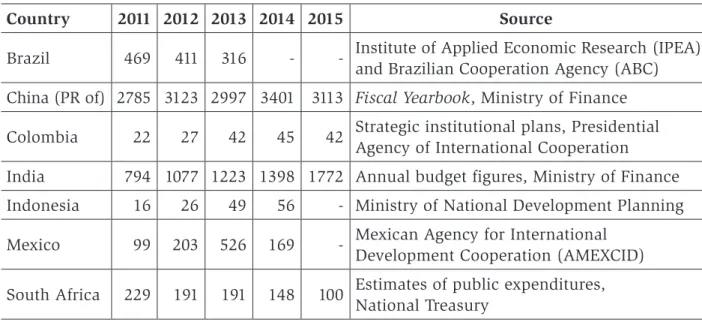
background of the new development agenda. However, the issue of availability of data must be mentioned. Outside OECD/DAC, there are no harmonized practices for reporting on development finance. The OECD publishes information about non-DAC countries. Some do report figures about their ODA using DAC standards. This is the case with Saudi Arabia, United Arab Emirates, Kuwait, Russia, and Thailand. None of the three countries of interest does report to the OECD. However, OECD occasionally publishes estimates based on data published by the countries themselves.
Table 3. Estimates of gross concessional flows for development cooperation 2011-2015 (USD million, current)
Country 2011 2012 2013 2014 2015 Source
Brazil 469 411 316 - - Institute of Applied Economic Research (IPEA) and Brazilian Cooperation Agency (ABC) China (PR of) 2785 3123 2997 3401 3113 Fiscal Yearbook, Ministry of Finance
Colombia 22 27 42 45 42 Strategic institutional plans, Presidential Agency of International Cooperation
India 794 1077 1223 1398 1772 Annual budget figures, Ministry of Finance
Indonesia 16 26 49 56 - Ministry of National Development Planning
Mexico 99 203 526 169 - Mexican Agency for International
Development Cooperation (AMEXCID) South Africa 229 191 191 148 100 Estimates of public expenditures, National Treasury
Source: Own elaboration (2020)
OECD also publishes data regarding flows of concessional resources going through international institutions to which middle income countries are contributors, using the coefficient that qualifies the amount of these contributions counted as ODA.
17 The World Bank Group (www.worldbank.org), United Nations Development Program (www.undp.org) and the OECD share the same view on this nexus.
Table 4. Estimated contributions of middle-income countries to international institutions contributing to ODA (USD million, current)
Brazil (PR of)China Colombia India Indonesia Mexico AfricaSouth Total Total Total Total Total Total Total Total United Nations 54,3 206,6 13,2 59,3 14,2 50,0 18,7
UN (18%) 14,3 25,1 1,3 3,3 1,7 9,0 1,8 FAO (51%) 8,7 18,8 5,4 2,0 1,1 13,7 2,5 UNESCO (60%) 6,0 18,5 0,0 5,0 1,0 5,9 1,1 WHO (76%) 1,9 24,9 0,1 9,1 2,2 6,5 1,9 UNDPKO (7%) 0,7 38,8 0,1 0,2 0,1 0,4 0,1 WFP (100%) 7,2 10,5 1,4 1,4 - - -IFAD (100%) - 7,0 0,2 13,0 3,6 1,7 -ILO (60%) 8,0 15,2 0,0 2,0 1,0 0,2 2,3 UNIDO (100%) - 13,9 0,3 6,7 0,5 0,3 0,5 IAEA (33%) - 10,5 0,1 1,5 0,8 3,5 1,1 UNDP (100%) 0,5 8,1 3,8 9,7 0,8 2,0 2,6
Other United Nations Agencies 6,9 15,4 0,5 5,5 1,4 6,7 4,6
Total regional devpt banks 41,6 21,3 17,7 41,8 - 36,0 26,9
IaDB (100%) 41,6 - 11,4 - - 26,8 -AfDB (100%) - 9,6 - 34,4 - - 26,9 IsDB (100%) - 10,0 - - - - -CABEI (100%) - - 5,4 - - - -AsDB (100%) - - - 7,5 - - -CaDB (100%) - 1,8 0,9 - - 9,2
-World Bank Group (total) - - - 65,5 - - 12,3 Other multilateral organisations - 5,0 - 21,7 - - 22,9
African Union (100%) - - - 15,6
Global Environment Facility (100%) - - - 2,9 - -
-The Global Fund (100%) - 5,0 - 4,3 - -
-Southern African Development
Community (100%) - - - 4,0
Other organisations - - - 14,6 - - 3,4
Overall total 95,9 232,9 30,9 188,3 14,2 86,0 80,8 Source: Benn and Luijkx (2017).
Other estimates provide very different figures. For Brazil, Suyama et al (2016, 39) show expenditures reaching 900 million USD in 2011, with peacekeeping operations representing 250 million USD and contributions to international organizations
300 million USD, way above OECD estimates. Because methodologies are not clearly stated, comparison with “traditional” donors are difficult. However, if OECD sources are used, in 2013 these three countries have provided the following amounts of concessional finance to developing countries, either bilaterally or through international organizations.
Table 5. Concessional finance to developing countries, from South Africa, Brazil and Colombia, based on OECD estimates, in million USD
Bilateral Multilateral Total
South Africa 191 80 271
Brazil 316 95 411
Colombia 42 30,9 72,9
Source: Benn and Luijkx (2017).
The three countries under analysis have established development agencies, which channel or implement part or most of the bilateral funding listed above (Agência Brasileira de Desenvolvimento (ABC) in the case of Brazil, South African Development Partnership Agency (SADPA)18 in South Africa, and Agencia Presidencial de Cooperación Internacional de Colombia, (APC) for Colombia. However, they have development banks that play a role in international public finance: BNDES, BANCOLDEX, DBSA. To assess the impact of development banks on international public finance, we considered the disbursements and the part of these disbursements related to activities abroad (which can be export finance of financing for projects). Based on these criteria, the following figures can be extracted from the annual reports of the banks:
Table 6. Annual disbursements of BNDES, Bancoldex and DBSA related to international activities
Bancoldex BNDES DBSA
Annual disbursements
(converted in million USD) 1,600 22,000 0,891
Of which, international activities 0,450 4,000 0,222
Type of activities Exports Exports Development financing in 14 countries
Source: Based on information contained in annual reports by Bancoldex, BNDES and DBSA, 2015-2016.
18 SADPA is still in the process of being formally established. South Africa has been implementing development cooperation through its “Africa Renaissance Fund”, under the Department of International relations and cooperation (DIRCO).
Exports credits are not considered under OECD rules as development financing. Some may therefore object to considering a bank providing export finance as a “development financier”. However, it is worth noting that the definition of “climate finance” used to follow up on the commitment made in Copenhagen in 2009 about the 100 bn USD target of climate finance for development countries includes export finance. Seen from a “micro” perspective, it is better in terms of combatting climate change to use export finance of wind or solar plants than to use ODA to finance a coal-powered thermal plant.
Strangely enough, the current literature dealing with South-South cooperation seldom focusses on the role of these banks as providers of international public finance. It focusses more on the role of agencies when the sheer numbers would suggest doing otherwise.
Final Remarks
Since the 1992 Rio Summit, the global landscape changed considerably. Likewise, different ambitious and global agendas set the decades’ priorities related to development, notably in 2015. The Monterrey meeting, the Addis Ababa Action Agenda, the United Nations Agendas (setting Millennium Development and Sustainable Development Goals) and the climate COP 21, all together, emphasize the need for public policies consistent with the new global challenges. They encompass ensuring properly functioning institutions, providing public services, making up for what the private cannot or does not want to finance. As a result, public policies require public finance and more private financing mechanisms and investment. This complex interaction is captured by the concept of institutional bypass. In this context, public development banks are the only category of public actors, apart from the states themselves, having the capacity to make the numbers match the targets set at the global conferences and agendas. Five key changes affected the evolution of the global financing framework for sustainable development. First, the evolution of development agendas was remarkable, notably under the UN auspices, although the results are still generally poor as Guterrez stated in 2019. Not only did the multilateral agendas offer a broader view global challenges and their interconnections, but also they adopted a more sophisticated approach to viable solutions, opening windows for other financing options. From the 1992 Rio Summit to the 2015 Paris Agreement on
climate change, public and private actors augmented their interactions in the financing of development efforts. In addition, the simple distinction between developed and developing countries was challenged by theses agendas. These agendas also recognized other types of countries with specific needs, such as small islands developing states, least developed countries and emerging economies.
Second, the systemic power relations changed, that is, the power shift to Asia and some middle-income countries. Most recent literature focus on China and the South-East Asia, emphasizing the role new institutions such as the New Development Bank and the Asian Infrastructure Investment Bank tend to play in the future. However, countries like Brazil, Colombia and South Africa also play an important role in the framework. Besides having regional importance, they participated in the creation of the International Development Finance Club.
Third, we mentioned emerging countries and their institutional entrepreneurship, mainly connected to the South-South cooperation efforts. Brazil, Colombia and South Africa are examples of countries that invested heavily in the financing of development projects. Because some of them experimented recent and impressive economic growth rates up to 2015, but declined afterwards, it is important to follow their respective roles in the post-COVID-19 scenario.
Fourth, the empowerment of development banks and the creation of their own international club, the IDFC. Because development banks share the same objectives and financing for development, planning to finance global goals is an opportunity to shape their respective priorities. Although the IDFC is still little explored in IR literature, we tried to highlight its mounting importance. The conditions under which it functions and how policy networks inside member countries may influence its success need to be analyzed in depth in the future.
Fifth, the international public financing mechanisms that resulted from the previous changes lead to the conclusion that the framework for financing development changed significantly. The SDGs definitely also contributed to blurring the distinction between developed and developing countries. Confronted with the challenge of SDGs all countries are “developing”, since they all have a social agenda to manage. The 2030 Agenda also dilutes the distinction between what is domestic and what is international. For example, the implementation of domestic policies aimed at reducing GHG emissions in all countries is key for the success of international cooperation to tackle climate change and health issues. This paradigm makes even more relevant an increased role for institutions that can act, both at domestic and international levels. It somehow questions the
traditional link between development cooperation and foreign policy. In fact, this needs to be explored in future research too.
Therefore, the growing relevance of development banks is the result of several factors, lying at the heart of Agenda 2030. Many countries have development banks, regardless of their level of income per capita. Many of these institutions contribute both to domestic public finance and to international public finance. This is the case with BNDES, Bancoldex and DBSA. This is even more relevant since the three banks are members of IDFC (founding member in the case of BNDES). Finally, in this fast-evolving landscape, development banks are critical for the success of the agendas aforementioned.
References
Allison, Graham. The Myth of Liberal Order. Foreign Affairs, July/August, 2018. Disponível em: https://www.foreignaffairs.com/articles/2018-06-14/myth-liberal-order. Acesso em: 02 fev. 2020.
Baumann, Renato. Os novos bancos de desenvolvimento: independência conflitiva ou parcerias estratégicas? Revista de Economia Política, 37(2) (147): 287-303, 2017. Biscop, Sven. European Strategy in the 21st Century. New Future for Old Power. Routledge,
2019.
Bresser Pereira, Luiz Carlos. From Old to New Developmentalism in Latin America. José Antonio Ocampo and Jaime Ros (eds) Oxford Handbook of Latin American Economics. Oxford: Oxford University Press, 2011.
Chataigner, Jean-Marc; Tous, Morgane. “La négociation diplomatique des Objectifs de développement durable: succès ou miroir aux alouettes”. In Caron P. (ed.), Châtaigner Jean-Marc (ed.). Un défi pour la planète: les Objectifs de développement durable en débat. IRD Editions, 2017.
Chaturvedi, Sachin; Fues, Thomas; Sidiropulos, Elizabeth. Development cooperation and emerging powers, new partners or old patterns. NY: Zed Books, 2012.
Chimhowu, Admos; Hulme, David; Munro, Lauchlan. The ‘New’ national development planning and global development goals: Processes and partnerships. World Development (120): 76–89, 2019.
Farias, Déborah. Aid and Technical Cooperation as a Foreign Policy Tool for Emerging Donors, Routledge, 2018.
Ferraz, João Carlos, Além, A. C., Madeira, R.. A contribuição dos bancos de desenvolvimento para o financiamento de longo prazo. Revista BNDES, Rio de Janeiro, 2013.
Ferraz, João Carlos; Coutinho, Luciano. Investment policies, development, finance and economic transformation: lessons from BNDES. Structural Change and Economic Dynamics(48): 86-102, Elsevier. 2019. DOI: 10.1016/j.strueco.2017.11.008.
Gu, Jin; Shankland, Alex; Chenoy, Anuradha. The BRICS in international development, London: Palgrave Macmillan, 2016.
Guterrez, António. Report of the Secretary-General on SDG Progress, 2019.
Ikenberry, John. The Future of the Liberal World Order. Internationalism After America. Foreign Affairs, special edition: From the Anthology: Masters of International Relations, 2011.
Inoue, Cristina; Vaz, Alcides. Brazil as ‘Southern donor’: beyond hierarchy and national interests in development cooperation? Cambridge Review of International Affairs, 25(4): 507-534, 2012. DOI: 10.1080/09557571.2012.734779.
Inter-agency Task Force on Financing for Development (2019) Financing for Sustainable Development Report (FSDR). Available at: <https://developmentfinance.un.org/ node/2463>.
International Development Finance Club (IDFC), 2019. Available at: <https://www.idfc. org/wp-content/uploads/2019/10/cfd-booklet-final-2019-1.pdf>. Access on 10 Nov 2020.
International Development Finance Club (IDFC), 2019. Available at: <https://www. idfc.org/green-finance-mapping/>. Access on 10 Nov 2020.
Khanna, Parag. The Future is Asian. Commerce, Conflict and Culture in the 21st Century. New York: Simon & Schuster, 2019.
Lee, Nancy. Trillions for the SDGs? Time for a rethink. Available at: <https://oecd-development-matters.org/2019/01/17/trillions-for-the-sdgs-time-for-a-rethink/>. 06 June 2020.
Moreira, Jorge; Gornitzka, Charlotte. “Multilateral action for sustainable development: How to build on the strength of ODA? Development matters, 31 May 2018. <https:// oecd-development-matters.org/author/stacebrad/>. Accessed on 07 June, 2020. Crishna Morgado, N. et B. Lasfargues (2017), «Engaging the Private Sector for Green
Growth and Climate Action: An Overview of Development Co-Operation Efforts», OECD Development Co-operation Working Papers, nº 34, Éditions OCDE, Paris, <https://doi.org/10.1787/85b52daf-en>.
Morin, Jean-Frédéric; Orsini, Amandine. (eds) Essential Concepts of Global Environmental Governance. Routledge, 2020.
Narlikar, Amrita, Introduction: Negotiating the Rise of New Powers, International Affairs, 89 (3): 561-577, 2013.
OECD. Geographical Distribution of Financial Flows to Developing Countries. Disbursements, Commitments, Country Indicators, 2019. DOI: <https://doi.org/10.1787/fin_flows_ dev-2019-en-fr>. 07 June 2020.
Orliange, Philippe. From Poverty Reduction to Global Challenges, a New Horizon for International Development Cooperation?. Revista Brasileira de Política Internacional, 63 (2), 2020.
Overseas Development Institute. Available at: <https://www.odi.org/publications/9097-financing-post-2015-sustainable-development-goals-rough-roadmap>. Access on 10 Nov 2020.
Overseas Development Institute. Available at: <https://www.odi.org/comment/9102-why-we-should-lend-more-money-richer-countries>. Access on 10 Nov 2020. Paris Agreement. Available at: unfccc.int. Access on 10 Nov 2020. Access on 10 Nov 2020. Prado, Mariana. Institutional Bypasses: the Construction of a Concept. Available at:
<http://www.cambridgeblog.org/2019/01/institutional-bypasses-the-construction-of-a-concept/>. 07 June 2020.
Prado, Mariana; Trebilcock, Michael. Institutional Bypasses. A Strategy to Promote Reforms for Development. Cambridge University Press, 2019.
Prantl, Jochen. Taming Hegemony: Informal Institutions and the Challenge to Western Liberal Order. Chinese Journal of International Politics, 7(4): 449-482, 2014.
Saad Filho, Alfredo. Towards a Pro-Poor Development Strategy for Middle-Income Countries: a Comment on Bresser-Pereira and Nakano. Brazilian Journal of Political Economy, vol. 24, 1 (93): 130-135, 2004.
Soares, Frederico; Inoue, Cristina. The Role of the Private Sector in the Agenda 2030: Modalities of Engagement and Financing Alternatives. Rev. Carta Internacional, v. 15, n. 1, 2020, p. 5-28. DOI: 10.21530/ci.v15n1.2020.979.
Stuenkel, Oliver. New Development Banks as Horizontal International Bypasses: Towards a Parallel Order? AJIL Unbound (111): 236-240, 2019.
Suyama, Bianca; Waisbich, Laura, Leite, Iara. Brazil as a Development Partner Under Lula and Rousseff: Shifts and Continuities. In: Gu Jin, Shankland Alex, ChenoY, Anuradha (eds) The BRICS in International Development. International Political Economy Series. London: Palgrave Macmillan, 2016.
United Nations. Resolution adopted by the General Assembly on 25 September 2015. Available at: <https://www.un.org/en/development/desa/population/migration/ generalassembly/docs/globalcompact/A_RES_70_1_E.pdf>. Access on 10 Nov 2020. United Nations. Department of Economic and Social Affairs. Available at: <https://
sustainabledevelopment.un.org/?menu=1300>. Access on 10 Nov 2020.
Voituriez, Tancrède; Morita, K.; Giodarno, T.; Bakkour, N.; Shimizu, N. (2017). Financing the 2030 Agenda for Sustainable Development. In: Kanie, Norita; Biermann, Frank (eds). Governing Through Goals: Sustainable Development Goals as Governance Innovation; Cambridge: MIT Press, 2017.