IT TAKES TWO TO TANGO: CO-CREATION FOR
SUSTAINABLE DEVELOPMENT IN THE FOOD RETAILING
SECTOR
Ana Mafalda Aleixo Carias Chambel
Dissertation submitted as partial requirement for the conferral of
Master in Business Administration
Supervisor:
Prof. Ana Margarida Madureira Simaens, Assistant Professor, ISCTE Business School, Department of Marketing, Operation and Management
IT T A K E S T W O T O TA N G O : C O -CRE A T IO N F O R S U S T A IN A BL E D E V E L O P M E N T I N T H E F O O RE T A IL IN G S E CT O R
Acknowledgments
I would like to thank my friends, my biggest cheerleaders through the making of this dissertation. Your kind words and constant support were crucial to make this happen and I could not be more thankful to have such amazing people in my life. An extra special thanks to an extra special person, who taught me to believe in myself and to understand that the world was not going to end if I missed a spelling error in the dissertation. Without all of you, I would probably have run away to Australia to have a kangaroo sanctuary before I even finished to write the title of this thesis.
Thanks to my family, I was able to quit my job and go back to school to pursuit a better life. Thank you for giving me this opportunity and allowing me to fulfill the dream of taking a master’s degree. And thank you to start using a composting bin in our home, after I nagged you about the importance of sustainable development.
Last but not least, I would like to thank my supervisor Ana Simaens who was always available to answer my existential doubts regarding this dissertation and whose encouragement words kept me going until the very end.
Abstract
Sustainable development (SD) issues are one of the top concerns of contemporary societies and whose problems are a responsibility shared by all countries, individuals, governments and businesses. The environmental impacts derived from current production and consumption habits are not sustainable for the planet and more than a quarter of these can be blamed on the food industry. If firm measures are not put into practice quickly, the future of upcoming generations will be compromised. The normalization of integrating Corporate Social Responsibility (CSR) as an embedded part of businesses’ strategy has undoubtedly help to raise awareness on the importance of SD, but companies cannot succeed alone. Consumers are also a key part on the process of achieving SD and without them, it will not be possible to accomplish the Sustainable Development Goals proposed by the United Nations. The concept of Consumer Social Responsibility (CnSR) is thus introduced not only as a way of holding consumers responsible in the battle for SD too, but also to understand the drivers of consumers when it comes to sustainable food purchasing. Finally, Co-creation is suggested as a solution to connect retailers and consumers so that, together, they can pursuit SD. As to access the research question, a qualitative study was performed with interviews including both consumers and retailers and it was concluded that there is still a lot of work that must be done by both parts.
Key words: Corporate Social Responsibility, Sustainable Development, Consumer Social Responsibility, Co-creation
Resumo
As questões relacionadas com o Desenvolvimento Sustentável (DS) são uma das maiores preocupações da sociedade contemporânea e cujos problemas são uma responsabilidade partilhada por todos os países, indivíduos, governos e empresas. Os impactos ambientais derivados dos atuais hábitos de produção e consumo não são sustentáveis para o planeta e mais de um quarto destes é causado pela indústria alimentar. Caso não sejam adotadas medidas firmes rapidamente, o futuro das gerações vindouras será comprometido. A normalização da integração da Responsabilidade Social Corporativa (RSC) como parte integrada da estratégia das empresas sem dúvida que ajudou na consciencialização para a importância do DS, mas as empresas não podem ser bem-sucedidas sozinhas. Os consumidores são um elemento chave no processo de atingir o DS e sem eles, não será possível cumprir os Objetivos do Desenvolvimento Sustentável propostos pelas Nações Unidas. O conceito de Responsabilidade Social do Consumidor é deste modo introduzido não só com uma forma de responsabilizá-los na luta pelo DS, mas também para entender as motivações dos consumidores no que toca à compra sustentável de comida. Por fim, a Co-criação é sugerida como uma solução para conectar os retalhistas e consumidores para que, juntos, possam na procura pelo DS. Para confirmar as perguntas de investigação, foi adotado um estudo qualitativo onde se realizaram entrevistas aos consumidores e retalhistas e onde se concluiu que ainda há muito trabalho para ser feito de ambas as partes.
Palavras-chave: Responsabilidade Social Corporativa, Desenvolvimento Sustentável, Responsabilidade Social do Consumidor, Co-criação
TABLE OF CONTENTS
Acknowledgments ... I
1. Introduction ... 1
1.1 Research problem and questions ... 1
1.2 Thesis structure ... 6
2. Literature Review ... 7
2.1 Sustainable Development & Corporate Social Responsibility ... 7
2.1.1 Sustainable Development ... 8
2.1.2 Corporate Social Responsibility ... 12
2.1.3 CSR and Retailers ... 17
2.2 Consumer Social Responsibility ... 19
2.3 Co-creation ... 25
2.4 Co-creation for Sustainable Development ... 28
3. Methodology ... 29
3.1 Recruitment of the sample ... 29
3.1.1 Consumers ... 29
3.1.2 Retailers ... 31
3.2 Data collection and procedure ... 33
4. Findings and Discussion ... 34
4.1 Consumers ... 36
4.1.1 Less overconsumption & packaging ... 36
4.1.2 Less highly processed & more natural ... 37
4.1.3 Less food waste ... 40
4.1.4 Less animal-based & more plant-based ... 42
4.1.5 Less global & more local ... 44
4.1.6 Co-creation: client view ... 45
4.1.7 Other findings ... 46
4.2 Retailers ... 47
4.2.2 Market factors ... 48
4.2.3 Regulatory factors ... 49
4.2.4 Social factors ... 51
4.2.5 Co-creation: retailer view ... 53
5. Conclusion, Limitations and Future Research ... 55
5.1 Conclusion ... 55
5.2 Limitations and Future Research ... 57
6. References ... 59
Graph 1 - What the Portuguese eat vs What they should eat; Adapted from IANF
(2017) Source: Universidade do Porto ... 30
Graph 2 - Perceptions of participants on the sustainability of R1 and R2 ... 32
List of Tables: Table 1 - CSR definitions ... 13
Table 2- Socially Responsible Consumers vs Ethical Consumers ... 21
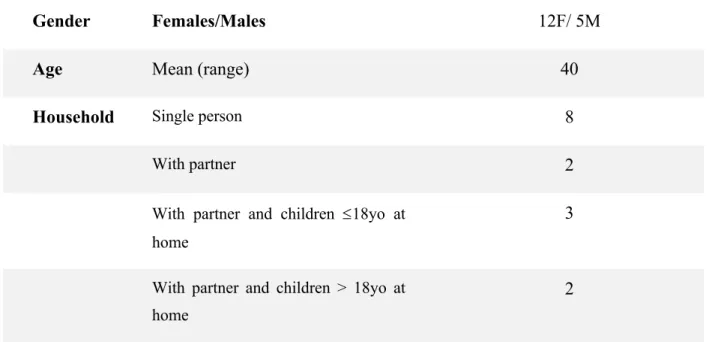
Table 3 -Profile of participants ... 34
List of Figures: Figure 1 –Land needed to produce Europe’s food; Adapted from European Environmental Agency (2017) ... 3
Figure 2 – Environmental Perspective of Food System Activities; ... 5
Figure 3 – The Evolution of Corporate Responsibility and Sustainability ... 7
Figure 4 - A Stakeholder Model of the Corporation, Freeman (2001) ... 13
Figure 5 - Relative Importance of Drivers and Barriers for Supply Chain Sustainability Initiatives; ... 18
Figure 6 - Mutual support between CSR and CnSR; Source: Adapted from Szwajca (2018) ... 24
1.1 Research problem and questions
When the movie Inconvenient Truth about global warming debuted in 2006, it predicted that a combination of a massive storm with the rise of the sea level - caused by global warming - could provoke such a flood that it would reach the 9/11 Memorial in New York City, which has over 300m of distance separating it from the river (Gore, 2017). Back then, climate change sceptics found this affirmation ridiculous and completely absurd but the fact is that, in 2012, hurricane Sandy indeed caused a massive flood in the 9/11 Memorial (Gore, 2017). This is just one of many examples of what is currently happening in the environmental crisis we currently live in and, as such, we must take climate change seriously and assume the responsibility to change it (García & Sanz, 2018).
The thing about climate change is that its consequences affect the whole globe and are all complexly interconnected. The rise of the CO2 level in the atmosphere caused by factories, among other agents, originates the melting of polar caps, which consequently rises the average sea level and cause floods, which destroy not only human populated areas, but also animals natural habitats (Gore, 2017). The rise of the Earth’s average temperature is also the originator of heat strokes that kill thousands every year, severe droughts that lead to food shortage causing hunger and the proliferation of viruses like Zika, that caused thousands of babies to be born with congenital malformations in Brazil in 2016 (Gore, 2017; United Nations, 2018). As a matter of fact, all the things we have in life require some kind of production and a simple 1 ton of paper actually requires the usage of 98 tons of other resources (Leonard, 2010). We need materials to make the saws that will cut down the wood, trucks to drive the wood to the factories, petroleum to make all the machines in the factory work and a lot of water to turn the wood into paper (Leonard, 2010). It is thus crucial that we, as a society, make an effort to reduce both production and consumption levels, which addresses directly to the consumerist lifestyle observed in the expanding middle class all over the globe (Alfredsson et al., 2018).
It all started with the beginning of the economic expansion in the 20th century, that has been constantly growing ever since and that has been a huge cause of environmental degradation and exhaustion of human, material and capital resources, all in the name of profit growth (Szwajca, 2018). These less fortunate events were deeply enhanced by the
globalization phenomena observed in the last decades, which was powered essentially by companies that have the distribution and logistics capability to reach global markets (Paterson, 2006). However, if in developed countries production processes are a target of more regulations and are generally more energy-efficient, the same does not happen in poorer countries (Alfredsson et al., 2018). In some areas of Bangladesh, where a lot of factories that manufacture products for the entire world are located, people live side by side with the toxic residues of their production and the worst part is that they are not informed about the dangers of it: children play next to it and adults walk with their bare feet on it (Leonard, 2010). This does not mean that people who live in developed countries do not experience the negative effects of climate change. With the fossil fuels footprint reaching levels four times higher than developing countries, in 2016, 91% of the air quality in urban centers did not oblige to the guidelines required by the World Health Organization (United Nations, 2018). From extraction, production, distribution, consumption and elimination, all phases of the products we consume are sources of CO2 emissions so the logic could not be any more simple: the more we consume, the more we pollute (Leonard, 2010).
Out of all the things humans consume, food is the one that is absolutely indispensable, since it is a basic human need (Notarnicola, Tassielli, Renzulli, Castellani, & Sala, 2017). However, our current habits of production and consumption are not sustainable and are responsible for 20-30% of the overall environmental impact on the planet, with meat and dairy being the dominant contributors to this numbers (Notarnicola et al., 2017).
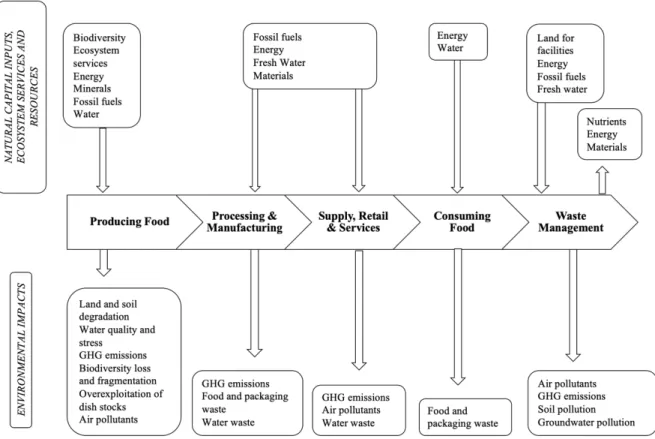
Figure 1 shows clearly the actual amount of land that is needed to cater for the meat and dairy industry in Europe alone (European Environmental Agency, 2017). The production of plant-based foods, which also includes foods that are not contemplated in the staple food wheels – coffee, alcoholic beverages, sugar - totals 28100 ha. Meanwhile, 133200 ha of land are needed to produce dairy and meat, since the land needed is not only the one where the animals live, but also the land required to farm the food they eat. Overall, 72% of all land needed to feed Europe is being occupied by the meat and dairy industry. As observed in Figure 2, food consumption requires the input of several natural resources and puts a lot of pressure into the environment. Food consumption is a process that can be divided into five phases – producing; processing and manufacturing; supply retail and services; consuming; and waste management – and all of these stages have a significant impact on the environment (European Environmental Agency, 2017). There
are a lot of tips given by Gore (2017) that consumers can follow to reduce the environmental impact of their food consumption. Eating a lot of meat results into the rise of greenhouse gases to the atmosphere so a vegetarian or even vegan diet can significantly improve one’s carbon footprint. There should also be a preference from the consumer for local products, since 11% of the food related emissions are linked to their transportation.
Moreover, 10% of all greenhouse gas emissions are caused by deforestation, which is currently happening to free more soil to be available for cattle production. Buying organic produce is also a way consumers can contribute to the environment, since it uses up until less 50% of energy in comparison with regular agriculture. At last, buying in bulk is also a good option, since it uses less or no packaging at all and saves trips to the store, which also help to reduce the transportation footprint (Gore, 2017).
However, a scenario where everyone in the world is vegan and goes to the organic supermarket to buy local products, putting them in reusable produce bags and glass jars is somehow utopic. In a study performed by Notarnicola et al., (2017) using data from the environmental impact of the main consumed products in the European Union in 2010, it was assessed that the typologies of food with the biggest impact on the environment were meat and dairy. In comparison, fruit and vegetables presented a much lower footprint, since it requires less resources to produce and do not have to be mandatorily
Figure 1 –Land needed to produce Europe’s food; Adapted from European Environmental Agency (2017)
Source: PBL, compiled from Eurostat, 2016 (ef_oluft); Lesschen et al., 2011; FAOSTAT 2013 data (soybean products); Euromalt (www.euromalt.be) statistics; European Feed Manufacturers Federation (www.fefac.eu) data; and the European Vegetable Oil and Protein Meal Industry Federation (www.fediol.be) data.
packaged (Notarnicola et al., 2017). In another study by van de Kamp et al., (2018) taking into account the diet of the average Dutch, it was found that in order to achieve a sustainable and healthy consumption of food, cheese consumption should be reduced by 22%, fish by 56% and red meat consumption should decrease by an astonishing 65%. The study also revealed that incorporating a healthier diet with more non-animal products and less processed foods, which are not only generally unhealthy but also highly packaged, improved significantly the greenhouse gases emissions (van de Kamp et al., 2018).
It has been shown by several studies that reducing the consumption of meat, dairy and processed foods is not only good for the health of the individuals, but for the environment as well. In order to achieve sustainable development (SD), it is essential that there is an offer of healthy and sustainable food in all categories (Hoek, Pearson, James, Lawrence, & Friel, 2017). However, changing the food we are used to eat is not that easy to do and the higher prices associated with sustainable products often push the consumer away (Devinney, Auger, & Eckhardt, 2012).
As Figure 2 shows, consumers are only a part of the whole process of food consumption and this thesis will attempt to shed a light on retailers, which are present in all other stages. Not only they are responsible for the sustainability initiatives done in-store, but are also accountable for the development of these actions upstream and downstream the supply chain (Chkanikova & Mont, 2012). Additionally, it should not be forgotten that retailers are not only stores where products from food companies are sold: they also have products of their own private brand, whose portfolio has been increasing over the years and that provides them with a direct source of profit (Kremer & Viot, 2012), which makes them directly accountable for the sustainability of their own products.
We need to change our food consumption habits, but how well informed are consumers about these statistics? What about the food sector, are they fully aware too and, if yes, what are they doing to change the game? A simple shopping trip to buy milk is an example of how hard it is to make the most sustainable choice. Cow milk is, by far, the least sustainable choice but however, soymilk is known by having a great probability of containing genetically modified organisms and almond milk is also tricky, since it requires up to 5 liters of water to grow one single almond (Abrahamse, 2019). So, is there really a sustainable way of consuming certain food groups? And are the consumers really interest in sustainable products and are they willing to pay the extra price that is associated with such foods? Or, on the contrary, are consumers demanding more sustainable food options and companies are the ones whom are not responding? What are the drivers that motivate an individual when making a food purchase? Do they take sustainability in account and if yes, in what ways?
Figure 2 – Environmental Perspective of Food System Activities; Source: Adapted from European Environmental Agency (2017); EFA
Hence, this thesis intends to better understand the sustainable food consumption panorama in Portuguese supermarkets by getting to know the purchasing habits of consumers, their awareness on products’ sustainability and by checking directly with retailers in the field what is currently being done to achieve SD to answer a question: How can retailers and consumers, together, achieve SD through co-creation?
1.2 Thesis structure
Due to the recent awareness of climate change related issues, “sustainability has been on top of the international agenda in the last few years” (Biggemann, Williams, & Kro, 2014:3), with SD arising as a matter of greatest importance and with companies engaging in Corporate Social Responsibility (CSR) in order to pursuit it (Salvioni & Gennari, 2017). As much as companies acknowledge that profits are essential for the survival of the business, the truth is that they are only able to earn them because of the society they are inserted in (Chandler & Werther, 2014). Therefore, there is an undeniable interdependence between companies and their consumers, so these last ones must not be denied a role in SD nor be unaccountable for the consequences of their purchase actions (Carroll, 2009; Chandler & Werther, 2014). Co-creation thus emerges as a possible solution to achieve SD, since it promotes a transparent and propitious collaboration between companies and consumers (Biggemann et al., 2014) in order to create more conscious products that consequently will contribute to achieve long-term SD.
This thesis will then begin with a literature review where all the concepts mentioned above will be further investigated and explored. After the literature review about these subjects, the investigation in order to answer the research questions will follow. It will firstly be explained the methodology used to examine the problem, in which will be justified why a qualitative approach was selected. Finally, the discussion of results and findings from the study will be provided and analyzed.
2. Literature Review
2.1 Sustainable Development & Corporate Social Responsibility
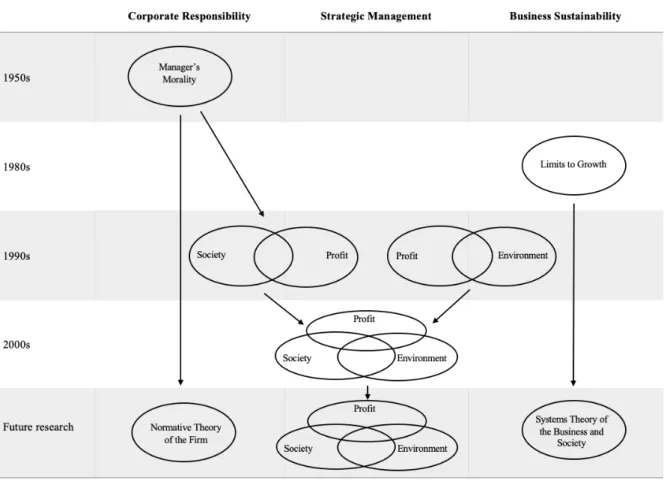
Over the last decades, debates about sustainability have been more and more common, with the number of academic papers on the subjects of SD (Silvestre & Ţîrcă, 2019) and Corporate Social Responsibility (CSR) registering an increase each year (Ebner & Baumgartner, 2006). Although the concepts of responsibility and sustainability ended up converging in some points, they have different roots: responsibility has its origin in economics and ethics, whereas sustainability emerged out of the interdisciplinary field of systems science (Bansal & Song, 2017). As demonstrated by Figure 3, corporate responsibility and business sustainability begin apart and eventually ended up following the same path of the Triple Bottom Line (TBL), which formed what is now known as CSR in strategic management literature (Bansal & Song, 2017).
As it will be further explored in detail, CSR and sustainability share the ultimate goal of balancing environmental, social and economic responsibilities (Montiel, 2008).
Figure 3 – The Evolution of Corporate Responsibility and Sustainability Source: Adapted from Bansal and Song (2017)
Both responsibility and sustainability address to the same business crowd and share a mutual interest in the connection existent between business, the society and the environment but blurring the two concepts has led to the disorientation of managers and academic researchers (Bansal & Song, 2017). Although the two concepts are highly interdependent and connected by a solid bond, they are not synonymous, and it is therefore important to establish the differences existent between them (Ebner & Baumgartner, 2006).
2.1.1 Sustainable Development
Although it seems a contemporary concept, the term SD actually dates back to the 18th century in Britain, France and Germany (Grober, 2007) and was applied in forestry, when it was established a limit on tree cutting to ensure a stable wood supply to future generations (Ebner & Baumgartner, 2006; Grober, 2007). This concern was successively extended to the conscious exploitation of other resources, which evoked the current SD mission statement (Ebner & Baumgartner, 2006). In 1987, the World Commission on Environment and Development (WCED) composed the Brundtland Report where they wrote one of the most commonly used definitions of SD in literature (Ebner & Baumgartner, 2006; Geissdoerfer, Morioka, de Carvalho, & Evans, 2018; Grober, 2007; Lacoste, 2016; Marcus & Fremeth, 2009; Scherer, Palazzo, Seidl, & Seidl, 2013; Sinakou, Boeve-de Pauw, Goossens, & Van Petegem, 2018) which states that “sustainable development is development that meets the needs of the present without compromising the ability of future generations to meet their own needs.” (United Nations, 1987:41). As much as this definition is very straightforward and simple to understand, it is too vague (Reid, 1995). It lacks complexity and leaves some very significant unanswered questions, considering it gives no clues about putting SD into practice and what needs to be done to achieve it (Reid, 1995).
SD is actually a holistic concept which englobes three spheres: sustainability of the environment, society and economy (Biggemann et al., 2014; Giddings, Hopwood, & O’Brien, 2002; Marcus & Fremeth, 2009), which are collectively known as the triple bottom line (TBL). The concept was coined by Elkington twenty-five years ago (Elkington, 1997) and stands for the equal balance between people, profit and planet (Alhaddi, 2015; Slaper & Hall, 2011). Elkington actually proposed a recall on the concept
per occasion of the 25yh anniversary of TBL1. In this article, Elkington explains that businesses did not follow the TBL as it was meant to be reflected, since it has been seen simply as an accounting tool and not a way for businesses to reflect on how capitalism should change.
Having sustainability at its core, TBL aims to measure the performance of companies on all these three levels (Slaper & Hall, 2011). As for people, it claims that businesses should not only treat their workers in a fair manner but also give back to the community, with the consequence of neglecting this sphere being the negative performance of the firm. Environmentally speaking, businesses should use the resources needed for its operation in a responsible way and if it is not possible, they ought to compensate their negative actions. Finally, TBL looks at profits in an interesting way through the sustainability lens, since it actually considers economic prosperity an opportunity for the sustenance to future generations (Alhaddi, 2015). In order to achieve it, planet Earth’s limitations should be taken into consideration (Meadows, Meadows, & Randers, 2005), and it is a task that needs to be executed by the joint of forces of corporations, government and civil society (Sachs, 2012; Szwajca, 2018).
Since SD is a broad topic that covers several different matters, the Sustainable Development Goals (SDG) were created in the 2030 Agenda for Sustainable Development (United Nations, 2015). These goals “are integrated and indivisible, global in nature and universally applicable, taking into account different national realities, capacities and levels of development and respecting national policies and priorities.” (United Nations, 2015:16) and it is up to each government to establish their own targets for their country. The established set of 17 different SDG ultimately advocates to stimulate prosperity of humanity whilst taking care of planet Earth. Each one covers a specific subject, being some examples to end poverty – goal 1 –, to reduce inequality – goal 10 -, or to promote decent and sustainable work conditions for all – goal 8 (United Nations, 2015). As referent to the subject of this thesis, both goals 2 – end hunger, achieve food security and improved nutrition and promote sustainable agriculture -, and goal 12
1
– ensure sustainable consumption and production patterns - (United Nations, 2015), are particularly important. As per goal 2, according to the SDG Report of 2018, both world hunger and general food prices have risen, which may affect food security in a negative way (United Nations, 2018). Regarding goal 12 and despite being relative to all consumption and production and not only food, 108 countries had national policies targeting this subject and 93% of the world’s largest companies are reporting on sustainability (United Nations, 2018).
Taking in mind the perspective of ethics, which defines what is right or wrong, businesses should actively work towards SD (Chandler & Werther, 2014; Payne & Raiborn, 2001). Rationally speaking, the preservation of the environment is vital so that all of the Earth’s living beings can inhabit it and thrive and, as so, the lighter financial costs of exploiting resources should not overlap life itself (Payne & Raiborn, 2001). Earth does not belong exclusively to humans and both fauna and flora are not only unaccountable for the negative actions of human kind, but also are not capable of fixing them (Payne & Raiborn, 2001). Since SD highlights the use of resources, it is not hard to understand why companies should be interested in being sustainable (Baumgartner & Library, 2014). After all, the main cause for the severe depletion of resources that has been occurring since the 20th century is the production activity of companies (Szwajca, 2018), considering the private sector is the main wheel of the economy (Sachs, 2012). It is actually worrying that crescent economic development powered by corporations and the world’s population growth are causing tremendous pressure onto ecosystems, which are already causing devastating consequences to not only humans, but the planet as well (Sachs, 2012).
The lifestyle based on consumerism is pushing the environment to its limits (Sachs, 2012; Szwajca, 2018) and its consequences are more complex than we think. In fact, it creates a snowball effect as described by Crocker (2016): with the industrial revolution, companies started to be able produce more goods, which allowed a reduction in prices and encouraged people to buy more. Later on, the rise of technology that granted the society 24h access to social media and introduced them to online shopping, has caused people to constantly compare themselves to others and feeling the need to self-express in a materialistic form. This lead to a rapid cycle of buying, using and discarding as a result of a deadly combination of massive advertising campaigns and products being designed to have a short life cycle (Assadourian, 2010; Crocker, 2016; Hamilton, 2009). Pointing
the matter of study of this thesis, food also entered this vicious cycle of consumerism. As for an example, the hamburger was considered poor people’s food in the early 1900’s but by the mid of the century it gained such popularity that it actually driven the phenomenon of fast-food, which not only produces lots of disposable materials, but also led to the obesity epidemic (Assadourian, 2010).
Right up front, the problem begins with the neglection of one of the premises of the Brundtland Report (1987), which stated that sustainability should envision all countries and, as so, no country should harm the resources of others. Sadly, this is not the reality and the out of control consumerism of developed countries is not only harming themselves, but developing countries too (Sachs, 2012; Szwajca, 2018), inducing direct implications on all three dimensions of the TBL. Social problems like obesity (Assadourian, 2010) and depression (Crocker, 2016) are found in developed countries, whereas child labor and poor access to basic sanitation (Devinney, Auger, & Eckhardt, 2010) are common in developing nations. Economically speaking, excessive credit debt (Balderjahn et al., 2013) is typically found in developed countries, whilst poverty (Devinney et al., 2010) is frequent among developing communities. Regarding the environmental sphere of TBL, there are problems that are more commonly found in developed countries, like excessive amounts of waste (Crocker, 2016) or deforestation (Devinney et al., 2010) in the case of developing nations. However, environmental issues end up reflecting on the entire planet in a more homogenous and palpable way, regarding political boarders. Climate change, mass pollution, extinction of species and acidification of the oceans (Cardoso & van Schoor, 2017; Sachs, 2012) are environmental concerns that affect the entire globe.
Ultimately, consumerism causes an overwhelming overburden of goods and increase of waste (Sachs, 2012; Szwajca, 2018). Due to the rampant and out of control over consumption, companies escalate their manufacturing and the increase in the production of goods consequently originates, among others, high emissions of greenhouse gases and water poisoning (Sachs, 2012). In light of the fact that companies are the main agent responsible for these unfortunate events, the following statement arose: “The main question is not why a corporation should act more sustainable, but how can corporations be more sustainable” (Baumgartner & Library, 2014:259), which is where CSR steps in to play its crucial role on saving the planet Earth.
2.1.2 Corporate Social Responsibility
Since its emergence in the 1950’s (Carroll, 2009) the concept of CSR has been thriving strongly, being a matter of amply discussion, research and with plenty theories built around it for decades (Carroll & Shabana, 2010). Archie Carroll is one of the most famous authors linked to the CSR subject and in 1979 he wrote one of the must cited definitions in academia that states that “the social responsibility of business encompasses the economic, legal, ethical and discretionary expectations that society has of organizations at a given point of time” (Carroll, 1979:500). A business that focuses on CSR is the “one that proactively offers social benefits or public service, and voluntarily minimizes practices that harm society, regardless of any legal requirements” (Vitell, 2015:767). As one can imagine, there are hundreds of approaches to the concept of CSR but the key idea of it is simple: Corporations should have the responsibility to create a positive impact on both society and the environment by pursuing other goals than purely growing profits (Chandler & Werther, 2014).
CSR definitions
Reference Definition
Purcell & Albright (1974:437) “Corporate social responsibility means a willingness on the part of the corporate manager (acting not only as an individual but as a decision-maker implicating his firm) actively and with moral concern to confront certain social problems he deems urgent and to bend the influence of his company toward the solution of those problems insofar as the firm is able to do so. Such responsibility requires that the manager balance intelligently the needs of the many groups affected by the firm so as best to achieve both profitable production and the common good, especially in situations in which he is not required to do so by law or by external pressures which the company cannot easily resist.”
Jones (1980:59-60) “Corporate social responsibility is the
notion that corporations have an obligation to constituent groups in society other than stock- holders and beyond that prescribed by law or union contract.”
McWilliams & Siegel (2001:117) “Actions that appear to further some social good, beyond the interests of the firm and that which is required by law.”
Marrewijk (2003:102) “CSR refer to company activities – voluntary by definition – demonstrating the inclusion of social and environmental concerns in business operations and in interactions with stakeholders.”
Hohnen (2007:4) “CSR is understood to be the way firms
integrate social, environmental and economic concerns into their values, culture, decision making, strategy and operations in a transparent and accountable manner and thereby establish better practices within the firm, create wealth and improve society.”
European Comission (2011:3) “Corporate social responsibility concerns
actions by companies over and above their legal obligations towards society and the environment.”
Vitell (2015:767))
“A CSR focused business is best defined as one that proactively offers social benefits or public service, and voluntarily minimizes practices that harm society, regardless of any legal requirements”
Table 1 - CSR definitions
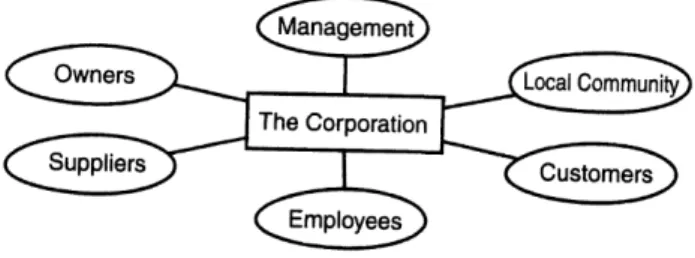
CSR thus proposes the stakeholder theory, a management approach that takes into account all stakeholders involved in the business, which are all individuals that can benefit or be harmed with its operation: local community, customers, employees, suppliers, owners and management as seen in Figure 4 (Freeman, 2001). Payne & Raiborn (2001) go even further stating that from the SD perspective, stakeholders are all living creatures on Earth, both humans and animals. By integrating the stakeholder perspective into the firms strategy, it can better respond to their demands, thus boosting economic and social value (Chandler & Werther, 2014).
Unlike the shareholder theory, which only worries about paying earnings to stockholders as they are key to the firms survival, the stakeholder theory englobes all stakeholder as important parts of the firm (Freeman, 2001).
In practice, it surely is impossible to pay equal attention to every one of the stakeholders, especially if we take in consideration that sometimes their interests enter in conflict (Chandler & Werther, 2014). However, businesses cannot constantly ignore all stakeholders interests, no matter how low they are in the firms priority list (Chandler & Werther, 2014) and a fair balance is needed to assure the long-term sustainability of the business (Salvioni & Gennari, 2017).
In the beginning this concept was looked at as a parody and being accused of having completely inconsistent premises by the skeptical enterprise community, with mid-level managers often facing CSR as a cost with doubtful outcomes (Lee, 2008) and with shareholders pushing their influence towards economic responsibility only (Salvioni & Gennari, 2017). We cannot discuss theories against CSR without mentioning Milton Friedman, one of the most popular opposers that articulated harsh critics towards CSR, whom even called advocates of CSR “unwitting puppets” (Friedman, 1970:122). Friedman firmly argued that the only responsibility a business should have is to maximize profits for its shareholders and that businessmen should not be bothered to be concern with social issues (Carroll & Shabana, 2010; Friedman, 1970; Lee, 2008). He defended that managers, as persons, may have social responsibilities to charity, church and to his country but that those were a part of his personal life sphere, not to be mixed with his job (Friedman, 1970). Some of the other arguments against CSR that emerged in the 1970’s stated that businesses were not operationally prepared to deal with social activities, that it caused the mitigation of the firm’s purpose of making profits and that it made businesses less competitive on a global scale (Carroll & Shabana, 2010). Luckily for CSR, it slowly became popular in the late 1990’s, it was already widely accepted and endorsed “by all constituents in society from governments and corporations to non-governmental organizations and individual consumers” (Lee, 2008:53). In the present days, CSR is usually associated with mitigating the adverse outcomes of commerce, business and marketing (Marquina Feldman & Vasquez-Parraga, 2013).
To fight any negative criticism against CSR and to express the depth of the concept, Chandler & Werther (2014) gave four arguments in favor of it from different
perspectives: ethical, moral, rational and economic. First of all, there are two ethical reasonings in which CSR is valid: consequentialist (doing the greatest good for the greatest number of individuals) and categorical (following ethical principles no matter their outcomes). As so, both these philosophical approaches should be integrated in the firm’s Code of Ethics since it is expected from them to engage ethically and to do the right thing in matters like human rights or environmental conservancy. Second, there is also a moral argument advocating CSR which recalls that there is a relationship of interdependence between business and society, and because the former operates mandatorily in the latter’s sphere, society has the right to establish their expectations for businesses. According to this argument, the existence of society is what makes businesses possible so in return, businesses should act in their benefit and according to its boundaries. Anticipating highly analytical critics like Friedman, a rational argument was too proclaimed. If a business does not feel compelled to engage in CSR due to ethical and moral reasons, it should at least do it so for a third argument, i.e. a rational one (Chandler & Werther, 2014). Following this line of thought, in order for a business to maximize its performance, it needs to minimize possible sanctions. Laws must be followed, and fines can be avoided if firms take a proactive approach to responsible behavior, which will consequently help to shape current jurisdiction towards a fairer one. Finally, there is an economic argument supporting CSR, which is based on the fact that it adds value and constitutes a differentiation point to the firm in relationship with their competition (Chandler & Werther, 2014). A business success is deeply related with its values and if its perceived as socially irresponsible, its public image can shatter which diminishes its value and decreases its attractiveness to investors (Chuang & Tai, 2014).
CSR is a broad topic and the literature about it reflects that evidence, since it is characterized by being both vast and hugely fragmented into specific disciplinary fields (Aguinis & Glavas, 2012), which reveals the influence CSR can have. Scholars approach it both conceptually and empirically, primarily through the lens of a particular department, like marketing, finance, corporate strategy, among others (Aguinis & Glavas, 2012). It has been studied as being an integrated part of a corporation’s strategy (Chandler & Werther, 2014), calculated its impact in the access to finance (Cheng, Ioannou, & Serafeim, 2014), considered its effects on purchasing behavior through marketing campaigns, (Ko, Hwang, & Kim, 2013), explored how satisfaction from human resources affect it (Edmans, 2012), to name a few. Over the last decades, CSR has registered not
only a noticeable evolution within the scope of academia, but it has actually managed to be tremendously embraced by corporations (Carroll & Shabana, 2010). The explosion in popularity of CSR within corporations was induced mainly by a combination of the acknowledgement of the negative impacts that a business can generate, as well as the increasing concern of companies and consumers with both the environment and society (Öberseder et al., 2017).
In a broader view, Schwartz & Carroll, (2003) also developed a three-domain model to better understand the dimensions of CSR. Through the conception of a Venn diagram, the model presents the three responsibilities a corporation should have: Purely Economic, Purely Legal and Purely Ethical. As the name suggests, the economic domain involves all activities of the corporation that impact positively on profit and/or share value. The legal sphere refers to the corporation’s jurisdictional obligations like payment of taxes, not polluting above the established levels or manufacturing safe to use products. The ethical dimension covers the firm’s ethical responsibilities expected by its stakeholders (Carroll & Shabana, 2010). All three domains overlap between each other, but the optimal intersection of CSR is the one that combines all of them. A business that takes CSR into its core strategy is the one who has a proactive attitude on these three spheres, promptly minimizing practices that cause any harm (Schwartz & Carroll, 2003; Vitell, 2015) by having policies regarding “environmental sustainability, community support, cause-related marketing, and employee enablement” (Ailawadi, Luan, Neslin, Taylor, & Jordan, 2011:3). Such practices have been proven to positively affect corporation’s performance like increase in sales and customer retention, which has turned shareholders from opposers into supporters of CSR (Carroll, 2009; Lee, 2008; Vanhamme, Lindgreen, Reast, & Van Popering, 2012). Consumers are also highly influenced by CSR, since it allows them to choose to be associated with a certain brand as to define themselves as a person (Ho, 2017). In fact, the purchase likelihood actually increases if the consumer has a positive CSR belief on a certain company, as well as it fosters long-term loyalty (Chuang & Tai, 2014). CSR is therefore turning into a true business driver, pleasing both consumers and investors whom are happily prompt to support companies that aim towards creation long-term of sustainable value (Lee, 2008; Salvioni & Gennari, 2017), which strengths the proposition of “doing well by doing good” (Karnani, 2011; Price & Sun, 2017).
Businesses aim to profit from the production and selling of their products and it is sometimes hard to make them shift to a sustainable-oriented model since it does not generate profits in its initial phase (Soni & Dawar, 2018). It is a solid challenge for those in managerial positions to raise awareness related to the TBL issues into the corporate strategy of the company, but ethical leadership is absolutely needed to achieve sustainability (Chuang & Tai, 2014). As business competition is expected to continue to grow intensely, it becomes clear to many that CSR can only be sustainable as long as it adds value to the corporation’s success (Carroll, 2009; Lee, 2008; Vanhamme et al., 2012). However, “being green” is becoming mainstream among competition and demanded from consumers, so although it is a challenge that will take time, it is needed for the sake of sustainable development (Carroll, 2009; Soni & Dawar, 2018).
The concept of CSR itself relates directly with companies and its responsibility to care about other issues beyond making profit, but the fact is that it implicitly involves its stakeholders (Chandler & Werther, 2014). As much as a company wants to practice CSR, the truth is that it will not be successful if the individuals and groups that relate to them do not comply along (Vitell, 2015). Therefore, responsibility on reaching a long-term sustainable development should not rely solely on the retailers and the public must be supportive too (Carroll, 2009; Chandler & Werther, 2014).
2.1.3 CSR and Retailers
As mentioned, our purchasing habits have changed drastically in the last decades and are heavily marked by consumerism. If in 1945 a typical grocery store offered a range of 1.400 products (Beitzen-Heineke, Balta-Ozkan, & Reefke, 2017), nowadays a supermarket sells about 8.000 different products and hypermarkets 14.000 (Teller, Holweg, Reiner, & Kotzab, 2018). Consumers demand the shelves to always be stocked, with a wide range of products to choose from and with food that is neither local – like tahini sauce - or in season – like fresh strawberries in January (Beitzen-Heineke et al., 2017). Globalization has put a lot of pressure on retailers as a result of consumers asking for a wider variety of products and at a cheaper price, which makes retailers engage fiercely in the fight of price competition with each other (Beitzen-Heineke et al., 2017; Chkanikova & Mont, 2012).
Current literature often explores companies in the food industry, but few take a look on retailers and their importance in the supply chain (Chkanikova & Mont, 2012). Hence,
this thesis will attempt to fill in this blank space by focusing the study on retailers and their potential to ignite the sustainability dynamism through the whole food supply chain.
When it comes to the retailer’s role on sustainability, we often only think about the store itself. However, in regards to this topic, retailers have the power to change the whole system, as they are responsible not only for the in-store actions but also have influence upstream and downstream the supply chain (Chkanikova & Mont, 2012). As seen in Figure 5, there are some drivers and barriers to sustainability initiatives that can be taken by retailers up and down the stream. To embed such actions upstream is quite difficult for the retailers, since most regulations are dictated by governments and other institutions. It is also challenging due to the high prices associated with sustainable products, who tend to push most customers away and the limited authority to stimulate suppliers to provide better and less expensive sustainable products.
Figure 5 - Relative Importance of Drivers and Barriers for Supply Chain Sustainability Initiatives;
Adapted from Chkanikova & Mont (2012)
Despite the difficulties, retailers can still prosecute their influence by having cross-industry open debates about sustainability in order to both suppliers and retailers share ideas on the topic and to engage in initiatives, like re-designing packaging (Chkanikova
& Mont, 2012). As per an example, Portuguese retailer Pingo Doce has been re-designing their packages since 2011 in order to them to be more sustainable and already saved over 15.000 tonnes of packaging materials in several of their products (Pingo Doce, 2019). In-store sustainability initiatives address directly the internal operations of the In-store like waste management, logistics and applying energy efficient methods. The lack of financial resources constitutes a strong barrier that discourages retailers from adopting measures that require larger investments, like putting solar panels on the outdoors parking lots (Gore, 2017). Finally, retailers can also generate positive sustainable initiatives downstream the food supply chain, especially driven by the demand of sustainably aware customers and strategies from other retailers to become greener. Removing unsustainable products from the shelves is an option that seems simple, but in reality, it is not recommended as consumers may swap to other store in search for those products. Plus, it is often hard to find sustainable products at a reasonable price (Chkanikova & Mont, 2012).
2.2 Consumer Social Responsibility
Although all stakeholders have an important role in the long-term existence of a firm, consumers are ultimately its economic engine and, without them, firms would lose its legitimacy (Chandler & Werther, 2014). In a simpler way: A business exists as long as customers exist. Following this line of thought, consumers end up being the rulers of a business, since their needs and desires will dictate the validity of a company (Chandler & Werther, 2014). As for CSR, if it is true that the pull marketing strategy is sometimes what makes companies act more responsibly since they are being pressured by the consumers, the opposite also happens (Balderjahn et al., 2013; Prahalad & Ramaswamy, 2004). In fact, it is believed that CSR cannot be completely and successfully achieved if consumers do not engage and support their efforts (Soni & Dawar, 2018; Szwajca, 2018; Vitell, 2015). Hence, this thesis will take an in depth look into consumers, taking in mind a not so much explored concept: Consumer Social Responsibility (CnSR), which is a notion with a similar content as the terms socially responsible consumer behavior, consumer reactions or consumer awareness of CSR (Marquina Feldman & Vasquez-Parraga, 2013).
CnSR was defined “as the conscious and deliberate choice to make certain consumption choices based on personal and moral beliefs” (Devinney, Auger, Eckhardt, & Birtchnell, 2006:3). It happens when the consumer has some knowledge of what is behind their purchases and seeks to act responsibly in all three phases of consumer behavior – obtaining, use and disposal (Vitell, 2015). This means that when making a purchase, the consumer will take into consideration other elements that are non-functional to a product (Devinney et al., 2012), like if the product is organic, the package is recyclable or if it is made out of child labor (Devinney et al., 2010; Soni & Dawar, 2018). Globalization played a significant role on the rise of conscious awareness of the consumer, since it helped to the establishment of the shared economy concept between developed, developing and underdeveloped nations with the goal of sustainability (Soni & Dawar, 2018).
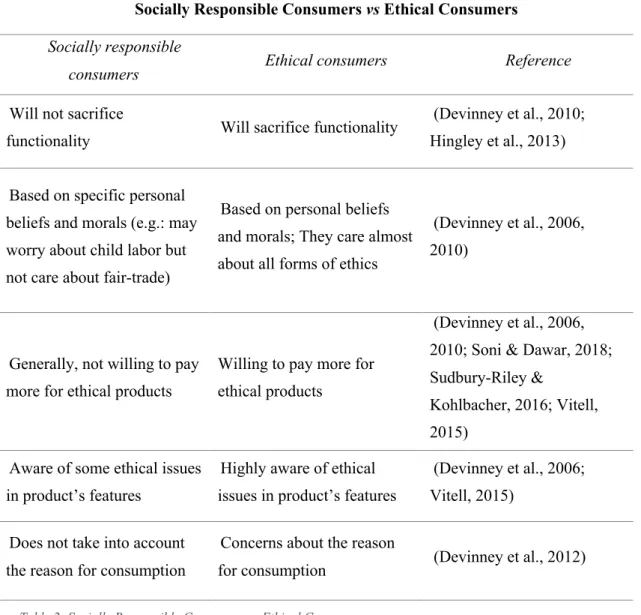
However, CnSR is not as simple as it might seem at first sight. Its dynamic is quite complex (Hingley, Lindgreen, Reast, & Manning, 2013) and it is crucial to realize that there is a clear distinction between socially responsible consumers and ethical consumers (Devinney et al., 2012). Ethical consumers determinedly will not buy anything that is not environmentally and/or humanly ethical, being heavily guided by the morality principles of what is wrong or right (Devinney et al., 2012; Soni & Dawar, 2018). Unlike socially responsible consumers, they are easily identified mostly because they are “loud” about it, since they actively participate in protests against brands and post on their social media the latest news about the unethical practice’s companies do. Socially responsible consumers are silent about their purchase’s reasons and therefore, they are nearly impossible to be identified (Devinney et al., 2006). Contrasting with ethical consumers, socially responsible consumers are not fundamentalists and most certainly will not sacrifice for the cause (Devinney et al., 2006). They do not renounce product functionality, even if it is for a socially better cause and highly need incentives to change their behavior (Hingley et al., 2013). What makes it difficult to understand the drivers of these consumers is that they will shop ethically for the matters they personally care about (Devinney et al., 2010). Each person has its own ideas of what is ethical or not and, therefore, it is impossible to predict their choices like it is with ethical buyers. This means, as for an example, that socially responsible consumers can feel driven to support McDonald’s not for the Ronald McDonald charity institution they run, but because they offer some healthy items on their menus (Green & Peloza, 2011), which sometimes does
not happen with other fast-food chains. Table 2 summarizes the main differences between socially responsible consumers and ethical consumers as for their drivers of consumption.
Socially Responsible Consumers vs Ethical Consumers Socially responsible
consumers Ethical consumers Reference
Will not sacrifice
functionality Will sacrifice functionality
(Devinney et al., 2010; Hingley et al., 2013)
Based on specific personal beliefs and morals (e.g.: may worry about child labor but not care about fair-trade)
Based on personal beliefs and morals; They care almost about all forms of ethics
(Devinney et al., 2006, 2010)
Generally, not willing to pay more for ethical products
Willing to pay more for ethical products
(Devinney et al., 2006, 2010; Soni & Dawar, 2018; Sudbury-Riley &
Kohlbacher, 2016; Vitell, 2015)
Aware of some ethical issues in product’s features
Highly aware of ethical issues in product’s features
(Devinney et al., 2006; Vitell, 2015)
Does not take into account the reason for consumption
Concerns about the reason
for consumption (Devinney et al., 2012)
Table 2- Socially Responsible Consumers vs Ethical Consumers
To complicate things even more, several studies have demonstrated that surveys are not the answer to try to understand who the socially responsible consumers are and what are the drivers that determine their intention to make an ethical purchase (Devinney et al., 2012). It has been proved that surveys tend to suffer from social desirability bias (Öberseder et al., 2017), since the matter under investigation is very sensitive and deals with the ethical attitudes of the individual (Devinney et al., 2010). On paper, consumers declare to be activists, just truly noble people that are concerned about ethical matters and motivated to support brands who practice CSR but in reality, “consumers are not willing to put their money where their mouth is” (Devinney et al., 2006:4). They simply will not
pay more for an ethical product even if they state that they care about CSR and ultimately want a good product for a good price (Devinney et al., 2012; Vitell, 2015). CnSR is a deeply complex dynamic and the majority of consumers will only change if there are some kind of incentives to do so (Hingley et al., 2013).
As a way of clarifying and organizing ethical matters, Devinney et al., (2010:140-141) suggested a set of topics to measure the consumer’s degree of concern : “(1) animal rights in product testing; (2) the use of animal by-products; (3) product biodegradability; (4) products made from recyclables; (5) the provision of product safety information; (6) human rights; (7) packaging recyclability; (8) product disposability; (9) the payment of minimum wages; (10) whether unions are allowed; (11) whether minimum living conditions are met; (12) sexual orientation rights; (13) the guarantee of safe working conditions; (14) the use of child labor in production; (15) genetically modified material usage; and (16) gender, religious, and racial rights”.
This assortment of ethical issues clearly demonstrates the variety of existent topics and the reality is that it is impossible to care about every matter in an equal form, so there will always exist issues that will just not be a part of our concerns (Devinney et al., 2010). Some disagree with this division of ethical matters because it breaks the TBL pillars of sustainability into single facets of sustainable behavior, with no focal point whatsoever (Balderjahn et al., 2013). As an alternative, a three-dimensional scale to measure conscious sustainable consumption was provided that divides consumer’s ethical beliefs under the umbrella of TBL, measuring the importance consumers give to the consequences of their purchasing actions (Balderjahn et al., 2013). Therefore, the conscious sustainable consumption conceptual model presents itself as a more structured way of analyzing CnSR, since it compiles some of the ethical matters mentioned above though connecting them to the TBL. However, despite consumers having knowledge of all of these terms and are aware they exist, the truth is that they do not have enough knowledge of what it really takes for a product to be in their hands (Devinney et al., 2006).
Some argue that consumers need to be educated by the companies about the consequences of their purchasing actions so they can transform their behavior into a more conscious one to, consequently, achieve sustainable development (Soni & Dawar, 2018). Unfortunately, consumers tend to have a lot of misconceptions about the impact of the food they eat. In a study with 1055 participants performed by Lazzarini et al., (2018),
consumers had to choose the most environmental product out of two hypotheses which included food like pork strips, parmesan cheese, tofu and minced beef. Tofu, falafel and meat substitutes were always the most environmentally friendly choice in comparison with any of the other animal-based products, but the participants almost invariably perceived these plant-based products as more environmentally damaging than they really were. In fact, the percentage of correct answers on some items was astonishing: only 28% guessed correctly that falafel was the correct choice in comparison with Gruyère cheese, between chicken breast and tofu, 16% guessed tofu as the right answer and only 9% of participants guessed correctly that tofu was the true answer in comparison with Gruyère cheese (Lazzarini et al., 2018). In another study by (Hoek, Pearson, James, Lawrence, & Friel, 2017b) with 29 interviewees, it was concluded that the overall perceived idea of not eating a lot of highly processed and packaged foods was very difficult, although they have shown to be highly aware of the amount of packaging products have and that those products are generally not healthy. As regarding to wasting food, participants showed strong negative emotions like guilt and shame when they wasted food but that it was sometimes difficult to avoid due to bad planning and impulsive buying (Hoek et al., 2017b)
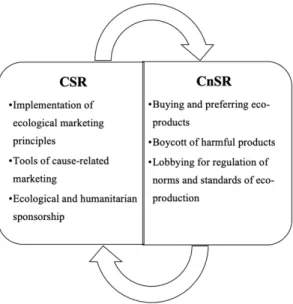
That is why research on the consciousness of purchasing choices of consumers is so important, since it aids practitioners to better understand them and to help them to engage in sustainable consumption (Balderjahn et al., 2013). And specifically regarding to food, this means that consumers need to eat less animal-based products, thereby increasing the consumption of plant-based foods, as well as to reduce the overconsumption of food that surpasses the daily energy needs and reduce food waste (Hoek et al., 2017b)This mutual support between CSR and CnSR can happen in many forms, as described in Figure 6 by Szwajca (2018). Once consumers are enlightened about the magnitude of their buying choices, the importance of their “purchase vote” and are assured of the benefits of the non-functional elements of a product, they become more rational buyers (Soni & Dawar, 2018).
The positive truth is that times are changing and consumers are becoming more aware of the power they have to influence corporations and are increasingly educated about ethical matters of consumption (Soni & Dawar, 2018; Szwajca, 2018). Therefore, research on CnSR is needed now more than ever to aid companies to better understand consumer´s ethical beliefs and to guide them towards a more sustainable consumption (Balderjahn et al., 2013). Additionally, it is also crucial to take into account the current food trends and the market opportunities they provide to retailers. Individuals are increasing their consumption of fruit and vegetables due to their health benefits, since they are low in calories and highly rich in vitamins and minerals (Santeramo et al., 2018). People who follow alternative diets like vegetarianism, that eliminates fish and meat or veganism, that eliminates all products derived from animals are increasing rapidly (Farm Animal Investment Risk & Return, 2018). In Europe, the demand for meat substitutes is increasing about 8% per year and it is estimated that in a five-year period, alternatives to animal protein will represent one third of the total protein demand with millennials are playing a key role in these numbers, since 30% are eating meat alternatives every day (Farm Animal Investment Risk & Return, 2018). The demand for plant-based milk is increasing as consumers want an alternative to cow’s milk, making it 10% of the overall dairy market (Abrahamse, 2019).
CSR and CnSR must therefore walk side by side to reach SD and the literature as the answer on how they should do it: through co-creation.
Figure 6 - Mutual support between CSR and CnSR; Source: Adapted from Szwajca (2018)
2.3 Co-creation
Business relationships used to have clear and separate roles, where the company was the active provider of goods responsible for production and the customer was a passive spectators responsible for consumption, who simply purchased the goods that companies sold (Payne, Storbacka, & Frow, 2008; Prahalad & Ramaswamy, 2000; Ramaswamy & Ozcan, 2014). However, customers were sometimes displeased with the offer available and began to push their influence into all the business chain (Prahalad & Ramaswamy, 2004), having an active role on both phases of production and consumption (Prahalad & Ramaswamy, 2000; Rakesh Ranjan & Read, 2016; Vargo & Lusch, 2004) which is what is called co-creation. The term itself is quite recent, being firstly introduced by Prahalad (2000) in the light of customer demand for different products (Prahalad & Ramaswamy, 2004) and the rising environmentally awareness of consumers, pressuring companies to be more sustainable (Lacoste, 2016).
Co-creation was defined in literature as “the joint, collaborative, concurrent, peer-like process of producing new value, both materially and symbolically” (Lacoste, 2016:644), “the process of creating something together in a process of direct interactions between two or more actors, where the actors’ processes merge into one collaborative, dialogical process” (Grönroos & Gummerus, 2014:209) and the “enactment of interactional creation across interactive system-environments (afforded by interactive platforms), entailing agenting engagements and structuring organizations” (Ramaswamy & Ozcan, 2018). Simply put, co-creation is a paradigm that allows a synergy to happen between companies and its stakeholders to create value (Galvagno & Dalli, 2014; Payne et al., 2008),. In this thesis, co-creation is where CSR and CnSR connect and will therefore focus on the company-consumer relationship for value creation.
Literature often divides value into value-in-exchange, which is the potential value formed by providers and value-in-use, which is produced by consumers when using a product (Grönroos & Gummerus, 2014; Grönroos & Voima, 2013; Prahalad & Ramaswamy, 2000; Vargo & Lusch, 2016). This means that value creation ends up being all about value-in-use, which translates into customer satisfaction and therefore it does not contemplate value creation for the other actors involved (Grönroos & Gummerus, 2014). This distinction caused a gap in the creation literature between the concepts co-production and value-in-use (Ramaswamy & Ozcan, 2018), which was studied in detail
by the literature review of Ranjan & Read (2016). The conclusion they reached demonstrated that co-creation literature lacks a more unifying view of the concept, since of the 149 analyzed papers, 71 only consider co-production, 46 only consider value-in-use and 32 consider both. Additionally, the literature often also focvalue-in-uses on studying the value creation process aiming their attention to discussing who creates value and who benefits from it (Grönroos & Gummerus, 2014; Ramaswamy & Ozcan, 2018), arguing for a customer-centered view as in service logic (Grönroos & Gummerus, 2014; Grönroos & Voima, 2013; Merz, Zarantonello, & Grappi, 2017) and an all-actors view as in service-dominant logic (Vargo & Lusch, 2004, 2008, 2016). Taking this into account, this thesis will take a more consolidated approach of co-creation endorsed by Ramaswamy & Ozcan (2018), who defend an interactive system-environments theory where value can be found anywhere regardless if its derived by producing, exchanging or using goods.
Establishing co-creation within the companies’ DNA is challenging and demands a change on all platforms so that everyone can co-create (Ramaswamy & Ozcan, 2014). According to literature, putting co-creation into practice is still far from perfect. Consumers end up having a passive role in value creation, since they are observed, segmented, engaged into focus groups but do not take really a part of the conception of the product (Arnold, 2017; Ramaswamy & Ozcan, 2014), since they are only able to give their opinion when everything is already done. Consumers are presented with the finalized packaging and the campaign that the company believes it is right for them, but they do not actively participate in the making of it (Ramaswamy & Ozcan, 2014). Ramaswamy & Ozcan (2014) give the example of Nike and its wear-testing platform for their running shoes. Nike involves runners into the creation process of the product by sending them samples of shoes, so they can test them under real weather and surface conditions. As much as this interaction provides great feedback for Nike and allows them to manufacture a product that was tested in the real world (and not only in the laboratories), it is not a genuinely co-creative collaboration. For co-creation to truly happen, customers should be viewed as co-producers involved in the whole value chain instead of being just a target (Prahalad & Ramaswamy, 2004; Ramaswamy & Ozcan, 2014; Vargo & Lusch, 2004). In the case of Nike, co-creation would exist if the testers and the developers worked closely as a community in the codesign of the shoe, allowing richer inputs to arise and increasing strategic value (Ramaswamy & Ozcan, 2014). It is
most desirable that the agents involved in the co-creation process with the goal of reaching sustainability have both experience and knowledge regarding the subject, either by working or leisure activities (Arnold, 2017), without forgetting that they have to be engaged on the same level as corporations (Ramaswamy & Ozcan, 2014). It is also important that they are present in the early stages of production so they can contribute in all its phases being those the origin of raw materials and production process, product usage and product disposability (Biggemann et al., 2014; Lacoste, 2016). However, the presence of the customer into the heart of the production raises some ethical questions regarding legal rights. If the consumer brings an idea to the table that ends up being implemented, they often do not have any rights over it, which is a question that needs to be changed urgently (Arnold, 2017). For co-creation to be successful, Ramaswamy & Ozcan (2014:xvii) suggested that some components must be integrated into its thinking, being those:
“Jointly creating and evolving value with stakeholding individuals; purposefully designing platforms of engagements; affording a variety of novel, personalized interaction environments; meshing together ecosystems of capabilities; augmenting creative capacities of enterprise architectures and management systems; enabling and supporting individuated value creation, personally and in the social, business, civic and natural communities in which individuals function; connecting with the quality of actual experiences of engagements through the platform and of the outcomes of value that result; using rapid experiential learning, insights, and knowledge to coevolve human stakeholder experiences of value; building new strategic capital for enterprises; and expanding wealth-welfare-wellbeing.”
This shifts completely the traditional mindset of producing, selling and using to listening, personalizing and co-creating (Payne et al., 2008). These principles can be put into practice through techniques that map customers processes like process mapping or customer activity cycles, innovation workshops, an ideas competition and a web community (Arnold, 2017; Payne et al., 2008). In the end, by adopting co-creation into its production strategy, companies can optimize value creation for everyone, as long as the customer can be involved in all stages of production and a deep relationship based on trust is established (Arnold, 2017; Payne et al., 2008; Salvioni & Gennari, 2017).