Instituto de Letras e Ciências Humanas
DZIANIS KVASHEVICH
Work experience at
the Nota Bene Translation Agency
Report on Work Experience
Masters in Translation and Multilingual Communication
Supervisors:
Doutora Maria Filomena Louro Prof-a Nadejda Nagovitsina Machado
INDEX
Acknowledgements iv
Abstract in English v
Аннотация на русском vi
List of Figures vii
List of Tables vii
List of Abbreviations vii
CHAPTER 1 GENERAL PROVISIONS (N.B.)
1.1 The Agency 1
1.2 Objectives and timeline 2
1.3 N.B.’s contact details 3
CHAPTER 2 TERMS AND CONDITIONS (METHODOLOGY)
2.1 Internship. Workflow 5
2.2 Sources of information 6
2.3 CATs and DOGs 10
CHAPTER 3 FORCE MAJEURE (ENG-RUS)
3.1 Foreword 12
3.2 Legal translations 13
3.3 Technical translations 17
3.4 IT translations 21
3.5 Other types of ENG-RUS translations 24
CHAPTER 4 RESOLUTION OF DISPUTES (RUS-ENG)
4.1 Foreword 27
4.2 Most disputable RUS-ENG cases 28
4.2.1 Legal documents 28
4.2.2 Presentations 30
4.2.3 Financial documents and Reports 31 4.2.4 Other types of RUS-ENG translations 36
CHAPTER 5 CONFIDENTIALITY (DISCLAIMER) 42
CHAPTER 6 FINAL PROVISIONS (CONCLUSIONS) 43
List of Appendices
Appendix 1. Original Project Proposal (ENG) 49
Appendix 2. Fragment from legal translation (ENG-RUS) 55 Appendix 3. Fragment from technical translation (ENG-RUS) 57 Appendix 4. Example of App localization (game) (ENG-RUS) 58 Appendix 5. Example of Software localization (ENG-RUS) 59 Appendix 6. Example of App manual localization (ENG-RUS) 60 Appendix 7. Fragments from other ENG-RUS registers 61 Appendix 8. Exctract from a Company’s Charter (RUS-ENG) 64 Appendix 9. Fragments from Presentations (RUS-ENG) 65 Appendix 10. Fragments from financial documents (RUS-ENG) 67 Appendix 11. Fragments from Reports (RUS-ENG) 69 Appendix 12. Fragements from other types of RUS-ENG translations 72
Discussio mater veritas est
Socrates
Acknowledgements
I would like to place on record my heartfelt thanks to my supervisors, Doutora Maria Filomena Louro and Professora Nadejda Ivanovna Nagovitsina Machado, for their professionalism, guidance, valuable advice and deep knowledge of the subjects taught, as well as for their concern and assistance in any non-academic matters when in Portugal. They made me feel at home, both at the University and in Braga.
Sincere gratitude must be attributed to Dr. Fernando Ferreira Alves and Dr. José João Dias de Almeida for their devoted teaching and CAT tools experience shared with us. Thanks to Dr. Fernando Ferreira Alves we became certified users of the SDL Trados Studio 2011 and 2014 free of charge which is very significant for any students.
I am sincerely grateful to Doutora Silvia Araujo, Marie-Manuelle Silva and Álvaro Iriarte Sanromán for extending my horizons and deepening my theoretical and practical background in translation-related studies (Linguística Aplicada, Teorias Contemporâneas da Tradução and Terminologia correspondingly). This knowledge is quite important for self-orienting in the translation sphere.
I would also like to thank Maria Vasilevskaya for her critical approach to the translation process and her knowledgeable and useful advice. As the epigraph suggests, “Thought thrives on conflict.”
All in all, it was very valuable and inspiring once-in-a-lifetime experience and I am very thankful to everyone I have met and got acquainted with.
Abstract in English
Obtaining the Master’s Degree in Translation and Multilingual Communication of the University of Minho (Braga, Portugal) requires doing a three-month internship as a part of the study programme. Particularly for this purpose I have worked as a translator-editor at the Nota Bene Translation Agency located in Minsk, Republic of Belarus.
The Nota Bene Translation Agency (also known as Govorun prior to 2012) is a provider of turnkey language solutions for any businesses. 14-year work experience in the translation industry enabled the Company to accumulate expertise and form an extensive global network of freelance translators to cooperate with. Therefore, my contribution to the Agency and benefit from this internship consisted in being a part of the team of in-house translators working on all kinds of projects in different modes: cooperatively, individually, in a team, with assigned and subsequent tasks, etc., where I was able to apply all my theoretical knowledge and skills acquired during the classes.
Keywords:
translation, editing, proofreading, CAT tools, SDL Trados Studio, English, Russian, internship, translation agency.
Аннотация на русском
Получение степени магистра университета Минью (г. Брага, Португалия) в сфере перевода и мультиязычной коммуникации предполагает прохождение трехмесячной стажировки в рамках учебной программы. Именно с этой целью я прошел стажировку в качестве переводчика-редактора в агентстве переводов «Нота Бене», расположенном в г. Минск, Республика Беларусь. Агентство переводов «Нота Бене» (до 2012 года – «Птица Говорун») оказывает широкий перечень услуг по лингвистическому сопровождению бизнеса. За 14 лет работы в сфере перевода компания приобрела значительный опыт и сформировала широкую сеть внештатных переводчиков по всему миру. Таким образом, мой вклад в работу агентства, который по прохождении стажировки преобразовался в опыт, состоял в исполнении функций и обязанностей члена команды штатных переводчиков, работающих над всевозможными проектами в различных режимах: совместно, индивидуально, в команде, с распределением задач и т.п. Эта стажировка позволила мне применить на практике все свои теоретические знания и навыки, приобретенные за время обучения на курсе. Ключевые слова: перевод, редактирование, корректура, система автоматизированного перевода, SDL Trados Studio, английский, русский, стажировка, агентство переводов.List of Figures
Figure 1 My translation processFigure 2 CAT tools used
Figure 3 Main ENG-RUS registers
Figure 4 Other types of ENG-RUS translations Figure 5 Main RUS-ENG registers
Figure 6 Other types of RUS-ENG translations Figure 7 Achieved and failed internship objectives
List of Tables
Table 1 Timeline
Table 2 N.B.’s contact details
Table 3 Sources of information: Pros&Cons
Table 4 Most frequent and typical legal terms (ENG-RUS) Table 5 The most specific legal translation (ENG-RUS)
Table 6 Major examples of technical terminology (ENG-RUS) Table 7 Proper names in game localization
Table 8 Examples of “laconic” translations Table 9 False localization friends
Table 10 “Other” most complicated cases (ENG-RUS) Table 11 Examples of financial vocabulary (RUS-ENG)
Table 12 Medical and technical examples from a financial project (RUS-ENG) Table 13 Biological research and hygienic expertise reports terminology
(RUS-ENG)
Table 14 Examples from other types of RUS-ENG translations
List of Abbreviations
NB Nota Bene (Translation Agency)
TM Translation Memory (SDL Trados Studio 2014)
CHAPTER 1: GENERAL PROVISIONS (N.B.)
1.1 The Agency
The Nota Bene Translation Agency (http://notabeneby.com/en/) offers various translation services. Based on its expertise, the Company renders such services as written translations of texts and documents of any complexity and scope in any field for a number of language pairs (from/into 40 languages), as well as notarization of translations, document legalization, apostille services, editing services, translation and localization of websites and software, proofreading by native speakers, desktop publishing and prepress services. In 2013 the Translation Agency was assessed and awarded with the certificate of quality management system conformity with the requirements of ISO 9001:2008 regarding translation services. It has a good reputation and an extensive database of clients varying from ordinary students to the UN Office in Belarus, Robert Bosch AG and Gazprom Company (leading Russian oil company). Among other influential, highly-respected and world-known clients are, for instance, Cadbury, BergHOFF, Peugeot Belarus, Berlin Chemie, SCARLETT, etc. The Agency assures top quality translations at very competitive rates and on a very timely basis, that is why a number of companies, including foreign corporations and huge holdings, give their preference to its services. The Nota Bene has its branches in the neighbouring countries, namely Poland and Russia.
Why did I choose Nota Bene? Well, I didn’t choose it, it chose me. Speaking seriously, it is one of the leading and respected providers of language-related solutions and services in the Republic of Belarus. This Agency is internationally certified which gives it a great advantage and makes it reliable and trustworthy in the eyes of foreign clients. Some affluent and global clients demonstrated their loyalty to NB which in its turn made me confident in my choice. For example, the UN Office in the Republic of Belarus’s testimonial sounds like “we have been working with Nota Bene since 2006 and consider it to be a leading player in the market for translation and interpreting services in Belarus.” My cooperation with the Agency as a freelance translator goes back to 2011 and since then I have been continually working for them on a freelance basis, with some short-time breaks for my studies abroad. I have never experienced any troubles with either payments, feedback, any kind of assistance from the managers/directors or whatever personal, project- or translation-related requests that might arise.
The Agency summarizes all these facts briefly and clearly with the reference to its own name: NB – “we are indeed worthy of note!”
1.2 Objectives and timeline
As stated in the Project Proposal submitted along with the Timeline and attached to this Report, during my internship I aimed at achieving the following objectives:
1. translate texts of different complexity and registers from ENG/RUS into RUS/ENG correspondingly with the help of CAT tools and reference materials, if provided;
2. search for and use information available on the Internet (if no TMs or reference materials accompany a placed order or they are not sufficient enough for translation purposes); 3. comply with the deadlines, ethics and meet clients’ needs, be impartial;
4. mine databases and other sources for required and relevant information (e.g. proper names, titles, abbreviations, etc.);
5. create and use TMs for different types and directions of translations (e.g. ENG-RUS TM or a separate TM for legal translations);
6. update and improve created TMs upon the receipt of feedback from the editors;
7. develop a multilingual term base ENG-RUS or RUS-ENG (if needed, provided I deal with totally different texts);
8. use online resources and experience of other translators (e.g. Pro-Z and Multitran discussions/forums) to come up with appropriate solutions and look for specific terms and translations (e.g. medical or technical).
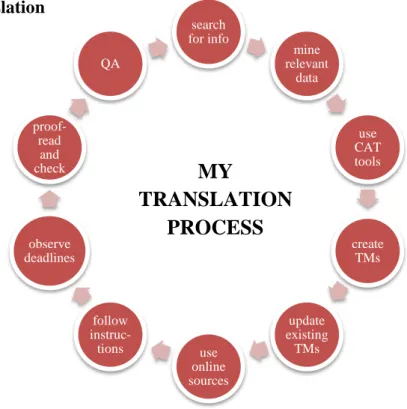
Figure 1 below reveals a summary of the main tasks (interrelated and interconnected with my main objectives) I was engaged into during a translation process while working on a certain project. Depending on the type, urgency and complexity of a project, these constituents might swap places, drop out or rearrange themselves in a totally different order. It should be mentioned in this respect that focus might be placed on different aspects emphasized by a client, but it is quality and client’s needs satisfaction that have always been prioritized as the primary goal. Some other steps might also appear on an as-needed basis, e.g. “coordinate terminology use in a shared project”. To cut a long story short, this is not a must-follow plan, this is merely a graphic representation of my relatively ideal translation process I tried to stick to. But as everybody knows, rules are made to be broken and this is the very case when I could hardly follow the steps set forth in this schema due to heterogeneity and diversity of projects.
In Table 1, there is a slightly modified timeline that I used to keep an eye on the workflow and overall progress. According to it, my internship should have ended in June, however, I had an opportunity to prolong it and work for another month, till July 4, thus turning it into a 4-month internship, which I actually did. This allowed me to further develop and master my translation skills and competences since in July I encountered some new topics I hadn’t been into before (e.g. hockey rules). Moreover, this extra period gave me more time to prepare for writing my final report on the work experience and to collect more information and examples I would like to include into it.
Table 1. Timeline
1 Interview with the Agency February 20
2 Start of the Internship March 4
3 End of the Internship June 4
4 *Extra Month July 4
5 Writing the Final Report
August-September
1.3 N.B.’s contact details
Table 2 below contains all important information and contact details of the Agency, including my supervisor’s name and e-mail. It can be easily contacted or found on the Internet.
search for info mine relevant data use CAT tools create TMs update existing TMs use online sources follow instruc-tions observe deadlines proof-read and check QA
MY
TRANSLATION
PROCESS
Figure 1. My translation processTable 2. N.B.’s contact details
Registered
Name Private Unitary Service Company Nota Bene Translation Agency Address 1 Olesheva str., Office 301, 220090 Minsk, Republic of Belarus
Web http://notabeneby.com/en/ E-mail [email protected] Tel./Fax Phone/fax: +375 17 293 36 64 GSM Velcom: +375 29 632 27 74 (mobile) GSM MTS: +375 29 705 60 64 (mobile) GSM Life:+375 25 664 77 41 (mobile) Motto “Said and Done”
Logo
Supervisor
Olga Yermakova
Customer Service Specialist, Editor and Translator of English, German and Polish
[email protected] Director Vitali Yanachkin Development
CHAPTER 2: TERMS AND CONDITIONS (METHODOLOGY)
2.1 Internship. Workflow
In this Chapter I am going to dwell on the Terms and Conditions of my internship, namely its detailed description, methodology I used, sources I referred to in search of information and tools that automated the process and improved the quality of my work.
As I have already mentioned in Chapter 1, my internship lasted four months instead of standard three-month work experience. It started at the beginning of March and was to have ended in three months, at the beginning of June. However, at the end of the period I suggested working for another month since time and circumstances allowed and at that time I was still job hunting, therefore it seemed quite a fruitful solution for the both parties.
Being a freelance translator, I managed to work with most of the Agency’s staff, so formally we were acquainted beforehand and the managers were aware of my professional skills and capabilities, as well as the quality of work done by me. Upon acceptance, a supervisor was assigned to me – Olga Yermakova, Customer Service Specialist, Editor and Translator of English, German and Polish, who likely used to cooperate with me more than others and consequently was better informed about my performance capabilities. The University professors in charge of my internship were Doutora Maria Filomena Louro and Prof-a Nadejda Ivanovna Nagovitsina Machado.
I worked full time, 5 days a week, 9 a.m. to 8 p.m. Taking into consideration the economic state and the necessity to move to the other city, the Company’s management agreed on my working remotely during the initial period of our cooperation. Nonetheless, I stayed in touch with my colleagues via Skype throughout the working hours and some experienced translators/managers supervised my work and provided me with feedback, if it was appropriate and applicable. Moreover, I turned up at the office in Minsk once a month to meet the management and get some feedback on my performance.
My direct duties as a translator-editor at the Company lay in the following: translation of texts from English into Russian and from Russian into English using CAT tools (including mostly but not limited to the SDL Trados Studio), editing and proofreading of texts translated by other/freelance translators. As the Agency has a limited number of in-house translators, the workflow is high and deadlines are tight, neither translators nor editors are assigned to certain fields of their expertise, e.g. law. It goes without saying that a priority is given to a translator or editor whose field of expertise a certain text belongs to, provided the person is available,
otherwise no distinctions are made in this respect. Thus, my scope of translations varied greatly and unpredictably at times. I dealt with legal, scientific, literary, technical, medical, economic and other types of texts, e.g. those related to sports and computer games localization. Translations were to be done with the help of CAT tools mostly, SDL Trados Studio in particular. Upon availability, the Agency provided TMs and other reference materials forwarded by a client or “stocked” from previous similar orders. Target texts were to be spelling- and grammar-checked, exported, formatted and submitted in the formats corresponding to the originals, except for some definite file types. For example, PDF or JPG files needed to be converted into DOC(X), sometimes manually, when originals were of poor quality or automatic text recognition failed to produce any legible content. The Company accepts almost all file formats and works with almost all translation memory software (including Trados 2006, 2007, 2009, 2011, 2014, SDLX, Fortis, Studio, Idiom, Transit, Catalyst, Wavetronix and T-Stream). All in all, I could expect any kind of projects to be assigned to me and should be ready to cope with all levels of complexity and deadlines, at the same time I had by all means to follow our clients’ instructions no matter how strange or linguistically inappropriate they might seem to me. This is the so-called translator’s impartiality. Still the managers always enquired if a certain project was not beyond my capacity and I didn’t have any other on-going projects at the moment of request.
The orders were received by the in-house managers whose responsibility was to accept them, handle, distribute, assign and forward to translators either by e-mail, Skype or a specialized platform. Managers also carried out all correspondence with clients, filed enquires and asked for additional information, stayed in contact and delivered all orders. Each project was numbered and every translator and manager had to keep record of all projects they dealt with for accounting purposes.
2.2 Sources of information
I would say that during my internship I faced all possible kinds of projects, which had great impact on the types of sources I could obtain specific information from. They varied as much as text registers did, starting with my friends’ explanations and ending with specialized databases and websites (that granted free access, of course). On-line dictionaries and encyclopedias, parallel corpora, translators’ forums and chats, multilingual websites of companies and organizations were of much importance and avail too. The well-earned tribute should be also paid to the well-liked Google search engine without which information mining would be a torture and would last for ages. Sometimes clients, mostly IT companies, attached
variants. Managers could also provide previously done translations from the same client or any topic-related reference materials to search for terminology or any other useful information (private names, names of companies or products, acronyms, etc.), or just to stylistically comply with translations already done and accepted by/submitted to a client.
Below you can find Table 3 shedding light on advantages and disadvantages, which, to my mind, are characteristics of different sources of information I used, prioritized in accordance with the reference frequency. The order does not imply their credibility or reliability; this is just my subjective viewpoint formed merely with regard to my own preferences and needs during the translation process.
Table 3. Sources of information: Pros&Cons
Sources Pros&Cons
Online dictionaries
+ very useful when looking up a separate word or an expression. I enjoyed mostly the Multitran online dictionary as translators can contribute to it by adding their translation variants (from their own contexts) to every single entity, thus you have an option of choosing the best variant suiting your case. Especially useful with regard to narrowed-down topics, terminology, slang and professionalisms. Can also be used as a thesaurus for stylistic purposes. A registered user gets access to extra options like parallel corpora search, thematic search, links to dictionaries, etc.
- doubts might appear as for some translations to be considered credible because they are added by people and sometimes it is not possible to find any proofs or similar translation variants in other sources.
Online encyclopedias
+ extremely useful for extensive reading purposes when forming a background knowledge of a subject-matter you deal with. Indispensable for understanding some out-of-your-league topics. Overwhelming majority of articles has indicated references and sources of information. This increases the chances of coming across the necessary terminology or any other practical information.
parallel-corpus basis: even if the same article is translated into several languages, its content may differ significantly in each language version available.
Parallel corpora
+ ideal for looking up a word or an expression in a context and then choosing a variant with the closest context or meaning. User-friendly layout (parallel columns) makes search easier and much faster. Quite credible. Some corpora have an option of choosing a scientific area/field, thus minimizing the number of results and making search more accurate and precise.
- sometimes translations look like done by means of machine translation only (especially webpages), without any editing or proofreading by a human. Some corpora require learning of specific search queries formation rules (e.g. Opus).
Translators’ forums
+ quite useful when working on any specific topic, e.g. construction or medicine. It stands to reason that narrow focus terminology is typical of many fields, that is why turning for help to professionals seems quite a reasonable idea.
- often it is not just asking and getting an answer at once. Not an option when you need a prompt solution: you need time to register and place a request, it also takes some time for people to reply, etc.
Reference materials (TMs, glossaries,
termbases)
+ reference materials provided by a client can be of great use to a translator, e.g. they save the need to form a terminology base or save time spent on information mining. Reference materials can include glossaries, translated topic-related texts, explanatory pictures and other visual aids, links, etc.
- there is also a risk that you will find no useful information you personally need in a specific case.
Websites
+ a company’s website translated into several languages can be a good source of required information, e.g. the official name of an organization in a foreign language, proper names of the management, product/service details, similar translated documents/agreements/contracts, detailed descriptions and other data. In some cases such translations done by organizations themselves might not comply with the grammar/spelling or
transliteration rules and differ completely from variants you may come up with without such prompts.
- some companies don’t care for good representation of their websites in foreign languages. In numerous cases machine translation suffices, if any.
Databases
+ perfect for mining data on theses, scientific articles, laws, companies, scientists, patents, inventions and much more, which are quite often not available as open-source information. Free access for University students through University networks. - access to most of the best databases is provided on a paid basis and prices are rather high. Not every translator really needs to pay for the access unless they make frequent use of this source and it will be repaid. Moreover, it takes some time to challenge yourself and master complicated query rules to obtain better results just to the point.
Client’s explanations
+ might be sufficient enough to clarify some points about a project. Additional information on instructions, products or services, acronyms/abbreviations or a company-specific terminology is never out of place.
- depending on a client, it might take too long to get an answer, no answer may follow or the answer will not clarify the issue.
Friend’s explanations
+ a friend in need is a friend indeed: you can test your friends on being true ones . Besides, in some situations you simply can’t get things cleared up by a client or manager, but which require prompt actions without wasting time on in-depth investigations or research. For example, you deal with an IT text and come across a hacker’s term, your friend is a hacker/IT specialist, you turn to him for clarification of this very term – done! Time and efforts saved with the problem solved.
- there’s a risk that some friends may not be highly-skilled professionals or will turn out to be not faithful enough. There is also a risk that you will not be able to explain the context clearly for a friend to get the right meaning, unintentionally causing misinterpretation of the situation resulting in a possibly wrong solution.
Here are some major examples of the information sources I used most frequently during my internship (with integrated links):
1. On-line dictionaries Multitran ABBYY Lingvo Cambridge Dictionary 2. On-line encyclopedias Wikipedia Britannica 3. Parallel corpora Linguee
Russian National Corpus Opus
My Memory Translated 4. Translators’ forums
ProZ
Multitran Forum
ABBYY Lingvo Forum 5. Databases ProQuest LexisNexis Web of Knowledge 6. Reference materials TMs Glossaries Termbases
Previously done translations 7. Client’s explanations
Abbreviations/acronyms 8. Friend’s explanations
IT specialists Sportsmen
2.3
CATs and DOGs
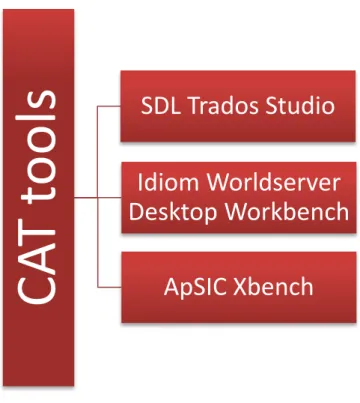
Most projects were done with the help of computer-aided translation tools (CAT tools),
SDL Trados Studio 2014 particularly. This is the most famous CAT tool used by more than 200,000 translation professionals all over the world that offers a range of sophisticated tools and features to assist translators in completing projects much faster and easier without any loss of quality.
All credits go to Dr. Fernando Ferreira Alves who provided all the course students with a unique opportunity to become certified users of this worldwide leading translation software for free. I just couldn’t miss this wonderful opportunity and got certified which later helped me a lot during my internship.
Besides the simple use of CAT tools during my work, the following objectives were among my internship goals: “create and use TMs for different types and directions of translations (e.g. ENG-RUS TM or a separate TM for legal translations)” and “update and improve created TMs upon the receipt of feedback from the editors” which I successfully accomplished owing to our CAT tools classes that acquainted us with the SDL Trados and prepared for work with it and all its core applications and components (e.g. Multiterm, Alignment tool).
I also happened to work with the Idiom Worldserver Desktop Workbench, a tool
designed for translators, proofreaders, editors and other language professionals who prefer to work offline on WorldServer assignments. It supports all Translation Memory (TM) features and looks and functions much like the SDL Trados Studio. But my experience with this tool confined to one or two uses only.
Some clients requested submitting QA reports. For this purpose the ApSIC Xbench was
used. This software offers powerful and user-friendly Quality Assurance and Terminology Management tools in a single package and supports numerous file types, including SDL’s XLIFF and TMX formats. This simple tool helps to quickly QA-check a translation on its consistency and uniformity.
The usage of such CAT tools significantly simplifies any translation process and assures a prompt result of high quality – the very outcome people always strive for. In our digital era of unimaginable amount of information transferred with inconceivable speed, being an advanced “computerized” professional is a great and highly valued advantage. Thus, we can say that CAT makes you a DOG (digitally-oriented genius ).
Figure 2. CAT tools used
CA
T t
ools
SDL Trados Studio
Idiom Worldserver
Desktop Workbench
ApSIC Xbench
CHAPTER 3: FORCE MAJEURE (ENG-RUS)
3.1
Foreword
This Chapter is dedicated to ENG-RUS translations and is called “Force majeure” as indeed I faced a number of challenges I had to solve while working with texts of totally different registers ranging from sport rules to technical characteristics of plant equipment. Some projects turned out real force majeure to me since I had to spend hours on information search and research and whatever on the earth might happen I had to observe deadlines. There is a joke in the Russian language popular with students who always put off studying and reading for exams till the very last moment, and which describes tough times a student has being totally pressed for time and still having to cover lots of material for the whole semester: we say that within several sleepless nights of thorough preparations a student may acquire second higher education. Complete concentration on a subject-matter and investigation of a certain topic, especially that differs from one's major, can make you feel an expert in a field you have never faced before. However, a professional translator should be aware of such pitfalls as it can mislead them and result in some miscommunication of information, which in its turn can have serious repercussions, e.g. mistranslated agreements or technical descriptions. Personally, I believe that a perfect translation should be done by a professional who feels quite at home with the topic. Reference materials, additional information, excellent search skills (and a good editor, of course) are of great importance though in case one is plunged into this kind of adventure.
Figure 3 below depicts main registers/topics of the texts in descending order that I translated from ENG into RUS.
Figure 3. Main ENG-RUS registers
Legal (contracts, agreements, assigment forms, etc.)
Technical (construction proposal, technical specifications, manuals, etc.) IT (game localization, software localization, software manuals, etc.)
Education (Interim Report, End-of-Year Report) Finances (Bank statements, calculation of expenses) Sports (Hockey rules)
3.2 Legal translations
Having background knowledge in a different sphere, I found legal translations rather challenging at the beginning due to their specific vocabulary, sentence structure and strict line of thought. However, after the second or third legal text I realized that their structures were quite similar and resembled each other in many respects. Quite a large number of legal documents like contracts or agreements are based on certain templates. For example, a relatively complete agreement pattern normally includes the following components: a preface/preamble, general provisions, obligations of the parties, responsibilities/liability, force majeure, resolution of disputes, termination, final provisions and banking details. Therefore, I came to a conclusion that once you produce a perfect translation, all upcoming documents will be already half-translated at the very moment you receive them. Consequently, my core objective was to produce a perfect translation as soon as possible to build my legal TM upon. I was lucky enough as managers provided me with feedback for my first assignment to have a look on. I considered all their notes most of which were of stylistic character, introduced changes and corrected the TM units. Next projects were also followed by feedback – one document was edited and proofread by a native speaker, which altogether helped me to form a credible TM. From that point on, I was looking forward to any legal projects as I began enjoying this kind of translations, especially being equipped with the reliable TM and some kind of experience I have attained. This is exactly where the Trados Studio comes into play most effectively.
On the other hand, a template is just a template and it is not a must-follow rule to obey at all times. There are also different types of agreements/contracts I have got acquainted with: supplemental agreements, confidentiality and non-disclosure agreements, partner contracts, third party channel agreements, framework agreements, etc. Depending on the needs and purposes of a document, some components may be missing (e.g. final provisions or banking details), while some other may appear (e.g. definitions, payment terms, confidentiality), but the typical framework remains relatively unaltered in most cases.
The most complicated part was coming up with appropriate and most accurate variants in the Russian language provided there are predefined sets of legal words, combinations and expressions in every language and clichés or word-by-word translation might become false friends. Such words as “hereunder, hereby, hereto, hereof”, for instance, do not have any direct translations in Russian and can be transferred by means of the recognized equivalents and case system without any loss of the meaning or message distortion, at the same time “hereinafter
referred to as” can be translated almost literally, although there is the widely-used accepted variant which is to be used (see Table 4).
One should also keep in mind changing formats of addresses and measures, as it is a common knowledge that they differ in different cultures. For example, American to Russian formats:
address: str. = ul. (this is a suggested innovation but not an accepted norm yet: ulitsa = street);
date: mm/dd/yyyy = dd.mm.yyyy; time: 1.20 p.m. = 13.20;
numerals: 1.2 = 1,2; 1,000,000 = 1 000 000; 1,000 = 1000; distance: miles = km;
weight: pounds = kg;
and currency: € (EUR), £ (GBP), $ (USD) = BYR; etc.
However, in most cases distance, weight and currency didn’t need to be converted unless it was essential for understanding or due to some other reasons (payments in invoices, for example). The same was attributed to legal addresses, which normally were kept in the format they were provided in (Equivalence approach preferred in accordance with the Agency's rules). On the other hand, sums of money present in contracts were always converted by compilers themselves, upon necessity and with the indication of the conversion rate as of the signature date. Personally, I experienced no cases requiring any kind of conversion, although back to 2011, at the beginning of my freelance cooperation with the Agency I received a kind of “manual” instructing translators and editors on the strategies to follow in regard to suchlike matters.
I would like to place here a short list of words and word combinations with their Russian equivalents. Those are expressions I came across most often translating legal documents and that is one of the reasons for me to consider them some sort of flag indicators which could be find in almost every agreement and that one way or another label those documents as legal-related.
Table 4. Most frequent and typical legal terms (ENG-RUS)
NOUNS party сторона
provision положение, условие counterpart экземпляр, копия
legal entity юридическое лицо written consent письменное согласие third party третье лицо effective date дата вступления в силу remuneration вознаграждение severability независимость положений, делимость договора force majeure форс мажор, обстоятельства непреодолимой силы obligation обязательство liability ответственность terms условия, положения; срок confidentiality конфиденциальность disclosure разглашение, раскрытие breach нарушение ADJECTIVES (non-)compliant (не)соответствующий illicit противозаконный, запрещённый liable нести ответственность unilateral односторонний valid действительный, имеющий силу; правомерный applicable (law) применимое (законодательство) insolvent несостоятельный; неплатёжеспособный VERBS shall обязаться, быть должным be deemed считаться stipulate оговаривать bind иметь обязательную силу, связывать обязательством determine устанавливать, определять agree upon договариваться, согласовывать come into effect вступать в силу
execute исполнять, выполнять conform to соответствовать
соблюдать, подчиняться undertake брать на себя обязательство, обязаться terminate расторгать confer (rights) предоставлять права incur нести, вытекать, следовать из indemnify компенсировать, возмещать abide by следовать, соблюдать PREPOSITIONS upon по in accordance/compliance with согласно, в соответствии within в рамках, в течение ADVERBS hereunder в соответствии с настоящим hereby настоящим (Т.п.) herewith настоящим (Т.п.) hereto к настоящему (Д.п.) hereof настоящего (Р.п.)
hereinafter (referred to as) в дальнейшем (именуемый как)
Appendix 2 contains a short fragment from a contract which serves an illustration of kinds of legal documents that I translated from English into Russian. There were far better documents to exemplify this part of the Project with more typical structures and contents, but unfortunately for me they were protected by confidentiality or non-disclosure notes and were not supposed to be published or used publicly in any form.
I would like to pay special attention to the Institute Cargo Clauses as it was the most difficult project. Although a legal document, it was rather different from what I had received before. This was the very case when I was about to reject the project because of its specific nature and vocabulary, but I was lucky enough to come across some translated documents of this type which formed a basis for my work. The source was quite reliable and the materials were in-depth and extensive enough to cover the topic, which made me come to a conclusion that I would be able to produce a meaningful translation of high quality. Another factor that persuaded me in favour was the democratic deadline: I had enough time to look for information and in case I had failed to find any foundation sufficient for me, I still could have rejected in due time to pass it to other translator without any repercussions. On the whole, it was risky in terms of the
quality only, but everything was under control and such a risky enterprise came off success in the end. The credible information source and sufficient amount of time for editing and proofreading manifested themselves. Time is very vital in this respect as it enables you to see your work in a new light and detect some “defects” you are just unable to spot at once during the translation process and first QA checks. Eventually, this has a direct impact on the quality.
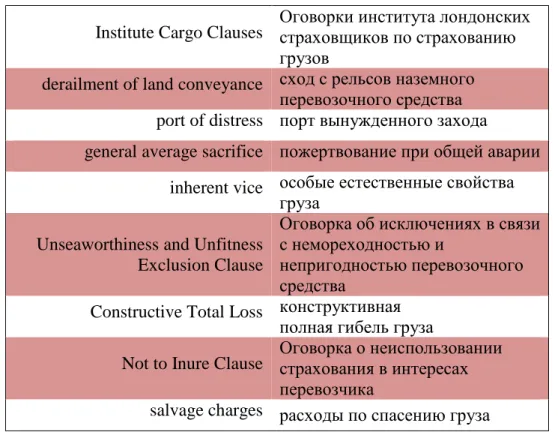
Now I would like to give a few examples from this project that I found challenging when translating:
Table 5. The most specific legal translation (ENG-RUS)
Institute Cargo Clauses Оговорки института лондонских страховщиков по страхованию грузов
derailment of land conveyance сход с рельсов наземного перевозочного средства port of distress порт вынужденного захода
general average sacrifice пожертвование при общей аварии inherent vice особые естественные свойства
груза Unseaworthiness and Unfitness
Exclusion Clause
Оговорка об исключениях в связи с немореходностью и
непригодностью перевозочного средства
Constructive Total Loss конструктивная полная гибель груза
Not to Inure Clause Оговорка о неиспользовании страхования в интересах перевозчика
salvage charges расходы по спасению груза
To sum it up, I want to highlight the fact that I consider the Equivalence theory to be a much better and more suitable approach to the translation of legal texts due to the following reasons:
a number of words and phrases have definite sets of fixed topic-related equivalents in a target language;
each sentence unit plays a certain role and influences the overall meaning of a sentence, that is why hardly any component can be omitted, overlooked or replaced; strict sentence structure hardly allows any rephrasing or restructuring;
straightforward, explicit, well-defined and unambiguous message should be transferred retaining all the same characteristics and without any loss of meaning; and last but not least, translating agreements and contracts that will govern
cooperation processes among other people and companies demands being as precise and accurate as possible because others’ success to a certain extent depends on the quality of the work done by you.
3.3 Technical translations
As for technical translations, most of them were quite specific and caused a lot of troubles. To find a good and accurate translation I had to look through numerous similar documents which had been already translated and uploaded on the Internet, mostly on the websites of companies placing orders, but not excluding all other possible sources. Very often the websites themselves were quite valuable in terms of terminology, if localized, or just for information-mining purposes to find descriptions or definitions of processes, equipment, products and services. Thematic forums could also provide access to some useful explanations concerning functions or technical features of certain devices, e.g. cameras or monitors.
The most complicated translation in this part was the Budget Proposal. Judging by its name, the document might seem to be financial or economic-related, but in fact it was devoted to the aqua park construction and abounded in special terminology (examples are provided in Table 6 below) which I have never met before, with a total sum of money mentioned only once at the very end of the text. Dictionaries and forums helped me out partially, but all the rest credits must go to the Multirtran online dictionary that offers numerous translation variants with the indication of the fields they may be used in. Having at least a draft translation makes it possible to check other sources for any concurrences or similar options. As a rule, the most frequently repeated word or expression would be the most suitable solution, with regard both to the topic and context of course. Furthermore, a big amount of terms could be found in dictionaries as they can be considered words and expressions with fixed meanings provided they are used in the sphere in question widely enough to be introduced into a dictionary with a definite meaning.
Technical documentation includes even more numerical information than legal texts that alongside with different physical signs, indicators, abbreviations and acronyms should be paid close attention to: e.g. 38.45m = 38,45 м, 0.1 W/kg (0.05 W/lb) = 0,1 Вт/кг (0,05 Вт/фунт), 2.0 µT B1+rms = 2,0 µT B1+rms. At some point company-specific acronyms (e.g. VDL, Vendor Document List = СДП, Список документов поставщика; KOM, Kick off meeting = Стартовое совещание по контракту) can all of a sudden turn nightmares when you realize their
expansions are not present in the text. Then this “Finding Nemo” game puts you at risk of being bled totally dry in terms of efforts and time. I should also mention here that while some acronyms are broadly accepted in their original forms (e.g. LED, IQ), some can be either translated/transliterated or kept as are (e.g. PC = PC/ПК, ISO = ISO/ИСО) and others have their equivalents (e.g. MRI = МРТ, EU = ЕС), there is still another group of words that do not have any “analogues” or are considered internationally recognized norms. Such instances should be transferred by means of explanations and additional information unless the target audience is acquainted with the relevant terminology closely enough to grasp the meaning without any external assistance (e.g. DIN – Deutsche Institut fuer Normung = 1) стандарт DIN; or 2) логарифмическая шкала оценки светочувствительности фотоплёнок или светодиодов. Возрастание на 3 единицы даёт удвоение светочувствительности (Multitran)). There is also a good source of acronyms to refer to: http://www.acronymfinder.com. To cut a long story short, it is the target audience (or the client) that influences a translator’s choice of a certain translation variant. And it stands to reason that possession of this kind of information is quite beneficial and advantageous and at least as much valuable as any good reference material.
In Appendix 3, there is an abstract from a technical document. Other major documents were dedicated to technical characteristics of a camera film, LED lights, industrial elevator, as well as specifications of implantable neurostimulators, etc. More examples of a specific technical vocabulary illustrating the issues discussed above, as well as some other examples can be found here:
Table 6. Major examples of technical terminology (ENG-RUS)
CONSTRUCTION
single curved skylight изогнутая крыша back vertical задняя вертикаль
bay пролет
fixed glazing below расположенное снизу остекление workpoint at eave of tower установочная точка свеса башни
apex of curve конек изгиба
trapezoidal shaped трапециевидной формы gable end торцевая стена со щипцом thermally broken extruded aluminum
frame
экструдированный алюминий с термоизоляционными вставками clear annealed прозрачное ламинированное
MEDICAL EQUIPMENT
implantable neurostimulators имплантируемые нейростимуляторы DBS (Deep Brain Stimulation) ГСМ (глубокая стимуляция мозга)
full-body eligible MRI МРТ всего тела
1.5-tesla horizontal closed bore закрытое горизонтальное отверстие при напряженности поля 1,5 Тесла (Tл) spatial gradient of 19 T/m (1900
gauss/cm)
пространственный градиент 19 Тл/м (1900 Гс/см)
RF receive/transmit body coil приемно-передающая РЧ катушка для исследования всего тела
SAR (Specific Absorption Rate) удельный коэффициент поглощения gradient slew rate скорость нарастания градиентов
TECHNICAL SPECIFICATIOS
FDA/EU-approved materials материалы, одобренные Управлением по контролю за продуктами и лекарствами США (FDA) и (или) ЕС bead blasted матирование дробеструйной
обработкой
piping and adjusting valves трубы и клапаны регулирующие electric main board главная электрическая плата
Infeed Station блок подачи
Outer Dimensions LxWxH внешние габариты Д х Ш х В single phase 230 Vac + N + PE однофазное, 230 В перем. + N + PE
CL Input Histogram by PO (Chemical Lean Input Histogram)
Гистограмма поступления триммингов с точной химической долей постного мяса (CL гистограмма поступления), сгенерированная по заказу на покупку throughput производительность
Pressure dew point температура конденсации под давлением PTC/KTY датчик давления/полупроводниковый термодатчик glass blasted стеклоструйная обработка OTHER FIELDS polycarbonate поликарбонат ester сложный эфир tri-acetate триацетат consistency (110±10) microns общая толщина пленки (110±10) мкм pankromatic панхроматический
photosensitivity (18-21) DIN светочувствительность (18-21) ед. по логарифмической шкале DIN
tensile strength высокая прочность на разрыв при растяжении в продольном направлении extendable LED Add on set дополнительный удлиняющий набор
LED MPS= Manufacturing Production System
ССП =
Система серийного производства MRB =
Manufacturing Record Book
СДИ =
Сводная документация изготовителя
Having suffered several severe technical “(dis)orders”, I can make a conclusion that this register is even stricter and more formal than legal documents. If in the latter you can occasionally reposition at least a subordinate close, the former doesn’t allow even these casual changes as they may distort the overall meaning of a sentence. Actually, when there are too many hardly understandable and very detailed technical facts stuck in one sentence, you don’t really feel like rearranging or rephrasing just to make them sound better – this is not the right style for esthetics that excludes any kind of improvisation and creative approach. In other words, appealing appearance is the last thing you consider when you work with technical texts again eliminating the functional approach in favour of the Equivalence theory.
3.4 IT translations
IT translations turned out quite “user-friendly” and didn’t bring about any major troubles. Being an advanced PC user, I am relatively acquainted with the terminology and aware of some pitfalls. It doesn’t need to be mentioned though that this register, as well as any other, can go much deeper than that and end up in peculiarities leading a too self-assured translator to a dead end. But luckily I evaded this sort of headache. Besides, there always was a possibility to reject a project if successful outcome was at stake due to any hesitations and doubts as for my expertise and knowledge of a certain subject-matter or lack of any credible referential materials.
Most of the incoming projects were connected with localization and came in SDL packages. Software localization was quite a cake as it contained a lot of distinguishing terminology (e.g. add profile, comment, enable/disable, connection failed, edit, dismiss, error, status, select, close, continue, etc.). Multilanguage localization projects supplied additional information in the form of translations done into other languages (see Appendix 5) the usefulness of which I will describe in more details below when talking about game localization. I was also provided with reference materials and clients’ TMs, so I was able to check not only troublesome abbreviations, but also other terminology in case I came up with two equally legitimate translation variants, for instance. Furthermore, queries addressed to clients and made by other
translators in charge of previous projects were forwarded to me helping to obtain useful information about some ambiguous aspects, e.g.:
1) QUERY: Desc (Is it the abbreviation for “description”?) CLIENT’S REPLY: Desc is abbreviation for “description”
2) QUERY: Data Master (Is it a software?)
CLIENT’S REPLY: Data Master is an area in the goalz system that contains all of the master data for all fields populated by a drop down
While localization of software went more or less smoothly, game localization proved a challenge in terms of creativity. The project was to localize an iPhone game application sending notifications to the Apple Watch connected to it. At this point I should mention that localization had been already done into numerous foreign languages (Spanish, French, Italian, German, Korean, Chinese, Brazilian, Japanese) and I had access to the Excel file with all of them while localizing into Russian (see Appendix 4). This fact played a great role in the process of translation of some words and expressions as, when at a loss, I could refer to and consult other languages for extra information that might be in some way revealed or made explicit in them. Some marketing texts describing the game and its features were also included into the package for translation from which I was able to extract some more explanations and clarifications. I realized that catching the idea is the utmost objective in translation-related activities in general, and for localization purposes in particular.
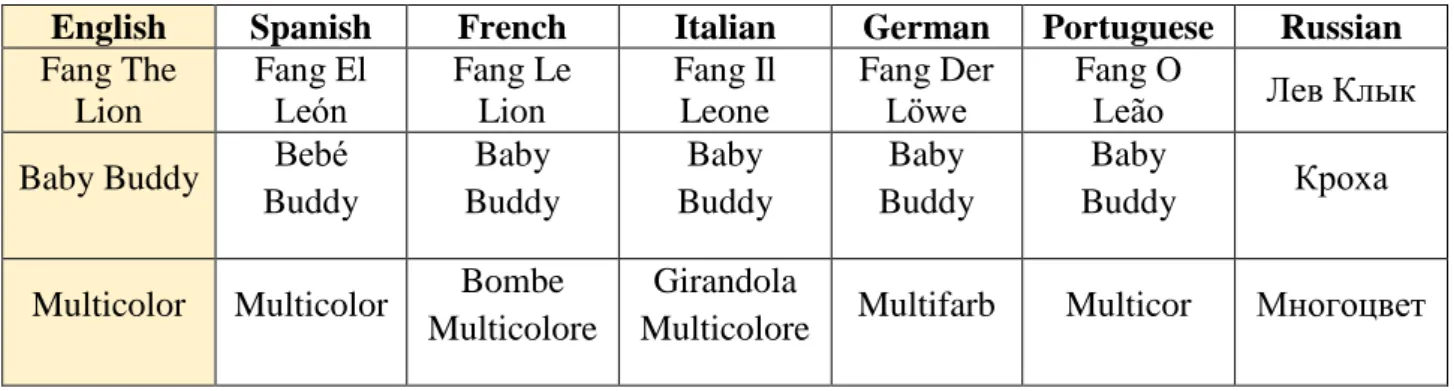
On the one hand, the game contained proper names which somehow were to be transferred into the target language. Taking into account that majority of users may possess little knowledge of English, especially the target audience – school children, I decided to create new translated/localized names for heroes based on their originals regardless of the fact that in other languages the original names were retained or just slightly modified, for example:
Table 7. Proper names in game localization
English Spanish French Italian German Portuguese Russian
Fang The Lion Fang El León Fang Le Lion Fang Il Leone Fang Der Löwe Fang O Leão Лев Клык Baby Buddy Bebé
Buddy Baby Buddy Baby Buddy Baby Buddy Baby Buddy Кроха
Multicolor Multicolor Bombe Multicolore
Girandola
Paper Popper Piñata Bombes en papier Spara-coriandoli Papier-popper Poppers de Papel Бумажная хлопушка
Confetti Confeti Confetti Coriandoli Konfetti Confete Конфетти
In European languages, a great number of words either have common Latin roots or origin, have been introduced from some other modern language (English, French) or are just widely used by the youth, for example. As for Russian, it would be quite acceptable to keep Baby, but Fang, Buddy or Popper would be perceived by a small number of users and taken as mere proper names without any meaning by all the rest. For this reason, I translated the names and localized the main hero Baby Buddy as “Кроха” (Tiny) grounding my logics on the fact that this Buddy is a small creature in an Apple Watch one has to take care of: to play, to pet, to feed, to bring to bed and so on. But, as you can see from Table 6, there was a unified name that required no interference in all languages but Italian: Confetti.
On the other hand, there were also some expressions translation of which could not be direct or word-by-word as they had to be produced as short as possible and the Russian language is not the most “laconic” in this respect. This was the client’s instruction conditioned by their intended purpose: these notifications were to be shown on Apple Watch screens which are very small in size and have limited space. Thus, it was important to deliver the message in the shortest possible form. For example:
Table 8. Examples of “laconic” translations
English Spanish French Italian German Portuguese Russian
I'm hungry!
¡Tengo
hambre! J'ai faim ! Ho fame!
Ich habe Hunger!
Estou com
fome! Я голоден! I'm sad! ¡Estoy triste! Je suis triste ! Sono
triste!
Ich bin
traurig Estou triste!
Мне грустно!
Pet me! Acaríciame Caresse-moi Accarezza mi Streichel mich Faça carinho Погладь меня!
As seen from these examples, languages like Portuguese and Spanish allow omitting the subject making a sentence shorter. English, German and Russian do not allow such omissions, that is why they are harder to work with when economy of language means and minimization of sentence constituents come to the fore. At the same time, the link-verb “to be” is omitted in Russian present tense sentences, which cannot be considered a common characteristic of English and German.
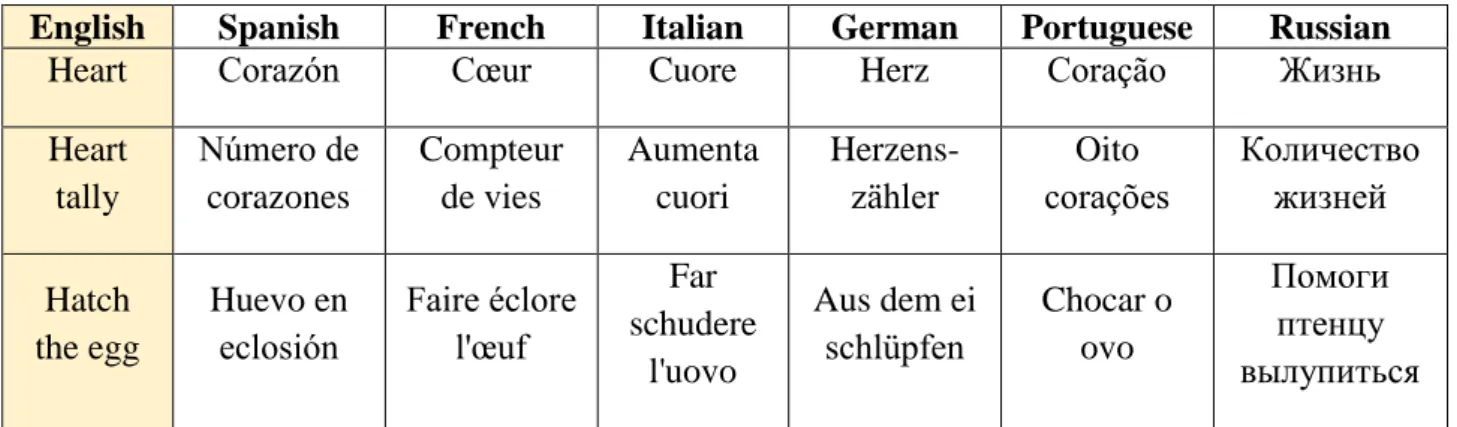
And to crown it all, I’d like to add that in some cases other languages may be false friends duplicating English phrases or emphasizing their own cultural phenomena and as a result disorienting translators. Table 9 gives some examples of such false friends:
Table 9. False localization friends
English Spanish French Italian German Portuguese Russian
Heart Corazón Cœur Cuore Herz Coração Жизнь
Heart tally Número de corazones Compteur de vies Aumenta cuori Herzens-zähler Oito corações Количество жизней Hatch the egg Huevo en eclosión Faire éclore l'œuf Far schudere l'uovo Aus dem ei schlüpfen Chocar o ovo Помоги птенцу вылупиться
The word “heart” in a game stands for an attempt, a try which you have a limited number of to complete a mission/level and when you run out of them, the game is over. All the languages put it as “heart”, though in Russian we normally call it “жизнь” (life). Similarly, the word “tally”, which the Oxford online dictionary defines as “a current score or amount”, is translated into Portuguese as “oito”. In fact, the research undertaken by me proved that the number of hearts in the game was 8 indeed, but if I doubt the word “tally” and refer to the Portuguese as my first foreign language, for example, I will be misled, not fully mistaken though. Such distinctions may account for cultural differences or perception. To be on the safe side, it is necessary to take the original as the main source of information whereas other languages may perform a function of additional sources referred to in case of emergency.
3.5 Other types of ENG-RUS translations
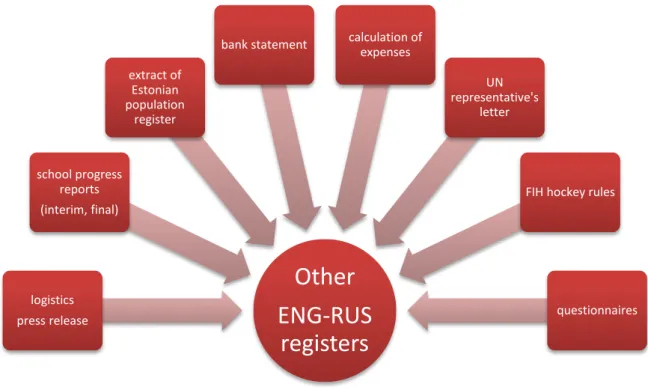
There were also some other registers I tried my hand at, among them: press release, school progress reports, extract from a population register, bank statement, expenses calculation, official letter, hockey rules and companies’ questionnaires. They were “isolated” instances representing their specific areas, therefore I grouped them all together under one Chapter. Figure 4 summarizes this information in a graphic form:
Next, I would like to present a table with the most complicated cases I came across in the documents listed above.
Table 10. “Other” most complicated cases (ENG-RUS)
PRESS RELEASE (logistics)
cutting-edge supply chain solutions передовые решения по управлению цепочками поставок
freight brokerage куртаж за фрахт highly engineered contract logistics
сфера контрактной логистики с высоким уровнем технического развития
all-cash simplified tender offer
публичное предложение о
приобретении в упрощенном виде за наличные денежные средства
STUDENT PROGRESS REPORTS PSHE
(Personal, Social, Health Education)
ЛСЗ (Формирование личности, освоение социальных навыков и
воспитание сознательного отношения к здоровью)
EXTRACT FROM ESTONIAN POPULATION REGISTER rights of curatorship право на попечительство
full personal care полное попечительство
full property care полное распоряжение частным имуществом
Other
ENG-RUS
registers
logistics press release school progress reports (interim, final) extract of Estonian population registerbank statement calculation of expenses
UN representative's
letter
FIH hockey rules
BANK STATEMENT maturity date дата погашения balance B/F перенесенное сальдо DD repayment оплата тратты, срочной по предъявлении OR balance сальдо счета с превышением разрешенного овердрафта HOCKEY RULES obstruction блокировка
field Player with Goalkeeping privileges полевой игрок с привилегиями вратаря flick щелчок
scoop бросок forehand удар справа
bully спорный мяч single convex or concave deviation
отклонение от нормы в виде гладкого неразрывного изгиба (выпуклого либо вогнутого)
standard pointed depth gauge стандартный заостренный глубиномер QUESTIONNAIRES (surveys) HM store гипермаркет SM store супермаркет HD store магазин постоянных распродаж MasterData отдел основных данных in-flight training обчение во время полета
It should be pointed out that some of these documents were rather difficult to work with (e.g. bank statement from Malta or the extract from Estonian population register) as they contained some pieces of information in the form of abbreviations/acronyms without any expansions or in the Maltese or Estonian languages originating in those countries. One page each, they took incredible efforts and ages to extract information from the websites of the corresponding issuing institutions for some proper names and abbreviations/acronyms. To illustrate this I have included several examples into Table 10, and here are some more:
certain Maltese Bank Departments simply do not exist in the Russian-speaking reality (e.g. Capital Transfer Duty Department), consequently there are no direct correspondences, a definite equivalent must be found. In this case I decided in favour of “Отдел налогообложения на передачу капитала”;
or a stamp on the Estonian extract and the position of the official in charge were given in Estonian – however, I do not possess any Estonian language knowledge. Fortunately,
simple exploring of the relevant website worked out as it had a Russian version to compare with the Estonian homepage and discover the needed data.
I was going to attach the screenshots of these documents, but unfortunately this was unacceptable as they teemed with personal data and wiping them out would turn the images into blank sheets with no illustrative information left.
As to the hockey rules, I had to surf all hockey federations’ websites I could locate on the Internet to obtain any useful materials. I believe that first of all after being assigned a project a good translator should focus on careful and thorough information search – if successful, half the battle won. One may object that this part is the most exhausting task, but no pain – no gain. I managed to dig out the earlier edition of the rules, so why reinvent the wheel? This material served an excellent base to build the work on. Some examples from this project are given in the table above and in Appendix 7 as well.
All the rest projects were comparatively easy, at least I can’t recollect any particular troublesome situations having me to tear my hair out. Some projects (questionnaires, press release and a progress report) were in a relatively free form and allowed application of the Skopos theory to deliver messages in the adapted form most appropriate for the target culture and audiences. Nonetheless, the bank statement and the register extract implied no liberties in terms of thought expression having a lot of common with legal documents.