João Ferreira do Amaral, João Carlos Lopes* & João Dias
External dependency, value added generation and
structural change: an interindustry approach
WP 12/2010/DE/UECE
___________________________________________________________________
Department of Economics
W
ORKINGP
APERSISSN Nº 0874-4548
School of Economics and Management
External dependency, value added generation and
structural change: an interindustry approach
João Ferreira do Amaral, João Carlos Lopes* and João Dias ISEG (School of Economics and Management) - Technical University of Lisbon,
and UECE (Research Unit on Complexity and Economics)
Abstract
The external dependency of many industries and the corresponding low value added generated in production create high external deficits and growing debt to GDP ratios in several open economies. In this paper we propose an empirical method to assess the evolution of these vulnerabilities, based on a new treatment of interindustry production multipliers. The (gross) output growth potential given by the column sums of the Leontief inverse matrix (backward linkage indicators) results from three terms: interindustry consumptions, value added and imported inputs. After a convenient arrangement of these terms, the evolution of backward linkage indicators can be used to detect structural changes, particularly quantifying a (net) growth effect (more value-added generation) and an external dependency effect (more imported inputs), and to classify the productive sectors accordingly. An application to the Portuguese Economy is made, using input-output tables for the years 1980, 1995 and 2005. This method can also be useful as a simple, but suggestive, device to compare the evolution of two or more economies, along their development processes in time.
Keywords: input-output linkages, external dependency, structural change, Portugal JEL classification: C67, D57
* Corresponding author: ISEG - Rua Miguel Lupi, nº 20, 1249-078 Lisboa, Portugal. E-mail address: [email protected]
______________________
The financial support of FCT (Fundação para a Ciência e a Tecnologia), Portugal, is gratefully
1. Introduction
The external dependency of many industries (strong reliance on imported inputs) and
the associated low value added generated in domestic production are important
vulnerabilities in several developed and developing open economies. When associated
with a relatively high level of personal consumption and a weak export potential, they
tend to create high external deficits and a rapidly growing debt to GDP ratio that
request very demanding financial efforts and disturbing macroeconomic imbalances.
In this paper we propose an empirical method to evaluate the changes in the external
dependency of the production system of an economy and its capacity to generate value
added, based on a new treatment of interindustry production multipliers.
The column sums of the Leontief inverse matrix (backward linkage indicators) give the
output growth of all sectors when the final demand directed to each (correspondent)
sector increases by one unity, and this growth potential can be divided in three terms:
interindustry flows, value-added and imported inputs (a good exposition of the basic
structure and results of the Leontief model is made in Miller and Blair, 2009).
After a convenient arrangement of these terms, the evolution of backward linkage
indicators can be used to detect structural changes, particularly quantifying a (net)
growth effect (more value-added) and an external dependency effect (more imported
inputs), and to classify the productive sectors accordingly.
An application to the Portuguese economy is made for the period 1980-2005, divided in
Portuguese version: 1977; and 1995-2005, with data for 60 sectors, based on the E.U.
SEC1995. This method can also be useful as a simple, but suggestive, device to
compare the evolution of two or more economies.
Since the pioneering work of Rasmussen (1956) and Hirschman (1958), the concepts of
backward and forward linkages have been widely discussed and applied (for an
interesting survey and discussion see Drejer, 2002).
More recently, sophisticated methods to deal with structural change have been
proposed (Sonis et al (1995), Dietzenbacher and van der Linden (1997), Dridi and
Hewings (2002), are, among others, very interesting examples).
The strategy in this work is different, and based on the conviction that sometimes,
‘back to basics’ and simplicity enriched with easy visualisation ways to look at the data
can play an important role in our understanding of how an economy evolves in time.
2. Interindustry linkages indicators
The Rasmussen traditional method of using compact indicators from the production
multipliers matrix (Leontief inverse) is one of the classical references for the analysis of
intersectoral relations.
It is well known that this matrix is obtained by solving an n equations system that
equates sector productions to possible uses: intermediate and final demand.
This system can be represented as follows:
(2.1) x = A x + y,
with: A – (domestic) technical coefficients matrix; x – sectoral production vector; y –
(domestic) sectoral final demand vector.
The solution of this system is:
(2.2) x = B y, with B = (I-A)-1
Each element of B is a production multiplier that gives the total (direct and indirect)
effect in one’s sector production of a unity increase in domestic final demand of a given
sector. That is, bij is the global impact on the sector i production when the domestic final
demand of sector j increases by one unity.
Particular interest in this context has the notion of backward linkage indicators:
(2.3)
∑
=
= n i
ij
j b
b
1
0 ( j = 1, … , n )
This indicator results from summing up the n values of column j and gives the effect on
total production (of all sectors) of a unitary change in the final demand directed to j
sector. The larger the value of this coefficient, the larger will be the impact of this
increase of the final demand on the sector concerned and on all the others. For the
method we propose in the next section and its empirical application to the Portuguese
3. Net growth (or efficiency
)
and external dependency effects
The backward linkage indicators can be used to evaluate the gains in the capacity of an
economy to generate value added and the changes in external dependency of an
economy from one year to another.
The overall effect of a unity change of final demand is the sum of three terms:
interindustry flows, value added and imported inputs.
Moreover, an important property applies: the second and last terms sum up unity,
exactly the value of the initial (exogenous) stimulus, and this is so because in
equilibrium the total value of sectoral final demand equals the gross value added plus
imported inputs of all sectors.
Using this property, and after a convenient arrangement of terms, the evolution of
backward linkage indicators, value added and imported input coefficients over time can
be used to detect structural changes in the economy.
Particularly, we can quantify the capacity to generate more (or less) value-added by
unity of final demand (what in some sense we can call an ‘efficiency effect’, although a
peculiar one1), and the need to import more (or less) intermediate inputs (a certain kind
of ‘external dependency effect’). And we can classify the productive sectors according
1
to the particular combination of both effects, finding a new kind of “key sectors”, those
presenting a positive “efficiency” change and a negative “dependency” change.
One way to express formally these ideas is as follows.
Considering a unitary increase in j sector’s final demand, ∆ yj = 1, its effects on total
production are:
(3.1) Σi ∆xi = Σibij = b0j
By the equilibrium condition between total sectoral final demand and total primary
inputs, we have:
(3.2) ∆ yj = 1 => ∆ (Σi vi +Σi mi) = 1,
where vi and mi are the value added and the value of imported inputs used by sector i.
Defining, and assuming as constants, the value-added coefficients (avi = vi/xi) as well as
the imported inputs coefficients (ami = mi/xi), we have:
(3.3) 1 = Σibij avi + Σibij ami
Dividing both sides of (3.3) by b0j:
and, representing by v*j and m*j the terms in the right hand side of (3.4) (the weighted
average of value-added and imported inputs coefficients, respectively), we arrive finally
at:
(3.5) 1 = b0j (v*j + m*j).
This expression can be used in a dynamic (or, as in the present paper, in a comparative
static) exercise to detect and quantify the changes in the productive structure of an
economy.
Suppose that, for each sector j, we have, between two given years, a decrease inb0j.
This means that, in order to satisfy a unitary increase in sector j final demand it is
necessary a smaller increase in the global production of the economy.
It is also true that, in this case, we must have ∆m*j+∆v*j > 0, and so four situations are
possible, in a two dimensional space with axes ∆v*j and ∆m*j:
- when ∆ v*j > 0 and ∆ m*j < 0, the decrease in b0j goes with a larger capacity to
generate value added (a beneficial ‘net’ growth effect) and a lower necessity of
imported inputs (a reduced external dependency effect) – let’s call this area A, the most virtuous one;
- if ∆v*j > 0, ∆m*j > 0 and ∆v*j/∆ m*j > 1, there is a simultaneous increase in ‘net
growth effect’ and ‘external dependency’, with the first dominating the second (area B);
- with ∆m*j > 0, ∆ v*j > 0, but ∆m*j/∆ v*j > 1, the increase in ‘external dependency’
is relatively more significant than the increase in ‘net growth effect’ (area C);
- finally, with ∆m*j > 0 and ∆ v*j < 0, the decrease in b0j is totally due to an increase
in ‘external dependency’, with a simultaneous decrease in the capacity to generate
value added (area D, the most disadvantageous situation).
For the case of a b0j increase we must have ∆m*j+∆v*j < 0, a worse situation for the
economy, at least from the ‘capacity to generate more value added’ point of view. The
four possible areas now are (in a descending order):
- Area A’: ∆v*j > 0 and ∆ m*j < 0, with ∆ v*j < |∆m*j|
- Area B’: ∆v*j < 0 and ∆ m*j < 0, with |∆ v*j| < |∆m*j|
- Area C’: ∆v*j < 0 and ∆ m*j < 0, with |∆ v*j| > |∆m*j|
- Area D’: ∆v*j < 0 and ∆ m*j > 0, with |∆ v*j| > ∆m*j
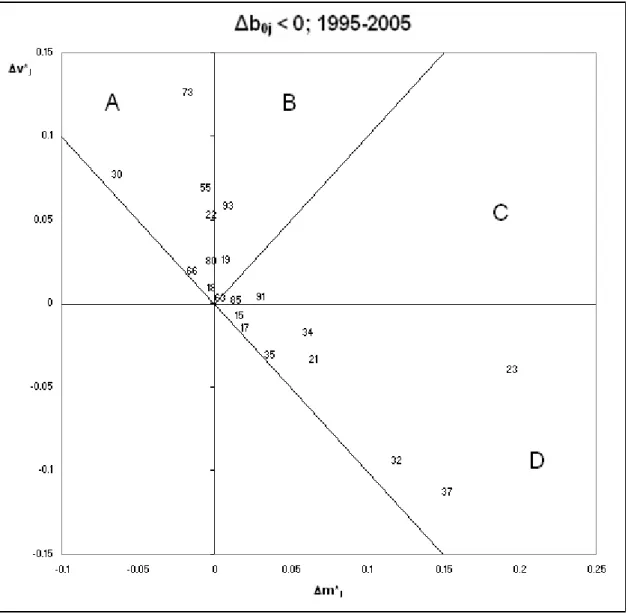
In practical terms, a suggestive way of analysis is the graphical presentation of ∆v*j and
∆ m*j values in the two-dimensional space above described, distributing the position of
the sectors in the possible areas A, B, C, D (for a b0j decrease) and A’, B’, C’, D’ (for a
b0j increase). The structural change is more beneficial to an economy when more sectors
4. Application to the Portuguese Economy
We have applied the method presented above to the Portuguese economy in two
periods: 1980-1995 and 1995-2005, using the Domestic Input-Output Tables with 49
sectors (SCNP1977) and 60 sectors (SEC1995), respectively. In both cases the data
sources are Statistics Portugal (INE) and Departamento de Prospectiva e Planeamento
(DPP).
The main conclusion drawn from the results is the apparent global deterioration of the
Portuguese productive system between 1980 and 2005.
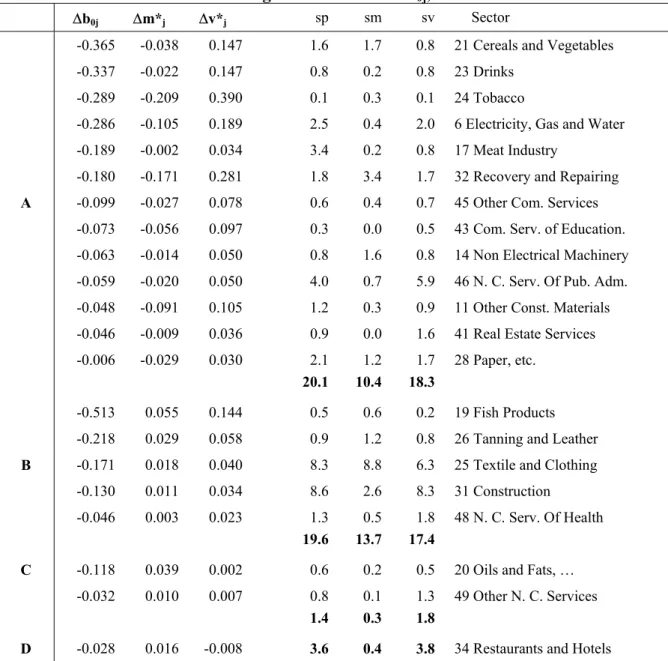
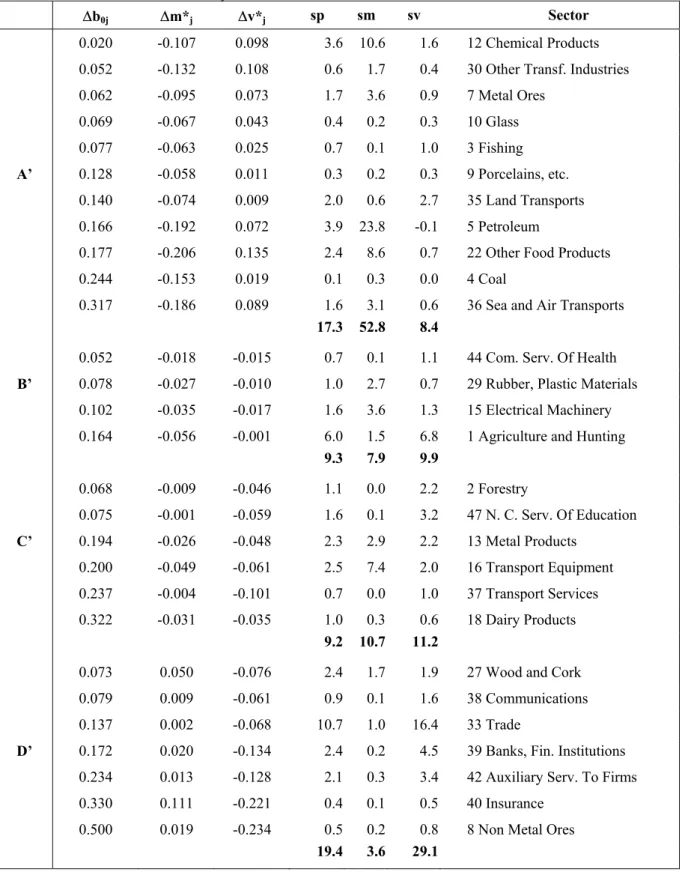
For the first sub-period we can see in tables 1 and 2 that there are in both sub-periods
more sectors with b0j increasing than with b0j decreasing.
< Table 1 approximately here > < Table 2 approximately here >
For the sectors with decreasing b0j only 13 are located in the most virtuous area A (more
‘net growth effect’ and lower external dependency). Moreover, the majority of these
sectors are services, utilities or protected sectors.
Among the sectors with increasing b0j, only 11 are in the area with positive variation of
These results can be better visualised in Figures 1 and 2. It could be expectable that, as
an economy develops over time most sectors should be concentrated in virtuous areas A
and A’.
< Figure 1 approximately here > < Figure 2 approximately here >
In fact, it is not what we get in this case and it is difficult to explain these findings for
the evolution of the Portuguese productive structure between 1980 and 1995. It was a
period of normalisation of political, economic and social conditions, of economic
integration in the (then) European Economic Community (since 1986) and of relatively
strong growth and real convergence at macroeconomic level.
However, it is important to note that this analysis was made using data at current prices
and therefore the methodology used does not allow us to reach conclusions about the
breakdown of the effects between price effects and technological or other real effects.
Although we have not in Portugal domestic flows input-output data at constant prices,
there are nonetheless good reasons to support the view that the kind of effects that we
tried to measure should in fact be measured at current prices as we have actually done.
For the second and more recent sub-period, 1995-2005, the tendency for more sectors
with b0j increasing than decreasing remains (see Tables 3 and 4), and the percentage of
sectors in virtuous areas (A and A’) is even smaller (see Figures 3 and 4), representing
around 20% of gross output (against 37,4% in 1980-95) and value added (26,7% in
disadvantage areas (D + D’), from 23% to 51% in terms of production, and from 33% to
48% in terms of value added.
< Table 3 approximately here > < Table 4 approximately here > < Figure 3 approximately here > < Figure 4 approximately here >
However, there is at least one positive tendency in the structural evolution of the
Portuguese productive system concerning the sectoral composition of virtuous areas A
and A’. In 1980-95 there is a clear predominance of services, nontradables or low
technology sectors (Tobaco, Electricity, gas and water, Recovery and repairing, Cereals
and vegetables, Drinks, Commercial Services of Education, Other Commercial
Services, etc.). In 1995-2005 enter in these areas of great value added creation and
lower external dependency several medium and high technology sectors as Office
machinery, R&D services, Machinery and equipment, Fabricated metal products,
Wearing apparel, Other business services. It would be very important to keep these
sectors in virtuous areas and reinforce significantly its weight in the Portuguese
productive system. This can be a valuable contribution to solve (or at least diminish) the
external and macroeconomic imbalances currently affecting the growth performance of
5. Concluding remarks
In this paper we have proposed a simple method to study the structural changes of an
economy, using the traditional Rasmussen indicators based on the production
multipliers matrix or Leontief inverse. This method is appropriate to assess the external
dependency of industries (strong reliance on imported inputs) and the associated low
value added generated in domestic production, an important vulnerability in several
open economies.
We used the method to analyse the evolution of the Portuguese productive structure
between 1980 and 2005, divided in two sub-periods, until and post-1995. Our results
point to a mixed pattern, with the positive gains in the capacity to generate value added
and importing less intermediate inputs overcome by many losses and an increased
external dependency for the majority of sectors, particularly in more recent years.
However, our results also point to an apparent upgrade of the Portuguese productive
system with more medium and high technology sectors entering in the virtuous areas of
value added generation and less dependency.
External dependency is not necessarily bad. It may be the result of increased benefits
from international division of labour. What is not a priori desirable is that the decrease
in production needed to satisfy an increase in domestic demand should be a
consequence of domestic production being supplanted by imports.
One of the possible explanations for the results obtained is the great variation in the
a concept of multiplier that is immune to that variation: the singular value
decomposition method proposed in Ciaschini (1993).
It is important to emphasise that, although conditioned by the well-known limitations of
the traditional gross multipliers (Oosterhaven and Stelder, 2002), the method we
propose can be used as a simple, but (visually) suggestive, device to quantify the
structural changes of an economy. And with some refinements it can also be useful to
compare the evolution of two or more economies along their development paths.
REFERENCES
Ciaschini M. (1993) Modelling the Structure of the Economy (London, Chapman and
Hall).
Dietzenbacher, E. & van der Linden, J. (1997), Sectoral and Spatial Linkages in the EC
Production Structure, Journal of Regional Science, 37, pp. 235-257.
DPP (2001), Estimação de um sistema de matrizes na óptica da produção efectiva,
Documento de Trabalho, Departamento de Prospectiva e Planeamento, Maio.
Drejer, I. (2002), Input-Output Based Measures of Interindustry Linkages Revisited – A
Survey and Discussion, Paper presented at the 14th International Conference on
Input-Output Techniques, Montreal, Canada.
Dridi, C. & Hewings, G. (2002) An Investigation of Industry Associations, Association
Loops and Economic Complexity: Application to Canada and the United States,
Hirschman, A. (1958) The Strategy of Economic Development (New York, Yale
University Press).
INE, Contas Nacionais, Lisboa.
Miller, R. E. and Blair, P. D. (2009), Input-Output Analysis: Foundations and
Extensions, Second edition. New York: Cambridge University Press.
Oosterhaven, J. & Stelder, D. (2002), Net Multipliers Avoid Exaggerating Impacts:
With a bi-regional illustration for the Dutch transportation sector, Journal of
Regional Science, 42, pp. 533-43.
Rasmussen, P. (1956) Studies in intersectoral relations (Amsterdam, North-Holland).
Sonis, M., Hewings, G. & Guo, J. (1996) Sources of structural changes in input-output
systems: a field of influence approach, Economic Systems Research, 8, pp. 15-32.
Annex: Tables and Figures
Table 1: Negative variation of b0j, 1980-95
∆b0j ∆m*j ∆v*j sp sm sv Sector
-0.365 -0.038 0.147 1.6 1.7 0.8 21 Cereals and Vegetables -0.337 -0.022 0.147 0.8 0.2 0.8 23 Drinks
-0.289 -0.209 0.390 0.1 0.3 0.1 24 Tobacco
-0.286 -0.105 0.189 2.5 0.4 2.0 6 Electricity, Gas and Water -0.189 -0.002 0.034 3.4 0.2 0.8 17 Meat Industry
-0.180 -0.171 0.281 1.8 3.4 1.7 32 Recovery and Repairing A -0.099 -0.027 0.078 0.6 0.4 0.7 45 Other Com. Services
-0.073 -0.056 0.097 0.3 0.0 0.5 43 Com. Serv. of Education. -0.063 -0.014 0.050 0.8 1.6 0.8 14 Non Electrical Machinery -0.059 -0.020 0.050 4.0 0.7 5.9 46 N. C. Serv. Of Pub. Adm. -0.048 -0.091 0.105 1.2 0.3 0.9 11 Other Const. Materials -0.046 -0.009 0.036 0.9 0.0 1.6 41 Real Estate Services -0.006 -0.029 0.030 2.1 1.2 1.7 28 Paper, etc.
20.1 10.4 18.3
-0.513 0.055 0.144 0.5 0.6 0.2 19 Fish Products -0.218 0.029 0.058 0.9 1.2 0.8 26 Tanning and Leather B -0.171 0.018 0.040 8.3 8.8 6.3 25 Textile and Clothing
-0.130 0.011 0.034 8.6 2.6 8.3 31 Construction
-0.046 0.003 0.023 1.3 0.5 1.8 48 N. C. Serv. Of Health
19.6 13.7 17.4
C -0.118 0.039 0.002 0.6 0.2 0.5 20 Oils and Fats, … -0.032 0.010 0.007 0.8 0.1 1.3 49 Other N. C. Services
1.4 0.3 1.8
Table 2: Positive variation of b0j, 1980-95
∆b0j ∆m*j ∆v*j sp sm sv Sector
0.020 -0.107 0.098 3.6 10.6 1.6 12 Chemical Products 0.052 -0.132 0.108 0.6 1.7 0.4 30 Other Transf. Industries 0.062 -0.095 0.073 1.7 3.6 0.9 7 Metal Ores
0.069 -0.067 0.043 0.4 0.2 0.3 10 Glass 0.077 -0.063 0.025 0.7 0.1 1.0 3 Fishing A’ 0.128 -0.058 0.011 0.3 0.2 0.3 9 Porcelains, etc.
0.140 -0.074 0.009 2.0 0.6 2.7 35 Land Transports 0.166 -0.192 0.072 3.9 23.8 -0.1 5 Petroleum
0.177 -0.206 0.135 2.4 8.6 0.7 22 Other Food Products 0.244 -0.153 0.019 0.1 0.3 0.0 4 Coal
0.317 -0.186 0.089 1.6 3.1 0.6 36 Sea and Air Transports
17.3 52.8 8.4
0.052 -0.018 -0.015 0.7 0.1 1.1 44 Com. Serv. Of Health B’ 0.078 -0.027 -0.010 1.0 2.7 0.7 29 Rubber, Plastic Materials
0.102 -0.035 -0.017 1.6 3.6 1.3 15 Electrical Machinery 0.164 -0.056 -0.001 6.0 1.5 6.8 1 Agriculture and Hunting
9.3 7.9 9.9
0.068 -0.009 -0.046 1.1 0.0 2.2 2 Forestry
0.075 -0.001 -0.059 1.6 0.1 3.2 47 N. C. Serv. Of Education C’ 0.194 -0.026 -0.048 2.3 2.9 2.2 13 Metal Products
0.200 -0.049 -0.061 2.5 7.4 2.0 16 Transport Equipment 0.237 -0.004 -0.101 0.7 0.0 1.0 37 Transport Services 0.322 -0.031 -0.035 1.0 0.3 0.6 18 Dairy Products
9.2 10.7 11.2
0.073 0.050 -0.076 2.4 1.7 1.9 27 Wood and Cork 0.079 0.009 -0.061 0.9 0.1 1.6 38 Communications 0.137 0.002 -0.068 10.7 1.0 16.4 33 Trade
D’ 0.172 0.020 -0.134 2.4 0.2 4.5 39 Banks, Fin. Institutions 0.234 0.013 -0.128 2.1 0.3 3.4 42 Auxiliary Serv. To Firms 0.330 0.111 -0.221 0.4 0.1 0.5 40 Insurance
0.500 0.019 -0.234 0.5 0.2 0.8 8 Non Metal Ores
Table 3. Negative variation of b0j, 1995-2005
∆b0j ∆m*j ∆v*j sp sm sv Sector
-0.237 -0.018 0.126 0.2 0.0 0.2 73 Research and development services -0.226 -0.006 0.069 3.7 2.6 2.7 55 Hotel and restaurant services -0.153 -0.002 0.053 1.1 1.6 0.8 22 Printed matter and recorded media A -0.033 -0.002 0.025 3.6 0.4 6.3 80 Education services
-0.030 -0.064 0.077 0.1 0.4 0.1 30 Office machinery and computers -0.023 -0.002 0.009 2.6 4.5 1.5 18 Wearing apparel; furs
-0.008 -0.015 0.019 0.7 0.2 0.8 66 Insurance and pension funding services
12.0 9.7 12.4
B -0.149 0.009 0.058 0.5 0.2 0.7 93 Other services
-0.098 0.007 0.026 1.6 3.3 1 19 Leather and leather products
2.1 3.5 1.7
C -0.148 0.03 0.004 0.4 0.2 0.2 91 Membership organisation services n.e.c. -0.034 0.014 0.002 4.2 2.1 5.4 85 Health and social work services
-0.02 0.004 0.003 0.9 0.2 1.1 63 Supp./ aux. transport serv.; travel agency serv.
5.5 2.5 6.7
D -0.226 0.195 -0.04 1 7.4 -0.1 23 Coke, refined petrol. prod. and nuclear fuels -0.116 0.152 -0.113 0.1 0 0.1 37 Secondary raw materials
-0.1 0.065 -0.034 1.6 1.8 1.1 21 Pulp, paper and paper products
-0.094 0.061 -0.018 1.6 7 0.5 34 Motor vehicles, trailers and semi-trailers -0.045 0.119 -0.094 0.8 3.8 0.3 32 Radio, televi., comm. equip. and apparatus -0.035 0.016 -0.008 6.8 9.3 2.9 15 Food products and beverages
-0.012 0.02 -0.015 3 5.3 2.3 17 Textiles
-0.01 0.036 -0.031 0.4 0.7 0.4 35 Other transport equipment
15.3 35.3 7.5
Table 4. Positive variation of b0j, 1995-2005
∆b0j ∆m*j ∆v*j sp sm sv Sector
A’ 0.007 -0.019 0.017 5.8 3.4 5.5 74 Other business services
0.013 -0.079 0.074 1.2 4.1 0.5 29 Machinery and equipment n.e.c. 0.041 -0.043 0.030 1.0 3.0 0.4 28 Fab. metal prod., except mach. and equip.
8.0 10.5 6.4
B’ 0.034 -0.013 -0.002 2.8 2.6 3.4 50 Trade, maint., repair serv. of motor vehicles
2.8 2.6 3.4
C’ 0.008 -0.002 -0.003 4.1 0.3 6.5 70 Real estate services
0.114 -0.015 -0.036 0.3 0.1 0.4 67 Services auxiliary to financial intermediation 0.120 0.000 -0.043 6.0 2.8 7.0 51 Wholesale trade
0.120 0.000 -0.048 3.1 0.9 4.0 52 Retail trade services
0.143 -0.003 -0.050 2.1 5.9 1.3 24 Chemicals, chemical products
0.161 -0.005 -0.068 0.1 0.0 0.2 90 Sewage, refuse disposal services, sanitation 0.179 -0.008 -0.089 2.8 0.7 4.5 65 Financial interm. services, except insurance
18.5 10.7 23.9
D’ 0.036 0.028 -0.038 1.9 1.5 1.5 26 Other non-metallic mineral products 0.052 0.006 -0.025 0.9 2.2 0.5 25 Rubber and plastic products
0.056 0.028 -0.050 0.3 0.0 0.4 41 Collected and purified water, distr. water 0.058 0.001 -0.022 1.5 0.7 1.7 92 Recreational, cultural and sporting services 0.067 0.009 -0.031 1.1 2.2 0.8 36 Furniture; other manufactured goods n.e.c.
0.073 0.010 -0.066 0.5 0.0 0.9 2 Forestry 0.077 0.024 -0.063 0.3 0.1 0.4 5 Fish
0.084 0.027 -0.063 1.1 2.9 0.8 31 Electrical machinery and apparatus n.e.c. 0.086 0.006 -0.027 9.3 5.4 7.2 45 Construction work
0.087 0.031 -0.068 0.2 0.4 0.2 33 Medical, precision, optical instrum. 0.095 0.128 -0.167 0.8 1.6 0.7 27 Basic metals
0.105 0.026 -0.060 3.2 1.1 3.7 1 Agriculture, hunting
0.141 0.020 -0.079 0.4 0.1 0.6 72 Computer and related services 0.142 0.004 -0.095 4.5 0.9 7.8 75 Public admin., defence, social security
0.145 0.019 -0.056 1.3 1.3 0.9 20 Wood, cork 0.150 0.065 -0.134 0.1 0.1 0.1 16 Tobacco
0.165 0.025 -0.073 0.3 0.2 0.3 61 Water transport services 0.177 0.025 -0.122 0.1 0.0 0.2 13 Metal ores
0.192 0.041 -0.105 0.3 0.1 0.3 14 Other mining and quarrying 0.247 0.075 -0.164 0.6 0.9 0.6 62 Air transport services
0.260 0.093 -0.166 3.2 1.9 3.1 40 Electrical energy, gas, steam and hot water 0.265 0.006 -0.114 1.7 1.0 2.2 64 Post and telecommunication services 0.270 0.026 -0.161 0.7 0.1 1.1 71 Renting services of mach. and equipment
0.288 0.046 -0.167 1.5 0.4 2.1 60 Land transport; transport via pipeline
Figure 1: Negative variation of b0j, 1980-95.
-0.3 -0.2 -0.1 0 0.1
-0.1 0 0.1 0.2 0.3 0.4 0.5 24 32 6 11 43 21 28 45 23 4614 4117 48 49 31 34 2526 20 19
∆ m*j
∆ v*j
∆b0j < 0; 1980-95
A
B
C
Figure 2: Positive variation of b0j, 1980-95
-0.25 -0.15 -0.05 0.05 0.15
-0.3 -0.2 -0.1 0 0.1 0.2 0.3 22 536 4 30 12 7 35 10 3 9 1 16 15 18 29 13 44 2 37 473338 42 8 39 27 40
∆ m*j
∆v*j
∆b0j > 0; 1980-95