UNIVERSIDADE DA BEIRA INTERIOR
Ciências
A influência do processo de produção de
scaffolds na regeneração óssea
Mariana Costa da Silva Vallejo
Dissertação para obtenção do Grau de Mestre em
Biotecnologia
(2º ciclo de estudos)
Orientador: Prof. Doutor Ilídio Joaquim Sobreira Correia
ii
iii
iv
Acknowledgements
First, I would like to thank my supervisor Professor Ilídio Correia for the opportunity to develop my master's thesis with him. For all the dedication and all the time spent in carrying out the whole project.
To Eng. Ana Paula from the Optics center of Universidade da Beira Interior for helping in the acquisition of EDS and XRD results.
To Professor Abílio Silva for all the help and availability to perform the mechanical characterization of the scaffolds.
To Professor Eugenia Gallardo, for providing several times the vacuum pump. To Sónia Miguel, for helping with the acquisition of the SEM and CLSM images.
To all my group colleagues. One way or another all contributed to the development of my work. A special thanks to Ricardo, Sofia and Elisabete, the people who spent more time with me in the laboratory even in the after hours. For all the help and understanding throughout this year.
To all my special friends for all their contribution. A special thanks to my boyfriend, David, for all the patience and unconditional support through this year.
To the most important people in my life, my family, for all the love, motivation and support. Mostly to my parents for all the sacrifices that they made this year to allow me to be here today. You are all my strength.
v
Abstract
The raising level of bone defects worldwide has become a major concern of public health. Autografts, allografts and xenografts are some alternatives that are currently being used to overcome bone related problems. However the risks of infection and immunological response from the patient are very high. To surpass these handicaps, new biodegradable and biocompatible structures (scaffolds) have been produced in the area of tissue engineering to be used as temporarily bone substitutes. These structures allow cell adhesion and proliferation, while giving mechanical support to the newly bone formation. Several biocompatible materials have been used so far for scaffolds production. Nevertheless it is fundamental that the right production method is chosen, since it will influence the regenerative process. In this study a chitosan/alginate/β-TCP scaffold was produced by three different techniques: rapid prototyping using a Fab@home 3D printer, freeze-drying and foam replication method. The scaffolds were characterized by Fourier transformed Infrared spectroscopy, X-ray diffraction, Energy dispersion Spectroscopy, Scanning Electronic microscopy and water contact angle. Moreover, the porosity, mechanical properties, swelling profile, and degradation behavior of the different scaffolds were also characterized. The cytotoxic profile of the scaffolds was studied using a rezazurin assay. The cellular adhesion, proliferation and internalization in the scaffolds were studied by optical, scanning electronic and confocal laser scanning microscopy. The antimicrobial properties of the different scaffolds were tested against Staphylococcus Aureus, using a Kirby-Bauer disk diffusion method. All the results revealed that the chitosan/alginate/β-TCP scaffolds produced by rapid prototyping had the most suitable properties for being applied in bone regeneration.
Keywords
Bone regeneration; Chitosan/Alginate/β-TCP scaffolds; Foam replication Method; Freeze-drying; Rapid Prototyping
vi
Resumo
O aumento de defeitos ósseos nas últimas décadas tem se tornado um problema de saúde a nível mundial. Os autoenxertos, aloenxertos e xenoenxertos são algumas das alternativas terapêuticas utilizadas para a reparação/regeneração dos defeitos do tecido ósseo. Contudo o elevado risco de infeção e rejeição têm limitado a sua aplicação. A engenharia de tecidos tem procurado soluções para ultrapassar estes problemas, nomeadamente atravéz da produção de estruturas temporariamente substitutas do tecido ósseo que sejam biocompatíveis e biodegradáveis. Estas estruturas são conhecidas como matrizes 3D (scaffolds), que permitem a adesão e proliferação celular, fornecendo suporte mecânico até á formação de novo tecido ósseo. O sucesso de um scaffold depende das suas propriedades químicas, mecânicas e biológicas. Na produção destas estruturas tridimensionais têm sido usados vários materiais biocompatíveis. Contudo também é importante ter em conta que a técnica usada na produção dos scaffolds vai influenciar diretamente as suas propriedades e consequentemente a sua ação na regeneração óssea. Neste estudo scaffolds de quitosano/alginato/β-TCP foram produzidos usando três técnicas de produção diferentes: prototipagem rápida com uma impressora 3D Fab@home, método de sublimação e método de replicação de esponja. Os scaffolds produzidos foram caracterizados de forma a perceber qual a técnica que permitiria a produção de scaffolds com propriedades adequadas para a regeneração óssea. Os diferentes scaffolds foram caracterizados por espectroscopia de infravermelhos, difração de raio X, espectroscopia de dispersão de energia, microscopia electrónica de varrimento e o carácter hidrofílico foi caracterizado atravéz da determinação do ângulo de contacto. Por outro lado, a porosidade e as propriedades mecânicas dos materiais foram analisadas, assim como o inchaço e a sua degradação. O perfil citotóxico dos scaffolds foi avaliado usando um ensaio de rezazurina e a adesão, proliferação e internalização celular nos scaffolds foi estudada por microscopia ótica, microscopia electrónica de varrimento e microscopia confocal. As propriedades antibacterianas foram avaliadas usando o método de difusão em placa de Kirby-Bauer, usando a bactéria Staphylococcus Aureus como modelo. Os resultados obtidos mostraram que os scaffolds de quitosano/alginato/β-TCP produzidos por prototipagem rápida apresentaram propriedades adequadas para que futuramente possam ser usados na regeneração óssea.
vii
Palavras-chave
Método de replicação de esponja; Método de sublimação; Prototipagem rápida; Regeneração óssea; Scaffolds de quitosano/alginato/β-TCP;
viii
Resumo alargado
O osso humano é um tecido altamente resistente e vascularizado com capacidade de auto-remodelação, e é responsável por várias funções no corpo humano. O osso é constituído pela matriz orgânica (maioritariamente colagénio), matriz inorgânica (hidroxiapatite) e várias células (osteoblastos, osteócitos e osteoclastos). No entanto, existem diferentes factores tais como infeções, doenças ósseas e acidentes que conduzem ao aumento de defeitos ósseos, e que nas últimas décadas se têm tornado um problema de saúde a nível mundial. Os autoenxertos, aloenxertos e xenoenxertos são algumas das alternativas terapêuticas utilizadas para a regeneração dos tecidos ósseos. No entanto, o elevado risco de infeção e rejeição têm limitado a sua aplicação.
Neste contexto, a Engenharia de Tecidos surgiu como uma área promissora para a resolução deste tipo de problemas. A Engenharia de Tecidos é uma área interdisciplinar que combina biomateriais para desenvolver substitutos temporários biocompativeis de forma a restaurar, manter e melhorar a função dos tecidos biológicos. Um dos conceitos da engenharia de tecidos passa por produzir matrizes 3D (scaffolds) que permitem a adesão e proliferação celular e fornecem suporte mecânico até à formação de novo tecido ósseo. O sucesso de um scaffold depende de diversos parâmetros tais como biocompatibilidade, biodegradabilidade, hidrofobicidade, porosidade e resistência mecânica, com o objetivo de promover o crescimento, proliferação e intenalização celular. Na produção de scaffolds têm sido usados vários materiais para a regeneração óssea. Estes materiais incluem cerâmicas e polímeros (naturais e sintéticos) que conferem resistência e biocompatibilidade aos scaffolds. Contudo, também é importante ter em conta a técnica usada na produção dos scaffolds. O processo de produção pode influenciar diretamente as propriedades fisico-químicas, mecânicas e biológicas de um scaffold e, consequentemente, a sua ação na regeneração óssea. Desta forma, é essencial encontrar uma técnica que permita a produção de scaffolds com as melhores propriedades para a regeneração óssea.
Neste estudo scaffolds de quitosano/alginato/β-TCP foram produzidos usando três técnicas de diferentes: prototipagem rápida com uma impressora 3D Fab@home, liofilização e método de replicação de esponja. Após a produção dos três tipos de scaffolds, estes foram caracterizados de forma a perceber qual a técnica que permitiria a produção de scaffolds com propriedades adequadas para a regeneração óssea. A análise macroscópica dos scaffolds produzidos revelou que a técnica de prototipagem rápida foi a única que permitiu o controlo da estrutura e dimensões do scaffold. A estrutura interna e proriedades físico-químicas dos scaffolds foram caraterizados por microscopia eletrónica de varrimento, espectroscopia de Infravermelho (FTIR), difração de raios-X (XRD) e ainda foram determinados os ângulos de contato na superfície dos scaffolds. Os resultados obtidos de XRD permitiram concluir que
ix apesar dos diferentes processos de produção, os três tipos de scaffolds não sofrem alterações na sua estrutura cristalina. No entanto, os resultados obtidos por FTIR permitiram concluir que os scaffolds produzidos pelo método de replicção de esponja sofreram a perda do seu conteúdo polimérico. Todos os scaffolds produzidos apresentaram um carater hidrofílico, o que é fundamental para promover adesão e proliferação celular.
Os resultados da caracterização mecânica dos scaffolds revelaram que os scaffolds apresentaram valores de resistência à compressão e módulos de Young mais próximos daqueles que o osso trabecular humano possui. Para além disso, todos os scaffolds apresentaram tamanhos de poro desejáveis para a internalização e proliferação celular. O perfil citotóxico dos scaffolds foi avaliado através de um ensaio de rezazurina, usando osteoblastos humanos. Nenhum dos scaffold apresentou citotoxicidade. A adesão e internalização celular nos diferentes scaffolds foram analisadas por microscopias ótica, electrónica de varrimento e confocal. Os resultados revelaram que os osteoblastos humanos aderiram e proliferaram na superfície dos scaffolds, assim como migraram e proliferaram no interior dos biomaterias produzidos.
As propriedades antibacterianas dos diferentes scaffolds foram testadas através do teste de difusão em placa de Kirby-Bauer, usando como modelo a bactéria gram-positiva
Staphylococcus Aureus. Os resultados obtidos revelaram que os scaffolds produzidos por
prototipagem rápida e método de sublimação possuem propriedades antimicrobianas.
Com base nos resultados obtidos concluiu-se que os scaffolds de quitosano/alginato/β-TCP produzidos pela técnica de prototipagem rápida foram os que apresentaram melhores propriedades para que futuramente possam serem aplicados na regeneração do tecido ósseo.
x
Table of contents
CHAPTER I - INTRODUCTION
... 11.1 Bones in the human body ... 2
1.1.1 Types of bones ... 2 1.1.2 Bone matrix ... 3 1.1.3 Bone cells ... 4 1.1.4 Bone remodeling ... 5 1.2 Bone disorders ... 6 1.3 Bone grafts ... 7 1.4 Tissue engineering ... 7
1.4.1 Biomaterials used for bone scaffolds production ... 8
1.4.2 Scaffolds properties... 11
1.4.3 Techniques used for the production of scaffolds ... 12
1.5 Aims ... 14
CHAPTER II - MATERIALS AND METHODS
... 152.1 Materials ... 16
2.2 Methods ... 16
2.2.1 Production of the scaffolds ... 16
2.2.1.1 Production of the scaffolds by the Foam Replication Method (FRM) ... 16
2.2.1.2 Production of the scaffolds by the Freeze-Drying technique ... 17
2.2.1.3 Production of the scaffolds by Rapid Prototyping ... 17
2.2.2 Morphological and physicochemical characterization of the scaffolds ... 17
2.2.2.1 Morphological analysis of the scaffolds ... 17
2.2.2.2 Fourier Transform Infrared Spectroscopy analysis ... 17
2.2.2.3 X-Ray diffraction analysis ... 18
2.2.2.4 Energy dispersive spectroscopy ... 18
xi
2.2.4 Total porosity evaluation ... 18
2.2.5 Characterization of the swelling capacity of the scaffolds ... 19
2.2.6 Characterization of the degradation rate of the scaffolds ... 19
2.2.7 Mechanical characterization of the different scaffolds ... 20
2.2.8 Biological characterization of the chitosan/alginate/β-TCP scaffolds ... 20
2.2.8.1 Characterization of the cytotoxic profile of the scaffolds ... 20
2.2.8.2 Proliferation of the osteoblast cells in the presence of the scaffolds ... 21
2.2.8.3 Confocal Laser Scanning Microscopy ... 22
2.2.9 Evaluation of the antibacterial activity of the scaffolds ... 22
2.2.10 Statistical Analysis ... 22
CHAPTER III - RESULTS AND DISCUSSION
... 233.1 Macroscopic properties of the scaffolds ... 24
3.2 Physicochemical characterization of the scaffolds ... 27
3.2.1 Fourier Transform Infrared Spectroscopy ... 27
3.2.2 X-Ray diffraction analysis ... 28
3.2.3 Energy Dispersive Spectroscopy ... 29
3.3 Porosity of the scaffolds ... 30
3.4 Water contact angle determination ... 31
3.5 Swelling capacity of the scaffolds ... 32
3.6 Degradation behavior of the scaffolds ... 33
3.7 Mechanical characterization of the scaffolds ... 35
3.8 Biological characterization of the scaffolds ... 37
3.8.1 Evaluation of the cytotoxic profile of the scaffolds ... 37
3.8.2 SEM and CLSM images of the cells in contact with scaffolds ... 40
3.9 Antibacterial activity of the scaffolds ... 42
3.10 Summary ... 42
xii
xiii
List of figures
Figure 1: Different types of bones found in the human body. ... 2
Figure 2: Representation of the composition of the bone matrix ... 3
Figure 3: Schematic representation of the main phases of bone remodeling ... 5
Figure 4: Schematic representation of the role of a scaffold in bone regeneration. ... 8
Figure 5: Ilustration of the chemical structure of alginate ... 9
Figure 6: Ilustration of the chemical structure of chitosan ... 10
Figure 7: Ilustration of the chemical structure of HA and β-TCP ceramics. ... 11
Figure 8: Macroscopic images of the produced scaffolds ... 25
Figure 9: SEM images of the internal structure of the scaffolds ... 26
Figure 10: FTIR analysis of the 3D scaffolds ... 27
Figure 11: X-Ray spectra of β-TCP and 3D scaffolds ... 29
Figure 12: Total porosity the different scaffolds ... 31
Figure 13: Swelling behavior of the different scaffolds. ... 33
Figure 14: Degradation rate of the different scaffolds... 34
Figure 15: Characterization of the scaffolds compressive strength ... 36
Figure 16: Characterization of the scaffolds Young’s Modulus ... 36
Figure 17: Evaluation of the cytotoxic profile of the scaffolds ... 37
Figure 18: Macroscopic images of the cells in the presence of the scaffolds ... 39
Figure 19: SEM images of the cells at the scaffolds surface ... 40
xiv
Figure 21: Evaluation of the scaffolds antibacterial activity trough the Kirby-Bauer diffusion
xv
List of tabels
Table 1: Young´s modulus and compressive strength values of human cortical and trabecular
bone ... 4
Table 2: EDS analysis of the produced 3D scaffolds ... 30
Table 3: Water contact angle values determined for the different produced scaffolds... 32
xvi
Acronyms
3D Three-Dimensional Ba2+ Barium β-TCP βeta-Tricalcium Phosphate BMP Bone Morphogenetic Proteins BSA Bovine Serum Albumin Ca2+ CalciumCAD Computer-Aided Design Cbfal Core binding factor
CLSM Confocal Laser Scanning Microscopy dethanol Ethanol´s density
DMEM-F12 Dulbecco’s Modified Eagle’s Medium ECM Extracellular Matrix
EDS Energy Dispersive Spectroscopy EDTA Ethylenediaminetetraacetic Acid EtOH Ethanol
FBS Fetal Bovine Serum
FTIR Fourier-Transform Infrared Spectroscopy FRM Foam replication method
HA Hydroxyapatite hOB Human osteoblasts MSC Mesenchymal Stem Cells OB Osteoblasts
OC Osteoclasts OT Osteocytes
PBS Phosphate-Buffered Saline PCL Poly (ε-caprolactone) PLGA Poly (lactic-co-glycolic acid) PLLA Poli (L-lactic-acid)
PI Propidium Iodide PTH Paratiroid Hormone PVA Poly(vinyl) Alcohol RANKL NF-kappa B ligand RP Rapid prototyping RT Room Temperature
S.Aureus Staphylococcus Aureus
xvii SFF Solid free form fabrication
SLS Selective Laser Sintering Sr2+ Strontium
STL Stereolithography TE Tissue Engineering TNF Tumor Necrosis Factor Ts Resistance to Compression XRD X-Ray Diffraction
Chapter I
2
1. Introduction
1.1 Bones in the human body
The skeleton is one of the most important organs of the human body. By adult age, it is composed by 206 bones, and it is involved in the body sustention and locomotion [1]. Furthermore, it is responsible by other body functions, including the protection of vital organs (brain, lungs, and heart), and is also involved in the production of blood cells through hematopoiesis, as well as the storage of important ions, such as phosphorus and calcium [2].
1.1.1 Types of bones
Bones can present various shapes (Figure 1a). The long bones, like the femur and tibia, are rigid and dense bones, providing strength, structure and mobility, supporting most of the human weight [3]. On the other hand, short bones like the carpal bones of the wrist, or the tarsal bones of the ankle, are responsible for support and stability in small movements [1, 4]. Flat bones, like the skull, present a flat and broad surface, important for muscle attachment, as well as organ protection [1, 2]. Finally, irregular bones, like the vertebrae, are named due to their variety of shapes and present many surface features for muscle or articulation attachment [1].
Figure 1: Different types of bones found in the human body (a). Distribution of cancellous and compact
3
1.1.2 Bone matrix
Bone tissue is composed by bone matrix and cells. Bone matrix is formed by organic and inorganic phases (figure 2), in a ratio of 35/65% [1]. The inorganic phase is mainly composed of hydroxyapatite (HA), while the organic phase consists primarily of collagen and proteoglycans. These two components are responsible for the majority of the functional characteristics of bone: while collagen confers elasticity to the matrix, HA provides compression strength [1, 3, 5]. In a healthy bone, both the inorganic and organic components must exist in a fine tuned balance: a decrease in collagen composition leads to excessive mineralization, making the bone brittle, while a decrease in the mineral content can make the bone excessively flexible [1].
Figure 2: Representation of the composition of the bone matrix at different scales, from macro to nano
perspective (adapted from [6]).
In relation to the density of the bone matrix, bones can be classified as cortical/compact or trabecular/cancellous (figure 1b) [1, 4].Cortical bone is a dense and hard tissue and accounts for 80% of the skeleton, with approximately 10% porosity, and high compressive strength. On the other hand, trabecular bone presents a higher porosity, around 90%, with lower mechanical resistance, representing near 20% of the skeleton [5, 7, 8]. The mechanical characteristics of these types of bone tissue are represented in table 1.
4
Table 1:Young´s modulus and compressive strength values of human cortical and trabecular bone
(adapted from [7]).
Young Modulus (MPa) Compressive Strengh (MPa)
Cortical bone 10000 - 25000 100 - 200
Trabecular bone 60 - 3200 2 - 18
1.1.3 Bone cells
Bone tissue is surrounded and populated by a variety of different cells. Bone tissue functionality is maintained by three main cells types: osteoblasts (OB), osteocytes (OT) and osteoclasts (OC) [9].
OB are basophilic, mononuclear cells, derived from mesenchymal steam cells (MSC), and are present at the surface of the bone [9, 10]. These cells play an important role in the formation of bone matrix (figure 3b), being responsible for the synthesis and secretion of collagen type I and proteoglycans [10]. Furthermore, OB produce vesicles containing enzymes and important ions (phosphate and calcium) that are released by exocytose, and are responsible for the formation of hydroxyapatite crystals [9, 10]. After the deposition of the organic matrix, the OB lay down a pre-mineralized matrix, called osteoid.
OT are mature, long-lived cells and the most abundant cell type in the bone matrix (85-90%). These cells possess cytoplasmatic prolongations (filopodia), creating a complex intercellular network (figure 3c) and maintaining its integrity [1, 11]. OT are also responsible for intercellular communication, forming a complex cellular network, which allows the exchange of nutrients and oxygen between the blood vessels and distant osteocytes [11]. Moreover, these cells are also responsible for osteocytic osteolysis, breaking down the bone matrix, and releasing calcium that is essential for calcium homeostasis [12].
OC are multinuclear and polymorphic giant cells that derive from hematopoietic stem cells (figure 3a) [13]. They are involved in the matrix reabsorption and are responsible for the bone demineralization, by promoting an increase in the solubility of HA crystals, as well as being involved in the enzymatic destruction of the organic matrix [10]. Furthermore, these cells are rich in actin and myosin, which are crucial for OC attachment to the bone surface and then by bone resorption [9].
5
1.1.4 Bone remodeling
One of the bone´s most important characteristics is its self-regeneration capability. This tissue is in constant renovation, being the old bone reabsorbed and new one formed. Bone remodeling comprises three main phases: resorption, reversal and formation (figure 3) [14].
Figure 3: Representation of the main phases of bone remodeling (adapted from [9]).
1.1.4.1 Resorption Phase
Bone resorption involves the degradation of the inorganic and organic components, through different processes [4, 5, 14]. An increase in the parathyroid hormone (PTH) levels initiates the bone resorption process, promoting the surface expression of the receptor of nuclear factor-kappa B ligand (RANKL) by osteoblasts. At the same time, the osteoclastogenic stimulus induces the expression of nuclear factor-kappa B (RANK) by pre-osteoclastic cells. This RANK/RANKL interaction promotes the migration of OC precursors to the bone surface, and subsequent maturation and differentiation into multinucleated OC [5, 10]. Simultaneously, PTH stimulates OB to produce proteins, such as collagenase, that are involved in the degradation of collagen present in the bone matrix [1]. Finally, the differentiated OC attach to the bone surface [11], and using specific proton and chloride pumps (ATP-consuming vacuolar proton pumps) [15], they release hydrochloric acid that
6 dissolves HA crystals, allowing proteolytic enzymes to reach and degrade the collagen in the bone matrix [5].
It is important to consider that a continuous increase in the expression of RANKL promotes a decrease in the osteoprogesterin (OPG) levels [1, 9]. OPG is a competitive inhibitor of RANK that also binds to the RANKL. With an increase in PTH levels, the RANKL levels increase and OPG levels decrease, enhancing RANK/RANKL interaction, OC migration and differentiation, and promoting bone resorption.
1.1.4.2 Reversal and formation phases
After the resorption phase, bone enters a reversal state, with OC leaving the bone surface and suffering apoptosis [5, 14]. Collagen remnants at the bone surface are removed by mononuclear cell of undetermined lineage, preparing the bone surface for subsequent osteoblast-mediated bone formation [16]. This begins the process of bone formation [14]. OB precursors are attracted to the reabsorbed site and suffer differentiation into OB (figure 3 b). After OB recruitment, they start to produce and lay down the organic matrix, called osteoid. Posteriorly, some OB get trapped inside the new matrix and suffer differentiation into OT. These cells will be part of the bone matrix structure, promoting its maintenance (figure 3 c) [5, 14]. Finally, in the last osteoid phase, bone formation stops and following bone mineralization, bone lining cells remain in a quiescent state, as it is illustrated in Figure 3d. The remodeling cycle is fundamental for the maintenance of the integrity of the bone. For that, an equilibrium between the matrix formation and resorption is necessary.
1.2 Bone disorders
Apart from its high resistance and self-regeneration capability, bone can suffer anomalous remodeling processes or injuries that can be caused by different factors, such as trauma, infections and tumors. Age, smoking and diabetes can also hinder bone remodeling and regeneration [4, 17-19].
Osteoporosis is the bone remodeling disease with the highest prevalence, generally affecting females, and progresses with age [17]. According to the World Health Organization (WHO), osteoporosis is characterized by low bone mineral density, which causes bone fragility, reduced strength and increased vulnerability to fractures [18].Moreover, the number of hip fractures worldwide due to osteoporosis is expected to rise three-fold by the middle of the next century, from 1.7 million in 1990 to 6.3 million by 2050 [20].
7 Another common bone pathology is Paget’s disease, being the second most common disorder of bone remodeling, after osteoporosis. Its impact usually increases with age, and it affects men more frequently. This disease is characterized by heightened presence of OC, resulting in dramatic increases in bone reabsorption in the affected bones and, therefore, decreasing the bone strength [18, 19].
Despite these diseases, other bone fractures can occur due to pedestrian and transport accidents or even assaults [21].
1.3 Bone grafts
Nowadays different therapeutic strategies have been studied, in order to overcome bone damages and improve treatment options. The most common therapies for the treatment of large bone defects are bone grafts. Depending on their source, they can be classified as autologous, allogenic or xenogenic grafts [22, 23].
Autologous grafts are obtained from the patient’s own body. These grafts have the advantage of presenting low rejection risk. However, they can cause additional pain, and there is the risk of donor site infection. In addition, autologous bone grafts have limited supply, requiring the use of allogeneic grafts for extensive damage [24]. Allogeneic grafts are isolated from donors of the same species, leading to a higher risk of immune rejection when compared to the autologous grafts [22, 24]. Another approach used so far is xenogeneic bone grafting, which is obtained from animals from different species. Such grafts can cause infections, immune rejection and present limited functionality. Another option is to use decellularized matrix, providing a suitable support for cellular repopulation, while eliminating problems associated with xenogeneic cells [23, 24].
In order to overcome the drawbacks associated with the use of bone grafts, several bone substitute materials have been studied so far, based on the concept of tissue engineering [6, 22].
1.4 Tissue engineering
Tissue engineering (TE) is an interdisciplinary field of research that applies the principles of engineering and life sciences, to develop biological substitutes to restore, maintain, or improve tissues functions [8, 24-27]. Different TE approaches have been used to create new therapeutics for the regeneration of bone defects including drug delivery systems and scaffolds, that are aimed to promote the regeneration of bone without causing adverse
8 effects on the patient [28]. Scaffolds can be defined as material-based three-dimensional structures, that intent to improve bone healing, while they are reabsorbed by the body (Figure 4) [23, 27, 29].
Figure 4: Schematic representation of the role of a scaffold in bone regeneration (adapted from [30]).
1.4.1 Biomaterials used for bone scaffolds production
Metals, polymers and ceramics are the most widely used materials for the production of bone scaffolds [6, 22, 31, 32]. Metals, like titanium and aluminum, have been used for their high mechanical strength, light-weight nature and biocompatibility [33-35],being used for a wide variety of applications, such as screws and fixation devices [35]. However, they can release metallic ions and suffer corrosion, causing some toxicity in the body, as well as being poorly osteointegrated in the surrounding bone [32, 35].
Polymers can be divided in synthetic and natural [35, 36]. Synthetic polymers have been used in bone TE due to their biocompatibility, biodegradability, and easiest manufacturing into different shapes. These polymers include polyurethane (PU), polypropylene (PP) and polyesters like polylactic acid (PLA), polyglycolic acid (PGA) and poly (lactic-co-glycolic) acid (PLGA) [37]. However, these materials also present disadvantages, such as release of by-products that can lead to some local temporary disturbances, or may result in inflammatory reactions [38]. Natural polymers have also been used in bone TE due to their several advantages, including good biocompatibility, biodegradability and enhanced cell adhesion and
9 proliferation. Among the most used natural polymers are included collagen, silk fibroin, hyaluronic acid, cellulose, dextran, chitosan and alginate [37].
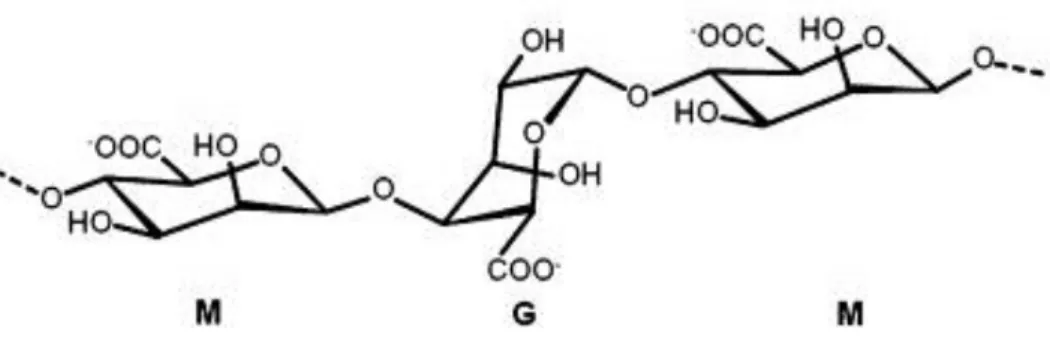
Alginate is a well-known polysaccharide that has been studied over the years [28, 39-42]. This natural anionic polymer exhibits some of the desirable properties for bone TE, including good biocompatibility, biodegradation, gel-forming capacity (through the addition of divalent cations, like Ca2+, Ba2+ and Sr2+) and low cost [43]. Alginate is obtained from brown sea weeds and is composed by 1,4-linked β-D-mannuronic acid (M) and α-L-guluronic acid (G) residues (figure 5), which allow the polymer to create stable hydrogels through ionic interactions between its functional groups [28].However, the properties of the alginate gels (stiffness, elasticity and stability) are highly sensitive to the species and concentrations of ions present in solution. When the content of the G residues is higher than the M residues, brittle gels are obtained [43, 44]. Furthermore, cells do not bind directly to the negatively charged polymer [41, 43].
Figure 5: Chemical structure of alginate and organization of the M and G blocks in its structure.
(adapted from [42]).
In order to produce more stable and consistent gels, and to improve cells adhesion to alginates, it has been ionically associated with cationic polymers, namely chitosan [41, 43, 45].
Chitosan is a natural polysaccharide composed by N- acetetylglucosamine and N-glucosamine groups randomly distributed through its biopolymer chain (figure 6) [46]. This polymer is produced through the deacetylation of marine chitin [47], being available with different degrees of deacetylation (percentage of free amine groups), viscosity and molecular weight [48]. Chitosan is only soluble in acidic solutions, due to the protonation of its amine groups [49]. Moreover, these positively charged groups interact with the negatively charged phospholipids of cells membranes, promoting cellular adhesion, proliferation and differentiation [50]. In addition, chitosan interaction with the electronegative residues present at the bacteria surface, leads to decrease of the bacterial cell wall permeability, and thus bacteria death [47, 49]. Furthermore, due to its biocompatibility and biodegradability
10 properties, low cost and availability, chitosan has attracted great attention in bone TE [46, 47, 49, 51-53].
Figure 6: Chemical structure of (A) chitosan and (B) protonated chitosan (adapted from [51]).
Different studies have reported the production of scaffolds containing both chitosan and alginate, for bone tissue engineering [39, 41, 43, 52-56]. However, these scaffolds do not present the desired mechanical properties for supporting load bearing applications [6, 29, 56]. The combination of polymers with ceramics can improve the mechanical properties of the scaffolds [41, 56-59].
Ceramics are known for having high compressive strength, good bioresorbability and biocompatibility [60]. The ceramics currently used for preparing scaffolds for bone regeneration are calcium phosphate (CaP) based bioceramics. Among these, hydroxyapatite (HA) and beta-tricalcium phosphate (β-TCP) are the most commonly used in clinical applications [61]. Since HA (figure 7) is the major component of bone, it is usually the first choice for scaffolds production [62]. There are several studies where this ceramic was combined with chitosan and alginate to produce bone scaffolds [41, 56, 57, 63]. However, this ceramic presents some disadvantages like high cost and low biodegradability [64]. Conversely, Β-TCP presents better biodegradability, osteocondutivity and osteoindutivity. Moreover, β-TCP is cheaper than HA [32, 63, 64] and has been used in several studies for bone regeneration [58, 63, 65-67]. However, β-TCP also presents some limitations like brittleness and poor resistance to fatigue [63].
11
Figure 7: Representation of the different HA (A) and β-TCP (B) compositions.
There are several studies revealing that the combination of both bioactive ceramics and natural polymers improves the mechanical and biological properties of the scaffolds [41, 56-59]. In fact, Qiao et al developed an injectable paste containing chitosan, alginate and calcium phosphate for bone regeneration [39], demonstrating that the combination of these components is very promising for bone TE applications.
1.4.2 Scaffolds properties
An ideal scaffold to be applied in bone TE has to meet certain parameters [8, 27, 29, 36, 38, 68-70] , such as:
Biocompatibility and biodegradability: The biocompatibility of a scaffold can be defined as
the ability to perform its function in the host tissue without eliciting any immune response [36, 38]. This is very important, because it allows the scaffold to serve as a permanent or temporary structure to support the formation of new tissue [36]. Biodegradability is defined as the tunable rate of degradation, matching the growth of new bone tissue, replacing the scaffold by new bone tissue. Such will allow the transference of the mechanical load to the new tissue [27, 36].
Porosity and pore size: Porosity is an essential property in a scaffold aimed for bone
regeneration. An interconnecting porous structure increases the surface area of the scaffold, allowing increased cell growth at the scaffold surface and within its structure [69]. It also maximizes cell-to-cell interactions inside the scaffold. In addition, pores also enable the diffusion of nutrients and gases to the entrapped cells [27]. According to Karageorgiou et al, the minimum pore size required for bone regeneration is 100 µm. However, the increase of the material’s porosity may lead to the reduction of the mechanical properties of the
12 scaffolds [69]. It is also important to consider the type of bone that the scaffold is aimed to replace, since the trabecular and cortical bones present different ranges of porosity [1].
Mechanical properties: The mechanical properties of human bones vary according to the type of bone (table 1). Cortical bone has a compressive strength of 100-230 MPa and trabecular bone has a compressive strength of 2-18 MPa. The young´s modulus of cortical and trabecular bones vary between 10000-25000 MPa and 60-3200 MPa, respectively [7]. Therefore, a scaffold for human bone regeneration must have suitable mechanical properties to support the mechanical loads on the damaged area, while maintaining the biological properties required for cell growth and new matrix formation [29].
Surface properties: The scaffolds surface properties include the hydrophobic/hydrophilic character, charge, roughness/softness and chemical composition of the materials. Such properties play an essential role on cellular adhesion, morphology, differentiation and proliferation [68].
1.4.3 Techniques for the production of scaffolds
The selection of the proper materials for the production of bone scaffolds is essential. However, the choice of the right manufacturing technique is also of great importance [70]. Since there are different production parameters (like pressure, temperature and time) influencing the properties of the scaffolds, the fabrication processes play an important role in the final characteristics of the biomaterials [31, 70]. Therefore, it is essential to understand and control the processes variations [32, 70]. Different production methods have been used through the years for the production of scaffolds for bone regeneration, including Foam Replication Method, Freeze-drying and Rapid Prototyping [12, 36, 41, 60, 63, 70-72].
In Foam Replication Method (FRM) a desired solution is impregnated in a polymeric template [63, 73-75]. The exposure to high temperatures, known as sintering, promotes the template melting and the fusion of the solution particles [63, 76-78], resulting in a final 3D scaffold with a structure similar to the initial template [64, 76, 77]. The strength of the construct is critically dependent on the ability to achieve a solid network with high density, thus depending on the particle packing of the infiltrated foam [75]. Previous studies reported the use of this technique in the production of scaffolds composed by glasses [73, 75] and ceramics [63, 74]. Torres et al describes this technique as a simple and cost-effective method that allows good reproducibility [63]. Furthermore, using a foam with an appropriate architecture, scaffolds with a microstructure similar to trabecular bone can be prepared by FRM [63, 75]. However, the scaffold final shape is restricted to the initial template structure [63], and sintering temperature must be optimized according to the desired materials [60]. For
13 instance, it is reported that the sintering temperature of scaffolds containing β-TCP has to be below 1200ºC, or else it will acquire its α-TCP form [60].
Another method usually applied in the production of bone scaffolds is Freeze-drying [26, 41, 72, 79]. This technique is based on the freezing of a desired solution, followed by a process of sublimation. This process allows the removal of solvents, under the action of vacuum, resulting in porous scaffolds [26, 80]. By varying the cooling rate, phase separation could result in different porosities of the scaffold [81]. Several studies using this technique have been reported for the production of chitosan [82, 83], chitosan/alginate [41, 84], and chitosan/alginate/HA scaffolds [41]. This production technique is known for being cheap and versatile [26, 72, 79]. Furthermore, it is possible to produce scaffolds with high porosity, which is crucial for bone TE applications. The disadvantages of this technique are associated with the Iack of control in the structure and shape of the final scaffold [8].
More recently, techniques based on rapid prototyping (RP) have been attracted a lot of attention [31, 38, 71, 80, 85]. In RP techniques, 3D models are designed by computer-aided design (CAD), and created through a layer by layer process until the desired 3D structure is completed [58, 86, 87]. This technique allows the production of different structures for several applications (bone, cartilage, heart valves, nerves) in TE, in short periods of time. Furthermore, it is reported that this technique promotes the desired level of complexity into the scaffold that cannot be achieved with the conventional techniques [35, 36, 71]. Fab@home 3D printing system is an example of RP that has the ability of producing structures composed by different materials like plastics and hydrogels. Previous studies using this technique, reported the production of alginate [88] and alginate/β-TCP scaffolds [58, 65] for bone TE. According to Diogo et al, RP is relatively simple and inexpensive technique. Furthermore, the Fab@home model has advantages over other equipments, since it allows the employment of different materials, such as composite or viscous solutions [89]. However, the production of scaffolds using this technique depends on the optimization of material viscosity and printing parameters [58].
One of the challenges in bone TE is to find a technique that allows the production of scaffolds with suitable characteristics for being applied in bone tissue regeneration [25, 80]. There are several reviews that report the production of bone scaffolds, using different materials, through distinct techniques [25, 27, 38, 80]. In fact, these reviews include the advantages and disadvantages of several techniques in the production of scaffolds for bone TE. Nevertheless, it is important to understand how the different production processes can influence the properties of the same scaffold and their impact in bone regeneration. Therefore, the main purpose of the present study was to produce a chitosan/alginate/β-TCP scaffold by FRM, freeze-drying, and RP techniques, and posteriorly perform a comparative study.
14
1.5 Aims
In the present study, the main goal was to study the influence of three different production techniques on the properties of a chitosan/alginate/β-TCP scaffold, in order to find the most suitable method to produce this 3D construct for bone regeneration. For that, the objectives of this work are:
Production of scaffold by Rapid Prototyping;
Production of scaffolds by Freeze-drying;
Production of scaffolds by Foam Replication Method;
Evaluation of the mechanical, physicochemical, and biological properties of the scaffolds.
Chapter II
16
2.1 Materials
Amphotericin B, bovine serum albumin (BSA), dulbecco’s modified eagle’s medium (DMEM-F12), ethanol (EtOH), ethylenediaminetetraacetic acid (EDTA), glutaraldehyde, high molecular weight chitosan (Mw= 310.000-375.000 g/mol), LB Broth, L-glutamine, paraformaldehyde (PFA), penicillin G, phosphate-buffered saline (PBS), sodium alginate (Mw= 120.000–190.000 g/mol), sodium tripolyphosphate (TPP), streptomycin, trypan blue, trypsin , and 7-hydroxy-3H-phenoxazin-3-one-10-oxide (resazurin) were bought from Sigma-Aldrich (Sintra, Portugal). β-TCP powder was aquired from Panreac® (Barcelona,Spain). Fetal bovine serum (FBS) was purchased from Biochrom AG (Berlin, Germany). Human osteoblast cells (CRL-11372) and Staphylococcus aureus (25923) were obtained from American Type Culture Collection (VA, USA). Propidium Iodide (PI) was purchased from Invitrogen (Carlsbad, USA). Acetic acid and sodium hydroxide (NaOH) were bought from Pronalab.
2.2 Methods
2.2.1 Production of the scaffolds
Initially, a solution of Alginate/Chitosan/β-TCP was optimized and finally prepared in a ratio 1/1/8 (% wt/wt/wt). Briefly, chitosan powder was dissolved at 2% (wt/v) in a 1% acetic acid solution and left overnight, under magnetic stirring. Then, alginate powder was added to the solution and left stirring for 5 hours. Finally, β-TCP powder was added and the final mixture was homogenized using a X10/25 ultraturrax (Ystral, Germany). After dissolution of all the components, the solution was processed with the different techniques.
2.2.1.1 Production of the scaffolds by the Foam Replication Method (FRM)
To prepare the scaffolds by FRM, polyurethane (PU) foam was cut into cubes (1 x 1 x 1 cm) to be used as sacrificial template [63]. These were then washed with ultrapure water, and left to dry at RT. Then, the previously prepared solution was impregnated in the PU foams. The wet samples were subsequently immersed in a 6% TPP (wt/v) solution, for 24 h, and dried at room temperature (RT). Finally, the samples were step-wise heated in a furnace at 1ºC/min to 1100ºC, and then kept at this temperature for 240 min [66].
17
2.2.1.2 Production of the scaffolds by the Freeze-Drying technique
The scaffolds were also prepared by freeze-drying [57, 90, 91]. Briefly, the previously produced solution was deposited into a 48-well polystyrene plate, frozen at -20ºC for 24 h, and then lyophilized for another 24 h. Thereafter, the lyophilized 3D structures were removed from the mold and cross-linked with a 6% TPP (wt/v) solution for 24 h. Finally, the scaffolds underwent another similar cycle of freezing and lyophilization.
2.2.1.3 Production of the scaffolds by Rapid Prototyping
To prepare the scaffolds by RP, the 3D structures were first designed in Solidworks® software (Dassault Systèmes, Massachusetts, USA). This software allows the creation of the 3D scaffold models with controllable structure. A Fab@home 3D printer was chosen to produce the scaffolds, as previously described by Diogo et al [58]. In order to print the scaffolds, the file was converted and stored in stereolithography (STL) format. A 10cc disposable syringe barrel was filled with the previously prepared solution, and the solution was extruded trough a 20G polypropylene tapered nozzle. Thereafter, the produced scaffolds were immersed in a 6 % TPP (wt/v) solution for 24 h. Subsequently, the scaffolds were frozen at -80ºC and lyophilized for 24 h, in order to allow their drying.
2.2.2 Morphological and physicochemical characterization of the scaffolds
2.2.2.1 Morphological analysis of the scaffolds
Scanning electronic microscopy (SEM) analysis was performed in order to assess the morphology and pore sizes of the different scaffolds. This analysis was performed by adapting the method reported by Valente et al [28]. The scaffolds were mounted on aluminum stubs using double-sided adhesive tape, and sputter coated with gold using a Q150R ES (United Kingdom) sputter coater. The materials were analyzed using a Hitachi S-3400N (Tokyo, Japan) scanning electron microscope operated at an acceleration voltage of 20 kV, at various magnifications.
2.2.2.2 Fourier Transform Infrared Spectroscopy analysis
Fourier-transform infrared (FTIR) spectroscopy was used to analyze the physicochemical characteristics of the scaffolds [38, 64]. Briefly, all samples were crushed, the resulting powders were mounted on a diamond window, and the spectra recorded on a Nicolet iS10 FTIR spectrophotometer (Thermo Scientific, USA). The individual powder components used in the production of the scaffolds were also analyzed [55]. FTIR spectra represent the average
18 of 250 scans, between 500 and 4000 cm-1, at a resolution of 4 cm-1. The acquired data was
then processed using Omnic Spectra analysis software.
2.2.2.3 X-Ray diffraction analysis
To evaluate the crystallinity and characteristic phases of the scaffolds, X-ray diffraction (XRD) measurements were performed with a X-ray diffractometer (Rigaku Americas Corporation, USA). XRD technique was used to assess the material composition and internal structure, and to confirm the presence of β-TCP in the scaffolds. Samples were mounted in silica supports and the data was recorded over a range of 5º to 90º 2θ degrees, with continuous scans at a rate of 1º/min with a copper ray tube operated at 30 kV and 20 m [58].
2.2.2.4 Energy dispersive spectroscopy
In order to assess the elemental composition of the scaffolds, Energy dispersive spectroscopy analysis (EDS) (Rontec) was also performed. Prior to data acquisition, the scaffolds were cut into slices, mounted in aluminum stub supports and air-dried at RT [58, 63].
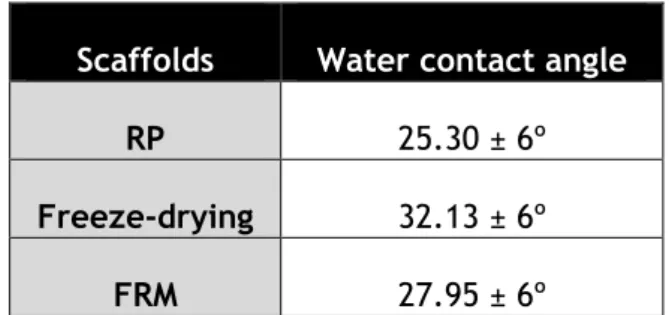
2.2.3 Water contact angle measurement
In order to analyze the scaffolds hydrophilicity, their water contact angle was measured. The assay was performed using a sessile drop method, adapted from Diogo et al, with water as reference fluid [58]. The contact angle data were acquired in a Data Physics Contact Angle System OCAH 200 apparatus, operating in static mode at RT. For each sample, water drops were placed at different locations of the analyzed scaffolds.
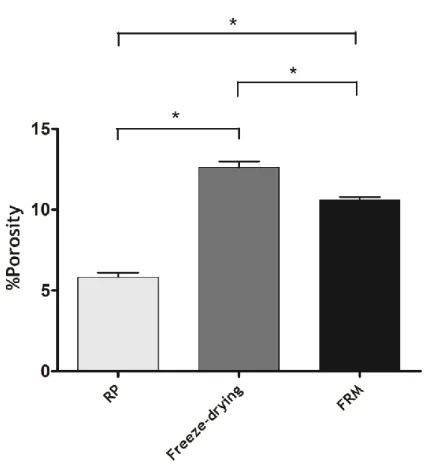
2.2.4 Total porosity evaluation
In order to assess the porosity (P) of the scaffolds, the method previously described by Nie et
al was adapted [92]. The porosity of each scaffold was determined through the total amount
of absolute ethanol (EtOH) that the scaffolds were able to absorb in 48 h, using equation 1 [93].
19
Where W1 the weight of the dry scaffold and W2 is weight of the wet scaffold, dethanol is the
density of the ethanol at RT and Vscaffold is the volume of the wet scaffold. For each scaffold,
three replicates were analyzed and data represent the average of each replicate.
2.2.5 Swelling capacity of the scaffolds
The swelling capacity of scaffolds (S) was determined by following a method adapted from Coimbra et al [94]. In brief, the different scaffolds were placed in falcons containing Tris buffer (pH=7.4), at 37ºC. At predetermined intervals, the swollen samples were removed from the solution, the excess of Tris was removed with filter paper and the samples were weighted. After, the scaffolds were re-immersed into the swelling medium. The scaffolds were measured in triplicate, and the swelling ratio was determined by using equation 2:
Where Ws is the final weight of scaffolds and Wd is the initial weight of scaffolds.
2.2.6 Degradation of scaffolds
Scaffolds degradation was also assessed by adapting a method described by Christopher et al. [95].Briefly, the scaffolds were weighted and placed in 6 well-plates, containing incomplete Dulbecco’s modified Eagle medium (DMEM-F12) at 37ºC, for 4 weeks. Once a week, they were removed from the medium, washed with ultrapure water, dried and weighted. Four replicates of each type of scaffold were analyzed. The scaffolds mass loss was determined through equation 3 [95]:
20
2.2.7 Mechanical characterization of the different scaffolds
In order to assess the mechanical behavior of the different scaffolds, their resistance to compression and Young´s Modulus were analyzed. The assays were performed by following a method adapted from Santos et al [64]. Briefly, the produced scaffolds were first cut into similar fragments and measured. Compression assays were then performed using a Zwick® 1435 Material prüfung (Ulm, Germany), with a crosshead speed of 0.2mm/min and a load cell of 5 kN. Six samples of each scaffold were tested.
The determination of the resistance to compression (Ts) of each scaffold was determined through equation 4[72]:
Where F is the load at the time of the fracture and a and l represent the width and length of the scaffold, respectively.
Young’s Modulus (YM) was obtained from the stress-strain relations calculated by applying the equation 5 [96]:
)
Where Hd is the scaffold height deformation and Ts is the scaffold tensile strength. Average
values and standard deviations (s.d.) were determined for each sample.
2.2.8 Biological characterization of the chitosan/alginate/β-TCP scaffolds
2.2.8.1 Characterization of the cytotoxic profile of the scaffolds
In order to study the biocompatibility of the scaffolds, human osteoblast cells (CRL-11372) (hOB) were used. First, hOB were cultured in DMEM-F12, containing 10% of heat inactivated fetal bovine serum (FBS), streptomycin (100 μg /mL) and gentamicin (100 μg /mL) antibiotics, in 75 cm2 T-flasks. Cultures were maintained in a humidified environment at 37ºC, with 5%
CO2, until confluence was attained. Then, cells were trypsinized with 0.18 % trypsin (1:250) and 5 mM EDTA, centrifuged at 260rpm for 5 min, and the resulting pellet was resuspended in 5 mL of medium. After that, cellular density (number of cells per mL) was determined by using the trypan blue method, according to equation 6:
21
Before being placed in contact with the cells, the scaffolds were cut into the desired size, and placed into 48-well plates. They were subsequently sterilized under ultraviolet (UV) light for 1 h [49]. The scaffolds were neutralized with NaOH 0.1M for 1 h, and thereafter washed with incomplete medium at 37 ºC, several times [97]. Finally, cells were seeded in contact with scaffolds at density of 10x103 cells per well, to evaluated cell viability and proliferation
at days 1, 4 and 7. The culture medium was changed every two days until day 7 [49, 58]. In order to evaluate the cytotoxicity of the scaffolds, after the determined incubation periods, resazurin assays were performed [98]. Briefly, the medium was removed from each well and replaced by a mixture of 10% (v/v) of resazurin and 90% (v/v) of medium, and the cells were incubated for 4 h, at 37ºC, under a 5% CO2 humidified atmosphere. The
fluorescence was measured using a plate reader spectrofluorometer (Spectramax Gemini XS, Molecular Devices LLC, USA) at an excitation/emission wavelength of 560/590 nm, respectively. EtOH treated cells were used as positive controls (K+) while cells without
samples were used as negative controls (K-).
2.2.8.2 Proliferation of the osteoblast cells in the presence of the scaffolds
After the sterilization and washing of the scaffolds, hOB were also seeded at a density of 10x103 cells per well, on the surface of the materials for 1, 4 and 7 days, as previously
described. Cell growth was monitored using an Olympus CX41 inverted light microscope (Tokyo, Japan) equipped with an Olympus SP-500 UZ digital camera [58].
Cellular attachment and morphology were also characterized by SEM analysis. After 1 and 7 days of seeding with hOB, the culture medium was removed and the samples were washed with PBS and fixed overnight with 2.5% glutaraldehyde (v/v) at 4°C. Samples were rinsed with PBS and dehydrated with graded EtOH solutions (70, 80, 90 and 100%). Posteriorly, the samples were frozen with liquid nitrogen and freeze-dried for 3 h. Then, they were mounted on aluminium stubs using double sided adhesive tape, and sputter-coated with gold using a Quorum Q150R ES sputter coater. Finally, SEM images were acquired with an acceleration voltage of 20 kV, at variable magnifications, using a Hitachi S-3400N scanning electron microscope [99].
22
2.2.8.3 Confocal Laser Scanning Microscopy
In order to analyse the cell distribution within the 3D scaffolds, Confocal Laser Scanning Microscopy (CLSM) analysis was performed by adapting a protocol described by Miguel et al [49]. In brief, 4 days after cell seeding, the culture medium was removed and the cells were washed with PBS at RT. The remaining cells were then fixed with 4% PFA for 15 min at RT, and then rinsed three times with PBS. Afterwards, the cell nucleus was labelled with propidium iodide (PI) (15 mM) during 15 min, followed by five additional washes with PBS. The cell-seeded scaffolds were then transferred into μ-Slide 8 well Ibidi® chamber coverslips and imaged in a Zeiss LSM710 confocal microscope (Carl Zeiss SMT Inc., USA) equipped with a Plan-Neofluar 10×/NA 0.3 and Plan-Apochromat 40×/1.4 Oil DIC objectives. All data was acquired in z-stack mode with a step of 4.67 μm. Z-stacks were then rendered into 3D images using Zeiss LSM 710 software. Depth code rendering of z-stacks were also performed using Zeiss software with the open GL and transparent rendering mode to provide visualization of cell spatial distribution within the scaffold architecture.
2.2.9 Evaluation of the antibacterial activity of the scaffolds
To evaluate the antimicrobial activity of the scaffolds, Staphyloccocus aureus was used as a model of Gram-positive bacteria. The bacterial growth in the presence of the scaffolds was assessed through a Kirby-Bauer disk diffusion method, as previously described by Kim et al [100]. The scaffolds were placed on the surface of a plate of LB agar, in contact with
Staphylococcus aureus at a concentration of 0.5x10⁸ CFU/ml. Then the petri plates were incubated for 24h at 37°C [100]. Finally, the antibacterial activity of the scaffolds was assessed through the observation of the inhibition hales around the samples.
2.2.10 Statistical Analysis
Statistical analysis of the obtained results was performed using one-way ANOVA with Dunnet´s post hoc test and Newman-Keuls test. A p value lower than 0.05 (p<0.05) was defined as statistically significant. The obtained results were expressed as the mean ± standard error of the mean of at least three independent experiments.
Chapter III
24
3.1 Macroscopic properties of the scaffolds
In this study, chitosan/alginate/β-TCP scaffolds were produced by three different production techniques (FRM, Freeze-drying and RP) and their properties were characterized. The comparison of the scaffolds properties allows the comprehension of how the different manufacturing processes can influence the suitability of these scaffolds for bone tissue regeneration [36, 70]. The chosen production techniques were selected since they are commonly used for the production of bone scaffolds. The polymeric materials used for the production of the scaffolds were chosen due to their ability to mimic the bone matrix. Chitosan and alginate are natural polymers that present biocompatibility, biodegradability and low toxicity properties. Moreover, chitosan has bactericidal activity [43, 51]. The bioactive ceramic β-TCP presents a similar composition to the inorganic components of the bone matrix, possessing osteoindutivity and osteocondutivity, biocompatibility and adequate biodegradability. Furthermore, this ceramic improves the mechanical resistance of the scaffolds, which is extremely important for bone TE applications [65, 101].
Figure 8 presents the macroscopic images of the produced scaffolds. The scaffolds produced by RP (figure 8 A) presented a more complex and controlled macroporous structure, that is important for the promotion of cell adhesion and capillary in-growth [69, 102]. The RP method allows the control of all the structural parameters, thus leading to a scaffold with the desired shape [103]. In opposition, the scaffolds produced by Freeze-drying (figure 8 B) and FRM (figure 8 C) presented structures limited by the templates used. For instance, the samples produced by Freeze-drying were limited to their cylindrical molds [57, 86] while the FRM samples were limited to the cubic template, which was sacrificed during sintering [63]. Another important property of the surface of scaffolds is roughness, since a rough surface increases the contact areas between the materials and the cells, allowing better cell attachment, proliferation and differentiation [13, 69].Moreover, it is described that OB are able to attach more rapidly and synthesize more extracellular matrix in the presence of rougher surfaces [22, 31].
The scaffolds produced by RP and Freeze-drying showed smoother and soft surfaces, while scaffolds produced by FRM presented more rough surfaces (Figure 8 C, C1).
25
Figure 8: Macroscopic images of the final scaffolds produced by RP (A), freeze-drying (B), and RP(C).
SEM images were also acquired in order to characterize the internal structure and pore sizes of the scaffolds (figure 9). It has been previously reported that porous structures with pore sizes above 100 µm allow cell penetration and proliferation inside the scaffolds, as well as the exchange of gases and nutrients [28, 29, 69].
Through the analysis of the SEM images (figure 9), it is clear that each scaffold presents a different internal structure and pore size. The RP samples (figure 9 A and B) showed a highly porous and interconnected structure, with pore sizes around 150 µm, a suitable size for bone regeneration [69].Such porosity might be attributed to the liophilization process used in the production of this scaffold [37]. The images of the Freeze-drying samples (figure 9 C and D) showed that these scaffolds had a porous structure, presenting pore sizes around 220 µm. These characteristics provide a suitable environment for cell growth and proliferation [69]. It is important to notice that these scaffolds presented larger pores than the RP samples. As proposed by Kang et al, the different freezing temperatures (-20ºC and -80ºC) that these scaffolds were exposed, lead to different pore sizes within the scaffolds structure. In brief, the Freeze-drying samples were frozen at -20ºC leading to a slower freezing and higher crystals formation. On the other hand, RP scaffolds were frozen at -80ºC leading to faster freezing and smaller crystals. Consequently, after the liophilization step, the respective crystals in the scaffolds structure were removed, creating different pore sizes [91].
The FRM samples (figure 9 E and F) also revealed a highly porous structure with large pores, similar to those of the Freeze-drying samples. These results can be attributed to the sintering process that led to the loss of the mold and polymers in the sample [104, 105], remaining just the ceramic. Such loss can negatively influence the scaffold role in bone regeneration, since
26 the polymers would provide additional desirable properties to the biomaterial, such as antibacterial activity and swelling capacity. Tampieri et al described the use of this technique for the production of similar porous structures, with pore sizes between 200 and 500 µm [76], which are comparable to those obtained here.
Figure 9: SEM images of the internal porosity of the scaffolds produced by RP (A, B), Freeze-drying (C,
27
3.2 Physicochemical characterization of the scaffolds
3.2.1 Fourier Transform Infrared Spectroscopy
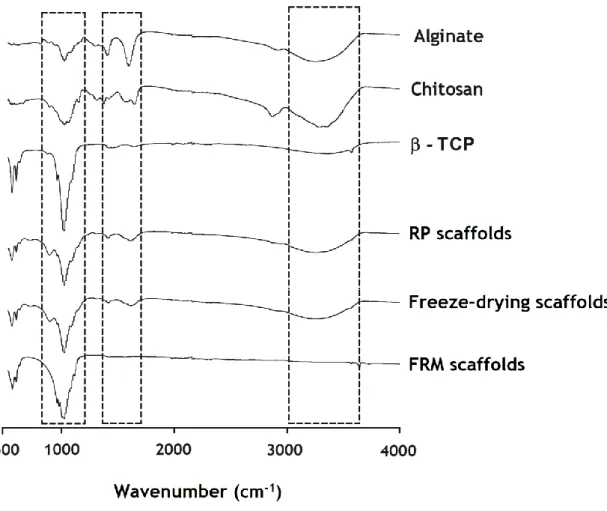
FTIR analysis of the biomaterials was performed, including comparison of each scaffold spectrum with the raw powders spectra (figure 10), since it is important to evaluate if the different techniques used for scaffolds production have any influence on their composition.
Figure 10: FTIR analysis of the 3D scaffolds produced by the three different technics and comparing
with the powders.
The FTIR spectra of alginate, chitosan and β-TCP were obtained from the respective powders. Through the analysis of these spectra (figure 10), it is possible to observe that alginate presented bands at 1421 cm-1, 1620 cm-1 and 3429 cm-1, corresponding to the COOH stretch
and C=O stretch of the alginate carboxylic groups, and to a O-H stretch vibration, respectively [41]. Chitosan spectrum showed peaks at 1157 cm-1, 1422 cm-1 and 1620 cm-1 that were
assigned to the N-H stretch of the amine, C=O stretch and N-H stretch of the amide, respectively [55]. Moreover, the large band between 3000 cm-1 and 3500 cm-1, present in the
28 polymers, belonged to the O-H stretch of water [41, 55]. β-TCP spectrum revealed a major band at 1020 cm-1 that was assigned to the P-O stretching [58, 67].
The spectra of the scaffolds produced by RP and Freeze-Drying, showed the characteristic peaks of chitosan, alginate and β-TCP powders, suggesting that these components were present in the scaffolds and that the composition of the scaffolds was not altered when different techniques were used for scaffolds production. However, the spectrum of the scaffolds produced by FRM revealed only the characteristic peak of β-TCP, suggesting that the scaffolds lost its polymeric content. This can be explained by the fact that the exposition of the scaffolds to a sintering temperature of 1100ºC led to a removal of chitosan and alginate contents [105-107]. In fact, for temperatures higher than 800ºC, the polysaccharides are desintegrated, resulting in a scaffold composed only by the ceramic [104-107].
3.2.2 X-Ray diffraction analysis (XRD)
In order to confirm the presence of crystalline phases of β-TCP in the scaffolds, XRD analysis was also performed. Figure 11 shows that the commercial β-TCP powder presented two intense peaks located at 2θ=25º-35º. Such peaks were also observed in all the manufactured scaffolds. The absence of anomalous crystalline phases suggested that the ceramic component of the scaffolds preserved its crystalline structure [58]. Furthermore, the intensified peaks present in the scaffold produced by FRM can be explained by the sintering process that only left β-TCP in the samples [60, 100]. In addition, Sanosh et al reported that when the sintering temperature increase, the β-TCP peaks of the sample become sharper, representing a better crystallinity [78]. Furthermore, it is reported that β-TCP is stable below 1180ºC and when the sintering temperature reaches 1200ºC β-TCP acquires its α-TCP conformation [60]. Nevertheless, the sintering of β-TCP at 1100ºC does not affect its beta conformation, as previously demonstrated by Chen et al [66].
29
Figure 11: X-Ray spectra of β-TCP and 3D scaffolds. Peaks inside the rectangle represent the
characteristic peaks of the ceramic present in the scaffolds.
3.2.3 Energy Dispersive Spectroscopy (EDS)
An EDS analysis was also performed to evaluate the elemental composition of the scaffolds (table 2). The carbon (C) content of the scaffolds is provided by the polymers in the samples. The results showed that the amount of C was higher in the scaffolds produced by RP and Freeze-drying, when compared to the ones produced by FRM. This result is in accordance with the FTIR results, since the polymers disintegrated during sintering [104, 105]. In addition, the calcium (Ca) and phosphate (P) content were similar between the samples, demonstrating that the ceramic component (figure 8) was not affected, as observed in the FTIR and XRD results. Sodium (Na) and oxygen (O) percentages were also similar between the scaffolds, showing that no additional changes occurred in the scaffolds.
![Figure 1: Different types of bones found in the human body (a). Distribution of cancellous and compact bone tissue on flat bones (b) (adapted from [1])](https://thumb-eu.123doks.com/thumbv2/123dok_br/18679592.914391/19.892.258.682.698.1089/figure-different-types-distribution-cancellous-compact-tissue-adapted.webp)
![Figure 2: Representation of the composition of the bone matrix at different scales, from macro to nano perspective (adapted from [6])](https://thumb-eu.123doks.com/thumbv2/123dok_br/18679592.914391/20.892.308.624.438.857/figure-representation-composition-matrix-different-scales-perspective-adapted.webp)
![Figure 3: Representation of the main phases of bone remodeling (adapted from [9]).](https://thumb-eu.123doks.com/thumbv2/123dok_br/18679592.914391/22.892.187.736.309.696/figure-representation-main-phases-bone-remodeling-adapted.webp)
![Figure 4: Schematic representation of the role of a scaffold in bone regeneration (adapted from [30])](https://thumb-eu.123doks.com/thumbv2/123dok_br/18679592.914391/25.892.158.775.246.595/figure-schematic-representation-role-scaffold-bone-regeneration-adapted.webp)
![Figure 6: Chemical structure of (A) chitosan and (B) protonated chitosan (adapted from [51])](https://thumb-eu.123doks.com/thumbv2/123dok_br/18679592.914391/27.892.280.629.197.502/figure-chemical-structure-chitosan-b-protonated-chitosan-adapted.webp)