Department of Information Science and Technology
Evil-Twin Framework
-A Wi-Fi intrusion testing framework
for pentesters
André Esser
A Dissertation presented in partial fulfillment of the Requirements
for the Degree of
Master in Telecommunications and Computer Engineering
Supervisor
Prof. Dr. Carlos Serrão, Assistant Professor
ISCTE-IUL
Actualmente existem inúmeros pontos de acesso Wi-Fi. Apesar dos utilizadores serem sempre recomendados a utilizar redes protegidas, esta não é a única preocu-pação que devem ter. A conveniência de nos ligarmos facilmente a um ponto de acesso deixou grandes falhas de segurança em aberto para atacantes explorarem. Isto acentua a preocupação em relação à carência de segurança do lado cliente em tecnologias Wi-Fi. A segurança nas comunicações Wi-Fi foi uma preocupação desde os dias em que esta tecnologia foi primeiramente lançada. Por um lado, protocolos como o WPA2 aumentaram consideravelmente a segurança das comu-nicações Wi-Fi entre os pontos de acesso e os seus clientes, mas como saber, em primeiro lugar, se o ponto de acesso é legítimo? Hoje em dia, com a ajuda de software de código aberto e a imensa quantidade de informação gratuita, é fácil para um atacante criar uma rede Wi-Fi falsa com o objetivo de atrair clientes. O risco desta vulnerabilidade torna-se óbvio ao estudar o comportamento do lado do cliente Wi-Fi. O cliente procura activamente redes conhecidas de forma a ligar-se automaticamente a estas. Em muitos casos os clientes ligam-se sem interação do utilizador mesmo em situações em que a legitimidade do ponto de acesso não é verificável. Ataques ao lado cliente das tecnologias Wi-Fi já foram descobertos há mais de uma década, porém continuam a não existirem formas eficazes de proteger os clientes deste tipo de ataques.
Com base nos problemas apresentados existe uma necessidade clara de proteger o lado cliente das comunicações Wi-Fi e ao mesmo tempo sensibilizar e educar os utilizadores de tecnologias Wi-Fi dos perigos que advêm da utilização destas tecnologias. A contribuição mais relevante deste projeto será a publicação de uma ferramenta para análise de vulnerabilidades e ataques em comunicações Wi-Fi. A ferramenta irá focar-se em ataques ao cliente mas permitirá extensibilidade de funcionalidades de forma a possibilitar a implementação de qualquer tipo de ataques sobre Wi-Fi. A ferramenta deverá ser utilizada por auditores de segurança durante testes de intrusão Wi-Fi. Tem também como objetivo ser uma ferramenta educacional e de prova de conceitos de forma a sensibilizar os utilizadores das tecnologias Wi-Fi em relação aos riscos e falhas de segurança destas.
Palavras-chave: Wi-Fi, segurança, cliente, ponto de acesso malicioso, hack-ing, auditoria de segurança, framework
In today’s world there is no scarcity of Wi-Fi hotspots. Although users are always recommended to join protected networks to ensure they are secure, this is by far not their only concern. The convenience of easily connecting to a Wi-Fi hotspot has left security holes wide open for attackers to abuse. This stresses the concern about the lack of security on the client side of Wi-Fi capable technologies. The Wi-Fi communications security has been a concern since it was first de-ployed. On one hand protocols like WPA2 have greatly increased the security of the communications between clients and access points, but how can one know if the access point is legitimate in the first place?
Nowadays, with the help of open-source software and the great amount of free information it is easily possible for a malicious actor to create a Wi-Fi network with the purpose of attracting Wi-Fi users and tricking them into connecting to a illegitimate Wi-Fi access point. The risk of this vulnerability becomes clear when studying client side behaviour in Wi-Fi communications where these actively seek out to access points in order to connect to them automatically. In many situations they do this even if there is no way of verifying the legitimacy of the access point they are connecting to.
Attacks on the Wi-Fi client side have been known for over a decade but there still aren’t any effective ways to properly protect users from falling victims to these. Based on the presented issues there is a clear need in both, securing the Wi-Fi client side communications as well as raising awareness of the Wi-Fi technologies everyday users about the risks they are constantly facing when using them.
The main contribution from this project will be a Wi-Fi vulnerability analysis and exploitation framework. The framework will focus on client-side vulnerabilities but also on extensibility for any type of Wi-Fi attack. The tool is intended to be used by auditors (penetration testers - pentesters) when performing intrusion tests on Wi-Fi networks. It also serves as a proof-of-concept tool meant to teach and raise awareness about the risks involved when using Wi-Fi technologies.
Keywords: Wi-Fi, security, client, evil access point, hacking, pentesting, framework.
I would like to thank my supervisor Dr. Carlos Serrão for correcting and reviewing my work and also for his guidance throughout this thesis. I would also like to acknowledge all teachers and colleagues who I have learned and shared thoughts with. Additionally I want to sincerely thank the open-source community as I have learned so much by reading awesome code from great projects.
Last but not least I would like to sincerely thank Ana Febrer Caetano for her amazing work and the countless hours spent designing and creating the diagrams, lists and tables found throughout this thesis.
Resumo v
Abstract vii
Acknowledgements ix
List of Figures xiii
Abbreviations xv
1 Introduction 1
1.1 Subject and Motivation . . . 1
1.2 Problem Description . . . 3 1.3 Research Questions . . . 5 1.4 Objectives . . . 5 1.5 Contribution . . . 6 1.6 Thesis Overview . . . 7 1.7 Research Methodology . . . 8
2 State of the Art 11 2.1 Summary of the Evolution of Wi-Fi Security . . . 12
2.2 Wi-Fi Communications and Security . . . 14
2.2.1 Wi-Fi Client Behavior . . . 15
2.2.2 Wi-Fi Networks and Communication . . . 16
2.2.2.1 Open Networks . . . 17
2.2.2.2 WEP Protected Networks . . . 18
2.2.2.3 WPA-PSK Protected Networks . . . 19
2.2.2.4 WPA-Enterprise Protected Network . . . 21
2.2.3 Vulnerabilities and Attacks on Wi-Fi Communications . . . 24
2.2.3.1 Wi-Fi Client Behavior . . . 24
2.2.3.2 Open Networks . . . 26
2.2.3.3 WEP Protected Networks . . . 27
2.2.3.4 WPA-PSK Protected Networks . . . 28
2.2.3.5 WPA-Enterprise Protected Network . . . 32
2.3 Vulnerabilities and possible Exploitation Summary . . . 35
2.5 Tools of the Wi-Fi Hacking Trade . . . 41
2.6 Conclusions . . . 43
3 Proposed Solution and Implementation 45 3.1 Review of needed features . . . 45
3.2 Choosing of Technologies and Justification . . . 47
3.3 Architecture and Design . . . 49
3.4 Technical and Detailed Description of the Evil-Twin Framework . . 52
3.4.1 The "ConfigurationManager" Module . . . 52
3.4.2 The "SessionManager" Module . . . 55
3.4.3 The User Interface . . . 56
3.4.4 The "AirCommunicator" Module . . . 62
3.4.5 The "SpawnManager" Module . . . 75
3.4.6 The "ETFITM" Module . . . 76
3.4.7 Extensibility of the Evil-Twin Framework . . . 79
3.5 Additional Features . . . 93
4 Testing and Validation 95 4.1 List of implemented features . . . 96
4.2 Feature coverage comparison between the State of the Art tools and the Evil Twin Framework . . . 98
4.3 Features and Attack validation in a test environment . . . 100
4.3.1 Test 1: Capturing a WPA 4-way handshake after a de-authentication attack . . . 100
4.3.2 Test 2: Launching an ARP replay attack and cracking a WEP network . . . 104
4.3.3 Test 3: Launching a catch-all honeypot . . . 107
4.3.4 Test 4: Capture 10,000 packets with caffe-latte attack . . . . 110
5 Conclusion 115 5.1 Result Summary . . . 115
5.2 Conclusions . . . 116
5.3 Future Work . . . 118
2.1 Security Protocol Description . . . 12
2.2 Authentication Protocol Description . . . 14
2.3 Discovery and Authentication . . . 16
2.4 Authentication on Open Network . . . 17
2.5 Authentication on WEP Network . . . 18
2.6 Authentication on WPA Network . . . 20
2.7 Basic Authentication on WPA-EAP Network . . . 22
2.8 Certificate Authentication on WPA-EAP Network . . . 23
2.9 Catch-all Evil-Twin attack . . . 25
2.10 PMK Formula . . . 29
2.11 Wi-Fi Vulnerabilities Description . . . 36
2.12 Wi-Fi Vulnerabilities Mapped to Network Security Type . . . 37
3.1 Software Architecture . . . 50
3.2 "ConfigurationManager" Class Screenshot . . . 53
3.3 Excerpts from the configuration file . . . 54
3.4 The "SessionManager" Class . . . 55
3.5 ETFConsole Auto-Complete . . . 58
3.6 ETFConsole Navigation . . . 58
3.7 ETFConsole start and stop . . . 58
3.8 ETFConsole display . . . 59
3.9 ETFConsole display where . . . 60
3.10 ETFConsole display only . . . 60
3.11 ETFConsole copy . . . 60
3.12 ETFConsole crack . . . 61
3.13 ETFConsole spawn . . . 61
3.14 ETFConsole session loading . . . 62
3.15 ETFConsole shell . . . 62
3.16 The "start_sniffer" method of the "AirCommunicator" . . . 63
3.17 Class Diagram of the AirHost . . . 65
3.18 The "start_access_point" method of the "APLauncher" . . . 66
3.19 The "start_access_point" method of the AirHost module . . . 67
3.20 The "start_sniffer" method of the AirScanner module . . . 68
3.21 The "handle_packets" method of the AirScanner module . . . 69
3.23 Class Diagram of the AirScanner . . . 70
3.24 The "interpret_targets" method of the "Deauthenticator" plugin . 71 3.25 The "injection_attack" method of the AirInjector module . . . 72
3.26 The "injection_thread_pool_start" method of the AirInjector mod-ule . . . 73
3.27 Class Diagram of the AirInjector . . . 74
3.28 The "add_spawner" and "restore_spawner" method of the "Ses-sionManager" module . . . 76
3.29 The "start" and "stop" method of the "ETFITM" module . . . 77
3.30 Method hooks of the "MasterHandler" . . . 78
3.31 The constructor of the "Plugin" class . . . 80
3.32 The "add_plugins" method of the "AirCommunicator" module . . 81
3.33 The "CredentialSniffer" class . . . 81
3.34 Class Diagram of the "AirCommunicator" Plugins . . . 82
3.35 The "AirScannerPlugin" class . . . 83
3.36 The "handle_packet" method from the "PacketLogger" plugin . . . 84
3.37 The "AirHostPlugin" class . . . 85
3.38 The "pre_start" method from the "Karma" plugin . . . 86
3.39 The "AirInjectorPlugin" class . . . 87
3.40 The "inject_packets" method from the "Deauthenticator" plugin . 88 3.41 The "MITMPlugin" base class . . . 89
3.42 The "BeEFInjector" plugin . . . 90
3.43 The "SSLStrip" spawner configuration . . . 90
3.44 The "Spawner" base class . . . 91
3.45 The "SSLStrip" spawner class . . . 92
3.46 The "DNSSpoofer" configuration . . . 92
4.1 ETF Implemented Features . . . 96
4.2 ETF Implemented Features Description . . . 97
4.3 Feature Coverage Comparison 1 . . . 98
4.4 Feature Coverage Comparison 2 . . . 99
4.5 Test 1 . . . 101 4.6 Results of Test 1 . . . 103 4.7 Test 2 . . . 104 4.8 Results of Test 2 . . . 106 4.9 Test 3 . . . 108 4.10 Results of Test 3 . . . 110 4.11 Test 4 . . . 111 4.12 Results of Test 4 . . . 113
Wi-Fi Wireless Fidelity
WEP Wired Equivalent Privacy WPA Wireless Protected Access WPS Wireless Protected Setup
EAP Extensible Authentication Protocol PSK Pre Shared Key
PTK Pairwise Transient Key PMK Pairwise Master Key GTK Global Transient Key MIC Message Integrity Check SSL Secure Socket Layer TLS Transport Layer Security
MD5 Message Digest 5 Hashing Algorithm AP Access Point
IV Initialization Vector
PRNG Pseudo Random Number Generator MITM Man In The Middle
GUI Graphical User Interface
API Application Programming Interface HTTP(S) Hiper Text Transfer Protocol (Secure) ETF Evil- Twin Framework
Pentester Penetration Tester, a professional security auditor OSI Open System Interconnection
BSSID Basic Service Set Identifier IP Internet Protocol
DHCP Dynamic Host Configuration Protocol DNS Domain Name Server
Introduction
1.1
Subject and Motivation
The use of Wi-Fi technologies has become common practice in today’s world. Anybody with a laptop or a smartphone will most likely use Wi-Fi on a daily basis. To cope with such high demand for Wi-Fi connected Internet access many small businesses, such as shops and restaurants, tend to offer free Wi-Fi to their users. It is not uncommon to walk along a busy street and detect dozens of access points. Even if the offered connection uses encryption, users may still connect to an unprotected access point when they want to avoid authentication.
This significant increase in Wi-Fi hotspots and their users has left many secu-rity flaws to be exploited by malicious attackers. Attackers focus is on the users of Wi-Fi technologies as it is on their side where the most easily exploitable vul-nerabilities lie and can be exploited [14, 39]. These vulvul-nerabilities become more highlighted when studying client behaviour of Wi-Fi devices. Most devices that employ a Wi-Fi client will actively look towards connecting to an access point that they have previously connected before. This process alone is already a security flaw in which the device discloses a lot of information about networks it previously connected to, which can result in a lack of privacy as one can find out where the person has been. Furthermore if an access point’s name and security configuration
match the ones saved on the client device it will try to automatically connect to it without user interaction, making it possible to be unknowingly connected to a malicious access point. Following this logic, an attacker could set up a rogue access point that mimics a real one in a way that it cannot be identified as such by the client device. The client device will then establish a connection to this malicious access point sending all its Internet traffic through it. The attacker can then sniff, store and manipulate the information coming from and going to the client device. The attacks mentioned above have been discovered over a decade ago, but little has been done to mitigate these problems. None of the various proposed mitigation techniques [28, 5, 19, 34, 21, 22, 3, 16] have a 100% success rate and none of them have been implemented in commercial products. This still leaves Wi-Fi users at a high risk of falling victim to one of these attacks.
The main motivation for this thesis is to raise awareness about Wi-Fi client-side technology vulnerabilities while at the same time providing professional se-curity auditors with the tools and necessary information to identify and showcase them. This was accomplished through the development of a complete security framework capable of detecting and exploiting the client-side vulnerabilities men-tioned above, as well as other Wi-Fi related security problems. The developed framework is intended to be used by professional security auditors (otherwise also known as penetration testers, or pentesters for short) during their security audits. Although there are already several open-source Wi-Fi security penetration testing tools, these tend to focus on cracking Wi-Fi networks and neglect the client-side vulnerabilities. Furthermore they usually require complex configurations as well as having multiple terminal windows open, this contributes to unnecessary com-plexity which slows down the pentester productivity. The work developed in this thesis, resulted in the development of a framework, known as Evil-Twin Framework (ETF), that tries to mitigate these issues by integrating different but interdepen-dent features needed for Wi-Fi penetration testing by connecting them all inside a single integrated framework.
1.2
Problem Description
Even though security being a critical concern in Wi-Fi technologies since the days it was first deployed it still has high risk and a large number of security flaws not addressed that should be taken into consideration [35, 17].
Firstly it is relevant to mention encryption. The addition of cryptography in Wi-Fi communications has greatly increased the security of the communications between the access point and a client device [17, 8, 25]. On the other hand only the communication between the client and the access point is encrypted, while the communication to the rest of the Internet might not be. This leads to a false sense of security since most people tend to think all of their communications are secure when connected to an access point that uses WPA2. Furthermore, the used encryption system in use may be broken to begin with and therefore be as good as non-existent. This is true considering WEP protected networks. WEP is the predecessor of WPA which was created out of necessity of fixing the major security flaws that plagued WEP [35, 2, 8, 30]. Another concern is the widespread deployment of Wi-Fi access points. This problem ranges from busy streets where every shop offers a Wi-Fi connection, schools and colleges using international networks (such as "eduroam" [12]), even to nationwide projects that try to offer free Internet connection to all their users (such as Fonera - Fon). It poses a problem because every single one of these networks’ access points can be spoofed and consequently trick a user into connecting to them.
One more issue worth mentioning is the lack of awareness when it comes to Wi-Fi security, this is the reason most users will fall victim to hacking attacks in the first place. The combination of lack of security related knowledge and awareness and the convenience of connecting to free Internet makes Wi-Fi a very appealing attack platform for hackers.
The problems mentioned above focus on the security of Wi-Fi and its clients. Another problem that the Evil-Twin Framework will address is the actual showcas-ing and exploitation of these vulnerabilities. Currently, organizations in order to
be prepared to deal with the security potential threats conduct technical security audits. These audits, both internal or external, are carried in a controlled manner, by information security experts, to try to identify the major security flaws that affect organization – this is usually conducted at different levels, such as the net-work and system level. The role of the auditor, also known as penetration tester, is to discover the flaws, know how it can be exploited (and sometimes even exploit it) and document its findings and recommendations.
The phases involved in a Wi-Fi penetration test that are described here fol-low the PTES (Penetration Test Execution Standard) [26]. The phases include pre-engagement interactions, intelligence gathering and threat modeling as well as vulnerability analysis, exploitation and post-exploitation and finally reporting [11, 26]. The scope of the penetration test is discussed and agreed upon during the pre-engagement interactions. The intelligence gathering, threat modeling and vulnerability analysis are known as the Wi-Fi reconnaissance phase. During this phase, auditors usually enumerate access points and their security configurations as well as Wi-Fi clients. The attack phase englobes the exploitation and post-exploitation phases. During the post-exploitation phase, auditors will perform attacks on the Wi-Fi network according to the previously found vulnerabilities, this may include attacks on Wi-Fi clients as well. The post-exploitation mostly refers to attacks done inside the network once access is granted and also exploits on Wi-Fi client devices up to a persistent infection. Exploitation and post-exploitation rules are agreed upon during the pre-engagement interactions as well. The last phase is reporting the findings and risk remediation recommendations back to the entity being tested.
Conducting an audit or penetration test on a Wi-Fi network can be a cum-bersome job for the auditor. It requires the usage of a multiplicity of different tools with different purposes to test for the existence of serious vulnerabilities. This requires time and skills that can increase the duration of the audit and in-crease its costs. Most Wi-Fi hacking tools require complex and time-consuming configurations. Furthermore each tool tends to contribute with a single feature of
results in having multiple programs (with multiple windows) concurrently open, increasing the needed resources, knowledge to work with all the different programs and time consumption. Even if the attack environment is already set up by the pentester it will still be time consuming to manually pass information between programs when needed. The need to run multiple tools that only serve a single purpose concurrently, unnecessarily increases the complexity of the penetration test and consequently decreases its efficiency.
The Evil-Twin Framework (the tool developed as contribution of this disser-tation) will tackle these limitations by providing a complete Wi-Fi penetration testing platform/framework.
1.3
Research Questions
The research questions were identified by the author while studying the topic of Wi-Fi security. These are the questions that this thesis will try to answer:
- What Wi-Fi vulnerabilities can still be exploited? - How vulnerable are client devices to attacks over Fi? - Is there a better way of performing Wi-Fi penetration tests? - Is it possible to develop a better tool to conduct Wi-Wi-Fi penetration tests?
1.4
Objectives
The goals of this thesis is to mitigate the problems described in the previous section. The way this was accomplished was by developing a very complete Wi-Fi intrusion testing framework which has to take the mentioned problems into consideration.
The major objective of this work is the research and development of a frame-work that can be used to create Wi-Fi client security awareness, through the
demonstration of the potential attacks that can be conducted to exploit the end-user devices, and also to offer a simpler and streamlined process for security au-ditors (pentesters) to improve their productivity while conducting Wi-Fi security assessments.
Another objective of the work was to research and implement ways to extend the developed framework. This way, the developed framework as an open-source project to enables its extension through the addition of new attacks and new tools.
1.5
Contribution
The contribution of this thesis project is directly related to its objectives.
First, by providing a detailed and organized list of possible Wi-Fi vulnerabili-ties, depending on the network encryption and authentication type, this work will give a complete cover of what to look out for, either when doing a Wi-Fi pentest or while setting up a wireless network. This thesis will also focus on the client side of Wi-Fi security to stress, not only to the common Wi-Fi user but also the security community, that this side still has a lot of security flaws which can easily be exploited with the necessary know-how.
In addition to the detailed set of vulnerabilities, the tool itself. The Evil-Twin Framework will be able to showcase some exploits for which there is no tool yet, thereby making it an unique contribution. Furthermore it will serve as a one stop shop for all other Wi-Fi penetration testing needs, eliminating the need for complex configurations and usage of multiple programs. Additionally, these same features will also enable interoperability between basic Wi-Fi components, ease of use and most importantly extensibility and code reuse for future development of new features.
Since the framework will be designed in a way that allows easy contribution and extensibility, it will serve as a platform for developing new zero-day exploits that the security community may discover in the future. This contribution is not
only important for the security community but also for the open-source commu-nity since the framework will have fully documented code to teach about wireless security as well as Wi-Fi related programming.
1.6
Thesis Overview
In addition to this introductory chapter the current thesis is composed by 4 addi-tional chapters which will be described briefly here.
Chapter 2 is where the state of the art of Wi-Fi networking security will be presented. Since this thesis is about the development of a Wi-Fi pentesting frame-work this chapter will focus on three main aspects. The first is meant to familiarize the reader with the current state of Wi-Fi communications. It starts off with a description of what Wi-Fi client behaviour looks like and how it interacts with the various types of networks. Later it will relate the previous communication scenario descriptions to known Wi-Fi vulnerabilities and exploitation possibilities. After the detailed explanation of Wi-Fi vulnerabilities and attacks follows a brief and concise summary of the same before going into the second part which aims to explain how intrusion tests on Wi-Fi environments are conducted. This second part will identify the phases of such an intrusion test, what tools are usually used in each phase and the current limitations that pentesters face when conducting their them. The third part is where the state of the art Wi-Fi hacking tools will be presented. As mentioned in the introduction, these tend to focus on one specific feature of Wi-Fi hacking and can therefore be directly related to the vulnerabil-ities presented in the previous chapter. Following the introduction of the tools is a description of how each of them exploits the vulnerabilities that they were designed for.
Following the state of the art comes the actual solution proposal description and its development plan. Chapter 3 starts with a review of the needed features according to the objectives described in in the ’Objectives’ section but also taking
the state of the art tools into consideration. After describing the needed compo-nents comes the need to choose the technologies to be used in order to implement the desired features. So what follows is a list of the technologies with proper jus-tification of why they were chosen instead of others. Chapter 3 ends with UML diagrams describing the architecture and design of the proposed solution.
In Chapter 4 the focus is on validating the Evil-Twin Framework and its fea-tures. It starts by enumerating the implemented features up until the time of the conclusion of this thesis. It goes on by first comparing feature coverage and then performance with the tools mentioned in the state of the art. This will be done in a test environment by setting up a set of realistic attack scenarios. The evaluation criteria will be explained for each test and tends to be as objective as possible. Finally the tool will also be tested by security auditors for a professional review and validation of the framework and its features.
Chapter 5 is the final chapter of this thesis. Here is where the evaluation results are presented. It will also feature a conclusion about the current state of Wi-Fi security and pentesting. It ends with a sub-chapter about the future work related not only to the development of the framework but also Wi-Fi security in general.
1.7
Research Methodology
The chosen research methodology is Design Science Research. It was chosen as it was the most suitable for the resolution of the proposed problem. This is because it uses information technology artifacts to solve a real world problem. The following research questions have been used as guidance throughout this thesis:
- Question 1 - What is the focus of this research?
The focus of this research is the development of an integrated and extensible Wi-Fi vulnerability detection and exploitation framework to be used by profes-sional security auditors. The developed solution is meant to increase the efficiency
of the pentester by providing a flexible tool that covers a large scope of function-ality.
- Question 2 - What is the produced artifact and how is it represented? The produced artifact is the developed Wi-Fi vulnerability detection and ex-ploitation framework called "Evil-Twin Framework". The framework is meant to substitute previous tools with similar functionality by providing a tool with integrated intercommunication between parts of the program.
- Question 3 - What design methods are going to be used for the creation of the artifact?
The development of the tool focuses on using the Object Oriented Program-ming paradigm as it increases the artifacts organization and eases its extensibil-ity. Furthermore, programming design patterns were used whenever the developer found it was adequate.
- Question 4 - How is the design method and the artifact supported by the knowledge base?
The knowledge base will be the tests conducted by with the developed frame-work in comparison to other tools of the state-of-the-art.
- Question 5 - What evaluations are performed during the internal development cycle? What design improvements are identified during each cycle?
The internal evaluation first focuses on making a certain functionality work. This is then verified by using other, already verified, tools. Secondly, the efficiency of the added functionality is taken into consideration when comparing it to other tools. Improvements are considered if the level of efficiency is not satisfactory.
- Question 6 - How is the produced artifact introduced in practice? What met-rics were used to demonstrate its use and improvement of the previous artifacts?
The artifact’s efficiency is tested against other tools over the course of four tests. The evaluation metrics are different for each test but will generally focus on "execution time" and "complexity of use".
- Question 7 - What information is added to the knowledge base and how? The development of the tool covers the implementation of many attacks. As it is an open-source project, the project will educate security enthusiasts on how certain attacks work and how they are implemented in a programming language that is easy to read.
- Question 8 - Was the question that led to the research answered in a satis-factory manner?
According to the results of the tests performed with the tool and the general experience during the usage of the tool it is possible to say that the question that led to the research was properly answered.
State of the Art
This chapter serves the purpose of introducing the reader to the world of Wi-Fi communications in order to better understand the inherent security flaws. It will start by briefly guiding the reader through the evolution of Wi-Fi security. The next section is dedicated to analyzing client behavior, seeing how it discovers Wi-Fi networks and how it connects to them. Since there are many different security configurations a Wi-Fi network can have, this chapter follows by describing each one and will analyze how the client interacts with each of the network types.
After that, this chapter will pinpoint vulnerabilities in each of the previously described communications and explain how they can be exploited. At the end there will be a concise summary table of the known vulnerabilities and attacks that can be performed on them. This will serve as reference to match the state of the art tools to the attacks they can perform. It will also serve as reference of what capabilities the Evil Twin Framework will have to have.
Later in this chapter the reader will be introduced to the state of the art Wi-Fi pentesting tools. These tools will be explained thoroughly, first by describing their capabilities and later by identifying their strengths and drawbacks.
2.1
Summary of the Evolution of Wi-Fi Security
This section is simply meant to guide the reader through the evolution of Wi-Fi security. From the very start, IEEE 802.11 considered security mechanisms to preserve the confidentiality and integrity of the data exchanged over wireless channels. The standard’s authors had into consideration the aspects related with security of the data over the air, between the user devices and the different network equipments.
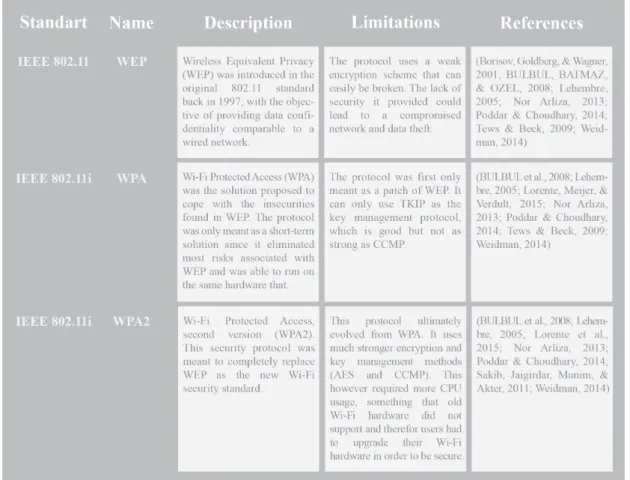
The following table (2.1) presents an overview of the major security mecha-nisms that have been implemented on the different versions of the IEEE 802.11 standard and also some of its major limitations. The three major security pro-tocols have been implemented to comply with security requirements of wireless communication: WEP, WPA and WPA2 [40, 23, 6, 17].
The Wireless Equivalent Privacy (WEP) was the first default encryption proto-col to be introduced in the IEEE 802.11 standard however, due to major technical failures in the protocol security was practically abandoned [9, 17]. As a response to WEP problems, Wi-Fi Protected Access (WPA) was created. But WPA was only a quick patch for WEP as a response for the lack of security it provided as the newer version was already being developed but would need extra hardware on routers that were only meant to support WEP encryption [17]. The new version of WPA - WPA2 - was released as an IEEE 802.11 amendment [29, 17].
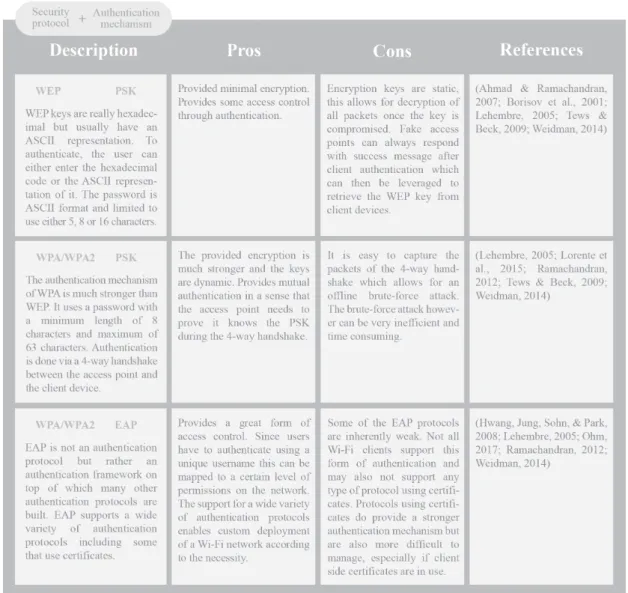
These standards however refer mostly to what encryption scheme they use. These protocols can use many different authentication mechanisms which have their own security flaws [27]. Wi-Fi authentication mechanisms are mainly de-signed for two purposes, personal or enterprise use [27]. For personal use the authentication mechanism usually relies on a simple password and is known as the pre-shared key (PSK). For enterprise use however there is a need to differentiate the user access level and for this purpose there are a multitude of protocols which rely on a username and password credential combination for authentication. This allows for better control over who can and who is accessing the network. Most enterprise authentication mechanisms rely on the EAP authentication framework [27], so in order to increase the security of the individual authentication protocol some have introduced the use of certificates as a form of authentication. All of these authentication protocols offer a different type of protection for the exchange of credentials. The following table (2.2) presents a description of all authentication mechanisms divided into categories with an evaluation of their pros and cons.
Figure 2.2: Difference between various authentication protocols.
2.2
Wi-Fi Communications and Security
This section focuses on describing Wi-Fi communications. It first analyzes the typical client behavior and later the access point behavior and how it interacts with the client depending on its security configuration.
2.2.1
Wi-Fi Client Behavior
One key aspect to learning how Wi-Fi communications can be compromised is understanding client behavior. The ad-hoc behavior may vary slightly depending on the operating system that is used, but in principle they all follow the same rules.
Whenever a user wants to connect to a network he will first take a look at the available networks. These have been detected by the client device by listening for "Beacon" packets, these packets are the ones being constantly sent by an access point - this behavior is known as passive network scanning [27, 31].
Another way for discovering Wi-Fi networks is by sending out "Probe Request" packets. These packets contain the SSID of the network they want to connect to. These are usually sent when the device is looking for a network that it has con-nected to previously and is therefore saved as a "trusted" network. This discovery method is known as active network scanning [27, 31]. The rate and frequency of when these packets are sent is what may vary depending on the operating system. After finding a network the client wants to connect to, either by passive scan-ning and user interaction or through active scanscan-ning and automatic connection, the client device will enter the authentication and association phase [27, 14].
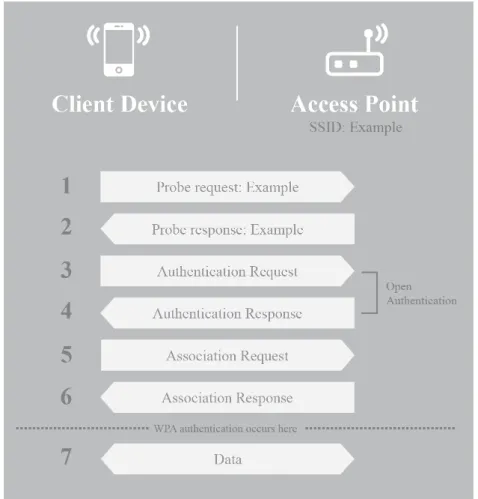
The communications are represented in the flowchart in figure 2.3. It is im-portant to mention that the 802.11 management frames were only supposed to support WEP authentication, that is why WPA authentication occurs after the actual association process. In case of the WEP-PSK authentication the above shown communication will have two extra packets between the packets identified as 4 and 5, this will be described later in this chapter. It is important to mention that the client will only try to associate automatically to a network if the security settings match the ones saved on the device [27, 39, 31], the security settings can be found in "Beacon" and "Probe Response" packets. For instance, if a client has a WPA/WPA2-PSK protected network stored as trusted and an access point broadcasts a network with the same SSID, the client will only try to connect to
Figure 2.3: Probe Request followed by Authentication
it if it is also a WPA/WPA2-PSK protected network, otherwise it will ignore the "Probe Response" packet.
2.2.2
Wi-Fi Networks and Communication
It is common knowledge that Wi-Fi networks may either be protected, if they use any encryption mechanism, or unprotected if not. The level of security is highly dependent on what security configuration the access point has. The communica-tion between the client and the access point can be very different depending on these configurations, specially during the authentication phase. To understand the security implications of these communications one has to analyze each type individually since they have different vulnerabilities.
2.2.2.1 Open Networks
Open networks are inarguably the least secure. They don’t employ any access management, which means anybody can connect to it and be on the same net-work. Furthermore they don’t offer any type of encryption, this means that all communications between any client and the access point can be intercepted and read without even being connected to the access point [27, 31]. The following flowchart (2.4) shows the authentication and association process.
Figure 2.4: Open Network Authentication
As it is possible to observe from the flowchart in 2.4, authentication with these access points will always be successful and after associating they can exchange data freely.
2.2.2.2 WEP Protected Networks
WEP was the first step in Wi-Fi security, it stands for "Wired Equivalent Privacy". The authentication to these types of network can be done in two ways depending on its configuration.
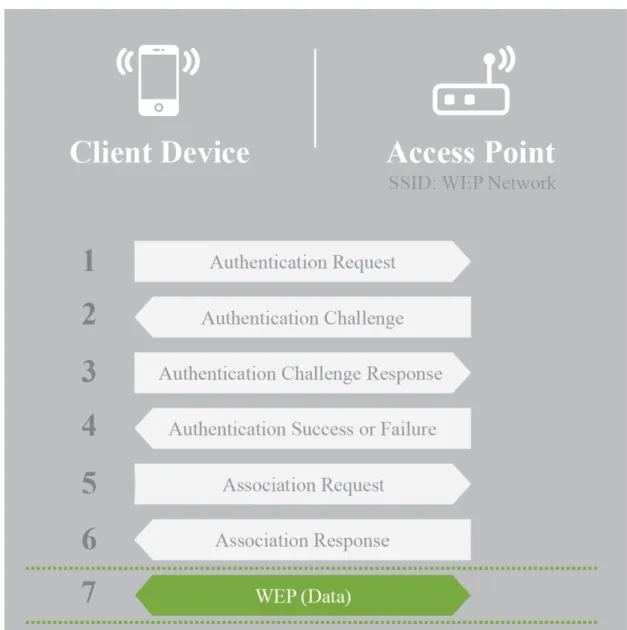
Figure 2.5: WEP Network Authentication
A WEP access point can be configured as open, where the user does not provide any credentials to authenticate to the access point, although he has to have the encryption keys configured on his side in order to exchange data with it. The other method is known as WEP-PSK, as the name suggests it uses a pre shared key (a
password) to authenticate to the access point [35, 17, 8]. The encryption keys are derived from this password. The authentication process to the latter example is shown in the flowchart 2.5.
As can be seen in the flowchart in 2.5 the authentication includes two extra packets. When a client wants to authenticate to the access point it responds with a challenge. The client has to encrypt the challenge using the pre shared key and sends the result back to the access point. The access point has to verify if the result matches the one it calculated to then send a response of success or failure. After successfully authenticating to and associating with the access point, the client is able to exchange encrypted packets with the access point. The encryption keys used to encrypt the data exchange are static, this means they are always the same for every user and don’t change with time.
2.2.2.3 WPA-PSK Protected Networks
The WPA and WPA2 protocols were developed to address and fix the many secu-rity issues that were found in the WEP protocol and is considered the most secure Wi-Fi communications protocol [8, 25, 17]. The WPA/WPA2 protocol has two different authentication mechanisms. One was designed for personal use and is also known as WPA-Personal or WPA-PSK. As the latter name suggests it uses a pre shared key for authentication, but the mechanism is very different from the WEP implementation.
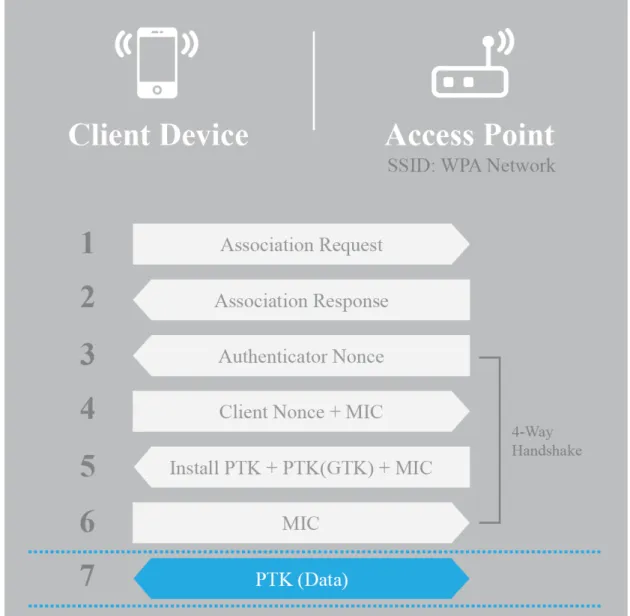
The first noticeable difference is when it begins, as one can see in the flowchart in 2.6 it starts right after the association phase, unlike WEP where it happens before. But what actually happens during the 4-way handshake and what pro-tection does it offer? The 4-way handshake is used for many things. First the protocol ensures mutual authentication between the client and the access point [27, 25, 8]. It is assumed that both have the pairrwise master key (PMK), which is directly derived from the password. The PTK (Pairwise Transient Key) can be calculated using the PMK and the generated nonces by each of the parties, so the PTK is different in every authentication. From the PTK it is already possible
Figure 2.6: WPA Network Authentication
to calculate the message integrity check (MIC). The client has all the informa-tion it needs to calculate the MIC after receiving the first frame containing the authenticator nonce. The client generates his own nonce and calculates the MIC and sends both back to the access point. At this point the access point also has enough information to calculate the MIC, which he then compares to the MIC sent by the client. This is where the actual authentication of the client happens, if the calculated MIC matches the one sent by the client it means he knows the password and therefore has access to the network. After verifying the MIC the access point sends back a message telling the client to install the PTK and the
GTK (Global Transient Key) encrypted by the calculated PTK, the GTK is used to encrypt broadcast communications from the access point to all clients. Both the PTK and GTK are temporary and go through a cycling process. The PTK is unique to each client while the GTK is the same for all clients. The last step of the 4-way handshake is the acknowledgement of the installed PTK and GTK by the client.
After the 4-way handshake is complete the client and access point can exchange packets encrypted with the calculated PTK.
2.2.2.4 WPA-Enterprise Protected Network
WPA-Enterprise uses the authentication mechanism designed for companies and corporations. The authentication process for this kind of network is a lot more complex, on the other hand it enables features that were not possible through the classic PSK authentication.
To the user the main difference will be that instead of just a password the user also has to provide a username as well. This makes it possible to uniquely identify each user on the network. It also makes it easier to manage access, since the pair of credentials is unique to each user it is possible to add or remove access to each user individually. This was not possible with the PSK authentication since the password is the same for all users.
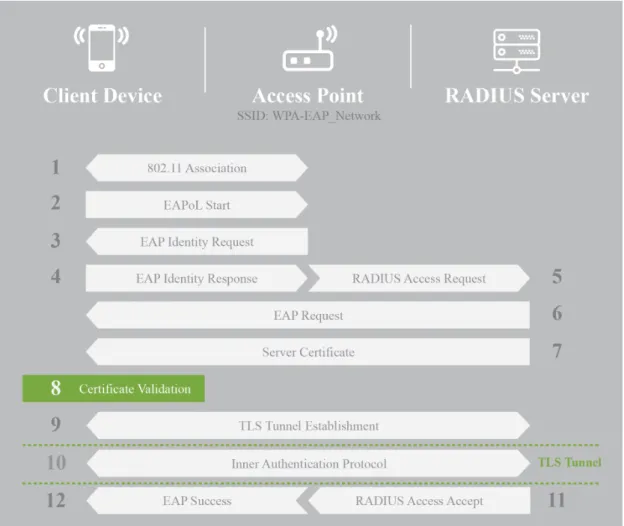
The other difference is that, instead of authenticating directly with the access point, an extra RADIUS server is used to authenticate users [27, 14]. There is a wide range of RADIUS-based protocols over which a client may authenticate. These protocols can be divided into two categories, protocols that use EAP and the ones that don’t. The main difference between non-EAP and EAP protocols is that the latter starts with an authentication protocol negotiation before the actual authentication. Protocols using EAP may be subdivided into protocols that don’t use certificates, the ones that use certificates but only on the server side and the ones that use certificates on both, client and server side. The focus will be on
protocols using EAP since these are the most widely deployed as well as being similar to the ones that do not use EAP but with EAP packet type encapsulation. EAP protocols that don’t use certificates do not establish a TLS connection which would hide the client authentication process. The protocols that use a server side certificate will have to negotiate an outer authentication protocol as well as an inner authentication method which is to be used inside the encrypted TLS tunnel.
Figure 2.7: Basic WPA-EAP Network Authentication
In the flowchart in 2.7 one can see that basic EAP relies on a challenge-response authentication mechanism, the challenge and response go through the air unen-crypted. In this scenario we can see that only the client authenticates himself to the server. Examples of these protocols would be EAP-MD5 and EAP-LEAP, which use "Message Digest 5" and "MS-CHAPv2" as hashing algorithm respec-tively. Protocols using certificates will use the server certificate to establish a TLS tunnel. The client has to trust the certificate to establish a layer 3 connection, this is how the client authenticates the server. What follows is the client authenticat-ing to the server inside the TLS tunnel. They will previously have agreed on an
Figure 2.8: WPA-EAP Network Authentication with certificates
inner authentication method to be used inside the encrypted tunnel. Examples of these are EAP-PEAP and EAP-TTLS which can use many different protocols as inner authentication method. The most common inner authentication method for EAP-PEAP is "MS-CHAPv2" and is also based on challenge-response mechanism. Regarding protocols that use certificates on both sides, EAP-TTLS has an op-tional feature that requires the client to authenticate to the server using a certifi-cate as well before creating the encrypted tunnel. After that there is a multitude of inner authentication protocols that can be used that also use a challenge-response mechanism.
2.2.3
Vulnerabilities and Attacks on Wi-Fi Communications
In this subsection the previously described communications will be analyzed from a security perspective. It will cover the vulnerabilities for each type of network as well as the vulnerabilities in client behavior when communicating with each type of network.
2.2.3.1 Wi-Fi Client Behavior
From a security perspective, the ad-hoc behavior of a client device is the most neglected aspect of Wi-Fi communications. It puts the owner of the device in risk of being compromised as well as the network it tries to connect to.
It is important to first understand how its behavior affects the owner and the device itself. As mentioned in section 2.1, the client has two ways of discovering if a certain Wi-Fi network is nearby. The one that poses a security risk is active scanning as it sends out information about Wi-Fi networks it had previously been connected to. Knowing this, an attacker could simply listen for probe requests coming from a device and associate the network SSIDs to geographical locations to find out where the owner has been. This can be done via online services such as "WiGLE" 1 [27]. This would be considered information disclosure and results
in a lack of privacy for the owner of the device.
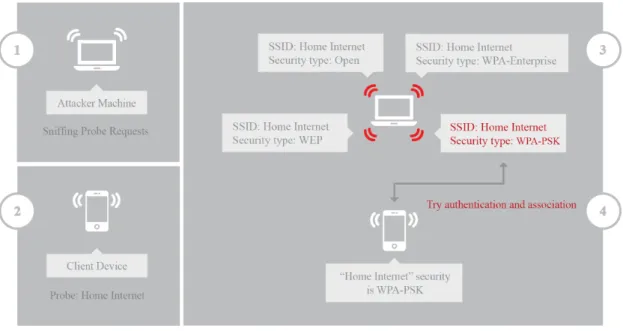
This is not the only security risk enabled by active scanning. It is important to remember that this mechanism leads to an automatic attempt of authentication if it finds a network with the same SSID and security configuration [27, 39]. From an attacker’s perspective there is no way of discovering the security configurations of the networks from simply analyzing the probe requests. Regardless, the attacker could perform what is referred to as a "Catch-all Twin" attack. The Evil-Twin by itself works creating an access point that clients are likely to connect to. The catch-all part means that multiple access points are created, all with the same SSID but with different security configurations. This works because the
device will automatically try to connect to the network that matches its security configurations, this way an attacker can force a device into disclosing the security type of the network it had previously connected to [27]. The following illustration (2.9) explains the process.
Figure 2.9: Probe Request triggering a Catch-all Evil-Twin attack
In step one (1) the attacker starts sniffing for probe requests and captures the one for "Home Internet" sent by the client device in step two (2). Then in step three (3) the attacker is able to create multiple access points all with the same SSID matching "Home Internet" but with different security configurations since that at that point he does not know what type of network the client is trying to connect to yet. Once the client device identifies a Wi-Fi network with the same SSID and security configuration (in this case it is WPA-PSK) it tries to authenticate and associate with it automatically as illustrated in step four (4).
Now depending on the security settings there are different ways an attacker can take advantage, the different scenarios will be explained when analyzing that specific network type later in this chapter.
Once a client device is connected to the attacker’s machine it will be exposed to a whole new set of attacks operating on layer 3 of the OSI model. This greatly increases the attack surface of an attacker because he is on the same network
as the victim and also acts as the gateway to the Internet. This enables the possibility of DNS spoofing in order to redirect victims to malicious websites as well as HTML and Javascript injection on websites that are not using HTTPS [39, 14]. An attacker can also target and attack SSL/TLS communications in order to sniff sensitive data. Furthermore, because the victim is on the same subnet as the attacker it is also vulnerable to network based attacks since the victim could be running a vulnerable version of a networking service. Strategical use and combination of these attacks could result in malware infection and access to the victim’s machine.
2.2.3.2 Open Networks
Open Wi-Fi networks provide the least security to the client. The communications between client devices and the access point are not encrypted in any way, this means that any outsider can spy on these communications without even being connected to the network. Since everybody can connect to this type of network it is also a lot more likely that a malicious actor is connected. Being on the same network as the attacker makes the victim exposed to layer 3 attacks that were already mentioned before, although with a little less control since the attacker would need to perform an ARP poision attack to act as the gateway for other clients.
Considering the Evil-Twin problem, this would be the easiest network to repli-cate [33, 13]. Even worse, since no proper authentication is needed in order to associate with the access point, the victim would automatically and successfully connect to the network without giving warnings or user interaction [31, 27]. The key problem here is blind trust in networks whose authenticity cannot be verified by conventional means.
2.2.3.3 WEP Protected Networks
Wired Equivalent Privacy (WEP) was the first encryption standard developed for Wi-Fi communications and as the name suggests it was supposed to make wireless network as secure as its wired equivalent. There is a whole plethora of known vulnerabilities regarding the WEP protocol and if a network uses it, it is considered insecure [27, 2, 8, 35]. This is because the used encryption is considered weak and the WEP encryption key can be deterministically recovered from gathering enough WEP data packets [2, 25, 35, 8]. The rate at which these data packets are generated usually depends on how busy the network is. An attacker could although perform an ARP replay attack which greatly increases the rate at which these data packets are generated and thereby accelerates the cracking process as he can gather more information needed for WEP cracking in a shorter amount of time. With today’s open-source tools the whole process of gathering enough packets and recovering the WEP key can take less than ten minutes [2, 35, 30]. What makes this even more dangerous is that WEP keys are static, this means that all captured packets, even though they were encrypted, can now be deciphered and read by the attacker. Again, let’s take into consideration the problem of the Evil-Twin attack. De-pending on the goal of the attacker he could perform different types of attacks. For the first example an attacker could setup a WEP encrypted AP configured with the real WEP key [2]. If the attacker does not have the key he would not be able to set up the access point since he would not be able to decrypt packets sent by the client nor sent correctly encrypted packets back to the client. But since the WEP key is so easy to recover, the attacker would be able to mimic the network once the WEP key had been recovered, putting the client at risk of all the layer 3 and man-in-the-middle attacks mentioned earlier in section 2.3.1.
The method explained in the first paragraph of this section assumes that the attacker is near the legitimate access point in order to actually sniff its traffic. However there is a way an attacker can retrieve the WEP key solely by com-municating with clients who have that WEP key cached in their system. This method involves creating an Evil-Twin access point to lure clients into connecting
with them. The attacker is able to accept all incoming connections regardless of the entered key. Assuming that the client connects automatically it will use the WEP key stored in its system. After the client associated with the evil AP it will try to obtain an IP address, it will do it according to how it is configured. However, regardless of their configuration, if that method fails the client will most likely fall back to assigning a static AP to itself and sending out a gratuitous ARP packet. Once that packet is detected the attacker can cleverly modify the encrypted content so that it is still a valid encrypted packet. These modifications turn the original gratuitous ARP packet into a regular ARP request for the same IP address that client assigned to himself. By replaying this packet the client will respond to the ARP requests, thereby generating new packets with different IVs which can then be used to crack the real network. This whole process can take as little as six minutes and is called the caffe-latte attack [2]. It is important to note that the attacker can obtain the WEP key without ever communicating with the real access point, therefore this attack can also be called AP-less WEP cracking [2, 27].
2.2.3.4 WPA-PSK Protected Networks
The WPA protocol was very successful in correcting almost every security flaw found in WEP. First there is no way of recovering the WPA key through statis-tical analysis since WPA uses dynamic keys. This is also important in case of an attacker eventually recovering the PMK, he will still be unable to decrypt previ-ously captured packets since he would need the PTK which is the key that is used when encrypting data and is generated dynamically [8, 17, 29]. Additionally the WPA protocol implements a sequence counter in order to protect against replay attacks.
Cracking a WPA network to figure out the key can be an arduous and time consuming process. The first thing the attacker needs to have in order to crack a WPA password is the 4-way handshake that occurs between the client and an
access point during authentication. This can be done by passively sniffing pack-ets in the air and waiting for someone to authenticate with the target network. Another way would be by performing a de-authentication attack, this is done by sending spoofed de-authentication packets to an already connected client, the 4-way handshake is then captured during reconnection to the access point. When an attacker captures the 4-way handshake he will have everything but the actual passphrase to calculate the message integrity check, this means he can perform a brute-force or dictionary attack in order to crack the password [27, 35, 37].
There is more than one reason why this process is very time consuming. Firstly a WPA password has a minimum of 8 characters and a maximum of 63 characters. With this we conclude that the key space is very large and the smallest passphrase is at least 8 characters long. To further understand why WPA cracking is a very time consuming process it is important to understand how the PMK is calculated. The formula for generating the PMK is:
Figure 2.10: Formula for calculating the PMK
The PBKDF stands for "Password Based Key Derivation Function", it is specifically designed to reduce the vulnerability of encrypted keys to be brute-forced. This function receives five parameters. The first is a PRF (Pseudo Random Function) which has a fixed output length. The second is the master password from which the derived key is generated, this is the password one would type in when connecting to a WPA network. The third parameter is the cryptographic salt, WPA uses the network’s SSID for this parameter. The fifth parameter is the desired output length of the final key, in this case it is 32 bytes. The fourth parameter is the number of iterations going through this function, as we can see in case of WPA the number of iterations is 4096, this is the actual bottleneck that makes WPA cracking very slow. It means that every word in a dictionary would have to go through 4096 iterations. Assuming we had a dictionary with a million (1.000.000) words (which is relatively short), it would have to go through a total
of 4096 million iterations of the PBKDF. Taking this into account it is safe to say that performing a dictionary attack from a regular laptop is infeasible. There are however online services that will attempt to crack a WPA handshake for as little as five (5) american dollars 2 [27].
In summary, cracking a WPA password is generally hard and very time consum-ing. However it is possible avoid having to crack the WPA password altogether. This is due to another attack vector that the access point might be vulnerable to. The attack targets the Wi-Fi Protected Setup (WPS) which gives out information about the AP’s configuration, including the WPA password. If the the access point is WPS enabled an attacker can brute-force its PIN which is 8 digits long. This PIN however, is divided into three parts. The first four digits are the first part of the pin, the next three digits are the second part of the pin, the last digit is just a checksum of the previous seven digits. The attacker usually has two main ways of taking advantage of this vulnerability. The first method is brute-forcing the WPS pin by directly communicating with the actual access point. This method should work 100% of the time but can take a long time since a lot of wrong guesses will trigger a blocking mechanism where the access point stops answering [38]. The second method is called the Pixie attack and works by capturing two hashes that are sent in clear-text, these hashes are calculated with the help of two generated nonces. These nonces are what is needed to be brute-forced offline, they are how-ever 128 bits long which would take a long time to crack even offline. The key to this attack is that these two nonces are not generated securely in many routers, the nonces are either static or generated by a weak PRNG. This low entropy in nonce generation is what allows for a more directed offline guessing approach which can lead to a compromised WPS pin in a matter of minutes [7, 18].
The WPA-PSK protocol unfortunately does not solve the Evil-Twin problem completely. Although WPA-PSK supposedly offers mutual authentication between the client and the access point, this simply means that both parties know the passphrase to calculate the PMK. This means that if the attacker knows the WPA password he can ultimately mimic the network without raising suspicion from the
client. This becomes a realistic problem when taking into account that a lot of shops and restaurants, even though they offer WPA protected Wi-Fi, simply hand out their password when asked for it. It would make a lot of sense for an attacker to deploy an Evil-Twin attack in this scenario as the evil access point would have increased credibility due to the false sense of security of connecting to a WPA protected network .
Furthermore, similarly to the case of WEP networks, WPA networks are also vulnerable to AP-less attacks. The information an attacker needs in order to crack a WPA password is: the authenticator nonce generated by the access point, the supplicant nonce generated by the client, the message integrity check that is calculated and sent by the client and the access point’s and the client’s MAC addresses. All of this information can be captured within the first two frames of the WPA handshake. So all an attacker has to do is setup a WPA-PSK access point with the SSID of the network he wants to crack and a random passphrase. A client who actually knows the password would automatically try to connect to it, the attacker then proceeds to generating its nonce (the authenticator nonce), the client uses that nonce along with the one it generated itself (the supplicant nonce), calculates the MIC and sends it all back to the access point for verification. At this point, since the attacker does not have the actual password he cannot conclude the handshake as he cannot calculate the PTK to encrypt messages from that point forward. The attacker does however have all the information necessary to start cracking the WPA password [27, 36, 1].
In conclusion it is possible to see that the client is still not completely safe from Evil-Twin attacks when connecting to a WPA-PSK network. Moreover, the ad-hoc client behavior unnecessarily increases the risk of a WPA-PSK network being hacked, emphasizing that the Evil-Twin attack is still a problem even for this type of network.
2.2.3.5 WPA-Enterprise Protected Network
As mentioned before, the WPA-Enterprise network is mostly used in companies and corporations. The only thing that differs from the WPA-PSK protocol is the authentication mechanism, the encryption scheme between the client and the ac-cess point remains the same. Therefore WPA-Enterprise offers the same security features in regards to encryption standard, dynamic keys and replay attack pro-tection as WPA-PSK. Since there are no known vulnerabilities in those features there are only the various types of authentication mechanisms left to analyze.
The focus will be on protocols that use EAP. These can be subdivided into three categories according to certificate usage, therefore this section will be divided in three subsections accordingly, one for each EAP category.
WPA-EAP without certificates
Examples of WPA-EAP protocols that do not use certificates are EAP-LEAP and EAP-MD5 [14]. The flowchart in section 2.7 regarding EAP protocols without certificates shows that the challenge-response authentication goes through the air unencrypted. This would allow an attacker to passively listen to 802.11 traffic and capture these authentications. In this scenario it all comes down to the strength of the password as well as the hashing algorithm. In case of EAP-MD5 the hashing algorithm is MD5 which is considered to be very weak. There are many online services which offer reverse hash lookup for MD5 hashes, these services hold a very large database of pre-calculated MD5 hashes and their respective plain-text. In case of EAP-LEAP the hashing algorithm is "MS-CHAPv2", it is a stronger hashing algorithm than MD5 but nevertheless it is still crackable.
Regarding the Evil-Twin attack, clients that have a WPA-EAP network con-figured and don’t use certificates are very susceptible to this attack. Because there are no certificates there isn’t a way to authenticate the server, this forces the client to simply send out its username and hashed password directly to the
directly derived from the password but is negotiated between the client and the RADIUS server. This allows the attacker to always send out EAP Success packets regardless of knowing the client’s password or not. For the client this means he can successfully associate with the attacker’s access point and browse the Inter-net with a man-in-the-middled connection while at the same time providing the attacker with crackable credentials that he can use to gain access to the target network [27].
It is important to note that, in a scenario where the attacker’s objective is to gain access to the corporate network, the attacker would have a larger attack surface since there would be a lot of clients with different credentials, the attacker would only need to crack one of the credentials to gain access [27, 39, 1]. Again the client behavior is the weakest link in keeping the network itself secure.
WPA-EAP with server-side certificates
These types of networks provide a much stronger authentication mechanism than the previous one. Examples of these would be EAP-PEAP and EAP-TTLS. First the client is able to authenticate the server by validating its certificate. This is meant to ensure that the access point that the client is connecting to is a legitimate one. Secondly, after validating the server’s certificate a TLS tunnel is established inside of which the inner authentication protocol takes place. The inner authentication mechanism can be one of many challenge-response authentication protocols. This protocol is not necessarily stronger as it can be configured to use MD5 or MS-CHAPv2 anyway, but since it is encrypted inside the TLS tunnel it is safe from passively being sniffed off the air [27, 14, 39].
Nevertheless this network still is not completely secure and again it is mostly the client’s fault. To set up an evil access point with WPA-EAP authentication the attacker would need to run a RADIUS server alongside the access point and have a certificate ready to be sent to the client [27, 39]. Some Wi-Fi clients, as is the case of many Android smartphones, do not perform certificate validation
at all, this allows an attacker to send any certificate. So although certificates are being used, the server’s authenticity is never verified. In the case of having an iPhone as the Wi-Fi client, it does verify the certificate, if it is not trusted it the phone prompts the user giving him the possibility to still accept it. In this scenario the attacker could perform a social engineering attack by making the fields in the certificate look legitimate and thereby enticing the user to accept it.
After accepting the certificate the client will have successfully associated with the access point, exposing himself to layer 3 and man-in-the-middle attacks, while at the same time having given out its hashed credentials which can be cracked and used to log in to the real corporate network.
Yet again it is the client’s behavior outside the network that introduces a strong attack vector that could compromise a corporation’s network [39].
WPA-EAP with client and server-side certificates
WPA-EAP with server and client-side certificates is the most secure Wi-Fi setup possible. Both EAP-PEAP and EAP-TTLS support this feature and both are based on the EAP-TLS protocol. The EAP-TLS protocol also uses certificates on both sides, but it never establishes a TLS session, the client and server simply verify and validate each other’s certificates before exchanging data encrypted through WPA [27].
In case of EAP-PEAP and EAP-TTLS, if EAP-TLS is used as inner authen-tication protocol, the only difference is that the client certificate is sent over the TLS tunnel that was established after validation of the server’s certificate.
In both scenarios there is no critical information to be obtained by passively sniffing the air. Moreover, the encryption scheme is still WPA so it is still immune to replay and statistical analysis attacks.
All there is left to analyze is the Evil-Twin problem. The only thing that would make the client vulnerable to Evil-Twin attacks would be if it does not
honor certificate validation and would connect to the attacker’s malicious access point. Even if the attacker is able to trick a user into connecting with him, the client would only have sent the public part of its certificate which the attacker cannot use to log in to the corporate network. Nevertheless the client would still be vulnerable to layer 3 and man-in-the-middle attacks, which could eventually lead to malware infection followed by information theft, such as certificates.
In conclusion, if the client honors certificate validation then these authentica-tion protocols completely mitigate the Evil-Twin attack. Otherwise, in case they don’t honor certificate validation, then they at least do not reveal any critical in-formation which the attacker could use to log in to the corporate network. This means that for these authentication protocols the ad-hoc client behavior does not compromise the security of the network.
2.3
Vulnerabilities and possible Exploitation
Sum-mary
This subsection will present a concise summary of all the previously mentioned vulnerabilities and what Wi-Fi protection protocols are vulnerable to each.
This first table (2.11) contains the the generalized vulnerability name and its corresponding description.
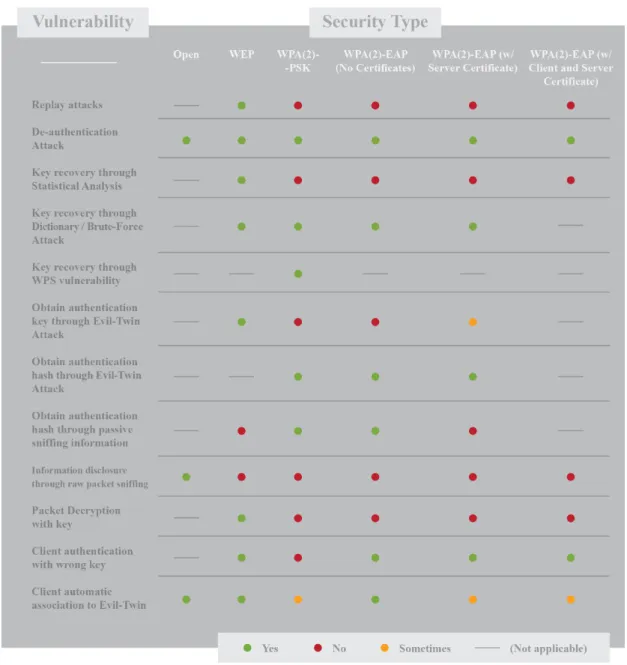
This set of vulnerabilities is now mapped to the security protocols described before (2.12).
Looking at the table above there are a few things that need clarification. For instance the de-authentication attack to which every network type is vulnerable, this happens because de-authentication packets are part of the IEEE 802.11 defined management frames. These frames are either sent by the access points or clients and are unencrypted, this allows an attacker to easily spoof these packets and send them. There is no way of verifying if the packet was sent by its legitimate source.
Figure 2.11: Description of identified Wi-Fi vulnerabilities
Obtaining the authentication key with an Evil-Twin attack is marked as "some-times" for WPA-EAP networks that use server-side certificates. This is only pos-sible if the inner authentication protocol is a plain-text password authentication.
WEP is the only protocol whose packets can be decrypted after recovering the key. This is because WEP uses static keys [35, 20], WPA on the other hand encrypts its packets with the PTK which is new for every connection.
Figure 2.12: Mapping of the identified Wi-Fi vulnerabilities to their network security type
with an EAP-Success message no matter what the credentials are, allowing a client to establish a compromised Internet connection. This does not hold true for WPA-PSK since the attacker has to prove to the client that he knows the PSK.
The "Client automatic association with Evil Twin" vulnerability varies a lot between authentication methods. For a WEP network the client can successfully authenticate with the AP and become victim of the Caffe-Latte attack [2], but he cannot connect to the Internet since the Evil Twin does not know the WEP key to decrypt packets. In case of WPA-PSK this vulnerability is marked as "sometimes".