Disponível em:
http://editora.unoesc.edu.br/index.php/race RACE, Joaçaba, v. 16, n. 1, p. 175-202, jan./abr. 2017
CHANGE AND INSTITUTIONAL LOGIC: OVERVIEW
AND PROPOSAL OF ANALYSIS OF DIFFERENT
INSTITUTIONALIST APPROACHES
Mudança e Lógicas Institucionais: Panorama e Proposta de Análise a partir das Diferentes Perspectivas Institucionalistas
Mayla Cristina Costa E-mail: [email protected] Doutora em Administração pela Universidade Positivo, com período de Doutorado Sanduíche na Universidade de Alberta, Canadá; Mestre em Controladoria e Contabi-lidade pela Universidade de São Paulo; Professora Adjunta e Coordenadora do MBA
em Gestão Contábil e Tributária na Universidade Federal do Paraná. Endereço para contato: Avenida Prefeito Lothário Meissner, 632, Campus III, Jardim Botânico, 80210-170, Curitiba, Paraná, Brasil.
Cristiane Marques de Mello E-mail: [email protected] Doutora em Administração pela Universidade Positivo; Mestre em Administração pela Universidade Estadual de Maringá; Professora na Faculdade Integrado de Campo Mourão.
Abstract
During the past two decades, institutionalists have raised questions about “how” and “why” institutions change. The explanation of the process of institutional change also has a set of conflicting views, assumptions and divergent voices of dissent (SCOTT, 2008). Mahoney and Thelen (2010) claim that the three dominant approaches to institutional theory, sociological, historical and rational, point to problems in the explanation of institutional change. Our main goal is to raise the discussion about the main currents that explain institutional change, and contribute by way of identify the challenges that the institutional approaches have. We believe that to understand the process of institutional change is necessary to understand the mechanisms underlying the processes by which institutional models prevailing in a social context (country or organization or field) also appear (or not) on another. Also, we propose the use of institutional logic for analysis of institutional change.
Keywords: Institutional Change. Institutional Logics. Sociological Institutionalism. Rational Institutionalism. History Institutionalism.
Resumo
Nas últimas décadas, institucionalistas têm levantado questões sobre “como” e “por que” instituições se modificam. A explicação sobre o processo de mudança institucional possui ainda um conjunto de concepções conflituosas, pressupostos divergentes e vozes discordantes (SCOTT, 2008). Mahoney e Thelen (2010) afirmam que as três abordagens dominantes da teoria institucional, sociológica, racional e histórica apontam problemas na explicação sobre a mudança institucional. Nosso principal objetivo é suscitar a discussão acerca das principais correntes que explicam a mudança institucional e contribuir por meio da identificação dos desafios que as abordagens institucionalistas possuem em suas explicações. Consideramos que para entender o processo de mudança institucional é necessário compreender os mecanismos subjacentes aos processos pelos quais modelos institucionais predominantes em um contexto social (país ou organização ou campo) também surgem (ou não) em outro. Por fim, propõe-se o uso da perspectiva de lógicas institucionais para análise da mudança institucional. Palavras-chave: Mudança Institucional. Lógicas Institucionais. Institucionalismo Sociológico. Institucionalismo Racional. Institucionalismo Histórico.
1 INTRODUCTION
Over the last 20 years, the institutionalists have questioned “how” and “why” the institutions changed. The existing literature about how we can understand the institutions and the process of institutional changed also has a set of conflicting con-ceptions, differing assumptions and dissenting voices (SCOTT, 2008).
The three different institutionalism approaches: economical, historical and sociological, suggest that the individual preferences and their related issues such as the self, social action and citizenship are molded by institutional forces (DIMAGGIO; POWELL, 1991). However, the conceptions about fundamental issues that differen-tiate between those two aspects in several aspects, one of them refers to how the pro-blem of the Agency and of the change considered by such studies.
It is observed that one of the major points of attack on the institutionalism of sociological basis, for example, lies on the emphasis to the permanence, and homo-geneity, and inconsideration of change and of the agency (MACHADO-DA-SILVA; FONSECA; CRUBELLATE, 2010). From this point, in search of a resolution, some actors suggest the establishment of a third stage of institutional theory, marked es-sentially by the unification of these approaches (CAMPBELL, 2004; MAHONEY; THELEN, 2010; THORNTON; OCASIO; LOUNSBURY, 2012), which in principle does not seem to be possible.
For Mahoney and Thelen (2010), the institutionalists of rational choice approa-ch have long time already recognized the importance of understanding the shift of ba-lance, but them analyzes usually involve more comparative statistical than a dynamic approach. This approach marks a membership to scientific methodology of economic theory, based on the assumption of the epistemology of Imre Lakatos, which operates predominantly on reductionist assumptions of reality, rational utility, and also framed from models based on these presumptions. The criticisms pointed to it by problem-dri-ven theorists (SHAPIRO, 2002) are that the greatest difficulty of this approach is related to the vision of institutions as coordination mechanisms that sustain particular balance (SHEPSLE, 1998; CALVERT, 1995; LEVI, 1997). For Mahoney and Thelen (2010, p. 6), the conclusion of this perspective is that “[…] the institutional changes should have an exogenous source”, i.e., with a focus on external causes.
On the other hand, historical institutionalists consider institutions first as po-litical legacies of concrete historical struggles, thus taking a vision of popo-litical power of institutions that emphasizes the distributional effects, and the institutional persis-tence in terms of the increase of power return. In the explanation of the change, the historical institutionalists often call attention to critical junctures, generally unders-tood as periods of contingency plan during the restrictions on action that are high or facilitated (CAPOCCIA; KELEMEN, 2007). The explanations for change with focus on such episodes are sometimes also related to the arguments about the relative weight of the agency versus structure in several phases. Katznelson (2003) considers that the institutions are more restrictive in periods of political stability, but argues that
critical junctures enable opportunities for historical agents to change the development trajectory.
In this way, the historical institutionalists tend to fall on a model of change discontinuously in which lasting periods punctuated regularly by moments of agency and choice. These arguments thus lead to the design of the change as involving the collapse of a set of institutions and their replacement. Mahoney and Thelen (2010) affirm that what they do not supply with is a general model of change that understands both endogenous and exogenous sources.
In the organizational institutionalism under the perspective of institutional logic, institutional change, as suggested by Garud, Jain and Kumaraswamy (2002), occurs at the time when an alternative institutional logic replaces the dominant pre-vailing logic. This means that change often occurs when a way of doing things can replaced by another.
Other studies, such as for example the Purdy and Gray (2009), indicate that multiple logic can stay within a field, and suggest a multilevel analysis for better un-derstanding.
Campbell (2004) considers that the problem in the explanation of the change is due to the lack of the dependent variable specification, i.e., of the understanding of the type of change (change) to be studied. For the actor, the relevant change dimen-sions and the study periods need to be carefully specified. He argues that the problem of explanatory change mechanisms is the lack of procedures specification that repre-sent causal relationships between variables. In their view, the mechanisms responsible to explain how the normative structures and cognitive affect the behavior are vaguely specified by the institutionalists studies. The main problem in understanding the chan-ge is the inability of the researchers to define clearly what the institutional chanchan-ge is because the theory does not make it clear which the mechanisms responsible for their occurrence are, and does not explain properly the “Ideas”, which are not self-interest, affect the institutional change.
In the vision of Thornton, Ocasio and Lounsbury (2012), two considerations are necessary about the relationship between the concepts of institutional logic, agen-cy and change. The first is that the institutional logic and practice are issues that should considered in duality. That is, the practices adopted in certain social field are not only reflected from the institutional logic, they are also tangible actions that may cause changes or changes in own logic. Practices are considered as sets of activities that feature social signification, and therefore, embraces coherent sense and stability in a given context. The second consideration made by the actors is that the
institutio-nal logic is also responsible for the identity formation, whether individual, collective or organizational.
Thus, the institutional logic approach has been considered responsible for changing the attention of institutionalist researchers on organizational aspects not considered before. The focus on institutional logic competitors, as pointed by Lou-nsbury (2007, p. 289), redirected to the studies of the area, who “[…] before they emphasized the concept of isomorphism and segregation of institutional and technical forces”, and began to emphasize the understanding of how the conflict between mul-tiple logic serves as support for institutional change. Thornton, Ocasio and Lounsbury (2012) consider that institutional logic is an institutionalist strand in development that unites points of the old and new institutionalism.
Okhuysen and Bonardi (2011) consider necessary the development of orga-nizational theories through the combination of multiple lenses. They claim that these attempts are growing up in view of the need for relevant research studies that ex-plain how management decisions in private organizations and government agencies influence negatively millions of people in the world, i.e., it is understood that these decisions provoke changes. In addition, some researchers consider the negative effect of the subject specialization, with the danger that the field becomes a ‘Tower of Ba-bel’, like this limiting the development of the administration area as a field of study (OKHUYSEN; BONARDI, 2011). However, these actors observe two dimensions of the combination of two perspectives to construct a theory: the proximity in terms of the phenomenon and the congruence of assumptions.
Having said this, our main objective is to encourage the discussion about the main currents that explain the institutional change, and contribute by means of analysis of the integration challenges between the institutionalist approaches, pro-posing that the analysis performed by means of the prospect of institutional, as logic conciliatory and method. Given that theoretical text implies an attempt and initiative to generate reflection and advancement, we also propose reflections on the concept of institutional logic and the possibilities of organizational studies related to the same, more specifically with regard to the process of change. We hope, this way, to contri-bute to a focal analysis and more narrowed on the proposed theme.
2 STABILITY AND DYNAMICITY: SIMILARITIES AND
DIFFERENCES BETWEEN THE INSTITUTIONAL APPROACHES
The concept of institutions was considered ambiguous during many years in institutionalist studies and even today some researchers of the sociological, historical and rational aspects, to treat equivocally. According to Greenwood et al. (2008), the ambiguity in part was resulting from the emphasis of the precursor studies in the analysis of governmental institutions. Thus, a part of the researchers treats institutions as templates that become cultural prescriptions and other they treat them as regulatory agencies of political economy. Concerning this ambiguity, Greenwood et al. (2008, p. 12) affirm that regulatory frameworks can only be considered institutionalized pat-terns “[…] if it is clearly demonstrated that these institutions are constituted by social values and standards, such as certain data (taken for granted), and if these values are explicitly identified.”
Despite of the misunderstandings observed in the three approaches, the con-sensus between them that institutions are relatively durable patterns of social practice is old (HUGHES, 1936). The stability is performed by a complex set of restrictions that include formal and informal rules, so that “[…] the standard deviations be neu-tralized, in a regulated way, by repeatedly controls enabled, socially constructed - that is, by a set of rewards and sanctions.” (JEPPERSON, 1991, p. 145). Although Zucker (1977), a representative precursor of new sociological institutionalism, has argued that the greater the degree of institutionalization the less the need for control and sanction, because the actors begin to share the assumption that there is an alternative to the actions available in the institutional context.
In recent years, it has been shared by the three approaches the idea that the institutions are compositions of “[…] cultural elements-cognitive, normative and re-gulatory that together with activities and associated resources, provide stability and meaning to social life.” (SCOTT, 2001, p. 48). To analyze the stability, North (1990) points out, contributes to improving the understanding of the nature of the incremental process of change. This actor, one of the main representatives of the rational approa-ch, says that the gradual institutional change occurs through a continuous marginal adjustment and it is not possible to understand the choices of today without tracing the incremental evolution of the institutions. The routines, customs, traditions and conventions are terms commonly used to observe the persistence of informal res-trictions (standards of behavior). And it is the complex interaction of formal rules and informal restrictions, along with the way they are applied, that shapes the daily
life of people and offers direction to the activities that dominate the life of the same (NORTH, 1990).
The Table 1 adapted by Campbell (2004), presents the similarities and diffe-rences regarding the rational, institutionalist, organizational (sociological basis) and historical approaches.
Table 1 – Similarities and differences in the New rational, organizational choice, and historical Institutionalism Similarities Rational choice (econo-mical institutionalism) (sociological base)Organizational Historical Changing Patterns
favored
Punctuated equilibrium Punctuated equilibrium Punctuated equili-brium
Evolution Evolution Evolution
Punctuated evolution Punctuated evolution Casual favored
concepts Dependent on the tra-jectory Dependent on the tra-jectory Dependent on the trajectory Based on the feedback,
growing returns and choice within institutional restrictions (or cons-traints)
Based on restrictions and constitutive aspects of the institutions
Based on the fee-dback, learning, and choice within institu-tional restrictions Dissemination Dissemination Dissemination Based on the contagion
information, feedback and imitation
Based on mimetic, re-gulatory and coercive processes
Based on coercive and learning processes Role of ideas Growth: cognitive
structu-res, beliefs and standards constrains the actors (and become inefficient insti-tutions)
Substantial: normative structures and cognitive taken as certain (taken--for-granted) restrict (and enable) the actors
Growth: political paradigms and beliefs on principles restrict actors
Differences
Theoretical roots Neoclassical economics Phenomenology, ethno-methodology and cogni-tive psychology
Marxist and weber political economy
Definition of the
institution Formal and informal rules and procedures of confor-mity; strategic balance
Formal rules and cultural structures taken as cer-tain (taken-for-granted), cognitive scheme and reproduction of routine process
Procedures and formal and informal rules
The level of analysis Micro-analytical exchan-ges Organizational fields and populations Macro-analytical national political economy
Similarities Rational choice (econo-mical institutionalism) (sociological base)Organizational Historical Theory of action The logic of instrumen-tality The logic of ownership (or adequacy) The logic of instru-mentality and
suita-bility
Theory of restric-tion
Action is restricted by ru-les, such as human rights and the constitutions of ownership, and limited rationality
Action is restricted by culture, Scheme and routine
Action is restricted by rules and procedures, cognitive paradigms and beliefs on Prin-ciples
Source: adapted from Campbell (2004, p. 11).
Under the perspective of historical institutionalism, Mahoney and Thelen (2010, p. 4) in a similar way, they argue that the institutional change occurs “[…] when problems in interpreting rules and execution open space for the actors to imple-ment the existing rules of a new way”, i.e. by means of ambiguity.
Mahoney and Thelen (2010) consider still that the institutions are full of tension because they inevitably incite resource considerations and invariably have distributive consequences. In this way, the power of a group or coalition on the other can be so great that dominant actors are able to draw institutions that clearly corres-pond to its well-defined institutional preferences. But the institutional results do not need to reflect the objectives of any particular group; it may be the unintended result of conflicts between groups or the result of ambiguous compromises between actors that can succeed an institutional significance even if they differ by substantive goals (SCHICKLER, 2001; PALIER, 2005).
This is why there is nothing automatic, self-perpetrator or self-strengthening in the institutional arrangements. Under the perspective of historical institutionalism there is a dynamic element, where institutions represent durable commitments or agreements although still unresolved on the basis of the dynamic coalition, are, there-fore, always vulnerable to changes. Thus, change and stability are inseparable, in such a way that those who benefit from the arrangements existing may have preference for the continuity, ensuring that the continuity requires political mobilization as support, as well as active efforts for the resolution of ambiguities in its favor (THELEN, 2004). The change as North (1990) explains under the rational institutionalism, typi-cally consists of marginal adjustments to the complex rules, standards and control measures which constitute the institutional framework. North (1990) considers that the process of strengthening of the existing institutions, provides a logic. In this mo-del, the actors become familiarized with the institutions through an acculturation pro-cess and reinforce the existing institutions through a reproduction propro-cess. The system
has a specific logic that is reinforced by the relations between the various elements such as the institutions (in), formal structures of public and private governance and mental maps shared. On the process of institutional change, the variables relate to three vectors, which are culture, technology and State, including two other related to the actors: desire to improve efficiency, and desire to protect their own interests.
Finally, to researchers of sociological approach, institutional change occurs when an alternative institutional logic replaces the prevailing logic (GARUD; JAIN; KUMARASWAMY, 2002), within a spatial time context. The institutional logic is so-cially constructed (FRIEDLAND; ALFORD, 1991; THORNTON, 2002; SHIPILOV; GREVE; ROWLEY, 2010), set standards, values and beliefs that structure the actors ‘cognition in organizations and provide a collective understanding of how strategic interests and decisions are formulated (THORNTON, 2002; SHIPILOV; GREVE; ROWLEY, 2010). Such logic may be better understood within a spatial-time historical context (THORNTON, 2002), of material and symbolic practices that constitute the institutional principles (SCOTT, 2008).
In this sense, studies have demonstrated that structure and some institutio-nal practices involve different actors who have different backgrounds, thus resulting in different attributions of meanings and institutional effects, enabling the change by means of different mechanisms (THORNTON; OCASIO; LOUNSBURY, 2012). Recently, DellaPosta, Nee and Opper (2016) analyzed two cases in which the endo-genous institutional change arises from an interaction of three causes: utility gain of agents associated with decoupling from institutional balance; positive externalities derived from similar dissociation between neighbors; and accommodation by state actor. In fact, we believe that this accommodation by the actor’s status will depend on the institutional logic of the state of the field, as well as the other two factors are dependent on the current institutional logics that influence community actors.
We believe that, not necessarily restricting institutional logic as propelling force of the shift by ambiguities of rules, but it is by means of multiple rationalities in the game in the institutional context that arises the possibility of combination between the existing institutional logic and by chance, institutional change. Thus, we present in the next section, the concept and the constituents of institutional logic.
3 INSTITUTIONAL LOGIC
Although the implicit meaning in the term “institutional logic” was already being treated by several authors in different areas of social sciences, for example,
Bourdieu (1977) – the idea only distinguished itself in the area of institutionalist stu-dies from the seminal text of Friedland and Alford (1991). One of the major contribu-tions that the idea brings to the field is the fact that, from it, the authors proposed the development of a non-functionalist and non-deterministic approach of society.
To achieve this goal, Friedland and Alford (1991, p. 232) proposed the recon-ceptualization of the term “institution”, as follows: “As at the same time the supraor-ganizational way of the activity through which human beings conduct their material life in time and space, and symbolic system through which they categorize these ac-tivities”, i.e., here the authors take into consideration the dissemination of material structures, and the cultural aspect and symbolic.
In this sense, the authors argued that to understand the individuals and or-ganizations, it is necessary to situate them in society. This instance, in turn, must be understood as an interinstitutional system, composed of contradictory and dynamic institutions. The mutual interference between different institutional logic available in the context of corporate interaction would be largely responsible for the behavior of the social actors, and the change, in turn, could be understood from the systematic analysis of the contradictions experienced in the individual and social level. So, the authors argue that “[…] the opposition is not between rationality or not of the actors, but between different transrational orders.” (FRIEDLAND; ALFORD, 1991, p. 234). Although Alford and Friedland had introduced the concept of institutional logic before by analyzing the contradiction between beliefs and capitalism practices, state of bureaucratic and political democracy (ALFORD; FRIEDLAND, 1985), it was only in the seminal 1991 text, others researchers have begun to pay more attention to the concept and develop analysis schemes and empirical research on the topic.
In the design of some revisionist views of this approach, the first empirical research of institutional logic strand emphasized the dominance of a logic in the ins-titutional environment and the replacement in different historical periods of a logic by another (SCOTT; MENDEL; POLLACK, 1997; THORNTON; OCASIO, 1999; THORNTON, 2002). This way, the first studies have guided their analysis in terms of eras representative of the dominant institutional logic in the field. And, with the aim of proposing useful ideas and concepts in identifying structures and processes that ope-rate in the organizational field, the authors of these studies reported that the concepts of institutional and logic structures of governance still needed to be better developed to allow their adequate operationalization.
For this reason, Scott, Mendel and Pollack (1997) in his study of the evolu-tion of an organizaevolu-tional field in the medical field, incorporating the analysis of
insti-tutional logic, the principle of “duality” in the concept. They describe not only logical as interrelated distinctions systems (rules, values and standards), but also as related practices (rituals, routines and strategic solutions), used by participants in the field.
The authors concluded that, in the studied field for them to change the logic for the professional market logic impacted considerably in the prevailing order in this organizational field in particular.
However, as Thornton, Ocasio and Lounsbury (2012) emphasize, the con-cept still lacks better definition and analytical support, in such a way that allows to operate it empirically. However, this limitation that has not prevented the studies of institutional logic from propagating in recent years. In this respect, Thornton e Oca-sio (2008) has come to consider it as a kind of ultra-used concept and therefore also misinterpreted.
Thus, since the study of Friedland and Alford (1991, p. 243), the idea of the institutional logic has been conceptualized in different ways. For the proponents, “[…] institutional logic is symbolic systems, ways of ordering the reality, thus making the experience in time and space significant.” Industries and other organizational fields can have their own logic, since they are considered hierarchical in form, and imbricated with the five central social institutions of Western capitalism submitted by them (FRIEDLAND; ALFORD, 1991).
In the design of Thornton and Ocasio (2008), the approach of institutional lo-gic shares with the founding studies of neo-institutionalism Meyer and Rowan (1977), Zucker (1977), DiMaggio (1988), DiMaggio and Powell (1991) the concern is in how the culture and cognition influence the organizational structures. However, it differs significantly from these when it starts to emphasize the relationship between institu-tional logic, individuals and organizations with the goal of understanding the variation existing in the environment, instead of emphasizing the isomorphism.
Thus, according to the new strand of the institutional logic, at the same time that the logic shapes the understanding of actors of those behaviors considered signifi-cant, they also are molded and modified by these behaviors (THORNTON; OCASIO, 2008). In the words of Lounsbury (2007), the concept of institutional logic refers to beliefs and rules structuring the cognition, and guide the decision making in an orga-nizational field. It is so that they can be understood as guides for the social actions and prescriptions responsible for the actors ‘cognitive capacity, allowing the interpretation of reality and the understanding of what is the correct way to behave (THORNTON, 2004; GREENWOOD et al., 2011).
In addition, the idea of the institutional logic is also considered by their precursors as a metatheoretical framework (THORNTON; OCASIO,2008; THORN-TON; OCASIO, LOUNSBURY, 2012), as it includes the potential to analyze the in-ter-relationships between individuals, organizations and institutions, from the societal system composed of many institutions. That is, this approach considers that the actors are immersed “[…] into the institutional orders [societal] of the family, religion, state, market, professions and corporations”, logic that has different rationalities (THORN-TON, OCASIO; LOUNSBURY, 2012, p. 4).
Thornton, Jones and Kury (2005), in their study on organizational change on the accounting fields, architecture and publishing industry, have used the approach of institutional logic as analysis theory and method, with the goal of understanding the influence of the overall level (understood by authors from the cultural dimension) and cognition in the strategic behavior of the actors. In this study, the cultural content of the logic being analyzed was represented by means of societal institutions bounded from ideal types. The authors argue that the creation of hybrid institutions can be originated from the mutual influence of logic from different sectors. In the Article, they also propose that the hybridization occurs through at least three mechanisms: entrepreneurship, the institutional and structural overlap and the sequence of histori-cal events. The result of the survey revealed that different dimensions are responsible for different patterns of change, where it was identified that, in the case of accounting field, was followed by a model of scored change, while in architecture field estab-lished a cyclical model, and in the publishing industry field, the study found an evo-lutionary model of change. The authors concluded that the prospect of institutional logic presents a useful theory for the understanding of culture and of its consequences for the governance of organizations, without failing to consider the importance of the historical events in the explanation of the patterns of cultural transformation.
Thornton and Ocasio (2008) present five principles underlying the idea of institutional logic understood as a metatheory, being that these are considered provi-ders of insights for better development and refinement of this analytical perspective of social interaction. They are: the principle of the agency immersed the principle of so-ciety as interinstitutional system, the principle of the material and cultural foundations of the institutions, the principle of institutions as multiple levels and the principle of historical contingency.
The principle of the immersed agency considers that, at the same time in whi-ch individuals and organizations are enabled for the action, these also are constrained by the prevailing institutional logic. This principle is considered important to
distin-guish the logical approach of institutional prospects based on rational choice, or even in the vision of the determinism of agent by the structure (scheming in organizational studies from the vision of Parsons (1956) that separates the institution of economic sectors or technical). Thus, the perspective of the Logic assumes partial autonomy of different levels, individual organizational and institutional in society. Thornton and Ocasio (2008) argue that a limitation prevalent in many of the studies of institutional logic relates to the fact that the empirical studies tend to emphasize a level of analysis on the other, instead of performing an integrated analysis of levels, identifying the effects of one on the other.
The second principle of the approach of the institutional logic allows for the study of the Agency and the heterogeneity from the observation of existing contradic-tions between logic of different institutional orders. As it has already been mentioned, society understood as an interinstitutional system allows at the same time the not deterministic vision to the researchers and the consideration that “[…] construction keys for analysis as organizational efficiency, rationality, participation and values are not neutral, but they are themselves molded by the logic of interinstitutional system.” (THORNTON; OCASIO, 2008, p. 105). This premise reinforces the idea that the agency and the prevailing institutions are recursive queries, and that not only one di-mension but as well as the other one are important to explain the dynamic nature and perennial structures that constitute the society (GIDDENS, 2003).
The third principle is related to the role of culture in decision making and in the use of power. Thus, when incorporating the symbolic and normative aspect as cul-tural components, the perspective emphasizes how the behavior of actors is resulting from the logic of appropriate conduct instead of a behavior based on the analysis of the consequences. In this sense, the approach differs from conceptions that focuses on the internalization aware of values, as well as those prospects that emphasize exclu-sively resource dependency and political interests. Thus, still according to Thornton and Ocasio (2008), the institutional logic implies a probabilistic adherence viewpoint to the dominant standards of behavior, instead of the deterministic vision of the insti-tutional arrangements.
The fourth principle emphasizes the ability of institutional logic as meta-theory, by enabling the development of theories and research between multiple levels of analysis, but by enabling the consideration of different explanatory mechanisms, thus allowing greater accuracy and theoretical generalization. However, Thornton and Ocasio (2008, p. 106) emphasizes that to “[…] apply [the idea of] the institutional logic as metatheory it is critical that the level of analysis on which the
institutiona-lization occurs be clearly specified.” With respect to this principle, the authors still consider that many researchers started to be inaccurate in their analyzes to infer that an interpretative or logic scheme of any level of analysis is an institutional logic. They argue that institutional logic originates legitimacy and a sense of security, ontological, representing, in this way, more than simple strategies or logic of action.
Finally, the fifth principle regarded as presupposition of the approach of the institutional logic is of historical contingency. In a certain way, this principle is consis-tent with the approach of the organizational institutionalism to take into consideration that the forces that act on the behavior of individuals and organizations are historically contingent. Thus, the fifth principle emphasizes that the studies of institutional logic depart from the-historicism common to organizational studies (KIESER, 1994), since the goal of organizational analysis is not to develop universalist conceptions about the organizational behavior, but express them in particular contexts delimited by determi-ned historical time and cultural environment (CLARK; ROWLINSON, 2004).
By this set of factors, the prospect of institutional logic considered responsi-ble for transforming the theory of organizational institutionalism, having the potential to better integrate the institutional research in the area of social sciences (THORN-TON; OCASIO; LOUNSBURY, 2012) for exactly taking into account an integrated manner the multiple aspects considered by different disciplines in different levels of analysis. In accordance with Lounsbury (2007), when observed at the organizational level, decisions and resolutions of problems undertaken by individuals bounded by the existing institutional logic. Because, to focus the attention of actors for a list of available alternatives, the institutional logic are responsible for enabling a sense of shared organization that there is a coherent meaning attributed to decisions taken, thus strengthening certain identities and existing organizational strategies.
In this way, a fundamental presupposition of perspective is that each of the institutional orders present in society has different characteristics of the material and cultural order (FRIEDLAND; ALFORD, 1991), but do not fail to integrate within the micro-social. For example, both the family and religion are not normally consi-dered as societal institutions related to economic plan, but are directly involved in the production, distribution and consumption of goods and services (THORNTON; OCASIO, 2008).
Before the discussion earlier explained, we present below the proposal for conciliation between the three institutionalist approaches, specifically for analysis of institutional change. What is important emphasized at this moment is that this is not a conciliation of different theories in order to make it a meta-theory (as a sum of three
perspectives), because we believe that at this moment to do so would be unlikely. We would say that, in certain circumstances, it would be like trying to mix oil and wa-ter. We know that different approaches have concepts, assumptions and also different perspectives, that most of the times are irreconcilable. Our proposal then, is linked to the fact that we believe there are organizational phenomena, such as for example the institutional change, can be analyzed at the same time, under different aspects and different theoretical perspectives, as presented below.
4 CHALLENGES AND PROPOSAL FOR ANALYSIS
In the attempt to a greater understanding of the institutions and the process of institutionalization, Greenwood et al (2008) affirm that the institutional theory of so-ciological basis has obtained gains to relate to other theories. It is important therefore to analyze that, although the institutions are taken as the “More Durable aspects of social life” (GIDDENS, 2003, p. 28) they are not free of processing. Institutions are best understood as being, concomitantly, product and process (DIMAGGIO, 1988), acting narrowly or enabling the actions, while they are constructed and reconstructed, in a recursive process of (DIS) institutionalization.
At the same time that attention is given to the symbolic aspects of social life, it is complemented by a concern with the production and reproduction activities of these elements. Even if an institutional perspective gives attention intensified to the symbolic aspects of social life, it must also be attentive to the activities that produce and reproduce (SCOTT, 2008). The actors can exchange or replace their guidelines for the action, changing in this way their degrees of flexible responses, inventive, and critical to structured contexts (EMIRBAYER; MISCHE, 1998).
The construction of relations (and possible modifications in them) stems from the action of the actors who can be motivated, as Meyer and Rowan (2006) indicate for their own interests, but also by their cultural values and beliefs that arise in a context of existing institutions. The institutions that shape organizational actions are inserted into the logic of a higher order of society (FRIEDLAND; ALFORD, 1991; THORNTON, 2002). The main institutional sectors of society, such as: family, reli-gions, liberal professions, The State, corporation, and market provide a distinct set of often conflicting or additional logic that form the basis of the conflict and institutional compliance (THORNTON, 2002).
The study of Purdy and Gray (2009) reported that in emerging fields the con-flicting logic can co-exist. The search results provide evidence of dissemination of
contradictory logic, showing that in some contexts, the dissemination may follow different mechanisms that allow multiple logic remain within a field and challenge the assumption that a single dominant logic should prevail. The study also suggests that the understanding of the logic institutionalization in emerging fields requires a multilevel model of forces in favor and against the institutionalization.
According to Greenwood et al. (2011) organizations face institutional com-plexity because they are immersed in an environment consisting of multiple and con-tradictory institutional logic, each of them with a different rationality. Recently, the institutional logic has been defined as a “meta-theoretical framework” capable of in-tegrating the individual, organizational and institutional levels (THORNTON; OCA-SIO; LOUNSBURY, 2012).
Nigam and Ocasio (2010) affirm that multiple logic may interact and compe-te for influence in all institutional areas. We believe that the logic at the organizational fields becomes reference to the organizational behavior, with different weights. While the practices and organizational structures represent tangible manifestations of logics, when combined and configured in recursive bases, they provide then feedback to the social domain.
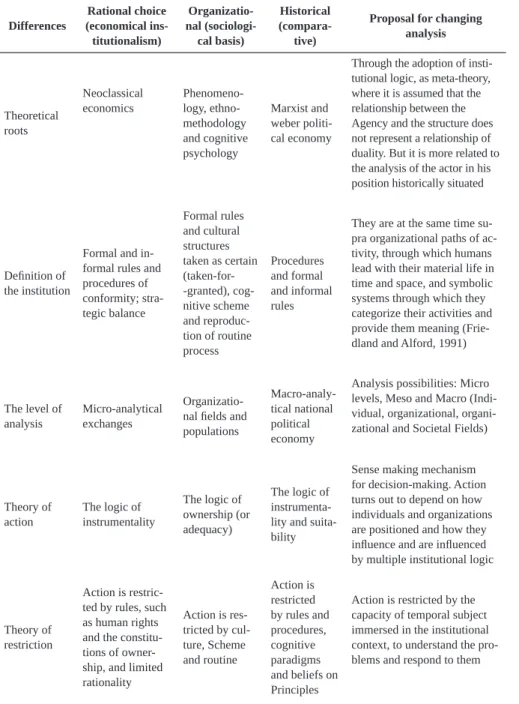
Based on these considerations and what has already been discussed until the present moment, we show in Table 2, a proposal for analysis of the change by the three institutionalist strands, through the logical perspective. Table 2 has as a basis of comparison Table 1 presented earlier.
Table 2 – Differences and Proposal for analysis for the institutionalist, rational, sociological and historical perspectives
Differences (economical ins-Rational choice titutionalism) Organizatio-nal (sociologi-cal basis) Historical (compara-tive)
Proposal for changing analysis
Theoretical roots
Neoclassical
economics Phenomeno-logy, ethno-methodology and cognitive psychology Marxist and weber politi-cal economy
Through the adoption of insti-tutional logic, as meta-theory, where it is assumed that the relationship between the Agency and the structure does not represent a relationship of duality. But it is more related to the analysis of the actor in his position historically situated
Definition of the institution
Formal and in-formal rules and procedures of conformity; stra-tegic balance Formal rules and cultural structures taken as certain (taken-for--granted), cog-nitive scheme and reproduc-tion of routine process Procedures and formal and informal rules
They are at the same time su-pra organizational paths of ac-tivity, through which humans lead with their material life in time and space, and symbolic systems through which they categorize their activities and provide them meaning (Frie-dland and Alford, 1991)
The level of
analysis Micro-analytical exchanges
Organizatio-nal fields and populations
Macro-analy-tical national political economy
Analysis possibilities: Micro levels, Meso and Macro (Indi-vidual, organizational, organi-zational and Societal Fields)
Theory of
action The logic of instrumentality
The logic of ownership (or adequacy)
The logic of instrumenta-lity and suita-bility
Sense making mechanism for decision-making. Action turns out to depend on how individuals and organizations are positioned and how they influence and are influenced by multiple institutional logic
Theory of restriction
Action is restric-ted by rules, such as human rights and the constitu-tions of owner-ship, and limited rationality Action is res-tricted by cul-ture, Scheme and routine Action is restricted by rules and procedures, cognitive paradigms and beliefs on Principles
Action is restricted by the capacity of temporal subject immersed in the institutional context, to understand the pro-blems and respond to them
In the last column of the table, we have a proposal for analysis of the change from the different elements – Institutionalist, rational, sociological and historical pers-pectives. That is, the proposal is that the change researcher is open to the use of diffe-rent approaches in the same study. For example, if we look at the change that occurs in the levels micro, meso and macro (instead of opting for only one level of analysis), it is likely to find explanations for a level at another level. The recognition of each one of these levels has stimulated the development of fruitful way of institutional theory and research (SCOTT, 2008), a larger amount of empirical studies developed in diffe-rent levels of analysis could contribute to new discoveries in the field.
Looking now to the institutions. Considering that they are at the same time su-pra-organizational paths of activity, through which humans lead with their material life in time and space, and symbolic systems through which categorize their activities and provide them meaning, we can suggest that: in an analysis of institutions for explanation of change, the researcher will be able to identify and evaluate the formal rules, cultural struc-tures (taken-for-granted), cognitive scheme, looking the aspect temporality, considering also the history and the meanings immersed in social relations. After all, the researchers cannot wait to understand the social behavior, without taking into account the meanings that intermediate the social action, as Scott (2008) recalls, supported by Weber.
When it is contrasted the Norton’s rationalist vision to the sociological approach, it is perceived in common the observation that multiple institutional logic exists and they compete for attention points, it is emphasized the importance of the examination of the institutional arenas or relational contexts. Thornton (2002), under the perspective of organizational institutionalism (basic sociological) emphasizes that by means of institutional moderate pressures, companies define problems and become sensitive to different market conditions, determining that organizational strategies and structures are likely to be taken to resolve their problems.
Thus, we emphasize that the concept of institutional logic is more appropriate for the understanding of change, for two reasons:
a) it does not reduce the action of the actors to intentionality as the rationa-list approach;
b) it does not reduce the process of change to the variables culture, techno-logy and State, but makes it possible simultaneously the analysis of indi-vidual levels, organizational, organizational field, and macro institutio-nal, as the World Sector (FRIEDLAND; ALFORD, 1991; THORNTON; OCASIO; LOUNSBURY, 2012).
In this sense, Thornton and Ocasio (2008) affirm that the approach of the institutional logic is able to solve the problem of “immersed agent” in institutional environment to conceptualize society as an interinstitutional environment in which the logic is characterized by cultural differentiation, fragmentation and contradiction. So, the authors focus on three mechanisms for change: institutional entrepreneurship, overlap structural and sequence of historic event.
Still, the institutional logic of perspective suggests that the mechanisms are rela-tively universal to the status of contestation and power within organizational fields, condi-tioned by prevailing institutions (THORNTON; OCASIO, 2008). We must also consider that the institutional logic can be responsible for identities alteration, as well as identities can also be responsible for changes in logic, as suggested by Thornton, Ocasio and Lou-nsbury (2012). The authors argue that changes in practice and organizational identities generally occur together and that, therefore, is still needed a greater understanding of their effects and how their mutuality occurs with the institutional logic. Thus, the authors also consider that the understanding of how and to what extent logical changes are related to changes in practices and identities is a matter which still requires empirical research.
In addition to the problem of identity in organizational studies and their poten-tial use in the perspective of institutional logic, it is necessary to consider the question of the diversity of identities in the organizational context. According to Kodeih (in press) literature about organizational identity has also been presented with the challenge of the understanding that the organizations are faced with multiple identities. The study of Ba-ttilana and Dorado (2010) reveals that the maintenance and development of hybrid or-ganizations, for example, depends on the creation of a common organizational identity that works as a mediator between the logic that they match. Other studies also highlight that the institutional logic only influence the attitudes and actions only after specifying the identity to invoked and positioned (HEIMER, 1999; KRAATZ; BLOCK, 2008).
Finally, we have that the relationship between identity and institutional logic viewed through the dynamics of power. At this point, Thornton and Ocasio (2008) affirm that the institutional logic shape and create relations by which the status and power can be obtained, maintained and lost in organizations. And reinforce that the mechanism by which the institutional logic shapes the cognition of individuals, it is through the classification and social categorization. Given the institutionalization of cate-gories, individuals go to take for granted certain categories that identify a set of values, practices and even organizations such as the categories of corporate governance, human resources and multidivisional structures. That is, these categories are socially constructed and shared, however, they are not categories that they exist naturally, but institutionalized.
The previous arguments reinforce our vision that the institutional change (among other themes of organizational studies) would have greater power of expla-nation (but not only single), if it were investigated and analyzed from the perspective of institutional logic.
With respect to the analysis of institutional change, we propose for institutio-nalist strands analysis through mechanisms that explain at individual level and collec-tive action A 1 – n involved in the event or variable I – for understanding the social level (as well as an event or variable I lead or causes a change in variable or event O). For this reason, we aimed at provoking researchers from institutionalist strand understand how and why, when faced with a problem Pn (Problem 1, 2, 3...) and em-powered with cognition habits and action Hn, along with other resources, consider the response Rn to the most feasible one to be taken. Thus the structure S should be then being made by all relations A1-N-P1-n-H1-N-R1-n that, the aggregate or sequentially, compose the relationship I-O (GROSS, 2011).
In this sense, to understanding of the process or structure S, we must examine how multiple institutional orders M (different rationalities) shape the cognition C of individual and collective is actors.
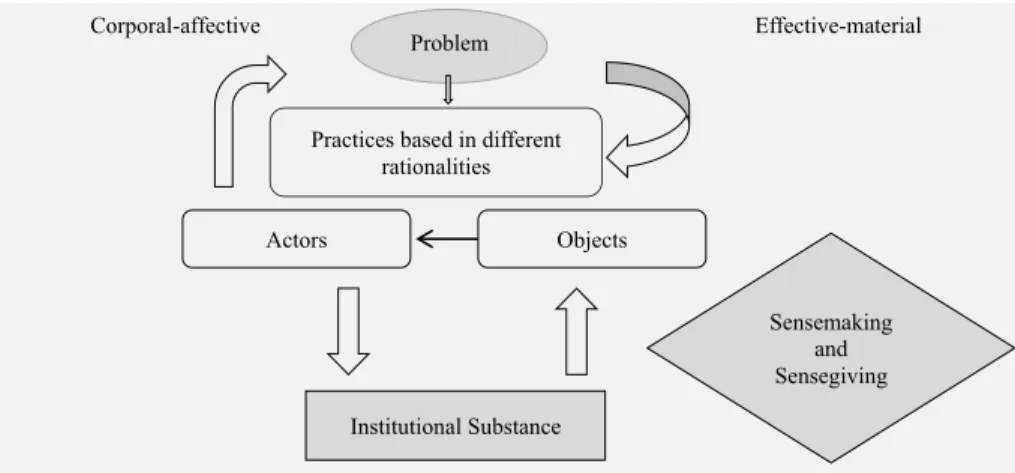
According to Friedland et al. (2014) to better understand Institutional Logics we have to considers that the production of value occurs by actor’s practices that are influenced and created by Institutional Substance. Including our argument in his fra-mework, we actually have the Figure 1.
Figure 1 – Elements of Institutional Logics
Source: adapted from Friedland et al. (2014, p. 338).
Corporal-affective Effective-material
Practices based in different rationalities Actors Objects Problem
f
Institutional Substance Sensemaking and SensegivingBased in what Weber considers the “gods” of the values spheres, Friedland (2013) says that institutional substance can be understood as the unobservable but essential “value”. So, this way the objects of institutional life are meaningful, ready--at-hand in a particular way, that is, they only exist as collective representations or by the process of sensegiving and sensemaking through the resolution of problems in every day life.
Indeed, according Friedland (2009), that institutional logics are both media for subjectification in that they enable and possess practitioners, and of objectification in that those practices, and hence the subjects, hinge on their symbolic and performa-tive production of objects.
5 FINAL CONSIDERATIONS
The three approaches of institutional theory privilege studies that try to ex-plain the change and persistence of institutions. The fact is that the change is a long and complex process. To build a new “collective commitment” to a new system of values is required an intentional action on the part of many members of society. In this process, the agents of institutional change are crucial (NORTH, 1990). In addition to game of interests, conflict and the struggle for power, the analysis of institutio-nal change should also include mechanisms for social learning and experimentation, as Meyer and Rowan (2006) externalize. In dynamic approach of institutional chan-ge, the analysis focuses on the explanation of the process, which implies a historical analysis in which it is involved in real time (NORTH, 1990).
New logic (which presuppose institutional change), as emphasized by Purdy and Gray (2009), are transmitted by institutional entrepreneurs, promoting new or-ganizational practices, ratified by existing institutions. Far from suggesting a linear trajectory, the search results suggest that models of institutionalization need reflect complex patterns of political movements and reactions between the different levels of action that make up these processes (PURDY; GRAY, 2009). We reiterate, not only as regards the models of institutionalization, but also as the deinstitutionalization proces-ses of actions, regulations, standards and organizational practices.
It is important to emphasize that on institutional logic (GREENWOOD et al., 2011; PURDY; GRAY, 2009) treats conflicting multiple logics and complemen-tary that interact among themselves, departing from the idea of dominant logic. This multiple logic can be or cannot be mutually incompatible. The propose of institutional logic still needs to be empirically tested to assess the potential of its contribution, as
we understand the extent to which this logic imposes challenges and tensions to the organizations (FRIEDLAND; ALFORD, 1991; KRAATZ; BLOCK, 2008).
In short, from the matters specified and discussed, we believe that to unders-tand the process of institutional change, it is necessary to undersunders-tand the mechanisms underlying the processes by which institutional models prevailing in a social context (country or organization or field) may or may not occur in another. In addition, it is also necessary to understand the strategies of action from the concept of practices and identity. Thus, only a theoretical integrating conceptualization of perspectives is ca-pable of clarifying the conditions under which we can expect that any one of two pro-cesses may help explain the different directions that the institutional change may take. We agree with Berger and Luckmann (1985), when they say that society will exert influence throughout the course of human development. The importance of the historical context already a long time has been emphasized by different epistemologi-cal perspective, when investigating and treating the objects of social sciences within a development course revealed by history.
We believe that the temporality is one of the complementary factors with ex-planatory power on change and institutional logics, having in view that the influential factors are better understood from a historical analysis, i.e., by means of observation and analysis of the institutional changes that occur over time.
Possibly, the achievement of other empirical studies (in addition to those that have been mentioned in this work) on conflicts and institutional logic, will contribute to broaden and deepen the understanding of institutional change (and questions still not explained), especially the studies that favor the longitudinal perspective.
REFERENCES
ALFORD, R.; FRIEDLAND, R. Powers of theory: capitalism, the state, and de-mocracy. Cambridge: Cambridge University Press, 1985.
BATTILANA, J.; DORADO, S. Building sustainable hybrid organizations: the case of Commercial Microfinance Organizations. Academy of Management Journal, v. 53, i. 6, p. 1419-1440, 2010.
BERGER, P.; LUCKMANN, T. A construção social da realidade. 6. ed. Petropolis: Vozes, 1985.
BOURDIEU, P. Outline of a theory of practice. New York: Cambridge University Press, 1977.
CALVERT, R. The rational choice theory of social institutions. In: BANKS, J.; HA-NUSHEK, E. (Ed.). Modern Political Economy. New York: Cambridge University Press, 1995.
CAMPBELL, J. L. Institutional change and globalization. Princeton: Princeton University Press, 2004.
CAPOCCIA, G.; KELEMEN, R. D. The study of critical junctures: theory, narrative, and counterfactuals in historical institutionalism. World Politics, v. 59, i. 3, p. 341-369, 2007.
CLARK, P.; ROWLINSON, M. The treatment of History in Organization Studies. Towards an ‘Historic Turn’? Business History, v. 46, i. 3, p. 331-352, 2004. DELLAPOSTA, D.; NEE, V.; OPPER, S. Endogenous dynamics of institutional change. Rationality and Society, 2016.
DIMAGGIO, P. J. Interest and agency in institutional theory. In: ZUCKER, L. G. Institutional patters and organizations: culture and environment. Cambridge: Ballinger, 1988.
DIMAGGIO, P. J.; POWELL, W. The new institutionalism in organizational analysis. Chicago: University of Chicago Press, 1991.
EMIRBAYER, M.; MISCHE, A. What is agency? The American Journal of So-ciology, v. 103, i. 4, p. 962-1023, 1998.
FRIEDLAND, R.; ALFORD, R. R. Bringing society back in: symbols, practices, and institutional contradictions. In: POWELL, W.; DIMAGGIO, P. (Ed.). The new institutionalism in organizational analysis. Chicago: The University of Chicago Press, 1991.
FRIEDLAND, R. et al. The institutional logics of love: measuring intimate life. Theory and Society, v. 43, i. 3, p. 333-370, 2014.
FRIEDLAND, R. God, love and other good reasons for practice: Thinking through institutional logics. In: LOUNSBURY, M.; Boxenbaum, E. (Ed.) Institutional logics in action: research in the sociology of organizations, v. 39, part A, p. 25-50, 2013. FRIEDLAND, R. Institution, practice, and ontology: Toward a religious sociology. Research in the Sociology of Organizations, v. 27, i. 1, p. 45-83, 2009.
FRIEDLAND, R. The Value of Institutional Logics. Working Paper, [n.d.]. GARUD, R.; JAIN, S.; KUMARASWAMY, A. Institutional entrepreneurship in the sponsorship of common technological standards: the case of Sun Microsystems and Java. Academy of Management Journal, v. 45, i. 1, p. 196-214, 2002.
GIDDENS, A. A constituição da sociedade. 2. ed. São Paulo: Martins Fontes, 2003. GREENWOOD, R. et al. Institutional Complexity and Organizational Responses, The Academy of Management Annals, v. 5, i. 1, p. 317-371, 2011.
GREENWOOD, R. et al. Introduction. In: GREENWOOD, R. et al. (Ed.) The Sage handbook of organizational institutionalism. London: Sage Publications, 2008. GROSS, D. Recovering low-rank matrices from few coefficients in any basis. IEEE Transactions on Information Theory, v. 57, i. 3, p. 1548-1566, 2011.
HEIMER, C. A. Competing institutions: Law, medicine, and family in neonatal in-tensive care. Law & Society Review, v. 33, i. 1, p. 17-66, 1999.
HUGHES, E. C. The ecological aspect of institutions. American Sociological Re-view, v. 1, i. 2, p. 180-189, 1936.
JEPPERSON, R. Institutions, institutional effects, and institutionalism. In: DIMAG-GIO, P.; POWELL, W. (Ed.). The new institutionalism in organizational analysis. Chicago: University of Chicago Press, 1991.
KATZNELSON, I. Periodization and preferences: reflections on purposive action in comparative historical social science. In: MAHONEY, J.; RUESCHEMEYER, D. (Ed.). Comparative historical analysis in the social sciences. Cambridge: Cam-bridge University Press, 2003.
KIESER, A. Why organization theory needs historical analyses. Organization
Sci-ence, v. 5, i. 4, p. 608-620, 1994.
KODEIH, F. Coping with Institutional Complexity through Identity. Working Paper (in press).
KRAATZ, M. S.; BLOCK, E. S. Organizational implications of institutional plural-ism. In: GREENWOOD, R. et al. (Ed.). Handbook of Organizational Institution-alism. London: Sage, 2008.
LEVI, M. A model, a method and a map: rational choice in comparative and his-torical analysis. In: LICHBACH, M. I.; ZUCKERMAN, A. S. (Ed.). Comparative politics: rationality, culture, and structure. New York: Cambridge University Press, 1997.
LOUNSBURY, M. A Tale of Two Cities: Competing Logics and Practice Variation in the Professionalizing of Mutual Funds. Academy of Management Journal, v. 50, i. 2, p. 289-307, 2007.
MACHADO-DA-SILVA, C.; FONSECA, V.; CRUBELLATE, J. M. Estrutura, agên-cia e interpretação: elementos para uma abordagem recursiva do processo de institu-cionalização. Revista de Administração Contemporânea, v. 14, p. 77-107, 2010. (Special Edition).
MAHONEY, J.; THELEN, K. A. Theory of gradual intitutional change. In: MA-HONEY, J.; THELEN, K. (Ed.). Explaining institutional change: ambiguity, agen-cy and power. Cambridge: Cambridge University Press, 2010.
MEYER, H. D.; ROWAN, B. Institutionalized organizations: formal structure as myth and ceremony. American Journal of Sociology, v. 83, i. 2, p. 340-363, 1977. MEYER, J. W.; ROWAN, B. Institutional analysis and the study of education. In: MEYER, H-D.; ROWAN, B. The new institutionalism in education. Albany: State University of New York Press, 2006.
NIGAM, A.; OCASIO, W. Event attention, environmental sensemaking, and change in institutional logics: An inductive analysis of the effects of public attention to Clinton’s health care reform initiative. Organization Science, v. 21, i. 4, p. 823-841, 2010.
NORTH, D. C. Institutions, institutional change and economic performance. New York: Cambridge University Press, 1990.
OKHUYSEN, G.; BONARDI, J. P. Editor’s comments: the challenge of building theory by combining lenses. Academy of Management Review, v. 36, i. 1, p. 6-11, 2011.
PALIER, B. Ambiguous agreement, cumulative change: French social policy in the 1990s. In: STEECK, W.; THELEN, K. (Ed.). Beyond continuity: institutional change in advanced political economies. Oxford: Oxford University Press, 2005.
PARSONS, T. Suggestions for a sociological approach to the theory of organiza-tions. Administrative Science Quarterly, v. 1, i. 1, p. 63-85, 1956.
PURDY, J. M.; GRAY, B. Conflicting logics, mechanisms of diffusion, and multilev-el dynamics in emerging institutional fimultilev-elds. Academy of Management Journal, v. 52, i. 2, p. 355-380, 2009.
SCHICKLER, E. Disjointed pluralism: institutional innovation and the develop-ment of the U.S. Congress. Princeton: Princeton University Press, 2001.
SCOTT, W. R. Institutions and organizations. 2. ed. Thousand Oaks: Sage, 2001. SCOTT, W. R. Institutions and organizations: ideas and interests. 3. ed. London: Sage Publications, 2008.
SCOTT, W. R.; MENDEL, P.; POLLACK, S. Environments and fields: studying the evolution of a field of medical care organizations. In: POWELL, W. W. Remaking the iron cage: institutional dynamics and processes. Chicago: University of Chicago Press, 1997.
SHAPIRO, I. Training for racial equity and inclusion: a guide to selected pro-grams. WashingtonDC: O Instituto Aspen.: The Aspen Institute, 2002.
SHEPSLE, K. A. Reforming the state: political to the core. Centennial Lecture LSE, 1998.
SHIPILOV, A. V.; GREVE, H. R.; ROWLEY, T. When do interlocks matter? Institu-tional logics and the diffusion of multiple corporate governance practices. Academy of Management Journal, v. 53, i. 4, p. 846-864, 2010.
THELEN, K. How institutions evolve: the political economy of skills in Germany, Britain, the United States, and Japan. New York: Cambridge University Press, 2004. THORNTON, P. H.; JONES, C.; KURY, K. Institutional logics and institutional change in organizations: Transformation in accounting, architecture, and publishing. Transformation in Cultural Industries. Research in the Sociology of Organizations, v. 23, special i. p. 125-170, 2005.
THORNTON, P. H. Markets from culture: institutional logics and organizational decisions in higher education publishing. Stanford: Stanford University Press, 2004.
THORNTON, P. H.; OCASIO, W. Institutional Logics and the Historical Contin-gency of Power in Organizations: Executive Succession in the Higher Education Publishing Industry, 1958-1990. American Journal of Sociology, v. 105, i. 3, p. 801-843, 1999.
THORNTON, P. H.; OCASIO, W. Institutional logics. The SAGE handbook of organizational institutionalism. London: Sage Publications, 2008.
THORNTON, P. H.; OCASIO, W.; LOUNSBURY, M. The institutional logics per-spective. Oxford: Oxford University Press, 2012.
THORNTON, P. H. The rise of the corporation in a craft industry: conflict and con-formity institutional logics. Academy of Management Journal, v. 45, i. 1, p. 81-101, 2002.
ZUCKER, L. G. The role of institutionalization in cultural persistence. American Sociological Review, v. 42, i. 5, p. 726-743, 1977.
Como citar este artigo: ABNT
COSTA, Mayla Cristina; MELLO, Cristiane Marques de. Change and institutional logic: overview and proposal of analysis of different institutionalist approaches. RACE, Revista de Administração, Contabilidade e Economia, Joaçaba: Ed. Unoesc, v. 16, n. 1, p. 175-202, jan./abr. 2017. Disponível em: <http://editora. unoesc.edu.br/index.php/race>. Acesso em: dia/mês/ano.
APA
Costa, M. C., & Mello, C. M. de. (2017). Change and institutional logic: overview and proposal of analysis of different institutionalist approaches. RACE, Revista de Administração, Contabilidade e Economia, 16(1), 175-202. Recuperado em dia/mês/ ano, de http://editora.unoesc.edu.br/index.php/race