
PROJECT MANAGEMENT AND BUSINESS ANALYSIS: AN
ANALYSIS OF COFIDIS PORTUGAL
Mariana de Albuquerque Veloso Machado
Dissertation submitted as partial requirement for the conferral of
Master in Science in Business Administration
Supervisor:
Prof. Doutor Leandro Pereira, Prof. Auxiliar Convidado, ISCTE Business School
Alone we can do so little; together we can do so much. - Hellen Keller
Abstract
Project managers and business analysts are more and more critical in nowadays’ companies. This dissertation explores the role of the business analyst and project manager at Cofidis Portugal, aiming at three main goals: to find out whether these roles are clear for the project team; to understand how the PM-BA/BA-PM relationship is perceived, and; to outline opportunity measures for both project management and business analysis.
More than understanding the how project managers and business analysts perceive each other’s roles, this research intends to show a 360º overview of the roles of project manager and business analyst. This means that the perspective of the reality shown in this research is not only from the project manager’s or business analyst’s point of view, but from all project stakeholders’ point of view. To reach this goal, 57 answers from project team members from different areas at Cofidis Portugal were analyzed.
The findings show that project team members are generally aware of project management and business analysis tasks. However, the respondents find overlapping tasks between both areas. Although they define the PM-BA/BA-PM relationship as neutral, they also agree on the fact that there is room for improvement. As for improvement measures, three are suggested: fostering a PM-BA/BA-PM partnership, implementing a dynamic team and improve business knowledge.
Palavras chave: Administration, Business Administration JEL Classification System: M0, M1
Resumo
Gestores de projeto e analistas funcionais são cada vez mais importantes nas empresas de hoje em dia. Esta dissertação explora a função de Analista Funcional e Gestor de Projeto na Cofidis Portugal. Esta investigação tem três objetivos: perceber se estas funções estão claras para a equipa de projeto; entender como a relação entre Gestor de Projeto e Analista Funcional/Analista Funcional – Gestor de Projeto é percecionada; e delinear os eixos de melhoria para a Gestão de Projeto e Análise Funcional.
Mais do que perceber como o gestor de projeto e analista funcional percecionam as funções de cada um, esta pesquisa visa mostrar uma análise 360º sobre a função de gestor de projeto e de analista funcional. Isto significa que a perspetiva da realidade mostrada nesta pesquisa não é apenas do ponto de vista de um gestor de projeto ou analista funcional, mas sim do ponto de vista de todos os stakeholders de projeto. De forma a atingir este objetivo, 57 respostas provenientes de membros das equipas de projeto de várias áreas na Cofidis Portugal foram analisadas.
Os resultados indicam que os membros da equipa de projeto têm a noção das tarefas de gestão de projeto e análise funcional. Não obstante, os inquiridos encontram tarefas sobrepostas entre as duas áreas. Apesar destes definirem a relação gestor de projeto-analista funcional/projeto-analista funcional – gestor de projeto como neutra, também concordam com o facto que existe espaço para melhorias. Em relação a sugestões de melhoria, três são sugeridas: fomentar uma parceria entre o gestor de projeto-analista funcional/analista funcional – gestor de projeto, implementar uma equipa dinâmica e melhorar o conhecimento do negócio.
Palavras chave: Gestão, Gestão de Empresas JEL Classification System: M0, M1
Acknowledgments
I must express my profound gratitude to everyone that I know at Cofidis Portugal, for their unconditional support. A very special thank you to Armanda Azevedo, Regina Gomes and Benjamim Simões for allowing me to conduct this research at Cofidis.
I am extremely thankful to Luís Rito, who took the time to proofread my work.
Also, I would like to thank my supervisor Prof. Doutor Leandro Pereira for his input through the process of writing this dissertation.
Finally, I would like to thank my family and friends for providing me continuous encouragement to reach my goal
Index
Abstract ... I Resumo ... II Acknowledgments ... III List of Figures ... VI Glossary ... VII Chapter I – Introduction ... 1Chapter II - Literature review ... 3
2.1 Project Management and Business Analysis ... 3
2.2 Institutes and Bodies of Knowledge ... 5
2.2.1 Project Management Institute (PMI) and PMBOK 5th edition ... 6
2.2.2 International Institute of business analysis (IIBA) and BABOK V3 ... 10
2.2.3 Comparison between PMI and IIBA approaches ... 11
2.2.4 PMBOK Guide 6th edition – a game changer? ... 24
2.2.5 Thoughts on IIBA and PMI approaches ... 25
2.3 The challenge of collaboration ... 26
Chapter III – Methodology ... 29
3.1 Context ... 29
3.2 Research questions ... 30
3.3 Target chosen ... 31
3.4 Approach ... 32
3.5 Research design ... 33
3.6 Pilot testing: Pretesting ... 37
Chapter IV – Findings ... 38
4.1 The respondents ... 39
4.1.1. Number of respondents ... 39
4.1.2 Years of experience ... 40
4.2 Project Manager and Business analyst roles and responsibilities ... 41
4.3 Perceptions of the value of Project Managers and Business Analysts ... 45
4.4 Perceptions of the PM-BA/BA-PM relationship ... 49
4.4.1 Relationship between the PM and the BA (PM-BA/BA-PM) ... 49
4.4.2 Impact on deliverables ... 50 4.5 Improvement areas ... 51 4.5.1 Project Management ... 51 4.5.2 Business Analysis ... 52 4.6 Comments/Feedback ... 54 4.7 Discussion ... 54
Chapter V – Conclusions and further research ... 61
5.1 Conclusions ... 61
5.2 Limitations ... 63
5.3 Further study ... 64
References ... 65
A. Non Electronic documents ... 65
B. Electronic documents ... 67
Appendix I – Comparison between PMI and IIBA ... 69
Appendix II – Comparison between PMI and IIBA guides ... 70
List of Figures
Figure 1 – KAs in Project Management Institute (2013) [self-constructed] ... 7
Figure 2 – Domains in Project Management Institute (2015) [self-constructed] ... 8
Figure 3 – PMI certifications - Project Management Institute (2017c) [self-constructed] ... 9
Figure 4 – IIBA certifications - International Institute of Business Analysis (2017b) [self-constructed] .. 10
Figure 5 – KAs in International Institute of Business Analysis (2015a) [self-constructed] ... 11
Figure 6 – Main changes in BABOK Knowledge areas from version 2 to version 3 [self-constructed] ... 12
Figure 7 – Stakeholders in International Institute of Business Analysis (2015a) and Project Management Institute (2013) [self-constructed] ... 16
Figure 8 – Requirements classification (International Institute of Business Analysis, 2015a; Project Management Institute, 2013) [self-constructed] ... 18
Figure 9 – Collect requirements task, in Project Management Institute (2013) ... 19
Figure 10 – PMBOK-BABOK mapping proposed by Maritato (2012) [self-constructed] ... 21
Figure 11 –International Institute of Business Analysis (2015a) KAs and Project Management Institute (2015; 2016) domains [self-constructed] ... 23
Figure 12 –Integration of Business Analysis in Project Management Process Groups, in Project Management Institute (2016) ... 24
Figure 13 – Mapping the research questions to survey questions [self-constructed] ... 33
Figure 14 – Mapping the findings section to survey and research questions [self-constructed] ... 38
Figure 15 – Inquired vs respondents per area [self-constructed] ... 39
Figure 16 – Respondents per area [self-constructed] ... 40
Figure 17 – Years of experience [self-constructed] ... 40
Figure 18 – Project Management tasks [self-constructed] ... 41
Figure 19 – Business analysis tasks [self-constructed] ... 42
Figure 20 – Degree of definition of PM and BA tasks [self-constructed] ... 44
Figure 21– Perceptions of the degree of definition of PM and BA tasks [self-constructed] ... 44
Figure 22– Perceptions of Project Managers and Business Analysts [self-constructed] ... 46
Figure 23– Impacts on the absence of a business analyst [self-constructed] ... 47
Figure 24– Impacts on the absence of a project manager [self-constructed] ... 48
Figure 25– Perceptions on the BA-PM/PM-BA relationship[self-constructed] ... 49
Figure 26– Impact of PM-BA/BA-PM relationship on deliverables [self-constructed] ... 50
Figure 27 – Opportunities to improve the Project Management sector [self-constructed] ... 51
Figure 28 –Other perceptions on how to improve the Project Management sector [self-constructed] ... 52
Figure 29 – Opportunities to improve the Business Analysis sector [self-constructed] ... 53
Figure 30 –Other perceptions on how to improve the Business Analysis sector [self-constructed] ... 53
Glossary
BA – Business Analyst
BABOK – Business Analysis Body of Knowledge BOK – Body of Knowledge
IIBA – International Institute of Business Analysis KA – Knowledge Area
PM – Project Manager
PMBOK – Project Manager Body of Knowledge PMI – Project Management Institute
Chapter I – Introduction
Over the years, it has become obvious that both project management and business analysis add value to an organization (Carkenord, 2005; Carkenord et al., 2010; Chan, 2011; Wysocki, 2011; Maritato, 2012; James, 2015; Pullan, 2015; Project Management Institute, 2015).
While project management is a widely-known area in the project industry, business analysis professionals face uncertainty when it comes to professional recognition (Paul et al., 2014; James, 2015; Pullan, 2015). Although these two professionals may not have the same level of recognition, they should complement each other, working side by side in order to achieve project success (Chan, 2011; Wysocki, 2011; Maritato, 2012; Pullan, 2015). In fact, according to Project Management Institute (2016) “67% of high performing organizations value collaboration between project managers and business analysts”.
The reason why these professionals are strategic to nowadays’ companies (Maritato, 2012) is because they have different roles that can leverage project success. Although we can find in the literature several definitions of the roles of project manager and business analyst, (Carkenord, 2005; Maritato, 2012; Pullan, 2015), based on the institutes of reference (International Institute of Business Analysis, 2015a; Project Management Institute, 2016), we can have the following short, non-comprehensive definitions: project managers are responsible for achieving project objectives, while business analysts identify needs (requirements) and recommend solutions in accordance to those needs.
However, defining these roles is not as easy as it may seem. In fact, overlaps in tasks can be found between these two roles (Carkenord, 2005; Carkenord et al., 2010; Chan, 2011; Maritato, 2012; James, 2015; Pullan, 2015; Project Management Institute, 2016) that can lead to confusion between business analysis and project management. That is why the roles that professionals should perform in each area should be clear (Carkenord et al., 2010).
to project managers on how to deal with business analysts. We can also find authors aiming at integrating Business Analysis practices in Project Management (Maritato, 2012; Project; Project Management Institute, 2016). Nonetheless, we cannot find a both integrative and inclusive overview on how project managers and business analysts should interact in a project context.
This research intends to show a 360º overview of the role of project manager and business analyst in a specific reality - Cofidis Portugal. This means that the perspective of the reality shown in this research is not only from the project manager’s or business analyst’s point of view, but from all project stakeholders’ point of view (Project Managers, Business Analysts, IT professionals, Continuous improvement team members, Testers and Business areas members).
Ultimately, this research aims to understand three aspects: whether these roles are clear for the project team; how business analysis and project management is perceived at Cofidis Portugal; and which are the improvement measures could be implemented in the name of project success. This approach allows us to have a comprehensive overview on the perception the company has of these two roles and the steps we can take to improve project management and business analysis at Cofidis Portugal.
In terms references for project management and business analysis practices, a great emphasis is given to PMBOK®, BABOK® and PMI® Practice Guides (Project Management Institute, 2015; Project Management Institute, 2016). These are the reference guides from Project Management Institute® and International Institute of Business Analysis®.
Chapter II - Literature review
2.1 Project Management and Business Analysis
Although the construction of Egypt Pyramids is usually referred as an example of the beginning of project management, this discipline has formally appeared in the 50s. In fact, the first published papers came in 1958 (Snyder, 1987), tackling scheduling methods like Critical Path Method (CPM) and Program Evaluation and Review Technique (PERT) (Pinney, 2000).
It was over the 90s that project management became popular, breaking from Traditional Project Management to Modern Project Management (Kerzner, 2009). This change happened mostly due to the period of recession experienced from 1989 to1993 as well as the increase in focus on scheduling (Kerzner, 2009).
However, project management has considerably changed in the last years.According to Project Management Institute (2013), “project management is the application of knowledge, skills, tools, and techniques to project activities to meet the project requirements”.
Regarding Business Analysis, it is believed that it started around the 50s, with the beginning of the first computer applications (Wysocki, 2011). However, is not as widely known as Project Management. In fact, (Paul et al., 2014) argue that business analysis is not widely known in the academic research. James (2015) goes deeper, classifying the uneasiness to accept this area as the biggest challenge business analysts can face.
According to International Institute of Business Analysis (2015a) “business analysis is the practice of enabling change in an enterprise by defining needs and recommending solutions that deliver value to stakeholders”. Project Management Institute (2015) has a similar definition of Business analysis, describing it as “the set of activities performed to identify business needs, recommend relevant solutions, and elicit, document and manage requirements”.
On the other hand, Chan (2011) defends that business analysis is “the art of helping business people and solution people understand one another”. This author also defends that business analysts can be considered as a bridge business areas and developers (Chan, 2011).
James (2015) puts it simple way by saying that the role of business analyst is “to analyze business”. Despite the simple definition provided by James (2015), the author defends that the biggest difficulties in identifying business analyst as a project role arises from the fact that a business analyst can have several job titles. Also, James (2015) refers that the title “business analyst” can cause confusion because it is composed by two words that have a broad meaning: “business” and “analyst”.
Thus, this project role can be confused with several other roles, for instance, with a financial business analyst. Although there is a big difference between business analysts and financial business analyst tasks, there is another important difference when it comes to organization - in accounting’s job hierarchy, the role “analyst” refers to a position below the role of “manager” (James, 2015). This fact can contribute for the lack of knowledge when it comes to business analysis tasks and purpose.
In the past, Business analysis was formerly focused on Information Technology, but nowadays it is also focused on the development of new products and services (Paul et al., 2014). However, as the Business analysis profession started developing, overlapping tasks between project managers and business analysts came up (Wysocki, 2011).
In fact, authors have established comparisons in terms of definitions between project managers and Business Analysts (Carkenord, 2005; Maritato, 2012; Pullan, 2015). Carkenord (2005) defends that the Project Manager is responsible for the product deliverance “on time and within the budget”, while the Business analyst assures that the “product is built according to the requirements and is built correctly”. Maritato (2012) says that the project manager’s focus is placed on the “product, service or result of the project”, while the business manager’s focus is placed on the stakeholder’s needs. Pullan (2015) makes it simpler: while the project manager is focused on the “scope of the project”, the business analyst is focused on the “scope of the solution”.
In the case of organizations where an individual is required to perform both roles, Carkenord (2005) suggests that an “internal debate” may be experienced due to the existence of overlaps when performing the roles of project manager and business analyst. However, when there is both a project manager and a business analyst, the relationship between them is described as “the dynamic duo” (Carkenord, 2005.; Mariatato, 2012).
Facing the actual differences between these professions, training from professional institutes, such as PMI and IIBA are important (Carkenord, 2005).
Concerning degree of knowledge in the project industry on Business analysis, James (2015) tells us that in a presentation to 50 project managers given by the author back in 2013, few of them had heard about IIBA at the time. However, this case was not the only one.
In the process of contacting Project Managers to participate in a survey on the relationship between Project Managers and Business Analysts, Pullan (2015) states that most project managers argued that “they didn’t work with business analysts”. Also, some of the project managers inquired did not know that business analysis could be a role in a project (Pullan, 2015).
Finally, the need of defining the profession of the business analyst may come from the fact that there is a lack of knowledge when it comes to the business analysis project role (James, 2015). It is important to understand the differences and similarities between Project Management and Business Analysis. Therefore, there is a need to define the professions of Project Manager and Business Analyst.
2.2 Institutes and Bodies of Knowledge
To clarify necessary tasks and skills for both Project Management and Business Analysis, there are institutes and frameworks for each profession at an international level, such as Project Management Institute (PMI), International Institute of Business Analysis (IIBA), International Project Management Association (IPMA) , Australian Institute of Project Management Standards (AIPM) and Global Alliance for Project Performance Standards (Marion, 2014).
Two Institutes will be considered for the literature review: Project Management Institute (PMI) and International Institute for Business Analysis (IIBA).
IIBA and PMI can provide the necessary details when it comes to defining both professions. These institutes also certify professionals, making sure that they have “the appropriate skill set” (Carkenord, 2005).
Also, several authors have referred the frameworks of IBA and PMI in their publications (Carkenord et al., 2010; Clare, 2011; Maritato, 2012; Zambruski, 2014).
2.2.1 Project Management Institute (PMI) and PMBOK 5th edition
The Project Management Institute (PMI) is a professional association that promotes and certifies project managers. PMI was “founded in 1969 and delivers value for more than 2.9 million professionals” (Project Management Institute, 2017b).
PMI provides the PMBOK Guide – its body of knowledge. According to Project Management Institute (2013), the PMBOK Guide identifies the good practices in terms of Project Management.
This guide is divided into ten Knowledge Areas and five Process Groups. In order to understand the Project Management framework promoted by Project Management Institute (2013), it is fundamental to understand both the Process Groups and the Knowledge areas described in PMBOK 5th edition.
Starting by the Process Groups, it is important to understand that these are not “project life cycle phases” (Project Management Institute, 2013). Instead, once project management is “iterative”, processes from any group can be reused throughout the “project life cycle” (Project Management Institute, 2013), meaning that these processes can be used regardless the project phase.
The Initiating process group is described in Project Management Institute (2013) as the group of processes that are undertaken to delineate “a new phase of an existing project”.
Moving on to Planning Process Group, it is defined as processes undertaken “to establish the total scope of the effort” and to set goals and action plans to reach them. (Project Management Institute, 2013). Concerning the “Executing Process Group”, it is the group of processes that aim at finalizing the work previously planned to meet “project specifications” (Project Management Institute, 2013). The “Monitoring and Controlling Process Group” is detailed as “processes required to track, review, and orchestrate the progress and performance of the project” (Project Management Institute, 2013). Finally, he Closing Process Group consists of processes aimed at finishing all tasks across Process Groups “to formally complete the project, phase or contractual obligations” (Project Management Institute, 2013)
In PMBOK 5th edition, there are 47 “management processes” divided into ten Knowledge
areas (Project Management Institute, 2013). These Knowledge areas can be found in Figure 1.
Apart from PMBOK Guide, PMI also offers Foundational Standards, Practice Standards and Practice Guides. Among these, PMI has two guides related to Business Analysis:
- Business Analysis for Practitioners – A practice Guide, which "describes the work of business analysis and identifies the tasks that are performed in addition to the essential knowledge and skills needed to effectively perform business analysis in programs and projects.". (Project Management Institute, 2015);
- Requirements Management – A Practice Guide, aiming at discussing and defining requirements management work (Project Management Institute, 2016 b).
These guides have different domains. In the table below, we observe the different sections described by Project Management Institute (2015).
Figure 2 – Domains in Project Management Institute (2015) [self-constructed]
On the other hand, Project Management Institute (2016) publication Requirements Management, we can see that these sections are slightly altered.
Thus, instead of the domain “Business Analysis Planning” Project Management Institute (2015), Project Management Institute (2016) presents this section as “Requirements Management Plan”, mentioning the importance of having a “requirements management plan or business analysis plan” for planning project activities. Also, Project Management
Institute (2016) divides “Requirements Elicitation and Analysis” (Project Management Institute, 2015) into two sections: “Requirements Elicitation” and “Requirements Analysis” (Project Management Institute, 2016). Concerning the “Traceability and Monitoring” domain referred in Project Management Institute (2015), Project Management Institute (2016) calls it “Requirements monitoring and controlling”. Finally, Project Management Institute (2016) adds a new domain called “Project or phase closure”, which is meant to describe a “maintenance state” that happens “upon program or phase closure”.
In fact, according to Project Management Institute (2016), this practice guide intends to bridge PMBOK 5TH edition (Project Management, 2013) with Business Analysis for
Practitioners: A Practice Guide (Project Management Institute, 2015).
Besides providing a Book of Knowledge and various Practice Guide, as mentioned before, PMI provides certifications. The certification types can be found in Figure 3.
Figure 3 – PMI certifications - Project Management Institute (2017c) [self-constructed]
All certifications require a certain amount of experience hours (except CAPM® if the individual holds a four-year degree). Also, all certifications mentioned require a certain
2.2.2 International Institute of business analysis (IIBA) and BABOK V3
International Institute of Business analysis (IIBA) is a “non-profit professional association” dedicated to Business Analysis (International Institute of Business Analysis, (2017a). Its goal is to enhance business analysts’ careers by providing information, training and certification in business analysis-related areas.
IIBA was founded in 2003 in Canada. In 2015, it had 29,166 members and 7,344 certification holders (CCBA® and CBAP®) worldwide (International Institute of Business Analysis, 2015b).
This professional association provides A Guide to the Business Analysis Body Of Knowledge (BABOK Guide), the basis of knowledge for all the certifications the association offers.
BABOK aims “to define the profession of business analysis and provide a set of commonly accepted practices” (International Institute of Business Analysis, 2015). In terms of certifications, IIBA offers four certification levels (International Institute of Business Analysis, 2017b), as shown below in Figure 4.
Figure 4 – IIBA certifications - International Institute of Business Analysis (2017b) [self-constructed]
Each certification has a specific exam blueprint, meaning that each certification evaluates BABOK Guide Knowledge Areas with different weights.
According to International Institute of Business Analysis (2015a), there are six BABOK® Guide Knowledge Areas. Each area has a certain number of tasks. Figure 5 describes the Knowledge Areas (KA) and the number of tasks found in each one.
Figure 5 – KAs in International Institute of Business Analysis (2015a) [self-constructed]
2.2.3 Comparison between PMI and IIBA approaches
In order to compare IIBA and PMI approaches, we will compare the Books of Knowledge and Practice Guides from these two professional associations.
However, it is important to note that while we used in this research the latest version of both BOKs (Project Management Institute, 2013; International Institute of Business Analysis, 2015a), authors used the previous versions for their comparisons (Carkenord et al., 2010; Maritato, 2012). Therefore, it is necessary to outline the changes between versions.
Project Management Institute (2013) made 23 changes to the previous PMBOK to have the 5th edition. The biggest changes that can affect the comparison between PMI and IIBA approaches when using 4th edition are the separation of the Project Communications Management Knowledge area into Project Communications Management and Project Stakeholder Management (which, as we have seen in the previous chapters, includes 4 processes) and; four new processes were added to Planning Process Groups (Plan Scope Management, Plan Schedule Management, Plan Cost Management and Plan Stakeholder Management) and one process was added to Monitoring and Controlling Process Groups (Control Stakeholders Engagement). Apart from that, twelve other Processes changed its name or its section (Project Management Institute, 2013).
Concerning the transition from BABOK v2 to BABOK v3, BABOK augmented 50% from the previous version (Larson & Larson, 2015). According to Larson & Larson (2015) The biggest changes were “changes to knowledge areas and tasks” and “expansion of techniques”.
The major changes in BABOK’s knowledge areas can be found in Figure 6, as these will be referred further on.
It is also important to note that PMBOK 5 ed. has an appendix called “FIFTH EDITION CHANGES” (Project Management Institute, 2015, while BABOK v3 (International Institute of Business Analysis, 2013) has an appendix called “Summary of Changes from BABOK® Guide v 2.0”.
Figure 6 – Main changes in BABOK Knowledge areas from version 2 to version 3 [self-constructed]
Thus, in to establish a comparison between PMI and IIBA approaches, the following Books of Knowledge (BOKs) and Practice guides were considered:
- PMBOK Guide 4th edition (Carkenord et al., 2010; Maritato, 2012). 5th edition (Project Management Institute, 2013);
- Business Analysis for Practitioners: A Practice Guide (Project Management Institute, 2015);
- BABOK Guide v3 (International Institute of Business Analysis, 2015)
- Requirements Management: A Practice Guide Project Management Institute, 2016).
Regarding the overall structure of the frameworks promoted by Project Management Institute (2013; 2015; 2016) and International Institute of Business Analysis (2015a), they are quite different. In PMBOK 5TH edition, Project Management Institute (2013) shows
us ten knowledge areas and five process groups, while in BABOK Guide v3 (International Institute of Business Analysis, 2015) has six knowledge areas. “Business Analysis for Practitioners: A practice Guide” (Project Management Institute, 2015) is divided into five “domains”. while Requirements Management: A Practice Guide (Project Management Institute, 2016) has seven main sections
Tasks in BABOK V3 “are organized in the following format: “Purpose, Description, Inputs, Elements, Guidelines/Tools, Techniques, Stakeholders, Outputs” (International Institute of Business Analysis 2015a). On the other hand, tasks in PMBOK 5TH edition are organized into “Inputs, Tools and Techniques and Outputs” (Project Management Institute, 2013).
As for the two Practice Guides, they are based on Project Management Institute (2013) Processes and Knowledge areas, being an “extension” of PMBOK 5th edition (Project Management Institute (2015; 2016).
In the previous sections of this dissertation, we have seen the meaning of Process Groups (Project Management Institute 2013), Knowledge areas (Project Management Institute 2013; International Institute of Business Analysis, 2015a) and sections/domains (Project Management Institute, 2015; 2016), which are part of the different Guides. The table in Apendix II).
Concerning its purpose, the BOKs and guides mentioned above aim to reach different goals: PMBOK 5 edition is a Body of Knowledge for the profession of Project Management, BABOK v3 is a Body of Knowledge for the profession of Business Analysis, Business Analysis for Practitioners: A Practice Guide demonstrates “the practical application of this discipline” (Project Management Institute, 2015) and Requirements Management: A Practice Guide serves as “a bridge” between PMBOK 5 edition and Business Analysis for Practitioners: A Practice Guide (Project Management Institute, 2016).
PMBOK 5th edition and BABOK v3 are the references in Project Management and
Business Analysis. When looking for the definition of “project”, they both define it as “a temporary endeavor to create a unique product, service or result”. (Project Management Institute, 2013; International Institute of Business Analysis, 2015a).
Although these Bodies of Knowledge may share some concepts, there are also differences. In fact, they are built in a different way. PMBOK is purely about project management knowledge, aiming at conveying the “what is generally recognized as good practice” (Project Management Institute, 2013). On the other hand, BABOK, besides conveying the “commonly accepted practices” (International Institute of Business Analysis, 2015a) goes beyond by also “defining the profession of business analysis and (…) help people who work with business analysts to understand the skills and knowledge they should expect from a skilled practitioner” (International Institute of Business Analysis, 2015a). Thus, BABOK (International Institute of Business Analysis, 2015a) provides us a list of popular job titles for business analysts: “business architect, business systems analyst, data analyst, enterprise analyst, management consultant, process analyst, product manager, product owner, requirements engineer, systems analyst”.
Although BABOK ® (International Institute of Business Analysis, 2015a) presents the list above, a greater importance is placed in the tasks of business analyst professional, rather than its job title. In other hand, PMBOK (Project Management Institute, 2013) places a greater focus on the definition of processes and knowledge areas of project management. Regarding the definition of the profession of project manager, PMBOK (Project Management Institute, 2013) only dedicates one page and a half for the to describe the role, responsibilities and project manager’s skills.
This means that while PMBOK (Project Management Institute, 2013) doesn’t aim at the promotion of project management, BABOK (International Institute of Business Analysis, 2015a) puts a real focus on defining and promoting the profession of Business Analyst.
In a joint IIBA-PMI White Paper aiming at comparing both BABOK and PMBOK frameworks, Carkenord et al. (2010) defend that while PMBOK is focused on how to manage projects, BABOK is focused on the responsibilities and value business analysis can add to an organization.
It is interesting to observe that the term “Business Analysis” is not mentioned in PMBOK 5th edition at any time, whilst “Project Management” is also not mentioned in BABOK
v3. However, PMBOK does mention “Business analyst” and BABOK mentions “Project Manager”.
According to PMBOK 5th edition, the business analyst is the one who generally performs a business case, “using various stakeholder inputs” (Project Management Institute, 2013). This may be considered as a limited definition of the profession business analyst when compared to BABOK’s Business Analyst definition, which defines this professional as “any person who performs business analysis tasks described in the BABOK® Guide, no matter their job title or organizational role. Business analysts are responsible for discovering, synthesizing, and analyzing information from a variety of sources within an enterprise, including tools, processes, documentation, and stakeholders. The business analyst is responsible for eliciting the actual needs of stakeholders—which frequently involves investigating and clarifying their expressed desires—in order to determine underlying issues and causes” (International Institute of Business Analysis, 2015a). As for Project Managers, International Institute of Business Analysis (2015a) states that they “are responsible for managing the work required to deliver a solution that meets a business need, and for ensuring that the project's objectives are met while balancing the project factors including scope, budget, schedule, resources, quality, and risk.". In this case, this definition of Project Manager seems to be in line with the definition stated in PMBOK, which describes the project manager as “the person assigned by the performing
organization to lead the team that is responsible for achieving the project objectives." (Project Management Institute, 2013).
In fact, besides describing Business Analysts’ tasks, BABOK (International Institute of Business Analysis, 2015a) includes in each task the role of different stakeholders, meaning “individual [s] or group[s] that a business analyst is likely to interact directly or indirectly”.
Figure 7 shows a comparison between stakeholders listed in BABOK (International Institute of Business Analysis, 2015) and stakeholders listed in in PMBOK (Project Management Institute, 2013).
Figure 7 – Stakeholders in International Institute of Business Analysis (2015a) and Project Management Institute (2013) [self-constructed]
As we can see from the table, the role of “business analyst” is not directly listed as a stakeholder in PMBOK (Project Management Institute, 2013). Besides the stakeholders listed on the table, Project Management Institute (2013) tells us that project teams can include the role of Project staff, meaning the members who are responsible to create the project deliverables (Project Management Institute, 2013). One may argue that a Business Analyst may fall in this category, as Project Management Institute, (2013) states that "the
project manager also works closely and in collaboration with other roles, such as a business analyst (..)”.
Two years after the publication of PMBOK 5th edition, PMI clarifies the concept of business analysis as “the set of activities performed to identify business needs and recommend relevant solutions; and to elicit, document and manage requirements” (Project Management Institute, 2015). As for Business Analyst, Project Management Institute (2015) defends that this role “may be performed by any individual (…) regardless of the person’s title” and defines it as “who performs business analysis tasks in the context of programs and projects”. This definition is somewhat aligned with the definition of business analysts in BABOK v3 that we have seen above.
In Business Analysis for Practitioners: A Practice Guide, Project Management Institute, (2015) defines the profession of Business Analysis as "The set of activities performed to identify business needs and recommend relevant solutions; and to elicit document and manage requirements". This definition is close to the one found in International Institute of Business Analysis (2015a): “"Business analysis is the practice of enabling change in an enterprise by defining needs and recommending solutions that deliver value to stakeholders.”. Nonetheless, Project Management Institute (2015) refers specific tasks: “elicit, document and manage requirements”. Finally, it seems that Project Management Institute (2015) came closer to the definition found in BABOK by International Institute of Business analysis (2015a). However, International Institute of Business Analysis (2015a) refers “change” and “value”, which confirms that BABOK ® aims to demonstrate the value this role can add to an organization (Carkenord et al., 2010).
Three years later, Project Management Institute (2016) publishes Requirements Management: A Practice Guide, which intends to create a “bridge” between PMBOK 5th edition (Project Management Institute, 2013) and Business Analysis for Practitioners: A Practice Guide (Project Management Institute, 2015) by giving an overview of the practices when it comes to requirement management.
According to Project Management Institute (2016), managing requirements is critical to an organization, being the second major cause of project failure, after unstable
In terms of definition, International Institute of Business Analysis (2015a) defends that a requirement “is a usable representation of a need”, while Project Management Institute (2013; 2015; 2016) defends that a requirement is a “condition or capability that is required to be present in a product, service, or result to satisfy a contract or other formally imposed specification". The table below (Figure 8) maps the similarities and differences between requirements classification from International Institute of Business Analysis (2015) and Project Management Institute (2013; 2015; 2016).
Figure 8 – Requirements classification (International Institute of Business Analysis, 2015a; Project Management Institute, 2013) [self-constructed]
In terms of requirements classification, we can see that classifications are very similar, except the fact that Project Management Institute (2013; 2015; 2016) adds two more categories: Project Requirements and Quality Requirements.
According to Project Management Institute (2015), “requirements have been a concern in Project Management”. In fact, in the definition of project management we can read that the goal of project management is “to meet project requirements”.
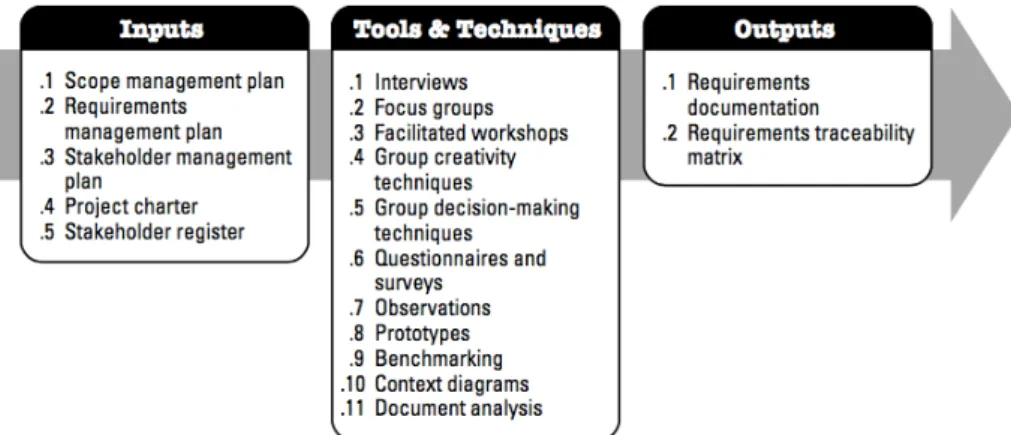
In PMBOK 5th edition, the task Collect Requirements – described as “the process of determining, documenting and managing stakeholder needs and requirements to meet project objectives” - can be found under the knowledge area Project Scope Management (Project Management Institute, 2015). In the figure below, the Inputs, Techniques and Outputs are summarized.
Figure 9 – Collect requirements task, in Project Management Institute (2013)
Thus, we can observe an overlap between once their collection is both referred as a Project Management task (Project Management Institute, 2013) and Business Analysis task (International Institute of Business Analysis, 2015a). Project Management Institute (2015), defends that while the project manager should be accountable for requirements, this task should be assigned to the person who has more business expertise.
In fact, according to James (2015), IIBA was built “very closely” to PMI. In fact, PMI had suggested a partnership between both institutes, but IIBA has refused it due to lack of alignment in terms of goals. Currently, PMI is entering in the field of Business Analysis, directly competing with IIBA
Regarding the interactions between project managers and business analysts, Project Management Institute (2015) states that “confusion exists between project managers and
collaboration between these two roles. This issue had been tackled five years before the first publication of PMI on Business Analysis in a IIBA-PMI joint white paper by Carkenord et al. (2010) who defend that PM-BA confusion can arise due to lack of role definition, different job titles and expectations by the organizations. As a result, Carkenord et al. (2010) state that PM-BA both uncertainty over roles and tension can lead to unsuccessful project results.
After having a team of experienced project managers and business analysts revising PMBOK 4 and BABOK v3 and mapping Business analysis to each project management Process Groups, Carkenord et al. (2010) shows us four areas of “conflict”: Project Scope management, Project Communications Management, Project Risk Management, project Requirements Management.
The first area of conflict is Project Scope Management. Carkenord et al. (2010) defend that both Project Managers and Business Analysts are focused on scope, but while project managers are focused on “project scope” – meaning “the work required to deliver a product, service or result” – business analysts’ focus is on “product scope” – meaning “the features and functions that characterize a product, service or result”.
In terms of Project Communications Management, Carkenord et al. (2010) defend that while the project manager is “accountable for all project related communication with all project stakeholders”, it is actually the business analyst who is in contact with project stakeholders because it is through them that the requirements are identified.
Regarding Risk Management, the project manager is accountable for this area, while the business analyst works alongside the project manager by providing inputs based on requirements as well as on the impacts in the business Carkenord et al. (2010).
In fact, according to Carkenord et al. (2010), the definitions of Project Manager, Project Management, Business analysis, Business analyst are relevant for project success. Once job titles are not the same in every organization, this white paper defends that people should understand project management and business analysis tasks so the roles can be precisely defined.
Regarding Project Requirements management, the business analyst’ “requirements management plan (…) is a key input to the project management plan”, once it contains the way requirements are going to be managed. (Carkenord et al., 2010)
According to Carkenor et al. (2010), in order to establish effective collaboration, project managers and business analysts should know each other’s roles, with special focus on the areas where there is an overlap.
However, the aim of this white paper is to give advice to project managers on how to take advantage of BA skills to achieve project success, which is the reason why PMBOK 4th
is used as a reference, and not BABOK.
Maritato (2012) comes with a different approach. According this author, project outcomes can be improved through the integration of project management and business analysis, referring project managers and business analysts as “the dynamic duo”.
Therefore, instead of pointing out overlapping areas, Maritato (2012) describes how BABOK v2 brings value to the Process Groups found PMBOK 4th edition e ed. Thus, this author gives defends that BABOK v2 knowledge areas can improve PMBOK 4th edition.
The inputs found in Maritato (2012) are summarized in Figure 10.
Concerning Business Analysis Planning and Monitoring, Maritato (2012) defends that it provides an “important input to the Develop Project plan process (…) the Plan Communication process (…), the Define Scope process (…) and the Risk Management processes”. In addition, this knowledge area allows for keeping lessons learned for the future.
Also, Maritato (2012) believes that the tasks in the Knowledge Area Elicitation describe a “professional elicitation”. Therefore, they could bring value to “Initiating, Planning and Monitoring and Controlling” from PMBOK 4 edition. As for the “Enterprise Analysis, Solution Assessment and Validation”, they can improve PMBOK 4 ed. by inciting the use of Business Requirements as a “starting point” when collecting requirements. Thus, it fosters a solid definition of a business need (Maritato, 2012).
In terms of requirements modelling, Maritato (2012) believes that the “requirements packages” found in BABOK can ensure effective communication with the stakeholders. Also, the knowledge area Requirements Management and Communication found in BABOK v2 allow stakeholder engagement and requirements traceability (Maritato, 2012).
In terms of the techniques described in BABOK, Maritato (2012) defends that these can be adapted to different project settings.
Finally, in terms of Solution Assessment and validation, Maritato (2012) believes that it can improve Planning, Executing, Monitoring and Controlling PMBOK 4 ed. Process Groups, as it can help to “manage stakeholder expectations”, while the project manager is focused on “project issues”.
It is important to note that Carkenord et al. (2010) and Maritato (2012) had their work published before the 2015, which means that, at the time, PMI haven’t had published the two Practice Guides concerning Business Analysis (Project Management Institute, 2015; 2016).
Project Management Institute (2016) classifies business analysis as a “critical competence for project, program and portfolio management”, being “requirements management (…) a component of business analysis”.
The table below maps the way business analysis is described by International Institute) of Business analysis (2015) with the it is described by Project Management Institute (2015).
Figure 11 –International Institute of Business Analysis (2015a) KAs and Project Management Institute (2015; 2016) domains [self-constructed]
In Figure 11, we can see that we are able to map the different sections of BABOK (International Institute of Business Analysis 2015a) with the publications on Business Analysis and Requirements Management (Project Management Institute 2015; 2016), the Knowledge areas presented in the different Guides are similar. When comparing the existent knowledge areas/sections between International Institute of Business Analysis (2015) and (Project Management Institute, 2016), we can see that they are very similar.
As already mentioned, Requirements Management: A Practice Guide intends to be a bridge between Project Management Institute (2013) and Project Management Institute (2016). Thus, in Figure 12 below, we can find the requirements process mapped to Project Management Process Groups.
Figure 12 –Integration of Business Analysis in Project Management Process Groups, in Project Management Institute (2016)
Project Management Institute (2016) integrates Requirements Management’ domains into Project management process Groups. Also, it describes the interactions these sections have in PMBOK 5th edition (Project Management Institute, 2013), specifically in the following Knowledge areas: Stakeholder Management, Communications Management and other areas, such as Project Integration Management, Project Time Management, Project Risk Management and Project Procurement Management.
It is interesting to observe that, four years before the publication of Requirements Management: A Practice Guide, Maritato (2012) had come to similar conclusions on the integration of Business Analysis/Requirement management practices in PMBOK 5th, even if he used BABOKv2 as a reference at the time (Figure 10).
2.2.4 PMBOK Guide 6th edition – a game changer?
On 10th August 2017, Project Management Institute uploaded a video on Youtube (Project Management Institute, 2017a), outlining the changes that the new PMBOK Guide – PMBOK 6th edition – will contain.
In this new edition, two Knowledge areas were renamed (Project Schedule Management and Project Resource Management) and some processes were added or changed. Also, there is new content in four knowledge areas (Project Communications Management, Project Risk Management, Project Procurement Management and Project Stakeholder Management).
According to Project Management Institute (2017a), in this new Guide, PMI places a great focus on “aligning projects to the strategic objectives of the organization”. Thus, we can speculate about the relationship between this new project approach and the Business Analysis Knowledge Areas/domains Strategy Analysis (International Institute of Business Analysis, 2015a) and Needs Assessment (Project Management Institute 2015; 2016). Moreover, the new guide will also tackle business knowledge in project management (Project Management Institute, 2017a).
Having these inputs on the new Guide, the question arises: Will the new content of PMBOK Guide 6th edition create more overlaps between project managers and business
analysts? While we cannot know for sure, Project Management Institute explores the relationship between projects managers and business analysts in the Project Scope Management Knowledge area.
In addition, Project Management Institute included a new section on the project manager role, intended to guide project managers on how to successfully lead their projects (Project Management Institute, 2017a).
2.2.5 Thoughts on IIBA and PMI approaches
After reviewing IIBA and PMI approaches, can conclude that when comparing the Bodies Of Knowledge, there are important differences in terms of organization of bodies of knowledge, International Institute of Business Analysis (2015) and Project Management Institute (2013) share some concepts. However, while PMBOK is focused on managing projects, BABOK is focused on explaining the importance and the value of business analysis for an organization.
Also, project Management Institute is investing in Business Analysis/Requirements Management Field (Project Management Institute, 2015: 2016), having Practice Guides dedicated to these matters, as well as a certification (PMI Professional in Business Analysis). Thus, Project Management Institute (2015; 2016) looks for an integration of the business analysis profession in their framework.
When comparing Business Analysis/Requirements Management frameworks from International Institute of Business Analysis (2015) and Project Management Institute, we can find similarities in the knowledge areas/domains described.
On the other hand, the new PMBOK Guide 6TH can be a game changer, once it will tackle the relationship between Project Managers and Business Analysts.
2.3 The challenge of collaboration
According to the Cambridge Dictionary (2017), collaboration is “the act of working together with other people or organizations to create or achieve something”.
According to Project Management Institute (2016) “67% of high performing organizations value collaboration between project managers and business analysts”. Moreover, according to the findings of 2014 PMI Pulse of Profession® In Depth Report, “52% of organizations expect an increase in the integration of requirements management and business analysts over the next 3 to 5 years and 58% of the organizations are focusing on more defined practices and processes” (Project Management Institute, 2016).
However, one may think that only one person is able perform both roles. Carkenord (2005) defends the importance of the existence of both Project manager and business analyst, playing different roles because of their different competences and domains that when put together can result in a successful outcome. Project Management Institute (2015) refers that business analysis allows for better requirements; stakeholder engagement; compliance in terms of deadlines, scope and budget; solutions that bring business value and respond to stakeholder needs; and development of organization’s skills in Business Analysis.
Thus, the purpose of having both a Project management and Business analysis is to add value to the organization by meeting the project’s objectives. These are considered as two strategic roles for nowadays’ companies (Maritato, 2012).
Once we have already gone through PMI and IIBA frameworks, what are the practical steps we can take to foster better collaboration between project managers and business analysts?
Due to the differences between project managers and business analysts, Carkenord (2005) suggests that there is a “healthy tension” between both roles that makes this partnership work. On the other hand, Wysocki (2011) defends that in order to add value to business, project manager’s and business analyst’ goals should be fully aligned. Also, Wysocki (2011) and Chan (2011) defend that these two professionals should work in the project from the very beginning to the end.
Chan (2011) also implies that there are overlapping areas between project managers and business analysts. Thus, the author gives advices to Project Managers foster communication and collaboration with Business Analysts. Pullan (2015) also leaves advice Project Managers to foster BA-PM relationship. Thus, a comparison will be established between these two authors.
In terms of aligning Project Management and Business Analysis activities, Pullan (2015) states that Project Managers and Business Analysts should both be leaders, working side by side, exploring the complementarity between these two roles. This way of working can be useful in overlapping areas such as Risk Management and Communications (Carkenord et al.; Pullan, 2015). Still, if there are doubts, “a responsibility assignment matrix (RACI Matrix)” can be used (Pullan, 2015) to clarify confusion between roles and responsibilities.
To contribute PM-BA relationship, Chan (2011) defends that it is necessary to adopt a good project infrastructure that encourages “collaboration and communication”, such as “project management information systems, facilities and equipment, project standard operations and emergency channels” (Chan, 2011). On the other hand, Pullan (2015) defends that developing “a common understanding” fosters good communication.
Chan (2011) states that there is a need for adapting a flexible approach, because “there is no single template or methodology that fits all projects”. Also, the author adverts project managers that it is not possible to have a project without issues being essential managing them by working together with the business analyst.
Besides from performing project tasks, Pullan (2015) calls for an open discussion between project managers about their relationship that aims to reach project success. Pullan (2015) got the findings about by exploring PM-BA relationship, the tensions that may arise between them and how to solve them. Thus, the author sent a survey business analysts and project managers around the world about the relationship between both roles. With the survey results, the author listed tensions caused by Project Managers, Business Analysts and the Organization.
In this this survey conducted by Pullan (2015), the large majority of the respondents (124 out of a total of 186 people) were business analysts, followed by project managers (60 people) and business analyst managers (26 people). In this research, it is implied that business analysts might have found the subject more engaging than project managers. According to this author, the findings reveal that project managers seem to be happier than business analysts with the BA-PM relationship. On the other hand, business analysts tend to recognize the issues and tension in the relationship. (Pullan, 2015).
Finally, there is a need for “clear roles and responsibilities” for both business Analysts and Project Managers (Carkenord et al., 2010; Pullan, 2015). The organization can have an important influence on the definition of these roles. Also, as stated before, training from professional institutes, such as PMI and IIBA can be relevant (Carkenord, 2005). However, it is also important to note that even these Institutes defend that Project Managers and Business Analysts should adapt their approach according to the project these professionals are working in. Project Management Institute (2013) describes it as “tailoring”, while International Institute of Business Analysis (2015) refers that “any set of practices must be tailored to the specific conditions under which business analysis is being performed”.
Chapter III – Methodology
3.1 Context
After reviewing the literature, we can find that the authors reviewed agree on the fact that the goal of both project management and business analysis is to add value to an organization (Carkenord, 2005; Carkenord et al., 2010; Chan, 2011; Wysocki, 2011; Maritato, 2012; James, 2015; Pullan, 2015; Project Management Institute, 2015).
Project Managers and Business analysts should complement each other by working side by side (Chan, 2011; Wysocki, 2011; Maritato, 2012; Pullan, 2015). However, overlaps in tasks can be found between these two roles (Carkenord, 2005; Carkenord et al., 2010; Maritato, 2012; James, 2015; Pullan, 2015; Project Management Institute, 2016) that can lead to confusion between business analysis and project management. In order to achieve project success, roles and responsibilities should be clear (Pullan, 2015; Carkenord et al., 2010). Thus, Institutes such as PMI and IIBA can be relevant in defining roles and responsibilities of both professionals (Carkenord, 2005).
In terms of framework promoted by these two Institutes, we can see that they share some concepts, even if the framework is not the same. After all, IIBA was built very closely to PMI (James, 2015). Still, PMI is investing both the profession of Business Analysis and on the collaboration between project managers and business analysts. The PMBOK 6th
Guide can be a game changer on these matters.
However, not only Institutes that care about the collaboration between. In fact, according to Project Management Institute (2016), “67% of high performing organizations value collaboration between project managers and business analysts”. Thus, in this research a company was chosen to conduct a research on Project Managers and Business analysts – Cofidis Portugal. This way, real world data is used for this research.
As we have seen, Pullan (2015) conducted a survey on “Project Management/Business Analyst friction”. Nonetheless, in this survey, only project managers and business analysts are questioned.
We can notice a trend in which the PM/BA-PM relationship is analyzed through project management lenses (Carkenord et al., 2010; Chan, 2011; Pullan, 2015), aiming at advising project managers on how to work with business analysts. Also, some authors have put an effort on integrating Business Analysis practices into Project Management Institute’s framework (Maritato, 2012; Project; Project Management Institute, 2016). This may be explained by the fact that business analysis is not as widely known as project management in the project industry Paul et al., 2014; James, 2015; Pullan, 2015).
However, none of the authors explored how both project managers and business analysis are seen by every project team member. This is critical because these professionals do not work isolated, but in a team.
Thus, this research intends to show a 360º overview of the role of project manager and business analyst. This means that the perspective of the reality shown in this research is not only from the project manager or business analyst’s point of view, but from all project stakeholders’ point of view. Only this way we can find a both integrative and inclusive overview on how project managers and business analysts interact in a project context.
Ultimately, this research aims to understand how business analysis and project management are perceived at Cofidis Portugal and which are the improvement measures could be implemented in the name of project success.
3.2 Research questions
RQ1: Are the roles and responsibilities of both project managers and business analysts clear?
As we have seen, there is a need for “clear roles and responsibilities” for both business Analysts and Project Managers (Carkenord et al., 2010; Pullan, 2015).
The goal of this research question is to find out whether the roles and responsibilities of both business analysts and project managers are standardized across all the stakeholders.
RQ2: How is the relationship between these two roles perceived by each stakeholder? According to Project Management Institute (2016) “67% of high performing organizations value collaboration between project managers and business analysts”.
This means the interaction between project managers and business analyst is an issue to take in account. Thus, this research question aims at finding out how the relationship between project managers and business analysts is perceived.
RQ3: Which are the improvement opportunities regarding the process or the role? Finally, the last research questions aim at pointing out tips for the improvement of both project management and business analysis at Cofidis Portugal.
3.3 Target chosen
The target for this survey is is professionals who have worked at least in the last 6 months in projects at Cofidis Portugal. More specifically, this survey is aimed at:
- Business Analysts - Project Managers - Testers
- Continuous improvement team members
- IT technicians (Software architects, developers, BIs) - Business areas
The online survey was sent to Cofidis employees who have been listed as project resources for the last 6 months. This way, we can have an overview on how people from different teams perceive project managers and business analysts.
Cofidis Portugal is a financial services company. Founded in 1966, it is specialized in consumer credit. Among its products, we can find personal credits, credit lines, credit cards, automobile credits and consolidated credits.
This company states its mission as the following: “To contribute for the improvement of quality of living of our customers, through the development and management of a product portfolio that aims at offering the best solution to satisfy our clients’ needs as well as making the aspirations of every individual come true”. In terms of values, Cofidis has five: “Agility, Audacity, Simplicity, Responsibility, Consideration”. (Cofidis, 2017a.)
Cofidis Portugal is part Groupe Cofidis Participations, specialized in distance credit. Besides Portugal, we can find Cofidis in eight other European countries: Spain, France, Belgium, Italy, Czech Republic, Slovakia, Hungary and Poland. (Cofidis, 2017b)
Cofidis Participations’ main stockholder is Crédit Mutuel, considered as the best French banking group in 2016 by World Finance (Crédit Mutuel, 2017). In 2016, Cofidis Portugal had 624 employees, 474.043 customers and a business volume of 172.361.115€ (Cofidis, 2017c).
At Cofidis, both Project Management and Business Analysis professionals work under the same Department, together with the Continuous Improvement team and Tests and Quality team.
Both Project Management and Business Analysis have had contact with PMI and IIBA frameworks. In fact, in 2014, Project Management at Cofidis was awarded by PMI Portugal Chapter as the Best PMO in Portugal. As for business analysis, the whole team got training on BABOK v3 in 2017.
3.4 Approach
The technique used to conduct this research was an online survey, using Typeform, a survey platform. The survey was shared by email between 10 and 18th July 2017.
The online survey was used because it is the easiest way to collect answers in a short period of time as well as it provides a data extraction functionality that allow the researcher to integrate the survey findings directly in a data analysis software (Ilieva et al., 2003).
In terms of methodology, the approach used to conduct this research was Mixed Methods Research, also named “multimethodology” (Harper, 2013), which combines qualitative and quantitative approaches in a research. According to Creswell and Clark (2011), combining these two approaches allows for a deeper knowledge of the research questions. In this case, both qualitative and quantitative data was collected in the online survey.
In terms of qualitative approach both close-ended and open ended questions were used. On the other hand, in quantitate approach, only close-ended questions were used.
In quantitative questions, 5-point Likert-type items were used. Using this tool, the respondents can choose one out of five scale positions that best explains what they feel about the subject that has been asked. The scale comes along with a statement that describes what each point means.
Likert scales are used to measure “people’s attitudes, beliefs, emotions, feelings, perceptions, personality characteristics, and other psychological constructs” (Lewis-Beck et al., 2004). The main difference between Likert scales and Likert type items is that a Likert scale is composed by several items or questions, while a Likert item is only composed by “one item or question” (Uebersax, 2006).
The findings from qualitative data collected are displayed in a form of bar charts, stacked charts, pie chart and visual displays. As for qualitative data collected, this type of data is only displayed in staked charts.
In the next section, the survey questions will be explored in detail.
3.5 Research design
This section will describe the way this research was designed, as well as the goal behind each question.
The questionnaire was made in Portuguese because of the respondents’ mother language.
Figure 13 shows the relation between research questions and survey questions.
![Figure 2 – Domains in Project Management Institute (2015) [self-constructed]](https://thumb-eu.123doks.com/thumbv2/123dok_br/19208255.957093/17.892.138.758.545.874/figure-domains-project-management-institute-self-constructed.webp)
![Figure 3 – PMI certifications - Project Management Institute (2017c) [self-constructed]](https://thumb-eu.123doks.com/thumbv2/123dok_br/19208255.957093/18.892.133.756.606.998/figure-pmi-certifications-project-management-institute-self-constructed.webp)
![Figure 4 – IIBA certifications - International Institute of Business Analysis (2017b) [self-constructed]](https://thumb-eu.123doks.com/thumbv2/123dok_br/19208255.957093/19.892.130.746.737.1000/figure-iiba-certifications-international-institute-business-analysis-constructed.webp)
![Figure 5 – KAs in International Institute of Business Analysis (2015a) [self-constructed]](https://thumb-eu.123doks.com/thumbv2/123dok_br/19208255.957093/20.892.140.756.227.748/figure-kas-international-institute-business-analysis-self-constructed.webp)
![Figure 6 – Main changes in BABOK Knowledge areas from version 2 to version 3 [self-constructed]](https://thumb-eu.123doks.com/thumbv2/123dok_br/19208255.957093/21.892.129.770.826.993/figure-main-changes-babok-knowledge-version-version-constructed.webp)

![Figure 8 – Requirements classification (International Institute of Business Analysis, 2015a; Project Management Institute, 2013) [self-constructed]](https://thumb-eu.123doks.com/thumbv2/123dok_br/19208255.957093/27.892.135.754.385.879/requirements-classification-international-institute-business-management-institute-constructed.webp)
![Figure 10 – PMBOK-BABOK mapping proposed by Maritato (2012) [self-constructed]](https://thumb-eu.123doks.com/thumbv2/123dok_br/19208255.957093/30.892.139.748.782.1076/figure-pmbok-babok-mapping-proposed-maritato-self-constructed.webp)
![Figure 11 –International Institute of Business Analysis (2015a) KAs and Project Management Institute (2015; 2016) domains [self-constructed]](https://thumb-eu.123doks.com/thumbv2/123dok_br/19208255.957093/32.892.132.755.269.574/international-institute-business-analysis-project-management-institute-constructed.webp)
