Viability of Lactobacillus acidophilus immobilized in calcium alginate
spheres and submitted to different conditions of stress
Viabilidade de Lactobacillus acidophilus imobilizado em esferas de alginato de
cálcio e submetido a diferentes condições de estresse
Emiliane Andrade Araújo Naves
(1); Samarina Gabrielle de Fátima Pereira
(2)Richtier Gonçalves da Cruz
(3); Milene Therezinha das Dores
(4)(1) Professora; Universidade Federal do Triângulo Mineiro. Uberaba, Minas Gerais, Brasil.
Orcid:http://orcid.org/0000-0002-5103-1929. E-mail:[email protected]
(2) Bacharel em Ciências de Alimentos e Mestre em Agronomia, pela Universidade Federal de Viçosa. Rio
Paranaíba, Minas Gerais, Brasil. E-mail:[email protected]
(3) Professor; Universidade Sagrado Coração. Bauru, São Paulo, Brasil. E-mail: [email protected] (4) Professora; Universidade Federal de Viçosa. Rio Paranaíba, Minas Gerais, Brasil. E-mail:
ABSTRACT: This work aimed to evaluate the viability of Lactobacillus acidophilus immobilized in calcium alginate sphere under different stress conditions. For the preparation of the sphere was dripped into a solution of 5 % (w/v) sodium alginate bacterial suspension of Lactobacillus acidophilus, previously activated. To simulate the acid stress, free and immobilized bacteria were exposed to pH values 2.5, 3.5 and 7.0, for 4 hours, incubated at 37 °C. The same was done for salt stress, at concentrations of 0.85 %, 4 % and 6 %. For freezing stress, the bacteria free and immobilized was stored at - 20 °C for three months. In all simulations of stress conditions (pH, salts and freezing) changes in count for the immobilized bacteria were lower, with the greatest protection occurred when Lactobacillus acidophilus immobilized was subjected to high osmotic pressure in a concentration of 6 % NaCl and freezing. We can conclude calcium alginate acted as a protective agent in adverse conditions, providing protection to the microorganism. Therefore, the immobilization technique in calcium alginate has good prospects for the development of new probiotic foods.
Keywords: Probiotic Microorganisms. Immobilization. Survival. Sodium Alginate.
Resumo: O estudo objetivou avaliar a viabilidade de Lactobacillus acidophilus imobilizados em esferas de
alginato de cálcio sobre diferentes condições adversas. Para o preparo da esfera, gotejou-se em uma solução de 5 % (p/v) de alginato de sódio, a suspensão bacteriana de Lactobacillus acidophilus, previamente ativada. Para simular o estresse ácido, as células livres e imobilizadas foram expostas aos valores de pH de 2.5, 3.5 e 7.0 por 4 horas à 37 °C. O mesmo procedimento foi realizado para o estresse a sais nas concentrações de 0.85 %, 4 % e 6 % de NaCl. Para avaliar o efeito da baixa temperatura, as células livres e imobilizadas foram estocadas a - 20 °C durante três meses. Em todas as condições de estresse simuladas, a letalidade dos Lactobacillus acidophilus imobilizados foi menor quando comparada à forma livre. A maior proteção ocorreu quando as células imobilizadas de Lactobacillus acidophilus foram submetidas à alta pressão osmótica na concentração de 6 % de NaCl e ao congelamento. Pôde-se concluir que o alginato de cálcio agiu como um protetor quando o micro-organismo probiótico foi exposto a condições adversas. Assim, a técnica de imobilização em alginato de cálcio pode ser considerada uma boa alternativa para o desenvolvimento de novos produtos probióticos.
Palavras-chave: Micro-organismos probióticos. Imobilização. Sobrevivência. Alginato de cálcio.
INTRODUCTION
Several everyday aspects, such as urbanization, industrialization, and globalization, may adversely affect the quality of modern life, and therefore the intake of functional foods that improve health is increasingly sought by consumers (LORENZ, 2009). Due to this interest, the development of healthy and desirable products has attracted the attention of both the industry and the scientific community. Nevertheless, this new demand for products has
become a major challenge, since they must meet sensory and technological standards as well as ensure safety and welfare of the consumer (KOMATSU et al., 2008).
Functional foods are those that, in addition to providing basic nutrition, bring other health benefits. They have the potential to promote health through mechanisms not provided by conventional nutrition. It should be emphasized that this effect is limited to the prevention, rather than the curing, of disease (OLIVEIRA et al., 2002). The main ingredients
Ar
ti
g
responsible for the functionality of these products are constituted by dietary fiber, fish oils, plant sterols, minerals, vitamins, probiotics, and prebiotics (FERREIRA, 2001; THAMER; PENNA, 2006).
The internationally accepted definition of probiotics is that they are live microorganisms which, when administered in adequate quantities, confer health benefits to the host (FAO, 2001). Besides these features, probiotics must also resist the pH of the gastric juice, tolerate the pancreatic and intestinal secretions without carrying antibiotic resistance genes in the genome, possess antimutagenic and anticarcinogenic properties, retain viability in the long term and be safe (HAVENAAR; HUIS'T VELD, 1992; SALMINEN et al., 1998;. OUWEHAND et al., 1999; SAARELA et al., 2000; HOLZAPFEL; SCHILLINGER, 2002).
Some lactic acid bacteria, in addition to promoting desirable technological effects in products to which they have been added, are able to exert functional effects for those who ingest them. Therefore, they are considered probiotic. A requirement for a probiotic microorganism is that it must resist the digestive enzymes of the gastrointestinal tract, multiply, and colonize the intestine, at least temporarily, by adhering to the intestinal epithelium (ZIEMER; GIBSON, 1998; LEE et al., 1999).
Lactobacillus acidophilus, an extensively used
lactic acid bacteria, is one of the most recommended probiotics compared to other species of the genus Lactobacillus. This isbecause of its high capacity for adhesion to the intestinal epithelium and the benefits to the host, in regulation of the gastrointestinal tract (ALVES, 2010). Consequently, it has been one of the most used and studied probiotics in recent years (O'Sullivan, 2006).
Several factors undermine the growth and viability of probiotic bacteria in food products. Among them stands the pH, the acidity increase during storage, the storage temperature, the presence of preservatives and other microorganisms, the oxygen concentration contained in the product, the permeability through the packaging, and the availability of growth factors (SILVA, 2007). An alternative to ensure a greater survival and viability of these organisms in adverse conditions during the shelf life of a food is immobilization (CANILHA et al., 2006).
Cell immobilization decreases cell death and increase its viability, which may be affected by the storage, product processing, or during the actual food intake, since the immobilized cells have a greater resistance to the action of biological fluids related to the digestive process. Furthermore, immobilization provides a lower interaction of microorganisms and food constituents, reducing susceptibility to infection (ROSA, 2010). This technique consists of cells being lodged inside or on the surface of an immobilizing agent enzymes or cells. The calcium alginate gel and K-carrageen are the most commonly used matrixes (BATISTA, 2005).
Alginates belong to a family of heterogeneous polymers with a wide range of chemical compositions, molecular size, and functional properties. Chemically, they are unbranched polysaccharides composed of waste 1,4-linked β -D-mannuronic acid and α -L-guluronic acid monomers in varying proportions (BRINQUES, 2009). Gel properties can be summarized by their porosity and mechanical strength necessary to the process. Porosity is directly linked to the ability of the gel to protect the cells and modify the effective diffusivity of the substrate (FREITAS, 2007).
In this context, the present work aimed to study the viability of Lactobacillus acidophilus immobilized in calcium alginate beads under different stress conditions.
MATERIAL AND METHODS
Immobilization of Lactobacillus acidophilus For the immobilization of the cells in the alginate spheres, the bacterial suspension of Lactobacillus
acidophilus, which was previously activated in
reconstituted skimmed milk (LDR 10%) with 6.67% of skimmed milk powder to increase the viscosity (the same amount of milk powder was also added in bacteria not immobilized) was dripped with the aid of a pipette in a solution of 5% (w/v) sodium alginate (Gastronomy lab), the spheres were formed immediately and these remained at rest for 30 minutes so that the reaction of formation of calcium alginate occurred.
Stress condition – pH
To evaluate the pH stress condition, 1 ml of the bacterial suspension of Lactobacillus acidophilus was added to 9 ml of physiological saline (0.85% NaCl) containing lactic acid at three pH values,2.5, 3.5, and 7.0, following the methodology described by Araújo (2007). The mixture was incubated at 37 °C for 4 hours for evaluation of the stress applied. During this period, every hour, the surviving cells were collected by centrifugation (Sorvall centrifuge) at 6000 g for 6 minutes and washed with PBS (pH 7.2). The cell pellet was re-suspended again in 9 mL of saline (0.85% NaCl). Then, we performed serial dilutions made in the saline (0.85% NaCl) to count survivor cells on MRS agar (Merck) after incubation under anaerobic conditions at 37 ° C for 48 hours. Plates containing between 25-250 colonies were selected. We counted the colony-forming units (CFU.mL-1)and the results expressed as log10. The
same procedures for evaluating the stress condition of acid were made to Lactobacillus acidophilus cells immobilized in calcium alginate.
Stress condition – NaCl
For salt stress condition, 1 ml of the bacterial suspension of Lactobacillus acidophilus was added
to 9 ml of physiological saline solution with varying NaCl concentrations (0.85, 4 and 6%). The mixture was incubated at 37 °C for 4 hours for evaluation of the stress applied. Each hour, the cells were collected for the counting of viable cells. The same procedures were followed for the acid stress condition. This same procedure was done for to
Lactobacillus acidophilus immobilized in calcium
alginate.
Stress condition – Freezing
In temperature stress condition, 1 mL of the bacterial suspension of Lactobacillus acidophilus was added to 9 mL of physiological saline (0.85% NaCl). The mixture was stored at - 20 ° C (freezing) for 3 months. During this period, a bacterial count was determined before freezing, after freezing, and every 30 days during 90 days of storage as previously performed (HOMAYOUNI et al., 2008). Each time, cells were collected for counting of viable cells. This same procedure was done for to
Lactobacillus acidophilus immobilized in calcium
alginate. Statistics
The experiment was conducted in triplicate with three replications. The results were analyzed using descriptive statistics.
RESULTS AND DISCUSSION Stress condition – pH
The viable cell count of Lactobacillus acidophilus free and immobilized subjected to stress condition, with at different values to pH and at different times (from 1 to 4 hours) is shown in Tables 1 and 2. Table 1. Number of viable cells of free Lactobacillus
acidophilus (Log CFU.mL-1) subjected to stress pH.
Table 2. Number of viable cells of immobilized
Lactobacillus acidophilus (Log CFU.mL-1) subjected to stress pH.
Free bacteria minimum and maximum cell counts ranged from 8.04 to 8.71 Log CFU.mL-1 in different pH values. In comparison, immobilized bacteria such variation was from 8.12 to 8.46 Log CFU.mL-1.
It is noted that for pH 2.5, the free bacteria tend to have a steeper decay than the immobilized since bacteria as the free bacteria count ranged from 8.58 to 8.33 Log-CFU.mL-1, having 0.25 of difference, and the immobilized ranged from 8.32 to 8.27 Log CFU.mL-1, the difference being 0.05. At pH 3.5, the reduction in bacterial count immobilized was markedly in initial three hours, however, the further reduction of free bacteria counts occurred after the third time analysis. The difference between the initial and final count for bacterium free is 0.30, on the other hand the difference immobilized bacteria is 0.04. At pH 7.0, both free as well as the immobilized bacteria exhibited similar behavior. However, the reduction in the free bacterial count was 0.36 and immobilized 0.21.
Lactobacillus acidophilus tolerates acid environments in the range of 0.3% to 1.9% of lactic acid and the optimum pH ranging from 5.5 to 6.0.It is resistant to the gastric acidity and bile salts, as the survival in the gastrointestinal tract is estimated between 2% and 5% to reach sufficient concentrations in the colon (GUEDES NETO et al.,2002) This resistance may explain the notable counts to acid stress found in this study.Oliveira (2006) also found high counts of Lactobacillus
acidophilus microencapsulated, approximately 108CFU.mL-1, even after 3 hours of incubation at pH 1 and 3.
Yoon et al. (2004), studying the behavior of lactic acid bacteria in tomato juice. They found that
Lactobacillus acidophilus, Lactobacillus plantarum, Lactobacillus casei and Lactobacillus delbrueckii
grew rapidly in this drink, reducing the levels of sugars and increasing the concentration of lactic acid. Although the pH of the juice after 72 hours of fermentation was reduced to pH 3.5; the viability of lactic cultures remained above 106 CFU g-1 after 4 weeks of storage at 4 ° C. Similar results were found in this study in like conditions, once all counts at pH 3.5 were more than 106CFU.mL-1 at different times analyzed. This evidence may be related to a larger adaptation of Lactobacillus acidophilus to lactic acid, since this is product resultant of the fermentative process of the lactose performed by L. acidophilus for energy production (ATP).
The immobilization provided greater protection when the bacteria were subjected to different pH values. In all conditions, the reduction of counts was lower in immobilized bacteria.
In the study by Krasaekoopt et al. (2006), the encapsulation with alginate and chitosan were also effective for enhancing the viability of Lactobacillus
acidophilus and Lactobacillus caseiin yogurt when
applied at pH 4.7 and placed in refrigerated conditions at 4 ° C.
Mandal et al. (2006) evaluated the tolerance of
Lactobacillus casei NCDC 298 encapsulated by the
technique of emulsification at different
Time (hours) pH 1 2 3 4 7,0 8,40 ± 0,36 8,43 ± 0,25 8,67 ± 0,19 8,04 ± 0,26 3,5 8,64 ± 0,06 8,57 ± 0,17 8,71 ± 0,30 8,34 ± 0,21 2,5 8,58 ± 0,24 8,42 ± 0,23 8,40 ± 0,15 8,33 ± 0,17 Time (hours) pH 1 2 3 4 7,0 8,33 ± 0,29 8,39 ± 0,23 8,16 ± 0,22 8,12 ± 1,87 3,5 8,46 ± 0,22 8,24 ± 0,21 8,23 ± 0,11 8,42 ± 0,23 2,5 8,32 ± 0,18 8,24 ± 0,23 8,17 ± 0,20 8,27 ± 0,25
concentrations of sodium alginate and exposed to low pH, high concentrations of bile salts and heating. As this study the authors found that immobilized of probiotic improved the resistance to the conditions tested when compare with free form. Furthermore,they observed that the increase in viability increased proportionally to the concentration of sodium alginate used.
Stress condition – NaCl
The count viable cells of Lactobacillus
acidophilus free and immobilized after stress
condition in the different salt concentrations (0.85%, 4% and 6%) are shown in Tables 3 and 4 .
Table 3. Count (log CFU.mL-1) of viable cells of
Lactobacillus acidophilus free after exposure to
different salt concentrations
Table 4. Count (log CFU.mL-1) of viable cells of
Lactobacillus acidophilus immobilized after exposure
to different salt concentrations
At a concentration of 6% salt, the free bacteria count ranged from 8.60 to 7.40 log CFU.mL-1, occurring a reduction of more than one log cycle. On the immobilized bacteria, the difference was 0.19, ranging from 8.35 to 8.16 log CFU.mL-1. This indicates that the calcium alginate provided greater protection for the Lactobacillus acidophilus when it was subjected to a higher stress of osmotic pressure.
In the concentration of 4% we observed that the count of free bacteria decreased from 9.18 to 8.61 log CFU.mL-1 (difference of 0.57). Regarding the immobilized bacteria, the difference of the count was 0.54, with an initial count at the end of 8.66 and 8.12 log CFU.mL-1, respectively.
The count for Lactobacillus acidophilus free at concentration of 0.85% varied from 8.54 to 8.75 log CFU.mL-1, increasing 0.21. For the immobilized bacteria count ranged from 8.03 to 8.51 logCFU.mL
-1 increasing 0.48. This behavior is expected since
the bacterium is in a favorable osmotic pressure to maintaining their metabolic activity (JAY, 2005).
Stress condition – Freezing
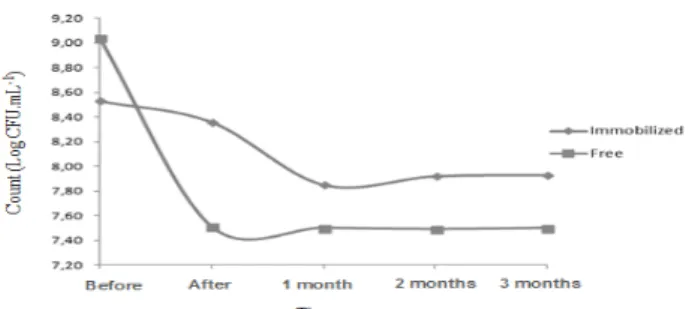
The behavior of the immobilized and free
Lactobacillus acidophilus form during freezing for
three months is shown in Figure 1 through trendlines.
The count of free bacteria ranged from 9.04 to 7.50 log CFU.mL-1 (difference of 1.54). For the immobilized bacteria the difference was 0.60, reducing from 8.53 to 7.93 log CFU.mL-1 respectively. It is observed that the cell count of
Lactobacillus acidophilus in immobilized form was
higher than the free form when exposed to freezing temperatures, which suggests a better protection of the microorganisms immobilized in calcium alginate.
The same happened in the study by Lorenz (2009), where the survival of microencapsulated cells was higher than that of free cells. The counting showed a decrease of 4.3 log cycles on the viability of free cells after 12 weeks of storage at -18 ± 2 ° C. In the same period, the viability of microencapsulated cells decreased 1.77 log and 1.75 log cycles when produced by emulsification and spray drying respectively.
According to Desmond et al. (2002) and Tsen et al. (2007), several studies have shown that lower temperatures may ensure a higher survive of microencapsulated cells, however, the mortality of the cells increases with storage time.
However, in this study, we note that the highest fatality occurred shortly after freezing, and over time in three months the counts tended to remain constant. This can be explained by the slow formation of ice crystals occurring almost exclusively during this phase, these crystals can cause denaturation of proteins and enzymes and may also cause lesions in the cell membrane leading to death of the microorganism (Jay, 2005).
Time (hours) %Salt 1 2 3 4 0,85% 8,54 ± 0,27 8,41 ± 0,58 8,76 ± 0,14 8,75 ± 0,21 4,0% 9,18 ± 0,41 9,25 ± 0,05 8,58 ± 0,35 8,61 ± 0,28 6,0% 8,60 ± 0,08 8,75 ± 0,56 8,63 ± 0,20 7,40 ± 0,50 Time (hours) %Salt 1 2 3 4 0,85% 8,03 ±0,11 8,80 ± 0,05 8,33 ± 0,28 8,51 ± 0,30 4,0% 8,66 ±0,09 8,41 ± 0,20 8,14 ± 0,14 8,12 ± 0,07 6,0% 8,35 ±0,42 8,64 ± 0,12 8,29 ± 0,31 8,16 ± 0,24
FIGURE 1.Trend lines of stress condition of
freezing for free and immobilized Lactobacillus
CONCLUSIONS
In all simulations of stress conditions (pH, salts and freezing) the lethality to Lactobacillus
acidophilus immobilized was lower than in the free
form, indicating that the calcium alginate acted as a protective agent in unfavorable conditions cell viability. The greater protection occurred when the probiotic immobilized was subjected to high osmotic pressure in a concentration of 6% NaCl and the freeze condition. The immobilization technique using calcium alginate with Lactobacillus acidophilus has proved to be an important alternative for the development of new probiotic products having adverse conditions.
REFERENCES
ALVEZ , C. C. C. (2010). Comportamento da E. coli em queijo Minas Frescal elaborado com a utilização de L. acidophilus e acidificação direta com ácido lático (Dissertação de Mestrado). Universidade Federal Fluminense, Niterói.
ARAÚJO, E. A. (2007). Desenvolvimento e
Caracterização de Queijo tipo Cottage Adicionado de Lactobacillus delbrueckii UFV H2b20 e de Inulina. (Dissertação de Mestrado) Universidade Federal de Viçosa, Viçosa.
BATISTA, M. A. (2005). Estudo da imobilização de células de saccharomyces cerevisiae em gel de alginato de cálcio no processo de fermentação alcoólica
(Dissertação de Mestrado) Universidade Federal de Uberlândia, Uberlândia.
BRINQUES, G. B. (2009). Otimização da produção de probióticos em biorreatores e suas aplicações em sistemas alimentícios sob a forma imobilizada (Tese de Doutorado) Universidade Federal do Rio Grande do Sul, Rio Grande do Sul.
CANILHA, L.et al. Biocatalizadores imobilizados uso de células imobilizadas em processos biotecnológicos. Biotecnologia Ciência e Desenvolvimento.n.9, vol.3, 2006, p. 48-57.
DESMOND, C. et al. Improved survival of Lactobacillus paracasei NFBC 338 in spray-dried powders containing gum acacia. Journal of Applied Microbiology, n.1, vol. 93, 2002, p. 1003-1011.
FAO. (2001). Food and Agriculture Organization of the United Nations; World Health Organization. Evaluation of health and nutritional properties of probiotics in food including powder Milk with live lactic acid bacteria. Córdoba, 34p. Retrieved from:
ftp://ftp.fao.org/es/esn/food/ probioreport_ en.pdf. FERREIRA, C. L. L. F. Tecnologia para produtos lácteos funcionais: probióticos. In: O Agronegócio do Leite e os Alimentos Lácteos Funcionais. 2001.
FREITAS, F. F. (2007). Otimização do Processo de Imobilização de β – Galactosidase de Aspergillus oryzae em Alginato de sódio com gelatina e glutaraldeído (Tese de Doutorado) Universidade Federal de Uberlândia, Uberlândia.
GUEDES NETO, L.G.et al. Lactobacillus acidophilus e a indústria de laticínios. In: Leite de derivados. 2002.
HAVENNAR, R. & HUISIN’T, M. J. H. (1992). Probiotics: a general view. In: WOOD, B.J.B (Ed.), Lactic acid bacteria in health and disease. (p.151- 170, 1992). Elsevier Applied Science.
HOLZAPFELl, W.H.& SCHILLINGER, U.. Introduction to pre and probiotics. Food Research International, n.3, vol.35, 2002, p. 109-116.
HOMAYOUNI, A.et al. Effect of microencapsulation and resistant starch on the probiotic survival and sensory properties of symbiotic ice cream. Food Chemistry, n.1, vol. 111, 2008, p. 50-55.
JAY, J. M. Microbiologia de Alimentos. (6. ed.) Porto Alegre: Artmed Editora S. A. 2005.
KRASAEKOOPT, W.et al.Survival of probiotics encapsulated in chitosan-coated alginate beads in yoghurt from UHT – and conventionally treated milk during storage. Food Science and Technology, n.1, vol. 39, 2006, p. 177-183.
KOMATSU, T.R.et al. Inovação, persistência e
criatividade superando barreiras no desenvolvimento de alimentos probióticos. Pharmaceutical Sciences, n.4, vol. 44, 2008, p. 329-337.
LEE, Y.K. et al. Handbook of probiotics. (1. ed.) New York: Wiley. 1999.
LORENZ, J. G. (2009). Comparação dos métodos de emulsificação e spray drying de Lactobacillus acidophilus (LA-5) e aplicação em sorvete. (Dissertação de
mestrado). Universidade Federal de Santa Catarina, Florianópolis.
MANDAL, S. et al. Effect of alginate concentrations on survival of microencapsulated Lactobacillus casei NCDC-298. International Dairy Journal, n.1, vol. 16, 2006, p. 1190-1195.
OLIVEIRA, M.N. et al. (2002). Aspectos tecnológicos de alimentos funcionais contendo probióticos. Revista Brasileira de Ciências Farmacêuticas, n.1, vol.38, 2002, p. 1-21.
OLIVEIRA, A. C. Viabilidade de Lactobacillus acidophilus e Bifidobacterium lactis, microencapsulados por
coacervação, seguida de secagem por spray drying e leito de jorro. (Dissertação de Mestrado). Universidade de São Paulo, 2006.
OUWEHAND, A.C. et al.(1999). Probiotics: mechanisms and established effects. International Dairy Journal, n.1, vol. 9, 1999, p. 43- 52.
O’SULIVAN, D. J. Primary Sources of Probiotic Cultures. In: Probiotics in food safety and human health. 2006. ROSA, P. R. F. (2010). Produção de probióticos com Lactobacillus imobilizados em alginato de cálcio
empregando soro de queijo. (Dissertação de mestrado), Universidade Federal de Uberlândia, Uberlândia. SAARELA, M. et al. Probiotic bacteria: safety, functional and technological properties. Journal of Biotechnology, n.3, vol. 84, 2002, p. 197-215.
SALMINEN, S. et al. (1998). Clinical applications of probiotic bacteria. International Dairy Journal, n.5, vol.8, 1998, p. 563-572.
SILVA, S.V. (2007). Desenvolvimento de iogurte probiótico com prebiótico (Dissertação de Mestrado) - Universidade Federal de Santa Maria, Santa Maria.
THAMER, K.G.& PENNA, A.L.B. Caracterização de bebidas lácteas funcionais fermentadas por probióticos e acrescida de prebiótico. Ciência e Tecnoogia de Alimentos, n.6, vol.26, 2006, p. 589-595.
TSEN, J.H.et al. (2007). Enhancement of freezing-resistance of Lactobacillus rhamnosus by the application of cell immobilization. Journal of General and Applied Microbiology, n.1, vol.53, 2007, p. 215-219.
ZIEMER, C. J., GIBSON, G. R. An overview of probiotics, prebiotics and synbiotics in the functional food concept: perspectives and future strategies. International Dairy Journal, v.8, n. 5-6, p.473-479, 1998.
YOON, K. Y.; WOODAMS, E. E.; HANG, Y. Probiotication of Tomato Juice by Lactic Acid Bacteria. The Journal of Microbiology, v.42, n.4, p. 315-318, 2004.