s í s i f o / e d u c a t i o n a l s c i e n c e s j o u r n a l · n o . 3 · m a y / a u g 0 7 i s s n 1 6 4 6 ‑ 6 5 0 0
Educational Technologies: analysis
of Master dissertations carried out in Portugal
Fernando Albuquerque Costa
[email protected]Faculty of Psychology and Educational Sciences of the University of Lisbon
Abstract:
Acknowledging the importance scientific research may have in terms of the foundation, orientation and evaluation of the use of technologies in an educational context, it is only natural that there should also be greater knowledge on the research carried out in this particular field. This is what we set out to achieve in a recent conference held in Portugal on the theme Research in Education1.
Using the theme of the conference itself – Research in Education between 1960 and 2005 – as our basis, we decided to focus on what has actually been the object of research in our country within the framework of Educational Technology.
We realised, at a very early stage, that there were hardly any studies in this field before Portuguese universities took on a more active role, nor in the field of educational tech‑ nologies, particularly after the appearance of the first Masters courses at the University of Minho in 1987. Even though we are not aware of any in‑depth study to characterise scien‑ tific research developed in Portugal in this area, several Portuguese authors have referred to this issue in some way or another (Abrantes, 1981, 1998; Blanco & Silva, 1993; Caldas, 2001; Fernandes, 1969; Ponte, 1994; Silva, 2000).
On the other hand, since we have stated that a considerable part of research, in this partic‑ ular field, focuses precisely on this academic qualification, we have decided to construct our analysis around this aspect. Therefore, in this article we present the result of the studies on Masters dissertations carried out in Portugal, with a view to furthering understanding of the studied themes, their theoretical and methodological frameworks, and to finding out where they are carried out, who does the research, what the collection techniques are and the type of data analysis used, just to mention some of the aspects around which our analysis is centred. This is an exploratory analysis within a restricted context, however, we hope that it may contribute to the acquisition of more profound knowledge regarding research prac‑ tices in this specific field of Educational Sciences in Portugal.
Keywords:
Educational technology, Scientific research, Masters dissertations, Paradigms, Tenden‑ cies, Portugal.
Costa, Fernando Albuquerque (2007). Educational Technologies: analysis of Master dissertations carried out in Portugal. Sísifo. Educational Sciences Journal, 03, pp. 7‑24.
InTROdUCTIOn
Research in the area regarding the integration of technology in an educational context is recognisably conditioned by a series of varied factors, as, indeed, is the case in other fields and areas of Educational Sciences.
Since one of the aims of the Conference was to contribute to the historical overview of research, carried out in the different areas of Educational Sciences, and given the importance that this very research may have in overcoming ambiguities and insufficiencies as far as the integration of technol‑ ogy in schools is concerned, it is, perhaps, appro‑ priate to consider some of the challenges scientific research has to face in this particular area.
One of the first points we would like to consider is directly related to the results of the research, itself, in the field of educational sciences which, accord‑ ing to some analytical studies, are not conclusive. In fact, they are, rather, quite the opposite. Modest positive effects in learning (Pelgrum, 2001; Pelgrum & Law, 2004; Plomp & Pelgrum, 1991; Walker, 1994) and the non‑existence of “significant differences”, with or without the use of technologies, are some of the more obvious conclusions of an analysis of the set of studies in which computer use is compared with other traditionally used learning means (Rus‑ sell, 1999).
Secondly, there also continues to be some confu‑ sion as to what is really worth researching and how the process should be carried out which, in some
situations, questions the actual credibility of the studies performed. Weaknesses, as far as restric‑ tions of the supporting theoretical framework are concerned, lack of clarity in the definition of study objects, inadequacy and insufficiency in methodo‑ logical terms are some of the main areas of criticism (Coutinho, 2000a; Reeves, 1995, 1997, 2000) which contribute to better or poorer research quality.
From an epistemological perspective, weak‑ nesses may be found on two levels (Salomon, 2000, 2002): On the one hand, since there is still the belief that the use of certain means over others produces better results in learning, thus, leading to positivist research practices. According to the author, the lat‑ ter are inadequate since, more often than not, the final results are disappointing and provide no con‑ tribution to the valorisation and acceptance of the revolutionary potential (Walker, 1994) of technol‑ ogy in Education. On the other, these weaknesses are due to insistence on evaluating the same types of products and results that are traditionally priori‑ tised by the school. In Salomon’s opinion, this is precisely where the main error lies, since owing to the potential of these technologies to become pow‑ erful tools for a wide range of more demanding pur‑ poses, in cognitive terms, research should be focus‑ ing on other empirical objects and adopting more suitable methodologies, consistent with these new study objects2.
From this perspective, as several authors suggest, it would, indeed, make sense if research shifted its focus to centre on the study of contexts in which
learning has a place, mainly with a view to under‑ standing how these contexts should be structured, so as to motivate the students to use their cognitive potential to the full ( Corte, 1996) and, subsequent‑ ly, to enable them to accomplish the best results at school.
This way of looking at the problem of integrating computers in the teaching and learning process sug‑ gests that observation and data collection, from an ecological perspective, should be based on the use of technology’s potential by pupils and teachers and its implications in the activities of both. It is an ob‑ servation in action, where a more inductive and eth‑ nographical approach makes sense and one which has, in fact, been accompanying movements in this direction since the nineties, both in research in gen‑ eral and, particularly, in Educational Sciences.
Therefore, instead of the techniques of quanti‑ tative analysis used in co relational and classic ex‑ perimental studies (based exclusively on quantifi‑ able and measurable data), the use of techniques and methods is more justifiable, since it furthers understanding of the complexity of reality and the subjectivity of the actors (Figueiredo, 2005). Instead of explaining the phenomena (construction of laws and theories), it is more important to understand them (identification of regularities, patterns, contra‑ dictions, etc.) in light of the meaning attributed to them by individuals and the way they are perceived at a given moment, in a given context by the agents (Pourtois & desmet, 1988). More than a strict, standardised plan, it is a perspective that demands great flexibility from the researcher and a clinical at‑ titude, with the support of a wide range of collection techniques and data analysis (including quantitative procedures). The researcher’s ability to create a personal and suitable strategy for approaching the problems in question, according to the context and the study’s aims, is put to the test (Pourtois & des‑ met, 1988; Taylor & Bogdan, 1984).
Although it is not appropriate to focus, here, on aspects related to doubts and questions on the growing attention given to qualitative data or to reservations regarding the credibility of qualitative approaches, in terms of validity, objectivity and neu‑ trality, for example, it does, however, make sense to draw attention to what this might mean to the re‑ searcher, in terms of the increasing need for rigour
in the process and a guarantee of the scientificity of the methods used.
The afore‑mentioned dissatisfaction with the overall results of the research, as well as movements, in the related subjects, towards a methodological openness, end up encouraging the creation of fa‑ vourable conditions so that this opposition may also disappear here, giving rise to a commitment and conjugation between the two underlying philoso‑ phies, and thus, creating a personal methodological reference system which is better adapted to research in learning contexts enriched with the potential of new technologies (Coutinho & Chaves, 2001).
Indeed, this aspect leads us to the final question which is worth considering, since it may be linked to the stronger or weaker impact and influence of research on educational practices. Even though we accept that this aspect is not directly related to the researcher, it is still important to refer to it since it may affect the decision on “what” to research and “why” (pertinence and social relevance of the re‑ search) and the resulting justification in terms of the costs involving its accomplishment (cost‑benefit analysis).
In fact, according to some authors, the effects of research on educational practice are, in most cases, slow and indirect (Atkinson & Jackson, 1992; Hol‑ loway, 1996), even though this might occur for a number of different reasons. It may depend not only on greater or less quality and credibility of the re‑ search carried out, but also if and how it is used af‑ terwards (Holloway, 1996). As far as research in the field of educational technology is concerned, there has been very little change in the classroom, in spite of very few systematic and in‑depth studies on its use in the daily practices of teachers and students (Costa & Peralta, 2006).
On the one hand, there seems to be a link be‑ tween the scope of the studies carried out and the degree of influence such a variable is likely to have on political decision and, consequently, although indirectly, in micro terms, on specific teaching and learning practices. According to Holloway (1996), studies with a view to describing and characterising reality (understanding the degree of diffusion and explaining the what, where and why of acceptance or rejection of technologies in education), usually performed on a large scale by means of surveys, tend
to have greater influence on decision makers than research studies on more restricted realities (what goes on at school or in the classroom, for exam‑ ple), which are far less widespread in general and less considered (acknowledged) in terms of political decision (Holloway, 1996). Based on the revision of a recently accomplished research study, the au‑ thor defends the idea that most of these studies cre‑ ate a vision of the problems that is more “focused on equipment”, on the “potential of technologies” and technical issues. This approach provides little information on the changes in schools and on how the research study, itself, affects these changes (Hol‑ loway, 1996).
On the other hand there is concern, mentioned by Thomas Reeves (2000), due to the fact that lit‑ erature revision and meta‑analyses in this area do not provide sufficiently clear, practical guidelines, owing, mainly, to the insufficient quality of the stud‑ ies on which they are based. According to the au‑ thor, despite the fact that more and more research‑ ers have started to monitor interpretation aims, the understanding of phenomena and the resolution of practical problems, having also adopted methodol‑ ogies of a more qualitative nature, there is still little evidence that the quality of research has improved, with natural implications resulting from this.
In his opinion, this is also due to the fact that most research in this field is performed by isolat‑ ed researchers. It is rarely connected to the more solid lines of research and developed within the framework of academic assignments (Masters dis‑ sertations or Phd theses) such as those we have analysed, or to progress in their academic careers. A rather sterile type of research, not only in terms of the results achieved (see what was said on the in‑ conclusiveness of the results), but mainly in terms of practical use and objective influence in the contexts in which it was developed, will generally not go be‑ yond possible individual changes, on the part of the researcher(s) in question.
RESEARCH And AIMS
As a contribution to the characterisation of scientific research activity in Portugal, within the field of Edu‑ cational Technology, between 1960 and 2005, we are
of the opinion that certain central issues should be discussed, around which analysis criteria and the presentation of results are organised: What are the themes being studied? Which reference tables are used? What research methodologies are used?
As far as an analysis of the studied themes is con‑ cerned, we were primarily interested in finding out whether the research study is determined mainly by practice needs, in other words, a study based on the problems and issues the use of technology has brought to the teaching and learning process, or, on the other hand, whether it is determined more by the way the different perspectives and ideologies (ex‑ plicit or implicit) interpret the educational act and the subsequent role of technological resources. Our aim, furthermore, was to identify the themes in which research, empirical objects and the purpose for their study are raised: whether the studies focus mainly on the analysis and description of reality, whether the intention is to intervene or if they are mainly con‑ cerned with the conception and accomplishment of material or any other kind of support resources for communication or knowledge acquisition. As regards the identification of theoretical refer‑ ence tables, we tried to find marks that would en‑ able us to classify them within the main perspectives traditionally used in this field, namely behaviourist, cognitive, constructivist, systemic, communication‑ al, multimedia perspectives, etc…Without under‑ mining explicit references to other approaches, our aim was to try to understand the extent to which re‑ search carried out in Portugal follows the main ten‑ dencies of research carried out internationally and its specificities in terms of the theoretical support on which it is based.
As for the characterisation of research methodol‑ ogies, and since it is directly related to the epistemo‑ logical status of the research undergone, particular attention should be drawn to this fact in articulation with the aspects that have just been mentioned. In‑ deed, this is a crucially important aspect, since it is on this very level that many authors find sufficient reasons to harshly criticise the quality of research carried out in this field. However, as Reeves affirms, although not worse than research in education in general (Reeves, 2000), the effective quality of re‑ search developed in this area is still one of the main sources of controversy and, according to the author,
is mainly the result of confusion between basic re‑ search and applied research. Although it is clearly not our most urgent aim to evaluate the quality of the research produced, especially in view of the afore‑mentioned limitations, we will continue to pay attention to this issue and try to collect data that will allow us to come back to the subject at a later stage. Therefore, in order to be able to address the is‑ sue in terms of the research methodologies used on a more global level, we believe it is necessary to: dis‑ tinguish the research aims set out in terms of “expla‑ nation” versus “understanding” of the phenomena versus “problem solving”; to characterise the meth‑ odological designs used within the “experimental” versus “non‑experimental” binomial; to characterise the type of data analysis (“qualitative” versus “quan‑ titative”); to identify the analysis techniques used and, finally, to characterise the scope of the sample on which the studies are focused (macro, meso, micro). METHOdOLOgy
It is not our immediate aim to carry out an exhaustive historical analysis and so, we have decided to adopt an exploratory attitude which will enable us, above all, to understand the evolution that has been regis‑ tered, while trying to highlight the main research ar‑ eas and tendencies. We are aware of the complexity of such a task which is, for the most part, a result of the actual complexity of Educational Sciences, from both the perspective of the multiplicity and inter‑ penetration of theoretical reference frameworks and the strictly methodological perspective, from which we can not detach ourselves. nevertheless, it is our aim to be attentive to articulation between the evo‑ lution registered in the different related areas (from the perspective of an evolution of the theoretical ref‑ erence frameworks), and the tendencies that were affirmed internationally in terms of actual research methodologies (evolution of the research paradigms). documental corpus
As already mentioned, the results of the analysis of Masters dissertations, supervised by Portuguese universities for almost a decade and a half, will be presented in this article. The reviewed documenta‑ tion up to the present moment consists of 254 dis‑ sertations (see Table 1 – Reviewed documentation).
Table 1
Reviewed documentation
Type of publication No of texts*
dissertations Master 254
Phd 23
* Data reviewed until December 2005 (activity in progress)
Analysis Criteria
given the nature of the “corpus”, we used the nor‑ mal procedures of documental analysis in our initial approach for the classification and indexation of the identified texts. This also allowed for the organisa‑ tion of a referenced data base in this area, thus, fa‑ cilitating access and data up‑dating at a later stage.
The second phase involved a qualitative analy‑ sis of the collected texts’ content, with particular emphasis on a summary of them, so as to identify the characteristics that help to “contextualise” each research study, based on pre‑established criteria. These criteria, which will be presented in more de‑ tail in the next section, are directly related to and stem from the afore‑mentioned aims of this study.
Without undermining some adjustments we made, as a result of the need to accommodate some of the emerging categories, an analysis structure was constructed around three of the above‑mentioned central themes: studied themes, theoretical refer‑ ence frameworks and methodological options.
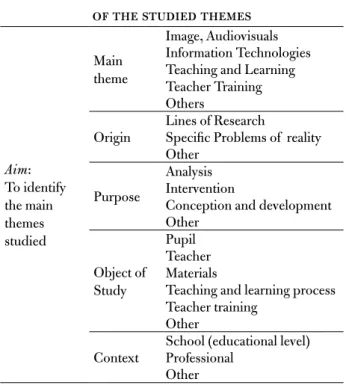
Criterion 1 – Studied themes. With a view to iden‑ tifying the main themes under study, this criterion is essentially applied to the formulation of the central research question (influential in the selection of the study object, mobilisation of a theoretical reference framework, definition of aims or formulation of re‑ search possibilities and the drawing up of a plan for the collection of empirical data). In order to better understand the scope of the developed research, we have set out some aspects of this criterion in order to identify not only the central theme under study, and the empirical field from where the data is col‑ lected (object of study), but also the origin of the research itself (research lines, reality problems) and its ultimate purpose (analysis of reality, intervention, conception and development). We have also includ‑ ed a criterion referring to the context studied, with a view to understanding the type of study distribution between the professional and school context and, as
regards the latter, through the different educational levels (see Table 2 – Identification and charac‑ terisation of the studied themes).
Criterion 2 – Theoretical Reference Tables. With a view to identifying the theoretical frameworks used as research support, this criterion applies to the ref‑ erences made by the researcher to the scientific ar‑ eas, theories or specific authors, in terms of clarify‑ ing the research question, supervising the collection of data and serving as the basis for interpretation (Table 3 – identification and characterisation of theoretical reference frameworks).
Criterion 3 – Methodological Options. Finally, with a view to characterising the research method‑ ologies used, this criterion applies to the descrip‑ tion that is made, in each individual work, of the na‑ ture, arguments and collection of data techniques, as well as the methodological procedures adopted in the planning, analysis and interpretation. As with the previous criterion, we have considered the dif‑ ferent aspects for the characterisation of the meth‑ odological options: the research aims (search for explanation, search for understanding, description of reality, problem solving); the methodological plan (experimental, non‑experimental); data analysis (quantitative, qualitative); the techniques and instru-ments used and the scope of the sample (see Table 4 – Characterisation of the methodologies).
Table 2
identification and characterisation of the studied themes
Aim: To identify the main themes studied Main theme Image, Audiovisuals Information Technologies Teaching and Learning Teacher Training Others
Origin Lines of Research Specific Problems of reality Other
Purpose
Analysis Intervention
Conception and development Other Object of Study Pupil Teacher Materials
Teaching and learning process Teacher training
Other
Context School (educational level)Professional Other
The frequencies of each category of analysis and respective percentages were calculated with the SPSS. In order to guarantee the validity of the categorisation process, a second classification was drawn up for a random sample of dissertations, hav‑ ing achieved a coefficient of 83.50% in the equiva‑ lence test between the two classifications obtained.
Table 3
identification and characterisation of the theoretical reference frameworks
Aim: To identify the main theoretical reference frameworks used as research support. Theoretical references* Behaviourist Perspective (Skinner, gagné, Bloom…) Communicational, Multimedia Perspective (Shannon e Weaver, Mayer…) Systemic Perspective (Bertalanfy, Romiszovsky…) Cognitive and constructivist perspectives (Bruner, Piaget, giardina, Papert…) Hypermedia Approach and cognitive flexibility (nelson, Spiro…)
Other
* Classification systematised by Chaves (1998) and Pereira (1993).
Table 4 characterisation of methodologies Aim: To characterise the research methodologies used Research Aims
Search for explanation Search for understanding Problem solving Other (mere description…) Methodological Level Experimental non‑experimental Mixed
Type of analysis QuantitativeQualitative Mixed Techniques Statistical Analysis… Observation, non‑ structured interviews, documental analysis… Mixed Scope of the sample Macro Meso Micro
PRESEnTATIOn And dISCUSSIOn OF RESULTS
Where is the research carried out?
In order to better understand the overall panorama of the research carried out, we will begin by present‑
ing the information regarding the distribution of the dissertations in the universities where they were carried out. As may be observed in Table 5 (dis‑ sertations per University), the dissertations in‑ cluded in the analysis (226) are concentrated in just five Portuguese universities3.
Table 5
dissertations per university Distribution of frequencies and percentages
UnIVERSITIES f %
U. Aberta [Open Uni.] 41 18.1
U. de Aveiro [Aveiro Uni.] 25 11.1
U. de Lisboa [Lisbon Uni] 54 23.9
U. do Minho [Minho Uni] 98 43.4
U. Nova de Lisboa 8 3.5
Total 226 100.0
The University of Minho stands out from the rest as it was there that almost half of the dissertations carried out were analysed (43.4%), followed by the University of Lisbon with 23.9%. We may, indeed, conclude that three quarters of academic research for Master courses carried out in Portugal in the field of Educational Technology are held at these two universities. If, in our analysis, we exclude the Universidade Aberta4, it is only fair to associate the more recent universities (Aveiro, Minho, nova) and the greater amount of research carried out there: Around two thirds, against around one third in the University of Lisbon, the only representative of the so‑called “Classic” Universities among those con‑ sidered. This fact may be interpreted in support of the possibility that the appearance of new universi‑ ties, from the 80’s onwards has been a contributory factor in the development of this scientific area. How does the number of dissertations evolve? We have tried to understand how the dissertations are distributed over the four periods of five years in which we have divided the last two decades, in or‑ der to verify the evolution of time since the appear‑ ance of the first studies of Master5 courses, up to the present day.
Therefore, based on Table 6 (Evolution of the number of dissertations), it is possible to observe an overall crescendo in research, which is particu‑ larly clear in the transition from the 80s (with only 8
dissertations concluded) to the 90s with more than half of the analysed theses (136), or 60.2% of the total.
Table 6
Evolution of the number of dissertations Distribution of frequencies and percentages
PERIOdS Freq. % 1986‑1990 8 3.5 1991‑1995 77 34.1 1996‑2000 59 26.1 2001‑2005 82 36.3 Total 226 100.0
In the last period taken into consideration which includes the years between 2001 and 2005 in the new millennium, there are 82 dissertations (36.3%). The set of results seems to point towards a continuation of the research rhythm at this academic level, with the possibility of even stronger reinforcement with the scientific production of other courses which have opened in the meantime, such as the Mestrado em Informática Educacional [Master in Educational Computer Technology] offered by the Portuguese Catholic University and which, as is already known, perhaps for its accomplishment mainly by distance‑ learning, achieved a remarkable number of enrol‑ ments in its first edition.
These results, coupled with the high demand for post‑graduations in this field, namely on the part of teachers, may represent more favourable settings in terms of the actual use of technologies for educa‑ tional purposes as well as providing strong evidence of the amount of research carried out in our coun‑ try,. This is mainly due to the critical mass these teachers and other participants in the educational phenomenon become a part of, and also the impact their action may have in the near future, namely if appropriately integrated in specific intervention projects created for this purpose.
What themes are studied?
As we were able to explain earlier on, we used a set of diversified criteria as the reference for the char‑ acterisation of the studied themes, with a view to highlighting the research carried out. Thus, we were able to contribute to the acquisition of more profound knowledge on what is researched, why it is researched, the context and purpose. The idea is,
then, that the analysis of these arguments may pro‑ vide an overall perspective of the effort deposited in the research carried out in academic contexts and, eventually, open new horizons, at least in terms of social relevance, as a contribution to the innovation and alteration of ways of teaching and learning in our schools. The following tables refer specifically to each one of these analysis bases, in other words: to the main themes handled; to the root of the prob‑ lems that instigated the research; to the purposes set out by the authors of the research studies; to the specific study objects and, finally, to the observed and studied contexts.
Main themes handled
Based on the analysis of Table 7 (Themes handled in the research study) it may be said that there is a predominance of studies of themes related to “in‑ formation technologies” as a tool and resource, sub‑ ject to being studied regardless of their connection (or not) to specific study objects. In other words, they are at the service of learning on the part of the pupil, at the service of the teacher, at the service of the teaching and learning process itself, in general (41,1%). Whenever they are not connected to other study objects, “information technologies” emerge as the object of analysis themselves (evaluation of software, for example), object of development, such as the studies leaning towards the creation and de‑ velopment of new applications for specific purposes (a multimedia application for Children’s drawing, to give a specific example).
Table 7
Themes handled in the research Distribution of frequencies and percentages
MAIn THEME Freq. %
Audiovisuals 39 17.8 Information Technologies 90 41.1 Teaching and Learning 47 21.5 Teacher Training 20 9.1
Other 23 10.5
Total 219 100.0
There is, indeed, a great distance between the study of “audiovisuals” (with just 17.8%), confirm‑ ing the growing interest in digital technologies and the importance adopted by the latter in terms of the
audiovisual and analogical technologies with which they are associated. As may also be understood, they are only predominant up to the point where computers take on effective and generalised expres‑ sion in more recent, modern‑day society.
Only 9.1% of the studies focus on the theme “teacher training” (20 dissertations), but around a quarter focus on the observation and analysis of teaching and learning”. These are two interesting results, especially in terms of what each one means in itself, but also since they each point in opposite directions. If, on the one hand, it is crucial that at‑ tention be shifted to the study of the ways in which technologies are integrated in the teaching and learn‑ ing process, it is worrying that little attention con‑ tinues to be given to the contexts in which teachers should be expected to be professionally prepared, which implies the integration and use of these same technologies in their teaching practices.
Although we are aware that it is not in the con‑ text of academic studies of an individual nature that this should be done, it is still an indicator of the critical situation in which we find ourselves and which is characterised by the complete absence of an integrated and articulated vision of the profes‑ sional development of teachers in this field. Inter‑ estingly, as the few studies on this theme clearly show (Costa & Peralta, 2006; Matos, 2005; Ponte & Serrazina, 1998; Ponte et al., 2000), this also oc‑ curs in terms of initial personal training which, in our opinion, is one of the most worrying factors within the national context. despite being in har‑ mony with what happens internationally in terms of the impact of initial training among the new gen‑ erations of teachers (Brett et al., 1997; ITRC, 1998; Makrakis, 1997; Willis & Mehlinger, 1996), what is worse is that in Portugal this is not by any means an object of structured and consistent intervention, deriving from previous, in‑depth reflection on the role of technologies in learning.
From a “geographical” perspective of the themes, in other words, of their distribution around the uni‑ versities in which the dissertations were carried out, observation of the results suggests some preferences that may be interesting to explore: in the University of Minho “information technologies” are, by far, the most preferred theme (22.83%); the case is the same in the University of Aveiro, although on a smaller scale
(5.94%); in the Open University, the most studied theme is “image audiovisuals” (8.22%), closely fol‑ lowed by “information technologies” (7.31%); in the University of Lisbon the main interest is “teaching and learning” with “teacher training” in second place. Origin of the Research
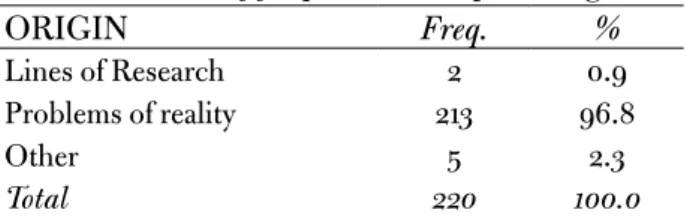
As far as the selection of the studied themes is con‑ cerned, it is possible to observe through Table 8 (Origin of the research), that the “problems of reality” are what determine what is going to be the research focus. Indeed, they are clearly predomi‑ nant, in almost all the studies (94.2%), which is why they can be associated with the interest of authors in acquiring greater knowledge on the issues or prob‑ lems which they have encountered, in some form or other, in their professional activity.
Table 8
Origin of the research
Distribution of frequencies and percentages
ORIgIn Freq. %
Lines of Research 2 0.9 Problems of reality 213 96.8
Other 5 2.3
Total 220 100.0
As, perhaps, was expected, given the type of sporadic relationship established with the universi‑ ties in order to obtain this academic level, there are hardly any research studies in which their insertion in a particular “line of research” is clearly and ex‑ pressly adopted, such as, in a certain centre or re‑ search unit.
Main Purposes
In accordance with the results in Table 9 (Research purposes) and in harmony with what has been said on the origin of the research, it may be affirmed that the main motivation for the accomplishment of the research developed in the analysed disserta‑ tions is clearly the understanding of the observed phenomena, situations or contexts. Indeed, in al‑ most two thirds of the studies (70.4%) the dominant purpose is “analysis”, followed by “conception and development” which emerges in second place, even though at a great distance with 25.5% of the cases, in other words, a third of the research considered.
Table 9 Research purposes
Distribution of frequencies and percentages
PURPOSE Freq. %
Analysis 152 70.4
Intervention 9 4.2
Conception and 55 25.5
Total 216 100.0
Both figures seem to make sense, in that we are referring to something very recent, in constant evo‑ lution and whose outlines, as we have already seen, are not very clear, at least not for those confronting the difficulties and inherent implications of the use and integration of machines for the first time, in an environment that had previously been exclusively reserved for human action and interaction. Indeed, it could be a good indicator of development in this field and of its practical applications, if the impact of the set of research studies carried out in order to obtain an academic level were different.
Perhaps owing to the fragile position of the authors of these research studies who, as we have already mentioned, are mainly teachers who individually go in search of an academic qualification that will allow them to progress in their career, the number of disser‑ tations with a view to “intervening” is not expected to be high. However, a structured intervention with a specific institutional support, for example in terms of a school or a set of schools would be expected. The high degree of this area’s applicability contrasts with the low percentage found in studies with this purpose (4.2%, in other words only 9 dissertations), which still cor‑ responds to what was said in the previous paragraph.
As regards the association between universities and aims, the results point to a preference for “analy‑ sis” and an understanding of reality in the cases of the Universities of Minho (26.39%), Lisbon (24.55%), Aveiro (8.33%) and nova (3.70%), and for the “de‑ velopment” of materials in the Open University (11.57%), but also in the University of Minho (10.65%). Main study objects
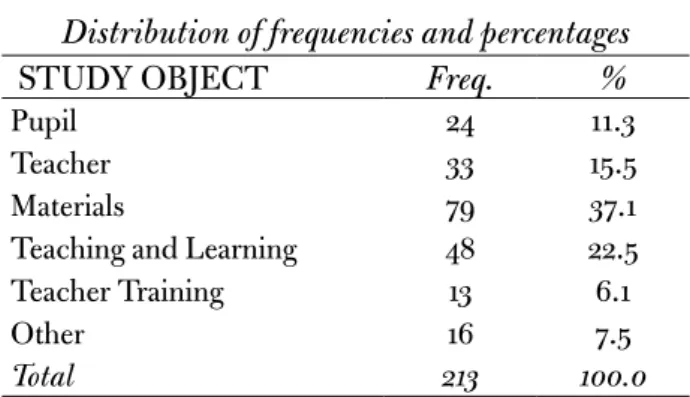
The analysis of the results presented in Table 10 (Study objects) show that the “materials” are the main focus of the research developed among the analysed Masters dissertations, with 37.1% of the studies, or 79 dissertations6.
Focus on the “teaching and learning process” appears in second place, with 22.5% of the studies (48 dissertations). Conjugating this figure with the set of theses that concentrate more specifically on the “pupil” (considered individually and directly related to learning), with 11.3% (24 theses), and on the “teacher” (studies primarily related to attitudes towards technologies or with a view to discovering the kind of use made of technologies), with 15.5% (33 dissertations), it is also possible to observe the special interest that the related topics deserve, not exactly technology itself, but the context in which it is supposed to be used, with its more direct users and with the role it may have in learning.
Table 10 Study objects
Distribution of frequencies and percentages
STUdy OBJECT Freq. %
Pupil 24 11.3
Teacher 33 15.5
Materials 79 37.1
Teaching and Learning 48 22.5 Teacher Training 13 6.1
Other 16 7.5
Total 213 100.0
On the other hand, only 6.1% of the studies focus on “teacher training” which is, indeed, the lowest figure in this category. Corroborating what has al‑ ready been said on teacher training and pointing in the same direction, it is interesting to see that only three dissertations have the process and practices of teacher training as their main focal point, which is rather curious since the former is, recognisably and unavoidably, a touchstone here and in other areas of Educational Sciences.
In terms of the geography of the study objects, it is interesting to note the preferences of the Uni‑ versities of Minho (18.78%), the Open University (11.74%) and Aveiro (5.63%) for studies focusing on “materials”. As far as the University of Lisbon is concerned, preference is shared in the same way for two of the study objects that are more directly related to the didactic situation itself, in other words the “teacher” (7.98%) and the “teaching‑learning” process (7.98%).
Research focus
As already mentioned on a number of occasions, it is mainly teachers who go in search of obtaining post‑graduate qualifications in the field of Educa‑ tional Sciences, particularly in those areas which may be directly related to the structured reflection on the relationship between technology and its use for educational purposes, namely in terms of a Mas‑ ters degree . Perhaps because of this, the “school” context, in the corpus considered here, represents almost all the research studies carried out (200 dis‑ sertations, 95.7%), with only one residual figure (3.3%) of dissertations developed in a “profession‑ al” context outside the school (See Table 11 – Con‑ texts in which research is carried out).
Table 11
Contexts in which research is carried out Distribution of frequency and percentages
COnTEXT Freq. %
School 200 95.7
Professional 7 3.3
Other 2 1.0
Total 209 100.0
Main theoretical reference frameworks The sturdiness of the theoretical support is one of the fundamental attributes of scientific research and, as it would have to be, is a guarantee of the quality and credibility of the studies carried out. As far as the dissertations are concerned for obtaining an academic qualification such as those we have al‑ ready analysed, it is important to know the theoreti‑ cal references used in the research process so that it is possible to evaluate which are the more predomi‑ nant tendencies at a particular moment and how they are distributed around the universities where the research is being supervised.
According to the results presented in Table 12 (Theoretical reference frameworks), it is pos‑ sible to conclude that most of the dissertations (53.6%) do not use what we had originally consid‑ ered the basis of our analysis as their theoretical ref‑ erences and which, as has already been mentioned, were founded on the perspectives that are tradition‑ ally stimulated to study the theme of Educational Technology. In addition to our initial difficulty in
some research studies in identifying the theoreti‑ cal reference framework, whether through a lack of clarity in its specification or a lack of clarity in the option for just one of the perspectives considered in our analysis, we also included the studies that pre‑ sented other frameworks of theoretical structures in this category (“other references”) in addition to those we had defined a priori.
Table 12
Theoretical reference frameworks Distribution of frequency and percentage
THEORETICAL REFEREnCES Freq. %
Communication and Multimedia 32 22.9 Cognitivism and Constructivism 16 11.4 Hypermedia and Cognitive Flexibility 17 12.1
Other 75 53.6
Total 140 100.0
A possible interpretation of this result, in terms of the last alternative, may be related to the loan sought in other scientific areas, particularly those directly linked to specific themes and study objects, such as teacher training. If a certain dissertation has teacher training as its main study object, it is natural that the researcher will try to construct the respective theoretical framework in light of current knowledge on teacher training models, for example. In our opinion, this would be extremely beneficial from an interdisciplinary perspective and the broad‑ ening of scope to include scientific related areas, in order to study issues that are frequently confined to researchers from the area of technology. This could have profound implications in terms of the impact and relevance of the research carried out, both in general terms and in strictly scientific ones.
Since it was only possible to clearly classify the dissertations analysed in only three of the five pre‑ viously defined categories of analysis, it is through them that the rest of the theoretical reference figures are distributed. The dissertations that were theoret‑ ically supported by a “communicational and multi‑ media” approach were at the top with 22.9%, closely followed by dissertations based on an approach we have referred to as “hypermedia and cognitive flex‑ ibility” (12.1%) and the studies that were based on a “cognitive and constructivist” approach (11.4%). Interestingly, or maybe not so, the number of stud‑
ies based explicitly on both the behaviourist per‑ spective and the systemic approach was insignifi‑ cant, which may, in some way, also be connected to a paradigm inflection to which some authors refer (Coutinho, 2000b, 2005; Pereira, 1993,) in terms of the understanding of the educational phenomena in light of more up to date approaches which are more in touch with the challenges that digital and network technologies have brought to the teaching and learning process.
Methodologies
Although the methodologies used in any research study should result from what is intended to be studied and the foreseen purposes, the selection and adoption of methodological procedures, or the establishment of a research plan, or the selec‑ tion of collection techniques and data analysis are not always exclusively determined by the in‑depth analysis of what is most appropriate and consistent from an epistemological perspective with the spe‑ cificity of the study object. Indeed, there are often more circumstantial factors that end up condition‑ ing both the design of the research and the instru‑ ments used. In the specific case of the Masters dis‑ sertations, many of them will represent these con‑ tingencies, and so, the results we obtain may also serve as a source of reflection , namely as far as the research quality is concerned, and as we have pre‑ viously mentioned, should arouse concern for the educational community in general, and for each re‑ searcher in particular.
Research Aims
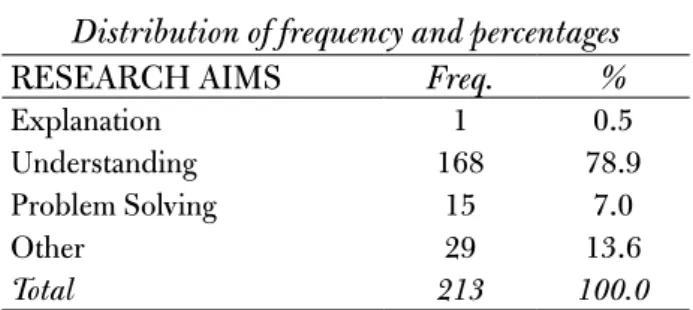
As regards the research aims explicitly set out in the dissertations and based on the results presented in Table 13 (research aims), it is possible to conclude that “understanding” of the phenomena or prob‑ lems is the most frequent category, with a total of 168 dissertations (78.9%), followed, at a large distance, by the category “others” (13.6%), in which both the aims that did not correspond to the criteria consid‑ ered and the dissertations in which more than one of these aims would be expected were included. Only 15 theses (7.0%) refer explicitly to the aim of “problem solving” and the intention to “explain” the studied phenomena is hardly visible at all in the dissertations (0.5%).
Table 13 research aims
Distribution of frequency and percentages
RESEARCH AIMS Freq. %
Explanation 1 0.5
Understanding 168 78.9 Problem Solving 15 7.0
Other 29 13.6
Total 213 100.0
It is also worth mentioning that the above‑men‑ tioned setting clearly occurs in all the universities where the dissertations were carried out.
Methodological Design
With a view to understanding how the dissertations are situated in terms of methodological design, a clear “non‑experimental” predominance was regis‑ tered with 78.7% of all the studies performed (140 dissertations), over the designs organised according to a more “experimental” logic, with only 34 disser‑ tations (19.1%), and over the “mixed” plans, with just 4 studies (see Table 14 – methodological design).
Table 14
methodological design Distribution of frequency and percentages
METHOdOLOgICAL dESIgn Freq. %
Experimental 34 19.1 non Experimental 140 78.7
Mixed 4 2.2
Total 178 100.0
As regards the methodological design, itself, the results enable us to conclude that, on the one hand the “non‑experimental” methods are preferred in all the universities and only the University of Minho also appears in the “experimental” designs.
Type of Data
As with the previous results, it is possible to ob‑ serve in Table 15 (Type of analysis) the preference of most dissertations for a “qualitative” type of data analysis (56.0%), over a “quantitative” analysis used in only 45 dissertations, in other words, 30.0% of all the cases in which this information is given ex‑ plicitly.
Table 15 Type of analysis
Distribution of frequency and percentages
TyPE OF AnALySIS Freq. %
Quantitative 45 30.0 Qualitative 84 56.0
Mixed 21 14.0
Total 150 100.0
In a small percentage of these studies (14.0%) combinations of both types of analysis are used (“mixed” analysis). However, the option for qualita‑ tive data is clear in all the universities in whose dis‑ sertations it was possible to discover this informa‑ tion.
Techniques
Based on the results presented in Table 16 (Tech‑ niques ), in accordance with previous results, it is possible to verify the predominance of “non‑sta‑ tistical” data collection techniques (observation, non‑structured interviews, personal notes…) with 57.8% of all the studies in which this information is supplied, over the so‑called “statistical” techniques in just 31.3% of these studies. In similarity to what was observed in the above section, dissertations where “mixed” techniques (10.9%) were used are also identified here.
Table 16 Techniques
Distribution of frequencies and percentages
TECHnIQUES Freq. % Statistical Analysis 46 31.3 Observation, non‑structured interviews, registers… 85 57.8 Mixed 16 10.9 Total 147 100.0
The preference for “statistical” techniques (25.85%) is only noticeable at the University of Minho, even though “non‑statistical” techniques are also used there in a relevant way (14.97%). The option for “non‑statistical” techniques is clearly an option of the University of Lisbon (27.21%), the Open University (8.84%) and also the dissertations carried out at the new University [Nova] (4.08%).
Scope of the sample
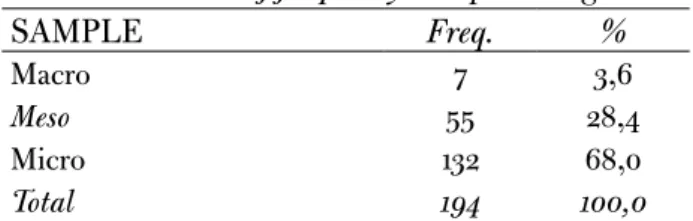
As for the scope of the sample, Table 17 (scope of the sample) shows that in 68.0% of the dissertations where this information is explicit, they focused, as perhaps was to be expected, on small‑scale studies (“micro” sample). Only 28.4% are part of studies with considerable scope (“meso”) and 3.6% of large‑ scale studies (“macro”).
Table 17 Scope of the sample
Distribution of frequency and percentages
SAMPLE Freq. %
Macro 7 3,6
Meso 55 28,4
Micro 132 68,0
Total 194 100,0
In this particular criterion, the option is clearly for samples of a weak range in all the universities, even though there is also a percentage of disserta‑ tions with relatively larger samples, such as in the University of Minho (14.95%) and in the University of Lisbon (6.19%).
SUMMARy And PERSPECTIVES
With a view to highlighting the more salient aspects of the scientific research in question here, we will end on some of the main arguments already pre‑ sented, and which, to a certain extent, may serve as a systematisation of the main tendencies of what is researched in this field in Portugal in terms of Mas‑ ters degrees.
It is worth mentioning that, as has been the case internationally over recent years, first of all, interest in the study of themes related to audiovisuals has shifted to the study of themes more directly related to “new” information and communication technolo‑ gies, in other words, digital technologies. As a study object in itself (studies with a technological slant), but also, even though on a lesser scale, in its direct relationship with the agents, contexts and learning objectives (pedagogical studies).
On the other hand, the little attention given to training contexts (initial training and continuous training) and to the preparations of professionals
(teachers, trainers) for the integration of technolo‑ gies in their practices is also worth mentioning.
Even though universities may have research lines with preferred themes and approaches which might, to a certain extent, influence what is studied in terms of dissertations, it is the school setting and the issues or problems of reality that motivate their authors, most of whom are teachers, who focus, primarily, on analysing and understanding the observed phenom‑ ena, situations and contexts. Therefore, it is not the priority to stimulate the interest of these research teachers since, as may be easily understood, their in‑ tervention is strongly restricted to individual action.
Studies regarding the conception and develop‑ ment of materials take second place, as far as the re‑ search aims are concerned, and are of considerable relevance since they represent a third of the analysed dissertations.
In terms of the theoretical framework, different signs seem to lean towards what some refer to as a paradigmatic inflection towards the use of more up to date and adjusted approaches to the new ways of equating learning and that which educational poli‑ cies have introduced in the official curriculum. In other words, it refers to the pupil as an active agent in the construction of his/her learning, the latter be‑ ing socially constructed, etc…There is also inflec‑ tion towards greater attention being given, not so much to technology, itself, but rather to its direct relationship with the actual teaching and learning process and its implications in terms of its open‑ ness and stimulation of other knowledge. Thus, it is granted an interdisciplinary status and involves other, traditionally ignored scientific areas, which are of the utmost importance, such as Curriculum, Assessment and even Teacher Training, itself.
Finally, an inflection may also be spoken of in terms of methodology (methodological inflection), since there is a clear withdrawal from the tradi‑ tionally preferred classic methods (experimental method, co relational studies, the comparison of means…), as some authors had already mentioned, and which is obvious in the tendency to use “non‑ experimental” research designs, the preference for “non‑statistical” data techniques and the option for a qualitative type of data.
In short, it may be said that the research present‑ ed here represents a relevant part of the research
developed over the last two decades in Portugal. The high demand for post graduation courses at universities from the nineties onwards, particularly in this field, indeed, corresponding to the strong ap‑ peal of new technologies and their potential for use in Education, is perhaps, one of this period’s main characteristics and influences what is researched in Portugal in this field. In fact, as we have already observed, teachers are the ones who are more inter‑ ested in taking a Masters course in this area, even though their motivations are directly related to the study of integrating technology in education, but also for reasons to do with the development of their professional career.
Owing to an increase in the supply of Masters courses at some universities which are directly re‑ lated to educational technology, the tendency over the last fifteen years has been for demand to also in‑ crease. despite being a good indicator of the amount of research carried out, this fact sheds very little light on the direct contribution of research to educational practices, namely in terms of clarification of ways of using the technologies, their implications for the organisation of contexts, their impact on learning, just to mention a few of the crucial aspects regarding which there is no systematic information.
However, it is still an important contribution on the part of the teachers who are involved in it, for the emerging critical mass and the impact it may have in the near future, for example, in the schools where they work. As previously discussed, it could have a positive impact, especially if it is duly considered and employed in structured intervention projects that are suitably supported by the educational projects of the same schools.
The little research carried out beyond the aca‑ demic context and the absence of systematic evalu‑
ation studies on the introduction of technologies in schools are two characteristics that we may also as‑ sociate with the second period in consideration. In accordance with international tendency, they lead us to assume that the results of the scientific stud‑ ies will have a weak impact on the practices of those who, for a wide range of mainly circumstantial rea‑ sons, were able to use the available technology, at a given moment, for educational purposes.
Even though the scientific and methodologi‑ cal support to the introduction of technologies in an educational setting is apparently of vital impor‑ tance, where research is expected, as is the case in other areas of knowledge, to precede the respective professional practices, in educational technologies the opposite seems to happen. Technologies reach the schools, are used, generally by the teachers who are more sensitive to their integration in the teach‑ ing and learning process, and only much later does a possible reflection emerge (when it does emerge) on their possible benefits for learning. This reflec‑ tion depends, more often than not, on circumstan‑ tial factors (such as carrying out studies to obtain a Masters degree) and is only sporadically integrated in a broader project or research line, with a view to equating new forms of teaching and learning with technologies and to bringing about specific support for different types of use and practice of these same technologies.
This is a crucially important aspect, especially as far as new technologies are concerned, not only be‑ cause of the challenges they represent (may represent) in terms of the innovation of conception and teach‑ ing and learning practices, but also because of the need to strictly and systematically monitor their im‑ plementation, or evaluate their impact and respective effects on a number of different levels of schooling.
Endnotes
1. XV Conference of the Portuguese Branch of AFIRSE – Association Francophone Internationale de Recherche en Sciences de l’Education (Lisbon, February 2006).
2. “There are literally hundreds if not thousands of studies that keep repeating this horse‑racing par‑ adigm, a paradigm that was condemned and sen‑ tenced to death years ago when discovery learn‑ ing, educational television, and CAI were compared with their traditional competitors” (Salomon, 2000). Basically, it is like trying to measure a certain object without a valid measurement unit, since it was not constructed in view of the nature and characteris‑ tics of such an object.
3. Even though we are aware that there are Mas‑ ters dissertations in other Portuguese universities, resulting from research connected, in some degree, to the area of Educational Technology, we were una‑ ble to gain access to the respective information from the data bases we consulted. We were also unable to gain access to the respective libraries or docu‑ mentation centres in time. We have been informed that the Universities of Coimbra, Porto and Algarve are members of this group, even though the figures are not very significant, due to the lack of Masters courses in this specific area at these Universities.
4. Exclusion of the Universidade Aberta [Open University] can only be justified by its marked dif‑ ference in relation to the other universities, at least in terms of the means it uses to accomplish its mission. However, in this specific case, only as a way of test‑ ing the possibility of the decisive contribution of the surge of new universities after April 25th 1974.
5. The first Master of Education courses of which we know, specialising in the area of Educational Technology were held at the University of Minho in the academic year 1991/92 (Chaves, 1998), although there had already been a specialisation at this Uni‑ versity in Informática no Ensino [Computer Technol‑ ogy in Education](since 1987). during the academic year 1991/92 a Master course also opened at the Uni-versidade Aberta on Multimedia Communication.
6. This fact seems to tie in with the results observed in relation to the “main theme”, in which interest in the more technological aspects was much higher, reaching a percentage of 58.9% of the stud‑
ies when considered in conjunction with “infor‑ mation technologies” and the “audiovisuals” (it is worth mentioning that the set of themes that are not directly related to the “technologies” – “teach‑ ing and learning” and “teacher training”‑ represent only 30.6% of the cases).
Bibliographical references
Abrantes, J. C. (1981). Tecnologia Educativa. In M. Silva & I. Tamen (eds.), Sistema de Ensino em Portugal. Lisboa: Fundação Calouste gulben‑ kian, pp. 521‑551.
Abrantes, J. C. (1998). Os media e a escola: da imp-rensa aos audiovisuais no ensino e na formação. Lisboa: Texto Editora.
Atkinson, R. C. & Jackson, g. B. (1992). Research and education reform : roles for the Office of Edu-cational Research and Improvement. Washing‑ ton, d.C.: national Academy Press.
Blanco, E. & Silva, B. (1993). Tecnologia educativa em Portugal: conceito, origens, evolução, áreas de intervenção e investigação. Revista Portugue-sa de Educação - CIEd, 6, 3, pp. 37‑55.
Brett, A.; Lee, O. & Sorhaindo, L. (1997). Effect of Field‑Based Technology Laboratory on Pre‑ service Teachers’ Knowledge, Attitudes, and In‑ fusion of Technology. Florida Journal of Educa-tional Research, 37, 1, pp. 1‑16.
Caldas, J. C. (2001). O vídeo na escola em Portugal. In B. Silva & L. Almeida (eds.), Congresso Galai-co-Português de Psicopedagogia. Braga: Centro de Estudos em Educação e Psicologia, pp. 383‑394. Chaves, J. H. (1998). Mestrado em Educação/Área de Especialização em Tecnologia Educativa. Resumo das Dissertações da 1ª Edição do Curso.
Costa, F. & Peralta, H. (2006). Primary teachers’ competence and confidence. Level regarding the use of ICT. In ED-MEDIA - World Conference on Educational Multimedia, Hypermedia & Tel-ecommunications. Orlando.
Coutinho, C. (2000a). ICT in education in Por‑ tugal: a review of 15 years of research. Comuni‑ cação apresentada na AECT.
Coutinho, C. (2000b). Percursos de investigação em Tecnologia Educativa em Portugal: Uma abordagem temática e metodológica a publicações
científicas (1985-2000). Braga: Cied/Universi‑ dade do Minho.
Coutinho, C. (2005). Evaluation research in educa‑ tion: the importance of a paradigmatic debate of fundamentals and practices. Comunicação ap‑ resentada no IX Congreso de Metodología de las Ciencias Sociales y de la Salud, granada.
Coutinho, C. & Chaves, J. H. (2001). desafios à in‑ vestigação em TIC na educação: as metodologias de desenvolvimento. In P. dias & C. V. d. Frei‑ tas (eds.), Actas da II Conferência Internacional Desafios/Challenges 2001. Braga: Universidade do Minho, Centro de Competência nónio Sec. XXI, pp. 895‑904.
de Corte, E. (1996). Aprendizage apoyado en el com‑ putador: una perspectiva a partir de investigación acerca del aprendizage y la instrucción. Comu‑ nicação apresentada no III Congresso Iberoa-mericano de Informática Educativa. Colômbia. Fernandes, R. (1969). Para a história dos meios
audiovisuais na escola portuguesa. Separata da «Revista de Portugal», Série A: Língua Portu‑ guesa, XXXIV, Lisboa, p. 3.
Figueiredo, A. d. (2005). Learning Contexts: a Blueprint for Research. Interactive Educational Multimedia, 11 (October), pp. 127‑139.
Holloway, R. (1996). diffusion and adoption of Ed‑ ucational Technology: A critique of research de‑ sign. In d. Jonassen (ed.), Handbook of Research for Educational Communications and Technnol-ogy. new york: MacMillan, pp. 1107‑1133.
ITRC ‑ Instructional Technology Resource Center (1998). Integration of Technology in Preservice Teacher Education Programs: The SouthEast and Islands Regional Profile. Orlando, Florida: Instructional Technology Resource Center. Col‑ lege of Education. University of Central Florida. Makrakis, V. (1997). Perceived Relevance of In‑ formation Technology Courses to Prospec‑ tive Teachers’ Professional needs: the case of greece. Journal of Information Technology for Teacher Education, 6, 2, pp. 157‑167.
Matos, J. F. (2005). As Tecnologias de Informação e Comunicação e a Formação Incial de Professores em Portugal: radiografia da situação em 2003. Lisboa: gIASE‑ME.
Pelgrum, W. J. (2001). Obstacles to the integration of ICT in education: results from a worldwide
educational assessment. Computers & Educa-tion, 37, 37, pp. 163‑178.
Pelgrum, W. J. & Law, n. (2004). Les TIC et l’education dans le monde: tendances, enjeux et perspectives. Paris: UnESCO.
Pereira, d. C. (1993). A Tecnologia Educativa e a mudança desejável no sistema educativo. Revista Portuguesa de Educação - CIEd, 6, 3, pp. 19‑36. Plomp, T. & Pelgrum, W. (1991). Introduction of
computers in education: state of art in eight countries. Computers & Education, 19, pp. 249‑ 258.
Ponte, J. P. (1994). O projecto MINERVA: introduz-indo as NTI na educação em Portugal: introduc-ing NIT in education Portugal. Lisboa: ME/dEP gEF.
Ponte, J. P. & Serrazina, L. (1998). As Novas Tecnolo-gias na Formação Inicial de Professores. Lisboa: dAPP‑Ministério da Educação.
Ponte, J. P. d.; Oliveira, P.; Varandas, J. M.; Ol‑ iveira, H. & Fonseca, H. (2000). Tecnologias de informação e comunicação na formação de. pro‑ fessores: Que desafios? Revista Ibero-Americana de Educación, 24, pp. 63‑90.
Pourtois, J.‑P. & desmet, H. (1988). Épistémologie et instrumentation en sciences humaines. Liège; Bruxelles: Pierre Mardaga.
Reeves, T. (1995). Questioning the Questions of Instructional Technology Research. In M. R. Simonson & M. Anderson (eds.), Proceedings of the Annual Conference of the Association for Educational Communications and Technology, Research and Theory Division. Anaheim, C.A., pp. 457‑470.
Reeves, T. (1997). Evaluating What Really Matters in Computer-Based Education. University of georgia. Retrived January 2004 from http://www. educationau.edu.au/archives/cp/reeves.htm Reeves, T. (2000). Enhancing the Worth of Instruc‑ tional Technology Research through “design Experiments” and Other development Research Strategies. Comunicação apresentada na Session 41.29. International Perspectives on Instruction-al Technology Research for the 21st Century, new Orleans, LA, USA.
Russell, T. L. (1999). The no significant difference phenomenon. north Carolina State University: Raleigh, nC, USA.
Salomon, g. (2000). It’s not just the tool, but the educational rationale that counts. Comunicação apresentada na Ed-Media Meeting, Montreal. Salomon, g. (2002). Technology and Pedagogy:
Why don’t We See the Promised Revolution? Educational Technology, pp. 71‑75.
Silva, B. (2000). As tecnologias de informação e comu‑ nicação nas reformas educativas em Portugal. Re-vista Portuguesa de Educação - CIEd, pp. 111‑153. Taylor & Bogdan, R. (1984). Introduction to quali-tative research methods : the search for meanings 2nd. new york: Wiley.
Walker, d. (1994). new information technology and the curriculum. In T. Husen & n. T. Postlethwaite (eds.), The Encyclopedia of Education (Vol. 7). Oxford: Pergamon Press, pp. 4081‑4088. Willis, J. & Mehlinger, H. (1996). Information technology and teacher education. In J. Sikula (ed.), Handbook of Research on Teacher Educa-tion. ny: Mc.Millan, pp. 978‑1029.