UNIVERSIDADE DE LISBOA FACULDADE DE CIÊNCIAS DEPARTAMENTO DE INFORMÁTICA
Design and implementation of a protocol for safe cooperation of
self-driving cars
João Pedro Vicente e Campos Pinto
Mestrado em Engenharia Informática
Especialização em Arquitetura, Sistemas e Redes de Computadores
Dissertação orientada por:
Prof. Doutor António Casimiro Ferreira da Costa
e co-orientada pelo Prof. Doutor Naercio David Pedro Magaia
Acknowledgments
My advisor’s Ant´onio Casimiro and Naercio Magaia, for their guidance during the course of this dissertation and Tiago for all the help and availability to discuss ideas regarding both our projects.
Cheila, for listening and encouraging me for the past nine months and always being by my side for the past five years.
My Mother, my Father, Jo˜ao Paulo and the rest of my family, for always supporting and encouraging me to go further.
Francisco, Jo˜ao Becho, Jo˜ao Batista, Nuno Rodrigues and others at LASIGE for the comradery and helpful debates.
Tom´e, Emanuel, Geraldes, Pedro, Lu´ıs, Sofia, Bruno, Cac¸a, Guilherme and everyone else at BARCODEU for the fun moments during the more stressful times.
In the beginning the Universe was created. This has made a lot of people very angry and been widely regarded as a bad move.
Resumo
Desde que comec¸ou a ser produzido no in´ıcio do s´eculo XX, o autom´ovel alterou pro-fundamente a forma como as pessoas se deslocam e as cidades s˜ao constru´ıdas. `A medida que a ec´onomia dos paises se fortaleceu, tamb´em a popularidade do autom´ovel aumentou, e hoje em dia ´e extremamento comum existir pelo menos um ve´ıculo por agregado fami-liar. Contudo esta popularidade introduziu v´arios problemas, sendo um dos mais visiveis a congest˜ao das vias rodovi´arias. Os condutores perdem anualmente v´arios milhares de euros em combust´ıvel desperdic¸ado e tempo perdido. Outro problema existente, agravado pelo anteriormente descrito, ´e a poluic¸˜ao gerada pelos ve´ıculos. Os poluentes libertados pelos ve´ıculos a combust˜ao constituem uma porc¸˜ao consider´avel dos gases que contri-buem negativamente para o efeito de estufa na atmosfera. Aumentar a fluidez do trafego iria ajudar a minimizar os dois problemas descritos. Por ´ultimo e n˜ao menos impor-tante, dezenas de milhares de vidas humanas s˜ao perdidas anualmente devido a acidentes rodovi´arios. Qualquer melhoria que aumente a seguranc¸a na realizac¸˜ao de manobras ro-dovi´arias tem o potencial de salvar uma quantidade consider´avel de vidas humanas.
A introduc¸˜ao dos primeiros ve´ıculos aut´onomos est´a a fornecer a oportunidade de atenuar estes problemas. Actualmente, os sistemas de conduc¸˜ao aut´onoma existentes recolhem informac¸˜ao atrav´es de sensores, ie. Proximidade e Light Detection And Ran-ging(LIDAR), montados em pontos estrat´egicos do ve´ıculo, e baseiam as decis˜oes nessa informac¸˜ao com o objectivo de realizar as manobras pretendidas, enquanto mantˆem a seguranc¸a dos ocupantes intacta. Contudo, nem sempre os sensores tˆem a precis˜ao ne-cess´aria em todas as condic¸˜oes de funcionamento de modo a obter informac¸˜ao sobre a qual ´e poss´ıvel tomar as melhores decis˜oes. Adicionalmente, os sensores podem inclu-siv´e ter falhas, levando a que estes reportem dados err´oneos ou n˜ao reportem dados de todo. Deste modo, os sistemas de conduc¸˜ao aut´onoma devem tem em conta estas possibi-lidades. Uma poss´ıvel abordagem para garantir a seguranc¸a dos ocupantes consiste em o sistema adaptar o seu modo de funcionamente consoante as condic¸˜oes externas e o estado dos seus componentes, tomando medidas preventivas quando n˜ao opera em condic¸˜oes ideais, como por exemplo reduzir a velocidade ou aumentar a distˆancia entre os ve´ıculos pr´oximos.
Os sistemas de transporte inteligentes s˜ao um t´opico de pesquisa bastante ativo e um dos principais pontos que estes tratam ´e a comunicac¸˜ao entre ve´ıculos e comunicac¸˜ao
tre ve´ıculos e infraestrutura. J´a existem v´arios meios de comunicac¸˜ao veicular, sendo o mais promissor baseado no padr˜ao 802.11p e no protocolo Wireless Access in Vehicular Environments(WAVE). Esta comunicac¸˜ao entre ve´ıculos introduz possibilidades interes-santes, como por exemplo a troca de informac¸˜ao entre eles. Isto permitiria colmatar a falha de sensores dos ve´ıculos, ou at´e mesmo a obtenc¸˜ao de informac¸˜ao que o ve´ıculo seria incapaz de obter de outro modo, permitindo ao sistema de conduc¸˜ao aut´onoma ter uma melhor percepc¸˜ao do ambiente que permitira a tomada de decis˜oes mais informadas. Outro aspecto interessante introduzido pela comunicac¸˜ao veicular ´e a possibilidade de cooperac¸˜ao entre v´arios ve´ıculos. A introduc¸˜ao de cooperac¸˜ao entre ve´ıculos aut´onomos – tornando-os ve´ıculos cooperativos – permite o desenvolvimento de aplicac¸˜oes ve´ıculares complexas. Essas aplicac¸˜oes podem ser classificadas como aplicac¸˜oes para conforto ou para seguranc¸a. Exemplos de aplicac¸˜oes de conforto s˜ao informac¸˜oes sobre localizac¸˜ao de bombas de gasolina e prec¸o de combust´ıves , e informac¸˜ao de tr´afego. Exemplos de aplicac¸˜oes de seguranc¸a incluem pelot˜oes de carros, onde os ve´ıculos viajam com distˆancias extremamente reduzidas entre eles, sinais de tr´afego virtuais, onde os ve´ıculos decidem de modo distribu´ıdo a ordem pela qual estes atravessam um cruzamento, e aplicac¸˜oes de alerta de servic¸os de emergˆencia. Contudo, estas aplicac¸˜oes necessitam de garantias de seguranc¸a extremamente elevadas devido ao contexto em que operam, isto ´e, ve´ıculos, com passageiros, em estradas p´ublicas e possivelmente com pedestres. ´E ent˜ao essencial que a seguranc¸a das aplicac¸˜oes seja uma das principais preocupac¸˜oes no desenvolvimento destas, para garantir que o pior cen´ario seja evitado, isto ´e, a perda de vidas humanas.
Para a existˆencia de cooperac¸˜ao entre ve´ıculos de um modo seguro ´e necess´ario que estes se consigam coordenar. Para tal ´e necess´ario um protocolo de coordenac¸˜ao entre ve´ıculos conhecido pelos mesmos que os auxilie a determinar qual deles ´e que deve rea-lizar a manobra pretendida.
Nesta dissertac¸˜ao de mestrado ´e apresentado um protocolo de coordenac¸˜ao de ve´ıculos baseado na comunicac¸˜ao entre os mesmos e com suporte de um servic¸o de group mem-bership. O protocolo est´a permanentemente `a espera de novos pedidos de outros ve´ıculos e por defeito aceita esses pedidos, a n˜ao ser que j´a exista outro ve´ıculo a realizar uma manobra ou que esta nova manobra coloque a hipotese de por em perigo um ve´ıculo. Isto permite que para o caso usual, isto ´e, n˜ao existe outro ve´ıculo a realizar uma mano-bra, a manobra n˜ao coloque nenhum outro ve´ıculo numa situac¸˜ao perigosa, e as men-sagens trocadas sejam entregues atempadamente, o pedido seja aceite com recurso a apenas uma ronda de comunicac¸˜ao entre os ve´ıculos. O conjunto de ve´ıculos que re-presenta a vizinhanc¸a de cada um dos ve´ıculos do sistema ´e calculado pelo servic¸o de group membership, informac¸˜ao essa que depois ´e utilizada no protocolo para determinar se uma determinada manobra pode colocar outros ve´ıculos em risco. Foi desenvolvida uma implementac¸˜ao deste protocolo de coordenac¸˜ao em Java, bem como uma aplicac¸˜ao
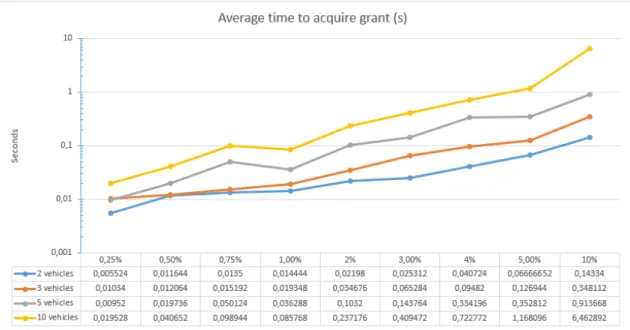
de teste para verificar o correcto funcionamento do mesmo. As principais decis˜oes toma-das durante a implementac¸˜ao est˜ao descritas em detalhe no decorrer do documento. Foi tamb´em desenvolvida uma aplicac¸˜ao de teste que integra tanto o protocolo de coordenac¸˜ao como o servic¸o de group membership. Esta aplicac¸˜ao suporta v´arias instˆancias do pro-tocolo de coordenac¸˜ao, e liga-se a um simulador para demonstrar o funcionamento do protocolo num ambiente cooperativo. Realizou-se tamb´em uma avaliac¸˜ao do protocolo. Primeiro efetuou-se uma avaliac¸˜ao do protocolo em trˆes casos de uso para aferir se as propriedades desejadas se verificam, tendo sido obtidos resultados positivos. De seguida, avaliou-se o desempenho do algoritmo segundo duas m´etricas, em v´arios cen´arios com diferentes probabilidades de perda de mensagens: tempo m´edio para adquirir permiss˜ao para realizar uma manobra, e n´umero de tentativas extra necess´arias para realizar um to-tal de 250 manobras. Relativamente `a primeira das m´etricas recolhidas, observou-se que o tempo m´edio para adquirir permiss˜ao para realizar uma manobra ´e na grande maioria dos casos inferior ao tempo que um condutor humano levaria a realizar uma manobra, sendo que apenas nos piores casos testados os tempos se tornam equivalentes, mantendo-se ainda dentro dos valores m´aximos considerados. Quanto ao n´umero de tentativas extra necess´arias para realizar 250 manobras, observou-se que este aumenta exponencialmente consoante a percentagem de falhas de comunicac¸˜ao.
Palavras-chave: Ve´ıculos Aut´onomos, Comunicac¸˜ao Ve´ıculo-Ve´ıculo, Protocolo de coordenac¸˜ao, Servic¸o de Membership
Abstract
Ever since its introduction, the car has fundamentally changed our society. Its pop-ularity grew tremendously in the early 20th century, and today it is nearly ubiquitous. However, there are several problems related to automobiles, one of the major ones being road congestion. Drivers lose millions of dollars every year in fuel costs and time spent in day to day traffic congestion. Another major problem is emissions from vehicles, forming a significant percentage of greenhouse gas emissions.
Automated driving systems currently rely on their own sensors to gather information from the real-world, and make informed decisions to keep their passengers safe. But sen-sors may not be sufficiently accurate during all conditions and can even fail, so automated driving systems take this into consideration when controlling the car, leading to larger safety margins.
Vehicle-to-Vehicle communication can enable cooperation between vehicles which, among other things, can be sending or receiving information from other nearby vehicles, increasing the confidence level in the information gathered or even gathering information otherwise not obtainable.
Cooperation opens the door to complex vehicular applications such as road-trains (or platooning) and virtual traffic lights, both of which have the potential to mitigate the problems mentioned before. These applications have tight safety requirements due to the context in which they operate: vehicles, possibly with human occupants, operating on roads traversed by non-autonomous vehicles and pedestrians.
In this MSc Dissertation, we describe the implementation of a vehicular cooperation algorithm backed by both vehicle-to-vehicle communication and a cloud membership ser-vice. We then evaluate the implemented algorithm in a cooperative environment to con-clude about its correctness, making use of the Robot Operating System middleware to implement a simulation and visualize a maneuver executed using the algorithm.
Keywords: Autonomous Vehicles, Vehicle-to-Vehicle Communication, Coordination Protocol, Membership Service
Contents
List of Figures 17 List of Tables 19 1 Introduction 1 1.1 Motivation . . . 1 1.2 Objectives . . . 2 1.3 Document Structure . . . 32 Context and Related Work 5 2.1 Autonomous vehicles and automated driving systems . . . 5
2.1.1 Cooperative vehicles . . . 6
2.2 Inter-vehicle communication applications . . . 6
2.2.1 Platooning . . . 7
2.2.2 Lane merging assistance . . . 7
2.2.3 Intersection Crossing Assistance . . . 8
2.2.4 Virtual Traffic Lights . . . 8
2.2.5 Roundabout assistance . . . 8
2.2.6 Cooperative Collision Avoidance . . . 9
2.2.7 Emergency Services . . . 10
2.3 MANETs and VANETs . . . 10
2.4 Virtual synchrony and group membership . . . 11
3 Protocol Analysis 15 3.1 Assumptions . . . 15 3.2 Models . . . 15 3.2.1 Communication Model . . . 15 3.2.2 System Model . . . 16 3.2.3 Fault Model . . . 16 3.3 Properties . . . 17 3.4 Protocol Architecture . . . 17 3.4.1 Protocol Parameters . . . 17 13
3.4.2 Agent States . . . 18
3.4.3 Message Types . . . 18
3.4.4 Timers . . . 19
3.4.5 Maneuver Identification . . . 19
3.4.6 Initialization . . . 19
3.4.7 Trying to execute a maneuver . . . 20
3.4.8 Message Processing . . . 20
3.5 Considerations Regarding Communication Failures . . . 21
4 Implementation 25 4.1 Compatibility . . . 25 4.2 Key Decisions . . . 25 4.3 C++ Approach . . . 26 4.4 Java-based Approach . . . 27 4.4.1 Common Module . . . 28 4.4.2 Protocol Module . . . 29 4.4.3 Protocol Spawner . . . 30 5 Integration 33 5.1 Integration with Membership Service . . . 33
5.2 Integrated Testing Application . . . 34
5.2.1 Architecture . . . 34
5.2.2 Simulator . . . 34
5.2.3 Simulator Backend and Agent Manager . . . 36
6 Evaluation 37 6.1 Empirical evaluation . . . 37
6.1.1 Results . . . 37
6.2 Performance evaluation . . . 38
6.2.1 Results . . . 39
7 Conclusion and Future Work 43 7.1 Conclusion . . . 43
7.2 Future Work . . . 44
A Coordination Protocol - Pseudocode 45
Glossary 51
References 59
List of Figures
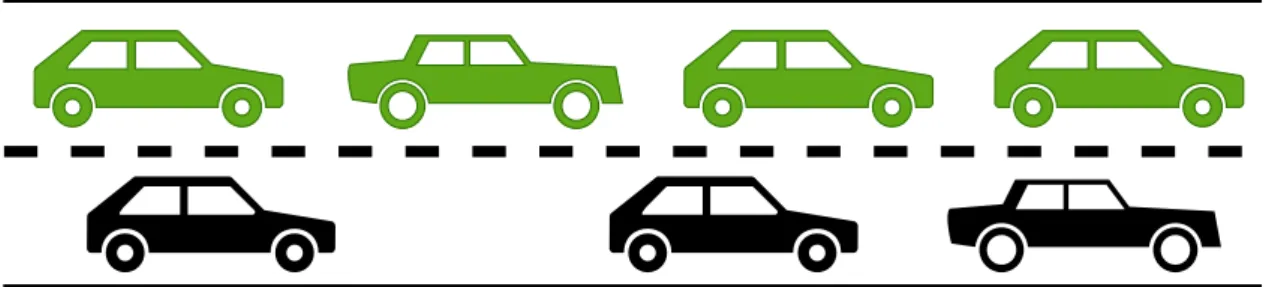
2.1 Example of a platoon of vehicles (in green) travelling next to regular,
non-cooperative vehicles (in black) . . . 7
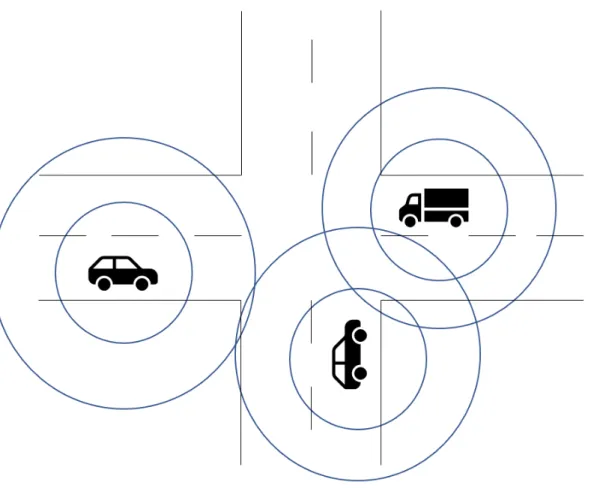
2.2 Example of an intersection with vehicles working in a Virtual Traffic Light application . . . 9
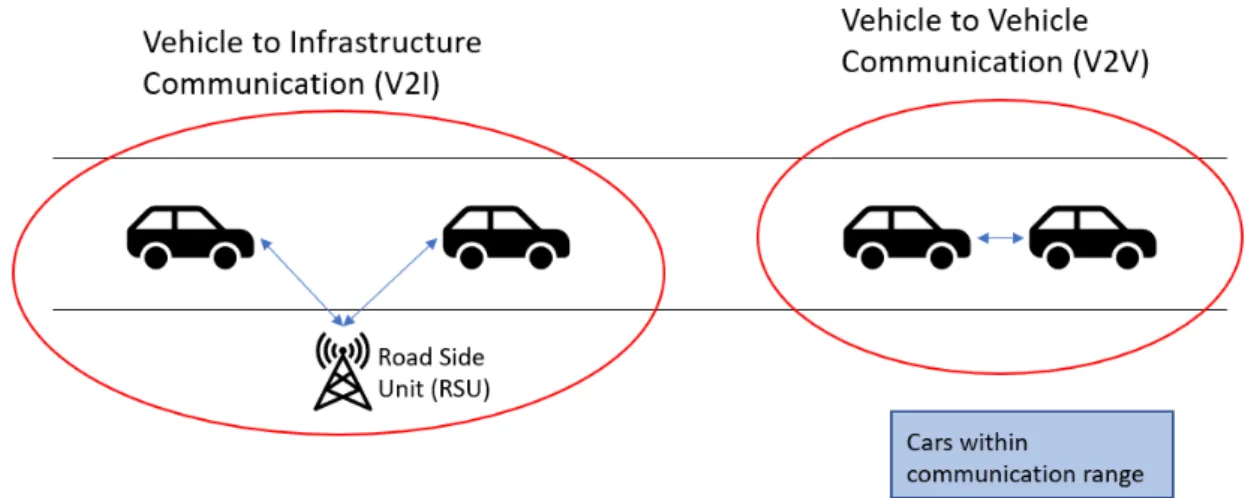
2.3 Example of vehicles communicating within a Vehicular Ad-hoc NETwork (VANET) . . . 11
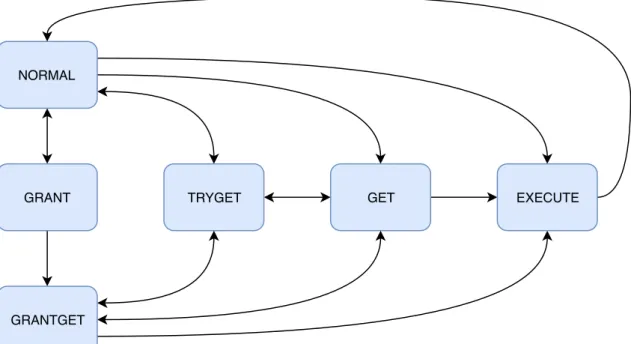
3.1 Existing Agent States and possible transitions between them . . . 19
4.1 Main components of the vehicle coordination protocol implementation . . 29
5.1 Integrated Testing Application Architecture . . . 34
5.2 V-REP with the scenario developed loaded . . . 35
6.1 Average time to acquire grant . . . 39
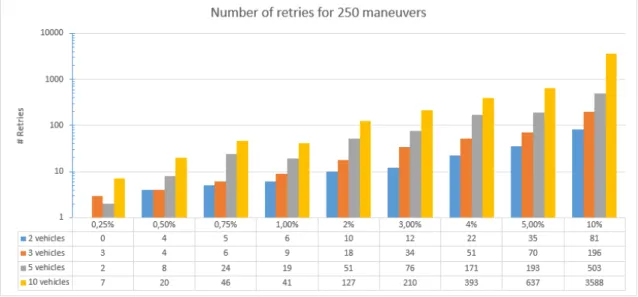
6.2 Number of retries needed to perform 250 maneuvers . . . 40
List of Tables
2.1 Levels of Automation for Driving Systems according to Society of Auto-motive Engineers (SAE International) [2] . . . 6 3.1 Parameters used in the agent coordination protocol . . . 17 6.1 Parameters used in the coordination protocol evaluation . . . 38
Chapter 1
Introduction
Ever since the car started being mass-produced, it fundamentally changed the way we move. As countries’ economies grew in the 20th century, so did the popularity of the automobile, being a pillar in the lives of most people. According to [17], over 80% of households in developed countries own at least one vehicle. Furthermore, OCDE’s Transport Outlook predicts that by 2050 there will be 2 billion vehicles in circulation.
As stated in [5], the transportation sector accounted for 28% of greenhouse gas emis-sions, of which over half is generated by passenger cars and light-duty trucks. Addition-ally, this increase in the number of vehicles generates an enormous amount of congestion on the roads. [65] reported that US drivers lost 300 billion dollars in 2016 in fuel costs and time due to congestion, with Los Angeles drivers spending an average of 104 hours in gridlock traffic that year.
Automated driving systems promise to ease these issues and change the transportation outlook. Several companies are currently exploring such autonomous solutions, including Volvo with drive me [21], Google with Waymo [50] (formerly Google car) and Ford through its partnership with Argo AI [49]. The current solutions make use of a variety of sensors and actuators placed in strategic points of the automobile to observe obstacles that might affect the vehicle and perform actions to ensure safety is not jeopardized.
1.1
Motivation
Sensory information collected by autonomous driving systems are the only mechanisms these systems have of perceiving the world around them. This information can be incom-plete, and therefore we cannot completely rely on it to perform complicated maneuvers.
Vehicle-to-Vehicle (V2V) communication has the potential to allow vehicles to gather information from other nearby vehicles, therefore increasing confidence in the informa-tion collected by its sensors, or even gaining access to new informainforma-tion or detecting errors in sensors. This form of communication also introduces the opportunity of V2V coordi-nation and with it coordinated maneuvers.
Chapter 1. Introduction 2
Several applications can be developed based on V2V communication. Examples of such applications include vehicle road-trains (commonly referred to in literature and henceforth as platoons or platooning) and Virtual Traffic Light (VTL), having both been studied extensively ([7, 23, 28, 29, 13]). Advances in the area of V2V communication allowed us to get near the point of where we can implement such applications, but further work is needed in the area of vehicular cooperation to ensure that such applications are feasible.
Safety must be a consideration however, as communication failures may occur at any point and vehicles must be able to continue to operate safely. They must be able to know if every other nearby vehicle knows the maneuver to perform before starting it, otherwise a rogue vehicle can compromise the safety of all nearby vehicles. With this in mind, vehicular applications need to proactively abort maneuvers when it detects that the necessary safety properties are not guaranteed. Existing vehicular safety applications include traffic-signal-violation warning and emergency electronic brake lights, but future iterations may include applications such as cooperative forward collision warning or stop-sign movement assistance.
Furthermore, even though outside the scope of this MSc Dissertation, pedestrian safety is also extremely important. The first pedestrian death related with autonomous vehicles happened in March of 2018 [39], and is the main example of the consequences of what a catastrophic failure in such vehicles can cause, that is, the loss of human lives.
This poses the question of how can vehicles safely cooperate. As previously described, autonomous vehicles have tight safety requirements that must be met, even when facing failures. Additionally, given the different efforts by several different manufacturers, each in implementing its own Autonomous Driving System, a standard vehicle cooperation protocol.
Nonetheless, in [16], the authors propose a coordination protocol to allow a set of ve-hicles to coordinate among themselves. The authors also proposes a membership service which is used by the agents running the protocol in the vehicles to know which vehicles are near, and allow that information to be used by the algorithm to check which vehicles will have to be accounted for. We aim to implement the protocol proposed to support vehicle coordination, and perform tests in a vehicular application.
1.2
Objectives
The main goal of this MSc Dissertation is to implement a set of protocols to be executed in autonomous vehicles in order to safely perform coordinated maneuvers in an environment comprised of autonomous vehicles. In order to achieve this goal, we will break down the main objective into two separate objectives.
pro-Chapter 1. Introduction 3
tocol, and integrating it with a cloud-based membership service.
The second objective naturally focuses on the evaluation of our work and the complete system integrated with the membership service. A scenario will also be developed in order to enable the visualization of a maneuver being coordinated with the aid of the coordination protocol developed.
1.3
Document Structure
The remainder of this document will be structured as follows:
• In Chapter 2 we will present related work, mainly in the areas of consensus, wire-less mediums, V2V Communication and cooperation
• In Chapter 3 an overview of the coordination protocol will be provided, as well as the properties it aims to ensure and the assumptions made about the system
• Chapter 4 will describe the development of the solution, our implementation and the decisions made throughout the development
• Chapter 5 illustrates the integration process between the coordination protocol and the membership service, as well as the simulation scenario developed for visualiza-tion of a maneuver coordinated with the aid of the coordinavisualiza-tion protocol developed • Chapter 6 presents the evaluation process and its results
Please note that this dissertation has been accepted as a communication at 11th edition of INForum.
Chapter 2
Context and Related Work
In this chapter we will list and give a brief overview of a few essential concepts and the state of the art related to our work. The concept of autonomous vehicles is expanded upon, as well as a subset of vehicular applications based on V2V communication. How that communication can be achieved is also expanded upon, as well as the concepts of group membership and virtual synchrony as abstractions to better deal with consensus problems.
2.1
Autonomous vehicles and automated driving systems
In Section 1.1 it is shown that autonomous vehicles and automated driving systems have the potential to be extremely useful in reducing road congestion, emissions and fuel usage. Autonomous vehicles are those that are capable of intelligent motion and action without requiring either a guide to follow or teleoperator control [22]. Automated driving sys-tems are a conjunction of several automated syssys-tems working together in order to allow a vehicle to autonomously drive itself.
Autonomous vehicles rely on sensors to perceive the world and build their under-standing of it. With this underunder-standing, autonomous vehicles are able to make informed decisions adequate to the environment they are operating in.
Some ethical questions can be raised about the topic, such as ”Who is accountable in the event of an accident? The driver or the manufacturer?” and ”Can the information generated by the vehicles be used to identify individuals?”
The SAE International has classified autonomous driving systems in five levels [2], presented in Table 2.1. Most currently available vehicles with autonomous driving fea-tures operate on either Level 1 or Level 2. For instance, an Adaptive Cruise Control application lies in Level 1, while Tesla’s Autopilot [42] lies in Level 2. It is clear that automated driving systems are on the range of levels 3 – 5.
Chapter 2. Context and Related Work 6
Level 1 Driver Assistance The system helps with some basic driving func-tions like accelerating, braking and steering, but most of the input is still the responsibility of the driver
Level 2 Partial Automation The system is capable of handling basic driv-ing function by itself in some conditions, but the driver is still responsible for monitoring the environment
Level 3 Conditional Automation The system can fully handle basic driving func-tions and monitors the environment by itself, but the driver maintains tactical awareness in case the system needs a fallback
Level 4 High Automation The system can fully handle basic driving func-tions, monitors the environment and maintains tactical awareness in some driving modes Level 5 Full Automation The system performs the same tasks as Level 4
Automation, but does so for all driving modes Table 2.1: Levels of Automation for Driving Systems according to SAE International [2]
2.1.1
Cooperative vehicles
Also described in [2] is the definition of cooperative vehicles, that is, a subset of au-tonomous vehicles that depend on outside entities to perform their auau-tonomous driving duties. This does not imply that these vehicles are not able to use their own sensors in case they encounter communication errors.
By sharing information and decisions, we can improve traffic flow and safety by coor-dinating the decisions among vehicles. Information can also be shared with infrastructure, for instance with transport management systems such as traffic signals.
This brings several benefits, such as the potential to reduce the number and severity of crashes, improve the efficiency of the road network and reduce travel time.
Cooperative vehicle also raise security concerns, most notably the authenticity of the information.
2.2
Inter-vehicle communication applications
Here we will talk about the main application types described in the literature. Inter-Vehicle Communication applications are in one of two categories [67]:
• Comfort Applications - applications that improve passenger comfort and traffic efficiency or optimizes a route to a destination
• Safety Applications - applications that increase passenger safety by exchanging safety relevant information
Chapter 2. Context and Related Work 7
Figure 2.1: Example of a platoon of vehicles (in green) travelling next to regular, non-cooperative vehicles (in black)
Applications that fit in the comfort category include gas station location and price information applications, restaurant location and price information and traffic congestion information. The application we discuss in the following sections can all be considered safety applications.
2.2.1
Platooning
Platooning [13] is defined as a collection of vehicles that travel together, actively coordi-nated in formation. Platooning can improve safety, traffic flow and reduce fuel costs.
Since vehicles travel with short inter-vehicle distances, the lead vehicle in the platoon is effectively “splitting” the air as it travels, creating a low aerodynamic drag area behind it that the following vehicles take advantage of. The reduced inter-vehicle distance also means that the platoon takes less space on the road than if the vehicles were not traveling together. This also means that it is not subject to sudden accelerations, further helping with saving fuel. In [7] the authors study fuel economy in platoons composed of trucks, and conclude that a fuel saving of 4.7% to 7.7% can be achieved, depending on inter-vehicle distances. Since the inter-vehicles are coordinated, when one of the inter-vehicles needs to perform an emergency braking maneuver, the following vehicles can immediately react, not being subject to human reaction times, hence reducing braking distances in emergency situations. This specific point is further discussed in Section 2.2.6.
Figure 2.1 shows an example of how a platoon would travel, compared to non-cooperative vehicles. Please notice the reduced inter-vehicle distances.
2.2.2
Lane merging assistance
Lane merging has several specific instances (i.e. joining a platoon). In a lane merge scenario, the merging vehicle has to assure that its maneuver will not be a safety hazard to other vehicles. This can be achieved by the merging vehicle communicating with other nearby vehicles to ensure all vehicles know its intentions and enable the merge.
When a new vehicle wants to join a platoon, it coordinates with the members of the platoon the location in which it will join. After this negotiation, the vehicles in the platoon
Chapter 2. Context and Related Work 8
will generate a gap at the agreed location, and the new vehicle will merge into the platoon and resume its normal operation.
The reverse happens when a vehicle wants to leave a platoon. It communicates its intention to both the platoon and nearby vehicles, and when the vehicle safely merges into a different lane, the existing platoon closes the gap left by the leaving vehicle.
2.2.3
Intersection Crossing Assistance
According to the US Department of Transportation Federal Highway Administration, more than 50% of the combined total of fatal crashes and crashes with injuries occur at or near intersections [55]. Automating Intersection crossing can therefore undoubtedly provide safety benefits. Knowing nearby vehicles, we can coordinate who crosses the intersection, and when they do it.
2.2.4
Virtual Traffic Lights
While not a maneuver in itself, VTL’s can be considered as an extension to the Inter-section Crossing scenario. In a VTL system, the right-of-way is decided in a distributed manner, with the use of V2V communication. This self-organizing traffic scheme does not need infrastructure at intersections.
According to [29], only 20% of intersections in cities are signalized. Additionally, the authors argue that introducing VTL’s will reduce the average commute by 30%. This would be a significant help in reducing congestion in large cities, which usually suffer from crippling traffic and congestion issues.
In [28] the authors show that introducing VTL’s in areas with high traffic density could reduce carbon emissions by as much as 20%.
VTL’s, with support from vehicular cooperation, are an efficient solution for todays traffic overflowing cities, and related problems created by congestion.
2.2.5
Roundabout assistance
Over the last few couple of decades, roundabouts have become a popular alternative to intersections. They reduce or nearly eliminate head-on and driver-side crashes, and have reduced energy consumption and maintenance costs. However, drivers do not always make good use of roundabouts, and when such happens the adjacent areas may become subject to traffic jams [3].
Literature exists on roundabout applications, specifically management, speed and flow control ([11, 69, 58]), but not much work exists of completely autonomous vehicles navi-gating and cooperating in roundabouts. In [56] the authors study how trajectories can be generated from roundabout parameters such as diameter and center point coordinates and explore control techniques that can implement lateral control of autonomous vehicles. In
Chapter 2. Context and Related Work 9
Figure 2.2: Example of an intersection with vehicles working in a Virtual Traffic Light application
[59] the authors propose a fuzzy logic controller for lateral control in roundabouts, which generates trajectories based on roundabout parameters (diameter, center coordinates).
2.2.6
Cooperative Collision Avoidance
Millions of traffic accidents occur every year. In 2016, there were 7.2 million traffic accidents in the United States of America, with 3.1 million people injured and 37461 killed ([33]). The leading cause was the driver’s behavior.
The inability of drivers to react in time can lead to chain collisions. Drivers rely on the tail lights of other cars to determine emergency situations, which may not be enough. This visual feedback loop is not enough to guarantee collision avoidance.
Cooperative collision avoidance makes use of V2V communication to quickly and safely react to emergency situations. Upon detecting an emergency, the vehicle can send a message informing nearby vehicles of such emergency, and these vehicles can immedi-ately take preventive actions, not being subject to the drivers reaction time.
Chapter 2. Context and Related Work 10
2.2.7
Emergency Services
Assuming vehicles are connected and exchanging information, and that vehicles are equipped to detect when a crash occurs and retains connectivity after the crash, it is trivial to disseminate this information across the network.
A simple example of an interesting application is one that detects when a crash occurs and immediately calls emergency services, giving crucial information such as the number of vehicles involved and their positions, to emergency services. They will then be able to assist passengers with a shorter response time, increasing the chances of survival if the passengers suffered life threatening injuries.
In [52] the authors provide a comprehensive outlook on how emergency services could benefit from vehicular communication, either directly with each other in the form of V2V communication or using Vehicle-to-Infrastructure (V2I) communication.
2.3
MANETs and VANETs
A Mobile Ad-hoc NETwork (MANET) [19] is a network comprised of mobile nodes, forming a mesh network with a dynamic topology. Given that there is no fixed infras-tructure in the network, nodes are expected to assist by adopting packet routing duties. Their dynamic nature also allows them to self-heal. Nodes connect to their neighbors, and this set changes as nodes move through the area, changing the topology. As long as the network is not partitioned, all nodes can be reached.
Given how well MANETs adapt to dynamic environments, they are perfect candidates to use in vehicular communication. A VANET(see Figure2.3) [70], is a specific instance of a MANETs in which nodes are vehicles. VANETs can enable V2V or V2I communi-cation using either Short Range Radio Technology standards such as IEEE 802.11p [43] or IEEE 802.15.4 [1], or celular technologies such as LTE. Most applications use the Wireless Access in Vehicular Environments (WAVE) standard, based on IEEE 802.11p. This protocol uses Dedicated Short Range Communications (DSRC) [25, 68], which has a range of 1 km with transmission rates varying from 3 Mbps to 27 Mbps range and can withstand vehicle velocities up to 260 Km/h. Messages are exchanged over the medium using the WAVE Short Message Protocol [66] described in standard IEEE1609. This pro-tocol supports high priority, time sensitive communications [47, 36], but does not guaran-tee message delivery. In [38] the authors show that the delay of control messages with the highest priority remains in the order of tens of milliseconds, and that delay only becomes excessive when traffic reached 1000 packets per second.
Traditional MANET routing protocols such as Ad Hoc Distance Vector [57] require an explicit route establishment phase prior to data transmission taking place. This means that applications that require low delivery latencies may not use such protocols. Another factor that makes such protocols not suited for vehicular safety applications is that receivers
Chapter 2. Context and Related Work 11
Figure 2.3: Example of vehicles communicating within a VANET
may be unknown. Considering the two points above, broadcast oriented protocols are preferred. Context-aware broadcast can further increase efficiency, by applying direction-aware broadcast forwarding. This implies that a packet is forwarded based on the direction it was received (i.e. if a node receives a packet coming from North it is forwarded to the South). This approach has the benefit of reducing the number of messages sent, reducing the chances of collisions. A high collision rate causes reduced delivery-rates and increases latency.
In [44] the authors present the operational concept of 5.9Ghz DSRC-based vehicular-safety communication, and propose a set of protocols to address the issues found. In [15], the authors implemented a cooperative collision avoidance application based on an intelligent broadcast primitive with direction aware broadcast forwarding and show that for packet error rates up to 50% crash performance is not affected. In [68] the authors also implement a cooperative collision warning application based on a location-based broadcast protocol. Some Location-Aided Routing protocols are shown in [46]. In [4] a more broad overview is presented, categorizing protocols into ”proactive” or ”reactive”.
2.4
Virtual synchrony and group membership
Distributed Consensus has been heavily discussed in literature ([35, 53, 30, 61, 12, 60]). It considers the selection of a single value from a set of values proposed by members of a group. The selected solution is required to be reached within a bounded time. There are a number of impossibility results related to distributed consensus ([31, 27, 32]). It is shown by the authors in [51] that the presence of communication failures makes it impossible to deterministically reach consensus.
As mentioned in Section 2.3, VANETs uses V2V communication, and the former are designed to adapt to dynamic environments. However, in a vehicular environment,
Chapter 2. Context and Related Work 12
communication is inherently prone to failures. When these communication failures are too frequent, vehicles can fail to reach consensus for an unbounded time, which poses a safety threat.
The existing literature on consensus algorithms with real-time requirements generally assume timed and reliable communication [40, 6]. In this work, is is assumed that mes-sages arrive within a known bounded time, but that there is no bound on the number of consecutive message omissions. It is therefore possible to detect message omissions.
Automated driving systems with V2V communication are safety-critical applications, therefore being paramount that faults do not lead to catastrophic failures. Alpern and Schneider define liveness in [8] as ”A liveness property stipulates that a good thing hap-pens during execution”. In distributed consensus, the good thing the execution tries to achieve is the selection of a single value. However, in the scenario of V2V communica-tion, where communication failures cannot be ruled out, this implies that the system will wait for a consensus. Since we assume that there is no bound to the number of consec-utively dropped messages, this effectively means that nodes can try to reach consensus for an indeterminate amount of time. Thus we need to ensure that, if no consensus is reached within a certain upper bound, the execution must continue with no consensus, with vehicles possibly aborting intended maneuvers and relying only on their sensors for example.
In this context, we can consider topology changes to be transient failures since they lead to inconsistencies. One way to achieve this is through virtual synchrony. Birman et al. describe virtual synchrony in [14]: ”It will appear to any observer that all processes observed the same events in the same order. This applies not just to message delivery events, but also to failures, recoveries, and group membership changes”. From this, we can see that two key concepts are needed to create virtually synchronous executions (ie. the notion of a group and an atomic multicast primitive).
Group membership services act as an abstraction layer for consensus problems. As mentioned before, most work was based around the node crash fault model, but there has been significant work on tackling network partitions. Examples of such work include Transis [9], Totem [54], Moshe [45] and Jgroups [10]. In [24] the authors also present a Group Service for dynamic networks. In the context of vehicular cooperation, such services maintain a view of which cars are neighbors and ensure that cars have consistent views on their neighbors. Lim and Conan address the problem of group membership in MANETs in [48]. Other approaches to form group membership exist. In [63] Cahill and Slot take a hardware-based approach, in which vehicles make use of laser-scanners to retrieve information regarding empty areas around themselves, and share this information with other vehicles, attaining precise membership information. In [26] the authors make the distinction between safe and unsafe disagreement, the latter being when nodes decide on different non-empty views, and propose a decision algorithm based on synchronous
Chapter 2. Context and Related Work 13
rounds, unreliable communication and unreliable oracles. A more broad overview of group communication services is presented in [20].
Chapter 3
Protocol Analysis
In this chapter an overview of the vehicle coordination protocol that was proposed to be implemented and which is described in [16] will be provided, along with the models used, assumptions, limitations, and properties that should be assured.
The agent coordination protocol aims to allow agents (ie. vehicles) to obtain sup-port or permission from other agents for performing a maneuver, which will allow the maneuver to be done in a more efficient way than if done without any coordination.
3.1
Assumptions
The following assumptions are made: • Membership
– Accurate membership information may be available
– Membership information has a defined validity period, which allows detecting when it is no longer valid
• On-board Sensors
– On-board sensor information is insufficient to perform autonomous maneu-vers efficiently
– Facing communication failures, on-board sensor information is sufficient for eventually performing a maneuver in a safe manner
3.2
Models
3.2.1
Communication Model
• Agents may communicate with other agents within Z11 of each other 1Maximum Communication Range (Agent to Agent)
Chapter 3. Protocol Analysis 16
• The network is fully connected between agents and the infrastructure • V2V Communication and V2I Communication are asynchronous • The number of consecutive message omissions is unbounded
This communication model implies that any agent can communicate with nearby agents and with any infrastructure process, and that communication delays are unbounded. It also implies that the protocol must be able to deal with these unbounded delays and mes-sage omissions, while achieving the desired goals (described in Section 3.3) Based on the aforementioned assumptions, one can conclude that it is not possible to guarantee that all needed remote information will be received and that there will be an indication that all such information was received.
3.2.2
System Model
• The number of agent processes is bounded, but its bound is unknown • Agent processes are also physical entities, with physical properties • The number of infrastructure processes is bounded but unknown
• All processes have access to a local clock perfectly synchronized with a global time
The key point in the system model for the protocol is the existence of local clocks syn-chronized with a global time, which allows us to rely on timestamps. This can be achieved in vehicles through GPS, for example. Based on globally synchronized timestamps it be-comes possible, for instance, to determine if a certain membership information, created at some time t, is still valid. It also allows to determine the delay of transmitted mes-sages and discard the ones that took too long to arrive and therefore may contain outdated information.
3.2.3
Fault Model
• Agent processes do not fail arbitrarily
• Agent processes may crash and their physical instantiation will leave the system in a finite amount of time
• Infrastructure processes do not fail arbitrarily • Infrastructure processes may crash
Chapter 3. Protocol Analysis 17
3.3
Properties
The protocol aims at guaranteeing two basic properties: • Safety
– Safe maneuver - Regardless of the presence of failures, no two vehicles per-form maneuvers concurrently
• Liveness
– Timely maneuver - In the absence of failures, a vehicle intending to do a maneuver will do said maneuver in a bounded amount of time
Additionally, from a practical point of view, the protocol is not particularly useful if the agent needs a larger time frame to execute a maneuver than when in a situation where no cooperation is possible. From this observation, it is possible to extrapolate an additional desirable property:
• Performance - The average time that it takes for an agent intending to do a maneu-ver to execute said maneumaneu-ver is, at most, the same as when the agent is not able to interact with other agents and executes the maneuver using only information pro-vided by its local sensors
3.4
Protocol Architecture
In this Section a detailed description of the protocol will be provided. A pseudocode description of the protocol is also provided in Annex A
3.4.1
Protocol Parameters
The protocol has some configurable parameters that are used throughout the protocol, described in Table 3.1.
TD Upper bound on transmission delay
TA Period of agent registry update
TM Period of membership protocol
TM AN Upper bound on maneuver execution time
Table 3.1: Parameters used in the agent coordination protocol
TD specifies the upper bound on transmission delay the coordination protocol
toler-ates. Messages which are deemed to have had a transmission delay larger than this value are dropped. TAis the value used for the timer that triggers the job to update the agent’s
Chapter 3. Protocol Analysis 18
information in the membership service. TM is used to calculate if a membership received
by the membership service is still valid. Finally, TM AN is the maximum amount of time a
vehicle has to perform a maneuver, and is used to calculate the maximum amount of time a grant can be active.
3.4.2
Agent States
The agent (i.e., the protocol executing in the scope of an agent), can be in one of six different states, depending on the progress in the protocol execution since a request for permission (grant) for doing a maneuver is sent to nearby vehicles (indicated in the cur-rently valid membership) until this permission is obtained and the maneuver is done.
• NORMAL - When no maneuver is currently being executed
• GRANT - When the current agent has given a grant to a nearby agent to perform its maneuver
• TRYGET - When the current agent is trying to obtain a grant from nearby agents to execute its maneuver
• GRANTGET - When the current agent has given a grant, and intends to request one after the current grant has expired
• GET - When the current agent is awaiting the response for the request made
• EXECUTE - When the current agent is executing the desired maneuver
Agents state transitions are indicated in Figure 3.1.
3.4.3
Message Types
The messages can have only one of the following four types:
• GRANT - Sent when the agent accepts a maneuver request from another agent
• DENY - Similar to GRANT, but sent when the request is denied
• GET - Sent when the sender requests a grant
• RELEASE - Sent when the sender explicitly releases a grant
Chapter 3. Protocol Analysis 19
NORMAL
GRANT TRYGET GET
GRANTGET
EXECUTE
Figure 3.1: Existing Agent States and possible transitions between them
3.4.4
Timers
The protocol has three internal timers it uses to schedule certain procedures:
• T UPDATE - executes a procedure that updates the agent information stored in the membership service. Runs with a period of TAwhile the agent is active
• T GRANT - this timer is started when the agent gives another agent a grant, and when fired executes a procedure where it will revert its state to NORMAL, and if a grant request is pending will execute tryManeuver as described in Section 3.4.7 • T RETRY - started when a grant request is sent, when triggered this timer will
execute a procedure to retry the grant request. This timer is cancelled when the agent receives a response from all expected agents in a timely manner
3.4.5
Maneuver Identification
Each maneuver is identified by a Maneuver Tag. These tags consist of the ID of the agent that requested the maneuver, and the timestamp of when the request was created. The timestamp of the maneuver is used to decide who has priority in case a conflict exists (ie. two grant requests received within a short amount of time).
3.4.6
Initialization
Upon initialization, the agent will be in state NORMAL. From this point forward, the agent will listen and process arriving messages from other agents. It will also be able to
Chapter 3. Protocol Analysis 20
try maneuvers, requesting grants from nearby relevant agents.
3.4.7
Trying to execute a maneuver
When an agent tries to execute a maneuver, a procedure tryManeuver is executed. In this procedure, the agent will check wether it is currently in a state where it is possible to start a maneuver, these states being NORMAL or GRANT. If in one of these states, the agent will create a new Maneuver Tag.
Following this, the agent will do another check to confirm if it is in a state where it can request a grant, these being NORMAL or TRYGET. If in any of these two states, the agent will update its membership information, verify its validity and, if there exists a maneuver opportunity (MO), will proceed to send messages to agents in its membership requesting a grant to perform the maneuver. The maneuver opportunity is an information sent by the membership service to indicate if an agent can initiate a maneuver. Since the membership service has a global vision of the system, it is better informed to inform if the conditions allow for a maneuver to be executed.
After sending the grant request, the agent will start a timer T RETRY. When this timer fires, the agent will resend the grant request, change status to TRYGET if its status is GET, and will execute the procedure tryManeuver again, regardless of its previous state. If its membership is empty, meaning there are no nearby agents that might impact the maneuver, the agent will immediately execute the maneuver.
If instead the agent is not in a state where a grant request is possible, but is in state GRANT, meaning another agent has an active grant, the agent will change his state to GRANTGET and will retry to execute the tryManeuver procedure when the current grant timer terminates.
3.4.8
Message Processing
The agent is perpetually listening for new messages. When a new message arrives, it must be processed. The first step in this process is to check wether the message is timely, accomplished by comparing the message timestamp and the reception timestamp. If the difference between the timestamps is less than TD, the message is deemed timely and
processing continues, otherwise it is deemed ”not timely” and processing of that message halts with the message being discarded. This complies with the assumption that messages arrive within a bounded amount of time.
After ensuring that the message is timely, the type of the message is checked to deter-mine how further processing should be carried out. If the message type is either GRANT or DENY and agent is in state GET, meaning the message received is a reply to a grant request previously sent by the agent, processing will continue by removing the agent that sent the message from the set of expected responses, and check wether this is the last
Chapter 3. Protocol Analysis 21
expected message. If that is the case, T RETRY timer will be stopped and the agent will check if any of the received responses is of type DENY. If at least one DENY message was received, the agent will change state to TRYGET, send a RELEASE message and restart timer T RETRY. If all messages are of type GRANT, the agent will change sta-tus to EXECUTE and execute the maneuver requested, after which it will return to state NORMAL.
If instead, the message type is GET, the agent will check if the following are true: • there is no conflict between this agent and the agent that sent the message for the
period 2TD + TM AN
• the agent is in one of the following states:
– NORMAL – TRYGET
– GET and the agent’s maneuver tag does not precede the tag received in the message
– GRANT or GRANTGET and the agent has given a grant to the agent that sent the message
If there is no conflict between the agents and the receiving agent is in one of the listed states, message processing continues, otherwise a DENY message is sent to the sender. When processing continues, if the agent is in state NORMAL, it will change state to GRANT, else if it is in states GET or TRYGET it will stop its timer T RETRY, change status to GRANTGET and broadcast a RELEASE message. In both cases, a GRANT message is sent, notifying the acceptance of the request, and the timer T GRANT started. The final possible case is if the message type is RELEASE, the agent is in state GRANT or GRANTGET, and has given a grant to the sender. In this case, the agent will stop the timer T GRANT, will revoke the grant given out and if currently in state GRANTGET, will change state to TRYGET and call procedure tryManeuver, otherwise it will change state to NORMAL.
3.5
Considerations Regarding Communication Failures
Whenever a maneuver request is initiated timer T RETRY is started, as mentioned previ-ously. Also mentioned previously is that when the request does not receive all necessary responses from nearby agents, or when all answers are received but one of them is a DENY message, a new communication round will be needed to retry the maneuver re-quest. It is also clear that to successfully coordinate a maneuver at least 2 ∗ (n − 1) messages need to be exchanged, where n is the number of vehicles to coordinate.
Chapter 3. Protocol Analysis 22
If a single message in a maneuver request is dropped, the protocol will not progress until timer T RETRY is fired, at which point a RELEASE message will be sent to all agents, and the request will be started again. Since the value of timer T RETRY is 2TD,
a retry implies an implicit increase in the time needed to achieve a grant to perform a maneuver of at least 2TD.
Additionally, since the number of messages needed to be exchanged increases expo-nentially, so will the amount of retries needed when facing communication failures.
Chapter 4
Implementation
In this chapter, we will walk through our decisions when implementing the agent coordi-nation protocol, the available options and how we proceeded along with our reasoning.
4.1
Compatibility
One of the main objectives of this project is to provide a working proof of concept im-plementation of the protocol working in tandem with the Membership Service. As such, there must be a degree of compatibility between the implementations of the coordination protocol and the membership service. The communication between the coordination pro-tocol and the membership service is done through a library specific to the membership service implementation. This obviously implies that the membership client library must be usable by the protocol implementation. The safest way of assuring this is by both being implemented in the same programming language, and the library providing a stable API for use in the protocol.
4.2
Key Decisions
Before actually starting to implement the protocol, a few key decision needed to be made:
• Middleware
• Communication among agents
• Programming language
• Tools
Regarding Middleware, our analysis focused on the robotics middleware Robot Oper-ating System [34]. ROS is, contrary to what its name implies, not an OperOper-ating System
Chapter 4. Implementation 26
but rather a set of tools and frameworks for robot software development. It provides hard-ware abstraction, low-level device control, implementation of commonly used function-ality, message-passing between processes, and package management. Message-passing functionality of ROS is implemented as a Publisher/Subscriber model, where executables can listen and publish data to specific topics. The latest ROS distribution at the time of writing, Melodic Morenia, provides bindings for Python 2.7 and C++. A port of the ROS distribution Kinetic Kame in Java called rosjava is also available, although with unofficial support.
Communication among agents is, as described earlier in 3.1, bounded in delay, but not bounded in number of omissions. Initially, it was hypothesized that ROS’ message-passing facilities could be used to establish communication among agents. However, due to the Publish/Subscriber nature of the model, this was not a good fit with the assumptions made in the protocol. Therefore, it was decided that using simple UDP Datagram based communication was the best option, due to it perfectly fitting our assumptions (Connec-tionless and with no handshaking, thus not providing guarantees of delivery, ordering or duplicate protection).
With regards to programming language and tooling, which obviously will depend on the language selected, two approaches were investigated:
• A C++ based approach leveraging the native ROS bindings • A Java based approach leveraging rosjava
Each of these approaches, as well as their motivation, will be explained in the follow-ing sections.
4.3
C++ Approach
The first approach to development was to have simulated agents execute inside the ROS runtime, each running an instance of the protocol. Communication with a visualization platform would be handled by the Publish/Subscriber system part of the ROS runtime. As for communication among agents, it would be done using standard UDP Sockets of the host operating system where the ROS runtime is running.
Additionally, a spawner was planned to ease testing, allowing to dynamically spawn agents and configure them to start maneuver requests based on certain predefined condi-tions. This allows easier testing of the protocol by effortlessly preparing the environment, taking into account the desired configuration.
As mentioned in Section 4.1, the protocol will have to interact with the Membership Service through a library. To ease this integration, the library should use the same lan-guage as the protocol. The Membership Service makes use of Apache Zookeeper, which provides Java and C bindings.
Chapter 4. Implementation 27
Given the above points, a decision was made to implement the agent coordination protocol in C++, in order to maximize compatibility between all parts and due to the sensitive nature of the application, namely requiring efficient processing of the received messages.
Significant difficulties were found when working on this approach. The most dis-ruptive being the unfamiliarity with C++. This meant significant effort was needed to achieve most of the desired functionalities. Additionally, implementation of the member-ship service was facing similar issues due to unfamiliarity with the language, as well as a general lack of documentation for the C binding for Apache Zookeeper, leading to several workarounds to get a working library for use in the protocol.
These factors lead to a discussion regarding changing from implementing the protocol in C++ to a different language. Since Apache Zookeeper also provides Java bindings, a decision was made to drop this approach and instead move over to a Java-based approach, using rosjava instead of native ROS.
Although this implementation did not fully materialize, the time spent analyzing the protocol and possible solution for its implementation proved immensely valuable when working on the Java-based implementation.
4.4
Java-based Approach
Before reimplementing the protocol in Java, a new structure for the implementation of the coordination protocol was drafted.
To ease implementation and maintainability, it was decided to separate several parts into their own codebases, and to use a build system to allow different parts to work to-gether. Maven was the selected build system, due to it being the standard build tool used with Java development.
The protocol implementation was planned in a manner that would easily allow it to be embedded in other applications. This decision allows for the retention of the concept for the Spawner to ease testing, as well as allow the creation of other testing clients if we so desire. In this new approach ROS is still used, however its scope is much smaller, being used only for its message passing abilities. Agents are emulated outside of the ROS runtime, in a Java-based application, similar to the Spawner mentioned. The visualiza-tion components, and the integravisualiza-tion of the protocol with both components and with the Membership Service is described in detail in Section 5.
The project was split into the following codebases:
• Common - A set of utilities and structures used mostly throughout the project. In-cludes domain objects that represent core structures (agent, membership, message, etc)
Chapter 4. Implementation 28
• Protocol-Spawner - The Spawner used for testing, as well as a simple Wrapper around the protocol that can be used standalone
• Membership-Client - The library used for communication with the Membership Service
Please note that the Membership-Client library is not developed within this project, but it does provide a stable interface initially described in the reference material for this work.
4.4.1
Common Module
The common module, as described previously, contains utilities and structures used through-out the project. Its goals is to reduce code duplication by aggregating reusable code in a common dependency.
It contains the following domain objects:
• Coordinates - Indicates a position in the physical world, in reference to a pre-established origin
• AgentState - Used to represent the state of an agent within the physical world (Position, acceleration and velocity)
• Agent - Represents a physical agent. Contains the agents’ state and how he can be reached
• ManeuverTag - Used to identify a maneuver. Contains the timestamp of when it was requested and the identity of the agent that requested it
• Membership - Represent a Membership group. Contains the timestamp indicating its validity, and a list of agents that belong to it.
These Domain objects are used throughout both the protocol and the membership service. Implementing these in a separate module and then importing the module as a dependency in other projects helps guaranteeing that all projects use the same objects, and reduces code duplication improving both readability of the code and its ease of main-tenance.
Additionally, it also contains some interfaces used by the protocol:
• AgentProperties - Defines methods that return physical properties of the Agent, such as position, velocity and acceleration
• ManeuverCallback - Defines callback methods invoked when a maneuver reaches a certain point.
Chapter 4. Implementation 29 Protocol V2V Communication Timers Sender Listener T_UPDATE T_GRANT T_RETRY V2I Communication Membership Client Membership Service tryManeuver() Client
(Agent, Simulation Backend, Spawner, etc)
doManeuver(Instant t) Protocol
Figure 4.1: Main components of the vehicle coordination protocol implementation
• MembershipClientInterface - Implemented by the Membership Service client li-brary, specifies the API that the protocol should use for communication with the service
In summary, all of the interfaces described above are very important for the protocol. AgentProperties is used whenever there is a need to gather information about the phys-ical properties of the agent. The decision to implement AgentProperties as an interface stemmed from the fact that implementation obviously differ depending on the environ-ment we are operating in, and it is not within the scope of the protocol to know all the possible different implementations. ManeuverCallback is used at critical points in the lifecycle of a maneuver to communicate critical information to the agent, usually related to the state of the maneuver. However, it is not the responsibility of the protocol to know what actions should be performed in response to this information. Finally, Membership-ClientInterface specifies the methods that the protocol has available to interact with the Membership service, and is implemented by the membership client library.
There is also a MembershipConnectionException in this module, used in the Mem-bershipClientInterface. It is thrown in the methods that communicate with the member-ship service whenever a communication failure arises.
4.4.2
Protocol Module
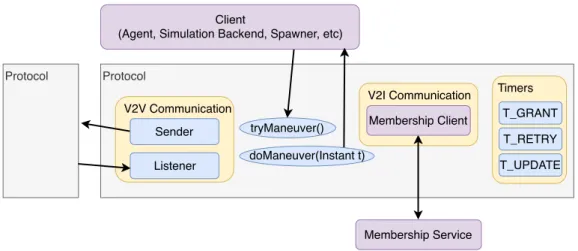
This module is where the majority of the logic regarding the protocol is implemented. Figure 4.1 presents the main components that compose the protocol, as well as the con-nections to other outside entities.
The V2V communication block contains the two objects responsible for establish-ing communication with other agents, Sender and Listener. The Sender class wraps a DatagramSocket object for UDP communication and provides two functions:
Chapter 4. Implementation 30
• multicast(Message, Set<Agents>) - Broadcasts the Message to each Agent in the provided Set using the send function
The Listener class also wraps a DatagramSocket object, but functions in a very distinct manner. Upon initialization, a new Runnable object is created. After the initialization of the protocol is finished, the Runnable is started in a new thread. The Runnable consists of a while loop in which it will permanently listen for new incoming messages until explicitly requested to stop doing so. Whenever a new message arrives, it is then unserialized into a Message object, and the message processing routine is invoked.
To help testing during development the Listener provides the ability to set a reception success probability, in order to simulate scenarios where communication failures exist. That process is done by discarding messages in a probabilistic manner, according to the probability set.
V2I Communication is, as mentioned before, handled by the MembershipClient li-brary. This library implements the MembershipClientInterface available in the common module. Section 5.1 describes the library in further detail.
All communication with the Membership service is abstracted by this library. Ad-ditionally, should a different implementation of the membership service arise, switching implementations should be straight forward for the protocol, as long as its API remains stable.
The timers described in Section 3.4.4 are here implemented. Each of the timers’ re-spective jobs is implemented as a Runnable. They are scheduled through the means of an ExecutorService, more specifically a ScheduledExecutorService. This ScheduledEx-ecutorService holds control over a thread pool comprised of three threads that are used to compute the jobs as needed. Whenever a job is scheduled it returns a Future object. This Future object represents the result of an asynchronous computation, and also exposes pro-cedures to cancel the latter. As such, we save the respective Future object related to the job in memory, in order to be able to cancel the latter, effectively cancelling the corresponding timer.
To interact with the protocol, the host Agent has the public method tryManeuver() available. When the host Agent invokes this method, the a new maneuver request is started, performing the actions described in Section 3.4.7. When the possibility to exe-cute a maneuver exists, the protocol will call an internal procedure doManeuver(Instant t). This procedure will invoke the current instance of the ManeuverCallback interface, informing the host Agent of the clearance to perform the requested maneuver until instant t. After this instant t, other agents will revoke the clearance given.
4.4.3
Protocol Spawner
The idea of a spawner to help with testing has transitioned from the C++ to the Java implementation, and two different spawners are provided in this module.
Chapter 4. Implementation 31
• Spawner - Base spawner used for evaluation
• Configurable Spawner - Spawner used for testing interaction with Membership Service
The base spawner was mostly used throughout development to verify correct imple-mentation of the protocol. Its functioning is rather simple:
• Instantiate a predetermined number of protocol instances
• Periodically request a random instance to perform a maneuver for an undetermined amount of time
This spawner was later extended to allow evaluating the protocol by performing a couple of extra steps:
• Upon completing a pre-defined number of maneuvers, no further maneuvers are requested
• Shows statistics gathered during execution, including total number of requests, total number of maneuvers completed, and time taken to complete each maneuver
In order to allow this spawner to work without the need for other components, several dummy implementations of interfaces are provided:
• DummyMembershipClient - Simply returns all agents instantiated by the spawner • StaticAgentProperties - Returns a set of static agent properties when queried • MeasurementsManeuverCallback - Used when gathering metrics from the
Chapter 5
Integration
In this chapter a description of how the coordination protocol was integrated with the membership service, as well as the application developed to test both the coordination protocol and the membership service with a scenario in a simulator.
5.1
Integration with Membership Service
As described in Section 4.4.2, interaction between the coordination protocol and the mem-bership service is done through the memmem-bership-client library.
This library provides two methods for use in the protocol:
• storeAgentRegistry(Agent) - this method is used to store information regarding the current agent in the membership service
• getMembershipRegistry() - used to request the current membership information relevant to the current agent
The method storeAgentRegistry receives a parameter of type Agent, described pre-viously in Section 4.4.1, and stores the state of the agent in the membership service. This method is periodically called as part of the job run whenever timer T UPDATE is fired. On the other hand the result of method getMembershipRegistry is a Membership ob-ject containing the relevant agents for the current maneuver and the membership validity. This method is invocated whenever an agent intends to perform a maneuver, as part of the tryManeuverprocedure.
The use of this library abstracts the whole communication structure with the member-ship service, making it considerably easier to use the service. The actual library imple-mentation details are unknown to the protocol.
Chapter 5. Integration 34
Simulator ROS
Simulator Backend
ROS Bridge
Protocol Protocol Protocol
1 2 n
Membership Service
Figure 5.1: Integrated Testing Application Architecture
5.2
Integrated Testing Application
In this section, we will show how we developed an application integrating both the agent coordination protocol and the membership service, as well as a visualization layer.
5.2.1
Architecture
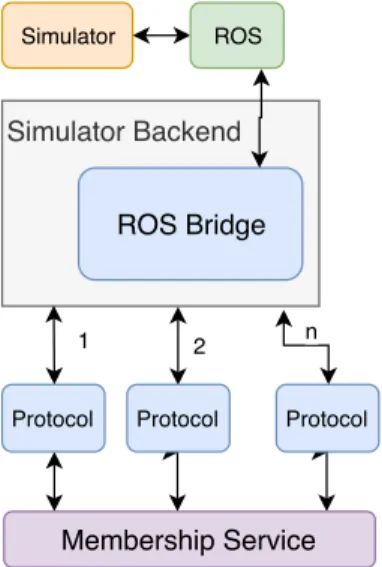
Figure 5.1 shows the architecture of the application integrating both the coordination pro-tocol, the membership service, and a visualization layer. The purpose of this application is to visualize scenarios where several vehicles utilize the coordination protocol and mem-bership service to coordinate maneuvers among themselves.
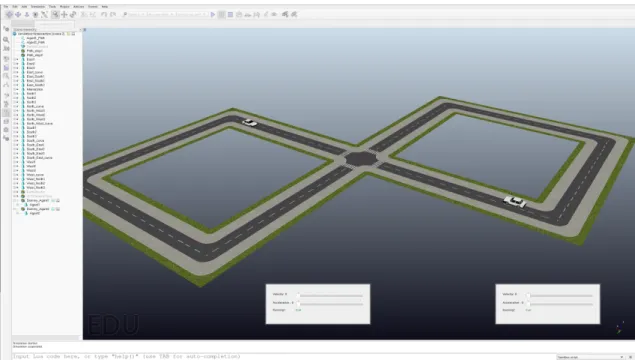
The simulator is the application that allows the visualization of the scenario developed. The tool selected and criteria for selection is further described in Section 5.2.2. The simulator backend is responsible for gathering information from the simulator, correctly generating instances of the coordination protocol and assigning them to vehicles in the scenario loaded in the simulator. For this goal it uses a module called ROS bridge. A Protocol is an instance of the coordination protocol, which communicates with an agent simulated in the simulator backend.
5.2.2
Simulator
Several simulators were evaluated to use within the integrated testing application, namely:
• Gazebo • RoboDK • rviz