Revista da Associação Portuguesa de Psicologia ISSN 2183-2471 Revista PSICOLOGIA, 2017, Vol. 31 (2), 192-197
Atas do IX Simpósio Nacional de Investigação em Psicologia
More socially responsible, more ethical, more attractive as a future
employer? Contributes of corporate social performance and ethical
reputation for the attraction of future employees
Ana Patrícia Duarte
1,2,3, Vítor Hugo Silva
1,2, Eduardo Simões
1,3& José Gonçalves das
Neves
1,31 Instituto Universitário de Lisboa (ISCTE-IUL) 2 Centro de Investigação e Intervenção Social (CIS-IUL) 3 Business Research Unit (BRU-IUL)
Abstract: Previous studies suggest that the corporate social performance of organizations influences their attractiveness as a workplace. This study analyzed additional variables that may help explain this relationship. In this context, an ethical reputation is a construct positively related to corporate social responsibility (CSR). In the research, CSR perception was manipulated in order to observe its effect on organizational attractiveness through the mediating effect of ethical reputation. Participants (n = 260) were randomly subjected to two experimental conditions by responding to an electronic questionnaire containing the description of an organization that implements (i.e., the high involvement condition) or not (i.e., the low involvement condition) a set of CSR practices. This was followed by questions about other variables of interest. The results show that the proposed theoretical model provides a strong fit to the data, thus empirically supporting the proposal that CSR directly and indirectly affects, through ethical reputation, evaluations of organizations as a future workplace. In practical terms, this means that, in the war for talent, organizations can use information about their corporate social performance and ethical reputation to attract potential candidates, alongside more traditional information on organizational attributes and job characteristics.
Keywords: Corporate social responsibility; Ethical reputation; Organizational attractiveness; Recruitment;
Talent attraction.
Organizações mais socialmente responsáveis, mais éticas, mais atrativas como futuras empregadoras? Contributos do desempenho social e da reputação ética para a atração de futuros trabalhadores. Estudos anteriores sugerem que o desempenho social das organizações influencia a atratividade destas enquanto futuros locais de trabalho. O presente estudo analisou a existência de variáveis adicionais que ajudam a explicar esta relação. A reputação ética é um constructo positivamente relacionado com a responsabilidade social das organizações (RSO). Neste estudo procedeu-se à manipulação da perceção de RSO com o objetivo de observar o seu impacto na atratividade da organização considerando o efeito mediador da reputação ética. Os participantes (n = 260) foram distribuídos aleatoriamente por duas condições experimentais, respondendo a um questionário online contendo uma descrição de uma organização que levava a cabo (condição de alto envolvimento) ou não (condição de baixo envolvimento) um conjunto de práticas de RSO, seguindo-se questões sobre as variáveis de interesse. Os resultados indicam que o modelo teórico proposto apresenta um forte ajustamento aos dados, dando suporte empírico à proposta de que a RSO afeta diretamente e indiretamente, através da reputação ética, a avaliação de uma organização enquanto futuro local de trabalho. Em termos práticos, tal significa que na “guerra pelo talento” as organizações podem fazer uso da informação sobre o seu desempenho social e reputação ética enquanto ferramenta de atração de potenciais candidatos, em conjunto com a informação habitual sobre os atributos organizacionais e as características da função.
Palavras-chave: Responsabilidade social das organizações; Reputação ética; Atratividade organizacional;
Recrutamento; Atração de talentos.
1 Dados para correspondência: Patrícia Duarte, Instituto Universitário de Lisboa (ISCTE-IUL), Av. das Forças Armadas, 1649-026
Lisboa. E-mail: [email protected]. This study was partially supported by Fundação para a Ciência e a Tecnologia through a postdoctoral fellowship to the first author (SFRH/BPD/76114/2011). The authors are grateful to the students of the Master on Social
Human resources are a valuable capital for any organization (Cascio & Bondreau, 2011) as they provide companies with the necessary knowledge, skills, and competences to pursue organizational goals successfully (Cappeli & Crocker-Hefter, 1996). Not unexpectedly, therefore, organizations compete with each other to attract the most interesting employees in what has been called the “war for talent” (Michaels, Handfield-Jones, & Axelrod, 2001).
How organizations can most effectively attract qualified candidates with appropriate profiles is currently a topic of great interest in human resource management (Duarte, Gomes, & Neves, 2014). Previous studies have revealed that organizational attractiveness is important for effective recruitment because it is positively associated with candidates’ attitudes and behaviors toward the hiring organization (e.g., Gomes & Neves, 2010; Greening & Turban, 2000). Organizational attractiveness refers to the degree to which a candidate perceives an organization as a good place to work and the positive desirability of developing a work relationship with it (Aiman-Smith, Bauer, & Cable, 2001; Rynes, 1991). Hence, the higher the organization’s attractiveness, the more effective will be the attraction stage of recruitment.
Alongside job characteristics, organizational attributes, and characteristics of recruitment advertising (e.g., Gomes & Neves, 2010; Reeve, Highhouse, & Brooks, 2006), corporate social responsibility (CSR) has been proposed, in the last decade, as a relevant predictor of organizational attractiveness. CSR refers to the degree to which organizations assume responsibility for their impact on society and integrate social and environmental considerations into their business operations (Aguinis, 2011; European Commission, 2001, 2011). Some empirical evidence has now been found that candidates consider corporate social performance important when assessing future workplaces and that they are more attracted to companies considered to be socially responsible (e.g., Backhaus, Stone, & Heiner, 2002; Bauer & Aiman-Smith, 1996; Evans & Davis, 2011; Lin, Tsai, Joe, & Chiu, 2012).
The question that gave origin to the present study has to do with the mechanism that explains the impact of CSR on organizational attractiveness. Previous studies have suggested some possible mediating variables, such as corporate image (Duarte et al., 2014) or person-organization fit (Kim & Park, 2011). However, the process underlying the relationship between the variables is still mainly a black box, and further research on the topic has been called for in the literature. Given this context, the present study proposed ethical reputation as a possible mediating mechanism.
Ethical reputation reflects organizations’ commitment to ethics (Jaramillo, Grisaffe, Chonko, & Roberts, 2009; Mulki & Jaramillo, 2011), based on perceived occurrences of ethical problems (Armstrong, 1996) and ways organizations treat their employees and customers (Dawkins & Lewis, 2003). Fombrun (2000) suggests that, when individuals evaluate companies, they look for information available on past workplace and organizational performance. Information about CSR activities appears to be dominant in shaping a personal sense of corporate reputation (Zhu, Sun, & Leung, 2014).
In addition, because CSR encompasses observed corporate ethics (Baselga-Pascual, Trujillo-Ponce, Vähämaa, & Vähämaa, 2016), ethics should naturally play a key role in individuals’ evaluations of companies. In fact, the literature has shown that socially questionable practices generate a negative impact on perceptions about organizations (Farah & Newman, 2010), while engagement in socially responsible practices enhances positive perceptions of corporate reputation (Lai, Chiu, Yang, & Pai, 2010). Furthermore, having a favorable reputation may lead to favorable consequences, such as attracting more, and possibly higher-quality, applicants (Fombrun & Shanley, 1990; Turban & Cable, 2003).
Two theoretical perspectives can be used as a framework for the relationship between ethical reputation and organizational attractiveness. On the one hand, social identity theory (Ashforth & Mael, 1989; Tajfel & Turner, 1985) suggests that candidates may consider a socially responsible company more attractive in terms of employment by anticipating increased self-esteem from belonging to an organization with a positive ethical reputation. On the other hand, the theory of planned behavior (Ajzen, 1991) indicates that organizations act in accordance with existing expectations, which can mean that candidates concerned about CSR develop positive attitudes about the hiring organization. Following this line of reasoning, the present study proposed that:
Hypothesis 1: The level of engagement in CSR practices affects organizational attractiveness so that the level of organizational attractiveness will be higher when perceived corporate engagement is high.
Hypothesis 2: Ethical reputation mediates the effect of CSR on organizational attractiveness. METHOD
Participants
The research was based on a convenience sample of 260 participants, aged between 18 and 56 years old (M = 26.64; SD = 8.81), most of them female (57.7 %) with higher education degrees (67.3%). Most participants have previous work experience (64.2 %), while 74.1% were employed at the time of the study
and 25.4% were looking for a new job. No significant differences were found between experimental conditions regarding sociodemographic characteristics (i.e., p > 0.05 for all).
Design, Procedure, and Measures
An experimental study manipulating participants’ perception of level of corporate engagement in CSR practices (i.e., the independent variable) was performed. Participants were invited by email to participate voluntarily in a study about how individuals evaluate organizations as potential future employers. The email contained the study aims and a link to a survey comprising a description of a company (i.e., the experimental scenario) followed by a set of questions about the variables of interest. This survey was developed in Qualtrics, allowing the randomization of scenarios.
As proposed by Duarte (2011), in the high engagement condition, the scenario described a hypothetical company as implementing a set of socially responsible practices (e.g., investing in equity between men and women, participating in environmental protection programs, and obtaining profits). In the low engagement condition, the same company was depicted as implementing none of these practices. After reading the scenario, participants answered items measuring the following aspects.
Perceived engagement in CSR (i.e., the manipulation check) was addressed by two items taken from Duarte (2011) (e.g., “This company is a socially responsible company.”). The response scale ranged from 1 (“Strongly disagree”) to 5 (“Strongly agree”) (r = 0.84). The manipulation check showed that scores for perceived engagement in CSR practices varied as expected from the high engagement condition (M = 4.16; DP = 0.46) to the low engagement condition (M = 1.69; DP = 0.53; t(258) = -40.433, p < .001).
Ethical reputation (i.e., the mediator variable) was measured by three items adapted from Valenzuela et al. (2010) on a response scale from 1 (“Strongly disagree”) to 5 (“Strongly agree”) ( = 0.86). Organizational attractiveness (i.e., the dependent variable) was covered by four items adapted from Bauer and Aiman-Smith (1996) and Highhouse, Lievens, and Sinar (2003) on a response scale from 1 (“Strongly disagree”) to 7 (“Strongly agree”) ( = 0.92). Participants were also asked to indicate their gender, age, level of education, and previous work experience, as well as if they were searching for a job at the time of the study.
RESULTS
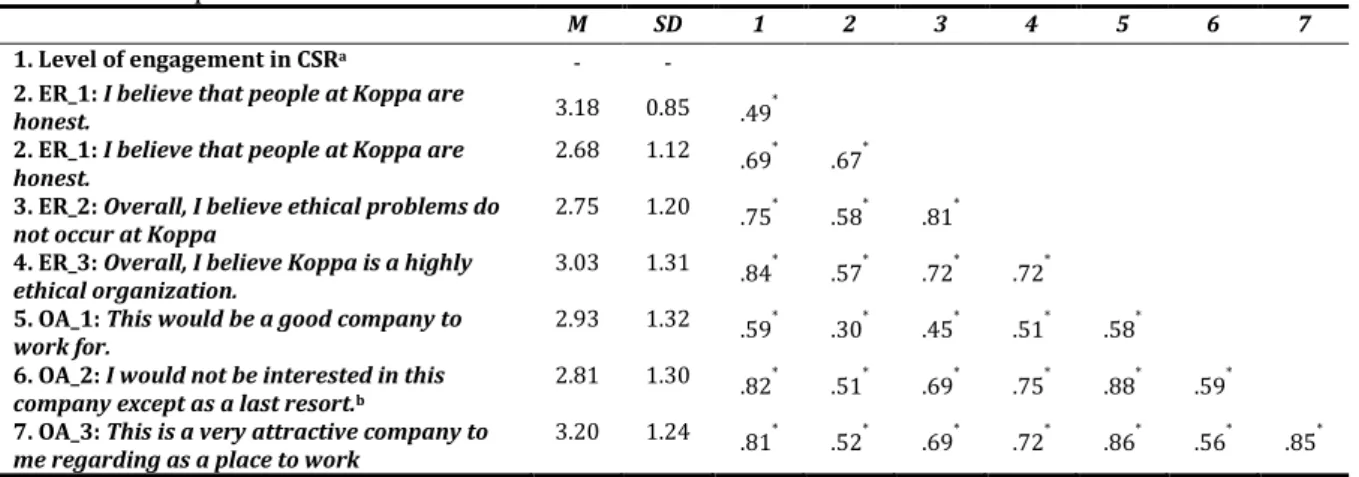
The data were analyzed using structural equation modelling with Amos 20. Bootstrapping was used in all analyses. Table 1 presents the descriptive statistics and correlations between all indicators.
Table 1. Descriptive statistics and correlations between indicators.
M SD 1 2 3 4 5 6 7
1. Level of engagement in CSRa - -
2. ER_1: I believe that people at Koppa are
honest. 3.18 0.85 .49*
2. ER_1: I believe that people at Koppa are
honest. 2.68 1.12 .69
*
.67*
3. ER_2: Overall, I believe ethical problems do
not occur at Koppa 2.75 1.20 .75
*
.58* .81*
4. ER_3: Overall, I believe Koppa is a highly
ethical organization. 3.03 1.31 .84
*
.57* .72* .72*
5. OA_1: This would be a good company to
work for. 2.93 1.32 .59
*
.30* .45* .51* .58*
6. OA_2: I would not be interested in this
company except as a last resort.b
2.81 1.30 .82*
.51* .69* .75* .88* .59*
7. OA_3: This is a very attractive company to
me regarding as a place to work 3.20 1.24 .81
*
.52* .69* .72* .86* .56* .85* Note: a low = 0; high = 1; b reverse scored; * p < .01
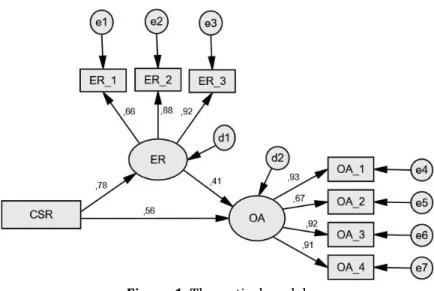
First, the goodness-of-fit of the theoretical model was compared with the goodness-of-fit of a single factor model. The level of engagement in CSR was used in the analyses as an observed variable and ethical reputation and organizational attractiveness as latent variables (see Figure 1).
Figure 1. Theoretical model.
An analysis of the goodness-of-fit of the proposed model showed an extremely good fit to the data, while the alternative single factor model revealed unacceptable fit indices. Next, mediational effects were evaluated by comparing the fit of the theoretical model with that of an alternative model without a direct path to be estimated (see Table 2). The results indicate that the proposed theoretical model is better than the alternative model, which denotes a mediational effect of ethical reputation in the relationship between engagement in CSR and organizational attractiveness.
Table 2. Fit indices.
Models 𝜒2(gl) TLI CFI RMSEA
Single factor model 146.637 (20) 0.905 0.932 0.152
Theoretical model 34.992 (18) 0.986 0.991 0.060
No direct path model 117.130(19) 0.923 0.948 0.141
The analysis of standardized direct, indirect, and total effects (see Table 3) revealed that the direct effect of the level of CSR engagement on organizational attractiveness is significant (0.56; p < 0.001), which supports Hypothesis 1. The total effect of this predictor on organizational attractiveness is also significant (0.88; p < 0.001), as well as its indirect effect through ethical reputation (0.32; p < 0.001). This indicates a partial mediation of ethical reputation in the relationship between the level of engagement in CSR and organizational attractiveness, thus confirming Hypothesis 2.
Table 3. Theoretical model—total, indirect, and direct effects.
Models Total effect Indirect effect Direct effect
Level of engagement in CSR-Organizational Attractiveness 0.884* 0.323* 0.561*
Note: *p < 0.001
DISCUSSION AND CONCLUSIONS
These findings replicate previous studies in that they show that individuals’ assessment of companies as a future workplace is influenced by the perception they have about its CSR performance (e.g., Albinger & Freeman, 2000; Backhaus et al., 2002; Duarte et al., 2014; Greening & Turban, 2000). Good corporate social performance leads to higher levels of organizational attractiveness than poor CSR performance.
The results add to previous studies by revealing that ethical reputation mediates the relationship between CSR and organizational attractiveness. It appears, therefore, that perceptions of CSR performance influence candidates’ evaluation of firms’ ethical stance, and, consequently, this evaluation helps determine the desirability of developing a work relationship with companies. These findings extend the current knowledge about relevant mediating variables explaining how CSR impacts candidates’ attitudes toward organizations (Duarte et al., 2014; Kim & Park, 2011).
On a more practical level, the present results suggest that recruiters need to consider information related to CSR and ethical reputation during the attraction stage of recruitment, in order to maximize their
study shows that equal consideration should be given to ethical reputation. In short, the more socially responsible companies are, the more ethical and attractive they are as a future employer.
REFERENCES
Aguinis, H. (2011). Organizational responsibility: Doing good and doing well. In S. Zedeck (Ed.), APA Handbook of Industrial and Organizational Psychology (vol. 3, pp. 855-879). Washington, DC: American Psychological Association.
Aiman-Smith, L., Bauer, T., & Cable, D. (2001). Are you attracted? Do you intend to pursue? A recruiting policy-capturing study. Journal of Business and Psychology, 16, 219-37. https://doi.org/10.1023/A:1011157116322
Ajzen, I (1991). The theory of planned behavior. Organizational Behavior and Human Decision Processes, 50, 179-211. https://doi.org/10.1016/0749-5978(91)90020-T
Albinger, H. S., & Freeman, S. J. (2000). Corporate social performance and attractiveness as an employer to different job seeking populations. Journal of Business Ethics, 28(3), 243-253. https://doi.org/10.1023/A:1006289817941
Armstrong, R.W. (1996). The relationship between culture and perception of ethical problems in international marketing. Journal of Business Ethics, 15 (11), 1199-1208. https://doi.org/10.1007/BF00412818
Ashforth, B. E., & Mael, F. (1989). Social identity theory and the organization. The Academy of Management Review, 14, 20–39. https://doi.org/10.5465/AMR.1989.4278999
Backhaus, K. B., Stone, B. A., & Heiner, K. (2002). Exploring the relationship between corporate social performance and employer attractiveness. Business and Society, 41(3), 292-318. https://doi.org/10.1177/0007650302041003003
Baselga-Pascual, L., Trujillo-Ponce, A., Vähämaa, E., & Vähämaa, S. (2016). Ethical reputation of financial institutions: Do board characteristics matter? Journal of Business Ethics, forthcoming. https://doi.org/10.1007/s10551-015-2949-x
Bauer, T., & Aiman-Smith, L. (1996). Green career choices: The influences of ecological stance on recruiting. Journal of Business and Psychology, 10, 445-458. https://doi.org/10.1007/BF02251780
Bhattacharya, C., Sen, S., & Korschun, D. (2008). Using corporate social responsibility to win the war for talent. MIT Sloan Management Review, 49, 37-44.
Cappeli, P., & Crocker-Hefter, A. (1996). Distinctive human resources are firm’s core competencies. Organizational Dynamics, 24(3), 7-22. https://doi.org/10.1016/S0090-2616(96)90002-9
Cascio, W., & Bondreau, J. (2011). Investing in people: Financial impact of human resources initiatives. New Jersey: Pearson Education Inc.
Dawkins, J. and Lewis, S. (2003). CSR in stakeholders’ expectations: and their implication for company strategy. Journal of Business Ethics, 44(2/3), 85-93. https://doi.org/10.1023/A:1023399732720 Duarte, A.P. (2011). Corporate social responsibility from an employees’ perspective: Contributes for
understanding job attitudes. Non-published doctoral dissertation. Lisboa: ISCTE-IUL.
Duarte, A.P., Gomes, G., & Neves, J. (2014). Tell me your socially responsible practices, I will tell you how attractive for recruitment you are! The impact of perceived CSR on organizational attractiveness.
Téchkne - Review of Applied Management Studies, 12, 22-29.
https://doi.org/10.1016/j.tekhne.2015.01.004
European Commission. (2001). Green paper: Promoting a european framework for corporate social responsibility. Brussels: EU Commission.
European Commission. (2011). A renewed EU strategy 2011-14 for Corporate Social Responsibility. Brussels: EU Commission.
Evans, W., & Davis, D. (2011). An examination of perceived corporate citizenship, job applicant attraction and CSR work role definition. Business & Society, 50(3), 456-480. https://doi.org/10.1177/0007650308323517
Fombrun, C. (2000, December 4). The value to be found in corporate reputation. Financial Times. Retrieved from http://www.ft.com/
Fombrun, C. J. & Shanley, M. (1990). What’s in a name? Reputation building and corporate strategy. The Academy of Management Journal 33, 233–58. https://doi.org/10.2307/256324
Gomes, D., & Neves, J. (2010). Employer branding constrains applicants’ job seeking behavior? Journal of Work and Organizational Psychology, 26, 223-234. https://doi.org/10.5093/tr2010v26n3a6 Greening, D., & Turban, D. (2000). Corporate social performance as a competitive advantage in attracting a
quality workforce. Business & Society, 3, 254-280. https://doi.org/10.1177/000765030003900302 Highhouse, S., Lievens, F., & Sinar, E. (2003). Measuring attraction to organizations. Educational and
Jaramillo, F., Grisaffe, D.B., Chonko, L.B., & Roberts, J.A. (2009). Examining the impact of servant leadership on salesperson’s turnover intention. Journal of Personal Selling and Sales Management, 29(4), 351-365.
Kim, S., & Park, H. (2011). Corporate social responsibility as an organizational attractiveness for prospective public relations practitioners. Journal of Business Ethics, 103, 639-653. https://doi.org/10.1007/s10551-011-0886-x
Lai, C., Chiu, C., Yang, C., & Pai, D. (2010). The effects of corporate social responsibility on brand performance: The mediating effect of industrial brand equity and corporate reputation. Journal of Business Ethics, 95(3), 457-469. https://doi.org/10.1007/s10551-010-0433-1
Lin, C., Tsai, Y., Joe, S., & Chiu, C. (2012). Modeling the relationship among perceived corporate citizenship, firms’ attractiveness, and career success expectation. Journal of Business Ethics, 105, 83–93. https://doi.org/10.1007/s10551-011-0949-z
Michaels, E., Handfield-Jones, H., & Axelrod, B. (2001). The war for talent. Boston: Harvard Business School Press.
Mulki, J. P., & Jaramillo, F. (2011). Ethical reputation and value received: Customer perceptions.
International Journal of Banking Marketing, 29(5), 358-372.
https://doi.org/10.1108/02652321111152891
Reeve, C., Highhouse, S., & Brooks, M. (2006). A closer look at reactions to realistic recruitment messages. International Journal of Selection and Assessment, 14, 1-15. https://doi.org/10.1111/j.1468-2389.2006.00330.x
Rynes, S. (1991). Recruitment, job choice, and post-hire consequences. In M. Dunnette & L. Hough (Eds), Handbook of industrial and organizational psychology (pp. 339-444). Palo Alto: Consulting Psychologists Press.
Tajfel, H., & Turner, J. C. (1985). The social identity theory of intergroup behavior. In S. Worchel, & W. G. Austin (Eds.), Psychology of intergroup relations (pp. 7–24). Chicago: Nelson-Hall.
Turban, D. B. & Cable D. (2003). Firm reputation and applicant pool characteristics. Journal of Organizational Behavior 24, 733–751. https://doi.org/10.1002/job.215
Valenzuela, L. M., Mulki, J. P., & Jaramillo, J. F. (2010). Impact of customer orientation, inducements and ethics on loyalty to the firm: Customers’ perspective. Journal of Business Ethics, 93(2), 277-291. https://doi.org/10.1007/s10551-009-0220-z
Zhu, Y., Sun, L.-Y., & Leung, A. S. M. (2014). Corporate social responsibility, firm reputation, and firm performance: The role of ethical leadership. Asia Pacific Journal of Management, 31(4), 925-947. https://doi.org/10.1007/s10490-013-9369-1
Historial do artigo
Recebido 30/07/2016 Aceite 02/01/2017 Publicado 11/2017