www.scielo.br/rbg
PROCESSING OF HIGH-RESOLUTION, SHALLOW SEISMIC PROFILES,
GUANABARA BAY – RIO DE JANEIRO STATE, BRAZIL
Igor Kestemberg Marino
1, Marco Antonio Cetale Santos
2and Cleverson Guizan Silva
2ABSTRACT.This paper presents a proposal for implementing a processing flowchart for high-resolution single-channel seismic data acquired in Guanabara Bay, followed by its interpretation. Geologically, it consists of mapping the Guanabara Bay Quaternary deposits relative to the drowning of a fluvial paleochannel that resulted from recent sea level changes. So far, high-resolution seismic data have been interpreted without any signal improvement, while the development of a processing flowchart for this is hardly addressed in the literature. The parameters were selected based on the processing applied to conventional seismic prospecting for oil and gas in order to compose a less extensive and more applicable flowchart. The results confirmed the efficacy of the processing applied to shallow seismic data, with noise and multiples attenuation and better lateral continuity of reflectors in subsurface, thus increasing the quality of the final seismic record.
Keywords: Processing, shallow seismic, Guanabara Bay, high-resolution seismic.
RESUMO.O presente trabalho apresenta uma proposta de aplicac¸˜ao de um fluxo de processamento para dados de s´ısmica monocanal de alta resoluc¸˜ao adquiridos na Ba´ıa de Guanabara e, posteriormente, sua interpretac¸˜ao. O objetivo geol´ogico consiste no mapeamento dos dep´ositos Quatern´arios da Ba´ıa de Guanabara relativos ao afogamento de um paleocanal fluvial como consequˆencia das variac¸˜oes recentes do n´ıvel do mar. At´e o momento os dados de s´ısmica de alta resoluc¸˜ao vˆem sendo interpretados sem a aplicac¸˜ao de nenhuma melhoria e a elaborac¸˜ao de um fluxo de processamento para tal ´e raramente abordada na literatura. Os parˆametros foram selecionados para a elaborac¸˜ao do fluxo com base no processamento aplicado `a s´ısmica convencional na prospecc¸˜ao de hidrocarbonetos de forma a compor um fluxo mais sucinto e aplic´avel. Os resultados obtidos nos perfis analisados comprovaram a efic´acia do processamento de dados de s´ısmica rasa, com a atenuac¸˜ao de ru´ıdos, das m´ultiplas de fundo e maior continuidade lateral dos refletores em subsuperf´ıcie, aumentando assim a qualidade do registro s´ısmico.
Palavras-chave: Processamento, s´ısmica rasa, ba´ıa da Guanabara, alta resoluc¸˜ao s´ısmica.
1PGS – Rio Office, Rua S˜ao Jo˜ao, 25 Apto 712 – Centro, Niter´oi, RJ, Brazil. Phone: +55(21) 3628-0580 / +55(21) 99232-9889 – E-mail: [email protected] 2Departamento de Geologia e Geof´ısica, Instituto de Geociˆencias, UFF – Av Gen. Milton Tavares de Souza, s/n, Boa Viagem, 24210-346 Niter´oi, RJ, Brazil. Phone: 2629-5922 / 2629-5927 – E-mail: [email protected]; [email protected]
INTRODUCTION
In geophysics, the seismic reflection method is widely used in exploratory surveys to detect and map subsurface structures and interfaces. It consists basically in characterizing the depth of the reflecting surfaces and their influence on the wave speed on sub-surface layers (Lowrie, 2006). A seismic source induces a sig-nal at a certain known location, and its reflections on the inter-faces between physically different layers are recorded for further analysis.
High-resolution seismic has very limited applicability at shal-lower depths (ten to hundred meters, in the case of lagoon, estu-ary and river surveys) and has better resolution than the conven-tional seismic, since it is able to image structures of centimeters (Brunetta, 2005). Methods and concepts from solid Earth geo-physics are used in high-resolution seismic and its objective is generally addressing economic, technological and environmental issues. From the 70s and 80s, applied geophysics has also been used in engineering, hydrogeology and the environment, in order to investigate shallow targets. Usually, the noise content in high-resolution data makes very difficult to interpret the seismic pro-file and justifies the application of processing techniques to treat the acquired data.
Until now, high-resolution, single-channel seismic data are being interpreted without any previous treatment, while studies and references in the area are quite rare, very recent or poorly addressed in the pertinent literature (e.g. Brunetta, 2005; Gomes et al., 2010). Based on these facts, this study presents a pro-posal for processing high-resolution seismic data that differs in several aspects from the conventional seismic processing flow. Based on certain parameters, such as the behavior of high fre-quency wave, acoustic impedance, applicability of filters to sup-press typical background noise and gain recovery, it is possible to obtain a much higher quality seismic profile compared to the original data.
STUDY AREA
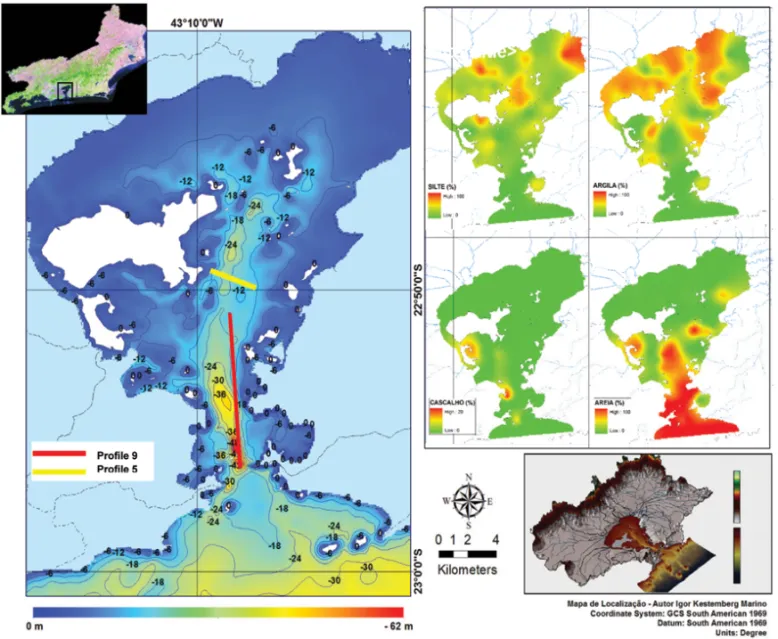
Guanabara Bay is located in Rio de Janeiro State, Brazil, between 22◦40’ and 23◦00’S latitude and 43◦00’ and 43◦20’W longitude (Fig. 1). The total perimeter of 131 km extends up to 30 km from North to South and about 28 km from East to West (Kjerfveet et al., 1997), a narrowing of 1.6-km width can be observed between the S˜ao Jo˜ao Fort and Santa Cruz Fortress (Quaresma, 1997). It has an approximate area of 381 km2, up to its entry in the alignment
between Santa Cruz and S˜ao Jo˜ao tips, with average water volume of 1,87× 10⁹ m3. The bay presents a very complex bathymetry
with a central channel that extends approximately 400 m, with average maximum depth of 60 m nearby the inlet and a minimum of 5 m in the inner portion. The original shape of the study area is a consequence of the sea invasion and marine accumulation, ini-tially identified by Ruellan (1944). From the twenty seismic pro-files acquired in the study area, propro-files 5 and 9 were selected because they include different portions of the study area with well-known sedimentary characteristics. Profile 9 consists of a longitudinal section with approximate N-S orientation that extends from the entrance to the middle portion of the bay, while Profile 5 features a cross section of the Guanabara Bay extension, a cen-tral canal in the inner portion with preferential E-W orientation (Fig. 1).
Figure 2a shows key events and sedimentary deposits asso-ciated with the geological context of the study area during the Quaternary. The seismic profiles presented in this study provide evidence that covers from the end of a drainage paleosystem to the actual deposition system. During the last glacial period, about 20,000 – 18,000 A.P., Guanabara Bay underwent signifi-cant changes in its paleoenvironment. The fluvial deposits of the Caceribu Formation indicate that sea level was below the actual position up to 100 m, dry climate, and a drainage system in-terlaced with shallow and wide channels. The coastline at this time would stand tens of kilometers toward the ocean (Fig. 2-b). The continental shelf was exposed to subaerial conditions where features typical of coastal areas developed. The current islands consisted of higher fragments of massif coastal ranges (Amador, 1997). About 16,000 B.P., the drowning process of the Pleis-tocene Basin started, thus marking the beginning of the Lower Holocene. This transgressive phase is called Guanabarina Trans-gression (Amador, 1980). At the peak of this transTrans-gression, be-tween 5000 and 6000 A.P. (Bigarella, 1970, In: Amador, 1980), the bay had an area of 800 km2, relative sea level varied between 3 and 4 m above the current (Fig. 2-c).
According to Amador (1997), between 3800 and 3000 B.P., a new transgressive phase would have raised the sea level by about 1.5 m above its current level, being responsible for forming fossil beaches. At the rear of the shoreline, the bay primitive segments, truncated by the latest sedimentation, turned into lagoons. Fur-thermore, the tidal influence stretched over many kilometers into the bay allowing the development of extensive mangroves. How-ever, more recent studies (Dias & Kjerfve, 2008) show a nearly linear drop of the relative sea level during the last 5000 years.
Several authors infer that facies distribution affects signifi-cantly the seismic record, and it is possible to observe changes in the reflected signal characteristics and amount of energy
depend-Figure 1 – Study site showing the isobathymetric line sand distribution of bottom sediments. Localization of profiles 5 (yellow) and 9 (red) selected to undergo
data treatment through the steps of the processing flowchart.
ing on the type of bottom sediment and depositional acting pro-cesses (Baptista Neto et al., 1996; Quaresma et al., 2000; Catan-zaro et al., 2004).
Coarse to medium lithoclast sand can be observed in a small strip that extends from the entrance of Guanabara Bay to the more central regions, also in isolated portions near to the Ilha do Governador and about 5 km from Ilha de Paquet´a. Such distribu-tion would result from the narrowing caused by morphology and increasing speed of tidal currents in the region (Amador, 1992; Quaresma, 1997). These sediments, located between the bay en-trance and Rio – Niter´oi bridge, are related to the Pleistocene sands of the river system drowned by the last major transgression and reworked by the current hydrodynamic conditions. From the entrance of the bay to the outer portions, a large sandy bank with minimum 11 m isobaths can be observed.
Fine to very fine lithoclast sand is found along the entrance of the Jurujuba cove in Botafogo Bay and in the transition zone
between the medium sand and terrigenous muds to the south of Rio – Niter´oi bridge. The presence of finer sands is justified by the lower velocities of tidal currents, due to the enlargement of the bay toward its inner portion (Quaresma, 1997).
Terrigenous muds, silts and clays are observed from the cen-tral portions, in the nearby areas of Rio – Niter´oi bridge to the bottom of the bay, and are related mainly to the speed of tidal cur-rents, which are much lower in this region.
METHODOLOGY
The seismic data processed in this study were acquired using anEdgeTech CHIRP compartment-type profiler, with modulated frequency (2 – 17 kHz). The equipment consists of a rigid alu-minum plate attached to a coil spring specific for this type of survey. The device is attached to a maritime vehicle, which is towed and connected by cables to a computer / processor /
ampli-Figure 2 – Geochronology of Guanabara Bay during the Quaternary, associated deposits (Amador, 1980; Angulo & Lessa, 1997) and respective
Paleocene: (a) Last glacial period – 20.000-18.000 A.P; (b) Maximum of the transgression – 6.000-5.000 A.P. (modified from Amador, 1997).
fier integrated platform. The raw seismic section can be viewed at the time of acquisition in order to maintain survey quality control. The Seismic Processing Workshop (Parallel Geosciences) software was used for the practical application of seismic data
processing sequence. This software consists of a few basic steps to prepare a general flowchart and to optimize machine time. The Workflow and Seisview modules were used to elaborate the flowchart, visualize and interpret the post-processing seismic
section and for quality control as well. The Vector Calculator module was used for plotting the data, analyzing the contents of signal amplitude frequency and spectrum.
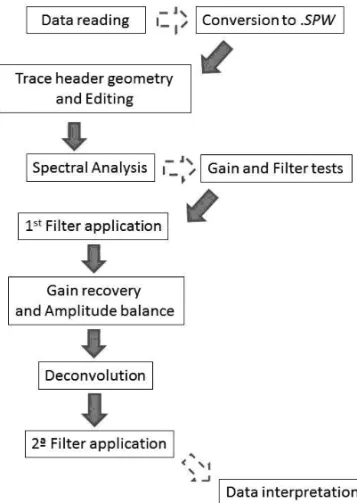
The flowchart seen in Figure 3 was based on the process-ing applied to the conventional hydrocarbon seismic exploration, which is better adapted to the frequency content of shallow records and favored imaging of subsurface geological structures.
Figure 3 – Flowchart proposed for the processing steps taken to treat the
seismic data.
In order to optimize the tests, fragments of the survey cen-ter line was used for test configuration and to decen-termine the co-efficients to be inserted, since no significant variations occur in the subsurface characteristics that can interfere with the adopted variables and parameters in the study area. The tests and com-parisons made in both selected profiles show the best parameter configuration to apply the steps of filtering and recovering of en-ergy decay over propagation time, which are better described fur-ther in this article.
The maps of textural characterization and distribution of bottom sediments were developed based on information from 92 bottom samples and 16 cores collected by Baptista Neto et al. (2006). For the data plotting step, a geographic information sys-tem (ARCGIS) was used, where the compiled data were inserted to generate grid maps of sedimentological parameters, bathymetric maps and coordinate system conversion.
Data reading
The data acquired with the Boomer equipment were initially recorded on the SEG-Y format according to predetermined equip-ment configuration, the seismic trace header contained only the information relative to the positioning of the source/receiver and gain adjustments.
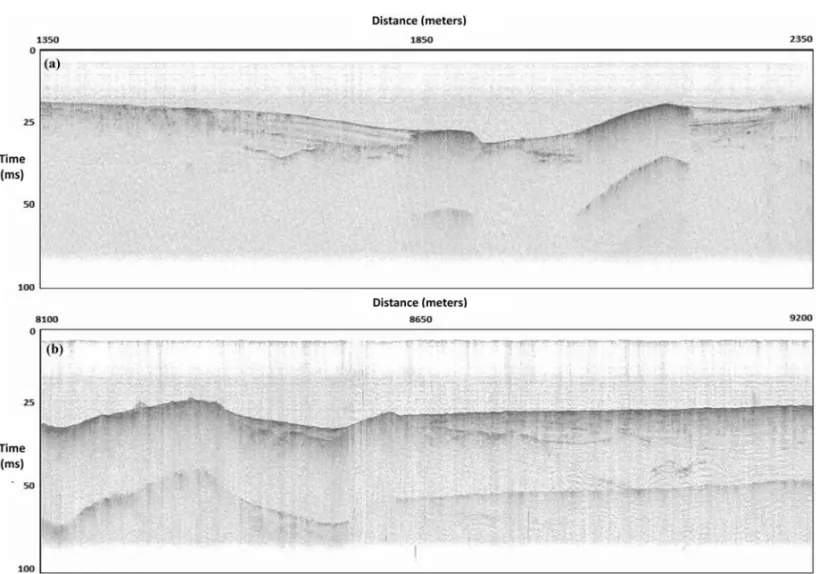
In the initial stages, the selected seismic records were con-verted from the standard SEG-Y format to the internal format (.spw) file extension, and loaded using the I/O Data Management module. The first viewing of the raw data is performed in Seisview module to define the scale patterns as shown in Figure 4. Pro-file 5 (Fig. 4-a) consists of 7445 traces, with sampling interval of 3.10-2ms and maximum recording time of 100 ms, while pro-file 9 (Fig. 4-b) has 22180 traces, also sampled at intervals of 3.10-2ms and record up to 100 ms. Adopting a constant value of 1500 m/s for the propagation speed of the seismic pulse in shallow surveys (Barros, 2006), it may be inferred an acquisition maximum depth of about 75 m for both profiles.
The viewing patterns defined in this processing step do not change the final result, since no other type of output or processed data is generated. Once the initial stage is validated, the program updates the database and feeds the tables related to shots, re-ceivers and seismic traces. In a second step, the input seismic file headers are updated from the information in the database, ini-tiating the step for inserting the acquisition geometry and quality control.
RESULTS AND DISCUSSIONS
The main conventional processing steps were centralized and adapted to the high-resolution data, resulting in the following proposed flowchart: editing the SEG-Y record trace header, defi-nition and quality control of acquisition geometry, data frequency spectrum analysis, testing filtering parameters, data cleaning and incoherent noise attenuation, amplitude normalization and gain recovery, attenuation of multiples, deconvolution, post-deconvolution filtering and as end product, the interpretation of seismic records.
Trace header geometry and editing
At this early processing step, the data regarding acquisition pa-rameters such as shot coordinates and seismic signal receivers are inserted in the seismic trace header. Geometry insertion must precede any offset depending step and its definition avoids losses in the final product (Yilmaz, 1987).
The first correction of the geometry step consisted of trans-forming the coordinate system, from the original arc sec to
Figure 4 – Raw seismic profiles. Profile 5: offsets 1350-2350 (a), and profile 9: offsets 8100-9200 (b).
UTM coordinates and updating the new values into the head-ers of the stored traces in the program database. The values in-serted in this step were: Survey ID, Trace Index and Field File, Source/Receiver Line, Source/Receiver Location, Trace Increment and Source/Receiver Elevation. The filling of these headers are very important since the different algorithms applied in the later steps use this data to move the windows of seismic trace analy-sis. Trace incremental distance was calculated using the average speed of the vessel (approximately 8 km/h) and shot rate (6/sec-ond), being estimated at about 0.35 m.
Immediately after inserting the geometry parameters, the wa-ter column was removed from the seismic record using the early muting tool, as seen in Figure 5. This removal can be very effective to optimize processing time and to minimize profile visual satu-ration since it removes the influence of fish schools, suspended sediment and debris, except in regions where certain phenom-ena in the water column should be identified, such as shallow gas seeps, commonly found in the study area (Fig. 6).
When the seismic profiler uses floats (and swell compen-sator) while being towed, topography can be corrected using the
depth difference between the sensor and the air/water interface, with wave compensation and tidal variation. When floats are not used, as in the present work, topography can be corrected us-ing bathymetric data and tidal tables, which were correlated to the trace signals in the reflector of the water/seafloor interface.
Spectral analysis and amplitude balance
The signal captured during seismic acquisition presents inco-herent noises arising from environmental, instrumental or even anthropogenic interferences (Robinson & Treitel, 1980). These noises impair the identification of subsurface structures degrad-ing the quality of the final section and greatly reducdegrad-ing the sig-nal/noise ratio. According to Houlding (1994), in high-resolution seismic profiling most of the noise present in the signal has amplitude values very close to the natural amplitudes, therefore, making it difficult to detect and remove the noise during data treatment.
The discrete Fourier transform enables the conversion of a seismic signal into a complex function containing information
Figure 5 – Early mute applied to profile 5 (a) to eliminate the water column (b).
Figure 6 – Evidence of gas presence in profile 9 between the offsets 4100-4150 (a) and 8250-8300 (b). Early mute applied to
the water column, preserving areas with occurrence of exhaust gas.
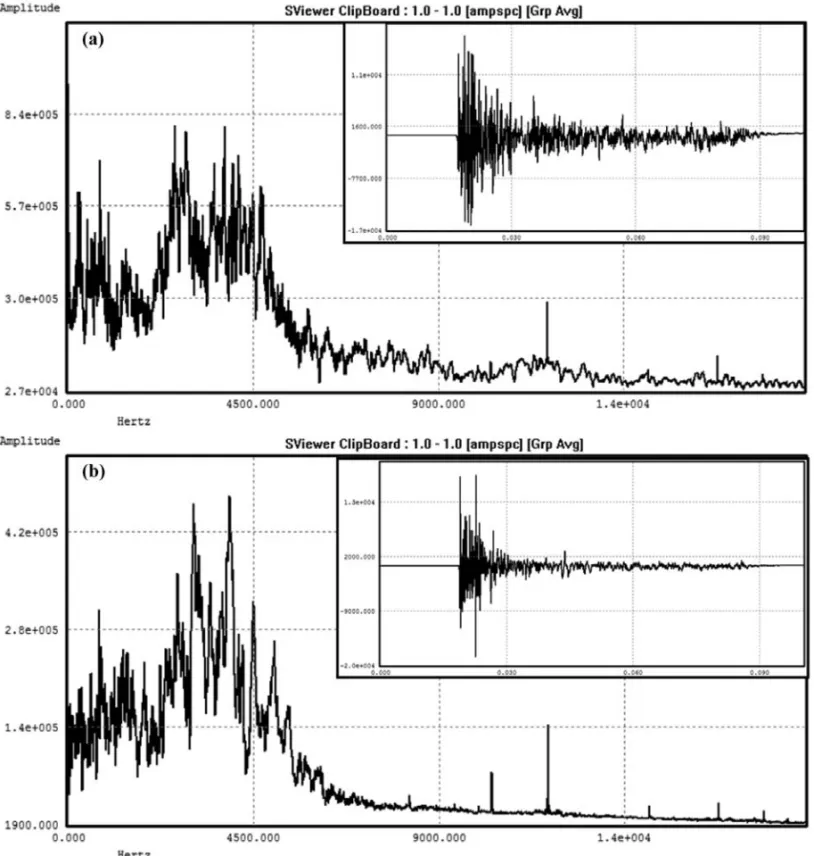
about amplitude and phase of seismic data spectrum. It is pos-sible to identify more consistently the existence of noise in the amplitude spectrum data from the spectral analysis of the seismic traces. Spectral analysis should be performed before and after all the steps that use some kind of filter, in order to determine what
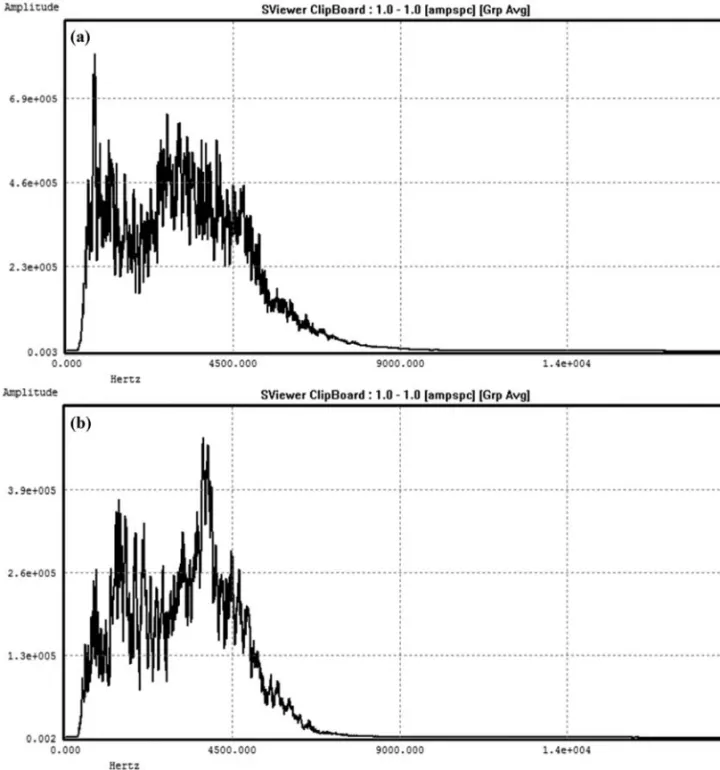
kind of amplitude spectrum changes are caused by the filter used. For the acquired profiles, the highest energy concentrations, re-lated the coherent signal of the subsurface reflectors, are found in the frequency range between 0.5 and 7.0 kHz, while random noise as well as instrumental and background noises are observed in
other frequencies with lower amplitude values (Fig. 7).
During propagation of seismic pulse in a certain medium, the amount of energy contained in the wave front decays with increas-ing distance along the trajectory due to geometrical spreadincreas-ing. Energy absorption mechanisms by the medium are quite com-plex, but the decay can be characterized as a loss of a fixed frac-tion of the total energy for each oscillafrac-tion of the medium parti-cles (Kearey et al., 2002).
According to Yilmaz (1987), spectral whitening aims to cor-rect the effects of attenuation by selecting the data in the low frequency bands, without major changes in the original signal phase. An inverse function of amplitude decay is applied to each frequency band, and the results are then summed to give the balanced trace. The comparison of the profiles (Fig. 8) shows that the non-balanced trace section (8-a) displays lateral variations and rapid energy decay along the depth due to natural
Figure 8 – Profile 9 before(a) and after (b) spectral balancing. Note the emphasis on deposits with cross stratigraphy.
tion of seismic pulse, while the seismic section after spectral bal-ancing (8-b) shows better frequency distributions, highlighting depth events.
The signal can also be enhanced through the AGC (Automatic Gain Control), which creates an equalized distribution of signal amplitudes over time, but it should be used with caution, since it can destroy signal characteristics. In order to avoid this, an AGC snapshot can be used, where the absolute mean values of trace amplitudes are stored within an analysis window and then
applied. This analysis window is then moved vertically, in time, and the entire process repeats itself until the last seismic trace data.
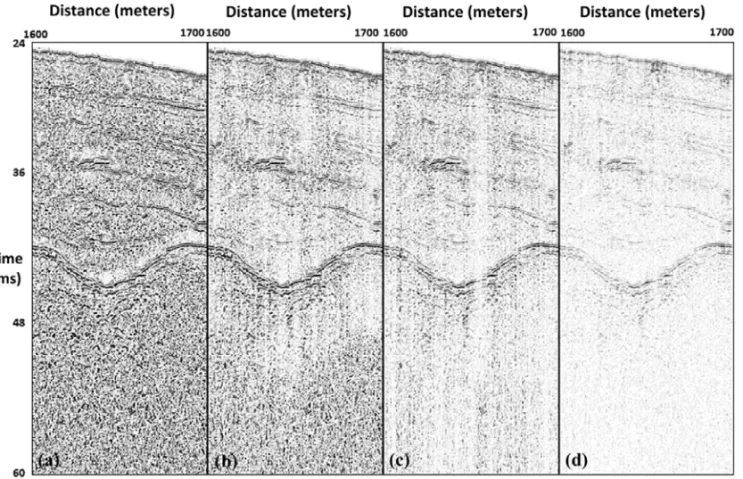
Highly limited analysis windows tend to cause significant signal loss while enhancing low amplitude areas, thus making stronger and weaker reflections indistinguishable from one an-other. Figure 9 shows this effect on the seismic section when AGC analysis windows vary for the times 3.5 ms (9-a), 20 ms (9-b), 50 ms (9-c) and 100 ms (9-d).
Application of frequency filters
Frequency filters operate on signal components in specific fre-quency bands so that such signal and wavelet noise components can be separated due to their distinctive features. The Butterworth filter can be used to meet the specific characteristics regarding frequency band restrictions of a seismic signal, since its frequency response enables in the band-pass, a flat response that does not alter the characteristics of the signal spectrum in this range (Oppenheim et al., 1983).
The band-pass frequency filter was designed based on the frequency distribution observed in data spectral analysis. As a
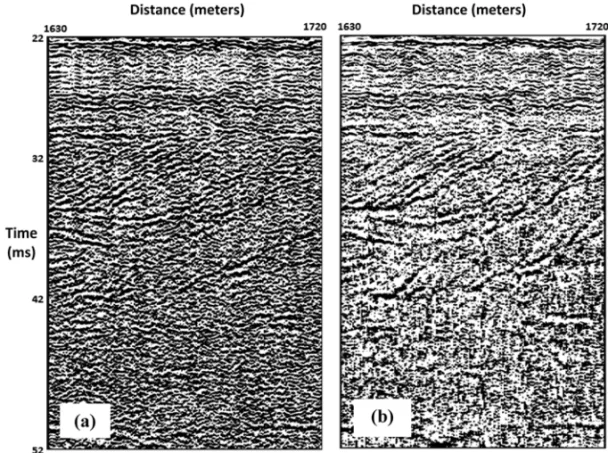
result, the filtered section presents regions where a more ac-curate filter performance can be seen, enhancing the coherent pattern of the signal and reducing very high frequency noises, commonly found in high-resolution seismic data, thus improv-ing the signal/noise relationship (Fig. 10). The high frequency noise creates a rectilinear pattern that crosses the seismic reflec-tions, masking the regions of interest. The removal of such noise demands close attention since they are mixed up with signals of interest that can eliminate the reflection signal and, therefore, im-pair the final product. Figure 11 shows the removal of unwanted frequency content of the traces by spectral analysis after the filtering step.
Figure 11 – Comparison between unfiltered sections (a) and after applying the band-pass filter (b), indicating the presence
of buried paleochannel deposits, profile 9.
A weighted average filter, which considers traces adjacent to the center trace and assigns importance based on this distance, was used aiming to improve the horizontal resolution and enhance the lateral continuity of subsurface horizons. The weighted aver-age filter is considered a low-pass filter implemented from a win-dow that may or may not be associated with a previously selected structure or horizon (Chopra & Marfurt, 2007).
A window containing five traces was adopted for the seis-mic records, with the greater weight being assigned to the cen-tral trace to avoid the loss of signal integrity and decrease the signal/noise ratio, especially in dip events on subsurface where the weighted average does not yield optimum effect. Figure 12 shows a fragment of profile 9 where the improved spatial reso-lution and greater lateral continuity of the horizons after applying the weighted average filter can be seen.
Deconvolution
Several components of the seismic noise occur within the range of the frequency spectrum of a seismic signal, such as multiple and diffraction, called coherent noise, and cannot be removed us-ing frequency filters. Deconvolution is the process of removus-ing the adverse effects associated with seismic pulse propagation on subsurface. Greater distortions occur in the layers closer to the surface and are consistent with the receiver and source.
Decon-volution is an attempt to recover the reflection coefficients from the theoretical trace, considering the source waveform.
In high-resolution seismic profiling is common to observe the presence of multiple reflections associated with the seabed, which may overcome the primary reflection events on the sur-faces of interest. The cyclic interference of wave trains amplified from individual horizons, seriously degrades the seismic records making its identification nearly impossible. Usually, the multiple reflections have the same frequency band of signal, and the pre-dictive deconvolution is a useful tool in its removal. It can also be used to improve the imaging of thinner thin layers, not visible in the raw signal.
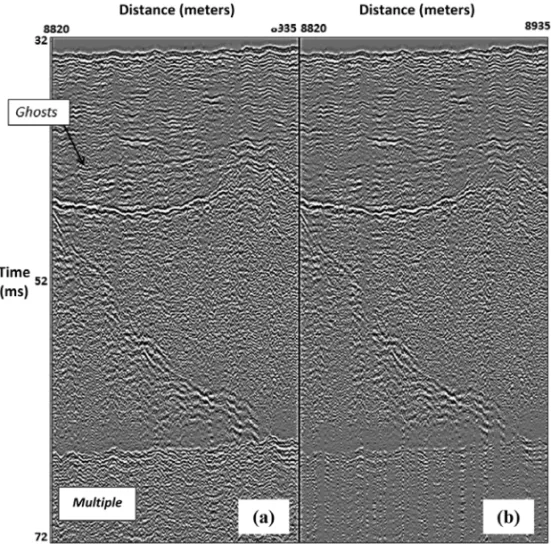
The best results for treating the seismic data were obtained using predictive deconvolution, attenuating the multiples and overlapping reverberations that mitigated the subsurface reflec-tions (Fig. 13). Basically, the predictive deconvolution algorithm attempts to remove the effects of multiples by predicting their arrival times, and based on the arrival times of primary events, that is, related reflectors, assuming that there is no systematic pattern for the distribution of reflection interfaces and that the waveform of a minimum phase impulsive source has energy concentrated on the pulse front (Robinson & Treitel, 2000). The application of predictive deconvolution aimed at removing back-ground multiples and improving data vertical resolution.
Figure 12 – Application of the moving average filter. The comparison between frames (I) and (II) shows
improve-ment in the lateral continuity of the horizons with respect to raw data.
Figure 14 – Raw profile (a) and after the processing steps(b).
There are still several gaps on the removal process of multi-ples in shallow seismic data. In most cases deconvolution can-not attenuate the multiples, particularly those related to the pres-ence of shallow gas which has quite high amplitudes, as observed in the studied profile (Fig. 14). In these cases, the use of more than one window, a deconvolution operator or the application of SRME are suggested.
2ndData filtering
Subsequent to the deconvolution step, the data were filtered again to eliminate artifacts generated in the seismic wavelet compression. The filter parameters of the first cleaning step re-mained the same, supported by the fact that applying the decon-volution algorithm generates coherent high frequency noise, re-quiring a further low-pass filter.
Interpretation of seismic profiles
Figures 15 and 16 correspond respectively to cropped sections of profiles 5 and 9 before and after the processing steps. The sedi-mentary deposits of Guanabara Bay, observed in high-resolution seismic, reveals a series of erosion and sediment filled events, with numerous paleovalleys and buried paleochannels, featuring at least three major distinct filling phases on the acoustic
base-ment: eroded fluvial paleochannels and paleovalleys (I), drown-ing deposits showdrown-ing cross bedddrown-ing and propagation toward the mainland (II) and current sedimentation featuring finer particles toward the inner portion of the bay (III).
The lower portion (I) appears to be associated with deposi-tion environments and fluvial dynamics due to its seismic unit acoustic features and very irregular geometry. The first layer above the acoustic basement display a highly irregular contour featuring numerous inner erosion surfaces, showing various filled pale-ochannels, with clear evidence of deposits associated with chan-nel lateral progradation and total thickness of about 15 to 20 m, tapering as it enters the bay.
The intermediate unit (II) has thickness varying from 5 to 10 m, displays softer reflectors compared to the lower portion in-dicating parallel-plane sedimentation, slightly crossed from the edge of the bay, with at least one internal discordant surface and small filled channels. Thus, it is believed that this portion repre-sents the current and sub-current estuarine deposits of the bay.
The upper portion (III) represents the current deposition of the bay, strongly influenced by the decreasing energy of the innermost portions. In the north bay, shallow gas pockets occur more often, also evidenced by columns of multiples, and there is also in some places, exhaust gas into the water column.
Figure 15 – Comparison between raw and processed data, profile 5.
Figure 16 – Comparison between raw and processed data, profile 9.
CONCLUSIONS
The application of different geophysical techniques has shown to be a highly feasible solution to study coastal environments, such as assessing the impact of human activities on them. The main objective of this work was to process the high-resolution seis-mic data, targeting the Quaternary sedimentary deposits of Gua-nabara Bay. In summary, the main results of this study are:
• The simple processing flowchart used to search for well-marked reflectors modified only slightly the raw data. The available literature proved quite limited regarding the pro-cessing of high-resolution seismic, addressing especially surveys in regions of relatively simple geology;
• Too restrictive gain windows tend to cause significant degradation of the signal while enhancing low amplitude areas, thus making stronger and weaker reflections indis-tinguishable from one another;
• After testing different filtering techniques aiming to in-crease the signal/noise ratio, significant improvements were observed in reflector imaging;
• Using a five-trace window average filter was shown to be very efficient to improve lateral continuity of reflectors, ex-cept in regions where the reflectors are very inclined, since this filter was not very effective in these regions;
• One of the problems that degraded the most the quality of the records was the constant presence of reverberations and ghosts. The application of predictive deconvolution showed good results in mitigating them, without this fil-ter, trace interpretation would be severely compromised; • The sedimentary deposits of Guanabara Bay revealed three
distinct deposition phases over the crystalline basement, interpreted in the seismic record as: fluvial (I) – marked by a very irregular surface related to lateral migration of the channels; sub-current estuarine (II) – softening the ir-regular morphology, related to the drowning of the fluvial paleosystem; and current estuarine (III) – plain-parallel re-flectors associated with the decrease of relative sea level; • The implementation of a processing flowchart to treat
high-resolution seismic data proved quite promising since it enhanced features not observed before in the interpreta-tion of seismic records.
ACKNOWLEDGEMENTS
The authors are very thankful to PETROBRAS/Agˆencia Nacional do Petr´oleo (ANP) for the financial support given to the Depart-ment of Geology and Geophysics at Universidade Federal Flumi-nense and for the availability of the facilities and equipment used in this work.
REFERENCES
AMADOR ES. 1980. Unidades sedimentares cenoz´oicas do recˆoncavo da baia de Guanabara (folhas Petr´opolis e Itabora´ı). Proceedings... Academia Brasileira de Ciˆencias, 52(4): 743–761.
AMADOR ES. 1997. Ba´ıa de Guanabara e ecossistemas perif´ericos: homem e natureza. UFRJ. Rio de Janeiro. 539 pp.
BAPTISTA NETO JA, SILVA MAM & FIGUEIREDO Jr. AG. 1996. S´ısmica de alta frequˆencia e o padr˜ao de distribuic¸˜ao de sedimentos na enseada de Jurujuba (Ba´ıa de Guanabara) – RJ/Brasil – Revista Brasileira de Geof´ısica, 14(1): 51–57.
BAPTISTA NETO JA, BREHME I, GINGELE FX & LEIPE T. 2006. Spa-tial distribution of heavy metals in superficial sediments from Guanabara bay: Rio de Janeiro, Brazil. Environmental geology, 49: 1051–1063. BARROS GLM. 2006. Navegando com a eletrˆonica. 2aEd. Petr´opolis, RJ. Catedral das Letras. 392 pp.
BRUNETTA R. 2005. O processamento da s´ısmica de reflex˜ao rasa – Desafios encontrados no estudo de modelos an´alogos a reservat´orios
fraturados. Master Dissertation. Universidade Federal do Paran´a – Curitiba, PR, 94 pp.
CATANZARO LF, BAPTISTA NETO JA, GUIMAR˜AES MSD & SILVA CG. 2004. Distinctive sedimentary processes in Guanabara Bay – SE/Brazil, based on the analysis of echo-character (7.0 kHz). Revista Brasileira de Geof´ısica, 22(1): 69–83.
CHOPRA S & MARFURT KJ. 2007. Seismic attributes for prospect identification and reservoir characterization. SEG Books. 464 pp. DIAS GTM & KEJRFVE B. 2008. Geology and geomorphology of Holocene coastal barriers of Brazil. Louisiana State University. Springer-Verlag Berlin and Heidelberg & Co; 7: 225–252.
GOMES MP, VITAL H & MACEDO JWP. 2010. Fluxo de processamento aplicado a dados de s´ısmica de alta resoluc¸˜ao em ambiente de plata-forma continental. Exemplo: Macau-RN. Revista Brasileira de Geof´ısica, 29(1): 173–186.
HOULDING SW. 1994. 3-D Geoscience Modeling Computer Techniques for Geological Characterization. Springer-Verlag. Berlin. 309 pp. KEAREY P, BROOKS M & HILL I. 2002. An introduction to Geophysical Exploration. Blackwell Scientific. Oxford (UK). 438 pp.
KJERFVE B, RIBEIRO CHA, DIAS GTM, FILIPPO AM & QUARESMA VS. 1997. Oceanographic characteristics of an impacted coastal bay: Ba´ıa de Guanabara, Rio de Janeiro, Brazil. Continental shelf research, 17(13): 1609–1643.
LOWRIE W. 2006. Fundamentals of geophysics. 17aEd. United King-dom. Cambridge University Press. 354 pp.
OPPENHEIM AV, WILLSKY AS & YOUNG IT. 1983. Signals and Systems. Prentice-Hall, Englewood Cliffs, 796 pp.
QUARESMA VS. 1997. Caracterizac¸˜ao da dinˆamica sedimentar da Ba´ıa de Guanabara, RJ. Master Dissertation – LAGEMAR – UFF. Niter´oi. 97 pp. QUARESMA VS, DIAS GTM & BAPTISTA NETO JA. 2000. Caracteriza-c¸˜ao da ocorrˆencia de padr˜oes de sonar de varredura lateral e s´ısmica de alta freq¨uˆencia (3,5 e 7,0 khz) na porc¸˜ao sul da ba´ıa de Guanabara – RJ. Revista Brasileira de Geof´ısica, 18(2): 201–214.
ROBINSON EA & TREITEL S. 1980. Geophysical Signal Analysis. Prentice-Hall, Englewood Cliffs, 466 pp.
ROBINSON EA & TREITEL S. 2000. Geophysical Signal Analysis. Society of Exploration Geophysicists, Tulsa,USA. 516 pp.
RUELLAN F. 1944. Evoluc¸˜ao geomorfol´ogica da Ba´ıa de Guanabara e das regi˜oes vizinhas. Revista Brasileira de Geografia, 6(4): 445–508. YILMAZ O. 1987. Seismic Data Processing. SEG Books. 534 pp. Recebido em 07 fevereiro, 2013 / Aceito em 06 dezembro, 2013
NOTES ABOUT THE AUTHORS
Igor Kestemberg Marino received his B.Sc. in Geophysics at Universidade Federal Fluminense in 2013. He currently works at PGS – Rio Office, with the Imaging
and Engineering team, as a Junior Geophysicist on marine seismic processing projects.
Marco Antonio Cetale Santos received his B.Sc. in Electronics Engineer at Universidade Estadual do Rio de Janeiro in 1996, his M.Sc. and D.Sc in Electric
Engineer at Pontificia Universidade Cat´olica of Rio de Janeiro in 1998 and 2003, respectively. Professor of the Department of Geology and Geophysic of Universidade Federal Fluminense since 2009. Presently is the head of department since 2012. His interest are in Seismic Processing and Imaging; Seismic Inversion; Anisotropy, Elastic and Acoustic Modeling; Signal processing and Data Compression.
Cleverson Guizan Silva B.Sc. and M.Sc. in Geology at Universidade Federal do Rio de Janeiro (UFRJ) in 1982 and 1987. Ph.D. in Geology at Duke University