FUNDAÇÃO GETULIO VARGAS
ESCOLA BRASILEIRA DE ADMINISTRAÇÃO PÚBLICA E DE EMPRESAS MESTRADO EXECUTIVO EM GESTÃO EMPRESARIAL
How Can Companies Capture Value From An
Innovation? From Value Creation To Value Capture
Case Study: Uber
Frederik Seifert
Rio de Janeiro - 2016DISSERTAÇÃO APRESENTADA À ESCOLA BRASILEIRA DE ADMINISTRAÇÃO
PÚBLICA E DE EMPRESAS PARA OBTENÇÃO DO GRAU DE MESTRE
Ficha catalográfica elaborada pela Biblioteca Mario Henrique Simonsen/FGV
Seifert, Frederik
How can companies capture value from an innovation?: from value creation to value capture: case study: Uber / Frederik Seifert. - 2016.
62 f.
Dissertação (mestrado) - Escola Brasileira de Administração Pública e de Empresas, Centro de Formação Acadêmica e Pesquisa.
Orientador: Flávio Carvalho de Vasconcelos. Inclui bibliografia.
1. Valor adicionado. 2. Vantagem competitiva. 3. Inovações tecnológicas. 4. Planejamento estratégico. I. Vasconcelos, Flávio Carvalho de. II. Escola Brasileira de Administração Pública e de Empresas. Centro de Formação Acadêmica e Pesquisa. III. Título.
Abstract
This thesis examines the value creation process and how companies can capture value that they created. It particularly analyses the opportunities a company has to capture value from an innovation. The ability to monetise innovations is crucial for companies and determines whether they can establish a sustainable business. This thesis first discusses previous research and connects theories to broaden and enhance their applicability. The main part is a case study on Uber, a ride-hailing company. In the case study, the company is thoroughly examined and theories which were discussed before are applied in order to expose how Uber creates and captures value. This thesis further highlights the importance of network effects in a competitive environment within the sharing economy. Although value creation and value capturing has extensively been discussed in prior research, this thesis contributes by applying traditional and recent theories to a rising startup that has received unprecedented funding from its investors. Understanding how Uber pursues its way to the top and how it captures value provides vital implications for other similar startups and helps them in their efforts to succeed. This thesis finds that Uber needs to focus on three aspects. Firstly, it needs to diversify its portfolio and offer more services. Secondly, it needs to develop a system that prevents drivers from using competing apps, which would realise network effects that lower prices and enable faster pickups. Thirdly, it needs to further innovate, especially in the field of autonomous driving.
Resumo
A presente pesquisa de mestrado analisa o processo de criação de valor pelas empresas e como elas capturam o valor que criam. Mais especificamente, investiga as oportunidades que uma empresa tem de capturar valor por meio de uma inovação. A habilidade de monetizar inovações é crucial para as empresas e determina se elas podem estabelecer negócios duradouros. Primeiramente, são apresentadas pesquisas anteriores e, em seguida, o autor as conecta para expandir e melhorar sua aplicabilidade. A parte principal é o estudo de caso sobre a Uber, uma empresa de tecnologia que oferece carona remunerada. Nele, a empresa é profundamente analisada e as teorias discutidas anteriormente, aplicadas para explicar como a Uber cria e captura valor. Esta tese reforça ainda a importância do efeito de rede no competitivo ambiente da economia compartilhada. Apesar de outras pesquisas já terem discutido extensamente geração e captura de valor, este trabalho contribui para aplicar teorias tradicionais e recentes a uma startup em ascensão, que recebeu aportes sem precedentes de seus investidores. Compreender como a Uber busca estar no topo e como ela captura valor tem impacto vital para ajudar outras startups similares a alcançarem o sucesso. O resultado desta pesquisa mostra que a Uber precisa focar em três aspectos. Em primeiro lugar, deve diversificar seu portfólio, oferecendo mais serviços. Em segundo, precisa desenvolver um sistema para evitar que os motoristas usem aplicativos concorrentes, de modo a alcançar o efeito de rede, que reduz os preços e possibilita buscar os passageiros mais rapidamente. Em terceiro lugar, verificou-se que a empresa necessita inovar, especialmente na área de carros autônomos.
List of Abbreviations
Abbreviations
Meaning
BBC British Broadcasting Corporation
CEO chief executive officer
e.g. exempli gratia (for example)
et al. et alii (and others)
GPS Global Positioning System
i.e. id est (that is)
OSHA Occupational Safety and Health Administration
Q (financial) quarter
R&D research and development
UK United Kingdom
US United States
List of Figures
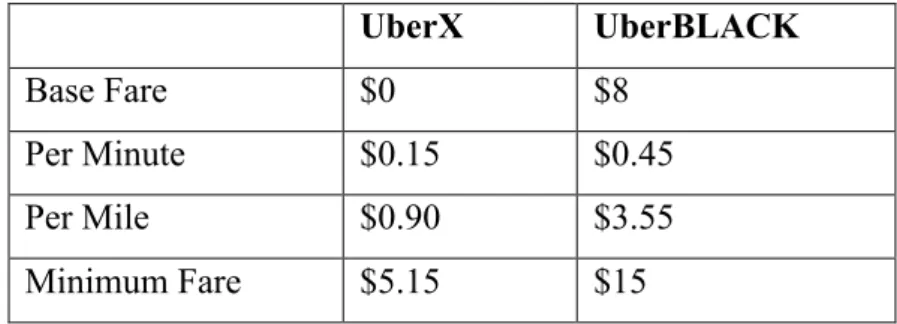
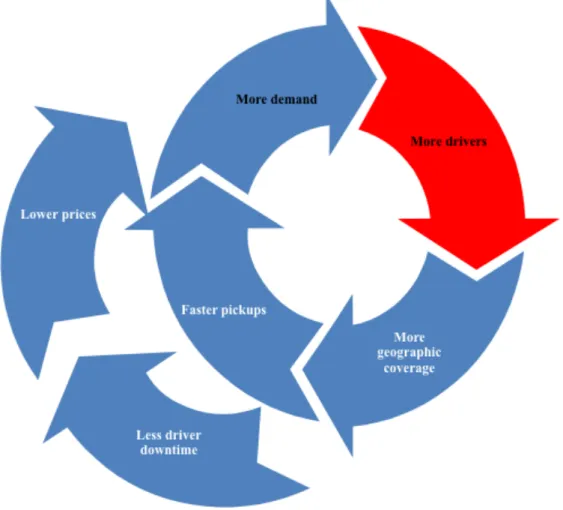
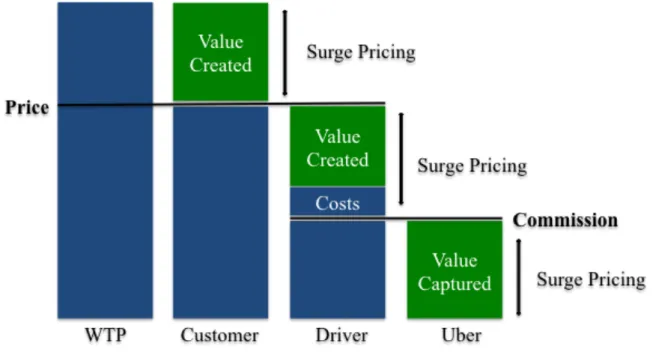
Figure 1: Price difference between UberX and UberBLACK ... 36 Figure 2: Realising network effects ... 39 Figure 3: Uber’s value creation and value capture model ... 42
List of Appendices
Appendix 1: Value Creation and Value Capture Process ... 55
Appendix 2: Methods of Capturing Value ... 56
Appendix 3: VC2 Framework ... 57
Appendix 4: PayPal’s Approach Towards Value Creation and Value Capturing ... 58
Appendix 5: Expenses ... 59
Appendix 6: P&L ... 60
Appendix 7: Balance Sheet ... 61
Table of Contents
1. Introduction ... 9 1.1 Contextualization and Relevance of the Problem ... 9 1.2 Justification of the Theme Selection ... 10 1.3 Structuring of the Paper ... 11 2. Literature Review ... 12 2.1 Sharing Economy ... 12 2.2 Monopolies in Modern Businesses ... 13 2.3 Value Creation ... 14 2.4 Value Capturing ... 16 2.5 The VC2 Framework ... 21 3. Methodology ... 22 3.1 Case Study Method ... 23 3.2 Data Collection ... 24 3.3 Sources ... 244. Case Study — Uber ... 25
4.1 The Company ... 25 4.2 Products/Services ... 25 4.3 History ... 26 4.4 Regulatory Problems and Legal Constraints ... 27 4.5 Financial Figures ... 28 4.6 Competitors ... 29 4.7 How does Uber Create Value? ... 31 4.8 Value Capture ... 34
4.8.1 How does Uber currently Capture Value? ... 35
4.8.2 How will Uber Capture Value in the Future? ... 38
4.9 Uber’s Positioning in the VC2 Framework ... 41
5. Discussion and Conclusion ... 42
5.1 Uber — Value Capturing in a Competitive Landscape ... 42
5.2 Contribution to Academia and Startups ... 44
6. Bibliography ... 46
1. Introduction
1.1 Contextualization and Relevance of the Problem
In the contemporary world companies are more and more facing the challenge of shortened life cycles, imitation from cheap-labour countries, disruptive innovation and well-informed consumers. That said, capturing value from innovation is more difficult than it has been ever before. However, it has never been easier to build businesses and to create value for customers. Innovation and inventions today are all made in a technological context. Through technology, inventors are able to innovate with a low budget. Finding easier solutions with technology can disrupt long-established industries and force them to innovate or make them redundant. Yet, a business that only focuses on the creation of value and neglects the capturing of value will not be sustainable.
From the mid 1990’s until the early 2000’s, the so-called dot-com bubble showed exemplarily what happens when companies only focus on the value creation component and neglect the value capture one (Verdin and Tackx, 2015). These days, promising startups launched businesses, which certainly created value for its customers but could not monetise any of this value for themselves and eventually went bust. The newspaper industry still suffers from its “free of charge” culture because its actors did not foresee the trend from print towards online news. Today they are desperately trying to find ways to make consumers pay for online content (The Economist, 2009). Facebook, with more than 1.7 billion active monthly users, also creates value. Yet, shortly after its IPO, investors were in doubt about how and if Facebook was able to capture some of this created value (Michel, 2014; Statista, 2016). Finally, Amazon concludes this catalogue. Whereas it has undoubtedly been a value creator for its customers, it took eight years until Amazon generated its first profits and was able to capture value from its innovative solutions (Hawawini, Subramanian and Verdin, 2004). The above list shows that both established companies and innovative startups are likewise concerned with the concepts of value creation and value capturing. While startups often have to find ways to capture value, established companies may need to innovate their services or products to create more value for their customers, or need to innovate in the way they capture value.
This thesis aims to examine how companies can capture value from an innovation. However, as stated above, the process of capturing value cannot be analysed on its own. It always needs to be connected to the process of value creation. The goal of this paper is to connect existing approaches on how companies can capture value and apply them to the company Uber. It will be analysed how Uber creates value, if and how Uber differs from its competitors and how it currently captures value. Furthermore, this thesis will propose how Uber can capture value in the future. This comprehensive analysis aims to make Uber and its business model more transparent and indicates important lessons for future unicorns. Particularly, in the context of Silicon Valley’s mentality, that only one company can win, Uber stands out as an exciting company, which is still fighting its way to the top.
1.2 Justification of the Theme Selection
Despite Uber often being a topic of conversation amongst the media and the market, to the author’s best knowledge, the value creation and value capturing processes have not been subject to an exclusive case study. Besides, the selection of Uber, to identify how companies can capture value from innovation, has multiple other reasons.
Highly valued startups are generally a popular theme for theses or dissertations. Companies that are so popular that their names become verbs are even more worth investigating. “To uber” alongside with “to skype” and “to google” are some of the rare examples. In 2016, Uber is the world’s most valuable startup in history, having a valuation of $68 billion (Sorkin, 2016). Since its inception in 2009, Uber has disrupted the taxi industry, changed urban transportation and invested heavily in self-driving cars. The company has further expanded into the delivery industry and tries to get a foot in the door of public transport. Thus, rather than only focusing on the traditional taxi industry, Uber aims to become the leading company in global personal mobility. Uber currently operates in more than 527 cities in 77 countries and has around 40 million monthly passengers worldwide (Kokalitcheva, 2016).
Furthermore, the case study on Uber was chosen because the company’s strategies can be a trend setter for startups in the sharing economy or expose flaws, which should be avoided by other entrepreneurs. Many investors and entrepreneurs see Uber in a list with Facebook, Amazon and Google; companies which managed to become market leaders and which are
today almost monopolists in their core businesses. Although Uber carries an enormous valuation and managed to attract around $18 billion from investors, it still did not generate profits. It is also far from being without competitors. In fact, it faces competition on literally all levels of its operations. In the ride-hailing industry, traditional taxis and other tech companies such as Lyft compete against Uber. In the delivery industry, the company faces competition from established incumbents with great expertise. Finally, Uber’s efforts in developing self-driving cars are challenged by the automotive industry and giants such as Google and Apple. Investors, nevertheless, trust Uber and pour money into it, believing that it ultimately finds it way to generate profits.
1.3 Structuring of the Paper
After the introduction, this thesis continues with an overview of the most important theories and models on value creation and value capturing. The section starts with defining the terms sharing economy and monopoly. Both terms are relevant for the understanding of the company Uber and its business model. The segment on monopolies also illustrates the Silicon Valley phenomenon “the winner takes it all” and gives some recent examples of tech companies that have found their way to the top. The main section of the literature review begins by defining the term value in the context of this thesis. It continues with developing a common understanding of value creation and distinguishes different actors for whom value can be created. The part pursues with defining value capture and outlines different methods on how companies can monetise the value they created. In this context, traditional as well as recent models are introduced. The literature review concludes with introducing the VC2 framework which combines value creation and value capturing. This model acts as a positioner and aims to help companies to analyse their status quo (low or high value creation/value capture). It further gives some real life examples and exposes how companies have tried to improve their state.
The main segment is a comprehensive case study on the company Uber. It includes an introduction of Uber’s services and sweeps the history of ride hailing. It subsequently discusses the regulatory and legal constraints of the business model. Uber’s financial constitution is examined on the basis of leaked financial data in combination with official statements that were made by the company. Furthermore, the competitive environment is examined, focusing on other ride-hailing startups. The main part of the case study includes
both the process of how Uber creates and captures value. The part on how Uber captures value is divided in current strategies and possible future approaches. The case study concludes with positioning Uber in the VC2 framework and linking the value creation and capturing part. The thesis concludes with a final overview of Uber’s business model and how customers, drivers and the company itself creates and captures value. The final section also discusses how the case study on Uber contributes to further research as well as other startups in the sharing economy.
2. Literature Review
The theoretical and literature section begins with an overview of the most important terms and defines them in the context of this paper. Whereas some terms may be perfectly familiar to the reader, others are used ambiguously and in fact opposing in academia. That is why a common understanding of these terms is necessary. Beside these clarifications, the section introduces selected frameworks and significant studies, which aim to point out substantive findings in the field of value creation and value capture.
2.1 Sharing Economy
The term sharing economy is frequently used in the context of this thesis, wherefore it is important to establish a common understanding of it. The Economist (2013) defines sharing economy as “the phenomenon in which people rent beds, cars, boats and other assets directly from each other, co-ordinated via the internet”. Whereas all these things were possible before the era of the internet, technology, namely smartphones and big data have facilitated the process of matching owners and renters. In fact, today’s technology enables scaling these activities and hence reduces transaction costs. Companies which operate in the sharing economy also benefit from the trend of people being more willing than ever to dismiss the idea of ownership and preferring “pay-per-use” and/or consider renting (Belk, 2014).
2.2 Monopolies in Modern Businesses
It is not at all obvious to include a subsection on monopolies into a thesis on a tech company that was founded in 2009. Rather, as today’s view on business is characterised by its belief in competition, the reader could have expected a subsection on this matter. Each single business, however, can only survive when it is able to generate sound profits and outperforms and differentiates itself from its competitors. Every business and economics student studies in microeconomics that perfect competition has unrealistic assumptions and prevents companies from generating above-normal profits (Herriges, 2010). In fact, with perfect competition, companies operate at zero economic surpluses (Herriges, 2010). Thiel and Masters (2014) point out how much it matters whether a company operates in a highly competitive environment or whether a company acts (almost) as a monopolist. According to Thiel and Masters (2014), United States (US) airlines—which operate in an extremely competitive environment—generated, on average, 37 cents per passenger trip. In the same year, Google’s margin was 100 times higher. Whereas Google would never consider itself as a monopolist, it is, nonetheless clear that it operates in a number of ways as one (Thiel and Masters, 2014). Hence, there are in fact strong reasons why companies want to operate in less competitive markets. Another reason which makes this subsection highly relevant, is the mentality of tech companies from Silicon Valley: the winner takes it all. This phenomenon can be explained twofold: in the Economist’s (2016b) special report “In the shadow of giants”, the author argues that tech companies have shifted the focus from the supply side, which traditionally focuses on production efficiencies, towards the demand side, which in this case focuses on networks effects. This trend can be seen in companies such as Facebook, Amazon or Airbnb. Companies can achieve a monopoly position when a network is necessary to use the product or service purposefully. In addition, switching costs should be high in order to avoid other products or services substituting the company’s own product or service. A second reason concerns funding. Young companies are highly dependent on venture capital. Venture capitalists, however, are also aware of the trends explained above. Hence, they, too, minimise their risk and tend to invest in “the winner”.
A Monopoly exists when there is only one single supplier for a service or product (Kreps, 1990). It is the exact opposite of perfect competition. As for any other company (except non-profits), monopolists aim to generate the highest possible earnings. Monopolists, however, face also constraints. On the one hand, the monopoly may face production constraints caused
by limitations in technology or by high prices for its inputs (Herriges, 2010). On the other hand, the monopoly always faces demand constraints. Although the monopoly can set the price for a product or service itself, the range is predetermined by the demand curve (Herriges, 2010). According to Kreps (1990), traditionally, there are three reasons for monopolies: (i) there may be legal barriers that hinder competitors from entry, (ii) the monopolist might hold a patent or other forms of intellectual property that is not accessible for competitors, and (iii) it may be illegal for competitors to enter (e.g., government monopoly). Firms, however, can also become a monopolist on their own and it brings many advantages for them. As the monopolist is the only product producer or service provider, it sees the linkage between price and quantity demand (Herriges, 2010). This enables the firm to choose the price-quantity combination which maximises the producer surplus the most. Whereas monopolist can charge every customer the same, it is also possible to price discriminate and charge customers different prices. According to Herriges (2010), monopolies do not discriminate customers based on prejudice, stereotypes or other immoral traits. Monopolies discriminate customers based on their willingness to pay for a product or service (Herriges, 2010).
If a company today aims to become a monopolist, there are some crucial things they need to pay attention to. Thiel and Masters (2014), for instance, suggest that companies should start in small markets because it is easier to dominate them. According to Thiel and Masters (2014), the ideal target market to become a monopolist is a small group of particular people concentrated together and served by few or no competitors. In Roger’s (1962) classical model of Diffusion of Innovations, they would be called ‘innovators’. From this point, companies are able to gain a large market share very fast. Facebook, for instance, started in a market of 12,000 people at Harvard University, and went from zero to 60% market share in 10 days (Thiel and Masters, 2014).
2.3 Value Creation
Value creation is one of the most important terms and concepts in strategic management. Searching the term on Google Scholar sums up to approximately 3.28 million results.
In most papers or studies, however, the term “value creation” is used without any further explanation. Value creation in e-business does not necessarily have the same meaning as in finance or strategy. In the context of this thesis, value creation is comprehensively examined with respect to the company Uber.
Bowman and Ambrosini (2000) differentiate between two forms of value: use value and exchange value. According to Bowman and Ambrosini (2000), “use value refers to the specific quality of a new job, task, product, or service as perceived by users in relation to their needs, such as the speed or quality of performance features of a new product or service.” Use value, therefore, is subjective and is assessed during the decision making process at the point of purchase (of either the product or service) and is perceived by the customer. Exchange value, according to Bowman and Ambrosini (2000) refers to the price. It is the financial amount exchanged between companies and their customers or suppliers when use values are traded (Bowman and Ambrosini, 2003). Exchange value refers to the process of capturing value and is therefore explained in more detail in the subsection of value capture. Bowman and Ambrosini (2003) point out that value has a different meaning for different stakeholders. They are: the company itself, customers, employees, suppliers, investors and society. For customers, according to Bowman and Ambrosini (2003), value represents the traditional microeconomic view of the consumer surplus, i.e., the difference between the maximum price a consumer is willing to pay and the actual price they do pay. Put simply, the customer aims to maximise the ‘value for money’. According to Lepak, Smith and Taylor (2007), the value for customers is created through inventions, innovations, research and development (R&D), knowledge transformation, structures and social conditions, incentives, selection and training (see appendix 1). Bowman and Ambrosini (2003) define value, per se, as measured in monetary terms. Lepak, Smith and Taylor (2007) emphasise the role of added service and utility in the creation of value. Whereas customers seek to optimise use value, suppliers focus on optimising the exchange value (Bowman and Ambrosini, 2003). Bowman and Ambrosini (2003) define that the use value, which is supplied by supplier of inert inputs, is fixed. The use value of the product is close to zero for suppliers. Screw suppliers, for instance, do not have any “personal” value in form of use value when producing screws. Optimising exchange value means capture as much value as possible. This can be achieved when the price for use value is optimised (this may be possible, for instance, when consumers perceive a higher value for a product or service).
Bowman and Ambrosini (2003) argue that employees can be seen as suppliers of human input. They supply use value—which is, as stated before, fixed—in the form of their capacity to work. Similar to ordinary suppliers, employees also aim to optimise their exchange value. According to Lepak Smith and Taylor (2007), the value for employees is created through knowledge creation, search, ability, motivation and training. Again, Bowman and Ambrosini (2003) focus on the monetary aspects, whereas Lepak, Smith and Taylor (2007) point out
softer aspects, which improve the relationship between the firms and their employees and make the jobs more fulfilling. Investors are also concerned with value. According to Bowman and Ambrosini (2003), investors aim to optimise the exchange value returned for the exchange value invested. Put simply, investors want to receive more money back than they invested in the company. Yet, they neither provide nor receive any use value (Bowman and Ambrosini, 2003). Nevertheless, investors may also be concerned about the use value. Companies will only be successful if customers and employees are satisfied— that is, optimising their use value and exchange value. Lastly, value can be created for the society generally. According to Lee, Peng and Barney (2007), innovation and new business formations, competition, capital investment and laws and regulations can create value for society. New and successful companies, for instance, create value in providing more jobs, tax revenues and through innovative and improved products or services higher living standards (Lee, Peng and Barney, 2007).
2.4 Value Capturing
According to Bowman and Ambrosini (2000), value capture is the realisation of exchange value. It is influenced by the bargaining power of sellers and buyers. While value creation says nothing about profits, value capture is the part where the firm needs to monetise the use value it created before. There are, in fact, different views on how and why companies are able to capture value. Conner (1991) argues that there are two ways companies can capture value: First, the product needs to be distinctive and must be attractive in both the way one can use the product and the price vis-à-vis substitutes. Second, if there is already an identical product in the market, the firm needs to offer the product at lower costs. Porter (1991) stresses the importance of resources that are unique to the company. He argues that these resources enable a firm to capture value. This concept emphasises the firms focus on its value chain and to perform a value chain analysis to define how to configure their primary and support activities and hence maximise and sustain their competitive advantages (Porter, 1985). While these views vary in their details, they have all in common the idea that companies need to have a differentiating factor, a competitive advantage, a Unique Selling Proposition (USP). Although the competitive advantage is pivotal, it is not sufficient to create value or have a unique service for the customers. In fact, companies need to innovate also in the way they capture value. Michel (2014) proposes different ways of how companies can innovate in the process of capturing value. He argues that companies have pivotal points that make it possible to
change the way value is captured. One aspect, according to Michel (2014), is changing the price mechanism. He proposes (i) value-based pricing, (ii) auctioning, (iii) demand-driven pricing, (iv) make your own price and (v) pay what you want. In the context of this thesis, value-based pricing and demand-driven pricing are interesting and relevant ways of capturing value. Firms which use value-based pricing do not set the price by calculating production costs or benchmarking with their competitor. They rather set prices due to the perceived use value of the customer and hence their willingness to pay the price. Haller and Gersappe (2014) argue that value-based pricing has a promising future. According to the authors, big data helps firms to deeply understand their customers, they only need to use the data appropriately. One way to leverage big data is during the segmentation process. Whereas companies traditionally segmented customers, for instance, on the basis of demography, psychology and geography, big data is able to detect transactional and behavioural information to define more sophisticated customer groups. These profound insights about their customers enable firms to learn which variables are perceived most important, improve them and ultimately price the product accordingly. Haller and Gersappe (2014) find that, if these procedures are executed properly, companies can expect to generate between 1% and 3% of revenues as incremental margin in using value-based pricing.
Demand-driven pricing, also called demand-based pricing, is another pricing strategy which takes more factors into account than only costs and competitors. As the name implies, demand-driven pricing takes volatility in demand into account and changes the price of a product or service with respect to these fluctuations. Companies can use real time data to change prices instantly or they can use forecast models, which rely on past experiences and data (Michel, 2014). A special form of demand-based pricing is price skimming (Dean, 1969). Price skimming can be of particular interest for companies that introduce new products and aim for high pricing and high profits in the early stages of marketing. In practice marketers set the price high when introducing the product and then subsequently lower the price until they reach the market price. This strategy is sometimes called riding the demand curve and aims to exploit a monopolistic and superior position in the market—before competitors enter the market and impact pricing. As value-based pricing—if executed properly—demand-driven pricing can maximise profitability, especially in peaks. Another form of demand-based pricing is penetration pricing. It is the opposite of price skimming and intends to penetrate the market with a product as impactful as possible, i.e., gaining a large share of the market in the beginning. Penetration pricing means introducing the product at a low price—often below market prices—until the product is established in the market. While the price is low the
company just stimulates and generates demand for the product. Later on the firm can incrementally increase the price until it reaches the market price (Dean, 1969). According to Dean (1969), there are four reasons that make firm choose this strategy: (i) when sales volume is very sensitive to price, (ii) when firms can exploit economies of scale and scope, (iii) when companies face strong potential competition and (iv) when there are no buyers willing to pay a higher price to obtain the newest product or service.
Michel (2014) also proposes bundling and unbundling within a category called ‘changing the price carrier’. The author refers to the telecommunications industry and its approach to market the services bundled instead of pricing them separately. This form of pricing has two main advantages. First, it enables firms to provide solutions that appeal to different customer segments. Second, it prevents price wars, as it is more difficult to compare the different solutions one-by-one (Michel, 2014). According to Michel (2014), the airline industry represents the approach of unbundling. Initiated by low-cost airlines—by now also the established premium airlines—customers can choose themselves what service they want to use. Hence, today’s low-cost fares often do not include any food or luggage allowance. James, Leiblein and Lu (2013) distinguish four main methods within their framework on value capture (see appendix 2). They distinguish patents, secrecy, lead time and investment in complementary assets. A patent is the right to be the only one who can make, use, or sell an invention for a particular number of years (Cambridge Dictionary, 2016). According to Somaya (2003), patents represent well-known measures to prevent rivals from easily imitating or replicating valuable firm-specific services or products and hence preserve competitive advantages a firm owns. Despite their great potential, it is arguable whether to use patents as a value capture strategy. Somaya (2003) and Lanjouw and Schankerman (2001), stress that using patents can be extremely costly. Both filing the application and enforcing it entails substantial costs and does not guarantee that the innovation will capture any value. Companies which decide to patent should ideally have their own, specialised lawyers in order to be able to detect infringements and fight them effectively. However, even if a patent is granted, in some cases legal reinforcement remains weak and hence the protection may be ineffective (Cohen, Nelson and Walsh, 2000). Whether the protection is weak or strong depends mostly on the country where the patent is registered (James, Leiblein and Lu, 2013). Furthermore, firms need to keep in mind that the industry they are operating in also influences whether patents are an efficient way to protect their competitive advantages and to capture value. Generally speaking, it is worth considering to pursuit patents in industries with high R&D costs. That is, industries such as Medical Instruments, Biotech and Drugs and
Medicines. While a patent ought to protect ones own product or service, it also increases costs for competitors when they try to imitate them. Mansfield, Schwartz and Wagner (1981) find that using patents increased imitations costs for competitors by 30% in the pharmaceutical industry, by 10% in the chemical industry and by 7% in the electronics and machinery industry. Besides pursuing their own practical plans with the patent, firms can also capture value by licencing intellectual property to other firms. In sum, patents can have a tremendous impact on the value capture of companies, as it enables them to act—for a particular time—as a monopolist. Yet, firms need to consider the corresponding costs too. Secrecy, according to James, Leiblein and Lu (2013), is another approach firms can choose to capture value. Often companies consider either using patents or secrecy to monetise their innovations. James, Leiblein and Lu (2013) argue that it requires internal policies and procedures to confine the information flow within as well as outside the organisation. Yet, while these attempts increase competitors’ imitation costs it entails substantial costs for the executing firm, too. Secrecy, in theory, seems to be a great method to capture value. It does not require any legal procedures and thus does not entail costs that are a natural by-product of patenting. Thus, companies could achieve a monopolistic position by exploiting their secretly developed competitive advantages. In practice however, secrecy is rather difficult to establish and to maintain. Mansfield (1985) finds that in spite of all efforts to maintain secrecy about R&D projects, on average, after 12 to 18 months in progress information tends to be leaked. Generally, at this stage projects are only half completed. Nevertheless, companies, particularly in industries that provide weak intellectual property protection, can benefit from the use of secrecy (Cohen et al., 2002; Zhao, 2006). It also matters whether a company innovates in a product or process (James, Leiblein and Lu, 2013). James, Leiblein and Lu (2013) argue that product innovations are not suitable for the approach of secrecy. Naturally, product innovations aim to increase the perceived quality of a product and want customers make to purchase it. However, in this case—where firms disclose their innovation to customers—competitors can likewise perceive the innovative developments and imitate the product. Process innovations, according to James, Leiblein and Lu (2013), are rather suitable in the context of secrecy. These kinds of innovations focus largely on efficiency and the reduction of production costs. Contrary to product innovations, which necessarily must disclose details, process innovations are usually in-house and concern proprietary elements of the value chain, such as manufacturing and assembly. That is why they are less likely to get leaked and hence secrecy can be an effective mechanism to capture value (James, Leiblein and Lu, 2013). Either way, firms need to think through the secrecy approach carefully. The literature provides a number of reasons against
secrecy. Bayus, Jain and Rao (2001), for instance, point out that market leaders can prevent competitors from entering through publicly disclosing new product innovations. Further, companies may want to encourage other firms to develop complementary products or technologies or they want to establish an industry/technological standard (Harhoff, Henkel and von Hippel, 2003; Dranove and Gandal, 2003).
James, Leiblein and Lu (2013) further mention the concept of lead time as a mechanism to capture value. Lieberman and Montgomery (1988), for instance, point out three primary sources for first-mover advantages: that is, the degree of technological leadership, the ability to pre-empt scarce assets and switching costs. Technological leadership may be achieved through learning curve advantages or the successful use of R&D and patenting (Lieberman and Montgomery, 1988). The pre-emption of scarce resources can be achieved through strategic purchases of raw materials, locations in key geographic regions or other input factors before competitors learn about them (Lieberman and Montgomery, 1988). Hence, superior information and advanced expertise are essential for mover adherents. Lastly, first-movers can create their own demand and build their customer base without competition. Later entrants need to convince customers to switch and use their products or services. These enticements can be very costly. Ideally, the first-mover has established a network, which makes it unfavourable and expensive to change the product or service due to high switching costs (Lieberman and Montgomery, 1988). Network effects emerge where current users of a service benefit when additional users adopt it (Klemperer, 2005). One way for firms to innovate faster than their competitors is through absorptive capacity. Cohen and Levinthal (1990) stress the significance of absorptive capacity and define it as the ability to assimilate and exploit external knowledge. Moreover it is the ability to evaluate and utilise this external knowledge and connect it to prior knowledge (Cohen and Levinthal, 1990). As a result, companies can generate first-mover and learning curve advantages. According to Tilton (1971), Allen (1977) and Mowery (1983) as cited by Cohen and Levinthal (1990), firms that conduct R&D themselves are also more capable in utilising external knowledge. Further, according to these findings absorptive capacity is sometimes acquired as a by-product of R&D activities. Cohen and Levinthal (1990) also cited Abernathy (1978) and Rosenberg (1982) who find that direct involvement in manufacturing also improves a company’s ability to recognise and exploit significant information related to the production processes. Besides, firms also acquire absorptive capacity by investing in advanced technical training for their engineers (Cohen and Levinthal, 1990). In sum, it can be stated that lead time (reached through absorptive capacity) can particularly help R&D-focused companies to capture value
when they are first in the market. Lead time, in this sense, can also be connected to patents and secrecy since firms need to be able to manage their intellectual property efficient when they want to be the first mover.
Finally, James, Leiblein and Lu (2013) propose the investment in complementary assets as a mechanism how companies capture value from innovation. Particularly, if companies face technological discontinuity (paradigm shifts such as the shift from products to platforms) and other fundamental changes, owning complementary assets helps them to sustain competitive advantages (Rothaermel & Hill, 2005). These findings, however, do not generally state when firms should invest in complementary assets themselves. James, Leiblein and Lu (2013) suggest investing in complementary assets in two scenarios. First, if the necessary complementary assets are needed to establish the innovation in the market and cannot be accessed in the related markets. Second, if the environment displays weak appropriability, i.e., a weak protection of intellectual property, companies also need to assess whether it is better to invest in complementary assets and develop them internally or whether they should be purchased (Stanko, 2008; James, Leiblein and Lu, 2013). Ultimately, if weak appropriability is given and complementary assets are not accessible in the respective markets, investing in these assets can be a method to capture value.
2.5 The VC
2Framework
This theoretical and literature section concludes with a model that emphasises the importance of both value creation and value capture and combines them into one single competitive advantage. Hawawini, Subramanian and Verdin (2004) delineate their VC2 framework in a two-by-two matrix with value capturing on the horizontal axis and value creation on the vertical axis (see appendix 3). Logically, the authors distinguish between four different scenarios: (i) the dream scenario, where the company does not create value but captures significant value, (ii) the hell scenario, where value is neither created nor captured, (iii) the nightmare scenario, where companies create substantial value but cannot capture it, and (iv) the heaven scenario, where value is both created and captured substantially. While this model, first and foremost, is designed to guide existing firms how to escape the dilemma of the ‘hell’ and ‘nightmare’ scenario, it also provides some insights for startups and companies that aim to penetrate markets with new innovations. Hawawini, Subramanian and Verdin (2004) describe how PayPal, a leading payment service, could have moved away from the ‘hell’ scenario in its early stages. PayPal was launched in 1998 and grew straight into what was later
called the dotcom bubble. The fundamental problem of PayPal-like firms in those days was that they created value for their customers (use value) but were not able to capture anything of it. PayPal, however, is an exemplar of capturing value. They viewed the process of creating and capturing value not unilaterally but combined both dimensions. Whenever PayPal was able to capture value, they used some of it to improve its value proposition, thus increasing the value created for their customers. These incremental improvements (see appendix 4) led to continuous innovations and provided the company with competitive advantage and a dominant position in the market. Nickerson, Silverman and Zenger (2007) also acknowledge the importance of value creation. They stress that the creation process has to come first and that especially innovative companies must focus on delivering value before capturing it. Verdin and Tackx (2015), too, warn firms of focusing solely on the value capturing part; firms may risk ending up in ‘the failure of success’, where they do not create any additional value for their customers and eventually vanish from the market.
This thesis acknowledges that both dimensions—value creation and value capturing—are intrinsically tied to one another, yet reserves the right to both connect and disconnect them when necessary. The following case study examines Uber with great comprehension and examines how it creates and captures value. It applies the above theories where it is possible and compiles its own ideas and solutions where unique ways have been identified.
3. Methodology
This thesis applies the case study method to examine how companies capture value from innovation. Deriving from the literature, which has been outlined previously, the case study analyses and examines a real company and will connect theoretical frameworks of value capture with practical, real-life approaches.
3.1 Case Study Method
Zainal (2007) defines a case study as a study which analyses approaches and behaviours in “a small geographical area or [with] a very limited number of individuals.” Thus, the case study approach enables researchers to dedicate their efforts towards one specifically defined field. This in-depth examination allows the author to develop answers to concrete and unique cases. The literature distinguishes between different forms of case studies. According to Zainal (2007), researchers ought to choose between a single-case design, in which only one event is examined, and a multiple-case design. This thesis uses a single-case design.
Furthermore, researchers are required to decide on the category of the case study. Yin (1984) differentiates three different kinds of categories: (i) exploratory, (ii) descriptive and (iii) explanatory. While the overall thesis topic would require an exploratory case study, the actual case study on Uber is descriptive.
The specific research questions in this thesis are: How does Uber create value?
How does Uber currently capture value? - innovative or traditional?
- imitable?
How will Uber capture value in the future? What are the core implications for academia?
Are there implications for other sharing economy startups?
There are both advantages and disadvantages in using the case study method.
Researchers benefit from analysing data in its actual context (Yin, 1984). In management studies, for instance, it is often important to focus on specific companies or industries to determine disruptive trends or strategies. In particular, market leaders are frequently examined because management scientists or competitors want to understand how they become first.
Uber, as the market leader in the tech-based on-demand taxi service, naturally represents such a company.
According to Zainal (2007), case studies also help to gain a more precise picture of real-life events because they try to elucidate complex situations that are not covered by experimental or survey research. In the context of strategic management, case studies not only point out
which strategies were used, but also why and how, which adds value for other decision makers.
Case studies, however, have some disadvantages too. Yin (1984) points out three: (i) lack of rigour, (ii) little basis for generalisation and (iii) often labelled as too long and difficult to conduct.
The second disadvantage (little basis of generalisation), at the same time, addresses the limitations of this thesis. As Uber has launched a new and innovative service, it will not be possible to derive all approaches to other companies. Especially the fact that Uber has almost no physical assets will make it impossible to apply its strategies to more traditional companies. Furthermore, different industries require different strategies to be successful. Different business models as well as different strategic approaches are needed throughout different companies and industries. Finally, some companies decide to only operate on the domestic market whilst others penetrate many markets (internationalisation).
Nevertheless, companies, especially tech-ones from Silicon Valley, tend to have in common that in one business only the winner survives. Thus, Uber’s strategies can be highly relevant to other innovative startups.
3.2 Data Collection
In order to gain a comprehensive picture of the company, various secondary sources are used. They were obtained through several sources such as academic papers and newspaper articles. Furthermore, company publications and the company website were used. The author of this thesis is aware that this data/information of the company can be equivocal or biased. Yet, the conduction of a company case study would be impossible without these sources. The case study, therefore, is designed to be very precise and rigour and aims to expose supposedly biased statements.
3.3 Sources
In order to make the following case study more reader-friendly the source is not stated after every fact. The information on Uber is—if not stated otherwise—from http://uber.com and http://newsroom.uber.com. Uber operates both websites. Thus, if information was likely to be coloured, additional sources were tried to found.
4. Case Study — Uber
4.1 The Company
Uber Technology Inc. (Uber) is an American-based transportation network company. The company is headquartered in San Francisco, California, USA, and was founded by Travis Kalanick, Alexander Hank and Garrett Camp in 2009, as UberCab.
Uber’s core product is its mobile application (app), which is available for Apple iOs, Google’s Android, and Microsoft’s operating system. The app provides a platform where passengers and drivers come together. Its key purpose is to match these two groups. That is, passengers who request a ride on their devices are matched with nearby drivers. As the app uses the user’s GPS coordinates, he or she is not required to know the pick-up location. In case the driver cannot locate the passenger, both sides are able to contact the other party— though the driver is never given the telephone number of the passenger directly. Once the driver has accepted a ride, the passenger can track live where the driver is and how long it takes until he or she will arrive. The payment is processed through the app as well. Passengers have to type in their credit card details upon registration. Thus, there is no need to pay cash at the end of the ride. After the ride, both sides (drivers and passengers) can provide feedback and evaluate each other privately on a scale from one to five.
On its fifth anniversary, Travis Kalanick, Uber’s chief executive officer (CEO), proclaimed Uber’s vision to be to aim for a smarter transportation with fewer cars and greater access; having cities with more space for housing, parks and schools rather than car parks (Kosoff, 2015).
4.2 Products/Services
Uber offers currently 13 variations of its ride hailing service. The most frequently used service is UberX. Launched in 2012, UberX offers a peer-to-peer service that matches private drivers with passengers using the Uber app. The service is designed for one to four passengers and is advertised as a cheaper alternative to normal taxis. UberPOOL is a more recent product. It aims to pick up multiple riders that head in the same direction. Passengers who request a ride on UberPOOL are entitled to bring one additional person. This service decreases fares vis-à-vis standard UberX-rates approximately by half. UberBLACK was the company’s first service. It provides a professional driver in an upper class, black automobile
such as BMW 5 or 7-Series. This service, however, is also more expensive than rides with UberX. Uber offers more services, which simply differ in either the status and quality of the car or in how many people can be carried. These services are UberXL, UberXXL, UberSUV, UberLUX and UberBIKE.
UberWAV and UberASSIST are services especially tailored towards the needs of disabled people. UberWAV, for instance, provides the transportation of wheelchairs.
Particularly in countries where, due to regulations, UberX is not permitted, Uber now offers the service UberTAXI. This service matches passengers with ordinary taxis, which use the app. When using UberTAXI, passengers have to pay normal (local) taxi fares. Sometimes, in Berlin for example, the fare can be even higher due to credit card fees.
UberEATS is a different service and represents a shift towards the delivery service industry. Uber advertises the service as “Get the food you want, from the local restaurants you love, delivered at Uber speed”. The company collaborates with many restaurants in the cities where this service is available and claims to deliver the food on average, within 35 minutes. In three US cities—San Francisco, Chicago and New York—Uber also offers the service UberRUSH. This recently introduced service enables people to order anything from clothes to food to floristics. Customers only have to type in the pick-up location, the size of the parcel (small, medium, large) and the drop-off location. Once the package is on its way, customers can track in real-time where it is.
4.3 History
Uber and its business model are clearly part of the so-called sharing economy phenomenon. That is, in short, the trend of preferring the experience over ownership. In Uber’s case, people are more willing to pay drivers for rides rather than owning a car.
Whereas the term sharing economy was born in the mid-2000s, the idea of shared rides is not new. Almost 100 years ago, on 31 January 1915, the New York Times headlined:
“One of the most astonishing businesses, in point of speed of development, which this country has seen is that of the "jitney" bus or automobile which, almost in the twinkling of an eye has taken the West by storm and extended eastward as far as Baltimore” (The New York Times, 1915).
Jitneys, which were privately owned cars or buses and modified for passengers operated from around 1914 until 1919. They often took the same routes as buses or streetcars. Yet passengers were flexible about where to get on and off. Further, the ride for a jitney bus was significantly cheaper; while you paid $2.50 for a normal taxi, the same distance by jitney bus would cost 5 cent (Chambliss, 2008). As soon as no regulation prohibited this kind of
transportation it grew tremendously: In 1915, there were 50,000 rides per day in Seattle, 45,000 rides in Kansas and 150,000 rides in Los Angeles; in 2016 Uber undertook, on average, 157,000 rides per day in Los Angeles (TED, 2016).
4.4 Regulatory Problems and Legal Constraints
From the very beginning, Uber faced regulatory problems with the service it offered. When it launched its service in 2009 as UberCab, it was directly under scrutiny. The San Francisco Metro Transit Authority and the Public Utilities Commission of California raised the following issues short after its launch. First, Ubercab operates similar to a taxi company but does not possess a taxi license. Second, its cars do not have insurance equivalent to taxis’ insurance. Third, Ubercab may threaten taxi dispatchers’ way of operating. Limousines in American cities usually have to pre-book one hour in advance, by law, while only licensed cabs can pick someone up right away or got hailed. UberCab, however, picks people up right away without a taxi license (Siegler, 2010). Uber reacted very fast and changed its name from UberCab to Uber only one day after these legal issues were raised (Kolodny, 2010). Nevertheless, not all legal obstacles could be solved that fast. In fact, Uber has built a reputation for entering markets even illegally to gain market share as fast as possible (Suich, 2016). Whereas Uber indeed gained market share due to this rigorous approach, regulators deprecate it. Uber is able to operate like this because—unlike many of its competitors—it has the financial resources to fight lawsuits and other decrees. The taxi business in many cities and countries is highly regulated. Taxi companies are obligated to have—besides the taxi license—a so-called medallion (Kramer and Krueger, 2016). Medallions are limited licenses which restrict the number of taxis that are allowed to operate in a given district. This practice, particularly justifies the, in some cases, artificially high fares, which occur due to limited supply (Kramer and Krueger, 2016). Taxi drivers and incumbent taxi companies claim that Uber, at its core, is a taxi company and hence has to follow the above rules. In many countries, the taxi lobby managed to convince politicians that Uber de facto operates illegally so that its service got prohibited. This is problematic, as there are some very lucrative and dense areas in countries such as Germany, Italy and Spain where UberX is not allowed (The Economist, 2016a).
Uber also encounters problems in countries where it is permitted. On New Year's Eve in 2013, Sophia Liu, a six-year-old girl was hit and killed by an Uber driver in a San Francisco
cross-walk (Levine, 2015). While the case has been settled in 2015, it raised the question of accountability of companies such as Uber.
This criticism goes hand in hand with claims that Uber actually employs its drivers. Whereas Uber considers its drivers as partners and independent contractors who are self-employed, Uber drivers in the United Kingdom (UK) and the US have filed lawsuits, claiming that they are de facto employed by Uber (British Broadcasting Corporation (BBC), 2016; Scheiber, 2016).
As Uber is heavily investing in autonomous driving and self-driving cars, regulations in these fields will be pivotal for its future performance as well. While it is far from clear how governments around the globe will position themselves vis-à-vis this technology, the Obama administration supports the development and testing of these trends strongly (Kang, 2016). Also Germany, where the automobile industry is traditionally strong, has declared to support automakers in their efforts (The Guardian, 2016).
4.5 Financial Figures
In 2016, Uber still remains a private company. Thus, the firm does not have to report its financials quarterly. Neither is there an audited financial statement available. Nevertheless, it is possible to derive a sound image of Uber’s financials from various leaked data and from data about its several investors.
According to the Economist (2016a), Uber carries a valuation of nearly $70 billion. This extraordinary valuation makes it worth more than General Motors ($55.45 billion) and Ford ($55.56 billion) (Chen, 2015; Kapitall, 2015). Uber has attracted a sum of $18 billion in equity and debt (The Economist, 2016a). Crunchbase (2016e), an online publisher of technology industry news, tracked 14 funding rounds in which Uber raised a total of $11.46 billion. In June 2016, Uber received its single biggest investment from Saudi Arabia’s sovereign wealth fund, of $3.5 billion (Satariano, 2016). Other famous investors include Google Ventures, which in 2013 in the third funding round invested $258 million and Black Rock, which invested in the fourth funding round. As a result, Uber raised $1.4 billion. Besides, Uber is also funded through debt. It holds $1.15 billion in debt from Morgan Stanley and $1.6 billion from Goldman Sachs (Crunchbase, 2016e). Raising so much money prior to an IPO is unprecedented Even the most successful, recent tech companies could not raise as much when going public. When Amazon went public in 1997 it held a valuation of $500
million and could raise $54 million from its IPO (Blodget, 2015). Facebook, which held a $100 billion valuation, raised $16 billion (Blodget, 2015; Rusli and Eavis, 2012).
In sum, Uber is profusely equipped with capital, which ought to help its global expansion as well as to promote its brand.
Uber’s bookings have developed extremely positively throughout the last two years. While in 2014 bookings amounted to $2.93 billion, in the first half of 2015 they grew to $3.63 billion (Solomon, 2016a). In 2016, they were $3.8 billion and $5 billion respectively in the first quarter (Q1) and Q2 (Newcomer, 2016b). However, the company did not only grow substantially. It also accumulated great losses. As outlined in the expenses and revenues sheet (see appendix 5), although revenues grew from $104 million in 2013, to more than $100 million only after the second quarter in 2014, losses also accelerated. Whereas Uber had already lost more than $56 million in 2013, it accumulated losses of $160 million after Q2 in 2014. Another leaked file shows Uber’s quarterly profits and losses in 2012 as well as for Q1 and Q2 of 2013. In 2012, Uber’s losses were $20.4 million; from Q1 2012 until Q2 2013, quarterly losses more than doubled from $3.5 million to $8.1 million (see appendix 6). The trend to generate losses did not stop in the first half of 2016. According to McAlone and Hartmans (2016), Uber lost $1.27 billion in Q1 ($520 million) and Q2 ($750 million) of 2016. Promotions and price cuts as well as other marketing and sales activities are major cost blocks. As outlined in appendix 5, total costs and expenditures had already risen by more than 60% from 2013 to mid-2014. According to Mcqueeney (2016), this trend continued, resulting in costs for promotions and price cuts from $57.3 million in 2014 to $72 million in the first six months of 2015. In the same period, sales and marketing costs grew from $264 million to $295 million (Mcqueeney, 2016). Despite these increasing costs, Uber was able to significantly bolster its cash. From 2013 to Q2 2014, it increased from $236 million to $1,161 billion (see appendix 7). From the end of 2014 to mid-2015 it further increased from $1.96 billion to $4.15 billion (Solomon, 2016a).
4.6 Competitors
Uber faces competition from many sides. Naturally, it is competing against the industry it disrupts—the taxi industry. In the field of self-driving cars and autonomous driving it competes with traditional carmakers as well as tech companies such as Google, Facebook and Amazon. This section, however, focuses on competitors in Uber’s current core business, the ride-hailing industry.
In various markets Uber faces different competitors. The most significant ones are undoubtedly Lyft, Ola, Grab and Didi Chuxing (see overview in appendix 8).
Uber’s major competitor in the US is Lyft. Lyft was founded in 2012, and offered an UberX-like service at a time when Uber only started with its initial service UberBLACK (Suich, 2016). Other than Uber, Lyft focuses solely on the US market. It operates in 200 cities and carries a valuation of $5.5 billion (Suich, 2016). According to Crunchbase (2016c), Lyft raised $2.01 billion in nine funding rounds. Among its investors is the Venture Capital firm Andreessen Horowitz, which invested $60 million. In December 2015, Lyft also partnered up with General Motors, which invested $1 billion. This partnership mainly focuses on the research and development of self-driving cars and its linkage to the ride-hailing industry. Whereas Uber had about $10.8 billion of gross bookings in 2015, Lyft, at the same time, had about $1 billion (Suich, 2016). Lyft tries hard to gain market share from Uber. If a driver promotes Lyft and hires a new driver, both receive $750 (Newcomer, 2016a). It also runs many promotions, which are costly. Yet, Lyft promised its investors that it would not exceed $50 million of losses per month (Newcomer, 2016a). Bill Gurley, a board member of Uber, acknowledges that Lyft’s ‘price war is bad for business’ (Newcomer, 2016a).
Another competitor, which operates in a very large and promising market is Ola. Ola is an Indian-based ride-hailing company that was founded in 2010. It is currently valued at $5 billion and has raised $1.23 billion in eight funding rounds (Kashyap, 2016; Crunchbase, 2016d). It is the leader on the Indian market with 70% market share and a total number of 450,000 drivers (Kashyap, 2016). With Uber entering India, Ola decided to lower its prices drastically in order to prevent access (Mundy, 2016). Like Uber, Ola has still lost money. In 2015, it had a net loss of $7.96 billion on revenues of $4.21 billion (Kashyap, 2016).
Until August 2016, Uber operated in China under its branch Uber China. On August, 1, however, Uber ended a tough price war with Didi Chuxing, the local ride-hailing company, who by now, has almost 99% market share in China, and made a deal with it (Li, 2016). Before, Uber had reportedly lost $1 billion a year in China due to extreme competition (Clover and Hook, 2016). Didi Chuxing acquired Uber China for $7 billion in stocks and it invests $1 billion in Uber’s global company (Newcomer and Wang, 2016). Didi Chuxing operates in 400 Chinese cities and has more than 300 million users. According to Crunchbase (2016a), Didi Chuxing raised $7.44 billion in seven funding rounds. Among its investors were companies such as Alibaba and Apple, the latter alone invested $4.5 billion (Crunchbase, 2016a).
Grab is Uber’s main competitor in Southeast Asia. The company is headquartered in Singapore and was founded 2012. According to Crunchbase (2016b), the company could raise $1.43 billion in six funding rounds. The company operates in Singapore, Indonesia, the Philippines, Malaysia, Thailand and Vietnam (Nusca, 2016). In 2016, 200,000 private drivers used the firm’s application (Nusca, 2016).
In December 2015, Lyft, Grab and Ola formed a global ride-hail alliance which allows Lyft users to hail rides from Didi Chuxing, Ola, or Grab in the regions in which they operate and vice versa (Bhuiyan, 2016).
4.7 How does Uber Create Value?
Uber is an example of a two-sided network. According to Eisenmann, Parker and Alstyne (2006), two-sided networks differ significantly from traditional value chains. Whereas in traditional chains, value moves from the left (cost side) to the right (revenue side), in two-sided networks costs and revenues are both to the left and to the right because the network has a distinct group of users on each side (Eisenmann, Parker and Alstyne, 2006). Uber’s current business model incorporates such a network through passengers and drivers. As a result, within this system, Uber creates, first and foremost, value for the abovementioned groups. In the simplest way, Uber creates value in bringing these two groups together. On the one hand, there are passengers who are willing to pay for a ride and seek an alternative to taxis. On the other, there are drivers offering rides to make money. Yet, there are more ways Uber creates value.
As previously discussed, the taxi business is highly regulated and requires drivers to acquire expensive medallions in order to legally carry passengers (Kramer and Krueger, 2016). In the cases where drivers do not own the medallion themselves, they need to lease it. In Chicago, it can cost up to $707 per week to lease a taxi medallion (The City of Chicago, 2012). Additionally, many drivers also have to rent the taxis themselves, as they do not own one. According to Tobias (2011), renting a cab costs from $75 to $100 per day. Thus, taxi drivers who neither own an own taxi nor own a medallion have to spend an enormous amount of money before ever hitting the road. The renting costs do not cover the fuel either (Tobias, 2011). In fact, only a few drivers own their own medallion. According to Badger (2014), only 25% of the medallions belong to single drivers. However, the top two percent of medallions owners control 41% of the total. The artificial scarcity of available medallions makes it almost impossible for individuals to purchase them: In 2014, one medallion cost $1 million in