Characterization of musical perception in cochlear implant
users
Caracterização da percepção musical em usuários de implante coclear
Sílvia Regina Siqueira de Araújo1, Sheila de Souza Vieira2, Carolina de Campos Salvato1, Alexandra Dezani Soares2, Brasilia Maria Chiari2
RESUMO
Objetivo: Avaliar a percepção musical de adultos usuários de implante coclear, utilizando o Questionário de Música de Munique (Munich Music Questionnaire – MUMU). Métodos: Pesquisa transversal, de abordagem quantitativa. Participaram do estudo 22 adultos pós-linguais, usuários de implante coclear há, pelo menos, um ano. O instrumento de coleta dos dados aplicado foi o Questionário de Munique, que abrange questões sobre a participação em atividades musicais e a respeito dos hábitos de ouvir música, em relação aos estilos musicais, aos diferentes instrumentos, ao ambiente de escuta e ao uso de dispositivos auxiliadores. Os dados foram computados em seus valores absolutos e relativos e foi utilizada estatística descritiva para caracterizar a amostra. Resultados: Foi possível observar que houve melhora na frequência de música ouvida pós-implante coclear. Dos participantes, a maioria respondeu não ligar a música diretamente ao seu processador. A maioria dos pacientes mencionou que ouvia música por prazer e para relaxar e que conseguiam perceber, principalmente, o ritmo. O instrumento com maior frequência de detecção foi o piano, seguido da bateria. O gênero musical referido com grande satisfação foi música para dançar e religiosa. Dos 10 pacientes que tocavam instrumentos antes da perda auditiva, 4 voltaram a tocar após a implantação e 3, que não tocavam, começaram a tocar, após o implante coclear. Conclusão: Foi possível observar que o uso do implante coclear propiciou melhora na percepção
musical dos usuários, refletindo benefício na qualidade de vida. Por isso, a
reabilitação deve incluir, dentro do treinamento auditivo, o desenvolvimento de habilidades musicais.
Palavras-chave: Implante coclear; Música; Questionário; Qualidade de vida
ABSTRACT
Purpose: To evaluate the musical perception of adults with cochlear implant using the Munich Music Questionnaire (MUMU). Methods: Cross-sectional research with a quantitative approach, approved by the institution’s Research Ethics Committee (Opinion n° 1,626,211). Twenty-one post-lingual adults who were cochlear implant users for at least one year participated in the study. The data collection instrument applied was the Munich Questionnaire, which covers questions about participation in musical activities and about
the habits of listening to music in relation to musical styles, different
instruments, the listening environment and the use of assistive devices. The data were computed in absolute and relative values and descriptive statistics were used to characterize the sample. Results: It was possible to observe that there was improvement in the frequency of music heard after cochlear implantation. Of the participants, most respondents did not connect the music directly to their processor. Most patients listen to music for pleasure and to relax, and they can mostly sense the rhythm. The instrument with the highest frequency of detection was the piano, followed by the drums. The musical genre referred to with great satisfaction was techno and religious. Of the 10 patients who played instruments before hearing loss, 4 played again after implantation and 3, who did not play, began to play after cochlear implantation. Conclusion: It was possible to observe that the use of the cochlear implant provided an improvement in
the users’ musical perception, reflecting an improvement in the quality of
life. Therefore, rehabilitation should include within the auditory training the development of musical abilities.
Keywords: Cochlear implantation; Music; Questionnaires; Quality of life
Study carried out at Universidade Federal de São Paulo – UNIFESP/EPM – São Paulo (SP), Brasil.
1 Curso de Fonoaudiologia, Universidade Federal de São Paulo – UNIFESP - São Paulo (SP), Brasil. 2 Departamento de Fonoaudiologia, Universidade Federal de São Paulo – UNIFESP - São Paulo (SP), Brasil. Conflict of interests: None.
Author’s contributions: SRSA main researcher, research elaboration, chronogram elaboration, literature review, data collection, data analysis, text, article submission and formalities; SSV research elaboration and article text correction; CCS assistant researcher and data collection; ADS assistant researcher and data
collection; BMC advisor, research elaboration, chronogram elaboration, data analysis, article text correction, approval of the final version.
Funding: Research derivative from the National Council for Scientific and Technological Development (PIBIC-CNPq) under process number 122274/2016-4.
INTRODUCTION
The discovery of hearing impairment is an impacting moment, and can generate negative feelings, such as anguish, sadness, fear, and frustration. The withdrawal of sound from the individual’s life cause them to isolate themselves from daily activities, since there are limitations in communication(1-3). It can
be said that hearing impairment isolates the person from other people, depriving them in many situations of social, professional, academic and family life.
Currently, there are hearing aid devices, with the cochlear implant (CI) being one of the technological advances of the last decades. It directly stimulates the auditory nerve through small electrodes that are placed inside the cochlea. It can be used in
different age groups, by patients with severe and/or profound sensorineural loss who did not benefit from a personal sound amplification product (PSAP). It is an equipment that benefits
the individual with hearing loss in language development, improvement of the perception of speech sounds and perception of music.
The use of CI and/or PSAP brings physical, psychological
and social benefits that improve the life quality of the users(4,5).
Mainly, the cochlear implant was designed to improve speech perception(5,6). However, technological advances and
users desire to enjoy music, entertainment and leisure activities have motivated studies that seek to improve the patients’ musical perception.
Music is complex and wide, including many elements variety as rhythm, melody, timbre, pitch, and harmony(7-11).
It is inserted in the daily life, in the entertainment, fun and relaxation, being able to help the creativity and the expression of feelings. In previous studies, it was possible to observe that the frequency, in hours per week, of listening to music decreased after cochlear implantation, however, the music remained of great importance in the life of the patient(11,12). One of the strategies
used to improve the identification of songs is the use of lane
(letters and/or rhythm)(13,14).
There are some objective instruments of evaluation of musical perception for CI users, as MACarena Software(8), PMMA - Adapted Primary Measures of Musical Audiation(11),
and Mu.S.I.C. test(14).However, there are few instruments of
additional evaluation to know the habits and satisfaction of the user, as the Munich Music Questionnaire, also known as MUMU. Few studies are related to the habits and recognition of the need for musical perception in cochlear implant users in Brazil. In the period from 2000 to 2010, only one research was found on the subject in the country(15).
Thus, the present study aimed to evaluate the musical perception of adults using cochlear implants, using the Munich Music Questionnaire.
METHOD
This is a quantitative cross-sectional study in which the Munich Music Questionnaire was applied. The study was carried out at the Hearing Impaired Center of the Federal University of São Paulo. The project was approved by the Ethics and Research Committee - CEP UNIFESP, under number 1,626,211. All participants signed the Informed Consent Term.
Twenty-two adult individuals, of whom 13 women and 9 men, were evaluated under the following inclusion criteria: over 18 years of age, with hearing loss in the post-lingual period, with at least one year of cochlear implantation, in follow-up by the cochlear implant team of the Hearing Impaired Center of that institution. The users who met the criteria above and who returned to follow up the rehabilitation in the center of
CI from May 2016 to April 2017 participated in the survey. Individuals with other deficiencies registered in the medical
record were excluded.
The Munich Music Questionnaire was created in 2002 and translated and adapted to Brazilian Portuguese in 2015.
The Munich Music Questionnaire was specially developed for the adult population with hearing loss acquired in the post-lingual period and users of CI. It contains 25 questions to record the habits of listening to music, in relation to musical
styles, different instruments, the listening environment, the
use of assistive devicesand participation in musical activities,
in different periods of the patient’s life. The questionnaire has
been used as an additional measure to objective tests of musical perception, such as MACarena Software(8), PMMA(11) and Mu.S.I.C. test(14), being an important instrument to evaluate the aspects
of the musical appreciation in implanted post-lingual adults. The questions 1, 2, 3, 14, 15, 19, 20 and 21 deal with three periods: before hearing loss; after hearing loss, but before the
use of CI, and after CI surgery. Questions 17 and 18 include the
three periods cited and the time when the patient was a child. Questions were answered with “yes” (Y) or “no” (N), or following a multiple choice rating scale. On some issues, more than one item may be ticked.
Participants answered individually the questionnaire during a cochlear implant follow-up session. The evaluator was available to clarify any doubts but did not interfere with the participants’ answers.
The data were computed in their absolute and relative values and analyzed by means of appropriate statistical treatment. For the analysis of the questions, frequency and percentage distribution tables were constructed for each response category. Descriptive statistics were used to characterize the sample.
RESULTS
Based on the established criteria, the responses of the 22 adult CI users were analyzed. The participants were attended during the routine of follow-up in the CI service, from September
2016 to March 2017. The mean age of participants was 44 years, 21 years the minimum age and 71 years the maximum age,
being 13 women and 9 men.
Regarding the etiology of hearing loss, 10 individuals had unknown etiology, 6 due to meningitis, 3 due to otosclerosis, 2 due to measles, and 1 due to Meniere’s disease. The average hearing loss time was approximately 21 years. Of the participants, 3 used bilateral CI and 18 unilateral CI, of which, 8 also used PSAP in the other ear. Regarding the implants brand, 50% were users of Med-El, 31.81% of Cochlear and 18.19% of Advanced Bionics. Participants’ individual information (gender, age, etiology of hearing loss, age at implantation, time of hearing loss, time of cochlear implant use, cochlear implant use, CI model and brand) are shown in Table 1.
40.9% of the participants always listened and 27.2%, never.
After hearing loss, only 9.1% always listened and 50% said they did not listen at all. With the cochlear implant, 31.8% started to always listen, improving in relation to the period when they presented hearing loss (Table 2).
In question 8, “When did you start listening to music
regularly after receiving your cochlear implant?”, 59.07% reported starting to listen to music regularly within the first
month of use of the CI (Figure 1).
In question 12, “Which instruments can you detect without
difficulty?”, The majority of the participants reported to detect without difficulty the piano (77.72%), the drums (68.18%), the
violin (59.1%), the electric guitar (54.55%) and/or accordion (50%) (Figure 2).
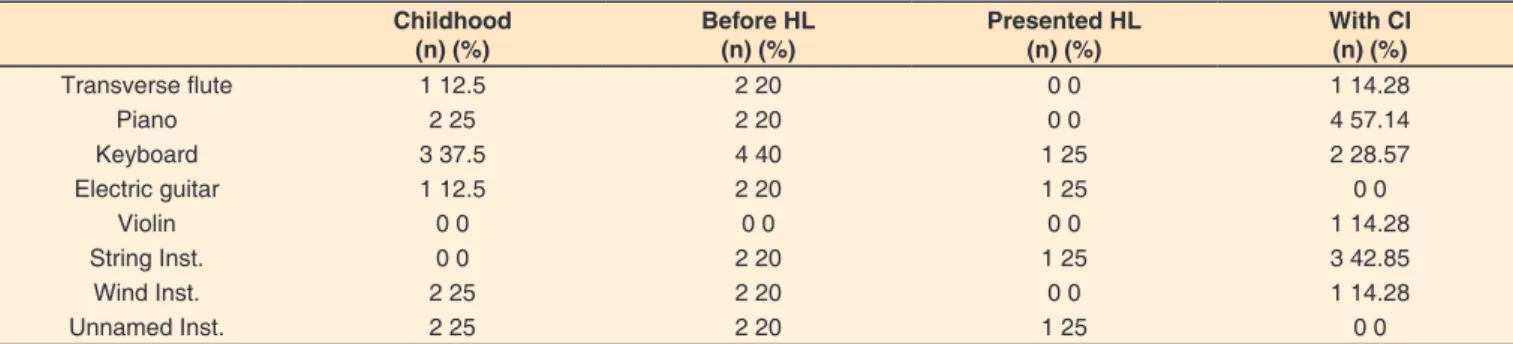
In question 18, “What instruments have you played or play at this time?”, 8 patients reported playing instruments during childhood and 10 patients who played before the HL, being the keyboard the most played instrument during these periods. After the CI, of the 10 patients who played instruments before HL, 4 returned to play and 3, who did not play, began to play (Table 3).
In question 22, “Have you received any kind of out-of-school music education (singing and/or instrument classes)?”,
Most participants (77.27%) mentioned not having received and
among the 5 adults who received musical education, 60% had more than 3 years of study in this area (Table 4).
According to the answers to the questions 24 and 25, most users trained to listen to music with the cochlear implant (68.2%), mainly listening to familiar music, repeatedly (60%), and reading the lyrics while listening (53.3%) (Table 5).
Table 1. Characteristics of individuals included in the research
Gender Age
(years) Etiology Implanting age
HL time (years)
CI usage
time CI use Brand Model
Nº of electrodes
off 1. F 51 Otosclerosis 48 years and 10 months 10 2 years and 2 months CI+PSAP Cochlear Freedom 0
2. M 38 Meningitis 33 years and 6 months 30 4 years and 6 months CI+CI Cochlear Freedom 0
3. F 50 Unknown 47 years and 5 months 6 2 years and 7 months CI+PSAP Med-El Sonata -1
4. F 27 Unknown 25 years e 10 months 20 2 years and 2 months CI+ PSAP AB HiRes 90k
-1
5. M 38 Meningitis 28 years and 3 months 11 9 years and 9 months CI Med-El Pulsar -2
6. F 64 Meningitis 60 years and 7 months 4 3 years and 5 months CI Cochlear Freedom 0
7. F 39 Unknown 35 years and 6 months 31 3 years and 6 months CI+PSAP AB HiRes 90k
0
8. M 32 Meningitis 12 years and 10 months 21 19 years and 2 months CI+CI AB HiRes 90k
0
9. M 66 Unknown 57 years and 8 months 20 8 years and 4 months CI Med-El Pulsar -1
10. F 45 Otosclerosis 42 years and 11 months 19 2 years and 1 month CI+PSAP Cochlear Freedom -1
11. F 25 Unknown 22 years and 1 month 12 2 years and 11 months CI Med-El Sonata -3
12. M 65 Unknown 58 years and 9 months 36 6 years and 3 months CI Med-El Sonata 0
13. F 35 Meniere’s
disease
32 years and 2 months 22 2 years and 10 months CI+PSAP Cochlear Freedom 0
14. F 53 Meningitis 46 years and 10 months 14 6 years and 2 months CI Cochlear Freedom 0
15. M 41 Unknown 34 years and 10 months 22 7 years and 2 months CI Med-El Sonata -2
16. F 53 Unknown 49 years and 6 months 35 4 years and 6 months CI Med-El Sonata 0
17. F 30 Unknown 26 years and 10 months 14 3 years and 2 months CI AB HiRes 90k
0
18. M 41 Measles 39 years and 8 months 24 1 year and 4 months CI+PSAP Med-El Sonata 0
19. F 21 Unknown 19 years and 4 months 14 1 year and 8 months CI Med-El Sonata 0
20. M 56 Measles 47 years and 11 months 46 8 years and 1 month CI+PSAP Cochlear Nucleus 24
-3
21. M 71 Otosclerosis 64 years and 6 months 38 7 years and 6 months CI Med-El Sonata -1
22. F 32 Meningitis 14 years and 8 months 18 17 years and 4 months CI+CI Med-El Rondo 0
Subtitle: CI = Cochlear Implant; PSAP = Personal Sound Amplification Product; HL = Hearing Loss; AB = Advanced Bionics; F = Female; M = Male
Table 2. How often do you listen and/or listened to music?
Always (n) (%)
Frequently (n) (%)
Occasionally (n) (%)
Rarely (n) (%)
Never (n) (%)
Total (n)
Total (%)
Before HL 9 40.90 5 22.73 1 4.55 1 4.55 6 27.27 22 100
Presented HL 2 9.10 4 18.18 4 18.18 1 4.54 1 1 50 22 100
With CI 7 31.81 7 31.81 4 18.18 2 9.10 2 9.10 22 100
Figure 1. When did you start to listen to music regularly after implanting your cochlear implant?
Figure 2. Which instruments can you identify without difficulty? Subtitle: Inst. = Instrument
Table 3. Which instruments did/do you play?
Childhood (n) (%)
Before HL (n) (%)
Presented HL (n) (%)
With CI (n) (%)
Transverse flute 1 12.5 2 20 0 0 1 14.28
Piano 2 25 2 20 0 0 4 57.14
Keyboard 3 37.5 4 40 1 25 2 28.57
Electric guitar 1 12.5 2 20 1 25 0 0
Violin 0 0 0 0 0 0 1 14.28
String Inst. 0 0 2 20 1 25 3 42.85
Wind Inst. 2 25 2 20 0 0 1 14.28
Unnamed Inst. 2 25 2 20 1 25 0 0
Subtitle: Inst = Instrument; HL = Hearing Loss; CI Cochlear Implant; (n) = Number of individuals
Table 4. Did you receive any kind of music education outside school (singing and/or instrument lessons)?
(n) (%)
No 17 77.27
Yes 5 22.73
Total 22 100
DISCUSSION
In Brazil, only one instrument that allows to know the
musical activities of users of cochlear implant was identified,
the Munich Music Questionnaire(12-15). This instrument was
created in 2002, translated and adapted to Brazilian Portuguese in 2015. It was chosen because it approaches aspects of the individual user of CI and their relationship with music in an
objective way, in the different moments of life.
In this study, a decrease in the frequency in which the individuals implanted heard music, when comparing the period before and after CI(11,12). Despite the decrease in this frequency,
music played a major role in the lives of most participants before and after hearing loss.
It was observed that 95.45% of the patients did not hear the music with the aid of the speech processor. This result becomes questionable and limiting, since the technology of the device can be a facilitating factor in the appreciation of music.
Most users listen to music for pleasure and to relax(9,12) and
they begin to listen to music regularly in the first few months
after activation, proving that this is the most important moment to encourage, start, or have begun training in musical skills.
The elements of music such as rhythm, melody, timbre and pitch are still challenging aspects for most users. In the study, 81.82% of those implanted responded that they could hear the rhythm element during music(7,8,10,14). The instrument
that most users enjoy listening to is the piano, followed by the electric guitar(16).
The musical genres less heard among the users were opera
and classical, and it may be influenced by the local culture(12).
In another study, were found religious and techno genres(16).
Of the ten patients who played instruments before the hearing loss, four played again after implantation(17,18). In addition, three
that did not play, began to play after the CI.
Most individuals implanted did not sing before the HL; however, in the period after HL with the cochlear implantation, the frequency of most users increased from “never” to “occasionally”. Hypothetically, this increase has the auditory feedback of the voice itself.
Only 22.73% of the patients received musical education
before HL. According to the literature, individuals who had previous musical experience obtain better recognition of musical elements(19).
The majority of those implanted (68.2%) trained to listen to music with the device, being the most used strategies to hear, repeatedly, familiar music and to listen reading the song lyrics. In the literature, there is evidence that familiarity with music helped in the recognition of excerpts and the improvement of
the musical experience post-CI(20,21). Train auditory recognition
of musical instruments(22), listen specifically something of the
music to understand(23); and recognize songs together(24) are
facilitators for the best performance.
It is important to consider the variability of results found in the clinical population and also that numerous factors are capable of impacting the auditory performance with the CI and, consequently, the musical appreciation. In this sense, the combined analysis of the questionnaire results and other clinical information of the professionals that attend this population may contribute to a better understanding of the insertion of the music in the daily activities of the users of CI.
CONCLUSION
It was possible to know the profile of CI users attended at
the institution and to observe that the use of CI improved their perception of music and quality of life.
Returning to the thought of Aldous Huxley “After silence that which comes nearest to expressing the inexpressible is music.”
Appreciating music is something inherent to the human being and its lack can imply isolation and failure in personal and professional life. This research allowed to conclude that there are few users of cochlear implants who continue with their previous musical habits. However, it is possible to start or resume engaging with music, hearing, listening, singing, or playing an instrument. Pre-implantation and post-implantation auditory rehabilitation is necessary and should include the development of musical skills for the best musical appreciation, thus rescuing another aspect of the sound world.
ACKNOWLEDGEMENTS
To the patients, for the collaboration in participating in the research and in sharing some of the experiences of their lives.
REFERÊNCIAS
1. Chiari BM. Língua e linguagem: forma, conteúdo e uso nos déficits de audição. In: Marchezan IQ, Justino H, Tomé MC. Tratado de fonoaudiologia. Rio de Janeiro: Roca; 2014. p. 632-34.
2. Palácios T, Oliveira LN, Chiossi JSC, Soares AD, Chiari BM. Fatores biológicos e socioculturais na avaliação do vocabulário receptivo em português oral de deficientes auditivos pós-linguais. Audiol Table 5. How did you trained to listen to music with your cochlear implant?
(n) (%)
Listened to familiar music repeatedly 9 60
Listened to unknown music repeatedly 7 46.6
Listened and read the music 8 53.3
Had music lessons 1 6.6
Read and played the music 3 20
Played repeatedly familiar music without reading it 5 33.3
Trained to read the music in my rehabilitation 4 26.6
Commun Res. 2014;19(4):360-6. http://dx.doi.org/10.1590/S2317-64312014000400001414.
3. Gomes-Machado ML, Soares AD, Chiari BM. Avaliação dinâmica e interdisciplinar na deficiência auditiva em ambulatório público: relato de caso. Rev soc bras fonoaudiol. 2009;14(3):416-420.
4. Cohen SM, Labadie RF, Dietrich MS, Haynes DS. Quality of life in hearing-impaired adults: The role of cochlear implant and hearing aids. Otolaryngol Head Neck Surg. 2004;131(4):413-22. http://dx.doi. org/10.1016/j.otohns.2004.03.026. PMid:15467610.
5. Francis HW, Chee N, Yeagle J, Cheng A, Niparko JK. Impact of cochlear implants on the functional health status of older adults. Laryngoscope. 2002;112(8 Pt 1):1482-8. http://dx.doi.org/10.1097/00005537-200208000-00028. PMid:12172266.
6. Buarque LFSFP, Brazorotto JS, Cavalcanti HG, Lima LRP Jr, Lima DVSP, Ferreira MAF. Desempenho auditivo ao longo do tempo em usuários de implante coclear com perda auditiva pós-lingual. Audiol Commun Res. 2013 abr./jun.;18(2).
7. Limb CJ. Cochlear implant-mediated perception of music. Curr Opin Otolaryngol Head Neck Surg. 2006;14(5):337-40. http://dx.doi.
org/10.1097/01.moo.0000244192.59184.bd. PMid:16974148.
8. Martins JH, Cortesão R, Rodrigues F, Rodrigues MF, Ribeiro C. Percepção da música em pacientes com estimulação auditiva bimodal.
SPORL Journal. 2009;47(1):9-13.
9. Falcón-González JC, Borkoski-Barreiro S, Limiñana-Cañal JM, Ramos-Macías Á. Reconocimiento auditivo musical y melódico en pacientes con implante coclear, mediante nuevo método de programación de asignación frecuencial. Acta Otorrinolaringol Esp. 2014;65(5):289-96. http://dx.doi.org/10.1016/j.otorri.2014.02.005. PMid:24890686.
10. Peterson N, Bergeson TR. Contribution of hearing aids to music perception by cochlear implant users. Cochlear Implants Int. 2015;16(3,
Suppl 3):S71-8. http://dx.doi.org/10.1179/1467010015Z.000000000268. PMid:26561890.
11. Lassaletta L, Castro A, Bastarrica M, Pérez-Mora R, Herrán B, Sanz L, et al. Percepción y disfrute de la música en pacientes poslocutivos con implante coclear. Acta Otorrinolaringol Esp. 2008;59(5):228-34.
http://dx.doi.org/10.1016/S0001-6519(08)73300-4. PMid:18501158.
12. Lopes NBF, Bevilacqua MC, Costa AO. Munich Music Questionnaire: adaptação para a língua portuguesa e aplicação em usuários de implante
coclear. CoDAS. 2015;27(1):13-20. http://dx.doi.org/10.1590/2317-1782/20152013062. PMid:25885192.
13. Leal MC, Shin YJ, Laborde ML, Calmels MN, Verges S, Lugardon S, Andrieu S, et al. Music perception in adult cochlear implant
recipients. Acta Otolaryngol. 2003;123(7):826-35. http://dx.doi. org/10.1080/00016480310000386. PMid:14575398.
14. Brockmeier SJ, Peterreins M, Lorens A, Vermeire K, Helbig S, Anderson I, et al. Music Perception in Eletric Acoustic Stimulation Users as Assessed by the Mu. S.I.C. Test. Adv Otorhinolaryngol.
2010;67:70-80. PMid:19955723.
15. Barbosa RS, Munster MV, Costa MPR. Uma análise das dissertações e teses sobre Implante Coclear no período de 2000 a 2010. CEFAC. 2013;15(6):1583-90. http://dx.doi.org/10.1590/S1516-18462013000600021.
16. Veekmans K, Ressel L, Mueller J, Vischer M, Brockmeier SJ. Comparison of Music perception in bilateral and unilateral cochlear implant users and normal-hearing subjects. Audiol Neurootol. 2009;14(5):315-26. http://dx.doi.org/10.1159/000212111. PMid:19372650.
17. Mirza S, Douglas SA, Lindsey P, Hildreth T, Hawthorne M. Appreciation
of music in adult patients with cochlear implants: a patient questionnaire. Cochlear Implants Int. 2003;4(2):85-95. http://dx.doi.org/10.1179/ cim.2003.4.2.85. PMid:18792140.
18. Migirov L, Kronenberg J, Henkin Y. Self-Reported listening habits and enjoyment of music among adult cochlear implant recipients. Ann Otol Rhinol Laryngol. 2009;118(5):350-5. http://dx.doi.
org/10.1177/000348940911800506. PMid:19548384.
19. Maarefvand M, Marozeau J, Blamey PJ. A cochlear implant user with exceptional musical hearing ability. Int J Audiol. 2013;52(6):424-32.
http://dx.doi.org/10.3109/14992027.2012.762606. PMid:23509878. 20. Gfeller K, Olszewski C, Rychener M, Sena K, Knutson JF, Witt S, et al.
Recognition of “real-world” musical excerpts by cochlear implant
recipients and normal-hearing adults. Ear Hear. 2005;26(3):237-50. http://dx.doi.org/10.1097/00003446-200506000-00001. PMid:15937406.
21. Looi V, She J. Music perception of cochclear implant users: A questionnaire, and its implications for a music training program. Int J Audiol. 2010;49(2):116-28. http://dx.doi.org/10.3109/14992020903405987. PMid:20151886.
22. Driscoll VD. The effects of training on recognition of musical instruments by adults with cochlear implants. Semin Hear. 2012;33(4):410-8. http://dx.doi.org/10.1055/s-0032-1329230. PMid:23503992.
23. Bartel LR, Greenberg S, Friesen LM, Ostroff J, Bodmer D, Shipp D, et al. Qualitative case studies of five cochlear implant recipients’
experience with music. Cochlear Implants Int. 2011;12(1):27-33. http://dx.doi.org/10.1179/146701010X486435. PMid:21756456.
24. Cheng MY, Spitzer JB, Shafiro V, Sheft S, Mancuso D. Reliability Measure of a Clinical Test: Appreciation of Music in Cochlear
Implantees (AMICI). J Am Acad Audiol. 2013;24(10):969-79. http://