http://www.uem.br/acta ISSN printed: 1806-2636 ISSN on-line: 1807-8672
Doi: 10.4025/actascianimsci.v34i1.12083
Performance and digestibility of Nile tilapia fed with pineapple
residue bran
Misleni Ricarte de Lima1*, Maria do Carmo Mohaupt Marques Ludke2, Mônica Calixto Ribeiro de Holanda3, Bárbara Wanderley Costa Pinto4, Jorge Vitor Ludke5 and Elton Lima Santos6
1
Programa de Doutorado Integrado em Zootecnia, Universidade Federal Rural de Pernambuco, R. Dom Manoel de Medeiros, s/n, 52171-900, Recife, Pernambuco, Brazil. 2
Departamento de Zootecnia, Universidade Federal Rural de Pernambuco, Recife, Pernambuco, Brazil. 3
Universidade Federal Rural de Pernambuco, Garanhuns, Pernambuco, Brazil. 4
Departamento deCiências Biológicas, Universidade Federal Rural de Pernambuco, Recife, Pernambuco, Brazil. 5
Centro Nacional de Pesquisa de Suínos e Aves, Empresa Brasileira de Pesquisa Agropecuária, Concórdia, Santa Catarina, Brazil. 6
Centro de Ciências Agrárias, Universidade Federal de Alagoas, Rio Largo, Alagoas, Brazil. *Author for correspondence. E-mail: [email protected]
ABSTRACT. Two experiments were conducted, the first being the digestibility of feed and the second performance in an attempt to evaluate the residue of pineapple bran in diets for Nile tilapia. Eighty animals weighing 63.9 ± 0.79 g in a completely randomized design were used to test the digestibility in order to evaluate the apparent digestibility of dry matter, crude protein, gross energy, digestible energy and digestible protein. In the performance of 240 juveniles were distributed in three ranges of weights: 34.9 ± 0.06, 44.4 ± 0.27 and 55.5 ± 0.10 g, in order to evaluate performance, yield Housing and somatic indices of Nile tilapia. The design was a randomized block with three blocks, with four treatments and five repetitions, rations in both experiments contained four levels of inclusion of pineapple bran residue (0, 5, 10 and 15%). The digestibility of the diets were: dry matter (76.17, 75.42, 75.31 and 75.77%), crude protein (87.90, 90.24, 89.51 and 89.03%) gross energy (79.12, 79.33, 79.07 and 77.48%), digestible energy (3649, 3559, 3560 and 3190 kcal kg-1) and digestible protein (29.28, 30.35, 29.82 and 29.79%), respectively. It was observed the significant effect on the carcass without head, so we recommend the inclusion of up to 10.39% for the inclusion of pineapple bran residue in diets of Nile tilapia.
Keywords: alternative ingredient, Oreochromis niloticus, waste of fruit.
Desempenho e digestibilidade da tilápia do Nilo recebendo dietas com farelo de
resíduo de abacaxi
RESUMO. Foram realizados dois experimentos, sendo o primeiro de digestibilidade das rações e o segundo de desempenho na tentativa de avaliar o farelo do resíduo de abacaxi nas dietas para tilápia do Nilo. Foram utilizados para o ensaio de digestibilidade 80 animais com peso de 63,9 ± 0,79g, em um delineamento experimental inteiramente casualizado, com o objetivo de avaliar o coeficiente de digestibilidade aparente da matéria seca, proteína bruta, energia bruta, energia digestível e proteína digestível. No experimento de desempenho foram utilizados 240 juvenis, distribuídos em três faixas de pesos: 34,9 ± 0,06; 44,4 ± 0,27 e 55,5 ± 0,10 g, com o objetivo de avaliar desempenho produtivo, rendimento de carcaça e índices somáticos da tilápia do Nilo. O delineamento utilizado foi em blocos casualizados com três blocos, com quatro tratamentos e cinco repetições, As rações em ambos os experimentos continham quatro níveis de inclusão do farelo de resíduo de abacaxi (0, 5, 10 e 15%). Os coeficientes de digestibilidade das rações foram: matéria seca (76,17; 75,42; 75,31 e 75,77%), proteína bruta (87,90; 90,24; 89,51 e 89,03%), energia bruta (79,12; 79,33; 79,07 e 77,48%), energia digestível (3649, 3559, 3560 e 3190 kcal kg-1) e proteína digestível (29,28; 30,35; 29,82 e 29,79%), respectivamente. Foi observado o efeito significativo sobre o rendimento de carcaça sem cabeça, recomenda-se, então, a inclusão de até 10,39% de inclusão do farelo de resíduo de abacaxi nas rações de tilápia do Nilo.
Palavras-chave: ingrediente alternativo, Oreochromis niloticus, resíduo de frutas.
Introduction
The Nile tilapia (Oreochromis niloticus) is one of the prominent species of global aquaculture because of some intrinsic characteristics, such as rusticity and tolerance to low taxes of dissolved oxygen. Its flesh presents good sensorial characteristics and fillet with no intramuscular “Y” shaped spines (FURUYA et al.,
animals. As alternative to Northeast Region, it can be used agro-industrial residue, because that region is prominent on cultivation of most of the tropical fruit species (LOUSADA JÚNIOR et al., 2005).
In Brazil, the cultivation intended to meet the demand of fresh fruits, however, there is a global tendency to processed products market, as conserves, juices, jams and sweets (LOUSADA JÚNIOR et al., 2006). After processing the fruits for obtaining those products, it is generated a huge quantity of residue, which majority does not go through any treatment before be discarded into environment.
Among agro-industrial residues, the pineapple ones deserve attention by being source of calcium and A, B, C vitamins and bromelain, enzyme belonging to protease group. This enzyme occurs on stalk, leaves, roots and pineapple fruit (FRANÇA-SANTOS et al., 2009). Generally, fruit pulp factories discard pineapple leaves, shells and the pressed bagasse that was made after obtaining the pulp. Indeed, to feed monogastric animals it is advisable the using of pressed bagasse bran, due presents a lower fiber content, in relation to the one made of leaves, shells and bagasse.
According to nutritional composition of pineapple residue bran, it is considered as an ingredient of energetic source, because Fialho et al. (2009) reports that for the ingredient be considered an energetic one, it must presents a percentage average under 20% of crude protein and under 18% of crude fiber.
So, the present research was made with the aim of evaluate the inclusion of pineapple residue bran on the apparent digestibility, productive performance, carcass yield and somatic index of Nile tilapia.
Material and methods
The research was conducted in the Laboratório de Digestibilidade de Não-Ruminantes do Departamento de Zootecnia da Universidade Federal Rural de Pernambuco –
UFRPE.
The pineapple residue bran was obtained from a factory of pulp fruit obtaining, in Recife, Pernambuco State, made of fibrous bagasse, obtained from the pulp extraction. It was acquired in
natura and passed through a pre-drying process, in
which the one was exposed to the sun, spreads in a soft layer over a plastic canvas during an eight hours period. Then, it was taken to a forced ventilation stove at 65°C, for 48 hours, in which they were revolved twice a day, to make the dehydration easier and avoid the appearance of fungus. After
dehydration, the material was processed in type knife grind, 2 mm sieved, to obtain the bran. After, it was carried to the Laboratório de Nutrição Animal do
Departamento de Zootecnia da UFRPE, for analysis of
dry matter, crude protein, ether extract, crude fiber, fiber in neutral detergent and fiber in acid detergent, according to the methodology described by Silva and Queiroz (2006) and the analyses of crude energy was made at Universidade Federal Rural do Semi Árido –
UFERSA.
For processing the feed, the ingredients were crushed by a type knife grind, 1mm sieved, and then it was manually mixed until it acquires a homogeneous look. Then, the mixture was moistened with water in a temperature about 60°C and, then, it occurred the pelleting in a manual meat grinder. After the end of this process, the feed was taken to a forced ventilation stove at 65°, for a period of 24 hours.
The pellets were broken and separated by different sized sieves, for present the right diameter of animal’s mouth.
After processing the residue and the feed they were started nutritional experiments, which were divided in two steps: firstly, it was made a test of feed digestibility, containing 0, 5, 10 and 15% of inclusion of pineapple residue bran, during 23 days, in which, 3 days for adaptation and 20 days for data collect. They were used 80 juveniles of Nile tilapia, with average weight of 63.9 ± 0.79 g.
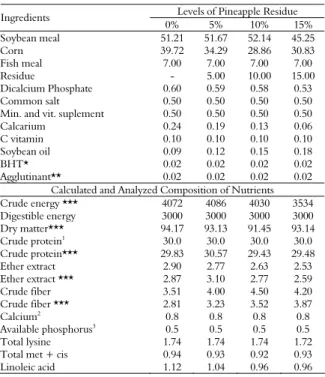
The animals were distributed in 20 fiberglass conic aquariums, with 60 L capacity, continuous aeration system, being placed 4 animals per aquarium. It was adopted the entirely randomized design, with four treatments and five repetitions. The fishes were fed until apparent satiety with small fractions every 30 minutes from 8h until 16h 30 min., with four isoproteic and isoenergetic feed containing 0, 5, 10 and 15% of inclusion of pineapple residue bran, as described on (Table 1). These feed were added with 1,0% of Chromium oxide (Cr2O3), for the test of digestibility.
At the end of the afternoon it was renewed all aquarium water gradually, where at the bottom of them there were stopcocks which were opened for water flow, and while the water flowed, there were hoses on the top of the aquariums for water renewal. This management was daily realized to avoid feed lefts with faeces samples. The collect was made at 8h, and the material stored in freezer at 0°C.
Apparent digestibility coefficients were obtained applying the indirect method, with chromium oxide (Cr2O3), and analyses for
feed and faeces were realized according to Bremer Neto et al. (2005).
Table 1. Percent and Chemical Composition of experimental feed with different levels of pineapple residue for Nile tilapia (natural matter based).
Levels of Pineapple Residue Ingredients
0% 5% 10% 15%
Soybean meal 51.21 51.67 52.14 45.25
Corn 39.72 34.29 28.86 30.83
Fish meal 7.00 7.00 7.00 7.00
Residue - 5.00 10.00 15.00
Dicalcium Phosphate 0.60 0.59 0.58 0.53
Common salt 0.50 0.50 0.50 0.50
Min. and vit. suplement 0.50 0.50 0.50 0.50
Calcarium 0.24 0.19 0.13 0.06
C vitamin 0.10 0.10 0.10 0.10
Soybean oil 0.09 0.12 0.15 0.18
BHT* 0.02 0.02 0.02 0.02
Agglutinant** 0.02 0.02 0.02 0.02
Calculated and Analyzed Composition of Nutrients
Crude energy *** 4072 4086 4030 3534
Digestible energy 3000 3000 3000 3000
Dry matter*** 94.17 93.13 91.45 93.14
Crude protein1 30.0 30.0 30.0 30.0
Crude protein*** 29.83 30.57 29.43 29.48
Ether extract 2.90 2.77 2.63 2.53
Ether extract *** 2.87 3.10 2.77 2.59
Crude fiber 3.51 4.00 4.50 4.20
Crude fiber *** 2.81 3.23 3.52 3.87
Calcium2
0.8 0.8 0.8 0.8
Available phosphorus3 0.5 0.5 0.5 0.5
Total lysine 1.74 1.74 1.74 1.72
Total met + cis 0.94 0.93 0.92 0.93
Linoleic acid 1.12 1.04 0.96 0.96
*Butyl-Hydroxy-tolueno (antioxidant) **Sodium alginate. 1- According to data of Meurer et al. (2000). 2-According to data of Boscolo et al. (2002). 3- According to data of Furuya et al. (2008b). ***analysed composition. Mineral e vitaminic Suplement (Composition kg of product-1): A vit. = 900,000 UI; D3 vit. = 50,000 UI; E vit. = 6,000 mg; K3 vit. = 1,200 mg; B1 vit. = 2,400 mg; B2 vit. = 2,400 mg; B6 vit. = 2,000 mg; B12 vit. = 4,800 mg; Folic Acid = 1,200 mg; calcium panthotenate = 12,000 mg; C vit. = 24,000 mg; biotin = 6.0 mg; choline = 65,000 mg; nicotinic acid = 24,000 mg; Fe = 10,000 mg; Cu = 600 mg; Mn = 4,000 mg; Zn = 6,000 mg; I = 20 mg; Co = 2.0 mg and Se = 25 mg.
The apparent digestibility coefficient was calculated according to the formula described by Cho et al. (1985):
CDa(n) = 100 –[100( % Cr2O3r / % Cr2O3f) x (%Nf / %N r)]
where:
Da(n) = aparent digestibility of nutrient; Cr2O3r = % of chromium oxide in feed;
Cr2O3f = % of chromium oxide in faeces;
N r = % nutrients in feed; Nf = % nutrients in faeces.
The second stage consisted of performance experiment, during 60 days. They were used 240 juveniles of Nile tilapia, mannish, distributed on three weigh levels: 34.9 ± 0.06; 44.4 ± 0.27 and 55.5 ± 0.10 g. It was adopted the design in randomized blocks with three blocks and four treatments (the same used at the digestibility test) with five repetitions.
The fishes were distributed in 10 boxes of (500 L), halved by a plastic canvas (1 cm diameter
between knots), resulting in two experimental unities, where were stored 12 fishes each, staying so 250 L for each side.
The boxes were interconnected by a recirculation system of water, with an average flow of two liters of water per minute, using a biological filter, and a continuous aeration system by microporous stones, connected to a portable air compressor. The feeding was made five times a day: 9 to 17h, every two hours, until apparent satiety.
Water physico-chemical variables, as dissolved oxygen, pH, nitrite, ammonia and temperature were analyzed during all experimental period, every two days. The dissolved oxygen was monitored by digital oximeter, the nitrite, the pH and the ammonia, by colorimetric chemical tests, and the water temperature by mercury thermometer installed inside the boxes. These variables were analyzed always at 8h, before of siphoning, that was made at 8:30 for remove the feed and faeces lefts in the depth of the boxes. Each two days it was renewed 40% of the water in the boxes, what provided the maintenance of its quality. The fishes were submitted to a photoperiod of 12 hours of light.
At the end of the experiment, the fishes were kept unfed for 24 hours, being next sacrificed by thermal shock (water + ice). Posteriorly, they were collected biometrical data (total weight and size), it was made a ventral longitudinal incision and it was removed all the content of the abdominal cavity, including gonads and abdominal fat. From collected data there were evaluated the parameters of: hepatosomatic index, abdominal fat index and organs weights. To take yield data of carcass with head, it was weighed the carcass without the content of abdominal, and for the yield of carcass without the head, this one was sectioned from body around the junction with the spine, including gill, and it was removed the content of abdominal.
Obtained data were submitted do analysis of variance and regression using the software Statistical Analysis System (SAS, 2000).
Results and discussion
The results of bromatological composition of pineapple residue bran, based on dry matter, were: dry matter 85.58%, crude protein 4.60%, fiber in neutral detergent 36.96%, fiber in acid detergent 11.91%, crude fiber 13.17%, ether extract 0.58%, mineral matter 4.41% and crude energy 3.701 kcal kg-1.
neutral detergent is yet bigger and expresses better the content of residue fiber.
Lousada Júnior et al. (2006), evaluating the composition of pineapple residue bran, that was composed of added pulp shell plus the pressed pulp of juice obtaining, had found different values of bromatological composition from the ones found on the present study, for dry matter 84.7%, crude protein 8.3%, fiber in neutral detergent 71.4%, fiber in acid detergent 30.7%, ether extract 1.2% e mineral matter 6.8%.
Correia et al. (2006), evaluating the bromatological composition of pineapple residue, being this constituted of shell plus pressed pulp from juice obtaining, had found values of dry matter 87.9%, mineral matter 10.1%, crude protein 7.4%, fiber in neutral detergent 72.1% and fiber in acid detergent 33.7%.
The processing way of the fruits by agro-industries, the cultivation place, the variety of the fruit and the way through the bran was made may influence on nutritional composition of pineapple residue bran. The results of digestible coefficients for dry matter, crude protein, digestible energy and digestible protein in function of the levels of inclusion of pineapple of residue bran are described on (Table 2).
It was observed a quadratic effect on digestibility for all parameters above, except for digestible protein, there was not a significant difference.
For the apparent digestibility coefficient of crude protein it was observed quadratic effect, however, the level that presented the best digestibility coefficient was the 5.0%. That might be occurred because of the percentage of crude fiber of feed, because of the increasing on fiber level from 3.51 to 4.20%, increasing, then, the viscosity of digestion more prominent. Sklan et al. (2004) quote that the high content of diet fiber decreases the access of digestible enzymes to nutrients or by indirect interaction among the components of cell wall or by digestible process.
According to Furuya et al. (2008a), diet fiber can reduce the digestibility of protein and amino acids throughout stimulation of bacterial-originated protein, occurring adsorption of amino acids and peptides for the fiber matrix and by the increasing of secretion of endogen protein.
The fiber reduces the digestibility of nutrients because it changes the passage rate. Lanna et al. (2004b) analyzing the effects of the crude fiber levels (2.5, 5.0, 7.5, 10.0 and 12.5%) on Nile tilapia feed, over the speed of gastrointestinal traffic, concluded that the increase of the crude fiber content of the feed decreases significantly the time of the gastrointestinal traffic.
The influence of the fiber upon the fishes is still few studied and may be connected to its percentage composition in celluloses, hemicelluloses, lignin and silica, among other (MEURER et al., 2003).
Although the inclusion levels of pineapple residue bran have interfered on digestibility of the protein, the results of coefficient of digestibility presented were satisfactory for a vegetal ingredient. Probably, these results were obtained, since the pineapple may be a source of proteolytic enzyme, bromelain, that is an enzyme of hydrolases classes and are able to break the peptide bond of proteins and peptides (FRANÇA-SANTOS et al., 2009).
However, this fruit has an anti-nutritional factor, the polyphenols, that may react, reversible or irreversibly with the protein, harming the digestibility and the bioavailability of lysine and of other amino acids essential (SANTOS et al., 2001). But, these anti-nutritional factors are present in stalk and leaves, parts that were not used for compose the bran used on this research, this fact can explain the good results of digestibility coefficient.
For the apparent digestibility coefficient of dry matter, it was also observed quadratic effect, with better digestibility coefficient (76.17%) for witness treatment, it means without pineapple residue, and among the inclusion percentage of residue, the level of 15% was what presented the best result, one more time the level of fiber interfered on digestibility.
Table 2. Probability values (P), variation coefficient (CV) and averages of the aparent digestibility coefficients of dry matter (CDaMS), crude protein (CDaPB), crude energy (CDaEB), digestible energy (ED) and digestible protein (PD) of feed containing different levels of inclusion of pineapple residue bran for Nile tilapia.
Levels of Inclusion CDa
0% 5% 10% 15% P* CV Regression
CDaPB (%) 87.90 90.24 89.51 89.03 0.0228 0.81 Q1
CDaMS (%) 76.17 75.42 75.31 75.77 0.0001 0.14 Q2
CDaEB (%) 79.12 79.33 79.07 77.48 0.0001 0.23 Q3
ED(kcal kg-1
) 3649 3559 3560 3190 0.0001 0.68 Q4
PD (%) 29.28 30.35 29.82 29.79 0.1196 1.56 NS
Digestibility coefficients of dry matter of this study were superior to the ones found by Lanna et al. (2004a), that evaluated three levels of fiber inclusion (6, 9 and 12%), using the cane bagasse as fiber source in practical feed for Nile tilapia. These authors obtained values of 71.2, 64.3 and 62.4%, respectively.
Apparent digestibility coefficient of crude energy and digestible energy presented the same effect, although these parameters had been optimized to levels of 5 and 0% of inclusion, respectively.
The average values of temperature (25.4 ± 0.83ºC), dissolved oxigen (6.0 ± 0.8 ppm), pH (6.6), ammonia (0.003 to 0.009 ppm) e nitrite (0.25 to 0.5 ppm) were inside the tolerable range for the species described by Kubitza (2000), except temperature. According to the same author, the thermal comfort range for this species is between 27 to 32°C, and that the temperatures outside this range reduce the consumption and, consequently the growth. However, the temperature range to which the animals were found did not interfered on feed consumption.
The results of the development parameters are described on Table 3; they were not observed statistical differences.
For the parameters of final weight, weight gain, feed consumption, apparent feed conversion and survival rate were not observed significant effects. Santos et al. (2009), evaluating the coconut residue bran on feed for Nile tilapia fingerlings, they also did not found statistical difference for the parameters of weight gain and feed consumption.
For weight variables of carcass with or without head and yield of carcass with head they were not observed significant effects (p > 0.05) among the different levels of inclusion of pineapple residue bran (Table 4). Though, for yield of carcass without head it was observed quadratic effect (p < 0.05), presented for that analyzed variable the best inclusion level of 10.39%, obtaining the best yield of 67.63%, throughout following equation: (Ŷ = 65.575 + 0.395x – 0.019x2, R2 = 0.99).
Similarly, Lanna et al. (2004a), evaluating different levels of crude fiber (6, 9 and 12%) and using cane bagasse as fiber source in feed for Nile tilapia, with initial weight of 6.41 ± 0.05 g lower than the present research, they did not find significant difference among the treatments for yield of carcass without head.
The parameters hepatossomatic index, abdominal fat and organs weight of tilapia fed with different levels of pineapple residue did not present significant difference (p > 0.05) (Table 4).
Lima et al. (2011), evaluating the mango residue for Nile tilapia, with average final weight of 126.6 g, obtained similar results for the parameters hepatossomatic index and organs weight, however, for abdominal fat index were superior to the obtained on present research.
Lopes et al. (2010), evaluating the babassu bran in feed for tambaqui, with final average weight of 40.0 g, obtained similar results for organs weight, however, for hepatossomatic index they had found lower values and the abdominal fat index were superior to the present work.
Table 3. Probability values (P), variation coefficient (CV) and averages of initial weight, final weight, weight gain (final weight – initial weight (GP)), feed consumption (CR), apparent feed conversion (CAA) and survival rate (TS) of tilapias fed with different levels of pineapple residue bran.
Inclusion Levels Analyzed Variables
0% 5% 10% 15% P* CV Regression
Initial weight (g) 46.8 46.9 46.8 47.1 - - -
Final weight (g) 125.5 117.3 113.5 107.6 0.1943 11.39 NS
GP(g) 78.4 70.4 66.6 60.5 0.3681 19.30 NS
CR(g) 135.8 162.7 139.9 175.2 0.5705 28.13 NS
CAA 1.8 2.4 2.2 2.9 0.2462 31.25 NS
TS (%) 93.3 82.2 88.9 82.2 0.6791 21.71 NS
Table 4. Probability values (P) and variation coefficient (CV) and carcass weight average (PC), carcass with head yield (RCCC), carcass weight without head (PCSC), carcass without head yield (RCSC), hepatossomatic index (IHS), abdominal fat index (IGC) and organs weight (PO) of tilapia fed with different levels of pineapple residue.
Inclusion Levels Analyzed variables
0% 5% 10% 15% P* CV Regression
PC(g) 111.1 102.7 98.7 95.3 0.1102 10.75 NS
RCCC(%) 88.6 87.6 87.0 87.6 0.0595 1.15 NS
PCSC(g) 82.3 75.1 72.2 69.8 0.1100 11.58 NS
RCSC(%) 65.6 64.0 63.6 63.9 0.0015 1.72 Q1
IHS(%) 1.6 1.4 1.4 1.3 0.3216 16.88 NS
IGC(%) 0.3 0.2 0.2 0.2 0.0454 29.67 NS
PO(%) 3.1 2.9 3.4 3.2 0.4755 21.84 NS
Nevertheless, Santos et al. (2009), evaluating coconut residue bran on Nile tilapia fingerlings, had found lower results to the obtained on the present study for the parameters hepatossomatic index, abdominal fat index and organ weight.
Generally, modifications that may occur on studied variables are directly related to accumulation of energetic reservations or to any disturb on metabolism of proteins and lipids, but the accumulation of fat is more evidenced on animals in finishing phase, that was not this research case, in which there were used juvenile animals. Yet, the deposition of corporal fat may also occur for other factors. Arbeláez-Rojas et al. (2002) relate that in conditions of confinement, where fishes’ movements are restricted, it may happen an increasing on corporal fat, which decreases the quality of the product and may affect the acceptation by the consumer.
According to Santos et al. (2009), somatic index are important for better evaluation of physiological conditions, when the animal is submitted to feed with alternative vegetal food. Those products may contain relations with anti-nutritional factors present in these feed that would prejudice the normal functioning of fishes’ organisms, causing problems to their metabolism.
The using of pineapple residue bran from agro-industrial processing may be considered as alternative source on fishes’ feed, however, researches on nutritional way must be made for a better knowing of bromatological composition, nutrient digestibility and, consequently, testing appropriated levels on trying to obtain the best answer from the animal.
Conclusion
It is recommended the usage of until 10.39% of pineapple residue bran on feed for Nile tilapia without affect the yield of carcass without head.
References
ARBELÁEZ-ROJAS, G. A.; FRACALOSSI, D. M.; FIM, J. D. I. Composição corporal de tambaqui Colossoma macropomum, e matrinxã Brycon cephalus, em sistema de cultivo intensivo, em igarapé, e semi-intensivo, em viveiros. Revista Brasileira de Zootecnia, v. 31, n. 3, p. 1059-1069, 2002.
BOSCOLO, W. R.; HAYASHI, C.; MEURER, F. Digestibilidade aparente da energia e nutrientes de alimentos convencionais e alternativos para tilápia do Nilo (Oreochromis niloticus L.) Revista Brasileira de Zootecnia, v. 31, n. 2, p. 539-545, 2002.
BREMER NETO, H.; GRANER, C. A. F.; PEZZATO, L. E.; PADOVANI, L. R. Determinação de rotina do
crômio em fezes, como marcador biológico, pelo método espectrofotométrico ajustado da 1,5-difenilcarbazida.
RevistaCiência Rural, v. 35, n. 3, p. 691-697, 2005. CHO, C. Y.; COWEY, C. B.; WATANABE, T. Finfish nutritionin Ásia: methodological approaches to research and development. Otawa: IDRC, 1985.
CORREIA, M. X. C.; COSTA, R. G.; SILVA, J. H. V.; CARVALHO, F. F. R.; MEDEIROS, A. N. Utilização de resíduo agroindustrial de abacaxi desidratado em dietas para caprinos em crescimento: digestibilidade e desempenho. Revista Brasileira de Zootecnia, v. 35, n. 4, p. 1822-1828, 2006.
FIALHO, E. T.; SILVA, H. O.; ZANGERONIMO, M. G.; AMARAL, N. O.; RODRIGUES, P. B.; CANTARELLI, V. S. Alimentos alternativos para suínos. Lavras: UFLA, 2009.
FRANÇA-SANTOS, A.; ALVES, R. S.; LEITE, N. S.; FERNANDES, R. P. M. Estudos bioquímicos da enzima bromelina do Ananas comosus (abacaxi). Scientia Plena, v. 5, n. 11, p. 1-6, 2009.
FURUYA, W. M.; SALES, P. J. P.; SANTOS, L. D.; SILVA, L. C. R.; SILVA, T. C. S.; FURUYA, V. R. B. Composição química e coeficiente de digestibilidade aparente dos subprodutos desidratados das polpas de tomate e goiaba para tilápia do Nilo (Oreochromis niloticus).
Boletim do Instituto de Pesca, v. 34, n. 4, p. 505-510, 2008a.
FURUYA, W. M.; FUJII, K. M.; SANTOS, L. D.; SILVA, T. S. C.; SILVA, L. C. R.; MICHELATO, M. Exigência de fósforo disponível para tilápia-do-nilo (35 a 100 g).
Revista Brasileira de Zootecnia, v. 37, n. 6, p. 961-966, 2008b.
KUBITZA, F. Tilápia. Tecnologia e planejamento na produção comercial. 1. ed. Jundiaí: F. Kubitza, 2000. LANNA, E. A. T.; PEZZATO, L. E.; CECON, P. R.; FURUYA, W. M.; BOMFIM, M. A. D. Digestibilidade aparente e trânsito gastrintestinal em tilápia do Nilo (Oreochromis niloticus), em função da fibra bruta da dieta.
Revista Brasileira de Zootecnia, v. 33, n. 6, p. 2186-2192, 2004a.
LANNA, E. A. T.; PEZZATO, L. E.; FURUYA, W. M.; VICENTINI, C. A.; CECON, P. R.; BARROS, M. M. Fibra bruta e óleo em dietas práticas para alevinos de tilápia do Nilo (Oreochromis niloticus). Revista Brasileira de Zootecnia, v. 33, n. 6, p. 2177-2185, 2004b.
LIMA, M. R.; LUDKE, M. C. M. M.; PORTO NETO, F. F.; PINTO, B. W. C.; TORRES, T. R.; SOUZA, E. J. O. Farelo de resíduo de manga para tilápia do Nilo. Acta Scientiarum. Animal Sciences, v. 33, n. 1, p. 65-71, 2011.
LOPES, J. M.; PASCOAL, L. A. F.; SILVA FILHO, F. P.; SANTOS, I. B.; WATANABE, P. H.; ARAÚJO, D. M.; PINTO, D. C.; OLIVEIRA, P. S. Farelo de babaçu em dietas para tambaqui. Revista Brasileira de Saúde e Produção Animal, v. 11, n. 2, p. 519-525, 2010.
frutas tropicais visando seu aproveitamento na alimentação animal. Revista Ciência Agronômica, v. 27, n. 1, p. 70-76, 2006.
LOUSADA JÚNIOR, J. E.; NEIVA, J. N. M.; RODRIGUEZ, N. M.; PIMENTEL, J. C. M.; LÔBO, R. N. B. Consumo e digestibilidade de subprodutos de processamento de frutas para ovinos. Revista Brasileira de Zootecnia, v. 34, n. 2, p. 659-669, 2005.
MEURER, F.; HAYASHI, C.; BOSCOLO, W. R. Fibra bruta para alevinos de tilápia do Nilo (Oreochromis niloticus L.).
Revista Brasileira de Zootecnia, v. 32, n. 2, p. 256-261, 2003.
MEURER, F.; HAYASHI, C.; SOARES, C. M.; BOSCOLO, W. R. Utilização de levedura spray dried na alimentação de alevinos de tilápia do Nilo (Oreochromis niloticus L.) Acta Scientiarum. Animal Sciences, v. 22, n. 2, p. 479-484, 2000.
SANTOS, M. A. T.; NEPOMUCENO, I. A. S.; ABREU, C. M. P.; CARVALHO, V. D. Teores de polifenóis de caule e folha de quatro cultivares de abacaxizeiro. Revista Brasileira de Fruticultura, v. 23, n. 2, p. 274-276, 2001.
SANTOS, E. L.; LUDKE, M. C. M. M.; BARBOSA, J. M.; RABELLO, C. B. V.; LUDKE, J. V.; WINTERLE, W. M. C.; SILVA, E. G. Níveis de farelo de coco em rações para alevinos de tilápia do Nilo. Revista Brasileira de Saúde e Produção Animal, v. 10, n. 2, p. 390-397, 2009. SAS-Statistical Analysis System. User’s guide. Version 8.12. Cary: SAS Inc., 2000.
SILVA, D. J.; QUEIROZ, A. C. Análise de alimentos. Métodos químicos e biológicos. 3. ed. Viçosa: UFV, 2006. SKLAN, D.; PRAG, T.; LUPATSH, I. Apparent digestibility coefficients of feed ingredients and their predictions in diets for tilapia Oreochromis niloticus x Oreochromis aureus (Teleostei, Cichlidae). Aquaculture Research, v. 35, n. 4, p. 358-364, 2004.
Received on December 24, 2010. Accepted on April 20, 2011.