ISSN 0103-8478
Adriana Yatie Mikami
IAline Pissinati
IDáfila Fagotti
IAyres de Oliveira Menezes Júnior
IIMaurício Ursi Ventura
II*Control of the Mexican bean weevil
Zabrotes subfasciatus
with kaolin
Controle do caruncho-do-feijão
Zabrotes subfasciatus
com caulim
IPrograma de Pós-graduação em Agronomia, Centro de Ciências Agrárias, Universidade Estadual de Londrina (UEL), Londrina, PR, Brasil. IIDepartamento de Agronomia, UEL, CP 6001, 86051-970, Londrina PR, Brasil. E-mail: [email protected]. Autor para
correspondência.
ABSTRACT
The Mexican bean weevil Zabrotes subfasciatus
(Coleoptera: Chrysomelidae: Bruchinae) is an important pest of stored beans in tropical regions. The efficiency of kaolin [with or without neem (Azadirachta indica) oil] and diatomaceous earth (DE) (standard treatment) was studied in laboratory aiming to obtain alternatives for chemical control of this insect. Insects were confined in plastic vials containing beans treated with kaolin (2, 4 and 8g kg-1),
kaolin + neem [2g kg-1(5% neem oil)], diatomaceous earth
(1g kg-1) and control. Mortality of adult insects, number of
eggs and F1generation beetles emergency were assessed. Kaolin caused mortality of Z. subfasciatus, however higher periods and doses than DE were necessary to promote high mortality (100% or close). Kaolin treatments also affected female behavior because many eggs were placed in the vials walls. Number of emerged adults (F1) was similar between DE and kaolin; hence, kaolin constitutes a promising tool to the management of Z. subfasciatus. The mixture of kaolin and neem oil was not efficient in the control of Z. subfasciatus.
Key words:bruchids, inert dusts, Phaseolus vulgaris.
RESUMO
O caruncho-do-feijão Zabrotes subfasciatus
(Coleoptera: Chrysomelidae: Bruchinae) é uma importante praga de grãos de feijão armazenado nas regiões tropicais. A eficiência do caulim [com ou sem óleo de nim (Azadirachta
indica)] e terra diatomácea (TD) (tratamento padrão) foi
estudada em laboratório com o intuito de obter alternativas para o controle químico deste inseto. Insetos foram confinados em frascos de plástico com feijão tratado com caulim (2, 4 e 8g kg-1), caulim + nim [2g kg-1(5% óleo de nim)], terra
diatomácea (1g kg-1) e controle. Mortalidade de insetos
adultos, número de ovos e emergência da geração F1 foram avaliados. Caulim causou a mortalidade de Z. subfasciatus, porém foram necessários maiores períodos e doses que a TD para promover elevada mortalidade (100% ou aproximadamente). Os tratamentos com caulim também afetaram o comportamento da fêmea, pois muitos ovos foram colocados nas paredes dos frascos. O número de adultos emergidos (F1) foi similar entre a TD e o caulim; portanto, caulim constitui uma ferramenta promissora para o manejo
de Z. subfasciatus. A mistura de caulim e óleo de nim não foi
eficiente no controle de Z. subfasciatus.
Palavras-chave: bruquídeos, Phaseolus vulgaris, pós inertes.
INTRODUCTION
The weevil
Zabrotes subfasciatus
(Boheman, 1833) (Coleoptera: Crysomelidae:
Bruchinae) is an important pest of beans (
Phaseolus
vulgaris
L.). This insect damages the stored legume
seeds in tropical regions (SPERANDIO, 2001). Larvae
develop in the cotyledons until reach adult stage,
causing reduction of weight, nutritional quality
(CREDLAND & DENDY, 1992; GALLO et al., 2002),
germination and vigor (HOHMANN & CARVALHO,
1989) and also contributing to the development of
fungi and mycotoxins in the grains. The quality of
seeds is also reduced. Plants from seeds with one hole
of
Z. subfasciatus
presented a reduced number of
with four holes presented 3 and 2.5 times less
germination and weight of 100 seeds, respectively, in
comparison with the control (CHIPUNGAHELO et al.,
2001).
Inert dust and botanical extracts have been
studied as substitutes to chemical insecticides due to
insect resistance, increasing costs and suitability for
small farmer conditions (GARCIA et al., 2000;
ALMEIDA et al., 2005). Neem plant (
Azadirachta
indica
A. Juss) derivatives are referred as effective to
more than 300 species of insects (SCHMUTTERER,
1990). OLIVEIRA & VENDRAMIM (1999) found that
the neem oil repelled
Z. subfasciatus
weevils from
beans. BARBOSA et al. (2002) obtained protection
during 150 days using 3mL of neem oil kg
-1of beans
seed.
Diatomaceous earth (DE) also has been
used to control insects in stored grains. This material
acts physically on insects, destroying the cuticle by
abrasion and absorbing lipids, causing insect death
by desiccation (GOLOB, 1997). DE is the fossilized
sediments of microscopic diatomaceous algae mainly
composed of hydrated silica in the shape of disordered
crystals (PINTO JÚNIOR et al., 2005) and may be
associated with insecticides (BARROS, 1999; CERUTI
& LAZZARI, 2005); has no toxic effect for humans or
animals (ATUI et al., 2003). LAZZARI (2005) obtained
satisfactory control of
Z. subfasciatus
using
diatomaceous earth (0.75 and 1.00g kg
-1of beans) at
different temperatures (15, 20, 27 e 30°C).
Kaolin is an aluminum silicate, nonabrasive
dust that when activated by acid and heat treatments
has a high specific surface that absorbs the wax in the
epicuticle of insect pests of stored grains (EBELING,
1971). In addition, it has been referred as effective in
the control of some plant pests such as aphids
(COTTRELL et al., 2002), olive fruit flies (SAOUR &
MAKEE, 2004) and pear psyllids (GLENN et al., 1999).
Thus, the efficiency of kaolin (with or without neem
oil), compared with diatomaceous earth, on
Z.
subfasciatus
in common beans was studied in
laboratory.
MATERIAL AND METHODS
Experiments were conducted in the
Entomology Laboratory, Department of Agronomy,
Universidade Estadual de Londrina, Londrina, PR,
Brazil. A rearing facility of
Z. subfasciatus
was
maintained in the laboratory. Common bean cv. Carioca
was used both in rearing and experiments. Treatments
were kaolin (Protesyl
®) (Fertirico, Curitiba, PR, Brazil)
(2, 4 and 8g kg
-1), kaolin + neem [2g kg
-1(5% neem oil)]
(Fertirico, Curitiba, PR, Brazil); diatomaceous earth (DE)
(KeepDry
®) (Vet Química, Campinas, SP, Brazil) (1g
kg
-1) and control. The dusts were placed in plastic
bags containing the grains and mixed during two
minutes. The grains (30g) were put in 100mL vials
containing five holes of 0.5mm in the cover. Five couples
of
Z. subfasciatus
beetles were placed in each vial.
Vials were maintained in environmental chambers (T
25+2
oC; RH 70+10%; 12h Photophase).
Weevils’ mortality was evaluated daily.
Insects were considered dead when no movements
were observed after be touched by a brush. After the
assessment, died insects were recorded, sexed and
discarded, and the alive insects were replaced in the
vial. Eight days after experiment onset, all adults were
removed and eggs quantified. The vials remained in
the environmental chamber until total emergency of
the F1 generation.
The completely randomized design was
used. Proportion data (mortality) were transformed
using arc sen (square root sen/100). ANOVA was
performed on data and means compared using Tukey’s
test (P
<
0.05).
RESULTS AND DISCUSSION
In general, from second day after treatment,
higher mortalities were found in the treatment with DE
in which total mortality was observed in the third day
for females and fourth day for males (Tables 1, 2). On
the other hand, in the treatment using kaolin, 100% of
mortality was observed in the fourth (4 and 8g kg
-1)
and seventh (2g kg
-1) days for females; and 100 and
96% of mortality was found in the sixth (2g kg
-1) and
eight (4 and 8g kg
-1) days for males, respectively. Higher
doses of kaolin did not improve significantly the
mortality.
In the treatment in which kaolin was mixed
with neem oil, the efficiency was lower in the first
assessments. Mortality was similar to the other
treatments using kaolin just in the seventh and eight
days for females and males, respectively (Table 1, 2).
These results corroborate previous information about
the relatively fast time of action of DE. Total mortality
of
Acanthoscelides obtectus
(Coleoptera: Bruchinae)
in common bean grains was referred at three and four
days after treatment in the same dosage used in the
present study (PINTO JÚNIOR et al., 2005;
BAVARESCO, 2007).
in the higher doses of kaolin. Except for the control,
females deposited eggs in the vials walls.
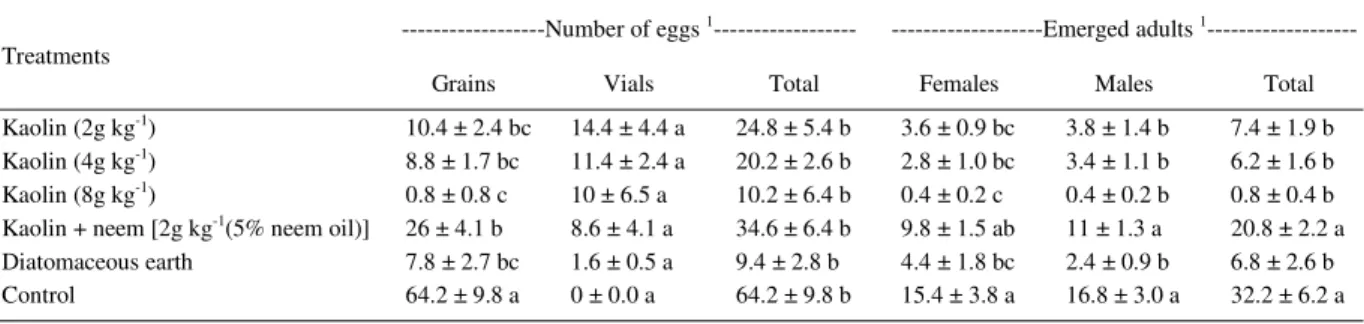
Higher number of emerged adults was
observed in the control. In the kaolin + neem treatment
values were intermediate (Table 3). DE and mostly
kaolin probably changed the oviposition behavior
because females placed their eggs in the walls of the
vials. This behavior probably disabled larvae survival
because when larvae hatch, they penetrate directly
inside the grains without contact with the outside
[CARVALHO & ROSSETTO (1968) apud SPERANDIO
(2001)]. Activated kaolin was also used for paddy rice
treatment and suppressed progeny of some insect
species for 250 days (PERMUAL & PATOUREAL,
1992). Insecticidal proprieties of DE and activated
kaolin are attributed mostly by the thin dust proprieties
that absorbs the lipids of the insect cuticle what
promotes its desiccation (EBELING, 1971; GOLOB,
1997). Although the kaolin formulation used in this
study was not heat or acid activated, protection of the
grains was found. Another probable explanation for
this efficiency is the physical action of the dusts on
the surface of the grains affecting beetles behavior.
According to HEADLEE (1924), when beans are
treated with some kinds of inert dusts, larvae slips
have no adherence to on the grain surface and
difficulties to drill into the bean. Kaolin (hydrated
aluminum silicate) formulation, when applied to the
plants, constitutes a protective barrier (Particle Film
Technology) that acts by repellence or physical barrier
which difficult movements, feeding and oviposition
(GLENN & PUTERKA, 2005). The results obtained in
this study confirm for a pest of stored grains the
previous results in which kaolin formulation reduced
insect infestations in cultivated plants (EL-WAKEIL
& SALEH, 2007; COTTRELL et al., 2002). Apparently,
the protective barrier was effective because, when
bean grains were treated with kaolin, the majority of
eggs were placed in the vials walls (Table 3).
Other inert dusts also have been proposed
for the common bean beetles management. However,
hydrated lime and mostly dolomitic lime and wood ash
are used in higher concentration than the present
study (6; 200 and 200g kg
-1, respectively)
(BAVARESCO, 2007).
Although neem oil is reported as effective
against
Z. subfasciatus
(BARBOSA et al., 2002;
SILVA et al., 2007), antagonistic effects probably
Table 2 - Cumulative mortality (%) of Zabrotes subfasciatus weevils males in common bean grains treated with kaolin, kaolin + neem and diatomaceous earth in the laboratory (25±2ºC, 70% RH; 12: 2 L: D).
---Cumulative mortality 1 (Days after treatment)
---Treatments
1 2 3 4 5 6 7 8
Kaolin (2g kg-1) 8 D a 32 CD bc 56 BC b 84 AB a 96 A a 100 A a 100 A a 100 A a
Kaolin (4g kg-1) 4 D a 40 C bc 72 B ab 92 AB a 92 AB ab 92 AB a 92 AB a 96 A a
Kaolin (8g kg-1) 0 C a 52 B ab 92 A a 96 A a 96 A a 96 A a 96 A a 96 A a
Kaolin + neem [2g kg-1(5% neem oil)] 4 D a 12 D bc 24 CD c 48 BC b 68 AB b 80 A a 96 A a 96 A a
Diatomaceous earth (1g kg-1) 24 B a 84 A a 96 A a 100 A a 100 A a 100 A a 100 A a 100 A a
Control 4 A a 4 A c 4A c 8 A c 16 A c 20 A b 32 A b 40 A b
1 Means followed by the same letter did not differ using Tukey’s test (P<0.05) (capital letters in the lines and lower case in the columns).
Table 1 - Cumulative mortality(%) of Zabrotes subfasciatus females in common beans grains treated with kaolin, kaolin + neem and diatomaceous earth in the laboratory (25±2ºC, 70% RH; 12: 2 L: D).
---Cumulative mortality1 (Days after treatment)
---Treatments
1 2 3 4 5 6 7 8
Kaolin (2g kg-1) 16 C ab 28 C bc 64 B bc 84 AB a 92A a 96 A ab 100 A a 100 A a
Kaolin (4g kg-1) 8 C ab 44 B bc 84 A ab 100 A a 100 A a 100 A a 100 A a 100 A a
Kaolin (8g kg-1) 36 B a 76 A a 92 A a 100 A a 100 A a 100 A a 100 A a 100 A a
Kaolin + neem [2g kg-1(5% neem oil)] 4 E b 8 DE c 40 CD cd 48 BC b 64 ABC b 76 AB b 84 A b 92 A a
Diatomaceous earth (1g kg-1) 24 C ab 76 B a 100A a 100 A a 100 A a 100 A a 100 A a 100 A a
Control 4 C b 16BC bc 24 BC d 28 BC b 36 AB c 40 AB c 56 A c 56 A b
occurred when it was mixed with kaolin (Tables 1, 2
and 3). The oil may have affected the sorptive effect
and the physical characteristics of kaolin and the
protective layer would be negatively influenced.
Further investigations using other neem derivatives
(extracts or powders) can be conducted to test this
hypothesis.
CONCLUSION
Kaolin treatment constitutes a suitable
candidate for
Z. subfasciatus
management
because
the F1 generation been similar to DE although higher
periods and doses than DE is necessary to promote
high mortality. The mixture of kaolin and neem oil is
not efficient in the control of
Z. subfasciatus.
REFERENCES
ALMEIDA, F.A.C. et al. Efeitos de extratos alcoólicos d e p l a n t a s s o b r e o c a r u n c h o d o f e i j ã o v i g n a (C a l l o s o b r u c h u s m a c u l a t u s). R e v i s t a B r a s i l e i r a d e E n g e n h a r i a A g r í c o l a e A m b i e n t a l, v.9, n.4, p.585-5 9 0 , 2 0 0 p.585-5 . Av a i l a b l e f r o m : < h t t p : / / w w w. s c i e l o . b r / s c i e l o . p h p ? s c r i p t = s c i _ a r t t e x t & p i d = S 1 4 1 5 -43662005000400023&lng=en&nrm=iso>. Accessed: D e c 0 2 , 2 0 0 8 . d o i : 1 0 . 1 5 9 0 / S 1 4 1 5 -4 3 6 6 2 0 0 5 0 0 0 -4 0 0 0 2 3 .
ATUI, M.B. et al. Avaliação de metodologia para a detecção de resíduos de terra diatomácea em grãos de trigo e farinha.
Revista do Instituto Adolfo Lutz, v.62, n.1, p.11-16, 2003.
BARBOSA, F.R. et al. Controle do caruncho-do-feijoeiro
Zabrotes subfasciatus com óleos vegetais, munha, materiais
inertes e malathion. Pesquisa Agropecuária Brasileira,
v.37, n.9, p.1213-1217, 2002. Available from: <http:// www.scielo.br/scielo.php?script=sci_arttext&pid=S0100-204X2002000900002&lng=en&nrm=iso>. Accessed: Apr 11, 2008. doi: 10.1590/S0100-204X2002000900002.
BARROS, A.S.R. Tratamento de sementes de milho com pó inerte. Revista Brasileira de Sementes, v.21, n.2, p.64-69, 1999.
BAVARESCO, A. Avaliação de tratamentos alternativos para o controle do Acanthoscelides obtectus (Say) (Coleoptera:
Bruchidae). Revista de Ciências Agroveterinárias, v.6, n.2, p.125-133, 2007.
CERUTI, F.C.; LAZZARI, S.M.N. Combination of diatomaceous earth and powder deltamethrin for insect control in stored corn. Revista Brasileira de Entomologia, v.49, n.4, p.580-583, 2005. Available from: <http://www.scielo.br/ s c i e l o . p h p ? s c r i p t = s c i _ a r t t e x t & p i d = S 0 0 8 5 -56262005000400020&lng=en&nrm=iso>. Accessed: Jul 04, 2007. doi: 10.1590/S0085-56262005000400020.
CHIPUNGAHELO, M.S. et al. The effect of sowing bruchid damaged bean (Phaseolus vulgaris L.) seeds on germination, plant development and yield. In: BEAN SEED WORKSHOP, 2001, Arusha, Tanzania. Available from: <<http:// sustainableseedsystems.wsu.edu/proceedings/Misangu.pdf>. Accessed: Oct 29, 2008.
COTTRELL, T.E et al. Particle film affects black pecan aphid (Homoptera: Aphididae) on pecan. Journal of
Economic Entomology, v.95, n.4, p.782-788, 2002.
Available from: <http://hdl.handle.net/10113/11297>. Accessed: May 09, 2009. doi: 10.1603/0022-0493-95.4.782.
CREDLAND, P.F.; DENDY, J. Intraspecific variation in bionomic characters of the Mexican bean weevil, Zabrotes subfasciatus. Entomologia Experimentalis et Applicata, v.65, n.1, p.39-47, 1992. Available from: <http:// w w w.springerlink.com/content/g2717767u0t85442/>. Accessed: Jun 10, 2008. doi: 10.1007/BF00189715.
EBELING, W. Sorptive dusts for pest control. Annual Review of Entomology, v.16, p.123-158, 1971. Available from: http://arjournals.annualreviews.org/doi/pdf/10.1146/ annurev.en.16.010171.001011>. Accessed: Jun 12, 2008. doi: 10.1146/annurev.en.16.010171.001011.
EL-WAKEIL, N.E.; SALEH, S.A. Effects of neem and diatomaceous earth against Myzus persicae and associated predators in addition to indirect effects on artichoke growth and yield parameters. Research Journal of Agriculture
and Biological Sciences, v.3, n.6, p.782-789, 2007.
Available from: http://www.informaworld.com/smpp/ c o n t e n t ~ c o n t e n t = a 7 9 0 4 3 8 6 6 6 ~ d b = a l l ~ j u m p t y p e = r s s . Accessed: Jun 12, 2008. doi: 10.1080/ 03235400701650858.
Table 3 - Means number of eggs (+ SE) and emerged beetles of Zabrotes subfasciatus in common beans grains treated with kaolin, kaolin + neem and diatomaceous earth in laboratory (25±2ºC, 70% RH; 12: 2 L: D).
---Number of eggs 1--- ---Emerged adults 1
---Treatments
Grains Vials Total Females Males Total
Kaolin (2g kg-1) 10.4 ± 2.4 bc 14.4 ± 4.4 a 24.8 ± 5.4 b 3.6 ± 0.9 bc 3.8 ± 1.4 b 7.4 ± 1.9 b
Kaolin (4g kg-1) 8.8 ± 1.7 bc 11.4 ± 2.4 a 20.2 ± 2.6 b 2.8 ± 1.0 bc 3.4 ± 1.1 b 6.2 ± 1.6 b
Kaolin (8g kg-1) 0.8 ± 0.8 c 10 ± 6.5 a 10.2 ± 6.4 b 0.4 ± 0.2 c 0.4 ± 0.2 b 0.8 ± 0.4 b
Kaolin + neem [2g kg-1(5% neem oil)] 26 ± 4.1 b 8.6 ± 4.1 a 34.6 ± 6.4 b 9.8 ± 1.5 ab 11 ± 1.3 a 20.8 ± 2.2 a
Diatomaceous earth 7.8 ± 2.7 bc 1.6 ± 0.5 a 9.4 ± 2.8 b 4.4 ± 1.8 bc 2.4 ± 0.9 b 6.8 ± 2.6 b Control 64.2 ± 9.8 a 0 ± 0.0 a 64.2 ± 9.8 b 15.4 ± 3.8 a 16.8 ± 3.0 a 32.2 ± 6.2 a
GALLO, D. et al. Entomologia agrícola. Piracicaba: FEALQ, 2002. 920p.
GARCIA, J. et al. Eficiência de produtos alternativos no controle de Z a b r o t e s s u b f a s c i a t u s, e seus efeitos sobre a qualidade das sementes de Phaseolus vulgaris.
P e s q u i s a A g r o p e c u á r i a Tr o p i c a l, v. 3 0 , n . 2 , p . 3 9 -4 2 , 2 0 0 0 .
GLENN, D.M.; PUTERKA, G. Particle film technology: a new technology for agriculture. Horticultural Reviews, v.31, p.1-44, 2005. Available from: <http://www.wiley.com/ WileyCDA/WileyTitle/productCd-0471666947,descCd-tableOfContents.html> Accessed: Dec 12, 2009.
GLENN, D.M. et al. Hydrophobic particle films: A new paradigm for suppression of arthropod pests and plant diseases.
Journal of Economic Entomology, v.92, n.4, p.759-771, 1999.
GOLOB, P. Current status and future perspectives for inert dusts for control of stored product insects. Journal of Stored Products Research, v.33, n.1, p.69-79, 1997. Available from: h t t p : / / w w w . s c i e n c e d i r e c t . c o m / s c i e n c e ? _ o b = A r t i c l e U R L & _ u d i = B 6 T 8 Y 3 R H 0 Y H 2 -9&_user=686187&_coverDate=01%2F31%2F1997&_rdoc =1&_fmt=high&_orig=search&_sort=d&_docanchor=&view=c &_searchStrId=1322524215&_rerunOrigin=scholar.google&_acct=C 000037199&_version=1&_urlVersion=0&_userid=686187&md5=44602d068cf236 e2f806392061fad3da >. Accessed: Dec 12, 2009. doi:10.1016/ S0022-474X(96)00031-8.
HEADLEE, T.J. Certain dusts as agents for the protection of stored seeds from insect infestation. Journal of Economic Entomology, v.17, p.298-307, 1924.
HOHMANN, C.L.; CARVALHO, S.M. Pragas e seu controle. In: CARVALHO, M. et al. O feijão no Paraná. Londrina: IAPAR, 1989. p.217-246.
LAZZARI, F.N. Controle de Zabrotes subfasciatus (Boheman, 1833) (Coleoptera, Chrysomelidae,
Bruchinae) e qualidade do feijão (Phaseolus vulgaris
Linnaeus, 1753) tratado com terra de diatomácea. 2005. 69f. Dissertação (Mestrado em Ciências Biológicas) – Curso de Pós-graduação em Ciências Biológicas, Universidade Federal do Paraná, Curitiba, PR.
OLIVEIRA, J.V.; VENDRAMIM, J.D. Repelência de óleos essenciais e pós vegetais sobre adultos de Zabrotes subfasciatus
(Boh.) (Coleoptera: Bruchidae) em sementes de feijoeiro.
Anais da Sociedade Entomológica do Brasil, v.28, n.3, p.549-555, 1999.
PERMUAL, D.; PATOUREL, G.N.J. Small bin trials to determine the effectiveness of acidactivated kaolin against four species of beetles infesting paddy under tropical storage conditions. Journal of Stored Products Research, v.28, p.193-199, 1992. Available from: http:// w w w . s c i e n c e d i r e c t . c o m / s c i e n c e ? _ o b = A r t i c l e U R L & _ u d i = B 6 T 8 Y 4 9 N 9 2 3 6 -2N&_user=686187&_coverDate=07%2F31%2F1992&_rdoc=1&_ fmt=high&_orig=search&_sort=d&_docanchor=&view=c& _searchStrId=1322572985&_rerunOrigin=google&_acct=C00003 7199&_version=1&_urlVersion=0&_userid=686187&md5=a06336396 b76577086df6755251ec5ea. Accessed: Dec 05, 2009. doi: 10.1016/0022-474X(92)90041-N.
PINTO JÚNIOR, A.R. et al. Controle de Acanthoscelides
obtectus (Coleoptera: Bruchidae) com diferentes doses de terra
diatomácea (dióxido de sílica). Revista Acadêmica: ciências agrárias e ambientais, v.3, n.1, p.75-79, 2005.
SAOUR, G.; MAKEE, H. A kaolin-based particle film for suppression of the olive fruit fly Bactrocera oleae Gmelin (Dip., Tephritidae) in olive groves. Journal of Applied Entomology, v.128, p.28-31, 2004. Available from: <http:/ /www3.interscience.wiley.com/journal/118788835/abstract>. Accessed: Nov 20, 2009. doi: 10.1046/j.1439-0418.2003.00803.x.
SCHMUTTERER, H. Properties and potencial of natural pesticides from the neem tree, Azadirachta indica. Annual Review of Entomology, v.35, p.271-297, 1990. Available from: http://arjournals.annualreviews.org/doi/abs/10.1146/ annurev.en.35.010190.001415?journalCode=ento. Accessed: Sep 10, 2009. doi: 10.1146/annurev.en.35.010190.001415.
SILVA, J.P. et al. Antifeedant and allelopathic activities of the hydroalcoholic extract obtained from Neem (Azadirachta
indica) leaves. Revista Brasileira de Farmacognosia,
v.17, n.4, p.529-532, 2007. Available from: <http:// www.scielo.br/scielo.php?script=sci_arttext&pid=S0102-695X2007000400009&lng=en&nrm=iso>. Accessed: May 04, 2008. doi: 10.1590/S0102-695X2007000400009.
SPERANDIO, L.A.A. Alguns aspectos do comportamento
de oviposição de fêmeas selvagens de Zabrotes
subfasciatus (Coleoptera: Bruchidae) em condições de
privações do hospedeiro. 2001. 76f. Dissertação