A Vida é Bela: Institutionalisation Processes
and Sensemaking through the Media
1João Figueira [email protected]
CEIS20 – Centro de Estudos Interdisciplinares do Século XX, Faculdade de Letras da Universidade de Coimbra, Largo da Porta Férrea, 3004-530 Coimbra, Portugal
Abstract
Sense making is the main goal of the Organisation’s strategy. Actually, the communica-tion by the media represents one of the key issues in the Organisacommunica-tion’s life. That requires to the Organisations that they should be familiar and have some expertise about the media culture and their routines. The Portuguese company A Vida é Bela achieved, between 2005-2012, around 4,558 issues about them in the national media. That public performance shows how an Organisa-tion could play a leading act through the media with the purpose of attracting some prestige to their brand name.
Keywords
Communication; organisations; media; A Vida é Bela
Introduction
Organisations do not live in a meaning vacuum . As they construct and assert their identity, organisations have to create meaning, that is, they have to search, as was ar-gued by Andrade (2001: 175), ‘the institutionalisations of meaning.’ These are, therefore, a core objective in the life of organisations, in the context of the complex environments in which they operate, and taking into account the multiple dynamics to which they are subject. Currently, turning communication into news ‘has become the most effective in-stitutional way of acting’ (Chaparro, 2001: 44), since sensemaking of the organisation by resorting to the media discourse gains a renewed expression and breadth.
This research therefore aims to intersect the fields of organisational communica-tion and journalism, by observing the meaning construccommunica-tion processes of organisacommunica-tions in an attempt to understand the role played by the media in those very processes, as well as the reasons why organisations need them and how they use them in their communica-tion strategies and processes.
Not all communication is targeted at the media. However, currently this is the ground where organisations compete for their vital space, to the extent that ‘media cov-erage is an essential element of any process of institutionalisation, having now con-quered an unprecedented dimension’ (Andrade, 2000: 13).
1 The present article is based on the research conducted within the scope of the PhD thesis ‘The event that seeks to become news: the sensemaking of Organizations through the media. The case of A Vida é Bela’, defended in July, 2014, at the Uni-versity of Coimbra.
The Portuguese company A Vida é Bela, founded in 2002, is an example of an or-ganisation that has always seen the media as instruments for their institutionalisation strategy and sensemaking. Therefore, they always paid special attention to all aspects related to the media coverage of their values, products and activity, until the time it went bankrupt, in November 2012.
In a study conducted on the sensemaking through the media made by the com-pany, between 2005 and 2012, in which the field of organisational communication inter-sected with the field of journalism, we observed the existence of a strategic dimension of the communication processes of A Vida é Bela that were specifically designed to have an impact on the media and achieve the respective results.
Based on the corpus collected by the company2 that monitored the media coverage
and produced the clipping for A Vida é Bela over that period of eight years, and which amounted to 4,558 news items published in the Portuguese media (whose media cover-age, according to the criteria set by the Advertising Value Equivalency, is worth 28 million Euro), a qualitative and quantitative analysis was conducted of all contents, using the SPSS software3. In addition, I also interviewed the general director of Central de
Infor-mação, Rodrigo Viana de Freitas, who assisted the implementation of A Vida é Bela’s communication strategy during the period researched, and established all communica-tion with the media on their behalf. We believe, moreover, that the statements made by António Quina in his interviews to the press strengthen the assumption of strategic focus of the company in their communication processes with the media: ‘To be fair, I must admit that it was the good press that helped me build the brand’ (i newspaper, 08.12.2012); ‘I learnt the value of spontaneous media in Brazil, and that is what differ-entiates my company from the rest. I never ceased to be a journalist; simply, I now write for myself. [Thanks to this journey] I was entitled to almost two minutes of prime-time television, 30 seconds of which using my own images. How much is this worth?’ (Visão, 6.1.2011); ‘What we do [at A Vida é Bela] is to identify new infrastructures and new oppor-tunities, transform them into experiences and disseminate them by resorting to a news format so as to whet people’s appetite’ (Across-Luxury Travel & Safaris, 1.10.2008).
Based on the total amount of contents that were published, we limited our analysis to the press, as this is the most representative (2,396 pieces) and diverse area, as far as editorial and media decisions are concerned: general, specialised (Marketing, Tourism & Travel, Economics, Women) and regional media.
The focus of the present analysis was aimed at investigating: the presence of A Vida é Bela in the Portuguese media; the presence of A Vida é Bela in the press; a contents list of pieces in which the company is the main subject, as well as pieces in which it is the main source; presence of the owner of A Vida é Bela in the media; list of contents of favourable and adverse news; the main company products covered by the media, and the values associated with them; appropriation, by the media, of the discourse and
2 We refer to Cision, a multinational based in Stockholm and world leader in media monitoring and evaluation, whose sup-port was crucial, since it would be virtually impossible to conduct the research without the corpus that it provided. 3 Statistical Package for Social Sciences.
ideological principles of A Vida é Bela; the main communication strategies of the com-pany in their relationship with the media.
Only news pieces were taken into account, i.e. all non-advertising texts included in editorial sections of the following genres: news, interviews, reports and profiles. Given the small amount (less than a dozen texts) of opinion articles written by third parties on A Vida é Bela, they were considered news items.
From a theoretical point of view, this research builds upon the work of Deetz (2003, 2010), for whom communication is a component element of organisational life, since it is the former that gives life and expression to the latter – while at the same time address-ing the views of meanaddress-ing institutionalisation followed by Andrade (2000, 2001) and the concept of celebrity proposed by Rindova et al. (2006).
Organisations as discursive constructions
With a view to implementing successful activities, organisations appropriate ‘the narrative and argumentative skills of journalism’ (Chaparro, 2001: 44), thereby assimilat-ing their routines and culture, so as to better assert their values, products, image and reputation in the public mediated space. Communication thus envisaged is a way of act-ing and makact-ing sense of the respective organisation, in which the more the journalistic discourse is identified with the strategic objectives of the organisation, the better it serves their interests. In this context, the role of language stands out, since that which we call re-ality, events or happenings are impossible to carry in pure form as they are built through narratives (Mendes, 1995). Thus, the power of the media, according to Esteves (2005), ‘cannot, under any circumstance, be considered unique, or even a priority in terms of communication structures and public meanings. This place belongs to language – upon which the media are built’ (p. 35). Besides, there is no reasoning outside language (Bar-thes, 1988), which means that it is through language that communication is materialised.
The understanding of language as power in this context is aimed at highlighting the crucial importance of language, not only as an element and an instrument of a certain discursive enunciation, but also how it is appropriated and taken on through the media narratives, in accordance with the place of its author. This is because ‘languages do not speak, only people do’ (Ricoeur, 1996: 24). That is, the sensemaking in the field of news media, building upon the strategic and persuasive action of the professional sources of organisations (who resort to their means and position to more effectively achieve their objectives), is entirely done by language. Hence, those organisations that pay more at-tention to communication issues are particularly careful with the narratives that they themselves create, as their purpose is to have a real impact on the target group(s). This explains why organisations are seen as discursive constructions, in the sense of Mumby & Mease’s (2011) understanding that it is impossible to distinguish the discourse of the members of an organisation from the organisation itself.
In this perspective, communication is no longer aimed at transmitting something, but rather at creating meaning, since organisations result from personal choices and
creations – hence subjective – and, as such, they are historically and culturally situated (Ruão, 2008).
Indeed, when organisations are seen as systems where stories are told – the
sto-rytelling system, which is, among others, the core of Boje’s (1991, 1995, 2008) studies
– the narrative approaches introduced by linguistics, not only in organisational studies, but also in the social sciences (Alvesson & Karreman, 2000; Deetz, 2003), transformed discourse analysis into a discipline that encompasses fields of knowledge as diverse as anthropology, sociology, psychology and, of course, communication (Dijk, 2011). On the other hand, the current multiplicity of approaches enabled by discourse itself and to which it is subject – social interaction, domination and power and communication, among others – allows it to overcome the old, traditional analysis centred on language, which was disconnected from a specific social and cultural context, to understand it within a wider conceptual framework in which language operates as the support of a hu-man interaction and communication multimodal discourse (Dijk, 2011).
In other words, and in line with the theories of Foucault (1996), whose works were instrumental to the subsequent development of research in the field of discourse analy-sis, language cannot be understood as an independent method or theory, but rather as a means or a tool used by human sciences to understand the world. And, to that extent, it is also the main tool used by the process of meaning construction.
This is precisely what research into discourse demonstrates, by suggesting that organisations are precarious structures that exist only through the discursive practices of its members (Mumby & Mease, 2011). This suggests that discourse is a component element of the organisation (Deetz, 2003, 2010).
From a theoretical perspective, this research – which gives precedence to the pro-cess of construction of senses and meanings – sees discourse as the expression of text and speech, which is built right when interaction takes place, and whose relationship also includes the process of construction of emotions, identities, attitudes and signs, among other aspects of the organisational reality (Jian, Schmisseur & Fairhurst, 2008). However, as was previously observed, discourse presupposes a certain intention, which brings us closer to the criticism made by Fairclough (1989) to those who argued for au-tonomous linguistics, by considering it as ‘an asocial way’ (p . 7) of studying language, as it ignored the relationships holding between language, power and ideology. Fairclough, like Dijk, are positioned in the field of critical discourse analysis. This means that the context is a key dimension where the players are built and build the discursive processes ‘from its ideological nature’ (Pedro, 1997a: 20). Discourse is, therefore, both a commu-nicative act and a social practice, since its implementation influences and is influenced by the contexts in which it takes place (Fairclough, 2003). Therefore,
a discourse provides a set of possible statements about a given area, and organizes and gives structure to the manner in which a particular topic, ob-ject, process is to be talked about (Kress, 1985, quoted in Pedro, 1997a: 22).
In this discursive action – that is, in journalistic discourse and in its interactions and relationships with organisations (as sources) – there are, thus, views and understandings
of the world that underlie that which is said, published. In this respect, a journalistic text always corresponds to an option, since it reflects the interpersonal choices of its author and how s/he represents the world and the other. These choices ‘position the textual producer [in this case, the journalist] in relation to the propositional contents, as far as a particular cognitive and social representation of reality’ (Pedro, 1997b: 294) is con-cerned, while simultaneously reflecting
ideological strategies that reveal, not only the positioning of the author in relation to the real story – the specific event that justifies the information –, but also the strategies that they use to position, in a particular way, their readers (Pedro, 1997b: 294.)
As they are aimed – or when they do – at sensemaking through the media, organi-sations can only achieve this purpose through journalistic discourse. Consequently, they share responsibility as promoters of information and events and, moreover, they play the role of news characters, once transformed into narratives. Taking this perspective into account, there are (news) organisations that operate as the set and the stage of an event, project, idea or concept, and organisations that interact with the former, and which are – or want to be – responsible for the enunciation of the news discourse.
An organisation, as primary definer (Hall et al., 1993; Ginneken, 2003) of the com-munication process – to which, in the organisation context, we may call what Andrade (2000: 11) terms ‘organisational narrator’ – plays a decisive role, as news source. How-ever, this role is all the more crucial the more influential it is, and the better it masters the news culture.
Communicating for and with the media
Introducing the concept of primary definer is especially relevant, as it enables map-ping, in the framework of the news process, the message meaning, what it says and al-lows saying, and the intended interpretation of the corresponding informative excerpt:
This interpretation then ‘commands the field’ in all subsequent treatment and sets the terms of reference within which all further coverage or debate takes place. Arguments against a primary interpretation are forced to insert themselves into its definition of ‘what is at issue’ – they must begin from this framework of interpretation (Hall et al, 1993: 230).
The primary definer plays, in fact, a highly relevant role, as we shall see, because it can influence the view and the choices of the journalist in relation to the primary and secondary aspects of a certain event. This role is particularly salient in the case of the ac-tivities of A Vida é Bela – the case study researched –, as in the media arena the company lives almost exclusively of the view that it projects itself, and which is more favourable to them. That is, since their public exposure through the media is solely aimed at promot-ing their products and projects, which, in turn, stimulate notions of pleasure and well-being resulting from the experiences that they sell, the organisation – the sole source of
information of the news pieces in which they feature – communicate their values and their views. In this sense, A Vida É Bela go beyond the primary definers. This is because they are not subject to the adversarial principle, the statements of the company owner – and main actor – António Quina are never questioned, and neither is the company ever challenged. Exception is made to the period between October and December 2012, over the eight years (2005-2012) of meaning construction through the media analysed; this is the period preceding the fall and subsequent bankruptcy of the company.
In fact, the company and the owner, António Quina, knew how to use the news media very effectively, providing them with informative contents that they need, and whose stra-tegic relevance is mentioned by Chaparro (2001). Since ‘making themselves to the news has become the most effective institutional course of action’ (Chaparro, 2001: 44), on which depend, to a great extent, the results and the success of organisations, then these organisations increasingly need to know how to use – because competition is increasing –, that is to influence, the news schedules so that they deal with the events, projects and products of a company and, therefore, promote their public image and highlight them.
The sensemaking through the news media is thus currently a crucial element in the life of organisations, particularly of companies that need to keep a permanent visibility and communication with their audiences. Hence, the close relationship that they need to establish with the news area, which requires from the company, not only an ability to seduce, but also initiative, as well as an ability to influence, so that their discourse and their values are assimilated, internalised and publicly taken by the news media. The ter an organisation – business or other – masters the culture of news production, the bet-ter positioned they will be to obtain gains from their communicative dimension. António Quina himself revealed that his communication strategy with the media relied on taking the products that he wanted to disseminate and subsequently ‘disseminating them us-ing a news format so as to whet people’s appetite’4. Not to forget the aim of whetting
also the journalists’ appetite. There are two good examples of this: one is the presenta-tion of the Hummer limousine rides from inside the car, where he welcomed journalists from the major media, and took them in turn on a ride through the city; the other is the invitation that he sent to a group of journalists for a Ferrari drive in the Spanish Jarama race track as a means to introduce that experience in Portugal.
In this sense, not all organisations are at the same level, i.e. not all of them have the same tools and resources to influence the news agenda for their own advantage. Like-wise, as sources of information, they are not all equal before the media. Consequently, only the best-positioned and equipped organisations have the ability to influence and transform their own discourse into news discourse, thereby promoting their meaning construction through the media. Let us now look, in the case of A Vida é Bela, at how, firstly, the company deployed their institutionalisation process.
Institutionalisation of A Vida é Bela
It all started in 2002, when António Quina founded the 60,000 euros capital com-pany Maritz Marketing, whose core product was a guide of unforgettable experiences
called A Vida é Bela. The first client was BP, followed by Banco Best, Unicer, Renault Gest,
and later Vodafone5. All of them had the same wishes and the same demands: to create
different, innovative, outstanding prizes. It is this spirit of differentiation that lies at the origin of the ideas that would provide those companies’ special customers with a flight aboard a MiG 21, in the outskirts of Moscow, and a Formula 1 training in southern France. The first experiences were thus born in Portugal, within the scope of experience marketing.
The aim, as the word itself suggests, is to provide a product, service or brand ex-perience to all those who get in touch with it. This new form of relationship differs from traditional marketing since the experiences are focused – and that is their purpose – on the life experiences that they offer to the respective consumer (Schmitt, 1999; Andrés
et al. 2005). I.e. the experiences replace ‘the functional values and provide sensorial,
emotional, cognitive, behavioural and relational values’ (Andrés et al., 2005: 41). These values, whose conceptualisation was developed by Schmitt (1999), are highly focused on the sensory and emotional spheres, thus transforming it into the more relevant feature of experience marketing, although not the only one.
In Portugal, this concept was introduced via corporate activities, i.e. events related to companies and / or brands. However, the resulting degree of satisfaction, which was not independent of the fact that marketers have discovered a new lucrative niche, soon led the concept of gift experiences into reaching ordinary citizens, as new products were launched. The table reproduced below is an example of this diversity and respective af-fordability to ordinary citizens.
Figure 1. Diversity of products offered by A Vida é Bela6
5 António Quina also revealed in an interview that these were also the companies that ‘accounted for our initial business volume’, Human magazine (Martins, AL, April 1, 2009: 6). The same information is conveyed by Andrés et al. (2005). 6 From: A Vida é Bela selling dreams with experience marketing.
After an initial period especially focused on organising events and creating unique sensory and emotional experiences, the company extended their range of offerings to include, among the wide range available, gourmet dinners, massages, special tours and accommodation. The company expanded, and one of their offers, A Vida é Bela, quickly took over, to such an extent that it became the ID of the entire company.
Soon, this name became a concept: it won the product of the year award in 2011. It became the flagship of the gift experiences market, gained its individuality, and came to be treated indistinctively in the public sphere as trademark and / or as company. It is also as a company that we hereby refer to A Vida é Bela, which in a few years grew from a small team of initially five unemployed people to dozens of employees. The ultimate expansion was from 20057 when the company opened their first shop in Restelo, Lisbon, and hired
the expert services of a public relations and communication consulting company called Central de Informação. Their media coverage increased, and so did their turnover. A Vida é Bela and their gift experiences ceased to be a novelty and become fashionable. In 2006, the company extended to Spain, where they opened a local office. Brazil then followed. The turnover grew year on year: 8.8 million euros in 2008; 11 million euros in 2009; 24 million euros in 2010; and 47 million euros in 2011. The fall of the company began the following year, which was apparent only in the second half of the second semester, when the first news were circulated that several hotels rejected their vouchers. In November 2012, António Quina declared the suspension of their business activities. A month later, DECO had registered 1,600 complaints against the company, which, in 2013, had their Special Process of Revitalisation (commonly known as economic recovery and refinanc-ing plan) failed by their major creditors – the banks. The outcome was a 13 million euro debt and 1,500 creditors.
But how could this company – which has developed out of nowhere, that is, of a mere idea (‘I started paying business visits to some potential clients, simply bringing a models folder with me’ (Andrés et al., 2005: 12.) – climb to the Olympus to then fall on the Tarpeien rock? What role did communication play in this process? How did the com-pany relate to and use the media, i.e. what role did the media play in the sensemaking of A Vida é Bela? What steps did the company take to position itself in the market and consolidate its market position?
Briefly, the process of institutionalisation of the company, from the moment it was launched to its market consolidation, was mainly marked by the following steps: a) in-novative diverse range of offerings (as mentioned above); b) experiences affordable to the middle class (driving a Ferrari cost 149.90 euro and riding a balloon cost 74.90 euro, but the range of offerings started at 15 euro); c) support and promotion of partnerships that simultaneously increased the public expression of A Vida é Bela and expanded the gift experience offering supply; d) intervention with the top management, especially with large companies; e) participation in marketing and tourism seminars and conferences,
7 The reason why our research into the company starts in 2005, rather than on the date when the company was founded, is that the company took a qualitative leap that year, when it actually started expanding into the market and initiating their aggressive media coverage.
while the company owner contributed opinion articles in specialised periodicals; f) open-ing of outlets in shoppopen-ing centres throughout the country; g) close relationship with the media, especially from 2005 onwards, which marks the company’s expansion and the date when the company resorted to the specialised services of a communication and public relations agency (Central de Informação), at the same time the first shop, which was introduced as the first experience store, was opened in Restelo, Lisbon; h) strong presence in the media.
These were, in short, the activities and means used for the institutionalisation of the company, based on the brand differentiation (and products), aiming at building a reputation. This was deployed by resorting to the distinction that Andrade (2000) refers to, and by calling upon the communication processes for the achievement of its objec-tives. These, in fact, ‘are true institutionalisation processes’ (Andrade, 2000: 12), as com-munication, in this context, aims at ‘enforcing an establishment’ (Andrade, 2000: 12).
The aim of institutionalising, i.e.
of making something into an institution, discloses the very old need for individuals and their organizations to ensure the stability of conducts, to gain a place at the ‘centre of the world’ (which, for a company, equates, for example, with conquering a privileged place in space or in the inter-organi-sational network to which it belongs) (Andrade, 2000: 9).
Therefore, we are led into agreeing with the author that institutionalising, in addi-tion to being a ‘meaning distincaddi-tion’ (p. 9), is a process that tends, due to the status that it creates, to gain a legitimacy that leads to what Oliver (1992) considers the standardisa-tion of the establishment.
The concept of sense, in the terms that we use, refers to that which the organisa-tions draw up from the signs of the present ‘and the ever porous environments in which they are immersed’ (Andrade, 2000: 4), taking into account that creating meaning con-sists of the ability to create a fact, to make something visible and sensitive (Weick, 1995). In the case of A Vida é Bela, the creation of something visible and feasible to which Weick (1995) refers received an important contribution from the media. To the latter, the com-pany allocated a strategic role for their assertiveness, within the framework of which its celebrity construction process is inscribed.
Celebrity as a product of the media
By extending the concept of celebrity of the individual sphere into the analysis of the collective sphere, understood as a brand or company, Rindova et al. (2006) argue that the strong public attention combined with a positive emotional response – which are aspects that characterise the concept of celebrity – contribute to increased economic opportunities available to an organisation. Public attention, in the context of the present study, refers to the idea of celebrity-building through the media, without mitigating the key role that companies play in this important field: ‘Firms contribute to this process by
taking nonconforming actions and proactively seeking to manage impressions about themselves’ (Rindova et al., 2006: 50).
The term celebrity can be defined in terms of the consequences that a given actor causes or originates in large audiences, who pay attention to it and for whom it has a huge value (Rein, Kottler & Stoller, 1987). Or alternatively as someone who draws posi-tive emotional answers from the public because the respecposi-tive actor has a posiposi-tive va-lence to the audience (Trope & Liberman, 2000), ‘to the extent that he or she helps fulfill various behavioral goals” (Rindova et al., 2006: 51).
In the case of a celebrity, this presupposes meeting the audiences’ needs of fantasy, gossip, identification, status, affiliation and affinity (Adler & Adler, 1989; Gamson, 1994; O’Guinn, 2000 apud Rindova et al. 2006: 51). Therefore, it can be stated that the concept of celebrity lies primarily with the relationship that a particular actor establishes with the respective audience(s), rather than corresponding to a certain characteristic – innate or other – that he or she have. Rindova et al. (2006), moreover, envisage celebrity in terms of the nature of the audience’s reaction, either before a person or a company. This enables authors to use the term celebrity in the context in which these reactions were caused: ‘We do so in order to avoid more cumbersome terms, such as individuals or firms that have achieved celebrity, or celebrity individual and celebrity firms’ (2006: 51).
It is, however, important to stress that, although some actors attract public at-tention through negative emotional responses, this spans beyond the scope of this re-search, which focuses exclusively on positive emotional responses. This research consid-ers that a famous company is that which has a high capacity to attract public attention and to cause positive emotional reactions from the target or affected audiences. In the case of companies, celebrity is closely associated with economic goals, because that is the reason of their existence. That is, if a company does not generate positive emotional responses, it can be admitted that their economic performance is also limited:
without the attention of an audience of significant size, a firm’s ability to generate positive emotional responses is likely to have limited economic consequences. Without positive emotional responses, the level of atten-tion a firm commands may be insufficient to influence stakeholder choices (Rindova et al., 2006: 51).
Currently, the construction of the celebrity takes place in the mediated public space, this being the reason why it is said to be a product of the media. Daniel Boorstin (1961) was the first to approach this topic, when he referred to the creation of pseudo-events and the processes that lead to their newsworthiness – although some decades earlier Walter Lippman (1922), in his most famous work, Public Opinion, had already touched upon this, by emphasising the strategic dimension of narrative attractiveness of journal-ists, who sought to reach the respective audiences through it (i.e. through the actors (individuals or organisations) who participated in it).
According to Boorstin (1961), celebrities are a product of modern communication technologies that strengthen an individual presence in the eyes of the general public, making it, in his own words, ‘known for their wellknownness’ (p. 47).
More recently, O’Guinn (2000), Gamson (1994), Reine et al. (1987), among others, analysed and studied the same phenomenon, as they argue, like Gans (1979), Schudson (1978) and Gitlin (1981), that the media play an important and powerful role in shaping the public agenda. Hence, they attract and draw the attention of the public to certain actors and their discourses in particular. It is within this framework of relationships and public exposure that celebrity is constructed – although, interestingly, as noted by Gam-son (1994) and Rindova et al. (2006), despite celebrities playing such an important role in contemporary societies and markets, the celebrity topic is far from being studied in direct proportion to its relevance.
From the point of view of marketing scholars, the celebrity phenomenon results from the combination of entertainment and fame (Reine et al., 1987 cited in Rindova et al., 2006) in order to create high visibility products, desirably able to surprise or innovate. This is the case of the following proposals of A Vida é Bela, which were so suggestively com-municated by the media discourse that passes off the company discourse as their own:
Since it is increasingly difficult to find original solutions for parties, offsites and business celebrations, the experiences guide provides some hints that will not leave anyone indifferent. (...) A Vida é Bela will select the best chefs, as well as the most creative cooking workshops, and engage the most re-nowned oenologists, so that you can prepare a gourmet event that is ad-justed to the needs of each institution. (...) A Vida é Bela also suggests a Funky Party along a very special journey; can you imagine a train booked exclusively for your company, lots of entertainment and music to the sound of the 70s, and a game that depicts a lively scene of ‘Murder on the Orient Express’?8 (‘A Vida é Bela’, August 1, 2008: 86-87).
Or even the observations made by the journalist in the middle of the interview with António Quina, which contribute to strengthening his popularity and picturing him as a permanent creative – elements that are part of his personality as media character:
He makes a long pause, the longest in the whole interview. He seems to be looking for the right words; this is the first time that he gives this impres-sion, to the extent that such a long silence seems odd. Is he already think-ing about the meetthink-ing that he will have in the eventhink-ing, just before dinner? Did he get some spontaneous inspiration? His expression reveals nothing, apart from his effort to concentrate on something. When he resumed the conversation, almost half a minute later, he acted as if the question had just been asked9 (‘As pessoas ainda acham que sou maluco’, June 24, 2007: 55).
Once again, celebrity is generated and created through the media, which, by resor-ting to a process of choices and selection, produce what Marc Lits (1996) calls media
8 Executive Woman. 9 Público: Pública.
character. This was also studied by other researchers, such as McCracken (1989) and Reeves (1988), who describe this character as the subject of an action that aims to sti-mulate strong and positive emotional responses from their target groups or audiences.
In the case of media narratives, and particularly in journalism – which is the focus of this research:
it is known that the character represents a real life person. It is, however, the case that, usually, all we know about that person is what the media convey. Usually, ordinary people only get to know the most renowned politicians or show business people through biography excerpts conveyed by the media (Mesquita, 2003: 133).
After the media character previously constructed by the newspaper Público (‘As pes-soas ainda acham que sou maluco’, June 24, 2007), which allowed ordinary citizens to learn more about António Quina, another narrative depicted the same person with anoth-er level of detail, but with the same intention and purpose to construct a favourable image:
His personality is contagious, he is good-humoured, he speaks with his hands and laughs with his body. He likes doing things, taking on his re-sponsibilities, doing fieldwork, and experiencing things. Above all, he en-joys living life, which he considers to be beautiful... just like the film that inspired him to name the company for which he now works night and day: A Vida é Bela – Life is Beautiful. This is the first major experience company in the Portuguese market, which reached Spain and Brazil in less than five years, and which António Quina wants to make a global brand. As long as his memories go, he has always been like this: dreamy, optimistic, and en-ergetic, with a knack for business. He recalls a day when he was seven years old and lived in Milan; his mother fetched him from the street where he sold trinkets to raise money10 (‘Porque a Vida é Bela’, January 1, 2010: 89).
The process of celebrity construction thus takes place within a system of production (of communication and information) that tends to emphasise certain characteristics and values. In this respect, Gamson (1994) and McCracken (1989) highlight, additionally, the changes operated in the narratives on the characteristics of celebrities throughout the twentieth century.
As a result of the emergence of a new culture of consumption – particularly in the societies that, a few decades later, came to be known as post-industrial – from the 1940s onwards the values of merit, aptitude and competence were gradually replaced with the increasing customisation of image valorisation and what it stands for, both as a lifestyle to which audiences aspire, and as a social category, status or symbol of success. This means, according to Rindova et al. (2006), that the degree of manipulation in the celebrity pro-duction process impacts, not only their sustainability and value, but also their greatness:
Whereas ‘celebrity personas’ can be entirely fabricated, resulting in ‘minor’, ‘shortlived’, or ‘flash in the pan’ celebrities, individuals with real ability and a unique style become ‘stars’, ‘superstars’, or ‘cultural icons’ (Dyer, 1979 cited in Rindova et al., 2006: 53; Gamson, 1994;McCracken, 1989: O’Guinn, 2000; Reeves, 1988).
This excerpt, which synthesises extremely well the celebrity media production pro-cess, inevitably refers us to an in-depth article on António Quina’s character and life that was published in Expresso, and whose opening lines are quoted below:
Pop! The stopper of a small bottle of French champagne hits the sea. António Quina, carrying his diving goggles at his chest, wearing a tight neo-prene suit and carrying an air cylinder on his back, swims with one hand while sipping his champagne from the bottle in the other, only seconds after emerging from the depths of the ocean. We are off Baía dos Porcos, in Sesimbra. The sea is calm, the day is sunny and the sky is clear. We join António on a toast to life, to the future and to future successes. (...) António Quina, 43, achieved what many of us wish, but have never achieved or never had the courage to try11 (Mendonça, August 7, 2010: 48).
Therefore, by impacting the degree or the individual greatness of the respective ce-lebrity, based on their media exposure and on what the media say and write about them, this media coverage brings along natural consequences and advantages in the sphere of economic opportunities that then come to be offered, and to which they can access more easily. Between 2005 and 2012, António Quina made a total of 852 appearances in the news. This includes pieces where he is cited as the source, where he is interviewed or where he is the subject of a news profile. The figures in the following table aim to show his news value and, consequently, his presence in the media, which are considered an important contribution to the media coverage of the company A Vida é Bela. Especially as, it should be emphasised, in the whole media presence of António Quina it is not possible, as Mumby & Mease (2011) argued, to disconnect the discourse and the values conveyed by the organisational narrator from the organisation itself.
Figure 2. Chart showing the presence of António Quina in the media and its news value.
As can be seen, the press (491 published pieces) is the journalistic field that paid more attention to António Quina, with 60% of the overall news items. This corresponds to almost the double of those that were published in digital media. The radio, as we will see later in relation to A Vida é Bela, had a very marginal number of pieces – 17 – i.e. two per cent over the total number of pieces that were edited.
The media coverage of António Quina represented a strong and decisive contribu-tion to his celebrity construccontribu-tion process as the face and role model of a certain way of being and of living life; however, his activities were never intended to be disconnected from the activity and the brand of his company. It is a known fact that the more famous people are, the greatest are their chances of multiplying and maximising the return on the opportunities in which they participate. This means that their (media and business) attractiveness potential is directly proportional to the profits and benefits that are gener-ated and provided to the third parties.
António Quina, president of A Vida é Bela, yesterday announced in Porto the launch of three new brands: Enjoy, Weekbreak and Freepass. The three new concepts will position themselves in different market segments. The Weebreak results from a partnership with Galileo and is aimed for travel agencies. A Vida é Bela closed the year 2008 with a turnover of 8.8 million euro overall, in Portugal, Spain and Brazil. In 2009 the company expects to generate revenues of 11 million euro 12 (‘Empresa ‘A vida é bela’ lança três novas marcas e factura 9 milhões de euros’, May 15, 2009: 21).
As was previously mentioned, António Quina has always taken advantage of his media exposure to maximise the name and the activities of A Vida é Bela. Rather than transforming his name into a brand, his plans consisted of taking full advantage of the spotlights and the stage that he was offered to transform his company, as it turned out, into a celebrity.
In this line of thought, it can be stated, several celebrities eventually transform their
names into brands. Ronaldo is CR713; the chef José Avilez has his image managed by a
communication and marketing expert, thus transforming him – and the companies that he runs – into a brand, too; and the same applies to people like David Beckham, Ferran Adrià, and Ophrah Winfrey, among many others.
These cases, in line with the understanding of Hayward et al. (2004), are carefully and strategically disseminated, since they follow a particularly well-prepared information model that aims to produce and disseminate at a larger scale the features or achievements of those at stake. And although the media play a core role in this process of dissemination and creation of collective myths, precisely by resorting to often exaggerated appraisal and highlights of the successes and skills of these individuals (Rein et al., 1987), the truth is that nowadays, the use of the social media – namely Twitter, where, for example, Cristiano
12 Diário Económico.
13 According to the Marketeer magazine (no. 211, February 2014), which cited a study by IPAM (The Marketing School), the value of the brand Ronaldo, after he was awarded this year’s Golden Ball, ‘is 50 million euro’ (p . 30).
Ronaldo has 23 million followers – personally or by those who represent them14, expand
and maximise the construction and consolidation capacities of celebrities, who, it should be noted, live and feed themselves not only on their deeds and achievements, but also on the attractiveness of their identities (Rindova et al., 2006; Gamson, 1994).
This review of the literature that studies the phenomenon of individual celebrity provides us with valuable clues to understand their construction process at the company level: ‘The idea that the media socially construct celebrity firms by featuring them in dra-matic narratives is consistent with research on celebrity creation at the individual level’ (Rindova et al., 2006: 56).
These same ideas can be found in the journalistic discourse, as the following exam-ple on António Quina and the creation of his company shows:
Creating an experience company, having two beaches he can call his and re-ceiving this newspaper aboard a catamaran. The life of the creator of A Vida é Bela is not restful, but it’s not bad at all, either. (...) For António, ‘surviving tomorrow is building today’. For those who do not believe in success, suc-cess can only be achieved this away: non-stop15 (Marques, April 25, 2009: 6).
Either through a thorough communication strategy based on interaction processes between the company and the media, through press releases, or by creating events with media coverage potential – which Boorstin (1961) terms pseudo-events – A Vida é Bela and their owner achieved a remarkable public exposure. Their easy – or shall we say privi-leged? – access to the media, which the data presented below demonstrate, confirms the assumption that both the company’s institutionalisation and sensemakingprocess, and their celebrity construction are strongly associated with the role and action of the media.
The media coverage of A Vida é Bela
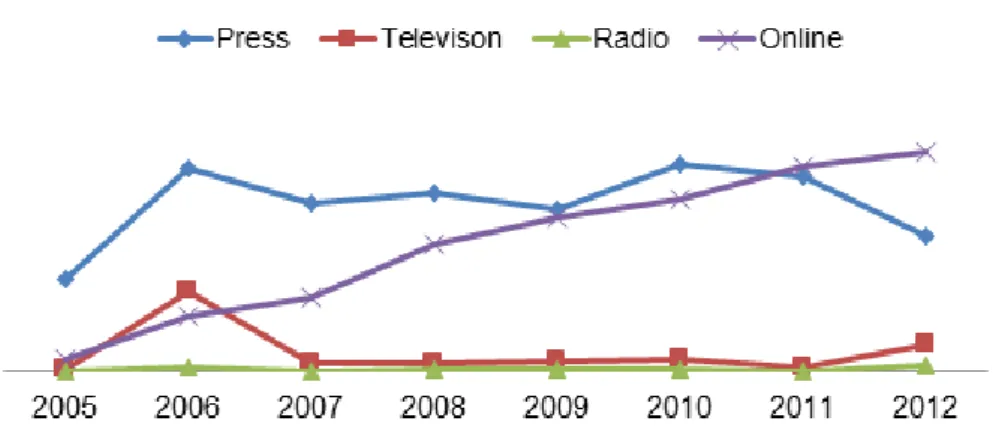
Between January 2005 and December 2012, A Vida é Bela featured in a total of 4,558 news pieces across the Portuguese media. With the exception of the very small number of radio pieces, the company achieved a remarkable media attractiveness and penetra-tion rate. Estimates by Cision (the company responsible for monitoring the media cover-age and calculating their results for the imcover-age of A Vida é Bela) and by Central de Infor-mação suggest that such media coverage is worth around 28 million euro in Advertising
Value Equivalency (AVE). In the press alone, the AVE value is 13 million euro, according
to the two sources that monitored and supported A Vida é Bela throughout those eight years. The two charts and the table below provide the overall figures of the company’s media coverage:
14 Cristiano Ronaldo (and José Mourinho, who is called ‘the special one’ by the media) is represented by the company Gestifute, owned by businessman Jorge Mendes, who is responsible for all aspects related to the player’s image and com-munication strategy.
Figure 3. Chart showing the evolution of the company’s news coverage (2005-2012).
Table 1. Evolution of the presence of A Vida é Bela in the media (2005-2012).
Figure 4. Chart showing the percentage media coverage of A Vida é Bela.
When analysing the press news coverage (the field analysed by the present re-search), we noticed that A Vida é Bela was the subject of 2,396 pieces scattered over dozens of media over the period studied. These were collected into six major groups: Generalist, Women, Tourism & Travel, Economics, and Marketing and Regional. The rep-resentativeness of the press (2,396 out of a total of 4,558 pieces), together with a great
editorial diversity, justifies its choice as our field of study. The following figure shows the year-on-year evolution of the pieces published:
Figure 5. Number of pieces published per year between 2005-2012.
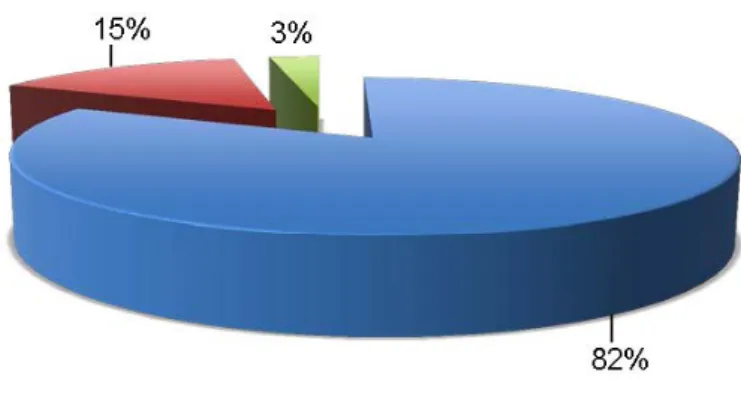
Figure 6. Typology of pieces published in the press.
Figure 6 shows the media coverage of A Vida é Bela divided into different types of texts: news, promotions and opinion articles. This is intended to allow for a better understanding of the profile of the published texts. Thus, we found that 1,969 texts (i.e. 82%) are pieces that were written following journalistic conventions, whereas 356 text are
short, promotional texts, almost always accompanied by a small picture similar to the one illustrated in Figure 1 of this article. Although the existence of this type of contents strengthens, on the one hand, the public image of the company’s media penetration ca-pacity – and therefore it is appropriate to take these inserts into account – on the other hand, we believe that a distinction should be made between the afore-mentioned promo-tions (albeit their being placed in news areas, as information, and not as advertising) and newspaper articles that were written taken professional conventions into consideration. This distinction highlights, moreover, the company’s leading role and their ability to ac-cess the media, since 18% of the contents found in the press are not published as a news story, interview or in-depth report, but rather as useful information texts suggested by the respective magazine or newspaper.
It was also decided to separate the opinion texts written by António Quina, which, to a certain extent, also contributed to reinforcing the company’s image in the press – since the name A Vida é Bela is always associated with him, and even operates as identi-fying brand for readers, in relation to his name and job role, and his work place.
The fact that these details are highlighted is intended to provide a more exact and accurate picture of the profile of the pieces published, and furthermore to show how A Vida é Bela penetrated the press, by resorting to a variety of textual devices and narrative strategies.
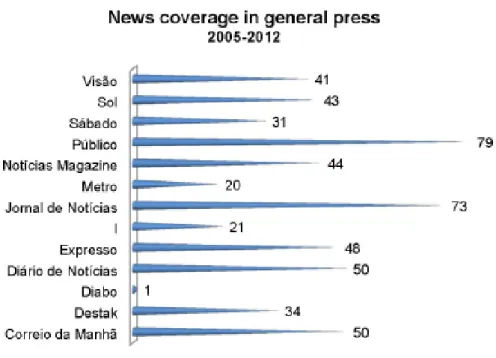
Figure 7. Number of pieces published in each Generalist medium 2005-2012.
The generalist press (554 pieces) was the segment that paid more attention and allocated most space to A Vida é Bela, with almost as many pieces as those published jointly by Economics (234), Tourism & Travel (243) and Regional (104) media. Marketing (122) and Women (123) media complete the picture. This picture, however, is not really
complete until another element is considered: the high number of pieces published in the group referred to as ‘Other’. This naming reflects the considerably high dispersion of pieces published in a wide range of media. Each of these media – most of which are spe-cialised in certain niches, such as Animals, Health and Wellness, Fashion and Garden, among many others – has a small number of news, but overall they represent around 40% of the texts published. This fact, which was moreover stressed in the research inter-view conducted with the general director of Central de Informação, shows the attention that both the company and António Quina paid to the whole media spectrum, and which resulted in their media penetration capacities.
In the generalist press group (Figure 7), Público is the undisputed leader. It is worth stressing, however, the attention paid by the news magazines (Visão, Sábado and Notícias
Magazine), as well as by the influential Expresso. The present analysis also found that,
although Público was the medium that wrote the most pieces on A Vida é Bela, it did not publish a single line on the company’s period of crisis, when news emerged about vouchers issued by the company being rejected; likewise, it extraordinarily ignored the business closure and subsequent bankruptcy.
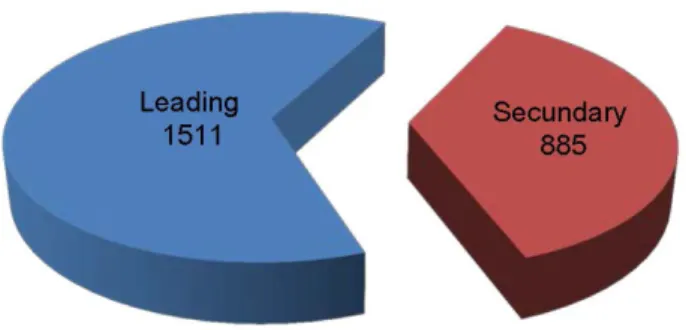
Figure 8. Chart on the leading role of A Vida é Bela within each page.
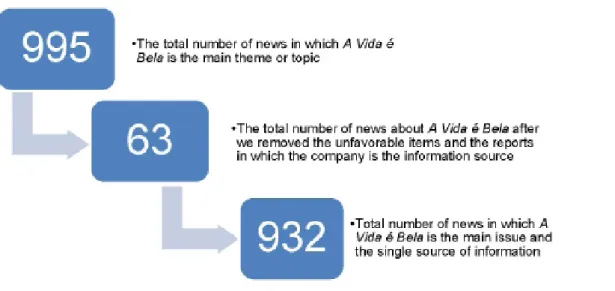
Another relevant aspect of the news coverage of A Vida é Bela is that of a total of 2,396 pieces, 1,511 are in the main area of the respective page. If we add to this the fact that A Vida é Bela was the main topic of 995 news pieces, we can have a more complete picture of the leading role played by the company. Furthermore, if the 63 unfavourable news pieces where A Vida é Bela features as the main topic (but not the source of infor-mation) are subtracted from the afore-mentioned 995 pieces, a total of 932 news items is obtained in which the company is both the main topic and single or main news source. The role of the company as primary definer, in the sense in which the concept was previ-ously framed, can thus be observed. This is moreover strongly demonstrated by their leading role, together with the fact that they are the exclusive or main source in 932 cases.
Figure 9. A Vida Bela as main topic and source
The leading role and their ability to set the tone and determine the direction of in-formation that was produced, within the scope of the sensemaking process conducted by the media about A Vida é Bela, is further reinforced by the data of the present research on the rate of favourable and adverse news. The following chart (Figure 10) shows the re-sults of this process – 63 adverse news in eight years of media attention and 2,396 pieces in the press. Notwithstanding, they all relate to a short period (October-December) in 2012, when, due to the appearance of another institutional source in the scene – DECO – the media were no longer able to mitigate the company’s crisis and the criticism against them.
These data confirm our previous assumption that A Vida é Bela played a role as news definer, and that their discourse was appropriated by the media. These figures also underline the company’s influence and privileged access to the media, which (almost) always simply reproduced the sensemaking by A Vida é Bela via the multiple interactions that the company established with them.
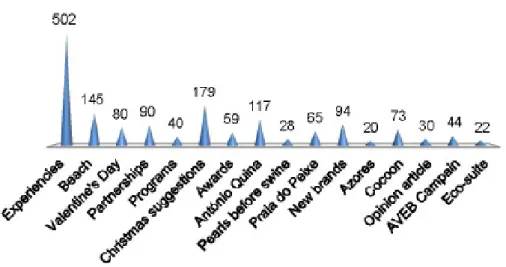
Finally, Figures 11 and 12 show the list of top products covered in the news and the corresponding values. As the company closed their activity before the end of 2012, only the data until December 2011 are taken into account.
Figure 11. Main products covered in the news (2005-2011)
Figure 12. Main values associated with the products covered.
Conclusion
Starting with the initial definition and application of a set of measures that led to the institutionalisation of A Vida é Bela, the company then implemented, especially from 2005 onwards, a process of sensemaking through the media, which is reflected in the data presented in this study. In fact, the meaningfulness of the high media coverage achieved over the period studied spans beyond the figures. This coverage has a thickness whose sense takes on a new and more consistent meaning when the company succeeds in having the journalistic discourse appropriate their own discourse and their own values.
Additionally, the assumption is also confirmed that the media contributed deci-sively to the process of meaning and celebrity construction of A Vida é Bela; in this context, the action of the company owner, António Quina, played a strategic role. In this context, it was also found that it is impossible to disconnect the discourse of a member of an organisation from the organisation itself. At the same time, the concept that com-munication is an integral component of organisational life (Deetz 2003, 2010) gained a new élan.
References
Adler, P. & Adler, P. (1989) “The Gloried Self: The Aggrandizement and the Construction of Self”, Social
Psychological Quaterly, 52: 299-310.
Alvesson, M. & Karreman, D. (2000) “Varieties of Discourse: On the Study of Organizations Through Discourse Analysis”, Human Relations, 53(9): 1125-49.
Andrade, R. F. de (2000) Institucionalizações e Colapsos de Sentido nas Organizações, Lisboa: Universidade Lusófona.
Andrade, R. F. de (2001) Institucionalizações, Colapsos e Reparações de Sentido nas Organizações, Tese de Doutoramento, Lisboa: [S. n.].
Andrés, A., Caetano, J. & Rasquilha, L. (2005) Gestão de Experience Marketing, Lisboa: Quimera. Barthes, R. (1988) Lição, Lisboa: 70.
Boje, D. M. (1991) “The Storytelling Organization: A Study of Story Performance in a Office-Supply Firm”,
Administrative Science Quarterly, 36(3): 106-126.
Boje, D. M. (1995) “Stories of the Storytelling Organization: A Postmodern Analysis of Disney as “Tamara-Island””, Academy of Management Journal, 38(4): 997-1035.
Boje, D. M. (2008) Storytelling organizations, Los Angeles: Sage.
Boorstin, D. J. (1961) The Image: A Guide to Pseudo-events in America, New York: Harper & Row. Chaparro, M. C. (2001) A linguagem dos conflitos, Coimbra: Minerva.
Deetz, S. (2003) “Reclaiming the Legacy of the Linguistic Turn”, Organization, 10(3): 421-29.
Deetz, S. (2010) “Comunicação Organizacional: Fundamentos e Desafios” in Marchiori, M. (Org.) (2010)
Comunicação e Organização: Reflexos, Processos e Práticas, São Caetano do Sul: Difusão, pp. 83-101.
Dijk, T. A. V. (2011) “Introduction: the Study of Discourse” in Discourse Studies: a Multidisciplinary Introduction, London: Sage, pp. 1-7.
Esteves, J. P. (2005) O Espaço Público e os Media: Sobre a Comunicação entre Normatividade e Facticidade, Lisboa: Colibri.
Fairclough, N. (1989) Language and Power, London: Longman.
Fairclough, N. (2003) Analysing Discourse: Textual Analysis for Social Research, London: Routledge. Foucault, M. (1966) Les Mots et les Choses: Une Archéologie des Sciences Humaines, Paris: Gallimard.
Gamson, J. (1994) Claims to Fame: Celebrity in Contemporary America, California: Berkeley University.
Gans, H. (1979) Deciding What´s News: A Study of CBS Evening News: NBC Nightly News, Newsweek and Time, New York: Pantheon Books.
Ginneken, J. (2003) Understanding Global News: A Critical Introduction, London: Sage. Gitlin, T. (1981) The Whole World is Watching, California: Berkeley University.
Hall, S., Chritcher, C., Jefferson, T., Clarke, J. & Roberts, B. (1993) “A Produção Social das Notícias: O Mugging nos Media”, in Traquina, N. (Org.) (1993) Jornalismo: Questões, Teorias e “Estórias”, Lisboa: Veja, pp. 224-48.
Hayward, M. L. A, Rindova, V. P. & Pollock, T. G. (2004) “Believing One´s Own Press: The Causes and Consequences of CEO Celebrity”, Strategic Management Journal, 25: 637-55.
Jian, G., Schmisseur, A. M. & Fairhurst, G. T. (2008) “Discourse and Communication: The Progeny of Proteus”, Discourse and Communication Journal, 2(3): 299-320.
Lippman, W. (1922) Public Opinion, NY: Free Press Paperbacks.
Lits, M. (1996) Récit, Média et Société, Louvain-la-Neuve: Bruylant-Academia.
McCracken, G. (1989) “Who is the Celebrity Endorser?: Cultural foundations of the Endorsement Process”,
Journal of Consumer Research, 16(3): 310-21.
Mendes, J. M. R. (1995) “Mudança Vigiada no Discurso da Imprensa”, Revista de Comunicação e Linguagens, 1.
Mesquita, M. (2003) O Quarto Equívoco: O Poder dos Media na Sociedade Contemporânea, Coimbra: Minerva. Mumby, D. K. & Mease, J. (2011) “Organizational Discourse” in Dijk, T. A. V. (Ed.) (2011) Discourse Studies: A
Multidisciplinary Introduction, London: Sage, pp. 283-302.
O´Guinn, T. (2000) “Touching Greatness: The Central MidwestBarry Manilow Fan Club” in Holt, D. & Schor, J. (Eds.) (2000) The Consumer Society, New York Press. pp. 155-68.
Oliver, C. (1992) “The Antecedents of Deinstitutionalization”, Organization Studies, 13(4): 563-88.
Pedro, E. R. (1997a) “Análise Crítica do Discurso: Aspectos Teóricos, Metodológicos e Analíticos”, in Pedro, E. R. (Org.) (1997a) Análise Crítica do Discurso, Lisboa: Caminho, pp. 19-46.
Pedro, E. R. (1997b) “O Discurso dos e nos Media”, in Pedro, E. R. (Org.) (1997b) Análise Crítica do Discurso, Lisboa: Caminho, pp. 293-312.
Rein, I., Kottler, P. & Stoller, M. (1987) High Visibility, New York: Dodd, Mead & Company.
Reeves, J. L. (1988) “Television Stardom: A Ritual of Social Typification” in Carey, J. W. (Ed.) (1988) Media,
Myths and Narratives: Television and the Press, Newbury Park, CA: Sage, pp. 140-60.
Ricoeur, P. (1996) Teoria da Interpretação, Lisboa: 70.
Rindova, V. P., Pollock, T. G. & Hayward, M. L. A. (2006) “Celebrity Firms: The Social Construction of Market Popularity”, Academy of Management Review, 31(1): 50-71.
Ruão, T. (2008) A Comunicação Organizacional e os Fenómenos de Identidade: A Aventura Comunicativa da
Schmitt, B. (1999) “Experiential Marketing”, Journal of Marketing Management, 15(1-3): 53-67. Schudson, M. (1978) Discovering the News, New York: Basic books.
Selznick, P. (1996) “Institutionalism “old” and “new””, Administrative Science Quarterly, 41(2, 40th Anniversary
Issue): 270-77.
Weick, K. (1995) Sensemaking in Organizations, Thousand Oaks: Sage. ***
Received: 31-07-2014 Accepted: 06-10-2014