E G I T A N I A S C I E N C I A Nº 2 6 – 2 0 2 0 I S S N : 1 6 4 6 - 8 8 4 8
| 109 |
COMPARATIVE STUDY ABOUT SOME EATING
HABITS IN SIX COUNTRIES: EATING OUT AND
FAST FOOD CONSUMPTION
ESTUDO COMPARATIVO SOBRE ALGUNS HÁBITOS ALIMENTARES EM
SEIS PAÍSES: COMER FORA DE CASA E
FAST FOOD
ESTUDIO COMPARATIVO SOBRE ALGUNOS HÁBITOS ALIMENTARIOS EN
SEIS PAÍSES: COMER FUERA DE CASA Y COMIDA RÁPIDA
Raquel Guiné ([email protected]) * Sofia Florença ([email protected]) ** Marcela Leal ([email protected]) *** Ivana Rumbak ([email protected]) ****
Irena Barić ([email protected]) **** Drazenka Komes ([email protected]) ***** Marijana Sarić ([email protected]) ***** Monica Tarcea ([email protected]) ****** Zita Fazakas ([email protected]) ******
Viktória Szűcs ([email protected]) ******* Dace Klava ([email protected]) ********
Evita Straumite ([email protected]) ********
ABSTRACT
Poor diets have proven very detrimental for the maintenance of good health and eating an excessive amount of fast food and highly processed meals can harm the general health status of the population. Hence, this work investigates the habits related to eating outside the home and frequency of eating fast food meals in participants from six different countries. A cross-sectional descriptive study was undertaken on a sample of 4,904 adult participants. For the data treatment, basic statistics were complemented with tree classification analysis, using the CRT algorithm. This study concluded that in the sample under study the frequency of eating out of home was in general low, corresponding to four or fewer times per week for 71.9% of the participants, and the consumption of fast food meals was also acceptable, i.e., with a low frequency of up to two times per week in 88.6% of the respondents. The biggest differences were encountered when comparing participants from different age groups, countries or sexes, and not so much for living environment or education level. Tree classification analysis highlighted the relative importance of the considered factors for eating out and fast food meals, being country and age confirmed as the most influential factors. In the evaluated sample the incidence of eating out and fast food meals were low, which is a good indicator to contribute globally for the good health status of the participants involved in the study.
Keywords: healthy diet, eat away from home, eat out, fast food, chronic diseases.
E G I T A N I A S C I E N C I A Nº 2 6 – 2 0 2 0 I S S N : 1 6 4 6 - 8 8 4 8
| 110 |
RESUMO
Dietas inadequadas demonstraram ser muito prejudiciais para a manutenção de uma boa saúde, e comer fast-food em excesso e refeições altamente processadas pode ter um impacto negativo no estado geral de saúde da população. Assim, este trabalho investigou os hábitos relacionados com a alimentação fora de casa e a frequência de refeições rápidas numa amostra oriunda de seis países diferentes. Foi realizado um estudo descritivo transversal numa amostra de 4904 participantes adultos. Para o tratamento dos dados, a análise estatística básica foi complementada com análise de classificação do tipo árvore (Tree), usando o algoritmo CRT. Este estudo permitiu concluir que na amostra em análise a frequência com que os participantes comeram fora de casa foi em geral baixa, correspondendo a quatro ou menos vezes por semana para 71,9% dos participantes, sendo o consumo de fast-food também aceitável, ou seja, com baixa frequência de até duas vezes por semana em 88,6% dos entrevistados. As maiores diferenças foram encontradas na comparação entre participantes de diferentes faixas etárias, países ou sexos, e não tanto no que diz respeito ao local de habitação ou nível de educação. A análise de classificação de árvores destacou a importância relativa dos fatores considerados para refeições fora e fast-food, sendo país e idade confirmados como os fatores mais influentes. Na amostra avaliada, a incidência de refeições fora de casa e refeições rápidas foi baixa, o que é um bom indicador para contribuir globalmente para um bom estado de saúde dos participantes envolvidos no estudo.
Palavras Chave: dieta saudável, comer fora de casa, comida rápida, doenças crónicas.
RESUMEN
Las dietas deficientes han demostrado ser muy perjudiciales para el mantenimiento de una buena salud, y comer comidas rápidas y comidas altamente procesadas en exceso puede tener un impacto negativo en el estado de salud general de la población. Por lo tanto, este trabajo investigó los hábitos relacionados con comer fuera de casa y la frecuencia de comer comidas rápidas en participantes de seis países diferentes. Se realizó un estudio descriptivo de corte transversal en una muestra de 4904 participantes adultos. Para el tratamiento de datos, las estadísticas básicas se complementaron con el análisis de árboles de clasificación, utilizando el algoritmo CRT. Este estudio permitió concluir que en la muestra en estudio, la frecuencia con la que los participantes comían fuera del hogar era en general baja, lo que corresponde a cuatro o menos veces por semana para el 71.9% de los participantes, y el consumo de comidas rápidas también fue aceptable , es decir, con una baja frecuencia de hasta dos veces por semana en el 88.6% de los encuestados. Las mayores diferencias se encontraron al comparar participantes de diferentes grupos de edad, países o sexos, y no tanto para el entorno de vida como para el nivel educativo. El análisis de árboles de clasificación resaltó la importancia relativa de los factores considerados para comer fuera y comidas rápidas, siendo el país y la edad confirmados como los factores más influyentes. En la muestra evaluada, la incidencia de comidas fuera de casa y comidas rápidas fue baja, lo que es un buen indicador para contribuir globalmente a un buen estado de salud de los participantes involucrados en el estudio.
Palabras clave: dieta saludable, comer fuera de casa, comer fuera, comida rápida, enfermedades crónicas.
* CI&DETS/CERNAS Research Centres, Polytechnic Institute of Viseu, Portugal
E G I T A N I A S C I E N C I A Nº 2 6 – 2 0 2 0 I S S N : 1 6 4 6 - 8 8 4 8
| 111 |
** Faculty of Food and Nutrition Sciences, University of Oporto, Portugal *** Faculty of Health Sciences, Maimonides University, Argentina **** Faculty of Food Technology and Biotechnology, University of Zagreb, Croatia
***** Department of Health Studies, University of Zadar, Croatia ****** Department of Community Nutrition & Food Safety, University of Medicine & Pharmacy Targu-Mures, Romania
******* Directorate of Food Industry, Hungarian Chamber of Agriculture, Budapest, Hungary
******** Department of Food Technology, Latvia University of Life Sciences and Technologies, Jelgava, Latvia
Submitted: 5th April 2019 Accepted: 22th October 2019
E G I T A N I A S C I E N C I A Nº 2 6 – 2 0 2 0 I S S N : 1 6 4 6 - 8 8 4 8
| 112 |
INTRODUCTION
In modern lifestyles, eating out of home is a reality for many people, due to various reasons, including distance from work, lack of time for lunch or lack of time to prepare meals. Urbanization alters the dietary patterns and also the eating habits of residents, including an increased frequency of restaurant visits or eating away from home. Previous studies indicated that several socioeconomic factors could be responsible for the increase in the number of times people eat out of home, namely gender, age, marital status, education, income, occupation, household size, and spatial geographic variations. The research undertaken by many about eating out habits has examined the expansion of this phenomenon over the past decades as well as the factors that have explained it. Essentially, two explanations are presented to explain this: to consider eating out as a way to help people cope with certain drawbacks from their working life, or alternatively as a leisure practice with the single aim to bring satisfaction (Bai et al., 2016; Díaz-Méndez and García-Espejo, 2017; Li et al., 2019).
Poor diets have proven very detrimental for the maintenance of a good health, and eating excessive fast food and highly processed meals are well-known to contribute for the increase in many diet related chronic diseases and dietary related pathologies. Fast food is typically high in calories, refined carbohydrates, fat, particularly saturated fat, sugar, sodium, and bears a high load of synthetic food additives. Studies have shown the particular relation between a poor diet and increased risks of obesity, insulin dysregulation, systemic inflammation, and metabolic syndrome. Furthermore, sugar-sweetened beverages, many times associated with fast food meals, also have demonstrated to increase the risk of hypertension, cardiovascular disease, obesity, type 2 diabetes and metabolic syndrome. The growing trend to increase low nutritional quality fast food consumption has to be considered as a global problem, greatly imparting the wellbeing of the population and also being associated with very high economic and social costs (Bahadoran et al., 2015; Bowman and Vinyard, 2004; van Draanen et al., 2018; Marlatt et al., 2016).
Because some eating habits can have a positive or negative impact on general health status of the population, this work was designed in order to investigate the habits related to eating out of home and frequency of eating fast food meals in participants from six different countries (Argentina, Croatia, Hungary, Latvia, Portugal and Romania). Furthermore, the study was complemented with an evaluation of the level of influence of the sociodemographic variables on those habits. Hence the studied hypotheses were: 1) To what extent the eating habits of eating out and fast food consumption differ from country to country and 2) Do the aforementioned eating habits vary according to sociodemographic variables?
1. MATERIALS AND METHODS
1.1. Data collection
The questionnaire used for the survey included a starting section aimed to obtain the socio-demographic characteristics of the enquired individuals, namely age, gender, level of education, country and living environment. After this another part of the questionnaire included questions about eating habits, and specifically the number of times the participant eats outside from home per week and the number of times he eats fast food, also considering the same
E G I T A N I A S C I E N C I A Nº 2 6 – 2 0 2 0 I S S N : 1 6 4 6 - 8 8 4 8
| 113 |
weekly period. For these questions the respondents should indicate the frequency (open question), considering a typical week.
The methodological study consisted of a questionnaire survey applied to a sample of nearly 5 thousand participants, residents in six different countries, namely: Argentina, Croatia, Hungary, Latvia, Portugal and Romania, which had been part of a multinational framework related to Dietary Fibre.
The questionnaire was applied only to adult citizens, who answered it voluntarily after granting informed consent. All the answers remained anonymous and all ethical issues were strictly obeyed when preparing and applying the questionnaire, which was approved by the ethical committee (REF. 03/2015) before the beginning of the data collection phase.
1.2. Data analysis
To facilitate the treatment of data the variables were categorized according to the criteria defined in Table 1. For the questions related to eating out or eating fast food, three categories were defined in each case, and appropriately named as shown in Table 1. The classification was defined by the research team considering that eating out of home on working days would be acceptable (medium class between 5 and 8 times/week) and that eating fast food should be limited to a minimum number of times per week, for which the class acceptable is for a frequency of up to two times/week.
For data treatment, basic descriptive statistical tools were used. Furthermore, in order to evaluate the relative importance of each of the possible influential variables (age group, sex, country, living environment, level of education) on the participants’ eating habits a tree classification analysis was used, following the Classification and Regression Trees (CRT) algorithm with cross validation and the minimum number of cases considered for parent child nodes was 100 and 50 for child nodes. All data analyses were performed using SPSS software from IBM Inc. (version 25) and the level of significance considered was 5% (p<0.05).
Table 1. Categorization of the variables at study.
Eating out habits Eating out habits Eating out habits Eating out habits
Frequency per WEEK Frequency per WEEK Frequency per WEEK
Frequency per WEEK LowLowLowLow MediumMedium MediumMedium HigHigHigHighhhh
Eat out of home ≤4 5 - 8 ≥9
Fast food habits Fast food habits Fast food habits Fast food habits
Frequency per WEEK Frequency per WEEK Frequency per WEEK
Frequency per WEEK AcceptableAcceptable AcceptableAcceptable ExcessiveExcessive ExcessiveExcessive Too excessiveToo excessive Too excessiveToo excessive
Eat fast food ≤2 3 - 5 ≥6
2. RESULTS AND DISCUSSION
2.1. Sample characterization
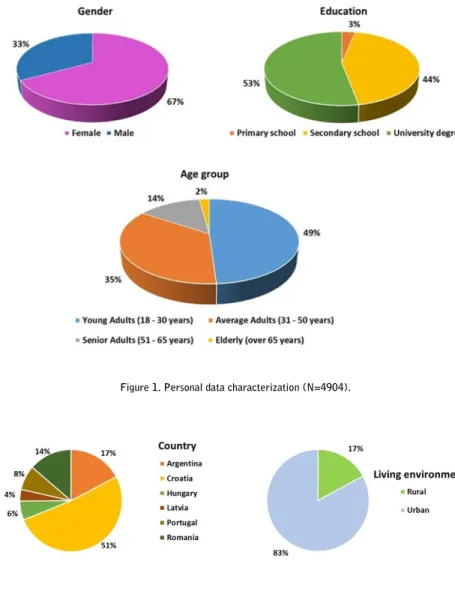
The number of participants involved in this study was nearly five thousand (N=4904) with ages between 18 and 84 years old. Figure 1 presents the personal data that characterize the study sample, showing that most participants were women (67%). As for the highest level of
E G I T A N I A S C I E N C I A Nº 2 6 – 2 0 2 0 I S S N : 1 6 4 6 - 8 8 4 8
| 114 |
education completed, university degrees were owned by more than half of the participants, 54%. Regarding age, the class most represented was that of young adults (age between 18 and 30 years) accounting for almost half, being the elderly those whose representability was poorer (only 2%).
As for the geographical characterization of the sample shown in Figure 2, the distribution by country indicated that the participants were mostly from Croatia (51%) followed by Argentina (17%) and in last came Latvia, the least represented country (only 4%).
Figure 1. Personal data characterization (N=4904).
Figure 2. Geographical characterization (N=4904).
E G I T A N I A S C I E N C I A Nº 2 6 – 2 0 2 0 I S S N : 1 6 4 6 - 8 8 4 8
| 115 |
2.2. Eating out and fast food habits
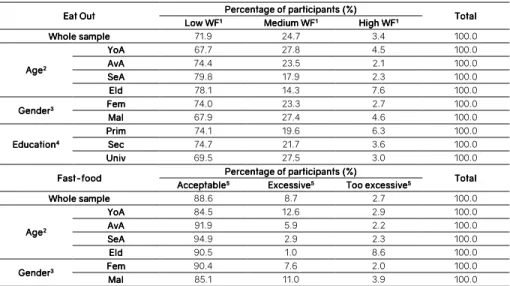
The results in Table 2 refer to the frequency reported by the participants as to how many times they eat out of home per week and how often they eat fast food meals on a typical week, depending on some sociodemographic characteristic, namely age, gender and level of education completed. In the sample at study was observed that most participants, over 70%, showed a low frequency of eating out, corresponding to up to 4 times per week, and only a small minority, 3.4%, ate out more than 8 times, i.e., more than once a day. These results contradict other studies that have shown that urbanization alters both the dietary patterns but also the eating habits, namely increasing the frequency of restaurant visits or eating out from home (Li et al., 2019). Research has focused in the past years on eating out habits analysing its expansion as well as the factors that influence it. According to Díaz-Mendez and García-Espejo (Díaz-Méndez and García-García-Espejo, 2017) eating out can be explained according to working life factors, or as a leisure practice that provides satisfaction itself. In modern societies, with people working generally far from home it is expected that on working days people tend to eat lunch away from home 5 times per week. However, people have different options: to eat in canteens provided by their employers, eat in restaurants or even take home prepared food. To choose how to face the need to eat far from home each person will weight differently the possible options and this also depends on the availability of each option for each particular case. No doubt that taking home-prepared food can allow a higher control on what to eat, how the food is prepared, the ingredients used or the overall quality of the meal and nutrients/calories balance. However, this also requires extra time to prepare the food early in the morning before leaving for work or in the previous day at night, and that might be a factor leading to preference for prepared meals, i.e., eating out. When analysing the habits of eating out by age class, the results were not much different from those of the global sample. Nevertheless, a higher incidence of eating out with a medium frequency (5-8 times/week) was observed for young adults (27.8%) when compared with the other age groups, and particularly elderly (14.3%) (Table 2). The young adults, with ages between 18 and 30 years, include university students, and these are prone to eat lunch at university canteens in the five week days with classes, from Monday to Friday. In fact, university years are critical for young people to turn independent and shape eating patterns that will accompany them through life (Al-Thani and Khaled, 2018; Bowman and Vinyard, 2004). The eating out frequency was also observed to be slightly different depending on gender, with men eating out with higher frequencies when compared to women: more in the medium frequency category (27.4% against 23.3% for women) and also more in the high frequency category (7.6% as compared with 2.7% for women) (Table 2). Although the traditional roles of women and men have been fading oved the years, there are still differences as to the engaging in cooking practices by men and women, most especially in what concerns everyday life practices, i.e., the continuous preparation of meals on a daily basis, with men tending to cook on special occasions rather than regularly (De Backer and Hudders, 2016). Also, the new trend in exhibiting television cooking shows has contributed to incentive home cooking both for women and men (De Backer and Hudders, 2016). Regarding the habits of eating out according to education level, no visible differences were encountered, suggesting that education might have a minor role in the eating out patterns that seem more defined by the life/working needs and limitations.
Table 2 also shows the weekly frequency of eating fast food, which was globally acceptable, with nearly 90% eating fast food up to twice a week. However, when seen by age, there was a non-negligible part (15.5%) who showed excessive (3 – 5 times/week) or even too excessive
E G I T A N I A S C I E N C I A Nº 2 6 – 2 0 2 0 I S S N : 1 6 4 6 - 8 8 4 8
| 116 |
(over 6 times</week) consumption of fast food. Fast foods often correspond to extremely processed foods, with a high fat content, and especially saturated fat, dense in calories and with too much sodium. Besides, they are sold in large serving sizes contributing for the ingestion of much more than what the body would need to meet the energy and nutrient requirements. Hence, excessive consumption of fast foods has been associated with many health problems, increasing the risk of developing numerous diseases like obesity, diabetes, hypertension, cardiovascular disease, inflammation and metabolic syndrome (Bahadoran et al., 2015; Burton et al., 2006; van Draanen et al., 2018; Marlatt et al., 2016). However, because of these evidences, new trends are emerging in providing choices for fast and convenience foods of a healthier nature, based on increased use of vegetables and more natural ingredients, but also available at convenience stores or take away restaurants. One measure to influence people’s food choices is the addition of Health Star Rating (HSR) labelling to menus at fast food outlets (Niven et al., 2019). Also, nutrition labelling (like for example the inclusion of kilojoule/calorie information on menu boards at point-of-sale in fast-food outlets and front-of-pack labelling systems on pre-packed foods) can effectively endow people to make informed choices (Scrinis and Parker, 2016).
Also gender appeared to influence the fast food habits, with a higher percent of women (90.4%) showing an acceptable frequency of fast food meals (lower or equal to twice/week), as compared with men (85.1%). Still, for both genders the great majority of participants consumed fast food on a sporadic rather than regular basis. In a study by Lassen et al. (Lassen et al., 2016) the purchase intentions when choosing fast food were analysed according to gender and they observed that while the majority of men preferred a beef burger menu (Kouvari et al., 2016) instead of a healthier option (chicken burger menu or a wholegrain burger menu), most women would choose one of the healthier menus. This indicates that gender influences the eating options, so that women, even when eating out of home or fast food meals tend to be more careful in making healthier options. Again, Education did not seem to produce such an evident change as to influence the eating habits related to fast food, although a slight increase was observed in the percent of participants with higher education who ate fast food only 2 times/week or less.
Table 2. Eating out and fast food habits for the whole sample and separated by age, gender and education.
Eat Out Eat Out Eat Out
Eat Out Percentage of participants (%)Percentage of participants (%)Percentage of participants (%)Percentage of participants (%) TotalTotal TotalTotal Low WF
Low WFLow WF
Low WF1111 Medium WFMedium WFMedium WFMedium WF1 111 High WFHigh WFHigh WFHigh WF1111
Whole sample Whole sample Whole sample Whole sample 71.9 24.7 3.4 100.0 Age AgeAge Age2222 YoA YoAYoA YoA 67.7 27.8 4.5 100.0 AvA AvAAvA AvA 74.4 23.5 2.1 100.0 SeA SeA SeA SeA 79.8 17.9 2.3 100.0 Eld Eld Eld Eld 78.1 14.3 7.6 100.0 Gender Gender Gender
Gender3333 FemFem FemFem 74.0 23.3 2.7 100.0
Mal Mal Mal Mal 67.9 27.4 4.6 100.0 Education EducationEducation Education4444 Prim Prim Prim Prim 74.1 19.6 6.3 100.0 Sec Sec Sec Sec 74.7 21.7 3.6 100.0 Univ Univ Univ Univ 69.5 27.5 3.0 100.0 Fast Fast Fast
Fast----foodfoodfoodfood Percentage of participants (%)Percentage of participants (%)Percentage of participants (%)Percentage of participants (%) TotalTotal TotalTotal Acceptable
Acceptable Acceptable
Acceptable5555 ExcessiveExcessiveExcessiveExcessive5 555 Too excessiveToo excessiveToo excessiveToo excessive55 55
Whole sample Whole sample Whole sample Whole sample 88.6 8.7 2.7 100.0 Age AgeAge Age2222 YoA YoAYoA YoA 84.5 12.6 2.9 100.0 AvA AvAAvA AvA 91.9 5.9 2.2 100.0 SeA SeA SeA SeA 94.9 2.9 2.3 100.0 Eld Eld Eld Eld 90.5 1.0 8.6 100.0 Gender Gender Gender
Gender3333 FemFem FemFem 90.4 7.6 2.0 100.0
Mal Mal Mal
E G I T A N I A S C I E N C I A Nº 2 6 – 2 0 2 0 I S S N : 1 6 4 6 - 8 8 4 8 | 117 | Education EducationEducation Education4444 Prim Prim Prim Prim 86.7 5.7 7.6 100.0 Sec Sec Sec Sec 88.1 8.7 3.2 100.0 Univ Univ Univ Univ 89.2 8.9 1.9 100.0
1Scale: Low WF (weekly Frequency): ≤4 times, Medium WF: 5 – 8 times, High WF: ≥9 times.
2YoA: young adults (18y≤age≤30y), AvA: average adults (31y≤age≤50y), SeA: senior adults (51y≤age≤ 4y),
Eld: elderly (Age≥65y).
3Fem: female, Mal: male.
4Prim: primary school, Sec: secondary school, Univ: university degree. 5Scale: Acceptable: ≤2 times, Excessive: 3 – 5 times, Too excessive: ≥6.
In Table 3 the same eating habits previously discussed were analysed as to geographical variables (country and living environment). No clear differences were observed for eating out or fast food consumption habits between participants who resided in rural or urban areas. However, in a study undertaken by Xiao et al. (Xiao et al., 2015) it was found that living environment influenced the eating away from home habits, specifically concerning meat consumption, with urban residents being responsible for twice as much consumption as compared with the rural residents.
The results in Table 3 also show important differences between countries, and particularly in what regards eating out. For example, in Romania the percent of participants who eat out up to 4 times/week is very high (almost 90%) in contrast with Argentina (about 63%). These differences may be related, on one side, to cultural heritages, but also to life-styles, distance between home and working place, or even economic availability, i.e., the level of income of families and the cost of food out of home. For example, in China it was observed an immense increase (up to 200%) in expenditure on eating out of home over a decade period, this continuing to grow due to the increased wealth of city residents (Zhai et al., 2014). On another study developed in Spain (Díaz-Méndez and García-Espejo, 2017), the authors analysed profiles, motivations, places and relationships associated with eating out habits, allowing to define an eating-out a food model very specific to Spain, according to which food is not limited to a duality between work and leisure, and giving emphasis to a strong element of sociability which acts as a motivator to take people to eat out. These findings help understand the eating out patterns and extrapolate maybe to other countries.
Table 3. Eating out and fast food habits separating by country and living environment.
Eat Out Eat Out Eat Out
Eat Out Percentage of participants (%)Percentage of participants (%) Percentage of participants (%)Percentage of participants (%) TotalTotal TotalTotal Low WF
Low WFLow WF
Low WF1111 MeMeMeMedium WFdium WFdium WFdium WF1111 High WFHigh WFHigh WFHigh WF111 1
Country Country Country Country Argentina Argentina Argentina Argentina 63.2 33.9 3.0 100.0 Croatia CroatiaCroatia Croatia 72.5 23.8 3.7 100.0 Hungary Hungary Hungary Hungary 63.9 31.1 5.1 100.0 Latvia Latvia Latvia Latvia 65.0 32.2 2.8 100.0 Portugal Portugal Portugal Portugal 66.2 31.4 2.4 100.0 Romania RomaniaRomania Romania 89.6 7.6 2.8 100.0 Living Living Living Living Environment Environment Environment Environment Rural Rural Rural Rural 72.0 23.6 4.5 100.0 U U U
Urbanrbanrbanrban 71.8 25.0 3.2 100.0
Fast Fast Fast
Fast----foodfoodfoodfood Percentage of participants (%)Percentage of participants (%) Percentage of participants (%)Percentage of participants (%) TotalTotal TotalTotal Acceptable
Acceptable Acceptable
Acceptable2222 ExcessiveExcessiveExcessiveExcessive2 222 Too excessiveToo excessiveToo excessiveToo excessive22 22
Country Country Country Country Argentina Argentina Argentina Argentina 83.7 13.5 2.8 100.0 Croatia CroatiaCroatia Croatia 86.9 10.2 2.8 100.0 Hungary Hungary Hungary Hungary 96.3 3.7 0.0 100.0 Latvia Latvia Latvia Latvia 96.1 3.9 0.0 100.0 Portugal Portugal Portugal Portugal 94.8 3.4 1.8 100.0 Romania RomaniaRomania Romania 92.5 3.1 4.3 100.0 Rural Rural Rural Rural 89.5 7.3 3.1 100.0
E G I T A N I A S C I E N C I A Nº 2 6 – 2 0 2 0 I S S N : 1 6 4 6 - 8 8 4 8 | 118 | Living Living Living Living Environment Environment Environment
Environment UrbanUrbanUrbanUrban 88.5 8.9 2.6 100.0
1Scale: Low WF (weekly Frequency): ≤4 times, Medium WF: 5 – 8 times, High WF: ≥9 times. 2Scale: Acceptable: ≤2 times, Excessive: 3 – 5 times, Too excessive: ≥6.
2.3. Influence of sociodemographic variables on eating habits
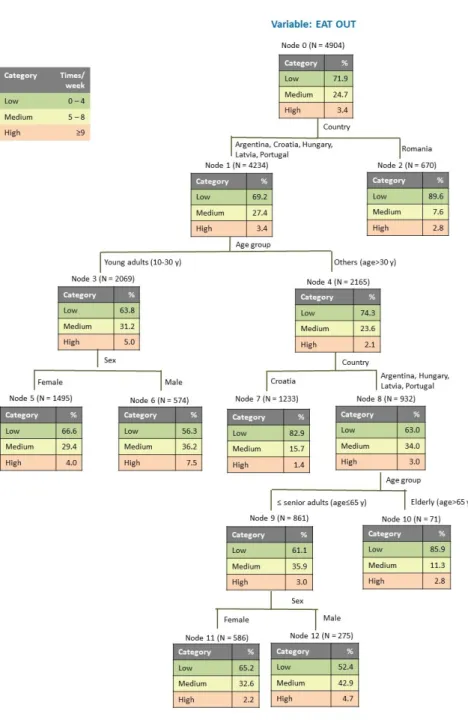
To assess the most influential determinants on the eating habits regarding eating out and fast food, a tree classification procedure was followed. The results obtained are presented in Figures 3 and 4. The tree in Figure 3 has 5 levels, 13 nodes, from which 7 were terminal. The results show that country appeared as the most important discriminating variable for the variable frequency of eating out, separating Romania from all other countries, with Romanian participants eating less out of home as compared with other countries (almost 90% showing a low frequency while for other countries it was about 70%), and this being a terminal node. For the other countries, the next discriminator was age, separating young adults from the other participants, so that younger people tend to eat out more than older people. The following discriminant variable for the younger participants was sex while for the older participants was again country, followed by age once more and finally also sex. In general, the highest percentages were always obtained for the low frequency of eating out, indicating that these participants prefer to eat at home, either for convenience, for economic reasons or to get better control over what they eat. Finally, these results indicated that variables such as living environment or level of education did not show a major influence on the habits of eating out.
E G I T A N I A S C I E N C I A Nº 2 6 – 2 0 2 0 I S S N : 1 6 4 6 - 8 8 4 8
| 119 |
Figure 3. Tree Classification for variable weekly frequency of meals out of home.
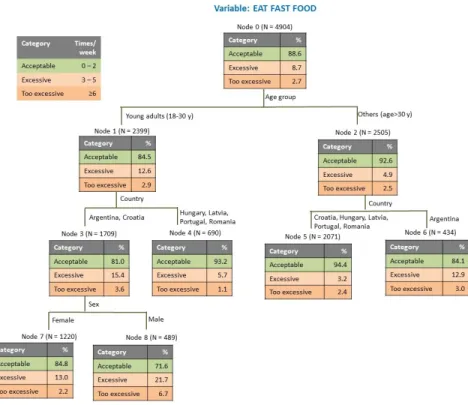
The tree in Figure 4 has 3 levels, 8 nodes, from which 5 were terminal. These results show that also for the frequency of eating fast food the two most important differencing factors were age and country, juts in a different order than in the previous case. Age was the first discriminant variable, separating young adults from all others, so that younger people showed a higher
E G I T A N I A S C I E N C I A Nº 2 6 – 2 0 2 0 I S S N : 1 6 4 6 - 8 8 4 8
| 120 |
percentage of excessive number of fast food meals (12.6%) as compared with the others (4.9%). Then, independent of the age class, country came as the second discriminant, with Argentina appearing always in the group with highest excessive fast food consumption. Finally, for the participants from Argentina and Croatia, sex was the last discriminant variable, with young women showing a higher percentage for acceptable numbers of fast food meals (84.4%) as compared with men (71.6%). Again, no influence was observed for the variables living environment or level of education.
Figure 4. Tree Classification for variable weekly frequency of fast food meals.
CONCLUSION
This study concluded that in the sample at study the frequency with which the participants ate out of home was in general low, corresponding to four or less times per week, and the consumption of fast food meals was also acceptable, i.e., with a low frequency of up to two times per week. These results are important because they are in line with dietary patterns associated with benefits for the human health.
Moreover, the tree classification analysis highlighted the relative importance of the considered factors for eating out and fast food meals, being country a very influential factor for the eating out habits followed by age, while age was the most important determinant for the fast food
E G I T A N I A S C I E N C I A Nº 2 6 – 2 0 2 0 I S S N : 1 6 4 6 - 8 8 4 8
| 121 |
consumption, followed by country. Hence, these two variables were confirmed as influential for the eating habits studied.
Although the results state a low frequency of eating out or eating fast food, possibly indicating that for the sample at study there were indicators that could help achieving a good health status, obesity and diet related diseases are still increasing worldwide and therefore, it could be important to complement the present study in order to understand other factors that could explain bad food habits. On the other hand, as it was demonstrated that age and country appear as important determinants of fast food consumption, this indicates that culture and political options can possibly be associated with healthier choices, and particularly implement better educational measures by following the examples of those countries with healthier eating habits.
REFERENCES
Al-Thani, M. A., & Khaled, S. M. (2018). “Toxic pleasures”: A study of eating out behavior in Arab female university students and its associations with psychological distress and disordered eating. Eating Behaviors, 31, 125–130. https://doi.org/10.1016/j.eatbeh.2018.08.008
Bahadoran, Z., Mirmiran, P., & Azizi, F. (2015). Fast Food Pattern and Cardiometabolic Disorders: A Review of Current Studies. Health Promotion Perspectives, 5(4), 231–240. https://doi.org/10.15171/hpp.2015.028
Bai, J., Zhang, C., Wahl, T., & Jr, J. S. (2016). Dining out, the missing food consumption in China. Applied Economics Letters, 23(15), 1084–1087. https://doi.org/10.1080/13504851.2015.1136388 Bowman, S. A., & Vinyard, B. T. (2004). Fast food consumption of U.S. adults: impact on energy and nutrient intakes and overweight status. Journal of the American College of Nutrition, 23(2), 163–168. Burton, S., Creyer, E. H., Kees, J., & Huggins, K. (2006). Attacking the Obesity Epidemic: The Potential Health Benefits of Providing Nutrition Information in Restaurants. American Journal of Public Health, 96(9), 1669–1675. https://doi.org/10.2105/AJPH.2004.054973
De Backer, C. J. S., & Hudders, L. (2016). Look who’s cooking. Investigating the relationship between watching educational and edutainment TV cooking shows, eating habits and everyday cooking practices among men and women in Belgium. Appetite, 96, 494–501. https://doi.org/10.1016/j.appet.2015.10.016
Díaz-Méndez, C., & García-Espejo, I. (2017). Eating out in Spain: Motivations, sociability and consumer contexts. Appetite, 119, 14–22. https://doi.org/10.1016/j.appet.2017.03.047
Kouvari, M., Tyrovolas, S., & Panagiotakos, D.B. (2016). Red meat consumption and healthy ageing: A review. Maturitas, 84, 17–24. https://doi.org/10.1016/j.maturitas.2015.11.006
Lassen, A. D., Lehmann, C., Andersen, E. W., Werther, M. N., Thorsen, A. V., Trolle, E., … Tetens, I. (2016). Gender differences in purchase intentions and reasons for meal selection among fast food customers – Opportunities for healthier and more sustainable fast food. Food Quality and Preference, 47, 123–129. https://doi.org/10.1016/j.foodqual.2015.06.011
Li, J., Song, G., Semakula, H. M., & Zhang, S. (2019). Climatic burden of eating at home against away-from-home: A novel Bayesian Belief Network model for the mechanism of eating-out in urban China. Science of The Total Environment, 650, 224–232. https://doi.org/10.1016/j.scitotenv.2018.09.015 Marlatt, K. L., Farbakhsh, K., Dengel, D. R., & Lytle, L. A. (2016). Breakfast and fast food consumption are associated with selected biomarkers in adolescents. Preventive Medicine Reports, 3, 49–52. https://doi.org/10.1016/j.pmedr.2015.11.014
E G I T A N I A S C I E N C I A Nº 2 6 – 2 0 2 0 I S S N : 1 6 4 6 - 8 8 4 8
| 122 |
Niven, P., Morley, B., Dixon, H., Martin, J., Jones, A., Petersen, K., & Wakefield, M. (2019). Effects of health star labelling on the healthiness of adults’ fast food meal selections: An experimental study. Appetite, 136, 146–153. https://doi.org/10.1016/j.appet.2019.01.018
Scrinis, G., & Parker, C. (2016). Front-of-Pack Food Labeling and the Politics of Nutritional Nudges. Law & Policy, 38(3), 234–249. https://doi.org/10.1111/lapo.12058
van Draanen, J., Prelip, M., & Upchurch, D. M. (2018). Consumption of fast food, sugar-sweetened beverages, artificially-sweetened beverages and allostatic load among young adults. Preventive Medicine Reports, 10, 212–217. https://doi.org/10.1016/j.pmedr.2017.11.004
Xiao, H., Chen, Q., Wang, J., Oxley, L., & Ma, H. (2015). The puzzle of the missing meat: Food away from home and China’s meat statistics. Journal of Integrative Agriculture, 14(6), 1033–1044. https://doi.org/10.1016/S2095-3119(14)60987-4
Zhai, F. Y., Du, S. F., Wang, Z. H., Zhang, J. G., Du, W. W., & Popkin, B. M. (2014). Dynamics of the Chinese diet and the role of urbanicity, 1991-2011. Obesity Reviews: An Official Journal of the International Association for the Study of Obesity, 15 Suppl 1, 16–26. https://doi.org/10.1111/obr.12124