
INDUCTION OF ANTI-HERBIVORE DEFENCES BY DIRECT
AMPHIPOD CONSUMPTION AND WATER BORNE GRAZER
CUES IN MACROALGAE
(dissertação para a obtenção do grau de mestre em Estudos Marinhos e
Costeiros)
JOANA MARIA DOS REIS FRANCO CRUZ
FARO
2007
Marinhos e Costeiros
ORIENTADORES: Professora Doutora Ester Serrão e Doutor Markus Molis DATA: 23 de Novembro de 2007
TÍTULO DA DISSERTAÇÃO: Induction of anti-herbivore defences by direct amphipod consumption and water borne grazer cues in macroalgae
JÚRI: Professor Doutor Eduardo Barata, Professora Doutora Ester Serrão e Professor Doutor Tomasz Boski
Ao Professor Doutor Martin Wahl, coordenador do projecto GAME, agradeço a minha participação no projecto e também todos os conhecimentos transmitidos.
Ao Doutor Markus Molis, pela orientação deste trabalho, e pela atenção dada em todas as ocasiões.
Ao Professor Doutor Martin Sprung, que apesar de já não estar presente, foi quem me deu a conhecer o GAME e aceitou a orientação desta tese na Universidade do Algarve. À Professora Doutora Ester Serrão, por ter aceite a orientação desta tese numa fase já avançada do trabalho, por todo o apoio dado, e disponibilidade demonstrada.
À Fundação Mercator GmbH pelo apoio financeiro cedido durante a minha estadia no Algarve e na Alemanha.
À Michaela Treitschke por todo o companheirismo e amizade demonstrados em todas as horas que passámos juntas.
Aos outros membros do projecto Game: Christof, Ika, Jochen, Kevin, Olivia, Ulli, Young e Yue, pela amizade, diversão e todo o apoio emocional durante o desenrolar do nosso trabalho.
À Dra. Margarida Machado pela ajuda na identificação dos anfípodes, e ao João Reis e colegas por todo o apoio prestado no Laboratório Marítimo do Ramalhete.
À Brice, Cátia, Doris, Muriel, Manel, Nuno e Sara pela ajuda nas saídas de campo bem como no trabalho de laboratório.
Aos “EMAC’s”, o grupo perfeito de colegas durante as aulas de Mestrado, por todo o tempo que passámos juntos.
A todos os meus amigos que não vêm citados, mas que de algum modo também foram importantes.
À minha família, que está sempre presente e sempre pronta a ajudar quando é preciso. Ao Florian, por estar sempre ao meu lado.
ABSTRACT
Herbivores have been repeatedly shown to induce defences in terrestrial plants, but few examples exist from marine macroalgae. In two bio-assayed laboratory experiments we tested the effects of (1) direct amphipod consumption, (2) water borne cues from nearby grazed conspecifics, and (3) water-borne cues from non grazing consumers on the induction of anti-herbivore defences in macroalgae of the southern coast of Portugal. Both the brown alga Fucus vesiculosus and the red alga Sphaerococcus coronopifolius displayed distinct defence regulation. They induced defences when consumers were present and reduced defences again when consumption ceased. A reduction in
palatability was considered to be indicative of an alga’s defence mechanism. Defence regulation reacted to consumption stimuli in less than two weeks. For F. vesiculosus we found the defence activity in the lipophilic fraction of the alga’s chemistry. Both algal species induce defences after receiving water-borne signals from nearby grazed
conspecifics as well as non-grazing amphipods. These results imply that species of red and brown algae can recognise a suite of cues indicating herbivore pressure, allowing them to adjust their defensive traits in finely tuned short-term responses. Inducible defences may be more common in macroalgae than suspected.
Key Words: Herbivore induced defences, Marine algae, Water borne cues, Fucus vesiculosus, Sphaerococcus coronopifolius
RESUMO
A herbivoria é um factor chave para controlar a biomassa e a estrutura das comunidades de macroalgas. De modo a evitar a intensa herbivoria, as macroalgas são capazes de utilizar diversas estratégias como resposta ao ataque dos herbívoros. Sendo assim, as macroalgas podem evitar, tolerar ou defenderem-se dos consumidores. As defesas podem ser de quatro tipos: estruturais, por associação, nutricionais ou defesas químicas. Esta última consiste no uso de compostos de reduzida palatabilidade, tóxicos ou repulsivos para herbívoros, sendo a sua maioria metabolitos secundários. A defesa química das algas pode ser constitutiva, i.e. permanentemente disponível, ou induzida, i.e. produzida quando necessária. Ambas as estratégias de defesa têm as suas vantagens e desvantagens. Apesar das defesas constitutivas assegurarem uma protecção permanente (desde que os herbívoros não se adaptem à defesa imposta), estas podem corresponder a custos energéticos desnecessários para a alga quando os consumidores estão ausentes. No entanto, a importância dos custos das defesas é um tema ainda em discussão e provavelmente difere entre espécies, compostos de defesa e condições ambientais. As defesas induzidas poderão minimizar estes custos mantendo as defesas baixas até serem realmente necessárias. Contudo, a protecção poderá vir atrasada relativamente à percepção de um estímulo apropriado. Se o sinal for a danificação do tecido, a alga irá perder biomassa antes do consumidor ser repelido. Deste modo, os meso-herbívoros como os anfípodes, isópodes ou gastrópodes, com uma locomoção mais lenta e consumindo pequenas porções de alga numa escala temporal maior, podem favorecer o tipo de defesa induzida. Na presença de macro-herbívoros como os peixes, que atacam de uma maneira mais repentina, intensa e menos permanente, uma defesa constitutiva será a mais indicada. No caso de defesas induzidas, após a ameaça do herbívoro, estas devem consequentemente baixar. Alguns estudos realizados em macroalgas mostraram que as defesas cessaram aproximadamente após duas semanas a seguir ao contacto com os herbívoros. Ao contrário do que acontece para as plantas terrestres, são conhecidos poucos exemplos de defesa induzida contra a herbivoria nas macroalgas. Este facto poderá ser devido ao número reduzido de estudos realizados para estes organismos quando comparado com as plantas terrestres. Até agora, a indução de metabolitos secundários nas macroalgas como resposta ao consumo dos meso-herbívoros foi maioritariamente encontrada em algas castanhas (e.g. Dictyota menstrualis, Sargassum filipendula, Fucus vesiculosus), havendo já alguns exemplos para algas vermelhas (Pterocladiella capillacea, Hypnea pannosa, Galaxaura diessingiana). Para além de defesas induzidas pelo consumo directo dos herbívoros, algumas plantas terrestres e organismos aquáticos são capazes de detectar sinais propagados pelo ar ou pela água. Só alguns estudos demonstraram os efeitos de sinais transmitidos através da água na indução de defesas anti-herbívoros em macroalgas (Ascophyllum nodosum, Glossophora kunthii e Fucus vesiculosus), no entanto, não está ainda esclarecido se os sinais provêm do herbívoro ou da alga.
O presente estudo teve como objectivos testar: (1) em que espécie de alga o consumo de anfípodes induz defesas, (2) se a existência de sinais propagados pela água provenientes de algas consumidas na vizinhança e/ou da presença de herbívoros não consumidores induzem defesas e (3) se a redução de defesas previamente induzidas ocorre após cessar
condições laboratoriais bem como a palatabilidade das algas. Desta forma, foram seleccionadas 7 espécies (Cladostephus verticillatus (Lightfoot), Codium tomentosum (Hudson), Dictyopteris membranacea (Stackhouse), Fucus vesiculosus (Linné), Gelidium sesquipedale (Clemente), Ulva lactuca (Linné) e Sphaerococcus coronopifolius (Stackhouse) para as experiências de indução. Todas as espécies de algas usadas são espécies comuns nas áreas de colheita. Para as experiências utilizou-se uma mistura de três anfípodes: Gammarus insensibilis (Stock), Gammarella fucicola (Leach) e Cymadusa filosa (Savigny), e na primeira experiência foi também utilizado o gastrópode Bittium reticulatum (Da Costa). As experiências decorreram no Laboratório Marítimo do Ramalhete, Universidade do Algarve, tendo sido a primeira iniciada em Julho e a segunda em Setembro de 2003, sendo ambas divididas em três fases de 2 semanas cada: aclimatação, tratamento e recuperação. A primeira experiência teve como objectivo testar os efeitos da herbivoria na palatabilidade de cada espécie de alga, em dois níveis de tratamento: consumo directo (presença de herbívoros) e controlo (sem herbívoros). No início da experiência, as algas foram divididas em pequenos pedaços aproximadamente do mesmo tamanho. Alguns destes foram directamente congelados (a -20º C), e os restantes colocadas em aquários (com cerca de 2 l cada), para que durante a primeira fase (aclimatação) as algas pudessem adaptar-se às condições de cultivo e recuperar de eventuais características defensivas adquiridas no seu ambiente natural. No final desta fase alguns pedaços de alga foram retirados dos aquários para uma posterior comparação das suas taxas de consumo (comparadas com algas inicialmente colocadas no congelador). Na fase de tratamento, em metade dos aquários foram adicionados herbívoros sendo a outra metade o controlo (n=5, para cada tratamento e espécie). No início da fase de recuperação, retiraram-se mais pedaços de algas e também os herbívoros de modo a testar se as defesas cessaram passadas 2 semanas de ausência de herbivoria. No final retiraram-se então as restantes algas para se proceder à comparação das taxas de consumo entre as algas que foram previamente sujeitas ao consumo directo de herbívoros, e as do controlo.
Na segunda experiência foram utilizadas apenas três espécies de algas (Fucus vesiculosus, Sphaerococcus coronopifolius e Codium tomentosum). O objectivo da experiência foi testar a existência de propagação na água de sinais provenientes de algas conspecificas a serem consumidas na vizinhança ou somente dos herbívoros, com capacidade de induzir defesas. Desta maneira foram utilizados quatro tratamentos: controlo, consumo directo, algas consumidas na proximidade e herbívoros não consumidores na proximidade. Para tal foi colocada uma rede (1 mm de malha) a dividir os aquários, sendo o resto do procedimento experimental totalmente idêntico ao da primeira experiência. No final de cada fase das duas experiências realizaram-se testes de
Por outro lado, estas algas poderão ter um tipo de defesa constitutiva, apresentando um elevado nível de defesas. Após a fase de tratamento as algas controlo intactas foram, em geral, mais consumidas que os seus conspecíficos previamente consumidos. A alga castanha Fucus vesiculosus foi a única espécie que mostrou uma indução significativa de defesas. Em média, os pedaços de algas controlo intactas de Fucus foram 1.6 vezes mais consumidos que as algas previamente consumidas (teste-t emparelhado, t = 4.83, p<0.05)
4
. O alimento artificial produzido das algas controlo de Fucus foi em média 1.3 vezes mais consumido que as algas anteriormente consumidas (teste-t emparelhado, t4 =
4.67, p<0.05). Mais uma vez, o alimento artificial constituído pelas outras espécies estudadas não revelou diferenças significativas na palatabilidade no final da fase de tratamento. Estes resultados demonstram que a espécie F. vesiculosus poderá ter a capacidade de induzir metabolitos repulsivos ou tóxicos para os herbívoros, não pondo de parte a possibilidade de haver também uma indução de defesas morfológicas. No entanto, não foi observada nenhuma alteração morfológica aparente, como em alguns estudos de outros autores. Apesar dos resultados sugerirem que os compostos defensivos pertencem à fracção lipofílica dos metabolitos secundários, não se pode excluir a possibilidade de uma actividade defensiva adicional proveniente dos metabolitos polares, facto descrito em algumas experiências anteriores. Relativamente às outras espécies testadas, uma vez que não apresentaram qualquer efeito do consumo directo de herbívoros na sua palatabilidade, poderão dispor de uma defesa constitutiva em vez de uma defesa induzida. Outra hipótese para explicar os resultados poderá ser a existência de defesas específicas para diferentes espécies de herbívoros, ou até mesmo a necessidade de uma maior concentração destes. Após a fase de recuperação, já não foi detectado qualquer efeito de indução nas algas intactas de Fucus. As outras espécies de algas também não mostraram diferenças significativas nas taxas de consumo no final desta fase. Após as duas semanas na ausência de herbívoros, no final da fase de recuperação, a defesa induzida no Fucus baixou novamente e a palatabilidade do alimento artificial de indivíduos previamente consumidos já não difere do alimento constituído por algas controlo. Para as outras espécies também não foram encontradas diferenças significativas. Aparentemente a defesa da alga F. vesiculosus além de poder ser induzida, também apresenta capacidades redutoras no caso de cessar o consumo da parte dos herbívoros. Contudo, não é possível saber ao certo o dia em que estas defesas terminaram, apenas se sabe que houve um relaxamento destas durante os 14 dias. Deste modo, serão necessárias mais experiências para precisar o período no qual as defesas ainda se mantêm. Relativamente à segunda experiência, após a fase de aclimatação nenhumas das três algas testadas (S. coronopifolius, F. vesiculosus e C. tomentosum) apresentou diferenças significativas nos níveis de palatabilidade, quer em algas intactas quer no alimento artificial. Em relação à alga verde Codium tomentosum, não houve qualquer diferença significativa nas taxas de consumo de algas intactas e alimento artificial no final das últimas duas fases da experiência. Este facto apoia os resultados obtidos na primeira experiência, indiciando que esta alga não tem defesas ou então tem defesas constitutivas. Os resultados relativos à espécie Fucus vesiculosus, mostraram que apenas as taxas de consumo entre algas controlo intactas e as expostas a sinais de algas a serem consumidas na proximidade e sinais unicamente de herbívoros foram significativamente diferentes. Só no final da fase de recuperação foram encontradas diferenças no tratamento com algas previamente expostas aos herbívoros, continuando a haver também preferência para algas controlo intactas relativamente às expostas a sinais
formas em relação à primeira experiência. O atraso na resposta induzida pode ser resultado da sazonalidade variável da actividade da herbivoria, enquanto que os efeitos não detectados no alimento artificial poderão ser devidos a alterações no tipo de compostos químicos ao longo do ano. Após duas semanas de exposição aos herbívoros, os níveis de palatabilidade de algas intactas de S. coronopifolius expostas aos diferentes tipos de tratamentos foram significativamente reduzidos quando comparados com as algas controlo. Testes posteriores revelaram que as algas controlo desta espécie foram significativamente preferidas às (1) previamente expostas aos herbívoros, (2) às que receberam sinais de algas a serem consumidas na proximidade e (3) às que receberam sinais de herbívoros apenas. Na primeira experiência verificou-se uma tendência semelhante, no entanto os efeitos não foram significativos. Isto pode significar que a reacção ao consumo directo dos herbívoros pode depender da época do ano. Até à presente data, tem sido considerado que sinais da presença de herbívoros na vizinhança não são por si só suficientes para induzir uma resposta defensiva. Contudo, o presente estudo revela que as espécies F. vesiculosus e S. coronopifolius são sensíveis até mesmo na presença de anfípodes que não se encontram a consumir. Este é o primeiro exemplo de uma alga vermelha com a capacidade de induzir defesas através de sinais propagados pela água. Para algas estruturalmente menos complexas como as deste grupo, esta capacidade pode compensar a fraca transmissão de sinais entre as diferentes partes da mesma alga. No entanto, outros estudos já tinham demonstrado mecanismos de defesa induzida pelo contacto directo com herbívoros para outras espécies de algas vermelhas. No final da fase de recuperação, não houve diferenças significativas de taxas de consumo para os diferentes tratamentos. As taxas de consumo de alimento artificial desta espécie não foram significativamente afectadas pelos diferentes tipos de tratamento, quer no final da fase de tratamento quer após a fase de recuperação. Assim, as defesas induzidas poderão ser morfológicas ou químicas (fracção hidrofilica) excluindo os compostos não polares. Em conclusão, a eficiência dos compostos lipofílicos bem como o tempo de reacção e intensidade das defesas induzidas anti-herbivoria variaram ao longo do tempo.
Palavras chave: Defesa induzida pela herbivoria, Algas marinhas, Sinais propagados pela água, Fucus vesiculosus, Sphaerococcus coronopifolius
1. Introduction...1
1.1. Macroalgae-herbivore interactions...2
1.2. Inducible versus constitutive defences...5
1.3. Induction experiments………...10
1.4. Water-borne cues...12
1.5. Aims of the present study………..13
2. Collection sites...14
3. Organisms...17
4. Materials and methods...21
4.1. Pilot studies...22
4.2. Induction Experiment Series - First experiment (Screening)………... 24
4.3. Induction Experiment Series - Second experiment (Water-borne cues detection) ………..27
4.4. Feeding preference assays with live algae………30
4.5. Feeding preference assays with diet containing non polar extracts………..32
4.6. Statistical analysis………...34
5. Results...35
5.1. First experiment (screening)...36
5.1.1. Acclimation phase...36
5.1.2. Treatment phase...36
5.2.2. Fucus vesiculosus...42
5.2.3. Codium tomentosum...43
6. Discussion...46
6.1. First experiment (screening)...47
6.1.1. Acclimation phase...47
6.1.2. Treatment phase...48
6.1.3. Recovery phase...50
6.2. Second experiment (water-borne cues detection)...53
6.2.1. Codium tomentosum …...53 6.2.2. Fucus vesiculosus...53 6.2.3. Sphaerococcus coronopifolius...56 7. Conclusion...58 8. References...61 Appendix I...74 Appendix II...77 Appendix III...82
1.1. Macroalgae-herbivore interactions
Marine benthic macroalgae play a key role in ecosystems (Costanza et al. 1997). Seaweeds provide up to 40% of the primary production in costal zones, represent carbon-sinks (Smith 1981), and also provide dispersal stages with suitable settlement substrata (Rangeley and Kramer 1995, Gotceitas et al. 1997). In the decades, however, populations of perennial macroalgae tend to decrease in many coastal regions (e.g. Vogt and Schramm 1991, Meyer and Paul 1992, Schramm and Nienhuis 1996). A common explanation is the competitive advantage ephemerals and phytoplankton experience under eutrophic conditions (e.g. Duarte 1995). Depending on the food web structure of a system, mesoherbivores (Brawley 1992) may benefit from the presently observed overexploitation of predatory fish (Myers and Worm 2003), which would enhance their impact on macroalgae. Another reason could be due to weakened anti-herbivore defences of environmentally stressed macroalgae (e.g. Cronin and Hay 1996b). Herbivory can cause declines in macroalgal populations and represents a key factor for controlling biomass accrual and community structure of macroalgae (Lubchenco, 1978, Hay and Fenical 1988, Hay 1991, Cyr and Pace 1993), affecting then a central ecosystem service. Despite meso-herbivores low mobility and consumption rates relative to macro-herbivores (e.g. fishes), meso-herbivores (e.g. amphipods) due to their elevated numbers and more site-bound life histories may shape species composition of
choice to escape from herbivores, to tolerate damage or defend themselves (Hay and Fenical 1988, Duffy and Hay 1990). Avoidance of consumption involves being where and/or when grazers are rare or inactive. Seaweeds can avoid herbivores spatially settling and growing in habitats that grazers fail to reach, e.g. by hiding in cracks and fissures, or temporally avoiding co-occurrence with important grazers by growing when predation pressures are low (Hay 1984, Duffy and Hay 1990). Tolerance to herbivory may be as compensatory growth (Lewis 1986, Hay 1997) or as spores that are able to survive gut passage (Buschmann and Santelices 1987), while mechanisms or strategies that increase the fitness of an alga when herbivores are present are usually called defence (Tollrian and Harvell 1999). Defending tissue against consumption involves making it less attractive to or shielding it from potential consumers. Defence is a common strategy among sessile organisms, especially ones that must grow in an exposed manner to acquire resources. Cronin (2001) reported four categories of defences used by seaweeds, (1) structural, (2) associational, (3) nutritional and (4) chemical:
(1) Structural defences involves the formation of protective arrangements, e.g. calcium carbonate (CaCO3) makes up as much as 90% of the dry mass of the hard thallus of
seaweeds (calcareous red algae Corallina officinalis hardens its thallus by storing calcium carbonate in its tissue). It is not quite certain if the CaCO3 serves as structural
defence by making the thallus harder to bite for the grazer or if the storage of CaCO3
might have an additional deterrent effect by diluting the nutritional value of the seaweed.
(2) Associational defences occur when a species gains protection (mutualistic or not) from a natural enemy by associating with a protective host, e.g. bryozoans growing epiphytic on kelps is believed to be an example where the basibiont benefits from protection by the epibiont. Interestingly, several cases are known where seaweeds offer protection to mesograzers against larger predators (Hay et al. 1990, Brawley 1992, Hay 1997), but to the authors knowledge no example is known, where an alga benefits from protection by another alga.
(3) Nutritional defences act when the organism has a low nutritive value and consequently is protected from consumption because it is not worth eating, as it probably happens with Corallina officinalis explained above in (1).
(4) Chemical defences imply the use of compounds that are distasteful, toxic, or otherwise repulsive to consumers. Most defensive compounds are secondary metabolites (Hay and Fenical 1988). Seaweeds are similar to terrestrial plants in that they produce a variety of secondary metabolites, including terpenes, acetogenins, aromatic compounds, amino acid-derived substances, and phloroglucinol-based polyphenolics. They differ from terrestrial plants by incorporating halogens into some compounds and by rarely producing the nitrogen-containing alkaloids common in many terrestrial plants (Faulkner 1984, Hay and Fenical 1988). The diversity of algal
1.2. Inducible versus constitutive defences
Algal chemical defence can be constitutive, i.e. permanently available, or inducible, i.e. produced “when needed”. Both strategies do have their pros and cons. While constitutive defences do ensure a permanent protection (as long as the consumers do not adapt to the defence) they may incur unnecessary costs when consumers are absent. The importance of defence costs, however, is still under debate (Kearsley and Whitham 1992, Cronin 2001, Arnold and Targett 2003) and probably differs among species, compounds and environmental conditions. Characteristic constitutive traits are, for instance, structural barriers or the constant production of secondary metabolites (Agrawal and Karban 1999). Inducible defence, on the other hand, was defined as a phenotypic change that is triggered by cues associated with biotic agents (Tollrian and Harvell 1999). This type of defence could minimize putative costs by keeping the level of defence low until it is needed (Harvell 1990). On the other hand, in the case of defence induction protection will always lag behind the perception of an appropriate stimulus. If the cue is tissue damage, the algae will lose biomass before the consumer is deterred. If, however, the alga is capable of detecting the presence and/or feeding of the consumer in its vicinity this risk can be significantly reduced especially when the consumers are slow moving mesograzers or urchins.
After the threat of herbivory disappeared, defences should consequentially be reduced again. Isolated studies reported the down regulation of defences after a time span of nine to fourteen days, but they focused rather on induction than recovery. Renaud et al. (1990) stated that Padina gymnospora became less susceptible to grazing by the sea
urchin Arbacia punctulata and subsequently lost this resistance after 9 days. Moreover, Peckol et al. (1996) found that increased levels of phlorotannins induced by simulated grazing in Fucus vesiculosus were reduced after two weeks. However, a study that standardises the examination of switch-off mechanism in bio-assayed induction experiments has, to the author’s knowledge, not yet been conducted.
In order to predict in which conditions plants would benefit more from an induced rather than a constitutive defence, many factors have been discussed. Therefore, three basic requirements have to be met (Harvell 1990, Cronin 2001):
- Encounters with consumers must be unpredictable and infrequent.
- A reliable cue that indicates the presence of herbivores and predicts the probability of future consumption must be present.
- The defence must be effective in deterring herbivores.
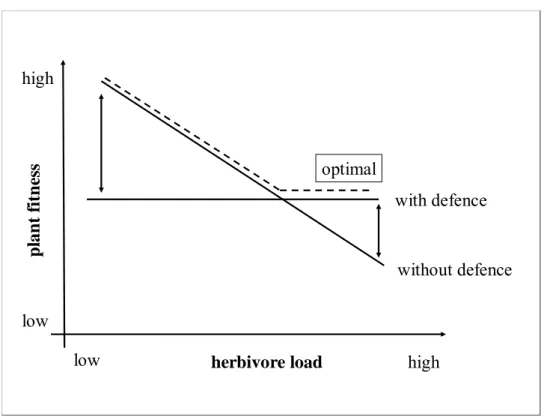
The model shown in the Fig.1 demonstrates the reason of an inducible instead of constitutive defence.
low herbivore load high pl a n t f itne ss with defence optimal high low without defence
Figure 3 - The reason for induced defence.
The present model predicts that when herbivore densities are low, undefended plants will be in advantage compared to constitutively defended plants in terms of plant fitness. When the herbivore load increases, undefended individual will have a decrease of fitness, being committed without protection against grazing. Constitutively defended plants have an advantage in this case. However, the strategy of inducible defences combines both benefits and therefore should be the optimal strategy. To cope with a typically more sudden, more intense but less permanent attack by macro-herbivores such as fishes, a constitutive defence may be optimal. In contrast, meso-herbivores consume smaller portions of their food over longer time spans, which could favour the selection for defences that are adjusted to grazer pressure, like inducible defences (Hay 1996, Pavia and Toth 2000).
With the aim of explaining the evolution of inducible defences, or by another words why it might be advantageous for a plant to defend itself only when the threat of herbivory is apparent, ecologists have discussed five main factors (Harvell 1990, Agrawal and Karban 1999):
- Defensive chemicals might be toxic for the plant itself. Therefore, the production of defences, only when they are required, would reduce the chance of auto-toxicity.
- Specialist herbivores might be able to detect certain waterborne cues. Avoidance of cue emission would make the algae more difficult to detect and therefore less susceptible.
- An induced response allows the plant to produce a qualitatively and quantitatively different response depending on the attacker.
- Fluctuating defence levels might be more difficult to adapt to and consequently slow down co-evolution of grazers.
a central position in most theories concerning inducible defences, since in addition to the principal energy spent producing defensive traits (that might not be necessary) consequential costs such as storage and maintenance can be avoided (Agrawal and Karban 1999). According to Harvell (1990), cost is usually estimated by measuring fitness components such as growth rate, reproductive output or survivorship. However, the interactions of these measures are extremely complex and difficult to assess. This is probably the reason, why the idea of defence being a trade-off for the individual has rarely been tested, even though is a very persuasive theory.
1.3. Induction experiments
In contrast to terrestrial plants (Karban and Myers 1989, Karban and Baldwin 1997), only few examples of inducible antiherbivore defence exist for seaweeds (Van Alstyne 1988, Cronin and Hay 1996a, Pavia and Toth 2000, Toth and Pavia 2000). This is surprising, if we consider the approximate number of 80000 species of marine macroalgae worldwide reported to produce a rich variety of secondary metabolites (Pavia and Toth 2000), many of them known as anti-herbivore defences. This discrepancy may be due to the reduced research effort on seaweeds relative to terrestrial plants. Alternatively, terrestrial plants might possess better developed internal transport systems than, for instance, red and green seaweeds, which is suggested to be a necessary prerequisite to transmit localized induction cues, e.g. from single grazer bites, across whole plants (Cronin and Hay 1996a).
Previous attempts to induce defence in marine algae used artificial clipping to standardise consumption (Hammerstrom et al. 1998, Lowell et al. 1991, Pavia et al. 1997), but many of these studies failed to adequately mimic the natural grazing that would induce a response, in both terrestrial and marine plant-herbivore interactions (e.g. Baldwin 1990, Pavia and Toth 2000). Studies that have been successful in producing this type of defence (Van Alstyne 1988, Cronin and Hay 1996a, Pavia and Toth 2000)
specific, when valuable algal parts, e.g. holdfasts, display constitutive and other tissues inducible defences (Taylor et al. 2002). Seasonal patterns of induction add further complexity to alga-grazer interactions (Molis et al. 2006). Induced defences were shown to be temporally and spatially variable. For example, the defence levels in F. vesiculosus were lowered to pre-grazed levels within 10 days (Hemmi et al. 2004). In addition, the repulsive response was not spreading to adjacent tissue (Hemmi et al. 2004).
Until now, seaweed induction of secondary metabolites in response to mesograzer consumption was mainly found for brown algae, e.g.: Dictyota menstrualis (Cronin and Hay 1996a), Sargassum filipendula (Sotka et al. 2002), Fucus vesiculosus (Rhode et al. 2004). However, recent studies have found some potential red algae species that induced defensive responses against herbivores, e.g.: Pterocladiella capillacea (Weidner et al. 2004), Hypnea pannosa (Ceh et al. 2005), Galaxaura diessingiana (Díaz et al. 2006).
1.4. Water-borne cues
Besides inducible defence effects of direct grazing impacts, a number of terrestrial plants and aquatic organisms are able to sense air- and water borne cues, respectively (Dicke and Bruin 2001). It has been suggested that exudates released by neighbouring grazed plants, or indeed by the herbivores themselves, could induce a defensive synthesis in macroalgae (Toth and Pavia 2000, Sotka et al. 2002). Because seaweeds often form dense monospecific stands, where plants are in direct contact with each other and water flow is reduced, chemical signals can be easily transmitted between conspecifics. Individuals able to detect and respond to such cues might have a selection advantage, because they can defend themselves before an attack. The role of waterborne cues in the induction of defences has not yet been adequately studied. To date, only few studies have demonstrated the effects of water-borne cues in the context of inducing anti-herbivory defences in macroalgae (Toth and Pavia 2000, Rohde et al. 2004, Macaya et al. 2005). Toth and Pavia (2000) found an inducing activity of water borne cues in the brown alga Ascophyllum nodosum while Macaya et al. (2005) found in Glossophora kunthii and Rhode et al. (2004) in Fucus vesiculosus. However, knowledge on whether effective water-borne cues stem from the grazer or the alga is extremely scarce. As proposed by Toth and Pavia (2000), external chemical cues may be common elicitors for induced defence in nonvascular plants, i.e. red and green algae. On the other hand, Sotka et al. (2002) rejected this mechanism for the brown seaweed Sargassum filipendula.
1.5. Aims of the present study
In this study it was investigated whether grazing by amphipods could induce defences in two red, two green, and three brown macroalgae of the southern coast of Portugal. The aim of this study was to test:
(1) in which algae grazing of amphipods induced defences,
(2) whether the existence of water-borne cues from neighbouring grazed plants and/or the mere presence of a non-grazing consumer induces defences and
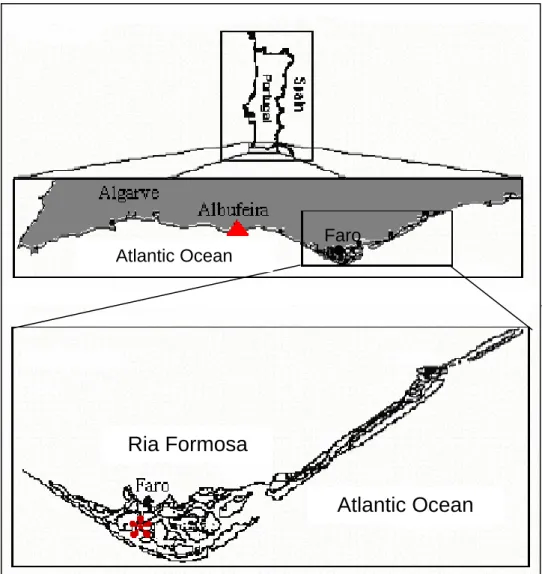
Collection sites were located on the rocky shore of São Rafael, Albufeira (37º 05’ N, 8º 15’ W, summer sea surface temperature reaching ca. 21 C, and salinity of 33 psu) and in the coastal lagoon-system of the Ria Formosa (37º 1’ N, 7º 55’ W, summer sea surface temperatures of 19-28 C, and salinity of 28-35 psu) on the Portuguese southern coast (Fig. 4).
Faro
Ria Formosa
Atlantic Ocean
Atlantic OceanFigure 4 – Localization of the study sites ▲ – Praia de S.Rafael, Albufeira; * - Ria Formosa,
Faro.
The Ria Formosa lagoon system covers an area of 16.300 ha between a series of barrier island and the mainland along the southern tip of Portugal (Pilkey et al. 1989). As a result of tidal currents (average tidal range 1.5 and 3.7 m) the water body in the lagoon
is well mixed. The water temperature in the summer ranges between 19 to 28ºC and salinities from 35 to 28. The nutrient availability is high in winter but low in summer, in summer (June-August) there is a concentration of 0.04µM for nitrate and 1.25µM for phosphate (Newton 1995). A variety of different habitats can be identified based on substrate type (ranging from sand, gravel, to fine mud), depth, vegetation, and distance from the sea.
In the other collection area of Sao Rafael the sea surface temperature reaching values of 21ºC or higher during the summer period. The wave conditions are less severe (>3m), since it is not exposed to the wave components predominant on the west coast. The nutrient supply on the south coast of Portugal is high, it reach values from 0.68 µmol/dm3 for nitrate and 0.5 µmol/dm3 for phosphate (Baptista 1997). Tidal range of
spring tides are extreme is approximately of 3.5 to 4m along the Portuguese coast. The south west shore is dominated by bedrocks (Boaventura 2000).
In pilot studies, it was assessed survivorship of algae under cultivation conditions and performed feeding preference assays to determine which algae are readily consumed by grazers. Based on the consumption rates (For calculations see section 4.3. Feeding preference assays with live algae), it was selected seven species (Cladostephus
verticillatus (Lightfoot), Codium tomentosum (Hudson), Dictyopteris membranacea
(Stackhouse), Fucus vesiculosus (Linné), Gelidium sesquipedale (Clemente), Ulva lactuca (Linné) and Sphaerococcus coronopifolius (Stackhouse)) for the induction
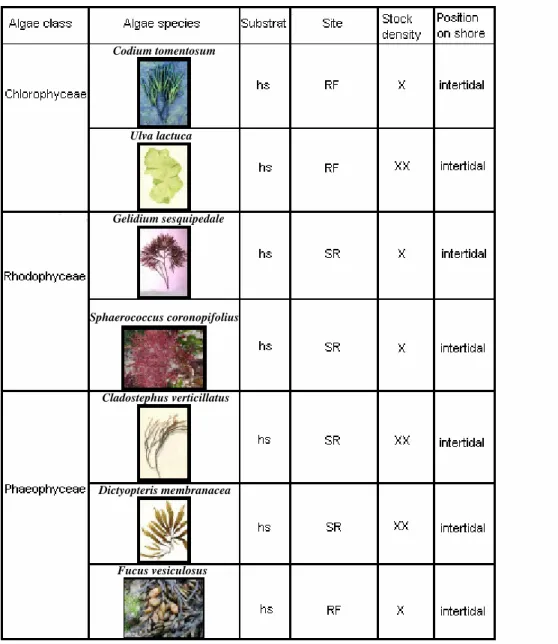
experiments. All algal species used in the experiment represented common species where they were collected (Table1).
Codium tomentosum Ulva lactuca Gelidium sesquipedale Sphaerococcus coronopifolius Cladostephus verticillatus Dictyopteris membranacea Fucus vesiculosus
Table 1: The 7 algae species for the induction experiment with a description of the collection areas. hs – hard substratum, RF – Ria Formosa, SR – Sao Rafael, X – high density, apart from each other 1 to 2 m, XX – high density
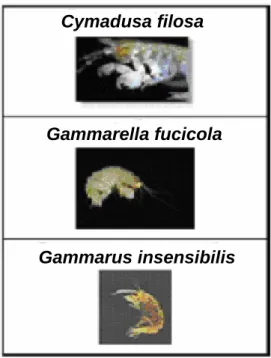
Grazers used for the experiment were chosen because they were common in Ria Formosa, where they grazed on the studied algae and were found in high abundance. For the experiments it was used a mixture of three amphipods Gammarus insensibilis (Stock), Gammarella fucicola (Leach) and Cymadusa filosa (Savigny). In the first experiment the common snail Bittium reticulatum (Da Costa) was used, which was no longer found in high densities during the late summer months to be used in the second experiment, probably due to an increase of the water temperature.
Gammarus insensibilis Gammarella fucicola
Cymadusa filosa
4.1. Pilot studies
The pilot studies were conducted, as it was referred before, to determine which algae and herbivores were the most indicated to be used in these experiments. Thus, it was assessed the survivorship of the algae under cultivation conditions and performed feeding preference assays to determine which algae are readily consumed by grazers. For these preliminary experiments, nine species of algae (Cladostephus verticillatus, Codium tomentosum, Sargassum vulgare, Dictyopteris membranacea, Fucus
vesiculosus, Padina pavonia, Gelidium sesquipedale, Ulva lactuca and Sphaerococcus
coronopifolius) and five common consumers (Bittium reticulatum, Gammarella
fucicola, Gammarus insensibilis, Cymadusa filosa, and Gibbula spp.) were tested. The herbivores were not starved before the experiments, since this could have effects on its feeding behaviour (Cronin and Hay 1996b). The algae were collected at the 17 June 2003 and transported in coolers to the laboratory in order to start the tests on the same day. For each combination tested (alga species + herbivore species) it was used a 3-fold replication. The algae were cut into three pieces (approx. 1.5 g each piece, depending on the alga species) to be used in the following three treatments:
- Direct consumption – with the presence of consumers - Control – without consumers
alga species) in every replicate. The wet weight of each piece of alga was determined in the beginning and in the end of the assay in order to get the consumption rate. With the purpose of removing all additional water each piece was dried before weighing. The experiment last for ten days and every two to three days the water in the plastic dishes was replaced. Afterwards, the piece of the direct consumption treatment and the control piece were put together in the same plastic dish with four consumers for two days. In the end the wet weight was determined once more (see 4.4. Feeding preference assays with live algae to calculations). Out of these data the suitable algae and consumers were determined to be used in the induction experiments (Table 1).
4.2. Induction Experiment Series - First experiment (Screening)
A total of seven species of algae were tested for herbivore-induced defences in laboratory experiments at the Marine Laboratory of Ramalhete, University of Algarve, Faro, between July 2003 and October 2003. The first experiment (screening) tested the effects of the grazing on the palatability of each algal species. Two treatment levels were used: direct consumption (with the presence of herbivores) and control (without herbivores). Both treatments levels were 5-fold replicated (total of seventy experimental units). One to four individual plants of each species were collected on 18 July 2003 and transferred in coolers to the laboratory within two hours. Here individual plants were cut into fourteen pieces (ca. 1.5 g each piece, depending on the algae species). Two pieces of each species were weighed, and stored in a freezer (-20°C). The remaining twelve plant pieces were allocated to transparent plastic aquaria (2l), representing experimental units. Each plastic aquarium was individually supplied with a continuous flow of seawater from a reservoir directly connected to the seawater in the costal lagoon, thus reflecting the natural conditions inside the costal lagoon. In- and outflow of water were on opposite sides of individual aquaria, generating a unidirectional flow. Ten aquaria were used for each of the seven investigated species of algae. At the beginning of the screening experiment six pieces of each species were placed in each of the five control and the five direct-consumption aquaria. The experiment was
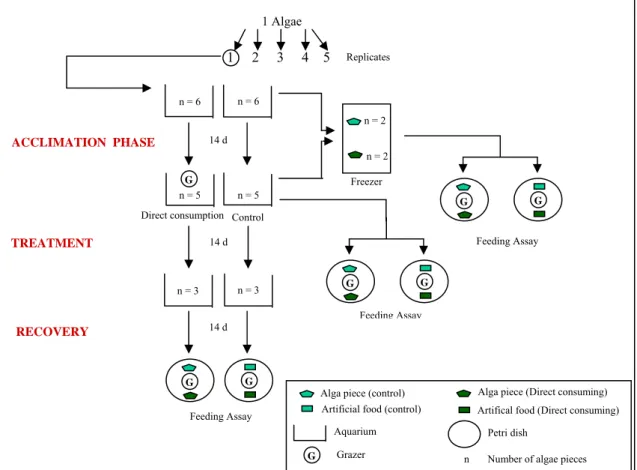
freezer (-20°C). Then, to start the treatment phase, grazers were added the five direct-consumption aquaria. Because previous observations revealed that the different algal species were consumed at different rates it was compensated this discrepancy by adding more or fewer herbivores. It was used five B. reticulatum for U. lactuca, one amphipod for C. verticillatus, D. membranacea and F. vesiculosus two amphipods for C. tomentosum and S. coronopifolius and three for G. sesquipedale. At the end of the treatment phase, three plant pieces were removed from each aquarium to serve as live alga item, artificial food item and growth control item, respectively to use in feeding preference assays (see 4.4. Feeding preference assays with live algae). Subsequently, to initiate the recovery phase, all grazers were removed from the aquaria to allow the algae to reduce their defence levels during a grazer-free two week period. The growth control item was put back in the aquaria. At the end of the recovery phase, the remaining three plant pieces were taken out of each aquarium and used in the same manner in feeding preference assays as described above after the treatment phase (Fig.6).
1 Algae
1 2 3 4 5 Replicates
Figure 6 - Experimental set up for the first experiment (screening) with the three phases acclimation, treatment and recovery and the feeding assays. Example of a replicate: an alga species was cut in the beginning into 14 pieces and 12 were distributed on the aquariums. Two pieces were frozen immediately (in order to maintain all the defences that the alga could had on the field) and another two pieces were taken out of the aquaria in the end of the 14 days of the acclimation phase and also placed in the freezer for two days (with the aim of being in the same conditions as the previous ones). Afterwards the pieces were used in feeding preferences assays. In the beginning of the treatment phase the grazers were placed in the aquarium correspondent to the direct consumption treatment. In the end of this phase two more pieces were taken out for the feeding assays (together with two pieces to be used as growth control that were brought back into the aquaria after the feeding assays). The consumers were also removed, in order to
Freezer n = 2 n = 2 14 d G n = 6 n = 6 ACCLIMATION PHASE G n = 5 n = 5 G Feeding Assay Direct consumption Control
14 d n = 3 n = 3 TREATMENT 14 d G G RECOVERY G G Feeding Assay
Alga piece (Direct consuming) Alga piece (control)
Artificial food (control) Artifical food (Direct consuming)
G
Aquarium Petri dish
Grazer n Number of algae pieces
4.3. Induction Experiment Series - Second experiment (Water-borne cues detection)
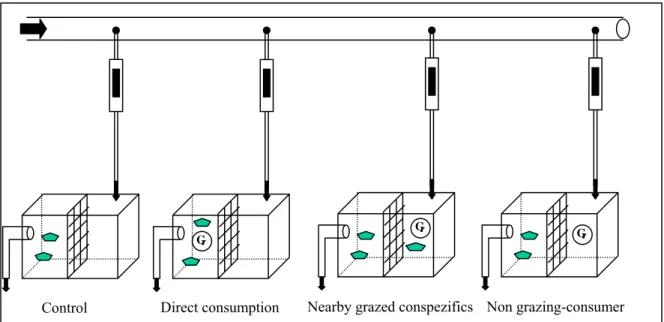
To detect whether water-borne cues released from grazers or grazed algae alone induce defences in other alga individuals, three algal species were used. The species were chosen taking into consideration the following criteria: (1) algae that appear to induce defences during the screening experiment, (2) the most resistant algae and (3) one of each group (red, green and brown). The experimental set-up was the same as in the first experiment (screening). The experiment was divided in four treatments and each one replicated 7 (C. tomentosum and F. vesiculosus) to 8-fold (S. coronopifolius) (together eighty eight experimental units). The four treatments were (Fig. 7):
- Control – without consumers.
- Direct consumption – algae were placed with consumers and therefore directly consumed.
- Nearby grazed conspecifics – additional pieces of the same species of the alga studied were placed in the same aquaria together with consumers. Additional pieces and the consumers were separated from the studied alga pieces with the help of a mesh, so that the examined pieces could detect any chemical cues coming out of the additional pieces and the consumers. This treatment should show whether the algae react to the nearby grazed conspecifics without being corroded.
- Non-grazing consumers – as in the previous treatment, consumers were placed in the aquaria and separated from the studied alga pieces using a mesh. Thus the studied algae can detect any chemical cues transmitted from the consumers alone. This treatment should show whether the algae react to consumers without being corroded.
The algae for this experiment were collected on 13 September 2003. C. tomentosum and F. vesiculodus were collected at the Lagoon system of the Ria Formosa and S. coronopifolius at the rocky shore of São Rafael, and transferred in coolers within 2 h to
the laboratory. As indicated by dashed line in Fig.7, a mesh (1mm) was fixed in the middle of all aquaria to separate consuming and non-consuming grazers in the up-stream compartment (Fig. 7). Thus it could be tested whether the mere presence of nearby grazed conspecifics or non-grazing consumers is sufficient to release an inducible defence. In order to have similar conditions in all treatments, a mesh was fixed in every aquarium. The grazers used for the present experiment were the species G. insensibiles, G. fucicola and C. filosa.
C
G
C G
G
Nearby grazed conspezifics Non grazing-consumer Direct consumption
Control
G
Figure 7 - Experimental set up (represents one replicate) for the water-borne cue detection experiment with the four treatments, the arrows show the waterflow.
4.4. Feeding preference assays with live algae
The three algal pieces withdrawn after the treatment phase and recovery phase, respectively, were used in different choice feeding preference assays to determine whether formerly consumed plants were less palatable than control plants. The response variable was the biomass of differently treated algae consumed during the feeding assay. The first piece was offered as artificial food, the second piece as intact alga, the third piece served as growth control to adjust for autogenic biomass changes of intact algae pieces. The two feeding preference assays, with intact algae and artificial food, are accomplished to verify both the mechanical/chemical and purely chemical (lipophilic) aspects of the defence, respectively. The consumption rate is calculated by the difference of the wet weight of the piece before and after the feeding assay. This difference was corrected with the growth rate of the algae pieces, using the growth control piece (Taylor et al. 2002). The amount of intact live algae consumed was calculated as:
( Tstart x Cend / Cstart ) - Tend
Where Tstart and Tend were pre-assay and post-assay wet masses of pieces exposed to
offered simultaneously to the consumers. The herbivores used were not the same individuals used during the treatment phase in order to avoid physiological adjustments. Again the herbivores were not starved since this could have effects on its eating behaviour (Cronin and Hay 1996b). To distinguish food pieces within such a pair, 3 cm long threads of different colour were tied to them. The growth control pieces were placed in a separated Petri dish with the purpose of getting the alga growth without consumers.
The remaining plant piece was used to assess in choice feeding preference assays whether a lipophilic extract (see 5.5. Feeding preference assays with diet containing non polar extracts) of formerly consumed plants decreased the palatability of artificial food more than an equivalent extract of control plants. All the pieces used to make artificial food were frozen right after coming out the aquaria.
4.5. Feeding preference assays with diet containing non polar extracts
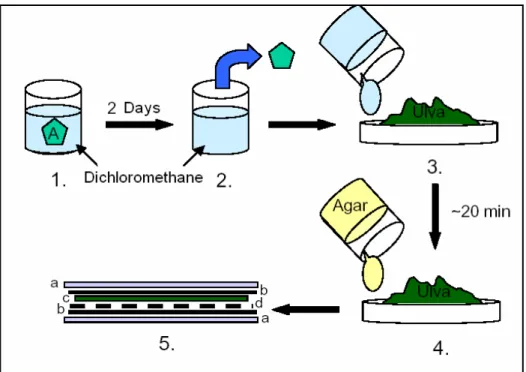
To test whether the inducible defences belong to the non-polar secondary metabolites, artificial food preference assays with artificial food and lipophilic extracts were conducted. Treatment and control algae pieces were extracted for two days by 10 ml of dichloromethane (organic solvent responsible for the lipophilic extraction) at room temperature. Dried Ulva lactuca, a frequently used basis for artificial food, was ground in a blender. The quantity of Ulva powder was equivalent to 32% of the wet weight of each piece of alga. A mixture of 0.72 g of Agar in 10 ml of distilled water was heated to boiling in a microwave oven, allowed to cool for a few seconds, and then added to a mixture of powdered Ulva, 10 ml of dichloromethane extract and 16 ml of distilled water. The Dichloromethane was allowed to evaporate for 20 min prior the mixing, until the powder was dry. The proportions of the ingredients were calculated to closely match organic content and the natural concentration of non-polar metabolites. The combined mixture was poured over a mosquito mesh flattened between two layers of greaseproof paper with the help of two fibreglass panels (method adapted from Hay et al. 1994, 1998) (see Fig. 8). After cooling, the mesh was cut into squares of 15 x 15 cells and controls were identified by cutting a different corner for each treatment. The feeding assays were run like the feeding preference assays with the intact live alga. Instead of counting the squares consumed after the two days, all pieces were weighed before and
Figure 8 – Production of the artificial food: 1 – extraction of the alga in dichloromethane, 2 – piece of alga is removed, 3 – the dichloromethane (with the extraction) is mixed with Ulva powder and distilled water and then evaporate for 20 min, 4 - the Ulva powder (with the extraction) is mixed with the agar (previously heated with distilled water) and, 5 – the artificial
food is flattened (a - fibreglass panels, b - greaseproof paper, c – Ulva-agar mixture, d –
4.6. Statistical analysis
Paired t-tests were used to analyse the data from the first experiment and the acclimation phase of the water-borne cues detection experiment. Prior to statistical analyses, the normal distribution of differences between control and grazed alga pieces was confirmed with the Kolmogorov–Smirnov test. Data showing heterogeneity of variances (Cochran’s test) were square root transformed. In order to compare the different treatments used in the cue - detection experiment during the treatment and recovery phases, a resampling method (Bärlocher 1999) (repeating 10000 times) was applied using a Monte Carlo analysis. Pairwise t-tests were used as post-hoc tests, for which no Bonferroni correction was calculated, if the probability of finding that the number of significant t-tests by chance was below 5% (Moran 2003).
5.1. First experiment (screening)
5.1.1. Acclimation phase
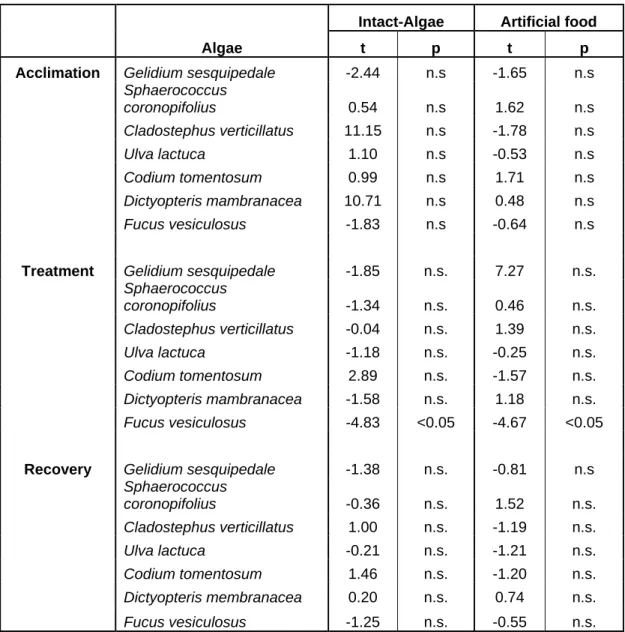
There were no significant differences in the consumption rates of intact algae when comparing pieces of algae frozen immediately after collecting and pieces of algae that were two weeks grazer-free (Table 2, Fig. 9). Regarding the artificial food, it was also not found any significant differences between freshly collected and acclimated algae of all the seven algae studied (Table 2, Fig. 9).
5.1.2. Treatment phase
After the treatment phase live control algae were generally more palatable than consumer-exposed conspecifics (Fig. 9). The brown seaweed Fucus vesiculosus was the only species showing a significant induction of defences (Table 2). On average, live control pieces of Fucus were 1.6 times more consumed than previously grazed conspecifics (paired t-test, t4 = 4.83, p<0.05, Fig. 9). Artificial food made of Fucus
control plants was on average 1.3 times more consumed than that of previously grazed plants (paired t-test, t4 = 4.67, p<0.05, Fig 9). Again artificial food made from the other
Intact-Algae Artificial food
Algae t p t p
Acclimation Gelidium sesquipedale -2.44 n.s -1.65 n.s
Sphaerococcus coronopifolius 0.54 n.s 1.62 n.s Cladostephus verticillatus 11.15 n.s -1.78 n.s Ulva lactuca 1.10 n.s -0.53 n.s Codium tomentosum 0.99 n.s 1.71 n.s Dictyopteris mambranacea 10.71 n.s 0.48 n.s Fucus vesiculosus -1.83 n.s -0.64 n.s
Treatment Gelidium sesquipedale -1.85 n.s. 7.27 n.s.
Sphaerococcus coronopifolius -1.34 n.s. 0.46 n.s. Cladostephus verticillatus -0.04 n.s. 1.39 n.s. Ulva lactuca -1.18 n.s. -0.25 n.s. Codium tomentosum 2.89 n.s. -1.57 n.s. Dictyopteris mambranacea -1.58 n.s. 1.18 n.s. Fucus vesiculosus -4.83 <0.05 -4.67 <0.05
Recovery Gelidium sesquipedale -1.38 n.s. -0.81 n.s
Sphaerococcus coronopifolius -0.36 n.s. 1.52 n.s. Cladostephus verticillatus 1.00 n.s. -1.19 n.s. Ulva lactuca -0.21 n.s. -1.21 n.s. Codium tomentosum 1.46 n.s. -1.20 n.s. Dictyopteris membranacea 0.20 n.s. 0.74 n.s. Fucus vesiculosus -1.25 n.s. -0.55 n.s.
Table 2: Screening experiment. Results of Student´s t-test for 7 different algae species comparing consumption rates of algae pieces frozen immediately after collecting and pieces of algae that were two weeks grazer-free (acclimation phase). Comparison of consumption rates of previously grazed-exposed and non-exposed plants directly after 14 d long grazer exposure phase (treatment phase) and after an additional 14 d long grazer-free period (recovery phase). The analysis was performed with intact algae and a diet containing non polar extract (artificial food). n.s. – non significant
5.1.3. Recovery phase
The effect found after the treatment phase in live Fucus algae was no longer detectable at the end of the recovery phase, i.e., two weeks after grazing had ceased (Table 2, Fig. 9). The other algal species also showed no significant differences in the consumption rates in the end of this phase (Table 2, Fig. 9).
After the two grazer-free weeks, at the end of the recovery phase, the induced defence in Fucus had been reduced again and the palatability of artificial food from previously grazed individuals no longer differed from that made from the control plants (Table 2, Fig. 9). In the other species artificial food from previously treated and control individuals did not differ (Table 2, Fig. 9).
C
onsu
m
pt
ion
(g)
AP TP RP AP TP RP Gelidium sesquipedale -0,4 -0,1 0,2 0,5 0,8 Sphaerococcus coronopifolius -0,2 0 0,2 0,4 0,6 Cladostephus verticillatus 0 0,2 0,4 0,6 Ulva lactuca -0,4 -0,1 0,2 0,5 Codium tomentosum -0,6 -0,1 0,4 0,9 1,4 Dictyopteris membranacea -0,3 -0,1 0,1 0,3 0,5 Fucus vesiculosus 0 0,2 0,4 0,6 0,8 Natural Acclimated Control Direct consumption AP TP RP AP TP RPIntact algae Artificial food Intact algae Artificial food Intact algae Artificial food
Intact algae Artificial food Intact algae Artificial food
Intact algae Artificial food
Intact algae Artificial food
* *
C
onsu
m
pt
ion
(g)
AP TP RP AP TP RP Gelidium sesquipedale -0,4 -0,1 0,2 0,5 0,8 Sphaerococcus coronopifolius -0,2 0 0,2 0,4 0,6 Cladostephus verticillatus 0 0,2 0,4 0,6 Ulva lactuca -0,4 -0,1 0,2 0,5 Codium tomentosum -0,6 -0,1 0,4 0,9 1,4 Dictyopteris membranacea -0,3 -0,1 0,1 0,3 0,5 Fucus vesiculosus 0 0,2 0,4 0,6 0,8 Natural Acclimated Control Direct consumption AP TP RP AP TP RPIntact algae Artificial food Intact algae Artificial food Intact algae Artificial food
Intact algae Artificial food Intact algae Artificial food
Intact algae Artificial food
Intact algae Artificial food
C
onsu
m
pt
ion
(g)
AP TP RP AP TP RP Gelidium sesquipedale -0,4 -0,1 0,2 0,5 0,8 Sphaerococcus coronopifolius -0,2 0 0,2 0,4 0,6 Cladostephus verticillatus 0 0,2 0,4 0,6 Ulva lactuca -0,4 -0,1 0,2 0,5 Codium tomentosum -0,6 -0,1 0,4 0,9 1,4 Dictyopteris membranacea -0,3 -0,1 0,1 0,3 0,5 Fucus vesiculosus 0 0,2 0,4 0,6 0,8 Natural Acclimated Control Direct consumption AP TP RP AP TP RPIntact algae Artificial food Intact algae Artificial food Intact algae Artificial food
Intact algae Artificial food Intact algae Artificial food
Intact algae Artificial food
Intact algae Artificial food
AP TP RP AP TP RP Gelidium sesquipedale -0,4 -0,1 0,2 0,5 0,8 Sphaerococcus coronopifolius -0,2 0 0,2 0,4 0,6 Cladostephus verticillatus 0 0,2 0,4 0,6 Ulva lactuca -0,4 -0,1 0,2 0,5 Codium tomentosum -0,6 -0,1 0,4 0,9 1,4 Dictyopteris membranacea -0,3 -0,1 0,1 0,3 0,5 Fucus vesiculosus 0 0,2 0,4 0,6 0,8 Natural Acclimated Control Direct consumption Natural Acclimated Control Direct consumption Natural Acclimated Control Direct consumption AP TP RP AP TP RP
Intact algae Artificial food Intact algae Artificial food Intact algae Artificial food
Intact algae Artificial food Intact algae Artificial food
Intact algae Artificial food
Intact algae Artificial food
*
*
Figure 3 - Fig. 3: Screening experiment. Mean consumption [g] (average+SD) of 7 species of intact algae and artificial food after acclimation, treatment and recovery phase. AP- Acclimation Phase TR- Treatment Phase, RP- Recovery Phase. * - significant results
5.2. Second experiment (water-borne cues detection)
5.2.1. Sphaerococcus coronopifolius
Palatability levels of live algae and artificial food of the red alga, Sphaerococcus coronopifolius, did not change significantly during acclimation phase (Table 3). After two weeks of grazer exposure, palatability levels in live Sphaerococcus coronopifolius plants exposed to different grazing cues were significantly reduced compared to non-exposed control pieces (Table 3). Post-hoc tests revealed that live control pieces of S. coronopifolius were significantly more preferred than conspecifics previously exposed
to (1) grazers, and waterborne cues from (2) nearby grazed plants and from (3) a nearby non grazing consumer. Whether the herbivore was physically consuming the target individual or whether only a conspecific neighbour was attacked made no tangible difference with regard to defence induction in the target individual (minus 82% versus minus 84% palatability decrease). The mere presence of a non-feeding grazer, however, had a still significant but substantially weaker effect (minus 69%) on defence induction then the other 2 cues. At the end of the recovery phase, differences in palatability levels of live S. coronopifolius plants of different grazer exposures were no longer observed (Table 3, Fig. 10). Consumption rates of artificial food made of this alga were not significantly affected by different grazer exposures, neither after the treatment, nor after
Intact Algae
Sphaerococcus coronopifolius
-0,05 0,00 0,05 0,10 0,15 C ons um pt ion [ g ]Natural Acclimated Control
Direct consumption Nearby grazed conspecifics Non-grazing consumer
Artificial food
Sphaerococcus coronopifolius
0 0,2 0,4 0,6 0,8 C ons um pt io n [ g ]Natural Acclimated Control
Direct consumption Nearby grazed conspecifics Non-grazing consumer
AP TP RP AP TP RP A A B B B A A A A
Intact Algae
Sphaerococcus coronopifolius
-0,05 0,00 0,05 0,10 0,15 C ons um pt ion [ g ]Natural Acclimated Control
Direct consumption Nearby grazed conspecifics Non-grazing consumer
Artificial food
Sphaerococcus coronopifolius
0 0,2 0,4 0,6 0,8 C ons um pt io n [ g ]Natural Acclimated Control
Direct consumption Nearby grazed conspecifics Non-grazing consumer
AP TP RP AP TP RP AP TP RP AP TP RP A A A B B B A A A A AA A A
Figure 10 - Fig. 4: Water-borne cue induction experiment. Mean consumption [g] (average+SD) for Sphaerococcus coronopifolius after the acclimation (AP), treatment (TP) and recovery (RP) phases of intact algae and artificial food used in feeding assays. Feeding assays were conducted with previously incubated algal pieces, exposed to direct consumption, nearby grazed conspecifics and non grazing-consumers by three amphipods and control algae. Different letters show significant differences between the control and the treatment.
Intact-Algae Artificial food
Phase Algae t p t p
Acclimation Sphaerococcus coronoifolius 0.12 n.s. -0.78 n.s.
Codium tomentosum -0.91 n.s. -1.56 n.s.
Fucus vesiculosus -0.60 n.s. -0.99 n.s.
Treatment Sphaerococcus coronopifolius <0.05 n.s.
Codium tomentosum n.s. n.s.
Fucus vesiculosus <0.05 n.s.
Recovery Sphaerococcus coronopifolius n.s. n.s
Codium tomentosum n.s. n.s.
Fucus vesiculosus <0.05 n.s.
Table 3: Water-borne cue detection experiment. Results of paired t-tests for the acclimation phase and the results of the Resampling/Monte Carlo analysis comparing consumption rates among four grazing treatments after acclimation, treatment and recovery phase using intact algae and diet containing non polar extract (artificial food). n.s. – non significant
5.2.2. Fucus vesiculosus
After the fourteen days of the acclimation there were no significant differences between the freshly collected and acclimated algae of the brown alga Fucus vesiculosus. Consumption rates between live control plants and Fucus pieces exposed to cues
consumed than Fucus pieces previously exposed to grazers (minus 99%) and non-grazing consumers (minus 87%). The effect of neighbour non-grazing is still evident, but no longer significant. Surprisingly, for artificial food made of Fucus plants we were unable to detect any effects on palatability of the different grazing cues neither after the treatment nor after the recovery phase (Table 3, Fig. 11).
5.2.3. Codium tomentosum
Palatability levels of live algae and artificial food of the green alga, Codium tomentosum, did not change significantly during acclimation phase (Table 3). Live
plants and artificial food made of Codium did not show any sign for defence induction when exposed to the different cues (Table 3, Fig. 12). After the fourteen days grazer-free it also showed no significant differences between all the treatments, for both the intact algae and artificial food (Table 3, Fig. 12).
Intact Algae
Fucus vesiculosus
0 0,1 0,2 0,3 C ons um pt ion [ g ]Natural Acclimated Control
Direct consumption Nearby grazed conspecifics Non-grazing consumer
Artificial food
Fucus vesiculosus
0 0,2 0,4 0,6 C o n s u m pt ion [ g ]Natural Acclimated Control
Direct consumption Nearby grazed conspecifics Non-grazing consumer
A A AB B B A B AB B A A A AP TP RP AP TP RP
Intact Algae
Fucus vesiculosus
0 0,1 0,2 0,3 C ons um pt io n [ g ]Natural Acclimated Control
Direct consumption Nearby grazed conspecifics Non-grazing consumer
Artificial food
Fucus vesiculosus
0 0,2 0,4 0,6 C o n s u m pt ion [ g ]Natural Acclimated Control
Direct consumption Nearby grazed conspecifics Non-grazing consumer
A A A AB B B A B AB B A A A A A A AP TP RP AP TP RP AP TP RP AP TP RP
Intact Algae
Codium tomentosum
0,0 0,5 1,0 1,5 2,0 C ons um pt ion [ g ]Natural Acclimated Control
Direct consumption Nearby grazed conspecifics Non-grazing consumer
Artificial food
Codium tomentosum
0 0,2 0,4 0,6 C o ns um p ti on [ g ]Natural Acclimated Control
Direct consumption Nearby grazed conspecifics Non-grazing consumer
A A A A A A AP TP RP AP TP RP
Intact Algae
Codium tomentosum
0,0 0,5 1,0 1,5 2,0 C ons um pt ion [ g ]Natural Acclimated Control
Direct consumption Nearby grazed conspecifics Non-grazing consumer
Artificial food
Codium tomentosum
0 0,2 0,4 0,6 C o ns um p ti on [ g ]Natural Acclimated Control
Direct consumption Nearby grazed conspecifics Non-grazing consumer
A A A A A A A A A A A A AP TP RP AP TP RP AP TP RP AP TP RP
Figure 12 - Water-borne cue induction experiment. Mean consumption [g] (average+SD) for
Codium tomentosum after the acclimation (AP), treatment (TP) and recovery (RP) phases of
intact algae and artificial food used in feeding assays. Feeding assays were conducted with previously incubated algal pieces, exposed to direct consumption, nearby grazed conspecifics and non grazing-consumers by three amphipods and control algae. Different letters show significant differences between the control and the treatment.
Generally, plants exposed to grazer cues tended to experience some reduction of palatability relative to control plants. During the two experiments, in two of the seven tested species these effects were significant. Palatability reduction can be interpreted as a response to grazer cues as induced defence in a broad sense. The brown seaweed Fucus vesiculosus induced defences when directly exposed to amphipods in the first
experiment. In the second experiment both, F. vesiculosus and the red seaweed Sphaerococcus coronopifolius induced a defensive response to direct grazing as well as
to water-borne cues from nearby grazed conspecifics and non-grazing amphipods.
6.1. First experiment (Screening)
6.1.2. Acclimation phase
After a 14 days long grazer-free period, all acclimated algae showed no significant difference in palatability when compared to simultaneously collected, non-acclimated conspecifics. Therefore, no structural or chemical changes were observed that could have affected the grazers feeding behaviour. At least three explanations for this consistent pattern seem plausible: 1. the algae were exposed to any or a low herbivore pressure while still on the field, so that no defences were developed in order to be reduced at the end of the acclimation phase. They also could have a high defence level given the possibility of owning a constitutive defence. 2. It would be possible that the induced defence needs more than two weeks to reduce the current level of defence. 3. Possibly the preparation and cultivation procedures have a negative effect in the algae
![Figure 3 - Fig. 3: Screening experiment. Mean consumption [g] (average+SD) of 7 species of intact algae and artificial food after acclimation, treatment and recovery phase](https://thumb-eu.123doks.com/thumbv2/123dok_br/18712057.917732/49.892.134.772.189.964/figure-screening-experiment-consumption-artificial-acclimation-treatment-recovery.webp)
![Figure 10 - Fig. 4: Water-borne cue induction experiment. Mean consumption [g] (average+SD) for Sphaerococcus coronopifolius after the acclimation (AP), treatment (TP) and recovery (RP) phases of intact algae and artificial food used in feeding assays](https://thumb-eu.123doks.com/thumbv2/123dok_br/18712057.917732/51.892.133.775.127.869/induction-experiment-consumption-sphaerococcus-coronopifolius-acclimation-treatment-artificial.webp)